
Fra
Angelico (vers 1395–1455), The Three
Marys at the Tomb / Résurrection de Jésus, circa 1439, 189 x
164, musée national San Marco, piazza San Marco, Florence,
Évangile de Jésus-Christ
selon saint Luc, VIII, 1-3
01 Ensuite, il
arriva que Jésus, passant à travers villes et villages, proclamait et annonçait
la Bonne Nouvelle du règne de Dieu. Les Douze l’accompagnaient,
02 ainsi que des
femmes qui avaient été guéries de maladies et d’esprits mauvais : Marie,
appelée Madeleine, de laquelle étaient sortis sept démons,
03 Jeanne, femme de
Kouza, intendant d’Hérode, Suzanne, et beaucoup d’autres, qui les servaient en
prenant sur leurs ressources.
SOURCE : https://www.aelf.org/bible/Lc/8
Évangile de Jésus-Christ
selon saint Luc, XXIV, 1-10
01 Le premier jour
de la semaine, à la pointe de l’aurore, les femmes se rendirent au tombeau,
portant les aromates qu’elles avaient préparés.
02 Elles trouvèrent
la pierre roulée sur le côté du tombeau.
03 Elles entrèrent,
mais ne trouvèrent pas le corps du Seigneur Jésus.
04 Alors qu’elles
étaient désemparées, voici que deux hommes se tinrent devant elles en habit
éblouissant.
05 Saisies de
crainte, elles gardaient leur visage incliné vers le sol. Ils leur
dirent : « Pourquoi cherchez-vous le Vivant parmi les morts ?
06 Il n’est pas ici,
il est ressuscité. Rappelez-vous ce qu’il vous a dit quand il était encore en
Galilée :
07 “Il faut que le
Fils de l’homme soit livré aux mains des pécheurs, qu’il soit crucifié et que,
le troisième jour, il ressuscite.” »
08 Alors elles se
rappelèrent les paroles qu’il avait dites.
09 Revenues du
tombeau, elles rapportèrent tout cela aux Onze et à tous les autres.
10 C’étaient Marie
Madeleine, Jeanne, et Marie mère de Jacques ; les autres femmes qui les
accompagnaient disaient la même chose aux Apôtres.
SOURCE : https://www.aelf.org/bible/Lc/24

Sainte JEANNE la
MYROPHORE
Cette bienheureuse était
femme de Chouza, intendant du roi Hérode. Après avoir, semble-t-il, été guérie
de quelque maladie par le Seigneur (Luc 8:3), comme Sainte Marie Madeleine (cf.
22 juil.), elle le servit, avec les autres saintes femmes, pendant tout son
ministère publique, de Galilée en Judée. Elle fut témoin de sa Passion
vivifiante et, le matin de Pâques, elle se rendit au tombeau avec des aromates,
en compagnie de Marie Madeleine et de Marie mère de Jacques. Le trouvant vide,
les femmes restaient perplexes et tenaient leur visage incliné. Deux Anges leur
apparurent alors et dirent : « Pourquoi cherchez- vous le Vivant parmi les
morts » (Luc 24:5), et ils leur rappelèrent les paroles du Seigneur annonçant
qu'il devrait être crucifié avant de ressusciter le troisième jour. Elles
allèrent rapporter tout cela aux Apôtres, mais ces propos leur semblèrent du
radotage et ils ne les crurent pas, tant que Pierre et Jean ne se furent pas
rendus à leur tour sur les lieux.
SOURCE : http://calendrier.egliseorthodoxe.com/sts/stsjuin/juin27.html
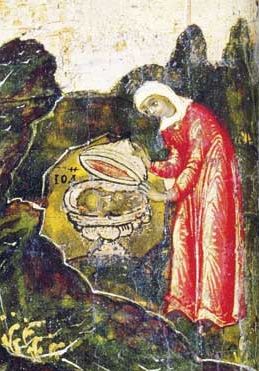
Saint Joanna and the Head of Saint John the Baptist
Иоанна
Мироносица прячет главу Иоанна Предтечи
(Фрагмент
клейма 11 "Положение во гроб Иоанна Предтечи" иконы "Иоанн
Предтеча Ангел пустыни"
с
житием в 18 клеймах. Около 1700 года. Москва. Школа царских изографов.)
Saint Jeanne la myrrhophore
Saint Jeanne la
myrhophore, épouse de Chuza, intendant de la maison du roi Hérode, fut l'une
des femmes qui suivit et servit le Seigneur Jésus-Christ pendant le temps de Sa
prédication et de Son ministère public. Elle est mentionnée dans l'Evangile de
saint Luc (8:3 et 24:10). Avec les autres femmes myrhophores, sainte Jeanne
alla au sépulcre pour oindre le Saint Corps du Seigneur avec de la myrrhe après
Sa mort sur la Croix, et elle entendit des anges l'annonce joyeuse de Sa Très
Glorieuse Résurrection. Selon la tradition, elle a récupéré la tête de saint
Jean-Baptiste, après qu'Hérodiade ait disposé de celle-ci (24 février).
Saint Jeanne est
également commémorée le dimanche des myrhophores.
Version française Claude
Lopez-Ginisty d'après OCA Feasts and Saints
SOURCE : http://orthodoxologie.blogspot.ca/2011/07/ste-jeanne-la-myrrhophore-27-juin10.html
Article
(Saint) Widow (May 24)
(1st century) The wife of Chuza, housesteward of King Herod Antipas. She was
one of the holy women who accompanied Our Lord in his journeyings and who
brought spices and ointments to the Sepulchre on Easter morning (Luke 8:3;
24:10). Nothing more is known concerning her. The Greeks and Armenians honour
her on their Festival of “The Holy Ointment Bearers.”
MLA
Citation
Monks of Ramsgate.
“Joanna”. Book of Saints, 1921. CatholicSaints.Info.
21 October 2013. Web. 31 January 2026.
<https://catholicsaints.info/book-of-saints-joanna/>
SOURCE : https://catholicsaints.info/book-of-saints-joanna/

St. Joanna
St. Joanna was the wife
of Chuza, Herod’s steward (Lk. 8:3) and a disciple of Jesus, and mentioned in
Luke (8.3) as providing for Jesus and the Apostles. According to Eastern
tradition, when Herod had John the Baptist beheaded, he cast the head out into an
unclean place. Joanna took the head and buried it with honour on the Mount of
Olives, on Herod’s land. Later, in the reign of Constantine the Great, the head
was found.
St. Joanna is also
remembered because she was present at both the Passion and Resurrection of
Christ. St. Joanna is one of the women Luke says (24.10) discovered the empty
tomb on the first Easter when she went to anoint the body. She is especially
venerated by the Jesuits.
SOURCE : http://www.ucatholic.com/saints/saint-joanna/
The Story of St. Joanna
Written by: Michelle
Chesney
With Holy Week behind us
and Easter upon us, we learn more about the many people around our Lord at the
end of His earthly life. There are of course the apostles and His Mother, but
also some lesser-known friends. So rarely are women named in Scripture, often
being identified only in terms of their husband or father, but in this case we
do know the name of one of Jesus’ female friends, Joanna. Which is fortunate,
as it is my daughter’s middle name!
We know St. Joanna only
through Luke’s Gospel. In Chapter 8, we learn that she was the wife of a man
named Chuza, who was a steward to Herod. In this brief account she, along with
Mary Magdalene, a woman Susanna, and “many others”, is described as providing
for Jesus out of personal resources as he traveled, preaching and healing in
many villages and cities.
The other time Joanna is
referenced is of course the account of Easter morning in Chapter 24. She was
one of the women who arrived at the tomb with spices to prepare His body for
burial, but found the stone moved and the body gone. They were confronted with
two men in dazzling clothes who told them that He had Risen, and reminded them
of Jesus’ own words that He would be crucified and rise again. The women left
the tomb and told the apostles what they had seen and heard.
Though we know so little
about her, it would seem she was a generous and devoted woman. She served our
Lord in His ministry as well as after His death. In both descriptions she used
her own means to provide for Him, and in return she had the honour of being one
of the first people to truly understand His Resurrection.
SOURCE : http://www.catholicchapterhouse.com/blog/2011/04/28/the-story-of-st-joanna/

Carracci,
Annibale, en français Annibal Carrache (1560-1609), Les saintes femmes au
tombeau du Christ, circa 1597, 121 x 145.5, Saint-Pétersbourg,
Ermitage. Histoire
sacrée. Saintes femmes au tombeau
CHAPTER 19: Joanna: A
Character Study
The teaching of Jesus for
today is a radical call to live and think and feel in a way that is
counter-cultural; i.e., that radically contradicts the prevailing culture
within which we live. The lives we are to live are, however, a continuation of
the spirit of those men and women who followed Him around Palestine 2000 years
ago. They, too, were counter-cultural in their following of Him; they too
walked out against the wind of prevailing wisdom and the expectations of those
around them.
AN INVERSION OF VALUES
When we turn to study
Joanna, we find ourselves right up against an example of this. Lk. 8:3 implies
that the women who followed Jesus, and Joanna is named as one of these,
basically supplied the funds and material backing for His mission. Male
disciples had left their homes and families to manage economically without
them, whilst they followed the Lord around Palestine. They evidently were
generally poor. Yet their expenses were being met by a few wealthy women.
Generally, the man was seen as the economic supporter of the woman, and this
situation turned all that on its head. It must have been hard for those men to
accept the ministrations of Joanna for them. It was almost a sociological
impossibility that wealthy women should support illiterate men in such an
itinerant lifestyle. But this was just the kind of inversion of values which
Jesus sought to inculcate in the new community which He forged. Further, the
wealthy simply didn’t mix with the lower classes; it was unthinkable for a
woman to go travelling around with a group of lower class men (1),
and women such as former prostitutes. It could only have been the compelling
personality of Jesus which led Joanna to do something as scandalous as she did.
Joanna is introduced as “the wife of Herod’s steward Chuza” (Lk. 8:3). Yet as a
married woman the right to dispose of her goods lay not with her but with her
husband; and it’s unlikely that a man of such great social rank as Chuza would
have allowed his wife to use his wealth like this. Thus if Joanna was married
at this time, she “braved public condemnation by leaving [her] husband to
follow Jesus”(2).
The call of Christ is no less radical in our day, even if the scandal of it is
articulated differently. Younger women who had wealthy families were still
under the authority of their families, especially their father or uncles, until
such time as they married. It is hard to understand, therefore, how Joanna got
the right to use wealth in the way that she did. Perhaps she simply left her
husband and insisted on taking some of their wealth with her. Perhaps he was
supportive; but at such an early stage in the Lord’s ministry, this seems to me
unlikely. And it’s equally unlikely that Herod’s right hand man would have
allowed his wife to go wandering around the country with a crowd of working
men. And it would have been a most a-typical 1st century marriage if the
wife was allowed to spend the husband’s money like this at her own initiative.
So I discount this possibility. Even if a woman made money from her own
business, the money would be under the control of her husband. So we are left
with the question, from where did Joanna get her money?
JOANNA’S MARRIAGE
The more likely
option comes from an awareness of the practice of ketubba. This was a sum
of money promised by the husband to the wife in case of divorce; it was part of
the marriage contract(3).
With this money she could attract a second partner if the husband divorced her(4).
And this, I submit, is what happened with Joanna. Perhaps for the cause of
Christ, her husband divorced her; and instead of using her money to attract a
second partner, she instead spent it on the true passion of her life- the cause
of Jesus and His men. There is evidence that if her husband died, she still was
not free to use the money that might come to her independently; his family and
her male relatives had a major say in the matter(5).
The Mishnah says that a wife cannot inherit anything from her husband, since
otherwise his ‘property’ in any sense might be alienated from the man’s family
(B. Bat. 8.1). So it would seem that the only way a woman had large funds
at her disposal would be if she were married to a wealthy man, who divorced her
and gave her the ketubbah. Hence the significance of the way Lk. 8:3
introduces her as having been the wife of a wealthy man, and yet also in a
position to financially support the ministry of Jesus.
Joanna had once been married to Herod’s “steward”. She would have lived with
her husband in Herod’s court in Tiberias, not far from Nazareth. She would have
heard of Jesus right at the start of His ministry; Lk. 8:2 comments how the
Lord healed women of ‘demons’, and the possibility is that Joanna was one of
those people, and perhaps her illness was another reason why Chuza divorced
her. When Herod invited his “courtiers and officers and chief men of Galilee”
to the birthday party at which he beheaded John (Mk. 6:21), this would almost
certainly have included Chuza. Manaen was a suntrofos of Herod- a
courtier (Acts 13:1), and he later became a disciple too. And one wonders about
the ‘Herodion’ of Rom. 16:11- was he another of Herod’s courtiers, also from
the palace in Tiberias? We can only speculate as to whether Joanna converted
these two. And then there was the “royal official” of Capernaum who was
converted by the Lord’s healing (Jn. 4:46-53); he too would have been one of
Herod’s courtiers. There, in the heart of the despised court at Tiberias, an
ecclesia developed! This was the very group known as the “Herodians” who so
persecuted the Lord (Mk. 3:6; 12:13; Mt. 22:16). It’s rather like a Christian
church developing in the drug dens of New York or cities controlled by Moslem
fanatics such as Mecca or Kandahar. The point is, all things are possible. The
personality of Jesus as portrayed in the Gospel can penetrate anything. And
further, one marvels at the wide range of people welded together by allegiance
to the Lord. Their differences were significant and major. Only the power of
His personality and the Truth that is in Him overcame them.
THE BOND OF FELLOWSHIP
Being associated with
Chuza and Herod’s court would have placed Joanna in a category of people that
were very unpopular to ordinary Jews- for she would have been allied to the
ruling class who so cruelly taxed and impoverished the ordinary people. Herod’s
“steward” was basically the chief thug who made sure that the heavy taxations
were paid by the populace. The disciples were thus being supported by a woman
from the class they had naturally hated. It must also be recognized that
Tiberias was a new city, built by Herod on a Jewish cemetery despite their
protests. It had only been built about 10 years at the time of Jesus’ ministry.
Tiberias was one of the “aggressive acts of Romanization by Antipas”(6);
the result was that the people of Galilee hated those who lived there,
especially the courtiers. Yet one of those women courtiers was to travel with
those Galilean fishermen and give up her financial security to support them!
The city had been built from funds raised by years of excessive taxation of the
people who lived around it. “The décor on the Herodian palace in Tiberias [which
included depictions of animals despite the Torah’s prohibitions] symbolized the
alien culture that had suddenly intruded upon the Galilean landscape along with
the “in-your-face” city built so visibly from revenues regularly taken from the
threshing floors and olive presses of Galilean villages by officers [e.g.
Chuza- D.H.] who lived lavishly near the palace”(7).
Worse still, Joanna is a strong Jewish name; she had as it were betrayed her
people by siding with the Gentile conquerors, and had perhaps married one of
them. The band of people around Jesus were thus as diverse as could possibly
be. They had every possible tension and background difference and resentment
between them, just as the present ecclesia does. Men like Simon the Zealot had
been fighting this very class, probably trying to assassinate Joanna’s
[former?] husband. And we pause to reflect upon the composition of our
ecclesias and community. Our extreme diversity matches the diversity of those
whom Jesus gathered around Him when He first began to build His ecclesia. The
Lord came to save all [types of] people; and hence there is this strange and
compelling diversity and unity, so extraordinary, so unusual, that the Lord
said that it alone had the power to convert the world.
REVERSAL OF STATUS
And so Joanna stepped out
from Herod’s court, over to the ranks of the Galilean poor. For her, conversion
was radical. Not only did she give up her financial security, she gave up her
social standing, and walked out so totally against the wind, like Moses walking
out of Pharaoh’s court to suffer affliction with God’s people. Like him, she
likely had to do it alone. In this, she is our pattern. Not only for those who
feel they are all too caught up in the courts of Herod, but for those who find
a true unity with their brethren almost impossible. She would have eagerly
memorized the Lord’s parables, and have perhaps nervously joined in the Lord’s
display of solidarity with the poorest of the poor in village after village
which He visited. And there is no reason to think that the 70 who were sent out
in pairs were all male; Luke’s account of this in Lk. 10 has been prefaced by
the explanation in Lk. 8:2,3 that the Lord had many female disciples too. In
any case, Joanna would have spoken to the women they met at wells, retold the
parables of the Lord to groups of women in the villages in which they stayed.
And she would have known the pain of rejection, the hurt of being rejected for
who you once were rather than being accepted for who you now are.
We read that Joanna “provided for them out of [her] own resources” (Lk. 8:3).
‘Provided’ translates the Greek diakoneo. It has been commented that the
word “refers almost exclusively to the menial labour of women and slaves,
performed for the people of higher rank on whom they were economically
dependent”(8).
And now you see the wonder of it all. The others were economically dependent
upon Joanna; but she served them as if she was the one dependent upon them. She
would’ve been used to Galileans serving her; but now she served them. She
perhaps more than most had heard and learnt and obeyed in hard, concrete
reality the Lord’s teaching: “The kings of the Gentiles have lordship over
them; and they that have authority over them are called Benefactors. But ye
shall not be so: but he that is the greater among you, let him become as the
younger; and he that is chief, as he that doth serve. For which is greater, he
that sitteth at meat, or he that serveth? is not he that sitteth at meat? But I
am in the midst of you as he that serveth” (Lk. 22:25-27). The radicality of
the Lord’s teaching about the utter reversal of status for those in Him had
been mastered and practiced by this extraordinary woman. When Jesus washed the
disciples’ feet, He made the very actions which were understood as the duty of
women and slaves to be emblematic of the leaders in His community. It was
through this utter reversal of status that the Lord removed the distinctions
between slaves and free, male and female, rich and poor within His community.
And if we are truly His people, we will seriously and practically aspire to
this spirit. Joanna crossed the huge gulf between aristocratic lady and humble
serving woman, inspired surely by the example of the Lord with whom she walked.
Her example leaves us a piercing challenge to follow.
JOANNA IN LATER LIFE
But Joanna’s story
doesn’t end here. Her name occurs again in the form of ‘Junia’ in Rom. 16:7:
“Greet Andronicus and Junia, my relatives [i.e. fellow Jews] and fellow
prisoners, who are prominent among the apostles and were in Christ before me”.
The AV’s “Junias” seems to be rooted in a desire not to have a woman seen as an
apostle. Junia was a common Roman woman’s name, the equivalent of the Hebrew
‘Joanna’. The Latin pronunciation of ‘Junia’ and the Hebrew ‘Yohannah’ would
have been very close indeed. It would seem, therefore, that Joanna moved to
Rome, changed her name to a Latin form, and married Andronicus, a Jewish
apostle, who like her was an early convert- “in Christ” before Paul’s
conversion(9).
Given her background in the Roman court at Tiberias, Joanna would have been an
ideal missionary to Rome; and thus she went, and was imprisoned. It could well
be that ‘Junia’ was the Latin name by which she would have been known even in
Tiberias. Note how there were other missionaries who changed their Hebrew names
into the Latin forms when they went on mission work into the Roman world: Silas
became Silvanus, Saul became Paulus, Joseph Barsabbas became Justus (Acts 1:23);
and hence we read of “John, whose other [Latin] name was Mark” (Acts 12:12,25).
THE PROMINENCE OF JOANNA
The Greek translated
“prominent” means ‘marked out, distinguished, outstanding, prominent’. She was
all of those words; there really was something exceptional about this sister.
And we need not be phased by her being called an “apostle”, for Paul uses the
word in a nontechnical sense to refer simply to a messenger of the ecclesias (2
Cor. 8:23; Phil. 2:25). The prominence of Joanna is perhaps reflected in the
chiastic structure of Lk. 24:9,10. Notice how the first three lines each have a
parallel in the last three lines- e.g. a) = a1). But the centerpiece is Joanna.
Why, unless she was worthy of special mention? Work it out for yourself:
“a) They told all these things to the eleven [‘the
apostles’],
b) and to all the rest [‘others’].
c) Now they were Mary Magdalene,
d) and Joanna,
c1) and Mary the mother of James:
b1) and the other women with them
a1) told these things unto the apostles”.
Note that the great commission to preach is given to “the eleven and those with
him” (Lk. 24:33) (10),
i.e. the women, including Joanna. Acts 1:13,14 speaks of “the eleven and the
women”- the same two groups. She would have known that she as a woman had no
credibility as a witness in her society; and yet she was bidden go witness. And
she did, it seems, as far as Rome- to the ends of her world. This surely is an
inspiring challenge to all who feel hopelessly unqualified to witness; it is
our very lack of qualification which seems to make the Lord chose us. To have
accompanied the eleven throughout the Lord’s ministry was a qualification to be
His authoritative witness (Acts 1:21,22); and Joanna fulfilled that
requirement, having been with the Lord from the beginning (Lk. 8:3) right up to
the crucifixion (Lk. 24:9,10). Note how Paul argues that he is an apostle
because he has seen Jesus the Lord; yet his words clearly allude to the way
Mary simply said: “I have seen the Lord” (1 Cor. 9:1; Jn. 20:18). It is worth
putting together two passages, both from Luke: “The women also, which came with
him from Galilee, followed after…” (Lk. 23:55); and Acts 13:30,31: “God raised
him from the dead and for many days he appeared to those who came up with him
from Galilee to Jerusalem, and they are now his witnesses”. Surely Paul and
Luke have in mind here the ministering women. They had followed from Galilee to
Jerusalem, the risen Lord had appeared to a woman first of all, and now those
women were witnessing to the people. Perhaps 1 Cor. 15:3-7 is relevant here,
where we read that the Lord appeared after His resurrection to the twelve, and
yet on another occasion to “all the apostles”- perhaps referring to the group
that included the women.
One evident reason for Joanna’s prominence was that when the male disciples
fled, it was Joanna and Mary who stood by the Lord during His crucifixion,
knowing full well that they faced death by crucifixion for showing such
solidarity with the victim. The importance of Joanna and the other women as
witnesses lies in the fact that it was they who had seen Jesus buried, and
therefore could vouch for the fact that the empty tomb was in fact the very
tomb in which Jesus had been buried. This piece of evidence becomes more
crucial the more one reflects upon it. An empty tomb was no proof that Jesus of
Nazareth had risen- unless there were witnesses there present at that empty
tomb who could testify also that it was in that very tomb that Jesus had been
laid. And only women, not men, were witnesses of this. The Greek world placed
great emphasis upon sight- “Eyes are surer witnesses than ears”, Heraclitus
said. They related to the past visually; for a group of people to be
eyewitnesses was considered conclusive. Hence the enormous significance of the
way in which the Gospels repeatedly make the women the subjects of verbs of
seeing (Mt. 27:55; Mk. 15:40; Lk. 23:49,55). They were the eyewitnesses.
COMPELLING WITNESSES
The choice of women
as the witnesses was made of course by God Almighty. Yet at that time, women
were considered to be gullible in religious matters and especially prone to
superstitious fantasy in religious matters. Celsus, a pagan despiser of Christianity,
commented in mockery: “After death he rose again…But who saw this? A hysterical
female…deluded by the same sorcery”(11).
Yet it was females who were chosen by God as the primary witnesses; for He
wanted to confirm His Son’s desire to turn human society upside down through
the body of His Son. The servant was to become the leader; the marginalized at
the centre of things from God’s perspective. And so it is today. A toothless
old sister who doesn’t know English converts hundreds in Kazakhstan; the
divorced and remarried ‘loser’ is seen as great in God’s eyes; the obscure old
brother in isolation touches the mind of Christ as few have ever done. And of
course, some men didn’t believe the women. The disciples didn’t;
Peter has to go to the tomb to see for himself, after dismissing the women’s
testimony as madness. In doing so, he was running parallel with Manoah, who
according to a widely known Jewish midrash on the Judges record, wouldn’t
believe his wife’s relaying of the message from the Angel because it was from a
woman. The parallel is so exact! Surely Peter later reflected upon it.
The travelers on the road to Emmaus reported to the Lord what the women had
told them about the empty tomb. They basically told Him that the women were
right about the empty tomb, but were wrong in thinking Jesus had risen-
because the men hadn’t seen Him. And what is the Lord’s response? He
could have said ‘O foolish men for not believing all that the women
told you!”. But instead He says: “O how foolish you are, and how slow of heart
to believe all that the prophets have told you!” (Lk.
24:22-25). The Lord cleverly parallels the women with the revered male prophets
of Israel. He is teaching that in His new community, the witness of the women,
the disbelieved, the marginalized, the ignored, the insignificant…was going to
be as earth shattering as the word of God Himself. In writing this, I am not a
raving feminist. I am seeking to inspire all of us who struggle with our
dysfunction and inadequacies, to realize that we too can rise up and witness as
the Lord intended; and it is through us that the Lord delights to
work! So, let us rise up…
Notes
(1) J.M. Arlandson, Women,
Class and Society in Early Christianity (Peabody, Mass.: Hendrickson,
1997) p. 130.
(2) J.B. Green, The Gospel of Luke (Grand Rapids: Eerdmans, 1997) pp.
318,319.
(3) Tal Ilan, Mine and Yours Are Hers: Retrieving Women’s History From
Rabbinic Literature (Leiden: Brill, 1997) pp. 144-146.
(4) S.J.D. Cohen, The Jewish Family In Antiquity (Atlanta: Scholar’s
Press, 1993) pp. 133-151.
(5) N. Lewis, The Documents From The Bar Kochba Period In The Cave Of
Letters (Jerusalem: Israel Exploration Society, 1989) p.80.
(6) Sean Freyne, Galilee, Jesus and the Gospels (Philadelphia:
Fortress, 1988) p. 147.
(7) R.A. Horsley, Archaeology, History and Society in Galilee (Valley
Forge, PA: Trinity Press, 1996) p. 57.
(8) L. Schotroff, Lydia’s Impatient Sisters (London: S.C.M., 1995) p.
205.
(9) This kind of speculation is foreign to some Bible readers. Yet the Biblical
records are highly abbreviated, reduced to essentials, leaving the inessentials
to be supplied by the reader / hearer. Ancient peoples were well used to doing
this; modern readers are accustomed to novels or accounts which supply every detail,
or to films whose visuality fills in such gaps. But, to me at least, the very
nature of the Biblical narratives is different; they invite interpretation and
‘filling in the gaps’.
(10) Note how these references to Joanna, and the central placement given to
her in the passage in Lk. 24:9,10, all occur within Luke’s writings. It would
seem that Luke had an especial interest in chronicling the women who went with
Jesus- his material accounts for two of the four parables that feature women
(Lk. 15:8-10; 18:1-14), and he has seven passages / incidents where women are
central (Lk. 7:11-17, 36-50; 8:1-3; 10:38-42; 11:27,28; 13:10-17; 23:27-31).
And it is Luke alone who gives the impression that the Lord was not followed
around Palestine by twelve men alone, but by a further group of ministering
women.
(11) Quoted in H. Chadwick, Origen: Contra Celsum (Cambridge: C.U.P.,
1965) p. 109.
Bible Lives by Duncan Heaster
SOURCE : http://www.aletheiacollege.net/bl/19-1Joanna_Character_Study.htm
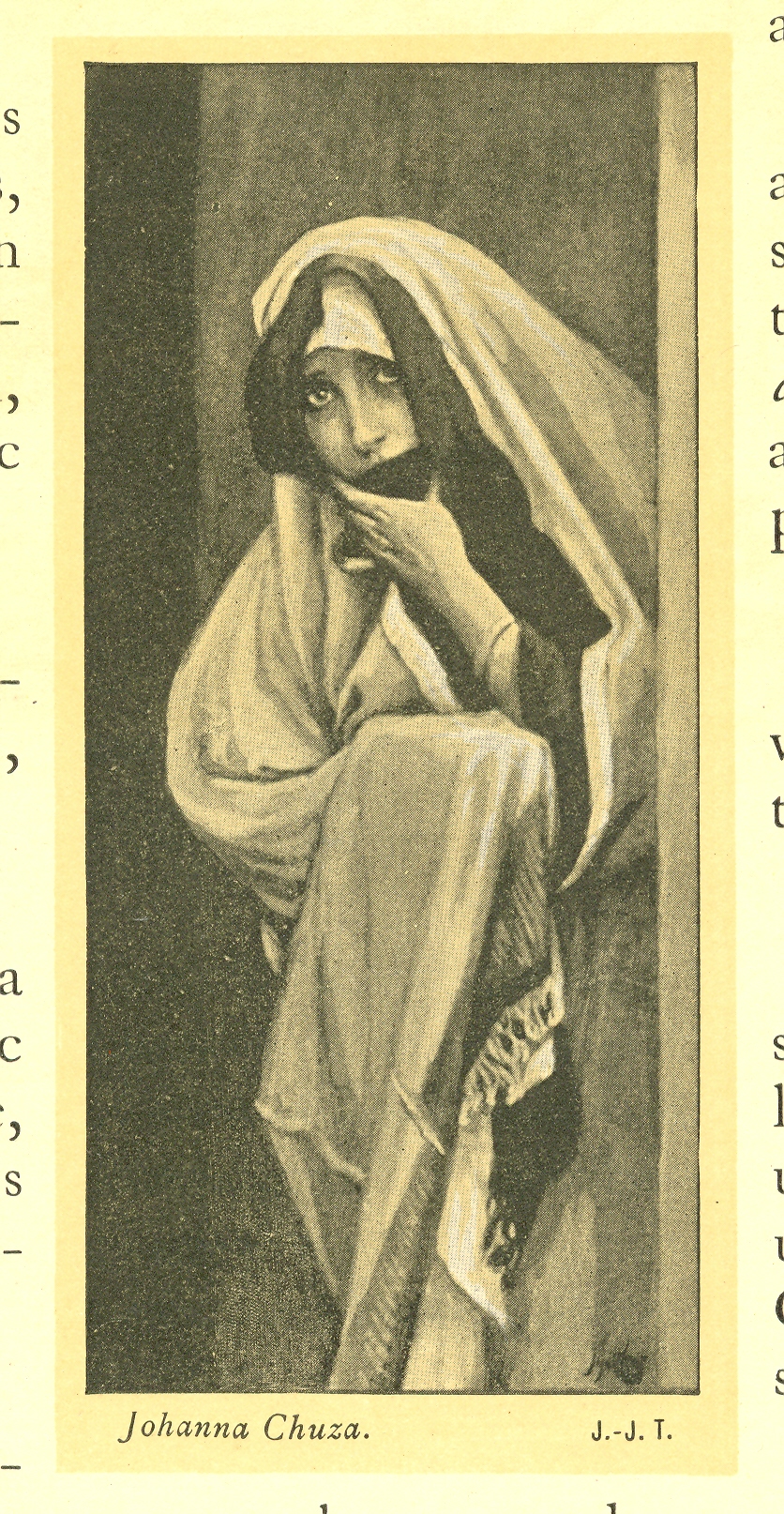
(James) Jacques-Joseph Tissot, French, 1836-1902. Johanna Chuza, After a painting now in the Brooklyn Museum, New York; photogravure from “La Vie de Notre Seigneur Jésus Christ . . . . avec des notes et des dessins explicatifs par J. James Tissot” 1896-1897.
June 27th
Joanna the holy
Myrrh-Bearer
As soon as she touched
the body of the Holy Redeemer, she was cut with the sword of an overpowering
grief.
At the same time, however
. . . amazingly . . . she also felt an immense wave of joy flowing deep within
her heart!
Her name was Joanna, and
she was the wife of Chuza, the household steward of the tyrant King Herod of
Judea (as identified in Chapter Three of the Book of St. Luke). Yet she
was also a deeply committed and faithful follower of the Messiah, Christ
Jesus. And when the news arrived that he had finally died – after three
torturous hours on the cross at Mt. Calvary – she hurried off in secret to assist
several other loyal women in the anointing of the body with a precious ointment
known as “myrrh.”
At the moment when she
first gazed upon the dead body of her Lord and Savior, Joanna knew grief and
joy in equal measure. She was grief-stricken because she knew that the
kind and loving figure she had willingly served for so long had departed from
this mortal world, and that she would not see him again in his living, earthly
form.
Yet she was also bursting
with joy at the same moment – because she knew His destiny had been fulfilled,
and that He would return some day to comfort the living and raise the dead.
Of course, this was not
the first time that St. Joanna had been called upon to assist in the funeral
ceremonies of a beloved Christian who had gone to his final reward. Not
many years before, after her husband’s employer, King Herod, had arranged for
the beheading of the Great Forerunner, John the Baptist, the patient and
longsuffering Joanna had learned a terrible fact: Herod’s vile assassins had dumped
the head of the great saint in an ordinary trash pit.
This precious relic was
resting in an unclean place, and for the kindhearted and deeply pious Joanna,
that sacrilegious outcome was simply not acceptable.
Slipping out under cover
of darkness, the valorous Joanna had retrieved this precious Christian relic
and had then managed to give it a dignified burial on the Mount of
Olives. Almost three hundred years later, under the rule of the first
Christian Roman Emperor, St. Constantine the Great, the saint’s head would be
discovered where St. Joanna had left it, and would be transported to
Constantinople, where generations of Christians would venerate this beloved
relic.
Like several of the other
helpful women who followed and ministered to Christ – including Mary Magdalene,
the sisters Mary and Martha and Susanna – St. Joanna was a loyal and thoughtful
assistant who tried to smooth the path of the Lord at every turn. It was
this same group of dedicated women, according to the Gospeler St. Luke, who
would take it upon themselves to prepare Jesus’ body for the tomb.
That was surely a
heartbreaking task for these pious devotees – and especially for Joanna, who
was required to follow Jesus in secret throughout most of her life, and who was
often forced to use her wits in order to avoid being arrested for her faith.
Yet she accomplished all of her tasks with courage and dignity.
Joanna’s assignment
during the funeral preparation at the Sepulcher must have been especially
taxing; it was her job to apply myrrh to the body of the deceased.
Consisting of equal parts of perfume and incense, this extremely valuable
ointment (supposedly worth “five times the price of gold” during the time when
Jesus walked the earth) was used to mask the smell of death, while also
softening and freshening the skin of the deceased.
Described in Luke 8:3 and
24:10, St. Joanna’s ministrations were full of gentle respect and
dignity. Weeping silently, she must have also smiled at times, as she
recalled His promise to rise again one day in the fullness of time, and the
prediction that the Holy Redeemer would “come again one day to judge the living
and the dead, and His Kingdom will have no end.”
Imagine her shock and her
wonder then, when upon departing the sepulcher with the other pious women, she
began to hear the voices of the Angels announcing joyfully the news of His
Resurrection!
It was Mary Magdalene,
Joanna, Mary the mother of James, and the other women with them, who told these
things to the apostles. (Luke 24:10).
Grief . . . but also
great joy! As St. Luke describes the unfolding astonishment around the
empty tomb, we can easily imagine the sublime feelings of joy that must have
been surging through the loyal St. Joanna and the other women who attended to
the body of Christ during those terrible hours:
Now on the first day of
the week, very early in the morning, they, and certain other women with them,
came to the tomb bringing the spices which they had prepared. But they
found the stone rolled away from the tomb. Then they went in and did not
find the body of the Lord Jesus. And it happened, as they were greatly
perplexed about this, that behold, two men stood by them in shining garments.
Then, as they were afraid and bowed their faces to the earth, they said to
them, “Why do you seek the living among the dead? He is not here, but is
risen! Remember how He spoke to you when He was still in Galilee, saying, ‘The
Son of Man must be delivered into the hands of sinful men, and be crucified,
and the third day rise again.’”
And they remembered His
words. Then they returned from the tomb and told all these things to the
eleven and to all the rest. (Luke 24: 1-9).
The life of St. Joanna
the Myrrh-Bearer tells us much about the simple kindness Jesus Christ so often
inspired in those who cared about him and cared for him. Reading the
descriptions of how this good woman and her companions went to the tomb to
complete the simple task of preparing a body for interment – and were then
amazed by the revelation that the Son of God was no longer in the
tomb – we can experience again the shock and wonder that the Lord’s
Resurrection must have caused throughout all of Palestine!
Apolytikion in the Second
Tone
Unto the myrrh-bearing
women did the Angel cry out as he stood by the grave: Myrrh-oils are meet
for the dead, but Christ hath proved to be a stranger to corruption. But
cry out: The Lord is risen, granting great mercy to the world.
Kontakion in the Second
Tone
When Thou didst cry,
Rejoice, unto the Myrrh-bearers, Thou didst make the lamentation of Eve the
first mother to cease by Thy Resurrection, O Christ God. And Thou didst
bid Thine Apostles to preach: The Saviour is risen from the grave.
SOURCE : https://almoutran.com/2011/06/3574/

Dessin
de Jeanne de Chouza et de Chouza par Lorenzo
Ferri selon les indications de Maria
Valtorta. Source : fonds documentaire de la Fondation Héritière de Maria
Valtorta.
Santa Giovanna Moglie
di Chuza
I secolo
Il Martyrologium Romanum
pone in data odierna la commemorazione di Santa Giovanna, moglie di Cusa,
procuratore di Erode. Giovanna con altre donne servì Gesù e gli Apostoli ed il
giorno della resurrezione del Signore, trovata la lapide del sepolcro
ribaltata, lo riferì prontamente ai discepoli.
Martirologio
Romano: Commemorazione della beata Giovanna, moglie di Cusa, procuratore
di Erode, che insieme ad altre donne serviva Gesù e gli Apostoli con i propri
beni e il giorno della Risurrezione del Signore trovò la pietra del sepolcro
ribaltata e ne diede annuncio ai discepoli.
Tra le numerosissime sante e beate di nome Giovanna, la santa venerata oggi è sicuramente una delle meno note. Celeberrima è l’eroina francese Santa Giovanna d’Arco e della medesima nazionalità sono le altre più famose sante omonime. La santa odierna è invece un personaggio citato nel Nuovo Testamento (Lc 8,2-3), una delle sante donne che Gesù aveva guarite da spiriti cattivi e da infermità, moglie di Chuza, procuratore di Erode.
Giovanna, con Maria Maddalena, Susanna ed altre, era tra le più fedeli discepole del Signore: esse con i dodici apostoli lo seguirono durante tutto il suo ministero pubblico, dalla Galilea alla Giudea. Anche Giovanna fu poi così testimone privilegiata della passione del Cristo ed il mattino di Pasqua si recò alla sua tomba con Maria Maddalena e Maria di Giacomo, portando con sé gli aromi preparati.
Sempre secondo il racconto dell’evangelista Luca, le donne impaurite trovarono la pietra scostata dal sepolcro e il corpo di Gesù era scomparso. Due uomini in vesti sfolgoranti apparvero allora loro invitandole a non cercare tra i morti colui che è vivo: “Non è qui, è risuscitato. Ricordatevi come vi parlò quando era ancora in Galilea, dicendo che bisognava che il Figlio dell'uomo fosse consegnato in mano ai peccatori, che fosse crocifisso e risuscitasse il terzo giorno” (Lc 24,6-7).
Esse si ricordarono allora delle parole del Signore e, tornate dal sepolcro, si fecero messaggere del lieto annunzio agli Undici apostoli superstiti ed a tutti gli altri discepoli. Ad essi, però, parve più un vaneggiamento da parte delle donne e non credettero loro. Solo “Pietro tuttavia corse al sepolcro e chinatosi vide solo le bende. E tornò a casa pieno di stupore per l’accaduto” (Lc 24,12).
Con questi brevi passi evangelici si esauriscono purtroppo tutte le informazioni che abbiamo al riguardo di Giovanna, della quale neppure successive tradizioni ci hanno tramandato ulteriori curiosità sulla sua vita, come invece accaduto per numerosi altri personaggi evangelici.
Il Martyrologium Romanum pone in data odierna, 24 maggio, la commemorazione di Santa Giovanna, talvolta soprannominata “la Mirofora” per l’aver portato aromi alla tomba del Salvatore.
Autore: Fabio Arduino
SOURCE : http://www.santiebeati.it/dettaglio/92686
Jeanne de Chouza: http://www.maria-valtorta.org/Personnages/JeanneChouza.htm (Voir :
Des femmes dans le Nouveau Testament Celles qui suivaient Jésus : https://www.enviedeparole.org/wp-content/uploads/2020/09/FEMMES_NT-DOSSIER2-celles_qui_suivaient.pdf
Joanna & Chuza in
‘The Chosen’: A Bad Marriage in the Bible? : https://www.patheos.com/blogs/inchrist/2024/03/justification-union-with-christ-an-eastern-orthodox-view/
Joanna — The Woman Who Followed Jesus | Faithful Disciple of the Lord | Catechism for Kids : https://www.youtube.com/watch?v=134SMl2Kv6Q

.jpg)