
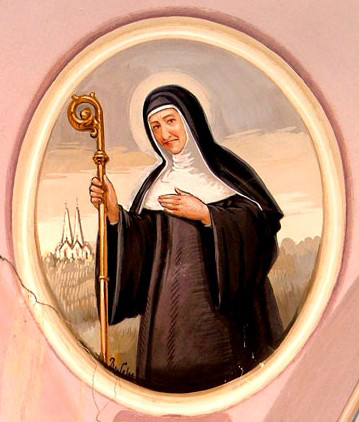
Johann Georg Üblhör. Statue of Saint Mechtildis of
Hackeborn. Engelszell monastery church ( 754-1764), Altar of Saint John of
Nepomuk. Engelhartszell ( Upper Austria )
Sainte Mechtilde de Helfta
Moniale en Allemagne (✝ v. 1298)
Apparentée aux Hohenstauffen, elle appartenait à une
famille puissante. Sa sœur aînée était abbesse du monastère des cisterciennes
de Rodersdorf qui, plus tard, sera transférée à Helfta. C'est donc tout
naturellement que la petite Mechtilde, lorsqu'elle eut 7 ans, fut confiée à sa
sœur pour son éducation. Elle ne quittera plus le monastère. Bien plus tard, on
lui remit la charge de la formation des jeunes élèves: l'alumnat. Elle
dirigeait le chant monastique et sainte Gertrude fut parmi
ses élèves. C'est à elle qu'elle dévoilera une partie de son extraordinaire vie
spirituelle dans "Le Livre de la grâce spéciale", vie spirituelle qui
s'enracine dans la liturgie et la pratique de la "Lectio Divina",
insistant plus sur la figure du Christ glorieux que sur la figure du Serviteur
souffrant. Elle recevra des visions du Sacré-Cœur, non point comme un amour
méconnu, mais comme un amour victorieux. Une sainte de la sérénité et de
l'optimisme.
Sainte
Mathilde de Hackeborn (1241/2-1298), grande figure du monastère
allemand de Helfta, a été le sujet de la catéchèse du Saint-Père le 29
septembre 2010:
Mathilde, fille des barons de Hackeborn, entra très jeune au monastère de Helfta où sa sœur, sainte Gertrude fut abbesse pendant quarante ans. Gertrude donna "une empreinte particulière à la spiritualité du monastère le portant à un épanouissement extraordinaire comme centre de mystique et de culture, école de formation scientifique et théologique". Les religieuses de Helfta bénéficiaient d'une instruction de haut niveau intellectuel leur permettant de cultiver une spiritualité fondée sur les Saintes Ecritures, la liturgie, la tradition patristique et sur la règle et la spiritualité cisterciennes".
C'est le livre écrit par sa sœur et intitulé "Le livre des grâces", qui nous permet principalement de connaître la vie de Mathilde et la décrit comme dotée de grandes qualités naturelles et spirituelles telles que "sa science, son intelligence, sa connaissance des lettres humaines et sa voix d'une douceur merveilleuse".
Mathilde bien que très jeune devint directrice de l'école du monastère de Helfta puis directrice du chœur et maîtresse des novices. La sainte possédait également "le don divin de la contemplation mystique" et était "une maîtresse de fidèle doctrine et grande humilité, conseillère, consolatrice et guide dans le discernement". C'est pourquoi "de nombreuses personnes, non seulement du monastère mais aussi venant de l'extérieur...attestaient qu'elle les avait libérées de leur peine et qu'elles n'avaient jamais éprouvé autant de consolation qu'auprès d'elle", observa le Saint-Père.
"Dans sa longue vie passée au monastère, Mathilde a été affligée de souffrances intenses et continues auxquelles elle choisit d'ajouter de dures pénitences pour la conversion des pécheurs. Elle participa ainsi à la passion du Seigneur jusqu'à la fin de sa vie".
"La prière et la contemplation furent au centre de son existence -a ajouté le Pape-. Ses révélations, ses enseignements, son service envers le prochain, son chemin dans la foi et l'amour trouvent ici leur origine... Dans la prière liturgique, Mathilde donne une importance particulière aux heures canoniques, à la célébration de la messe et surtout à la communion.... Ses visions, ses enseignements et les évènements de son existence sont décrits avec des expressions du langage liturgique et biblique. On mesure ainsi sa profonde connaissance des Saintes Écritures qui étaient son pain quotidien".
La sainte "en se laissant guider par les Saintes Écritures et nourrir du Pain eucharistique, parcourut un chemin d'intime communion avec le Seigneur, toujours fidèle à l'Église. Voilà pour nous aussi -a conclu le Saint-Père- une belle invitation à intensifier notre amitié avec le Seigneur, surtout à travers la prière quotidienne et une participation attentive, fidèle et active à la messe. La liturgie est une grande école de spiritualité". (source: VIS 20100929 460)
Au monastère d’Helfta en Saxe, vers 1298, sainte Mechtilde, vierge, qui fut une
femme d’une doctrine et d’une humilité excellentes, jointes au don de
contemplation mystique.
Martyrologe romain
Je considère, par delà ses plaies, le cœur blessé et rompu par son excès d’amour
Sainte Mechtilde
SOURCE : http://nominis.cef.fr/contenus/saint/167/Sainte-Mechtilde-de-Helfta.html

Vierge, Bénédictine
(1240-1298)
Sainte Mechtilde et Sainte Gertrude sa soeur, comtesses de Hackeborn, et
proches parentes de l'empereur Frédéric II, naquirent à Isèble dans la
Haute-Saxe. Mechtilde fut élevée chez les bénédictines de Rédaresdorff ou
Rodersdorff, au diocèse de Halberstad. Elle montra, dès ses premières années,
une grande innocence de moeurs et un grand dédain pour les vanités mondaines.
Son obéissance charmait ses supérieures; on la voyait toujours exécuter avec
autant de joie que de ponctualité ce qui lui avait été prescrit. Son amour pour
la mortification frappait toutes les personnes qui vivaient avec elle. Jamais
elle ne flattait son corps et quoiqu'elle fût d'une complexion très délicate,
elle s'interdisait l'usage de la viande et du vin. Son humilité lui faisait éviter
tout ce qui aurait pu sentir l'ostentation: elle mettait même autant de soin à
cacher ses vertus, que les autres en mettent d'ordinaire à cacher leurs vices.
Elle ne voulut point sortir de la solitude, et quand elle fut en âge de se
consacrer à Dieu par des voeux, elle fit profession dans le monastère de
Rodersdorff. Quelque temps après, on l'envoya à Diessen, en Bavière, où elle
devint supérieure du monastère de ce nom.
Elle y introduisit bientôt la pratique des plus sublimes vertus. Persuadée
qu'on ne peut atteindre à la perfection monastique sans une exacte observation
de tous les points de la règle, elle exhortait ses soeurs à s'y conformer avec
promptitude, et à anticiper plutôt sur le temps marqué pour chaque exercice,
que de se permettre le moindre retard par négligence.
Le monastère d'Ottilsteten ou d'Edelstetin, en Souabe, était alors tombé dans
un grand relâchement. Les évêques du pays, voulant y introduire la réforme,
ordonnèrent à Mechtilde de s'y retirer et de se charger de cette bonne oeuvre:
mais la sainte employa diverses raisons pour s'en dispenser; elle eut même
recours aux larmes et aux prières. Tout fut inutile, il fallut obéir. Elle se
rendit à sa nouvelle communauté et y rétablit en peu de temps l'esprit d'une
parfaite régularité. Personne ne peut résister à la force réunie de sa douceur
et de ses exemples. Austère pour elle-même, elle était pleine de bonté pour les
autres. Elle savait faire aimer la règle en la faisant observer, et tenir ce
juste milieu qui consiste à ménager la faiblesse humaine, sans élargir les
voies évangéliques. Ses instructions étaient toujours accompagnées de cet
esprit de charité et d'insinuation qui rend la vertu aimable. Elle obligeait
ses soeurs à la plus exacte clôture, et les tenait éloignées de tout commerce
avec les gens du monde: les préservant ainsi de la dissipation dont l'effet
ordinaire est de refroidir la charité et d'éteindre la ferveur.
Son lit était un peu de paille, sa nourriture fort grossière, encore ne
mangeait-elle que pour soutenir son corps. Elle partageait tous ses moments
entre la prière, la lecture et le travail des mains. Elle observait le silence
le plus rigoureux. L'esprit de componction dont elle était animée fournissait à
ses yeux une source continuelle de larmes. Elle ne se crut jamais dispensée de
la règle, pas même à la cour de l'empereur, où elle avait été obligée d'aller
pour les affaires de son monastère. Lorsque la maladie la forçait à garder le
lit, sa plus grande douleur était de ne pouvoir assister, avec les autres soeurs,
à la prière et à l'office de la nuit. Elle mourut à Diessen le 29 mars, quelque
temps après l'an 1300, et avant sainte Gertrude, sa soeur. Son nom n'a jamais
été inséré dans le martyrologe romain; mais on le trouve dans plusieurs
calendriers sous le 10 avril, le 29 mars et le 30 mai.
M. L'Abbé Jacquet, L'Année Chrétienne, La Vie d'un saint pour chaque jour,
Tome I, p. 409-410
SOURCE : http://magnificat.ca/cal/fr/saints/sainte_mechtilde_de_hackeborn.html

BENOÎT XVI
AUDIENCE GÉNÉRALE
Place Saint-Pierre
Mercredi 29 septembre
2010
Sainte Mathilde de
Hackeborn
Chers frères et sœurs,
Je voudrais vous parler
aujourd’hui de sainte Mathilde de Hackeborn, l’une des grandes figures du
monastère de Helfta, ayant vécu au XIIIe siècle. Sa consœur, sainte Gertrude la
Grande, dans le vie livre de l’œuvre Liber specialis gratiae (le livre de la grâce
spéciale), dans lequel sont relatées les grâces spéciales que Dieu a données à
sainte Mathilde, affirme: «Ce que nous avons écrit est bien peu au regard de ce
que nous avons omis. Nous publions ces choses uniquement pour la gloire de Dieu
et au bénéfice de notre prochain, car il nous semblerait injuste de garder le
silence sur les si nombreuses grâces que Mathilde reçut de Dieu, moins pour
elle-même, à notre avis, que pour nous et pour ceux qui viendront après nous»
(Mathilde de Hackeborn, Liber specialis gratiae, VI, 1).
Cette œuvre a été rédigée
par sainte Gertrude et par une autre consœur de Helfta et possède une histoire
singulière. A l’âge de cinquante ans, Mathilde traversait une grave crise
spirituelle unie à des souffrances physiques. C’est dans cette situation
qu’elle confia à deux consœurs amies les grâces spéciales à travers lesquelles
Dieu l’avait guidée depuis son enfance, mais elle ne savait pas que celles-ci
notaient tout. Lorsqu’elle l’apprit, elle en fut profondément angoissée et troublée.
Toutefois, le Seigneur la rassura en lui faisant comprendre que ce qui était
écrit l’était pour la gloire de Dieu et le bénéfice de son prochain (cf. ibid.,
II, 25, v. 20). Ainsi, cette œuvre est la source principale à laquelle nous
pouvons puiser les informations sur la vie et la spiritualité de notre sainte.
A travers elle, nous
sommes introduits dans la famille du baron de Hackeborn, l’une des plus nobles,
riches et puissantes de Thuringe, apparentée à l’empereur Frédéric II, et nous
entrons dans le monastère de Helfta à l’époque la plus glorieuse de son
histoire. Le baron avait déjà donné au monastère une fille, Gertrude de
Hackeborn (1231/1232-1291/1292), dotée d’une forte personnalité, abbesse
pendant quarante ans, capable de conférer une empreinte particulière à la
spiritualité du monastère, le conduisant à une floraison extraordinaire comme
centre de mystique et de culture, école de formation scientifique et
théologique. Gertrude offrit aux moniales une instruction intellectuelle de
haut niveau, qui leur permettait de cultiver une spiritualité fondée sur
l’Ecriture Sainte, sur la liturgie sur la tradition patristique, sur la Règle
et la spiritualité cistercienne, avec une prédilection particulière pour saint
Bernard de Clairvaux et Guillaume de Saint-Thierry. Elle fut une véritable
maîtresse, exemplaire en tout, dans la radicalité évangélique et dans le zèle
apostolique. Dès son enfance, Mathilde accueillit et goûta le climat spirituel
et culturel créé par sa sœur, en apportant ensuite sa marque personnelle.
Mathilde naquit en 1241
ou 1242 dans le château de Helfta; elle était la troisième fille du baron. A
l’âge de sept ans, avec sa mère, elle rendit visite à sa sœur Gertrude dans le
monastère de Rodersdorf. Elle fut si fascinée par ce milieu qu’elle désira
ardemment en faire partie. Elle y entra comme écolière, et en 1258, devint
religieuse dans le couvent, se transférant entre temps à Helfta, dans le
domaine des Hackeborn. Elle se distinguait par son humilité, sa ferveur, son
amabilité, la transparence et l’innocence de sa vie, la familiarité et
l’intensité avec lesquelles elle vivait la relation avec Dieu, la Vierge et les
saints. Dotée de qualités naturelles et spirituelles élevées, comme «la
science, l’intelligence, la connaissance des lettres humaines, la voix d’une
merveilleuse douceur: tout la rendait apte à être pour le monastère un
véritable trésor sous tous les aspects» (ibid., préambule). Aussi, «le
rossignol de Dieu» — comme elle était appelée — encore très jeune, devint
directrice de l’école du monastère, directrice du chœur, et maître des novices,
fonctions qu’elle accomplit avec talent et un zèle inlassable, non seulement au
bénéfice des moniales, mais de quiconque désirait puiser à sa sagesse et sa
bonté.
Illuminée par le don divin
de la contemplation mystique, Mathilde composa de nombreuses prières. C’est une
maîtresse de doctrine fidèle et de grande humilité, conseillère, consolatrice,
guide dans le discernement: «Elle distribuait — lit-on — la doctrine avec une
abondance telle que l’on n’avait jamais vue dans le monastère, et nous avons
hélas! la grande crainte que l’on ne verra plus jamais rien de semblable. Les
sœurs se réunissaient autour d’elle pour entendre la parole de Dieu, comme
autour d’un prédicateur. Elle était le refuge et le réconfort de tous, et elle
avait, par un don singulier de Dieu, la grâce de révéler librement les secrets
du cœur de chacun. De nombreuses personnes, pas seulement dans le monastère,
mais aussi des étrangers, des religieux et des laïcs, venus de loin,
attestaient que cette sainte vierge les avait libérés de leur peine et qu’ils
n’avaient jamais éprouvé autant de réconfort qu’auprès d’elle. En outre, elle
composa et elle enseigna de nombreuses prières qui, si elles étaient réunies,
dépasseraient le volume d’un psautier» (ibid., VI, 1).
En 1261, une petite fille
de cinq ans du nom de Gertrude arrive au couvent: elle est confiée aux soins de
Mathilde, qui a à peine vingt ans, qui l’éduque et la guide dans la vie
spirituelle jusqu’à en faire non seulement une excellente disciple, mais sa
confidente. En 1271 ou 1272, Mathilde de Megdeburg entre elle aussi au
monastère. Le lieu accueille ainsi quatre grandes femmes — deux Gertrude et
deux Mathilde —, gloire du monachisme germanique. Au cours de sa longue vie
passée au monastère, Mathilde est frappée par d’incessantes et intenses
souffrances auxquelles elle ajoute les très dures pénitences choisies pour la
conversion des pécheurs. De cette manière, elle participe à la passion du
Seigneur jusqu’à la fin de sa vie (cf. ibid., VI, 2). La prière et la
contemplation sont l’humus vital de son existence: les révélations, ses
enseignements, son service au prochain, son chemin dans la foi et dans l’amour
ont ici leur racine et leur contexte. Dans le premier livre de l’œuvre Liber
specialis gratiae, les rédactrices recueillent les confidences de Mathilde
effectuées lors des fêtes du Seigneur, des saints et, de manière particulière,
de la Bienheureuse Vierge Marie. La capacité que cette sainte possède de vivre
la liturgie dans ses différents éléments, même les plus simples, en la portant
dans la vie quotidienne monastique, est impressionnante. Certaines images,
expressions, actions sont parfois éloignées de notre sensibilité, mais, si l’on
considère la vie monastique et sa tâche de maîtresse et de directrice de chœur,
on saisit sa capacité particulière d’éducatrice et de formatrice, qui aide ses
consœurs à vivre intensément, en partant de la liturgie, chaque moment de la
vie monastique.
Dans la prière
liturgique, Mathilde accorde une importance particulière aux heures canoniques,
à la célébration de la Messe, en particulier à la communion. Là, elle est
souvent ravie en extase dans une profonde intimité avec le Seigneur dans son
cœur très ardent et très doux, dans un dialogue merveilleux, où elle demande
des lumières intérieures, alors qu’elle intercède de manière particulière pour
sa communauté et ses consœurs. Au centre, se trouvent les mystères du Christ
vers lesquels la Vierge Marie renvoie constamment pour marcher sur la voie de
la sainteté: «Si tu désires la véritable sainteté, reste près de mon Fils; Il
est la sainteté même qui sanctifie toute chose» (ibid., I, 40). Dans son
intimité avec Dieu est présent le monde entier, l’Eglise, les bienfaiteurs, les
pécheurs. Pour elle, le ciel et la terre s’unissent.
Ses visions, ses
enseignements, les épisodes de son existence sont décrits avec des expressions
qui évoquent le langage liturgique et biblique. On saisit ainsi sa profonde
connaissance des Saintes Ecritures, qui étaient son pain quotidien. Elle y a
constamment recours, que ce soit pour mettre en valeur les textes bibliques lus
pendant la liturgie, ou en y puisant des symboles, des termes, des paysages,
des images, des personnages. Sa préférence va à l'Evangile: «Les paroles de
l'Evangile étaient pour elle une nourriture merveilleuse et suscitaient dans
son cœur des sentiments d'une telle douceur que souvent, prise par son
enthousiasme, elle ne pouvait en terminer la lecture... La manière dont elle
lisait ces mots étaient si fervente qu'elle suscitait chez tous la dévotion. De
même, lorsqu'elle chantait dans le chœur, elle était tout absorbée en Dieu,
transportée par une telle ardeur qu'elle manifestait parfois ses sentiments
avec des gestes... D'autres fois, comme ravie en extase, elle n'entendait pas
ceux qui l'appelaient ou la secouaient et elle avait beaucoup de difficultés à
reprendre conscience des choses extérieures» (ibid., VI, 1). Dans l'une de ses
visions, c'est Jésus lui-même qui lui recommande l'Evangile; en lui ouvrant la
plaie de son cœur très doux, il lui dit: «Vois combien mon amour est grand: si
tu veux bien le connaître, tu ne le trouveras nulle part ailleurs mieux exprimé
que dans l'Evangile. Personne n'a jamais entendu exprimer des sentiments plus
forts et plus tendres que ceux-ci: Comme le Père m'a aimé, moi aussi je vous ai
aimés (Jean XV, 9)» (ibid., I, 22).
Chers amis, la prière
personnelle et liturgique, notamment la liturgie des Heures et la Messe sont à
la racine de l'expérience spirituelle de sainte Mathilde de Hackeborn. En se
laissant guider par les Saintes Ecritures et nourrir du Pain eucharistique.
Elle a parcouru un chemin d'intime union avec le Seigneur, toujours dans la
pleine fidélité à l'Eglise. Cela est également pour nous une puissante
invitation à intensifier notre amitié avec le Seigneur, surtout à travers la
prière quotidienne et la participation attentive, fidèle et active à la Messe.
La liturgie est une grande école de spiritualité.
La disciple Gertrude
décrit avec des expressions intenses les derniers moments de la vie de sainte
Mathilde de Hackeborn, très difficiles, mais éclairés par la présence de la
Bienheureuse Trinité, du Seigneur, de la Vierge Marie, de tous les saints,
ainsi que de sa sœur de sang Gertrude. Lorsque arriva l'heure où le Seigneur
voulut l'appeler à Lui, elle lui demanda de pouvoir encore vivre dans la
souffrance pour le salut des âmes et Jésus se complut de cette marque d'amour
supplémentaire.
Mathilde avait 58 ans.
Elle parcourut la fin de sa route marquée par huit ans de graves maladies. Son œuvre
et sa renommée de sainteté se répandirent rapidement. Lorsque son heure vint,
«le Dieu de Majesté... unique douceur de l'âme qui l'aime.., lui chanta: Venite
vos, benedicti Patris mei... Venez, ô vous qui êtes bénis par mon Père, venez
recevoir le royaume... et il l'associa à sa gloire» (ibid., VI, 8).
Sainte Mathilde de
Hackeborn nous confie au Sacré Cœur de Jésus et à la Vierge. Elle invite à
louer le Fils avec le Cœur de la Mère et à louer Marie avec le Cœur du Fils:
«Je vous salue, ô Vierge très vénérée, dans cette douce rosée qui, du Cœur de
la Très sainte Trinité, se répand en vous; je vous salue dans la gloire et dans
la joie avec laquelle vous vous réjouissez à présent dans l'éternité, vous qui
la première d'entre toutes les créatures de la terre et du ciel, fûtes élue
avant même la création du monde! Amen» (ibid., I, 45).
* * *
Je suis heureux
d’accueillir ce matin les francophones présents, en particulier ceux venus
d’Haïti. Je continue à porter les Haïtiens dans ma prière suppliant Dieu de
soulager leur misère. Que votre pèlerinage à Rome, chers pèlerins, soit pour
vous tous l’occasion d’approfondir votre relation personnelle avec le Christ.
Que Dieu vous bénisse!
APPEL DU SAINT-PÈRE
Mes pensées vont à
présent à la grave crise humanitaire qui a récemment frappé le Nord du Nigeria,
où près de deux millions de personnes ont été contraintes de quitter leurs
maisons à cause de violentes inondations. A toutes les personnes concernées,
j'exprime ma proximité spirituelle et je les assure de mes prières.
© Copyright 2010 - Libreria Editrice Vaticana
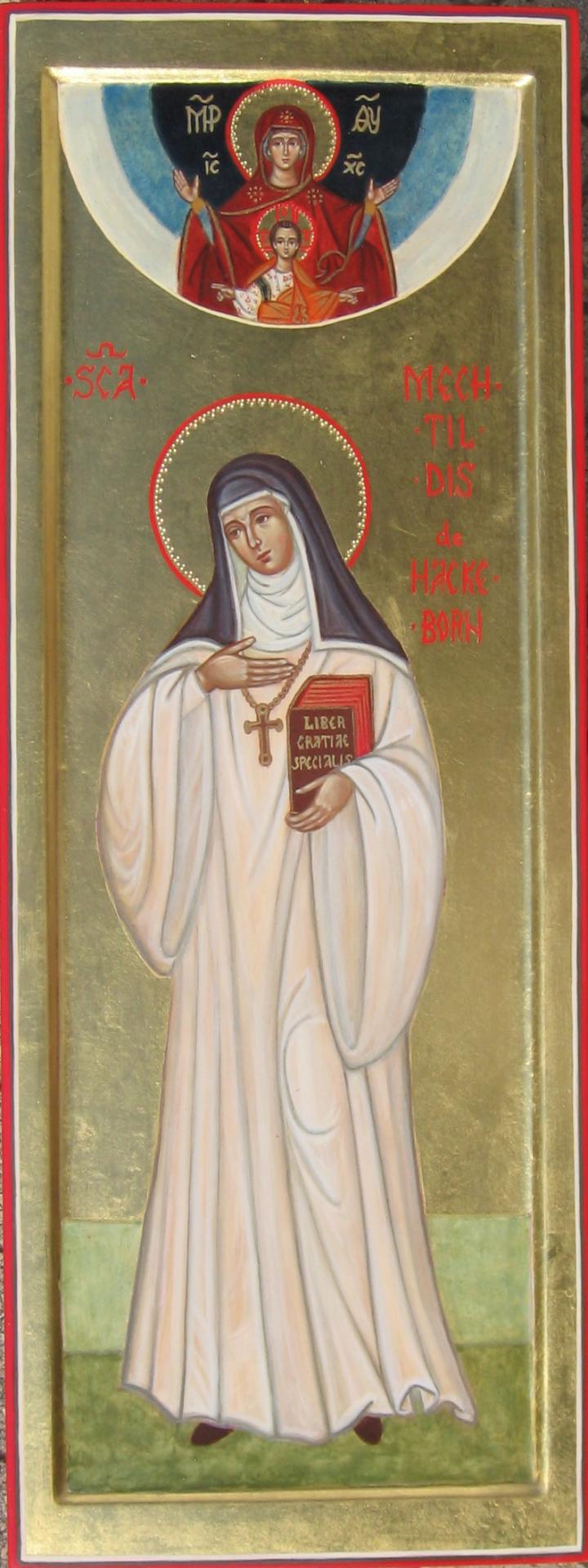
Sainte Mechthild von Hackeborn
Moniale et mystique allemande
Mechthild von
Hackeborn naît en 1241, au château de Helfta, dans une famille noble et
puissante. Sa sœur aînée étant abbesse au monastère des cisterciennes de
Rodersdorf, la petite fille lui fut confiée, dès l'âge de sept ans, pour son
éducation. Très vite Mechthild se distingua par son humilité, sa
ferveur, son amabilité et l'intensité de sa foi.
Devenue religieuse, elle
se verra confier la charge de chantre et de maîtresse des novices. Surnommée
« le rossignol de Dieu », les sœurs se réunissaient autour d'elle
pour entendre la Parole de Dieu, comme autour d'un prédicateur. De nombreuses
personnes extérieures au monastère sollicitaient son aide et ses sages
conseils.
Parmi ses élèves, une moniale particulièrement douée se signalera : sainte
Gertrude la Grande (fêtée le 16 novembre). La vie spirituelle de Mechthild,
d'une richesse rare, s'enracinera dans la Lectio Divina et la
contemplation du Christ Glorieux.
Elle bénéficiera de nombreuses visions du Sacré-Cœur de Jésus comme amour
victorieux et exercera une profonde influence sur la spiritualité catholique.
Dans l'une de ses visions, Mechthild entendit le Seigneur Jésus lui
dire : « Vois combien Mon Amour est grand : si tu veux bien le
connaître, tu ne le trouveras nulle part ailleurs mieux exprimé que dans
l'Évangile. Personne n'a jamais entendu exprimer des sentiments plus forts et
plus tendres que ceux-ci : Comme le Père M'a aimé, Moi aussi Je vous ai
aimés ». (Saint Jean 15, 9). (Liber specialis gratiae VI, 1).
C'est à l'âge de 58 ans que Mechthild, dans le monastère d'Helfta,
s'endormit dans la paix du Seigneur, le 19 novembre 1299.
Pour approfondir, lire la catéchèse du pape Benoît XVI :
>>> Sainte Mechthild de Hackeborn
[Allemand, Anglais, Croate, Espagnol, Français, Italien, Portugais]
et, plus encore : >>> Mechthild de Hackerborn
©Evangelizo.org
©Evangelizo.org 2001-2017
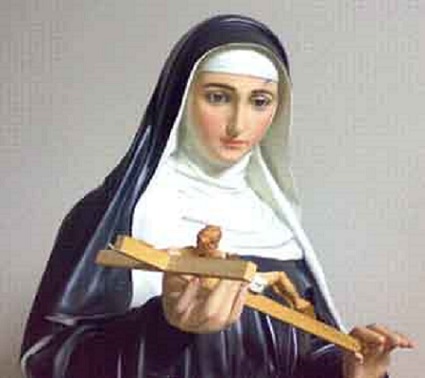
Le Notre Père de Sainte Mechtilde pour les âmes du purgatoire
A chaque fois que Sainte
Mechtilde récitait cette prière, elle voyait des légions d'âmes du Purgatoire
monter au Ciel !
Sainte Mechtilde ayant communié pour les morts, Notre-Seigneur lui apparut et lui dit : “Dites pour eux cette prière du Notre Père…”, et elle comprit qu’elle devait prier de la manière suivante ; après l’avoir fait, elle vit une grande multitude d’âmes monter au ciel (Révélations, I, 21).
Histoire vraie : Le récit suivant, qui raconte ce qui arriva à une dame, une âme privilégiée, le 2 février 1968, jour de la Chandeleur, nous montre la très grande valeur du Notre Père composée par Sainte Mechtilde pour le soulagement des âmes du Purgatoire.
Cela se passa en Suisse, à Einsiedeln, un lieu de pèlerinage marial ; c’était en hiver, un jour de semaine, et l’église était presque vide, pendant que Madame Aloisia y priait avec ses parents.
En regardant vers l’autel privilégié, elle remarqua la présence d’une religieuse très âgée, habillée d’un costume religieux fort ancien, datant d’une époque lointaine.
Elle alla vers elle, et cette religieuse lui remis un feuillet de prières qu’elle mit machinalement dans sa poche. Et il se produisît alors quelque chose d’étrange : la porte d’entrée s’ouvrit soudain et elle vît entrer une immense foule de pèlerins, tous pauvrement vêtus et qui marchaient à pas feutrés, comme des fantômes : un flot de pèlerins d’une longueur presque interminable pénétraient dans l’église, un prêtre se tenait là et leur montrait le chemin.
La paysanne se demandait avec étonnement comment cette foule immense allait-elle trouver de place dans l’église. Elle se tourna ensuite sur le côté, pendant un court instant, pour allumer un cierge, et, lorsqu’elle regarda derrière elle, l’église était à nouveau aussi vide qu’au début. Remplie de stupéfaction, elle demanda à ses parents où donc tous ces gens étaient passés. Pourtant aucun de ceux qui l’accompagnaient n’avait remarqué le défilé des pèlerins et personne non plus n’avait aperçu la religieuse. N’en croyant pas ses yeux, elle chercha dans sa poche le feuillet qu’on lui avait donné et ce feuillet qu’elle tenait dans ses mains lui prouvait bien qu’elle n’avait pas du tout rêvé. Il contenait le texte d’une prière que jadis Notre-Seigneur avait enseigné à Sainte Mechtilde, lors d’une apparition. C’était le Notre-Père de Sainte Mechtilde pour les âmes du purgatoire. A chaque fois que Sainte Mechtilde récitait cette prière, elle voyait des légions d’âmes du Purgatoire monter au Ciel.
« Notre Père qui êtes aux
cieux »
Je vous en prie, ô Père
Céleste, pardonnez aux âmes du Purgatoire, car elles ne vous ont pas aimé ni
rendu tout l'honneur qui vous est dû, à vous, leur Seigneur et Père, qui par
pure grâce, les avez adoptées comme vos enfants; mais au contraire, elles vous
ont, à cause de leurs péchés, chassé de leur cœur où vous vouliez pourtant
toujours habiter. En réparation de ces fautes, je vous offre l'amour et la
vénération que votre Fils incarné vous a témoignés tout au long de sa vie terrestre,
et je vous offre toutes les actions de pénitence et de satisfaction qu'Il a
accomplies et par lesquelles Il a effacé et expié les péchés des hommes. Ainsi
soit-il.
« Que votre Nom soit
sanctifié »
Je vous supplie, ô Père
très bon, pardonnez aux âmes du Purgatoire, car elles n'ont pas toujours honoré
dignement votre saint nom, mais elles l'ont souvent prononcé en vain et elles
se sont rendues indignes du nom de chrétien par leur vie de péchés. En
réparation de ces fautes qu’elles ont commises, je vous offre tout l'honneur
que votre Fils bien-aimé a rendu à votre Nom par ses paroles et par ses actes,
tout au long de sa vie terrestre. Ainsi soit-il.
« Que votre Règne arrive
»
Je vous en prie, ô Père
très bon, pardonnez aux âmes du Purgatoire, car elles n'ont pas toujours
recherché ni désiré votre Royaume avec assez de ferveur et d'application, ce
Royaume qui est le seul lieu où règnent le véritable repos et l'éternelle paix.
En réparation de leur indifférence à faire le bien, je vous offre le très saint
désir de votre divin Fils par lequel Il souhaite ardemment qu'elles deviennent,
elles aussi, héritières de son Royaume. Ainsi soit-il.
« Que votre volonté soit
faite sur la terre comme au ciel »
Je vous en prie, ô Père
très bon, pardonnez aux âmes du Purgatoire, car elles n'ont pas toujours soumis
leur volonté à la vôtre, elles n'ont pas cherché à accomplir votre volonté en
toute chose, et même elles ont souvent vécu et agi en ne faisant que leur
volonté. En réparation de leur désobéissance, je vous offre la parfaite
conformité du cœur plein d'amour de votre divin Fils avec votre sainte volonté
et la soumission la plus profonde qu'Il vous témoigna en vous obéissant jusqu'à
sa mort sur la croix. Ainsi soit-il.
« Donnez-nous aujourd'hui
notre pain quotidien »
Je vous en prie, ô Père
très bon, pardonnez aux âmes du Purgatoire, car elles n'ont pas toujours reçu
le saint Sacrement de l'Eucharistie avec assez de désir, mais elles l'ont
souvent reçu sans recueillement ni amour, ou même indignement, ou encore elles
ont même négligé de le recevoir. En réparation de toutes ces fautes qu'elles
ont commises, je vous offre l'éminente sainteté et le grand recueillement de
Notre-Seigneur Jésus-Christ, votre divin fils, ainsi que l'ardent amour avec
lesquels Il nous a fait cet incomparable don. Ainsi soit-il.
« Pardonnez-nous nos
offenses, comme nous pardonnons à ceux qui nous ont offensés »
Je vous en prie, ô Père
très bon, pardonnez aux âmes du Purgatoire toutes les fautes dont elles se sont
rendu coupables en succombant aux sept péchés capitaux, et aussi en n'ayant pas
voulu, ni aimer, ni pardonner à leurs ennemis. En réparation de tous ces
péchés, je vous offre la prière pleine d'amour que votre divin Fils vous a
adressée en faveur de ses ennemis lorsqu'il était sur la croix. Ainsi soit-il.
« Et ne nous laissez pas
succomber à la tentation »
Je vous en prie, ô Père
très bon, pardonnez aux âmes du Purgatoire, car trop souvent elles n'ont pas
résisté aux tentations et aux passions, mais elles ont suivi l'ennemi de tout
bien et se sont abandonnées aux convoitises de la chair. En réparation de tous
ces péchés aux multiples formes, dont elles se sont rendues coupables, je vous
offre la glorieuse victoire que Notre-Seigneur Jésus-Christ a remportée sur le
monde ainsi que sa vie très sainte, son travail et ses peines, sa souffrance et
sa mort très cruelle. Ainsi soit-il.
« Mais délivrez-nous du
mal… »
…et de tous châtiments en
vertu des mérites de votre Fils bien-aimé et conduisez-nous, ainsi que les âmes
du Purgatoire, dans votre Royaume de gloire éternelle qui s'identifie à vous.
Ainsi soit-il.
SOURCE : http://notredamedesneiges.over-blog.com/article-4402997.html

Mystique, Sainte
1241-1298
La vie de Sainte
Mechtilde
3-La vie de Sainte
Mechtilde
Sainte Mechtilde de
Hackeborn et Gertrude d’Helfta furent si proches l’une de l’autre dans le
cloître d’Helfta, qu’il est impossible de les séparer. Tout les unit: la vie
commune, leur amitié spirituelle, leur amour de Jésus, et surtout leurs
révélations mystiques.
Mechtilde de Hackeborn
naquit en 1241. À peine âgée de sept ans elle accompagnait sa mère dans une
visite au Monastère de Rodarsdorf, près d’Halberstadt, où se trouvait une de
ses sœurs aînées, Gertrude de Hackeborn, de neuf ans plus âgée qu’elle.
L’enfant demanda et
obtint de rester avec les Moniales.
Dix ans plus tard, en
1258, Mechtilde suivit sa sœur, devenue Abbesse en 1251, à Helfta, en Saxe,
dans un domaine familial.
3-1-Présentation :
extraits du Prologue du Livre de la Grâce spéciale. [1] La
naissance et la tendre enfance
Il y eut une vierge que
Dieu prévint à tel point des bénédictions de sa douceur, qu’au moment où elle
venait de naître, comme elle semblait prête à expirer, on la porta en
grande hâte pour la faire baptiser par un prêtre, homme de sainteté et de
vertu, qui se disposait à célébrer la messe. Après le baptême il prononça ces
paroles qui ont été réputées prophétiques:
— Que craignez-vous?
Cette enfant ne va pas mourir; elle deviendra une personne sainte et
religieuse, en qui Dieu opérera beaucoup de merveilles, et elle terminera ses
jours dans la vieillesse.
Le Christ révéla plus tard pourquoi le Baptême lui avait été si tôt conféré: il
voulait sans aucun retard consacrer son âme à Dieu comme un temple...
Le préambule historique
du Livre de la Grâce spéciale nous apprend que Dieu commença, dès sa
tendre enfance, à traiter familièrement avec elle et à lui révéler beaucoup de
ses mystères cachés...
Cependant le très doux Seigneur la tenait aussi sous les coups d’une épreuve
continuelle: elle souffrait presque toujours de la tête, ou des douleurs de la
pierre, ou d’une inflammation du foie.
3-2-Les grandes étapes de
la vie de Mechtilde
3-2-1-L’adolescence
Mechtilde fut élevée avec
soin par sa sœur, l’Abbesse. On raconte qu’elle “se distinguait par son
humilité, sa ferveur, et une extrême amabilité qui la faisait rechercher de
toutes.” Il semble qu’elle devint très vite une aide précieuse pour
Gertrude, sa sœur Abbesse, qui lui confia les écoles de chant et
l’alumnat. Elle instruisait dans les sciences divines et humaines et
formait à la pratique de toutes les vertus les enfants élevées parmi les
moniales.
C’est à cette maîtresse
prudente et sage que Dieu confia, en 1261, une petite fille de cinq ans qui
devait devenir Sainte Gertrude la grande. Mechtilde avait alors vingt ans. La
beauté de sa voix et sa compétence la désignèrent pour les fonctions de Dame
chantre.
3-2-2-La maîtresse
Les dons naturels de Mechtilde et ses grandes vertus ne la signalaient pas
seulement aux yeux de ses Sœurs; sa renommée, appuyée en quelque sorte sur
celle de l’abbesse Gertrude, s’étendait au loin et attirait à elle, en grand
nombre, les âmes avides de lumières ou de consolations.
En effet, Sainte
Mechtilde bénéficia de grâces très spéciales; ainsi elle pouvait lire dans les
cœurs.
On raconte qu’un jour,
pendant qu’elle se trouvait dans de grandes souffrances, Le Seigneur la
réjouissait par sa douce présence à tel point que ne pouvant cacher sa sainte
ivresse, elle manifestait, même aux hôtes et aux étrangers, cette grâce
intérieure qu’elle avait tenue si longtemps cachée.
Il en advint plusieurs
qui lui donnèrent leurs recommandations à porter auprès de Dieu, et, selon que
Dieu avait daigné le lui montrer, elle révélait à toutes ces personnes les
désirs de leurs cœurs.
Plus d’une en rendit avec
joie ses actions de grâces au Seigneur. (Livre de la Grâce spéciale,
deuxième partie, Ch. XXVI, 23)
Des savants Religieux de
l’Ordre de Saint Dominique étaient heureux de l’écouter, et nous savons que
Sainte Gertrude, au début de sa vie surnaturelle, s’adressa à elle pour en
recevoir l’assurance que les faveurs dont elle était l’objet procédaient bien
de Dieu.
Est-ce à cause de cette
réputation que Mechtilde, afin de garder sa liberté, cacha si longtemps et avec
tant de soin, les grâces extraordinaires dont le récit compose Le Livre de la
Grâce spéciale?
On peut le supposer. Quoi
qu’il en soit, l’humilité de Mechtilde et aussi le mystère dont Le Seigneur
aime le plus souvent à voiler ses dons, conspirèrent ensemble pour garder dans
le secret les communications du ciel jusqu’à la cinquantième année de la
sainte.
3-3-Les révélations
En 1291 Mechtilde fut si
malade qu’elle ne put assister à la mort de l’Abbesse Gertrude, sa sœur. Sa
solitude fut grande et Dieu permit alors qu’elle manifestât ce que Le Seigneur
opérait en elle.
Deux Moniales reçurent
ses confidences et les mirent par écrit à l’insu de Mechtilde. L’une de ces
deux Moniales était Sainte Gertrude. [2]
Mechtilde ne se remit
jamais de cette maladie et demeura dans un grand état de faiblesse. Deux ans
avant sa mort les douleurs redoublèrent et “l’avant dernier Dimanche après
la Pentecôte (1298), la malade comprenant que Dieu allait l’appeler à lui,
commença à se préparer au moyen des exercices composés à cette intention par
Sainte Gertrude.”
C’est pendant cette
maladie que mourut sa sœur l’Abbesse, Gertrude de Hackeborn.
D’abord très affectée,
Mechtilde eut bientôt la consolation de voir sa sœur au Ciel: “L’esprit de
celle-ci (Mechtilde) fut ravi dans le Ciel où elle vit Le Seigneur assis à
l’orient et sa sœur, d’heureuse mémoire, la dame Abbesse, entourée de tous les
membres de la Congrégation tant morts que vivants.
(Le Livre de la Grâce spéciale, deuxième partie, chapitre XXVI, 23)
3-4-Quelques miracles
Le Livre de la Grâce
spéciale parle très peu des miracles opérés par Mechtilde. Notons toutefois
qu’à une époque de grande sécheresse, sur ses prières instantes, le Seigneur
donna la pluie: “Aujourd’hui, dit Le Seigneur, je vous donnerai de la
pluie.”
Compte tenu de la
sérénité du Ciel, Mechtilde eut quelques doutes, mais le soir, contre toute
attente, une abondante pluie vint redonner vie à la nature exsangue. (Le Livre
de la Grâce spéciale, quatrième partie, chapitre X, 10)
À une autre époque, en
1294, pendant la guerre que menait l’empereur Adolphe contre les fils d’Albert
de Saxe, comme les Religieuses redoutaient beaucoup la présence du roi qui
se trouvait à peu de distance du Monastère, Mechtilde pria le Seigneur pour
qu’il daignât... les protéger contre les dommages que pourraient leur causer
l’armée du prince.
Le Seigneur lui dit: “Tu
ne verras pas un seul soldat de cette armée... Pas un seul n’approchera de vos
murs, et moi je vous défendrai avec tendresse contre tous.”
Et c’est ce qui arriva,
quoique beaucoup d’autres Monastères aient été attaqués. (Livre de la Grâce
spéciale, quatrième partie, chapitre XI, 11)
3-5-La louange du
Seigneur
Cependant, la
caractéristique de Sainte Mechtilde semble être la louange Divine. Il convenait
que celle qui fut toute sa vie la première chantre du Monastère et que Le
Seigneur salua à son entrée dans le Ciel, du titre de sa bien-aimée Philomène,
fût établie la prophétesse de la louange Divine...
Cette louange est répétée par Mechtilde avec amour et enthousiasme.
Non contente de se
dévouer à cette noble tâche et d’y dépenser ses forces, elle en inspire le zèle
à ses Sœurs par ses révélations et ses écrits; elle en répand même la pratique
et l’amour parmi les fidèles.
Mechtilde, en effet, avait à peine quitté la Terre, que son livre se répandit
rapidement sous le titre de Louange de la dame Mechtilde. La ville de
Florence fut une des premières à le recevoir, sans doute par l’entremise des
Frères Prêcheurs...
3-6-La mort de Mechtilde
Le jour de la Fête de
Sainte Élisabeth de Thuringe Gertrude assistait Mechtilde. Elle fut l’heureux
témoin des faveurs prodiguées par Le Seigneur à son épouse bien-aimée. Elle
vit comment les paroles de l’office étaient appliquées par les anges et par
Dieu lui-même à la sainte mourante; elle vit aussi s’accomplir à l’heure
suprême l’engagement contracté autrefois par Mechtilde avec Le Seigneur,
lorsque celui-ci lui donna son Cœur en gage.
À cette heure donc,
l’Époux divin lui redemanda son Cœur en gage, et Mechtilde le lui ayant
fidèlement rendu, fut aussitôt appelée à entrer dans les Joies de Son Seigneur
pour y goûter les délices de l’éternité.
C’était le 19 Novembre 1298.
Prière de Sainte Mechtilde de Hackeborn
Voici la Prière du
matin « Ô mon Unique, je t'offre mon cœur comme une rose printanière
» de Sainte Mechtilde (Mathilde) de Hackeborn (1241-1298), Bénédictine
allemande du XIII siècle qui vécut à Helfta, surnommée « le rossignol de
Dieu ».
La Prière de Sainte Mechtilde de Hackeborn « Ô mon Unique, je t'offre
mon cœur comme une rose printanière » :
« Ô mon Unique, je t'offre mon cœur comme une rose printanière ; que sa grâce, tout le jour, charme tes yeux, que son parfum ravisse ton Cœur divin.
Je t'offre mon cœur, pour que tu en uses comme d'une coupe, où tu pourras goûter ta propre douceur en tout ce que tu daignerais opérer en moi pendant cette journée.
Je t'offre mon cœur comme une grenade exquise, digne de ta table royale. Veuille le prendre entièrement et que lui-même, à son tour, se délecte en toi seul.
Fais, je t'en supplie, qu'aujourd'hui toutes mes pensées, toutes mes paroles,
toutes mes actions et ma volonté même se règlent sur le bon plaisir de ta
bénigne volonté. Ainsi soit-il. »
Sainte Mathilde de
Hackeborn (1241-1298)
Voir également sur Sainte
Mathilde de Hackeborn :
La « Catéchèse
de Sainte Mathilde de Hackeborn d’après Benoît XVI »
Les 5 « Ave
Maria » de Sainte Mathilde de Hackeborn
Le « Notre
Père » de Sainte Mathilde de Hackeborn pour les âmes du purgatoire
La Prière
« Ô très doux Cœur de Jésus » de Sainte Mathilde de Hackeborn
La Prière de Sainte
Mechtilde de Hackeborn « Ô
mon Unique, je t'offre mon cœur comme une rose printanière »
http://trinite.1.free.fr/prieres/salut_saintes_plaies.htm
SALUTATION DES SAINTES
PLAIES
à Sainte Mechtilde
Jésus enseigna aussi des prières à Sainte Mechtilde pour saluer ses Saintes Plaies. Il lui dit :
« si vous voulez honorer chacune de Mes Plaies dites cinq fois, chaque
jour, pendant trois ans, la salutation suivante » :
-Gloire vous soit rendue, ô très suave, ô très douce, ô très généreuse, ô
souveraine, ô excellente, ô radieuse et toujours immuable Trinité, pour ces
roses du divin Amour, pour les plaies de Jésus Christ, de Jésus l’unique ami,
l’unique élu de mon cœur.
Amen !
Ajoutez, après ces salutations, la Prière suivante :
-Mon Seigneur
Jésus-Christ, Fils du Dieu vivant, recevez cette prière, dans ce suprême et
ineffable Amour avec lequel vous avez supporté les plaies de votre saint
Corps : ayez pitié de moi, de tous les pécheurs, de tous les fidèles
vivants et morts ; accordez-nous tous une part dans Vos grâces et Vos
miséricordes, la rémission de nos péchés et la vie éternelle.
Amen !
La bienheureuse Gertrude, ayant récité pendant trois ans cette prière pour
saluer chacune des plaies du corps adorable du Christ souffrant, vit Jésus lui
apparaître, ayant sur chacune de Ses Plaies une fleur qui brillait de l’éclat
de l’or.
Il lui dit :
« C’est en ce
ravissant état que je t’apparaîtrai à l’heure de la mort, c’est de cette gloire
dont tu as revêtu Mes Plaies, en les saluant, que je couvrirai toutes les
souillures de tes péchés et que je les effacerai. »
L'Ave Maria (Ste
Mechtilde)
Sainte Mechtilde,
désirant savoir par quel moyen elle pourrait mieux témoigner la tendresse de sa
dévotion à la Mère de Dieu, fut ravie en esprit; et sur cette pensée, la Sainte
Vierge lui apparut portant sur son sein la Salutation angélique écrite en
lettres d'or et lui dit:
"Sachez, ma fille,
que personne ne peut m'honorer par un salut plus agréable que celui que m'a
fait présenter la très adorable Trinité et par lequel elle m'a élevée à la
dignité de Mère de Dieu.
Par le mot "Ave", qui est le nom d'Eve, Eva, j'appris que Dieu,
par sa toute-puissance, m'avait préservée de tout péché et des misères
auxquelles la première femme fut sujette.
Le nom de "Marie", qui signifie dame de lumières, marque que
Dieu m'a remplie de sagesse et de lumière, comme un astre brillant, pour
éclairer le ciel et la terre.
Ces mots: "pleine de grâces", me représentent que le Saint-Esprit
m'a comblée de tant de grâces que je puis en faire part abondamment à ceux qui
en demandent par ma médiation.
En disant: "Le Seigneur est avec vous", on me renouvelle la Joie
ineffable que je ressentis lorsque le Verbe éternel s'incarna dans mon sein.
Quand on me dit: "vous êtes Bénie entre toutes les femmes", je
loue la Divine Miséricorde qui m'a élevée à ce haut degré de Bonheur.
A ces paroles: "Jésus, le fruit de vos entrailles, est béni", tout
le Ciel se réjouit avec moi de voir Jésus mon Fils adoré et glorifié pour avoir
sauvé les hommes".
Saint Louis-Marie de
Montfort, Le Secret du Très Saint Rosaire § 48
http://prieresetdevotions.blogspot.com/2006/01/la-dvotion-des-trois-ave-maria.html
La dévotion des Trois
"Ave Maria"
Jésus disait: "Que
sert à l'homme de gagner l'univers s'il vient à perdre son âme?..." Saint
Ignace de Loyola répéta ces mots à maintes reprises, en rappelant que l'affaire
la plus importante est donc le Salut éternel.
Voulez-vous vous sauver? Ayez une dévotion à la Vierge Marie. Sans son
intervention auprès de Jésus personne ne se sauve.
Demandez-lui protection
en récitant tous les jours les trois "Ave Maria".
La Mère de Dieu révéla elle-même cette brève et simple dévotion à Sainte
Mechtilde et la fit connaître à Sainte Gertrude, montrant que toutes les
fois que les Chrétiens réciteront les trois "Ave Maria" pour rappeler
les privilèges qu'elle reçut de la Sainte Trinité (le Pouvoir que lui concéda
le Père, la Sagesse que lui communiqua le Fils et la Miséricorde par laquelle
l'enrichit l'Esprit Saint), le pouvoir, la sagesse et l'Amour inonderont, de
son Cœur Immaculé, les âmes de ceux qui l'honoreront et invoqueront.
Ainsi ils seront assurés
de sa protection leur vie durant et de son assistance particulière à l'heure de
la mort.
C'est pour cela que Saint Alphonse Marie de Liguori recommanda la prière des
trois "Ave Maria"; Saint Léonard de Port Maurice prêcha avec ferveur
cette dévotion en disant:
"Oh! Comme il est
saint, cet exercice de piété!
C'est un moyen très
efficace d'assurer votre Salut." Et le vénérable serviteur de Dieu, Louis
Marie Baudoin, écrivit, à son tour:
"Récitez chaque jour
les trois "Ave Maria"; si vous rendez fidèlement ce tribut d'hommage
à Marie, je vous promets le Paradis."
Réciter le matin et le soir:
1. Marie, ma Mère,
délivre-moi de tomber en état de péché mortel!
Par le pouvoir que vous
concéda le Père Eternel. Ave Maria...
2. Par la sagesse que
vous concéda le Fils. Ave Maria...
3. Par l'Amour que vous
concéda l'Esprit Saint. Ave Maria...
Propagez cette dévotion, car "qui sauve une âme, sauve la sienne".
(Saint Augustin.)
300 jours d'indulgences.

Also
known as
Mechtilde of
Hackeborn-Wippra
Mechtilde of Hackenborn
Mechtilde of Magdaburg
Mathilda of….
Mathildis of….
Matilda of….
Maud of….
Mechthild of….
Mechtild of….
Mechtildis of….
The Nightingale of Helfta
16
November on some calendars
26
February in some Benedictine and Cistercian monasteries
Profile
Born to a pious, powerful
Thuringian noble family; her older sister was a nun. Convent–educated from
age seven, Mechtilde became a nun at
Rodersdorf, Switzerland.
She moved to the Helfta monastery in 1258 where
her sister served as abbess. Teacher and choir director
at the convent
school at Helfta. Visionary and mystic. Novice
mistress for Saint Gertrude
the Great who wrote The
Book of Special Grace about Mechtilde’s teachings; she was initially
terrified that the book might
cause trouble, but Christ appeared to her in prayer and
told her not to worry. She became a much sought spiritual advisor to her
sister nuns, laity and
learned Dominicans.
May have been the inspiration for the character Matelda in
Dante’s Purgatorio.
Born
c.1241 at
her family’s castle of Helfta near Eisleben, Saxony, Germany
19 November 1298 at
Helfta monastery of
natural causes
against
blindess (one well-known miracle was healing the blindness of
a nun)
with Saint Gertrude
the Great
Additional
Information
Book
of Saints, by the Monks of
Ramsgate
Catholic
Encyclopedia, by Gertrude Casanova
Catholic
Truth Society of London
Love
of the Sacred Heart, illustrated by Saint Mechtilde (also available
in epub format)
Pope
Benedict XVI, General Audience, 29
September 2010
Saints
of the Day, by Katherine Rabenstein
books
Our Sunday Visitor’s Encyclopedia of Saints
other
sites in english
images
videos
e-books
Preces
Gertrudianae: Prayers of Saint Gertrude and Saint Mechtilde of the Order of
Saint Benedict
webseiten
auf deutsch
sitios
en español
Martirologio Romano, 2001 edición
fonti
in italiano
nettsteder
i norsk
Readings
There has never before
been anyone like her in our monastery,
and I fear there never will be again. – Saint Gertrude
of Helfta, about Saint Mechtilde
O almighty, everlasting
God, seeing that it is the true faith of your Church that the holy sacrifice of
the Mass instituted by your Son is infinitely pleasing to your divine Majesty,
and renders you an infinite worship and praise, and since by it alone you can
be worthily and adequately worshiped and praised; impelled by an ardent desire
of your honour and glory, I purpose to assist at this present sacrifice with the
utmost devotion of which I am capable, and to offer this most Holy Oblation to
you in union with your priest. I offer you not only this sacrifice, but all
those which shall be this day offered from every part of the world; and I
protest before you that if it depended on me whether they should be offered or
omitted, I would put forth all my powers to procure and further their being
offered. And were I able now to raise up to you, of the stones which are
scattered over the earth, most devoted priests, who should day by day and with
glowing fervour offer to you this sacrifice of praise, I would most gladly do
it. But, being what I am, I implore you, O most holy Father, through Jesus
Christ your Son, to pour into the hearts of all your priests, and especially those
who might perchance otherwise offer you this acceptable sacrifice coldly and
without due recollectedness, the spirit of grace and of fervour, that they may
be enabled to celebrate your tremendous Mystery with becoming awe and devotion.
Grant to me, and to all those who are here present with me, that we may join in
this most sacred action with reverence and devotion, so that we may have our
portion in its fruit and effect. I confess to you, O almighty God, and to the
Blessed Mary ever Virgin, and to all the Saints, my own sins and those of all
the world; and I lay them on your sacred Altar, that they may be entirely
blotted out by the virtue of this sacrifice. Do you deign to grant us this
grace, by that love which held back your hand from smiting when your most
beloved Son, your only Son, was immolated by the hands of ungodly men.
Amen. – prayer before Mass,
by Saint Mechtilde
MLA
Citation
“Saint Mechtilde of
Helfta“. CatholicSaints.Info. 6 August 2022. Web. 1 December 2025.
<https://catholicsaints.info/saint-mechtilde-of-helfta/>
SOURCE : https://catholicsaints.info/saint-mechtilde-of-helfta/

Figur
der hl. Mechthild in der Filial- und Wallfahrtskirche St. Ottilia in
Hörmanshofen (Gem. Biessenhofen), um 1700
BENEDICT XVI
GENERAL AUDIENCE
Saint Peter's Square
Saint Matilda of
Hackeborn
Dear Brothers and
Sisters,
Today I want to talk to
you about St Matilda of Hackeborn, one of the great figures of the convent of
Helfta, who lived in the 13th century. Her sister, St Gertrude the Great, tells
of the special graces that God granted to St Matilda in the sixth book of Liber
Specialis Gratiae (Book of Special Grace), which states : "What we
have written is very little in comparison with what we have omitted. We are
publishing these things solely for the glory of God and the usefulness of our
neighbour, for it would seem wrong to us to keep quiet about the many graces
that Matilda received from God, not so much for herself, in our opinion, but
for us and for those who will come after us" (Mechthild von Hackeborn, Liber
specialis gratiae, vi, 1).
This work was written by St
Gertrude and by another sister of Helfta and has a unique story. At the age of
50, Matilda went through a grave spiritual crisis, as well as physical
suffering. In this condition she confided to two of her sisters who were
friends the special graces with which God had guided her since childhood.
However, she did not know that they were writing it all down. When she found
out she was deeply upset and distressed. However, the Lord reassured her,
making her realize that all that had been written was for the glory of God and
for the benefit of her neighbour (cf. ibid., II, 25; V, 20). This
work, therefore, is the principal source to refer to for information on the
life and spirituality of our Saint.
With her we are
introduced into the family of Baron von Hackeborn, one of the noblest, richest
and most powerful barons of Thuringia, related to the Emperor Frederick ii, and
we enter the convent of Helfta in the most glorious period of its history. The
Baron had already given one daughter to the convent, Gertrude of Hackeborn
(1231/1232 - 1291/1292). She was gifted with an outstanding personality. She
was Abbess for 40 years, capable of giving the spirituality of the convent a
particular hallmark and of bringing it to an extraordinary flourishing as the
centre of mysticism and culture, a school for scientific and theological
training. Gertrude offered the nuns an intellectual training of a high standard
that enabled them to cultivate a spirituality founded on Sacred Scripture, on
the Liturgy, on the Patristic tradition, on the Cistercian Rule and
spirituality, with a particular love for St Bernard of Clairvaux and William of
Saint-Thierry. She was a real teacher, exemplary in all things, in evangelical
radicalism and in apostolic zeal. Matilda, from childhood, accepted and enjoyed
the spiritual and cultural atmosphere created by her sister, later giving it
her own personal hallmark.
Matilda was born in 1241
or 1242 in the Castle of Helfta. She was the Baron's third daughter. When she
was seven she went with her mother to visit her sister Gertrude in the convent
of Rodersdorf. She was so enchanted by this environment that she ardently
desired to belong to it. She entered as a schoolgirl and in 1258 became a nun
at the convent, which in the meantime had moved to Helfta, to the property of
the Hackeborns. She was distinguished by her humility, her fervour, her
friendliness, the clarity and the innocence of her life and by the familiarity
and intensity with which she lived her relationship with God, the Virgin and
the Saints. She was endowed with lofty natural and spiritual qualities such as
knowledge, intelligence, familiarity with the humanities and a marvellously
sweet voice: everything suited her to being a true treasure for the convent
from every point of view (ibid, Proem.). Thus when "God's
nightingale", as she was called, was still very young she became the
principal of the convent's school, choir mistress and novice mistress, offices
that she fulfilled with talent and unflagging zeal, not only for the benefit of
the nuns but for anyone who wanted to draw on her wisdom and goodness.
Illumined by the divine
gift of mystic contemplation, Matilda wrote many prayers. She was a teacher of
faithful doctrine and deep humility, a counsellor, comforter and guide in
discernment. We read: "she distributed doctrine in an abundance never
previously seen at the convent, and alas, we are rather afraid that nothing
like it will ever be seen again. The sisters would cluster round her to hear
the word of God, as if she were a preacher. "She was the refuge and
consoler of all and, by a unique gift of God, was endowed with the grace of
being able to reveal freely the secrets of the heart of each one. Many people,
not only in the convent but also outsiders, religious and lay people, who came
from afar, testified that this holy virgin had freed them from their
afflictions and that they had never known such comfort as they found near
her. "Furthermore, she composed and taught so many prayers that if
they were gathered together they would make a book larger than a
Psalter" (ibid., VI, 1).
In 1261 a five year old
girl came to the convent. Her name was Gertrude: She was entrusted to the care
of Matilda, just 20 years of age, who taught her and guided her in the
spiritual life until she not only made her into an excellent disciple but also
her confidant. In 1271 or 1272, Matilda of Magdeburg also entered the convent.
So it was that this place took in four great women two Gertrudes and two
Matildas the glory of German monasticism. During her long life which she spent
in the convent, Matilda was afflicted with continuous and intense bouts of
suffering, to which she added the very harsh penances chosen for the conversion
of sinners. In this manner she participated in the Lord's Passion until the end
of her life (cf. ibid., VI, 2). Prayer and contemplation were the
life-giving humus of her existence: her revelations, her teachings,
her service to her neighbour, her journey in faith and in love have their root
and their context here. In the first book of the work, Liber Specialis
Gratiae, the nuns wrote down Matilda's confidences pronounced on the
Feasts of the Lord, the Saints and, especially, of the Blessed Virgin. This
Saint had a striking capacity for living the various elements of the Liturgy, even
the simplest, and bringing it into the daily life of the convent. Some of her
images, expressions and applications are at times distant from our sensibility
today, but, if we were to consider monastic life and her task as mistress and
choir mistress, we should grasp her rare ability as a teacher and educator who,
starting from the Liturgy, helped her sisters to live intensely every moment of
monastic life.
Matilda gave an emphasis
in liturgical prayer to the canonical hours, to the celebrations of Holy Mass
and, especially, to Holy Communion. Here she was often rapt in ecstasy in
profound intimacy with the Lord in his most ardent and sweetest Heart, carrying
on a marvellous conversation in which she asked for inner illumination, while
interceding in a special way for her community and her sisters. At the centre
are the mysteries of Christ which the Virgin Mary constantly recommends to
people so that they may walk on the path of holiness: "If you want true
holiness, be close to my Son; he is holiness itself that sanctifies all
things" (ibid., I, 40). The whole world, the Church, benefactors and
sinners were present in her intimacy with God. For her, Heaven and earth were
united.
Her visions, her
teachings, the events of her life are described in words reminiscent of
liturgical and biblical language. In this way it is possible to comprehend her
deep knowledge of Sacred Scripture, which was her daily bread. She had constant
recourse to the Scriptures, making the most of the biblical texts read in the
Liturgy, and drawing from them symbols, terms, countryside, images and famous
figures. She had a special love for the Gospel: "The words of the Gospel
were a marvellous nourishment for her and in her heart stirred feelings of such
sweetness that, because of her enthusiasm, she was often unable to finish
reading it.... The way in which she read those words was so fervent that it
inspired devotion in everyone. "Thus when she was singing in the choir,
she was completely absorbed in God, uplifted by such ardour that she sometimes
expressed her feelings in gestures.... "On other occasions, since she was
rapt in ecstasy, she did not hear those who were calling or touching her and
came back with difficulty to the reality of the things around her" (ibid.,
VI, 1). In one of her visions, Jesus himself recommended the Gospel to her;
opening the wound in his most gentle Heart, he said to her: "consider the
immensity of my love: if you want to know it well, nowhere will you find it
more clearly expressed than in the Gospel. No one has ever heard expressed
stronger or more tender sentiments than these: "As my father has
loved me, so I have loved you (Jn 15: 9)'" (ibid., I, 22).
Dear friends, personal
and liturgical prayer, especially the Liturgy of the Hours and Holy Mass are at
the root of St Matilda of Hackeborn's spiritual experience. In letting herself
be guided by Sacred Scripture and nourished by the Bread of the Eucharist, she
followed a path of close union with the Lord, ever in full fidelity to the
Church. This is also a strong invitation to us to intensify our friendship with
the Lord, especially through daily prayer and attentive, faithful and active
participation in Holy Mass. The Liturgy is a great school of spirituality.
Her disciple Gertrude
gives a vivid pictures of St Matilda of Hackeborn's last moments. They were
very difficult but illumined by the presence of the Blessed Trinity, of the
Lord, of the Virgin Mary and of all the Saints, even Gertrude's sister by
blood. When the time came in which the Lord chose to gather her to him, she
asked him let her live longer in suffering for the salvation of souls, and
Jesus was pleased with this further sign of her love.
Matilda was 58 years old.
The last leg of her journey was marked by eight years of serious illness. Her
work and the fame of her holiness spread far and wide. When her time came,
"the God of majesty... the one delight of the soul that loves him... sang
to her:Venite vos, benedicti Patris mei.... Venite, o voi che siete i benedetti
dal Padre mio, venite a ricevere il regno... and he united her with his
glory" (ibid., VI, 8).
May St Matilda of
Hackeborn commend us to the Sacred Heart of Jesus and to the Virgin Mary. She
invites us to praise the Son with the Heart of the Mother, and to praise Mary
with the Heart of the Son: "I greet you, O most deeply venerated Virgin,
in that sweetest of dews which from the Heart of the Blessed Trinity spread
within you; I greet you in the glory and joy in which you now rejoice for ever,
you who were chosen in preference to all the creatures of the earth and of
Heaven even before the world's creation! Amen" (ibid., I, 45).
To special groups
Dear Brothers and
Sisters,
I am pleased to greet the
seminarians and staff from the Venerable English College and the new students
and staff from the Pontifical Irish College, and I offer prayerful good wishes
for their studies. I also welcome the members of the Christ Child Society from
the Diocese of Toledo, Ohio, accompanied by Bishop Leonard Blair. Upon all the
English-speaking visitors present at today's audience, especially the pilgrim
groups from Britain, Ireland, Denmark, Nigeria, Oceania, the Philippines, and
North America, I invoke God's abundant blessings.
I also greet those taking
part in the Youth Pilgrimage of the Focolare Movement, organized on the
occasion of the Beatification of Chiara Badano, and I ask them, after the example
of the new Blessed, to persevere in their commitment to adherence to Christ and
to the proclamation of the Gospel.
Lastly, I greet the young
people, the sick and the newlyweds. May today's Feast
of the Archangels Michael, Gabriel and Raphael and the upcoming Feast of the
Holy Guardian Angels, spur us to think of the provident concern with which God
cares for every human person. May you feel the presence of the Angels beside
you, dear young people, and let yourselves be guided by them so that
your whole life may be illuminated by the word of God. Dear sick
people, helped by your Guardian Angels, join your sufferings to those of
Christ for the spiritual renewal of human society. And may you, dear newlyweds, have
frequent recourse to the help of your Guardian Angels, so that you may grow in
the constant witness to authentic love.
APPEAL
My thoughts also turn to
the grave humanitarian crisis which has recently struck Northern Nigeria, where
some two million people have been forced to flee their homes because of severe
flooding. To all those affected I express my spiritual closeness and I assure
them of my prayers.
© Copyright 2010 -
Libreria Editrice Vaticana
SOURCE : http://w2.vatican.va/content/benedict-xvi/en/audiences/2010/documents/hf_ben-xvi_aud_20100929.html

Innozenz Anton
Warathy (1694–1758), Mechthild von Hackeborn (von Helfta) (Mitte
unten) und Gertrud von Helfta (Gertrud die Große),
Deckenfresko, um 1720, in der Bibliothek des Klosters Metten. Ökumenisches
Heiligenlexikon (public domain)
Mechtylda z Hackeborn (z Helfty)
Article
(Saint)
Virgin (November 19) (13th
century) A nun in Germany in
the Convent governed by Saint Gertrude,
of whom she was perhaps the sister. She has left us a marvellous volume of the
Revelations made to her by Our Blessed Lord, and is remarkable as having been
among the first to propagate devotion to the Sacred
Heart of Jesus. Recently there has been a controversy among the learned as
to whether there may not have been two contemporary Saints of
the name of Mechtildis, the accounts of whom have become confused.
Another German Saint of
the same name, a recluse near Spanheim, flourished a century earlier.
MLA
Citation
Monks of Ramsgate.
“Mechtildis”. Book of Saints, 1921. CatholicSaints.Info.
25 March 2015. Web. 1 December 2025.
<https://catholicsaints.info/book-of-saints-mechtildis/>
SOURCE : https://catholicsaints.info/book-of-saints-mechtildis/
New
Catholic Dictionary – Saint Mechtilde
Article
(Matilda von
Hackeborn-Wippra) Virgin, born near Eisleben, Saxony, c.1240; died in
the monastery of
Helfta, 1298. She was of a noble, influential Thuringian family, sister of
Saint Gertrude, Abbess of Helfta. She entered the convent of Rodersdorf, later
transferred to Helfta, and progressed rapidly in the religious life. She cared
for the novitiate of Saint Gertrude the Great. The “Book
of Special Grace,” composed by Saint Gertrude and another sister,
has had many editions. Feast, 26
February.
MLA
Citation
“Saint Mechtilde”. New Catholic Dictionary. CatholicSaints.Info.
11 August 2018. Web. 1 December 2025.
<https://catholicsaints.info/new-catholic-dictionary-saint-mechtilde/>
SOURCE : https://catholicsaints.info/new-catholic-dictionary-saint-mechtilde/
Mechtilde, O.Cist. V (AC)
Died 1298; feast day formerly on November 19.
"When you awake in
the morning, let your first act be to salute My Heart, and to offer Me your
own. . . . Whoever shall breathe a sigh toward Me from the bottom of his heart
when he awakes in the morning and shall ask Me to work all his works in him
throughout the day, will draw Me to him . . . For never does a man breathe a sigh
of longing aspiration toward Me without drawing Me nearer to him than I was
before." --Our Lord to Saint Mechtilde.
Saint Mechtilde, sister of abbess Gertrude of Hackeborn, was the mistress of novices of the Cistercian convent at Helfta Castle in Saxony. In this capacity she played an important role in the spiritual formation of Saint Gertrude the Great. Like her spiritual daughter, Mechtilde was blessed with many mystical experiences that were recorded by Saint Gertrude in the Book of Special Grace. Mechtilde and the younger Gertrude together wrote a series of prayers that became very popular (Benedictines, Delaney, Martindale).
SOURCE : http://www.saintpatrickdc.org/ss/1116.shtml
St. MECHTILDE
(MATILDA VON
HACKEBORN-WIPPRA).
Benedictine; born in 1240
or 1241 at the ancestral castle of Helfta, near Eisleben, Saxony; died in
the monasteryof
Helfta, 19 November, 1298. She belonged to one of the noblest and most
powerful Thuringian families,
while her sister was the saintly and illustrious Abbess Gertrude von Hackeborn.
Some writers have considered that Mechtilde von Hackeborn and
Mechtilde von Wippra were two distinct persons,
but, as the Barons of Hackebornwere
also Lords of Wippra, it was customary for members of that family to
take their name indifferently from either, or both of these estates.
So fragile was she at birth, that the attendants, fearing she might
die unbaptized, hurried her off to the priest who
was just then preparing to say Mass.
He was a man of great sanctity,
and after baptizing the
child, uttered these prophetic words: "What do you fear?
This child mostcertainly will not die, but she will become
a saintly religious in whom God will work
many wonders, and she willend her days in a good old age."
When she was seven years old, having been taken by her mother on a visit to her
elder sister Gertrude, then a nun in
the monastery of
Rodardsdorf, she became so enamoured of the cloisterthat
her pious parents yielded
to her entreaties and, acknowledging the workings of grace, allowed her to
enter the alumnate. Here, being highly gifted in mind as
well as in body, she made remarkable progress in virtue and learning.
Ten years later (1258)
she followed her sister, who, now abbess,
had transferred the monastery to
an estate at Helfta given her by her brothers Louis and Albert.
As a nun,
Mechtilde was soon distinguished for her humility,
her fervour, and that extreme amiability which had characterized her from
childhood and which, like piety,
seemed hereditary in her race. While still very young, she became a
valuable helpmate to Abbess Gertrude, who entrusted to her direction the
alumnate and the choir. Mechtilde was fully equipped for her task when, in
1261,God committed
to her prudent care a child of five who was destined to
shed lustre upon the monastery of
Helfta. This was that Gertrude who in later generations became known as St.
Gertrude the Great. Gifted with a beautiful voice, Mechtilde also
possessed a special talent for rendering the solemn and sacred
music over which she presided as domna cantrix. All her life
she held this office and trained the choir with indefatigable zeal.
Indeed, Divine praise was the keynote of her life as it is of her book; in this
she never tired, despite her continual and severe physical sufferings, so that
in His revelations Christ was wont to call her His
"nightingale". Richlyendowed, naturally and supernaturally,
ever gracious, beloved of all who came within the radius of her saintlyand
charming personality,
there is little wonder that this cloistered virgin should
strive to keep hidden her wondrous life. Souls thirsting for
consolation or groping for light sought her advice; learned Dominicans consulted
her on spiritual matters. At the beginning of her
own mystic life it was from St. Mechtilde that St.
Gertrude the Great learnt that the marvellous gifts lavished
upon her were from God.
Only in her fiftieth year
did St. Mechtilde learn that the two nuns in
whom she had especially confided had noted down the favours granted her, and,
moreover, that St. Gertrude had nearly finished a book on the
subject. Much troubled at this, she, as usual, first had recourse to prayer.
She had a vision of Christ holding in His hand the book of
her revelations, and saying: "All this has been committed to writing
by my will and inspiration; and, therefore you have
no cause to be troubled about it." He also told her that, as He
had been so generous towards her, she must make Him a like return, and that the
diffusion of the revelations would cause many to increase
in His love;
moreover, He wished this book to be called "The Book of
Special Grace", because it would prove such to many. When
the saint understood
that the book would tend to God's glory,
she ceased to be troubled, and even corrected the manuscript herself.
Immediately after her death it was made public, and copies were rapidly multiplied,
owing chiefly to the widespread influence of the Friars
Preachers. Boccaccio tells
how, a few years after the death of Mechtilde, the book of
her revelations was brought to Florence and popularized
under the title of "La Laude di donna Matelda". It is related
that the Florentines were accustomed to repeat daily before
theirsacred images the praises learned from St. Mechtilde's
book. St. Gertrude, to whose devotedness we owe the "Liber
Specialis Gratiae" exclaims: "Never has there arisen one like to her
in our monastery;
nor, alas! I fear, willthere ever arise another such!" —
little dreaming that her own name would be inseparably linked with
that of Mechtilde. With that of St. Gertrude, the body of St.
Mechtilde most probably still reposes at Old Helfta thought the exact spot is
unknown. Her feast is
kept 26 or 27 February in different congregations and monasteries of
her order, by special permission of the Holy
See. (For an account of the general life at Helfta and the
estimate of the writings of St. Mechtilde, see GERTRUDE
OF HACKEBORN; SAINT
GERTRUDE THE GREAT.)
There is another honour,
inferior certainly to that of sanctity,
yet great in itself and worthy of mention here: the homage of a transcendent
genius was to be laid at the feet of St. Mechtilde. Critics have
long been perplexed as to one of the characters introduced by Dante in
his "Purgatorio" under the name of Matelda.
After ascendingseven terraces of a mountain, on each of which the process
of purification is carried on, Dante,
in Canto xxvii, hears a voice singing: "Venite, benedicti patris
mei"; then later, in Canto xxviii, there appears to him on the opposite
bank of the mysterious stream a lady, solitary, beautiful, and
gracious. To her Dante addresses
himself; she it is who initiates him into secrets, which it is not given
to Virgil to penetrate, and it is to her
that Beatricerefers Dante in
the words: "Entreat Matilda that she teach thee this."
Most commentators have identified Matildawith the
warrior-Countess of Tuscany,
the spiritual daughter and dauntless champion of St.
Gregory VII, but all agree that beyond the name the two have little or
nothing in common. She is no Amazon who, at Dante's prayerthat
she may draw nearer to let him understand her song, turns towards him "not
otherwise than a virgin that droppeth
her modest eyes". In more places than one the revelations granted
to the mystics of Helfta seem in turn to have become the inspirations
of the Florentine poet. All writers on Dante recognize
his indebtedness toSt.
Augustine, the Pseudo-Dionysius, St.
Bernard, and Richard
of St. Victor. These are precisely the writers
whose doctrines had been most assimilated by the mystics of
Helfta, and thus they would the more appeal to the sympathies of the
poet. The city of Florence was among the first to welcome St.
Mechtilde's book. Now Dante,
like all true poets,
was a child of his age, and could not have been a stranger to a book which was
so popular among his fellow-citizens. The "Purgatorio" was finished
between 1314 and 1318, or 1319 — just about
the timewhen St. Mechtilde's book was popular. This interpretation is
supported by the fact that St. Mechtilde in her "Book of Special
Grace" (pt. I, c. xiii) describes the place of purification under the same
figure of a seven-terraced mountain. The coincidence of the simile and of the
name, Matelda, can scarcely be accidental. For another among many
points of resemblance between the two writers compare "Purgatorio",
Canto xxxi, whereDante is
drawn by Matelda through the mysterious stream with pt. II,
c. ii. of the "Liber Specialis Gratiae". The serene atmosphere which
seems to cling about the gracious and beautiful songstress,
her virgin modesty and simple dignity, all seem to point to the recluse of
Helfta rather than to the stern heroine of Canossa,
whose hand was thrice bestowed in marriage. Besides, in politics Dante,
as an ardent Ghibelline,
supported the imperial pretensions and he would have been little inclined to
sing the praises of the Tuscan Countess.
The conclusion may therefore be hazarded that this "Donna Matelda" of
the "Purgatorio" personifies St. Mechtilde as
representing mystic theology.
Sources
ST. MECHTILDIS, Liber
specialis gratiae; ST. GERTRUDIS, Legatus divine pictatis; Preface to
Revelationes Gertrudianae ac Mechtildinae, I, II (Paris and Poitiers,
1875); LEDOS, Ste. Gertrude (Paris, 1907); ZIEGELBAUER, Hist.
Lit. Bened. (Vienna, 1754); PREGER, Gesch. Deutsch. Mystik. I
(Leipzig, 1874); Révélations de S. Mechtilde (Paris and Poitiers,
1909).
Casanova, Gertrude. "St. Mechtilde." The Catholic
Encyclopedia. Vol. 10. New York: Robert Appleton
Company, 1911. 9 Apr.
2015 <http://www.newadvent.org/cathen/10105b.htm>.
Transcription. This
article was transcribed for New Advent by Thomas M. Barrett. Dedicated to
Sister Christine Kean, O.S.B.
Ecclesiastical
approbation. Nihil Obstat. October 1, 1911. Remy Lafort, S.T.D.,
Censor. Imprimatur. +John Cardinal Farley, Archbishop of New York.
Copyright © 2020 by Kevin
Knight. Dedicated to the Immaculate Heart of Mary.
SOURCE : http://www.newadvent.org/cathen/10105b.htm
B. Mechtildes, Virgin and
Abbess
THE TWO holy sisters, SS.
Gertrude and Mechtildes, were countesses of Hackuborn, cousins to the Emperor
Frederic II. and born at Islebe, in Upper Saxony. From seven years of age
Mechtildes had her education in the Benedictin monastery of Redaresdorff, or Rodersdorff,
in the bishopric of Halberstade, secularized and yielded to the elector of
Brandenbourg at the peace of Westphalia in 1648. She lived always a stranger to
the vices and vanities of the world, and from her infancy practised obedience
with such cheerfulness, that she was always ready to perform every command of
her superior. Though often sick, she denied herself the use of flesh-meat and
wine, and studied to retrench every superfluity. She endeavoured to conceal her
virtues as industriously as others labour to hide their most heinous sins. She
made her religious vows in the same house, and while yet young was removed to
Diessen near the lake Ambre in Bavaria, where she was appointed superior of the
monastery of that name, which seems to have been, at that time, of the Order of
St. Benedict, though it has long been a house of regular canonesses of St.
Austin’s Order. It was founded in 1132 by Bertkold, Count of Andechs, and
afterwards endowed with great revenues by St. Otho, bishop of Bamberg. This monastery
Mechtildes rendered a perfect school of all virtues, and knowing that a strict
discipline and a steady observance of rules are the means by which religious
persons are to attain to the sanctification of their souls in their state, she
taught all her sisters rather to anticipate by diligence every monastic duty,
than by coming one moment too late to give signs of the least sloth in the
service of their heavenly king. The noble monastery of Ottilsteten, or
Edelstetin in Suabia, situated between Ausburg and Ulm, being fallen into great
remissness, in order to restore becoming discipline therein, Mechtildes was
commanded by the bishops of the country to repair thither, and to take upon her
the direction of that house. She urged that it was enough for her to stand
arraigned at the bar of Christ for the neglect of her own vineyard. But neither
her tears nor those of her dear sisters could prevail. In this new situation
she laboured to sanctify her own soul, as if she had hitherto done nothing
towards the subduing of her body in order thereto: and the happy effects of her
humble endeavours and sighs for others appeared by the perfect regularity and
exemplary piety which began soon to be evident in that community. None could
resist the charms of her sweetness and example; for her virtue was mild to
others, though austere to herself. She neither screwed up the strings of
government too high, nor let them drop too low. She did not mollify the
severity of the maxims of the gospel, nor the obligations of a religious state:
but the manner in which she inculcated them, rendered them light and easy by
the charity with which she seasoned her commands.—She prohibited the enclosure
of her house to secular visitants, and by her abhorrence of worldly news and
discourse, banished out of her community that dangerous spirit which introduces
the world into the solitude of the recluse. Her bed was a little straw, her
diet most austere and slender, and her employment manual labour, prayer, and
pious reading. For one superfluous word which she spoke to a sister, she
immediately burst into tears, condemning herself on account of an unnecessary
breach of silence; for which she punished herself with fasts and watching for
several days. The perpetual fountains of her tears were nourished by the deep
compunction of her heart. In the court of the emperor, to which she happened to
be called on account of the affairs of her monastery, she observed all the
rules of her house. Once when confined to her bed by sickness she complained to
her Redeemer, that, like an excommunicated person and altogether unworthy, she
was excluded from joining her voice with her sisters in singing his praises at
the midnight office: but he in a vision assured her that he was more glorified
by her desire and obedience to his will than by any other sacrifice she could
offer him. Some time before her death, which she foresaw, she returned to her
dear monastery of Diessen, in which she departed to our Lord on the 29th of
March, some time after the year 1300, before her sister St. Gertrude, who in
her writings mentions the death of St. Mechtildes. Her name has never been
inserted in the Roman Martyrology; but occurs in several particular calendars
both on this day, on the 30th of May, and on the 29th of March. See her life
compiled by Engelhard, an abbot who was acquainted with her, in Canisius,
Lect. Antiq. Chatelain’s Martyrologe Universel on the 30th of May. 1
Note 1. Trithemius mentions another holy virgin called Mechtildes, who coming from St. Alban’s to Spanheim, lived there a recluse, and died in great reputation for sanctity in 1154. See Trithem. in Chron. Hirsaug. ad an. 1154. ed. Freher. p. 136. Also the same Trithem. in Chron. Spanheim. on the same year. Fabricius (Bibl. Med. et infirmæ ætatis, l. 12. p. 193.) and some others confound Mechtildes of Spanheim with St. Mechtildes of Diessen. Though the latter was born several years after the death of the former, not to mention other repugnances.
Rev. Alban Butler (1711–73). Volume IV: April. The Lives of the Saints. 1866.
SOURCE : http://www.bartleby.com/210/4/102.html
.jpg)
Catholic
Truth Society – Saint Mechtilde
The names of Gertrude and
Mechtilde have ever been so inseparably linked that it has erroneously been
thought that they were sisters. The mistake, however, makes little or no
difference to the intimate ties which bound them in the closest bond of
friendship for nearly forty years. The sympathy which existed between those two
holy souls arose from something far deeper than natural relationship. It sprang
from the mutual love which they bore to God, a love so ardent and eager that it
left no room in their hearts for any affections which were not for Him and in
Him. The wonderful favours which both received, and the intimacy which both
were privileged to have with their Divine Spouse, made them speak to each other
with great freedom, and understand each other as only saints can. Mechtilde,
being the elder of the two, was always looked up to by Gertrude, who speaks of
her sanctity with enthusiastic admiration, and often had recourse to her for
advice and for the solution of her difficulties regarding the revelations which
were made to her.
Some skeptical minds may
be inclined to think that the visions and familiar intercourse which existed
between Our Lord and these two chosen souls were nothing more than the poetical
flights of devout imaginations. They may imagine that because they themselves
have never experienced anything of the kind such things can never have taken
place. These should recall Our Lord’s own prayer to His heavenly Father: “I
confess to Thee, O Father, because Thou hast hid these things from the wise and
prudent, and hast revealed them to little ones.” It is sin which has raised up
a barrier between God and man, for before the Fall, God walked in Paradise and
conversed familiarly with Adam and Eve. It is the pride of life which blinds
and dulls our supernatural vision, so that we do not see that we are’s wretched
and miserable, and poor and blind and naked.” But in the case of Gertrude and
Mechtilde it was not so. They had never known the world and its wickedness;
their souls were spotless and unsullied; they had lived in a holy atmosphere
from childhood; God was all in all to them, and they could not realize anything
except in connection with Him. What wonder, then, if in them was verified, even
in this life, the Divine promise, “Blessed are the clean of heart, for they
shall see God.”
Saint Mechtilde was born
in 1241. Her father was Count de Hackeborn, head of one of the richest and
noblest families of Saxony, so that her surroundings were all calculated to set
this world and its attractions in their brightest light. But a love of
perishable goods was to find no place in the heart of one whom God had singled
out to be His, and His alone, from the first moment of her existence. That He
had so chosen her was shown by a remarkable event which occurred at her birth.
She was so weakly and fragile that when she was born she seemed on the point of
death, and the attendants, in great alarm, hurried her off then and there to
the parish priest to have Baptism administered before it was too late. The
priest complied with their wish to have the child baptized; but, animated by a
prophetic spirit, differed from them as to her danger. “Do not fear,” he said;
“this child will work great wonders, and she will end her days in a good old
age.” After wards Our Lord revealed to Saint Mechtilde that He had caused her
Baptism to be thus hastened that He might the more speedily take possession of
the temple of her heart, which was destined to be consecrated for ever to Him.
We have only one little
incident of Mechtilde’s childish years which shows that she had a touch of
mischief in her character. It appears that she wanted to have a little fun, so
she told the servants that there was a thief in the garden, and gave them all a
fright and a hunt for nothing. In after years this little untruth caused her
many tears; and, on her death-bed, it was the only breach of truth she could
find with which to reproach herself.
When she was seven years
old her mother took her to see her sister Gertrude, who was a professed nun at
the Benedictine Monastery of Rodardsdorf. As her mother and sister were talking
together, Mechtilde ran off to carry out a little plan she had secretly formed,
doing to each of the nuns in turn, she fell at their feet and begged them to allow
her to share with them the privilege of being a Spouse of Christ. The nuns, of
course, answered that they would be only too glad to welcome her among them if
she could obtain her mother’s consent, and the little girl determined never
again to leave the convent. When her mother wished to return home nothing could
induce the child to accompany her; and at length, not being able to delay any
longer, the mother decided to leave her at the Monastery, hoping that it was
only a passing whim on the part of her daughter. However, as time went on and
Mechtilde showed no sign of wishing to return, both her father and her mother
went to Rodardsdorf, and endeavoured by every means in their power to shake her
purpose. They had willingly given their eldest daughter to God, but they were
not prepared to sacrifice also their second dearly loved child. Yet when they
saw the strength of her resolution and the generosity with which she turned her
back on home and comforts and everything which could naturally attract, they were
con strained to acknowledge the higher power working within her, and to bow
their heads in submission to One who had a stronger claim to Mechtilde than
even they who had given her birth. So they left her to grow up and blossom in
the cloister until such time as the Master should come and gather her into His
garner.
Mechtilde was now safe in
her convent home, and in one sense she had gained her heart’s desire; but many
a long year had yet to pass before she could make her profession in the holy
Order of Saint Benedict, and bind herself by vow to Christ, her heavenly
Spouse. In the meantime she wore the little habit of an alumna; she assisted
daily at the conventual Mass and the day hours of the Divine Office, while on
great feasts she would be allowed to join the community at Matins. The greater
portion of her time was, however, devoted to her studies, in which she made
rapid progress; for we read that she was remarkably gifted both in mind and
body, and that such good use did she make of the talents entrusted to her that
she fitted herself to be a most useful member of the Community.
About three years after
Mechtilde’s arrival at Rodardsdorf the Abbess Cunegonde died, and Mechtilde’s
elder sister, Gertrude, was elected in her place in 1251. She was but nineteen
years of age, yet she bore within her heart the wisdom of old age, and
transcended her years by her ways, as is said of her holy patriarch Saint
Benedict, so that the Community had always reason to congratulate themselves on
their choice. Her father, Count de Hackeborn, had died some time before her
election, but her two brothers, Counts Albert and Louis, who had inherited his
vast estates, were anxious to bestow some mark of esteem and affection upon
their sisters. They therefore offered the nuns of Rodardsdorf an estate named
Helfta, situated about a mile from Eisleben, on which to build a more suitable
Monastery. The Abbess Gertrude gladly accepted their proposal, and in 1258 the
community removed to the Abbey, which the sanctity of its inmates was to render
so dear to the Heart of God.
Here Mechtilde sealed her
consecration by pronouncing her holy vows with all that earnestness which was
so characteristic of her. She had prepared for that day long and fervently, yet
the time of waiting had seemed but short for the greatness of her love, and for
the infinite value of the title to which she had aspired, of being in very
truth the spouse of Him whom angels serve. Henceforth she kept her eyes ever
fixed on her Beloved, seeking only to remove any obstacle which could hinder
the union which death was to perfect.
In 1261 the little child
arrived at the monastery of Helfta who was to immortalize its name and win for
herself the title of “Saint Gertrude the Great”; a title unshared, in the
annals of the Church, by any other woman saint. Gertrude seems to have been
instinctively attracted by the gentle holiness of Mechtilde, and it is probable
that they were much thrown together, as Mechtilde’s talents eminently qualified
her for the education of others. Her sister had placed her at the head of the school,
and she ably seconded the efforts of her Abbess to raise the standard of
education, and to ground her pupils thoroughly in sacred and profane knowledge;
while she established a higher class for the more advanced study of the Holy
Scriptures and the leathers for those who showed any aptitude for learning.
Mechtilde had a most
beautiful voice and remarkable appreciation of the art of music, so that she
held all her life the office of Chantress, and spared no pains to train the
choir to render as intelligently and as harmoniously as might be the sacred
chants of Holy Church. Her zeal for God’s service and the perfect performance
of the Divine praises was not, perhaps, always shared by those whom she
endeavoured to instruct, for we find her on one occasion praying for one of the
nuns who found the singing tedious And Our Lord said to Saint Mechtilde:’s Why
does she sing to Me unwillingly when I will sing to her most sweetly for ever
in heaven? Let her know that to sing to Me one day in obedience is more pleasing
to Me than all the singiing in the world done by her own will.” Mechtilde
herself never wearied of singing to her Beloved, so that He called her his
“Philomel,” because the sweetness of her voice found its melody in the depth of
her loving heart. Praise was the keynote of her life, as it is the keynote of
her writings, and in this she was animated by a truly Benedictine spirit. In
the Rule which she professed, her holy founder, Saint Benedict, speaks of
praise as the’s work of God,” and says that his children are so to devote
themselves to it that nothing whatever is to be preferred before it. Our Lord
once told Saint Mechtilde that the highest good and the most useful thing a man
can do is to praise God and converse with Him in prayer; and that the most
perfect thing for the heart to do is to love and desire God and think of Him in
meditation.
Love lives by suffering,
and the depth of our love for God is gauged by the depth of suffering we are
able to endure for His sake. Hence it is that great sanctity always entails
extraordinary trials. All are called upon to take up their daily cross and
follow Christ, yet, seeing our weakness and the shallowness of our love, He
deigns in most cases to bear the greater part of the burden. But when He sees
strong, courageous souls whom He can trust to love Him for His own sake and not
for what He gives, He makes such souls His cross-bearers, to share His load of
the iniquities of all mankind, and to fill up by their sufferings what is
wanting in His own. This is the expla nation of the life-long martyrdom which
sometimes the most innocent souls are called upon to endure: not to expiate
their own sins, but those of others, in union with the Passion of Our Lord and
Saviour Jesus Christ.
Mechtilde was a striking
example of this, for of her we are told that God ever held His scourge over her
head, and that she was never free from bodily pain. She was afflicted with
disease which does not kill, yet which, humanly speaking, takes all pleasure
out of life. Among her other ailments, she suffered from a painful eruption on
her head, so that, although as a rule she would accept of no alleviation which
was not according to the common usage, she was obliged to avail herself of a
lighter veil than that worn by the other nuns, for the burning fever in her
head caused the least weight to be almost intolerable. The terrible headaches
to which she was subject are often men tioned in her writings, as it was
generally on these occasions that Our Lord came to comfort her by some
revelation of His love. He told her once that when she was well He held her in
His right arm, but when she was ill He clasped her with His left, so as to
bring her nearer to His Sacred Heart. On one occasion she had been more than
usually suffering; indeed she had only laid down at night to suffer, as for a
whole month no sleep had come to give her any rest. This insomnia, added to the
violent headache, inevitably told on her mentally, so that she could not pray
or frame a holy thought. Our Divine Lord also appeared to have withdrawn all
His favours from her, and this dryness of spirit caused her such exquisite pain
that the nuns would hear her sometimes break forth into piteous appeals to her
Divine Spouse to have compassion on her and look upon her once more with His
wonted love. After a week of this trial He vouchsafed to hear her cry, and
inundated her soul with spiritual sweetness, though the physical pain still
continued; yet this she counted as nothing compared to the other. However, when
a whole month had elapsed without her being able to sleep, and her body was
utterly exhausted, she ventured to ask Our Lord to lay His hand upon her head
and let her sleep. He graciously did so, and then made her rest peacefully on
His breast. After forty days, as she was still suffering from her head, she
asked Our Lord to give her His blessing. He blessed her, saying, “Be cured in
mind and body.” Immediately the pain abated. Then she begged Our Lady and the
Saints to join her in thanking God for taking compassion on her weakness. From
that time she began to get better, although she never quite recovered, which
may partly be accounted for by the fact that no sooner did she feel a little
stronger than she would devote herself to her spiritual exercises with a zeal
and energy which far exceeded her bodily strength.
She was all her life
subject to such grievous infirmities that her biographer does not hesitate to
associate her with the white-robed army of martyrs. We might naturally have
supposed that, for one so delicate, corporal austerities were out of the
question; seeing, too, that she had such ample opportunity for patience and
mortification in bearing with resignation the sufferings God sent her. This,
however, was not the case, for the love which burned in Mechtilde s breast for
her Divine Spouse gave a strength to do penance which was almost superhuman.
Her constant meditation on the Passion of Christ made her long to make Him some
return; and her eagerness to suffer with Him and for Him sometimes induced her
to perform such excessive penances that most of us would rather admire than
imitate them. For example, it happened that one Lent she heard some men passing
the monastery who were singing detestable songs, and shouting and behaving in a
way which was all the more painful in a season set apart so especially for
contrition and amendment of life. Mechtilde was cut to the heart at the thought
of the offence against God, and touched, too, with compassion for the misguided
sinners. Full of zeal, and longing to make some expiation, she filled her bed
with broken glass and earthenware, and on this she rolled her innocent body
until she was one great wound from head to foot bathed in blood, and so torn
and gashed that, for a long time after, the pain would not allow her either to
sit or lie down.
Once when the nuns were
taking the discipline, according to their custom, Mechtilde was wrapt in
spirit, and heard how the sound of the disciplines reverberated in Heaven,
causing the angels to tremble with joy, while on earth the demons who were busy
tempting souls also heard and fled in terror; and thus the souls were freed and
sins prevented.
She could never meditate
on the Passion of her Saviour without shedding many tears; and in Holy Week the
reality of His sufferings and death became so vivid to her mind that her
compassion made her truly a sharer in His pain. Her face and hands seemed as
though she was consumed by a burning fever, and it is said that at times she
even sweated drops of blood in her agony. We read in Saint Mechtilde’s revelations
how, in her monastery, there was a touching little ceremony performed on Good
Friday evening. The nuns, having assisted in spirit at the death of Jesus
Christ, would take the Crucifix and bury it, in remembrance of the burial of
Our Lord on the first Good Friday; and Mechtilde would then pray with great
earnestness that He would bury her heart with Him, and unite it inseparably
with His.
Those who lived with
Mechtilde have left on record her many virtues exercised in an heroic degree.
They tell us how she was of a marvellously sweet and gentle disposition; how
she was profoundly humble and patient, a great lover of poverty, and so prompt
in obedience as to carry out most perfectly the injunction of her Rule that at
the call of obedience the sisters should leave unfinished any occupation they
may happen to be engaged in. Her diligence was one of her chief characteristics
and the outcome of her love; so that notwithstanding her bad health and the
lassitude which would have made inaction not only excusable, but very
permissible, it is said of her in the Orifice for her Feast that she never let
a moment of her time pass in idleness, but always either prayed, read, taught,
or worked. Her love of poverty caused her to deprive herself even of what was
necessary; her garments were of the coarsest possible material, and her habit
so patched and worn that it was difficult to find the original material.
Several little anecdotes
have come down to us which illustrate her forgetfulness of self, and show how
deeply she was absorbed in the thought of God. Like Saint Bernard, she knew not
what it was to look about her, or to be affected by things pleasing or
displeasing to the senses, such as food or drink. Sometimes she would eat,
unawares, rotten eggs, while her neighbours in the refectory could hardly
endure the smell they emitted. Her superiors sometimes made use of her utter
unconsciousness of what she ate to give her meat, as allowed by the Rule to
those who are in weak health. If offered to her she would refuse it on the
ground that she was not sufficiently ill; but if set before her in the
refectory, she would eat it without being the least aware of what she was
doing; and if the nuns laughed at her afterwards for it, she would testify her
surprise, not having noticed the stratagem.
Of her deep humility we
need no proof, for without it her many other virtues could not have existed.
Yet, hidden as true humility must be, it always betrays itself by its sweet
perfume. All through Saint Mechtilde’s revelations it is particularly striking
how she lays stress on her own weakness, unworthiness, and negligence in order
to bring out with greater prominence God’s exceeding compassion and goodness
towards her. In the opening chapter of her Revelations we find her thinking
over her sins in the bitterness of her heart, and wondering what she should do
when she appeared before the Almighty Judge, seeing how negligent she had been.
Again, we see her deploring with tears her infidelity to grace, and the little
return of love she had made to God for His infinite love towards her.
Prostrating herself at His feet, she would accuse herself of having wasted her
whole life, and offer in reparation to live on till the day of judgement in the
endurance of such pains and sufferings as no creature had ever experienced.
After her death, her confessors testified to the extraordinary innocence of her
life; so that one remarked, with great simplicity, that on hearing her general
confession, he had found so little matter that he had only imposed on her the
“Veni Creator” by way of penance. This makes us wonder what were the sins and
infidelities she so often alludes to; and perhaps some of the chapters in her
own revelations give us the best key to the problem.
She describes on one
occasion how she thought she stood before the judgement seat of God, and that
all the heavenly court came to bear witness against her. Our Lady accused her
of being wanting in fidelity to her most sweet Son, to whom she had given birth
in order that He might be a Brother to Mechtilde. The Angels accused her of
having cooled the fire of Divine love in her heart by her tepidity. They said
that she had not acted up to the great graces which she had received; that by
useless thoughts she had troubled the rest the King of Peace had sought for in
her heart; that she had not served God with that extreme reverence due to Him;
that she had not sufficiently respected the image of God, both in herself and
in others; that she had not been as attentive as she ought to the sweet
inspirations of grace; and finally, that she had sometimes not availed herself
of their (the Angels) ministry, by not sending through their means continuous
loving messages to her Beloved. Then came the Saints: the Martyrs complaining
that she had only borne her sufferings because she was obliged; the Confessors,
that she had gone through her spiritual duties negligently; the Virgins, that
she had not loved so lovable a Spouse with all her heart. Here we have a
picture of what she thought of herself, and of how she believed that all God’s
creatures would rise up in judgement against her. Yet such was her confidence
in Jesus Christ, and her trust in His infinite merits, that she goes on to
describe how, when all the Angels and Saints had borne witness against her, Our
Lord Himself came forward to plead her cause, and bade her offer to the Eternal
Father His virtues and sufferings in atonement for her sins; so that by this
means the just anger of the Almighty Judge was appeased, and all her negligence
atoned for.
In another place she
gives us a clue to the extreme rigour with which she judged herself, for she
tells us how, when she examined her conscience, she looked first into the
mirror of God’s awful sanctity and then at her own soul. She contemplated the
depth of humiliation to which the Son of God had subjected Himself, and can we
therefore wonder that in her own humility she still found a flaw? She looked at
the poverty of the Man-God who died stripped of all things, having given away
even the last drop of His blood; and she saw in her heart that she was not yet
stripped of every affection which was not for Him. She looked again at the
obedience of Him who came not to do His own will, but obeyed His Father even
unto death: and though she could say confidently that since she had sacrificed
her will to God on the day of her profession she never had recalled it; yet she
felt that she had not so utterly crucified it as to be able to say that she too
had been obedient even unto death. Yet while she pondered on the awful purity
of God, in whose sight the heavens are not pure and the strong pillars tremble,
she did not give way to discouragement at the view of her imperfections,
knowing that mercy is no less one of God’s attributes than purity; and she
counsels others not to endeavour to wash away the stains of their souls with
too much rigour that is to say, without remembering God’s infinite goodness;
for if the rust is scoured too eagerly the vessel itself is apt to be broken.
Once, when she was
praying most earnestly to the Blessed Virgin for purity of soul, Our Lady took
a garment of spot less whiteness and held it out to her for her acceptance. The
devils did all in their power, as she thought, to prevent her from taking it,
but she invoked Mary’s help with greater earnestness and they fled, so that she
was enabled to clothe herself with this beautiful garment. She was most anxious
not to stain it, and asked Our Lady how she might preserve it spotless. The
Blessed Virgin told her to keep herself from all vanity; and to be especially
careful to watch over her eyes, to fly from every pleasure that was not in God,
to avoid all idle words, and not to employ herself in any work which had not
God for its end.
It is not known exactly
when or how our Lord first revealed Himself to Mechtilde, and began with her
that familiar intercourse which can only be likened to the conversation between
friend and friend. All that we are told is that she was still very young when,
on account of her fidelity to grace and her great progress in virtue, Our Lord
deigned to pour out His favours upon her. She seems to have been very silent
about the graces she had received, except to one or two persons who were the
most intimate with her and who received similar favours. However, her sweet
character powerfully attracted the hearts of those who lived with her, so that
we read how from the first all loved her and sought to be with her. She was so
tender-hearted in regard to the sufferings of others, whether of mind or body,
that she could never do enough for those in trouble, consoling and helping them
like the most loving of mothers. Hence no one ever went to her for comfort who
did not come away strengthened and encouraged. As might be expected, the
reputation of her sanctity could not very long be kept within the limits of her
cloister home, and we hear of people of every description coming to seek
counsel in doubt, and spiritual remedies for the various ailments of their
souls. Prominent among those who sought help from Saint Mechtilde were some
learned Dominicans, who thought themselves privileged to come in contact with
so holy a soul. Saint Gertrude, who has left these facts on record, exclaims in
a transport of enthusiasm, “Never has there arisen one like to her in our
monastery; nor, alas! I fear, will there ever arise another such!” She little
thought in her humility that she herself was destined to surpass her.
It is very beautiful to
see how, in every difficulty brought to Mechtilde to solve, no matter how
small, she always turned to God for the solution, or prayed for the strength
necessary for the one in trouble, thus proving how clearly she felt that apart
from Him she was utterly powerless. For instance, we read how the Saint
consulted Our Lord about one who could not bring herself to forgive another,
and Our Lord said,’s Tell her to give her enemy into my keeping, and I will
give her Myself and my saints as her eternal reward in heaven.” Another time,
one of the nuns was suffering from great depression which she could not shake
off, and Mechtilde spoke of it in prayer to God, who vouchsafed to her this
answer,’s How can she be sad, when she remembers that I am her Father, since I
have created her for Myself; I am her Mother, for I have redeemed her; and I am
her Brother, since I have destined her to share My kingdom?’s On another
occasion we find her complaining sweetly to her Beloved, because He had allowed
one of the nuns to be ill on a great feast, so that she could not sing in
choir; and, again, interceding for one who could not keep her attention during
the Divine Office. On this occasion Our Lord told her that if at the end of
each hour any one would say with attention, “God, be merciful to me a sinner!”
she would obtain the pardon of her negligence and wandering of mind.
But, as we have seen, it
was not only her own sisters in Religion who came to her in their difficulties.
We read of one poor gentleman who was labouring under a grievous temptation. He
had sought help from many holy men, but could get no relief. At length
Mechtilde’s reputation having reached him, he determined to go to her, though
she lived a very long way off. He came and unburdened his soul to her; and she,
having comforted him with her kindly words, dismissed him with a promise to
pray for him. The next day he returned to thank her most gratefully, for his
temptation had completely vanished and he had never before felt so strengthened
and consoled.
Another time, a Dominican
came to beg her prayers on account of a number of worries, small in themselves,
but which disturbed his peace of mind. As she was praying Our Lord said to her,
“It would be just as easy for me to remove those little troubles from the friar
for whom you are praying as for a man to brush away flies; but I do not wish to
do so in order that he may learn, by being himself tempted in trifles, how to
help and advise others; therefore let him know that these things will do him no
more harm than so many flies.”
Again, when she was
interceding for one who seems to have been the Superior of his convent, Our
Lord said to her, “Tell him when he preaches to take My Heart for his trumpet,
and when he teaches to take My Heart for his book; and let him impress on the
friars these three points: (1) that they should avoid all human gratification;
(2) that they should fly from all kinds of honour; and (3) that they should
never have anything except what is strictly necessary.”
As regards her love for
sinners, she had drawn it from the very source of love that Heart which is ever
beating with the excess of Its yearning after those who have gone astray. With
what fervour she cried to heaven for mercy on poor sinners, and how efficacious
were her prayers, we learn from Our Lord’s own words to her; for He revealed to
her that, on one single occasion, one hundred sinners had been converted in
answer to her prayer. Could we have a more striking instance of the immense
power of prayer, or a stronger incentive to devote ourselves to so fruitful an
apostolate?
We come now to the
crowning grace of Mechtilde’s life that grace by which our Lord deigned to
reveal to her the love of His Sacred Heart for all mankind. So far as we know,
Saint Gertrude and Saint Mechtilde were the first to whom Our Divine Lord spoke
explicitly of this organ of Divine Love, which in these our own times has
become one of the greatest objects of Catholic devotion. It happened on a
Wednesday in Easter Week that while she was assisting at Mass, at the words of
the Introit’s Come ye blessed,” her soul was filled with an intense desire of
being one day among those who have heard these longed-for words. Then Our Lord
appeared to her and said,’s Be assured that one day you will be in that blessed
company; and as a pledge of My promise I give to you My Heart, which you will
keep until I have accomplished my words. It shall be to you a place of refuge
during life, and after death you shall rest in It for evermore.” This vision
was one of the first vouchsafed to her; and from that day forth she had the
greatest possible devotion to the Sacred Heart of Jesus. Scarcely ever did He appear
to her afterwards without giving her some special grace, or revealing to her
fresh depths of the love of His Heart. She said herself, that if all the
favours she had received from the Sacred Heart were written down they would
fill a large book.
Once, after Holy
Communion, she saw Our Lord take her heart and unite it to His own, so that the
two hearts formed but one; and He said to her, “So should the hearts of all men
be united to Mine.” He often told her how He longed for men to make Him some
return for all His excess of love, saying, “Nothing gives me so much pleasure
as the heart of man, yet how often am I deprived of it! I have everything else
in abundance, but many and many a time I have to long in vain for a human
heart.” And again He told her that the greatest desire He had was for the
conversion of sinners; and that the moment a sinner is truly sorry for his
sins, He clasps him to His Sacred Heart with as much love as though he had
never sinned at all. Another time, at the elevation of the Host, she saw Our
Lord offering His Sacred Heart, all flaming with love, to His eternal Father
for sinners. On one Friday she had a vision of Our Lord standing at the altar
with His hands outstretched, while blood flowed copiously from His Heart and
sacred wounds, as though they had been but now transfixed; and He said to her,
“See how all My wounds have broken out afresh to appease My Father for the sins
of men!”
Tender-hearted and
compassionate as Mechtilde ever was to every form of suffering, it was but
natural that she should have a very special devotion to the holy souls in
Purgatory, and that she should be unremitting in her endeavours to help and
comfort them. During her lifetime many of the nuns died in the odour of
sanctity; and as Mechtilde prayed for the repose of their souls, Our Lord, on
several occasions, revealed to her the glory which they already enjoyed in
Paradise. He told her, too, that there was nothing so precious in His sight in
heaven or on earth as the purity of a virginal soul; that His Father awaits the
arrival of such souls in heaven with greater joy than any king could await the
arrival of the bride of his only son; that as soon as the news spreads itself
that a virgin is about to enter her heavenly home, all the angels and saints
are transported with joy, and He Himself, rising from His throne, goes to meet
her, saying, “Come, my love, my spouse, come and be crowned!”
As Mechtilde was praying,
on another occasion, for the souls of Blessed Albert the Great and Saint Thomas
Aquinas, who both preceded her to the grave, she was privileged to see the
inestimable glory which crowned their labours, especially their writings.
Several of the Dominican fathers who had been intimate with her in life, and
whom she had helped and advised, also appeared to her in glory.
Sometimes, also, she saw
the souls of those who, by their sins, had not as yet been admitted to the
vision of God. In 1294 the young Count of Mansfield died after a short but
apparently excellent life. Mechtilde saw his soul, on the day of his death,
prostrate at Our Lord’s feet; and he was weeping bitterly because his
contrition in life had arisen rather from fear than from love of God. Thirty
days after his death, as Mass was being offered for him, she saw him again, and
asked whether he suffered any pain. He answered, “Only this, that I am still
deprived of the vision of God, whom I long to see with such an excess of
longing, that if all the desires of all men in the world were merged into one
they would not equal the longing of my soul for God.”
Our Lord once showed her
how, in Purgatory, the punishment is proportioned and, as it were, suitable to
the sin. Thus she saw those who had been proud, falling from one abyss to
another; those who had been disobedient and who had not kept their Rule,
compelled to walk about with an enormous load on their backs which weighed them
almost to the ground; those who had sinned through gluttony apparently dying of
hunger and panting for a drop of water; those who had indulged in sins of the
flesh seemingly roasted alive; and so on, according to their different vices.
Mechtilde was filled with pity at this sad sight, and as she prayed with
redoubled fervour she saw great numbers released. Not only on this occasion,
but again and again she had the consolation of experiencing the great efficacy
of prayer and penance in bringing relief to the prisoners in Almighty God’s
prison house.
The friendship which had
sprung up between Saint Mech tilde and Saint Gertrude at the very outset of
Gertrude’s religious life had ripened as the years passed into intimacy. The
similarity of the favours bestowed on them by Our Divine Lord, together with
the sympathy which naturally existed between two souls who loved God so
earnestly, and whose only object was to please Him, caused them mutually to
confide to each other God’s favours to them. Saint Gertrude had an enthusiastic
admiration for Saint Mechtilde, and carefully noted down all she told her, yet
with the utmost secrecy, for fear of being discovered and stopped. Plowever, at
last, when Mechtilde was over fifty, in some way she got to know what Gertrude
had done, and was in the greatest possible distress about it, her humility
naturally shrinking from having her revelations made public. As usual she went
for comfort to her heavenly Spouse, telling Him of her trouble. He appeared to
her, holding in His hand the book in which the revelations He had made to her
were written, and He said, “All this has been committed to writing by My will
and inspiration, and therefore you have no cause to be troubled about it.” When
she asked Our Lord whether she should cease to make known His favours, He told
her that, as He had been so generous towards her, she also ought to act with a
like generosity towards Him, and that the publishing of the revelations would
cause many to increase in love for Him; further, that He wished the revelations
to be called The Book of Special Grace, because it would prove so to many. When
Mechtilde understood that the book was to tend to glorify God, and not herself,
she ceased to be troubled, and even consented to correct the manuscript, and in
doubtful passages to consult Our Lord about it. After her death it was
published with the consent of the Bishop of the diocese. Yet it is especially
stated that all which was written down was very little compared with the
revelations which were never chronicled. Saint Gertrude tells us that she had
reason to know that many of the most intimate favours granted by our Lord to
Saint Mechtilde were never spoken of by her, partly because she could find no
words to express anything so sublime, and partly because they would surpass the
understanding of the greater part of men and be subject to misconception.
In 1291, that is about
seven years before Saint Mechtilde’s own death, she was called upon to make a
very great sacrifice in the person of her sister and Abbess, Gertrude of
Hackeborn, who died in the odour of sanctity after she had governed the
Monastery for many years. Of her holy life and precious death Saint Gertrude
thus speaks in Book V of the Herald of Divine Love: “Dame Gertrude, our
venerable Abbess, fulfilled her office for forty years with wisdom, sweetness,
prudence, and admirable discretion, to the glory of God and the advantage of
her neighbour. She lived in a most fervent love and devotion towards God, with
wonderful tenderness and watchfulness towards others, and in humility with
regard to herself. She was ever most careful to visit the sick, to procure them
all necessaries, to serve them with her own hands, to recreate them and to
comfort them in their needs. Not only in this was she always the first, but
also in sweeping the cloisters and setting in order what was out of place;
often labouring alone until, by her example, other sisters were led to help
her. Her life had bloomed like a beautiful rose in the sight of God and man
when, after forty years, she was seized with apoplexy. All those who knew her
well can understand how deeply the shaft, aimed by the hand of the Most High to
bring back to Himself from this miserable world that noble soul so full of
virtues, sank into the hearts of all those who had lived under her guidance.”
Her daughters, fearing
that if they were deprived of the light, the example, and the guidance of so
tender a mother they might forsake the straight paths of perfection, took
refuge in most earnest prayer to the Father of mercies, begging for her cure.
As He is sovereignly good, He did not disdain the prayers of His poor children,
and, though it was not expedient that He should hear them by curing their
mother, at least He heard by consoling them, and making them share by their joy
in her beatitude. For five whole months the Abbess was deprived of the use of
speech, so that, not being able to express her wishes or her wants, frequently
the very opposite to what she required was done by those attending her. She
showed not the slightest sign of annoyance at this: only at times she would
smile sweetly at her incapacity to make herself understood. When the nuns, who
visited her constantly during that time, expressed their grief on account of
her sufferings and their fear of losing her, she comforted them by signs and
showed her grateful sense of their love.
She had lost the use of
one leg by her malady, and the other on which she supported herself caused her
intense pain; yet she would try to hide the agony she endured that she might
not be prevented from dragging herself to the Choir for daily Mass, at which
she assisted with such attention as to appear insensible to her pain; while the
tears which she shed during the celebration of the adorable Mysteries bore
witness to the devotion of her heart. The day before her death she asked to be
carried to the bedside of one of the nuns, who was also very ill, in order to
console her by her blessing and presence for, as we have already said, she
could not speak. 1 She was then carried back to her own bed, Extreme Unction
was administered, and she entered into her agony. Saint Gertrude was kneeling
beside her, and she saw Our Lord enter the room, accompanied by His Blessed
Mother and Saint John the Evangelist, to whom the Abbess was particularly
devout; while in the corner she saw a number of chained devils giving vent to
their rage at the triumph of one who had so completely overcome them. She
noticed that Christ and His holy companions kept near the bed of the dying
Abbess, who breathed out her soul into the hands of her Divine Spouse as the
words of the Passion, “inclinato capite, emisit spiritum” were being read aloud
by one of the sisters attending her.
The Religious then
assembled for the funeral rites of their beloved mother and Abbess. When they
brought her body into the church they prostrated before the Altar offering to
God their tears, and begging for strength and resignation in the heavy cross He
had laid upon them, when suddenly the saintly Abbess appeared before them in
great glory and, as though still fulfilling her office of Superior and mother,
presented a petition to the Blessed Trinity in favour of all those who had been
under her care.
The death, so precious in
the sight of God, of her sister and Abbess, made Saint Mechtilde now look
forward all the more expectantly to the hour of her own release, for which she
had not much longer to wait. From that time she began to grow more infirm, and
her sufferings redoubled so that she was obliged to keep her bed. She was often
disturbed in her mind on account of the trouble she gave to the nuns who waited
upon her, and also because she feared that they took too much care of her, and
gave her more than was absolutely necessary At last Our Lord set her heart at
rest on this point by telling her that she need have no fear, since He took as
done for Himself all that was done for her, and rewarded those who had nursed
her as though they had nursed Himself, counting every step they took in her
service. Mechtilde’s humble diffidence betrays itself in her fear of giving
trouble to others, but the nuns looked upon it in quite another light, and
considered themselves privileged if they might be with her. Besides they still
continued to come to her in their troubles and difficulties, and she never
appeared too weary or too ill to listen to them. Even at the last, when she
could scarcely speak, we read of the sisters coming to her with the different
intentions they particularly wished her to commend to God or with those of
their friends; and if she could say no more, she would at least show her
interest, and answer “Yes willingly.” At times, when the convulsive movements
of her body showed how she was racked with pain, she would still find a smile
and a pressure of the hand for those around her. Before her death she asked the
Blessed Virgin to take under her special protection the nuns she was about to
take leave of, telling her that as during life she had tried always, in every
way in her power, to help them, so, now that she was about to die, she
entrusted them with great confidence to her motherly care; and Our Lady,
tenderly caressing her, promised to love and protect them with a special
affection.
At length, on the last
Sunday but one after Pentecost, in the year 1298, Mechtilde understood that her
end was at hand, and began to prepare for her passage into eternity. She had
been ill so long, and had so often seemed at the point of death, that her
superiors did not think that there was at present any immediate danger of
death, and would have delayed the administration of the last Sacraments. But
Gertrude, who was nursing her, and was a witness to all the wonderful favours
vouchsafed to her in those last days, begged her superior not to put off the
giving of Extreme Unction, seeing that she had but a few days to live. On
Tuesday she fell into her agony, and all the nuns assembled round her to assist
her with the accustomed prayers. During her long agony, which lasted nearly two
days, her sufferings were intense, and she would gasp out from time to time the
words, “O good Jesus! O sweet Jesus!” showing how in the midst of cruel pains
her heart was at peace. Several times during the day and night the sisters
assembled round her to recite the prayers for the dying, thinking that her
strength must give way. Yet she still lingered on; and when Saint Gertrude
asked Our Lord the reason why, He answered, “Because, although she is racked
with divers and continual pains, yet, trusting always in My love, she believes
it will profit her unto eternal salvation; and, persevering in unceasing
thanksgiving, she, with perfect confidence, commits herself to My providence.”
On Wednesday, however,
November 19th, the joyful day arrived upon which Christ had resolved to give to
His faithful spouse the sleep of eternal repose after all the fatigues,
weariness, and sufferings of this her earthly pilgrimage. Those who were watching
by Mechtilde amongst them the Abbess Sophia and Saint Gertrude suddenly saw her
whole face light up with an expression of unutterable sweetness, while by her
gestures (for she was speechless) she seemed to be inviting them to share in
her joy. Then Saint Gertrude saw Our Divine Lord enter the sick room in all His
Majesty; and, standing by the bedside, He began to sing in a voice surpassing
all description as a return for the many times when Mechtilde had charmed His
Divine Heart by the sweetness of her singing and the fervour of her devotion.
And the words He sang were these:’s Come, blessed of My Father, and take
possession of the kingdom prepared for you,” thus ratifying the promise He had
made her so many years before, when He gave her His Sacred Heart as a pledge.
“And now,” He continued, “where is My pledge?” Upon which Mechtilde restored to
Him His Sacred Heart, and with It her own, to rest on It for evermore, and
taste of Its delights for all eternity. “There,” continues Saint Gertrude, “may
she be mindful of those who think of her, and may she by her holy prayers
obtain for us at least some drops of that superabundance of delights from Him
with whom she now forms but one spirit, and with whom she will triumph for
ever.”
The day after Mechtilde’s
death, Saint Gertrude and another holy soul were privileged to receive a most
consoling revelation concerning her. Our Lord told them that, by an excess of
His goodness, not a single Christian had gone to hell on the day she left the
world; that all the sinners who had died that day had repented in answer to her
prayers; and that He had not allowed those who had hardened their hearts
against every grace to expire until the following day in order that so terrible
a judgement as that of damnation should not have to be passed on a day of such
great solemnity, and of such unmingled joy to Himself and the whole heavenly
court.
Finally Our Lord promised
that He would look with special love on all those who should have a devotion to
Saint Mechtilde for His sake; that He would draw them more closely to Himself;
and that all who should give Him thanks for the favours He had bestowed upon
her should have a share in her merits, and great consolation at the hour of
death.
O God, who in the most
devoted heart of Thy Virgin, Mechtilde, didst make for Thyself a pleasing
dwelling-place, grant to us, we beseech Thee, by the intercession of this holy
Virgin, that while we live we may be always raised in spirit from earthly to
heavenly things, and may likewise triumph with her in the resurrection of the
just. Amen.
– text taken from the
booklet Saint Mechtilde, author not
listed, published by the Catholic Truth Society of London
SOURCE : https://catholicsaints.info/catholic-truth-society-saint-mechtilde/
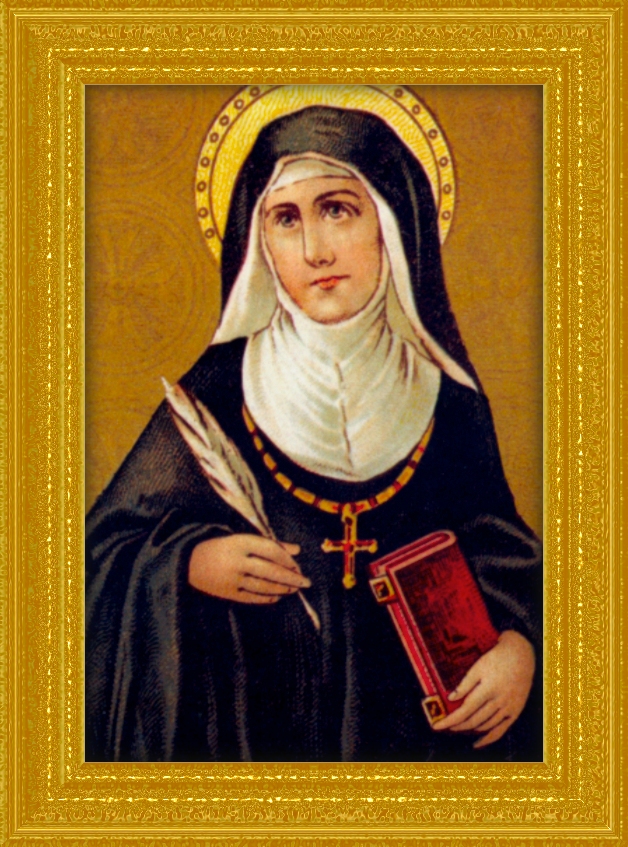
Santa Matilde di
Hackeborn (o di Helfta) Monaca
Sec. XIII
Nasce attorno al 1240 nel
castello di Helfta, in Sassonia, da una delle più delle più nobili e potenti
famiglie della Turingia, i von Hackeborn. La sorella maggiore, Gertrude, è
badessa nel convento di Helfta. All'età di sette anni Matilde viene
accolta come educanda nel monastero benedettino di Rodardsdorf. Qui la sua
vocazione cresce e la giovane decide di indossare il velo. Nel 1258 raggiunge
la sorella maggiore a Helfta dove, tre anni più tardi, le viene affidata la
cura di una giovane monaca che resterà nella storia con il nome di santa
Gertrude la Grande. Proprio a quest'ultima Matilde confesserà le proprie visioni
mistiche. Da queste confidenze nascerà poi uno dei libri più noti della mistica
medievale: il Libro della grazia speciale. Matilde, particolarmente dotata nel
canto, cura e dirige il coro del monastero e per questa sua qualità sembra che
lo stesso Dante si sia ispirato a lei per la figura di Matelda nel Purgatorio.
Muore nel monastero di Helfta nel 1298. (Avvenire)
Etimologia: Matilde =
forte in guerra, dal tedesco
Martirologio Romano: Nel
monastero di Helfta nella Sassonia in Germania, santa Mectilde, vergine, che fu
donna di squisita dottrina e umiltà, illuminata dal dono divino della
contemplazione mistica.
Nata in Germania, a Helfta (Sassonia), nel 1240 circa, Matilde è la terza figlia del barone di Hackeborn, nobile ricco e potente, imparentato con l’imperatore Federico II. La sorella maggiore Gertrude entra nel Monastero di Rodersdorf (Svizzera) e diventa badessa. La piccola Matilde, all’età di sette anni, va a trovare la sorella accompagnata dalla mamma. La bambina rimane affascinata dall’ambiente e si sente attratta fortemente dalla vita religiosa. Ammira la sorella e desidera diventare come lei. Viene, quindi, accolta nel monastero. La comunità, in seguito, si trasferisce a Helfta, nella tenuta del padre delle due sorelle.
Matilde studia, diventa molto colta. È buona, umile, ubbidiente, mite. Ha un talento particolare per il canto. La sua voce è melodiosa e incanta ed emoziona chi l’ascolta. Per questo motivo Matilde viene soprannominata “l’usignolo di Dio”. Il suo canto è, infatti, come l’armonioso cinguettio dell’uccellino. Matilde cresce amata da tutti. Viene nominata direttrice della scuola che accoglie fanciulle per la loro istruzione, ma anche del coro e delle novizie, le ragazze cioè destinate ad indossare l’abito da suora. Matilde è saggia, legge nei cuori. Aiuta le consorelle, le allieve, ma anche chi non vive nel monastero e va a farle visita per essere consigliato, consolato. Matilde ama leggere. Il suo libro preferito è il Vangelo che narra la vita di Gesù e i suoi insegnamenti. Dal Vangelo, dalla Messa, dall’Eucaristia e dalle preghiere, che compone lei stessa, Matilde trae la forza della sua fede che riesce a trasmettere a chi le vive accanto: spesso raduna attorno a sé le consorelle e le allieve e parla loro del Vangelo in maniera così appassionata, anche a gesti, da far restare tutte a bocca aperta. Si deve a Matilde l’inizio della devozione al Sacro Cuore di Gesù e al Cuore Purissimo di Maria, la Madonna.
“L’usignolo di Dio” muore nel 1298, nel Monastero di Helfta. Grazie agli
appunti, annotati dalla sua allieva Gertrude (detta “La Grande”, anche lei
santa), raccolti nel volume Il libro della grazia speciale, Matilde lascia una
bellissima testimonianza delle sue visioni di Gesù, della Madonna, dei santi e
degli angeli, che ha fin da quando è bambina, soprattutto degli insegnamenti
che da queste visioni ha ricevuto, da regalare all’umanità. Si narra che il
celebre poeta medievale Dante Alighieri (1265-1321) si sia ispirato a Santa
Matilde per scrivere alcuni versi della Divina Commedia.
Autore: Mariella
Lentini
NOME
Essendo il nome della monaca di Helfta in tedesco Mechthild o, latinizzato
Mechtildis, la prima edizione italiana delle sue visioni reca il nome di
Mettilde (1588) e l'ultima (1939) Metilde. Comunemente nelle lingue italiana,
spagnola e francese prevalse la forma Matelda (Dante), Mathilde, Matilda.
VITA
Nata nel 1241 dai nobili di Hackeborn Matilde, una delle sorelle minori di Gertrude di Hackeborn, fece con la madre una visita al monastero di Rodersdorf, diocesi di Halberstadt, dove Gertrude era già monaca. La bimba settenne fu tanto attratta dal sacro ambiente che non volle allontanarsene e chiese di esservi ammessa; le fu consentito. Dal 1251 fino al 1292 Gertrude fu badessa della comunità, che si trasferì nel 1258 a Helfta presso Eisleben. Gertrude, premurosa della formazione monastica, letteraria e spirituale delle sue figlie, ebbe nella sua capacissima sorella Matilde un grande e saggio aiuto. Matilde si distinse per la profonda umiltà, per l'innocenza e l'amabilità tanto da divenire per le consorelle e per altra gente consigliera ricercata. I Domenicani del convento di Halle avevano allora la direzione spirituale del monastero e tra loro, specialmente, il padre lettore fra Enrico di Halle, morto prima del 1294.
Per le sue doti intellettuali e artistiche, Matilde ebbe la direzione della scuola del monastero e fu nominata «cantora». La sua bella voce e il fervore nel canto le meritarono il nome di «usignuolo di Cristo». La lode di Dio era per lei l'occupazione primaria della sua Vita e l'espressione più profonda ed alta della sua esistenza. Nella recita e nel canto del divino ufficio tutta la sua anima religiosamente vibrava. Le parole fluivano dolci dalle sue labbra e spesso, durante l'ufficiatura, veniva rapita in estasi. Tutto il suo raccoglimento, la sua pietà e la sua devozione convergevano verso la liturgia, donde essa ricavava ampi lumi di contemplazione e ardente amore divino. Con diligente cura custodiva i suoi sensi infliggendosi dure penitenze e con coraggio mortificava il suo delicato corpo per compensare generosamente, dinanzi alla maestà divina, il male commesso dai peccatori.
Nonostante l'applicazione all'esercizio di tutte le virtù e nonostante i favori
ricevuti dal Signore, che la portavano alle alte vette della contemplazione e
della perfezione, essa si accusava talvolta di pigrizia e di tristezza.
Soffriva di atroci mal di testa, che negli ultimi anni (dal 1290 e più ancora
dal 1295) si aggravarono, unitamente ad altre infermità, sottoponendola a un
vero martirio. Ricevette l'Estrema Unzione il 18 ottobre1299 e morì «offrendo
il suo cuore al Salvatore e immergendolo in quello di lui» il 19 novembre 1299.
SCRITTI
Gli scritti di proprio pugno di Matilde sono soltanto alcune lettere ad una matrona. Dal 1291 in poi i racconti occasionali sulle sue esperienze spirituali furono raccolti da due consorelle, per ordine della badessa Sofia di Querfurt 1292-1303). Una di queste religiose era Gertrude (non la sorella della santa, ma una discepola di Matilde a Helfta, e anch'ella futura santa).
Quando Matilde seppe che alcune sue discepole avevano assiduamente notato tutto quello che da lei avevano appreso sui favori e sugli insegnamenti ricevuti da Dio, rimase confusa e inconsolabile; ma il Signore le assicurò che molte grazie sarebbero state elargite a quanti avessero letto quelle pagine. Allora Matilde si applicò con molta cura a rivedere il manoscritto. Lo stile di Matilde rivela una fantasia pura, feconda, capace di nobilitare ogni cosa. Anche nei fatti ordinari e negli eventi d'ogni giorno Matilde sa trovare riferimenti al «Diletto della sua anima». Lo scritto che tratta principalmente delle sue esperienze mistiche, Liber specialis gratiae, contiene, in cinque libri, la descrizione delle visioni e delle grazie ottenute durante la contemplazione. In esso sono riportati anche alcuni colloqui con il Salvatore, molte considerazioni stimolanti all'amore e alla dedizione totale a lui e squarci escatologici. Il domenicano Teodorico d'Apolda stimò grandemente il Liber specialis gratiae e lo approvò.
Ordinate secondo il ciclo dell'anno liturgico, le esposizioni matildiane
rispecchiano uno spirito trinitario e cristocentrico. Un rilievo particolare
meritano le preghiere e le pratiche della devozione al Sacro Cuore di Gesù e al
Cuore purissimo di Maria. Il Liber specialis gratiae, redatto probabilmente in
latino, documenta l'alto grado di cultura letteraria e teologica delle monache
di Helfta. L'autografo di Helfta non è conservato; sulla tradizione del testo
latino e di quello olandese medievale ha trattato minuziosamente R. Bromberg.
SPIRITUALITÀ
La spiritualità matildiana presenta in una fusione ardente e fantasiosa elementi di molteplice origine: elementi provenienti dalla regola benedettina, elementi domenicani per l'influsso dei direttori spirituali e altri, tratti dalle letture bernardine e francescane. Sopra questi vari elementi domina, come una novità nella storia della spiritualità, la «mistica di sposa» che prima di Matilde non si trova nei documenti del passato, ma che si ritroverà in seguito nelle esperienze e nelle Vitae di sante religiose fino a s. Teresa, anzi fino ai giorni nostri.
Dio ricolmò Matilde, già negli anni più teneri, di grazie segnalatissime. La familiare e fiduciosa conversazione con il Signore tuttavia non fu mai interrotta. Matilde sperimentò anche stati di desolazione che le parvero simili a pene dell'inferno. Soltanto in occasione di un'atroce sofferenza al capo che l'afflisse verso i cinquant'anni, essa parlò delle sue esperienze spirituali. Accanto all'alta contemplazione Matilde fu tentata da molteplici distrazioni e da altre debolezze. Per liberarsene ricorse a Maria S.ma mentre nei patimenti fisici, essa fu consolata dal Signore. Il solo pensiero che nella solitudine dei patimenti essa poteva darsi più tranquillamente alla preghiera era per lei un sollievo. Il suo spirito si concentrò tutto sulla lode e sull'amore di Dio: l'abbandono alla volontà di Dio è - secondo la parola di Cristo a lei diretta - la condizione per l'ineffabile letizia che riempie l'anima quando essa diventa una con Dio. Matilde paragona questa unione - come altri mistici all'assorbimento di una goccia d'acqua in un barile di vino. Nell'attiva e sentita celebrazione dell'Ufficio divino e nell'assistenza al sacrificio eucaristico, Matilde si esibiva nel canto della laus Dei.
Le visioni di Matilde si riferiscono alla S.ma Trinità, alla persona del Salvatore, alla beata Vergine Madre Maria, agli angeli e ai santi: fra questi ad Alberto Magno e a Tommaso d'Aquino, alle anime beate e del purgatorio e a quelle dannate. Di solito quando un'immagine sorgeva in lei, essa la guardava attentamente e ne ricavava una verità o una dottrina; nei casi invece di visioni intellettuali, le mancò la possibilità di esprimersi. Una meravigliosa dolcezza legata ai misteri descritti - dunque oggettiva - riempie senza turbamenti il mondo spirituale matildiano.
Nelle preghiere di petizione Matilde abbracciava - con un largo cuore - i bisogni del mondo visibile e invisibile, riunendo insieme ecclesiastici e reggitori di stato, popoli e singoli, peccatori, carcerati e anime del purgatorio. Spesso applicava l'aggettivo «augusto» a Cristo o a Maria o alle cose celesti, segno chiaro che l'idea dell'impero terreno nel suo spirito si congiungeva, viva e amorosa, con l'ordine ecclesiastico, religioso e spirituale.
Un ruolo particolare spetta a Matilde nella storia del culto al Sacro Cuore. Infatti, non solo era devotissima al Sacro Cuore, dal quale otteneva speciali grazie (donde il titolo Liber specialis gratiae), ma lei stessa divenne lo strumento provvidenziale che attrasse s. Gertrude e le altre consorelle alla devozione al Sacro Cuore. CosI tale devozione per merito di Matilde e Gertrude si manifesta per la prima volta in piena luce sul finire del sec. XIII, per avere una nuova fioritura, nel sec. XVI. I temi del Cuore di Gesti, dei suoi dolori, delle sue piaghe, della sua pena di morte e della trafittura trovarono il loro pieno coronamento nel concetto del Cuore del Salvatore glorioso, che siede alla destra del Padre, mediatore universale presso la S.ma Trinità.
Questi pensieri dalla liturgia monastica fluivano nella spiritualità matildiana e il S. Cuore concretizza per Matilde la formula liturgica Per Dominum nostrum lesum Christum: dal Sacro Cuore sgorga e prende moto la vita morale e mistica. Nella storia mariana Matilde spicca per la devozione al cuore purissimo di Maria. S. Pietro Canisio (m. nel 1597) possedeva un libriccino contenente preghiere matildiane al Sacro Cuore di Gesti. Martino da Cochem pubblicò nel 1668 un libro di preghiere delle ss. Gertrude e Matilde con aggiunta un'istruzione sulla preghiera orale.
Il Brornberg mostra la ricchezza della spiritualità matildiana
particolareggiando la presentazione in suggestivi paragrafi: cioè, 1) influssi,
fonti e carattere; 2) devozione al S. Cuore; 3) devozione all'umanità di
Cristo; 4) la mistica di sposa; 5) la devozione alla S.ma Trinità; 6)
l'Eucaristia; 7) la devozione a Maria S.ma; 8) la dottrina delle virtù; 9) la
santificazione; 10) il peccato e la confessione; 11) la devozione agli angeli.
ICONOGRAFIA
Matilde è rappresentata per lo più nell'abito dell'ordine dei cistercensi e
reca tra le mani un libro (probabilmente la sua opera: Buch besonderer Gnade)
come nella paia di altare nella chiesa di S. Gertrude di Mauterndorf (1750) e
la statua nel convento di Engelszell (1759).
CULTO
Benché non sia stata mai canonizzata, Matilde è stata venerata come santa in vari monasteri osservanti la regola di s. Benedetto. La sua festa è indicata nei martirologi il 16 febbraio e il 19 novembre.
Autore: Angelo Walz
SOURCE : http://www.santiebeati.it/dettaglio/78300
BENEDETTO XVI
UDIENZA GENERALE
Piazza San Pietro
Santa Matilde di
Hackeborn
Cari fratelli e sorelle,
oggi vorrei parlarvi di
santa Matilde di Hackeborn, una della grandi figure del monastero di Helfta,
vissuta nel XIII secolo. La sua consorella santa Gertrude la Grande, nel
VI libro dell’opera Liber specialis gratiae (Il libro della grazia
speciale), in cui vengono narrate le grazie speciali che Dio ha donato a santa
Matilde, così afferma: “Ciò che abbiamo scritto è ben poco in confronto di
quello che abbiamo omesso. Unicamente per gloria di Dio ed utilità del prossimo
pubblichiamo queste cose, perché ci sembrerebbe ingiusto serbare il silenzio,
sopra tante grazie che Matilde ricevette da Dio non tanto per lei medesima, a
nostro avviso, ma per noi e per quelli che verranno dopo di noi” (Mechthild von
Hackeborn, Liber specialis gratiae, VI, 1).
Quest’opera è stata
redatta da santa Gertrude e da un’altra consorella di Helfta ed ha una storia
singolare. Matilde, all’età di cinquant’anni, attraversava una grave crisi
spirituale, unita a sofferenze fisiche. In questa condizione confidò a due
consorelle amiche le grazie singolari con cui Dio l’aveva guidata fin
dall’infanzia, ma non sapeva che esse annotavano tutto. Quando lo venne a
conoscere, ne fu profondamente angosciata e turbata. Il Signore, però, la
rassicurò, facendole comprendere che quanto veniva scritto era per la gloria di
Dio e il vantaggio del prossimo (cfr ibid., II,25; V,20). Così,
quest’opera è la fonte principale a cui attingere le informazioni sulla vita e
spiritualità della nostra Santa.
Con Lei siamo introdotti
nella famiglia del Barone di Hackeborn, una delle più nobili, ricche e potenti
della Turingia, imparentata con l’imperatore Federico II, ed entriamo nel
monastero di Helfta nel periodo più glorioso della sua storia. Il Barone aveva
già dato al monastero una figlia, Gertrude di Hackeborn (1231/1232 -
1291/1292), dotata di una spiccata personalità, Badessa per quarant’anni,
capace di dare un’impronta peculiare alla spiritualità del monastero,
portandolo ad una fioritura straordinaria quale centro di mistica e di cultura,
scuola di formazione scientifica e teologica. Gertrude offrì alle monache
un’elevata istruzione intellettuale, che permetteva loro di coltivare una
spiritualità fondata sulla Sacra Scrittura, sulla Liturgia, sulla tradizione
Patristica, sulla Regola e spiritualità cistercense, con particolare
predilezione per san Bernardo di Chiaravalle e Guglielmo di St-Thierry. Fu
una vera maestra, esemplare in tutto, nella radicalità evangelica e nello zelo
apostolico. Matilde, fin dalla fanciullezza, accolse e gustò il clima spirituale
e culturale creato dalla sorella, offrendo poi la sua personale impronta.
Matilde nasce nel 1241 o
1242 nel castello di Helfta; è la terza figlia del Barone. A sette anni con la
madre fa visita alla sorella Gertrude nel monastero di Rodersdorf. È così affascinata
da quell’ambiente che desidera ardentemente farne parte. Vi entra come educanda
e nel 1258 diventa monaca nel convento trasferitosi, nel frattempo, ad Helfta,
nella tenuta degli Hackeborn. Si distingue per umiltà, fervore, amabilità,
limpidezza e innocenza di vita, familiarità e intensità con cui vive il
rapporto con Dio, la Vergine, i Santi. È dotata di elevate qualità naturali e
spirituali, quali “la scienza, l’intelligenza, la conoscenza delle lettere
umane, la voce di una meravigliosa soavità: tutto la rendeva adatta ad essere
per il monastero un vero tesoro sotto ogni aspetto” (Ibid., Proemio).
Così, “l’usignolo di Dio” – come viene chiamata – ancora molto giovane, diventa
direttrice della scuola del monastero, direttrice del coro, maestra delle
novizie, servizi che svolge con talento e infaticabile zelo, non solo a
vantaggio delle monache, ma di chiunque desiderava attingere alla sua sapienza
e bontà.
Illuminata dal dono
divino della contemplazione mistica, Matilde compone numerose preghiere. È
maestra di fedele dottrina e di grande umiltà, consigliera, consolatrice, guida
nel discernimento: “Ella - si legge - distribuiva la dottrina con tanta
abbondanza che non si è mai visto nel monastero, ed abbiamo, ahimé! gran
timore, che non si vedrà mai più nulla di simile. Le suore si riunivano intorno
a lei per sentire la parola di Dio, come presso un predicatore. Era il rifugio
e la consolatrice di tutti, ed aveva, per dono singolare di Dio, la grazia di
rivelare liberamente i segreti del cuore di ciascuno. Molte persone, non solo
nel Monastero, ma anche estranei, religiosi e secolari, venuti da lontano,
attestavano che questa santa vergine li aveva liberati dalle loro pene e che
non avevano mai provato tanta consolazione come presso di lei. Compose inoltre
ed insegnò tante orazioni che se venissero riunite, eccederebbero il volume di
un salterio” (Ibid., VI,1).
Nel 1261 giunge al
convento una bambina di cinque anni di nome Gertrude: è affidata alle cure di
Matilde, appena ventenne, che la educa e la guida nella vita spirituale fino a
farne non solo la discepola eccellente, ma la sua confidente. Nel 1271 o 1272
entra in monastero anche Matilde di Magdeburgo. Il luogo accoglie, così,
quattro grandi donne - due Gertrude e due Matilde –, gloria del monachesimo
germanico. Nella lunga vita trascorsa in monastero, Matilde è afflitta da
continue e intense sofferenze a cui aggiunge le durissime penitenze scelte per
la conversione dei peccatori. In questo modo partecipa alla passione del
Signore fino alla fine della vita (cfr ibid., VI, 2). La preghiera e la
contemplazione sono l’humus vitale della sua esistenza: le rivelazioni, i
suoi insegnamenti, il suo servizio al prossimo, il suo cammino nella fede e
nell’amore hanno qui la loro radice e il loro contesto. Nel primo libro
dell’opera Liber specialis gratiae, le redattrici raccolgono le confidenze
di Matilde scandite nelle feste del Signore, dei Santi e, in modo speciale,
della Beata Vergine. E’ impressionante la capacità che questa Santa ha di
vivere la Liturgia nelle sue varie componenti, anche quelle più semplici,
portandola nella vita quotidiana monastica. Alcune immagini, espressioni,
applicazioni talvolta sono lontane della nostra sensibilità, ma, se si
considera la vita monastica e il suo compito di maestra e direttrice di coro,
si coglie la sua singolare capacità di educatrice e formatrice, che aiuta le
consorelle a vivere intensamente, partendo dalla Liturgia, ogni momento della
vita monastica.
Nella preghiera liturgica
Matilde dà particolare risalto alle ore canoniche, alla celebrazione della
santa Messa, soprattutto alla santa Comunione. Qui è spesso rapita in estasi in
una intimità profonda con il Signore nel suo ardentissimo e dolcissimo Cuore,
in un dialogo stupendo, nel quale chiede lumi interiori, mentre intercede in
modo speciale per la sua comunità e le sue consorelle. Al centro vi sono i
misteri di Cristo verso i quali la Vergine Maria rimanda costantemente per
camminare sulla via della santità: “Se tu desideri la vera santità, sta’ vicino
al Figlio mio; Egli è la santità medesima che santifica ogni cosa” (Ibid.,
I,40). In questa sua intimità con Dio è presente il mondo intero, la Chiesa, i
benefattori, i peccatori. Per lei Cielo e terra si uniscono.
Le sue visioni, i suoi
insegnamenti, le vicende della sua esistenza sono descritti con espressioni che
evocano il linguaggio liturgico e biblico. Si coglie così la sua profonda
conoscenza della Sacra Scrittura, che era il suo pane quotidiano. Vi ricorre
continuamente, sia valorizzando i testi biblici letti nella liturgia, sia
attingendo simboli, termini, paesaggi, immagini, personaggi. La sua
predilezione è per il Vangelo: “Le parole del Vangelo erano per lei un alimento
meraviglioso e suscitavano nel suo cuore sentimenti di tale dolcezza che sovente
per l'entusiasmo non poteva terminarne la lettura … Il modo con cui leggeva
quelle parole era così fervente che in tutti suscitava la devozione. Così pure,
quando cantava in coro, era tutta assorta in Dio, trasportata da tale ardore
che talvolta manifestava i suoi sentimenti con i gesti ... Altre volte, come
rapita in estasi, non sentiva quelli che la chiamavano o la muovevano ed a mala
pena riprendeva il senso delle cose esteriori” (Ibid., VI, 1). In una delle
visioni, è Gesù stesso a raccomandarle il Vangelo; aprendole la piaga del suo
dolcissimo Cuore, le dice: “Considera quanto sia immenso il mio amore: se
vorrai conoscerlo bene, in nessun luogo lo troverai espresso più chiaramente
che nel Vangelo. Nessuno ha mai sentito esprimere sentimenti più forti e più
teneri di questi: Come mi ha amato mio Padre, cosi io vi ho amati (Joan.
XV, 9)”(Ibid., I,22).
Cari amici, la preghiera
personale e liturgica, specialmente la Liturgia delle Ore e la Santa Messa sono
alla radice dell’esperienza spirituale di santa Matilde di Hackeborn.
Lasciandosi guidare dalla Sacra Scrittura e nutrire dal Pane eucaristico, Ella
ha percorso un cammino di intima unione con il Signore, sempre nella piena
fedeltà alla Chiesa. E’ questo anche per noi un forte invito ad intensificare la
nostra amicizia con il Signore, soprattutto attraverso la preghiera quotidiana
e la partecipazione attenta, fedele e attiva alla Santa Messa. La Liturgia è
una grande scuola di spiritualità.
La discepola Gertrude
descrive con espressioni intense gli ultimi momenti della vita di santa Matilde
di Hackeborn, durissimi, ma illuminati dalla presenza della Beatissima Trinità,
del Signore, della Vergine Maria, di tutti i Santi, anche della sorella di
sangue Gertrude. Quando giunse l’ora in cui il Signore volle attirarla a Sé,
ella Gli chiese di poter ancora vivere nella sofferenza per la salvezza delle
anime e Gesù si compiacque di questo ulteriore segno di amore.
Matilde aveva 58 anni.
Percorse l’ultimo tratto di strada caratterizzato da otto anni di gravi
malattie. La sua opera e la sua fama di santità si diffusero ampiamente. Al
compimento della sua ora, “il Dio di Maestà … unica soavità dell'anima che lo
ama … le cantò:Venite vos, benedicti Patris mei ... Venite, o voi che
siete i benedetti dal Padre mio, venite a ricevere il regno … e l'associò
alla sua gloria” (Ibid., VI,8).
Santa Matilde di
Hackeborn ci affida al Sacro Cuore di Gesù e alla Vergine Maria. Invita a
rendere lode al Figlio con il Cuore della Madre e a rendere lode a Maria con il
Cuore del Figlio: “Vi saluto, o Vergine veneratissima, in quella dolcissima
rugiada, che dal Cuore della santissima Trinità si diffuse in voi; vi saluto
nella gloria e nel gaudio con cui ora vi rallegrate in eterno, voi che di
preferenza a tutte le creature della terra e del cielo, foste eletta prima
ancora della creazione del mondo! Amen” (Ibid., I, 45).
Saluti:
Je suis heureux
d’accueillir ce matin les francophones présents, en particulier ceux venus
d’Haïti. Je continue à porter les Haïtiens dans ma prière suppliant Dieu de
soulager leur misère. Que votre pèlerinage à Rome, chers pèlerins, soit pour
vous tous l’occasion d’approfondir votre relation personnelle avec le Christ. Que
Dieu vous bénisse!
I am pleased to greet the
seminarians and staff from the Venerable English College and the new students
and staff from the Pontifical Irish College, and I offer prayerful good wishes
for their studies. I also welcome the members of the Christ Child Society from
the Diocese of Toledo, Ohio, accompanied by Bishop Leonard Blair. Upon all the
English-speaking visitors present at today’s audience, especially the pilgrim
groups from Britain, Ireland, Denmark, Nigeria, Oceania, the Philippines, and
North America, I invoke God’s abundant blessings.
Ganz herzlich grüße ich
die Pilger deutscher Sprache, besonders die Wallfahrer des
Malteserhilfsdienstes aus Österreich. Herzlich willkommen! Mögen euch viele
schöne Stunden hier in Rom geschenkt sein, die ihr als innere Gabe und Kraft
nach Hause mitnehmt! Zudem ist aus den Niederlanden heute eine große
Pilgergruppe des Bistums Rotterdam mit ihrem Bischof Adrian van Luyn zugegen.
Herzlich willkommen! Die hl. Mechthild will uns ein Vorbild sein, im Gebet mit
Gott verbunden zu bleiben und so den Alltag zu heiligen. Der Herr begleite
euch auf allen euren Wegen
Saludo a los peregrinos
de lengua española, en particular a la Delegación de la Junta de Castilla y
León, de España, y a la de la Escuela de Carabineros, de Santiago de Chile, así
como a los demás grupos provenientes de España, México, Panamá, y demás países
latinoamericanos. Que el ejemplo de Santa Matilde nos mueva a todos a
considerar la Liturgia como una gran escuela de espiritualidad.
Muchas gracias.
Saúdo, com fraterna
amizade, os peregrinos vindos de Portugal e de demais países de língua
portuguesa, cuja romagem se detém hoje junto do túmulo de São Pedro e nesta
Audiência com o seu Sucessor: Obrigado pela vossa presença e oração! Peço a
Cristo Senhor que guarde no seu Coração Sagrado as vossas famílias e
comunidades cristãs, abençoando a todos com a sua paz e o seu amor.
Saluto in lingua lituana:
Nuoširdžiai sveikinu
ministrantus iš Lietuvos. Sekdami šventojo Tarcizijaus pavyzdžiu dosniai
tarnaukite Jėzui, esančiam Eucharistijoje.
Traduzione italiana:
Saluto con affetto i
ministranti provenienti dalla Lituania. Sull’esempio di san Tarcisio, servite
con generosità Gesù, presente nell’Eucaristia.
Saluto in lingua ceca:
Upřímně vítám poutníky z
farnosti svaté Ludmily v Praze!
Včera jsme oslavili
patrona české církve, mučedníka svatého Václava. Zůstaňte vždy věrni duchovnímu
odkazu tohoto velikána dějin vaší vlasti!
Srdečně vám žehnám.
Chvála Kristu!
Traduzione italiana:
Un cordiale benvenuto ai
pellegrini della parrocchia di Santa Ludmilla, di Praga!
Ieri abbiamo festeggiato
il Patrono della Chiesa Ceca, San Venceslao, martire. Rimanete sempre fedeli
all'eredità spirituale di questo gigante della storia della vostra Patria!
Di cuore vi benedico.
Sia lodato Gesù Cristo!
Saluto in lingua
slovacca:
Srdečne pozdravujem
slovenských pútnikov zo Širokého a Košíc ako aj ďakovnú púť študentov a
pedagógov Grécko-katolíckeho gymnázia svätého Jána Krstiteľa z Trebišova.
Bratia a sestry, pozajtra
sa začína mariánsky mesiac október. Pozývam vás do školy Panny z Nazareta. Učte
sa od nej byť stále ochotní plniť Božiu vôľu. S láskou žehnám vás i vašich
drahých.
Pochválený buď Ježiš
Kristus!
Traduzione italiana :
Saluto cordialmente i
pellegrini slovacchi provenienti da Široké e Košice come pure il pellegrinaggio
di ringraziamento degli studenti e docenti del Ginnasio greco-cattolico San
Giovanni Battista di Trebišov.
Fratelli e sorelle,
dopodomani inizia il mese mariano di ottobre. Vi invito a mettervi alla scuola
della Vergine di Nazaret. Imparate da Lei ad essere sempre disponibili a
compiere la volontà di Dio. Con affetto benedico voi ed i vostri cari.
Sia lodato Gesù Cristo!
Saluto in lingua romena:
Adresez un cordial salut
pelerinilor provenind din România. Iubţi prieteni, urez ca vizita voastră la
mormintele Apostolilor să suscite în voi o angajare tot mai generoasă de
mărturie creştină în Patria voastră. Invoc peste voi şi familiile voastre
binecuvântarea mea apostolică. Lăudat să fie Isus Cristos!
Traduzione italiana:
Rivolgo un cordiale
saluto ai pellegrini provenienti dalla Romania. Cari amici, auguro che la
visita alle tombe degli Apostoli susciti in voi un sempre più generoso impegno
di testimonianza cristiana nella vostra Patria. Invoco su di voi e sulle vostre
famiglie la mia benedizione apostolica. Sia lodato Gesù Cristo!
Saluto in lingua ucraina:
Щиро вітаю українських
прочан. Дорогі друзі, бажаю, щоб кожний із вас відчув живу присутність Бога у
своїй Церкві. Від щирого вас благословлю. Слава Ісусу Христу!
Traduzione italiana:
Rivolgo un cordiale
saluto ai pellegrini ucraini. Cari amici, auguro che ciascuno di voi possa fare
l’esperienza della presenza viva del Signore nella sua Chiesa. Di cuore vi
benedico. Sia lodato Gesù Cristo!
Saluto in lingua
ungherese:
Isten hozta a magyar
híveket, különösen is azokat, akik Pécsről érkeztek. Kedves Testvéreim, Szent
Mihály, Gábor és Ráfáel Arkangyalok közbenjárását kérve szívesen adom apostoli
áldásomat Rátok és családjaitokra.
Dicsértessék a Jézus
Krisztus!
Traduzione italiana:
Saluto con affetto i
fedeli ungheresi, specialmente quelli che sono arrivati da Pécs.
Cari fratelli e sorelle,
mentre chiedo l'intercessione dei Santi Arcangeli Michele, Gabriele e Raffaele,
volentieri imparto la Benedizione Apostolica a tutti voi e alle vostre
famiglie.
Sia lodato Gesù Cristo!
Saluto in lingua polacca:
Słowo pozdrowienia
kieruję do Polaków, a zwłaszcza do przedstawicielek Zgromadzenia Sióstr
Zmartwychwstania Pańskiego, które gromadzą się na kapitule generalnej. Niech
modlitwa i refleksja przyniesie obfite owoce duchowe. Wszystkich tu obecnych
polecam opiece Archaniołów Michała, Gabriela i Rafała, patronów dnia
dzisiejszego, i z serca błogosławię. Niech będzie pochwalony Jezus Chrystus!
Traduzione italiana:
Una parola di saluto
rivolgo ai polacchi qui presenti, e in particolare alle rappresentanti della
Congregazione della Suore della Risurrezione del Signore che si radunano per il
Capitolo Generale. La preghiera e la riflessione portino abbondanti frutti
spirituali. Raccomando tutti alla protezione degli Arcangeli Michele, Gabriele
e Raffaele, patroni del giorno, vi benedico di cuore. Sia lodato Gesù Cristo!
Saluto in lingua croata:
Upućujem srdačan pozdrav
svim hrvatskim hodočasnicima, a na poseban način vjernicima iz župe Svetog Luke
iz Zagreba. Po zagovoru svetih Arkanđela koje danas slavimo, obdario Gospodin
vas i vaše obitelji mirom i svakim nebeskim blagoslovom. Hvaljen Isus i
Marija!
Traduzione italiana:
Rivolgo un cordiale
saluto a tutti i pellegrini croati, e in modo particolare ai fedeli della
parrocchia di San Luca di Zagabria. Con l’intercessione dei santi Arcangeli che
oggi celebriamo, il Signore doni a voi e alle vostre famiglie la pace e ogni
benedizione celeste. Siano lodati Gesù e Maria!
* * *
Rivolgo un cordiale
pensiero ai pellegrini di lingua italiana. In particolare saluto con affetto i
fedeli della diocesi di Belluno-Feltre, accompagnati dal loro Pastore, Mons.
Giuseppe Andrich, e convenuti a Roma per pregare sulla tomba del Servo di
Dio Giovanni
Paolo I in occasione dell’anniversario della sua morte. Saluto
gli alunni del Pontificio Collegio Internazionale “Maria Mater Ecclesiae”di
Roma, assicurando per ciascuno un ricordo nella preghiera, perché il
Signore li ricolmi sempre dei suoi doni di grazia. Saluto, inoltre, i
partecipanti al pellegrinaggio dei Giovani del Movimento dei Focolari, promosso
in occasione della beatificazione di Chiara Badano e li invito, sull'esempio
della nuova Beata, a proseguire nell'impegno di adesione a Cristo e di
testimonianza evangelica.
Saluto infine i giovani,
gli ammalati e gli sposi novelli. L'odierna festa degli
Arcangeli Michele, Gabriele e Raffaele e quella imminente dei santi Angeli
Custodi, ci spingono a pensare alla provvida premura con cui Dio si occupa di
ogni persona umana. Sentite accanto a voi, cari giovani, la presenza degli
Angeli e lasciatevi guidare da loro, affinché tutta la vostra vita sia
illuminata dalla Parola di Dio. Voi, cari ammalati, aiutati dai vostri
Angeli Custodi, unite le vostre sofferenze a quelle di Cristo per il
rinnovamento spirituale dell'umana società. E voi, cari sposi novelli,
ricorrete sovente all'aiuto dei vostri Angeli Custodi, affinché possiate
crescere nella costante testimonianza di un amore autentico.
APPELLO DEL SANTO PADRE
My thoughts also turn to
the grave humanitarian crisis which has recently struck Northern Nigeria, where
some two million people have been forced to flee their homes because of severe
flooding. To all those affected I express my spiritual closeness and I assure
them of my prayers.
© Copyright - Libreria
Editrice Vaticana
SOURCE : http://w2.vatican.va/content/benedict-xvi/it/audiences/2010/documents/hf_ben-xvi_aud_20100929.html
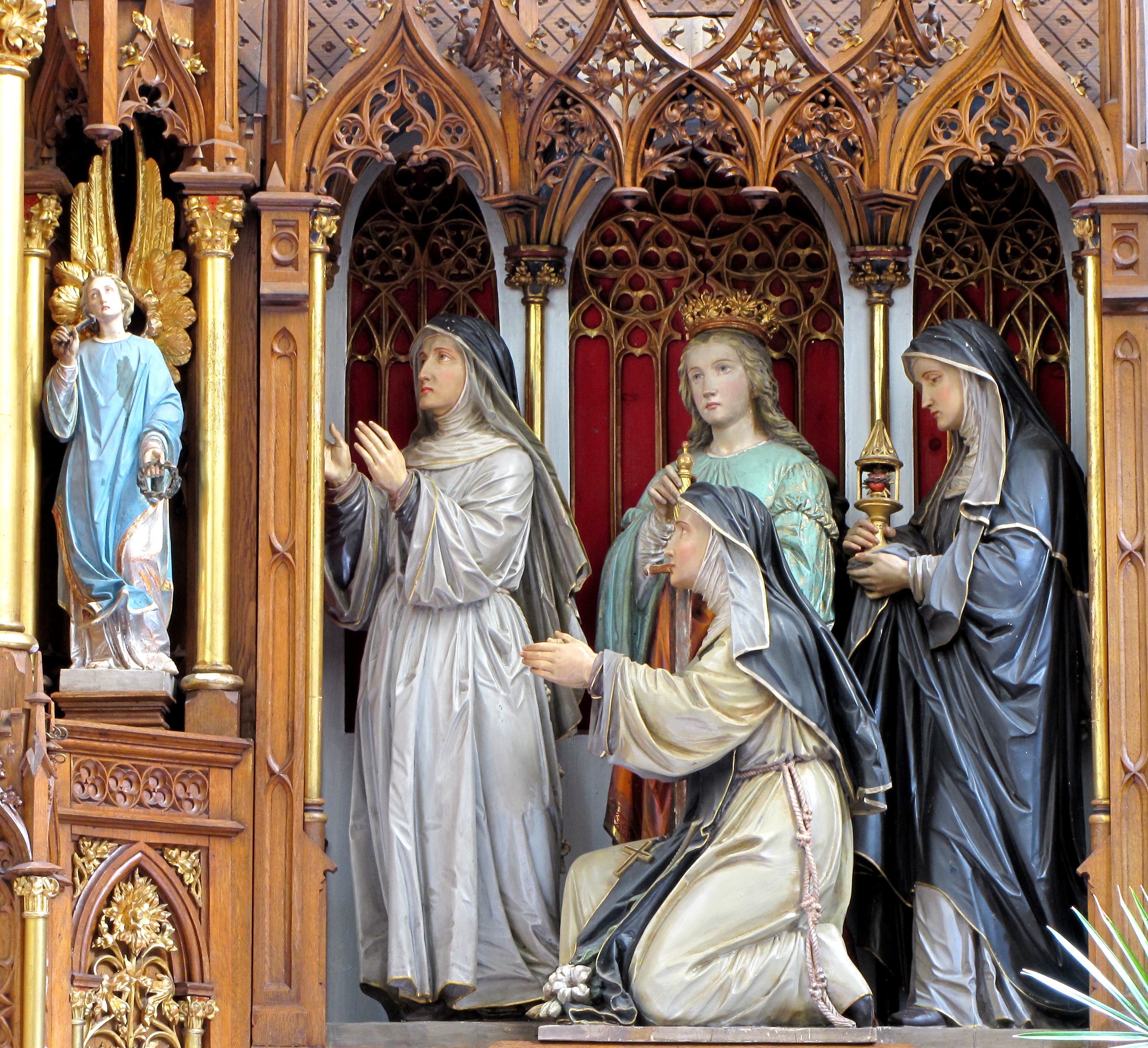
Den hellige Mechthild av
Helfta (av Hackeborn) (1241-1298)
Minnedag:
19. november
Skytshelgen mot blindhet
Den hellige Mechthild
(Mechtilde, Mechtild, Mathilda; lat: Mathildis) ble født rundt 1241 i Helfta i
Thüringen i Tyskland. Hun kom fra en av de ledende familiene i Thüringen. Noen
har trodd at Mechthild av Hackeborn og Mechthild av Wippra var to forskjellige
personer, men baronene av Hackeborn var også grever av Wippra, og det var
vanlig at medlemmer av familien tok et av disse navnene (eller begge).
Da Mechthild var syv år
gammel, var hun med moren på besøk hos den mye eldre søsteren Gjertrud, som da
var nonne i klosteret Rodersdorf. Jenta ble så begeistret for nonnenes fromme
liv at hun nektet å forlate klosteret. På hennes innstendige bønner ga
foreldrene sin tillatelse til å etterlate henne i den eldre søsterens varetekt
for å få sin utdannelse der. Gjertrud ga lillesøsteren en streng klosterlig
oppdragelse, som inkluderte både boklig lærdom og manuelt arbeid. Så snart
Mechthild hadde blitt gammel nok, ble hun selv benediktinernonne (Ordo
Sancti Benedicti – OSB) i Rodersdorf. Søsteren Gjertrud ble valgt til
abbedisse i 1251, bare 19 år gammel.
Rundt 1258 flyttet
abbedisse Gjertrud og hele kommuniteten til klosteret Helfta ved Eisleben i
Sachsen, som lå på land gitt av hennes brødre Ludvig og Albert. Den 18-årige
Mechthild fulgte med henne dit og avla løftene der. I det nye klosteret fikk
Mechthild ansvaret for å ta seg av barn som ble sendt til klosteret for
utdannelse, og på grunn av sin vakre sangstemme ble hun også sjefskantor (domna
cantrix) og lærer i gregoriansk sang og kordirigent. Medsøstrene kalte
henne «Kristi nattergal». Som hun senere skrev i sine «åpenbaringer» la hun
større vekt på sangens brennende hengivenhet enn på skolerte stemmer.
I Helfta fantes allerede
en annen, noen år yngre jente som skulle bli en av middelalderens store
helgener og mystikere, den hellige Gjertrud av Helfta,
som ettertiden skulle kalle «den Store». Så snart Gjertrud var gammel nok, ble
hun selv nonne i Helfta. Mechthild ble hennes novisemester, veileder og venn.
Gjertrud fikk en fortreffelig utdannelse og lærte latin, men hun hadde aldri
noe verv i kommuniteten, og hennes liv var ytre sett begivenhetsløst. I dette
klosteret virket tre hellige kvinner på 1200-tallet; foruten Gjertrud og
Mechthild av Hackeborn også den salige Mechthild av
Magdeburg.
Som Gjertrud hadde også
Mechthild en dyp andakt for Jesu hellige Hjerte, flere århundrer før denne
andakten ble allment utbredt i vide kretser i Kirken. Mange av invokasjonene i
litaniet for Jesu Hjerte er tatt fra Mechthilds bøker. Sine visjoner og de
nådebevisningene hun hadde fått, avslørte hun først mye senere, da hennes
søster abbedissen var død og hun selv i 50-årsalderen ble rammet av sykdom. To
av hennes medsøstre – den ene var Gjertrud den Store – nedtegnet alt hun
fortalte om sine åndelige opplevelser. Slik oppsto Liber specialis gratiae,
«Boken om den store nåden», et av middelaldermystikkens vakreste og mest
berømte verk.
Mange av Gjertrud den
Stores åndelige erfaringer er beskrevet i en skriftsamling som kalles Legatus
Divinae Pietatis, «Guds kjærlighets sendebud», men er mer kjent som «Gjertruds
og Mechthilds åpenbaringer». Samlingen består av fem bøker, blant dem «Bønner»
og «Åndelige øvelser». Gjertruds union med Kristus var så intens at Jesus sa
til Mechthild: «Hvis du ønsker å finne meg, se etter meg i Gjertruds hjerte».
Mechthild døde en stille
død på slutten av 1200-tallet, men vi vet ikke nøyaktig hvilket år.
Tradisjonelt angis 19. november 1298 som hennes dødsdato, men 1278 og 1299
nevnes også. Hennes åndelige bøker ble spredt sammen med ryktet om hennes
hellighet over hele Europa. Boccaccio vitner om at hennes verk allerede på
1300-tallet var oversatt til italiensk, og at hennes bok «Om den store nåden» i
Firenze var kjent under navnet «Fru Matildas lov» (La Laude di donna
Matelda). Gjertrud den Store skrev om Mechthild: «Det har aldri før vært noen
som henne i vårt kloster, og jeg frykter at det vil det heller aldri bli
igjen».
Mechthild ble aldri
formelt helligkåret, men hennes minnedag er dødsdagen 19. november, men 16.
november nevnes også. I mange benediktiner- og cistercienserklostre feires hun
også den 26. februar, siden 19. november er festen for den hellige Elisabeth av Ungarn (av
Thüringen). Hun fremstilles i cistercienserdrakt, som attributt har hun oftest
bok hvor det sitter en due. Ofte avbildes miraklet da hun ga en blind nonne
synet tilbake. Hennes navn er også populært i Frankrike og England som Maud.
Kilder: Attwater/John, Attwater/Cumming, Butler (XI), Benedictines, Bunson, Engelhart, Schauber/Schindler, Melchers, Dammer/Adam, KIR, CE, CSO, Patron Saints SQPN, Infocatho, Bautz, Heiligenlexikon - Kompilasjon og oversettelse: p. Per Einar Odden - Sist oppdatert: 2004-04-08 00:34
SOURCE : https://www.katolsk.no/biografier/historisk/mhelfta
SAINTE MECHTILDE. LE LIVRE DE LA GRÂCE SPÉCIALE. RÉVÉLATIONS de SAINTE MECHTILDE VIERGE DE L'ORDRE DE SAINT-BENOIT traduites de l'édition latine des Pères dominicains de Solesmes, Maison Alfred Mame et Fils, Tours & Paris 1921 : http://livres-mystiques.com/partieTEXTES/Ste_Mechtilde/table.htm
