
Maestranze bizantine, Maria Vergine, mosaico; Istanbul, Hagia Sofia: l'iscrizione in greco (ΜΡ ΘΥ) la indica come Madre di Dio
MESSE EN LA SOLENNITÉ DE SAINTE MARIE MÈRE DE DIEU
XLVIIe JOURNÉE
MONDIALE DE LA PAIX
HOMÉLIE DU PAPE FRANÇOIS
Basilique vaticane
Mercredi 1er janvier 2014
La première lecture nous
a proposé à nouveau l’ancienne prière de bénédiction que Dieu avait suggérée à
Moïse pour qu’il l’enseigne à Aaron et à ses fils : « Que le Seigneur te
bénisse et te garde ! Que le Seigneur fasse briller sur toi son visage, qu’il se
penche vers toi! Que le Seigneur tourne vers toi son visage, qu’il t’apporte la
paix ! »(Nb 6, 24-25). Il est ô combien significatif de réécouter ces
paroles de bénédiction au début d’une année nouvelle : elles accompagneront
notre chemin pour le temps qui s’ouvre devant nous. Ce sont des paroles de
force, de courage, d’espérance. Non pas une espérance illusoire, basée sur de
fragiles promesses humaines, ni une espérance naïve qui imagine un avenir
meilleur seulement parce qu’il est l’avenir. Cette espérance a sa raison dans
la bénédiction de Dieu, une bénédiction qui contient le souhait le plus grand,
le souhait de l’Église pour chacun de nous, souhait rempli de toute la
protection affectueuse du Seigneur, de son aide providentielle.
Le souhait contenu dans
cette bénédiction s’est réalisé pleinement en une femme, Marie, en tant que
destinée à devenir la Mère de Dieu, et il s’est réalisé en elle avant toute
créature.
Mère de Dieu ! C’est le
titre principal et essentiel de la Vierge. Il s’agit d’une qualité, d’un rôle
que la foi du peuple chrétien, dans sa tendre et naïve dévotion pour la maman
du ciel, a perçu depuis toujours.
Rappelons-nous ce grand
moment de l’histoire de l’Église antique, le Concile d’Éphèse, au cours duquel
fut définie avec autorité la maternité divine de la Vierge. La vérité sur la
maternité divine de Marie trouva écho à Rome où, peu de temps après, fut
construite la Basilique Sainte-Marie-Majeure, premier sanctuaire marial de Rome
et de tout l’Occident, où on vénère l’image de la Mère de Dieu – la Theotokos –
sous le titre de Salus populi romani. On raconte que, pendant le Concile,
les habitants d’Éphèse se rassemblèrent devant la porte de la Basilique où se
réunissaient les évêques et crièrent : « Mère de Dieu ! » Les fidèles,
demandant de définir officiellement ce titre de la Vierge, montraient en
reconnaître la divine maternité. C’est l’attitude spontanée et sincère des
enfants qui connaissent bien leur Mère, parce qu’ils l’aiment d’une immense
tendresse. Mais il y a plus, c’est le sensus fidei du saint peuple
fidèle de Dieu, qui jamais, dans son unité, jamais ne se trompe.
Marie est depuis toujours
présente dans le cœur, dans la dévotion et surtout sur le chemin de foi du
peuple chrétien. « L’Église marche au cours du temps… et sur ce chemin elle
progresse en suivant l’itinéraire accompli par la Vierge Marie » (Jean Paul II,
Enc. Redemptoris
Mater, n. 2). Notre itinéraire de foi est le même que celui de Marie, c’est
pourquoi nous la sentons particulièrement proche de nous ! Concernant la foi,
qui est le pivot de la vie chrétienne, la Mère de Dieu a partagé notre
condition, elle a dû marcher sur les mêmes routes que nous parcourons, parfois
difficiles et obscures, elle a du avancer dans le «pèlerinage de la foi »
(Conc. Œcum. Vat. II, Const. Lumen
gentium, n. 58).
Notre chemin de foi est
lié de manière indissoluble à Marie depuis que Jésus, mourant sur la croix,
nous l’a donnée pour Mère en disant :« Voici ta mère ! » (Jn 19, 27). Ces
paroles ont la valeur d’un testament et donnent au monde une Mère. Depuis ce
moment, la Mère de Dieu est devenue aussi notre Mère ! Au moment où la foi des
disciples était fissurée par tant de difficultés et d’incertitudes, Jésus les
confiait à Celle qui avait été la première à croire, et en qui la foi n’a
jamais faibli. Et la « femme » devient notre Mère au moment où elle perd son
divin Fils. Son cœur blessé se dilate pour faire place à tous les hommes, bons
et mauvais, tous, et elle les aime comme elle aimait Jésus. La femme qui, aux
noces de Cana en Galilée, avait coopéré par la foi à la manifestation des
merveilles de Dieu dans le monde, au calvaire tient allumée la flamme de la foi
en la résurrection du Fils, et elle la communique aux autres avec une affection
maternelle. Marie devient ainsi source d’espérance et de vraie joie !
La Mère du Rédempteur
nous précède et sans cesse nous confirme dans la foi, dans la vocation et dans
la mission. Par son exemple d’humilité et de disponibilité à la volonté de Dieu
elle nous aide à traduire notre foi en annonce joyeuse et sans frontières de
l’Évangile. Ainsi notre mission sera féconde, parce que modelée sur la
maternité de Marie. Confions lui notre itinéraire de foi, les désirs de notre
cœur, nos nécessités, les besoins du monde entier, spécialement la faim et la
soif de justice et de paix et de Dieu ; et invoquons-la tous ensemble, et je vous
invite à l’invoquer par trois fois, en imitant ces frères d’Éphèse, lui disant
: Mère de Dieu ! Mère de Dieu ! Mère de Dieu ! Amen.
Copyright © Dicastère
pour la Communication

Pedro Roldán, Pura y Limpia Concepción, vers
1680, Séville
Sainte Marie, Mère de
Dieu
Prières
Vierge très sainte et
immaculée, ma Mère, ô Marie, à vous qui êtes la Mère de mon Seigneur, le refuge
des pécheurs, j'ai recours à vous aujourd'hui, moi, le plus misérable de tous.
Je vous vénère, ô grande Reine, et je vous remercie de toutes les grâces que
vous m'avez faites jusqu'ici, spécialement de m'avoir délivré de l'enfer, que
j'ai si souvent mérité. Je vous aime, ô ma Souveraine très aimable, et pour
votre amour, je m'engage à vous servir toujours, et à faire tous mes efforts
pour que vous soyez aussi aimée par les autres. Je place en vous toutes mes
espérances, tout mon salut. Agréez moi pour votre serviteur, et recevez-moi
sous votre protection, ô Mère des miséricordes. Et puisque vous êtes si
puissante auprès de Dieu, délivrez-moi de toutes les tentations ou obtenez-moi
la force de les vaincre jusqu'à la mort. O ma Mère, par l'amour que vous portez
à Dieu, je vous prie de m'assister toujours, mais surtout au dernier moment de
ma vie. Ne m'abandonnez point que vous ne me voyez en sûreté au ciel, occupé à
vous bénir et à chanter vos miséricordes pendant toute l'éternité. Ainsi je
l'espère.
***
O Jésus, vivant en Marie,
venez et vivez en votre serviteur,
dans votre esprit de
sainteté, dans la plénitude de votre puissance,
dans la perfection de vos
voies, dans la vérité de vos vertus,
dans la communion de vos
divins mystères ;
dominez toute puissance
ennemie dans votre Esprit,
à la gloire du Père.
Saint Alphonse-Marie de Ligori
Souvenez-vous, ô très miséricordieuse Vierge Marie, qu'on n'a jamais entendu
dire qu'aucun de ceux qui ont eu recours à votre protection, imploré votre
assistance et réclamé votre secours, ait été abandonné. Animé d'une pareille
confiance, ô Vierge des vierges, ô ma Mère, j'accours vers vous, et gémissant
sous le poids de mes péchés, je me prosterne à vos pieds. O Mère du Verbe
Incarné, ne méprisez pas mes prières, mais écoutez-les favorablement et daignez
les exaucer.
Jean-Jacques Olier
***
Historique
Alors que de nombreux
hérésiarques, dès les premiers siècles de l'Eglise, avaient mis en doute la
divinité du Christ, il fallut, au siècle qui suivit celui d'Arius, que d'autres
missent en doute son humanité. Ainsi, Apollinaire, un des plus farouches
adversaires de l'arianisme, s'écria-t-il : A quoi bon une âme d'homme entre le
Verbe de Dieu et la chair qu'il daigne revêtir et vivifier pour notre salut ?
Il peut bien directement mouvoir cette chair et par elle accomplir la
rédemption du monde. N'est-ce pas en ce sens que saint Jean dit nettement que
le Verbe s'est fait chair (Evangile selon saint Jean I 14) ?
Sous la présidence de
saint Cyrille d'Alexandrie, près de deux cents évêques citèrent à comparaître
Nestorius qui refusa et l'hérésiarque fut condamné : forcés par les saints
canons et par les lettres de notre très saint Père et collègue Célestin, évêque
de Rome, nous avons dû, avec des larmes, en venir à cette triste sentence. Le
Seigneur Jésus-Christ que l'impie Nestorius a blasphémé, décide par le saint
concile que Nestorius est privé de la dignité épiscopale et de la communion
sacerdotale.
Les évêques Arcadius et
Projectus, accompagnés du prêtre Philippe, qui représentaient le Pape,
arrivèrent deux jours après la sentence et, à l'ouverture de la deuxième
session (10 juillet) y lurent une lettre de Célestin qui corroborait la
décision du concile. Au printemps de 433, sous l'autorité de Théodose II, tous
se réunirent sous une même confession de foi rédigée par le patriarche Jean
d'Antioche et, plus tard, approuvée par Sixte III : Nous confessons donc notre
Seigneur Jésus-Christ, Fils unique de Dieu, Dieu parfait et homme parfait,
composé d'une âme raisonnable et d'un corps, engendré du Père avant les siècle
selon la divinité, né en ces derniers jours, pour nous et pour notre salut, de
la Vierge Marie selon l'humanité, consubstantiel au Père selon la divinité,
consubstantiel à nous selon l'humanité. Car de deux natures l'union s'est
faite. C'est pourquoi nous affirmons un Christ, un Fils, un Seigneur. En raison
de cette union sans confusion, nous confessons la sainte Vierge Mère de Dieu,
parce que le Dieu Verbe s'est incarné et s'est fait homme, et que, dès
l'instant de sa conception, il s'est uni le temple qu'il avait pris d'elle. Les
paroles des évangiles et des apôtres sur le Seigneur, nous savons que les
théologiens les ont tantôt connues pour communes comme dites d'une seule
personne, tantôt séparées comme dites de deux natures, les unes convenant à
Dieu selon la divinité du Christ, les autres, humbles, selon l'humanité.
Puisqu'il n'y a en
Jésus-Christ qu'une seule personne, Marie est la mère cette personne, et
puisque cette personne est la personne du Fils de Dieu, Marie est véritablement
Mère de Dieu. A l'instant même où elle acquiesça à la parole de l'archange, le
Saint-Esprit forma de sa chair virginale une chair capable de recevoir une âme
humaine et, à ce même instant, cette chair, vivifiée par cette âme raisonnable,
fut unie substantiellement au Verbe divin. Puisque la nature humaine du
Seigneur entra ainsi, dès que formée au sein de Marie, dans la personne du
Verbe, cette personne est née de Marie. Certes, Marie n'a pas enfanté la nature
divine, mais Dieu le Père n'a pas davantage engendré la nature humaine du Verbe
Incarné, ce qui n'empêche pas, qu'à cause de l'unité de la personne de
Jésus-Christ, le Père a pu dire de l'homme que Jean-Baptiste baptisait dans les
eaux du Jourdain : Celui-ci est mon Fils bien-aimé en qui j'ai mis toute ma
faveur (Saint Matthieu III 17 ; saint Marc I 11 ; saint Luc III 22.).
Alors que de nombreux
hérésiarques, dès les premiers siècles de l'Eglise, avaient mis en doute la
divinité du Christ, il fallut, au siècle qui suivit celui d'Arius, que d'autres
missent en doute son humanité. Ainsi, Apollinaire1, un des plus farouches
adversaires de l'arianisme, s'écria-t-il : A quoi bon une âme d'homme entre le
Verbe de Dieu et la chair qu'il daigne revêtir et vivifier pour notre salut ?
Il peut bien directement mouvoir cette chair et par elle accomplir la
rédemption du monde. N'est-ce pas en ce sens que saint Jean dit nettement que
le Verbe s'est fait chair 2 ?
Or, si le Seigneur
n'avait comme nous une âme vivante, intelligente et libre, il ne serait
réellement un homme, son corps ne serait qu'un mécanisme incapable de mérite,
impuissant à opérer notre rédemption. Assurément, l'Eglise professe depuis
toujours que Jésus-Christ est à la fois vrai Dieu et vrai homme, mais il reste
que le mode de cette union de la divinité à l'humanité resta longtemps obscur
et que, jusqu'au milieu du V° siècle, les formules pour l'exprimer furent trop
souvent vagues, voire inexactes et qu'il fallut que surgît une nouvelle hérésie
pour que l'on précisât mieux le dogme en définissant mieux le mystère de
l'Incarnation.
On se souvient de ce jour
de 428 où un prêtre d'Antioche, Anastase, prêchant à Constantinople devant le
patriarche Nestorius3 dont l était le syncelle4, affirma : Que personne n'appelle
Marie Mère de Dieu, car Marie appartenait à la race humaine, et il est
impossible que d'une créature humaine ait pu naître un Dieu.
On imagine sans peine que
l'émoi fut grand parmi les auditeurs et l'on pressait le patriarche qui ne
disait mot de désapprouver le prédicateur. Les conversations firent si grand
bruit que le patriarche promit une explication catégorique pour le jour de Noël
: Plusieurs d'entre vous, dit-il alors, souhaitent apprendre de moi-même s'il
faut donner à la Vierge Marie le titre de Mère de Dieu ou celui de Mère de
l'homme. Qu'ils écoutent ma réponse : Dire que le Verbe divin, seconde personne
de la sainte Trinité, a une mère, n'est-ce pas justifier la folie des païens
qui donnent des mères à leurs dieux ? Dieu, pur esprit, ne peut avoir été
engendré par une femme ; la créature n'a pu engendrer le Créateur. Non, Marie
n'a point engendré le Dieu par qui est venue la rédemption des hommes ; elle a
enfanté l'homme dans lequel le Verbe s'est incarné, car le Verbe a pris chair
dans un homme mortel ; lui-même n'est pas mort, il a ressuscité celui dans
lequel le Verbe s'est incarné. Jésus est cependant un Dieu pour moi, car il
renferme Dieu. J'adore le vase en raison de son contenu, le vêtement en raison
de ce qu'il recouvre ; j'adore ce qui m'apparaît extérieurement, à cause du
Dieu caché que je n'en sépare pas. C'était-là une hérésie formelle : si le
Verbe est dans l'homme, si l'homme ne fait que renfermer le Verbe, Jésus-Christ
n'est donc pas vrai Dieu et vrai homme. Nestorius dit qu'il y a en Jésus-Christ
deux personnes : le Verbe, Fils éternel de Dieu, avec tous les attributs
divins, et l'homme, le fils de Marie, avec toutes les facultés humaines. Marie
ne peut avoir engendré que la personne humaine et l'on peut l'appeler Mère du
Christ, mais, en aucune façon, Mère de Dieu.
Le rhéteur Eusèbe qui
devait plus tard devenir évêque de Dorylée, interrompit un jour la prédication
du patriarche puis, fort de l'appui populaire, afficha sur les portes de
Sainte-Sophie, la contestatio avant que saint patriarche Cyrille d'Alexandrie,
sage, énergique, impérieux et véhément n'allât dénoncer au pape la théologie de
Nestorius. Un synode romain5 prononce la sentence de déposition et confie à
l'autorité de saint Cyrille le soin de l'exécuter. Après avoir été condamné par
un synode alexandrin, Nestorius demande à l'Empereur6 de réunir un concile
général qui se réunit à la Pentecôte 431, à Ephèse où la tradition voulait que
Marie s'endormît avant d'être transportée aux cieux en assomption.
Sous la présidence de
saint Cyrille d'Alexandrie, près de deux cents évêques citèrent à comparaître
Nestorius qui refusa et l'hérésiarque fut condamné : forcés par les saints
canons et par les lettres de notre très saint Père et collègue Célestin, évêque
de Rome, nous avons dû, avec des larmes, en venir à cette triste sentence. Le
Seigneur Jésus-Christ que l'impie Nestorius a blasphémé, décide par le saint
concile que Nestorius est privé de la dignité épiscopale et de la communion
sacerdotale. Les évêques Arcadius et Projectus, accompagnés du prêtre Philippe,
qui représentaient le Pape, arrivèrent deux jours après la sentence et, à
l'ouverture de la deuxième session (10 juillet) y lurent une lettre de Célestin
qui corroborait la décision du concile. Au printemps de 433, sous l'autorité de
Théodose II, tous se réunirent sous une même confession de foi rédigée par le
patriarche Jean d'Antioche et, plus tard, approuvée par Sixte III : Nous
confessons donc notre Seigneur Jésus-Christ, Fils unique de Dieu, Dieu parfait
et homme parfait, composé d'une âme raisonnable et d'un corps, engendré du Père
avant les siècle selon la divinité, né en ces derniers jours, pour nous et pour
notre salut, de la Vierge Marie selon l'humanité, consubstantiel au Père selon
la divinité, consubstantiel à nous selon l'humanité. Car de deux natures
l'union s'est faite. C'est pourquoi nous affirmons un Christ, un Fils, un
Seigneur. En raison de cette union sans confusion, nous confessons la sainte
Vierge Mère de Dieu, parce que le Dieu Verbe s'est incarné et s'est fait homme,
et que, dès l'instant de sa conception, il s'est uni le temple qu'il avait pris
d'elle. Les paroles des évangiles et des apôtres sur le Seigneur, nous savons
que les théologiens les ont tantôt connues pour communes comme dites d'une seule
personne, tantôt séparées comme dites de deux natures, les unes convenant à
Dieu selon la divinité du Christ, les autres, humbles, selon l'humanité.
Puisqu'il n'y a en
Jésus-Christ qu'une seule personne, Marie est la mère cette personne, et
puisque cette personne est la personne du Fils de Dieu, Marie est véritablement
Mère de Dieu. A l'instant même où elle acquiesça à la parole de l'archange, le
Saint-Esprit forma de sa chair virginale une chair capable de recevoir une âme
humaine et, à ce même instant, cette chair, vivifiée par cette âme raisonnable,
fut unie substantiellement au Verbe divin. Puisque la nature humaine du
Seigneur entra ainsi, dès que formée au sein de Marie, dans la personne du
Verbe, cette personne est née de Marie. Certes, Marie n'a pas enfanté la nature
divine, mais Dieu le Père n'a pas davantage engendré la nature humaine du Verbe
Incarné, ce qui n'empêche pas, qu'à cause de l'unité de la personne de
Jésus-Christ, le Père a pu dire de l'homme que Jean-Baptiste baptisait dans les
eaux du Jourdain : Celui-ci est mon Fils bien-aimé en qui j'ai mis toute ma
faveur7.
1 Apollinaire, né dans
les dix premières années du IV° siècle,à Laodicée de Syrie y enseignait,
ordonné lecteur, la rhétorique. Si saint Epiphane souligne sa grande culture
hellénique et son art de la dialectique, saint Basile y ajoute ses grandes
capacités en philosophie, en théologie et en hébreux ; son renom intellectuel
fut assez grand pour que Philostorge le mît au-dessus de saint Basile et de
saint Grégoire de Nazianze alors que saint Vincent de Lérins le regardait comme
un esprit supérieur. Malgré sa grande amitié pour saint Athanase, Apollinaire,
se mit à répandre des idées si hétérodoxes sur l'Incarnation qu'elles furent
évoquée au concile d'Alexandrie (362) ; il était alors (361) évêque de Laodicée
et un des apologistes les plus connus et les plus efficaces contre l'arianisme.
En 374, saint Basile et ses disciples demandèrent sa condamnation au pape
Damase qui la fulmina trois ans plus tard. Apollinaire mourut avant 393.
2 Saint Jean I 14.
3 Né vers 380 à
Germanicie, Nestorius se fit moine à Antioche où il reçut l'ordination
sacerdotale. Il fut choisi par l'empereur Théodose II comme patriarche de
Constantinople et fut sacré le 10 avril 428. Condamné per un synode romain
(août 430) et un synode Alexandrin, il refuse de se présenter au concile
d'Ephèse où il est condamné et déposé le 22 juin 431. Relégué puis exilé, il
meurt après 451.
4 Syncelle : officier de
l'Eglise de Constantinople qui demeure continuellement près du patriarche pour
rendre témoignage de toutes ses actions.
5 Nous anathémisons ceux
qui affirment deux Fils, existant l'un avant les siècles, l'autre après
l'assomption de la chair, né de la Vierge.
Nous anathémisons ceux
qui disent que le Verbe de Dieu a habité dans une chair humaine à la place
d'une â me raisonnable spirituelle, parce que le Fils et Verbe de Dieu n'a pas
été en son corps à la place d'une âme raisonnable et spirituelle, mais c'est
notre âme (raisonnable et spirituelle) que, sans péché, il a prise et sauvée.
Si quelqu'un dit que dans
la souffrance de la Croix, c'est Dieu qui ressentait la douleur, et non la
chair et l'âme dont le Christ, Fils de Dieu, s'était revêtu - la forme
d'esclave qu'il avait prise, comme dit l'Ecriture - il est dans l'erreur.
6 Théodose II, empereur
d'Orient de 408 à 450, succéda à l'âge de huit ans à son père Arcadius sous la
régence de sa soeur Pulchérie qui lui fit épouser la belle Eudoxie (ou
Athanaïs), fille du philosophe Léontius. Trompé par son chambellan (Chrysaphe)
et ses eunuques, il eut un règne peu glorieux. Il eut peu de succès contre les
Perses et n'arriva guère à réduire les Vandales de Genséric ; il n'arrêta
Attila qui ravageait la Thrace qu'en versant un tribut. Cependant il fit
rédiger et publia le code théodosien. Il n'eut qu'une fille qu'il maria à
Valentinien III.
7 Saint Matthieu III 17 ;
saint Marc I 11 ; saint Luc III 22.
SOURCE : http://missel.free.fr/Sanctoral/01/01.php
Christologie et doctrine
mariale
Pour comprendre Marie,
l'Eglise cherche à regarder la manière dont Dieu la regarde. Elle est d'une
certaine manière "le Secret du Roi", au coeur même de la Trinité, en
étant absolument la seule de toutes les créatures à être à la fois Fille du Père,
Mère du Fils et "Epouse" de l'Esprit Saint et à pouvoir vivre ainsi
les trois amours les plus forts (filiation / paternité-maternité / mariage) en
plénitude avec Dieu Lui-même.
Marie est la Nouvelle Eve
qui a partagé la vie et l'oeuvre rédemptrice du Nouvel Adam d'une manière
absolument unique (conception virginale en son sein pendant neuf mois; enfance
et vie cachée pendant trente années; communion permanente lors de sa vie
publique; communion parfaite après l'Ascension). Elle a passé à elle seule plus
de temps avec Jésus que toutes les autres créatures réunies.
Mère du Christ qui est la
Tête de l'Eglise, elle est aussi Mère de son Corps qui est l'Eglise avec une
vocation maternelle unique auprès de tous les hommes. Dieu a répondu au
"fiat" parfait qu'a été toute sa vie en lui donnant une gloire
unique, qui dépasse celle de toute autre créature : Reine du Ciel et de la
Terre, elle est avant tout Mère de Dieu et Mère des hommes. Dieu veut que nous
allions à Lui par elle, comme il est venu à nous par elle. Il est très
difficile de parler de Marie sans diminuer son éclat et sa grandeur. Voilà
pourquoi l'Hymne Acathiste chante :
Réjouis-toi, Montagne
dont la hauteur dépasse la pensée des hommes;
Réjouis-toi, Abîme à la
profondeur insondable, même aux Anges;
Réjouis-toi, tu conduis
les philosophes aux limites de leur sagesse;
Réjouis-toi, tu mènes les
savants aux frontières du raisonnement;
Réjouis-toi devant qui
les esprits subtils deviennent hésitants;
Réjouis-toi devant qui
les littérateurs perdent leurs mots ...
Equipe de MdN
SOURCE : http://www.mariedenazareth.com/5.0.html?&L=0
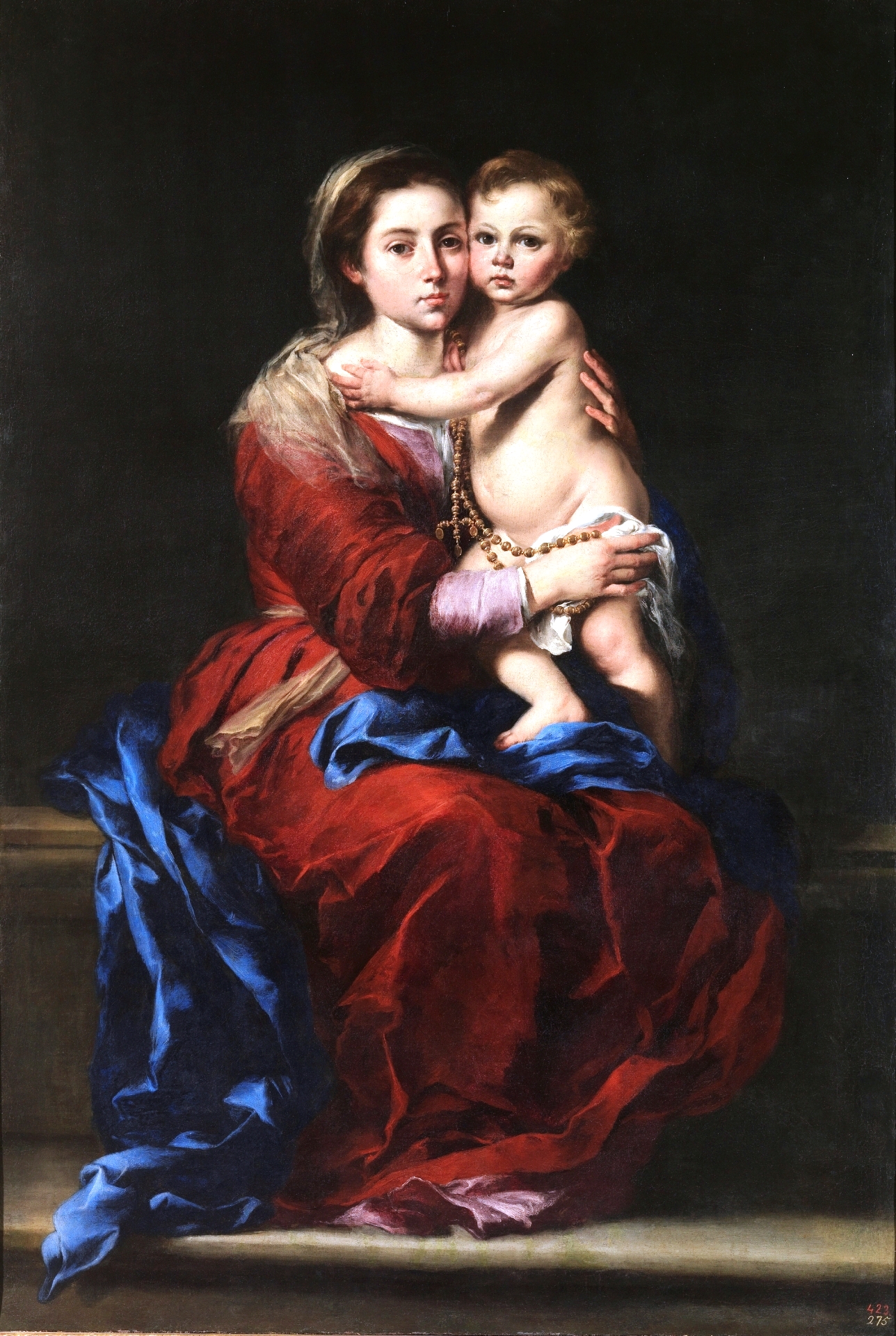
Bartolomé Esteban Murillo (1617–1682). La Virgen María llevando al Niño Jesús sobre sus rodillas y un rosario, circa 1655, 166 x 112, Museo del Prado
BENOÎT XVI
AUDIENCE GÉNÉRALE
Mercredi 2 janvier 2008
Chers frères et sœurs,
Une très ancienne formule de bénédiction, rapportée dans le Livre des Nombres, dit: "Que Yahvé te bénisse et te garde! Que Yahvé fasse pour toi rayonner son visage et te fasse grâce!" (Nb 6, 24-26). C'est avec ces mots que la liturgie nous a fait à nouveau entendre hier, premier jour de l'année, que je voudrais adresser mes voeux cordiaux à vous tous, ici présents, et à ceux qui, au cours de ces fêtes de Noël, m'ont fait parvenir des témoignages d'affectueuse proximité spirituelle.
Nous avons célébré hier la fête solennelle de Marie, Mère de Dieu. "Mère de Dieu", Theotokos, est le titre attribué officiellement à Marie au V siècle, plus exactement lors du Concile d'Ephèse de 431, mais qui s'était déjà affirmé dans la dévotion du peuple chrétien à partir du III siècle, dans le contexte des discussions enflammées de cette période sur la personne du Christ. On soulignait, par ce titre, que le Christ est Dieu et qu'il est réellement né, comme un homme, de Marie: on préservait ainsi son unité de vrai Dieu et de vrai homme. En vérité, même si le débat semblait porter sur Marie, celui-ci concernait essentiellement son Fils. Voulant sauvegarder la pleine humanité de Jésus, certains Pères suggéraient un terme plus atténué: au lieu du titre de Theotokos, ils proposaient celui de Christotokos, "Mère du Christ"; cela fut cependant vu à juste titre comme une menace contre la doctrine de la pleine unité de la divinité avec l'humanité du Christ. C'est pourquoi, après une longue discussion, lors du Concile d'Ephèse de 431, comme je l'ai dit, furent solennellement confirmées, d'une part, l'unité des deux natures, divine et humaine, en la personne du Fils de Dieu (cf. DS, n. 250) et, de l'autre, la légitimité de l'attribution à la Vierge du titre de Theotokos, Mère de Dieu (ibid., n. 251).
Après ce Concile, on enregistra une véritable explosion de dévotion mariale et de nombreuses églises dédiées à la Mère de Dieu furent construites. Parmi celles-ci domine la Basilique Sainte-Marie-Majeure, ici à Rome. La doctrine concernant Marie, Mère de Dieu, trouva en outre une nouvelle confirmation dans le Concile de Chalcédoine (451), au cours duquel le Christ fut déclaré "vrai Dieu et vrai homme [...] né pour nous et pour notre salut de Marie, Vierge et Mère de Dieu, dans son humanité" (DS, n. 301). Comme on le sait, le Concile Vatican II a recueilli dans un chapitre de la Constitution dogmatique sur l'Eglise Lumen gentium, le huitième, la doctrine sur Marie, réaffirmant sa maternité divine. Le chapitre s'intitule: "La Bienheureuse Vierge Marie, Mère de Dieu, dans le mystère du Christ et de l'Eglise".
La qualification de Mère de Dieu, si profondément liée aux fêtes de Noël, est donc le titre fondamental sous lequel la Communauté des croyants honore, pourrions-nous dire depuis toujours, la Sainte Vierge. Celle-ci exprime bien la mission de Marie dans l'histoire du salut. Tous les autres titres qui sont attribués à la Vierge trouvent leur fondement dans sa vocation à être la Mère du Rédempteur, la créature humaine élue par Dieu pour réaliser le plan du salut, centré sur le grand mystère de l'incarnation du Verbe divin. En ces jours de fête, nous nous sommes arrêtés pour contempler dans la crèche la représentation de la Nativité. Au centre de cette scène, nous trouvons la Vierge Mère qui offre l'Enfant Jésus à la contemplation de ceux qui viennent adorer le Sauveur: les pasteurs, les personnes pauvres de Bethléem, les Mages venus d'Orient. Plus tard, lors de la fête de la "Présentation du Seigneur", que nous célébrerons le 2 février, ce seront le vieux Siméon et la prophétesse Anne qui recevront le petit Enfant des mains de sa Mère et qui l'adoreront. La dévotion du peuple chrétien a toujours considéré la naissance de Jésus et la maternité divine de Marie comme deux aspects du même mystère de l'incarnation du Verbe divin et donc elle n'a jamais considéré la Nativité comme une chose du passé. Nous sommes "contemporains" des pasteurs, des mages, de Siméon et d'Anne, et alors que nous cheminons avec eux nous sommes remplis de joie, car Dieu a voulu être Dieu avec nous et qu'il a une mère, qui est notre mère.
C'est du titre de "Mère de Dieu" que dérivent ensuite tous les autres titres avec lesquels l'Eglise honore la Vierge, mais celui-ci est le titre fondamental. Nous pensons au privilège de l'"Immaculée Conception", c'est-à-dire au fait qu'elle soit exempte du péché depuis sa conception: Marie fut préservée de toute tache de péché, car elle devait être la Mère du Rédempteur. Cela est également valable pour le titre de l'"Assomption": Celle qui avait engendré le Sauveur ne pouvait pas être sujette à la corruption dérivant du péché. Et nous savons que tous ces privilèges ne sont pas accordés pour éloigner Marie de nous, mais au contraire pour la rendre proche; en effet, étant totalement avec Dieu, cette Femme est très proche de nous et nous aide comme une mère et comme une sœur. La place unique et singulière que Marie possède dans la communauté des croyants dérive également de sa vocation fondamentale à être la Mère du Rédempteur. Précisément en tant que telle, Marie est également la Mère du Corps mystique du Christ, qui est l'Eglise. C'est donc à juste titre que, durant le Concile Vatican II, le 21 novembre 1964, Paul VI attribua solennellement à Marie le titre de "Mère de l'Eglise".
Précisément parce qu'elle est la Mère de l'Eglise, la Vierge est également la Mère de chacun de nous, qui sommes les membres du Corps mystique du Christ. De la Croix, Jésus a confié sa Mère à chacun de ses disciples et, dans le même temps, il a confié chacun de ses disciples à l'amour de sa Mère. L'évangéliste Jean conclut son récit bref et suggestif par les mots suivants: "Et à partir de cette heure-là, le disciple la prit chez lui" (Jn 19, 27). Telle est la traduction du texte grec: "èis tà ìdia", il l'accueillit dans sa propre réalité, dans son propre être. Si bien qu'elle fait partie de sa vie et que les deux vies s'interpénètrent; et cette façon de l'accepter dans sa propre vie (èis tà ìdia) est le testament du Seigneur. Au moment suprême de l'accomplissement de la mission messianique, Jésus laisse donc à chacun de ses disciples, comme héritage précieux, sa propre Mère, la Vierge Marie.
Chers frères et sœurs, en ces premiers jours de l'année, nous sommes invités à considérer attentivement l'importance de la présence de Marie dans la vie de l'Eglise et dans notre existence personnelle. Remettons-nous à Elle, afin qu'Elle guide nos pas en cette nouvelle période de temps que le Seigneur nous donne de vivre, et qu'elle nous aide à être d'authentiques amis de son Fils et de courageux artisans de son Royaume dans le monde, Royaume de la lumière et de la vérité. Bonne année à tous! Tel est le souhait que je désire à présent adresser à vous tous ici présents et à vos proches, en cette première Audience générale de l'année 2008. Que la nouvelle année, commencée sous le signe de la Vierge Marie, nous fasse sentir plus vivement sa présence maternelle, si bien que, soutenus et réconfortés par la protection de la Vierge, nous puissions contempler avec un regard neuf le visage de son Fils Jésus et cheminer avec plus d'empressement sur les voies du bien.
Encore une fois, Bonne année à tous!
* * *
Je salue tous les
pèlerins francophones. Que Marie nous fasse ressentir plus vivement sa présence
maternelle ; ainsi soutenus et réconfortés par elle, nous pourrons
contempler avec un regard neuf le visage de son Fils Jésus et cheminer avec
plus d’empressement dans la voie du bien. Bonne Année à tous !
© Copyright 2008 -
Libreria Editrice Vaticana
BENOÎT XVI
AUDIENCE GÉNÉRALE
Mercredi 12 août 2009
Chers frères et soeurs,
La célébration de la solennité de l'Assomption de la Vierge Marie, samedi prochain, est imminente, et nous nous trouvons dans le cadre de l'Année sacerdotale; c'est pourquoi je voudrais parler du lien entre la Vierge et le sacerdoce. Il s'agit d'un lien profondément enraciné dans le mystère de l'Incarnation. Lorsque Dieu décida de se faire homme dans son Fils, il avait besoin du "oui" libre de l'une de ses créatures. Dieu n'agit pas contre notre liberté. Et une chose véritablement extraordinaire a lieu: Dieu devient dépendant de la liberté, du "oui" de l'une de ses créatures; il attend ce "oui". Saint Bernard de Clairvaux, dans l'une de ses homélies, a expliqué de façon dramatique ce moment décisif de l'histoire universelle, où le ciel, la terre et Dieu lui-même attendent ce que dira cette créature.
Le "oui" de Marie est donc la porte à travers laquelle Dieu a pu entrer dans le monde, se faire homme. Ainsi, Marie participe réellement et profondément au mystère de l'incarnation, de notre salut. Et l'incarnation, le fait que le Fils s'est fait homme, était dès le début finalisée au don de soi; au don de soi avec beaucoup d'amour dans la Croix, pour se faire pain pour la vie du monde. Ainsi, sacrifice, sacerdoce et Incarnation vont de pair et Marie est au centre de ce mystère.
Allons à présent à la Croix. Avant de mourir, Jésus voit sa Mère au pied de la Croix; et il voit le fils bien-aimé et ce fils bien-aimé est certainement une personne, un individu très important, mais il est davantage: c'est un exemple, une préfiguration de tous les disciples bien-aimés, de toutes les personnes appelées par le Seigneur à être "le disciple qu'il aimait" et par conséquent, de façon particulière, également des prêtres. Jésus dit à Marie: "Mère, voici ton fils" (Jn 19, 26). Il s'agit d'une sorte de testament: il confie sa Mère au soin du fils, du disciple. Mais il dit également au disciple: "Voici ta mère" (Jn 19, 27). L'Evangile nous dit qu'à partir de ce moment, saint Jean, le fils bien-aimé, accueillit la mère, Marie, "chez lui". C'est ce que dit la traduction française; mais le texte grec est beaucoup plus profond, beaucoup plus riche. Nous pourrions le traduire de la façon suivante: il prit Marie dans l'intimité de sa vie, de son être, "eis tà ìdia", dans la profondeur de son être. Prendre avec soi Marie, signifie l'introduire dans le dynamisme de son existence tout entière - il ne s'agit pas d'une chose extérieure - et dans tout ce qui constitue l'horizon de son apostolat. Il me semble que l'on comprend donc que le rapport particulier de maternité existant entre Marie et les prêtres constitue la source primaire, le motif fondamental de la prédilection qu'elle nourrit pour chacun d'eux. Marie les aime en effet pour deux raisons: car ils sont davantage semblables à Jésus, amour suprême de son coeur et parce qu'eux aussi, comme Elle, sont engagés dans la mission de proclamer, témoigner et apporter le Christ au monde. En vertu de son identification et conformation sacramentelle à Jésus, Fils de Dieu et Fils de Marie, chaque prêtre peut et doit se sentir véritablement le fils bien-aimé de cette très noble et très humble Mère.
Le Concile Vatican II invite les prêtres à voir en Marie le modèle parfait de leur existence, en l'invoquant comme "Mère du Grand prêtre éternel, Reine des Apôtres, soutien des prêtres dans leur ministère". Et elle a droit - poursuit le Concile - "à la dévotion filiale des prêtres, à leur vénération et à leur amour" (cf. Presbyterorum ordinis, n. 18). Le saint curé d'Ars, vers lequel notre pensée se tourne de façon particulière en cette année, aimait répéter: "Jésus Christ, après nous avoir donné tout ce qu'il pouvait nous donner, veut encore faire de nous les héritiers de ce qu'il a de plus précieux, c'est-à-dire sa Sainte Mère" (B. Nodet, La pensée et l'âme du curé d'Ars). Cela vaut pour tout chrétien, pour nous tous, mais en particulier pour les prêtres. Chers frères et soeurs, prions afin que Marie rende tous les prêtres, face à tous les problèmes du monde d'aujourd'hui, conformes à l'image de son Fils Jésus, dispensateurs du trésor inestimable de son amour de bon Pasteur. Marie, Mère des prêtres, prie pour nous!
Appel et prière du Pape
pour les victimes du typhon en Asie
Ma pensée se tourne vers les nombreuses populations qui, au cours des jours
derniers, ont été frappées par la violence d'un typhon aux Philippines, à
Taïwan, dans certaines provinces du sud-est de la République populaire de Chine
et au Japon, un pays qui a été frappé également par un violent tremblement de
terre. Je désire manifester ma proximité spirituelle à tous ceux qui se
trouvent dans des situations de graves difficultés et j'invite chacun à prier
pour eux et pour tous ceux qui ont perdu la vie. Je forme le voeu que ne
manquent pas le soutien de la solidarité et l'aide des secours matériels.
SOURCE : http://www.vatican.va/holy_father/benedict_xvi/audiences/2009/documents/hf_ben-xvi_aud_20090812_fr.html
HOMÉLIE DU PAPE BENOÎT
XVI
Basilique Saint-Pierre
Dimanche 1er janvier
2012
Chers frères et sœurs,
En ce premier jour de l’année, la liturgie fait résonner dans toute l’Église
disséminée dans le monde l’antique bénédiction sacerdotale, que nous avons
écoutée dans la première Lecture : « Que le Seigneur te bénisse et te garde !
Que le Seigneur fasse briller sur toi son visage, qu’il se penche vers toi !
Que le Seigneur tourne vers toi son visage, qu’il t’apporte la paix ! » (Nb 6,
24-26). Cette bénédiction fut confiée par Dieu, à travers Moïse, à Aaron et à
ses fils, c’est-à-dire aux prêtres du peuple d’Israël. C’est un triple vœu
plein de lumière, qui provient de la répétition du nom de Dieu, le Seigneur, et
de l’image de son visage. En effet, pour être bénis, il faut demeurer en
présence de Dieu, recevoir sur soi son Nom et rester dans le cône de lumière
qui part de son visage, dans l’espace illuminé par son regard, qui répand grâce
et paix.
C’est aussi l’expérience qu’ont fait les bergers de Bethléem, qui apparaissent
encore dans l’Évangile d’aujourd’hui. Ils ont fait l’expérience de demeurer en
présence de Dieu, de sa bénédiction, non pas dans la salle d’un palais
majestueux, devant un grand souverain, mais dans une étable, devant un «
nouveau-né couché dans une mangeoire » (Lc 2, 16). C’est justement de cet
enfant que rayonne une lumière nouvelle, qui resplendit dans l’obscurité de la
nuit, comme nous pouvons le voir sur de nombreux tableaux qui représentent la
Nativité du Christ. C’est de lui, désormais, que vient la bénédiction : de son
nom – Jésus, qui signifie « Dieu sauve » – et de son visage humain, en qui
Dieu, le tout-puissant Seigneur du ciel et de la terre, a voulu s’incarner,
cacher sa gloire sous le voile de notre chair, pour nous révéler pleinement sa
bonté (cf. Tt 3, 4).
La première à être comblée de cette bénédiction a été Marie, la vierge, épouse
de Joseph, que Dieu a choisie dès le premier instant de son existence pour être
la mère de son Fils fait homme. Elle est « bénie entre toutes les femmes » (Lc 1,
42) – comme la salue sainte Élisabeth. Toute sa vie est dans la lumière du
Seigneur, dans le rayon d’action du nom et du visage de Dieu incarné en Jésus,
le « fruit béni de son sein ». C’est ainsi que nous la présente l’Évangile de
Luc : retenant tous ces événements et méditant dans son cœur tout ce qui
concernait son fils Jésus (cf. Lc 2, 19. 51). Le mystère de sa
maternité divine, que nous célébrons aujourd’hui, renferme dans une mesure
surabondante ce don de grâce que toute maternité humaine comporte, si bien que
la fécondité du sein a toujours été associée à la bénédiction de Dieu. La Mère
de Dieu est la première qui est bénie et elle est celle qui porte la
bénédiction ; c’est la femme qui a accueilli Jésus en elle et qui lui a donné
le jour pour toute la famille humaine. Comme prie la liturgie : « Gardant pour
toujours la gloire de sa virginité, elle a donné au monde la lumière éternelle,
Jésus Christ notre Seigneur » (Préface de la B. V. Marie 1).
Marie est mère et modèle de l’Église qui accueille dans la foi la Parole divine
et s’offre à Dieu comme « bonne terre » en qui Il peut continuer à accomplir
son mystère de salut. L’Église aussi participe au mystère de la maternité
divine, à travers la prédication, qui répand dans le monde la semence de
l’Évangile, et qui, à travers les sacrements, communiquent aux hommes la grâce
et la vie divine. En particulier, dans le sacrement du Baptême, l’Église vit
cette maternité, quand elle engendre les fils de Dieu de l’eau et de l’Esprit
Saint, qui en chacun d’eux crie : « Abbà ! Père ! » (Ga 4, 6). Comme
Marie, l’Église est médiatrice de la bénédiction de Dieu pour le monde : elle
la reçoit en accueillant Jésus et la transmet en portant Jésus. Il est lui la
miséricorde et la paix que le monde ne peut se donner de lui-même et dont il a
besoin toujours, comme et plus que du pain.
Chers amis, la paix, dans son sens le plus plein et le plus élevé, est la somme
et la synthèse de toutes les bénédictions. C’est pourquoi, quand deux personnes
amies se rencontrent, elles se saluent en se souhaitant mutuellement la paix.
L’Église aussi, le premier jour de l’année, invoque de manière spéciale ce plus
grand bien, et elle le fait, comme la Vierge Marie, en montrant à tous Jésus, car,
comme l’affirme l’apôtre Paul, « il est notre paix » (Ep 2, 14) et, en
même temps, il est le « chemin » par lequel les hommes et les peuples peuvent
atteindre ce but, auquel tous aspirent. Avec, dans le cœur, ce désir profond,
je suis donc heureux de vous accueillir et de vous saluer vous tous, qui au
cours de cette 45ème Journée Mondiale de la Paix, êtes réunis dans la Basilique
Saint Pierre : Messieurs les Cardinaux ; les Ambassadeurs de nombreux pays
amis, qui, plus que jamais, en cette heureuse circonstance, partagent avec moi
et avec le Saint-Siège la volonté de renouveler leur engagement pour la
promotion de la paix dans le monde ; le Président du Conseil pontifical
‘Justice et Paix’, qui, avec le Secrétaire et les collaborateurs, travaille de
façon spéciale dans ce but ; les autres Prélats et Autorités présents ; les
représentants d’Associations et Mouvements ecclésiaux et vous tous, frères et
sœurs, en particulier ceux d’entre vous qui travaillent dans le domaine de
l’éducation des jeunes. En effet – comme vous le savez – la perspective
éducative est celle que j’ai indiquée dans mon Message
cette année.
« Éduquer les jeunes à la justice et à la paix » est une tâche qui concerne
toutes les générations, et, grâce à Dieu, la famille humaine, après les drames
des deux grandes guerres mondiales, a montré qu’elle en était toujours plus
consciente, comme l’attestent, d’une part, des déclarations et initiatives
internationales et, de l’autre, l’affirmation parmi les jeunes eux-mêmes, ces
dernières décennies, de nombreuses et différentes formes d’engagement social
dans ce domaine. Pour la communauté ecclésiale, éduquer à la paix rentre dans
la mission reçue du Christ, fait partie intégrante de l’évangélisation, car
l’Évangile du Christ est aussi l’Évangile de la justice et de la paix.
Toutefois, ces derniers temps, l’Église s’est fait l’interprète d’une exigence
qui engage toutes les consciences plus sensibles et responsables vis-à-vis des
destinées de l’humanité : l’exigence de relever un défi décisif qui est
justement le défi éducatif. Pourquoi un « défi » ? Pour deux raisons au moins :
en premier lieu, parce que dans l’ère actuelle, fortement marquée par la
mentalité technologique, vouloir éduquer et non seulement instruire ne
va pas de soi, mais est un choix ; en deuxième lieu, parce que la culture
relativiste pose une question radicale : est-ce qu’éduquer a encore un sens ?,
et ensuite éduquer à quoi ?
Naturellement nous ne pouvons pas affronter maintenant ces questions de fond,
auxquelles j’ai cherché à répondre à d’autres occasions. Je voudrais par contre
souligner que, face aux ombres qui obscurcissent aujourd’hui l’horizon du
monde, assumer la responsabilité d’éduquer les jeunes à la connaissance de la
vérité, aux valeurs et aux vertus fondamentales, signifie considérer l’avenir
avec espérance. Dans cet engagement pour une éducation intégrale, entre aussi
la formation à la justice et à la paix. Les jeunes, garçons et filles,
d’aujourd’hui grandissent dans un monde qui est devenu, pour ainsi dire, plus
petit, où les contacts entre les différentes cultures et traditions, même s’ils
ne sont pas toujours directs, sont constants. Pour eux, aujourd’hui plus que
jamais, il est indispensable d’apprendre la valeur et la méthode de la
coexistence pacifique, du respect réciproque, du dialogue et de la
compréhension. De par leur nature, les jeunes sont ouverts à ces attitudes,
mais justement la réalité sociale dans laquelle ils grandissent peut les amener
à penser et à agir à l’inverse, de manière même intolérante et violente. Seule
une solide éducation de leur conscience peut les mettre à l’abri de ces risques
et les rendre capables de lutter sans cesse, en comptant seulement sur la force
de la vérité et du bien. Cette éducation part de la famille et se développe à
l’école et durant les autres expériences de formation. Il s’agit
essentiellement d’aider les tout-petits, les enfants, les adolescents, à
développer une personnalité qui unisse un profond sens de la justice au respect
de l’autre, à la capacité d’affronter les conflits sans autoritarisme, à la
force intérieure de témoigner le bien même lorsque cela coûte sacrifice, au
pardon et à la réconciliation. Ils pourront ainsi devenir des hommes et des
femmes vraiment pacifiques et constructeurs de paix.
Dans cette action éducative à l’égard des nouvelles générations, une
responsabilité particulière incombe aussi aux communautés religieuses. Tout
itinéraire de formation religieuse authentique conduit la personne, dès son
plus jeune âge, à connaître Dieu, à l’aimer et à faire sa volonté. Dieu est
amour, il est juste et pacifique, et quiconque veut l’honorer doit avant tout
se comporter comme un fils qui suit l’exemple de son père. Un psaume affirme :
« Le Seigneur fait œuvre de justice, il défend le droit des opprimés. (…) Le
Seigneur est tendresse et pitié, lent à la colère et plein d’amour » (Ps 103,
6.8). En Dieu, justice et miséricorde cohabitent parfaitement, comme Jésus nous
l’a démontré par le témoignage de sa vie. En Jésus, « amour et vérité » se sont
rencontrées, « justice et paix » se sont embrassées (cf. Ps 85, 11).
Ces jours-ci, l’Église célèbre le grand mystère de l’Incarnation : la vérité de
Dieu a germé de la terre et, du ciel, s’est penchée la justice, la terre a
donné son fruit (cf. Ps 85, 12.13). Dieu nous a parlé en son Fils
Jésus. Écoutons ce que dit Dieu : « il annonce la paix » (Ps 85, 9). Jésus
est un chemin praticable, ouvert à tous. Il est le chemin de la paix.
Aujourd’hui la Vierge Mère nous l’indique, nous montre le chemin : suivons-la !
Et toi, Sainte Mère de Dieu, accompagne-nous de ta protection. Amen.
© Copyright 2012 -
Libreria Editrice Vaticana
Sainte Marie, Mère de
Dieu et notre mère
Celle qui est au-dessus
des anges et des saints a vécu une existence ordinaire, affirme le prélat de
l'Opus Dei.
Du chap. 4 de X.
ECHEVARRIA, Itinerarios de vida cristiana, Madrid, Editorial Planeta, 2001
La vie de la Sainte Vierge […] nous apprend que, comme saint Josémaria l’a écrit, il n’y a pas de raison pour que la sainteté et la grandeur se manifestent « par des actions voyantes, mais par un sacrifice quotidien, silencieux et caché […] Si nous voulons devenir « divins », si nous voulons nous revêtir de la plénitude de Dieu, il nous faut commencer par être très humains, en assumant face à Lui notre condition d’hommes ordinaires, et en sanctifiant notre apparente petitesse. Ainsi vécut Marie. Celle qui est pleine de grâces, qui est l’objet de toutes les faveurs de Dieu, qui a été établie au-dessus des anges et des saints, a mené une existence normale ».
Tel est, en effet, un des traits essentiels de l’existence terrestre de Notre
Dame et, par suite, de l’appel à une vie sainte qui résonne à partir d’elle.
C’est une des vérités splendides et simples que l’on découvre quand on pénètre
dans le foyer de Jésus, Marie et Joseph à Nazareth. Celui qui veut servir Dieu
et lui plaire peut trouver son Créateur, son Rédempteur et son Sanctificateur
dans la vie courante, au milieu du travail quotidien et des activités les plus
ordinaires. Il est possible, comme la vie de Marie le montrée toute évidence,
d’être complètement plongé dans les occupations de chaque jour et, en même
temps, de les diviniser. Il est possible d’être « contemplatifs au
milieu du monde », de maintenir une fréquentation intime de Dieu au
travers des activités normales de notre journée.
Pour atteindre cet objectif, il faut s’efforcer de rapporter sa conduite à
Dieu. Si la grandeur de la tâche nous impressionnait à un moment donné, un
regard à la réponse fidèle de la Sainte Vierge pourrait nous stimuler.
N’oublions pas en outre que ce n’est pas seulement son témoignage que nous
avons entre les mains comme un trésor, mais elle-même, car elle règne avec son
Fils dans les cieux et se montre toujours prête à venir à notre aide par sa
protection et son affection maternelles. À peine l’avons-nous invoquée, et même
avant, que Marie vient à notre secours, même si sa protection efficace et
affectueuse reste cachée à nos yeux avec une fréquence incroyable.
Il est possible, comme la
vie de Marie le montrée toute évidence, d’être complètement plongé dans les
occupations de chaque jour et, en même temps, de les diviniser.
Pensons aussi que le
chemin de la très Sainte Vierge, tout comme celui de don Fils, ne fait pas
l’économie de la Croix. […] Nous ne devons pas avoir peur de la Croix, car, si
nous regardons et suivons Marie, nous y découvrions, comme elle, la joie qui
saisit l’âme quand elle s’oublie elle-même pour se confier à l’amour rédempteur
de Jésus. Sa maternité, vécue de façon suprême à côté de son Fils au Calvaire,
est une invitation, forte et pleine de délicatesse, qu’elle nous adresse à tous
pour que nous sachions lui tenir compagnie et, l’accueillant comme Mère,
participer de son don à Dieu pour le salut du monde […].
Nous découvrirons cette riche aventure de la Croix dans l’effort de
compréhension et de générosité quotidiennes envers autrui ; dans les
petits services, même s’il en coûte de les rendre, propres à la vie en famille,
à la vie de travail ou en société ; dans la pénitence et le sacrifice,
recherchés et aimés dans les occupations habituelles ; dans le témoignage
joyeux et simple de sobriété, d’amour de la sainte pureté, de solidarité dans
la souffrance et les besoins de tous, en particulier des plus faibles ;
dans l’éloignement de toute occasion de péché, dans la fuite des tentations et
dans le retour rapide à Dieu par la conversion, au moyen de la confession
sacramentelle. Marie représente à nous, comme Jean-Paul II l’a indiqué, telle
une lumière et une aide spéciales pour retourner à la maison du Père, pour
parcourir le chemin qui, du repentir pour nos péchés, nous conduit à la joie de
nous savoir enfants de Dieu.
SOURCE : http://fr.opusdei.ca/art.php?p=12267
Marie : modèle et
paradigme de la croyance des chrétiens
28 décembre 2018
Solennité de Marie, Mère
de Dieu - mardi 1 janvier 2018
Nombres 6,22-27
Galates 4,4-7
Luc 2,16-21
Le Nouvel An chrétien est
célébré le 1er janvier, une semaine après la célébration de la naissance
de Jésus. Le 1er janvier est qualifié de diverses manières qui révèlent
divers aspects de la nature de la fête. Tout d’abord, le Nouvel an chrétien se
trouve dans l’octave de Noël [i.e. 8 jours après la naissance de Jésus.] Avant
la réforme liturgique du Concile Vatican II [1962-1965], la fête de la
Circoncision de Jésus ou de l’attribution du nom de Jésus [Saint Nom de Jésus]
a été célébrée à cette date pour commémorer le récit évangélique de la
circoncision de Jésus selon les prescriptions rituelles de la loi mosaïque,
faisant ainsi officiellement de lui un membre du peuple de l’alliance: « Quand
arriva le huitième jour, celui de la circoncision, l’enfant reçut le nom de
Jésus, le nom que l’ange lui avait donné avant sa conception. » [Lc 2,21-24]
Suite au renouvellement
liturgique du Concile Vatican II, le 1er janvier est aussi connu comme la
Solennité de Marie, la Mère du Seigneur, et a également été désigné Journée
mondiale de prière pour la paix.
Nous pouvons nous
demander souvent si en accumulant tant de significations différentes, les gens
ne portent plus attention au Jour de l’An comme une fête religieuse.
N’est-il pas vrai non
plus que l’atmosphère de réjouissances attachée à la veille du Jour de l’An ne
laisse pratiquement personne avec l’énergie, le désir ou la volonté de
considérer le Nouvel An comme une fête religieuse ? Examinons quelques-uns des
fondements bibliques pour les différentes significations rattachées au nouvel
an chrétien.
Fête de la circoncision
et attribution du nom de Jésus
Dans l’Antiquité et dans
les Écritures, il est commun de croire que le nom donné à une personne n’est
pas seulement un label, une étiquette, mais révèle aussi une partie de la
personnalité de celui qui le porte. Le nom porte la volonté et le pouvoir.
Jésus de Nazareth est né à Bethléem de parents juifs [Matthieu 1-2; Luc 1-2].
Lors de sa conception, un ange a affirmé que son nom serait « Jésus ». L’hébreu
et l’araméen du nom « Yeshua » [Jésus] est une forme tardive de l’hébreu «
Yehoshua » ou Josué. C’était un nom très commun dans le Nouveau Testament. La
signification du nom est « Le Seigneur est le salut », et on y fait allusion
dans Matthieu 1,21 et Luc 2,21.
Dans les Écritures, «
Yeshua » fait référence au Sauveur et fut l’un des moyens pour les chrétiens de
nommer et d’identifier Jésus. Le grec Christos traduit l’hébreu Mashiah, «
oint », par ce nom, les chrétiens affirmaient que Jésus était le Messie. Dans
le Nouveau Testament, le nom, la personne et l’œuvre de Dieu sont
indissociablement liés à ceux de Jésus-Christ. Les vrais disciples de Jésus
doivent prier en son nom [Jean 14,13-14]. Dans Jean 2,23, croire au nom de
Jésus signifie croire en lui comme le Christ, le Fils de Dieu [3,18]. Le nom de
Jésus est puissant seulement là où il y a la foi et l’obéissance [Marc
9,38-39]. Croire au saint nom de Jésus mène à la confession de ce nom [Hébreux
13,15]. Faire appel à ce nom est le salut.
Solennité de Marie, Mère
du Seigneur
La deuxième personne qui
est célébrée et honorée à l’occasion du Nouvel An chrétien est la mère de
Jésus. Cette jeune femme d’origine juive a pris sur elle la responsabilité
entière du mot « oui » à un visiteur mystérieux lors de l’Annonciation. Par sa
réponse, elle a brisé les frontières culturelles et religieuses de son temps,
manifestant foi et grand courage. Elle a littéralement apporté le ciel sur
terre. Marie de Nazareth a vécu ces événements et leur sens, montrant toujours
la capacité d’interpréter le fil conducteur de toute sa vie en se rappelant à
l’esprit des paroles et des événements.
« Marie » vient de
l’hébreu « Miriam » dont l’étymologie est probablement du mot égyptien qui
signifie « bien-aimée ». Elle est le disciple par excellence qui nous introduit
à la bonté et à l’humanité de Dieu. Le fait qu’elle soit femme n’est pas en soi
un signe de salut, mais il est significatif de la façon et de la manière dont
le salut arrive. Il n’y a de salut en aucun autre nom que celui de l’homme
Jésus, mais à travers cette femme, Marie, nous avons l’assentiment de l’humanité
au salut. C’est ainsi que nous pouvons parler d’une réalisation féminine de
salut de Dieu.
Aujourd’hui, nous
célébrons la Sainte Mère de Dieu, qui est un modèle pour tous les croyants. Je
ne peux pas m’empêcher de rappeler les fortes paroles de l’évêque anglican N.T.
Wright, de Durham, en Angleterre, lors du Synode sur la Parole de Dieu dans la
vie et la mission de l’Église en 2008. Mgr Wright, l’un des délégués fraternels
nommés par le Pape au Synode, a évoqué les quatre grands moments de la vie de
Marie, avec quatre mots: Fiat, Magnificat, Conservabat, et Stabat.
Grâce à son « fiat », Marie a donné son assentiment à la Parole de Dieu avec
son esprit. Grâce à son « magnificat », la vierge de Nazareth révèle sa force
et son courage. Marie a médité et gardé la Parole de Dieu dans son cœur: «
conservabat. » Sa fidélité à la fin est décrite par le mot « stabat » alors
qu’elle se trouvait au pied de la Croix et attendait patiemment dans son âme
l’accomplissement de la prophétie de Siméon et l’expérience de la nouvelle, de
l’inattendue révélation qui sauve, encore et toujours.
Dieu appelle chacun de
nous à travers l’Écriture d’un amour parfait et de grâce, et la réponse de
l’esprit docile est « fiat »:« Qu’il me soit fait selon ta parole ». Nous
célébrons nous aussi, avec nos forces, la pertinence de la parole à de
nouvelles situations personnelles et surtout politiques: « magnificat ». Puis
nous laissons monter dans notre cœur ce que nous avons vu et entendu : «
conservabat. » Mais l’Écriture nous dit que Marie, elle aussi, a dû apprendre
des choses difficiles : elle voulait contrôler son fils, mais ne le pouvait
pas. Son âme est percée par l’épée, comme elle est « stabat » au pied de la
croix. Nous aussi nous devons attendre patiemment, en laissant la Parole écrite
nous dire des choses inattendues, voire désagréables, mais porteuses de salut.
Nous avons lu avec humilité, confiant en Dieu et attendant de voir ce que
signifie sa volonté. Marie est vraiment un modèle et le paradigme de la
croyance des chrétiens.
Journée mondiale de
prière pour la paix
Le plus récent « thème »
rattaché au Nouvel An chrétien a été la « Journée mondiale de prière pour la
paix ». La Journée mondiale de la Paix fut lancée par l’Église sous le pape
Paul VI en 1967. Les chrétiens sont invités à entamer une nouvelle année en priant
pour la paix. Le thème de la quarante-troisième Journée mondiale de la Paix a
été : « Si tu veux construire la paix, protège la création », un jeu de mot
délibéré sur les célèbres paroles de Paul VI « Si tu veux la paix, travaille
pour la justice. »
Dans son message, le pape
Benoît XVI a présenté « une vision cosmique de la paix » une paix qui « vient à
propos dans un état d’harmonie entre Dieu, l’humanité et la création. Dans
cette perspective, la dégradation de l’environnement est une expression non seulement
d’une rupture de l’harmonie entre l’humanité et la création, mais d’une
profonde détérioration de l’unité entre l’humanité et Dieu. »
Benoît XVI s’est déjà
taillé une réputation en tant que pape « vert » en raison de ses appels répétés
pour une meilleure protection de l’environnement. Le langage du Pape dans le
message de cette année est d’ailleurs assez énergique.
Comment demeurer
indifférents face aux problématiques qui découlent de phénomènes tels que les
changements climatiques, la désertification, la dégradation et la perte de
productivité de vastes surfaces agricoles, la pollution des fleuves et des
nappes phréatiques, l’appauvrissement de la biodiversité, l’augmentation des
phénomènes naturels extrêmes, le déboisement des zones équatoriales et
tropicales ?
Comment négliger le
phénomène grandissant de ce qu’on appelle les « réfugiés de l’environnement »:
ces personnes qui, à cause de la dégradation de l’environnement où elles
vivent, doivent l’abandonner – souvent en même temps que leurs biens – pour
affronter les dangers et les inconnues d’un déplacement forcé ? Comment ne pas
réagir face aux conflits réels et potentiels liés à l’accès aux ressources
naturelles ? Toutes ces questions ont un profond impact sur l’exercice des
droits humains, comme par exemple le droit à la vie, à l’alimentation, à la
santé, au développement.
Benoît XVI a mis l’accent
sur une vision du cosmos comme un don de Dieu que les êtres humains ont
l’obligation de « soigner et de cultiver. » Le Pape a appelé à « une révision
profonde et clairvoyante du modèle de développement », fondée non seulement sur
les besoins actuels « des êtres vivants, humains et non humains », mais ceux
des générations à venir.
En même temps, Benoît XVI
a insisté sur le fait que la protection de l’environnement est « le devoir de
chaque personne », celui qui exige des changements dans les habitudes et
attitudes personnelles. Benoît XVI a appelé à « de nouveaux styles de vie »,
fondés non pas uniquement sur la logique de la consommation, mais aussi sur la
sobriété, la solidarité, ainsi que la prudence :
C’est pour cette raison
qu’il est indispensable que l’humanité renouvelle et renforce « l’alliance
entre l’être humain et l’environnement, qui doit être le miroir de l’amour
créateur de Dieu, de qui nous venons et vers qui nous allons ». Nos crises
actuelles […] sont des crises aussi morales, et toutes sont inter reliées.
Elles nous obligent à repenser le chemin que nous parcourons ensemble.
Aujourd’hui, alors que nous célébrons la Mère du Seigneur qui réconcilie les
nombreux sens donnés à la fête d’aujourd’hui, faisons-nous l’écho des paroles
du saint Basile le Grand, dont la fête suit immédiatement la célébration
d’aujourd’hui [2 janvier] : Adorons avec les mages, rendons gloire avec
les bergers, chantons avec les anges : « Il nous est né aujourd’hui un sauveur
qui est le Christ Seigneur ; le Seigneur Dieu qui nous est apparu […] »
Non pas sous la forme divine, afin de nous effrayer dans notre faiblesse, mais sous la forme d’un Serviteur, afin qu’Il puisse libérer se qui avait été réduit à la servitude […]
26 December (Byzantine
Catholic, Syriac Rites)
16 January (Coptic
Church)
About
A celebration the Blessed Virgin Mary in
her capacity as the mother of
Jesus.
Additional
Information
CatholicSaints.Info:
Blessed Virgin Mary
CatholicSaints.Info:
Feast of the Maternity of the Blessed Virgin Mary
Catholic
Encyclopedia: Feast of the Maternity of the Blessed Virgin Mary
Mary,
the Mother of God, and The Council of Ephesus, by Father B
Rohner, OSB
New
Catholic Dictionary: Feast of the Maternity of the Blessed Virgin Mary
New
Catholic Dictionary: Mother of God
The
Life of the Blessed Virgin Mary as Set Forth in Her Litany – Holy Mother of God
other
sites in english
video
sitios
en español
Martirologio Romano, 2001 edición
sites
en français
fonti
in italiano
Cathopedia: Maria Santissima, Madre di Dio
Cathopedia:
Theotokos
websites
in nederlandse
nettsteder
i norsk
spletne
strani v slovenšcini
Readings
This celebration, placed
on January 1. . . is meant to commemorate the part played by Mary in this
mystery of salvation. It is meant also to exalt the singular dignity which this
mystery brings to the ‘holy Mother. . .through whom we were found worthy to
receive the Author of life.’ It is likewise a fitting occasion for renewing
adoration of the newborn Prince of Peace, for listening once more to the glad
tidings of the angels (cf. Luke 2:14), and for imploring from God, through the
Queen of Peace, the supreme gift of peace.” – Pope Paul
VI, Marialis
Cultus, 2 February 1974
MLA
Citation
‘Mary, Mother of
God‘. CatholicSaints.Info. 30 April 2024. Web. 19 January 2026.
<https://catholicsaints.info/mary-mother-of-god/>
SOURCE : https://catholicsaints.info/mary-mother-of-god/
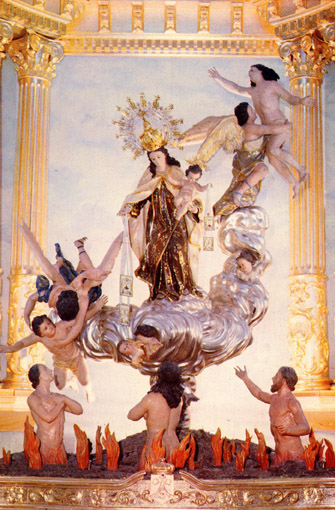
Antoine Duparc, Notre Dame du Mont-Carmel, Beniaján, Espagne
HOLY MASS ON THE SOLEMNITY OF MARY, MOTHER OF GOD
47th WORLD DAY OF PEACE
HOMILY OF POPE FRANCIS
Vatican Basilica
Wednesday, 1st January 2014
In the first reading we
find the ancient prayer of blessing which God gave to Moses to hand on to Aaron
and his sons: “The Lord bless you and keep you. The Lord make his face to shine
upon you, and be gracious to you. The Lord lift up his countenance upon you and
give you peace” (Num 6:24-25). There is no more meaningful time than the
beginning of a new year to hear these words of blessing: they will accompany
our journey through the year opening up before us. They are words of strength,
courage and hope. Not an illusory hope, based on frail human promises, or a
naïve hope which presumes that the future will be better simply because it is
the future. Rather, it is a hope that has its foundation precisely in God’s
blessing, a blessing which contains the greatest message of good wishes there
can be; and this is the message which the Church brings to each of us, filled
with the Lord’s loving care and providential help.
The message of hope
contained in this blessing was fully realized in a woman, Mary, who was
destined to become the Mother of God, and it was fulfilled in her before all
creatures.
The Mother of God. This
is the first and most important title of Our Lady. It refers to a quality, a
role which the faith of the Christian people, in its tender and genuine
devotion to our heavenly Mother, has understood from the beginning.
We recall that great
moment in the history of the ancient Church, the Council of Ephesus, in which
the divine motherhood of the Virgin Mary was authoritatively defined. The truth
of her divine maternity found an echo in Rome where, a little later, the
Basilica of Saint Mary Major was built, the first Marian shrine in Rome and in
the entire West, in which the image of the Mother of God – the Theotokos –
is venerated under the title of Salus Populi Romani. It is said that the
residents of Ephesus used to gather at the gates of the basilica where the
bishops were meeting and shout, “Mother of God!”. The faithful, by asking them
to officially define this title of Our Lady, showed that they acknowledged her
divine motherhood. Theirs was the spontaneous and sincere reaction of children
who know their Mother well, for they love her with immense tenderness. But it
is more: it is the sensus fidei of the holy People of God which, in
its unity, never errs.
Mary has always been
present in the hearts, the piety and above all the pilgrimage of faith of the
Christian people. “The Church journeys through time… and on this journey she
proceeds along the path already trodden by the Virgin Mary” (Redemptoris
Mater, 2). Our journey of faith is the same as that of Mary, and so we feel
that she is particularly close to us. As far as faith, the hinge of the
Christian life, is concerned, the Mother of God shared our condition. She had
to take the same path as ourselves, a path which is sometimes difficult and
obscure. She had to advance in the “pilgrimage of faith” (Lumen
gentium, 58).
Our pilgrimage of faith
has been inseparably linked to Mary ever since Jesus, dying on the Cross, gave
her to us as our Mother, saying: “Behold your Mother!” (Jn 19:27). These
words serve as a testament, bequeathing to the world a Mother. From that moment
on, the Mother of God also became our Mother! When the faith of the disciples
was most tested by difficulties and uncertainties, Jesus entrusted them to
Mary, who was the first to believe, and whose faith would never fail. The
“woman” became our Mother when she lost her divine Son. Her sorrowing heart was
enlarged to make room for all men and women, all, whether good or bad, and she
loves them as she loved Jesus. The woman who at the wedding at Cana in Galilee
gave her faith-filled cooperation so that the wonders of God could be displayed
in the world, at Calvary kept alive the flame of faith in the resurrection of
her Son, and she communicates this with maternal affection to each and every
person. Mary becomes in this way a source of hope and true joy!
The Mother of the
Redeemer goes before us and continually strengthens us in faith, in our
vocation and in our mission. By her example of humility and openness to God’s
will she helps us to transmit our faith in a joyful proclamation of the Gospel
to all, without reservation. In this way our mission will be fruitful, because
it is modeled on the motherhood of Mary. To her let us entrust our journey of
faith, the desires of our heart, our needs and the needs of the whole world,
especially of those who hunger and thirst for justice and peace, and for God.
Let us then together invoke her, and I invite you to invoke her three times,
following the example of those brothers and sisters of Ephesus: Mother of God!
Mother of God! Mother of God! Amen.
Copyright © Dicastery for Communication
BENOÎT XVI
AUDIENCE GÉNÉRALE
Mercredi 2 janvier 2008
Marie, Mère de Dieu
Chers frères et sœurs,
Une très ancienne formule
de bénédiction, rapportée dans le Livre des Nombres, dit: "Que Yahvé
te bénisse et te garde! Que Yahvé fasse pour toi
rayonner son visage et te fasse grâce!" (Nb 6, 24-26). C'est avec ces mots
que la liturgie nous a fait à nouveau entendre hier, premier jour de l'année,
que je voudrais adresser mes voeux cordiaux à vous tous, ici présents, et à
ceux qui, au cours de ces fêtes de Noël, m'ont fait parvenir des témoignages
d'affectueuse proximité spirituelle.
Nous avons célébré hier
la fête solennelle de Marie, Mère de Dieu. "Mère de Dieu", Theotokos,
est le titre attribué officiellement à Marie au V siècle, plus exactement lors
du Concile d'Ephèse de 431, mais qui s'était déjà affirmé dans la dévotion du
peuple chrétien à partir du III siècle, dans le contexte des discussions
enflammées de cette période sur la personne du Christ. On soulignait, par ce
titre, que le Christ est Dieu et qu'il est réellement né, comme un homme, de
Marie: on préservait ainsi son unité de vrai Dieu et de vrai homme. En
vérité, même si le débat semblait porter sur Marie, celui-ci concernait
essentiellement son Fils. Voulant sauvegarder la pleine humanité de Jésus,
certains Pères suggéraient un terme plus atténué: au lieu du titre de
Theotokos, ils proposaient celui de Christotokos, "Mère du Christ";
cela fut cependant vu à juste titre comme une menace contre la doctrine de la
pleine unité de la divinité avec l'humanité du Christ. C'est pourquoi, après
une longue discussion, lors du Concile d'Ephèse de 431, comme je l'ai dit,
furent solennellement confirmées, d'une part, l'unité des deux natures, divine
et humaine, en la personne du Fils de Dieu (cf. DS, n. 250) et, de l'autre, la
légitimité de l'attribution à la Vierge du titre de Theotokos, Mère de Dieu
(ibid., n. 251).
Après ce Concile, on
enregistra une véritable explosion de dévotion mariale et de nombreuses églises
dédiées à la Mère de Dieu furent construites. Parmi celles-ci domine la
Basilique Sainte-Marie-Majeure, ici à Rome. La doctrine concernant Marie, Mère
de Dieu, trouva en outre une nouvelle confirmation dans le Concile de
Chalcédoine (451), au cours duquel le Christ fut déclaré "vrai Dieu et
vrai homme [...] né pour nous et pour notre salut de Marie, Vierge et Mère de
Dieu, dans son humanité" (DS, n. 301). Comme on le sait, le Concile
Vatican II a recueilli dans un chapitre de la Constitution dogmatique sur
l'Eglise Lumen
gentium, le huitième, la doctrine sur Marie, réaffirmant sa maternité
divine. Le chapitre s'intitule: "La Bienheureuse Vierge Marie, Mère
de Dieu, dans le mystère du Christ et de l'Eglise".
La qualification de Mère
de Dieu, si profondément liée aux fêtes de Noël, est donc le titre fondamental
sous lequel la Communauté des croyants honore, pourrions-nous dire depuis
toujours, la Sainte Vierge. Celle-ci exprime bien la mission de Marie dans
l'histoire du salut. Tous les autres titres qui sont attribués à la Vierge
trouvent leur fondement dans sa vocation à être la Mère du Rédempteur, la
créature humaine élue par Dieu pour réaliser le plan du salut, centré sur le
grand mystère de l'incarnation du Verbe divin. En ces jours de fête, nous nous
sommes arrêtés pour contempler dans la crèche la représentation de la Nativité.
Au centre de cette scène, nous trouvons la Vierge Mère qui offre l'Enfant Jésus
à la contemplation de ceux qui viennent adorer le Sauveur: les pasteurs,
les personnes pauvres de Bethléem, les Mages venus d'Orient. Plus tard, lors de
la fête de la "Présentation du Seigneur", que nous célébrerons le 2
février, ce seront le vieux Siméon et la prophétesse Anne qui recevront le
petit Enfant des mains de sa Mère et qui l'adoreront. La dévotion du peuple
chrétien a toujours considéré la naissance de Jésus et la maternité divine de
Marie comme deux aspects du même mystère de l'incarnation du Verbe divin et
donc elle n'a jamais considéré la Nativité comme une chose du passé. Nous
sommes "contemporains" des pasteurs, des mages, de Siméon et d'Anne,
et alors que nous cheminons avec eux nous sommes remplis de joie, car Dieu a
voulu être Dieu avec nous et qu'il a une mère, qui est notre mère.
C'est du titre de
"Mère de Dieu" que dérivent ensuite tous les autres titres avec
lesquels l'Eglise honore la Vierge, mais celui-ci est le titre fondamental.
Nous pensons au privilège de l'"Immaculée Conception", c'est-à-dire
au fait qu'elle soit exempte du péché depuis sa conception: Marie fut préservée
de toute tache de péché, car elle devait être la Mère du Rédempteur. Cela est
également valable pour le titre de l'"Assomption": Celle qui
avait engendré le Sauveur ne pouvait pas être sujette à la corruption dérivant
du péché. Et nous savons que tous ces privilèges ne sont pas accordés pour
éloigner Marie de nous, mais au contraire pour la rendre proche; en effet,
étant totalement avec Dieu, cette Femme est très proche de nous et nous aide
comme une mère et comme une sœur. La place unique et singulière que Marie
possède dans la communauté des croyants dérive également de sa vocation
fondamentale à être la Mère du Rédempteur. Précisément en tant que telle, Marie
est également la Mère du Corps mystique du Christ, qui est l'Eglise. C'est donc
à juste titre que, durant le Concile Vatican II, le 21 novembre 1964, Paul VI
attribua solennellement à Marie le titre de "Mère de l'Eglise".
Précisément parce qu'elle
est la Mère de l'Eglise, la Vierge est également la Mère de chacun de nous, qui
sommes les membres du Corps mystique du Christ. De la Croix, Jésus a confié sa
Mère à chacun de ses disciples et, dans le même temps, il a confié chacun de
ses disciples à l'amour de sa Mère. L'évangéliste Jean conclut son récit bref
et suggestif par les mots suivants: "Et à partir de cette heure-là,
le disciple la prit chez lui" (Jn 19, 27). Telle est la traduction du
texte grec: "èis tà ìdia", il l'accueillit dans sa propre
réalité, dans son propre être. Si bien qu'elle fait partie de sa vie et que les
deux vies s'interpénètrent; et cette façon de l'accepter dans sa propre vie
(èis tà ìdia) est le testament du Seigneur. Au moment suprême de
l'accomplissement de la mission messianique, Jésus laisse donc à chacun de ses
disciples, comme héritage précieux, sa propre Mère, la Vierge Marie.
Chers frères et sœurs, en
ces premiers jours de l'année, nous sommes invités à considérer attentivement
l'importance de la présence de Marie dans la vie de l'Eglise et dans notre
existence personnelle. Remettons-nous à Elle, afin qu'Elle guide nos pas en
cette nouvelle période de temps que le Seigneur nous donne de vivre, et qu'elle
nous aide à être d'authentiques amis de son Fils et de courageux artisans de
son Royaume dans le monde, Royaume de la lumière et de la vérité. Bonne année à
tous! Tel est le souhait que je désire à présent adresser à vous tous ici
présents et à vos proches, en cette première Audience générale de l'année 2008.
Que la nouvelle année, commencée sous le signe de la Vierge Marie, nous fasse
sentir plus vivement sa présence maternelle, si bien que, soutenus et
réconfortés par la protection de la Vierge, nous puissions contempler avec un
regard neuf le visage de son Fils Jésus et cheminer avec plus d'empressement
sur les voies du bien.
Encore une fois, Bonne année à tous!
* * *
Je salue tous les pèlerins francophones. Que Marie nous fasse ressentir plus vivement sa présence maternelle ; ainsi soutenus et réconfortés par elle, nous pourrons contempler avec un regard neuf le visage de son Fils Jésus et cheminer avec plus d’empressement dans la voie du bien. Bonne Année à tous !
© Copyright 2008 -
Libreria Editrice Vaticana
Copyright © Dicastère pour la Communication
SOURCE : https://www.vatican.va/content/benedict-xvi/fr/audiences/2008/documents/hf_ben-xvi_aud_20080102.html
BENEDICT XVI
GENERAL AUDIENCE
Dear Brothers and Sisters,
The celebration of the Solemnity of the Assumption of the Blessed Virgin Mary, next Saturday, is at hand and we are in the context of the Year for Priest. I therefore wish to speak of the link between Our Lady and the priesthood. This connection is deeply rooted in the Mystery of the Incarnation.
When God decided to become man in his Son, he needed the freely-spoken "yes" of one of his creatures. God does not act against our freedom. And something truly extraordinary happens: God makes himself dependent on the free decision, the "yes" of one of his creatures; he waits for this "yes". St Bernard of Clairvaux explained dramatically in one of his homilies this crucial moment in universal history when Heaven, earth and God himself wait for what this creature will say.
Mary's "yes" is therefore the door through which God was able to enter the world, to become man. So it is that Mary is truly and profoundly involved in the Mystery of the Incarnation, of our salvation. And the Incarnation, the Son's becoming man, was the beginning that prepared the ground for the gift of himself; for giving himself with great love on the Cross to become Bread for the life of the world. Hence sacrifice, priesthood and Incarnation go together and Mary is at the heart of this mystery.
Let us now go to the Cross. Before dying, Jesus sees his Mother beneath the Cross and he sees the beloved son. This beloved son is certainly a person, a very important individual, but he is more; he is an example, a prefiguration of all beloved disciples, of all the people called by the Lord to be the "beloved disciple" and thus also particularly of priests. Jesus says to Mary: "Woman, behold, your son!" (Jn 19: 26). It is a sort of testament: he entrusts his Mother to the care of the son, of the disciple. But he also says to the disciple: "Behold, your mother!" (Jn 19: 27). The Gospel tells us that from that hour St John, the beloved son, took his mother Mary "to his own home". This is what it says in the [English] translation; but the Greek text is far deeper, far richer. We could translate it: he took Mary into his inner life, his inner being, "eis tà ìdia", into the depths of his being. To take Mary with one means to introduce her into the dynamism of one's own entire existence it is not something external and into all that constitutes the horizon of one's own apostolate. It seems to me that one can, therefore, understand how the special relationship of motherhood that exists between Mary and priests may constitute the primary source, the fundamental reason for her special love for each one of them. In fact, Mary loves them with predilection for two reasons: because they are more like Jesus, the supreme love of her heart, and because, like her, they are committed to the mission of proclaiming, bearing witness to and giving Christ to the world. Because of his identification with and sacramental conformation to Jesus, Son of God and Son of Mary, every priest can and must feel that he really is a specially beloved son of this loftiest and humblest of Mothers.
The Second Vatican Council invites priests to look to Mary as to the perfect model for their existence, invoking her as "Mother of the supreme and eternal Priest, as Queen of Apostles, and as Protectress of their ministry". The Council continues, "priests should always venerate and love her, with a filial devotion and worship" (cf. Presbyterorum Ordinis, n. 18). The Holy Curé d'Ars, whom we are remembering in particular in this Year, used to like to say: "Jesus Christ, after giving us all that he could give us, wanted further to make us heirs to his most precious possession, that is, his Holy Mother (B. Nodet, Il pensiero e l'anima del Curato d'Ars, Turin 1967, p. 305). This applies for every Christian, for all of us, but in a special way for priests. Dear brothers and sisters, let us pray that Mary will make all priests, in all the problems of today's world, conform with the image of her Son Jesus, as stewards of the precious treasure of his love as the Good Shepherd. Mary, Mother of priests, pray for us!
To special groups
Dear Brothers and Sisters,
I offer a warm welcome to the English-speaking visitors present at today's
Audience, including the Sisters of St Anne, the altar servers from Malta, and
the pilgrims from Australia and the United States of America. As the Feast of
the Assumption of the Blessed Virgin draws near in this Year of the Priest, my
Catechesis today is centred on Mary the Mother of priests. She looks upon them
with special affection as her sons. Indeed, their mission is similar to hers;
priests are called to bring forth Christ's saving love into the world. On the
Cross, Jesus invites all believers, especially his closest disciples, to love
and venerate Mary as their Mother. Let us pray that all priests will make a
special place for the Blessed Virgin in their lives, and seek her assistance
daily as they bear witness to the Gospel of Jesus. Upon you and your families I
invoke God's blessings of joy and peace!
I now address the young people, the sick and the newlyweds. Yesterday
we celebrated the Memorial of St Clare of Assisi, who was able to live her
adherence to Christ with courage and generosity. Imitate her example,
particularly you, dear young people, so that like her you may respond
faithfully to the Lord's call. I encourage you, dear sick people, to
be united with the suffering Jesus as you carry your cross with faith. And may
you, dear newlyweds, be apostles of the Gospel of love in your
family.
After the Catechesis, Pope Benedict XVI also appealed for solidarity and prayer
for the peoples of Eastern Asia and Japan.
Lastly, my thoughts turn to the numerous peoples who have been hit by a violent
typhoon in the past few days in the Philippines, in Taiwan, in certain
south-Eastern Provinces of the People's Republic of China and in Japan, which
latter country has also been sorely tried by a strong earthquake.
I wish to express my spiritual closeness to all who are in conditions of
serious hardship, and I ask everyone to pray for them and for all those who
have lost their life. I hope they will not be left without the comfort of
solidarity and material assistance.
© Copyright 2009 -
Libreria Editrice Vaticana
HOMILY OF HIS HOLINESS
BENEDICT XVI
Dear Brothers and
Sisters!
On the first day of the
year, the liturgy resounds in the Church throughout the world with the ancient
priestly blessing that we heard during today’s first reading: “The Lord bless
you and keep you; the Lord make his face to shine upon you, and be gracious to
you; the Lord lift up his countenance upon you and give you peace” (Num 6:24-26).
This blessing was entrusted by God, through Moses, to Aaron and his sons, that
is, to the priests of the people of Israel. It is a triple blessing filled with
light, radiating from the repetition of the name of God, the Lord, and from the
image of his face. In fact, in order to be blessed, we have to stand in God’s
presence, take his Name upon us and remain in the cone of light that issues
from his Face, in a space lit up by his gaze, diffusing grace and peace.
This was the very
experience that the shepherds of Bethlehem had, who reappear in today’s Gospel.
They had the experience of standing in God’s presence, they received his
blessing not in the hall of a majestic palace, in the presence of a great
sovereign, but in a stable, before a “babe lying in a manger” (Lk 2:16).
From this child, a new light issues forth, shining in the darkness of the
night, as we can see in so many paintings depicting Christ’s Nativity.
Henceforth, it is from him that blessing comes, from his name – Jesus, meaning
“God saves” – and from his human face, in which God, the almighty Lord of
heaven and earth, chose to become incarnate, concealing his glory under the
veil of our flesh, so as to reveal fully to us his goodness (cf. Tit 3:4).
The first to be swept up
by this blessing was Mary the virgin, the spouse of Joseph, chosen by God from
the first moment of her existence to be the mother of his incarnate Son. She is
the “blessed among women” (Lk 1:42) – in the words of Saint Elizabeth’s
greeting. Her whole life was spent in the light of the Lord, within the radius
of his name and of the face of God incarnate in Jesus, the “blessed fruit of
her womb”. This is how Luke’s Gospel presents her to us: fully intent upon
guarding and meditating in her heart upon everything concerning her son Jesus
(cf. Lk 2:19, 51). The mystery of her divine motherhood that we
celebrate today contains in superabundant measure the gift of grace that all
human motherhood bears within it, so much so that the fruitfulness of the womb
has always been associated with God’s blessing. The Mother of God is the first
of the blessed, and it is she who bears the blessing; she is the woman who
received Jesus into herself and brought him forth for the whole human family.
In the words of the liturgy: “without losing the glory of virginity, [she]
brought forth into the world the eternal light, Jesus Christ our Lord” (Preface
I of the Blessed Virgin Mary).
Mary is the mother and
model of the Church, who receives the divine Word in faith and offers herself
to God as the “good soil” in which he can continue to accomplish his mystery of
salvation. The Church also participates in the mystery of divine motherhood,
through preaching, which sows the seed of the Gospel throughout the world, and
through the sacraments, which communicate grace and divine life to men. The
Church exercises her motherhood especially in the sacrament of Baptism, when
she generates God’s children from water and the Holy Spirit, who cries out in
each of them: “Abba, Father!” (Gal 4:6). Like Mary, the Church is the
mediator of God’s blessing for the world: she receives it in receiving Jesus
and she transmits it in bearing Jesus. He is the mercy and the peace that the
world, of itself, cannot give, and which it needs always, at least as much as
bread.
Dear friends, peace, in
the fullest and highest sense, is the sum and synthesis of all blessings. So
when two friends meet, they greet one another, wishing each other peace. The
Church too, on the first day of the year, invokes this supreme good in a
special way; she does so, like the Virgin Mary, by revealing Jesus to all, for
as Saint Paul says, “He is our peace” (Eph 2:14), and at the same time the
“way” by which individuals and peoples can reach this goal to which we all
aspire. With this deep desire in my heart, I am glad to welcome and greet all
of you who have come to Saint Peter’s Basilica on this 45th World Day of Peace:
Cardinals, Ambassadors from so many friendly countries, who more than ever on
this happy occasion share with me and with the Holy See the desire for renewed
commitment to the promotion of peace in the world; the President of the
Pontifical Council for Justice and Peace, who with the Secretary and the
officials of the Dicastery work in a particular way towards this goal; the
other Bishops and Authorities present; the representatives of ecclesial
Associations and Movements and all of you, brothers and sisters, especially
those among you who work in the field of educating the young. Indeed – as you
know – the role of education is what I highlighted in my Message for this year.
“Educating Young People
in Justice and Peace” is a task for every generation, and thanks be to God,
after the tragedies of the two great world wars, the human family has shown
increasing awareness of it, as we can witness, on the one hand, from
international statements and initiatives, and on the other, from the emergence
among young people themselves, in recent decades, of many different forms of
social commitment in this field. For the ecclesial community, educating men and
women in peace is part of the mission received from Christ, it is an integral
part of evangelization, because the Gospel of Christ is also the Gospel of
justice and peace. But the Church, in recent times, has articulated a demand
that affects everyone with a sensitive and responsible conscience regarding
humanity’s future; the demand to respond to a decisive challenge that consists
precisely in education. Why is this a “challenge”? For at least two reasons: in
the first place, because in the present age, so strongly marked by a
technological mentality, the desire to educate and not merely
to instruct cannot be taken for granted, it is a choice; in the
second place, because the culture of relativism raises a radical question: does
it still make sense to educate? And then, to educate for what?
Naturally now is not the
time to address these fundamental questions, which I have tried to answer on
other occasions. Instead I would like to underline the fact that, in the face
of the shadows that obscure the horizon of today’s world, to assume responsibility
for educating young people in knowledge of the truth, in fundamental values and
virtues, is to look to the future with hope. And in this commitment to a
holistic education, formation in justice and peace has a place. Boys and girls
today are growing up in a world that has, so to speak, become smaller, where
contacts between different cultures and traditions, even if not always direct,
are constant. For them, now more than ever, it is indispensable to learn the
importance and the art of peaceful coexistence, mutual respect, dialogue and
understanding. Young people by their nature are open to these attitudes, but
the social reality in which they grow up can lead them to think and act in the
opposite way, even to be intolerant and violent. Only a solid education of
their consciences can protect them from these risks and make them capable of
carrying on the fight, depending always and solely on the power of truth and
good. This education begins in the family and is developed at school and in
other formative experiences. It is essentially about helping infants, children
and adolescents to develop a personality that combines a profound sense of
justice with respect for their neighbour, with a capacity to address conflicts
without arrogance, with the inner strength to bear witness to good, even when
it involves sacrifice, with forgiveness and reconciliation. Thus they will be
able to become people of peace and builders of peace.
In this task of educating
young generations, a particular responsibility lies with religious communities.
Every pathway of authentic religious formation guides the person, from the most
tender age, to know God, to love him and to do his will. God is love, he is
just and peaceable, and anyone wishing to honour him must first of all act like
a child following his father’s example. One of the Psalms says: “The Lord does
deeds of justice, gives judgment for all who are oppressed ... The Lord is
compassion and love, slow to anger and rich in mercy” (Ps 102:6,8). In
God, justice and mercy come together perfectly, as Jesus showed us through the
testimony of his life. In Jesus, “love and truth” have met, “justice and peace”
have embraced (cf. Ps 84:11). In these days, the Church is
celebrating the great mystery of the Incarnation: God’s truth has sprung from
the earth and justice looks down from heaven, the earth has yielded its fruit
(cf. Ps 84:12,13). God has spoken to us in his Son Jesus. Let us hear
what God has to say: “a voice that speaks of peace” (Ps 84:9). Jesus is a
way that can be travelled, open to everyone. He is the path of peace. Today the
Virgin Mary points him out to us, she shows us the Way: let us walk in it! And
you, Holy Mother of God, accompany us with your protection. Amen.
© Copyright 2012 -
Libreria Editrice Vaticana
Copyright © Dicastery for
Communication
_-_interior_-_Capella_della_Madonna_-_Maria_Ausiliatrice.jpg)
Sainte
Marie Auxiliatrice, Cathédrale de Trévise
Solemnity of Mary, the
Mother of God
In the 4th and 5th centuries debates about the nature of Christ raged in the
Church. The debate was about the relationship of Christ’s divine and human
natures. At the center of this debate was a title of Mary. Since at least the
3rd century, Christians had referred to Mary as theotokos, meaning
“God-bearer.” The first documented usage of the term is in the writings of
Origen of Alexandria in AD 230. Related to theotokos, Mary was called the
Mother of God.
Referring to Mary this way was popular in Christian piety, but the patriarch of
Constantinople from 428-431, Nestorius, objected. He suggested that Mary was
only the mother of Jesus’ human nature, but not his divine nature. Nestorius’
ideas (or at least how others perceived his arguments) were condemned at the
Council of Ephesus in AD 431, and again at the Council of Chalcedon in AD 451.
The Church decided that Christ was fully God and fully human, and these natures
were united in one person, Jesus Christ. Thus Mary could be called “mother of
God” since she gave birth to Jesus who was fully divine as well as human. Since
this time, Mary has been frequently honored as the “mother of God” by
Catholics, Orthodox, and many Protestants.
The Solemnity of Mary Mother of God falls exactly one week after Christmas, the
end of the octave of Christmas. It is fitting to honor Mary as Mother of Jesus,
following the birth of Christ. When Catholics celebrate the Solemnity of Mary
Mother of God we are not only honoring Mary, who was chosen among all women
throughout history to bear God incarnate, but we are also honoring our Lord,
who is fully God and fully human. Calling Mary “mother of God” is the highest
honor we can give Mary. Just as Christmas honors Jesus as the “Prince of
Peace,” the Solemnity of Mary Mother of God honors Mary as the “Queen of Peace”
This solemnity, falling on New Year’s Day, is also designated the World Day of
Peace.
The origins of a feast celebrating Mary’s divine maternity are obscure, but
there is some evidence of ancient feasts commemorating Mary’s role as
theotokos. Around 500 AD the Eastern Church celebrated a “Day of the Theotokos”
either before or after Christmas. This celebration eventually evolved into a
Marian feast on December 26th in the Byzantine calendar and January 16th in the
Coptic calendar. In the West, Christmas has generally been celebrated with an octave,
an eight day extension of the feast. The Gregorian and Roman calendars of the
7th century mark the Christmas octave day with a strong Marian emphasis.
However, eventually in the West, the eighth day of the octave of Christmas was
celebrated as the Feast of the Circumcision of Jesus. The push for an official
feast day celebrating Mary’s divine maternity started in Portugal, and in 1751
Pope Benedict XIV allowed Portugal’s churches to celebrate Mary’s divine
maternity on the first Sunday in May. The feast was eventually extended to
other countries, and by 1914 was being celebrated on October 11. The feast of
Mary’s divine maternity became a universal feast in 1931.
However, following Vatican II, Pope Paul VI decided to change the feast of
Jesus’ Circumcision to the Solemnity of Mary Mother of God to reclaim the
ancient Western Marian emphasis at the end of the Octave of Christmas.
Celebrating Mary’s divine maternity during the Christmas octave makes complete
sense in that the celebration is connected closely to Christ’s birth. Pope Paul
VI gave his reasoning for the change:
In the revised arrangement of the Christmas season, we should all turn with one
mind to the restored solemnity of the Mother of God. This feast was entered
into the calendar in the liturgy of the city of Rome for the first day of
January. The purpose of the celebration is to honor the role of Mary in the
mystery of salvation and at the same time to sing the praises of the unique
dignity thus coming to “the Holy Mother…through whom we have been given the
gift of the Author of life.” This same solemnity also offers an excellent
opportunity to renew the adoration rightfully to be shown to the newborn Prince
of Peace, as we once again hear the good tidings of great joy and pray to God,
through the intercession of the Queen of Peace, for the priceless gift of
peace. Because of these considerations and the fact that the octave of
Christmas coincides with a day of hope, New Year’s Day, we have assigned to it
the observance of the World Day of Peace (Paul VI, Marialis Cultus, Feb. 2,
1974, no.5).
Thus Pope Paul VI highlighted the feast’s celebration of both Mary and Jesus.
He also noted the connection to New Year’s Day and Mary’s role as Queen of
Peace. January 1st, the Solemnity of Mary Mother of God is also the observed
“World Day of Peace.”
SOURCE : http://www.ucatholic.com/saints/mother-of-god/
The Blessed Virgin Mary
The Blessed Virgin Mary is the mother of Jesus
Christ, the mother of God.
In general, the theology and history of Mary the Mother of God follow
the chronological order of their respective sources, i.e. the Old
Testament, the New
Testament, the early Christian and Jewish witnesses.
Mary prophesied in the
Old Testament
The Old
Testament refers to Our Blessed Lady both in its prophecies and
its types
or figures.
Genesis 3:15
The first prophecy referring
to Mary is found in the very opening chapters of the Book
of Genesis (3:15): "I will put enmities between thee and the woman,
and thy seed and her seed; she shall crush thy head, and thou shalt lie in wait
for her heel." This rendering appears to differ in two respects from the
original Hebrew
text:
(1) First, the Hebrew
text employs the same verb for the two renderings "she shall
crush" and "thou shalt lie in wait"; the Septuagint renders
the verb both times by terein, to lie in wait; Aquila, Symmachus,
the Syriac and
the Samaritan translators,
interpret the Hebrew verb
by expressions which mean to crush, to bruise; the Itala renders the terein employed
in the Septuagint by
the Latin "servare",
to guard; St.
Jerome [1] maintains that the Hebrew verb
has the meaning of "crushing" or "bruising" rather than of
"lying in wait", "guarding". Still in his own work, which
became the Latin
Vulgate, the saint employs
the verb "to crush" (conterere) in the first place, and "to lie
in wait" (insidiari) in the second. Hence the punishment inflicted on
the serpent and
the serpent's retaliation
are expressed by the same verb: but the wound of the serpent is
mortal, since it affects his head, while the wound inflicted by the serpent is
not mortal, being inflicted on the heel.
(2) The second point of difference between the Hebrew
text and our version concerns the agent who is to inflict the mortal
wound on the serpent: our version agrees with the present Vulgate text
in reading "she" (ipsa) which refers to the woman,
while the Hebrew
text reads hu' (autos, ipse) which refers to the seed of
the woman.
According to our version, and the Vulgate reading,
the woman herself
will win the victory; according to the Hebrew
text, she will be victorious through her seed. In this sense does the Bull "Ineffabilis"
ascribe the victory to Our Blessed Lady. The reading "she" (ipsa) is
neither an intentional corruption of the original text, nor is it an
accidental error;
it is rather an explanatory version expressing explicitly the fact of Our
Lady's part in the victory over the serpent,
which is contained implicitly in the Hebrew original.
The strength of the Christian
tradition as to Mary's share in this victory may be inferred from the
retention of "she" in St.
Jerome's version in spite of his acquaintance with the original text
and with the reading "he" (ipse) in the old Latin version.
As it is quite commonly admitted that the Divine
judgment is directed not so much against the serpent as
against the originator of sin,
the seed of the serpent denotes
the followers of the serpent,
the "brood of vipers", the "generation of vipers", those
whose father is the Devil,
the children of evil, imitando,
non nascendo (Augustine).
[2] One may be tempted to understand the seed of the woman in
a similar collective sense, embracing all who are born of God.
But seed not only may denote a particular person,
but has such a meaning usually, if the context allows it. St.
Paul (Galatians
3:16) gives this explanation of the word "seed" as it occurs in
the patriarchal promises:
"To Abraham were
the promises made and to his seed. He saith not, and to his seeds, as of many;
but as of one, and to his seed, which is Christ".
Finally the expression "the woman"
in the clause "I will put enmities between thee and the woman"
is a literal version of the Hebrew
text. The Hebrew Grammar of Gesenius-Kautzsch [3] establishes the rule:
Peculiar to the Hebrew is
the use of the article in order to indicate a person or
thing, not yet known and
not yet to be more clearly described, either as present or as to be taken into
account under the contextual conditions. Since our indefinite article serves
this purpose, we may translate: "I will put enmities between you and
a woman".
Hence the prophecy promises
a woman,
Our Blessed Lady, who will be the enemy of the serpent to
a marked degree; besides, the same woman will
be victorious over the Devil,
at least through her offspring. The completeness of the victory is emphasized
by the contextual phrase "earth shall thou eat", which is according
to Winckler [4] a common old-oriental expression denoting the deepest
humiliation [5].
Isaias 7:1-17
The second prophecy referring
to Mary is found in Isaias
7:1-17. Critics have endeavoured to represent this passage as a combination
of occurrences and sayings from the life of the prophet written
down by an unknown hand [6]. The credibility of the contents is not necessarily
affected by this theory, since prophetic traditions may
be recorded by any writer without losing their credibility. But even Duhm
considers the theory as an apparent attempt on the part of the critics to
find out what the readers are willing to bear patiently; he believes it is a
real misfortune for criticism itself
that it has found a mere compilation in a passage which so graphically
describes the birth-hour of faith.
According to 2
Kings 16:1-4, and 2
Chronicles 27:1-8, Achaz,
who began his reign 736 B.C., openly professed idolatry,
so that God gave
him into the hands of the kings of Syria and Israel.
It appears that an alliance had been concluded between Phacee, King of Israel,
and Rasin, King of Damascus,
for the purpose of opposing a barrier to the Assyrian aggressions. Achaz,
who cherished Assyrian proclivities,
did not join the coalition; the allies invaded his territory, intending to substitute
for Achaz a
more subservient ruler, a certain son of Tabeel. While Rasin was occupied in
reconquering the maritime city Elath, Phacee alone proceeded against Juda,
"but they could not prevail". After Elath had fallen, Rasin joined
his forces with those of Phacee; "Syria hath
rested upon Ephraim", whereupon "his (Achaz')
heart was moved, and the heart of his people, as the trees of the woods are
moved with the wind". Immediate preparations must be made for a protracted
siege, and Achaz is
busily engaged near the upper pool from which the city received the greater
part of its water supply. Hence the Lord says
to Isaias:
"Go forth to meet Achaz.
. .at the end of the conduit of the upper pool". The prophet's commission
is of an extremely consoling nature: "See thou be quiet; hear not, and let
not thy heart be afraid of the two tails of these firebrands". The scheme
of the enemies shall not succeed: "it shall not stand, and this shall not
be." What is to be the particular fate of the enemies?
Syria will
gain nothing, it will remain as it has been in the past: "the head
of Syria is Damascus,
and the head of Damascus is
Rasin".
Ephraim too will remain
in the immediate future as it has been hitherto: "the head of Ephraim
is Samaria,
and the head of Samaria the
son of Romelia"; but after sixty-five years it will be destroyed,
"within threescore and five years Ephraim shall cease to be a
people".
Achaz had
abandoned the Lord for Moloch,
and put his trust in an alliance with Assyria;
hence the conditional prophecy concerning Juda,
"if you will not believe,
you shall not continue". The test of belief follows
immediately: "ask thee a sign of the Lord thy God,
either unto the depth of hell or
unto the height above". Achaz hypocritically answers:
"I will not ask, and I will not tempt the Lord",
thus refusing to express his belief in God,
and preferring his Assyrian policy.
The king prefers Assyria to God,
and Assyria will
come: "the Lord shall
bring upon thee and upon thy people, and upon the house of thy father, days
that have not come since the time of the separation of Ephraim from Juda with
the king of the Assyrians."
The house of David has
been grievous not merely to men,
but to God also
by its unbelief; hence it "shall not continue", and, by an irony of
Divine punishment, it will be destroyed by those very men whom
it preferred to God.
Still the general Messianic promises
made to the house of David cannot
be frustrated: "The Lord Himself
shall give you a sign. Behold a virgin shall
conceive, and bear a son, and his name shall be called Emmanuel.
He shall eat butter and honey, that he may know to refuse the evil and
to choose the good.
For before the child know to refuse the evil,
and to choose the good,
the land which thou abhorrest shall be forsaken of the face of her two
kings." Without answering a number of questions connected with the
explanation of the prophecy,
we must confine ourselves here to the bare proof that
the virgin mentioned
by the prophet is
Mary the Mother of Christ.
The argument is based on the premises that the prophet's virgin is
the mother of Emmanuel,
and that Emmanuel is Christ.
The relation of the virgin to Emmanuel is
clearly expressed in the inspired words;
the same indicate also the identity of Emmanuel with
the Christ.
The connection of Emmanuel with
the extraordinary Divine sign which was to be given to Achaz predisposes
one to see in the child more than a common boy. In 8:8,
the prophet ascribes
to him the ownership of the land of Juda:
"the stretching out of his wings shall fill the breadth of thy land,
O Emmanuel".
In 9:6,
the government of the house of David is
said to be upon his shoulders, and he is described as
being endowed with more than human qualities:
"a child is born to us, and a son is given to us, and the government is
upon his shoulders, and his name shall be called Wonderful, Counsellor, God
the Mighty, the Father of the World to Come, and the Prince of Peace".
Finally, the prophet calls Emmanuel "a
rod out of the root of Jesse" endowed with "the spirit
of the Lord. . .the spirit of
wisdom and of understanding, the spirit of
counsel, and of fortitude, the spirit of
knowledge and of godliness"; his advent shall be followed by the general
signs of the Messianic era,
and the remnant of the chosen
people shall be again the people of God (11:1-16).
Whatever obscurity or ambiguity there may be in the prophetic text
itself is removed by St.
Matthew (1:18-25).
After narrating the doubt of St.
Joseph and the angel's assurance,
"that which is conceived in her is of the Holy
Ghost", the Evangelist proceeds:
"now all this was done that it might be fulfilled which the Lord spoke
by the prophet,
saying: Behold a virgin shall
be with child, and bring forth a son, and they shall call his name Emmanuel."
We need not repeat the exposition of the passage given by Catholic commentators who
answer the exceptions raised against the obvious meaning of the Evangelist.
We may infer from all this that Mary is mentioned in the prophecy of Isaias as
mother of Jesus
Christ; in the light of St.
Matthew's reference to the prophecy,
we may add that the prophecy predicted
also Mary's virginity untarnished
by the conception of the Emmanuel [7].
Micheas 5:2-3
A third prophecy referring
to Our Blessed Lady is contained in Micah
5:2-3: "And thou, Bethlehem,
Ephrata, art a little one among the thousands of Juda:
out of thee shall be come forth unto me that is to be the ruler in Israel,
and his going forth is from the beginning, from the days of eternity.
Therefore will he give them up till the time wherein she that travaileth shall
bring forth, and the remnant of his brethren shall be converted to the children
of Israel."
Though the prophet (about
750-660 B.C.) was a contemporary of Isaias,
his prophetic activity
began a little later and ended a little earlier than that of Isaias.
There can be no doubt that
the Jews regarded
the foregoing prediction as
referring to the Messias.
According to St.
Matthew (2:6)
the chief priests and scribes,
when asked where the Messias was
to be born, answered Herod in
the words of the prophecy,
"And thou Bethlehem the
land of Juda.
. ." According to St.
John (7:42),
the Jewish populace
gathered at Jerusalem for
the celebration of the feast asked the rhetorical question: "Doth not
the Scripture say
that Christ cometh
of the seed of David,
and from Bethlehem,
the town where David was?"
The Chaldee paraphrase of Micah
5:2, confirms the same view: "Out of thee shall come forth unto me
the Messias,
that he may exercise dominion in Israel".
The very words of the prophecy admit
of hardly any other explanation; for "his going forth is from the
beginning, from the days of eternity".
But how does the prophecy refer
to the Virgin Mary? Our Blessed Lady is denoted by the phrase, "till the
time wherein she that travaileth shall bring forth". It is true that
"she that travaileth" has been referred to the Church (St.
Jerome, Theodoret),
or to the collection of the Gentiles united
with Christ (Ribera, Mariana),
or again to Babylon (Calmet);
but, on the one hand, there is hardly a sufficient connection between any of
these events and the promised redeemer,
on the other hand, the passage ought to read "till the time wherein she
that is barren shall bring forth" if any of these events were referred to
by the prophet.
Nor can "she that travaileth" be referred to Sion: Sion is spoken of
without figure before
and after the present passage so that we cannot expect the prophet to
lapse suddenly into figurative language. Moreover, the prophecy thus
explained would not give a satisfactory sense. The contextual phrases "the
ruler in Israel",
"his going forth", which in Hebrew implies
birth, and "his brethren" denote an individual, not a nation; hence
we infer that the bringing forth must refer to the same person.
It has been shown that the person of the ruler is the Messias;
hence "she that travaileth" must denote the mother of Christ,
or Our Blessed Lady. Thus explained the whole passage becomes clear: the Messias must
be born in Bethlehem,
an insignificant village in Juda:
his family must
be reduced to poverty and
obscurity before the time of his birth; as this cannot happen if the theocracy remains
intact, if David's house
continues to flourish, "therefore will he give them up till the time
wherein she that travaileth shall bring forth" the Messias.
[8]
Jeremias 31:22
A fourth prophecy referring
to Mary is found in Jeremias
31:22; "The Lord has
created a new thing upon the earth: A woman shall
compass a man". The text of the prophet Jeremias offers
no small difficulties for the scientific interpreter; we shall follow the Vulgate version
of the Hebrew original.
But even this rendering has been explained in several different ways:
Rosenmuller and several conservative Protestant interpreters
defend the meaning, "a woman shall protect a
man"; but such a motive would hardly induce the men of Israel to
return to God.
The explanation "a woman shall seek a
man" hardly agrees with the text; besides, such an inversion of the
natural order is presented in Isaias
4:1, as a sign of the greatest calamity. Ewald's rendering, "a woman shall change
into a man", is hardly faithful to the original text. Other commentators see
in the woman a type of
the Synagogue or
of the Church,
in man the type of God,
so that they explain the prophecy as
meaning, "God will
dwell again in the midst of the Synagogue (of
the people of Israel)"
or "the Church will
protect the earth with its valiant men".
But the Hebrew
text hardly suggests such a meaning; besides, such an explanation
renders the passage tautological: "Israel shall
return to its God,
for Israel will love its God".
Some recent writers render the Hebrew original:
"God creates
a new thing upon the earth: the woman (wife)
returns to the man (her husband)". According to the old
law (Deuteronomy
24:1-4; Jeremiah
3:1) the husband could not take back the wife once repudiated by him; but
the Lord will
do something new by allowing the faithless wife, i.e. the guilty nation, to
return to the friendship of God.
This explanation rests upon a conjectural correction of the text; besides, it
does not necessarily bear the Messianic meaning
which we expect in the passage.
The Greek Fathers generally
follow the Septuagint
version, "The Lord has
created salvation in
a new plantation, men shall go about in safety"; but St.
Athanasius twice [9] combines Aquila's version "God has
created a new thing in woman"
with that of the Septuagint,
saying that the new plantation is Jesus
Christ, and that the new thing created in woman is
the body of the Lord,
conceived within the virgin without the co-operation of man. St.
Jerome too [10] understands the prophetic text
of the virgin conceiving the Messias.
This meaning of the passage satisfies the text and the context. As the Word
Incarnate possessed from the first moment of His conception all His
perfections excepting those connected with His bodily development, His mother
is rightly said to "compass a man". No need to point out that such a
condition of a newly conceived child is rightly called "a new thing upon
earth". The context of the prophecy describes
after a short general introduction (30:1-3) Israel's future
freedom and restoration in four stanzas: 30:4-11,
12-22; 30:23; 31:14,
15-26; the first three stanzas end with the hope of the Messianic time.
The fourth stanza, too, must be expected to have a similar ending. Moreover,
the prophecy of Jeremias,
uttered about 589 B.C. and understood in the sense just explained, agrees with
the contemporary Messianic expectations
based on Isaias
7:14; 9:6; Micah
5:3. According to Jeremias,
the mother of Christ is
to differ from other mothers in this, that her child, even while within her
womb, shall possess all those properties which constitute real manhood [11].
The Old
Testament refers indirectly to Mary in those prophecies which
predict the Incarnation of
the Word
of God.
Old Testament types and
figures of Mary
In order to be sure of
the typical sense,
it must be revealed,
i.e. it must come down to us through Scripture or tradition.
Individual pious writers have developed copious analogies between
certain data of the Old
Testament and corresponding data of the New;
however ingenious these developments may be, they do not prove that God really
intended to convey the corresponding truths in
the inspired text
of the Old
Testament. On the other hand, it must be kept in mind that not all truths contained
in either Scripture or tradition have
been explicitly proposed to the faithful as
matters of belief by
the explicit definition of
the Church.
According to the principle "Lex orandi est lex credenti" we must
treat at least with reverence the numberless suggestions contained in the
official prayers and liturgies of
the Church.
In this sense we must regard many of the titles bestowed on Our Blessed Lady in
her litany and
in the "Ave
maris stella". The Antiphons and Responses found
in the Offices recited
on the various feasts of
Our Blessed Lady suggest a number of types of
Mary that hardly could have been brought so vividly to the notice of the Church's
ministers in any other way. The third antiphon of Lauds of
the Feast
of the Circumcision sees in "the bush that was not burnt" (Exodus
3:2) a figure of
Mary conceiving her Son without
the loss of her virginity.
The second antiphon of Lauds of
the same Office sees
in Gideon's fleece
wet with dew while all the ground beside had remained dry (Judges
6:37-38) a type of
Mary receiving in her womb the Word
Incarnate [12]. The Office of
the Blessed Virgin applies to Mary many passages concerning the spouse in
the Canticle
of Canticles [13] and also concerning Wisdom in the Book
of Proverbs 8:22-31 [14]. The application to Mary of a "garden
enclosed, a fountain sealed up" mentioned in Canticles 4:12 is only a
particular instance of what has been said above. [15] Besides, Sara, Debbora, Judith,
and Esther are
variously used as figures of
Mary; the ark
of the Covenant, over which the presence
of God manifested itself, is used as the figure of
Mary carrying God Incarnate within
her womb. But especially Eve,
the mother of all the living (Genesis
3:20), is considered as a type of
Mary who is the mother of all the living in the order of grace [16].
Mary in the gospels
The reader of the Gospels is
at first surprised to find so little about Mary; but this obscurity of Mary in
the Gospels has
been studied at length by Blessed
Peter Canisius [17], Auguste
Nicolas [18], Cardinal
Newman [19], and Very
Rev. J. Spencer Northcote [20]. In the commentary on the "Magnificat",
published 1518, even Luther expresses
the belief that
the Gospels praise
Mary sufficiently by calling her (eight times) the Mother of Jesus.
In the following paragraphs we shall briefly group together what we know of
Our Blessed Lady's life before the birth of her Divine
Son, during the hidden life of Our
Lord, during His public life and
after His resurrection.
Mary's Davidic ancestry
St.
Luke (2:4)
says that St.
Joseph went from Nazareth to Bethlehem to
be enrolled, "because he was of the house and family of David".
As if to exclude all doubt concerning
the Davidic descent
of Mary, the Evangelist (1:32,
69) states that the child born of Mary without the intervention of man shall
be given "the throne of David His
father", and that the Lord
God has "raised up a horn of salvation to
us in the house of David his
servant". [21] St.
Paul too testifies that Jesus
Christ "was made to him [God]
of the seed of David,
according to the flesh" (Romans
1:3). If Mary were not of Davidic descent,
her Son conceived
by the Holy
Ghost could not be said to be "of the seed of David".
Hence commentators tell
us that in the text "in the sixth month the angel
Gabriel was sent from God.
. .to a virgin espoused to
a man whose name was Joseph,
of the house of David"
(Luke
1:26-27); the last clause "of the house of David"
does not refer to Joseph,
but to the virgin who
is the principal person in
the narrative; thus we have a direct inspired testimony
to Mary's Davidic descent.
[22]
While commentators generally
agree that the genealogy found
at the beginning of the first
Gospel is that of St.
Joseph, Annius
of Viterbo proposes the opinion, already alluded to by St.
Augustine, that St.
Luke's genealogy gives
the pedigree of Mary. The text of the third
Gospel (3:23)
may be explained so as to make Heli the
father of Mary: "Jesus.
. .being the son (as it was supposed of Joseph)
of Heli",
or "Jesus.
. .being the son of Joseph,
as it was supposed, the son of Heli"
(Lightfoot, Bengel, etc.), or again "Jesus.
. .being as it was supposed the son of Joseph,
who was [the son-in-law] of Heli"
[23]. In these explanations the name of Mary is not mentioned explicitly, but
it is implied; for Jesus is
the Son of Heli through
Mary.
Her parents
Though few commentators adhere
to this view of St.
Luke's genealogy,
the name of Mary's father, Heli,
agrees with the name given to Our Lady's father in a tradition founded
upon the report of the Protoevangelium
of James, an apocryphal Gospel
which dates from the end of the second century. According to this document
the parents of
Mary are Joachim and Anna.
Now, the name Joachim is only a variation of Heli or Eliachim,
substituting one Divine name (Yahweh)
for the other (Eli,
Elohim). The tradition as
to the parents of
Mary, found in the Gospel of James, is reproduced by St.
John Damascene [24], St.
Gregory of Nyssa [25], St.
Germanus of Constantinople [26], pseudo-Epiphanius [27],
pseudo-Hilarius [28], and St.
Fulbert of Chartres [29]. Some of these writers add that the birth of
Mary was obtained by the fervent prayers of Joachim and Anna in
their advanced age. As Joachim belonged
to the royal family of David,
so Anna is
supposed to have been a descendant of the priestly family of Aaron;
thus Christ the
Eternal King and Priest sprang
from both a royal and priestly family [30].
The hometown of Mary's
parents
According to Luke
1:26, Mary lived in Nazareth,
a city in Galilee,
at the time of the Annunciation.
A certain tradition maintains
that she was conceived and
born in the same house in which the Word became flesh [31].
Another tradition based
on the Gospel of James regards Sephoris as
the earliest home of Joachim and Anna,
though they are said to have lived later on in Jerusalem,
in a house called by St. Sophronius of Jerusalem [32] Probatica. Probatica,
a name probably derived from the sanctuary's nearness to the pond called Probatica or Bethsaida in
John 5:2. It was here that Mary was born. About a century later, about A.D.
750, St.
John Damascene [33] repeats the statement that Mary was born in the
Probatica.
It is said that, as early as in the fifth century the empress Eudoxia built a
church over the place where Mary was born, and where her parents lived
in their old age. The present Church of St. Anna stands at a distance of only
about 100 Feet from the pool Probatica. In 1889, 18 March, was discovered
the crypt which
encloses the supposed burying-place of St.
Anna. Probably this place was originally a garden in which both Joachim and Anna were
laid to rest. At their time it was still outside of the city walls, about 400
feet north of the Temple.
Another crypt near St.
Anna's tomb is the supposed birthplace of the Blessed Virgin; hence it
is that in early times the church was called St. Mary of the Nativity [34]. In
the Cedron
Valley, near the road leading to the Church of the Assumption, is a little
sanctuary containing two altars which
are said to stand over the burying-places of
Sts. Joachim and Anna;
but these graves belong
to the time of the Crusades [35].
In Sephoris too
the Crusaders replaced
by a large church an ancient sanctuary which stood over the legendary house of
Sts. Joachim and Anna.
After 1788 part of this church was restored by the Franciscan
Fathers.
Her Immaculate Conception
The Immaculate
Conception of Our Blessed Lady has been treated in a SPECIAL
ARTICLE.
The birth of Mary
As to the place of the
birth of Our Blessed Lady, there are three different traditions to
be considered.
First, the event has been placed in Bethlehem.
This opinion rests on the authority of the following witnesses: it is expressed
in a writing entitled "De nativ. S. Mariae" [36] inserted after the
works of St.
Jerome; it is more or less vaguely supposed by the Pilgrim of Piacenza,
erroneously called Antoninus Martyr, who wrote about A.D. 580 [37]; finally
the popes Paul
II (1471), Julius
II (1507), Leo
X (1519), Paul
III (1535), Pius
IV (1565), Sixtus
V (1586), and Innocent
XII (1698) in their Bulls concerning
the Holy
House of Loreto say that the Blessed Virgin was born, educated,
and greeted by the angel in
the Holy
House. But these pontiffs hardly
wish to decide an historical question; they merely express the opinion of their
respective times.
A second tradition placed
the birth of Our Blessed Lady in Sephoris,
about three miles north of Bethlehem,
the Roman Diocaesarea,
and the residence of Herod
Antipas till late in the life
of Our Lord. The antiquity of this opinion may be inferred from the fact
that under Constantine a
church was erected in Sephoris to
commemorate the residence of Joachim and Anna in
that place [38]. St.
Epiphanius speaks of this sanctuary [39]. But this merely shows that
Our Blessed Lady may have lived in Sephoris for
a time with her parents,
without forcing us to believe that
she had been born there.
The third tradition,
that Mary was born in Jerusalem,
is the most probable one. We have seen that it rests upon the testimony of St.
Sophronius, St.
John Damascene, and upon the evidence of the recent finds in the Probatica.
The Feast
of Our Lady's Nativity was not celebrated in Rome till
toward the end of the seventh century; but two sermons found among the writings
of St.
Andrew of Crete (d. 680) suppose the existence of this feat, and lead
one to suspect that it was introduced at an earlier date into some other
churches [40]. In 799 the 10th canon of
the Synod of Salzburg prescribes
four feasts in honour of
the Mother of God: the Purification,
2 February; the Annunciation,
25 March; the Assumption,
15 August; the Nativity,
8 September.
The Presentation of Mary
According to Exodus
13:2 and 13:12, all the Hebrew first-born male
children had to be presented in the Temple.
Such a law would
lead pious Jewish parents to
observe the same religious rite with regard to other favourite children. This
inclines one to believe that Joachim and Anna presented
in the Temple their
child, which they had obtained by their long, fervent prayers.
As to Mary, St.
Luke (1:34)
tells us that she answered the angel announcing
the birth of Jesus
Christ: "how shall this be done, because I know not man". These
words can hardly be understood, unless we assume that Mary had made a vow of virginity;
for, when she spoke them, she was betrothed to St.
Joseph. [41] The most opportune occasion for such a vow was
her presentation in
the Temple.
As some of the Fathers admit
that the faculties of St.
John the Baptist were prematurely developed by a special intervention
of God's power,
we may admit a similar grace for
the child of Joachim and Anna.
[42]
But what has been said does not exceed the certainty of antecedently probable
pious conjectures. The consideration that Our
Lord could not have refused His Blessed Mother any favours which
depended merely on His munificence does not exceed the value of an a
priori argument. Certainty in
this question must depend on external testimony and the teaching of
the Church.
Now, the Protoevangelium of James (7-8), and the writing entitled "De
nativit. Mariae" (7-8), [43] state that Joachim and Anna,
faithful to a vow they
had made, presented the
child Mary in the Temple when
she was three years old; that the child herself mounted the Temple steps,
and that she made her vow of virginity on
this occasion. St.
Gregory of Nyssa [44] and St.
Germanus of Constantinople [45] adopt this report; it is also followed
by pseudo-Gregory of Nazianzus in his "Christus patiens". [46]
Moreover, the Church celebrates
the Feast
of the Presentation, though it does not specify at what age the child Mary
was presented in the Temple,
when she made her vow of virginity,
and what were the special natural and supernatural
gifts with which God endowed her.
The feast is
mentioned for the first time in a document of Manuel Commenus, in 1166;
from Constantinople the feast must
have been introduced into the western
Church, where we find it at the papal court at Avignon in
1371; about a century later, Pope
Sixtus IV introduced the Office of
the Presentation,
and in 1585 Pope
Sixtus V extended the Feast
of the Presentation to the whole Church.
Her betrothal to Joseph
The apocryphal
writings to which we referred in the last paragraph state that Mary
remained in the Temple after
her presentation in
order to be educated with
other Jewish children.
There she enjoyed ecstatic
visions and daily visits of the holy
angels.
When she was fourteen, the high
priest wished to send her home for marriage.
Mary reminded him of her vow of virginity,
and in his embarrassment the high
priest consulted the Lord.
Then he called all the young men of the family of David,
and promised Mary in marriage to
him whose rod should sprout and become the resting place of the Holy
Ghost in form of a dove. It was Joseph who
was privileged in this extraordinary way.
We have already seen that St.
Gregory of Nyssa, St.
Germanus of Constantinople, and pseudo-Gregory Nazianzen seem to adopt
these legends. Besides, the emperor Justinian allowed
a basilica to
be built on the platform of the former Temple in
memory of Our Lady's stay in the sanctuary; the church was called the New St.
Mary's so as to distinguish it from the Church of the Nativity. It seems to be
the modern mosque el-Aksa. [47]
On the other hand, the Church is
silent as to Mary's stay in the Temple. St.
Ambrose [48], describing Mary's life before the Annunciation,
supposes expressly that she lived in the house of her parents.
All the descriptions of the Jewish
Temple which can claim any scientific value leave us in ignorance as
to any localities in which young girls might have been educated.
Joas's stay in the Temple till
the age of seven does not favour the supposition that young girls were educated within
the sacred precincts; for Joas was king, and was forced by circumstances to
remain in the Temple (cf. 2
Kings 11:3). What 2
Maccabees 3:19, says about "the virgins also
that were shut up" does not show that any of them were kept in the Temple buildings.
If the prophetess Anna is
said (Luke
2:37) not to have "departed from the temple,
by fastings and prayer serving
night and day", we do not suppose that she actually lived in one of
he temple rooms.
[49] As the house of Joachim and Anna was
not far distant from the Temple,
we may supposed that the holy child
Mary was often allowed to visit the sacred buildings in order to satisfy her
devotion.
Jewish maidens
were considered marriageable at
the age of twelve years and six months, though the actual age of the bride
varied with circumstances. The marriage was
preceded by the betrothal,
after which the bride legally belonged to the bridegroom, though she did not
live with him till about a year later, when the marriage used
to be celebrated. All this agrees well with the language of the Evangelists. St.
Luke (1:27)
calls Mary "a virgin espoused to
a man whose name was Joseph"; St.
Matthew (1:18)
says, when as his mother Mary was espoused to Joseph,
before they came together, she was found with child, of the Holy
Ghost". As we know of no brother of Mary, we must suppose that she was
an heiress, and was obliged by the law of Numbers
36:6 to marry a member of her tribe.
The Law itself
prohibited marriage within
certain degrees
of relationship, so that the marriage of
even an heiress was left more or less to choice.
According to Jewish custom,
the union between Joseph and
Mary had to be arranged by the parents of St.
Joseph. One might ask why Mary consented to her betrothal,
though she was bound by her vow of virginity.
As she had obeyed God's inspiration
in making her vow,
so she obeyed God's inspiration
in becoming the affianced bride of Joseph.
Besides, it would have been singular among the Jews to
refuse betrothal or marriage;
for all the Jewish maidens
aspired after marriage as
the accomplishment of a natural duty.
Mary trusted the Divine guidance implicitly, and thus was certain that
her vow would
be kept even in her married state.
The Annunciation
The Annunciation has
been treated in a SPECIAL
ARTICLE.
The Visitation
According to Luke
1:36, the angel
Gabriel told Mary at the time of the annunciation,
"behold, thy cousin Elizabeth,
she also hath conceived a son in her old age, and this is the sixth month with
her that was called barren". Without doubting the truth of
the angel's words,
Mary determined at once to add to the pleasure of
her pious relative. [50] Hence the Evangelist continues
(1:39):
"And Mary, rising up in those days, went into the hill country with haste
into a city of Juda.
And she entered into the house of Zachary, and saluted Elizabeth."
Though Mary must have told Joseph of
her intended visit, it is hard to determine whether he accompanied her; if the
time of the journey happened to coincide with one of the festal seasons at
which the Israelites had
to go to the Temple,
there would be little difficulty about companionship.
The place of Elizabeth's home
has been variously located by different writers: it has been placed in
Machaerus, over ten miles east of the Dead
Sea, or in Hebron,
or again in the ancient sacerdotal city
of Jutta, about seven miles south of Hebron,
or finally in Ain-Karim, the traditional St. John-in-the Mountain, nearly four
miles west of Jerusalem.
[51] But the first three places possess no traditional memorial
of the birth or life of St.
John; besides, Machaerus was not situated in the mountains of Juda; Hebron and
Jutta belonged after the Babylonian
captivity to Idumea,
while Ain-Karim lies in the "hill country" [52] mentioned in
the inspired text
of St.
Luke.
After her journey of about thirty hours, Mary "entered into the house of
Zachary, and saluted Elizabeth"
(Luke
1:40). According to tradition, Elizabeth lived
at the time of the visitation not
in her city home, but in her villa, about ten minutes distant from the city;
formerly this place was marked by an upper and lower church. In 1861 the
present small Church of the Visitation was erected on the ancient foundations.
"And it came to pass that, when Elizabeth heard
the salutation of Mary, the infant leaped
in her womb." It was at this moment that God fulfilled
the promise made by the angel to
Zachary (Luke
1:15), "and he shall be filled with the Holy
Ghost, even from his mother's womb"; in other words, the infant in Elizabeth's womb
was cleansed from the stain of original
sin. The fullness of the Holy
Ghost in the infant overflowed,
as it were, into the soul of
his mother: "and Elizabeth was
filled with the Holy
Ghost" (Luke
1:41). Thus both child and mother were sanctified by
the presence of Mary and the Word
Incarnate [53]; filled as she was with the Holy
Ghost, Elizabeth "cried
out with a loud voice, and said: Blessed art thou among women,
and blessed is the fruit of thy womb. And whence is this to me, that the mother
of my Lord should
come to me? For behold, as soon as the voice of thy salutation sounded in my
ears, the infant in
my womb leaped for joy.
And blessed art thou that hast believed,
because those things shall be accomplished that were spoken to thee by
the Lord"
(Luke
1:42-45). Leaving to commentators the
full explanation of the preceding passage, we draw attention only to two
points:
Elizabeth begins
her greeting with the words with which the angel had
finished his salutation, thus showing that both spoke in the same Holy
Spirit;
Elizabeth is
the first to call Mary by her most honourable title
"Mother of God".
Mary's answer is the canticle of praise commonly called "Magnificat" from the first word of its Latin text; the "Magnificat" has been treated in a SEPARATE ARTICLE.
The Evangelist closes
his account of the Visitation with
the words: "And Mary abode with her about three months; and she returned
to her own house" (Luke
1:56). Many see in this brief statement of the third
gospel an implied hint that Mary remained in the house of Zachary till
the birth of John
the Baptist, while others deny such an implication. As the Feast
of the Visitation was placed by the 43rd canon of
the Council
of Basle (A.D. 1441) on 2 July, the day following the Octave of
the Feast of St.
John Baptist, it has been inferred that Mary may have remained with Elizabeth until
after the child's circumcision;
but there is no further proof for
this supposition. Though the visitation is
so accurately described in the third
Gospel, its feast does
not appear to have been kept till the thirteenth century, when it was
introduced through the influence of the Franciscans;
in 1389 it was officially instituted by Urban
VI.
Mary's pregnancy becomes
known to Joseph
After her return
from Elizabeth,
Mary "was found with child, of the Holy
Ghost" (Matthew
1:18). As among the Jews, betrothal was
a real marriage,
the use of marriage after
the time of espousals presented
nothing unusual among them. Hence Mary's pregnancy could not astonish anyone
except St.
Joseph. As he did not know the mystery of
the Incarnation,
the situation must have been extremely painful both to him and to Mary.
The Evangelist says:
"Whereupon Joseph her
husband being a just man, and not willing publicly to expose her, was minded
to put
her away privately" (Matthew
1:19). Mary left the solution of the difficulty to God,
and God informed
the perplexed spouse in His own time of the true condition
of Mary. While Joseph "thought
on these things, behold the angel
of the Lord appeared to him in his sleep, saying: Joseph,
son of David,
fear not to take unto thee Mary thy wife, for that which is conceived in her is
of the Holy
Ghost. And she shall bring forth a son, and thou shalt call his name Jesus.
For He shall save His
people from their sins"
(Matthew
1:20-21).
Not long after this revelation, Joseph concluded
the ritual marriage contract
with Mary. The Gospel simply
says: "Joseph rising
up from sleep did as the angel
of the Lord had commanded him, and took unto him his wife" (Matthew
1:24). While it is certain that between the betrothal and
the marriage at
least three months must have elapsed, during which Mary stayed with Elizabeth,
it is impossible to determine the exact length of time between the two ceremonies.
We do not know how long after the betrothal the angel announced to
Mary the mystery of
the Incarnation,
nor do we know how long the doubt of Joseph lasted,
before he was enlightened by the visit of the angel.
From the age at which Hebrew maidens
became marriageable, it is possible that Mary gave birth to her Son when
she was about thirteen or fourteen years of age. No historical
document tells us how old she actually was at the time of the Nativity.
The journey to Bethlehem
St. Luke (2:1-5) explains how Joseph and Mary journeyed from Nazareth to Bethlehem in obedience to a decree of Caesar Augustus which prescribed a general enrolment. The questions connected with this decree have been considered in the article BIBLICAL CHRONOLOGY. There are various reasons why Mary should have accompanied Joseph on this journey; she may not wished to lose Joseph's protection during the critical time of her pregnancy, or she may have followed a special Divine inspiration impelling her to go in order to fulfil the prophecies concerning her Divine Son, or again she may have been compelled to go by the civil law either as an heiress or to settle the personal tax payable by women over twelve years of age. [54]
As the enrolment had brought a multitude of strangers to Bethlehem,
Mary and Joseph found
no room in the caravansary and had to take lodging in a grotto which served as
a shelter for animals. [55]
Mary gives birth to Our
Lord
"And it came to
pass, that when they were there, her days were accomplished, that she should be
delivered" (Luke
2:6); this language leaves it uncertain whether the birth of Our
Lord took place immediately after Joseph and
Mary had taken lodging in the grotto, or several days later. What is said about
the shepherds "keeping the night watches over their flock" (Luke
2:8) shows that Christ was
born in the night time.
After bringing forth her Son,
Mary "wrapped Him up in swaddling clothes, and laid Him in a manger"
(Luke
2:7), a sign that she did not suffer from the pain and weakness of
childbirth. This inference agrees with the teaching of some of the
principal Fathers and theologians: St.
Ambrose [56], St.
Gregory of Nyssa [57], St.
John Damascene [58], the author of Christus patiens [59], St.
Thomas [60], etc. It was not becoming that the mother of God should be
subject to the punishment pronounced in Genesis
3:16, against Eve and
her sinful daughters.
Shortly after the birth of the child, the shepherds, obedient to
the angelic invitation,
arrived in the grotto, "and they found Mary and Joseph,
and the infant lying
in the manger" (Luke
2:16). We may suppose that the shepherds spread the glad tidings they had
received during the night among their friends in Bethlehem,
and that the Holy Family was received by one of its pious inhabitants into more
suitable lodgings.
The Circumcision of Our
Lord
"And after eight
days were accomplished, that the child should be circumcised,
his name was called Jesus"
(Luke
2:21). The rite of circumcision was
performed either in the synagogue or
in the home of the Child;
it is impossible to determine where Our
Lord's Circumcision took
place. At any rate, His Blessed Mother must have been present at the ceremony.
The Presentation
According to the law of Leviticus
12:2-8, the Jewish mother
of a male child had to present herself forty days after his birth for legal
purification; according to Exodus
13:2, and Numbers
18:15, the first-born
son had to be presented on the same occasion. Whatever reasons Mary
and the Infant might
have for claiming an exemption, they complied with the law.
But, instead of offering a
lamb, they presented the sacrifice of
the poor,
consisting of a pair of turtle-doves or two young pigeons. In 2
Corinthians 8:9, St.
Paul informs the Corinthians that Jesus
Christ "being rich. . .became poor,
for your sakes, that through his poverty you
might be rich". Even more acceptable to God than
Mary's poverty was
the readiness with which she surrendered her Divine
Son to the good pleasure of His
Heavenly Father.
After the ceremonial
rites had been complied with, holy
Simeon took the Child in
his arms, and thanked God for
the fulfilment of his promises; he drew attention to the universality of
the salvation that
was to come through Messianic redemption
"prepared before the face of all peoples: a light to the revelation of
the Gentiles,
and the glory of thy people Israel"
(Luke
2:31 sq.). Mary and Joseph now
began to know their Divine
Child more fully; they "were wondering at those things which were
spoken concerning him" (Luke
2:33). As if to prepare Our Blessed Mother for the mystery of
the cross, holy
Simeon said to her: "Behold this child is set for the fall, and
for the resurrection of many in Israel,
and for a sign which shall be contradicted. And thy own soul a
sword shall pierce, that, out of many hearts, thoughts may be revealed" (Luke
2:34-35). Mary had suffered her first great sorrow at the time when Joseph was
hesitating about taking her for his wife; she experienced her second great
sorrow when she heard the words of holy
Simeon.
Though the incident of the prophetess Anna had
a more general bearing, for she "spoke of him (the Child)
to all that looked for the redemption of Israel"
(Luke
2:38), it must have added greatly to the wonder of Joseph and
Mary. The Evangelist's concluding
remark, "after they had performed all things according to the law
of the Lord, they returned into Galilee,
to their city Nazareth"
(Luke
2:39), has been variously interpreted by commentators;
as to the order of events, see the article CHRONOLOGY
OF THE LIFE OF JESUS CHRIST.
The visit of the Magi
After the Presentation,
the Holy Family either returned to Bethlehem directly,
or went first to Nazareth,
and then moved into the city
of David. At any rate, after the "wise
men from the east" had followed the Divine guidance to Bethlehem,
"entering into the house, they found the child with Mary his mother, and
falling down they adored him;
and opening their treasures, they offered him gifts; gold, frankincense, and
myrrh" (Matthew
2:11). The Evangelist does
not mention Joseph;
not that he was not present, but because Mary occupies the principal place near
the Child.
How Mary and Joseph disposed
of the presents offered by their wealthy visitors
has not been told us by the Evangelists.
The flight to Egypt
Soon after the departure
of the wise
men Joseph received
the message from the angel
of the Lord to fly into Egypt with
the Child and
His mother on account of the evil designs of Herod;
the holy man's
ready obedience is
briefly described by the Evangelist in
the words: "who arose, and took the child and his mother by night, and
retired into Egypt"
(Matthew
2:14). Persecuted Jews had
ever sought a refuge in Egypt (cf. 1
Kings 11:40; 2
Kings 25:26); about the time of Christ Jewish colonists
were especially numerous in the land
of the Nile [61]; according to Philo [62] they numbered at least a
million. In Leontopolis,
in the district of Heliopolis, the Jews had
a temple (160
B.C.-A.D. 73) which rivalled in splendour the temple
in Jerusalem. [63] The Holy Family might therefore expect to find in Egypt a
certain amount of help and protection.
On the other hand, it required a journey of at least ten days from Bethlehem to
reach the nearest habitable districts of Egypt.
We do not know by what road the Holy Family effected its flight; they may have
followed the ordinary road through Hebron;
or they may have gone by way of Eleutheropolis and Gaza,
or again they may have passed west of Jerusalem towards
the great military road of Joppe.
There is hardly any historical document which will assist us in determining
where the Holy Family lived in Egypt,
nor do we know how long the enforced exile lasted. [64]
When Joseph received
from the angel the
news of Herod's death
and the command to return into the land of Israel,
he "arose, and took the child and his mother, and came into the land
of Israel"
(Matthew
2:21). The news that Archelaus ruled in Judea prevented Joseph from
settling in Bethlehem,
as had been his intention; "warned in sleep [by
the angel,
he] retired into the quarters of Galilee.
And coming he dwelt in a city called Nazareth"
(Matthew
2:22-23). In all these details Mary simply followed the guidance of Joseph,
who in his turn received the Divine manifestations as head of the Holy Family.
There is no need to point out the intense sorrow which Mary suffered on account
of the early persecution of
the Child.
The Holy Family in
Nazareth
The life of the Holy
Family in Nazareth was
that of the ordinary poor tradesman.
According to Matthew
13:55, the townsfolk asked "Is not this the carpenter's son?";
the question, as expressed in the second
Gospel (Mark
6:3), shows a slight variation, "Is not this the carpenter?"
While Joseph gained
the livelihood for the Holy Family by his daily work, Mary attended to the
various duties of
housekeeper. St.
Luke (2:40)
briefly says of Jesus:
"And the child grew, and waxed strong, full of wisdom; and the grace
of God was in him". The weekly Sabbath and
the annual great feasts interrupted the daily routine of life in Nazareth.
The finding of Our Lord
in the Temple
According to the law of Exodus
23:17, only the men were obliged to visit the Temple on
the three solemn feasts of the year; but the women often
joined the men to satisfy their devotion. St.
Luke (2:41)
informs us that "his [the child's] parents went
every year to Jerusalem,
at the solemn day of the pasch".
Probably the Child
Jesus was left in the home of friends or relatives during the days of
Mary's absence. According to the opinion of some writers, the Child did
not give any sign of His Divinity during the years of His infancy, so as to
increase the merits of Joseph's and
Mary's faith based
on what they had seen and heard at the time of the Incarnation and
the birth of Jesus. Jewish Doctors of
the Law maintained
that a boy became a son of the law at
the age of twelve years and one day; after that he was bound by the legal
precepts.
The evangelist supplies
us here with the information that, "when he was twelve years old, they
going up into Jerusalem,
according to the custom of the feast, and having fulfilled the days, when they
returned, the child Jesus remained
in Jerusalem,
and his parents knew
it not" (Luke
2:42-43). Probably it was after the second festal day that Joseph and
Mary returned with the other Galilean pilgrims;
the law did
not require a longer sojourn in the Holy
City. On the first day the caravan usually made a four hours' journey, and
rested for the night in Beroth on
the northern boundary of the former Kingdom
of Juda. The crusaders built
in this place a beautiful Gothic church
to commemorate Our Lady's sorrow when she "sought him [her child] among
their kinsfolks and acquaintance, and not finding him, . . .returned into Jerusalem,
seeking him" (Luke
2:44-45). The Child was
not found among the pilgrims who had come to Beroth on
their first day's journey; nor was He found on the second day, when Joseph and
Mary returned to Jerusalem;
it was only on the third day that they "found him [Jesus]
in the temple,
sitting in the midst of the doctors,
hearing them, and asking them questions. . .And seeing him, they wondered. And
his mother said to him: Son, why hast thou done so to us? behold thy father and
I have sought thee sorrowing" (Luke
2:40-48). Mary's faith did
not allow her to fear a mere accident for her Divine
Son; but she felt that His behaviour had changed entirely from His
customary exhibition of docility and subjection. The feeling caused the
question, why Jesus had
treated His parents in
such a way. Jesus simply
answered: "How is it that you sought me? did you not know, that I must be
about my father's business?" (Luke
2:49). Neither Joseph nor
Mary understood these words as a rebuke; "they understood not the word
that he spoke to them" (Luke
2:50). It has been suggested by a recent writer that the last clause may be
understood as meaning, "they [i.e., the bystanders] understood not the
word he spoke unto them [i.e., to Mary and Joseph]".
The remainder of Our
Lord's youth
After this, Jesus "went
down with them, and came to Nazareth"
where He began a life of work and poverty,
eighteen years of which are summed up by the Evangelist in
the few words, and he "was subject to them, and. . .advanced in wisdom,
and age, and grace with God and men"
(Luke
2:51-52). The interior life of Mary is briefly indicated by the inspired writer
in the expression, "and his mother kept all these words in her heart"
(Luke
2:51). A similar expression had been used in 2:19,
"Mary kept all these words, pondering them in her heart".
Thus Mary observed the daily life of her Divine
Son, and grew in His knowledge and love by meditating on
what she saw and heard. It has been pointed out by certain writers that
the Evangelist here
indicates the last source from which he derived the material contained in his
first two chapters.
Mary's perpetual
virginity
In connection with the
study of Mary during Our
Lord's hidden life, we meet the questions of her perpetual
virginity, of her Divine motherhood, and of her personal sanctity.
Her spotless virginity has
been sufficiently considered in the article on the Virgin
Birth. The authorities there cited maintain that Mary remained a virgin when
she conceived and gave birth to her Divine
Son, as well as after the birth of Jesus.
Mary's question (Luke
1:34), the angel's answer
(Luke
1:35-37), Joseph's way
of behaving in his doubt (Matthew
1:19-25), Christ's words
addressed to the Jews (John
8:19) show that Mary retained her virginity during
the conception of her Divine
Son. [65]
As to Mary's virginity after
her childbirth, it is not denied by St.
Matthew's expressions "before they came together" (1:18),
"her firstborn
son" (1:25),
nor by the fact that the New
Testament books repeatedly refer to the "brothers
of Jesus". [66] The words "before they came together" mean
probably, "before they lived in the same house", referring to the
time when they were merely betrothed;
but even if the words be understood of marital intercourse, they only state
that the Incarnation took
place before any such intercourse had intervened, without implying that it did
occur after the Incarnation of
the Son
of God. [67]
The same must be said of the expression, "and he knew her not till she
brought forth her firstborn
son" (Matthew
1:25); the Evangelist tells
us what did not happen before the birth of Jesus,
without suggesting that it happened after his birth. [68] The name "firstborn" applies
to Jesus whether
his mother remained a virgin or
gave birth to other children after Jesus;
among the Jews it
was a legal name [69], so that its occurrence in the Gospel cannot
astonish us.
Finally, the "brothers
of Jesus" are neither the sons of Mary, nor the brothers
of Our Lord in the proper sense of the word, but they are His cousins
or the more or less near relatives. [70] The Church insists
that in His birth the Son
of God did not lessen but consecrate the virginal
integrity of His mother (Secret in Mass
of Purification). The Fathers express
themselves in similar language concerning this privilege of Mary. [71]
Mary's divine motherhood
Mary's Divine motherhood
is based on the teaching of the Gospels,
on the writings of the Fathers,
and on the express definition of
the Church. St.
Matthew (1:25)
testifies that Mary "brought forth her first-born
son" and that He was called Jesus.
According to St.
John (1:15) Jesus is
the Word made
flesh, the Word Who assumed
human nature in the womb of Mary. As Mary was truly the mother
of Jesus,
and as Jesus was
truly God from
the first moment of His conception, Mary is truly the mother of God. Even
the earliest Fathers did
not hesitate to draw this conclusion as may be seen in the writings of St.
Ignatius [72], St.
Irenaeus [73], and Tertullian [74].
The contention of Nestorius denying
to Mary the title "Mother of God" [75] was followed by the teaching
of the Council
of Ephesus proclaiming Mary to be Theotokos in the true sense
of the word. [76]
Mary's perfect sanctity
Some few patristic
writers expressed their doubts as
to the presence of minor moral
defects in Our Blessed Lady. [77] St.
Basil, e.g., suggests that Mary yielded to doubt on
hearing the words of holy
Simeon and on witnessing the crucifixion.
[78] St.
John Chrysostom is of opinion that Mary would have felt fear and
trouble, unless the angel had
explained the mystery of
the Incarnation to
her, and that she showed some vainglory at
the marriage feast
in Cana and
on visiting her Son during
His public life together with the brothers
of the Lord. [79] St.
Cyril of Alexandria [80] speaks of Mary's doubt and
discouragement at the foot of the cross.
But these Greek writers
cannot be said to express an Apostolic
tradition, when they express their private and singular opinions. Scripture and tradition agree
in ascribing to Mary the greatest personal sanctity;
She is conceived without
the stain of original
sin; she shows the greatest humility and
patience in her daily life (Luke
1:38, 48); she exhibits an heroic patience under the most trying
circumstances (Luke
2:7, 35, 48; John
19:25-27). When there is question of sin,
Mary must always be excepted. [81] Mary's complete exemption from actual sin is
confirmed by the Council
of Trent (Session VI, Canon 23): "If any one say that man
once justified can
during his whole life avoid all sins,
even venial ones, as the Church holds
that the Blessed Virgin did by special privilege of God,
let him be anathema."
Theologians assert that Mary was impeccable, not by the essential perfection
of her nature,
but by a special
Divine privilege. Moreover, the Fathers,
at least since the fifth century, almost unanimously maintain that the Blessed
Virgin never experienced the motions of concupiscence.
The miracle in Cana
The evangelists connect
Mary's name with three different events in Our
Lord's public life: with the miracle in Cana,
with His preaching, and with His passion.
The first of these incidents is related in John
2:1-10.
There was a marriage feast
in Cana of Galilee.
. .and the mother of Jesus was
there. And Jesus also
was invited, and his disciples,
to the marriage.
And the wine failing, the mother of Jesus saith
to him: They have no wine. And Jesus saith
to her: Woman, what is that to me and to thee? my hour is not yet come.
One naturally supposes that one of the contracting parties was related to Mary,
and that Jesus had
been invited on account of his mother's relationship. The couple must have been
rather poor,
since the wine was actually failing. Mary wishes to save her friends from the
shame of not being able to provide properly for the guests, and has recourse to
her Divine
Son. She merely states their need, without adding any further petition. In
addressing women, Jesus uniformly
employs the word "woman" (Matthew
15:28; Luke
13:12; John
4:21; 8:10; 19:26; 20:15),
an expression used by classical writers as a respectful and honourable address.
[82] The above cited passages show that in the language of Jesus the
address "woman" has a most respectful meaning. The clause "what
is that to me and to thee" renders the Greek ti emoi kai soi, which
in its turn corresponds to the Hebrew phrase mah
li walakh. This latter occurs in Judges
11:12; 2
Samuel 16:10; 19:23; 1
Kings 17:18; 2
Kings 3:13; 9:18; 2
Chronicles 35:21. The New
Testament shows equivalent expressions in Matthew
8:29; Mark
1:24; Luke
4:34; 8:28; Matthew
27:19. The meaning of the phrase varies according to the character of the
speakers, ranging from a most pronounced opposition to a courteous compliance.
Such a variable meaning makes it hard for the translator to find an equally
variable equivalent. "What have I to do with thee", "this is
neither your nor my business", "why art thou troublesome to me",
"allow me to attend to this", are some of the renderings suggested.
In general, the words seem to refer to well or ill-meant importunity which they
endeavour to remove. The last part of Our
Lord's answer presents less difficulty to the interpreter: "my
hour is not yet come", cannot refer to the precise moment at which the
need of wine will require the miraculous intervention
of Jesus;
for in the language of St.
John "my hour" or "the hour" denotes the time
preordained for some important event (John
4:21-23; 5:25-28; 7:30; 8:29; 12:23; 13:1; 16:21; 17:1).
Hence the meaning of Our
Lord's answer is: "Why are you troubling me by asking me for such
an intervention? The divinely appointed time for such a manifestation has not
yet come"; or, "why are you worrying? has not the time of manifesting
my power come?" The former of these meanings implies that on account of
the intercession of Mary Jesus anticipated
the time set for the manifestation of His miraculous power
[83]; the second meaning is obtained by understanding the last part of Our
Lord's words as a question, as was done by St.
Gregory of Nyssa [84], and by the Arabic version of Tatian's "Diatessaron" (Rome,
1888). [85] Mary understood her Son's words
in their proper sense; she merely warned the waiters, "Whatsoever he shall
say to you, do ye" (John
2:5). There can be no question of explaining Jesus' answer
in the sense of a refusal.
Mary during the apostolic
life of Our Lord
During the apostolic life
of Jesus,
Mary effaced herself almost completely. Not being called to aid her Son
directly in His ministry, she did not wish to interfere with His work by her
untimely presence. In Nazareth she
was regarded as a common Jewish mother; St.
Matthew (3:55-56;
cf. Mark
6:3) introduces the people of the town as saying: "Is not this the
carpenter's son? Is not his mother called Mary, and his brethren James,
and Joseph, and Simon,
and Jude:
and his sisters, are they not all with us?" Since the people wish to
lower Our
Lord's esteem by their language, we must infer that Mary belonged to
the lower social order of townspeople. The parallel passage of St.
Mark reads, "Is not this the carpenter?" instead of,
"Is not this the carpenter's son?" Since both evangelists omit
the name of St.
Joseph, we may infer that he had died before this episode took place.
At first sight, it seems that Jesus Himself
depreciated the dignity of His Blessed Mother. When He was told: "Behold
thy mother and thy brethren stand
without, seeking thee", He answered: "Who is my mother, and who are
my brethren?
And stretching forth his hand towards his disciples,
he said: Behold my mother and my brethren. For whosoever shall do the will of
my Father,
that is in heaven,
he is my brother, and my sister, and my mother" (Matthew
12:47-50; cf. Mark
3:31-35; Luke
8:19-21). On another occasion, "a certain woman from
the crowd, lifting up her voice, said to him: Blessed is the womb that bore
thee, and the paps that gave thee suck. But he said: Yea rather, blessed are
they who hear the word of God,
and keep it" (Luke
11:27-28).
In reality, Jesus in
both these passages places the bond that unites the soul with God above
the natural bond of parentage which
unites the Mother of God with her Divine
Son. The latter dignity is not belittled; as men naturally
appreciate it more easily, it is employed by Our
Lord as a means to make known the real value of holiness. Jesus,
therefore, really, praises His mother in a most emphatic way; for she excelled
the rest of men in holiness not
less than in dignity. [86] Most probably, Mary was found also among the holy women who
ministered to Jesus and
His apostles during
their ministry in Galilee (cf. Luke
8:2-3); the Evangelists do
not mention any other public appearance of Mary during the time of Jesus's journeys
through Galilee or Judea.
But we must remember that when the sun appears, even the brightest stars become
invisible.
Mary during the Passion
of Our Lord
Since the Passion
of Jesus Christ occurred during the paschal week,
we naturally expect to find Mary at Jerusalem. Simeon's prophecy found
its fulfilment principally during the time of Our
Lord's suffering. According to a tradition,
His Blessed Mother met Jesus as
He was carrying His cross to Golgotha.
The Itinerarium of
the Pilgrim of Bordeaux describes the memorable sites which the writer visited
A.D. 333, but it does not mention any locality sacred to this meeting of Mary
and her Divine
Son. [87] The same silence prevails in the so-called Peregrinatio Silviae
which used to be assigned to A.D. 385, but has lately been placed in A.D.
533-540. [88] But a plan of Jerusalem,
dating from the year 1308, shows a Church of St. John the Baptist with
the inscription "Pasm.
Vgis.", Spasmus Virginis, the swoon of the Virgin. During the course of
the fourteenth century Christians began
to locate the spots consecrated by
the Passion
of Christ, and among these was the place was the place where Mary is said
to have fainted at the sight of her suffering Son.
[89] Since the fifteenth century one finds always "Sancta Maria de
Spasmo" among the Stations
of the Way of the Cross, erected in various parts of Europe in
imitation of the Via
Dolorosa in Jerusalem.
[90] That Our Blessed Lady should have fainted at the sight of her Son's sufferings,
hardly agrees with her heroic behaviour under the cross;
still, we may consider her woman and
mother in her meeting with her Son on
the way to Golgotha,
while she is the Mother of God at the foot of the cross.
Mary's spiritual
motherhood
While Jesus was
hanging on the cross,
"there stood by the cross of Jesus,
his mother, and his mother's sister, Mary
Cleophas, and Mary
Magdalen. When Jesus therefore
had seen his mother and the disciple standing
whom he loved,
he saith to his mother: Woman, behold thy son. After that, he saith to
the disciple:
Behold thy mother. And from that hour, the disciple took
her to his own" (John
19:25-27). The darkening of the sun and the other extraordinary
phenomena in nature must have frightened the enemies of Our
Lord sufficiently so as not to interfere with His mother and His few
friends standing at the foot of the cross.
In the meantime, Jesus had prayed for
His enemies, and had promised pardon to the penitent thief;
now, He took compassion on His desolate mother, and provided for her future.
If St.
Joseph had been still alive, or if Mary had been the mother of those
who are called Our
Lord's brethren or sisters in the gospels,
such a provision would not have been necessary. Jesus uses
the same respectful title with which he had addressed his mother at the marriage feast
in Cana.
Then he commits Mary to John as
his mother, and wishes Mary to consider John as
her son.
Among the early
writers, Origen is
the only one who considers Mary's motherhood of all the faithful in
this connection. According to him, Christ lives
in his perfect followers,
and as Mary is the Mother of Christ,
so she is mother of him in whom Christ lives.
Hence, according to Origen, man has
an indirect right to
claim Mary as his mother, in so far as he identifies himself with Jesus by
the life of grace.
[91] In the ninth century, George of Nicomedia [92] explains Our
Lord's words on the cross in
such a way as to entrust John to
Mary, and in John all
the disciples,
making her the mother and mistress of all John's companions.
In the twelfth century Rupert of Deutz explained Our
Lord's words as establishing Mary's spiritual motherhood of men,
though St.
Bernard, Rupert's illustrious contemporary, does not enumerate this
privilege among Our Lady's numerous titles. [93] After this time Rupert's
explanation of Our
Lord's words on the cross became
more and more common, so that in our day it has found its way into practically
all books of piety. [94]
The doctrine of
Mary's spiritual motherhood of men is
contained in the fact that she is the antitype of Eve: Eve is
our natural mother because she is the origin of our natural life; so Mary is
our spiritual mother because she is the origin of our spiritual life. Again,
Mary's spiritual motherhood rests on the fact that Christ is
our brother, being "the firstborn among
many brethren" (Romans
8:29). She became our mother at the moment she consent to the Incarnation
of the Word, the Head of the mystical
body whose members we are; and she sealed her motherhood by consenting
to the bloody sacrifice on
the cross which
is the source of our supernatural
life. Mary and the holy women (Matthew
17:56; Mark
15:40; Luke
23:49; John
19:25) assisted at the death of Jesus on
the cross;
she probably remained during the taking down of His sacred body and during His
funeral. The following Sabbath was
for her a time of grief and hope.
The eleventh canon of
a council held
in Cologne,
in 1423, instituted against the Hussites the feast
of the Dolours of Our Blessed Lady, placing it on the Friday following the
third Sunday after Easter.
In 1725 Benedict
XIV extended the feast to
the whole Church,
and placed it on the Friday in Passion Week. "And from that hour,
the disciple took
her to his own" (John
19:27). Whether they lived in the city of Jerusalem or
elsewhere, cannot be determined from the Gospels.
Mary and Our Lord's
Resurrection
The inspired record
of the incidents connected with Christ's
Resurrection do not mention Mary; but neither do they pretend to give
a complete account of all that Jesus did
or said. The Fathers too
are silent as to Mary's share in the joys of her
Son's triumph over death. Still, St.
Ambrose [95] states expressly: "Mary therefore saw the Resurrection
of the Lord; she was the first who saw it and believed. Mary
Magdalen too saw it, though she still wavered". George of
Nicomedia [96] infers from Mary's share in Our
Lord's sufferings that before all others and more than all she must
have shared in the triumph
of her Son. In the twelfth century, an apparition of
the risen Saviour to
His Blessed Mother is admitted by Rupert of Deutz [97], and also by Eadmer [98] St.
Bernardin of Siena [99], St.
Ignatius of Loyola [100], Suarez [101], Maldonado [102],
etc. [103] That the risen Christ should
have appeared first to His Blessed Mother, agrees at least with our pious
expectations.
Though the Gospels do
not expressly tell us so, we may suppose that Mary was present when Jesus showed
himself to a number of disciples in Galilee and
at the time of His Ascension (cf. Matthew
28:7, 10, 16; Mark
16:7). Moreover, it is not improbable that Jesus visited
His Blessed Mother repeatedly during the forty days after His Resurrection.
Mary in other books of the New Testament
Acts 1:14-2:4
According to the Book
of Acts (1:14), after Christ's
Ascension into Heaven the apostles "went
up into an upper room", and: "all these were persevering with one
mind in prayer with
the women,
and Mary the mother of Jesus,
and with his brethren".
In spite of her exalted dignity it was not Mary, but Peter who
acted as head of the assembly (1:15).
Mary behaved in the upper room in Jerusalem as
she had behaved in the grotto at Bethlehem;
in Bethlehem she
had carried for the Infant
Jesus, in Jerusalem she
nurtured the infant Church.
The friends of Jesus remained
in the upper room till "the days of the Pentecost",
when with "a sound from heaven,
as of a mighty wind coming. . .there appeared to them parted tongues as it were
of fire, and it sat upon every one of them, and they were all filled with
the Holy
Ghost" (Acts
2:1-4). Though the Holy
Ghost had descended upon Mary in a special way at the time of
the Incarnation,
He now communicated to her a new degree of grace.
Perhaps, this Pentecostal grace
gave to Mary the strength of properly fulfilling her duties to
the nascent Church and
to her spiritual children.
Galatians 4:4
As to the Epistles,
the only direct reference to Mary is found in Galatians
4:4: "But when the fulness of time was come, God sent
his Son,
made of a woman,
made under the law".
Some Greek and Latin manuscripts,
followed by several Fathers,
read gennomenon ek gynaikos instead of genomenon ek gynaikos,
"born of a woman"
instead of "made of a woman". But
this variant reading cannot be accepted. For
gennomenon is the
present participle, and must be rendered, "being born of a woman",
so that it does not fit into the context. [104]
though the Latin variant
rendering "natum" is the perfect participle, and does not imply the
inconveniences of its Greek original, St.
Bede [105] rejects it, on account of its less appropriate sense.
In Romans
1:3, which is to a certain extent a parallel of Galatians
4:4, St.
Paul writes genomenos ek stermatos Daveid kata sarka, i.e.
"made of the seed of David,
according to the flesh".
Tertullian [106]
points out that the word "made" implies more than the word
"born"; for it calls to mind the "Word made
flesh", and establishes the reality of the flesh made of the Virgin.
Furthermore, the Apostle employs
the word "woman" in the phrase under consideration, because he wishes
to indicate merely the sex, without any ulterior connotation. In reality,
however, the idea of
a man made
of a woman alone,
suggests the virginal
conception of the Son
of God. St.
Paul seems to emphasize the true idea of
the Incarnation
of the Word; a true understanding
of this mystery safeguards
both the Divinity and the real humanity of Jesus
Christ. [107]
The Apostle
St. John never uses the name
Mary when speaking of Our Blessed Lady; he always refers to her as
Mother of Jesus (John
2:1-3; 19:25-26).
In his last hour, Jesus had
established the relation of mother and son between Mary and John,
and a child does not usually address his mother by her first name.
Apocalypse 12:1-6
In the Apocalypse
(12:1-16) occurs a passage singularly applicable to Our Blessed
Mother:
And a great sign appeared in heaven:
A woman clothed
with the sun, and the moon under her feet, and on her head a crown of twelve
stars; and being with child, she cried travailing in birth, and was in pain to
be delivered. And there was seen another sign in heaven:
and behold a great red dragon, having seven heads, and ten horns, and on his
heads seven diadems; and his tail drew the third part of the stars of heaven;
and cast them to the earth; and the dragon stood before the woman who
was ready to be delivered; that when she should be delivered, he might devour
her son. And she brought forth a man child, who was to rule all nations with an
iron rod; and her son was taken up to God,
and to his throne. And the woman fled
into the wilderness, where she had a place prepared by God,
that there they should feed her a thousand two hundred sixty days.
The applicability of this passage to Mary is based on the following
considerations:
At least part of the
verses refer to the mother whose son is to rule all the nations with a rod of
iron; according to Psalm
2:9, this is the Son
of God, Jesus
Christ, Whose mother is Mary.
It was Mary's
son that "was taken
up to God,
and to his throne" at the time of His Ascension
into heaven.
The dragon, or the devil of
the earthly
paradise (cf. Apocalypse
12:9; 20:2),
endeavoured to devour Mary's
Son from the first moments of His birth, by stirring up the jealousy of Herod and,
later on, the enmities of
the Jews.
Owing to her unspeakable
privileges, Mary may well be described as "clothed with the sun, and the
moon under her feet, and on her head a crown of twelve stars".
It is true that commentators generally
understand the whole passage as applying literally to the Church,
and that part of the verses is better suited to the Church than
to Mary. But it must be kept in mind that Mary is both a figure of
the Church,
and its most prominent member. What is said of the Church,
is in its own way true of
Mary. Hence the passage of the Apocalypse
(12:5-6) does not refer to Mary merely by way of accommodation [108],
but applies to her in a truly literal sense which appears to be partly limited
to her, and partly extended to the whole Church.
Mary's relation to the Church is
well summed up in the expression "collum corporis mystici" applied to
Our Lady by St.
Bernardin of Siena. [109]
Cardinal Newman [110] considers two difficulties against the foregoing interpretation of the vision of the woman and child: first, it is said to be poorly supported by the Fathers; secondly, it is an anachronism to ascribe such a picture of the Madonna to the apostolic age. As to the first exception, the eminent writer says:
Christians have
never gone to Scripture for proof of
their doctrines,
till there was actual need, from the pressure of controversy; if in those times
the Blessed Virgin's dignity was unchallenged on all hands, as a matter
of doctrine, Scripture,
as far as its argumentative matter was concerned, was likely to remain a sealed
book to them.
After developing this answer at length, the cardinal continues:
As to the second objection which I have supposed, so far from allowing it, I
consider that it is built upon a mere imaginary fact,
and that the truth of
the matter lies in the very contrary direction. The Virgin and Child is
not a mere modern idea;
on the contrary, it is represented again and again, as every visitor to Rome is
aware, in the paintings of
the Catacombs.
Mary is there drawn with the Divine
Infant in her lap, she with hands
extended in prayer, he with his hand in the attitude of blessing.
Mary in the early Christian documents
Thus far we have appealed to the writings or the remains of the early Christian era
in as far as they explain or illustrate the teaching of the Old
Testament or the New,
concerning the Blessed Virgin. In the few following paragraphs we shall have to
draw attention to the fact that these same sources, to a certain extent,
supplement the Scriptural doctrine.
In this respect they are the basis of tradition;
whether the evidence they supply suffices, in any given case, to guarantee
their contents as a genuine part of Divine
revelation, must be determined according to the ordinary scientific
criteria followed by theologians.
Without entering on these purely theological questions,
we shall present this traditional material,
first, in as far as it throws light on the life of Mary after the day of Pentecost;
secondly, in as far as it gives evidence of the early Christian attitude
to the Mother of God.
Post-pentecostal life of Mary
On the day of Pentecost,
the Holy
Ghost had descended on Mary as He came on the Apostles and Disciples gathered
together in the upper room at Jerusalem.
No doubt, the words of St.
John (19:27), "and from that hour the disciple took
her to his own", refer not merely to the time between Easter and Pentecost,
but they extend to the whole of Mary's later life. Still, the care of Mary did
not interfere with John's Apostolic ministry.
Even the inspired records
(Acts
8:14-17; Galatians
1:18-19; Acts
21:18) show that the apostle was
absent from Jerusalem on
several occasions, though he must have taken part in the Council of Jerusalem,
A.D. 51 or 52. We may also suppose that in Mary especially were verified the
words of Acts
2:42: "And they were persevering in the doctrine of
the apostles,
and in the communication of the breaking
of bread, and in prayers".
Thus Mary was an example and a source of encouragement to the early Christian community.
At the same time, it must be confessed that we do not possess any authentic documents
bearing directly on Mary's post-Pentecostal life.
Place of her life, death, and burial
As to tradition,
there is some testimony for Mary's temporary residence in or near Ephesus,
but the evidence for her permanent home in Jerusalem is
much stronger.
Arguments for Ephesus
Mary's Ephesian residence rests on the following evidence:
(1) A passage in the synodal letter of the Council
of Ephesus [111] reads: "Wherefore also Nestorius,
the instigator of the impious heresy,
when he had come to the city of the Ephesians, where John
the Theologian and the Virgin Mother of God St. Mary, estranging
himself of his own accord from the gathering of the holy Fathers
and Bishops. . ." Since St.
John had lived in Ephesus and had been buried there
[112], it has been inferred that the ellipsis of the synodal letter means
either, "where John.
. .and the Virgin. . .Mary lived", or, "where John.
. .and the Virgin. . .Mary lived and are buried".
(2) Bar-Hebraeus or
Abulpharagius, a Jacobite bishop of
the thirteenth century, relates that St.
John took the Blessed Virgin with him to Patmos,
then founded the Church of Ephesus,
and buried Mary
no one knows where. [113]
(3) Benedict
XIV [114] states that Mary followed St.
John to Ephesus and died there. He intended also to remove
from the Breviary those
lessons which mention Mary's death in Jerusalem,
but died before carrying out his intention. [115]
(4) Mary's temporary residence and death in Ephesus are upheld by
such writers as Tillemont [116], Calmet [117],
etc.
(5) In Panaghia Kapoli, on a hill about nine or ten miles distant
from Ephesus, was discovered a house, or rather its remains, in which Mary
is supposed to have lived. The house was found, as it had been sought,
according to the indications given by Catherine
Emmerich in her life of the Blessed Virgin.
Arguments against Ephesus
On closer inspection these arguments for Mary's residence or burial in Ephesus are
not unanswerable.
(1) The ellipsis in the synodal letter of the Council
of Ephesus may be filled out in such a way as not to imply the
assumption that Our Blessed Lady either lived or died in Ephesus. As there
was in the city a double church dedicated to the Virgin Mary and to St.
John, the incomplete clause of the synodal letter may be completed so as to
read, "where John
the Theologian and the Virgin. . .Mary have a sanctuary". This
explanation of the ambiguous phrase is one of the two suggested in the margin
in Labbe's Collect.
Concil. (l.c.) [118]
(2) The words of Bar-Hebraeus contain
two inaccurate statements; for St.
John did not found the Church of Ephesus,
nor did he take Mary with him to Patmos. St.
Paul founded the Ephesian Church,
and Mary was dead before John's exile
in Patmos.
It would not be surprising, therefore, if the writer were wrong in what he says
about Mary's burial.
Besides, Bar-Hebraeus belongs
to the thirteenth century; the earlier writers had been most anxious about the
sacred places in Ephesus; they mention the tomb of St.
John and of a daughter of Philip [119],
but they say nothing about Mary's burying
place.
(3) As to Benedict
XIV, this great pontiff is
not so emphatic about Mary's death and burial in Ephesus,
when he speaks about her Assumption
in heaven.
(4) Neither Benedict
XIV nor the other authorities who uphold
the Ephesian claims, advance any argument that has not been found
inconclusive by other scientific students of this question.
(5) The house found in Panaghia-Kapouli is of any weight only in so far as it
is connected with the visions of Catherine
Emmerich. Its distance from the city of Ephesus creates a
presumption against its being the home of the Apostle
St. John. The historical value of Catherine's visions is
not universally admitted. Mgr. Timoni, Archbishop of Smyrna,
writes concerning Panaghia-Kapouli: "Every one is entire free to keep his
personal opinion". Finally the agreement of the condition of the ruined
house in Panaghia-Kapouli with Catherine's description
does not necessarily prove the truth of
her statement as to the history of the building. [120]
Arguments against Jerusalem
Two considerations militate against a permanent residence of Our Lady in Jerusalem:
first, it has already been pointed out that St.
John did not permanently remain in the Holy
City; secondly, the Jewish Christians are
said to have left Jerusalem during
the periods of Jewish persecution (cf. Acts
8:1; 12:1).
But as St.
John cannot be supposed to have taken Our Lady with him on his apostolic expeditions,
we may suppose that he left her in the care of his friends or relatives during
the periods of his absence. And there is little doubt that
many of the Christians returned
to Jerusalem,
after the storms of persecution had
abated.
Arguments for Jerusalem
Independently of these considerations, we may appeal to the following reasons
in favour of Mary's death and burial in Jerusalem:
(1) In 451 Juvenal, Bishop of Jerusalem,
testified to the presence of Mary's
tomb in Jerusalem.
It is strange that neither St.
Jerome, nor the Pilgrim of Bordeaux, nor again pseudo-Silvia give any
evidence of such a sacred place. But when the Emperor Marcion and the Empress
Pulcheria asked Juvenal to send the sacred
remains of the Virgin Mary from their tomb
in Gethsemani to Constantinople,
where they intended to dedicate a new church to Our Lady, the bishop cited
an ancient tradition saying
that the sacred body had been assumed
into heaven, and sent to Constantinople only
the coffin and the winding sheet. This narrative rests on the authority of a
certain Euthymius whose report was inserted into a homily of St.
John Damascene [121] now read in the second Nocturn of
the fourth day within the octave of
the Assumption. Scheeben [122]
is of opinion that Euthymius's words are a later interpolation: they do not fit
into the context; they contain an appeal to pseudo-Dionysius [123]
which are not otherwise cited before the sixth century; and they are suspicious
in their connection with the name of Bishop Juvenal, who was charged with forging documents
by Pope
St. Leo. [124] In his letter the pontiff reminds
the bishop of
the holy places which he has under his very eyes, but does not mention
the tomb
of Mary. [125] Allowing that this silence is purely incidental, the main
question remains, how much historic truth underlies
the Euthymian account of the words of Juvenal?
(2) Here must be mentioned too the apocryphal "Historia
dormitionis et assumptionis B.M.V.", which claims St.
John for its author. [126] Tischendorf believes that the substantial
parts of the work go back to the fourth, perhaps even to the second, century.
[127] Variations of the original text appeared in Arabic and Syriac,
and in other languages; among these must be noted a work called "De
transitu Mariae Virg.", which appeared under the name of St.
Melito of Sardes. [128] Pope
Gelasius enumerates this work among the forbidden books. [129] The
extraordinary incidents which these works connect with the death of Mary do not
concern us here; but they place her last moments and her burial in
or near Jerusalem.
(3) Another witness for the existence of a tradition placing
the tomb
of Mary in Gethsemani is
the basilica erected
above the sacred spot, about the end of the fourth or the beginning of the
fifth century. The present church was built by the Latins in
the same place in which the old edifice had stood. [130]
(4) In the early part of the seventh century, Modestus, Bishop of Jerusalem,
located the passing of Our Lady on Mount Sion, in the house which contained the
Cenacle and the upper room of Pentecost.
[131] At that time, a single church covered
the localities consecrated by
these various mysteries. One must wonder at the late evidence for a tradition which
became so general since the seventh century.
(5) Another tradition is
preserved in the "Commemoratorium de Casis Dei" addressed to Charlemagne.
[132] It places the death of Mary on Mt.
Olivet where a church is said to commemorate this event. Perhaps the
writer tried to connect Mary's passing with the Church of the Assumption as the
sister tradition connected
it with the cenacle. At any rate, we may conclude that about the beginning of
the fifth century there existed a fairly general tradition that
Mary had died in Jerusalem,
and had been buried in Gethsemani.
This tradition appears
to rest on a more solid basis than the report that Our Lady died and was buried in
or near Ephesus. As thus far historical documents are wanting, it would be
hard to establish the connection of either tradition with apostolic times.
[133]
Conclusion
It has been seen that we have no absolute certainty as to the place in which
Mary lived after the day of Pentecost.
Though it is more probable that she remained uninterruptedly in or near Jerusalem,
she may have resided for a while in the vicinity of Ephesus, and this may
have given rise to the tradition of
her Ephesian death and burial.
There is still less historical information concerning the particular incidents
of her life. St.
Epiphanius [134] doubts even
the reality of Mary's death; but the universal belief of
the Church does
not agree with the private opinion of St.
Epiphanius. Mary's death was not necessarily the effect of violence;
it was undergone neither as an expiation or penalty, nor as the effect of
disease from which, like her Divine
Son, she was exempt. Since the Middle
Ages the view prevails that she died of love,
her great desire to be united to her Son either
dissolving the ties of body and soul,
or prevailing on God to
dissolve them. Her passing away is a sacrifice of love completing
the dolorous sacrifice of
her life. It is the death in the kiss of the Lord (in
osculo Domini), of which the just die.
There is no certain tradition as
to the year of Mary's death. Baronius in
his Annals relies on a passage in the Chronicon
of Eusebius for his assumption that Mary died A.D. 48. It is now
believed that the passage of the Chronicon is
a later interpolation. [135] Nirschl relies
on a tradition found
in Clement
of Alexandria [136] and Apollonius [137]
which refers to a command of Our
Lord that the Apostles were
to preach twelve years in Jerusalem and
Palestine before going among the nations of the world; hence he too arrives at
the conclusion that Mary died A.D. 48.
Her assumption into
heaven
The Assumption of
Our Lady into heaven has
been treated in a SPECIAL
ARTICLE. [138] The feast
of the Assumption is most probably the oldest among all the feasts of
Mary properly so called. [139] As to art,
the assumption was
a favourite subject of the school of Siena which
generally represents Mary as being carried to heaven in
a mandorla.
Early Christian attitude to the Mother of God
Her image and her name
Depictions of her image
No picture has
preserved for us the true likeness
of Mary. The Byzantine representations,
said to be painted by St.
Luke, belong only to the sixth century, and reproduce a conventional type.
There are twenty-seven copies in existence, ten of which are in Rome.
[140] Even St.
Augustine expresses the opinion that the real external appearance of
Mary is unknown to us, and that in this regard we know and believe nothing.
[141] The earliest picture of
Mary is that found in the cemetery of
Priscilla; it represents the Virgin as if about to nurse the Infant
Jesus, and near her is the image of a prophet, Isaias or
perhaps Micheas.
The picture belongs
to the beginning of the second century, and compares favourably with the works
of art found
in Pompeii. From the third century we possess pictures of
Our Lady present at the adoration of
the Magi;
they are found in the cemeteries of Domitilla and
Calixtus. Pictures belonging to the fourth century are found in the cemetery of
Saints Peter and Marcellinus; in one of these she appears with her head
uncovered, in another with her arms
half extended as if in supplication, and with the Infant standing
before her. On the graves of
the early Christians,
the saints figured
as intercessors for
their souls,
and among these saints Mary
always held the place of honour.
Besides the paintings on
the walls and on the sarcophagi, the Catacombs furnish
also pictures of
Mary painted on gilt glass disks and sealed up by means of another glass disk
welded to the former. [142] Generally these pictures belong
to the third or fourth century. Quite frequently the legend MARIA or MARA
accompanies these pictures.
Use of her name
Towards the end of the fourth century, the name Mary becomes rather frequent
among Christians;
this serves as another sign of the veneration they
had for the Mother of God. [143]
Conclusion
No one will suspect the early Christians of idolatry,
as if they had paid supreme
worship to Mary's pictures or name;
but how are we to explain the phenomena enumerated, unless we suppose that the
early Christians venerated Mary
in a special way? [144]
Nor can this veneration be
said to be a corruption introduced in later times. It has been seen that the
earliest picture dates
from the beginning of the second century, so that within the first fifty years
after the death of St.
John the veneration of
Mary is proved to have flourished in the Church of Rome.
Early writings
For the attitude of
the Churches of Asia
Minor and of Lyons we
may appeal to the words of St.
Irenaeus, a pupil of St.
John's disciple Polycarp [145];
he calls Mary our most eminent advocate. St.
Ignatius of Antioch, part of whose life reached back into apostolic times,
wrote to the Ephesians
(c. 18-19) in such a way as to connect the mysteries of Our
Lord's life more closely with those of the Virgin Mary. For instance,
the virginity of
Mary, and her childbirth, are enumerated with Christ's
death, as forming three mysteries unknown to the devil.
The sub-apostolic author of the Epistle
to Diognetus, writing to a pagan inquirer
concerning the Christian mysteries,
describes Mary as the great antithesis of Eve,
and this idea of
Our Lady occurs repeatedly in other writers even before the Council
of Ephesus. We have repeatedly appealed to the words of St.
Justin and Tertullian,
both of whom wrote before the end of the second century.
As it is admitted that the praises of Mary grow with the growth of the Christian community,
we may conclude in brief that the veneration of
and devotion to
Mary began even in the time of the Apostles.
Sources
[1] Quaest. hebr. in
Gen., P.L., XXIII, col. 943
[2] cf. Wis., ii, 25; Matt., iii, 7; xxiii, 33; John, viii, 44; I, John, iii,
8-12.
[3] Hebräische Grammatik, 26th edit., 402
[4] Der alte Orient und die Geschichtsforschung, 30
[5] cf. Jeremias, Das Alte Testament im Lichte des alten Orients, 2nd ed.,
Leipzig, 1906, 216; Himpel, Messianische Weissagungen im Pentateuch, Tubinger
theologische Quartalschrift, 1859; Maas, Christ in Type and Prophecy, I, 199
sqq., New York, 1893; Flunck, Zeitschrift für katholische Theologie, 1904, 641
sqq.; St. Justin, dial. c. Tryph., 100 (P.G., VI, 712); St. Iren., adv. haer.,
III, 23 (P.G., VII, 964); St. Cypr., test. c. Jud., II, 9 (P.L., IV, 704); St.
Epiph., haer., III, ii, 18 (P.G., XLII, 729).
[6] Lagarde, Guthe, Giesebrecht, Cheyne, Wilke.
[7] cf. Knabenbauer, Comment. in Isaiam, Paris, 1887; Schegg, Der Prophet
Isaias, Munchen, 1850; Rohling, Der Prophet Isaia, Munster, 1872; Neteler, Das
Bush Isaias, Munster, 1876; Condamin, Le livre d'Isaie, Paris, 1905; Maas,
Christ in Type and Prophecy, New York, 1893, I, 333 sqq.; Lagrange, La Vierge
et Emmaneul, in Revue biblique, Paris, 1892, pp. 481-497; Lémann, La Vierge et
l'Emmanuel, Paris, 1904; St. Ignat., ad Eph., cc. 7, 19, 19; St. Justin, Dialogue
with Trypho; St. Iren., adv. haer., IV, xxxiii, 11.
[8] Cf. the principal Catholic commentaries on Micheas; also Maas, "Christ
in Type and Prophecy, New York, 1893, I, pp. 271 sqq.
[9] P.G., XXV, col. 205; XXVI, 12 76
[10] In Jer., P.L., XXIV, 880
[11] cf. Scholz, Kommentar zum Propheten Jeremias, Würzburg, 1880; Knabenbauer,
Das Buch Jeremias, des Propheten Klagelieder, und das Buch Baruch, Vienna,
1903; Conamin, Le texte de Jeremie, xxxi, 22, est-il messianique? in Revue
biblique, 1897, 393-404; Maas, Christ in Type and Prophecy, New York, 1893, I,
378 sqq.
[12] cf. St. Ambrose, de Spirit. Sanct., I, 8-9, P.L., XVI, 705; St. Jerome,
Epist., cviii, 10; P.L., XXII, 886.
[13] cf. Gietmann, In Eccles. et Cant. cant., Paris, 1890, 417 sq.
[14] cf. Bull "Ineffabilis", fourth Lesson of the Office for 10
Dec.
[15] Response of seventh Nocturn in the Office of the Immaculate
Conception.
[16] cf. St. Justin, dial. c. Tryph., 100; P.G., VI, 709-711; St. Iren., adv.
haer., III, 22; V, 19; P.G., VII, 958, 1175; Tert., de carne Christi, 17; P.L.,
II, 782; St. Cyril., catech., XII, 15; P.G., XXXIII, 741; St. Jerome,
ep. XXII ad Eustoch., 21; P.L., XXII, 408; St. Augustine, de agone
Christi, 22; P.L., XL, 303; Terrien, La Mère de Dien et la mère des hommes, Paris,
1902, I, 120-121; II, 117-118; III, pp. 8-13; Newman, Anglican Difficulties,
London, 1885, II, pp. 26 sqq.; Lecanu, Histoire de la Sainte Vierge, Paris,
1860, pp. 51-82.
[17] de B. Virg., l. IV, c. 24
[18] La Vierge Marie d'après l'Evangile et dans l'Église
[19] Letter to Dr. Pusey
[20] Mary in the Gospels, London and New York, 1885, Lecture I.
[21] cf. Tertullian, de carne Christi, 22; P.L., II, 789; St. Aug., de
cons. Evang., II, 2, 4; P.L., XXXIV, 1072.
[22] Cf. St. Ignat., ad Ephes, 187; St. Justin, c. Taryph., 100; St. Aug., c.
Faust, xxiii, 5-9; Bardenhewer, Maria Verkundigung, Freiburg, 1896, 74-82;
Friedrich, Die Mariologie des hl. Augustinus, Cöln, 1907, 19 sqq.
[23] Jans., Hardin., etc.
[24] hom. I. de nativ. B.V., 2, P.G., XCVI, 664
[25] P.G., XLVII, 1137
[26] de praesent., 2, P.G., XCVIII, 313
[27] de laud. Deipar., P.G., XLIII, 488
[28] P.L., XCVI, 278
[29] in Nativit. Deipar., P.L., CLI, 324
[30] cf. Aug., Consens. Evang., l. II, c. 2
[31] Schuster and Holzammer, Handbuch zur biblischen Geschichte, Freiburg,
1910, II, 87, note 6
[32] Anacreont., XX, 81-94, P.G., LXXXVII, 3822
[33] hom. I in Nativ. B.M.V., 6, II, P.G., CCXVI, 670, 678
[34] cf. Guérin, Jérusalem, Paris, 1889, pp. 284, 351-357, 430;
Socin-Benzinger, Palästina und Syrien, Leipzig, 1891, p. 80; Revue biblique,
1893, pp. 245 sqq.; 1904, pp. 228 sqq.; Gariador, Les Bénédictins, I, Abbaye de
Ste-Anne, V, 1908, 49 sq.
[35] cf. de Vogue, Les églises de la Terre-Sainte, Paris, 1850, p. 310
[36] 2, 4, P.L., XXX, 298, 301
[37] Itiner., 5, P.L., LXXII, 901
[38] cf. Lievin de Hamme, Guide de la Terre-Sainte, Jerusalem, 1887, III,
183
[39] haer., XXX, iv, II, P.G., XLI, 410, 426
[40] P.G., XCVII, 806
[41] cf. Aug., de santa virginit., I, 4, P.L., XL, 398
[42] cf. Luke, i, 41; Tertullian, de carne Christi, 21, P.L., II, 788; St.
Ambr., de fide, IV, 9, 113, P.L., XVI, 639; St. Cyril of Jerus., Catech., III,
6, P.G., XXXIII, 436
[43] Tischendorf, Evangelia apocraphya, 2nd ed., Leipzig, 1876, pp. 14-17,
117-179
[44] P.G., XLVII, 1137
[45] P.G., XCVIII, 313
[46] P.G., XXXVCIII, 244
[47] cf. Guérin, Jerusalem, 362; Liévin, Guide de la Terre-Sainte, I, 447
[48] de virgin., II, ii, 9, 10, P.L., XVI, 209 sq.
[49] cf. Corn. Jans., Tetrateuch. in Evang., Louvain, 1699, p. 484;
Knabenbauer, Evang. sec. Luc., Paris, 1896, p. 138
[50] cf. St. Ambrose, Expos. Evang. sec. Luc., II, 19, P.L., XV, 1560
[51] cf. Schick, Der Geburtsort Johannes' des Täufers, Zeitschrift des
Deutschen Palästina-Vereins, 1809, 81; Barnabé Meistermann, La patrie de saint
Jean-Baptiste, Paris, 1904; Idem, Noveau Guide de Terre-Sainte, Paris, 1907,
294 sqq.
[52] cf. Plinius, Histor. natural., V, 14, 70
[53] cf. Aug., ep. XLCCCVII, ad Dardan., VII, 23 sq., P.L., XXXIII, 840; Ambr.
Expos. Evang. sec. Luc., II, 23, P.L., XV, 1561
[54] cf. Knabenbauer, Evang. sec. Luc., Paris, 1896, 104-114; Schürer,
Geschichte des Jüdischen Volkes im Zeitalter Jesu Christi, 4th edit., I, 508
sqq.; Pfaffrath, Theologie und Glaube, 1905, 119
[55] cf. St. Justin, dial. c. Tryph., 78, P.G., VI, 657; Orig., c. Cels., I,
51, P.G., XI, 756; Euseb., vita Constant., III, 43; Demonstr. evang., VII, 2,
P.G., XX, 1101; St. Jerome, ep. ad Marcell., XLVI [al. XVII]. 12; ad Eustoch.,
XVCIII [al. XXVII], 10, P.L., XXII, 490, 884
[56] in Ps. XLVII, II, P.L., XIV, 1150;
[57] orat. I, de resurrect., P.G., XLVI, 604;
[58] de fide orth., IV, 14, P.G., XLIV, 1160; Fortun., VIII, 7, P.L., LXXXVIII,
282;
[59] 63, 64, 70, P.L., XXXVIII, 142;
[60] Summa theol., III, q. 35, a. 6;
[61] cf. Joseph., Bell. Jud., II, xviii, 8
[62] In Flaccum, 6, Mangey's edit., II, p. 523
[63] cf. Schurer, Geschichte des Judischen Volkes im Zeitalter Jesu Christi,
Leipzig, 1898, III, 19-25, 99
[64] The legends and traditions concerning these points may be found in
Jullien's "L'Egypte" (Lille, 1891), pp. 241-251, and in the same
author's work entitled "L'arbre de la Vierge a Matarich", 4th edit.
(Cairo, 1904).
[65] As to Mary's virginity in her childbirth we may consult St. Iren., haer.
IV, 33, P.G., VII, 1080; St. Ambr., ep. XLII, 5, P.L., XVI, 1125; St. Aug., ep
CXXXVII, 8, P.L., XXXIII, 519; serm. LI, 18, P.L., XXXVIII, 343; Enchir. 34,
P.L., XL, 249; St. Leo, serm., XXI, 2, P.L., LIV, 192; St. Fulgent., de fide ad
Petr., 17, P.L., XL, 758; Gennad., de eccl. dogm., 36, P.G., XLII, 1219; St.
Cyril of Alex., hom. XI, P.G., LXXVII, 1021; St. John Damasc., de fide orthod.,
IV, 14, P.G., XCIV, 1161; Pasch. Radb., de partu Virg., P.L., CXX, 1367; etc.
As to the passing doubts concerning Mary's virginity during her childbirth, see
Orig., in Luc., hom. XIV, P.G., XIII, 1834; Tertullian, adv. Marc., III, 11,
P.L., IV, 21; de carne Christi, 23, P.L., II, 336, 411, 412, 790.
[66] Matt., xii, 46-47; xiii, 55-56; Mark, iii, 31-32; iii, 3; Luke, viii,
19-20; John, ii, 12; vii, 3, 5, 10; Acts, i, 14; I Cor., ix, 5; Galatians
1:19; Jude, 1
[67] cf. St. Jerome, in Matt., i, 2 (P.L., XXVI, 24-25)
[68] cf. St. John Chrys., in Matt., v, 3, P.G., LVII, 58; St. Jerome, de
perpetua virgin. B.M., 6, P.L., XXIII, 183-206; St. Ambrose, de institut.
virgin., 38, 43, P.L., XVI, 315, 317; St. Thomas, Summa theol., III, q. 28, a.
3; Petav., de incarn., XIC, iii, 11; etc.
[69] cf. Exodus
34:19; Numbers
18:15; St. Epiphan., haer. lxxcviii, 17, P.G., XLII, 728
[70] cf. Revue biblique, 1895, pp. 173-183
[71] St. Peter Chrysol., serm., CXLII, in Annunt. B.M. V., P.G., LII, 581;
Hesych., hom. V de S. M. Deip., P.G., XCIII, 1461; St. Ildeph., de virgin.
perpet. S.M., P.L., XCVI, 95; St. Bernard, de XII praer. B.V.M., 9, P.L.,
CLXXXIII, 434, etc.
[72] ad Ephes., 7, P.G., V, 652
[73] adv. haer., III, 19, P.G., VIII, 940, 941
[74] Against
Praxeas 27
[75] Serm. I, 6, 7, P.G., XLVIII, 760-761
[76] Cf. Ambr., in Luc. II, 25, P.L., XV, 1521; St. Cyril of Alex., Apol. pro
XII cap.; c. Julian., VIII; ep. ad Acac., 14; P.G., LXXVI, 320, 901; LXXVII, 97;
John of Antioch, ep. ad Nestor., 4, P.G., LXXVII, 1456; Theodoret, haer. fab.,
IV, 2, P.G., LXXXIII, 436; St. Gregory Nazianzen, ep. ad Cledon., I, P.G.,
XXXVII, 177; Proclus, hom. de Matre Dei, P.G., LXV, 680; etc. Among recent
writers must be noticed Terrien, La mère de Dieu et la mère des hommes, Paris,
1902, I, 3-14; Turnel, Histoire de la théologie positive, Paris, 1904, 210-211.
[77] cf. Petav., de incarnat., XIV, i, 3-7
[78] ep. CCLX, P.G., XXXII, 965-968
[79] hom. IV, in Matt., P.G., LVII, 45; hom. XLIV, in Matt. P.G., XLVII, 464
sq.; hom. XXI, in Jo., P.G., LIX, 130
[80] in Jo., P.G., LXXIV, 661-664
[81] St. Ambrose, in Luc. II, 16-22; P.L., XV, 1558-1560; de virgin. I,
15; ep. LXIII, 110; de obit. Val., 39, P.L., XVI, 210, 1218, 1371; St.
Augustin, de nat. et grat., XXXVI, 42, P.L., XLIV, 267; St. Bede, in Luc. II,
35, P.L., XCII, 346; St. Thomas, Summa theol., III. Q. XXVII, a. 4; Terrien, La
mere de Dieu et la mere des hommes, Paris, 1902, I, 3-14; II, 67-84; Turmel,
Histoire de la théologie positive, Paris, 1904, 72-77; Newman, Anglican
Difficulties, II, 128-152, London, 1885
[82] cf. Iliad, III, 204; Xenoph., Cyrop., V, I, 6; Dio Cassius, Hist., LI, 12;
etc.
[83] cf. St. Irenaeus, c. haer., III, xvi, 7, P.G., VII, 926
[84] P.G., XLIV, 1308
[85] See Knabenbauer, Evang. sec. Joan., Paris, 1898, pp. 118-122; Hoberg,
Jesus Christus. Vorträge, Freiburg, 1908, 31, Anm. 2; Theologie und Glaube,
1909, 564, 808.
[86] cf. St. Augustin, de virgin., 3, P.L., XL, 398; pseudo-Justin, quaest. et
respons. ad orthod., I, q. 136, P.G., VI, 1389
[87] cf. Geyer, Itinera Hiersolymitana saeculi IV-VIII, Vienna, 1898, 1-33;
Mommert, Das Jerusalem des Pilgers von Bordeaux, Leipzig, 1907
[88] Meister, Rhein. Mus., 1909, LXIV, 337-392; Bludau, Katholik, 1904, 61
sqq., 81 sqq., 164 sqq.; Revue Bénédictine, 1908, 458; Geyer, l. c.; Cabrol,
Etude sur la Peregrinatio Silviae, Paris, 1895
[89] cf. de Vogüé, Les Eglises de la Terre-Sainte, Paris, 1869, p. 438; Liévin,
Guide de la Terre-Sainte, Jerusalem, 1887, I, 175
[90] cf. Thurston, in The Month for 1900, July-September, pp. 1-12; 153-166;
282-293; Boudinhon in Revue du clergé français, Nov. 1, 1901, 449-463
[91] Praef. in Jo., 6, P.G., XIV, 32
[92] Orat. VIII in Mar. assist. cruci, P.G., C, 1476
[93] cf. Sermo dom. infr. oct. Assumpt., 15, P.L., XLXXXIII, 438
[94] cf. Terrien, La mere de Dieu et la mere des hommes, Paris, 1902, III,
247-274; Knabenbauer, Evang. sec. Joan., Paris, 1898, 544-547; Bellarmin, de
sept. verb. Christi, I, 12, Cologne, 1618, 105-113
[95] de Virginit., III, 14, P.L., XVI, 283
[96] Or. IX, P.G., C, 1500
[97] de div. offic., VII, 25, P.L., CLIX, 306
[98] de excell. V.M., 6, P.L., CLIX, 568
[99] Quadrages. I, in Resurrect., serm. LII, 3
[100] Exercit. spirit. de resurrect., I apparit.
[101] de myster. vit. Christi, XLIX, I
[102] In IV Evang., ad XXVIII Matth.
[103] See Terrien, La mere de Dieu et la mere des hommes, Paris, 1902, I,
322-325.
[104] cf. Photius, ad Amphiloch., q. 228, P.G., CI, 1024
[105] in Luc. XI, 27, P.L., XCII, 408
[106] de carne Christi, 20, P.L., II, 786
[107] Cf. Tertullian, de virgin. vel., 6, P.L., II, 897; St. Cyril of Jerus.,
Catech., XII, 31, P.G., XXXIII, 766; St. Jerome, in ep. ad Gal. II, 4, P.L.,
XXVI, 372.
[108] cf. Drach, Apcal., Pris, 1873, 114
[109] Cf. pseudo-Augustin, serm. IV de symbol. ad catechum., I, P.L., XL, 661;
pseudo-Ambrose, expos, in Apoc., P.L., XVII, 876; Haymo of Halberstadt, in
Apoc. III, 12, P.L., CXVII, 1080; Alcuin, Comment. in Apoc., V, 12, P.L., C,
1152; Cassiodor., Complexion. in Apoc., ad XII, 7, P.L., LXX, 1411; Richard of
St. Victor, Explic. in Cant., 39, P.L., VII, 12, P.L., CLXIX, 1039; St.
Bernard, serm. de XII praerog. B.V.M., 3, P.L., CLXXXIII, 430; de la
Broise, Mulier amicta sole, in Etudes, April-June, 1897; Terrien, La mère de
Dieu et la mere des hommes, Paris, 1902, IV, 59-84.
[110] Anglican Difficulties, London, 1885, II, 54 sqq.
[111] Labbe, Collect. Concilior., III, 573
[112] Eusebius, Church
History III.31 and V.24,
P.G., XX, 280, 493
[113] cf. Assemani, Biblioth. orient., Rome, 1719-1728, III, 318
[114] de fest. D.N.J.X., I, vii, 101
[115] cf. Arnaldi, super transitu B.M.V., Genes 1879, I, c. I
[116] Mém. pour servir à l'histoire ecclés., I, 467-471
[117] Dict. de la Bible, art. Jean, Marie, Paris, 1846, II, 902; III, 975-976
[118] cf. Le Camus, Les sept Eglises de l'Apocalypse, Paris, 1896, 131-133.
[119] cf. Polycrates, in Eusebius's Church
History III.31, P.G., XX, 280
[120] In connection with this controversy, see Le Camus, Les sept Eglises de
l'Apocalypse, Paris, 1896, pp. 133-135; Nirschl, Das Grab der
hl. Jungfrau, Mainz, 1900; P. Barnabé, Le tombeau de la Sainte Vierge a
Jérusalem, Jerusalem, 1903; Gabriélovich, Le tombeau de la Sainte Vierge à
Ephése, réponse au P. Barnabé, Paris, 1905.
[121] hom. II in dormit. B.V.M., 18 P.G., XCVI, 748
[122] Handb. der Kath. Dogmat., Freiburg, 1875, III, 572
[123] de divinis Nomin., III, 2, P.G., III, 690
[124] et. XXIX, 4, P.L., LIV, 1044
[125] ep. CXXXIX, 1, 2, P.L., LIV, 1103, 1105
[126] cf. Assemani, Biblioth. orient., III, 287
[127] Apoc. apocr., Mariae dormitio, Leipzig, 1856, p. XXXIV
[128] P.G., V, 1231-1240; cf. Le Hir, Etudes bibliques, Paris, 1869, LI,
131-185
[129] P.L., LIX, 152
[130] Guerin, Jerusalem, Paris, 1889, 346-350; Socin-Benzinger, Palastina und
Syrien, Leipzig, 1891, pp. 90-91; Le Camus, Notre voyage aux pays bibliqes,
Paris, 1894, I, 253
[131] P.G., LXXXVI, 3288-3300
[132] Tobler, Itiner, Terr. sanct., Leipzig, 1867, I, 302
[133] Cf. Zahn, Die Dormitio Sanctae Virginis und das Haus des Johannes Marcus,
in Neue Kirchl. Zeitschr., Leipzig, 1898, X, 5; Mommert, Die Dormitio, Leipzig,
1899; Séjourné, Le lieu de la dormition de la T.S. Vierge, in Revue biblique,
1899, pp.141-144; Lagrange, La dormition de la Sainte Vierge et la maison de
Jean Marc, ibid., pp. 589, 600.
[134] haer. LXXVIII, 11, P.G., XL, 716
[135] cf. Nirschl, Das Grab der hl. Jungfrau Maria, Mainz, 1896, 48
[136] Stromat. vi, 5
[137] in Eusebius, Church
History I.21
[138] The reader may consult also an article in the "Zeitschrift fur
katholische Theologie", 1906, pp. 201 sqq.
[139]; cf. "Zeitschrift fur katholische Theologie", 1878, 213.
[140] cf. Martigny, Dict. des antiq. chrét., Paris, 1877, p. 792
[141] de Trinit. VIII, 5, P.L., XLII, 952
[142] cf. Garucci, Vetri ornati di figure in oro, Rome, 1858
[143] cf. Martigny, Dict. das antiq. chret., Paris, 1877, p. 515
[144] cf. Marucchi, Elem. d'archaeol. chret., Paris and Rome, 1899, I, 321; De
Rossi, Imagini scelte della B.V. Maria, tratte dalle Catacombe Romane, Rome,
1863
[145] adv. haer., V, 17, P.G. VIII, 1175
The works treating the various questions concerning the name, the birth, the life, and the death of Mary, have been cited in the corresponding parts of this article. We add here only a few names of writers, or of collectors of works of a more general character: BOURASSE, Summa aurea de laudibus B. Mariae Virginis, omnia complectens quae de gloriosa Virgine Deipara reperiuntur (13 vols., Paris, 1866); KURZ, Mariologie oder Lehre der katholischen Kirche uber die allerseligste Jungfrau Maria (Ratisbon, 1881); MARACCI, Bibliotheca Mariana (Rome, 1648); IDEM, Polyanthea Mariana, republished in Summa Aurea, vols IX and X; LEHNER, Die Marienerehrung in den ersten Jahrhunderten (2nd ed., Stuttgart, 1886).
Maas,
Anthony. "The Blessed Virgin Mary." The Catholic
Encyclopedia. Vol. 15. New York: Robert Appleton
Company, 1912. <http://www.newadvent.org/cathen/15464b.htm>.
Transcription. This
article was transcribed for New Advent by Michael T. Barrett. Dedicated to
the Immaculate Heart of Mary.
Ecclesiastical
approbation. Nihil Obstat. October 1, 1912. Remy Lafort, S.T.D.,
Censor. Imprimatur. +John Cardinal Farley, Archbishop of New York.
Copyright © 2023 by Kevin Knight.
Dedicated to the Immaculate Heart of Mary.
SOURCE : http://www.newadvent.org/cathen/15464b.htm
5 Things You Might Not
Know About January 1st
The day's religious roots
run deep.
If someone asked you
about the significance of the January 1, what would you say? The first thing
that would probably come to your mind would be that it is New Year’s Day. And,
you might possibly cite it as the biggest hangover day of the year. If you’re
really up on your Catholic Faith, you would remember that the Church honors
Mary as Mother of God on that day. You’d be correct about all three of these
things, but did you know that there’s more to it?
Here are five things that you might not know about January 1:
1. January 1 is the Solemnity of Mary, Mother of God. A solemnity is a
liturgical celebration that is different from feast days and memorials. All
three honor the Saints or special aspects of Jesus and Mary, but solemnities
are the highest degree of celebration and are reserved for the most important
mysteries of the Faith. Solemnities include Easter, Pentecost, the Immaculate
Conception, the main titles of Jesus, and Saints that are of particular
importance in salvation history. Solemnity masses have the same basic elements
as Sunday ones, including all three readings, prayer of the faithful, the
Creed, and Gloria. Some solemnities are also holy days of obligation but
these vary from country to country according to the standards set by the bishops’
conferences. In the United States, January 1 is a holy day of obligation.
2. The Solemnity of Mary, Mother of God, is celebrated on the Octave of
Christmas. Octave comes from the Latin word for “eight,” and is the name for
the ancient Church practice of celebrating Christmas for eight days. The
tradition dates back to the Old Testament, when the Hebrew people observed many
of their feasts for a period of eight days. For example, the “Feast of
Tabernacles” and the “Dedication of the Temple.” Later, the Roman Emperor
Constantine added the celebration of the dedication of basilicas to this
tradition. In the past, there were several feasts that were celebrated with
octaves; since Vatican Council II, only Easter and Christmas have octaves.
The reason the Hebrews celebrated for eight days was that life was so hectic
for them and families struggled under pressures and divisions caused by pagan
traditions; the Church granted a period of eight days, so that families
could more fully take in the importance of these liturgical feasts. With
Christmas bearing the importance that it does, it’s no wonder the Church allows
us eight days of special contemplation (although traditionally the Christmas
season ends with the Baptism of Jesus, celebrated on January 11 this year).
3. Mother of God, or in Greek Theotokos, is the highest title ever to be given
to Mary. She was given this title during the Council of Ephesus in 431 AD. The
Council taught that Jesus' humanity and divinity could not be separated, and
therefore Mary rightly deserved the title Mother of God. Mary brought Jesus
into the world, and so she truly is God’s mother, since Jesus is the second
person of the Trinity.
4. The Solemnity of Mary, Mother of God, is the oldest feast of Mary celebrated
in the Catholic Church.
5. Mary not only is Mother of God but she also is truly your mother. When she
said yes to Gabriel at the Annunciation, she said yes to being Jesus’ mother,
and at that same moment gave her yes to becoming our spiritual mother.
The Catechism of the Catholic Church teaches that Mary is our mother in
the order of grace.
“Her role in relation to the Church and to all humanity goes still further. In
a wholly singular way she cooperated by her obedience, faith, hope, and burning
charity in the Savior's work of restoring supernatural life to souls. For this
reason she is a mother to us in the order of grace."
"’This motherhood of Mary in the order of grace continues uninterruptedly
from the consent which she loyally gave at the Annunciation and which she
sustained without wavering beneath the cross, until the eternal fulfillment of
all the elect. Taken up to heaven, she did not lay aside this saving office but
by her manifold intercession continues to bring us the gifts of eternal
salvation . . . . Therefore the Blessed Virgin is invoked in the Church under
the titles of Advocate, Helper, Benefactress, and Mediatrix." (CCC 968,
969)
Mary’s role as our mother began at the Annunciation and continues for all
Eternity. Because she loves her Son so very much, she loves us tenderly as
members of his Mystical Body.
So, when we wake up on
New Year’s Day, we can go ahead and turn the calendar page and get excited over
the prospects of a brand new year. We can also hit the Bloody Mary’s to
alleviate our hangover symptoms. But far more than that, we can rejoice because
we are deeply loved by a Mother who is, not only Mother of God but also our
Mother.
Marge Fenelon is a Catholic author, columnist, and speaker and a regular
guest on Catholic radio. She’s written several books about Marian devotion and
Catholic family life, including Strengthening
Your Family: a Catholic Approach to Holiness at Home and Imitating
Mary: Ten Marian Virtues for the Modern Mom . Find out more about
Marge at www.margefenelon.com.
Mary,
the Mother of God, and The Council of Ephesus, by Father B Rohner, OSB
To prove the extent and
nature of the devotion to Mary which was taught and practised in the early
Church, we have at our command not only copious writings of the Fathers, and
public professions of the faithful, but we have also the history of the serious
contests that were maintained against the hellish enemy of truth and his aiders
and abettors among men, in their assaults on her dignity and titles. Whenever
these prerogatives of the Blessed Virgin were assailed, the whole Catholic
Church, the whole Catholic world, was aroused, and every individual Catholic
heart took as earnest an interest in the question as if it were a personal
matter. With wonder and holy joy, Christian reader, will you be filled on
witnessing the remarkable spectacle that I shall portray for your edification,
while describing truthfully the condemnation of the Nestorian heresy,
pronounced by the bishops assembled in the Council of Ephesus, in the year 431,
and the brilliant victory obtained by the Blessed Virgin in consequence of that
sentence.
On the 24th of December,
427, the priest Nestorius was chosen to be patriarch of Constantinople. He was
an eloquent speaker, and by his sermons had acquired a good reputation. He also
wore a semblance of piety, and led an austere and secluded life. But his
eloquence and outward show of virtue were poisoned by an unbounded pride and
self-esteem. Owing to his erroneous conception and misunderstanding of the
union between the divine and the human natures in the one person of our divine
Redeemer, Nestorius was led into the heretical opinion that the Mother of Jesus
should not and could not be styled the Mother of God, but only Mother of
Christ, or rather Mother of the humanity of Christ! A recently ordained priest,
named Anastasius, was the first who dated to announce from the sacred precincts
of the pulpit, to the assembled faithful, this heretical proposition. Such an
unexpected and unheard-of attack on the teachings of the Catholic faith, and on
the title and the dignity of the Mother of God, filled all hearts immediately
with consternation, alarm and indignant grief.
The reigning Pontiff,
Pope Celestine, and Saint Cyril, the holy bishop of Alexandria, at once
confronted this Nestorian heresy with great decision and zeal. There followed a
long series of discussions and of efforts to undeceive and instruct, and to
bring back to the truth, the blinded patriarch of Constantinople and his few
followers. But as all these well-intentioned attempts proved unavailing, the
Pope and the bishops resolved to condemn the bold, incipient heresy publicly in
a general council.
On the 22d of December,
in the year 431, the Catholic bishops met in the city of Ephesus. According to
an ancient tradition, it was in this city that the Blessed Virgin passed the
greater part of her life subsequent to the Ascension of Our Lord. The city also
contained in very early times a church dedicated to her memory. Now the whole
city resounded with rejoicings in anticipation of the coming triumph of the
Mother of God, and with songs sung in her praise.
The venerable Fathers
composing the council passed the whole day in earnest discussion on this
all-important question. And what part did the believing and faithful laity take
in these events? All business was suspended, the stores remained closed, the
inhabitants seemed to forget their cares and pleasures. From earliest morning
the crowd waited patiently before the closed doors of the cathedral in which
the prelates of the Church were holding their deliberations.
It was nightfall when the
doors of the sacred edifice were at last thrown open. A solemn silence pervaded
the multitude. A bishop stepped forth from the porch and, in a solemn and
earnest voice, pronounced the sentence of condemnation on the unhappy
Nestorius, on his teachings and on his adherents. A very storm of exultation
and joy seemed to burst forth at once from a thousand hearts and as many
throats. To the voices of the people were added the joyous sounds of all the
bells in the city. Songs of thanksgiving to the Almighty God, and canticles of
praise to Mary, the humble handmaid of the Lord, were heard in every street and
house. In a few minutes every street in the city was brilliantly illuminated.
The chief citizens of the place turned out to escort the bishops to their
respective lodgings.
Early the next morning
the people came in great numbers to the church of the Blessed Virgin in which,
during the whole of the preceding night, hymns of praise and thanksgiving had
been kept up by pious persons. Prelates, priests and people wished to unite in
a grand and heart-felt thanksgiving-celebration.
Then Saint Cyril, the
most renowned preacher of his time, ascended the pulpit in order to give
suitable expression to the general enthusiasm of the occasion entertained
towards the blessed and beloved Mother of God. His words, Christian reader, are
indeed the expression of your joy and your fond enthusiasm for the Queen of
heaven.
Hence I will quote at
least the introduction to Saint Cyril’s sermon. “On your brows, dearest
brethren, I see written the joy with which, out of tender devotion to the
Mother of God, you have assembled in this holy place. Although the
difficulties, now overcome and settled forever, have disturbed me grievously,
yet the sight of so many holy and venerable prelates dispels every cloud of
sadness. The time has now come when the beautiful words of the Royal Psalmist
are verified in our regard. ‘Behold how good and pleasant it is for brethren to
dwell together in harmony.’ Praise, honor and glory be to Thee forever, O holy
and adorable Trinity, who hast assembled us together in this temple sacred to
the Blessed Virgin. And thou, O Mary, Mother of God, be thou forever blessed,
for thou art the priceless jewel of the universe, the sacred beacon-light which
is never extinguished. Thou art the crown of chastity, the sceptre of the true
faith, the imperishable temple, the sacred dwelling-place of Him no space can
contain. Thou art at once Mother and Virgin. In thy chaste womb thou hast
encompassed the Infinite and enclosed the Unfathomable. Through thee is the
Blessed Trinity adored and glorified; through thee are the heavens filled with
happiness, the angels and the archangels with joy; through thee are the evil spirits
dispersed, our fall repaired, and admission to heaven laid open to men; by thy
mediation the blind heathen are led to the knowledge of truth, to faith and to
the grace of holy Baptism; by thy aid is the holy Gospel spread far and wide
and the Church planted throughout the length and the breadth of the known
world.”
The whole Catholic world
re-echoed again and again with the joyful news from Ephesus. When the venerable
gray-haired Pope Celestine received the joyful news, he burst into tears of
gratitude to God, and with the prophet Simeon in the Gospel, besought the Lord
that He would now dismiss His servant in peace, for his eyes had seen the
salvation which God had prepared for the world by virtue of this triumph of
faith and this victory of the Mother of God.
In all Catholic hearts,
throughout all ages, down to our own day, this triumphant celebration at
Ephesus has met with corresponding sentiments that Mary is really the Mother of
God.
– text taken from Veneration of the Blessed Virgin Mary, Her Feasts, Prayers,
Religious Orders, and Sodalities, by Father B Rohner, OSB, adapted
by Father Richard Brennan, LLD, published in 1898 by Benziger Brothers; it has
the Imprimatur of Archbishop Michael Augustine, Archdiocese of New York, New
York, 22 June 1898

Maria Santissima Madre di
Dio
La solennità di Maria SS.
Madre di Dio è la prima festa mariana comparsa nella Chiesa occidentale.
Originariamente la festa rimpiazzava l'uso pagano delle "strenae"
(strenne), i cui riti contrastavano con la santità delle celebrazioni
cristiane. Il "Natale Sanctae Mariae" cominciò ad essere celebrato a
Roma intorno al VI secolo, probabilmente in concomitanza con la dedicazione di
una delle prime chiese mariane di Roma: S. Maria Antiqua al Foro romano, a sud
del tempio dei Castori.
La liturgia veniva ricollegata a quella del Natale e il primo gennaio fu
chiamato "in octava Nativitatis Domini": in ricordo del rito compiuto
otto giorni dopo la nascita di Gesù, veniva proclamato il vangelo della
circoncisione, che dava nome anch'essa alla festa che inaugurava l'anno nuovo.
La recente riforma del calendario ha riportato al 1° gennaio la festa della
maternità divina, che dal 1931 veniva celebrata l'11 ottobre, a ricordo del
concilio di Efeso (431), che aveva sancìto solennemente una verità tanto cara
al popolo cristiano: Maria è vera Madre di Cristo, che è vero Figlio di Dio.
Nestorio aveva osato dichiarare: "Dio ha dunque una madre? Allora non
condanniamo la mitologia greca, che attribuisce una madre agli dèi"; S.
Cirillo di Alessandria però aveva replicato: "Si dirà: la Vergine è madre
della divinità? Al che noi rispondiamo: il Verbo vivente, sussistente, è stato
generato dalla sostanza medesima di Dio Padre, esiste da tutta l'eternità... Ma
nel tempo egli si è fatto carne, perciò si può dire che è nato da donna".
Gesù, Figlio di Dio, è nato da Maria.
E’ da questa eccelsa ed esclusiva prerogativa che derivano alla Vergine tutti i
titoli di onore che le attribuiamo, anche se possiamo fare tra la santità
personale di Maria e la sua maternità divina una distinzione suggerita da
Cristo stesso: "Una donna alzò la voce di mezzo alla folla e disse:
"Beato il ventre che ti ha portato e il seno da cui hai preso il
latte!". Ma egli disse: "Beati piuttosto coloro che ascoltano la
parola di Dio e la osservano!"" (Lc 11,27s).
In realtà, "Maria, figlia di Adamo, acconsentendo alla parola divina,
diventò madre di Gesù e, abbracciando con tutto l'animo e senza peso alcuno di
peccato la volontà salvifica di Dio, consacrò totalmente se stessa quale
Ancella del Signore alla persona e all'opera del Figlio suo, servendo al
mistero della redenzione sotto di Lui e con Lui, con la grazia di Dio onnipotente"
(Lumen Gentium, 56).
Etimologia: Maria =
amata da Dio, dall'egiziano; signora, dall'ebraico
Martirologio
Romano: Nell’ottava del Natale del Signore e nel giorno della sua
Circoncisione, solennità della santa Madre di Dio, Maria: i Padri del Concilio
di Efeso l’acclamarono Theotókos, perché da lei il Verbo prese la carne e il
Figlio di Dio abitò in mezzo agli uomini, principe della pace, a cui fu dato il
Nome che è al di sopra di ogni nome.
Considerazioni generali
Parlare della Madonna è la cosa più bella e più cara per un cristiano. Al semplice nominarla il cuore si apre alla gioia e alla speranza. Sentimenti che crescono a livello esponenziale, se si prende a “guida” colui che della Vergine Maria è il Cantore e il Difensore della sua Immacolata Concezione.
Al momento della gioia spirituale, però, non è disgiunto quello della difficoltà a motivo della grandiosità e profondità dell’argomento. Sembra poter utilizzare l’affermazione di Isaia: “se non crederete, non comprenderete” (7, 9); e con l’osservazione mnemonica di un saggio: “prima di credere, ero in grado di parlare di Dio, ora che credo, ho perduto tale possibilità”.
Che vuol dire questo?
Il discorso intorno alla Madonna non è autonomo. Deve passare attraverso il discorso su Cristo. Ciò comporta che nei destinatari del messaggio mariano si esige una fede autentica e matura in Cristo Gesù. Come solo Cristo rivela il mistero di Dio, perché ne è la vera immagine visibile, così solo Cristo svela l’arcano segreto della Madre sua.
La fede in Cristo apre la via al discorso su Maria, la cui maternità verginale è presentata come segno della divinità del suo Figlio. Lo stretto legame di Madre-Figlio li rende uniti inseparabilmente sia nella storia sia nella preistoria e sia nella metastoria. L’unione non distrugge, però, la differenza qualitativa: Cristo è Dio e Maria, una creatura. Maria rimanda sempre a Cristo, mentre Cristo solo a Dio.
Queste indicazioni generali saranno illuminate da alcune intuizioni del su
Dottore per eccellenza, così da rendere il cammino verso la Maria Vergine
scientifico e sistematico, originalità e attuale. Nelle sua interpretazione
mariologica si distinguono facilmente tesi originali e tesi comuni. Tra le
prime sono da ricordare: la Predestinazione assoluta, la Maternità attiva,
l’Immacolata Concezione e, di conseguenza, anche l’Assunzione. Qui,
l’attenzione si polarizza sulla Maternità.
Unico caso di Madre di Dio
Unico caso accertato nella storia, che una creatura sia venerata come “Madre di Dio”, sembra quello proposto dalla Chiesa cristiana, che dichiara essere verità di fede la proposizione: la Vergine Maria è “Madre di Dio”. La dichiarazione dogmatica risale al 431, con il Concilio di Efeso che afferma essere in Cristo la natura umana e divina dell’unica persona del Verbo di Dio, e, di conseguenza, Maria come Madre di Cristo è anche Madre di Dio: Theotókos (da Theos: Dio e tikto: partorire; Colei che partorisce Dio; in latino: Deipara (Deus: Dio e para: da parere, partorire). In quanto Madre di Dio-Uomo, si può dire anche (Dei Genitrix: Madre di Dio) in forza del principio della communicatio idiomatum.
La traduzione italiana di “Madre di Dio”, per sé, anche se è comune, non rende bene né il testo greco né quello latino, anzi, potrebbe dare adito a qualche difficoltà, se non si è abbastanza attenti. L’imprecisione è dovuto al fatto che nella lingua italiana, il termine “madre” indica normalmente colei che genera, ossia colei da cui ha origine il figlio; invece, i termini greco e latino indicano solo colei che ha partorito. Distinzione delicata che introduce al mistero: Maria ha dato alla luce, in “carne umana”, il Verbo, seconda persona della Trinità.
Teologicamente parlando, quindi, il Dogma è più di natura cristologica che mariana, nel senso che asserisce qualcosa meno su Maria che su Cristo. Finalità del dogma, infatti, è chiarire la relazione delle due nature di Cristo, come rispecchia il clima storico della definizione di Efeso. Il mistero dell’Incarnazione consiste proprio in questo: Cristo ha due nature, Divina e Umana e una sola Persona, quella del Verbo. Le due Nature sono in perfetta unione nella Persona di Cristo, e non sono separate. Cristo allora è nello stesso tempo vero Dio (Natura e Persona del Verbo) e vero Uomo (solo Natura Umana senza Persona Umana).
Liturgicamente la festa venne istituita da Pio XI, nel 1931, a ricordo del XV
centenario del concilio di Efeso, fissando la celebrazione all’11 ottobre,
giorno in cui nel 431 venne proclamato il dogma. Con la riforma liturgica del
1969, invece, la Chiesa ha riportato la festa al 1° gennaio, come auspicio di
bene per ogni uomo e modello per ogni cristiano; celebrazione che conclude
anche l’ottava di Natale.
Spiegazione teologica del dogma
Per comprendere la possibilità che la Vergine Maria possa essere venerata come Madre di Dio, è da premettere un’osservazione di carattere generale: tutte le verità in suo onore non sono né autonome né indipendenti, ma tutte dipendono dal Cristo, suo Figlio.
La prima e fondamentale verità su Cristo, da cui discendono tutte le altre verità, come cascata di perle preziose e gioiose, che allietano il cuore e illuminano gli occhi, è quella della “predestinazione assoluta”; nella quale, è logico, che Cristo si sceglie la Madre da cui nascerà storicamente nella “pienezza del tempo” (Gal 4, 4), dopo averla arricchita di ogni grazia, che una creatura possa sopportare, rendendolacioè Immacolata e Assunta in ciel di “Sol vestita” (Ap 12,1).
Così, nell’unico e medesimo atto di predestinazione, Dio predestina sia Cristo che Maria, come è stato già ricordato nel dogma dell’Immacolata Concezione da Pio IX, che nella sua bolla Ineffabilis Deus, accetta l’interpretazione data da Duns Scoto. E tutto questo è implicitamente incluso nel grandioso e sublime mistero del disegno di Dio rivelato da Paolo: “Benedetto Dio, Padre del Signore nostro Gesù Cristo, che ci ha benedetti con ogni benedizione spirituale nei cieli, in Cristo. In lui [Cristo] ci ha scelti prima della creazione del mondo, per essere santi e immacolati al suo cospetto nella carità, predestinandoci a essere suoi figli adottivi per opera di Gesù Cristo, secondo il beneplacito della sua volontà. E questo a lode e gloria della sua grazia, che ci ha dato nel suo Figlio diletto” (Ef 1, 3-6).
Questo testo rivelato è fondamentale per inquadrare direttamente le verità
cristologiche e quelle mariologiche indirettamente, perché rappresenta la
struttura generale entro cui è racchiuso in nuce tutto il patrimonio della
storia della salvezza, che gradualmente si stenderà nell’arco del tempo fino
alla sua consumazione.
Predestinazione differenziata
Per predestinazione si intende, normalmente, quella decisione libera ed eterna di Dio con la quale decreta anticipatamente la salvezza o la dannazione definitiva di qualcuno. Tuttavia, la predestinazione alla gloria e alla grazia avviene ante praevisa merita, cioè prima di conoscere i meriti ed è del tutto gratuita, per questo si chiama anche assoluta e indipendente; quella alla riprovazione, invece, avviene post praevisa demerita, cioè dopo la previsione dei demeriti di condotta esistenziale in ordina alla fede e alla carità, e per questo è detta relativa e condizionata. Senza una particolare rivelazione, nessuno può ritenersi predestinato, per cui tutto viene dato all’uomo per “grazia” di Dio.
Secondo la Rivelazione e la Teologia sono predestinate ante praevisa merita solo due persone: Cristo Gesù e Maria Vergine. In questo delicatissimo e difficilissimo mistero, si ritrovano realizzate due norme ermeneutiche del “Rappresentante più qualificato della Scuola Francescana” (Paolo VI): non subordinare mai Cristo a qualcuno; e attribuire a Maria il meglio che si può attribuire nel rispetto della Scrittura e della Chiesa.
In un passaggio fondamentale del Maestro francescano, viene espresso l’intuizione dell’istante dell’agire ad extra di Dio, solo logico e non cronologico: “In primo luogo, Dio ama se stesso. In secondo luogo, Dio ama se stesso negli altri. In terzo luogo, Dio vuole essere amato da chi lo può amare in modo degno. In quarto luogo, Dio prevede l’unione ipostatica che deve amarlo sommamente”.
L’Incarnazione, allora, è il Summum Opus Dei, cioè il Capolavoro di Dio, la cui ragione primaria è quella di amare lodare ringraziare glorificare benedire…Dio ad extra. La presenza storica di Cristo, come si può notare, allora è autonoma e indipendentemente da qualsiasi altro fattore esterno, perché voluto e amato per primo da Dio. In questo modo, Cristo è predestinato alla gloria e alla grazia indipendentemente da qualsiasi fattore esterno alla stessa volontà divina. Tutto ciò che accadrà dopo, storicamente, non è altro che una liberale elargizione del suo “dono”: come la creazione, la redenzione e la glorificazione.
Nell’ottica della predestinazione assoluta di Cristo, per logica conseguenza,
ossia per diritto “grazioso”, cioè per grazia, entra anche la predestinazione
della sua Madre, scelta abbellita e resa graziosa al massimo, fin
dall’istante della sua accettazione del mandato del Padre. Così, dai “tempi
antichissimi” (Mi 5, 1) e nell’unico l’unico e medesimo atto di
predestinazione, Dio ha voluto nella sua massima libertà di amore la coppia
originale e originante di Cristo-Maria, indipendentemente dalle future e
previste vicissitudini storiche della realizzazione del suo disegno, come la
tragedia del rifiuto di Cristo da parte di un gruppo di Angeli e da parte dei
progenitori dell’umanità ingannata dal “serpente”, simbolo di Satana.
Nell’ordine della predestinazione, perciò, si può distinguere una varietà di
gradi in base al principio scotista “della vicinanza a Cristo”: dal massimo al
minimo: al primo posto c’è Cristo e Maria, che è incondizionata assoluta e
indipendente da qualsiasi condizione esterna, con la dovuta distinzione, però:
Cristo riceve tutto dall’Amore del Padre; e Maria, invece, dall’Amore di
Cristo; all’ultimo posto, invece, l’uomo in proporzione della sua fedeltà a
Cristo, per cui la sua predestinazione è relativa e condizionata al grado di
fede testimoniale durante l’esistenza storica.
La maternità di Maria
Il primo frutto della doppia predestinazione assoluta di Cristo e di Maria è certamente uno scambio reciproco d’amore: Cristo dona a Maria la grazia della Maternità, rendendola “piena di grazia”; e Maria dona a Cristo l’Umanità, per la quale diviene “vero Uomo”. In questo “gioco” d’amore, le azioni di Cristo e di Maria sono contemporaneamente attive e passive insieme: Cristo è attivo perché dona a Maria la “grazia” ed è passivo in quanto riceve da Maria l’“umanità”; così anche Maria è attiva in quanto dona a Cristo l’“umanità” ed è passiva in quanto riceve da Cristo la “grazia”. Tra Cristo e Maria si instaura, quindi, un duplice vincolo, naturale e morale insieme, con la precedenza certamente del primo sul secondo.
Precisato tale rapporto, l’attenzione verte ora sulla delicata complicata e difficile analisi del concetto di “maternità”. Dalla storia si sa che i grandi teologi del passato, come ad esempio Tommaso d’Aquino e Bonaventura da Bagnoreggio, rifacendosi all’autorità di Aristotele (De animalium generatione, I, c. 21; Metafisica, V, c. 15, 1020b 29-31), e in parte anche a qualche espressione del Damasceno e di Agostino, sostenevano che nella procreazione della prole, solo il padre (o maschio) è principio attivo; mentre la madre (o femmina) è semplice passività, avente il compito di far sviluppare in sé il seme vitale dell’uomo. Principio che applicato alla Maria comporta, di conseguenza, che essa non ha operato nulla di attivo nella concezione e nello sviluppo embrionale del Figlio Gesù, ritenuto totalmente opera dello Spirito Santo, interpretando alla lettera il testo di Luca (1, 35).
Il Cantore dell’Immacolata, invece, rifacendosi alla sua teoria della
con-causalità dei principi nel processo conoscitivo e alla teoria sessuologica
del medico Galeno (De usu partium corporis humani. De semine mulieris,1,1),
ripreso da Avicenna e reinterpretando sia Damasceno che Agostino, insegna
categoricamente che sia il padre sia la madre sono entrambi principi attivi
nella procreazione della prole (Ordinatio, III, d. 4, q. un., n. 5). E con
squisita sensibilità e onestà intellettuale, aggiunge che, in argomenti così
delicati, è meglio affidarsi a un medico che a un filosofo! E applicando tale
principio anche alla Madonna si pone contro la comune opinione dell’epoca e
afferma: “Io dico che la beata Vergine Maria ebbe una vera funzione di principio
attivo nella formazione del corpo di Cristo” (Reportata Parisiensia, III, d. 4,
q. 2, n. 10). E pur riconoscendo la naturalità del parto, ammette che il “modo”
come è avvenuto richiede necessariamente l’intervento soprannaturale (Ivi, n.
7).
La con-causalità di Maria nella maternità
Ora, secondo questo principio di sessuologia, precisa sempre il Cantore dell’Immacolata, mentre per la donna il principio attivo è dato dall’uomo, per Maria, invece, dallo Spirito Santo. Tuttavia, precisare lo specifico tipo di collaborazione, è cosa difficile arduo e difficile, perché si entra nell’alone del mistero, nel quale la ragione oltre non può andare: il mistero si accetta solo con fede.
La con-causalità di Maria non deve essere intesa in senso morale, come concorso volontario all’accettazione dell’Incarnazione e neppure come condiscendenza a fornire la materia alla formazione del corpo del Figlio, ma veramente in senso reale e fisico, cioè di vera causa efficiente della stessa unione ipostatica, anche se secondaria e strumentale. La causa principale resta sempre l’azione dello Spirito Santo o della SS. Trinità, perché nell’Annunciazione il termine “Spirito Santo” è da intendersi come sinonimo di Trinità, dal momento che si tratta di un’opera ad extra di Dio.
Maria, perciò, è realmente e fisicamente collaboratrice con lo Spirito
Santo, come causa essenziale secondaria, che agisce sempre in subordinazione e
in dipendenza della causa principale. Di conseguenza, alla formazione del
“corpo” di Cristo concorrono due cause essenziali, ordinate essenzialmente: lo
Spirito Santo come causa principale e Maria come causa secondaria. Due, le
conseguenze importanti che scaturiscono da questa singolare e ardita
interpretazione: Maria è vera Madre di Gesù, e Gesù è vero Figlio di Maria.
Ulteriore precisazione
Per meglio intendere ancora la delicata verità della “maternità” di Maria, il Cantore dell’Immacolata aggiunge una ulteriore precisazione. Nella procreazione della prole, si dice che la donna partorisce un “uomo”, benché concorra solo alla formazione del corpo, mentre l’anima è creata direttamente da Dio; così nella Maternità divina, benché Maria concepisce solo il corpo di Cristo, è riconosciuta come Madre di Dio, in quanto la maternità è determinata dall’elemento più nobile, cioè dal Verbo che sostanzialmente ha assunto in sé la natura umana da Maria concepita. Partecipazione naturale e attiva di Maria, che ben si sposa con la collaborazione con lo Spirito Santo, che svolge la funzione vicaria del padre nella generazione di Cristo.
Ciò non vuol dire che Maria sia causa dell’esistenza del Verbo o dell’esigenza nella natura umana a unirsi allo stesso Verbo, perché il Verbo, in quanto Dio, preesiste alla Madre; e l’essere assunto dipende unicamente dalla volontà di Dio. Anche nell’animazione, l’esigenza del corpo a unirsi con l’anima dipende esclusivamente dalla volontà divina, nel senso che Dio ha stabilito che il corpo prodotto dalla donna venga informato dall’anima, creata sempre esclusivamente dallo stesso Dio, in Cristo.
Questo, un semplice lembo svelato sulla delicata e misteriosa Maternità Divina di Maria.
Autore: P. Giovanni Lauriola ofm
SOURCE : http://www.santiebeati.it/dettaglio/20100
OMELIA DEL SANTO PADRE
FRANCESCO
La prima Lettura ci ha
riproposto l’antica preghiera di benedizione che Dio aveva suggerito a Mosè
perché la insegnasse ad Aronne e ai suoi figli: «Ti benedica il Signore e ti
custodisca. Il Signore faccia risplendere per te il suo volto e ti faccia grazia.
Il Signore rivolga a te il suo volto e ti conceda pace» (Nm 6,24-26). È
quanto mai significativo riascoltare queste parole di benedizione all’inizio di
un nuovo anno: accompagneranno il nostro cammino per il tempo che si apre
davanti a noi. Sono parole di forza, di coraggio, di speranza. Non una speranza
illusoria, basata su fragili promesse umane; neppure una speranza ingenua che
immagina migliore il futuro semplicemente perché è futuro. Questa speranza ha
la sua ragione proprio nella benedizione di Dio, una benedizione che contiene
l’augurio più grande, l’augurio della Chiesa ad ognuno di noi, pieno di tutta
la protezione amorevole del Signore, del suo provvidente aiuto.
L’augurio contenuto in
questa benedizione si è realizzato pienamente in una donna, Maria, in quanto
destinata a diventare la Madre di Dio, e si è realizzato in lei prima che in
ogni creatura.
Madre di Dio. Questo è il
titolo principale ed essenziale della Madonna. Si tratta di una qualità, di un
ruolo che la fede del popolo cristiano, nella sua tenera e genuina devozione
per la mamma celeste, ha percepito da sempre.
Ricordiamo quel grande
momento della storia della Chiesa antica che è stato il Concilio di Efeso, nel
quale fu autorevolmente definita la divina maternità della Vergine. La verità
sulla divina maternità di Maria trovò eco a Roma dove, poco dopo, fu costruita
la Basilica di Santa Maria Maggiore, primo santuario mariano di Roma e
dell’intero Occidente, nel quale si venera l’immagine della Madre di Dio -
la Theotokos - con il titolo di Salus populi romani. Si racconta
che gli abitanti di Efeso, durante il Concilio, si radunassero ai lati della
porta della basilica dove si riunivano i Vescovi e gridassero: «Madre di Dio!».
I fedeli, chiedendo di definire ufficialmente questo titolo della Madonna,
dimostravano di riconoscerne la divina maternità. È l’atteggiamento spontaneo e
sincero dei figli, che conoscono bene la loro Madre, perché la amano con
immensa tenerezza. Ma è di più: è il sensus fidei del santo popolo
fedele di Dio, che mai, nella sua unità, mai sbaglia.
Maria è da sempre
presente nel cuore, nella devozione e soprattutto nel cammino di fede del
popolo cristiano. «La Chiesa cammina nel tempo … e in questo cammino procede
ricalcando l’itinerario compiuto dalla Vergine Maria» (Giovanni Paolo II,
Enc. Redemptoris
Mater, 2). Il nostro itinerario di fede è uguale a quello di Maria, per
questo la sentiamo particolarmente vicina a noi! Per quanto riguarda la fede,
che è il cardine della vita cristiana, la Madre di Dio ha condiviso la nostra
condizione, ha dovuto camminare sulle stesse strade frequentate da noi, a volte
difficili e oscure, ha dovuto avanzare nel «pellegrinaggio della fede» (Conc.
Ecum. Vat. II, Cost. Lumen
gentium, 58).
Il nostro cammino di fede
è legato in modo indissolubile a Maria da quando Gesù, morente sulla croce, ce
l’ha donata come Madre dicendo: «Ecco tua madre!» (Gv 19,27). Queste
parole hanno il valore di un testamento e danno al mondo una Madre. Da quel
momento la Madre di Dio è diventata anche Madre nostra! Nell’ora in cui la fede
dei discepoli veniva incrinata da tante difficoltà e incertezze, Gesù li
affidava a Colei che era stata la prima a credere, e la cui fede non sarebbe
mai venuta meno. E la “donna” diventa Madre nostra nel momento in cui perde il
Figlio divino. Il suo cuore ferito si dilata per fare posto a tutti gli uomini,
buoni e cattivi, tutti, e li ama come li amava Gesù. La donna che alle nozze di
Cana di Galilea aveva dato la sua cooperazione di fede per la manifestazione
delle meraviglie di Dio nel mondo, al calvario tiene accesa la fiamma della
fede nella risurrezione del Figlio, e la comunica con affetto materno agli
altri. Maria diventa così sorgente di speranza e di gioia vera!
La Madre del Redentore ci precede e continuamente ci conferma nella fede, nella vocazione e nella missione. Con il suo esempio di umiltà e di disponibilità alla volontà di Dio ci aiuta a tradurre la nostra fede in un annuncio del Vangelo gioioso e senza frontiere. Così la nostra missione sarà feconda, perché è modellata sulla maternità di Maria. A Lei affidiamo il nostro itinerario di fede, i desideri del nostro cuore, le nostre necessità, i bisogni del mondo intero, specialmente la fame e la sete di giustizia e di pace e di Dio; e la invochiamo tutti insieme, e vi invito ad invocarla per tre volte, imitando quei fratelli di Efeso, dicendole “Madre di Dio”: Madre di Dio! Madre di Dio! Madre di Dio! Amen.
Copyright © Dicastero per la Comunicazione
BENEDETTO XVI
UDIENZA GENERALE
Divina Maternità di Maria
Cari fratelli e sorelle!
Un’antichissima formula
di benedizione, riportata nel Libro dei Numeri, recita: “Ti benedica il Signore
e ti protegga. Il Signore faccia brillare il suo volto su di te e ti sia
propizio. Il Signore rivolga su di te il suo volto e ti conceda pace” (Nm 6,24–26).
Con queste parole che la liturgia ci ha fatto riascoltare ieri, primo giorno
dell’anno, vorrei formulare cordiali auguri a voi, qui presenti, e a quanti in
queste feste natalizie mi hanno fatto pervenire attestati di affettuosa
vicinanza spirituale.
Ieri abbiamo celebrato la
solenne festa di Maria, Madre di Dio. “Madre di Dio”, Theotokos, è il
titolo attribuito ufficialmente a Maria nel V secolo, esattamente nel Concilio
di Efeso del 431, ma affermatosi nella devozione del popolo cristiano già a
partire dal III secolo, nel contesto delle accese discussioni di quel periodo
sulla persona di Cristo. Si sottolineava, con quel titolo, che Cristo è Dio ed
è realmente nato come uomo da Maria: veniva così preservata la sua unità di vero
Dio e di vero uomo. In verità, quantunque il dibattito sembrasse vertere su
Maria, esso riguardava essenzialmente il Figlio. Volendo salvaguardare la piena
umanità di Gesù, alcuni Padri suggerivano un termine più attenuato: invece del
titolo di Theotokos, proponevano quello di Christotokos, “Madre di
Cristo”; giustamente però ciò venne visto come una minaccia alla dottrina della
piena unità della divinità con l’umanità di Cristo. Perciò, dopo ampia
discussione, nel Concilio di Efeso del 431, come ho detto, venne solennemente
confermata, da una parte, l’unità delle due nature, quella divina e quella
umana, nella persona del Figlio di Dio (cfr DS, n. 250) e, dall’altra, la
legittimità dell’attribuzione alla Vergine del titolo di Theotokos, Madre
di Dio (ibid., n. 251).
Dopo questo Concilio si
registrò una vera esplosione di devozione mariana e furono costruite numerose
chiese dedicate alla Madre di Dio. Tra queste primeggia la Basilica di
Santa Maria Maggiore, qui a Roma. La dottrina concernente Maria, Madre di
Dio, trovò inoltre nuova conferma nel Concilio di Calcedonia (451) in cui
Cristo fu dichiarato “vero Dio e vero uomo (…) nato per noi e per la nostra
salvezza da Maria, Vergine e Madre di Dio, nella sua umanità” (DS, n. 301).
Com’è noto, il Concilio Vaticano II ha raccolto in un capitolo della
Costituzione dogmatica sulla Chiesa Lumen
gentium, l’ottavo, la dottrina su Maria, ribadendone la divina maternità.
Il capitolo s’intitola: “La Beata Maria Vergine, Madre di Dio, nel mistero di
Cristo e della Chiesa”.
La qualifica di Madre di
Dio, così profondamente legata alle festività natalizie, è pertanto
l'appellativo fondamentale con cui la Comunità dei credenti onora, potremmo
dire, da sempre la Vergine Santa. Essa esprime bene la missione di Maria nella
storia della salvezza. Tutti gli altri titoli attribuiti alla Madonna trovano
il loro fondamento nella sua vocazione ad essere la Madre del Redentore, la
creatura umana eletta da Dio per realizzare il piano della salvezza, incentrato
sul grande mistero dell'incarnazione del Verbo divino. In questi giorni di festa
ci siamo soffermati a contemplare nel presepe la rappresentazione della
Natività. Al centro di questa scena troviamo la Vergine Madre che offre Gesù
Bambino alla contemplazione di quanti si recano ad adorare il Salvatore: i
pastori, la gente povera di Betlemme, i Magi venuti dall’Oriente. Più tardi,
nella festa della “Presentazione del Signore”, che celebreremo il 2 febbraio,
saranno il vecchio Simeone e la profetessa Anna a ricevere dalle mani della
Madre il piccolo Bambino e ad adorarlo. La devozione del popolo cristiano ha
sempre considerato la nascita di Gesù e la divina maternità di Maria come due
aspetti dello stesso mistero dell'incarnazione del Verbo divino e perciò non ha
mai considerato la Natività come una cosa del passato. Noi siamo “contemporanei”
dei pastori, dei magi, di Simeone e di Anna, e mentre andiamo con loro siamo
pieni di gioia, perchè Dio ha voluto essere il Dio con noi ed ha una madre, che
è la nostra madre.
Dal titolo di “Madre di
Dio” derivano poi tutti gli altri titoli con cui la Chiesa onora la Madonna, ma
questo è il fondamentale. Pensiamo al privilegio dell’“Immacolata Concezione”,
all’essere cioè immune dal peccato fin dal suo concepimento: Maria fu
preservata da ogni macchia di peccato perché doveva essere la Madre del Redentore.
La stessa cosa vale per il titolo di “Assunta”: non poteva essere soggetta alla
corruzione derivante dal peccato originale Colei che aveva generato il
Salvatore. E sappiamo che tutti questi privilegi non sono concessi per
allontanare Maria da noi, ma al contrario per renderla vicina; infatti, essendo
totalmente con Dio, questa Donna è vicinissima a noi e ci aiuta come madre e
come sorella. Anche il posto unico e irripetibile che Maria ha nella Comunità
dei credenti deriva da questa sua fondamentale vocazione ad essere la Madre del
Redentore. Proprio in quanto tale, Maria è anche la Madre del Corpo Mistico di
Cristo, che è la Chiesa. Giustamente, pertanto, durante il Concilio Vaticano
II, il 21
novembre 1964, Paolo VI attribuì solennemente a Maria il titolo di “Madre
della Chiesa”.
Proprio perché Madre
della Chiesa, la Vergine è anche Madre di ciascuno di noi, che siamo membra del
Corpo mistico di Cristo. Dalla Croce Gesù ha affidato la Madre ad ogni suo
discepolo e, allo stesso tempo, ha affidato ogni suo discepolo all'amore della
Madre sua. L'evangelista Giovanni conclude il breve e suggestivo racconto con
le parole: “E da quel momento il discepolo la prese nella sua casa” (Gv 19,27).
Così è la traduzione italiana del testo greco: “εiς tά íδια”, egli
l’accolse nella realtà propria, nel suo proprio essere. Così che fa parte della
sua vita e le due vite si compenetrano; e questo accettarla (εiς tά íδια)
nella propria vita è il testamento del Signore. Dunque, al momento supremo del
compimento della missione messianica, Gesù lascia a ciascuno dei suoi
discepoli, come eredità preziosa, la sua stessa Madre, la Vergine Maria.
Cari fratelli e sorelle,
in questi primi giorni dell'anno, siamo invitati a considerare attentamente
l’importanza della presenza di Maria nella vita della Chiesa e nella nostra
esistenza personale. Affidiamoci a Lei perchè guidi i nostri passi in questo
nuovo periodo di tempo che il Signore ci dona da vivere, e ci aiuti ad essere
autentici amici del suo Figlio e così anche coraggiosi artefici del suo Regno
nel mondo, Regno della luce e della verità. Buon Anno a tutti! È questo
l'augurio che desidero rivolgere a voi qui presenti e ai vostri cari in questa
prima Udienza generale del 2008. Che il nuovo anno, iniziato sotto il segno
della Vergine Maria, ci faccia sentire più vivamente la sua presenza materna,
così che, sostenuti e confortati dalla protezione della Vergine, possiamo
contemplare con occhi rinnovati il volto del suo Figlio Gesù e camminare più
speditamente sulle vie del bene.
Ancora una volta, Buon
Anno a tutti!
Saluti:
Je salue tous les
pèlerins francophones. Que Marie nous fasse ressentir plus vivement sa présence
maternelle; ainsi soutenus et réconfortés par elle, nous pourrons contempler
avec un regard neuf le visage de son Fils Jésus et cheminer avec plus
d’empressement dans la voie du bien. Bonne Année à tous!
I greet the English-speaking
visitors present at today’s Audience, especially those from Ireland and the
United States. I especially greet the various pilgrimages of priests and
seminarians, and the many student groups in our midst. I also thank the choirs
for their praise of God in song. May the New Year bring God’s richest blessings
to you and your families!
Ein herzliches Willkommen
zu dieser ersten Generalaudienz im neuen Jahr sage ich allen deutschsprachigen
Pilgern und Besuchern. Besonders grüße ich natürlich die Alumnen und die
Leitung des Priesterseminars St. Wolfgang in Regensburg und den Mainzer
Domchor. Herzlichen Dank für den Gesang, wir hören uns ja dann nochmal an
Dreikönig. Die Liturgie der Kirche eröffnet das Kalenderjahr mit dem biblischen
Segenswort, das uns allen gilt: "Der Herr segne dich und behüte dich. Der
Herr lasse sein Angesicht über dich leuchten und sei dir gnädig. Der Herr wende
sein Angesicht dir zu und schenke dir Heil" (Num 6, 24-26). Allen ein
gesegnetes neues Jahr!
Saludo a los peregrinos
venidos España y Latinoamérica. Confiémonos a la Virgen María, para que nos
conduzca a su Hijo Jesucristo y nos haga valientes constructores de su Reino en
este mundo.
¡Feliz Año Nuevo!
Saluto in lingua polacca:
Witam obecnych tu Polaków.
Na początku roku do każdego i każdej z was kieruję biblijne życzenie: „Niech
cię Pan błogosławi i strzeże. Niech Pan rozpromieni oblicze swe nad tobą, niech
cię obdarzy swą łaską. Niech zwróci ku tobie oblicze swoje i niech cię obdarzy
pokojem”. Zanieście to pozdrowienie Waszym najbliższym. Niech będzie pochwalony
Jezus Chrystus!
Traduzione italiana:
Saluto i polacchi qui
presenti. All’inizio dell’anno rivolgo a ciascuno e ciascuna di voi il biblico
augurio: “Ti benedica il Signore e ti protegga. Il Signore faccia brillare il
suo volto su di te e ti sia propizio. Il Signore rivolga su di te il suo volto
e ti conceda pace”. Portate questo saluto ai vostri cari. Sia lodato Gesù
Cristo!
* * *
A tutti i pellegrini di
lingua italiana presenti a questa prima Udienza Generale del 2008 porgo un
affettuoso augurio di serenità e di bene per il nuovo anno.
Uno speciale saluto
rivolgo alla Comunità dei Legionari di Cristo, che provengono da diversi Paesi,
in particolare ai sacerdoti novelli e ai rappresentanti di "Regnum
Christi". Carissimi, il mistero dell'Incarnazione che celebriamo in questo
tempo liturgico vi illumini nel cammino della fedeltà a Cristo. Sull'esempio di
Maria, sappiate custodire, meditare e seguire il Verbo che a Betlemme si è
fatto carne, e diffondere con entusiasmo il suo messaggio di salvezza.
Saluto, infine, i giovani,
i malati e gli sposi novelli. A voi, cari giovani, auguro
di saper considerare ogni giorno come un dono di Dio, da accogliere con
riconoscenza e da vivere con rettitudine. A voi, cari malati, il nuovo
anno porti consolazione nel corpo e nello spirito. E voi, cari sposi
novelli, ponetevi alla scuola della Santa Famiglia di Nazareth, per imparare a
realizzare un'autentica comunione di vita e d'amore.
© Copyright 2008 -
Libreria Editrice VaticanaCopyright © Dicastero per la Comunicazione
SOURCE : https://www.vatican.va/content/benedict-xvi/it/audiences/2008/documents/hf_ben-xvi_aud_20080102.html
BENEDETTO XVI
UDIENZA GENERALE
Palazzo Apostolico di Castel Gandolfo
Mercoledì, 12 agosto 2009
Maria Madre di tutti i
Sacerdoti
Cari fratelli e sorelle,
è imminente la
celebrazione della solennità dell'Assunzione della Beata Vergine, sabato
prossimo, e siamo nel contesto dell'Anno Sacerdotale; così
vorrei parlare del nesso tra la Madonna e il sacerdozio. È un nesso
profondamente radicato nel mistero dell'Incarnazione. Quando Dio decise di
farsi uomo nel suo Figlio, aveva bisogno del «sì» libero di una sua creatura.
Dio non agisce contro la nostra libertà. E succede una cosa veramente
straordinaria: Dio si fa dipendente dalla libertà, dal «sì» di una sua
creatura; aspetta questo «sì». San Bernardo di Chiaravalle, in una delle sue
omelie, ha spiegato in modo drammatico questo momento decisivo della storia
universale, dove il cielo, la terra e Dio stesso aspettano cosa dirà questa
creatura.
Il «sì» di Maria è quindi
la porta attraverso la quale Dio è potuto entrare nel mondo, farsi uomo. Così
Maria è realmente e profondamente coinvolta nel mistero dell'Incarnazione,
della nostra salvezza. E l'Incarnazione, il farsi uomo del Figlio, era
dall'inizio finalizzata al dono di sé; al donarsi con molto amore nella Croce,
per farsi pane per la vita del mondo. Così sacrificio, sacerdozio e Incarnazione
vanno insieme e Maria sta nel centro di questo mistero.
Andiamo adesso alla
Croce. Gesù, prima di morire, vede sotto la Croce la Madre; e vede il figlio
diletto e questo figlio diletto certamente è una persona, un individuo molto
importante, ma è di più: è un esempio, una prefigurazione di tutti i discepoli
amati, di tutte le persone chiamate dal Signore per essere «discepolo amato» e,
di conseguenza, in modo particolare anche dei sacerdoti. Gesù dice a Maria:
«Madre ecco tuo figlio» (Gv 19, 26). È
una specie di testamento: affida sua Madre alla cura del figlio, del discepolo.
Ma dice anche al discepolo: «Ecco tua madre» (Gv 19, 27). Il
Vangelo ci dice che da questo momento san Giovanni, il figlio prediletto, prese
la madre Maria «nella propria casa». Così è nella traduzione italiana; ma il
testo greco è molto più profondo, molto più ricco. Potremmo tradurlo: prese
Maria nell'intimo della sua vita, del suo essere, «eis tà ìdia», nella
profondità del suo essere. Prendere con sé Maria, significa introdurla nel
dinamismo dell’intera propria esistenza – non è una cosa esteriore - e in tutto
ciò che costituisce l’orizzonte del proprio apostolato. Mi sembra si comprenda
pertanto come il peculiare rapporto di maternità esistente tra Maria e i
presbiteri costituisca la fonte primaria, il motivo fondamentale della
predilezione che nutre per ciascuno di loro. Maria li predilige infatti per due
ragioni: perché sono più simili a Gesù, amore supremo del suo cuore, e perché
anch’essi, come Lei, sono impegnati nella missione di proclamare, testimoniare
e dare Cristo al mondo. Per la propria identificazione e conformazione
sacramentale a Gesù, Figlio di Dio e Figlio di Maria, ogni sacerdote può e deve
sentirsi veramente figlio prediletto di questa altissima ed umilissima Madre.
Il Concilio
Vaticano II invita i sacerdoti a guardare a Maria come al modello
perfetto della propria esistenza, invocandola “Madre del sommo ed eterno
Sacerdote, Regina degli Apostoli, Ausilio dei presbiteri nel loro ministero”. E
i presbiteri – prosegue il Concilio – “devono quindi venerarla ed amarla con
devozione e culto filiale” (cfr. Presbyterorum
ordinis, 18). Il Santo Curato d'Ars, al quale pensiamo particolarmente in
quest’anno, amava ripetere: «Gesù Cristo, dopo averci dato tutto quello che ci
poteva dare, vuole ancora farci eredi di quanto egli ha di più prezioso, vale a
dire la sua Santa Madre» (B. Nodet, Il pensiero e l’anima del Curato d’Ars,
Torino 1967, p. 305). Questo vale per ogni cristiano, per tutti noi, ma in modo
speciale per i sacerdoti. Cari fratelli e sorelle, preghiamo perché Maria renda
tutti i sacerdoti, in tutti i problemi del mondo d’oggi, conformi all’immagine
del suo Figlio Gesù, dispensatori del tesoro inestimabile del suo amore di
Pastore buono. Maria, Madre dei sacerdoti, prega per noi!
Saluti:
Je suis heureux
d’accueillir ce matin les pèlerins francophones. À l’approche de la Solennité
de l’Assomption de la Vierge Marie, et en cette année sacerdotale, il nous est
bon de regarder Marie comme la Mère de tous les prêtres. Sur la croix, Jésus a
proclamé sa maternité spirituelle et universelle. En faisant ainsi le don de sa
mère à tous, Jésus a voulu particulièrement la confier à ses disciples, aux
prêtres qui plus que tout autre sont appelés à la prendre dans leur maison,
c’est-à-dire à l’introduire dans le dynamisme de leur existence et dans
l’horizon de leur apostolat. Prions pour que Marie aide les prêtres à se
conformer à l’image de son Fils Jésus, dispensateur des trésors inestimables de
son amour de Bon Pasteur. Marie, Mère des prêtres, priez pour nous!
I offer a warm welcome to
the English-speaking visitors present at today’s Audience, including the
Sisters of Saint Anne, the altar servers from Malta, and the pilgrims from
Australia and the United States of America. As the Feast of the Assumption of
the Blessed Virgin draws near in this Year of the Priest, my catechesis today
is centered on Mary the Mother of priests. She looks upon them with special
affection as her sons. Indeed, their mission is similar to hers; priests are
called to bring forth Christ’s saving love into the world. On the cross, Jesus
invites all believers, especially his closest disciples, to love and venerate
Mary as their mother. Let us pray that all priests will make a special place
for the Blessed Virgin in their lives, and seek her assistance daily as they
bear witness to the Gospel of Jesus. Upon you and your families I invoke God’s
blessings of joy and peace!
Mit Freude begrüße ich
die Pilger und Besucher aus den Ländern deutscher Sprache und unter ihnen
besonders die vielen Jugendlichen aus dem Ferienlager in Ostia. Bei seiner
Menschwerdung erwählte sich Jesus Christus eine leibliche Mutter, deren Ja zum
Willen Gottes ihm überhaupt erst das Menschwerden ermöglichte, Fleisch und Blut
eines Menschen gab. Vom Kreuz herab hat der Erlöser uns allen Maria als
geistliche Mutter geschenkt, und ihre Fürsorge gilt insbesondere den Priestern,
die durch ihre Berufung und Weihe ihrem Sohn in besonderer Weise ähnlich
geworden sind und mit ihrem ganzen Leben den Menschen die Liebe Christi erfahren
lassen sollen. Das Hochfest der Aufnahme Mariens in den Himmel am kommenden
Samstag erinnert uns daran, daß die Gemeinschaft unter uns Christen mit dem Tod
nicht endet, sondern sich intensiviert, weil die Heiligen im Himmel noch fester
mit Gott verbunden und daher uns noch näher sind und für uns Fürsprache
leisten. So begleite uns Maria, unsere himmlische Mutter, mit ihrem Segen. Euch
allen wünsche ich erholsame Ferien.
Queridos peregrinos de
lengua española. Agradezco vuestra visita y os saludo muy cordialmente, en
particular a los jóvenes de la Comunidad Misionera de Villaregia, venidos de
Perú y México. Pido al Señor que la estancia en la sede de Pedro sea una
ocasión para alentar el compromiso de ser verdaderos testigos del Evangelio en
el mundo de hoy, como lo fueron los primeros Apóstoles que nos transmitieron
con su palabra y su ejemplo de vida el mensaje salvador de Jesucristo.
Saluto in lingua polacca:
Witam obecnych tu w
Castel Gandolfo Polaków, a szczególnie młodzież z Ruchu Światło-Życie,
przebywającą na rzymskich rekolekcjach. Zainicjował je trzydzieści lat temu
Sługa Boży Jan Paweł II. Niech one umocnią was w waszym charyzmacie. Proszę
wszystkich: za wstawiennictwem Matki Kapłanów, wypraszajcie w Roku Kapłańskim
potrzebne łaski dla waszych pasterzy. Niech będzie pochwalony Jezus Chrystus.
Traduzione italiana:
Do il mio benvenuto ai
Polacchi presenti qui a Castel Gandolfo, e in modo particolare alla gioventù
del movimento Luce e Vita che segue a Roma il corso di esercizi spirituali.
Essi nacquero sotto l’invito del Servo di Dio Giovanni Paolo II.
Il tema di quest’anno vi consolidi nel vostro carisma. Chiedo a tutti voi
presenti: implorate le grazie di cui i vostri pastori hanno bisogno per
l’intercessione della Madre dei Sacerdoti nell’Anno Sacerdotale.
Sia lodato Gesù Cristo.
* * *
Un cordiale saluto
rivolgo ai pellegrini di lingua italiana, in particolare alle Figlie della
Madonna del Divino Amore e ai partecipanti alla Fiaccola della
Speranza. Nel ringraziarvi per la vostra presenza, sono lieto di invocare su di
voi l’abbondanza dei doni dello Spirito per un rinnovato fervore spirituale e
apostolico.
Mi rivolgo ora ai giovani,
ai malati e agli sposi novelli. Abbiamo celebrato ieri la
memoria di Santa Chiara d'Assisi, che ha saputo vivere con coraggio e
generosità la sua adesione a Cristo. Imitate il suo esempio particolarmente
voi, cari giovani, perché possiate come lei rispondere fedelmente alla
chiamata del Signore. Incoraggio voi, cari malati, ad unirvi a Gesù
sofferente nel portare con fede la vostra croce. E voi, cari sposi novelli,
siate nella vostra famiglia apostoli del Vangelo dell'amore.
Il mio pensiero va,
infine, alle numerose popolazioni che nei giorni scorsi sono state colpite
dalla violenza del tifone nelle Filippine, a Taiwan, in alcune province
sud-orientali della Repubblica Popolare Cinese e in Giappone, Paese,
quest’ultimo, provato anche da un forte terremoto. Desidero manifestare la mia
vicinanza spirituale a quanti si sono venuti a trovare in condizioni di grave
disagio e invito tutti a pregare per loro e per quanti hanno perso la vita. Mi
auguro che non manchino il sollievo della solidarietà e l’aiuto dei soccorsi
materiali.
© Copyright 2009 -
Libreria Editrice Vaticana
Copyright © Dicastero per
la Comunicazione
SOURCE : https://www.vatican.va/content/benedict-xvi/it/audiences/2009/documents/hf_ben-xvi_aud_20090812.html
OMELIA DEL SANTO PADRE
BENEDETTO XVI
Cari fratelli e sorelle!
Nel primo giorno
dell’anno, la liturgia fa risuonare in tutta la Chiesa sparsa nel mondo
l’antica benedizione sacerdotale, che abbiamo ascoltato nella prima Lettura:
“Ti benedica il Signore e ti custodisca. Il Signore faccia risplendere per te
il suo volto e ti faccia grazia. Il Signore rivolga a te il suo volto e ti
conceda pace” (Nm 6,24-26). Questa benedizione fu affidata da Dio, tramite
Mosè, ad Aronne e ai suoi figli, cioè ai sacerdoti del popolo d’Israele. E’ un
triplice augurio pieno di luce, che promana dalla ripetizione del nome di Dio,
il Signore, e dall’immagine del suo volto. In effetti, per essere benedetti
bisogna stare alla presenza di Dio, ricevere su di sé il suo Nome e rimanere
nel cono di luce che parte dal suo Volto, nello spazio illuminato dal suo
sguardo, che diffonde grazia e pace.
Questa è l’esperienza che
hanno fatto anche i pastori di Betlemme, che compaiono ancora nel Vangelo di
oggi. Hanno fatto l’esperienza di stare alla presenza di Dio, della sua
benedizione non nella sala di un maestoso palazzo, al cospetto di un grande
sovrano, bensì in una stalla, davanti ad un “bambino adagiato nella mangiatoia”
(Lc 2,16). Proprio da quel Bambino si irradia una luce nuova, che
risplende nel buio della notte, come possiamo vedere in tanti dipinti che
raffigurano la Natività di Cristo. E’ da Lui, ormai, che viene la benedizione:
dal suo nome – Gesù, che significa “Dio salva” – e dal suo volto umano, in cui
Dio, l’Onnipotente Signore del cielo e della terra, ha voluto incarnarsi,
nascondere la sua gloria sotto il velo della nostra carne, per rivelarci
pienamente la sua bontà (cfr Tt 3,4).
La prima ad essere
ricolmata di questa benedizione è stata Maria, la vergine, sposa di Giuseppe,
che Dio ha prescelto dal primo istante della sua esistenza per essere la madre
del suo Figlio fatto uomo. Lei è la “benedetta fra le donne” (Lc 1,42) –
come la saluta santa Elisabetta. Tutta la sua vita è nella luce del Signore,
nel raggio d’azione del nome e del volto di Dio incarnato in Gesù, il “frutto
benedetto del [suo] grembo”. Così ce la presenta il Vangelo di Luca: tutta
intenta a custodire e meditare nel suo cuore ogni cosa riguardante il suo
figlio Gesù (cfr Lc 2,19.51). Il mistero della sua divina maternità,
che oggi celebriamo, contiene in misura sovrabbondante quel dono di grazia che
ogni maternità umana porta con sé, tanto che la fecondità del grembo è sempre
stata associata alla benedizione di Dio. La Madre di Dio è la prima benedetta
ed è Colei che porta la benedizione; è la donna che ha accolto Gesù in sé e lo
ha dato alla luce per tutta la famiglia umana. Come prega la Liturgia: “sempre
intatta nella sua gloria verginale, ha irradiato sul mondo la luce eterna, Gesù
Cristo nostro Signore” (Prefazio della B.V. Maria I).
Maria è madre e modello
della Chiesa, che accoglie nella fede la divina Parola e si offre a Dio come
“terra buona” in cui Egli può continuare a compiere il suo mistero di salvezza.
Anche la Chiesa partecipa al mistero della divina maternità, mediante la
predicazione, che sparge nel mondo il seme del Vangelo, e mediante i
Sacramenti, che comunicano agli uomini la grazia e la vita divina. In
particolare nel sacramento del Battesimo la Chiesa vive questa maternità,
quando genera i figli di Dio dall’acqua e dallo Spirito Santo, il quale in
ciascuno di essi grida: “Abbà! Padre!” (Gal 4,6). Come Maria, la Chiesa è
mediatrice della benedizione di Dio per il mondo: la riceve accogliendo Gesù e
la trasmette portando Gesù. E’ Lui la misericordia e la pace che il mondo da sé
non può darsi e di cui ha bisogno sempre, come e più del pane.
Cari amici, la pace, nel
suo senso più pieno e più alto, è la somma e la sintesi di tutte le
benedizioni. Per questo quando due persone amiche si incontrano si salutano
augurandosi vicendevolmente la pace. Anche la Chiesa, nel primo giorno
dell’anno, invoca in modo speciale questo bene sommo, e lo fa, come la Vergine
Maria, mostrando a tutti Gesù, perché, come afferma l’apostolo Paolo, “Egli è
la nostra pace” (Ef 2,14), e al tempo stesso è la “via” attraverso la
quale gli uomini e i popoli possono raggiungere questa meta, a cui tutti
aspiriamo. Portando dunque nel cuore questo profondo desiderio, sono lieto di
accogliere e di salutare tutti voi, che nell’odierna XLV Giornata Mondiale
della Pace siete convenuti nella Basilica di San Pietro: i Signori Cardinali;
gli Ambasciatori di tanti Paesi amici, che, più che mai in questa lieta
occasione, condividono con me e con la Santa Sede la volontà di rinnovare
l’impegno per la promozione della pace nel mondo; il Presidente del Pontificio
Consiglio della Giustizia e della Pace, che con il Segretario e i Collaboratori
lavorano in modo speciale per questa finalità; gli altri Presuli ed Autorità
presenti; i rappresentanti di Associazioni e Movimenti ecclesiali e tutti voi,
fratelli e sorelle, in particolare quanti tra voi lavorano nel campo
del’educazione dei giovani. Infatti – come sapete – la prospettiva educativa è
quella che ho seguito nel mio Messaggio
di quest’anno.
“Educare i giovani alla
giustizia e alla pace” è compito che riguarda ogni generazione, e, grazie a
Dio, la famiglia umana, dopo le tragedie delle due grandi guerre mondiali, ha
mostrato di esserne sempre più consapevole, come attestano, da una parte,
dichiarazioni e iniziative internazionali e, dall’altra, l’affermarsi tra i
giovani stessi, negli ultimi decenni, di tante e diverse forme di impegno
sociale in questo campo. Per la Comunità ecclesiale educare alla pace rientra
nella missione ricevuta da Cristo, fa parte integrante dell’evangelizzazione,
perché il Vangelo di Cristo è anche il Vangelo della giustizia e della pace. Ma
la Chiesa, negli ultimi tempi, si è fatta interprete di una esigenza che
coinvolge tutte le coscienze più sensibili e responsabili per le sorti
dell’umanità: l’esigenza di rispondere ad una sfida decisiva che è appunto
quella educativa. Perché “sfida”? Almeno per due motivi: in primo luogo, perché
nell’era attuale, fortemente caratterizzata dalla mentalità tecnologica,
voler educare e non solo istruire non è scontato, ma è una
scelta; in secondo luogo, perché la cultura relativista pone una questione
radicale: ha ancora senso educare?, e poi educare a che cosa?
Naturalmente non possiamo
ora affrontare queste domande di fondo, alle quali ho cercato di rispondere in
altre occasioni. Vorrei invece sottolineare che, di fronte alle ombre che oggi
oscurano l’orizzonte del mondo, assumersi la responsabilità di educare i giovani
alla conoscenza della verità, ai valori fondamentali dell’esistenza, alle virtù
intellettuali, teologali e morali, significa guardare al futuro con speranza. E
in questo impegno per un’educazione integrale, entra anche la formazione alla
giustizia e alla pace. I ragazzi e le ragazze di oggi crescono in un mondo che
è diventato, per così dire, più piccolo, dove i contatti tra le differenti
culture e tradizioni, anche se non sempre diretti, sono costanti. Per loro,
oggi più che mai, è indispensabile imparare il valore e il metodo della
convivenza pacifica, del rispetto reciproco, del dialogo e della comprensione.
I giovani sono per loro natura aperti a questi atteggiamenti, ma proprio la
realtà sociale in cui crescono può portarli a pensare e ad agire in modo
opposto, persino intollerante e violento. Solo una solida educazione della loro
coscienza può metterli al riparo da questi rischi e renderli capaci di lottare
sempre e soltanto contando sulla forza della verità e del bene. Questa
educazione parte dalla famiglia e si sviluppa nella scuola e nelle altre
esperienze formative. Si tratta essenzialmente di aiutare i bambini, i ragazzi,
gli adolescenti, a sviluppare una personalità che unisca un profondo senso
della giustizia con il rispetto dell’altro, con la capacità di affrontare i
conflitti senza prepotenza, con la forza interiore di testimoniare il bene
anche quando costa sacrificio, con il perdono e la riconciliazione. Così
potranno diventare uomini e donne veramente pacifici e costruttori di pace.
In quest’opera educativa
verso le nuove generazioni, una responsabilità particolare spetta anche alle
comunità religiose. Ogni itinerario di autentica formazione religiosa
accompagna la persona, fin dalla più tenera età, a conoscere Dio, ad amarlo e a
fare la sua volontà. Dio è amore, è giusto e pacifico, e chi vuole onorarlo
deve anzitutto comportarsi come un figlio che segue l’esempio del padre. Un
Salmo afferma: “Il Signore compie cose giuste, / difende i diritti di tutti gli
oppressi. … Misericordioso e pietoso è il Signore, / lento all’ira e grande
nell’amore” (Sal 103,6.8). In Dio giustizia e misericordia convivono
perfettamente, come Gesù ci ha dimostrato con la testimonianza della sua vita.
In Gesù “amore e verità” si sono incontrati, “giustizia e pace” si sono baciate
(cfr Sal 85,11). In questi giorni la Chiesa celebra il grande mistero
dell’Incarnazione: la verità di Dio è germogliata dalla terra e la giustizia si
è affacciata dal cielo, la terra ha dato il suo frutto (cfr Sal 85,12.13).
Dio ci ha parlato nel suo Figlio Gesù. Ascoltiamo che cosa dice Dio: “egli
annuncia la pace” (Sal 85,9). Gesù è una via praticabile, aperta a tutti.
E’ la via della pace. Oggi la Vergine Madre ce lo indica, ci mostra la Via:
seguiamola! E tu, Santa Madre di Dio, accompagnaci con la tua protezione. Amen.
© Copyright 2012 -
Libreria Editrice Vaticana
Copyright © Dicastero per
la Comunicazione

Immagine
della Beata Vergine Maria del Carmelo (uno
dei più antichi titoli mariani)
nel
piccolo santuario di
Acquafondata
Høytiden for Guds hellige
mor Maria
Minnedag:
1. januar
Høytiden for Guds hellige
mor Maria er
en fest som feirer hennes viktigste tittel, Theotókos («Gud-føderske»
– vanligvis oversatt som «Guds mor»), og fra denne tittelen utgår alle hennes
andre privilegier. I mange tradisjoner ble tittelen Theotókos oversatt fra
gresk til det lokale liturgiske språket. Den bokstavelige oversettelsen til
latin er Deipara, men oversettelsen Dei Genitrix, «Guds mor», har
oftest blitt brukt. På kirkeslavisk er tittelen Bogoroditsa (Богородица).
Tittelen Theotókos (gr:
Θεοτόκος) er satt sammen av de to greske ordene Θεός (= Gud) og τόκος (=
barsel, fødsel, nedkomst). Siden det bokstavelige «Gudføderske» er et temmelig
klossete ord på de fleste språk, brukes ofte det greske ordet uoversatt eller
parafrasert som «Guds Mor». Denne tittelen finnes for øvrig også på gresk
som Mētēr Theou (Μήτηρ Θεού), og i patristiske og liturgiske tekster
finnes også Theomētor (Θεομήτωρ) og Mētrotheos (Μητρόθεος).
I den forkortede formen ΜΡ ΘΥ finnes tittelen ofte på ortodokse ikoner som en
identifikasjon av Maria.
Innenfor den kristne
tradisjon har tittelen «Guds Mor» aldri vært forstått, eller ment å bli
forstått, som at Maria er mor til Gud fra evighet, det vil si mor til Gud
Faderen, men bare som en referanse til Jesu fødsel, det vil si Inkarnasjonen,
da den andre personen i Treenigheten tok på seg menneskelig natur i tillegg til
den guddommelige natur han hadde hatt siden før tidens begynnelse, og dette ble
gjort mulig gjennom Marias samarbeid. Begrepet «Guds Mor» rettferdiggjøres
bibelsk av katolske og ortodokse kristne med Elisabeths hilsen til Jomfru
Maria: «Hvordan kan det gå til at min Herres mor kommer til meg?» (Luk 1,43).
Senest fra 200-tallet
brukte mange kirkefedre tittelen Theotókos, og kirkehistorikeren Theodoret
av Cyrus (ca 393-ca 457) (Historia ecclesiastica) skrev i 436 at å
kalle Jomfru Maria for Theotókos, er en apostolisk tradisjon. Ofte hevdes
det at kirkefaderen Origenes (ca
185-ca 254), og kirkehistorikeren Sokrates Scholasticus (380-439) siterer hans
kommentar til Romerbrevet (Ekklesiastike historia, 7.32), men den teksten
er muligens ikke ekte. Den hellige biskop Dionysios den
store av Alexandria (ca 170-ca 265) brukte begrepet Theotókos i
et brev til Paulus av Samosata rundt 250, og det samme gjorde de hellige Athanasius av
Alexandria (ca 296-373) i 330, Gregor av Nazianz (329-ca
390) («Teologen») i 370, Johannes
Krysostomos (ca 347-407) i 400 og Augustin av Hippo (354-430).
Den offisielle
stadfestelsen av tittelen Theotókos kom på det tredje økumeniske
konsil i Efesos i 431. Dette hadde sin bakgrunn i den kristologiske debatten
mellom erkebiskop/patriark Nestorius av
Konstantinopel (428-31) og den hellige patriark Kyrillos av
Alexandria (412-44).
Nestorius var opprinnelig
en prest fra Antiokia som representerte den antiokiske skolen med sin tendens
til å holde Kristi guddommelige og menneskelige naturer fra hverandre, mens
Kyrillos representerte den aleksandrinske skolen som hevdet deres dynamiske
enhet. Den østromerske keiseren Theodosios II (408-50) hadde i 428 plassert
Nestorius på erkebispesetet i Konstantinopel («Det nye Roma» ble patriarkat i
451, men noen regner setet som patriarkat fra 381). Patriarken vakte straks
oppstandelse ved å angripe den populære beskrivelsen av Jomfru Maria som Guds
Mor. Konsekvensen av hans syn var nemlig at Maria bare var mor til Kristi
menneskelige natur, ikke hans guddommelige, og dermed kunne hun ikke kalles
Guds Mor. Dette skapte forferdelse selv i Konstantinopel, og patriark Kyrillos
av Alexandria angrep den nye doktrinen på det sterkeste.
Keiser Theodosios II
innkalte et allment konsil (det tredje) til å møtes i Efesos i juni 431 for å
avgjøre saken. Kyrillos nådde Efesos først og åpnet konsilet den 22. juni uten
å vente på de pavelige legater eller de antiokiske biskopene. Nestorius ble
avsatt og ekskommunisert og mistet også støtten fra hoffet. Som en konsekvens
av konsilets fordømmelse av den nestorianske lære, erklærte det Maria som Theotókos,
ikke bare Khristotókos («den som fødte Kristus»), som Nestorius
foreslo.
Konsilets syn var at
Maria var Theotókos fordi hennes sønn Jesus er én person som er både
Gud og menneske, guddommelig og menneskelig. Dermed ligger betydningen av
tittelen Theotókos mer i hva den sier om Jesus enn i noen erklæring
om Maria. Nestorius selv trakk seg tilbake til sitt kloster uten å lage
vanskeligheter, og døde ca 450 i eksil i Egypt. Ved sin død hadde han akseptert
tittelen Theotókos.
I Roma var den eldste og
eneste festen for Vår Frue 1. januar, oktavdagen for Kristi fødsel, før den
hellige pave Sergius I (687-701) i 692 innførte de fire store
Mariafestene Fødselen, Bebudelsen, Renselsen og Innsovningen (i
dag: Opptakelsen i himmelen), som alle er av bysantinsk opprinnelse. Festen ble
feiret først i Santa Maria Maggiore, senere i Santa Maria ad Martyres, til ære
for Marias morsverdighet som erstatning for den hedenske nyttårsfesten som var
viet til guden Janus. Feiringen ble trolig lagt til denne dagen på grunn av
innflytelsen fra den bysantinske kirken, som feirer synapsen for den
hellige Theotókos den 26. desember. Dette er i samsvar med den
østlige praksis med å feire den sekundære personen dagen etter hovedpersonen, i
dette tilfelle Kristi fødsel. Den koptiske kirken feirer denne dagen den 16.
januar, men i vest ble festen så tidlig som på 400-tallet feiret på søndag før
jul, selv om den i Frankrike ble feiret den 18. januar og i Spania den 18.
desember.
Senere, på 1200- og
1300-tallet, ble festen for Jesu omskjæring tilføyd den 1. januar, selv om den
hadde blitt innført i Spania og Frankrike allerede på slutten av 500-tallet og
i Roma fra 900-tallet. Senere ble den tatt inn i det romerske missalet av den
hellige pave Pius
V (1566-72).
En folkelig bevegelse for
en fest til ære for Marias Morsverdighet begynte i Portugal på 1700-tallet, og
i 1914 ble datoen for festen fastlagt til 11. oktober. Den ble utvidet til hele
den latinske kirken i 1931 i anledning 1500-årsjubileet for konsilet i Efesos i
431, som ga Maria tittelen Theotókos. Deretter sto denne festen i den
romerske kalenderen i 38 år (1931-69) under 11. oktober som «Marias
Morsverdighet», Maternitas Beatae Mariae Virginis.
Siden kalenderrevisjonen
i 1969 feires den 1. januar, som også er oktavdagen for julen og begynnelsen på
det nye året, igjen høytiden for Guds Mor Maria, og dermed ble den opprinnelige
romerske praksis gjeninnført. Gjeninnføringen av festen den 1. januar gjør at
dagen faller i juletiden og har en økumenisk betydning, den faller også sammen
med andre merkedager: for eksempel nyttårsdag (siden 153 f.Kr; offisielt fra 46
f.Kr), oktavdagen for julen, som ble innført allerede på konsilet i Efesos. Den
nyeste feiringen på 1. januar er Verdens fredsdag, som ble innført av pave Paul
VI (1963-78) i encyklikaen Marialis Cultus i 1974.
Oktavdagen for julen var
også til minne om Jesu omskjæring. «Da åtte dager var gått, og gutten skulle
omskjæres, ga de ham navnet Jesus» (Luk 2,21). Omskjæringen skjedde ikke i
tempelet, selv om senere malere noen ganger har fremstilt det slik, men i et
privat hjem. Den offentlige seremonien i synagogen ble innført senere. Festen
for Jesu omskjæring ble tidlig feiret i den gallikanske ritus, noe som vises i
et konsil i Tours i 567 da messen for Omskjæringen ble foreskrevet. Festen som
ble feiret i Roma på 600-tallet, var ikke for omskjæringen som sådan, men
oktavdagen for julen. Det gelasianske sakramentariet gir den tittelen In
Octavas Domini. De tidligste bysantinske kalenderne fra 700- og 800-tallet)
angir for 1. januar både Jesu omskjæring og minnedagen for den hellige Basilios den store (ca
330-79). Festen for omskjæringen ble feiret i Spania før den hellige Isidor av Sevilla døde
i 636. Det verker derfor som om oktaven var mest prominent i de første
århundrene og omskjæringen senere. Før kalenderreformen i 1969 hadde 1. januar
tittelen In Circumcisione Domini et Octav Nativitatis.
Nyttårsdag var Jesu
navnedag, den dagen han ble gitt sitt navn. Dagen ble frem til 1969 feiret som
fest på søndagen mellom 2. og 5. januar. Festen for Jesu hellige Navn går
tilbake til 1721. Fra 1722 til 1969 var den obligatorisk for hele Kirken, men
var i det meste av perioden lagt til andre søndag etter epifani. Etter 1969
kunne Jesu navn minnes den 1. januar, men var da fullstendig i skyggen av
Høytiden for Guds Hellige Mor Maria. Da den tredje utgaven av det nye Missale
Romanum ble offentliggjort i 2002, var feiringen av Jesu hellige navn tilbake
i Kirkens universalkalender som en valgfri minnedag den 3. januar.
Kilder: Lodi,
Butler (I), Engelhart, Schnitzler, Schauber/Schindler, CE, Infocatho,
Heiligenlexikon, en.wikipedia.org - Kompilasjon og oversettelse: p. Per Einar Odden -
Opprettet: 2002-05-31 00:02 -
Sist oppdatert: 2009-07-02 18:47
SOURCE : https://www.katolsk.no/biografier/historisk/jan01
MARIA, Moeder Gods
Feest 1 januari (&
26 december: oosters-orthodoxe kerken)
Maria, Moeder Gods
Sinds de kalenderhervorming van 1969 geldt 1 januari vooral als feest van Maria, Moeder Gods.
Het was op het derde algemeen concilie, gehouden te Efese in 431 (feest 9
september), dat Maria officieel werd uitgeroepen tot 'Moeder van God', in het
Grieks: 'Theo-tokos'.
Derde Oecumenische Concilie, gehouden te Efese; 431.
Feest 9 september (oosterse kerk).
Dit concilie vond plaats tijdens de regering van keizer Theodosius de Jongere († 450). Er waren tweehonderd bisschoppen bijeen. Zij veroordeelden de leer van Nestorius, patriarch van Constantinopel. Hij meende dat Maria wel Moeder van Christus, maar niet Moeder van God kon worden genoemd. De concilievaders verklaarden plechtig dat Maria de eretitel toekwam van 'Theotokos' (= 'God-barend': 'Moeder van God').
Uit de manier waarop dit besluit genomen werd, valt op te maken dat God werkt door de zondigheid van mensen, ook gelovige mensen, heen. Hoe werd het besluit genomen tot Maria’s moederschap van God? Op het moment dat keizer Theodosius II de bisschoppen bijeenriep, was de toenmalige christenheid aangaande de opvattingen over de persoon van Jezus grof gezegd verdeeld in twee grote kampen: het Antiocheense en het Alexandrijnse kamp. Aan de ene kant had je patriarch Johannes van Antiochië. Hij behoorde tot de Nestorianen. De keizer sympathiseerde met deze opvattingen.
Daartegenover stond patriarch Cyrillus van Alexandrië († 444; feest 28 januari). Hij hield onverkort vast aan de geloofsbelijdenis of 'symbolum' (= 'samenvatting') van Nicea (325). Daar werd de tekst vastgelegd, zoals wij deze nog steeds bidden in de kerken. Hierin wordt van Jezus gezegd, dat hij én God én mens was: Hij verenigde in zich een goddelijke en een menselijke natuur. Dit was vooral gericht tegen de leer van Aríus en allerhande ketterijen, die dit op de een of andere manier loochenden (zie: Arianen).
Cyrillus was vanuit Alexandrië eerder in Efese aangekomen dan de tegenstanders uit Antiochië. Hij maakte hiervan gebruik door alvast de vergadering plechtig te openen. De aanwezigen kregen een brief voorgelegd, welke Cyrillus enige tijd terug aan Nestorius had geschreven en waarin hij onverkort vasthield aan 'Nicea'. Practisch eenstemmig werd de opvatting van Cyrillus aangemerkt als de ware leer, inclusief de conclusie dat Maria terecht de titel 'Theo-tokos' werd toegekend. Nestorius werd veroordeeld en afgezet als patriarch van Constantinopel.
Toen de Antiochenen arriveerden, hoorden zij, dat de belangrijkste beslissing al was genomen. In een aparte zitting verklaarden zij de buiten hen om genomen besluiten ongeldig en sloten Cyrillus uit van de geloofsgemeenschap (excommunicatie). Intussen bleek dat de afgezanten van Paus Celestinus I († 432; feest 6 april), de bisschop van Rome, aan de kant stonden van Cyrillus.
Ook de invloedrijke zus van keizer Theodosius sympathiseerde met deze opvatting. Zij wist haar broer geleidelijk aan te overtuigen van de juistheid van Cyrillus' opvattingen. Hij bekrachtigde daarop de besluiten van de eerste vergadering: Nestorius werd veroordeeld en afgezet. Waarop hij de vergadering ontbond en de bisschoppen weer naar huis stuurde.
De verzoening tussen beide groepen werd een kwestie van twee jaar lang delicaat
onderhandelen. In 433 sloten de Antiochenen zich tenslotte bij Cyrillus'
opvatting aan.
Het is niet zonder
bedoeling en betekenis dat juist in Efese Maria voor het voetlicht werd
gehaald. In de voormalige bedevaartplaats van Artemis. de heidense moedergodin!
Na drie eeuwen geharrewar over de wijze waarop men de persoon van Jezus op de
juiste manier onder woorden moest brengen, werd daar nu de consequentie uit
getrokken voor de persoon van Maria: als het juist was om van Jezus te zeggen,
dat Hij ook God was, dan was het gepast om Maria 'Moeder van God' te noemen.
Vanaf dat moment gaat
Maria een steeds groter plaats innemen in de devotie van het christenvolk, en
dus ook in de afbeeldingen en de verhalen.
Eén jaar na het concilie,
in 432 dus, trad paus Sixtus III († 440; feest 28 maart) aan als bisschop van
Rome. Hij liet onmiddellijk het bescheiden Mariakerkje, dat een eeuw geleden
door paus Liberius († 366) op de Esquilijnse heuvel was gebouwd, vergroten tot
de nog altijd beroemde Santa Maria Maggiore: 'Vergrote Santa Mariakerk'. Nog in
datzelfde jaar werd de kerk reeds plechtig ingewijd.
In de Middeleeuwen
ontstond er een legende rondom de bouwgeschiedenis van deze kerk. Maria zou aan
een Romeinse edelman, Johannes of Giovanni geheten, de opdracht gegeven hebben
om ter ere van haar een kerk in Rome te bouwen. Toen Giovanni haar vroeg waar
deze moest komen te staan, gaf ze hem te kennen dat ze de plek met een wonder
zou aanduiden. De volgende morgen - het was hartje zomer: 5 augustus - bleek er
smetteloos witte sneeuw gevallen te zijn op de Esquilijnse heuvel: dat was dus
de plaats die de Heilige Onbevlekte Maagd voor haar kerk had uitgekozen.
Sindsdien staat op de
Romeinse feestkalender 5 augustus bekend als het feest van Maria ter Sneeuw.
In hetzelfde jaar wordt
het Pantheon omgedoopt tot de kerk van de H. Maria ter Martelaren. Sindsdien is er
in de hele kunstgeschiedenis waarschijnlijk geen ander onderwerp dat zo vaak en
op zoveel verschillende manieren in beeld is gebracht als Maria met het Kind
Jezus op haar schoot.
Paus Johannes Paulus II
plaatste het op feest op de eerste dag van het jaar, 1 januari. In de
oosters-orthodoxe kerken wordt het vanouds gevierd daags na Kerstmis, 26
december.
[Dries van den Akker
s.j./2016.03.22]
Geschiedenis
Maria was de moeder van Jezus, de grondlegger van het christendom. Omdat Hij genoemd wordt 'de Zoon van God' draagt zij in de christelijke geloofsgemeenschap sinds de vierde eeuw de eretitel 'Moeder van God'.
(Feest Maria,
Moeder Gods 1 januari)
Over haar leven is welbeschouwd
weinig bekend. In de evangelieverhalen, die over Jezus vertellen, komt zij
slechts een enkele keer in beeld.
De evangelisten Matteus en Lukas vertellen over Jezus' geboorte. Van Lukas weten we dat Maria als jong meisje een boodschapper ('engel') van God op bezoek kreeg; hij begroette haar met de woorden "Wees gegroet Maria, vol van genade, de Heer is met u." Vervolgens gaf hij haar te kennen dat zij een zoon zou krijgen. Toen zij antwoordde dat zij geen omgang had met haar verloofde - we weten uit Matteus dat deze Jozef heette - antwoordde de engel dat de kracht van God zelf haar zou overschaduwen, en dat haar kind 'Zoon van de Allerhoogste' genoemd zou worden. Daarop sprak zij: "Zie, ik ben het dienstertje van de Heer."
(Lukas 1, 26-38. Feest Maria
Boodschap 25 maart)
Omdat de engel had gezegd dat haar bejaarde nicht Elisabeth al zes maanden in verwachting was, snelde Maria haar te hulp. Tijdens de begroeting zou het kind in Elisabeth's schoot opgesprongen zijn van vreugde bij het horen van Maria's stem. Zo zou Elisabeth haar nichtje herkend hebben als de moeder van haar Heer: "Gij zijt gezegend onder de vrouwen en gezegend is de vrucht van uw schoot. Waaraan heb ik het te danken, dat de moeder van mijn Heer naar mij toekomt?" En Maria barstte uit in een jubelzang: "Magnificat, groot prijst mijn ziel de Heer".
(Lukas 1, 39-45. Feest Maria
Visitatie 31 mei)
Nog altijd volgens Lukas werd Maria's kind geboren onder kommervolle omstandigheden: op reis, omdat ze in het kader van een volkstelling vanuit hun woonplaats Nazareth naar Bethlehem moesten, de stad van hun stamvader David. Omdat er voor hen geen plaats was in de herberg, werd het kind ergens buiten geboren; ze wikkelden het in doeken en legden het in een kribbe. Herders kwamen op kraamvisite; zij vertelden wonderlijke verhalen: dat engelen hun deze geboorte hadden aangekondigd als de komst van de verlosser. Lukas noteert: "Zijn moeder bewaarde al deze woorden in haar hart."
(Lukas 2, 1-20. Feest Kerstmis 25
december)
Na acht dagen werd het jongetje naar goed Joods gebruik besneden, en daarmee toegewijd aan God en opgenomen in diens verbond met zijn volk.
(Lukas 2, 21. Feest Besnijdenis
des Heren 1 januari)
Na veertig dagen moest de moeder van Jezus naar de tempel voor het reinigingsritueel; ook dat was een typisch Joods gebruik. In de tempel troffen ze een bejaard echtpaar. Bij het zien van het kind, begonnen ze te jubelen van vreugde: "Laat nu Heer, zoals U gezegd hebt, uw dienaar in vrede gaan; want ik heb de redding van ons volk nog tijdens mijn leven mogen aanschouwen." Tegelijk kondigde de grijsaard aan dat dit kind een teken zou zijn tot val en opstanding van velen, en dat een zwaard het hart van zijn moeder zou doorboren.
(Lukas 2, 22-40. Feest Maria
Lichtmis 2 februari)
Volgens Matteus zouden er ook nog drie wijzen uit het oosten gekomen zijn om het kind koninklijke hulde te brengen.
(Matteus 2, 1-12. Feest Driekoningen 6
januari)
Dit wekte de jaloezie op van de regerend vorst, Herodes. Hij gelastte dat alle jongetjes onder de twee jaar gedood moesten worden (zie: Onnozele kinderen). Een engel verscheen aan Jozef en beval hem op te staan: "Neem het kind en zijn moeder, en vlucht naar Egypte. Keer niet terug voordat ik het u zeggen zal."
Pas na Herodes' dood keerden ze terug, en gingen wonen in Nazareth.
(Lukas 2, 13-23)
Lukas weet nog te vertellen hoe het kind op 12-jarige leeftijd aan de aandacht van zijn ouders ontsnapte. Het bleef temidden van de schriftgeleerden en rabbijnen in de tempel achter. Pas na drie dagen vonden zijn ouders Hem. Zijn moeder sprak: "Jongen waarom heb je ons dit aangedaan. Kijk eens hoe je vader en ik ongerust naar je hebben gezocht." Hij moet toen gezegd hebben: "Je wist toch dat Ik bij mijn vader moest zijn." Ze begrepen niet wat Hij bedoelde, maar weer tekent Lukas aan: "Zijn moeder bewaarde al deze woorden in haar hart."
(Lukas 2, 41-52)
Dan vertellen de evangelies niets meer over Jezus en zijn ouders tot het moment dat Hij in de openbaarheid treedt. De evangelist Johannes vertelt hoe Jezus met zijn leerlingen op een bruiloft was uitgenodigd, evenals zijn moeder. Als er geen wijn blijkt te zijn, geeft zij dat veelbetekenend aan Jezus te kennen: "Ze hebben geen wijn." Jezus antwoordt afstandelijk: "Vrouw, wat is er tussen u en mij? Mijn uur is nog niet gekomen." Maar zij fluistert de dienaren toe: "Je moet gewoon alles doen wat Hij jullie opdraagt." Daarna verdwijnt zij uit het verhaal; dat ermee eindigt dat na een woord van Jezus zes kruiken reinigingswater van elk ruim honderd liter, bij uitschenken de heerlijkste wijn blijken te bevatten.
(Johannes 2, 1-12)
Heel even gaat haar
schaduw voorbij, als de evangelist Marcus vertelt hoe Jezus' leerlingen Hem
melden dat zijn moeder en zijn broeders hem willen spreken. Maar Jezus
antwoordt: "Mijn moeder en mijn broeders? Dat zijn de mensen die de wil
doen van de Vader die in de hemel is."
(Johannes 3, 31-35)
Tenslotte komt zij weer
tevoorschijn bij Jezus' dood. Zij zou Hem zijn hele lijdensweg lang gevolgd
zijn tot onder het kruis. Volgens Johannes zou zij er gestaan hebben tezamen
met zijn meest geliefde leerling. Hij vertrouwde haar aan die leerling toe, en
tegen zijn moeder zei Hij: "Ziedaar uw zoon."
(Johannes 19,25-27)
Na Jezus' opstanding
blijken die woorden bewaarheid. Jezus' moeder is het middelpunt van de
achtergebleven leerlingen die wachtten op de komst van Heilige Geest. Zij is
het biddend hart van de gemeenschap, zo suggereert de schrijver van de
Handelingen der Apostelen, die waarschijnlijk dezelfde is als de evangelist
Lukas.
(Handelingen 1, 12-14)
Meer vertelt het Nieuwe
Testament niet over haar.
Verdiept geloofsinzicht
Maar terugziende op haar
verborgen leven en mediterend over de grote rol die zij in de geschiedenis van
God met zijn volk inneemt, heeft de geloofsgemeenschap gaandeweg almaar
verborgen schatten uit de verhalen opgedolven. Zij was (en is) ervan overtuigd
dat alle genaden die aan haar Zoon Jezus gegeven waren, ook aan haar waren
geschonken. Zo zou ze Hem als eerste gevolgd zijn tot bij God in het paradijs,
"met lichaam en ziel in de hemel opgenomen" zegt de kerkelijke
traditie, juist zoals ze dat ook van Jezus gelooft.
(Feest Sterfbed
van Maria en Maria ten Hemelopneming 15 augustus)
Zoals Jezus na aankomst bij God bekleed werd met koninklijke waardigheid, zo werd ook Maria door de Vader en de Zoon in de Heilige Geest tot koningin des hemels gekroond.
(Feest Maria
koningin van de hemel 22 augustus)
In de hemel doet zij wat
zij ook tijdens haar leven heeft gedaan, zij spreekt voor de gelovigen ten
beste bij de Vader en de Zoon en zij weet zo voor ons talloze genaden te
verkrijgen.
(Feest Maria
Middelares van alle Genaden 31 augustus)
Net als Jezus zou ze ook
niet in zonde zijn geboren, "Onbevlekt - dus vrij van de erfzonde in de
moederschoot - Ontvangen".
Omdat haar geboortedag reeds vanouds op 8 september was geplaatst, de
inwijdingsdag van haar kerk in Rome, kwam het feest van haar conceptie
vanzelfsprekend negen maanden eerder te staan.
(Feest Maria
Onbevlekte Ontvangenis 8 december)
Ook stelden de gelovigen
vast dat Maria's maagdelijkheid door de geboorte van Jezus niet was geschonden,
en dat zij 'altijd maagd' is gebleven.
Al deze geloofsinzichten
die uit gebed en reflectie in de gemeenschap tevoorschijn kwamen, werden
omgeven met verhalen: legendes, die geen ander doel hebben dan de
geloofsinzichten te vertellen.
Legendevorming
Zo ontstaan er al in de eerste en tweede eeuw zogeheten apokriefe (= niet door de geloofsgemeenschap als Gods Woord bestempelde) evangelies, waarin verteld wordt over Maria's ouders, Joachim en Anna. Haar geboorte wordt op een soortgelijke manier aangekondigd als die van Jezus. Door een engel. Juist op het moment dat Joachim voor schut is gezet door de Hogepriester: deze heeft Joachim's offer in de tempel geweigerd, omdat hij onvruchtbaar is en het volk geen nageslacht geeft. Hij verbergt zich temidden van de herders. Intussen verneemt zijn vrouw Anna wat er gebeurd is; hoewel ze onvruchtbaar is, zal ze een dochter krijgen die op bijzondere wijze aan God zal toebehoren; daarom moet ze zo gauw mogelijk zich bij Joachim voegen. Hun tedere ontmoeting bij de Gouden Poort wordt beschouwd als het moment van Maria's Onbevlekte Ontvangenis.
(Feest Maria
Onbevlekte Ontvangenis 8 december)
Net als Jezus' geboorte is die van Maria omgeven door wonderlijke tekenen.
(Feest Maria
Geboorte 8 september)
Als meisje van drie wordt ze naar de tempel gebracht krachtens de belofte dat zij aan God zou worden toegewijd. Zo klein ze ook is, op het moment dat ze boven aan de trap de hogepriester ziet staan, snelt ze naar boven zonder ook nog maar één keer om te kijken naar haar vader en moeder: zo verlangde ze ernaar in dienst van God te treden.
(Feest Opdracht
van Maria 21 november)
Wanneer ze volwassen is geworden, wordt voor haar een bruidegom gezocht die haar roeping tot Maagd des Heren zal eerbiedigen. Middels een ingewikkelde loting blijkt Jozef de uitverkorene, waarop zij zich met elkaar verloven.
(Feest Maria's
Verloving 23 januari)
Over Jezus' kinderjaren
hebben de gelovigen veel gefantaseerd; ze probeerden zich voor te stellen hoe
het mensenkind Jezus zijn goddelijke natuur niet verborgen kon houden. En hoe
Hij daarmee zijn ouders herhaaldelijk in verlegenheid bracht.
Tenslotte vernemen we hoe
Maria temidden van Jezus' leerlingen is overleden. Omdat zij met lichaam en
ziel in de hemel zou worden opgenomen, werden alle leerlingen, ook degenen die
al gestorven waren, naar Jeruzalem geroepen om van dit mysterie getuige te zijn.
Er is een traditie die
van dit verhaal gebruik maakt om de apostel Thomas te rehabiliteren. Hij had
immers destijds zijn tien medeleerlingen niet geloofd, toen zij hem vertelden
dat ze de verrezen Heer hadden gezien. Welnu, omdat Thomas helemaal vanuit India
moest komen naar Maria's overlijden, werd hij door een engel meegevoerd langs
de hemelboog. Hij zou echter te laat zijn, want in die tussentijd overleed
Jezus' moeder. Zij werd door engelen ten hemel
opgenomen. (Op afbeeldingen is het haast altijd de verheerlijkte Jezus zelf
die, achter haar sterfbed staande, de ziel van Maria als een klein kind op zijn
arm draagt. Mooie omkering van de klassieke afbeelding van Maria met het kind
Jezus op haar arm!). Zo kwam het dat Maria's en Thomas' route elkaar in het
luchtruim kruisten. Maria wierp Thomas haar sluier toe, als bewijs dat zij in
de hemel was opgenomen. Maar zelfs met dat bewijsstuk in handen, werd hij door
de andere elf leerlingen niet geloofd. Ze begaven zich dus naar Maria' graf en
bevonden het zoals Thomas het hun had aangekondigd. En daarmee stonden de
leerlingen weer quitte!
(Feest Sterfbed
van Maria en Maria ten Hemelopneming 15 augustus)
Verering & Cultuur
In de kerkelijke kunst
begint men Maria pas af te beelden na het derde algemeen concilie, gehouden te
Efese in 431 (feest 9 september). Daar wordt Maria officieel uitgeroepen tot
'Moeder van God', in het Grieks: 'Theo-tokos'. In die tijd worden de eerste kerken
gebouwd ter ere van Maria; in Rome bv, de Santa Maria Maggiore; tegelijk wordt
het Pantheon omgedoopt tot de kerk van de H. Maria der Martelaren. Op de
christelijke afbeeldingen troont Maria voortaan als een vorstin, met het kind
Jezus op schoot. Er is in de hele kunstgeschiedenis waarschijnlijk geen ander
onderwerp dat zo vaak en op zoveel verschillende manieren in beeld is gebracht.
Daarbij valt op dat elke
tijd zijn eigen voorstellingswereld, zijn eigen gedachten en gebeden, en zijn
eigen ervaringen in die afbeelding neerlegt. Zelfs zozeer dat van het Joodse
karakter van Maria haast nooit iets te bespeuren valt. Sterker, elk volk beeldt
haar en haar kind af, zoals het zijn eigen mensen afbeeldt.
MARIA door de eeuwen heen
[artikel Dries van den Akker s.j. in de kerstuitgave van STUDIO, 2003]
Bijbel
Alles wat wij van Maria weten, stamt van na haar dood. De eerste die naar haar
verwijst is de apostel Paulus in zijn brief aan de Galaten uit het jaar 55.
Daar schrijft hij over Gods Zoon Jezus dat deze werd "geboren uit een
vrouw". Dat is wel het minste wat je over een moeder kan zeggen.
De evangelisten Lukas en
Matteus geven ons informatie over de omstandigheden rond Jezus' geboorte. Zij
schrijven rond het jaar 80. Beiden benadrukken dat Maria maagd was, toen zij
haar kind kreeg. Wat wordt daarmee gezegd? In ieder geval dit: wat de volwassen
Jezus later zo indrukwekkend maakt, had Hij niet van zijn vader of zijn moeder,
maar door zijn relatie met God.
Lukas vertelt over de
moeizame reis naar Bethlehem, als Maria in haar negende maand is. Daar wordt
haar kind geboren in een kribbe. We horen dat de oude Simeon bij het dankoffer
in de tempel voorspelt dat dit kind een teken van tegenspraak wordt en dat het
hart van zijn moeder met een zwaard doorboord zal worden.
Matteus weet ons te
melden dat er wijzen uit het oosten kwamen om het kind en zijn moeder hulde te
brengen. Dat wekte woede en jaloezie bij koning Herodes, die het kind wilde
doden (zie: Onnozele
kinderen). Onder de hoede van haar man Jozef vlucht Maria met het kind naar
Egypte, waar het gezin vier jaar onderduikt. Opvallend: het zijn goddelijke
gebeurtenissen, maar ze gaan gepaard met kommervolle omstandigheden. Nog één
keer vernemen we hoe de 12-jarige Jezus tussen de wetgeleerden in de tempel
achterblijft. Na drie dagen vinden zijn ouders Hem terug. Maria vraagt:
"Waarom heb je dit gedaan? Bedenk toch eens hoe we in angst hebben
gezeten." Hij antwoordt: "U wist toch dat ik bij mijn Vader moest
zijn."
Gedurende Jezus'
volwassen leven horen we nagenoeg niets over haar. Wel is er op een keer een
vrouw uit het volk die blijkbaar jaloers is op Jezus' moeder en roept:
"Gelukkig de schoot die u gedragen heeft en de borsten die u hebben
gevoed." Maar Hij geeft die woorden, zoals steeds, een godsdienstige
betekenis: "Je bent pas gelukkig, als je luistert naar het woord van God,
en ernaar leeft." Het vierde evangelie van Johannes ontstond tegen het
jaar 100. Het maakt melding van Maria's aanwezigheid op de bruiloft waar Jezus
water in wijn verandert. Daarna verschijnt zij weer in beeld onder het kruis
van haar Zoon, samen met diens geliefde leerling, waarschijnlijk Johannes zelf.
Jezus vertrouwt aan hem zijn moeder toe. In het boek van de Handelingen der
Apostelen horen we nog één keer hoe de leerlingen blijven samenkomen "met
Maria de moeder van Jezus". Verder zwijgt de bijbel over haar.
Apokriefe verhalen
Juist zoals in onze tijd familiebladen achter persoonlijke omstandigheden
proberen te komen van sterren en vorsten, deden de gelovigen van de eerste
eeuwen dat ook met Maria. Er kwamen steeds meer verhalen in omloop over de
onbekende kanten van Jezus' moeder. Meestal gebaseerd op vrome fantasie. Zo
horen we hoe Maria's ouders, Joachim en Anna, haar krijgen op een moment als ze
daar eigenlijk veel te oud voor zijn, net als vele andere groten uit de bijbel.
Wanneer zij na drie jaar van de borst af is, wordt ze naar de tempel gebracht.
Zij is zo vol van God, dat ze bij het zien van de tempel enthousiast de trappen
oprent zonder ook nog maar een ogenblik om te zien naar haar beteuterd
achterblijvende ouders. Zij mag het voorhang van de tempel borduren. We horen
hoe zij aan haar man Jozef komt, die haar maagdelijkheid moest respecteren; zij
was immers voorbestemd om als maagd Gods Zoon te ontvangen. Sommige van die
verhalen maken van hem een oude weduwnaar met kinderen uit zijn eerste
huwelijk. Zo wordt het des te aannemelijker gemaakt dat haar maagdelijkheid bij
hem in veilige handen was.
Na Jezus' heengaan zou
Maria met Johannes naar Efese zijn verhuisd, aan de westkust van het huidige
Turkije. Tot op de dag van vandaag kan men er het huisje bezoeken waar zij haar
laatste levensjaren zou hebben gesleten. Een prachtige stille plek, die tot
meditatie en gebed uitnodigt. Daar zou zij gestorven zijn, omringd door al
Jezus' leerlingen. Zelfs de leerlingen die reeds overleden waren, werden uit
het graf opgeroepen om erbij te zijn, want zij allen moesten getuige zijn van
het feit hoe Jezus' moeder met lichaam en ziel in de hemel werd opgenomen. Daar
werd zij door Jezus en zijn Vader in de Geest van Liefde ontvangen en tot
koningin van de hemel gekroond.
Maria, Moeder van God
Dat waren de 'apokriefe' (= nooit als echt erkende) volksverhalen, ontstaan van
de tweede tot de zesde eeuw. Ze hebben de christelijke kunst diepgaand
beïnvloed. Op de algemene bisschoppenvergadering van Efese in 431 werd Maria
uitgeroepen tot Moeder van God ('zij die God gebaard heeft'). Reeds in het jaar
daarna begon in Rome de herbouw van de Grootste Mariakerk, de Santa Maria
Maggiore. Deze kwam op de plek waar sinds zeventig jaar al een Mariakerkje
stond. Maria zelf had destijds in een verschijning aan ene Johannes laten weten
dat zij daar een kerk wilde. De precieze plek duidde zij aan door er op 5
augustus(!) sneeuw te laten vallen. In de daarop volgende middeleeuwen zal het
christendom zich over heel Europa verspreiden. Overal waar het vaste voet
krijgt, verrijst wel een Mariakerk. In elke kerk is er een afbeelding te vinden
van een - vorstelijke, majestueuze, hemelse - Moeder Maria met Kind.
Middeleeuwen & Renaissance
Vanaf de dertiende eeuw komt er meer aandacht voor de menselijke kant van het
geloof, voor het wonder dat God mens wordt. Talloos zijn de afbeeldingen van de
boodschap van de engel aan Maria. Piero della Francesca toont ons ca 1460 een
statige vrouw aan wie God de Vader met een veelzeggend handgebaar alles
toevertrouwt. Of we zien haar intens verdrietig onder het kruis, of op het
moment dat zij de dode Jezus in haar schoot ontvangt ('Piëta'). De gelovigen
roepen haar aan als een hemelse moeder. Zij weet immers wat wij doormaken,
heeft medelijden met de zwakken en doet haar best om zondaars voor de ondergang
te behoeden. Zo brengt een moeder uit Pijnacker haar in de sloot verdronken
kindje naar de Piëta in Delft en bidt: "U weet wat het is om een dood kind
te hebben. Help mij." Het kind wordt weer levend. Prachtige legendes
vertellen hoe zij zondaars behoedt voor de ondergang; ongemerkt de plaats
inneemt van een zuster die met een vriend het klooster ontvlucht; hoe zij met
ons begaan is en bij haar Zoon in de hemel een goed woordje voor ons doet. Zo
schildert Michelangelo haar op zijn beroemde afbeelding van het Laatste Oordeel
in de Sixtijnse Kapel van het Vaticaan (ca 1510): met haar blik naar de wereld
beneden probeert zij de aandacht te trekken van haar machtige Zoon die klaar
staat om het definitieve oordeel te vellen.
Reformatie & Contra-Reformatie
In de loop van de 16e eeuw verkondigen hervormers als Luther en Calvijn, dat
God oneindig veel groter is dan al die vrome gedachten en afbeeldingen. Zij
benadrukken de afstand die er bestaat tussen God en ons, en laten uit eerbied
alle afbeeldingen uit de kerken verwijderen. Maar de katholieken blijven
benadrukken dat God dichtbij is. Van de weeromstuit schilderen
barokkunstenaars, vooral in Zuid-Duitsland, op de plafonds van de kerken
geopende hemelen waar je vrij zicht hebt op God zelf en op alle engelen en heiligen, met
name Maria die met lichaam en ziel in de hemel wordt opgenomen. Halverwege de
18e eeuw schrijft Sint Alfonsus de Liguori zijn beroemde boek 'De Heerlijkheid
van Maria'. Een samenvatting van Maria's rol in de kerk tot dat moment. Hij
toont er Maria als doorgeefster, middelares van alle genadegaven. Als Alfonsus
geplaagd werd door zwaarmoedigheid, liet hij zich voorlezen uit zijn eigen boek
en knapte er prompt van op.
Moderne Tijd
Tot op de dag van vandaag is Maria voor vele gelovigen nog altijd de hemelse
Moeder van Barmhartigheid. In de afgelopen eeuwen kondigde de officiële kerk
twee dogma's over haar af: haar Onbevlekte Ontvangenis (= vanaf het moment van
haar ontstaan als mens is zij niet behept met erfzonde; 1854), en, in 1950, dat
zij met ziel en lichaam in de hemel is opgenomen. Het Tweede Vaticaans Concilie
(1962-1966) wijst vooral op haar als eerste van alle gelovigen en als beeld van
de Kerk. Opvallend is hoe vaak de laatste tijd gelovigen een verschijning van
haar krijgen, zoals o.a. in Lourdes (1858), Fátima (1917), Amsterdam (Vrouwe
van alle Volkeren: 1945) en Medzugorje (1981). Bij die gelegenheden is ze
meestal zonder haar Kind op de arm. De toon en de inhoud van haar boodschappen
zijn somber, dreigend. Zij spoort aan tot gebed, omdat er anders grote rampen
dreigen. Tegelijk zoeken duizenden pelgrims onverminderd steun en troost op de
plekken waar zij verscheen. Verreweg de meesten van hen komen gesterkt en
getroost weer terug.
Maria' psychologische functie
Psychologen en vrouwen weten: in iedere volwassen man gaat een klein kind
schuil dat getroost wil worden. Zijn het niet vooral mannen die Maria vereren?
Daar kan dat kind aan zijn trekken komen. Soms wordt daarover geschamperd. Maar
is het religieuze er juist niet om aan de diepste verlangens in mensen tegemoet
te komen? In het vertrouwen dat wat je verlangt, gegeven is; zo niet door
mensen, dan boven de mensen uit. Precies dat heet geloven, hopen, bidden.
Eens ging ik als priester
voor in een opvanghuis voor zwervers in Québec. Aan het eind van de mis waren
die viezige, smoezelige kerels gewoon brullend een loflied te zingen voor een
smetteloos wit Mariabeeld. Waar zij zelf nooit aan toekwamen en in het diepst
van hun ziel naar verlangden, was hun gegeven in de hemelse maagd Maria. Mooi
toch? En troostend.
De ridder Walter van
Bierbeek († 1222) werd na een kruistocht monnik. Na alle verschrikkingen van de
oorlog wenste hij alleen nog de tederheid van Maria voor ogen te hebben. De
voormalige ridder Ignatius van Loyola († 1556) had onderweg bijna een moslim
gedood die Maria's maagdelijkheid belachelijk had gemaakt. Toen hun wegen
scheidden, liet hij het aan zijn rijdier over. Als dit de moor achterna zou
gaan, zou hij hem doden. We hebben het aan de ezel van Ignatius te danken dat
hij een heilige is geworden.
De monnik Hermann van
Steinfeld († ca 1250) was zo'n Mariavereerder dat hem de bijnaam Jozef werd
gegeven, naar Maria's man uit de bijbel. Hij was blijkbaar meer partner dan
kind!
En de vrouwen? In
huwelijksmissen leggen bruiden hun boeket bij het Mariabeeld: zij spiegelen
zich aan haar moederschap. Maar nu dat maatschappelijk minder in aanzien staat,
kijken zij bv. liever naar haar onverwoestbaar geloof in barre tijden, en naar
het feit dat zij na Jezus' dood de leerlingen bij elkaar hield.
Zogende Maria
of: Maria lactans (= melkgevende Maria)
Bijbel
‘Welzalig de schoot die u mocht dragen, en de borsten die U mochten voeden,’
roept een vrouw uit het volk tot Jezus als Hij op een keer gepreekt heeft
(Lukas 11,27). Het zal enkele eeuwen duren, vooraleer men dit durfde afbeelden.
Vroeg-Christelijk Egypte
Op het Concilie van Efese (431) werd Maria officieel uitgeroepen tot Moeder van
God. Van af dat moment neemt de devotie tot haar een enorme vlucht. De eerste
afbeeldingen waarop te zien is hoe Maria aan het Kind Jezus de borst geeft,
vinden we in het Egypte van de 7e en 8e eeuw. Geleerden vermoeden dat ze een
christelijke aanpassing zijn van een bestaande afbeelding uit de oude
Egyptische godsdienst. Daar treffen we afbeeldingen aan van de godin Isis die
haar zoontje Horus de borst geeft.
Oosters Christendom
Eind 8e en de gehele 9e eeuw woedt in de christelijke kerk van het oosten de
zogeheten beeldenstrijd. Tegenstanders van religieuze afbeeldingen wezen op het
tweede van de Tien Geboden waarin verboden wordt een beeld van God te maken.
Zij streefden naar vernietiging van alle religieuze afbeeldingen: de
iconoclasten (beeldenbrekers). Beeldenvereerders benadrukten dat niet het beeld
zelf wordt vereerd, maar de persoon die afgebeeld wordt. Jezus zegt: ‘Wie Mij
ziet, ziet de Vader.’ God heeft zichzelf zichtbaar en dus afbeeldbaar gemaakt
door het feit dat Hij mens is geworden. Door zich te bekleden met een menselijk
lichaam, heiligt Hij bovendien alle materie. Vandaar dat niet alleen de persoon
die afgebeeld wordt, verering geniet, maar ook het voorwerp zelf met grote
eerbied behandeld moet worden. Het zijn de beeldenvereerders die de strijd
tenslotte gewonnen hebben. In die traditie durft men ook afbeeldingen te maken
van de zogeheten ‘Galaktotrophousa’ (= ‘melkvoedende’ Moeder).
Westers Christendom
De eerste afbeeldingen in het westen stammen van rond 1300. Zo vinden we haar
in de Santa Maria Trastevere te Rome.
Dat paste goed in de
westerse cultuur van dat moment. In Italië was de Renaissance begonnen. Door de
bloei van de handel en de opkomst van de rijke burgerklasse was de mens met al
zijn vermogens in het middelpunt van de aandacht gekomen. Op godsdienstig
gebied gold die aandacht de menselijke kant van Jezus. Bernardus van Claivaux
(† 1153) verdiept zich in Jezus’ lijden. Hij heeft zelfs een visioen, waarin de
gekruisigde zich naar hem voorover buigt en hem omhelst (afb. links). Zelf bidt
hij om de moedermelk van Maria, zodat hij dezelfde geest met de paplepel
ingegeven krijgt als Jezus (afb. rechts)!
Franciscus van Assisi (†
1226) richt een levende kerststal in, omdat hij met eigen ogen wil aanschouwen
hoeveel Gods Zoon moest doorstaan toen Hij als Kind op de wereld kwam:
Hij zal tegen het eind
van zijn leven Jezus’ kruiswonden (stigmata) in zijn lichaam ontvangen. In de
kunst zien we dezelfde toename voor Jezus’ menselijkheid. Ontelbaar zijn de
afbeeldingen van de engel die aan Maria komt berichten dat zij de Moeder van
Gods Zoon zal worden (Maria Boodschap). Hetzelfde geldt voor Jezus’ stamboom
(‘Boom van Jesse’) en de kerst- en lijdensafbeeldingen. In de Noordelijke
Nederlanden schrijft Thomas van Kempen zijn beroemde boekje ‘De Navolging van
Christus’.
Vanaf die tijd zal de
navolging van de mens Jezus een telkens terugkerend gegeven blijven in de
godsdienstige cultuur van het westen. En daarmee ook de vrome verbazing over
het feit dat in Jezus God solidair is geworden met ons, mensen: ‘in alles aan
ons gelijk, behalve in de zonde’. In die vroomheid past de afbeelding van de
zogende Maria. We vinden haar door de eeuwen heen. Hieronder van links naar
rechts afbeeldingen uit de 15e, 17e en 18e eeuw.
In die traditie past het beeld links uit het Beeldenmuseum in Vaals.
Het is van rond 1900, de bloeitijd van de Neo-Gotiek. In de kunst greep men
terug op de vroomheid van Middeleeuwen. Tegelijk echter is het de tijd koningin
Victoria (Victoriaans Tijdperk), waarin de preutsheid een grote plaats innam:
alles wat met seksualiteit te maken had, was min of meer taboe. Het was er wel,
maar men sprak er eenvoudig niet over. Daar was het onderwerp te delicaat voor.
Het is uitermate verrassend dat men in die tijd een afbeelding maakte van de
zogende Maria. Daarin moet immers een blote borst van Maria zichtbaar gemaakt
worden. De kunstenaar weerstaat de preutsheid van zijn tijd, en doet de
beschouwer stilstaan bij de heiligheid van dit intieme moment.
Dries van den Akker s.j.
/ Delft, 2012
Maria, Moeder van Jezus
'Bericht van boven' KRO Radio 5 zondag 11 mei 2008
Het is Pinksteren. En
moederdag. En meimaand. Het lag dus voor de hand dat ik gevraagd werd vandaag
iets tot u te zeggen. Dat is een eervolle uitverkiezing, maar eerlijk gezegd
houd ik er niet zo van om op de voorgrond te treden. Het was meer gepast geweest
als mijn Zoon, Jezus zelf, hier achter de microfoon had gezeten.
Toen Hij in de hemel was
opgenomen, liet Hij bij ons op aarde een lege plek achter. Het was de bedoeling
dat die opgevuld zou worden door ons, zijn leerlingen. Ja, ook ik, zijn moeder,
reken mij tot zijn leerlingen. Misschien realiseert u zich dat niet zo, maar ik
heb echt veel moeten leren. In het begin van zijn optreden liepen de mensen in
drommen achter Hem aan. Hij had het er zo druk mee dat Hij soms aan eten niet
toe kwam. Toen het te gek werd, heb ik zijn broers bij elkaar geroepen en zijn
we erop uit gegaan om Hem naar huis terug te halen. We hadden de indruk dat Hij
niet goed bij zijn hoofd was. (Geloof het of niet: ik kan mij goed inleven in
al diegenen die moeite met Hem hebben.) Maar om mijn verhaal af te maken: toen
ze tegen Hem zeiden: “Uw moeder en uw broers staan daar en vragen naar u,” keek
Hij in onze richting en zei tegen de mensen om Hem heen: “Weet u wie mijn echte
moeder en broeders zijn? Degenen die doen wat God wil.”
Ik weet niet of u,
luisteraar, ooit door uw kind bent afgewezen, maar dit deed pijn. Dagen, weken
lang bleven die woorden in mij rondspoken. Tot ik begreep wat Hij bedoelde en
inzag dat Hij gelijk had. Iemand die de wil van God doet, moet je niet voor gek
verklaren. Want de wil van God: dat is immers naastenliefde, barmhartigheid,
vergevingsgezindheid, vrede? Dat is het belangrijkste op de hele wereld. Veel
belangrijker dan familiebanden, om nog maar te zwijgen van goede
schoolprestaties, economische belangen of verkiezingsoverwinningen.
De wil van God: dat is de
Heilige Geest. Vandaag vieren wij dat die Heilige Geest een geschenk uit de
hemel is.
Ik zou u dus willen
uitnodigen eens om u heen te kijken, waar u die Heilige Geest aantreft. U
herkent ze aan oprechte, onbaatzuchtige naastenliefde; aan spontane goedheid en
vriendelijkheid. Grote kans dat u eerder moet zoeken bij eenvoudige mensen uit
uw omgeving dan bij de groten der aarde, de publiekstrekkers, de t.v.-sterren.
Die willen zelf graag gezien worden.
Uw kunstenaars hebben
heel vaak het pinksterfeest afgebeeld. Ze stellen zich twaalf mannen voor met
vurige tongen boven hun hoofd: de apostelen. (Dat is een vergissing: die vurige
tongen zaten in hun mond: daar verkondigden zij mee dat Jezus gelijk had: het gaat
om naastenliefde en vergeving). Veel van die afbeeldingen laten zien dat ikzelf
daarbij was, bij dat Pinkstergebeuren. Grappig eigenlijk, want in het Heilige
Boek staat bij het Pinksterverhaal helemaal niet te lezen dat ik erbij was.
Maar uw kunstenaars hebben het goed aangevuld. Ook ik ontving een vurige tong.
Daar heb ik veel mee gebeden. En Jezus’ leerlingen – ‘mijn jongens’ ben ik ze
gaan noemen - gestimuleerd. Zij trokken de wereld in en ik bleef thuis. Wás er
altijd, als ze terugkwamen met hun verhalen. Zo ben ik voor hen allemaal een
moeder geworden. Ik meen dat Hij dat bedoelde toen Hij aan het kruis tegen zijn
geliefde leerling zei: “Ziedaar uw moeder.” Ik nam mij voor er altijd voor hen
te zijn. Zo kon Ik beeld zijn van de Eeuwige die immers heet ‘Ik ben er
altijd’. Beeld van Hem ook. Zijn laatste woorden vóór zijn definitieve heengaan
waren immers: ‘Ik ben met jullie alle dagen van je leven…’ Dat was míjn manier
om de lege plek die Hij had achtergelaten, op te vullen.
En, luisteraar, mag ik vragen:
Wat is uw manier om de plek van Jezus op te vullen?
[Dries van den Akker s.j./2000.05.22]
© A. van den Akker
s.j. / A.W. Gerritsen
SOURCE : https://heiligen-3s.nl/heiligen/01/01/01-01-0001-maria.php
