Bienheureuse
Marie-Dominique Brun Barbantini
Fondatrice des
religieuses ministres des malades de Saint-Camille (+1868)
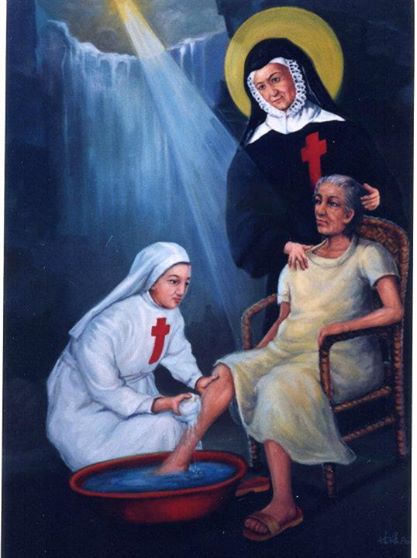
"Née à Lucca le 17 février 1789, ...Jeune femme brillante, cultivée, généreuse, ... elle épouse Salvatore Barbantini. Après six mois de mariage, ...mort subite de son époux bien-aimé... Veuve et en attente d'un enfant qui meurt à huit mois, Maria Domenica intensifie l'offrande survenue avec la mort de son mari et se donne totalement aux pauvres, aux malades et aux malheureux... Les malades, abandonnés dans leurs taudis deviennent l'objet de son amour. Elle ne consacre pas seulement sa tendresse à ceux qui souffrent mais elle l'exprime aussi dans diverses œuvres de miséricorde envers l'Église qu'elle aime avec une affection filiale et sert avec une ardeur d'apôtre. Dotée de qualités particulières, elle fonde à Lucca le Monastère de sainte Marie de la Visitation pour l'éducation des Jeunes; elle organise la catéchèse, elle ouvre un institut pour les enfants abandonnés, on lui confie la responsabilité de renforcer et de réformer les diverses activités apostoliques et éducatives. Mais l’œuvre charismatique qui définit Maria Dominique comme don de Dieu à l'humanité est l'Institut Religieux des Sœurs Ministres des Malades de saint Camille, bourgeon nouveau et prometteur de la Famille Chrétienne. En 1829, elle rassemble autour d'elle quelques jeunes filles pauvres et de santé fragile, et avec ces premières filles, elle accomplit des prodiges de charité au chevet des mourants les plus pauvres et les plus abandonnées. Le charisme que la Mère exerçait attira d'autres jeunes. Le 5 août 1941, L'archevêque de Lucca approuva la Règle écrite par Maria Domenica et érigea la communauté en Institut Religieux Diocésain. Femme de foi, toujours engagée dans la recherche et la réalisation de la volonté de Dieu, Maria Domenica s'impose dans l'histoire comme signe prophétique des temps nouveaux."
La bienheureuse Marie-Dominique Brun-Barbantini, fondatrice des Servantes des Malades de Saint-Camille, 1789-1868, a été béatifiée, le 17 mai 1995 par Jean-Paul II.
À Lucques en Toscane, l'an 1868, la bienheureuse Marie-Dominique Brun
Barbantini, religieuse, fondatrice de la Congrégation des Sœurs ministres des
malades de Saint-Camille.
Martyrologe romain
SOURCE : https://nominis.cef.fr/contenus/saint/11718/Bienheureuse-Marie-Dominique-Brun-Barbantini.html

Bienheureuse Marie
Dominique BRUN BARBANTINI
Nom: BRUN BARBANTINI
Prénom: Marie Dominique
(Maria Domenica)
Nom de religion: Marie
Dominique (Maria Domenica)
Pays: Italie
Naissance:
17.01.1789 à Lucques
Mort: 22.05.1868
Etat: Veuve - Religieuse
- Fondatrice
Note: 22.04.1811 se marie
avec Salvatore Barbantini qui meurt 6 mois plus tard. Se consacre aux œuvres de
charité. D'où l'union pieuse des Sœurs de la Charité, les moniales de la
Visitation et les Sœurs Ministres des Malades de Saint Camille (1829).
Béatification:
07.05.1995 à Rome par Jean Paul II
Canonisation:
Fête: 22 mai
Réf. dans l’Osservatore
Romano: 1995 n.20 p.2-3
Réf. dans la
Documentation Catholique: 1995 n.11 p.564
Notice
Maria Domenica Brun
Barbantini naquit à Lucques en Toscane en 1789. En 1811 elle se maria avec un
homme profondément pieux, Salvatore Barbantini qui mourut déjà 6 mois plus
tard. La nuit même du décès de son mari, elle se donna pour toujours au
Seigneur, mais elle aura la joie d'être mère d'un fils. La journée, elle
vaquait à son commerce, et le soir était consacré à l'assistance des pauvres.
C'est ainsi que naquit d'abord l'"Union pieuse des Sœurs de la
Charité", aux activités multiples, à quoi s'adjoignit plus tard une
branche contemplative, les "moniales de la Visitation", dont elle
partagea la vie pendant 5 ans. Puis, conquise par l'esprit de l'ordre de S.
Camille de Lellis, elle fonda en 1829 les religieuses "Ministres des
Malades" avec qui elle sa consacra aux malades jusqu'à sa mort le 22 mai
1868. "Elle a laissé à ses filles spirituelles un héritage et une mission
plus que jamais précieux et actuels: un amour évangélique concret pour les
derniers, les marginaux, les blessés; un amour fait de gestes, d'attention et
de consolation chrétienne, de dévouement généreux et d'inlassable
accompagnement des malades et des personnes souffrantes." (Jean Paul II -
7 mai 1995)

Bienheureuse Marie-Dominique Brun-Barbantini
Fondatrice des : « Servantes des Malades de Saint-Camille »
Maria Domenica naît à
Lucca (Toscane, Italie) le 17 Janvier 1789, de Pietro Brun et de Giovanna
Granucci.
Orpheline de père à l’âge
de 12 ans, elle grandit sous la guidance affectueuse et intelligente de sa
mère.
Jeune femme brillante,
cultivée, généreuse, le 22 Avril 1811, elle épouse Salvatore Barbantini. Après
six mois de mariage, ce « projet d’amour » fut rompu par la mort
subite de son époux bien-aimé.
« Toi seul mon
Christ Crucifié, mon bien, tu seras dorénavant mon unique et grand Amour, mon
unique délice. »
Veuve et en attente d’un
enfant qui meurt à huit mois, Maria Domenica intensifie l’offrande survenue
avec la mort de son mari et se donne totalement aux pauvres, aux malades et aux
malheureux.
Sa maternité humainement
amputée se développe en une maternité plus profonde et universelle.
Les malades, abandonnés
dans leurs taudis deviennent l’objet de son Amour. Elle ne consacre pas
seulement sa tendresse à ceux qui souffrent mais elle l’exprime aussi dans
diverses œuvres de Miséricorde envers l’Église qu’elle aime avec une affection
filiale et sert avec une ardeur d’apôtre.
Dotée de qualités
particulières, elle fonde à Lucca le Monastère de sainte Marie de la Visitation
pour l’éducation des Jeunes ; elle organise la catéchèse, elle ouvre un
institut pour les enfants abandonnés, on lui confie la responsabilité de
renforcer et de réformer les diverses activités apostoliques et éducatives.
Mais l’Œuvre
Charismatique qui définie Maria Dominique comme don de Dieu à l’humanité est
l’Institut Religieux des « Servantes des Malades de Saint-Camille »,
bourgeon nouveau et prometteur de la Famille Chrétienne.
En 1829, elle rassemble
autour d’elle quelques jeunes filles pauvres et de santé fragile, et avec ces
premières filles, elle accomplit des prodiges de Charité au chevet des mourants
les plus pauvres et les plus abandonnés.
Le charisme que la Mère
exerçait attira d’autres jeunes.
Le 5 Août 1841,
l’Archevêque de Lucca, Domenico Stefanelli, approuva la Règle écrite par Maria
Domenica et érigea la communauté en Institut Religieux Diocésain.
Femme de Foi, toujours
engagée dans la recherche et la réalisation de la volonté de Dieu, Maria
Domenica s’impose dans l’histoire comme signe prophétique des temps nouveaux.
« Éducatrice de la
paix », elle peut être proposée comme modèle à la femme d’aujourd’hui,
parce qu’elle fut une jeune femme exemplaire, épouse et mère aimante,
Fondatrice et Religieuse, vertueuse, maîtresse de spiritualité.
Elle a enseigné à ses
filles à cheminer près de l’homme qui souffre, soignant la maladie, valorisant
la souffrance, aimant la vie, annonçant dans l’histoire le visage maternel de
Dieu. Maria Dominique retourna au Père le 22 Mai 1868.
Maria Domenica
Brun-Barbantini a été Béatifiée le 17 Mai1995 par le Pape Saint Jean-Paul
II (Karol Józef Wojtyła, 1978-2005).

Bl. Maria Domenica Brun
Barbantini
Birth: 1789
Death: 1868
Beatified: Pope John Paul II
Maria Domenica Brun
Barbantini was born on January 17, 1789 in Lucca, Italy. She got married at the
age of 22 to Salvatore Barbantini who died a sudden death barely six months
after their marriage leaving her heavy with child. Lorenzo, the only fruit of
their marriage and the “greatest treasure” of her life, was also taken away
from her at the age of eight. This was an excruciating experience which led
Maria Domenica to a full realization and acceptance of the mysterious plans of
God for her. As a woman of strong faith, exceptional courage, and extraordinary
compassion for others, most especially the sick and the poor she totally dedicated
herself to their service. It was through this strong commitment that God chose
her to found a new Congregation – the Sisters Ministers of the Sick of St.
Camillus (the Camillian Sisters).On May 22, 1868, she died and left behind an
inspiring memory and an exemplary holy life, dedicated fully to the sick and
the needy.
SOURCE : https://www.catholic.org/saints/saint.php?saint_id=7436

Blessed Maria Domenica
Brun Barbantini, 1789 – 1868
BL. MARIA DOMENICA BRUN
BARBANTINI was born on 17 January 1789 in Lucca, Italy. She married at the
age of 22, but six months later her husband died and that same night she
consecrated herself to the Lord forever.
She was expecting a child
and gave birth to a son. While seeing that he received a Christian upbringing,
she carried on her husband’s business activities and still found time at night
to help the poor, sick and abandoned.
She continued to serve
them and gradually attracted a group of women who devoted themselves entirely
to this charitable service. In 1817 they became the Pious Union of the Sisters
of Charity.
Her son died at the age
of eight after a short illness. Her love for God led her to work wherever she
was needed. In advance of her time, she gave an impetus to all the activities
of Catholic action.
After living with the
Visitandines, the question arose as to whether God wanted her to be entirely
consecrated to prayer or to serving the poor sick.
She met Fr Antonio
Scalabrini, later Superior General of the Order of St Camillus, who taught her
the spirit of service to the sick, which led to the foundation of the Sisters
Servants of the Sick of St Camillus in 1829, dedicated to serving the sick in
the Camillian spirit. In 1841 the Archbishop of Lucca approved her Rule and
granted the new community the status of a diocesan religious institute. She
died in Lucca on 22 May 1868.
SOURCE: http://www.ewtn.com/library/MARY/bios95.htm#barbantini
SOURCE : https://theblackcordelias.wordpress.com/2009/05/22/may-22-blessed-maria-domenica-brun-barbantini/
Blessed Maria Domenica
Brun Barbantini
1789 – 1868
Foundress of the Sister Ministers of the Sick of St. Camillus
(Camillian Sisters)
MARIA DOMENICA BRUN BARBANTINI was born in Lucca, Italy, on January 17, 1789.
She got married at the age of 22 to Salvatore Barbantini, who died a sudden
death barely six months after their marriage leaving her heavy with a child.
Lorenzo, the only fruit of their marriage and the “greatest treasure” of her
life, was also taken away from her at the age of eight. This excruciating
experience led Maria Domenica to a full realization and acceptance of the
mysterious plans of God for her. She dedicated herself to their service as a woman
of strong faith, exceptional courage, and extraordinary compassion for others,
especially the sick and the poor. Through this strong commitment, God chose her
to found a new Congregation – the Sister Ministers of the Sick of St. Camillus
(the Camillian Sisters). On May 22, 1868, she died and left an inspiring memory
and an exemplary holy life dedicated to the sick and the needy. The Church
recognized her as a model for all Christians, and on May 7, 1995, she was
beatified by Pope John Paul II in Rome, Italy.
SOURCE : https://camilliansisters.org/our-foundress/

Biography of Maria
Domenica Brun Barbantini
IN THE TEACHINGS OF LOVE
Maria Domenica was born
on January 17, 1789, in Lucca, Italy. Her father, Pietro Brun, a native from
Lucerne, Switzerland, served in the Swiss Guards stationed in Lucca; her
mother, Joan Granucci, was a native of Pariana, a small town in the province of
Lucca.
The Brun family lived
modestly. The wages of the Swiss Guards were not high, however, they were
privileged to live in a quarter in the Ducal Palace.
There is very little
information about Maria Domenica’s father, Peter Brun. Her mother, Joan,
appears to be a wise woman, full of initiative, able to take care of the family
even after the premature death of her husband.
Years of Adoloscence
Maria Domenica has an
open personality and intelligence. She spent her early childhood happily in the
care of her mother and her father’s rigid, military-style, upbringing. The
official biographies write about her special devotion to the Blessed Virgin
Mary. Indeed, they also mention a particular incident that supposedly happened
during the celebration of the Mass, where Maria Domenica attended,
in the “Chiesa di Miracoli” (in front of the Ducal Palace); during the
consecration, Maria Domenica saw the Precious Blood overflow from the chalice
elevated by the priest. She was overwhelmed with emotion; strong character
as she, however, did not reveal the incident to anyone, aside from her
confessor. Since then, she became even more docile and virtuous.
Her childhood was
“ordinary.” Her adolescence was, instead, marked by pain; her father and
three siblings died within a short distance from each other.
Her father’s death seems
to touch her in a particular way, evident in her emotion and affective
development. There is no trace of him in her later writings, as though it will
remain a “secret” memory in her heart. Three years after her father’s
death, Maria Domenica has had a psychological crisis, which manage to
come out presumably due to the firm education, she received during her
childhood, and with the help of her mother’s patient guidance. Maria Domenica
overcomes the state of grief and enters her youth full of dreams and
hopes, engaged in the humanities and religious studies, common among the
middle-class bourgeois of her time and place.
Until about fifteen years
old, Maria Domenica seems to embrace an austere life, devoted to her study,
alienated from the pleasures of youth. Then her lifestyle begins to change. She
has become a very attractive young woman and has plenty of suitors and
admirers.
Young spouse
At the age of eighteen,
Maria Domenica was asked to marry Salvatore Barbantini, a good young man from
Lucca, well-to-do but not rich. Salvatore had inherited a fabric store from his
father. Giovanna, Maria Domenica’s mother, who knows about Barbantini’s
financial situation, is not happy about this marriage; she would like her
daughter to have a more secure position. The two young people love each other
tenderly: the “tug of war” between Maria Domenica and her mother lasts four
years, but in the end, she wins her battle: on April 22, 1811, in the cathedral
of St. Martin in Lucca, Maria Domenica marries Salvatore.
God’s plans for Maria
Domenica, however, are different from what might appear to be the happy outcome
of a romantic story. Just five months after the wedding, the “adored
bridegroom” suddenly dies, tragically leaving Maria Domenica alone, already
expecting a child.
Faced with the painful
ordeal, the 22-year-old widow wept, but she did not let herself be taken by
despair: her strong character and deep faith in divine mercy sustained her. On
the very night of the tragedy, she kneels before the Crucifix and, embracing
it, declares her acceptance of the Father’s will with these words: “Oh my God…
God of my heart… you have severely beaten me… you alone, my Crucified, my good,
will be from now on the sweetest spouse of my soul… my only love, my eternal
portion”. A full, total, and irrevocable consecration born from the ashes of
untimely mourning and a feeling of immense and cruel sorrow, enlightened
however by a living faith, by hope without boundaries, by an immense love for
the Lord.
Beginning of a “heroic”
life
After the death of
Salvatore, Maria Domenica always wore a simple black dress which symbolizes, in
a certain sense, the austerity of her interior life. She is still very young
and could remarry, but she refuses every proposal because she wants to dedicate
herself solely to the son who is about to be born and to the works of mercy
that the Lord will gradually show her.
On February 14, 1812,
Lorenzo Pietro was born. Lorenzino, as his mother affectionately called him.
From that moment on, Maria Domenica lived only for her son. Her economic
conditions are not very good: Salvatore, at his death, had left her little
property. As Maria Domenica herself wrote in her autobiography, she made every
possible sacrifice to make her son’s life as secure as possible.
In the meantime,
Lorenzino gave joy to his mother: Maria Domenica affirms, in the autobiography,
that the little boy seemed to have been endowed by the Lord with many admirable
qualities in body and soul as if to compensate her in part for the tragic death
of her husband. As the little boy grew up, he showed a keen sense of
discernment, an extraordinary passion for studies… Already at the age of four,
aided by an exceptional memory, Lorenzino was able to correctly answer the
questions he was asked about the Holy Scriptures. At the age of seven, he wrote
correctly in Latin and knew a little French…
In the meantime, another
«love» was born in Maria Domenica’s heart: the love for poor and sick women,
who lacked any kind of assistance. Although caring for her son took up her
entire day, Maria Domenica managed to take care of these poor women, heroically
dedicating a few hours of the night to assisting them in their homes.
But another trial awaited
the young widow: Lorenzino, the beloved son who was her only consolation, died
almost suddenly, struck by a serious illness, at the age of eight.
The poor mother is
distraught: «I don’t know how I didn’t lose my sanity», she writes, and while
her heart is weeping tears of blood, once again she transforms that unspeakable
drama into an offering: «I looked at the sky – she says – and oppressed by
grief, I repeated the offering of that only beloved son and my excessive
sorrow».
Offering to the sick
Two love stories have
tragically and prematurely broken. One might expect a desperate reaction, a
rebellion against the cruelty of destiny, even against God… Maria Domenica did
not fall into this terrible temptation, and she channeled the river of love
within her soul towards God “incarnate” in the poor people she met. From now
on, her heart will burn with love, tenderness, and care for the poor and lonely
sick, for the abandoned, for the dying.
By day and by night,
under the scorching sun or the pouring rain, she walked, with her lantern-lit,
through the narrow and dark streets of the city of Lucca to go to the bedside
of the most serious and lonely infirm. One night, assailed by a hurricane, her
light goes out; groping for a long time in the dark, she finally arrives at the
desired place and, with her clothes soaked in water, she carries out assistance
for the whole night, not caring at all about herself but about Jesus, present
“in the sick body” of that sick person.
Often, after a whole
night of service, she let the day pass without taking food. Sometimes, assailed
by a terrible sleep, while assisting, she goes so far as to put tobacco in her
eyes; this remedy causes her great suffering, but it is effective in keeping
her awake and not depriving the sick of her help and comfort.
Not everyone welcomed her
merciful work: it is said that someone put soap on the steps that Maria
Domenica had to climb to reach a sick person, to cause her to slip and fall.
She noted that perhaps the devil, irritated by the losses incurred by her work
of assistance not only to bodies but also to souls, tried in every way to
hinder her.
Sometimes, while she
moves in the middle of the night in the dark and precarious streets of the
outskirts of the city, she is pursued by unknown ill-intentioned people; a
strong and courageous woman, she is not intimidated by anyone; she has a flame
in her heart that nothing and no one can extinguish.
And she does not only
take care of body and soul: she often leaves – she as poor as she is – what
little she can in money to the sick to alleviate their misery.
Two love stories have
tragically and prematurely broken. One might expect a desperate reaction, a
rebellion against the cruelty of destiny, even against God… Maria Domenica did
not fall into this terrible temptation, and she channeled the river of love
within her soul towards God “incarnate” in the poor people she met. From now
on, her heart will burn with love, tenderness, and care for the poor and lonely
sick, for the abandoned, for the dying.
By day and by night,
under the scorching sun or the pouring rain, she walked, with her lantern-lit,
through the narrow and dark streets of the city of Lucca to go to the bedside
of the most serious and lonely infirm. One night, assailed by a hurricane, her
light goes out; groping for a long time in the dark, she finally arrives at the
desired place and, with her clothes soaked in water, she carries out assistance
for the whole night, not caring at all about herself but about Jesus, present
“in the sick body” of that sick person.
Often, after a whole
night of service, she let the day pass without taking food. Sometimes, assailed
by a terrible sleep, while assisting, she goes so far as to put tobacco in her
eyes; this remedy causes her great suffering, but it is effective in keeping
her awake and not depriving the sick of her help and comfort.
Not everyone welcomed her
merciful work: it is said that someone put soap on the steps that Maria
Domenica had to climb to reach a sick person, to cause her to slip and fall.
She noted that perhaps the devil, irritated by the losses incurred by her work
of assistance not only to bodies but also to souls, tried in every way to
hinder her.
Sometimes, while she
moves in the middle of the night in the dark and precarious streets of the
outskirts of the city, she is pursued by unknown ill-intentioned people; a
strong and courageous woman, she is not intimidated by anyone; she has a flame
in her heart that nothing and no one can extinguish.
And she does not only
take care of body and soul: she often leaves – she as poor as she is – what
little she can in money to the sick to alleviate their misery.
“Fioretti” of Maria
Domenica
During this period of the
life of Maria Domenica are told some “Fioretti”. One day she put on the body of
a poor pregnant woman, who seemed about to die, a flower taken from the altar
on which the Blessed Sacrament was exposed. The woman gave birth to twins and
recovered her health.
Another sick woman could
not feed her newborn. Maria Domenica prays to the Blessed Virgin venerated at
the altar of a church familiar to her. At the end of the prayer, Brun
Barbantini runs to the woman, tells her to pray to Our Lady and to take the
baby to her breast. The woman obeys and, to her surprise, can feed her baby.
To another sick woman,
worried to leave her little girl an orphan, Maria Domenica says not to be
afraid: «I promise you that when God calls you, I will take care of your
daughter and be her mother» …
Maria Domenica obeys her
heart. From the moment of her radical existential change, Jesus and the sick
become the life of her life, with total dedication. She is “the Good Samaritan”
who does not care for herself but only for those who need her, overcoming all
repugnance and all human respect.
It is the simple
“charism” that one day she will transmit to the young women who will follow her
on this path of love without reserve. They will have to overcome repugnance, to
seek God in the homes of the poor, often more malodorous than stables, on their
bodies ravaged by sores and ulcers. «It is where the air is tainted with
stench, where all sort of insects is the sole company of the unfortunate
sufferer, it is there, I say, where God often wants to be found and served…».
The Ministers of the
Infirm
As time went by, Maria
Domenica realized that she could not deal on her own with the world of the
sick, which appeared to her to be increasingly vast. She, thus, began to think
of a new form of assistance that would embrace the field of charity. As she
writes in 1817, there already existed in Lucca a small congregation of women
religious whose purpose was to assist the sick who were not accepted in
hospitals and families who had fallen into poverty and did not dare to bring
their loved ones to the hospital.
Her organizational skills
and practical intelligence led her to form a group of evangelically inspired
women who committed themselves to care for the sick poor. A small group for an
enormous purpose: but, after all, all great works of charity begin this way!
And that small group is also the strong root from which one day the Ministers
of the Infirm will be born.
It is 1819: the “Pious
Union of the Sisters of Charity” is born, immediately placed under the high
patronage of Our Lady of Sorrows. Archbishop Sardi officially approves the
“Pious Union” for which another holy priest, Monsignor Del Prete, confessor and
spiritual father of Maria Domenica, writes some “rules”.
Brun Barbantini’s life is
about to take a new turn. Monsignor Del Prete entrusted her with two women,
very devout, who wanted to “leave the world” to live together, in community,
“devoting themselves to prayer and the apostolate”. They needed a home to live
in. Del Prete told Maria Domenica about this and asked her to “cooperate for
the glory of God” by buying the house where the two “postulants” could live.
This is also the
beginning of new work: the foundation of the Oblates of St. Francis de Sales.
Foundation of the
Visitation Monastery in Lucca
The richness of the human
and spiritual gifts of the young widow Barbantini, including intelligence,
creativity, courage, and initiative, certainly do not escape the attention of
the archbishop and the clergy of her city. After the two first “foundations”
they entrusted her with the task of establishing in Lucca a “Monastery of the
Visitation” for the education of youth.
Maria Domenica, docile to
the voice of the pastors and sensitive to the demands of the Church, accepted
the commitment with generosity and determination.
Her love for the Lord
makes her once again capable of facing every difficulty. After about six years
of intense work marked by obstacles, she succeeds in giving the city of Lucca
the desired monastery, which still exists today and is rich in spiritual and
apostolic vitality.
The new Institute for the
sick
Once the work of the
Visitation was completed, Maria Domenica’s authentic “vocation” emerged,
bursting forth, that which she felt truly called by the Lord: to found a
religious Congregation of Oblate Nursing Sisters to serve Christ in the sick
and suffering, full-time and for life.
On January 23, 1829,
Maria Domenica initiated the first community of Oblate Nursing Sisters. Poor
and in poor health, but rich in zeal and love for Christ, the Foundress and the
first Sisters performed authentic prodigies of charity at the bedside of the
sick and dying, in poor dwellings, where even the dying lay alone and
abandoned.
Maria Domenica and the
other women who joined her in the meantime had only one ideal, as she specifies
in her Rules: “To visit, assist and serve the human God agonizing in the garden
or breathing on the cross in the persons of the poor and dying infirm”. And all
this “with a heart ablaze with the charity of Christ”.
Maria Domenica also
teaches her “daughters in the Spirit” that their vocation involves the total
gift of the person in “serving the sick, even at the risk of one’s life”. For
this reason, in the Rules, she asks her daughters to be willing to commit
martyrdom: “They will serve Our Lord Jesus Christ in the persons of the sick
with generosity and purity of intention, always ready to lay down their lives
for love of Christ who died on a cross for us.
The witness of
evangelical charity of Barbantini and her disciples led Monsignor Domenico
Stefanelli, Archbishop of Lucca, to approve – finally – the Rules and the
Institute of Maria Domenica. This happened on August 5, 1841. The Congregation
of the Ministers of the Infirm was born.
Our Lady of Sorrows and
St. Camillus de Lellis
Maria Domenica entrusted
to Our Lady of Sorrows the protection and guidance of her Institute and
expressly called her “Our Superior”.
The Mother of Sorrows is
indicated by her as the inspirational icon of the Congregation’s mission. Just
as the Mother of Jesus assists her crucified son and shares his pain, torment,
and abandonment, so Maria Domenica invites her daughters to live “compassion”
alongside the sick and suffering of every age.
Maria Domenica made
another decisive encounter: the one with Saint Camillus de Lellis. She met the
first Camillian when his ministry was taking its first steps. It is an
encounter of fundamental importance: Father Antonio Scalabrini sees in
Barbantini’s charism the singular similarities with that of its founder, St.
Camillus de Lellis. He encouraged her and promised her help in her
difficulties.
On March 23, 1852, Pius
IX conferred on the institute the Decretum Laudis, the pontifical document
through which he granted the daughters of Maria Domenica the name of “Ministers
of the Sick” and officially decreed the spiritual communion between the Order
of Camillian religious and the Congregation of Maria Domenica.
The Foundress and her
daughters ardently desired to wear the red cross of St. Camillus. This desire,
for a long time unfulfilled, was fulfilled in August 1855, when cholera was
still claiming victims throughout Tuscany, and the daughters of Maria Domenica
left the city of Lucca for the first time to go and care for the cholera
victims in the lazarettos of nearby cities, marked in their habit by the red
cross.
All good, then, all easy?
Not for Maria Domenica who has to face accusations, backbiting, and perhaps
envy. There is a misunderstanding between her and Archbishop Giulio Arrigoni,
who is an intelligent and open person. She even has to face a trial. And as
usual, she will find shelter in her usual refuge: HUMILITY.
The last years
Maria Domenica’s strength
gradually diminished. In 1866 she fell seriously ill, but managed to overcome
her illness, thanks – it is said – to the intercession of Saint Camillus de
Lellis. She still took an active interest in her congregation but realized that
her strength was diminishing every day and that life was about to leave her.
With this premonition,
she makes sure to leave “everything in order”. She did not want her daughters
to have to worry about anything, even from a practical point of view (Maria
Domenica had always been a woman “with her feet on the ground”).
In this period her prayer
becomes more intense. She has some serious concerns about the future of her
Institute. These are the times in which a united Italy is taking shape and in
which an anti-clerical and hostile wave to religious congregations is rising.
The approach of the end
seems to provoke also a change in her somatic features: her face swells, but
the sweetness of her expression and the transparency of her gaze remain intact.
These changes are also testified by the photographic portraits (photography had
just been invented) that were taken of her.
Maria Domenica was
weakened by an illness of which, however, there was no precise diagnosis, an
illness that would make her suffer until the last moment and of which she would
say: “This is the way I must die”.
This happened on May 22,
1868. Mother Maria Domenica Brun Barbantini left the Institute small in number,
but strong in spirit and generous in its service to the sick.
Maria Domenica “blessed”
During her long life,
Maria Domenica had sought only “the will of God and his greater glory”. In her
journey of holiness, she had tasted the joys of so much love and the bitterness
of calumny, which she had accepted by “praying, forgiving, and loving her
persecutors.” She dedicated every moment of her time and every moment of her
labors to the spiritual and charismatic formation of her daughters whom the
Spirit had entrusted to her.
On May 7, 1995, in St.
Peter’s Square in Rome, John Paul II solemnly proclaimed Maria Domenica Brun
Barbantini “Blessed”, indicating her to the world as an authentic witness “of a
concrete evangelical love for the last, the marginalized, and the wounded; a
love made up of gestures, of attention, of Christian consolation, of generous
dedication, and untiring closeness to the sick and the suffering”.
SOURCE : https://camilliansisters.org/our-foundress/biography/

Blessed Maria Domenica
Brun Barbantini
Blessed Maria Domenica
Brun Barbantini: the "beautiful lantern" of charity. Maria
Domenica—born in Lucca in 1789 and died in Lucca on May 22, 1868—was the wife
of Salvatore Barbantini. A marriage of love and long waiting awaited, but just
five months after their wedding, "her beloved husband" died suddenly,
tragically leaving Maria Domenica alone. She was already pregnant with a son,
Lorenzino, who died almost suddenly after only eight years of a serious
illness. The path of charity that Maria Domenica teaches us is that of the
"lantern." Thus, she is depicted, lantern in hand in the middle of
the night, walking through the streets of her city to seek out and serve the
poor and sick. Through her daughters—who founded the Congregation of the Ministers
of the Sick—Maria Domenica is a message of love, tenderness, and care for the
sick, poor and lonely, for the abandoned, and for the dying. He is a model of
charity for young people who wish to have “a heart ablaze with the charity of
Christ.”
SOURCE : https://www.camilliani.org/en/category/barbantini/

Beata Maria Domenica Brun
Barbantini Religiosa e fondatrice
Lucca, 17 gennaio 1789 -
22 maggio 1868
Vedova e fondatrice delle
Ministre degli infermi di San Camillo. Fu beatificata da San Giovanni Paolo II
il 17 maggio 1995.
Martirologio
Romano: A Lucca, beata Maria Domenica Brun Barbantini, religiosa, che
fondò la Congregazione delle Suore Ministre degli Infermi di San Camillo.
La sua adolescenza
Maria Domenica nasce a
Lucca il 17 gennaio 1789 da Pietro Brun di origine elvetica e da Giovanna
Granucci di Pariana, piccolo centro della provincia lucchese. Di carattere
aperto e intelligente, la piccola trascorre felicemente la prima infanzia tra
le cure della madre e la rigida educazione paterna.
La sua adolescenza è
invece segnata da quattro lutti: la morte del padre e quella di tre fratellini
a breve distanza uno dall’altro. Con l’aiuto della paziente guida materna,
Maria Domenica supera il dramma dei lutti ed entra nella giovinezza carica di
sogni e di speranze, tutta impegnata nello studio delle discipline umanistiche
e religiose, proprie del ceto medio borghese della sua epoca e della sua città.
Eroismo di sposa e di
madre
Il 22 aprile del 1811,
nella cattedrale di S. Martino in Lucca, Maria Domenica sposa il concittadino
Salvatore Barbantini. È un matrimonio d’amore e di molteplici attese, ma dopo
appena cinque mesi dalle nozze, "lo sposo adorato" muore improvvisamente
lasciando tragicamente sola Maria Domenica già in attesa di un figlio.
Di fronte alla dolorosa
prova, la vedova, appena ventiduenne, piange e singhiozza, ma non si lascia
prendere dalla disperazione: ella s’inginocchia davanti al Crocifisso, la notte
stessa della immane tragedia e, abbracciandolo, pronuncia il suo fiat con
questa parole: "Oh mio Dio... Dio del mio cuore... mi avete percossa a
sangue... voi solo, Crocifisso mio bene, sarete da qui innanzi il dolcissimo
sposo dell’anima mia... il mio unico e solo amore, la mia eterna
porzione". Una consacrazione totale ed irrevocabile che nasce sul calvario
di un dolore immenso e crudele, illuminato però da una fede viva, da una
speranza senza confini, da un amore teologale autentico.
Da quel momento nasce in
lei la "passione" di servire le inferme povere e sole della sua
città. Poiché le cure del figlio le occupano l’intera giornata, ella dedica
eroicamente alcune ore della notte all’assistenza delle inferme in case
private.
Ma un’altra prova attende
la giovane vedova: Lorenzino, il figlio amatissimo, che era tutta la
consolazione di Maria Domenica sulla terra, muore quasi improvvisamente,
colpito da grave malattia, all’età di soli otto anni.
La povera madre è
sconvolta: "Non so come non perdessi il senno", scrive lei stessa e,
mentre il suo cuore straziato piange lacrime di sangue, ancora una volta ella
trasforma in offerta quel dramma indicibile: "Guardavo il cielo — afferma
— e oppressa dal dolore, replicavo l’offerta di quell’unico amato figlio e dell’eccessivo
mio dolore".
Il carisma profetico di
Maria Domenica La donazione verso i malati
Da un matrimonio infranto
e da una maternità spezzata, Maria Domenica seppe elevarsi attraverso
l’abbandono totale a Dio ad una sponsalità cristica totale e ad una maternità
spirituale ed universale.
D’ora in poi, il suo
cuore materno brucerà d’amore, di tenerezza e di cure per i malati poveri e
soli, per gli abbandonati, per i morenti.
Di giorno e di notte,
sotto il sole cocente o la pioggia dirompente, ella percorre, con la lanterna
accesa, le vie strette e buie della città di Lucca per raggiungere al capezzale
le inferme più gravi e sole. Una notte, assalita da un uragano, le si spegne il
lumicino; brancolando a lungo nel buio, ella arriva finalmente al domicilio
desiderato, e, con gli abiti intrisi d’acqua, compie assistenza per tutta Ia
notte non curandosi affatto di sé ma di Gesù, presente "nelle membra
inferme" di quella persona malata.
Spesso, dopo una intera
notte di servizio, faceva seguire anche il giorno senza prendere cibo. Talvolta
assalita da un sonno terribile, mentre prestava assistenza, arrivò a mettersi
il tabacco negli occhi; tate rimedio le procurava una sofferenza grave, ma
efficace per tenerla sveglia e non privare le inferme del suo aiuto e conforto.
Talvolta, nel cuore della
notte, era inseguita da ignoti male intenzionati; donna forte e coraggiosa non
si faceva intimidire da nessuno; ella aveva in cuore una fiamma che non poteva
spegnere: servire e curare Gesù stesso nascosto nel volto dei malati e
sofferenti.
La fondazione del
Monastero della Visitazione a Lucca
La ricchezza delle sue
doti umane e spirituali, tra cui intelligenza, creatività, coraggio e intraprendenza,
non sfuggirono all’attenzione del Vescovo e del clero della sua città. Essi
infatti le affidarono il compito di stabilire in Lucca un Monastero della
Visitazione per l’educazione della gioventù.
Maria Domenica, docile
alla voce dei pastori e sensibile alle istanze della Chiesa, accettò l’impegno
con generosità e determinazione.
Il suo zelo per la gloria
di Dio, la rendeva capace di affrontare ogni difficoltà. Dopo circa sei anni
intensi di lavoro e di tribolazioni, ella riuscì nell’intento di dare alla
città di Lucca il monastero desiderato, ancor oggi esistente e ricco di
vitalità spirituale e apostolica.
Il nuovo Istituto per i
malati
Compiuta l’opera della
Visitazione, emerge chiara, prorompente in Maria Domenica la vocazione
profetica: fondare una Congregazione religiosa di Sorelle Oblate Infermiere per
servire Cristo nelle membra doloranti dei malati e sofferenti, a tempo pieno e
per tutta la vita.
Il 23 gennaio 1829 Maria
Domenica dà inizio alla prima comunità delle Sorelle Oblate Infermiere. Povere
e con poca salute, ma ricche di zelo e di amore per Cristo, la Fondatrice e le
prime sorelle compirono prodigi di carità al capezzale delle inferme e morenti,
nelle abitazioni povere, dove giacevano sole e abbandonate anche le moribonde.
La Fondatrice e le figlie
avevano un solo ideale, come specifica nelle sue Regole: "Visitare,
assistere e servire il Dio umanato agonizzante nell’orto o spirante sulla croce
nelle persone delle inferme povere e moribonde".. E tutto ciò "con un
cuore tutto avvampante della carità di Cristo".
Inoltre Maria Domenica
insegnò alle figlie che la vocazione delle Ministre degli Infermi comporta il
dono totale della persona nel "servire il malato anche a rischio della
vita". Per questo, nelle sue Regole, ella chiede ad esse la disponibilità
al martirio: "Serviranno Nostro Signore Gesù Cristo nelle persone delle
inferme con generosità e purità d’intenzione, pronte sempre ad esporre la
propria vita per amore di Cristo morto sopra una croce per noi".
La testimonianza di
evangelica carità della Fondatrice e delle figlie, indusse mons. Domenico
Stefanelli, Arcivescovo di Lucca, ad approvare le Regole e l’Istituto di Maria
Domenica; ciò avvenne il 5 agosto 1841.
Maria Domenica “beata”
Nella sua lunga vita,
Maria Domenica cercò unicamente "la volontà di Dio e la sua maggior
gloria". Nel suo cammino di configurazione a Cristo, assaporò l’amarezza
della calunnia, che accolse: "pregando, perdonando, e amando i suoi
persecutori". Dedicò tempo e fatiche alla formazione spirituale e
carismatica delle figlie.
Morì in Lucca il 22
maggio 1868, lasciando l’Istituto piccolo nel numero, ma forte nello spirito,
generoso nel servizio ai malati.
Il 17 maggio 1995, in
piazza S. Pietro, Giovanni Paolo II ha proclamato solennemente
"Beata" Maria Domenica Brun Barbantini, indicandola al mondo quale
testimone autentica "di un amore evangelico concreto per gli ultimi, gli
emarginati, i piagati; un amore fatto di gesti di attenzione, di cristiana
consolazione, di generosa dedizione e di instancabile vicinanza nei confronti
degli ammalati e dei sofferenti".
Beatificata il 17 maggio
1995.
SOURCE : http://www.santiebeati.it/dettaglio/90321
Maria Domenica Barbantini: The Woman and the Saint by Communications Office - 22/05/2017 : https://www.camilliani.org/en/maria-domenica-barbantini-the-woman-and-the-saint/
RadioMariaArgentina - Historias de santidad: beata María Doménica Brun Barbantini : https://www.youtube.com/watch?v=i-QiR9d1GDU