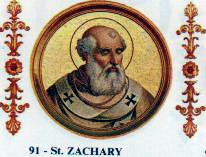
Maestranze
romane, Ritratto di papa Zaccaria (1850 ca.),
mosaico; Roma, Basilica di San Paolo fuori le Mura
Medaillon,
um 1848, in der Kirche San
Paolo fuori le Mura in Rom
Saint Zacharie
Pape (91e) de 741 à
752 (+ 752)
Il est le dernier des papes grecs. Confronté au problème des envahisseurs lombards, il règle cette question avec sagesse tant pour Rome, que le lombard Liutprand voulait gouverner, que pour Ravenne qui dépendait de l'empire de Byzance. Avec l'empereur de Constantinople, malgré la querelle iconoclaste où saint Zacharie rappelle la doctrine orthodoxe, il maintient des relations courtoises. Il encourage la réforme de l'Eglise franque et appuie Pépin le Bref. Il soutient le travail missionnaire de saint Boniface, archevêque de Mayence et lui demande de multiplier les conciles à cet effet. Il entreprit la reconstruction de l'abbaye du Mont-Cassin, détruite par les invasions lombardes.
À Rome, en 752, saint Zacharie, pape. En contenant l'assaut des Lombards, en
indiquant aux Francs la bonne succession au trône, en soutenant l'action
missionnaire de saint Boniface en Germanie et en poursuivant l'entente avec les
Grecs, il gouverna l'Église de Dieu avec une extrême vigilance et prudence.
Martyrologe romain
SOURCE : https://nominis.cef.fr/contenus/saint/6263/Saint-Zacharie.html
Saint Zacharie
Le saint pape Zacharie,
d'origine grecque, naquit en Calabre où il fut élevé dans la piété et les
sciences. Traducteur grec érudit des Dialogues de saint Grégoire le Grand et
prédicateur éloquent, il fut admis dans le clergé de Rome sous le pape Grégoire
III auquel il succéda alors que le roi des Lombards, Luitprand (712-744),
menaçait de s’emparer de Rome (741). Ses familiers aimèrent sa douceur et sa
compassion, admirèrent son pouvoir de persuasion et eurent confiance à sa
grande habileté politique.
Alors qu’on venait
d’apprendre la mort de Charles Martel (22 octobre 741) dont Grégoire III
espérait du secours contre les Lombards, Zacharie fut élu pape le 3 décembre
741 et sacré le 10 décembre 741. Zacharie abandonna le duc de Spolète, allié
inefficace du Saint-Siège, pour traiter avec Luitprand et s'entendit si bien
avec lui (traité de Terni, août 742) qu'un semblant de paix régna en Italie
surtout après le traite de Pavie où le Lombard s'engageait à ne pas attaquer
l'exarchat de Ravenne (29 juin 743). Luitprand étant mort au mois de janvier
suivant, son neveu et successeur, Hildebrand, se montra plus belliqueux mais il
était un si mauvais prince que ses sujets le chassèrent sept mois plus tard au
profit du duc de Frioul, Rachis, qui confirma traité pour vingt ans. Rachis
rompit le traité en assiégeant Pérouse (749), mais Zacharie, venu sur place,
lui fit lever le siège et se montra si édifiant que le Roi changea de vie au
point que, quelques mois plus tard, il se rendit à Rome et abdiqua pour entrer
à l'abbaye du Mont-Cassin tandis que sa femme et sa fille devenaient
religieuses (juin 749). Astolphe, le frère et successeur de Rachis, confirma le
traité pour vingt ans mais s'empara tout de même de Ravenne (751) et mit fin à
l’exarchat byzantin. Encore que Constantinople était acquise à l’iconoclasme,
Zacharie tenta avec succès d’avoir de bonnes relations avec Constantin V. Grâce
à saint Boniface, son légat, qui lui rendait exactement compte de toutes ses
actions, Zacharie eu d’excellentes relations avec les Francs, gouvernés par les
fils de Charles Martel, qui veillaient à la réforme ecclésiastique. Après que
Carloman se fut fait moine au Mont Cassin (747), le pape Zacharie, en faveur de
Pépin le Bref qui voulait ceindre la couronne royale, décréta qu'il était
logique que celui qui détenait effectivement la puissance fût roi (750) ; ainsi
après la déposition de Childéric III, Pépin fut élu roi et sacré par saint
Boniface, commençant le règne de la dynastie carolingienne (751). Désormais,
contre les Lombards qui redevenaient menaçants, le Saint-Siège avait un allié
indéfectible. On a longtemps cru que Zacharie mourut le 14 mars 752 et l'on
célébrait sa fête le 15 mars, mais le martyrologe de 1922 a estimé que sa mort
n'était survenue que le 22 mars.
SOURCE : http://missel.free.fr/Sanctoral/03/22.php
Saint Zacharie, pape
Natif de Syrie, mais
d’origine grecque, il devient moine puis, émigré en Italie, est admis comme
prêtre dans le clergé romain. Dernier pape grec, il est élu pour succéder
à Grégoire III en l’an 741. Confronté au problème des envahisseurs lombards, il
règle cette question avec sagesse tant pour Rome, que le lombard Liutprand
voulait gouverner, que pour Ravenne qui dépendait de l'empire de Byzance.
Malgré la querelle iconoclaste où saint Zacharie rappelle la doctrine
orthodoxe, il maintient des relations courtoises avec l'empereur de
Constantinople. Il encourage la réforme de l'Eglise franque et appuie Pépin le
Bref qui, après avoir déposé le dernier mérovingien, avait quelque scrupule à
ceindre la couronne ; non seulement Zacharie donna un avis favorable (« Il
vaut mieux appeler roi celui qui a la puissance que celui qui en fait n’a pas
le pouvoir ») mais il chargea Boniface de donner l’onction au nouveau roi,
sacre inédit chez les Francs, qui eut lieu à Soissons en 751 ; ainsi Pépin
devenait l’obligé d’une papauté à la recherche d’un nouveau protecteur.
Zacharie soutint aussi le travail missionnaire de saint Boniface, archevêque de
Mayence, et lui demande de multiplier les conciles à cet effet. Il entreprit la
reconstruction de l'abbaye du Mont-Cassin, détruite par les invasions
lombardes. Il meurt en 752.
Saint Zacharie (741-752),
91ième pape
Il réussit à se
réconcilier avec Liutprand et signa avec lui un pacte de paix de vingt ans.
Les Lombards, toutefois,
ne respectèrent pas ce pacte et envahirent Ravenne. Zacharie chercha alors à
faire alliance avec les Francs de Pépin le Bref.
SOURCE : http://eglise.de.dieu.free.fr/liste_des_papes_07.htm
ZACHARIE saint (mort
en 752) pape (741-752)
Quand Zacharie devint
pape en décembre 741, le Saint-Siège était en lutte avec les Lombards, alors
maîtres de l'Italie, en difficulté avec Constantinople et en défiance du côté
des Francs. Zacharie fut assez heureux pour faire la paix avec les Lombards et
retrouver pleine autorité sur le duché de Rome. Les difficultés de l'empereur
de Constantinople le détournèrent des querelles iconoclastes ; le pape en
bénéficia. Charles Martel mourut en 741, laissant le royaume à ses fils
Carloman et Pépin le Bref, qui soutinrent l'action réformatrice de saint
Boniface. En 747, Carloman s'étant fait moine au Mont-Cassin, Pépin le Bref
demanda alors au pape s'il ne serait pas meilleur que le titre de roi fût porté
par celui qui exerçait le pouvoir, c'est-à-dire par lui, Pépin, et non par un
incapable descendant de Clovis. Le pape répondit favorablement, non qu'il se
crût en possession du droit de nommer les rois, mais par simple souci de
résoudre un cas de conscience.
Jacques DUBOIS, (moine
bénédictin, directeur d'études à l'École pratique des hautes études (IVe
section))
SOURCE : http://www.universalis.fr/encyclopedie/zacharie/
Tropaire à saint
Zacharie,
Pape orthodoxe de Rome,
(Natalice en 752 A.D.)
Fils de l'Hellade, évêque
en la ville de Rome,*
Tu défendis l'Eglise
contre l'hérésie*
Qui voulait faire
disparaître les icônes.*
Tu soutins l'œuvre
missionaire en Germanie*
Conduite par saint
Boniface de Mayence.*
Saint Zacharie, prie le
Christ de sauver nos âmes!
SOURCE : http://acathistes-et-offices-orthodoxes.blogspot.ca/2012_03_01_archive.html

Papst
Zacharias, zeitgenössisches Freskenporträt in der von Zacharias restaurierten
Kirche Santa
Maria Antiqua auf dem Forum Romanum in Rom
Also
known as
Zacharias
Profile
Son of Polichronius, but
little else is known of his early life. Deacon.
Advisor to Pope Gregory
III. 91st pope.
First pope after Saint Gregory
the Great to not seek imperial confirmation on his election.
Negotiated peace between the Lombards and
Greek empire. Restored the Lateran palace and many churches around Rome.
Encourged the missionary work
of Saint Boniface,
and appointed Saint Abel as archbishop of Rheims, France.
When Venetian slavers bought slaves at Rome to
sell to Saracens in Africa,
Zachary bought them all so that Christians should
not become the property of heathens. Translated the Dialogues of Gregory
the Great into Greek.
Many of his actions among the royal powers of the day continued to echo for
centuries.
Born
Greek ancestry
Papal
Ascension
22 March 752 of
natural causes
buried at Saint
Peter’s Basilica, Rome, Italy
Name
Meaning
Yahweh remembers
making peace with King Luitprand
with a dove and
olive branch over him representing peace
Additional
Information
Book
of Saints, by the Monks of
Ramsgate
Catholic
Encyclopedia, by J P Kirsch
Lives
of the Saints, by Father Alban
Butler
Saints
of the Day, by Katherine Rabenstein
Saints
of the Order of Saint Benedict, by Father Aegedius
Ranbeck, O.S.B.
books
Our Sunday Visitor’s Encyclopedia of Saints
other
sites in english
images
video
sitios
en español
Martirologio Romano, 2001 edición
sites
en français
Father
Christian-Philippe Chanut
fonti
in italiano
webseiten
auf deutsch
strony
w jezyku polskim
MLA
Citation
“Pope Saint
Zachary“. CatholicSaints.Info. 15 March 2023. Web. 26 January 2026.
<https://catholicsaints.info/pope-saint-zachary/>
SOURCE : https://catholicsaints.info/pope-saint-zachary/
(Saint) Pope (March 15)
(8th
century) A Greek who
governed the Church from A.D. 741 to
A.D. 752.
He was a man of conspicuous learning and piety. It was he who gave the
memorable decision which replaced the Merovingian by the Carolingian dynasty
in France.
MLA
Citation
Monks of Ramsgate.
“Zacharias”. Book of Saints, 1921. CatholicSaints.Info.
8 March 2017. Web. 26 January 2026.
<https://catholicsaints.info/book-of-saints-zacharias/>
SOURCE : https://catholicsaints.info/book-of-saints-zacharias/
New
Catholic Dictionary – Pope Saint Zachary
Zacharias
Derivation
Hebrew: zachariali,
remembered by Jehovah
Article
(741-752) Born Calabria,
Italy, of Greek parentage; died Rome. As pope, by personal influence he
concluded a peace between the Roman duchy and the Lombards, whom he induced to
abandon the attack on Ravenna. He held a synod in Rome, 743, to regulate Church
discipline; encouraged the missionary work of Saint Boniface in Germany, and
extended his work to France; and confirmed the election of Pepin, mayor of the
palace, I as King of the Franks, after the decay of the Merovingian dynasty. In
the vicinity of Rome he established agricultural colonies, coined money, and
built churches and dwelling-places for the poor. He translated into Greek the
“Dialogues” of Saint Gregory I. Feast, 13
March.
MLA
Citation
“Pope Saint
Zachary”. New Catholic Dictionary. CatholicSaints.Info.
22 November 2018. Web. 26 January 2026.
<https://catholicsaints.info/new-catholic-dictionary-pope-saint-zachary/>
SOURCE : https://catholicsaints.info/new-catholic-dictionary-pope-saint-zachary/
Zachary I, Pope (RM)
(also known as Zacharias)
Born at San Severino, Calabria, Italy; died 752; feast day formerly on March
22; feast day in the East is September 5.
Pope Zachary I came from a Greek family in Calabria. He became a deacon in
Rome, known for his learning and sanctity, and was chosen pope in 741 to
succeed Saint Gregory III. His holiness was so great that, instead of seeking
revenge, he heaped benefits on those who had persecuted him before his
promotion to the pontificate.
When King Liutprand of the Lombards was about to invade Roman lands at Terni
because of the rebellion of the dukes of Spoleto and Benevento, Zachary risked
his own life in order to meet with the barbarian. Through persuasion Zachary
won the freedom of all prisoners of war and the Roman territory Liutprand had
occupied during 30 years was returned. It is said that the Lombards were moved
to tears at the devotion with which they heard him say Mass. Another time, he
dissuaded Liutprand from invading Ravenna.
Zachary achieved a great deal with the Lombards by negotiation, leading to
peace between the Lombards and the Greek Empire. In fact, he gave the
Benedictine habit to Saint Ratchis, king of the Lombards. By contrast,
Zachary's successor had to enter into the defensive alliance with the Frankish
Pepin the Short, which had the ambiguously felicitous result of leading to the
revival of the Western Empire and led also to the protective domination of the
emperor over the Roman Church which for centuries determined the course of
Western history.
This Papal-Frankish alliance was prepared for by Pope Zachary's acquiescence in
the deposition of the Merovingian puppet-kings and through his anointing of
Pepin, who had been mayor of the palace, in 751 by the hand of his legate,
Boniface at Soissons.
As a result of the iconoclastic movement, religious and political relations
with Byzantium, which were noticeable weakened in these disturbances, grew ever
looser. Zachary denounced the iconoclastic policy of Emperor Constantine
Copronymus.
On the other hand, the Church made vast strides in the realm of the Franks,
above all in Germany, through the work of reorganization and the missionary
zeal of Saint Boniface, whom he consecrated archbishop of Mainz. Zachary
assisted the labors of the Apostle of the Germans in every way. Two interesting
letters of the pope to Boniface have survived, which give the impression of a
man of great vigor and deep sympathy. He told Boniface to suspend polygamous
and murderous priests, to abolish superstitious practices even if these were
practiced at Rome, and to recognize the baptisms of those whose Latin was
extremely inaccurate (the intention was there to do what the Church intends,
even though the form was defective). At his synod of 745, he condemned the
heretics Clement and Adalbert who had caused Boniface a good deal of grief.
On the other hand, Boniface was proven to be all too human on another occasion.
He wrote to Zachary against an Irish priest named Virgilius, saying that he
sowed the seeds of discord between him and Duke Odilo of Bavaria, and
erroneously taught that there were other men under the earth, another sun and
moon, and another world. Pope Zachary answered, that if he taught such an error
he ought to be deposed. This cannot be understood as a condemnation of the
doctrine of Antipodes (that the earth is round), as some have mistaken. Rather,
there was a heresy that maintained there was another race of men, who did not
descend from Adam, and were not redeemed by Christ. Nor did Zachary pronounce
any sentence in the case: for in the same letter he ordered that Virgilius
should be sent to Rome so that this doctrine might be examined. It seems that
he cleared himself, for we find this same priest soon after made bishop of
Salzburg, Austria, and, in 1233, formally canonized as Saint Virgilius. It
seems that the friction between the two saints was probably a result of
jurisdictional conflicts and the tension between Roman and Celtic liturgical
customs. In any case, Pope Zachary was a peace-maker and judged no man without
a hearing.
Zachary was also responsible for restoring Montecassino under Saint Petronax
and himself consecrated its abbey church in 748. The saint was known for aiding
the poor, provided refuge to nuns driven from Constantinople by the
iconoclasts, ransomed slaves from the Venetians, forbade the selling of
Christian slaves to the Moors of Africa, and translated Saint Gregory the
Great's Dialogues into Greek. Since "Zacharias embraced and cherished all
people like a father and a good shepherd, and never allowed even the smallest
injustice to happen to anyone," he was venerated as a saint immediately
after his death (Attwater, Benedictines, Delaney, Farmer, Husenbeth, Schamoni).
Saint Zacharias is
depicted making peace with King Luitprand. Sometimes he may have a dove and
olive branch over him (do not confuse him with Saint Silvester (Roeder).
SOURCE : http://www.saintpatrickdc.org/ss/0315.shtml
Pope St. Zachary
(ZACHARIAS.)
Reigned 741-52. Year of
birth unknown; died in March, 752. Zachary sprang from
a Greek family living
in Calabria; his father,
according to the "Liber
Pontificalis", was called Polichronius. Most probably he was a deacon of
the Roman
Church and as such signed the decrees of
the Roman council of 732. After the burial of his
predecessor Gregory
III on 29 November, 741, he was immediately and unanimously elected pope and consecrated and enthroned on
5 December. His biographer in the "Liber
Pontificalis" describes him as a man of gentle and
conciliatory character who was charitable towards the clergy and
people. As a fact the new pope always
showed himself to be shrewd and conciliatory in his actions and thus
his undertakings were very successful. Soon after his elevation he
notified Constantinople of his election; it is noticeable that
his synodica(letter) was not addressed to the iconoclastic Patriarch Anastasius but
to the Church of Constantinople.
The envoys of the pope also
brought a letter for the emperor. After the death of Leo III (18
June, 741) his successorwas his son Constantine V, Copronymus. However, in
742 Constantine's brother-in-law Artabasdus raised a revolt
against the new emperor and established himself in Constantinople; thus
when the papal envoys
reached Constantinople they found Artabasdus the ruler there. As
late as 743 the papal
letters were dated from the year of the reign of Constantine
V; in 744, however, they are dated form the
year of the reign of Artabasdus. Still the papal envoys
do not seem to have come into close relations with the usurper
at Constantinople, although the latter re-established
the worship of images. After Constantine V had overthrown his rival,
the envoys of the pope presented
to him the papal letter
in which Zachary exhorted the emperor to restore the doctrine and
practice of the Church in
respect to the worship of images. The emperor received the envoys in
a friendly manner and presented the Roman
Church with the villages of Nympha and Normia (Norba)
in Italy,
which with their territories extended to the sea.
When Zachary ascended
the throne the position of the city and Duchy of Rome was
a very serious one.Luitprand, King of the Lombards, was preparing a new
incursion
into Roman territory. Duke Trasamund of Spoleto,
with whom Pope
Gregory III had formed an alliance against Luitprand, did not
keep his promise to aid the Romans in regaining the cities taken by
the Lombards. Consequently Zachary abandoned the alliance
withTrasamund and sought to protect the interests of Rome and Roman territory
by personal influence overLuitprand. The pope went
to Terni to
see the Lombard king who received him with every mark of honour. Zachary was
able to obtain from Luitprand that the four cities of Ameria, Horta,
Polimartium, and Blera should be returned to the Romans, and
that all the patrimonies of the Roman
Church that the Lombards had taken from it within the last
thirty years, should be given back; he was also able to conclude a truce for
twenty years between the Roman Duchy and the Lombards. A chapel to
the Saviour was built in the Church of St. Peter at Rome in
the name of Luitprand, in which the deeds respecting this return
of property were
placed. After the pope's return,
theRoman people went in solemn procession to St.
Peter's to thank God for
the fortunate result of the pope's efforts.
Throughout the entire affair the pope appears
as the secular ruler of Rome and
the Roman territory. In the next year Luitprand made ready
to attack the territory of Ravenna.
The Byzantine exarch of Ravenna and
thearchbishop begged Pope
Zachary to intervene. The latter first sent envoys to
the Lombard king, and when these were unsuccessful he went himself
to Ravenna and
from there to Pavia to see Luitprand. The pope reached Paviaon
the eve of the feast of Sts. Peter and Paul.
He celebrated the vigil and the feast of the princes of
the Apostlesat Pavia,
and was able to induce the king to abandon the attack on Ravenna and
to restore the territory belonging to the city itself. Luitprand died
shortly after than and after his first successor Hildebrand was
overthrown, Ratchis became King of the Lombards. The pope was
on the best of terms with him. In 749 the new king confirmed the
treaty of peace with the Roman Duchy. The same
year Ratchis abdicated, with his wife and daughter took the monastic vows before
the pope,
and all three entered the monastic life.
In 743 Pope Zachary
held a synod at Rome which
was attended by sixty bishops.
This synod issued fourteencanons on various matters
of church discipline. On this occasion the pope took
up the question of
the impediments to marriage of relationship in the
fourth degree, in regard to which the Germans claimed
to have obtained a dispensation from Pope
Gregory II. The year previous Zachary had written on this point
to the bishopsand
kings of that province. An active correspondence was kept up
between Zachary and St.
Boniface. The latter in his zealous labours
had organized the Church in
the German territories, and while doing this had kept in close
connection with the Papal See. Early in 742, soon after his
elevation, Zachary received a letter from Boniface in
which the saint expressed
his full submission to the possessor of the Chair of Peter and
requested then confirmation of the three newly established Bishoprics of Wurzburg, Buraburg,
and Erfurt; Boniface also
sought authority to hold a synod in France and
to suppress abuses in the lives of the clergy.
The pope confirmed the
three dioceses and
commissioned Boniface to
attend, as papal
legate, the Frankish synod which Karlmann wished
to hold. In a later letter Zachary confirmed the metropolitans of Rouen, Reims,
and Sens appointed by Boniface,
and also confirmed the condemnation of the two heretics Adelbert
and Clement. Various questions in which the pope and Boniface disagreed
were discussed in letters. In 745 was held the general synod for
the Frankish kingdom called
by Pepin and Carloman. Here decrees were passed against
unworthy ecclesiastics,
and the two heretics,
Adelbert and Clement, were again condemned. Boniface sent
a Frankish priest to Rome to
make a report to the pope,
and the latter held on 25 October, 745, a synod at
the Lateran at which, after exhaustive investigation, an anathema was
pronounced against the two heretics. Zachary forwarded
the acts of the synodwith a letter to Boniface. Pepin and
the Frankish bishops sent
a list of questions respecting the discipline of thevclergy and
of the Christian population
to Pope Zachary, and the latter answered in a letter of 746 in which
decisions respecting the various points are given. These decisions were
communicated to Boniface so
that he might make them generally known at a Frankish synod.
The following year, 747, Carloman resigned his authority and the world, went
to Rome,
and was received by Pope Zachary into a monastic order. At first
he lived in the monastery on
the Soracte, later at Monte
Cassino. Thanks to the efforts of St.
Boniface all the Frankish bishops were
now agreed in submission to the See of St.
Peter. Zachary sent still other letters to the bishops of Gaul andGermany,
and also to Boniface as
the papal
legate for the Church of
this region. Boniface was
constantly inintercourse with Rome both
by letters and envoys and sent important questions to the pope for
decision. An important proof of
the recognition by the Franks of
the high moral power of the papacy is
shown by the appeal to papal authority
on the occasion of the overthrow of the Merovingian
dynasty. Pepin's ambassadors, BishopBurkard of Wurzburg and Chaplain Folrad
of St. Denis, laid the question before Zachary: whether it seemed rightto
him that one should be king who did not really possess the royal power.
The pope declared
that this did not appear good to him, and on the authority of
the pope Pepin considered
himself justified in having himself proclaimed King of the Franks (cf. SAINT
BONIFACE; and PEPIN
THE SHORT). The ecclesiastical activity
of thepope also
extended to England.
Through his efforts the Synod of Cloveshove was held in 747 for the
reform ofchurch discipline in accordance with the advice given by
the pope and
in imitation of the Roman
Church.
Zachary was very zealous in
the restoration of the churches of Rome to
which he made costly gifts. He also restored the Lateran palace
and established several large domains as the settled
landed possessions (domus cultæ) of the Roman
Church. The pope translated
to the Church of St. George in Velabro the head of
the martyr St.
George which was found during the repairs of the decayed Lateran
Palace. He was very benevolent to the poor,
to whom alms were
given regularly from the papal palace.
When merchants from Venice bought slaves atRome in
order to sell them again to the Saracens in Africa,
the pope bought
all the slaves, so that Christians should
not become the property of heathens.
Thus in a troubled era Zachary proved himself to be an excellent,
capable, vigorous, and charitable successor of Peter. He
also carried on theological studies
and made a translation of the Dialogues of Gregory
the Great into Greek, which was largely circulated in
the East. After his
death Zachary was buried in St. Peters.
Sources
Liber Pontificalis, ed.
DUCHESNE, I, 426-39; JAFFE, Regesta Pontificum Romanorum (2nd ed.),
I, 262-70; LANGEN, Geschichte der römischen Kirche, II (Bonn, 1885),
628-49; HEFELE, Konziliengeschichte, III, passim; NURNBERGER, Die
romische Synode vom Jahre 743 (Mainz, 1898). Cf. also the bibliography to
SAINT BONIFACE; and PEPIN THE SHORT.
Kirsch, Johann Peter. "Pope
St. Zachary." The Catholic Encyclopedia. Vol. 15. New York:
Robert Appleton Company, 1912.10 Dec.
2015 <http://www.newadvent.org/cathen/15743b.htm>.
Transcription. This
article was transcribed for New Advent by Thomas M. Barrett. Dedicated to
Pope St. Zachary.
Ecclesiastical
approbation. Nihil Obstat. October 1, 1912. Remy Lafort, S.T.D.,
Censor. Imprimatur. +John Cardinal Farley, Archbishop of New York.
Copyright © 2023 by Kevin Knight.
Dedicated to the Immaculate Heart of Mary.
SOURCE : http://www.newadvent.org/cathen/15743b.htm
St. Zachary, Pope and
Confessor
HE succeeded Gregory III.
in 741, and was a man of singular meekness and goodness; and so far from any
thought of revenge, that he heaped benefits on those who had persecuted him
before his promotion to the pontificate. He loved the clergy and people of Rome
to that degree, that he hazarded his life for them on occasion of the troubles
which Italy fell into by the rebellion of the dukes of Spoletto and Benevento
against King Luitprand. Out of respect to his sanctity and dignity, that king
restored to the church of Rome all the places which belonged to it, Ameria,
Horta, Narni, Ossimo, Ancona, and the whole territory of Sabina, and sent back
the captives without ransom. The Lombards were moved to tears at the devotion
with which they heard him perform the divine service. By a journey to Pavia, he
obtained also of Luitprand, though with some difficulty, peace for the
territory of Ravenna, and the restitution of the places which he had taken from
the exarchate. The zeal and prudence of this holy pope appeared in many
wholesome regulations, which he had made to reform or settle the discipline and
peace of several churches. St. Boniface, the apostle of Germany, wrote to him
against a certain priest, named Virgilius; that he laboured to sow the seeds of
discord between him and Odilo, duke of Bavaria, and taught, besides other
errors, that there were other men under the earth, another sun and moon, and
another world. 1 Pope
Zachary answered, that if he taught such an error he ought to be deposed. This
cannot be understood as a condemnation of the doctrine of Antipodes, or the
spherical figure of the earth, as some writers have imagined by mistake. The
error here spoken of is that of certain heretics, who maintained that there was
another race of men, who did not descend from Adam, and were not redeemed by
Christ. Nor did Zachary pronounce any sentence in the case: for in the same
letter he ordered that Virgilius should be sent to Rome, that his doctrine
might be examined. It seems that he cleared himself: for we find this same
Virgilius soon after made bishop of Saltzburgh. 2 Certain
Venetian merchants having bought at Rome many slaves to sell to the Moors in
Africa, St. Zachary forbade such an iniquitous traffic, and, paying the
merchants their price, gave the slaves their liberty. He adorned Rome with
sacred buildings, and with great foundations in favour of the poor and
pilgrims, and gave every year a considerable sum to furnish oil for the lamps
in St. Peter’s church. He died in 752, in the month of March, and is honoured
in the Roman Martyrology on this day. See his letters and the Pontificals, t.
6. Conc. also Fleury, l. 42. t. 9. p. 349.
Note 1. Quod alius
mondus et alii homines sub terra sint, seu alius sol et luna. (Ep. 10. t. 6.
Conc. p. 15. 21. et Bibl. Patr. inter Epist. S. Bonif.) To imagine
different worlds of men upon earth, some not descending from Adam, nor redeemed
by Christ, is contrary to the holy scriptures, and therefore justly condemned
as erroneous, as Baronius observes. (add. ann. 784. n. 12.) [back]
Note 2. Many ancient
philosophers thought the earth flat, not spherical, and believed no Antipodes.
Several fathers adopted this vulgar error in philosophy, in which faith no way
interferes, as St. Austin, (1. 16. de Civ. Dei. c. 9.) Bede, (l. 4. de
Principiis Philos.) and Cosmas the Egyptian, surnamed Indicopleustes. It is,
however, a mistake to imagine, with Montfaucon, in his preface to this
last-mentioned author, that this was the general opinion of Christian
philosophers down to the fifteenth century. For the learned Philophonus
demonstrated before the modern discoveries, (de Mundi Creat. l. 3. c. 13.) that
the greater part of the fathers teach the world to be a sphere, as Saint Basil,
the two SS. Gregories, of Nazianzum and of Nyssa, Saint Athanasius, &c. And
several amongst them mention Antipodes, as Saint Hilary, (in Ps. 2. n.
32.) Origen, (l. 2. de princip. c. 3.) Saint Clement, pope, &c. [back]
Rev. Alban
Butler (1711–73). Volume III: March. The Lives of the
Saints. 1866.
SOURCE : http://www.bartleby.com/210/3/152.html
Pictorial
Lives of the Saints – Saint Zachary, Pope
Article
Saint Zachary succeeded
Gregory III in 741, and was a man of singular meekness and goodness. He loved
the clergy and people of Rome to that degree that he hazarded his life for them
on occasion of the troubles which Italy fell into by the rebellion of the Dukes
of Spoletto and Benevento against King Luitprand. Out of respect to his
sanctity and dignity, that king restored to the Church of Rome all the places
which belonged to it, and sent back the captives without ransom. The Lombards
were moved to tears at the devotion with which they heard him perform the
divine service. The zeal and prudence of this holy Pope appeared in many
wholesome regulations, which he had made to reform or settle the discipline and
peace of several churches. Saint Boniface, the Apostle of Germany, wrote to him
against a certain priest, named Virgilius; that he labored to sow the seeds of discord
between him and Odilo, Duke of Bavaria, and taught, besides, many errors.
Zachary ordered that Virgilius should be sent to Rome, that his doctrine might
be examined. It seems that he cleared himself; for we find this same Virgilius
soon after made Bishop of Salzburgh. Certain Venetian merchants having bought
at Rome many slaves to sell to the Moors in Africa, Saint Zachary forbade such
an iniquitous traffic, and paying the merchants their price, gave the slaves
their liberty. He adorned Rome with sacred buildings, and with great
foundations in favor of the poor and pilgrims, and gave every year a
considerable sum to furnish oil for the lamps in Saint Peter’s Church. He died
in 752, in the month of March.
MLA
Citation
John Dawson Gilmary Shea.
“Saint Zachary, Pope”. Pictorial Lives of the
Saints, 1889. CatholicSaints.Info.
2 February 2014. Web. 26 January 2026. <https://catholicsaints.info/pictorial-lives-of-the-saints-saint-zachary-pope/>
SOURCE : https://catholicsaints.info/pictorial-lives-of-the-saints-saint-zachary-pope/
Saints
of the Order of Saint Benedict – Saint Zachary, Pope, O.S.B.
As befitted one who was
afterwards to be the Pillar of the Church, Saint Zachary, who was a native of
Calabria, received from his infancy a most thorough education. Entering a
Monastery, he was distinguished both for his great learning and the sweetness
of his disposition; his fame not only spread throughout Calabria, but even
reached Rome. Thither he was summoned by Pope Gregory III, who made him a
Cardinal. The kindly countenance and gentle character of Saint Zachary, his
ripe learning and great virtue, so endeared him to the people of Rome, that he
was, without opposition, called to take charge of the See of Peter when Gregory
III died.
Under the late Pope, the
Church was greatly harassed by the attacks of Copronymus, the Emperor of the
East, and of Luitprand, the King of the Lombards. The latter had seized four
provinces belonging to the Romans. When Saint Zachary demanded the restoration
of these provinces, Luitprand promised compliance, but did not keep his word;
so the Pope set out for the Lombard camp at Interamna, now Terni. There his
eloquence and his sanctity had such an influence on Luitprand, that he not only
gave back the provinces in question, but voluntarily ceded to the Holy See all
the Sabine territory which had been torn from the Papal dominions for thirty years,
together with the districts of Narni, Ancona, Ossimo, and the Sutrine Valley, a
peace being concluded for twenty years. Saint Zachary was equally successful in
a second mission on which he went to Luitprand, to plead the cause of the
inhabitants of Ravenna, with whom that king was then at war.
To our Holy Father Saint
Benedict, Saint Zachary was especially devoted; and it was a source of great
joy to him that he was enabled to assist Pertinax, a wealthy citizen, in
rebuilding the Monastery of Monte Cassino, the parent house of the Order, which
had been burned by the Lombards. He also translated into Greek, for the use of
the Faithful in the East, the Dialogues of Saint Gregory the Great, which
treated fully of the life and work of Saint Benedict.
When Luitprand died,
Rachis became King of the Lombards, and he immediately broke the treaty his
predecessor had made, and invaded the Roman territories. Close siege was laid
to Perugia. Again the meek Pope ventured into the camp of the barbarians, and
his prayers prevailed. Rachis raised the siege, and withdrew from the cities
and towns he had captured. A still greater wonder was to follow. On a visit he
paid to Rome, this half-savage monarch was so affected by the holiness of the
Pontiff, that he threw himself at his feet, and, laying down his crown, begged
to be admitted as a monk. Saint Zachary granted his request, and placed him
under the rule of Pertinax at Monte Cassino.
About the same time
Chilperic, the King of France, was sunk in sloth and luxury, leaving the task
of government to Pepin, Mayor of the Palace. Both Pepin and the nobles of
France, disgusted with the incapacity and licentious life of the King, sent an
embassy to the Pope, demanding that Chilperic should be deposed and Pepin
declared King. Their request was acceded to by the Supreme Pontiff, who was
influenced thereto by the evils from which France was suffering, and also by
the recollection of the great victory by which Charles Martel, Pepin’s father,
had stayed the victorious progress of the Moors.
In gratitude for this,
King Pepin gave a favourable hearing to the prayers of the Monks of Monte
Cassino, who sent to him a mission, headed by his own brother Carloman, then a
monk of that house, and bearing a letter from the Pope. They asked that they
might be permitted to carry back with them to Monte Cassino the bodies of Saint
Benedict and his sister, which it was well known had been secretly taken to
Saint Benoit-sur-Loire in Gaul at the time Monte Cassino had been burned by the
Lombards. In obedience to the King’s command, the Monks of Saint
Benoit-sur-Loire had to surrender these sacred relics, and they were piously
transferred to Monte Cassino. That Monte Cassino is the place where the bones
of Saint Benedict were finally laid is proved beyond a doubt by the Bulls of
Popes Alexander II, Urban II, and Benedict VIII.
Having given peace to
Italy, the Pope now took in hand the improvement of the city. He rebuilt the
walls of Rome, strengthening them with towers; he restored sumptuously the
Basilica of the Lateran. From the revenues of this Basilica he ordered that a
certain number of the needy should be fed daily. He erected and furnished a
library, which is famous to this day. At length, after a glorious Pontificate
of ten years and three months, Saint Zachary died on the fifteenth March, A.D.
752, and was buried in Saint Peter’s.
– text and illustration
taken from Saints
of the Order of Saint Benedict by Father Aegedius
Ranbeck, O.S.B.
SOURCE : https://catholicsaints.info/saints-of-the-order-of-saint-benedict-saint-zachary-pope-o-s-b/
San Zaccaria Papa
Calabria, 700 ca. - m.
752
(Papa dal 10/12/741 al 22/03/752)
Greco, probabilmente era diacono a Roma quando venne eletto come successore di
Gregorio III (731-741). Quando salì al soglio pontificio i Longobardi premevano
alle porte di Roma, comandati dal re Liutprando. La questione longobarda
impegnò a lungo Zaccaria che incontrò Liutprando a Terni nel 742. Il papa,
però, intervenne anche a favore dell'esarcato di Ravenna, invaso nel 743, e
della Pentapoli, minacciata dal duca del Friuli, Rachis. Papa Zaccaria si trovò
anche a legittimare la nuova dinastia carolingia in Francia. Infine, convocò
due Sinodi per Roma, nel 743 e 745. A lui si deve la traduzione dei «Dialoghi»
di san Gregorio Magno, eseguita per i monasteri greci di Roma e d'Italia.
Etimologia: Zaccaria =
memoria di Dio, dall'aramaico
Martirologio Romano: A
Roma, san Zaccaria, papa, che arginò la veemenza dell’invasione longobarda,
indicò ai Franchi quale fosse il giusto governo, dotò di chiese i popoli
germanici e tenne salda l’unione con la Chiesa d’Oriente, governando la Chiesa
di Dio con somma accortezza e prudenza.
Sommo pontefice dal 10 dicembre 741 al 15 marzo 752, Zaccaria era di famiglia greca, residente in Calabria, dove nacque verso il 700 ca.. Doveva essere un diacono della Chiesa di Roma, perché il suo nome si trova tra i firmatari del Sinodo Romano del 732.
Fu eletto papa nel dicembre 741, succedendo a Gregorio III (731-741), senza richiedere più la conferma dell’esarca imperiale; il periodo in cui salì al trono pontificio, era piuttosto difficile per la Chiesa, con i Longobardi che premevano alle porte di Roma e che già con il suo predecessore, avevano invaso il ducato romano, comandati dal re Liutprando.
Inoltre la situazione generale era abbastanza confusa, con gli esarchi di Ravenna, molto instabili nelle loro relazioni con i papi, l’Impero d’Oriente in piena lotta iconoclasta e la stessa Roma era in una situazione non bene determinata, perché non era più soggetta all’imperatore bizantino, ma non era neppure ancora indipendente.
Fu impegnato per vario tempo, nel trovare una soluzione pacifica con il re
longobardo invasore Liutprando (712-744), che incontrò a Terni nel 742 e dal
quale ottenne la restituzione delle città di Amelia, Orte, Bomarzo e Blera,
precedentemente occupate; riuscì a riavere anche altri territori che i
Longobardi occupavano da 30 anni e infine stipulò con il re una tregua
ventennale.
Nel 743 papa Zaccaria, dovette intervenire di nuovo con Liutprando,
incontrandolo a Pavia, per distoglierlo dal proseguire la guerra contro
l’esarcato di Ravenna, che i Longobardi volevano togliere ai Bizantini,
operazione che fu portata a termine con successo dal papa.
Stessa opera di mediazione e stesso successo l’ebbe con il duca del Friuli Rachis, re longobardo, che aveva invaso la “Pentapoli” (regione comprendente cinque città delle Marche, Ancona, Rimini, Pesaro, Fano, Senigallia) originariamente una provincia bizantina.
Rachis (744-749) convinto dal papa, rinunciò all’impresa e si fece monaco nel 749, lasciando il regno al fratello Astolfo (749-756), il quale purtroppo occupò l’esarcato di Ravenna nel 751, giungendo a minacciare la stessa Roma, ma la storia prosegue con il successore di s. Zaccaria, papa Stefano II.
Altro fatto importante del suo pontificato, fu la legittimazione della nuova dinastia carolingia in Francia, che sostituiva la decadente stirpe merovingia, nella persona del suo ultimo rappresentante Childerico III, per questo consacrò re dei Franchi Pipino il Breve (714-768), futuro padre di Carlo Magno; fu la prima investitura di un sovrano da parte di un pontefice.
Riguardo l’Impero d’Oriente, ebbe rapporti burrascosi con l’imperatore Costantino V Copronimo (718-775), fautore della politica iconoclasta, riuscendo alla fine a renderlo favorevole alla Chiesa di Roma.
Convocò due Sinodi per Roma, nel 743 e 745, confermando la condanna pronunciata da s. Bonifacio contro i due eretici Adalberto e Clemente. Governò la Chiesa ed i territori che le appartenevano per dieci anni, le terre venivano coltivate mediante colonie agricole bene organizzate; fece restaurare il palazzo danneggiato del Laterano; abbellì la chiesa di S. Maria ‘Antiqua’ ai piedi del Palatino, ove ancora si conserva il suo ritratto, eseguito quando era ancora vivente.
Papa Zaccaria ultimo papa greco, fu un uomo di vasta erudizione ed a lui si deve la traduzione dei ‘Dialoghi’ di s. Gregorio Magno, eseguita per i monasteri greci di Roma e d’Italia e che ebbe vasta diffusione in Oriente. Morì il 15 marzo 752 a Roma e venne sepolto in S. Pietro.
Autore: Antonio Borrelli
SOURCE : http://www.santiebeati.it/dettaglio/91636
ZACCARIA, santo
di Paolo Delogu
Enciclopedia dei Papi
(2000)
Di origine greca, figlio di Policronio, apparteneva probabilmente ad una delle numerose famiglie che si trasferirono dall'Oriente a Roma tra la fine del VII secolo ed i primi decenni dell'VIII, per ricoprire uffici nell'amministrazione della città, che faceva parte dell'Impero bizantino, o per sfuggire alle persecuzioni religiose che accompagnarono l'imposizione della dottrina iconoclasta da parte dell'imperatore Leone III Isaurico. Il luogo e la data di nascita sono sconosciuti. In famiglia dovette ricevere un'apprezzabile istruzione; conosceva infatti oltre che il greco anche il latino e possedeva una biblioteca privata di codici liturgici che in seguito donò alla basilica di S. Pietro. Tradusse inoltre i Dialoghi di Gregorio Magno in greco per un pubblico che non conosceva il latino, forse nella stessa Roma. Non si hanno notizie sicure sulla sua carriera ecclesiastica. Può forse essere identificato con un diacono omonimo che sottoscrisse gli atti del sinodo romano del 732; certamente fu tra i collaboratori di papa Gregorio III, giacché in questa funzione lo conobbe l'evangelizzatore della Germania, Bonifacio, probabilmente durante il suo terzo viaggio a Roma, nel 737-738. Venne elevato al pontificato pochi giorni dopo la morte di Gregorio III, il 3 dicembre del 741, in una situazione politica particolarmente difficile. Fu il primo papa per cui non fu richiesto il benestare né a Ravenna, né a Costantinopoli. I re longobardi Liutprando e Ildeprando, associati nel potere, stavano infatti conducendo un'aggressiva politica contro i territori che l'Impero bizantino possedeva nell'Italia centrale: l'Esarcato (Romagna), la Pentapoli (Marche) e lo stesso Ducato romano, ossia il territorio regionale corrispondente a un dipresso all'attuale Lazio, su cui i papi avevano recentemente acquistato un'influenza politica che probabilmente comportava anche funzioni di governo, esercitate d'accordo con le autorità bizantine. Infatti l'esarca, rappresentante dell'imperatore in Italia, non era più in grado di governare efficacemente tutte le province imperiali, né di opporsi validamente all'aggressione dei re longobardi. Anche per questo il predecessore di Z., Gregorio III, aveva stabilito intese con i duchi di Spoleto e di Benevento, che, sebbene longobardi, erano ostili al rafforzamento dell'autorità regia, sperando col loro aiuto di poter tutelare almeno l'autonomia del Ducato romano. Z. fu eletto papa proprio mentre il re Liutprando stava preparando una spedizione militare contro il Ducato romano. Egli diede subito prova di quella notevole spregiudicatezza che caratterizza le sue principali iniziative politiche; abbandonando l'intesa con i duchi longobardi offrì al re Liutprando sostegno proprio contro il duca ribelle Trasmondo di Spoleto, in cambio della pace e della restituzione dei quattro castelli di Amelia, Orte, Bomarzo e Blera, nella valle del Tevere, che il re aveva occupato l'anno precedente. Effettivamente, per disposizione di Z., l'esercito romano partecipò nel 742 alla spedizione del re contro Trasmondo, conclusa con la sottomissione e la deposizione del duca. L'autorità esercitata in quell'occasione da Z. sull'esercito romano è una conferma del fatto che nell'ormai avanzata crisi del governo bizantino in Italia, il papa aveva assunto poteri politici in Roma, ed esercitava funzioni di governo nella città, d'intesa con il duca nominato dall'esarca. Dopo la sottomissione di Spoleto, poiché Liutprando tardava a consegnare i castelli promessi, Z. non esitò a lasciare Roma per incontrarlo personalmente e raccogliere i frutti dell'accordo, facendo valere nei confronti del re tutto il prestigio morale e carismatico che gli derivava dalla figura di vicario del principe degli apostoli. L'incontro avvenne a Terni probabilmente nell'estate del 742; Liutprando accolse il papa con grandi onori; le trattative durarono alcuni giorni, accompagnate da cerimonie religiose. Risultato fu la restituzione dei quattro castelli al papa, che probabilmente li ricevette per conto dell'Impero; inoltre il re restituì "a san Pietro", cioè propriamente alla Chiesa di Roma, vari patrimoni fondiari nella Pentapoli e nel Ducato romano, anch'essi recentemente occupati dai Longobardi. L'accordo fu sanzionato da una pace ventennale tra il re longobardo e il Ducato romano, i cui destini venivano così distinti da quelli delle altre province bizantine nell'Italia centro-settentrionale. Rientrato in Roma, Z. celebrò il successo della sua missione con una grande processione del popolo romano che si svolse da S. Maria ad Martyres (Pantheon) fino a S. Pietro. Questi eventi si intrecciarono con le vicende interne dell'Impero bizantino. Z. giunse al papato mentre era imperatore Costantino V e patriarca di Costantinopoli Anastasio (730-754), entrambi fautori dell'iconoclastia, che i predecessori di Z., in particolare Gregorio III, avevano duramente condannato. Nonostante ciò, Z. inviò al patriarca Anastasio la usuale sinodica, contenente la sua professione di fede ortodossa; insieme ad essa inviò anche uno scritto esortatorio all'imperatore. I messi papali giunsero a Costantinopoli mentre era in corso una ribellione contro Costantino ad opera del cognato Artavasdo, che nell'ottobre 742 si insediò a Costantinopoli mostrando di voler restaurare il culto delle immagini. Sembra che il patriarca lo assecondasse prudentemente, consentendo il ripristino delle icone della Madre di Dio e dei santi. Z., informato, inviò ad Anastasio una lettera in cui si felicitava per la caduta dell'"apostata" e per il ripristino, ancorché parziale, delle icone, esortandolo con una serie di considerazioni dottrinali ad accogliere in pieno l'orientamento iconodulo restaurando anche le icone di Cristo. Attribuita dalla tradizione a Gregorio II, la lettera è stata recentemente rivendicata a Z. e datata all'estate 743. Da quel momento il papato dovette anche riconoscere Artavasdo come imperatore. Tuttavia Costantino V, che aveva conservato basi in Asia Minore, in quegli stessi mesi sconfiggeva in battaglia Artavasdo e suo figlio, e il 2 novembre 743 riconquistava Costantinopoli. A Roma però si continuò per più di un anno a considerare Artavasdo come imperatore legittimo, datando col suo nome i documenti ufficiali e le lettere pontificie. Più che a disinformazione, ciò fu probabilmente dovuto all'incertezza su come sarebbe evoluta la situazione in Oriente, dove Artavasdo restava un soggetto politico importante, mentre erano in corso nuove ribellioni militari e il patriarca Anastasio, sebbene sottoposto a pubblica umiliazione, conservava la sua carica. È possibile anche che i messi papali trattassero il riconoscimento di Costantino, chiedendo garanzie per il papato e per il culto delle immagini in Italia. Solo alla fine del 745 i documenti papali figurano nuovamente datati con riferimento all'impero di Costantino V, che nel frattempo aveva eliminato definitivamente Artavasdo facendolo accecare insieme coi figli. La situazione politica si era così definitivamente chiarita, ma si doveva essere raggiunta anche, tra imperatore e papato, un'intesa che venne sanzionata dalla donazione alla Chiesa di Roma di due grandi proprietà fiscali site nella pianura pontina: le cosiddette "masse" di Ninfa e di Norma. È probabile che contemporaneamente l'imperatore accettasse l'accantonamento di fatto dei provvedimenti iconoclastici in Italia, dei quali non si fa più parola durante il pontificato di Zaccaria. La Corte papale fece cadere il silenzio sulla transitoria adesione ad Artavasdo, tanto che il biografo di Z. esplicitamente la nega. D'altra parte la complicata questione evidenzia che Z. riconosceva l'autorità dell'Impero in Italia e intendeva conservare i tradizionali vincoli che legavano ad esso il papato. Di questo lealismo egli aveva dato prova anche durante il periodo dell'usurpazione di Artavasdo, quando, nel 743, Liutprando era tornato ad assalire i territori bizantini in Romagna, conquistando Cesena e predisponendosi ad assediare la stessa Ravenna, sede del governo imperiale. L'esarca Eutichio e l'arcivescovo di Ravenna Giovanni, conoscendo il successo riportato da Z. nella precedente trattativa con Liutprando, gli chiesero di intervenire anche in difesa dell'Esarcato. Z. inviò al re un'ambasceria con ricchi doni, ma senza conseguire risultati. Affidò allora il governo di Roma al duca Stefano, che in questa situazione sembra essere un subordinato del papa, e si recò a Ravenna, da dove inviò una seconda ambasceria a Liutprando, per chiedergli un incontro; ad Imola i suoi messi vennero però a sapere che il re intendeva impedire la venuta del papa, e avvertirono Z., che prese l'audace risoluzione di forzare il re a riceverlo. Lasciata Ravenna, entrò infatti nel Regno longobardo, raggiungendo il Po il 28 di giugno. Liutprando, che aveva appena rifiutato di ricevere i messi del papa, fu costretto ad inviargli incontro i grandi della sua corte, che lo condussero a Pavia, dove il re si trovava. L'incontro si svolse con la massima formalità, tra cerimonie liturgiche e banchetti. Le trattative politiche furono invece molto difficili, ma finalmente Z. riuscì ad ottenere che Liutprando rinunziasse ad assalire Ravenna e restituisse Cesena all'Impero. In quelle vicende il papa estese dunque la sua protezione religiosa e politica alle popolazioni dell'Esarcato e della Pentapoli, difendendo insieme la sovranità dell'Impero bizantino in Italia. La biografia papale commenta la sua iniziativa facendo riferimento alla parabola evangelica del buon pastore che si adopera a salvare le pecorelle smarrite lasciando le altre al sicuro. La metafora delle perditae oves entrò da allora nella strumentazione ideologica con cui i papi della metà dell'VIII secolo giustificarono i loro ripetuti interventi a protezione delle popolazioni delle province bizantine, in sostituzione di un governo imperiale che non riusciva più ad esercitare un'efficace azione diplomatica o militare. La motivazione spirituale copriva peraltro una crescente influenza politica del papato in tutti i territori bizantini. A queste vicende seguì un periodo di relativa tranquillità nei rapporti con i Longobardi. Morto agli inizi del 744 Liutprando, il suo collega e successore Ildeprando venne deposto dopo pochi mesi e il nuovo re Ratchis manifestò un atteggiamento conciliante nei confronti del papato e delle popolazioni delle province bizantine; ricevette i messi che Z. gli aveva subito inviato e rinnovò con loro la pace ventennale probabilmente estendendola a tutti i territori bizantini. Nonostante la condiscendenza di cui Liutprando aveva dato tante volte prova nei confronti di Z., sembra che questi lo detestasse profondamente; secondo il suo biografo avrebbe chiesto a Dio la morte del re, venendo rapidamente esaudito. Attenuatosi il pericolo longobardo, e ristabilita insieme la pace con l'Impero bizantino, sembra che Z. si dedicasse a restaurare ed abbellire le principali chiese romane; una cura che era divenuta parte qualificante del governo dei papi. Restaurò e rinnovò il complesso lateranense ove aveva sede l'amministrazione papale: vi costruì tra l'altro una torre, con porte e cancelli di bronzo e un'immagine del Salvatore all'ingresso, ed una nuova sala per cerimonie, decorata di marmi, mosaici e pitture. Donò parati e vasellame liturgico alle basiliche degli apostoli e a molte altre chiese romane. Sembra che creasse una biblioteca di testi liturgici in S. Pietro, donando codici appartenenti alla sua famiglia. Z. si preoccupò anche dell'approvvigionamento delle istituzioni ecclesiastiche romane, per garantire il quale creò una serie di grandi aziende agricole, chiamate domuscultae, poste nel territorio circostante Roma, per lo più in prossimità delle grandi strade che raggiungevano la città. La peculiarità di queste aziende, che si estendevano per centinaia di ettari, consisteva nelle modalità di gestione. I numerosi patrimoni che la Chiesa romana possedeva fin dall'antichità nel Lazio e in altre regioni italiane, comprese quelle longobarde, erano per lo più affittati, con contratti a lunga scadenza, a persone che coltivavano direttamente; la Chiesa traeva da essi redditi in denaro, senza avere però la disponibilità delle terre né dei prodotti agricoli. Le domuscultae vennero invece gestite direttamente, facendole lavorare da contadini dipendenti, organizzati in forme di semi-schiavitù. I raccolti e il bestiame prodotti nelle aziende erano utilizzati direttamente dalla casa papale, oppure destinati ai consumi di determinati uffici ecclesiastici o di istituzioni dedite all'assistenza dei bisognosi (diaconie, ospedali). Oltre al vettovagliamento diretto, probabilmente divenuto necessario per la difficoltà di importare derrate alimentari da lontano, l'istituto delle domuscultae consentiva il controllo del territorio e della popolazione rurale. Forse per questo esse non furono ben viste dai proprietari fondiari di Roma e del territorio circostante; ciò nonostante l'istituzione venne salvaguardata dalla Chiesa, che riuscì per lungo tempo ad evitarne lo snaturamento. È possibile che anche le "masse" di Ninfa e Norma, donate dall'imperatore Costantino V, fossero sfruttate in gestione diretta. Nell'insieme sembra che Z. mirasse a ricostituire all'interno del Ducato romano quel complesso di patrimoni fondiari riservati che la Chiesa romana aveva perduto con le confische dell'imperatore Leone III circa dieci anni prima. Gli orizzonti politici e pastorali di Z. non furono comunque limitati alle questioni locali e alle relazioni con i Longobardi e con l'Impero bizantino. Fin dall'inizio del pontificato, egli dedicò grande attenzione all'opera di diffusione e organizzazione della Chiesa in Germania e nel Regno franco condotta dall'evangelizzatore anglosassone Bonifacio, che Gregorio II aveva già costituito "vescovo della Germania". Bonifacio si tenne continuamente in contatto con Z., informandolo sui progressi della sua attività e sollecitando istruzioni in materia di diritto ecclesiastico, di costume e di liturgia. Z. fornì le istruzioni richieste; inviò la conferma papale ai nuovi vescovi creati in Germania da Bonifacio; su richiesta di questi trasmise il pallio anche agli arcivescovi di fresca istituzione di Sens, di Reims e di Rouen. Nel 745 celebrò a Roma un sinodo nel quale si condannarono i sacerdoti Adelberto e Clemente, che in Germania predicavano dottrine lesive dell'autorità ecclesiastica ed erano stati perciò incarcerati da Bonifacio. Probabilmente per il tramite di Bonifacio Z. entrò in rapporto con i maestri di palazzo Pipino (III) e Carlomanno, figli di Carlo Martello, che esercitavano l'autorità regia nel Regno franco, in nome e in vece dei decaduti re dell'antica dinastia merovingia. Per motivi politici non meno che religiosi, i due principi favorivano sia l'azione missionaria di Bonifacio in Germania, sia l'opera di riforma ecclesiastica nel Regno franco; in particolare essi promossero sinodi in cui lo stesso Bonifacio avviò la riforma dei costumi e dell'educazione del clero franco, che versava in condizioni deplorevoli. Z. scambiò messaggi con i due maestri di palazzo, dando suggerimenti e direttive in materia di disciplina ecclesiastica e di morale. Quando, nel 747, Carlomanno rinunciò al potere per abbracciare la vita monastica, Z. lo accolse a Roma, e lo insediò nel monastero di S. Andrea al Monte Soratte, di cui gli fece dono. Nel 749 Pipino, rimasto unico capo politico dei Franchi, inviò dal papa il vescovo Burcardo di Würzburg ed il cappellano Fulrado per sollecitare un responso su un quesito di natura politica ed etica: era bene o male che vi fossero in Francia re privi del potere effettivo? Z., offrendo un'ulteriore prova di spregiudicatezza intellettuale e politica, diede una risposta destinata ad avere grandi conseguenze nella storia dell'Europa e del papato: era meglio che avesse nome di re chi esercitava realmente il potere, anziché chi ne era privo, "perché non fosse turbato l'ordine". Il responso papale fornì la legittimazione morale e religiosa al colpo di Stato con cui, nel novembre del 751, Pipino si fece proclamare re dei Franchi, deponendo l'ultimo sovrano di stirpe merovingia, Childerico. Dopo l'elezione, l'arcivescovo Bonifacio unse Pipino col crisma benedetto per conferirgli una consacrazione religiosa sostitutiva della sacralità pagana del sangue merovingio. La Chiesa legittimava così il cambiamento di dinastia e offriva sostegno al nuovo re; non è però attestato un ruolo diretto di Z. in tali vicende. Alcuni anni più tardi, peraltro, papa Stefano II rinnovò l'unzione di Pipino estendendola anche ai figli che dovevano succedergli nel regno. Al tempo dell'elevazione regia di Pipino, Z. era nuovamente alle prese con il problema longobardo in Italia. Nel 749 il re Ratchis, per ragioni che sfuggono, aveva rotto la tregua con l'Impero, assalendo la città di Perugia ed altri centri della Pentapoli. Z. riprese subito il ruolo di protettore dei territori imperiali; recatosi coraggiosamente a Perugia, accompagnato da esponenti del clero romano, pose nuovamente in atto quelle sperimentate tecniche di persuasione alle quali sembra che i re longobardi non sapessero resistere. Infatti riuscì ancora una volta ad ottenere che il re togliesse l'assedio alla città. Pochi giorni più tardi, anzi, Ratchis rinunciò al Regno e recatosi a Roma prese dalle mani del papa l'abito monastico, ritirandosi a Montecassino (così come Carlomanno si era ritirato a S. Andrea al Monte Soratte), mentre anche la moglie e la figlia entravano in monastero. In entrambe le iniziative di Ratchis dovettero influire problemi interni del Regno longobardo, dove i fautori della lotta contro l'Impero bizantino dovevano essere forti. Subito dopo la sua abdicazione, venne infatti eletto re suo fratello Astolfo, che riprese la politica aggressiva contro i territori bizantini e contro i Ducati di Spoleto e Benevento. Agli inizi del 751 Astolfo conquistò Ravenna, apparentemente senza incontrare resistenza, e si proclamò re degli abitanti ponendo fine alla sovranità bizantina nell'Italia centrale. Non si ha notizia delle reazioni di Z. a questi drammatici eventi; egli morì pochi mesi più tardi, il 15 marzo (giorno in cui ne viene festeggiata la memoria) del 752. Fu sepolto in S. Pietro "in porticu pontificum".
Fonti e Bibl.: Le Liber pontificalis, a cura di L. Duchesne, I, Paris 1955², pp. 426-39; Regesta Pontificum Romanorum, a cura di Ph. Jaffé-G. Wattenbach-S. Loewenfeld-F. Kaltenbrunner-P. Ewald, I, Lipsiae 1885, pp. 262-70; le lettere sono edite in Codex Carolinus, nr. 3, a cura di W. Gundlach, in M.G.H., Epistolae, III, a cura di W. Gundlach-E. Dümmler, 1892, pp. 479-87; S. Bonifatii et Lulli epistolae, nrr. 50-3, 57-61, 68, 77, 80, 82, 83, 86-9, a cura di E. Dümmler, ibid., pp. 298-375. La lettera al patriarca Anastasio, attribuita a Gregorio II, è conservata negli atti del secondo concilio di Nicea (787), editi in I.D. Mansi, Sacrorum conciliorum nova et amplissima collectio, XIII, Venetiis 1767, coll. 91-9; Annales regni Francorum, aa. 746, 749, 750, a cura di R. Rau, in Quellen zur Karolingischen Reichsgeschichte, I, Berlin 1955, pp. 12-4; Benedetto di S. Andrea del Soratte, Chronicon, a cura di G. Zucchetti, Roma 1920, p. 70. I sinodi romani celebrati da Z. nel 743-745 sono editi a cura di A. Werminghoff in M.G.H., Leges, Legum sectio III: Concilia, II, 1, 1906, pp. 8-44. E. Caspar, Geschichte des Papsttums, II, Tübingen 1933, pp. 707-23; O. Bertolini, Roma di fronte a Bisanzio e ai Longobardi, Bologna 1941, pp. 479-513; F.X. Seppelt, Geschichte der Päpste, München 1955², pp. 108-19; R.E. Sullivan, The Papacy and Missionary Activity in the Early Middle Ages, "Medieval Studies", 17, 1955, pp. 46-106 (ripubblicato in Id., Christian Missionary Activity in the Early Middle Ages, Aldershot 1994); J. Haller, Das Papsttum. Idee und Wirklichkeit, I, Esslingen 1962, pp. 360-62; O. Bertolini, I rapporti di Zaccaria con Costantino V e con Artavasdo nel racconto del biografo del papa e nella probabile realtà storica [1955], in Id., Scritti scelti di storia medievale, II, Livorno 1968, pp. 463-86; D.H. Miller, The Roman Revolution of the Eighth Century. A Study of the Ideological Background of the Papal Separation from Byzantium and Alliance with the Franks, "Medieval Studies", 36, 1974, pp. 79-133; J. Jarnut, Bonifaz und die fränkischen Reformkonzilien (743-748), "Zeitschrift für Rechtsgeschichte", Kanonistische Abteilung, 66, 1979, pp. 1-26; J. Richards, The Popes and the Papacy in the Early Middle Ages (476-752), London 1979, pp. 227-32; W. Affeldt, Untersuchungen zur Königserhebung Pippins. Das Papsttum und die Begründung des karolingischen Königtums im Jahre 751, "Frühmittelalterliche Studien", 14, 1980, pp. 95-187; D. Stein, Der Beginn des byzantinischen Bilderstreites und seine Entwicklung bis in die 40er Jahre des 8. Jahrhunderts, München 1980, pp. 89-137, 221 ss.; P. Classen, Italien zwischen Byzanz und dem Frankenreich, in Nascita dell'Europa e Europa carolingia: un'equazione da verificare, II, Spoleto 1981, pp. 919-67; J.T. Hallenbeck, Pavia and Rome. The Lombard Monarchy and the Papacy in the Eighth Century, Philadelphia 1982, pp. 39-55; P. Conte, Regesto delle lettere dei papi del secolo VIII. Saggi, Milano 1984, pp. 207-19; Th.F.X. Noble, The Republic of St. Peter. The Birth of the Papal State, 680-825, Philadelphia 1984, pp. 49-60; G. Arnaldi, Le origini dello Stato della Chiesa, Torino 1987, pp. 105-07; J.L. Saens Ruiz-Olalde, Correspondencia de san Bonifacio con el papa san Zacarias (741-752), in Hispania Christiana. Estudios en honor del prof. dr. José Orlandis Rovira en su septuagesimo aniversario, Pamplona 1988, pp. 217-37; A. Finck von Finckenstein, Rom zwischen Byzanz und den Franken in der ersten Hälfte des 8. Jahrhunderts, in Festschrift für Eduard Hlawitschka zum 65. Geburtstag, a cura di K.R. Schmith-R. Pauler, Kallmünz 1993, pp. 23-36; D. De Francesco, Considerazioni storico-topografiche a proposito delle domuscultae laziali, "Archivio della Società Romana di Storia Patria", 119, 1996, pp. 5-47; F. Marazzi, I "patrimonia sanctae Romanae ecclesiae" nel Lazio (secoli IV-X). Struttura amministrativa e prassi gestionali, Roma 1998, pp. 235-61.
© Istituto della
Enciclopedia Italiana fondata da Giovanni Treccani - Riproduzione riservata
SOURCE : https://www.treccani.it/enciclopedia/santo-zaccaria_(Enciclopedia-dei-Papi)/
Zacharias
Gedenktag katholisch: 15. März
nicht gebotener Gedenktag im Dom in Fulda
22. März
Gedenktag orthodox: 15.
März
Name bedeutet: Gott
hat sich erinnert (hebr. - griech.)
Papst
* 679 (?) in Siberene in Kalabrien, heute Santa Severina (?) bei Crotone in Italien oder in Athen (?) in Griechenland
† 15. (?) März 752 in Rom
Zacharias wurde als Sohn
einer griechischen Familie geboren. Das Papstbuch legt den Schluss nahe, dass
er schon als Diakon in enger Beziehung zu Papst Gregor III. stand
und die Dekrete der Synode im
Jahr 732 in Rom mit
unterzeichnet hat. Nach seiner Wahl zum Papst 741 - er war der letzte in der
Reihe der Päpste mit griechischem Hintergrund - begründete er durch
Geltendmachung seiner Autorität den Einfluss, den die abendländische Kirche in
den weltlichen Angelegenheiten Europas ausüben sollte. Zacharias' Geschick
gelang ein Friedensvertrag mit Langobardenkönig Liutprand - er traf ihn 742
in Terni und
743 im damaligen Palazzo
Reale in Pavia - und konnte ihn zur Rückgabe von Städten und
Ländereien an die Kirche bewegen; den Nachfolger, Langobardenkönig Ratchis,
bewog er, die Belagerung von Perugia aufzugeben.
Zacharias verbesserte auch die Beziehungen zur Ostkirche und suchte trotz
bleibender Differenzen im Streit um die Ikonen den
politischen Ausgleich mit dem oströmischen Kaiser Konstantin V. in Byzanz - dem
heutigen Ístanbul.
743 ergriff er Maßnahmen zur Hebung des Ansehens des Klerus und
dessen Eheproblematik, was 745 auf einer Synode in Rom bestätigt wurde.
Zacharias
unterstützte Bonifatius bei
dessen Missionsarbeit in Deutschland und gab ihm Ratschläge zur Verbesserung
der Disziplin im Klerus und
Anweisungen zur Reform der Kirche und Gesetzgebung im fränkischen Reich. Die
Einberufung des germanischen Konzils 742 unterstützte er.
747 erklärte er die neue
karolingische Dynastie für legitim. 751 setzte Pippin der Jüngere den merowingischen Schattenkönig
Childerich III. ab. Er sandte nun Abt Fulrad
von St-Denis und Bischof Burkard
von Würzburg zu Zacharias mit der Frage, ob es gut sei, dass die
Könige im Frankenland keine Macht hätten. Zacharias antwortete: Es ist
besser, den als König zu bezeichnen, der die Macht hat. Dies betrachtete
Pippin als päpstliche Legitimation und ließ sich als erster Karolinger zum König
ausrufen. Die erneute Expansionspolitik der Langobarden unter König Aistulf
konnte Zacharias nicht verhindern; sie wurde nach der Einnahme von Ravenna 751
zur ernsthaften Bedrohung für Rom.
Zacharias war im Volk
hoch angesehen und stand im Ruf ungewöhnlicher Milde und Güte. Er erneuerte die
landwirtschaftlichen Güter des Kirchenstaates und gründete Hilfswerke zur
Unterstützung des Klerus, von Pilgern, für Bedürftige und für Flüchtlinge aus
dem Osten. Das Kloster
Montecassino der Benediktinerkloster
erhielt zahlreiche Privilegien, die später auch Bonifatius' Kloster
- dem späteren Dom in
Fulda - eingeräumt wurden; diesem Kloster verlieh er auf Bitte von Bonifatius
das Zachariasprivileg zurück, das besonderen Schutz gegen
unrechtmäßige Übergriffe durch kirchliche Würdenträger bedeutete. Zacharias
ließ den damaligen Lateranpalast, den Sitz des Papstes, - von dem
Reste im heutigen Sanktuarium Scala
Santa erhalten sind - und die Kirche Santa
Maria Antiqua - die ab 1900 auf dem Forum Romanum ausgegraben wurde -
restaurieren und übersetzte die Dialoge von Papst Gregor
dem Großen ins Griechische. Zacharias war der bis heute letzte Grieche
auf dem Papstthron.
Zacharias wurde in der
damaligen Peterskirche bestattet.
Stadlers
Vollständiges Heiligenlexikon
Briefe
von Zacharias und seine Lebensgeschichte gibt es online zu lesen in
den Documenta Catholica Omnia.
Das Sanktuarium Scala Santa ist täglich von 6 Uhr bis 13 Uhr und von 15 Uhr bis 18.30 Uhr geöffnet; der Besuch der darin enthaltenen Kapelle Sancta Sanctorum ist täglich von 9.30 Uhr bis 12.45 Uhr und von 15 Uhr bis 17.45 Uhr möglich, dabei wird man begleitet, der Eintritt hierfür beträgt 3,50 €.
Das Ausgrabungsgelände mit der Kirche Santa
Maria Antiqua, das seinen Namen nach dem Forum
Romanum hat, kann täglich ab 8.30 Uhr besucht werden, die Schließung
erfolgt von April bis September um 19 Uhr, sonst früher je nach Einbruch der
Dunkelheit, der Eintritt beträgt - einschließlich Besuch des Kolosseums -
12 € und kann teilweise nur mit Bank- oder Kreditkarte bezahlt werden. (2017)
Seite zum
Ausdruck optimiertUnser Reise-Blog:
Reisen zu den Orten, an denen die
Heiligen lebten und verehrt werden.
Empfehlung an
Freunde senden
Artikel
kommentieren / Fehler melden
Fragen? -
unsere FAQs antworten!
Impressum - Datenschutzerklärung
Schauen Sie sich zufällige Biografien an:
Dulcissima
Daniel
von Murano
Märtyrerinnen
Valenciennes
Autor: Joachim
Schäfer - zuletzt aktualisiert am 08.04.2025
Quellen:
• Vera Schauber, Hanns Michael Schindler: Heilige und Patrone im Jahreslauf. Pattloch, München 2001
• Hiltgard L. Keller: Reclams Lexikon der Heiligen und der biblischen Gestalten. Reclam, Ditzingen 1984
• Lexikon für Theologie und Kirche, begr. von Michael Buchberger. Hrsg. von Walter Kasper, 3., völlig neu bearb. Aufl. Bd. 10. Herder, Freiburg im Breisgau 2001
• Charlotte Bretscher-Gisinger, Thomas Meier (Hg.): Lexikon des Mittelalters. CD-ROM-Ausgabe J.B. Metzler, Stuttgart / Weimar 2000
•
https://www.die-tagespost.de/kirche/heilige/15-maerz-der-heilige-papst-zacharias-art-249141
- abgerufen am 21.03.2024
korrekt zitieren: Joachim Schäfer: Artikel Zacharias, aus dem Ökumenischen Heiligenlexikon - https://www.heiligenlexikon.de/BiographienZ/Zacharias.htm, abgerufen am 26. 1. 2026
Die Deutsche Nationalbibliothek verzeichnet das Ökumenische
Heiligenlexikon in der Deutschen Nationalbibliografie; detaillierte
bibliografische Daten sind im Internet über https://d-nb.info/1175439177 und https://d-nb.info/969828497 abrufbar.
SOURCE : https://www.heiligenlexikon.de/BiographienZ/Zacharias.htm
Zacharias
S. Zacharias, Papa Conf.
(15. al. 14. März). Der hl. Papst Zacharias regierte die Kirche Gottes 10
Jahre, 3 Monate und 14 Tage. Durch seine unermüdliche und aufopfernde
Hirtensorgfalt, Wachsamkeit und Liebe ist er einer der größten Wohlthäter
Deutschlands geworden. Das Papstbuch schreibt von ihm: »Er war ein sehr milder
und sanftmüthiger Mann, mit aller Güte geziert, ein Freund des Klerus und des
gesammten römischen Volkes, langsam im Zürnen, schnell im Erbarmen; er vergalt
Niemanden Böses mit Bösem, und ging in der Strafe niemals auf das höchste Maß,
sondern ließ vom ersten Tage seiner Erhebung Allen, auch seinen früheren
Feinden, seine Milde angedeihen« (Bartolini, S. 14). Geboren um das J. 679 zu
Siberena (Severina), am Metoflusse in Calabrien gelegen, trat er nach einer
frommen Erziehung, welche sein Vater Polychronius selbst besorgt hatte, in den
geistlichen Stand, und wurde wahrscheinlich vom Papste Johannes VII., der aus
Rossano stammte, nach Rom berufen. Hier kam er an die geistliche Hochschule im
Lateran, wo man die Regel des hl. Benedictus befolgte,
und zeichnete sich so aus, daß ihn Papst Gregor III. am
Anfange seines Pontificates (im J. 731) zur Cardinalswürde erhob. Er folgte
diesem Papste im J. 741 auf dem Stuhle des hl. Petrus. Der
Bischof von Ostia ertheilte ihm am 3. Dec. d. J. (28. Nov.) im Oratorium von
St. Lorenzo die
bischöfliche Weihe. Die Zeitumstände waren schwierig, denn die Römer hatten
sich durch ihre Verbindung mit den Herzogen von Benevent und Spoleto die
Longobarden zu Feinden gemacht. Eben jetzt schickte sich der König Luitprand
an, gegen Rom zu ziehen, weil der Herzog Trasemund von Spoleto, mit welchem er
im Kriege lag, hier Zuflucht gefunden hatte. Da sich der Herzog unterwarf, so
erhielt der Papst für die Stadt nicht bloß das Versprechen des Friedens,
sondern auch für den römischen Stuhl die Rückgabe der unten genannten vier
Städte. In kirchlicher Hinsicht sah er im Anfange seines Pontificates manche
Unordnung, besonders die altheidnischen Umzüge am Neujahrstage wieder
auftauchen, traf aber sofort wirksame Mittel gegen ihre Wiederkehr (illico
omnia haec amputavimus, schrieb er an den hl. Bonifacius).
Schon im ersten Jahre seiner Erhebung sehen wir ihn der Kirche Deutschlands
seine Vaterliebe zuwenden. Hoch erfreut über den glücklichen Fortgang der
Glaubenspredigt, da fast täglich neue Bekehrungen zur heil. Kirche erfolgten,
bestätigte er die Bischofssitze zu Würzburg, Buraburg und Erfurt. Den hl.
Bonifacius ermahnte er zur Ausdauer und Standhaftigkeit, und versicherte ihn
seiner beständigen Gebetshilfe. Es mußte dem heil. Manne sehr wehe thun, (in
exstasin quandam incidimus schreibt er), daß es im fränkischen Reiche und in
Deutschland Verleumder gab, die ihn der Simonie beschuldigten; er wies die
Beschuldigung, die auf den heil. Stuhl selbst zurückfallen könnte, als
abscheuliche Lüge zurück. Sein Streben war, die kirchlichen Regeln und Canonen
überall, zuvörderst bei sich selbst, in Geltung zu bringen. So bereitwillig er
deßhalb dem hl. Bonifacius alle seine Bitten zugestand, und ihn in seinen
Bestrebungen unterstützte, so hörte diese Theilnahme alsbald auf, wenn diese
unverrückbare Grenze überschritten werden sollte. Aus dieser Ursache gab er dem
hl. Bonifacius keinen Nachfolger, obwohl er ihn dringend um einen solchen
gebeten hatte, weil solches gegen alle kirchliche Regel und die Bestimmungen
der Väter wäre. In seiner Güte unterließ er aber nicht, diese abschlägige
Antwort dadurch zu mildern, daß er für den Fall seines nahen Ablebens ihm die
Wahl des Nachfolgers ausnahmsweise frei ließ und denselben zu bestätigen
versprach. Auch die für die genannten drei Stühle ernannten Bischöfe erhielten
von dem Papste ein gleichlautendes Schreiben, in welchem er sie bestätigte und
zu eifriger Amtsführung ermahnte. Zu gleicher Zeit bethätigte der fromme
Oberhirte seine väterliche Sorge für die Gläubigen des Morgenlandes, wo
Constantin Copronymus die heiligen Bilder zerstörte und deren Verehrer grausam
verfolgte. Um die Mitte des Monats April (nach Andern schon im December des
Vorjahres) begab er sich nach Terni zum Könige Luitprand. Seine Aufnahme war
eine durchaus ehrerbietige und der Erfolg der Verhandlungen ein so glücklicher,
daß der König schon am folgenden Tage eine Urkunde unterzeichnete, welche er
Schankung nannte, wonach die Städte Blera (Bieda), Bomarzo, Amelia und Orte dem
Stuhle des hl. Petrus zufallen sollten. Derselbe erhielt ferner das Patrimonium
von Sabina zurück, und außerdem noch die Patrimonien von Narni, Osimo, Ancona,
Umana und das sogenannte große Thal im Gebiete von Sutri. Alle Gefangenen
wurden frei gegeben, und dazu wurde dem Papste ein zwanzigjähriger Friede
versprochen. Darauf kehrte derselbe nach Rom zurück, und ordnete sogleich zur
Danksagung eine große Procession vom Pantheon nach der St. Peterskirche an, bei
welcher die erfreuten Römer sich in großer Menge betheiligten. Dafür stellte
der Papst dem Könige die römischen Streitkräfte zur Verfügung. Mittlerweile
hatte der hl. Bonifacius eine große Bischofsversammlung abgehalten, der Ort ist
unentschieden, deren Beschlüsse der hl. Zacharias mit frohem Herzen bestätigte.
Besonders schärfte er neben alljährlicher Abhaltung von Synode n
Priestern und Bischöfen das Verbot des Kriegsdienstes ein: »Wie kann da von
einem Siege die Rede seyn, wo dieselben in der einen Stunde den Gläubigen den
Leib des Herrn reichen,
und in der andern mit gottesräuberischer Hand den Tod bringen?« Im J. 743
folgte das Concil von Leptines (Estines), dessen Beschlüsse er am 22. Sept. des
nämlichen Jahres gut hieß, nachdem ihn vorher wieder Friedensunterhandlungen
vollauf in Anspruch genommen hatten. König Luitprand hatte nämlich das damals
noch griechische Exarchat Ravenna überfallen und schickte sich bereits an,
diese Stadt selbst zu belagern. Der Exarch Eutychius, der Erzbischof Johannes
und angesehene Geistliche und Laien sprachen den Papst um Vermittlung an.
Dieser sandte sogleich seinen Generalvicar, den Bischof Johannes, und den
ersten Notar Ambrosius mit Geschenken an den König, daß sie ihn um den Frieden
und die Herausgabe der bereits weggenommenen Stadt Cesena bitten sollten. Da sie
nichts ausrichteten, begab sich der Papst neuerdings mit zahlreichem Gefolge
auf die Reise. Auf derselben schützte Gott seinen Diener durch eine Wolke, die
jedesmal am Abende wieder verschwand, vor der brennenden Sonnenhitze, so daß
die Reisenden wohlbehalten zur St. Apollinariskirche
bei Ravenna gelangten. Am 22. Mai reiste er weiter, und kam am 28. des näml.
Monates, ungeachtet er Nachricht bekommen hatte, daß die Longobarden im Sinne
hätten, sein Vorhaben mit Gewalt zu vereiteln, ohne Belästigung nach Pavia. Vor
seinem Einzuge beging er in der Peterskirche ad coelum aureum den
Vigilgottesdienst, und am andern Tage auf Einladung des Königs, der ihn durch
Hofbeamte feierlich in seinen Palast geleiten ließ, auch den Festgottesdienst,
worauf ein gemeinsames Mittagsmahl folgte. Das Unternehmen des Papstes hatte,
wenn es auch hart genug herging (post multam duritiem rex inclinatus est), ein
zweites Mal den Frieden im Gefolge; nur von Cesena behielt der König den
dritten Theil als Pfand für die Sicherheit der Gesandtschaft, die er nach
Constantinopel abgeordnet hatte, um den mit dem Papste vermittelten Frieden
dort ratificiren zu lassen. Zur Danksagung beging der hl. Zacharias zu Rom
nochmal mit dem gesammten Volke das Fest der Apostelfürsten, und oblag von
jetzt an noch mehr seinen Gebetsübungen (sese in orationibus dedit). Im
folgenden Jahre starb der König. Sein Neffe Hildebrandus, welcher den Thron
nach ihm bestieg, wurde bald abgesetzt, und es folgte ihm der Herzog Rachis von
Friaul, ein christlicher und friedliebender Fürst, welcher den zwanzigjährigen
Frieden sogleich wieder erneuerte. Die hinterlassenen Briefe des Papstes
bezeugen, daß er nicht aufhörte, dem Apostel der Deutschen mit Rath und That
behilflich zu seyn. Er schrieb an den König Pipin und die Bischöfe des
fränkischen Reiches: »Nach demjenigen, was uns von den heil. Vätern überliefert
worden ist, und die Autorität der Kirchengesetze bestätiget hat, haben auch wir
vermöge apostolischer Autorität mit dem Beistande Gottes als Antwort auf eure
Beschlüsse unsere Anordnungen erlassen,« und befahl dem hl. Bonifacius,
dieselben in Vollzug zu setzen. Es geschah dieses auf einer großen am 2. März
d. J. 744 eröffneten Synode zu
Soissons, welcher 23 Bischöfe beiwohnten. Mit der gleichen Sorgfalt hütete und
förderte der gewissenhafte Oberhirte die Festigung und Verbreitung des
Evangeliums in England, besonders im Königreiche Mercien, wohin er an den König
Ethelbald und an den Erzbischof Luthbert, und in Spanien, wohin er an Alphons
den Katholischen in diesem Sinne ein Sendschreiben abgehen ließ. Zur
Unterstützung der kriegerischen Operationen gegen die Heiden und Saracenen
legte er den Kleriker n
eine Kopfsteuer von 12 Denaren auf, und versprach außerdem noch seine
Gebetshilfe (preces nostras vestris miscebimus). Dieselbe Aufforderung zum
beharrlichen Kampfe gegen die Ungläubigen und zum Gebete wiederholte er im J.
747. Die in unserem Werke öfter genannte Synode von
Cloveshofen im J. 747 nahm seine ganze Aufmerksamkeit in Anspruch. Dazwischen
fallen wieder Briefe an den hl. Bonifacius disciplinären, kirchenrechtlichen
und rituellen Inhaltes; besonders betonte er fort und fort die Bewahrung der
kirchlichen Einheit, und drang auf Strenge gegen die »Diener des Satan«, welche
sich als Hirten und Lehrer aufspielten, obwohl sie weder Weihe, noch Sendung
hatten. Zur Verhütung von Aergernissen wollte er, daß die Priesterweihe erst im
31. Jahre ertheilt werde, und gestattete das 25. nur für den Nothfall. Im
letztgenannten Jahre empfing der Majordomus Carlmann aus
seinen Händen »das Joch des Klerikates« und das Mönchsgewand, mit welchem der
Papst zwei Jahre später auch den Longobardenkönig Rachis bekleidete, kurz
nachdem derselbe auf seine Bitte die Belagerung von Perugia aufgehoben hatte.
Das merkwürdigste Ereigniß des J. 748 war die Einweihung des St.
Benedictusklosters und der neuen Basilika auf Monte Casino, welche durch die
Theilnahme von 13 Erzbischöfen und 68 Bischöfen verherrlicht wurde. Zugleich
ertheilte der hl. Zacharias dem Kloster die Exemtion (von Bartolini S. 270 ff.
unwiderleglich nachgewiesen), eine Vergünstigung, welche in Deutschland auch
das Kloster Fulda, und in Frankreich die Abtei des hl. Dionysius bei
Paris vnon ihm erhielten. Den Reliquien des hl. Benedictus und seiner
Schwester, der hl. Scholastica,
welche er unverletzt vorfand, erwies er andächtige Verehrung, so daß er sie
nicht einmal zu berühren getraute. Im nämlichen Johre kam der hl. Bischof Burchard
von Würzburg nach Rom, und erstattete dem um die Kirche in Deutschland
so viel besorgten Papst mündlichen Bericht über die Fortschritte, welche das
Evangelium daselbst machte. Auf die Bitte dieses Bischofes befahl er auch die
Erhebung und den Cult des hl. Martyrers Kilian und
seiner Genossen. Bischöfe und Priester, welche sich gegen die kirchlichen
Satzungen versündigten oder durch unsittliches Betragen Aergerniß gaben, befahl
er, abzusetzen, und verordnete, daß in Predigten und Unterweisungen des Volkes
jede Uebertreibung vermieden werden solle: »denn wir dürfen nichts Anderes
lehren, als was wir von den heil. Vätern empfangen haben.« Er selbst war ein
Muster der Frömmigkeit. Alle wichtigen Unternehmungen begann er mit Gebet, wo
möglich in einer Kirche, und seine geistlichen Verrichtungen vollzog er mit so
großer Andacht, daß die Beiwohnenden zu Thränen gerührt wurden. Auch wegen
seiner Kirchenrestaurationen ist dieser hl. Papst berühmt. Zuerst war es die Patriarchalkirche
des Lateran, welchen Ort er in großer Dürftigkeit (penuria) angetroffen hatte,
welche er mit Gold-, Marmor- und Musivarbeiten prachtvoll ausstattete. Der
anstoßende Palast erhielt ein neues Triclinium, worin eine Weltkarte zu sehen
war. Im Oratorium, welches Sancta Sanctorum heißt, fand er das Haupt des
hl. Georgius;
es wurde in die St. Georgskirche in Velabro übertragen. In die Basilika von St.
Peter stiftete er kostbare Teppiche, ein neues Psalterium, und dazu das
Gregorianische Antiphonarium sammt dem Passionarium der Heiligen. Für den Altar
des heil. Petrus ließ er ein kunstreiches, aus Gold gewirktes und mit
Edelsteinen besetztes Antependium, die Geburt Christi vorstellend, anfertigen.
Außerdem schenkte er in die nämliche Basilika einen großen silbernen
Kronleuchter für hundert Kerzen, und vermehrte die Lichterstiftung an der
Confessio des Apostelfürsten. Auch die St. Paulusbasilika
erfreute sich seiner Wohlthätigkeit, obwohl besondere Stiftungen hier nicht
angegeben werden können. Zu Ehren des hl. Abtes Cyrus von
Alexandria erbaute er ein Oratorium; das der hl. Cäcilia auf
dem Wege nach Tivoli (in via Tiburtina) wurde von ihm vergrößert und
ausgeschmückt; das des hl. Apostels Andreas in
der St. Peterskirche ließ er mit einem herrlichen Baldachin (vestis) versehen;
die Kirche des hl. Eusebius wurde
von ihm restaurirt und mit einem neuen Dache versehen. Außerdem meldet
Anastasius: »Viele Orte der Heiligen setzte er in einen besseren Stand und ließ
über die Altäre dieser Kirchen kostbare Tapeten (vestes optimas) herstellen.«
Mehrere neue Ortschaften verdankten ihm ihre Gründung. Auf dem ager Romanus
legte er Colonien an und unterstützte Ackerbau und Viehzucht auf denselben.
Ebenso bezeugt Anastasius, daß der hl. Papst seinem Klerus mit inniger Liebe
zugethan war (dilexit clerum suum valde), und dessen jährlichen Einkünfte mehr
als verdoppelte. Als der Bischof Ausfred von Siena seine Jurisdiction ins
Bisthum Arezzo ausdehnen wollte, verhängte er sogleich Kirchenstrafen über ihn.
Die Majordomus Pipin und Carlmann, welche wohl verstanden, daß mit der Zunahme
des päpstlichen Einflusses und der kirchlichen Gesinnung des Volkes auch ihre
Macht zunehme, und deßhalb allen Wünschen des Papstes bereitwilliges Gehör
schenkten, ehrte er mit dankbarem Herzen, und nannte sie seine Genossen und
Helfer (socios et adjutores). Um so leichter konnte er unter solchen
Verhältnissen dem Majordomus Pipin den Königstitel verleihen und der Entsetzung
des von sämmtlichen gleichzeitigen und spätern Urkunden als Schattenkönig und
untauglich (vgl. Bartolini, S. 751 ff.) bezeichneten Childerich III. seine
Zustimmung ertheilen. Setzen wir hinzu, daß er den Armen, namentlich denen der
Stadt Rom, und Pilgern, für welche er bei St. Peter ein Spital erbaute und
einrichtete, seine besondere Liebe zuwendete, und eines Tages Venetianern, welche
damals Sklavenhandel nach Afrika trieben, sämmtliche Sklaven (unter ihnen waren
auch Deutsche) abkaufte und ihnen die Freiheit schenkte 1; daß er
neun aus Constantinopel vertriebenen Basilianerinnen in Rom eine
Zufluchtsstätte gewährte; daß er auf solche Weise die Geschenke, welche ihm von
den Gläubigen aller Länder reichlich zuflossen, bestens verwendete, und
überhaupt »Alle wie ein Vater und guter Hirte umfaßte und pflegte, und durchaus
Niemanden das geringste Unrecht widerfahren ließ«, so dürfte sein Lebensbild
gewiß als eines der schönsten und anziehendsten seiner Zeit angesehen werden.
In den Monaten März und December nahm er drei Ordinationen vor und weihte in
denselben 30 Priester, 5 Diacone und 85 Bischöfe für verschiedene Orte, und
verschied selig am 14. März des J. 752. Am folgenden Tage wurde er
wahrscheinlich in dem Oratorium des hl. Andreas beigesetzt. Daß er sogleich zu
den Heiligen gezählt wurde, ist durch alle Martyrologien bezeugt. Seine
Grabstätte ist in Folge der Umbauung der St. Peterskirche unter Papst Julius
II. nicht mehr von andern ältern Papstgräbern zu unterscheiden 2. Sein
schriftlicher Nachlaß, bestehend in Briefen und Decreten, ist bei Bartolini
wörtlich abgedruckt und hier benützt. Außerdem übersetzte er die Dialoge des
hl. Papstes Gregor d.
Gr. und die Regel des hl. Benedictus ins Griechische. Abgebildet
finden wir ihn in dem päpstlichen Ornate, wie er mit dem Könige Luitprand
Friedensunterhandlungen führt. Hie und da hat er eine Taube über sich, welche
jedesmal den Friedenszweig im Schnabel führen sollte.
1 Vgl. Paulus
Diaconus »die letzten Zeiten des Longobardenreiches« (c. 22): »Zu
jener Zeit (um d. J. 744) geschah es, daß mehrere Venetianische Kaufleute nach
Rom kamen, und eine große Anzahl von Sklaven männlichen und qeiblichen
Geschlechtes aufkauften, um sie nach Africa, zu den Völkern der Heiden zu
führen. Wie das der heil. Vater hörte, that er dem Einhalt etc.«
2 Obiges größtentheils nach dem schönen Werke: Di S. Zaccaria Papa e degli anni del suo Pontificato da Domenico Bartolini Prete Cardinale etc. Ratisbona, 1879. Die Boll. (Mart. II. 406-411) geben den Text des Anastasius mit erläuternden Bemerkungen und einer übersichtlichen Einleitung. Der Diacon Paulus, Geschichtschreiber der Longobarden, gibt einen dürftigen Auszug aus Anastasius.
Zur Bestätigung dessen, was wir über das Leben dieses hl. Papstes beigebracht haben, dienen folgende Verse des im J. 966 gest. Irodoardus von Rheims (fragm. de Rom. Pontificibus), welche bei Mabillon (Acta S. S. o. S. Bened. Saec. III. p. 2. fol. 517 u. 518 ed. Venet.) abgedruckt sind:
Ut genitos pater amplectens, vulgusque sacrosque,
Ponere non trepidans animam sese hostibus offert - -
Laetificat plebem, Christoque rependit honorem,
Tempora pace florens sacra domata sancit.
Atria dilatans, opibus sacraria replet
Instaurat fabricas, venerandis templa figuris
Ornat, lapsabunda novat, priscum auget honorem.
Alaeis dat apostolicas vernare columnas,
Codicibus divis armaria sancta refecit,
Ditat sacra, colit portis penetralia lychnis.
Veste Petri gemmis auroque gravi induit aram
Auratis operit velis varioque decore
Argento ditem appendit rutilante coronam.
Ferner vergl. man Quirinus3, Vigilius
von Salzburg und die übrigen einschlägigen Artikel.
SOURCE : https://www.heiligenlexikon.de/Stadler/Zacharias.html
