
Panneau
latéral d'un triptyque représentant le martyre de sainte Afre, église
Saint-Martin de Messkirch, Allemagne.
Master of Messkirch (fl. 1520–1540),
Die Heilige Afra, circa 1535, 53 x 33, Donaueschingen, Fürstenbergsammlungen,
Inv.Nr. 87, 88 oder Schwäbisch Hall, Kunsthalle Würth. Würth Collection
Standflügel
mit Bild der hl. Afra in der Meßkircher St. Martinskirche (Meister von Meßkirch)
Santa
Afra, pintura del Maestro de Meßkirch
Sainte Afra
Martyre à
Augsbourg (+ 304)
ou Affre.
C'était une prostituée de
grand luxe qui vivait en Bavière. Elle faisait payer très cher ses faveurs,
aussi quand elle devint catéchumène, tout le monde en parla et elle fut sommée
de sacrifier aux dieux pour reprendre ses relations perverses.
"Mes péchés sont
assez nombreux pour que je n'y ajoute pas celui-là, dit-elle. Mon martyre me
servira de baptême."
Un internaute nous
communique qu'à un cours d'anthropologie du Professeur Charlier de
l'université de Lille au sujet de Sainte Afra, il a noté que, d'après
l'analyse récente de ses reliques, l'hypothèse qu'elle fut brulée a été
rejetée, ses ossements ne présentant pas de signe de crémation, mais elle
présentait des traces de découpe au sabre sur la base du crâne, les chercheurs
chargés de cette étude pensent ne pas se tromper en indiquant qu'elle aurait
été décapitée.
À Augsbourg, cité des
Vindéliciens, en 304, sainte Afre, martyre dont on rapporte qu’elle avait vécu
dans le péché, mais que, convertie au Christ et avant même d’être baptisée,
elle fut livrée aux flammes pour avoir confessé le Christ.
Martyrologe romain
SOURCE : http://nominis.cef.fr/contenus/saint/1622/Sainte-Afra.html

Buchmalerei,
1493, Hartmann Schedels Nürnberger Weltchronik
Sainte Afra
Martyre à Augsbourg
(Bavière)
Fête le 5 août
Augsburg, Bavière – †
Augusta Vindelicum, Rhétie, v. 304
Autre graphie : Afra
ou Affre
Persécutée sous
l’empereur romain Dioclétien, elle est encore vénérée à Augsbourg, ancienne
capitale de la Rhétie. Sainte Afra, martyre du temps des Romains, et saint
Ulrich sont les patrons d’Ulm. L’abbaye bénédictine d’Augsbourg lui est dédiée.
La tradition, qui fait d’elle une prostituée cyprienne convertie, est erronée.
Martyre et ascète, fille
du roi de Chypre, Afra fut persécutée à Augsburg sous l’empereur romain
Dioclétien. Elle est mentionnée dans le Martyrologe Hiéronymien. Afra officiait
probablement dans un lupanar à Augsburg ou se prostituer dans le temple de
Vénus, vivant avec sa mère, Hilaria, et leurs servantes Eunomia, Eutropia et
Digna. Quand les persécutions commencèrent à Augsburg, Narcissus l’évêque de
Géroné, en Catalogne, arriva dans la cité et logea chez Afra et Hilaria, ne
sachant pas leur profession. Sa sainteté attira les femmes, qui se convertirent.
Quand les fonctionnaires vinrent chercher l’évêque, Afra le cacha sous une pile
de linge. Afra et sa maisonnée furent baptisées, et son oncle Dionysius fut
ordonné évêque. Arrêtée, Afra fut brûlée, liée à un arbre sur la petite île de
Lech. Elle fut enterrée à Augsburg et sa mère érigea une chapelle sur son
tombeau. Peu après, Hilaria et ses servantes furent brûlées vivantes dans leur
maison. Les restes d’Afra furent ensevelis dans une église. Les pèlerins
visitaient son sanctuaire dès 565. En 1012, le monastère bénédictin de
Saint-Ulrich et Sainte-Afra exposait son sarcophage. Les « Actes
d’Afra » donnent des explications sur son martyre.
SOURCE : http://www.martyretsaint.com/afra/

Feuchtwangen
( Mittelfranken ). Stiftskirche - Heilige Afra ( um 1480 ) aus der Werkstatt
von Michael Wolgemut.
Feuchtwangen
( Middle Franconia ) Parish church - Painting ( 1480s ) of Saint Afra by the
workshop of Michael Wolgemut.
LES
ACTES DU MARTYRE DE SAINTE AFRA. A AUGSBOURG, en 304.
« Les Actes de
sainte Afra contiennent une première partie non insérée par Ruinart, où est
racontée sa conversion, et sur laquelle Tillemont fait de justes réserves. Mais
la seconde partie, renfermant la passion proprement dite, me paraît offrir de suffisants
caractères d'authenticité, et avoir été sinon, comme le dit Ruinart, copiée sur
les registres publics, au moins composée d'après des souvenirs anciens et
précis. » (P. Allard.)
RUINART, Acta sinc.,
501. — TILLEMONT, Mém., t. V, note XXIV sur la perséc. de Dioclétien. — P.
ALLARD, Hist. des perséc., IV, 420 suiv. Peut-être la question est-elle
beaucoup plus complexe. Voy. BR. KRUSCH, Une note ajoutée à la passion de
Ste Afra, Annal. boll. (1894), p.62-63 et (1898) p. 433. — SEPP.
dans Ausburger Postzeitung (1847), p. 301-5, 325-28, et Bull.
crit. (1897), p. 405-8, 449-50.
LE
MARTYRE DE SAINTE AFRA, PÉNITENTE.
Dans la province de
Rhétie, à Augsbourg, la persécution sévissait contre les chrétiens, et on les
soumettait tous à divers supplices pour les entraîner à sacrifier. Or il arriva
que les persécuteurs saisirent Afra, connue de tout le peuple pour une prostituée.
Quand elle comparut, le juge l'ayant interrogée et ayant appris qui elle était,
lui dit : Sacrifie aux dieux, car pour toi il vaut mieux vivre que mourir dans
les tourments. » Afra répondit : «J'ai assez des péchés que j'ai commis lorsque
je ne connaissais pas Dieu ; ce que tu m'ordonnes de faire, je ne le ferai
jamais.»
Caïus lui dit : « Monte
au Capitole et sacrifie.
— Mon Capitole est le
Christ que. j'ai devant les yeux : je lui confesse chaque jour mes péchés ; et
comme je suis indigne de lui offrir un sacrifice, je désire me sacrifier
moi-même pour son nom, afin que ce corps, dans lequel j’ai péché, soit purifié
par les supplices.
— J'apprends que tu es
prostituée ; sacrifie, car tu ne peux appartenir au Dieu des chrétiens.
—Mon Seigneur Jésus-Christ
a dit qu'il était descendu du ciel pour les pécheurs. Ses Évangiles nous
attestent qu'une courtisane, ayant arrosé ses pieds de larmes, a reçu de lui le
pardon, et que, loin de mépriser jamais les prostituées et les publicains, il a
daigné manger avec eux.
— Sacrifie, et tes amants
te chériront comme ils te chérissaient autrefois, et ils te donneront de
grosses sommes.
— Je ne recevrai plus cet
argent abominable ; celui que j'avais,
je l'ai rejeté comme de
l'ordure, car il provenait de mon inconduite. Mes frères les pauvres n'ont pas
voulu le recevoir d'abord ; mais je les ai suppliés de daigner l'accepter et de
prier pour la pécheresse. Si donc j'ai rejeté l'argent que j'avais, comment
pourrais-je chercher à acquérir ce que j'ai repoussé loin de moi comme de
l'ordure ?
— Le Christ ne te trouve
pas digne de lui. C'est une folie d'appeler ton Dieu celui qui ne te reconnaît
pas pour sienne. Une courtisane ne peut porter le nom de chrétienne.
— Je suis indigne du nom
et de la qualité de chrétienne ; mais la miséricorde de Dieu, qui juge selon la
bonté qui lui est propre, et non selon le mérite des hommes, a daigné me donner
ce titre.
— Comment sais-tu qu'il
te l'a donné ?
— Je reconnais que je
n'ai pas été rejetée de devant la face du Seigneur à ce qu'il daigne m'admettre
à la glorieuse confession de son saint nom, par laquelle j'ai foi que tous mes
péchés me seront remis.
— Fables que tout cela.
Sacrifie aux dieux, qui te sauveront. — Mon salut est le Christ, qui, suspendu
à la croix, a promis les biens du ciel au larron pénitent.
— Sacrifie, si tu ne veux
pas être fouettée en présence de ces amants qui ont vécu honteusement avec toi.
— Je n'ai de confusion
que pour mes péchés.
— Sacrifie sans retard ;
car c'est une honte pour moi de disputer si longtemps avec toi ; si tu refuses,
tu périras.
— C'est là ce que je
souhaite, si toutefois je le mérite, afin que cette confession me rende digne
de trouver le repos. » Le juge Caïus dit a Sacrifie ; autrement je te ferai
torturer, puis je donnerai l'ordre de te brûler vive.
— Que ce corps, dans
lequel j'ai péché, souffre tous les tourments ; je ne souillerai point mon âme
par les sacrifices des démons. »
Le juge dicta la sentence
: « Nous ordonnons que la courtisane Afra, qui s'est déclarée chrétienne et n'a
point voulu participer aux sacrifices, soit brûlée vive. » Aussitôt les
exécuteurs l'enlevèrent et la menèrent dans une île du Lech : là ils la
dépouillèrent et la lièrent à un poteau. Elle leva alors les yeux au ciel et
pria avec larmes, disant : « Seigneur Jésus-Christ, Dieu tout-puissant, qui n'êtes
pas venu appeler les justes, mais les pécheurs, à la pénitence ; vous qui avez
daigné nous promettre qu'à l'heure même où le pécheur se convertira de ses
iniquités, vous en perdrez le souvenir, recevez à cette heure la pénitence de
mes souffrances, et par ce feu temporel préparé à mon corps, délivrez-moi de ce
feu éternel qui brûle â la fois l'âme et le corps. » Après cette prière on
l'environna de sarments auxquels on mit le feu tout aussitôt. On l'entendit
alors qui disait : a Je vous rends grâces, Seigneur Jésus-Christ, qui avez
daigné m'accepter comme victime pour votre saint nom, vous qui avez été offert
sur la croix, unique victime pour le monde entier ; juste pour les injustes,
bon pour les méchants, béni pour les maudits, exempt de péché pour tous les
pécheurs. Je vous offre mon sacrifice, à vous, ô mon Dieu, qui vivez et régnez
avec le Père et le Saint-Esprit, dans les siècles des siècles. Amen. » En
disant ces paroles, elle rendit l’esprit
Pendant que la
bienheureuse martyre du Christ Afra entrait ainsi au ciel par le triomphe du
martyre Digna, Eunomia et Eutropia, qui avaient été ses servantes, pécheresses
comme elle, et baptisées avec elle par le saint évêque Narcisse, se tenaient
sur le bord du fleuve. Elles supplièrent les exécuteurs qui revenaient de
l'île de les y transporter dans leur barque. Ils les y conduisirent, et elles
trouvèrent le corps de sainte Afra dans son entier. Un enfant qui était avec
elles repassa à la nage, et en porta la nouvelle à Hilaria, mère de la martyre.
Celle-ci vint, de nuit, avec les prêtres de Dieu, enleva le corps et le déposa
à deux milles d'Augsbourg, dans un sépulcre qu'elle avait fait construire pour
elle et pour les siens. Caïus, l'ayant appris, envoya ses gens à ce tombeau,
leur disant : « Allez et arrêtez-les. Si elles consentent à sacrifier,
vous me les amènerez avec honneur, afin que je les récompense largement mais si
elles persistent dans leur obstination et refusent toute participation aux
sacrifices, remplissez le sépulcre de sarments et d'épines sèches, fermez-le
sur elles, puis mettez-y le feu, afin que pas une n échappe.. » Arrivés auprès
d'elles, les soldats cherchèrent d'abord à les séduire par de belles promesses,
puis à les effrayer par des menaces ; enfin, les voyant fermes dans leur refus
de sacrifier, ils remplirent le sépulcre de sarments et d'épines sèches, le
fermèrent sur elles, y mirent le feu et partirent. Ainsi il advint que, le jour
même de l'ensevelissement de sainte Afra, sa mère Hilaria, et Digna, Eutropia
et Eunomia, ses servantes selon la chair, mais ses soeurs dans le Christ,
reçurent la couronne du martyre ; et que celles qui avaient gardé ensemble la
foi de Jésus-Christ arrivèrent aussi ensemble, avec la palme du martyre, à ce
même Dieu qui vit et règne avec le Père et le Saint-Esprit, dans les siècles.
Amen
LES MARTYRS. TOME II. LE
TROISIÈME SIÈCLE, DIOCLÉTIEN. Recueil de pièces authentiques sur les martyres
depuis les origines du christianisme jusqu'au XXe siècle TRADUITES ET
PUBLIÉES Par le B. P. DOM H. LECLERCQ, Moine bénédictin de Saint-Michel de
Farnborough. Imprimi potest FR. FERDINANDUS CABROL, Abbas Sancti Michaelis
Farnborough. Die 15 Martii 1903. Imprimatur. Pictavii, die 24 Martii 1903. +
HENRICUS, Ep. Pictaviensis.
SOURCE : https://www.bibliotheque-monastique.ch/bibliotheque/bibliotheque/saints/martyrs/default.htm

Leonhard
Wagner (1454-1522), Hl. Afra aus dem Graduale, Staats- und Stadtbibliothek
Augsburg 2° Cod 248, Bl. 199r - Datierung um 1500
LE MARTYRE DE SAINTE AFRA
(L'an de Jésus Christ 304)
fêtée le 5 août
Dans la province de Rhétie, en la ville d'Augsbourg, la persécution sévissait contre les chrétiens, et on les soumettait tous à divers supplices pour les entraîner à sacrifier. Or il arriva que les persécuteurs saisirent Afra, connue de tout le peuple pour une prostituée. Quand elle eut été amenée au tribunal, le juge l'ayant interrogée, et ayant appris qui elle était, lui dit : «Sacrifie aux dieux; car pour toi il vaut mieux vivre que mourir dans les tourments.» Afra répondit : «J'ai assez des péchés que j'ai commis lorsque je ne connaissais pas Dieu; je ne ferai jamais ce que tu m'ordonnes de faire.» Le juge Gaïus lui dit : «Rends-toi au Capitole et sacrifie.» Afra lui répondit : «Mon Capitole est le Christ que j'ai devant les yeux : je lui confesse chaque jour mes crimes et mes péchés; et comme je suis indigne de lui offrir un sacrifice, je désire me sacrifier moi-même pour son nom, afin que ce corps, dans lequel j'ai péché, soit purifié par les supplices.» Le juge Gaïus dit : «J'apprends que tu es prostituée; sacrifie, car tu n'as rien de commun avec le Dieu des chrétiens.» Afra répondit : «Mon Seigneur Jésus Christ a dit qu'il était descendu du ciel pour les pécheurs. Ses Évangiles nous attestent qu'une courtisane ayant arrosé ses pieds de larmes, a reçu de lui le pardon; et que, loin de mépriser jamais les prostituées et les publicains, il a daigné manger avec eux.»
Le juge dit : «Sacrifie, et tes amants te chériront comme ils te chérissaient autrefois, et ils te donneront de grosses sommes d'argent.» Afra répondit : «Je ne recevrai plus cet argent abominable; celui que j'avais, je l'ai rejeté comme de l'ordure; car il provenait d'une honteuse origine. Mes frères les pauvres n'ont pas voulu le recevoir d'abord; mais je les ai suppliés de daigner l'accepter et de prier pour la pécheresse. Si donc j'ai rejeté l'argent que j'avais, comment pourrais-je chercher à acquérir ce que j'ai repoussé loin de moi comme de l'ordure ?» Le juge Gaïus dit : «Le Christ ne te trouve pas digne de lui. C'est une folie d'appeler ton Dieu, celui qui ne te reconnaît pas pour sienne. Une courtisane ne peut porter le nom de chrétienne.» Afra répondit : «Je suis indigne du nom et de la qualité de chrétienne; mais la miséricorde de Dieu, qui juge selon la bonté qui lui est propre, et non selon les mérites des hommes, a daigné me conférer ce titre.» Le juge Gaïus dit : «Comment sais-tu qu'il te l'a conféré ?» Afra répondit : «Je reconnais que je n'ai pas été rejetée de devant la face du Seigneur, à ce qu'il daigne m'admettre à la glorieuse confession de son saint nom, par laquelle je m'attends à recevoir le pardon de tous mes crimes.» Le juge dit : «Ce sont là des rêveries. Sacrifie plutôt aux dieux, qui t'accorderont ton salut.» Afra répondit : «Mon salut est le Christ, qui, suspendu à la croix, a promis les biens du ciel au larron pénitent.» Le juge Gaïus dit : «Sacrifie, si tu ne veux pas être fouettée en présence de ces amants qui ont vécu honteusement avec toi.» Afra répondit : «Il n'est pour moi d'autre confusion que celle de mes péchés.» Le juge dit : «Sacrifie sans retard; car c'est une honte pour moi de disputer si longtemps avec toi; si tu refuses, tu périras.» Afra dit : «C'est là ce que je souhaite, si toutefois je le mérite, afin que cette confession me rende digne de trouver le repos.» Le juge Gaïus dit : «Sacrifie, autrement je te ferai torturer, puis je donnerai l'ordre de te brûler vive.» Afra répondit : «Que ce corps, dans lequel j'ai péché, souffre tous les tourments, je ne souillerai point mon âme par les sacrifices des démons.»
Alors le juge impie dicta la sentence en ces termes : «Nous ordonnons que la courtisane Afra, qui s'est déclarée chrétienne et n'a point voulu participer aux sacrifices, soit brûlée vive.» Aussitôt les exécuteurs l'enlevèrent et la menèrent dans une île du Lech : là ils la dépouillèrent et la lièrent à un poteau. Elle leva alors les yeux au ciel et pria avec larmes, disant : «Seigneur Jésus Christ, Dieu tout-puissant, qui n'êtes pas venu appeler les justes, mais les pécheurs, à la pénitence; vous qui, par une parole inviolable et certaine, avez daigné nous promettre qu'à l'heure même où le pécheur se convertira de ses iniquités, vous en perdrez le souvenir; recevez à cette heure la pénitence de mes souffrances, et par ce feu temporel préparé à mon corps, délivrez-moi de ce feu éternel qui brûle à la fois l'âme et le corps.» Après cette prière, on l'environna de sarments auxquels on mit le feu tout aussitôt. On l'entendit alors qui disait : «Je vous rends grâces, Seigneur Jésus Christ, qui avez daigné m'accepter comme victime pour votre saint nom, vous qui avez été offert sur la croix, unique victime pour le monde entier; juste pour les injustes, bon pour les méchants, béni pour les maudits, exempt de péché pour tous les pécheurs. Je vous offre mon sacrifice, à vous, ô mon Dieu, qui vivez et régnez avec le Père et le saint Esprit, dans les siècles des siècles. Amen.» En disant ces paroles, elle rendit l'esprit.
Pendant que la bienheureuse martyre du Christ Afra entrait ainsi au ciel par le
triomphe du martyre, Digna, Eunomia et Eutropia, qui avaient été ses servantes,
pécheresses comme elle et baptisées avec elle par le saint évêque Narcisse, se
tenaient sur le bord du fleuve. Elles supplièrent les exécuteurs qui revenaient
de l'île de les y transporter dans leur barque. Ils les y conduisirent, et
elles trouvèrent le corps de sainte Afra dans son entier. Un enfant qui était
avec elles repassa à la nage, et en porta la nouvelle à Hilaria, mère de la
martyre. Celle-ci vint, de nuit, avec les prêtres de Dieu, enleva le corps et
le déposa à deux milles d'Augsbourg, dans un sépulcre qu'elle avait fait
construire pour elle et pour les siens. Gaïus l'ayant appris, envoya ses gens à
ce tombeau, leur disant : «Allez et arrêtez-les. Si elles consentent à sacrifier,
vous me les amènerez avec honneur, afin que je les récompense largement; mais
si vous les voyez persister dans leur obstination et refuser toute
participation aux sacrifices, remplissez le sépulcre de sarments et d'épines
sèches, fermez-le sur elles, puis mettez-y le feu, afin que pas une n'échappe.»
Arrivés auprès d'elles, les soldats cherchèrent d'abord à les séduire par de
belles promesses, puis à les effrayer par des menaces; enfin, les voyant fermes
dans leur refus de sacrifier, ils remplirent le sépulcre de sarments et
d'épines sèches, le fermèrent sur elles, y mirent le feu et partirent. Ainsi il
advint que le jour même de l'ensevelissement de sainte Afra, sa mère Hilaria,
et Digna, Eutropia et Eunomia, ses servantes selon la chair, mais ses sÏurs
dans le Christ, reçurent la couronne du martyre; et que celles qui avaient
gardé ensemble la foi de Jésus Christ, arrivèrent aussi ensemble, avec la palme
du martyre, à ce même Dieu qui vit et règne avec le Père et le saint Esprit,
dans les siècles. Amen.
SOURCE : http://orthodoxievco.net/ecrits/vies/martyrs/aout/afra.htm

Thoman Burgkmair (–1523), Ulrich von Augsburg, Afra von Augsburg und Simpertus von Augsburg, circa 1492, 125.7 x 109.5, Sammlung Dursch, Museum of the Diocese of Rottenburg
Profile
A prostitute in Augsburg, Germany.
During the Diocletian persecutions,
c.303,
she and her mother Hilaria
hid their bishop from
the authorities. While in hiding, he brought
them to the faith,
and Afra devoted herself to working with the poor.
Eventually she was ordered to sacrifice to pagan gods;
she refused. Martyr.
When her mother, Saint Hilaria
of Augsburg, and the servants Digna,
Eunomia and Eprepria went to inter her
burned remains in a sepulchre, they were caught by
the authorities. The four of them were ordered to make the same sacrifice that
Afra had refused. They refused, and were burned to death in
Afra’s sepulchre.
Born
latter 3rd
century at Augsburg, Bavaria, Germany
suffocated from
smoke inhalation while being burned
alive c.304 at Augsburg, Bavaria, Germany
woman being burned alive,
sometimes tied to a tree,
sometimes tied to a stake,
sometimes just standing in fire
Additional
Information
Book
of Saints, by the Monks of
Ramsgate
Curiosities
of Popular Customs, by William Shepard Walsh
Lives
of the Saints, by Father Alban
Butler
Lives
of the Saints, by Father Francis
Xavier Weninger
New
Schaff-Herzog Encyclopedia of Religious Knowledge
Saints
and Their Symbols, by E A Greene
Saints
of the Day, by Katherine Rabenstein
Victories
of the Martyrs, by Saint Alphonsus
de Liguori
books
Dictionary of Saints, by John Delaney
Emblems of the Saints,
by Father Frederick
Charles Husenbeth and Augustus Jessopp
Our Sunday Visitor’s Encyclopedia of Saints
Sacred
and Legendary Art, by Anna Jameson
Saints
and Their Attributes, by Helen Roeder
other
sites in englisn
images
webseiten
auf deutsch
sitios
en español
Martirologio Romano, 2001 edición
fonti
in italiano
Martirologio Romano, 2005 edition
MLA
Citation
“Saint Afra of
Augsburg“. CatholicSaints.Info. 8 December 2023. Web. 12 June 2026.
<https://catholicsaints.info/saint-afra-of-augsburg/>
SOURCE : https://catholicsaints.info/saint-afra-of-augsburg/

Book of Saints –
Afra – 5 August
Article
(Saint)
Martyr (August 5) (4th century) Said to have been a courtesan in the city of
Augsburg in Bavaria, but converted by a saintly Bishop, whom she sheltered in
his flight from his persecutors. When the persecution reached Augsburg, Afra
was seized and taken before the judge, who, failing to move her constancy,
condemned her to be burned alive (A.D. 304). The same fate attended her mother,
Saint Hilaria, and her maids, Digna, Eunomia and Eutropia. These pious women,
whilst occupied in the interment of Saint Afra, were imprisoned in the burial
vault by soldiers, who filled it with burning logs and branches, and so roasted
them to death. An Abbey Church was built over the vault and dedicated to Saint
Afra.
MLA
Citation
Monks of Ramsgate.
“Afra”. Book of Saints, 1921. CatholicSaints.Info. 6 May 2012.
Web. 13 June 2026.
<http://catholicsaints.info/book-of-saints-afra-5-august/>
SOURCE : https://catholicsaints.info/book-of-saints-afra-5-august/

Curiosities
of Popular Customs – Saint Afra
Article
Patroness of Augsburg,
Germany. Her feast on August
5 is especially honored in this her native city. Legend asserts that
she was originally a courtesan, who with her three handmaidens, Digna, Eunomia,
and Eutropia, led a dissolute life during the reign of Diocletian. A priest
named Narcissus, fleeing from persecution, took shelter in her house in
ignorance of its character. He converted and baptized her and her companions,
and she aided him to escape. For this offence she was imprisoned, and when she
confessed the faith she was burnt alive,
August 7, 304. All the members of her household also suffered martyrdom on the
same day. But for some reason Saint Afra and her companions are commemorated on
August 5. Her relics are supposed to have been discovered in 955 by Saint
Ulfric. They now repose in the church of Saints Ulfric and Afra in Augsburg.
MLA
Citation
Willliam Shepard Walsh.
“Saint Afra”. Curiosities
of Popular Customs and of Rites, Ceremonies, Observances, and Miscellaneous
Antiquities, 1913. CatholicSaints.Info.
9 December 2023. Web. 13 June 2026.
<https://catholicsaints.info/curiosities-of-popular-customs-saint-afra/>
SOURCE : https://catholicsaints.info/curiosities-of-popular-customs-saint-afra/

Rader, Matthäus, 1561-1634, Heiliges Bayer-Land. 1, Die erste Tausend
Jahr nach Christi Geburt. 1714
Auß dem Lateinischen Vor Hundert Jahren Von R. P. Matthaeo Radero, Auß der
Gesellschafft Jesu Verfertigten Werck Anjezo In die Teutsche Sprach übersetzt.
Angefangen Von einem andern Priester bemelter Societet, In gegenwärtigen Stand
gebracht. Von R.P. Maximiliano Rassler, Eben bemelter Societet
Afra of Augsburg VM (RM)
Died c. 304. Saint Afra
was probably a martyr during the Diocletian persecution at Augsburg, Germany.
Her unreliable vita is probably historically worthless, although it does appear
to be an embroidery of some historical reference. It says that Afra, a prostitute
in Augsburg from Cyprus, had been converted when the Bishop of Gerona, driven
from his diocese by persecution, reached Augsburg, Germany, and took refuge in
her mother's house. The transformation of her life was complete, though Afra
never ceased to live as if she were doing penance for her former sins. When her
time came to suffer she saw this too as a form of atonement. The pagan judge
before whom she was brought, accused of being a Christian, told her that her
own Lord would have nothing to do with such a sinner as she had been. But Afra
replied that although she was without a doubt unworthy to be called a
Christian, Jesus Christ had indeed admitted her as one.
"My body has
sinned," confessed the saint at her trial. "Let it suffer. I will not
ruin my soul by idolatry." Her executioners tied her to a stake on an
island in the River Lech. Dried vine branches were piled up around her and set
alight. That night Afra's mother and three other women, who are said to be
Afra's servants and former prostitutes themselves, sailed to the island,
gathered up Afra's body and buried it in a large tomb at Augsburg. The pagan
authorities saw them performing this last act of mercy. The four women were
shut up in the family tomb, which was then set on fire. They, like Saint Afra,
were burned to death.
The Benedictine abbey in
Augsburg is dedicated to Saint Afra (Attwater, Benedictines, Bentley,
Encyclopedia).
In art, Saint Afra is
depicted crowned and enthroned, holding a dead tree. She might also be shown
(1) suspended from a tree and scourged; (2) bound to a tree and burned; (3)
surrounded by flames; (4) boiled in a cauldron; or (5) holding a fir cone
(Roeder). She is the patron saint of Augsburg, Germany, and invoked by penitent
women (Roeder).
SOURCE : http://www.saintpatrickdc.org/ss/0805.shtml

Kapelle
St. Ulrich (Fischhaus)
Kapelle St. Ulrich (Fischhaus)
; Saint Afra ; Joseph Christ
St. Afra
MARTYR.
The city of Augusta Vindelicorum (the
present Augsburg) was situated in the northern part of
the Roman province of Rhætia on the river Lech, not far from its
junction with the Danube. It was an important Roman colony, invested
with municipal rights (municipium)
by the Emperor
Hadrian, into which Christianity had
penetrated even before the time of Constantine, as is proved beyond
question by the martyrdom of St.
Afra. It is an indisputable historical fact that a Christian named
Afra was beheaded at Augsburg during
the persecution of Diocletian (c.
304) for her steadfast profession of faith,
and that at an early period her grave was the object of great veneration.
The so-called "Martyrologium Hieronymianum", a compilation from
various calendars and
lists of martyrs, dating in
its original form from the fourth century, mentions, under date of
5 August (in some manuscripts,
6 or 7 August), St. Afra as having suffered in the city of Augsburg,
and as buried there (Martyrologium Hieronym., ed. De
Rossi and Duchesne; Acta SS., II, Nov., 1 sqq.). In his poem
on St.
Martin, Venantius
Fortunatus, Bishop of Poitiers in
the sixth century, also mentions Augsburg as
her burial place (Vita S. Martini, IV, 642 sq.; Pergis ad
Augustam quam Virdo et Lica fluentant, Illic ossa sacræ venerabere martyris
Afræ). There are extant certain Acts of the martyrdom of St.
Afra (Acta SS., II, August, 39 sqq.; ed. Krusch in Mon. Germ. Hist.; SS.
RR. Merovingic., III, 56 sqq.), in the opinion of
most critics not a coherent whole, but a compilation of two different
accounts, the story of the conversion of St. Afra, and the story
of her martyrdom.
The former is of later origin, and has not the least claim to historical credibility,
being merely a legendary narrative of Carlovingian times,
drawn up with the intention of connecting with St. Afra the
organization of the church of Augsburg.
It relates that the grandparents of Afra came from Cyprus to Augsburg and
were there initiated into the worship of Venus. Afra was given over
as a prostitute to the service of the goddess by her own mother Hilaria,
or Hilara. In the persecution of Diocletian,
Bishop Narcissus of Gerundum, in Spain,
took refuge from his persecutors in Augsburg,
and chanced to find an asylum in Afra's house. Through his
efforts the family was converted to Christianity,
and baptized.
Narcissus, on his departure, ordained presbyter (or bishop)
a brother of Hilaria, Dionysius by name. To the same narrative
clearly belongs the conclusion of the story of Afra's martyrdom,
in which mention is made of the mother and three handmaidens of Afra (Digna,
Eunomia or Eumenia, and Eutropia or Euprepia), who, after the remains of
the martyr were
placed in the tomb,
themselves suffered martyrdom by
fire. The second part of the "Acts of Afra", dealing with her trial
and death (Ruinart, Acta Sincera, 482-484, Ratisbon, 1859), is more
ancient. In the opinion of Duchesne it dates from the end of the fourth, or the
beginning of the fifth, century. It may, therefore, have preserved, not only
the fact of the martyrdom,
but also reliable details concerning the Saint and her death. In this
narrative Afra alone is mentioned, and there is no trace of those exaggerations
and fantastic embellishments which characterize the later legends of
the martyrs.
According to this Passio, Afra (see ACTS
OF MARTYRS) was condemned to the flames because she professed herself
a Christian,
and refused to participate in pagan rites.
She was executed on a little island in the river Lech, and her
remains were buried at some distance from the place of her death. The
testimony of Venantius
Fortunatus shows that her grave was held in
great veneration in the sixth century. Her remains are still at Augsburg in
the church of Sts. Ulrich and Afra, beside which stands a
famous Benedictine abbey.
Her feast is
celebrated on 7 August [now 5 August --Ed.].
Kirsch, Johann
Peter. "St. Afra." The Catholic Encyclopedia. Vol.
1. New York: Robert Appleton Company, 1907. 5 Aug. 2016 <http://www.newadvent.org/cathen/01180b.htm>.
Transcription. This
article was transcribed for New Advent by Bob Knippenberg.
Ecclesiastical
approbation. Nihil Obstat. March 1, 1907. Remy Lafort, S.T.D.,
Censor. Imprimatur. +John Cardinal Farley, Archbishop of New York.
Copyright © 2026 by New Advent LLC.
Dedicated to the Immaculate Heart of Mary.
SOURCE : http://www.newadvent.org/cathen/01180b.htm

Sarcophage du Bas-Empire,
dit de Sainte Afre, entreposé dans l'ancienne basilique bénédictine Saint-Ulrich-et-Afre, Augsbourg, district de Souabe, Bavière.
Sarkophag
der Hl. Afra in Augsburg, Bayern, Basilika St. Ulrich und Afra, Augsburg,
Bayern
Tomb
of Saint Afra in Augsburg
Sepultura de Santa Afra en la Abadía de San Ulrico y Santa Afra de Augsburg

Afra
zugeschriebener Sarg in der Gruft der Kirche
St. Ulrich und Afra in Augsburg
Victories
of the Martyrs – Saint Afra the Penitent
Article
The history of Saint Afra
is related by most respectable authors, such as Fleury, Orsi,” and Massini.
Penitent sinners may receive great encouragement from the consideration of the
fortitude communicated to this penitent by the Lord, which enabled her to
suffer the martyrdom of fire; and also from the consideration of the wisdom
given to her, by which she answered the insidious arguments that were intended
to pervert her.
Saint Afra was a citizen
of Augsburg, in Rhaetia (Bavaria), and a pagan of so dissolute a character,
that her house and its inmates were used by her for the infamous purpose of
corrupting the youths of that city. But the triumph of divine grace appeared
the more brilliant in bringing this most wretched creature from the very lowest
abyss of infamy to the glory of martyrdom.
It is believed that Saint
Afra, together with her mother and entire family, was converted by the holy
bishop, Saint Narcissus. From her Acts, found in Ruinart, it would appear that
she had always before her eyes the deformity of her crimes, and was tortured by
the recollection of them; so that when she had embraced the faith, she
endeavored to get rid of the price of her infamy by giving liberally to the
poor; and when some Christians, although in extreme penury, refused to receive
from her what had been the wages of sin, she would beseech of them to accept
it, and pray to God for the remission of her grievous offences. Thus did this
holy penitent prepare herself to receive from God that glorious palm which she
finally obtained.
The persecution of Diocletian
was raging when Saint Afra was arrested and brought before the judge named
Gaius, who said to her: “Come now, sacrifice to the gods; it is better to live
than to die amid torments.” The saint replied: “The sins which I have committed
before I knew the true God are sufficient; wherefore I cannot now do that which
thou commandest. I never will do so: it would be adding a new insult to my
God.”
The judge having ordered
her to repair to the temple, she answered with great courage: “My temple is
Jesus Christ, whom I have continually before mine eyes, and to whom I every day
confess my sins. Since I am unworthy to offer him any other sacrifice, I am
anxious to sacrifice myself, in order that this body, with which I have
offended him, may be purified by torments; this reflection shall make me suffer
most willingly.”
“Since, therefore,” said
Gaius, “by reason of thy wicked life thou hast nothing to expect from the God
of the Christians, thou hadst better sacrifice to our gods.” The saint replied:
“My Lord Jesus Christ has said, that he descended from heaven to save sinners.
We read in the Gospel, that a sinful woman, having washed his feet with her
tears, obtained from him the forgiveness of all her offences; and, moreover,
that he never rejected sinful creatures nor publicans; but, on the contrary,
condescended to converse and even to eat with them.”
The iniquitous judge was
not ashamed to counsel her to return to her infamous practices, in order that
she might gain the favor of her gallants, and enrich herself. “I renounce,”
said the penitent saint, “that execrable gain, and look upon it with horror.
That which I had, I have cast from me and given to the poor, imploring them to
accept it; how, then, can I consent to earn it again?”
After this the discussion
was continued in the following manner:
Gaius said: “Thy Christ
esteemeth thee unworthy of him; in vain thou callest him thy God; he will have
nothing to do with thee; a common prostitute cannot be called a Christian.”
“True,” replied Afra, “I
am unworthy of this name; but my God, who chooseth not persons according to
their merits, but according to his own goodness, hath been pleased to accept
me, and make me a participator of his name.”
Gaius: “And whence
knowest thou that he hath done thee this favor?”
Afra: “I know that God
has not cast me off, since he has given me strength to confess his holy name;
and I feel a hope within me that I can thus obtain the pardon of all my sins.”
“These are foolish
stories,” replied the judge; “sacrifice to our gods; because they alone can
save thee.”
“My salvation,” answered
the saint, “depends alone upon Jesus Christ, who, while hanging on the cross,
promised heaven to a robber that confessed his sins.” Gaius replied: “If thou
wilt not sacrifice, I shall cause thee to be stripped and whipped publicly, to
thy great shame.”
Afra: “I am ashamed only
of my sins.”
“And I,” said Gaius, “am
ashamed to be losing my time in disputing with thee. Sacrifice to the gods, or
I shall condemn thee to death.”
Afra replied: “That is
what I desire, since I hope thus to find an eternal repose.”
Gaius threatened that if
she would not sacrifice, he would order her to be tortured and burned alive.
The saint courageously
replied: “Let this, my body, which hath been the instrument of so many sins,
under go every torment; but let my soul not be contaminated by sacrificing to
demons.”
The judge then pronounced
sentence upon her, in the following words: “We ordain that Afra, a prostitute,
who has declared herself to be a Christian, and has refused to sacrifice to the
gods, be burned alive.”
The place selected for
the execution of this terrible sentence was a little island in the river Lech.
The saint, having been conducted to this place, and the executioners having
tied her to the stake, she raised her eyes to heaven, and prayed after the
following manner: “O Lord Jesus Christ, who camest to call, not the just, but
sinners to repentance, and who hast vouchsafed to make known unto us, that,
upon whatever day the sinner shall return to Thee by contrition, Thou wilt
forget all his offences; receive me now, a poor sinner that offers herself to
suffer this torture for Thy love. By this fire, which is about to burn my body,
deliver my soul from everlasting flames.” At the termination of this prayer,
fire was set to the pile, and the saint was heard to say: “I give Thee thanks,
O Lord, who, being innocent, didst offer Thyself a sacrifice for sinners; and
being the ‘Blessed of God,’ didst vouchsafe to die for us ‘children of wrath.’
I give Thee thanks, and offer myself a sacrifice to Thee, who, with the Father
and the Holy Ghost, livest and reignest world without end. Amen.” Having
concluded her prayer she expired.
Her three servants,
Eunomia, Digna, and Eutropia, were standing on the banks of the river
witnessing her martyrdom. As they had been partners in her vice, they had also
imitated her in her conversion, and had been baptized by the holy Bishop Saint
Narcissus. Knowing that their mistress was now dead, they crossed over to the
island; and the news having reached Hilaria, the saint’s mother, she also came,
accompanied by some priests: they took the saint’s body and carried it to the
family burying- place, two miles distant from Augsburg. Gaius, having been
informed of this, sent a troop of soldiers with orders to arrest all who were
at the burying-place, and, in case they refused to sacrifice, to shut them up
in the sepulchre,’ and burn them there. This barbarous order was cruelly
executed, and thus all these holy women received the crown of martyrdom in the
year 304.
MLA
Citation
Saint
Alphonsus de Liguori. “Saint Afra the Penitent”. Victories
of the Martyrs. CatholicSaints.Info. 17 December 2022.
Web. 13 June 2026. <https://catholicsaints.info/victories-of-the-martyrs-saint-afra-the-penitent/>
SOURCE : https://catholicsaints.info/victories-of-the-martyrs-saint-afra-the-penitent/

Altarbild: Bischof Narcissus tauft Afra, 1878, in der Kirche St. Afra im Felde in Friedberg
St. Afra and Companions,
Martyrs
THE PERSECUTION of
Dioclesian was carried on with great cruelty by his colleague Maximian
Herculeus in Africa, Italy, Rhetia, Vindelicia, Noricum, and Upper Pannonia,
the government of which provinces fell to his share in the division of the
empire. At Ausburg, in Rhetia, the apparitors apprehended a woman called Afra,
known to have formerly been a common prostitute. The judge, by name Gaius, who
knew who she was, said: “Sacrifice to the gods; it is better to live than to
die in torments.” Afra replied: “I was a great sinner before I knew God; but I
will not add new crimes, nor do what you command me.” Gaius said: “Go to the
capitol and sacrifice.” Afra answered: “My capitol is Jesus Christ, whom I have
always before my eyes. I every day confess my sins; and, because I am unworthy
to offer him any sacrifice, 1 I
desire to sacrifice myself for his name, that this body in which I have sinned
may be purified and sacrificed to him by torments.” “I am informed,” said
Gaius, “that you are a prostitute. Sacrifice, therefore, as you are a stranger
to the God of the Christians, and cannot be accepted by him.” Afra replied:
“Our Lord Jesus Christ hath said, that he came down from heaven to save
sinners. The gospels testify that an abandoned woman washed his feet with her
tears, and obtained pardon, and that he never rejected the publicans, but
permitted them to eat with him.” The judge said: “Sacrifice, that your gallants
may follow you, and enrich you.” Afra answered: “I will have no more of that
execrable gain. I have thrown away, as so much filth, what I had by me of it.
Even our poor brethren would not accept of it, till I had overcome their
reluctance by my entreaties, that they might pray for my sins.” 2 Gaius
said: “Jesus Christ will have nothing to do with you. It is in vain for you to
acknowledge him for your God: a common prostitute can never he called a
Christian.” Afra replied: “It is true, I am unworthy to bear the name of a
Christian; but Christ hath admitted me to be one.” Gaius said: “Sacrifice to
the gods, and they will save you.” The martyr replied: “My Saviour is Jesus
Christ, who upon the cross promised paradise to the thief who confessed him.”
The judge said: “Sacrifice, lest I order you to be whipped in the presence of
your lovers.” Afra replied: “The only subject of my confusion and grief are my
sins.” “Sacrifice,” said the judge, “I am ashamed that I have disputed so long
with you. If you do not comply, you shall die.” Afra replied: “That is what I
desire, if I am not unworthy to find rest by this confession.” The judge said:
“Sacrifice, or I will order you to be tormented, and afterwards burnt alive.”
Afra answered: “Let that body which hath sinned undergo torments; but as to my
soul, I will not taint it by sacrificing to demons.” Then the judge passed
sentence upon her as follows: “We condemn Afra, a prostitute who hath declared
herself a Christian, to be burnt alive, because she hath refused to offer
sacrifice to the gods.”
The executioners
immediately seized her, and carried her into an island in the river Lech, upon
which Ausburg stands. There they stripped her and tied her to a stake. She
lifted up her eyes to heaven, and prayed with tears, saying: “O Lord Jesus
Christ, Omnipotent God, who camest to call not the righteous, but sinners to
repentance, accept now the penance of my sufferings, and by this temporal fire
deliver me from the everlasting fire, which torments both body and soul.”
Whilst the executioners were heaping a pile of vine branches about her, and
setting fire to them, she was heard to say: “I return thee thanks, O Lord Jesus
Christ, for the honour thou hast done me in receiving me a holocaust for thy
name’s sake; thou who hast vouchsafed to offer thyself upon the altar of the
cross a sacrifice for the sins of the whole world, the just for the unjust, and
for sinners. I offer myself a victim to thee, O my God, who livest and reignest
with the Father and the Holy Ghost world without end. Amen.” Having spoken
these words she gave up the ghost, being suffocated by the smoke.
Three maids of the
martyr, Digna, Eunomia, and Eutropia, who had been sinners as well as their
mistress, but were converted and baptized at the same time by the holy bishop
Narcissus, 3 stood
all the while on the banks of the river, and beheld her glorious triumph. After
the execution they went into the island, and found the body of Afra entire. A
servant man who was with them swam back, and carried the news to Hilaria, the
martyr’s mother. She came in the night with some holy priests, and carried away
the body, which she interred in a sepulchre she had built for herself and
family, two miles from the city. The sepulchres of the ancients were lofty
buildings, and big enough to contain several apartments. Whilst Hilaria and her
attendants were still there, Gaius was informed of what they had done. He,
therefore, despatched soldiers thither with an order to persuade the whole
company to offer sacrifice, and if they refused, to burn them alive without any
other formality. The soldiers used both mild words and threats; but finding all
to no purpose, they filled the vault of the sepulchre with dry thorns and vine
branches, shut the door upon them, and having set fire to the sticks went away.
Thus St. Afra, her mother, and three servants were honoured with the crown of
martyrdom on the same day, which was the 7th of August, as Ruinart and
Tillemont 4 observe;
though their festival is kept on the 5th. They suffered in year 304. St. Afra
is honoured as chief patroness at Ausburg. In her we admire the perfect
sentiments of a true penitent. At every word and in every thought she has her
sins always before her eyes; persuaded she never could do enough to efface
them, she never thinks on what she had already done for that end; immediately
upon her conversion she gave what she possessed to the poor, doubtless led a
most penitential life till her death, and she rejoiced to suffer in order to
atone for her former crimes. See her genuine acts, copied from the public
register, in Surius, Ruinart, p. 455, &c.
Note 1. Sinners
under canonical penance were not allowed to assist at the divine mysteries, but
prayed without the church door during mass. [back]
Note 2. The church,
by its ancient discipline, would not receive, even for the benefit of the poor,
the offerings of public sinners, or money which was acquired by wicked
means. See Constit. Apostol. l. 4, c. 5. 6. [back]
Note 3. This St.
Narcissus is honoured at Ausburg as the apostle of that country, on the 29th of
October, but he is named in the Roman Martyrology on the 18th of March. He is
said to have fled from the persecution in Spain, to have preached at Ausburg,
and to have returned afterwards to his church of Gironne in Catalonia, where he
received the crown of martyrdom with a deacon named Felix, mentioned by
Prudentius, hymno, 4. [back]
Note 4. Tillem. t.
5, p. 274. [back]
Rev. Alban
Butler (1711–73). Volume VIII: August. The Lives of the
Saints. 1866.
SOURCE : http://www.bartleby.com/210/8/053.html

Statuette
de sainte Afre, église Saint-George d'Unterschöneberg, Altenmünster, Allemagne.
Katholische
Filialkirche St. Georg in Unterschöneberg, einem Ortsteil von Altenmünster
im Landkreis Augsburg (Bayern), um 1620 errichtet, Hochaltar, bezeichnet 1684,
mit Skulptur der heiligen Afra (rechts)
Weninger’s
Lives of the Saints – Saint Afra, Martyr
Article
The Holy Church today
commemorates the feast of Christ’s Transfiguration upon Mount Thabor, but as
this is sufficiently familiar to all from the Gospel, I will here give the life
of Saint Afra, whose name is recorded in the Roman Martyrology on the 5th of
August, as it may serve to comfort and reanimate many souls.
The native place of Saint
Afra is not known. Some write that she was born in the island of Cyprus,
others, at Augsburg, at that time a heathen city. It is quite certain that she
lived in that city, blinded by heathenism, and led the life of a prostitute.
When, at the time of Dioclesian and Maximian, the Christians were most cruelly persecuted
in Spain, Saint Narcissus, bishop of Gerona, in Spain, and his deacon Felix, by
the especial decree of Providence, came to Augsburg. As they were entirely
unacquainted in the city, they took lodging in the first house they came to,
which was the one in which Afra lived. Whilst she was preparing their supper,
she perceived that they prayed most devoutly; and when they came to table she
saw them make the sign of the cross and noticed that they partook of but very
little food. Surprised at this, she asked them who they were. Narcissus
replied, that he was a bishop of the Christians, and was seeking to win souls
for Heaven. Afra, frightened, dropped on her knees before him, and said that
she was not worthy of such a guest, on account of the disorderly life she had
been leading for so long a time. Requesting her to rise, he said: “Christ,
whose gospel I preach, took lodgings with sinners, and sat at their table. Yes,
it is for them that He came upon earth, and suffered a most cruel death.” He
told her moreover of His great kindness towards the great sinner, Magdalen, and
of the means He had instituted to make all men partakers of His grace and to
pardon their sins.
Afra was touched in her
inmost heart, by the words of the bishop, and she was greatly rejoiced when he
promised to cleanse her of all sin and make her a partaker of the inheritance
of Heaven, if she would, with a truly repentant spirit, receive holy baptism.
She called her maids, Digna, Eutrepia, or Eutropia, and Eunomia; she related to
them what she had heard, adding that she was determined to follow the bishop
and become a Christian. The maids replied that she was their mistress and as
they had sinned with her, they would reform with her and adopt the Christian
faith.
Afra, pleased at their
willingness, was also anxious that her mother Hilaria, who lived elsewhere,
should be a partaker of the heavenly grace. Narcissus, therefore, repaired to
her house and found her no less willing to receive the Christian faith than
Afra and her maids had been. He began to instruct them and exhorted them, by
prayer and fasting, and above all by true repentance for their sins to prepare
for holy baptism. All this having been done according to his direction,
Narcissus baptized them, admonished them to remain faithful, and then proceeded
to lead others of the inhabitants of the city to the knowledge of the true God.
He converted Afra’s house into a church where he administered the Sacraments
and preached the Gospel, and remained at Augsburg nine months, after which he
returned to Spain, leaving a certain Dionysius in his place, whom he had
consecrated bishop.
Nothing more painful
could have happened Afra, than the departure of her holy teacher; but
continuing in her penitential life, she allowed nothing to disturb her. She
daily repented of her past life, constantly performed good deeds, and
endeavored, with great zeal, to convert others. The number of Christians
continually increased and it was the fervent desire of this holy penitent to
give her life for her faith. God granted her wish; for, when, in 303 or 304, a
cruel persecution of the Christians took place, Afra was taken prisoner and
brought before the prefect Gaius. “Sacrifice to the gods,” said he to her, “for
it is better for you to live, than to die in pain and torments.” “I have
committed a great number of iniquities,” replied Afra, “but the sin you command
me to commit, I shall never be guilty of.” Gaius tried to persuade her to
return to her former life, as in this way she would gain great wealth. Indignantly
she replied: “Never more shall my hand touch such accursed money. All I
possessed, I have given to the poor.” “But Christ does not esteem you, and
those who have led such an unchaste life can never be called Christians.” “I
know that I am not worthy to be called a Christian,” replied Afra, “but the
mercy of God has deigned to confer upon me this name. Jesus Christ, my Lord,
descended from Heaven to save sinners, and His Gospel testifies that He does
not despise them; He even granted complete absolution to. a public sinner who
bathed his feet with her tears.” When the prefect understood, by these and
similar words, that he could accomplish nothing by persuasion, he threatened
her with death, saying: “Sacrifice to the Gods, or I will have you cruelly
tortured and burnt to death.” “That is what I desire,” replied Afra; “the body,
with which I sinned, may suffer all sorts of torments; but I will not stain my
soul with such a crime.” Gaius enraged, immediately gave orders to burn her
alive, and the executioners seizing her, carried her over the river to an
island, and bound her to a stake. The Christian heroine, turning her eyes to
Heaven, cried aloud: “Jesus Christ! Thou hast come into the world to call not
the just but the sinner to repentance; graciously accept this hour of suffering
as my penance, and let this fire, which is prepared to consume my body, free me
from the eternal flames which destroy both soul and body.” Meanwhile, the wood
was piled around her and lighted; but she, fearlessly standing up, broke out in
the following words: “I give Thee thanks, Jesus Christ, that Thou hast deigned
to accept me as a sacrifice, Thou, who became a sacrifice for the whole world;
I offer myself to Thee, who livest and reigns with the Father and the Holy
Ghost, world without end, Amen.” When she had said these words, the smoke
suffocated her and her spirit departed, but her body remained unharmed by the
fire. Her three maids standing on the other side of the river, witnessed her
martyrdom. After all was over, they crossed the river, and finding the body
uninjured, they hastened to tell her mother, Hilaria, who, with some priests,
went in the night and took the body secretly and buried it with all due honors,
not far from Augsburg. Hilaria and the maids remained for some time at the
grave to pray; and returned the next day and for several days after; until the
prefect hearing of it, sent his officers to tell them, that if they refused to
sacrifice to the gods, they, too, should be burned alive. As neither Hilaria
nor the maids would consent to this, they were seized and burned without
further examination.
Practical Considerations
• Afra, a prostitute,
reformed, became a zealous Christian and a holy martyr. This was surely a
greater miracle, than if many dead had been raised to life. What cannot the
grace of God perform, if man earnestly works with it! It is true that there is
no sin from which it is so difficult to extricate one’s self as from
unchastity; yet we have, in Saint Augustine, an example of its possibility. It
can be done. It needs only strong resolution. If you are free from this sin,
give thanks to God and be careful to remain unspotted. If, however, you have
followed the sinful Afra, follow her also in her repentance and penance. Make a
strong resolution. As soon as Afra recognized the danger in which she stood of
eternal perdition, on account of her sins, and heard of the infinite mercy of
Jesus Christ, who is ever ready to absolve the greatest sinner, she immediately
became a convert to Christianity and began a severe penitential life. She never
again returned to her former vices. You also know, or can easily learn, the
danger of eternal perdition into which your sin places you, and the
immeasurable mercy of the Redeemer, who could have a thousand times taken you
while in sin, but who has spared you till this hour. He is ready to pardon your
iniquities. Therefore hasten to repent and do penance. Penance or hell! Which
of these will you choose?
• Saint Afra committed
her sins while in the darkness of heathenism. As soon as she had become a
Christian, she sullied her soul no more, either with her former sins, though
they had become habitual to her, or with any other, “I have sinned enough,”
said she. She repented of her sins as long as she lived, and wept over them, offering
her suffering as atonement for her iniquities. This offers food for reflection
and imitation for you. You have certainly committed, sins, perhaps many sins.
You ought to take care not to increase their number. You have already enough to
expiate and weep for, if you should live a thousand years. Daily repent of your
sins, and offer to God in atonement every trial that makes your heart heavy and
sore. Be careful henceforth, to fall no more into a sin against chastity; for,
you must be aware that this sin is especially offensive to the Almighty, and is
much more gross and hideous when committed by a Christian than by a heathen.
Baptism makes the Christian a temple, a dwelling of the Almighty. How terrible,
then, and how deserving of hell it is to desecrate this temple by that horrible
vice and make room for the unclean spirit! The body of the Christian so often
receives the most pure, the most holy flesh and blood of Christ. How horrible,
then, when a body which has been nourished with such precious food, united so
closely with Christ, wantonly leaves Him, giving itself as a sport to the
unclean spirit. “Know you not that you are the temple of God, and that the
Spirit of God dwells in you? If any man violate the temple of God, him shall
God destroy. (1st Corinthians 3) Do you not know that your bodies are the
members of Christ? Shall I then take the members of Christ and make them
members of a harlot?” (1st Corinthians 6) “Spare then, I pray thee,” writes
Saint Cyril of Jerusalem, “spare your body as a temple of the Holy Ghost. Do
not desecrate its dignity and greatness by a despicable sensuality.”
MLA
Citation
Father Francis Xavier
Weninger, DD, SJ. “Saint Afra, Martyr”. Lives of
the Saints, 1876. CatholicSaints.Info.
25 March 2018. Web. 13 June 2026.
<https://catholicsaints.info/weningers-lives-of-the-saints-saint-afra-martyr/>
SOURCE : https://catholicsaints.info/weningers-lives-of-the-saints-saint-afra-martyr/

Statuen
der Heiligen Simpert, Ulrich von Augsburg (Mitte) und Afra von Augsburg vor dem
Augsburger Dom Unserer Lieben Frau.
New
Schaff-Herzog Encyclopedia of Religious Knowledge – Saint Afra
An early female martyr,
concerning whom all that can be confidently asserted is that she suffered at
Augsburg. This fact is attested by Venantius Fortunatus and the mention of her
name in the older martyrologies, and there is no reason to question it since
the importance of Augsburg makes the early introduction of Christianity there
probable. Her Acta consist of two independent parts, Conversio and Passio, of
which the latter is the older. It is said that she was dedicated by her mother
to the service of Venus and lived an immoral life in Augsburg until she was
converted by a bishop and deacon, who, in time of persecution, took refuge in
her house, not knowing her character. She boldly confessed her faith in a
general onslaught on the Christians and died by fire August 5.
– from New Schaff-Herzog Encyclopedia of Religious Knowledge,
1908
SOURCE : https://catholicsaints.info/new-schaff-herzog-encyclopedia-of-religious-knowledge-saint-afra/

Hans
Koberstein - Diözese Augsburg - Afra – 1897 - https://www.zvab.com/servlet/BookDetailsPL?bi=22540909526
Saints
and Their Symbols – Saint Afra of Augsburg
Article
A.D. 307, August
5, patron
saint of Augsburg,
was a native of that city, where she led an evil life. She was converted to the
faith by a priest named Narcissus. who took refuge in her house from
persecution. She enabled him to escape, but was herself taken for concealing
Christians, and confessing the faith she was burned alive. Her mother Hilaria
and her three maidens, Digna, Eunomia and Eutropia, formerly as wicked as herself,
but converted with her, were also soon after martyred.
MLA
Citation
E A Greene. “Saint Afra
of Augsburg”. Saints and Their Symbols, 1909. CatholicSaints.Info.
6 August 2016. Web. 13 June 2026.
<https://catholicsaints.info/saints-and-their-symbols-saint-afra-of-augsburg/>
SOURCE : https://catholicsaints.info/saints-and-their-symbols-saint-afra-of-augsburg/

Circle
of Leandro Bassano (1557–1622) After Paolo Veronese (1528–1588), Martyrium der
Heiligen Afra. Öl auf Leinwand, 106 x 77. Nach dem Altarbild "Martyrium
der Heiligen Afra" aus der Chiesa di Sant´Afra in
Sant´Eufemia in Brescia von Paolo Veronese
Santa Afra Martire
Etimologia: Afra =
originaria dell'Africa, dal latino
Martirologio Romano: Ad
Augsburg nella Rezia, oggi in Germania, santa Afra, martire: convertitasi a
Cristo da una vita di peccato, si narra che, non ancora battezzata, sia stata
data al rogo per aver confessato la sua fede in Cristo.
Sante AFRA, ILARIA,
DEGNA, EUMENIA e EUPREPIA, martiri
L'esistenza e il martirio
di Afra sono storicamente accertati; ce ne fa fede il Martirologio Geronimiano,
che si basa su una notizia presa, come sembra, da un calendario milanese del
sec. V (7 agosto con anticipazione al 5 dello stesso mese). Venanzio Fortunato
visitò il suo sepolcro nel 565 (Vita S. Martini, IV, pp. 640-643). La passio
conservata in due stesure, di cui la prima è più breve e più antica, e la
Conversio sono da attribuirsi al sec. VIII; ambedue sono in gran parte
leggendarie. Secondo la passio più antica Afra era una meretrice che,
convertita al cristianesimo, ma non ancora battezzata, fu martirizzata. Secondo
la Conversio il vescovo Narciso guadagnò la cortigiana Afra alla religione
cristiana e la battezzò insieme con la madre di lei e le sue serve. Durante la
persecuzione di Diocleziano, Afra fu presa e condannata al rogo (304). Sembra
che l'autore della passio più antica abbia unito al nome di Afra quello di
Venerea, una martire di Antiochia, di cui si fa menzione, nello stesso giorno,
in un codice del Martirologio Geronimiano; da questo accostamento sarebbe sorta
la leggenda di Afra meretrice («Venerea»). Contrariamente a ciò, in antichi
calendari di Augusta (del 1010, 1050 e 1100) Afra figura come vergine. Il corpo
è venerato ad Augusta, nell'antichissima chiesa dei SS. Ulrico e Afra.
Sant'Ilaria, madre di
Afra, secondo la Conversio sant'Afrae fu battezzata da Narciso; secondo la
passio più recente seppellì il corpo della figlia insieme con le sue ancelle
Degna, Eumenia e Euprepia; rifiutandosi di allontanarsi dalla tomba e di
rinnegare il cristianesimo, fu arsa viva con le compagne lo stesso giorno delle
esequie di Afra.
Autore: Carlo Egger
SOURCE : http://www.santiebeati.it/dettaglio/65590

Hans
Degler: Afra, 1603/1604, am Afraaltar der Basilika St.
Ulrich und Afra in Augsburg
Afra von Augsburg
Gedenktag katholisch: 7. August
Hochfest im Bistum Augsburg
nicht gebotener Gedenktag im Erzbistum München und Freising
5. August
Übertragung von Reliquien in die Jesuitenkirche São Roque nach Lissabon: 25. Januar
Übertragung der Gebeine: 4. Juni
in Augsburg: Tag der Bekehrung: 26. Oktober
Gedenktag evangelisch: 7.
August
Name bedeutet: die
Afrikanerin (latein.)
Märtyrerin
* auf Zypern (?) oder in Africa proconsularis, heute Tunesien und der Norden von Libyen (?)
† um 304 auf dem Lechfeld, heute Friedberg bei
Augsburg in Bayern
Historisch gesichert ist
die Enthauptung einer Afra nahe Augsburg unter Kaiser Diokletian um 304, wohl
an der Stelle der heutigen Kirche
St. Afra im Felde in Friedberg bei Augsburg.
Legenden erzählen von
Afra als der Tochter des Königs von Zypern. Dieser wurde erschlagen, seine
Frau Hilaria floh
mit Afra nach Rom und
weihte ihre Tochter der Liebesgöttin Venus. Afra träumte, sie solle Königin
von Augsburg werden
und bewog die Mutter, mit ihr dorthin zu ziehen.
Mit drei Gespielinnen
richtete sie in Augsburg ein
Freudenhaus ein, Bischof Narcissus kehrte
während seiner Flucht vor der Diokletianischen
Verfolgung, Herberge suchend, unwissend in dieses Haus ein. Afra bereitete
ihm ein Mahl und wurde von seinem Tischgebet so erschüttert, dass sie ihm zu
Füßen fiel, sich bekehren und taufen ließ. Sie schloss das Bordell, worauf sie
von mehreren enttäuschten Augsburgern als Christin angezeigt wurde. Die auch in
Augsburg fortschreitende Christenverfolgung brachte sie ins Gefängnis und zur
Verurteilung: an einen Baumstamm gebunden, wurde sie um 304 enthauptet - eine
ältere Legende erzählt ihre Verbrennung auf dem Lechfeld. Ihre drei
Gespielinnen und die Mutter waren auch bekehrt worden, überlebten aber das
erste Martyrium und wurden dann zusammen dem Flammentod überantwortet.
Afras Mutter Hilaria soll
eine Kapelle gebaut haben, die ab 565 als Wallfahrtsstätte
bezeugt ist und an deren Stelle heute die Kirche
St. Ulrich und Afra steht, an der dann ein Kanonikerstift
gegründet wurde, das 1012 zum Kloster der Benediktiner wurde.
1064, im Jahr von Afras Heiligsprechung, wurde in dessen Kirche ein
spätrömischer Sarkophag mit angekohlten Gebeinen entdeckt;
dieser steht heute in der Gruft von St. Ulrich und Afra in Augsburg. In die
damals neu erbaute Basilika wurden
die Gebeine im
Jahr 1500 übertragen..
Archäologische
Untersuchungen ergaben, dass an der Stelle der heutigen Kirche
St. Ulrich und Afra, ein Kilometer südlich der damaligen Provinzhauptstadt
Augusta Vindelicum, ein spätrömisches Gräberfeld lag, in dem offenbar viele als
heilig Verehrte bestattet wurden; Afras Grab oder Inschriften konnten aber
nicht gefunden werden. Ihr Name kann auch als Herkunftsbezeichnung verstanden
werden, dann stammte sie aus Afrika - also der römischen Provinz Africa
proconsularis. Die älteste Notiz über Afra findet sich im Martyrologium
des Hieronymus; Venantius
Fortunatus kannte 565 die Verehrung von Afras Gebeinen in
Augsburg. Eine Leidens- und eine Bekehrunsgeschichte entstand im 8. Jahrhundert
in zwei Fassungen: erstere erzählt von der Prostituierten, letztere von der
Bekehrung Afras und ihrer Gefährtinnen durch Bischof Narcissus,
der dann Afras Onkel Dionysius zum
Bischof von Augsburg weihte.
Über das Bistum Augsburg hinaus
sind Afra zahlreiche Kirchen geweiht. Der Weiler Affenhausen - ein Ortsteil von
Mieming - in Tirol, ist nach Afra benannt, die in der dortigen Afra-Kapelle verehrt
wird. Eine ihr geweihte Kirche, Kirche
St. Afra im Felde in Friedberg bei Augsburg, wurde der Überlieferung
nach auf der Stätte ihres Todes errichtet, 955 bei einem Einfall der Ungarn
zerstört und durch Bischof Ulrich
von Augsburg wieder aufgebaut, aber von den Schweden im Dreißigjährigen
Krieg wieder zerstört. Der Nachfolgebau wurde 1712 geweiht, woraufhin die Wallfahrt großen
Aufschwung nahm; nach der Säkularisation 1803 wurde die Kirche profanisiert,
1878 wieder eröffnet und neu geweiht.
Kanonisation: 1064 erfolgte Afras Heiligsprechung.
Die Russisch-Orthodoxe Kirche führte 2023 den 3. Oktober als Gedenktag für mehr als ein Dutzend in Deutschland verehrte Heilige aus dem 2. bis 9. Jahrhundert, darunter Afra, ein.
Attribute: Fichtenzapfen, gekrönt an Baum gebunden oder auf brennendem Holzstoß
Patronin von Augsburg; der Büßerinnen, reuigen Dirnen und armen Seelen, der Heilkräuter; bei Feuersnot; zweite Patronin des Bistums Augsburg
Bauernregel: An St. Afra Regen / ist für Bauern ungelegen.
Das
Martyrium der heiligen Afra - historisch gesichert?
Im Kunstverlag Josef Fink
gab das Diözesanmuseum Augsburg den Katalog seiner Ausstellung
heraus: (Link mit Vergütung) Hl.
Afra. Eine frühchristliche Märtyrerin in Geschichte, Kunst und Kult.
Ausführlich und
kritisch setzt sich Dr. Franz-Dieter Sauerborn vom Theodor-Heuss-Gymnasium in
Freiburg mit der Afra-Legende und den Überlieferungen auseinander, jetzt zu
finden bei Wikiversity unter Diskussion:
Orthodoxe Heilige / Afra von Augsburg.
Seite zum Ausdruck
optimiertUnser Reise-Blog:
Reisen zu den Orten, an denen die
Heiligen lebten und verehrt werden.
Empfehlung an
Freunde senden
Artikel
kommentieren / Fehler melden
Fragen? -
unsere FAQs antworten!
Impressum - Datenschutzerklärung
Schauen Sie sich zufällige Biografien an:
Humbert
von Fritzlar
Johannes
von Tourkoleka
Theodor
Autor: Joachim
Schäfer - zuletzt aktualisiert am 18.08.2025
Quellen:
• Vera Schauber, Hanns Michael Schindler: Heilige und Patrone im Jahreslauf. Pattloch, München, 2001
• Hiltgard L. Keller: Reclams Lexikon der Heiligen und der biblischen Gestalten. Reclam, Ditzingen 1984
• Erhard Gorys: Lexikon der Heiligen. dtv, München, 1997
• Otto Wimmer, Hartmann Melzer: Lexikon der Namen und Heiligen, bearb. u. erg. von Josef Gelmi. Tyrolia, Innsbruck, 1988
• https://www.newadvent.org/cathen/01180b.htm - abgerufen am 19.07.2023
• Lexikon für Theologie und Kirche, begr. von Michael Buchberger. Hrsg. von Walter Kasper, 3., völlig neu bearb. Aufl., Bd. 1. Herder, Freiburg im Breisgau 1993
• http://terminal.friedberg.de/staticsite/staticsite.php?menuid=33&topmenu=3 nicht mehr erreichbar
• http://www.tt.com/kultur/kunst/14636915-91/ein-kaiser-f%C3%BCr-tirols-frauen.csp nicht mehr erreichbar
• Sabine Klotz: Basilika St. Ulrich und Afra Augsburg. Wißner Verlag, Augsburg 2015
•
https://de.catholicnewsagency.com/news/13974/einige-katholische-heilige-werden-jetzt-auch-in-der-russisch-orthodoxen-kirche-verehrt
- abgerufen am 09.09.2023
korrekt zitieren: Joachim Schäfer: Artikel Afra von Augsburg, aus dem Ökumenischen Heiligenlexikon - https://www.heiligenlexikon.de/BiographienA/Afra.htm, abgerufen am 13. 6. 2026
Die Deutsche Nationalbibliothek verzeichnet das Ökumenische
Heiligenlexikon in der Deutschen Nationalbibliografie; detaillierte
bibliografische Daten sind im Internet über https://d-nb.info/1175439177 und https://d-nb.info/969828497 abrufbar.
SOURCE : https://www.heiligenlexikon.de/BiographienA/Afra.htm

Katholische Pfarr- und Wallfahrtskirche
Mariä Schmerzen in Waldkirch, einem Ortsteil von Winterbach (Schwaben) im Landkreis
Günzburg (Bayern), Gemälde der hl. Afra
Heilige Afra, Büßerin und
Martyrin von Augsburg, + 304 – Fest: 7. August
Der gute Hirt geht dem
verlorenen Schaf nach und hat er es gefunden, so trägt er es mit Freuden zur
Herde zurück. So sucht die erbarmende Liebe Gottes den verirrten Sünder, und
wenn er sich aufrichtig bekehrt, so ist darüber im Himmel größere Freude, als
über 99 Gerechte, die der Buße nicht bedürfen. Ein solches verlorenes, aber
durch die Gnade des barmherzigen Gottes wiedergefundenes Schäflein war Afra.
Afras Großeltern waren
von der Insel Cypern nach Augsburg in Bayern gekommen und hatten den cyprischen
Venusdienst nach dieser damals römischen Stadt verpflanzt. Auch Afra wurde der
Venus zu Ehren von ihrer eigenen Mutter Hilaria zur Buhlerei angeleitet und
unterhielt als Heidin zu Augsburg ein Freudenhaus.
Im Jahr 303 beschloss der
grausame Kaiser Diokletian, das Christentum mit Stumpf und Stiel auszurotten
und erschöpfte sich in den gräuelvollsten Maßregeln, dieses Ziel zu erreichen.
Das Blut der Christen floss in Strömen. Wem es nicht gelang, sein Leben durch
die Flucht zu retten, verfiel den schrecklichsten Martern unter Henkershänden.
Um diese Zeit kam der Bischof Narcissus von Gerundum (jetzt Girona) in Spanien
mit seinem Diakon Felix als Flüchtling nach Augsburg. Die Gnade Gottes oder das
Bedürfnis nach Obdach und Nahrung führte ihn in das Haus der Afra. Sie nahm die
Fremdlinge gastlich auf und bereitete ihnen ein reiches Mahl, weil sie meinte,
sie seien gekommen, um mit ihr dem abscheulichen Venusdienst zu frönen. Ehe der
fromme Bischof sich zu Tisch setzte, machte er das heilige Kreuzzeichen und
betete voll Inbrunst und Dank zum Geber alles Guten. Die heilige Andacht des
Bischofs, seine ehrfurchtgebietende Haltung, sein Ernst und seine Milde
versetzten Afra in Staunen und Bewunderung. Eine geheimnisvolle Macht
erschütterte sie. Zaghaft fragte sie den Fremdling, woher er käme und was er in
Augsburg wolle. Und als sie erfuhr, er sei ein christlicher Bischof aus
Spanien, habe seines Glaubens wegen die Heimat verlassen und dürste nach nichts
mehr, als verirrte Seelen für den Himmel zu gewinnen, da wurde sie tief
erschüttert, bewunderte die Seelengröße und Opferfreudigkeit dieses Bischofs
und erkannte ihre eigene Unwürdigkeit und tiefe Versunkenheit. Voll Scham und
Reue fiel sie ihm zu Füßen und schluchzte: „O Herr, ich bin es nicht wert, dass
du mein Haus betrittst, denn ich bin die sündigste Frau der Stadt.“ Narcissus
sah hoch erfreut die tiefe Reue Afras, mahnte sie zu eifriger Buße und verhieß
ihr die Barmherzigkeit Gottes. „Seine Liebe“ – sprach er – „ist gleich dem
Glanz der Sonne, sie erleuchtet die ganze Erde, sie dringt auch in die Sümpfe
und Moraste und wird doch nicht verunreinigt. So bleibt auch rein die Liebe
Jesu, die mit ihrem Licht die Sünder erleuchtet. Öffne nur, meine Tochter,
deine Seele dem Licht des Glaubens, damit du von allen Sünden gereinigt und von
der reinen Liebe Jesu erfüllt, meinen Eintritt in dein Haus ewig segnen
mögest.“ Afra erwiderte: „Ach, wie könnte ich von so vielen Sünden gereinigt
werden? Meine Sünden sind mehr als die Haare meines Hauptes.“ Narcissus
antwortete: „Glaube an Christus, lass dich taufen und du wirst selig werden.“
Getröstet und hocherfreut eilte Afra hinaus und rief ihren drei Dienerinnen
Digna, Eunomia und Eutropia zu: „Dieser Mann, der in unser Haus kam, ist ein
Bischof der Christen. Er hat mir versichert, wenn ich an Christus glaube und
mich taufen lasse, werde ich von allen meinen Sünden rein sein. Was sagt ihr
dazu?“ Alle drei erwiderten einmütig: „Wir folgten dir in der Sünde, wir folgen
dir auch in der Reue und Buße.“
Die ganze Nacht brachte
der heilige Bischof mit seinem Diakon in Gebet und Psalmengesängen zu. Afra mit
ihren drei Mägden lauschte tiefgerührt. Am anderen Morgen schon forschten
Gerichtsdiener nach den beiden christlichen Fremdlingen und drangen in die
Wohnung Afras. Sie entgegnete ihnen: „Wie können Männer, die Christen sind, bei
einer Frau, wie ich, einkehren? Zu mir kommen nur solche, die mir in der
Aufführung gleichen.“ Die Häscher gingen fort. Weil Afra indes befürchtete, ihr
Haus möchte durchsucht werden, so eilte sie zu ihrer Mutter, erzählte ihr das
Vorgefallene und bat sie, die heiligen Männer in ihrem Haus zu verbergen.
Hilaria war gerne bereit, empfing mit ihrem ganzen Haus den christlichen
Unterricht und nach siebentägigem Fasten und Beten die heilige Taufe. Narcissus
weihte das Haus der Hilaria zu einem Bethaus ein, erteilte dem Bruder der
Hilaria, namens Dionysius die heilige Priesterweihe und setzte ihn der jungen
Christengemeinde vor. Noch neun Monate blieb Narcissus in Augsburg, dann kehrte
er nach Spanien zu seinem Bischofssitz Girona zurück und wurde drei Jahre
später während des heiligen Messopfers von den Feinden Christi mit drei
Schwertern durchstochen und so mit der Marterkrone beglückt.
Afras veränderter
Lebenswandel machte in der Stadt großes Aufsehen. Sie wurde als Christin
angeklagt und vor den heidnischen Richter Gajus geführt. Der sprach zu ihr:
„Nun, du Schöne, du wirst doch lieber den Göttern opfern, als unter Qualen
sterben?“
Afra erwiderte: „Ich habe
genug gesündigt, ehe ich den wahren Gott kannte, jetzt tue ich kein Unrecht
mehr!“
Gajus: „Geh in den Tempel
und opfere! Du bist ja eine Buhlerin, und so eine kann niemals eine Christin
genannt werden.“
Afra: „Zu meiner Schande bekenne
ich, dass ich des Christennamens unwürdig bin, allein Christus, der nicht
richtet nach unserem Verdienst, sondern nach seiner Milde, hat mich aus
Erbarmen unter seine Bekenner aufgenommen.“
Gajus: „Opfere, oder ich
lasse die öffentlich peitschen und lebendig verbrennen.“
Afra: „Mein Leib hat es
verdient, dass er gepeinigt und verbrannt werde. Mögen die Feuerflammen meine
Seele reinigen!“
Gajus ließ sie auf eine
kleine Insel des Lechflusses draußen vor der Stadt führen. Afra, an einen Baum
gebunden und auf dem Scheiterhaufen stehend, richtete ihre Augen gen Himmel und
betete: „Herr, Jesus Christus, gedenke nicht meiner Sünden. Nimm jetzt gnädig
meine Buße an und lass mir dieses zeitliche Feuer eine Abwehr der ewigen Glut
sein!“ In Rauch und Flammen schwang sich die Seele der büßenden Märtyrin zum
Himmel empor.
Afras Dienerinnen, Digna,
Eunomia und Eutropia hatten am Ufer des Flusses weinend dem Martertod
zugeschaut, fuhren dann zur Insel hinüber und fanden die Leiche völlig
unversehrt. In der folgenden Nacht begruben sie, begleitet von einem Priester
und der Mutter Hilaria, den Leichnam in der Familiengruft. Während des
Begräbnisses wurden sie von den Heiden überrascht und auf Befehl des Gajus,
weil sie sich weigerten, den Göttern zu opfern, in der Gruft eingesperrt und
durch Rauch erstickt. So wurden die Dienerinnen Afras nebst ihrer Mutter wieder
mit ihr vereinigt am 7. August 304. Über dem Grab Afras wurde eine prächtige
Kirche gebaut und Augsburg verehrt sie bis auf den heutigen Tag als ihre Patronin.
SOURCE : https://www.heiligen-legende.de/afra-von-augsburg/

Reliquiar in der Basilika
St. Peter
Predigt zum Privilegienfest 2010
Die heilige Afra
Die heilige Afra -
Predigt zur Lichtermesse am 7. August 2010 von DK J. D. Szuba
„Wenn dir vergönnt ist,
über die Flüsse der Barbaren zu kommen,
so dass Du friedlich den
Rhein überqueren kannst und die Donau,
ziehst du nach Augsburg,
wo Lech und Wertach hinfließen;
dort verehre die Gebeine
der heiligen Märtyrin Afra.“
Diese Worte stammen von
dem Dichter Venantius Fortunatus. Er unternimmt im Jahr 565 von
Ravenna aus eine Wallfahrt nach Gallien zum Grab des heiligen Martin
von Tours. Anschließend lässt er sich dort nieder. Einige Zeit
später wird er Bischof von Poitiers und stirbt um das Jahr 600. Ventantius Fortunatus verfasst
eine Lebensbeschreibung des hl. Martin als Gedichtzyklus und spricht
am Ende mit den zitierten Worten sein Buch selbst an. Es soll den umgekehrten
Reiseweg gehen, den er selbst einst angetreten hat: Auf dem Weg durch
Süddeutschland versäume es auf keinen Fall, so ermahnt der Dichter sein
Buch, die »ossa sacrae ... martyris Afrae« zu
verehren, die Gebeine der heiligen Märtyrin Afra.
Heute ist der Gedenktag
der hl. Afra. Zugleich ist es exakt der Todestag Heinrichs IV. Er starb am 7.
August 1106 in Lüttich, heute vor 904 Jahren. Zunächst wurde sein Leichnam nach
Speyer gebracht und - wie wir alle wissen – vorläufig in der Afrakapelle bestattet,
bis 1111 der Bann aufgehoben wurde. Die Übertragung seiner Gebeine
in den Dom erfolgte - so zumindest nach einigen Quellen - wiederum
am Gedenktag der hl. Afra.
Wer war diese Afra, nach
der die heutige Werktagskapelle des Dom benannt ist? Dieser Frage
will ich heute nachgehen. Der historische Befund ist schnell erzählt, so
weit er sich aus den Quellen herleiten lässt. Umso facettenreicher und
faszinierender ist die große Wirkungsgeschichte dieser Heiligen.
Um die Wende zum 4.
Jahrhundert lebt in Augsburg eine Christin mit dem Namen Afra. Ihr Name könnte
darauf hinweisen, dass Afra (»die Afrikanerin«) aus Afrika stammte. Es ist die
Zeit des römischen Kaisers Diokletian. Offenbar erleidet sie um 304 im
Zuge der Christenverfolgungen zusammen mit anderen einen gewaltsamen Tod. Das
Martyrium der Christin Afra zählt zu den frühesten christlichen
Glaubenszeugnissen nördlich der Alpen. Sehr bald beginnt ihre Verehrung. Eine
kleine, aber lebendige christliche Gemeinde hält das Andenken an ihr
Martyrium wach. Die Afra-Kultstätte lag ursprünglich wohl in einem großen
Gräberfeld. Sehr bald wird dort eine Kirche zu Ehren der Heiligen erbaut. Auch
im so genannten »Martyrologium Hieronymianum« aus dem 6. Jahrhundert -
eine Art Heiligenkalender - findet sich ein Hinweis auf Afras gewaltsamen
Tod.
Im 8. Jahrhundert wird
nun das wenige das man über die hl. Afra weiß, legendär ausgeschmückt. Es
entsteht eine fantasievolle und symbolträchtige Legende über die Conversio und
die Passio, über die Bekehrung und über die Leidensgeschichte der hl.
Afra. Im »Martyrologium Hieronymianum« findet sich bei dem Namen »Afra«
der Begriff »Veneria«. Dies hat man auf Afra bezogen und als Hinweis auf ihren
Beruf gedeutet. Danach war Afra als Veneria eine Venusdienerin, also
eine Liebesdienerin, nichts anderes als eine Prostituierte.
Folgendes erzählt nun die
Legende von ihrer Bekehrung: Afra kommt zusammen mit ihrer Mutter Hilaria und
einigen Begleiterinnen in der zweiten Hälfte des 3. Jahrhunderts von Zypern
nach Augsburg. Dort gehen sie ihrem besagten Beruf als Liebesdienerinnen nach.
Während der Christenverfolgung des Diokletian kommt nun ein
Bischof Narzissus mit seinem Diakon Felix in die Stadt. Sie befinden sich
auf der Flucht und suchen ein Quartier. Ganz arglos bitten sie um Einlass
in Afras Herberge. Sie hält die beiden natürlich für Kunden ihres
Etablissements, die ihre Liebesdienste in Anspruch nehmen wollen. Zunächst
richtet sie aber gastfreundlich das Abendessen. Vor dem Essen nun betet und
psalmodiert der Bischof. Afra hat so etwas noch nie gehört oder gesehen und
erkundigt sich nach dem Beruf des Gastes. Narzissus bekennt sich
sofort frank und frei als Bischof der Christen. Darauf offenbart auch Afra ihr
Gewerbe. Narzissus lässt sich davon nicht abschrecken, sondern
antwortet mit einem bemerkenswerten Bild: „Christus“, so sagt er, „kann durch
die Berührung mit Schmutz und Schande nicht befleckt werden. Ebenso wie das
Sonnenlicht, wenn es schmutzige Orte bescheint, rein und strahlend wieder zum
Himmel zurückkehrt.“
Dann folgt das so
genannte Lichtwunder: Sie unterhalten sich die ganze Nacht hindurch. Narzissus erklärt
ihr den christlichen Glauben. Als die Öllampe erlischt, will Afra sie wieder
entzünden, aber es gelingt ihr nicht. Darauf sagt Narzissus: „Kümmere dich
nicht um das Licht, das verlöschen kann. Bald wird dir ein Licht
gezeigt, das nicht mehr erlöschen kann.“ Er betet zu Christus mit den Worten
des Psalms: „Komm, Licht vom Himmel, zeig dein Antlitz und wir werden gerettet“
(vgl. Ps 80,4.8.20). Sogleich kommt wie ein Blitz Licht vom Himmel und erhellt
sonnengleich den Raum, bis der Morgen dämmert. - Eine anrührende und
anschauliche Schilderung, was passiert, wenn jemand den christlichen Glauben
entdeckt. - Nach mehreren Tagen Unterricht tauft Narzissus Afra
und ihre Mutter Hilaria sowie die anderen Mädchen, die sie bisher beschäftigt
hat. Das Haus der Hilaria wird zur Kirche, das Priesteramt
übernimmt Zosimus, ein Onkel Afras. Narzissus zieht nach
neunmonatiger Missionsarbeit weiter nach Spanien, wo er mit seinem Diakon drei
Jahre später das Martyrium erleidet.
In dem zweiten Teil,
der Passio, wird nun erzählt, wie Afra mit ihren Gefährtinnen als Christin
vor den römischen Richter geschleppt wird. Sie soll ihren Glauben verleugnen
und den Göttern opfern. Der Dialog mit ihrem Richter wird ausführlich
geschildert. Die ganze Erzählung ist sehr stark angelehnt an
frühchristliche Märtyerberichte. Es ist ein regelrechter Märtyerroman.
Es kommt, wie es unweigerlich kommen muss: Sie wird zusammen mit ihren
Gefährtinnen zum Tod verurteilt und soll lebendigen Leibes verbrannt werden.
Das Urteil wird außerhalb der Stadt vollzogen. Die Flammen erfassen ihren Leib
nicht, aber sie erstickt am Rauch. Heute steht an der Stätte, an der man ihr
Martyrium vermutet, die Kirche St. Afra im Feld.
Als Todestag ist der 7.
August überliefert. Dargestellt wird Afra darum auch meistens während ihres
Martyriums, an einen Baumstamm angebunden, von lodernden Flammen umgeben.
Zusammen mit Bischof Ulrich ist sie die Patronin der Stadt und des Bistums
Augsburg. St. Ulrich und St. Afra ist neben dem Dom die bedeutendste Kirche in
Augsburg, Jahrhunderte lang zugleich Benediktinerkloster und Reichsabtei. Ihr
erster Abt war 1012 - 1015 Reginbald, der spätere Bischof von Speyer. Von
1064 bis 1071 wurde die Kirche neu gebaut. Bei den Bauarbeiten stieß
man auf einen römischen Steinsarkophag, in dem ein Skelett lag, das
Spuren von Verbrennung zeigte. Man vermutete, die Gebeine der hl.
Afra gefunden zu haben und erhob sie zur weiteren Verehrung. Heute ist der
Sarkophag neben dem Grab des späteren Bischofs Ulrich in der Krypta der Kirche
zu sehen.
Die Salier waren mit
Augsburg sehr eng verbunden. Bischof Heinrich II. von Augsburg (1047 – 1063)
war in seiner vorbischöflichen Zeit Kanzler der italienischen Kanzlei Heinrichs
III. gewesen. Nach dem Tod des Kaisers wurde er von 1057-1062 der
einflussreichste Berater der Kaiserinwitwe Agnes, als sie für ihren unmündigen
Sohn die Regentschaft führte. Es ist deshalb verständlich, dass die Regentin am
Bischofssitz ihres Vertrauten wichtige Angelegenheiten beraten und entscheiden
ließ.
Kaiser Heinrich IV. hat
sich insgesamt vierzehnmal in Augsburg aufgehalten. Er weilte damit häufiger
als jeder andere Herrscher bis zum Ende der Stauferzeit in der Bischofsstadt am
Lech. Dies mag mit der Königstreue der Augsburger Bischöfe zusammenhängen.
Zugleich hatte Augsburg aber auch eine wichtige Funktion als Heeressammelplatz
und Ausgangspunkt für Italienzüge. Von daher war Heinrich natürlich die
ganze Afratradition vertraut. Offensichtlich wurde er ein besonderer
Verehrer der Heiligen. Eine für die Reichsgeschichte bedeutsame, in Augsburg
entstandene Quelle berichtet zum Jahre 1084, wie durch ein Wunder sei in der
Nacht vom 6. auf den 7. August die Stadt geräumt worden, die vorher von Truppen
unter Führung des feindlichen Bayernherzogs Welfs IV. besetzt worden war. Unter
dem Jubel von Klerus und Volk konnte Heinrich IV. am 7. August 1084 kampflos
einziehen. Auch darum mag Afra seine Lieblingsheilige gewesen sein. So geht
wohl auf seine Anregung das Patrozinium unserer Afrakapelle zurück.
An dieser Stelle erlaube
ich mir, auf zwei Irrtümer hinzuweisen, die immer wieder im Zusammenhang mit
der Afrakapelle erzählt werden. Die Afra-Kapelle ist nicht nach der
Tagesheiligen des Geburtstages seines Sohnes Heinrich V. benannt, auch wenn
diese Angabe gelegentlich in der Literatur zu finden ist. Zwar sind wohl andere
Kapellen am Dom nach solchen Tagesheiligen benannt. Nach heutigen Erkenntnissen
ist Heinrich V. aber am 11. August 1086 geboren, also einige Tage später.
Vielleicht war der Grund für die Benennung eben jener unerwartete Sieg und
Einzug in die Stadt Augsburg. Dort hat Heinrich - wie eine spätere Quelle berichtet
- sich für Speyer Reliquien der hl. Afra erbeten und auch bekommen. Der
Überlieferung nach handelte es sich dabei um das zweite Glied des großen Zehs.
Leider ist diese Reliquie im Lauf der Jahrhunderte hier verloren gegangen.
Eine zweiter Irrtum, den
ich schon öfter gehört habe: die Affenkapitelle an der Westseite der Afrakapelle wären
eine Anspielung auf den Namen der Heiligen. So plausibel diese Zuordnung auf
den ersten Blick klingen mag, es handelt sich offensichtlich um eine
Volksetymologie. Affen symbolisieren nach mittelalterlicher Tradition das
Unheimliche, die Sünden und Laster. Im „Physiologus“, einem
frühchristlichen Kompendium der Tiersymbolik, wird der Affe sogar als Sinnbild
des Teufels bezeichnet. Der Affe, so heißt es da, hat einen Kopf, aber keinen
Schwanz. Demzufolge hat der Satan einen Anfang, aber seine Verdammnis wird kein
Ende haben. Wie auch an anderen Kirchen sollen die Affenfratzen den Betrachter
auf das Böse hinweisen, von dem er immer wieder bedroht ist, das er aber im Glauben
besiegen kann.
Zurück zur Legende um die
heilige Afra. Heutzutage tun wir uns eher schwer mit solchen wundersamen
Geschichten. Wir werden diesen Erzählungen wohl am besten gerecht, wenn wir sie
als Ausdruck überzeitliche Wahrheiten sehen. In Form von anschaulichen
Geschichten soll den Menschen die Bedeutung des Glaubens erschlossen werden.
Walter Nigg, ein Schweizer reformierter Theologe, der sich sein ganzes
Leben lang mit Legenden beschäftigt hat, formuliert es so: „Legenden
sind gestaltgewordener Geist des Christentums, der alle pragmatische
Tatsächlichkeit überflutet.“ D. h. sie wissen um eine letzte Wirklichkeit
hinter allen Dingen ähnlich wie die Poesie, die Musik und die bildende Kunst.
„Glaube ist Feststehen in dem, was man erhofft, Überzeugtsein von
Dingen, die man nicht sieht.“ So hat es die heutige Lesung aus dem Hebräerbrief
formuliert (Hebr 11,1). Und das Evangelium fordert uns auf, einen Schatz
im Himmel zu suchen, der unvergänglich ist (Lk 12,33). Die Heiligen zeigen
uns auf ihre Weise dazu den Weg.
Im 11. Jahrhundert
verfasst Hermann der Lahme, ein Mönch von der Reichenau, das
Afra-Offizium. (Er ist übrigens als vermutlicher Verfasser des „Salve Regina“
auf der Innenseite unseres Domportals dargestellt.) Dabei handelt es sich um
eine Abfolge von Gesängen, die Afras Leben zu jeder Gebetsstunde an
ihrem Festtag erzählen. Seine Deutung hat nichts an Aktualität verloren. Afra
ist in seinen Augen das Bild einer Christin, die alle Anfeindung und Ablehnung
der Welt überwindet. Sie steht fest im Glauben und besteht die Feuerprobe des
Leidens. Damit wird sie zum Vorbild und zur Fürsprecherin für uns. So soll am
Schluss meiner Betrachtung jene Bitte stehen, die Hermannus Contractus,
an die Heilige des heutigen Tages richtet:
„Heilige Märtyrerin Gottes,
die du im Feuer des
Glaubens brennend
die Flammen der Peiniger
verachtet hast,
du Opferlamm Christi,
lösche durch deine Gebete
die verderbliche Glut der
Leidenschaft,
damit in uns wachse
die glühende Liebe zu
Gott.“
Verwendete Literatur in
Auswahl:
Walter Nigg, Die
stille Kraft der Legende. Vergessene Heilige kehren zurück. Freiburg 1982
Monika Prams-Rauner
(Hrsg.), Hymni de sancta. Hymnen an die heilige Afra. Augsburg
2006
www.augsburger-stadtlexikon.de/
da besonders: Georg Kreuzer: Von der fränkischen Zeit bis zur Verleihung des
Stadtrechts (1276)
Manfred Weitlauff u. a.
(Hrsg.) Afra, eine frühchristliche Märtyrerin in Geschichte, Kunst und Kult;
304 - 2004 ; Ausstellungskatalog des Diözesanmuseum St. Afra
Die Kunstdenkmäler von
Rheinland-Pfalz. Der Dom zu Speyer. Textband. (Bearbeitet von H. E. Kubach und
W. Haas) 1972, S. 447ff
Lexikon des Mittelalters.
München 1980
Lexikon für christliche Ikonographie. Freiburg 1968
Zurück
zum
Seitenanfang Zurück zu Privilegienfest
SOURCE : http://www.saliergesellschaft.de/Predigt%20%202010%20-%20Hl.%20Afra.htm

Santa Afra
Mártir.La ciudad de
Augusta (la actual Augsburgo) se encontraba situada en la parte norte de la
Provincia Romana de Rhtia sobre el río Lech, no lejos de su confluencia con el
río Danubio. Era una colonia romana importante, investida con derechos
municipales (municipium) por el Emperador Adriano, en la cual el cristianismo
había penetrado aún antes de la era de Constantino, como lo prueba, fuera de
toda duda, el martirio de Santa Afra.
Es un hecho histórico
indiscutible que una cristiana llamada Afra fue decapitada en Augsburgo durante
la persecución de Diocleciano (c. 304) por su inconmovible profesión de fe y
que ya en una época temprana su tumba era objeto de gran veneración. El así llamado
"Martyrologium Hieronymianum", que es una compilación de varios
calendarios y listas de mártires cuyos inicios datan del siglo cuarto,
menciona, el 5 de agosto (en algunos manuscritos, 6 ó 7 de Agosto), que Santa
Afra padeció en la ciudad de Augsburgo y fue enterrada allí (Martyrologium
Hieronym., ed. De Rossi y Duchesne; Acta SS., II, Nov., 1 sqq.). En el siglo VI
en su poema sobre San Martín, Venancio Fortunato, obispo de Poitiers, también
menciona a Augsburgo como su lugar de sepultura (Vita S. Martini, IV, 642 sq.;
Pergis ad Augustam quam Virdo et Lica fluentant, Illic ossa sacræ venerabere
martyris Afræ). Existen ciertas actas del martirio de Santa Afra (Acta SS., II,
agosto, 39 ss.; ed. Krusch en Mon. Germ. Hist.; SS. RR. Merovingic., III, 56
sqq.), en opinión de muchos críticos no algo muy coherente en su totalidad,
sino que se da una compilación de dos diferentes narraciones, una la historia
de la conversión de Santa Afra y la otra la historia de su martirio. El origen
de la primera es posterior y no posee credibilidad histórica, constituyendo
meramente una narración legendaria de la época Carolingia, escrita con la
intención de hacer participar a Santa Afra en la organización de la iglesia en
Augsburgo. Cuenta que los abuelos de Afra llegaron procedentes de Chipre a
Augsburgo y que allí fueron iniciados en la adoración de la diosa Venus. Afra
fue entregada como prostituta al servicio de la diosa por su propia madre
Hilaria o Hilara. Durante la persecución de Diocleciano, Narciso, Obispo de
Gerundum en España se refugió de sus perseguidores en Augsburgo y encontró
asilo en el hogar de Afra. Por sus esfuerzos, la familia se convirtió al
cristianismo, y fueron bautizados. Al partir Narciso ordenó presbítero (u
obispo) al hermano de Hilaria llamado Dionisio. Esta historia del martirio de
Afra termina mencionando que su mamá y tres doncellas de Afra (Digna, Eunomia o
Eumenia, y Eutropia o Euprepia), quienes después que los restos de la mártir
fueron colocados en su tumba, ella también sufrieron martirio siendo quemadas.
La segunda parte de las “Actas de Afra”, que tratan de su juicio y muerte
(Ruinart, Acta Sincera, 482-484, Ratisbon, 1859), es más antigua. Según
Duchesne data de finales del siglo cuarto o principios del siglo V. Por tanto
puede haber preservado, no solo el hecho del martirio sino también detalles
confiables relativos a la Santa y a su muerte. En esta narración, se menciona
solo a Afra, y no existen rastros de aquellas exageraciones y embellecimientos
fantásticos que caracterizaron las leyendas posteriores de los mártires.. Según
este Passio, Afra (ver Actas de los Mártires) fue condenada a morir quemada
porque se confesó cristiana, y se rehusó a participar en ritos paganos. Fue
ejecutada en la pequeña isla del río Lech y sus restos fueron sepultados cerca
del lugar de su muerte. El testimonio de Venancio Fortunato señala que su tumba
fue objeto de gran veneración durante el siglo sexto. Sus restos permanecen
hasta ahora en Augsburgo en la iglesia de los Santos Ulrico y Afra, al lado de
la cual se levanta una famosa abadía Benedictina. Su fiesta se celebra el 7 de
agosto.
Fuente: Kirsch, Johann
Peter. "St. Afra." The Catholic Encyclopedia. Vol. 1. New York:
Robert Appleton Company, 1907. 3 Nov. 2009 <http://www.newadvent.org/cathen/01180b.htm>.
Traducido por Ana Laura
Cox Zapater
SOURCE : https://ec.aciprensa.com/wiki/Santa_Afra

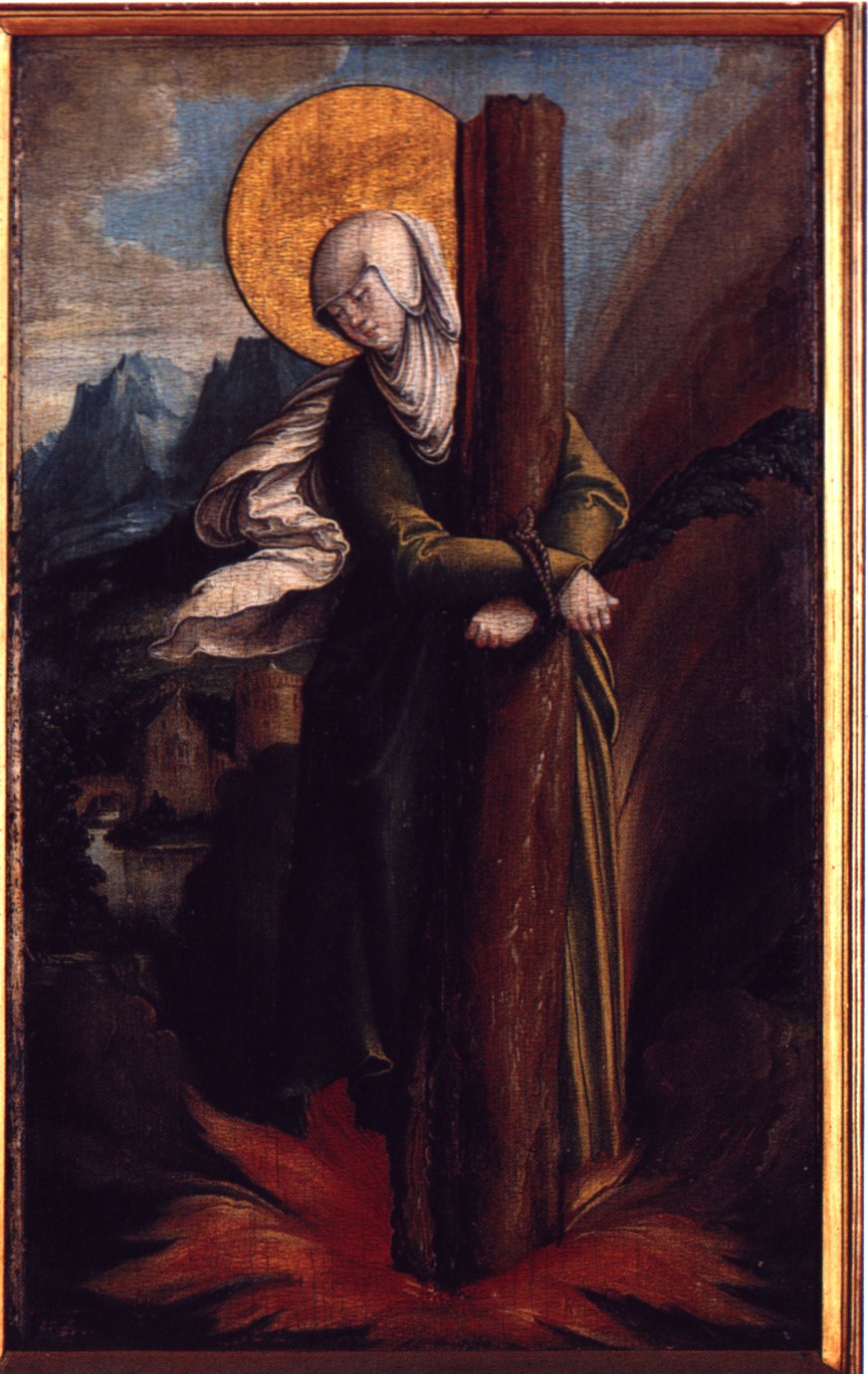


-WUS07593.jpg)

_-_061.jpg)
_9.jpg)
_15.JPG)


