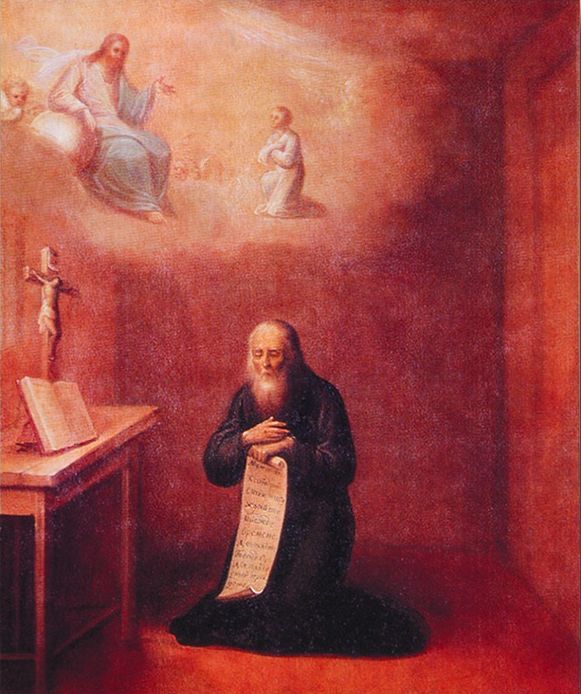
Saint Vital de Gaza
(7ème s.)
Il avait soixante ans
lorsqu'il réalisa que l'Évangile invite les femmes de "mauvaise vie"
à entrer, elles aussi, dans le Royaume de Dieu. Il résolut de les y décider sur
place. Il quitta son ermitage de Gaza en Palestine, et rejoignit Alexandrie
d'Égypte, célèbre en cela par son quartier du port. Il y loua une petite
chambre et fit deux parts de son temps. Le jour, il mendiait l'argent aux
portes des bonnes maisons; le soir il mendiait la conversion aux portes du
péché. Ces dames le prirent vite en amitié respectueuse tant il était bon et
miséricordieux dans ses paroles et ses jugements. Quand il abordait l'une ou
l'autre qui était attristée de son métier, il doublait ou triplait ce
qu'elle comptait gagner, l'emmenait dans sa chambre et lui parlait du bonheur
que donne une vie honnête. Souvent, elles changeaient de vie. Mais les
"saintes âmes" dénoncèrent saint Vital à l'évêque qui l'enferma.
Les filles de joie passèrent des nuits devant la résidence épiscopale, criant
et tapageant, réclamant leur ami. L'évêque comprit. Quelques jours plus tard,
saint Vital fut abattu d'un coup de couteau par un souteneur furieux de son
action. Près du saint, on trouva cette tablette écrite :"Attendez, pour juger,
le jour du jugement."
SOURCE : http://nominis.cef.fr/contenus/saint/5131/Saint-Vital-de-Gaza.html
Moines & moniales
Saint Vital de Gaza
Saint Vital de Gaza est
aussi connu sous le nom de saint Vital d’Alexandrie. Il est né à Gaza en
Palestine vers 625 et mort à Alexandrie un peu plus de 60 ans plus tard.
Saint Vital a d’abord
mené une vie d’ermite en Palestine. Arrivé à 60 ans, il est interpelé par la
situation des prostituées : il comprend qu’elles sont aussi appelées à
recevoir le salut du Christ. Il va à Alexandrie et il aide beaucoup de femmes à
quitter la prostitution pour accepter le Christ comme leur sauveur.
Mais les bonnes gens
d’Alexandrie sont scandalisés de voir un ermite se mêler aux prostituées. Ils
avertissent l’évêque qui met Vital en prison, mais les prostituées manifestent
en pleurant sous ses fenêtres jusqu’à ce qu’il libère Vital.
Peu de temps plus tard,
saint Vital meurt assassiné par un souteneur.
SOURCE : https://prieraujourdhui.com/saints/848592/

Vitalis
of Alexandria
Прп.
Виталий Александрийский. Икона. Нач. XIX в. (ЦАК МДА)
Profile
Monk and hermit in
the Gaza region. At age 60 he felt driven to travel to Alexandria, Egypt and
work to save the area prostitutes.
He had a unique method – he worked as a day labourer;
with each day’s wages he would hire a prostitute for
the evening; but instead of the usual services, he requested that she spend the
night without sin. To those who would listen he would teach and pray, and
from each he extracted a promise to not describe the evening. Not surprisingly,
this frequently led to controversy, gossip and opposition, but every
investigation cleared him of any charge of impropriety. Some writers claim
that he met and prayed with
every prostitute in
the city, and many of them were led to abandon the life and overcome the things
that had driven them to it.
he was struck in the head
in 625 with
a knife by a pimp who saw him leaving a brothel and wanted Vitalis to quit
interfering with business in Alexandria, Egypt
Vitalis managed to return
to his hut and died alone
soon after, apparently in prayer
Additional
Information
Saints
of the Day, by Katherine Rabenstein
books
Our Sunday Visitor’s Encyclopedia of Saints
other
sites in english
video
sites
en français
fonti
in italiano
websites
in nederlandse
Readings
Judge nothing before the
time, until the Lord come, who both will bring to light the hidden things of
darkness, and will make manifest the counsels of the heart. – Saint Vitalis
MLA
Citation
“Saint Vitalis of
Gaza“. CatholicSaints.Info. 11 January 2023. Web. 21 May 2026.
<https://catholicsaints.info/saint-vitalis-of-gaza/>
SOURCE : https://catholicsaints.info/saint-vitalis-of-gaza/
St. Vitalis of Gaza
Feastday: January 11
Death: 625
Monk. He served as
a monk in
Gaza, for many years and earned considerable controversy for his methods in
reforming the local prostitutes and scandalous women. After his death, he was
completely cleared of any possible impropriety or excessive zeal.
SOURCE : https://www.catholic.org/saints/saint.php?saint_id=1864
Vitalis of Gaza, Hermit
(AC)
Died c. 625. Vitalis was
a monk of Gaza, of unknown origin, who in his monk's dress, at the age of 60,
arrived in the gay and dazzling city of Alexandria, Egypt, like a ghost of the
desert. In his lonely cell he had read the story of the woman taken in adultery
and had felt impelled to travel to the city and work among the prostitutes. He
obtained the name and address of every harlot, hired himself our as a day
laborer, and every night took his wage to one of these unfortunate women.
It was a very strange and
unconventional procedure. He would sup with the woman, then, giving her the
money, would say: "I pay thee this, that thou mayest spend one night
without sin." Afterwards he would pray with her, often passing the night
in reciting the Psalms, and, on leaving, would extract a solemn promise that
she would tell no one of the nature of his visit.
It led to great scandal
and he was gravely misunderstood, but the Church refused to intervene and he
continued his mission. Thus he visited in turn every harlot in Alexandria, and
many, moved by his purity and sincerity as well as by his earnest appeal,
abandoned their shameful calling. Many, indeed, afterwards married and became
good wives and mothers.
But his story ends in
tragedy. One day, when leaving a house of ill fame, he was struck on the head
by a man who misunderstood his motive. Vitalis made his way back with
difficulty to the wretched hovel where he lived, and the crowd that followed,
when they entered, found him dead upon his knees. In his hand was a fragment of
parchment bearing the words: "Judge nothing before the time, until the
Lord come, who both will bring to light the hidden things of darkness, and will
make manifest the counsels of the heart."
Then all whom he had
helped revealed the secret of his redemptive work, and the whole city gathered
to do him honor, the women following him to his grave bearing lamps and candles
(Benedictines, Encyclopedia, Gill).
SOURCE : http://www.saintpatrickdc.org/ss/0111.shtml
Saint of the Day – 11 January – St Vitalis of Gaza (Died c 625)
Monk, Hermit and apostle of charity
and prayer.
Roman martyrology:
At Gaza, Vitalis was a monk for many years and earned considerable
controversy for his methods in reforming the local prostitutes and scandalous
women.
Vitalis was a monk of
Gaza, of unknown origin, who in his monk’s dress, at the age of 60, arrived in
the gay and dazzling city of Alexandria, Egypt, like a ghost of the
desert. In his lonely cell he had read the story of the woman taken
in adultery and had felt impelled to travel to the city and work among the
prostitutes. He obtained the name and address of every harlot, hired
himself our as a day labourer and every night took his wage to one of these
unfortunate women.
It was a very strange and
unconventional procedure. He would sup with the woman, then, giving
her the money, would say: “I pay thee this, that thou mayest spend
one night without sin.” Afterwards he would pray with her, often
passing the night in reciting the Psalms and, on leaving, would extract a
solemn promise that she would tell no one of the nature of his visit.
It led to great scandal
and he was gravely misunderstood, but the Church refused to intervene and he
continued his mission. Thus he visited in turn every harlot in
Alexandria and many, moved by his purity and sincerity as well as by his
earnest appeal, abandoned their shameful calling. Many, indeed,
afterwards married and became good wives and mothers.
Vitalis was killed when a
man, misunderstanding the nature of the monk’s visit to a brothel, struck him
on the head. Vitalis managed to return to his hut where he died.
Apparently during his burial, former prostitutes came out to explain his works
before processing with candles and lanterns as his body was brought to the
grave.
Author: AnaStpaul
Passionate Catholic.
Being a Catholic is a way of life - a love affair "Religion must be like
the air we breathe..."- St John Bosco Prayer is what the world needs
combined with the example of our lives which testify to the Light of Christ.
This site, which is now using the Traditional Calendar, will mainly concentrate
on Daily Prayers, Novenas and the Memorials and Feast Days of our friends in
Heaven, the Saints who went before us and the great blessings the Church
provides in our Catholic Monthly Devotions. This Site is placed under the
Patronage of my many favourite Saints and especially, St Paul. "For the
Saints are sent to us by God as so many sermons. We do not use them, it is they
who move us and lead us, to where we had not expected to go.” Charles Cardinal
Journet (1891-1975) This site adheres to the pre-Vatican II Catholic Church and
all her teachings. . PLEASE ADVISE ME OF ANY GLARING TYPOS etc - In June 2021 I
lost 100% sight in my left eye and sometimes miss errors. Thank you and I pray
all those who visit here will be abundantly blessed. Pax et bonum! View All Posts
SOURCE : https://anastpaul.com/2018/01/11/saint-of-the-day-11-january-st-vitalis-of-gaza-died-c-625/
Venerable Vitalius of
Gaza
Commemorated on April 22
Saint Vitalius, a monk of
the monastery of Saint Seridus, arrived in Alexandria when Saint John the Merciful
(November 12) was Patriarch of Alexandria.
When he was sixty years
old, undertook an extraordinary task: he wrote down from memory the names of
all the prostitutes of Alexandria and he began to pray for them. He worked from
morning to evening, earning twelve copper coins each day. In the evening the
saint bought a single bean, which he ate after sunset. Then he would give the
rest of the money to one of the harlots, whom he visited at night and said, “I
beg you, take this money and do not sin with anyone tonight.” Then he stayed
with the harlot in her room. While she slept, the Elder spent the whole night
at prayer, reading the Psalms, and quietly left in the morning.
He did this each day,
visiting all the harlots in turn, and he made them promise to keep the purpose
of his visit secret. The people of Alexandria, not knowing the truth, became
indignant over the the monk’s behavior, and they reviled him. However, he
meekly endured their scorn, and he only asked that they not judge others.
The holy prayers of Saint
Vitalius saved many fallen women. Some of them went to a monastery, others got
married, and others found respectable work. But they were forbidden to tell
anyone the reason why they had changed their life, and thereby stop the abuse
heaped upon Saint Vitalius. They were bound by an oath they had made to the
saint. When one of the women began to break her oath and stood up to defend the
saint, she fell into a demonic frenzy. After this, the people of Alexandria had
no doubt concerning the sinfulness of the monk.
Certain of the clergy,
scandalized by the behavior of Saint Vitalius, reported him to the holy
Patriarch John the Merciful. But the Patriarch did not believe the informers
and he said, “Cease to judge, especially monks. Don’t you know what happened at
the First Council of Nicea? Some of the bishops and the clergy brought letters
of denunciation against each other to the emperor Saint Constantine the Great
(May 21). He commanded that a burning candle be brought, and not even reading
the letters, he burned them and said, ‘If I had seen with my own eyes a bishop
sinning, or a priest, or a monk, then I would have veiled such with his garb,
so that no one might see his sin.’” Thus the wise hierarch shamed the
calumniators.
Saint Vitalius continued
on with his difficult exploit: appearing himself before people under the guise
of a sinner and a prodigal, he led the prodigal to repentance.
One time, emerging from
an house of ill repute, the monk encountered a young man going there -- a
prodigal fellow, who with an insult struck him on the cheek and cried out, that
the monk was a disgrace to the Name of Christ. The monk answered him: “Believe
me, that after me, humble man that I be, thou also shalt receive such a blow on
the cheek, that will have all Alexandria thronging to thine cry”.
A certain while
afterwards Saint Vitalius settled into a small cell and in it at night he died.
At that very hour a terrifying demon appeared before the youth who had struck
the saint, and the demon struck the youth on the cheek and cried out: “Here is
a knock from Saint Vitalius.” The youth went into a demonic madness. In a
frenzy he thrashed about on the ground, tore the clothing from himself and
howled so loudly, that a multitude of people gathered.
When the youth finally
came to his senses after several hours, he then rushed off to the cell of the
monk, calling out: “Have mercy on me, O servant of God, for I have sinned
against thee.” At the door of the cell he came fully to his senses and he told
those gathered there about his former encounter with Saint Vitalius. Then the
youth knocked on the door of the cell, but he received no answer. When they
broke in the door, they then saw that the monk was dead, on his knees before an
icon. In his hand was a scroll with the words: “Men of Alexandria, judge not
beforehand, til cometh the Lord, the Righteous Judge”.
At this moment there came
up the demon-possessed woman, punished by the monk for wanting to violate the
secret of his exploit. Having touched the body of the saint, she was healed and
told the people about everything that had happened with her.
When the women who had
been saved by Saint Vitalius learned about his death, they gathered together
and told everyone about the virtues and mercy of the saint.
Saint John the Merciful
also rejoiced, in that he had not believed the calumniators, and that a
righteous man had not been condemned. And then together with the throng of
repentant women, converted by Saint Vitalius, the holy Patriarch solemnly
conveyed his remains throughout all the city and gave them reverent burial. And
from that time many of the Alexandrian people made themselves a promise to
judge no one.
SOURCE : https://www.oca.org/saints/lives/2022/04/22/101183-venerable-vitalius-of-gaza
St. Vitalis of the
monastery of Abba Serid (Seridos) at Gaza (609-620)
Commemorated on January
11 and April 22
He lived for many years
as a monk in Palestine, then went to Alexandria to labor for the salvation of
women living as prostitutes. He worked with his hands by day, keeping only a
tenth of his earnings for himself. By night, he would take the rest of his
earnings to the prostitutes' quarter and offer his money to one of them, on
condition that she would not give herself up to sin that night, but instead
stay with him, praying all night for his salvation. When he left her, he would
make her promise to tell no one of this arrangement. Not surprisingly,
complaints soon reached the Patriarch, St John the Merciful (November 12) about
this monk who was causing scandal by his immoral life; but the Patriarch,
discerning Vitalis' heart, did nothing. When St Vitalis died, a writing tablet
was found near his body, on which was written: "Inhabitants of Alexandria,
judge not before the time, until the coming of the Day of the Lord." Then
many women who had been converted from an immoral life by the Saint came
forward and told of his good deeds. The people of Alexandria honored him with a
lavish funeral.
Saint Vitalis shows us in
at least two ways that the wisdom of the holy is foolishness to the
world: He never sought to justify himself in the eyes of the world, but on the
contrary did everything he could to hide his virtues; and, for all his
holiness, he counted himself more sinful than the "fallen," , asking
them to pray for his salvation.
SOURCE : http://www.holytrinityorthodox.com/calendar/los/January/11-05.htm
Vitalis van Gaza,
Palestina; monnik; † 5e eeuw of ca 625?
Feest 11 januari.
Aanvankelijk was hij
monnik in het klooster van de beroemde abt Seridus te Jeruzalem. Omdat hij jong
was ingetreden en niets van de gewone wereld scheen te weten, stuurde zijn abt
hem naar Alexandrië om zijn roeping te beproeven. Daar ontdekte hij dat er
prostituees bestonden. Geschokt zocht hij werk, verdiende er tien obolen per
dag mee, hield er één voor zichzelf, ging elke nacht naar één van die meisjes
en gaf haar de overige negen om haar zuiverheid te bewaren. Zelf bleef hij op
om te bidden...
Iedereen sprak er schande
van. Pas na zijn dood kwam de ware toedracht aan het licht, en werd hij
beschouwd als een groot heilige.
[140; Dries van den Akker s.j./2009.01.08]
© A. van den Akker
s.j. / A.W. Gerritsen
SOURCE : https://heiligen-3s.nl/heiligen/01/11/01-11-0625-vitalis.php