L’Église copte canonise
les 21 martyrs de Libye
Mamdouh Chehab ofm
19 février 2015
La rue copte et égyptienne a été bouleversée par le massacre perpétré par le
groupe Daesh (Etat Islamique), en Libye, de 21 ouvriers chrétiens. Les
réactions se sont multipliées. Aux gestes politiques du président al-Sissi,
s'ajoute la décision de la plus haute autorité religieuse chrétienne d'Egypte,
le patriarche copte orthodoxe Tawadros, de "canoniser" aussitôt
les martyrs à la date du 8 Amshir, le 15 février, en la fête de la
présentation de Jésus au Temple, dans le calendrier copte.
(Le Caire) – La rue copte
et égyptienne a été bouleversée par le massacre perpétré par le groupe Daesh
(Etat Islamique), en Libye, de 21 ouvriers chrétiens. Les réactions se sont
multipliées.
Au premier rang d’entre
elles, celle du Président égyptien al-Sissi. Dans un discours prononcé le soir
du dimanche 15 février, après que le massacre ait été révélé dans une vidéo, il
annonçait trois mesures phares.
La première d’ordre
militaire, prévoyant des frappes aériennes sur les positions de Daesh en Libye.
Elles eurent lieu dès le lendemain matin 16 février. La seconde est un signe
fort pour la Nation égyptienne avec la déclaration d’un deuil national de sept
jours. La troisième est l’engagement de l’Etat à verser aux familles des
victimes une pension mensuelle de 1500 Livres Egyptiennes (175 euros – le
salaire minimum en Egypte est de 1 200 livres égyptiennes par mois, soit
125 euros).
Dès le 16 février, le
Président al-Sissi se rendait à la cathédrale copte du Caire présenter ses
condoléances au Patriarche Tawadros.
Les réseaux sociaux de
leur côté ont témoigné de l’ampleur du choc à l’annonce de ce crime.
Ceux qui ont regardé la
vidéo de la décapitation ont relevé l’extrême dignité des ouvriers à quelques
instants de leur mort.
Un psychologue égyptien a
justifié le calme des victimes par la prise de stupéfiants. Selon lui, les
bourreaux auraient obligé leurs victimes à se droguer pour ne pas sentir la
douleur de la décapitation. Une théorie qui lui vaut les railleries de la
toile, certains proposant que les Nations Unies décorent les bourreaux.
Pour d’autres, leur calme
apparent serait dû à l’ignorance du sort qui leur était destiné. Anbâ Raphaël,
secrétaire du Synode copte-orthodoxe et évêque diocésain du Centre-ville du
Caire, a invité ceux qui propagent cette théorie « à se réveiller »
et à ne pas sous-estimer la foi chrétienne.
De nombreuses
publications sur Facebook rapportent que les bourreaux auraient proposé aux
victimes de se convertir à l’Islam pour éviter la mort.
De son côté, l’évêque
copte catholique de Gizeh, Mgr Anba Antonios Mina,
déclarait : « Le nom de Jésus est le dernier mot qui a effleuré
leurs lèvres. Comme dans la passion des premiers martyrs (…) ainsi, ils ont
célébré leur victoire, la victoire qu’aucun bourreau ne pourra leur enlever. Ce
nom susurré au dernier instant a été comme le sceau de leur martyre ».
L’Eglise copte quant à
elle n’a pas tardé à s’exprimer. Le Patriarche Tawadros a souligné que ces
Égyptiens avaient été tués en raison de leur appartenance à la foi chrétienne.
Et il a annoncé l’insertion des noms des victimes dans le Synaxaire.
L’équivalent oriental du martyrologe romain. La procédure équivaut à la
canonisation dans l’Eglise latine.
Leur martyr sera
commémoré le 8 Amshir du calendrier copte (15 février du calendrier grégorien),
le jour de la fête de la présentation de Jésus au Temple.
De son côté et en
direction de l’Eglise, le Président al-Sissi a annoncé qu’il ferait délivrer un
permis afin que l’Etat construise, à ses frais, une église en l’honneur des
martyrs, dans le diocèse de Minia, d’où la plupart étaient originaires. Un
geste fort quand on sait combien les autorisations pour construire de nouvelles
églises ont été données par le passé avec parcimonie.
La communauté copte
espère que ce choc sera le sursaut nécessaire et attendu pour que cessent en
Egypte les explosions et manifestations antichrétiennes variées dont elle fait
régulièrement l’objet.
SOURCE : https://www.terresainte.net/2015/02/leglise-copte-canonise-les-21-martyrs-de-libye/
« Décapités en
murmurant Jésus » : que reste-t-il du souvenir des 21 martyrs
coptes ?
Agnès
Pinard Legry - publié le 14/02/23
Les années passent mais
le choc et la violence demeurent. Le 15 février 2015, une vidéo montrant le
massacre de 21 chrétiens coptes, vingt Égyptiens et un Ghanéen, en Libye par Daesh
était diffusée sur les réseaux. Huit ans après, que reste-t-il du souvenir de
ces 21 martyrs ?
Il est des images sur
lesquelles le temps ne semble pas avoir de prise. Et celles diffusées il y a
huit ans, le 15 février 2015, en font partie. Sur une vidéo diffusée sur
Internet par l’État islamique et visionnée par des millions d’internautes, on y
voit 21 hommes, des chrétiens coptes, vingt Égyptiens et un Ghanéen portant des
combinaisons oranges. Une tenue semblable à celles d’autres otages exécutés ces
derniers mois de 2015 en Syrie. Ici c’est sur une plage libyenne qu’ils sont
alignés, les mains menottées dans le dos, avant que leurs bourreaux ne les
décapitent au couteau.
Trois ans jour pour jour
après leur mise à mort, en 2018, une église dédiée à leur mémoire est inaugurée à Al-Our,
dans la province égyptienne de Minya, ainsi qu’un musée souvenir. Dans ce dernier, on trouve les cercueils
utilisés pour le rapatriement de leurs corps, les menottes avec lesquelles ils
étaient attachés, les restes de leurs uniformes oranges, les monnaies
retrouvées dans leurs poches, leurs chaussures et divers documents. Déclarés
martyrs de la foi et de la patrie par l’Église copte-orthodoxe, leurs noms ont
été inscrits dans le « synaxarium », l’équivalent oriental du
martyrologe romain, et leur martyre est commémoré le 8 de Méchir du calendrier
copte, qui correspond au 15 février du calendrier grégorien actuel.
Ils sont morts en
murmurant “Seigneur Jésus !”
En France, Le Petit
Palais s’est porté acquéreur en 2019 d’une très grande
aquarelle de Nikola Sarić, consacrée à la mémoire des 21 martyrs coptes.
L’artiste a choisi d’y insérer la figure du Christ pour rappeler le sacrifice
des coptes qui ont refusé de renier leur foi. Sa présence révèle ainsi qu’il ne
s’agit pas d’une simple exécution mais bien d’un martyre. Le Christ est
d’ailleurs, symboliquement, revêtu de la même couleur orange.
« Il est vrai qu’il
y a une tragédie, que ces personnes ont laissé leur vie sur
la plage », a déclaré plus récemment, en 2021, le pape François au
sujet de ces martyrs. « Mais il est également vrai que
la plage a été bénie par leur sang. »
« Ces vingt-et-un hommes ont été baptisés chrétiens avec de
l’eau et de l’Esprit, et ce jour-là, ont aussi été baptisés avec
du sang », a assuré l’évêque de Rome. Pour lui, ces 21 victimes du
groupe État islamique sont « nos saints », les saints de « tous
les chrétiens », de « toutes les confessions et traditions
chrétiennes ».
Rappelant que ces hommes
étaient partis travailler en Libye pour faire vivre leur famille,
qu’ils étaient « des hommes ordinaires », le successeur de Pierre a
insisté sur leur foi « simple mais cohérente ». « La
gorge tranchée par la brutalité d’Isis (Islamic State of Irak and
Syria, ndlr), ils sont morts en murmurant “Seigneur Jésus !” »,
a-t-il insisté. Par ce témoignage de foi, « ils ont reçu le plus
grand cadeau qu’un chrétien puisse recevoir : le témoignage de Jésus-Christ au
point de donner sa vie ».
Une prière pour les
martyrs
Le pape François revient
régulièrement sur cette tragédie survenue il y a maintenant huit ans. En 2015,
au lendemain de la diffusion des exécutions macabres, il avait improvisé un
hommage appuyé aux 21 victimes. « Qu’ils soient catholiques, orthodoxes,
coptes, luthériens, cela n’a pas d’importance : ils sont chrétiens, et
le sang est le même ! Ce sang confesse le
Christ », avait-il lancé au terme d’un discours sur l’œcuménisme.
Pour s’unir à leur
sacrifice et pour que le souvenir de ces 21 martyrs coptes demeure vivace,
chacun peut réciter cette prière des martyrs, proposée par l’Aide à l’Église en
détresse (AED) :
Seigneur,
sur les cinq continents, en haine de la foi,
tant de chrétiens sont menacés, persécutés.
Signes de contradiction, animés du seul désir d’aimer,
ils meurent pour toi qui es l’Amour.
Nous te prions pour eux, accueille-les auprès de toi.
Nous te confions aussi leurs persécuteurs,
aveuglés par la haine et la violence.
Que le sacrifice et le pardon de leurs victimes
les mènent sur un chemin de conversion.
Vierge Marie,
toi qui la première éprouvas dans ta chair le glaive,
invoque pour nous l’Esprit de force,
qu’il éloigne de nous la peur, la honte, la lâcheté,
qu’il renouvelle notre foi
et nous donne le désir de témoigner,
en toutes circonstances, que le Christ est Seigneur.
Amen
Nigeria, Birmanie, Haïti…
2022, une nouvelle année sanglante pour les chrétiens :
Démarrer le diaporama
Lire aussi :Qu’est-ce que la palme du martyre ?
Lire aussi :Plus de 100 prêtres et religieuses enlevés, arrêtés ou tués en
2022
SOURCE : https://fr.aleteia.org/2023/02/14/decapites-en-murmurant-jesus-que-reste-t-il-du-souvenir-des-21-martyrs-coptes/?utm_campaign=Web_Notifications&utm_medium=notifications&utm_source=onesignal
A LA MÉMOIRE DES 21 MARTYRS COPTES
FR - 15/02/2019
Ce 15 février (2019), nous honorons la mémoire des vingt-et-un jeunes coptes orthodoxes égyptiens, sauvagement égorgés par les djihadistes de l’organisation Etat islamique. Il y a 1460 jours, sur une plage de Libye, vingt-et-un saints sont nés dans le sang.
Violence. Terreur. Mort. Martyr. Le 15 février 2015, les soldats de Daesh franchissent à nouveau la ligne de l’horreur. Vingt-et-un chrétiens coptes égyptiens sont assassinés sur une plage en Libye pour avoir refusé d’apostasier. La vidéo de leur décapitation fait le tour de la toile, provoquant l’indignation du monde entier.
Les nuages sont hauts dans le ciel. La mer est calme à l’horizon. Revêtus d’une tunique orange, ils ont les mains attachées dans le dos, chacun accompagné par un homme en noir cagoulé, un couteau pendant à la ceinture. D’une pression sur l’épaule, tous sont mis à genoux, dos à la mer. La caméra s’arrête sur un homme, les yeux fermés, les lèvres récitant une prière. La mise en scène est sordide, le professionnalisme frappant, les travellings et prises de vues aériennes étouffants.
Une semaine après leur mort, les victimes du massacre sont canonisées et inscrits sur le Synaxarium* par le patriarche copte Tawadros II, pape d'Alexandrie et patriarche de toute l'Afrique et du siège de saint Marc.
Le samedi 7 octobre 2017, après une longue enquête, les autorités libyennes annoncent la découverte des corps mutilés, dans un charnier près de Syrte sur le littoral libyen. Les dépouilles sont confiées à un médecin légiste de Misrata pour autopsie. Le lundi 14 mai 2018, les cloches des églises et des monastères sonnent à toute volée en Égypte pour accueillir « ces martyrs de la foi et de la patrie ». Ils reposent désormais dans l’église des martyrs, dans le village d’Al-Awar, près de Salamut.
Aujourd’hui, prions tout particulièrement pour les familles des victimes et pour tous ceux qui sont martyrisés à cause de leur foi.
« Ils ont été assassinés pour le seul fait d’être chrétiens. Le sang de nos frères chrétiens est un témoignage qui hurle. Qu’ils soient catholiques, orthodoxes, coptes, peu importe : ils sont chrétiens ! Et le sang est le même. Donner son sang, c’est témoigner du Christ. » Pape François.
*Équivalent du Martyrologe romain pour l’Église copte.
SOURCE : https://www.soschretiensdorient.fr/index.php/fr/item/521-a-la-memoire-des-vingt-et-un-martyrs-coptes
Une icône sur le martyre
des 21 coptes accrochée au Petit Palais
Caroline
Becker | 27 septembre 2019
C’est une acquisition
pour le moins enthousiasmante que vient d’effectuer le Petit Palais. Le musée
parisien s’est porté acquéreur d’une très grande aquarelle contemporaine peinte
en mémoire des 21 ouvriers coptes assassinés par Daech sur la plage de Syrte,
en Libye, le 15 février 2015. Un drame que beaucoup n’ont pas oublié, comme le
peintre Nikola Saric, auteur de cette oeuvre inspirée de l’iconographie
byzantine.
Dans la partie
supérieure, le Christ est auréolée d’une douce lumière rose. Sa figure trônante,
hiératique, est contrebalancée par la bonté de son visage. Dans un geste
paternel, ses bras s’allongent et enlacent ses enfants, ces 21 martyrs
chrétiens égyptiens sauvagement assassinés par Daech en 2015 sur une plage
libyenne. Un drame filmé, vu par des millions d’internautes, que personne n’a
oublié.
Lire aussi :
Égypte
: un musée en hommage aux 21 martyrs coptes
Nikola Saric, artiste serbe et chrétien à l’origine de cette œuvre, n’a pas non
plus oublié. Désireux de transcender ce martyr collectif, il a choisi la
peinture comme exutoire. Il en ressort une icône fortement inspirée de
l’iconographie traditionnelle byzantine. Composée à partir de la vidéo de
l’exécution, l’œuvre synthétise les différents éléments de la mise en scène :
les 21 otages, alignés à genoux, portent une combinaison orange. Les bourreaux,
derrière eux, forment une autre ligne et sont dissimulés sous une tenue noire à
cagoule. Ils maintiennent à terre les condamnés, un couteau à la main.
L’artiste a choisi d’y
insérer la figure du Christ pour rappeler le sacrifice des coptes qui ont
refusé de renier leur foi. Sa présence relève ainsi qu’il ne s’agit pas d’une
simple exécution mais bien d’un martyre. Le Christ est d’ailleurs, symboliquement,
revêtu de la même couleur orange. Une iconographie qui n’est pas sans rappeler
l’icône des Quarante martyrs de Sébaste, une icône du XVe siècle
relatant le martyre de 40 soldats chrétiens sous le règne de l’empereur romain
Licinius, en 320. Un autre martyre collectif auquel assiste le Christ et dont
Nikola Saric a puisé pour réaliser son icône. Avec cette œuvre contemporaine,
l’artiste serbe s’inscrit ainsi d’emblée dans la lignée des icônes
hagiographiques.
Avec cette acquisition,
le musée parisien vient compléter l’impressionnante collection d’icônes qu’elle
possède déjà. C’est cependant la première fois qu’elle devient propriétaire
d’une icône contemporaine, marquant ainsi un tournant dans l’histoire de ses
collections. Avec cette œuvre originale, l’institution témoigne des événements
récents de l’Histoire et révèle la naissance du culte des saints contemporains.
Les 21 coptes sont, en effet, déjà inscrits dans le Synaxarium,
l’équivalent du Martyrologe romain pour l’Église copte, ce qui signifie qu’ils
sont déjà canonisés.
Lire aussi :
Une
église dédiée aux 21 martyrs coptes de Daech
SOURCE : https://fr.aleteia.org/2019/09/27/une-icone-sur-le-martyre-des-21-coptes-accrochee-au-petit-palais/
ÉGYPTE: Exposition en
l’honneur des 21 martyrs de l’État islamique
Publié le 11 février 2020
Le 15 février, dans la
province de Minya, le sanctuaire des martyrs va rendre hommage aux 21 victimes
de l’État islamique à l’occasion du cinquième anniversaire de leur mort, en
inaugurant une exposition.
Le sanctuaire consacré
aux 21 chrétiens décapités par l’État Islamique sur une plage de Libye en
février 2015 va inaugurer ce 15 février une exposition pour commémorer le
cinquième anniversaire de leur mort. Vingt d’entre eux étaient des chrétiens
égyptiens coptes-orthodoxes, et la 21èmevictime était un chrétien du Ghana. Ils
ont tous été déclarés martyrs de la foi et de la patrie par l’Église
copte-orthodoxe.
L’exposition retrace
l’histoire de ces martyrs depuis leur enlèvement jusqu’au retour de leurs corps
dans le village d’Al-Aour, dans la province égyptienne de Minya, où se trouve
le sanctuaire. Les visiteurs pourront voir les combinaisons orange qu’ils portaient
lorsqu’ils ont été décapités, les outils ayant permis leur capture, le sable
sur lequel leur sang a été versé et les cercueils spécialement conçus pour eux.
« Je suis une mère
de martyrs et je suis fière d’eux »
Dans un entretien accordé
à l’AED, la mère de deux frères (cf photo) – Samuel, âgé de 22 ans, et Beshoy,
24 ans – qui faisaient partie des 21 martyrs, s’est ainsi exprimée : « Je suis
une mère de martyrs , et je suis fière d’eux. Au ciel, ils intercèdent pour moi
et pour leur père. Elle a ajouté qu’elle priait pour les disciples de l’État
islamique et demandait à Dieu « de leur donner la lumière et d’ouvrir leurs
yeux sur la vérité et le bien ».
Avant la publication de
la vidéo de l’État islamique montrant « le meurtre de mes frères et de leurs
compagnons, notre famille et toute l’église de notre village d’Al-Aour avaient
passé 45 jours à prier pour eux, depuis que nous avions appris leur
enlèvement », a déclaré Basheer, frère de Samuel et Beshoy. Il a
ajouté que, comme l’indique la vidéo : « Dieu a parlé à travers eux
lorsqu’ils ont invoqué “ Ô Jésus” ». « Nos martyrs priaient avant de
mourir, et il est évident qu’ils invoquaient Jésus. C’est un réconfort pour
nous, et cela nous rend fiers d’eux. Les vingt-et-une victimes ont eu la chance
d’être martyrs pour le Christ, et notre communauté se sent honorée d’avoir la
garde de leurs corps », a déclaré Basheer.
« Mes parents se
sont sentis soulagés quand ils ont su avec certitude que leurs enfants étaient
restés fermes dans leur foi en Jésus-Christ. Cela nous a soulagés et
réconfortés. Mes frères nous ont donné du courage face à la persécution. Nous
n’avons plus peur et ne sommes plus inquiets », a-t-il ajouté.
« Il y a beaucoup de
miracles qui leur sont attribués dans le village »
« L’Église
copte a une longue histoire de martyre et a traversé de nombreuses périodes de
persécution tout au long de son histoire », a déclaré le Père Abu Fanus
Unan qui travaille au sanctuaire qui se trouve dans l’église récemment construite
en l’honneur des Martyrs de la Foi et de la Patrie. Le prêtre a déclaré à
l’AED : « Nous sommes fiers du sang de ces martyrs qui ont refusé
d’abjurer leur foi chrétienne ». L’Église copte rend hommage à de nombreux
martyrs qui sont morts au cours des siècles passés, mais le prêtre a souligné
l’impact puissant du témoignage des « martyrs contemporains qui ont refusé
d’abjurer le nom de Jésus-Christ. Leur exemple affermit notre foi ».
Le sanctuaire prépare
également la publication d’un livre recensant les miracles attribués à
l’intercession de ces martyrs. « Il y a beaucoup de miracles qui leur sont
attribués dans le village. Ainsi, une femme atteinte d’un cancer a guéri après
avoir prié au sanctuaire », a déclaré le Père Abu Fanus, ajoutant que de
nombreuses personnes ont été baptisées et sont devenues chrétiennes grâce à
l’exemple des 21 martyrs. « L’Église copte survit grâce au sang de ses
enfants », a dit le prêtre.
La dépouille du Ghanéen
Matthew Ayariga se trouve toujours en Libye, mais l’ambassadeur de Lybie en Égypte
a promis que son corps serait transféré en Égypte une fois que la situation
politique dans son pays serait stabilisée.
SOURCE : https://www.aed-france.org/egypte-exposition-en-lhonneur-des-21-martyrs-de-letat-islamique/
L’Église va reconnaître
les 21 martyrs chrétiens de Libye décapités par Daech
Anna Kurian - publié
le 11/05/23
L’Église catholique va
reconnaître les 21 martyrs chrétiens de Libye décapités par Daech en 2015, a
annoncé le pape François ce jeudi 11 mai au patriarche copte Tawadros II. Une
initiative historique.
Les 21 martyrs chrétiens,
dont 20 coptes tués par Daech en 2015 en Libye, seront inscrits au
martyrologe romain, a annoncé le pape François le 11 mai 2023, devant le
patriarche Tawadros II, pape de l’Église copte orthodoxe, présent à Rome. Une
initiative historique : si l’Église catholique et l’Église copte ont en commun
des saints des premiers siècles, il s’agira des premiers saints reconnus par les
deux Églises depuis la rupture du Ve siècle.
Le pape François et
Tawadros II célèbrent ces jours-ci le 50e anniversaire de la rencontre
historique entre leurs prédécesseurs, le pape Paul VI et le patriarche Chenouda
III (1973-2023), la première entre un évêque de Rome et un patriarche de
l’Église copte orthodoxe. Dans ce cadre, le patriarche a participé à l’audience générale du 10 mai aux côtés
du pontife argentin, place Saint-Pierre.
Le 11 mai, les deux
hommes se sont entretenus en privé au Vatican. Puis,
remerciant le patriarche égyptien de 70 ans pour le « don précieux d’une
relique des martyrs coptes tués en Libye le 15 février 2015 », le Pape a
fait cette annonce : « Avec l’accord de Votre Sainteté, a-t-il déclaré,
ces 21 martyrs seront inscrits dans le martyrologe romain comme signe de la
communion spirituelle qui unit nos deux Églises ».
Ces ouvriers chrétiens,
dont 20 étaient coptes orthodoxes et l’un était Ghanéen, ont été assassinés par
des hommes de l’organisation État islamique sur une plage de Libye, le 15
février 2015. Six jours plus tard, le patriarche Tawadros II avait annoncé
l’insertion de leurs noms dans le « Synaxaire » – équivalent oriental
du martyrologe romain – à la date du 15 février.
Ces martyrs, a assuré le
pape François lors de l’audience, « ont été baptisés non seulement dans
l’eau et dans l’Esprit, mais aussi dans le sang, un sang qui est semence
d’unité pour tous les disciples du Christ ».
Un geste historique
Cette reconnaissance
officielle de l’Église catholique vient donc souligner « l’œcuménisme du
martyre », explique à I.Media une source vaticane. Ces 21 hommes
ont en effet été martyrisés « parce que chrétiens », et sont morts
« en haine de la foi chrétienne », selon le terme consacré,
ajoute-t-elle.
« De même que l’on a
des saints en commun d’avant la rupture entre les Églises, l’on aura à présent
des saints en commun d’aujourd’hui », souligne l’expert. Et de relever la
portée historique de ce geste : « Ce seraient les premiers saints reconnus
de cette façon ».
En pratique, le
Martyrologe romain inclut « tous ceux qui font l’objet d’un culte public
catholique » et ce terme recouvre couramment les saints qui sont inscrits
dans le calendrier universel de l’Église catholique, précise la même source.
Les 21 martyrs seront donc « saints » pour l’Église catholique. Cette
reconnaissance « n’est possible que parce que ces baptisés sont déjà
reconnus saints par l’Église copte », décrypte le spécialiste. L’inscription
au calendrier des saints catholiques est donc « la reconnaissance d’une
sainteté déjà reconnue par les coptes ».
Selon nos informations,
la question de savoir si l’on peut reconnaître des saints proclamés tels par
d’autres confessions chrétiennes est débattue depuis quelque temps. Mais dans
le cas des martyrs de Libye, le dossier s’avère « plus simple »,
assure encore notre source, car « aucune question de divergence
théologique n’entre en ligne de compte ».
Ni absorption ni
domination
Dans son discours devant
Tawadros II, le pape François a fait mémoire également de « la signature
d’une déclaration christologique mémorable » le 10 mai 1973, mettant fin à
la controverse née autour du Concile de Chalcédoine de 451 qui avait entraîné
une rupture entre Rome et nombre d’Églises orientales.
Cette rencontre, a
rappelé François, a mené à la création de la Commission mixte internationale
entre l’Église catholique et l’Église copte orthodoxe, qui en 1979 a adopté les
principes pionniers de la recherche de l’unité. Une unité qui ne peut être « une
absorption de l’un par l’autre ni une domination de l’un sur l’autre »,
comme l’ont déclaré Jean Paul II et Chenouda III.
Sur le chemin œcuménique,
le Pape a engagé à regarder « toujours en avant » avec « une
saine impatience et un désir ardent d’unité » en dépit des « moments
de découragement ». Et il remercié Tawadros II pour son attention envers
les coptes catholiques, ainsi que pour l’institution de la “Journée de l’amitié
entre coptes et catholiques”, célébrée tous les 10 mai depuis 2013 – date de la
première visite de Tawadros II au Vatican.
La rencontre s’est
conclue par un moment de prière dans la chapelle Redemptoris Mater du palais
apostolique. Dimanche, le patriarche copte célébrera une messe dans la
basilique Saint-Jean-de-Latran pour les fidèles coptes.
Lire aussi :Une icône sur le martyre des 21 coptes accrochée au Petit Palais
Lire aussi :Égypte : un musée en hommage aux 21 martyrs coptes
SOURCE : https://fr.aleteia.org/2023/05/11/leglise-va-reconnaitre-les-21-martyrs-chretiens-de-libye-decapites-par-daech/?utm_campaign=Web_Notifications&utm_medium=notifications&utm_source=onesignal
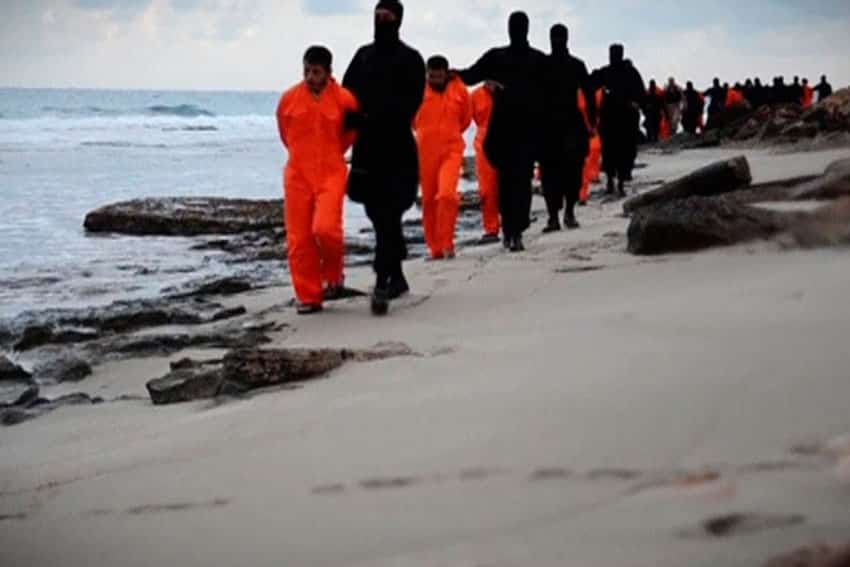
Men
in orange jumpsuits purported to be Egyptian Christians held captive by Islamic
State militants
are
marched by armed men along a beach said to be near Tripoli, Libya,
in
this still image from an undated video made available on social media Feb. 15.
The
video is said to show the beheading of 21 Egyptian Christians kidnapped in
Libya.
PHOTO:
CNS/Reuters
Updated List of the Names
of the New Martyrs of Libya
Below, please find the
most recent list of names of the 21 New Martyrs of Libya for use in prayers and
publications.
Milad Makeen Zaky
Abanub Ayad Atiya
Maged Soliman Shehata
Youssef Shukry Younan
Kirollos Boshra Fawzy
Bishoy Astafanous Kamel
Samuel Astafanous Kamel
Malak Ibrahim Sinyout
Tawadros Youssef Tawadros
Gerges Milad Sinyout
Mina Fayez Aziz
Hany Abdel Mesih Salib
Samuel Alham Wilson
Ezzat Boshra Naseef
Luka Nagaty Anis
Gaber Mounir Adly
Essam Baddar Samir
Malak Farag Abrahim
Sameh Salah Farouk
Gerges Samir Megally
Mathew Ayairga (from
Ghana)
In addition, another
Coptic Orthodox family was martyred in Libya just a few weeks before 21 New
Martyrs, because of their 15-year-old daughter’s unwillingness to wear
the hijab at her school. Extremists stormed their home by night,
killed her parents, and kidnapped the girl. When she resisted their advances,
she was killed and left by the side of the road. They are truly worthy to be
commemorated alongside the 21 New Martyrs. Their names are:
Magdy Sobhy Tawfeek
Sahar Talaat Rezk
Katherine Magdy Sobhy
SOURCE : https://www.lacopts.org/news/updated-list-of-the-names-of-the-new-martyrs-of-libya/
COPTIC CHURCH CANONIZES
THE 21 CHRISTIANS MURDERED BY ISIS IN LIBYA
The Coptic Orthodox Church has announced that the 21
Egyptian Christians murdered by the Islamic State in Libya will be commemorated
in its Church calendar as martyrs and saints.
Coptic Orthodox Pope
Tawadros II said that the names of the 21 martyrs beheaded by ISIS on February
14 will be inserted into the Coptic Synaxarium, the Oriental Church’s official
list of Martyrs, a procedure similar to canonization in the Latin Church.
An icon of the 21
martyrs, drawn by Tony Rezk, will be the official image to commemorate their
supreme witness (accompanying photo).
The Islamic State terror
group released a video on February 15 showing the brutal beheading of 21
Egyptian Christians who had previously been kidnapped in Libya. The Egyptian
Christians were lined up along a beach and abruptly beheaded in the graphic
five-minute video. The Islamic State’s Al Hayat Media produced the Libya video
titled, “A Message Signed with Blood to the Nation of the Cross.”
Pope Francis denounced
the murders and called the Christians “martyrs” who were “killed simply because
they were Christians.” The Pope also remarked that their last words were:
“Jesus, help me!”
“The blood of our
Christian brothers and sisters is a witness that cries out to be heard,” the
Pope said.
“It makes no difference
whether they be Catholics, Orthodox, Copts or Protestants,” the Pope continued.
“They are Christians! Their blood is one and the same. Their blood confesses
Christ.”
The recent murders in
Libya have driven home to Europeans the proximity of the Islamic State to
Europe, moving them to high alert and the mobilization of security forces. At
the same time, the heroic witness of those who died has also strengthened the
faith of many.
Beshir Kamel, brother of
two of the Coptic martyrs, said that he was proud of his brothers Bishoy and
Samuel, and said that their martyrdom was “a badge of honor to Christianity.”
Kamel went so far as to
thank the Islamic State for including their Christian witness in the videos
before beheading them.
“ISIS gave us more than
we asked when they didn’t edit out the part where they declared their faith and
called upon Jesus Christ. ISIS helped us strengthen our faith,” he said.
Kamel said these words in
an interview with SAT 7-ARABIC. The interview went viral, receiving over
100,000 views within hours of its release.
The interviewer asked
Kamel what his reaction would be if he were to encounter an Islamic State
militant, to which Kamel recalled his mother’s response: “My mother, an
uneducated woman in her sixties, said she would ask [him] to enter her house
and ask God to open his eyes because he was the reason her son entered the
kingdom of heaven,” Kamel said.
Breitbart
2/27/2015
SOURCE : https://orthochristian.com/77577.html
On February 12, 2015, the Islamic State of Iraq and
the Levant (ISIL) released a report in their online magazine Dabiq showing
photos of 21 Egyptian Coptic Christian construction workers that they had
kidnapped in the city of Sirte, Libya, and whom they threatened to kill to
"avenge the [alleged] kidnapping of Muslim women by the Egyptian Coptic
Church". The men, who came from different villages in Egypt, 13
of them from Al-Our, Minya Governorate,were kidnapped in Sirte in two separate
attacks on December 27, 2014, and in January 2015. This was not the first time
that Egyptians in Libya have been the subject of abuse for political reasons, a
pattern that goes back to the 1950s.
Earlier, in 2014, a
militia group in eastern Libya declared its affiliation with ISIL and then took
over parts of Derna in late 2014. People allied to the group claimed
responsibility for attacks across the country, including the Corinthia Hotel
attack in January 2015. On April 19, 2015, ISIL released another video in which
they murdered about 30 Ethiopian Christians.
On February 21, 2015 a
week after their death the Pope of the Coptic Orthodox Church, Pope Tawadros II
of Alexandria canonized the 21 Coptic Martyrs as a Saints their feast day would
be celebrated on February 15 of the Gregorian calendar. The commemoration falls
on the feast of the Presentation of Jesus at the Temple which is 8th Amshir of
the Coptic calendar.
SOURCE: https://commons.wikimedia.org/wiki/File:Coptic_Icon_of_21_Holy_Martyrs_of_Libya.jpg
AFRICA/EGYPT - The
official inauguration of the church of the "Coptic Martyrs of Libya"
scheduled for February 15th
Friday, 9 February 2018
Minya (Agenzia Fides) -
The church dedicated to the 21 Coptic martyrs beheaded in Libya in 2015 by
cutthroats affiliated to the so-called Islamic State (Daesh) will be officially
inaugurated next February 15th, on the day chosen for their liturgical memory.
The place of worship, built in al Our - the village next to the city of
Samalut, in the province of Minya, where 13 of the 21 martyrs came from - was
completed in the last months, and the ceremonies of February 15th will mark its
solemn inauguration. Many relatives of the Coptic martyrs will be present at
the liturgical and commemorative moments, and the possibility that these mortal
remains may be transferred to the new church have not yet been confirmed (see
Fides 29/9/2017) ) which in September were identified in a mass grave on the
Libyan coast, near the town of Sirte.
The 21 Egyptian Copts had been kidnapped in Libya in early January 2015. The
video of their decapitation was shown on jihadist sites on February 15th. Just
a week after their brutal act, Orthodox Catholic Patriarch Tawadros II decided
to register the 21 martyrs in the Synaxarium, the book of martyrs of the Coptic
Church, establishing that their memory was to be celebrated on February 15 .
"The video depicting their execution – said after the massacre Anba
Antonios Aziz Mina, Catholic Emeritus Bishop of Guizeh – had the intention of
spreading terror. During their barbaric execution, the victims repeated 'Lord
Jesus Christ'. The name of Jesus was the last word on their lips. As in the
passion of the first martyrs, they put their trust in Him who would soon
receive them. And so they celebrated their victory, the victory that no
executioner can take away from them". (GV) (Agenzia Fides, 9/2/2018)
SOURCE : http://www.fides.org/en/news/63727-AFRICA_EGYPT_The_official_inauguration_of_the_church_of_the_Coptic_Martyrs_of_Libya_scheduled_for_February_1
Coptic Orthodox to
dedicate church to New Martyrs of Libya
By Courtney
Mares
Minya, Egypt, Feb 13,
2018 / 16:01 pm
The Coptic Orthodox
Church will dedicate on Thursday a new church to the 21 Martyrs of Libya, who
were beheaded by the Islamic State, three years after their deaths.
The church will be opened Feb. 15, according to Fides News Agency. It is
located in the village of al-Our in Egypt's Minya Governorate. The village was
home to 13 of the martyred men.
"Any way that the
Church of today can honor her martyrs is a blessing. The story of these 21
brave men is worth telling. In way too many places Christians are under siege
from the dark forces of extreme hatred, and their freedom is conditioned by
this hatred," Bishop Gregory Mansour of the Maronite Eparchy of Saint
Maron of Brooklyn told CNA.
The church may someday
house the 21 martyrs' remains, which were identified in a mass grave on the
Libyan coast in September.
The Coptic Orthodox
Church recognized the 21 Coptic Christians as martyrs to be commemorated every
Feb. 15 within only a week of their murder in 2015 along the Libyan coast,
which was filmed by the Islamic State and released in an internet video.
The Coptic Orthodox
Church is an Oriental Orthodox Church, meaning it rejected the 451 Council of
Chalcedon, and its followers had historically been considered monophysites –
those who believe Christ has only one nature – by Catholics and the Eastern
Orthodox, though they are not considered so any longer.
Although Egyptian
President Abdel Fattah el-Sisi authorized the building of the new church, its
construction in a village that is 70 percent Muslim has faced resistance.
"Some of the
villagers protested and threw stones when construction started on the church.
Churches are a sensitive subject throughout Egypt, even though about 10 percent
of the population is Christian. It's hard to get permits to build them," Jane
Arraf of NPR reported from al-Our.
Christians in Egypt face
a constant threat of violence. Earlier this week, a man was found guilty of
stabbing Coptic Orthodox priest, Samaan Shehata, to death last October.
On Palm Sunday last year,
two Islamic State suicide bombings at Coptic churches in Egypt claimed the
lives of 47 people.
"We pray for our
Coptic brethren as they continue to witness to their beautiful faith and way of
life in Christ Jesus. They live in the most terrifying of circumstances, never
knowing the hour or the place of the next attack. May the prayers of the Mother
of God be their comfort and strength," said Bishop Mansour, who continued:
"Egypt was the first place of refuge for the holy family and continues to
be a place of refuge for God's holy family, mystically present in his Coptic
Christians."
Tags:
Ecumenism,
Coptic
Orthodox Church
Courtney Mares is a Rome
Correspondent for Catholic News Agency. A graduate of Harvard University, she
has reported from news bureaus on three continents and was awarded the Gardner
Fellowship for her work with North Korean refugees.
SOURCE : https://www.catholicnewsagency.com/news/37757/coptic-orthodox-to-dedicate-church-to-new-martyrs-of-libya
Miracles attributed to Coptic martyrs
By Staff Writers
February 20, 2019
A town in Egypt is
buzzing with news of miracles – favours obtained by the Christian men beheaded
by Islamic State on a Libyan beach in 2015.
Thirteen of the 21 men
were Coptic Christians from the upper-Egypt town of El-Aour, and according to
German novelist Martin Mosebach, numerous miracle stories have built up around
the 21 martyrs in El-Aour.
Some stories include the
martyrs being credited with saving children who fall out of windows, curing
sick people and even healing a woman of infertility.
Mosebach was inspired to
tell the story of the martyrs after seeing a picture on the cover of a German
magazine of the face of one of the executed migrant workers on the beach in
Libya.
He visited El-Aour, spoke
with families of the men killed and heard stories about how the martyrs are
being credited with modern-day miracles.
The resulting book, 21:
A Journey into the Land of Coptic Martyrs, was published in German last year
and will be released in English this month.
“El-Aour is a very poor
and primitive village,” Mosebach explained, adding that the Coptic villagers
there are very strong and knowledgeable in their faith and that miracles are
very important in their spirituality.
“Miracles didn’t save the
[21] from decapitation but did prove that their sacrifices had made them
Christlike and therefore accepted as such,” he said.
One miracle involved the
son of one of the martyrs. The son was said to have fallen onto the street from
the third floor of a building, causing him to break his arm in multiple places.
When the son regained consciousness, he claimed that his now-dead father had
caught him.
Days later, the son’s X-rays reportedly did not show any fractures.
According to Mosebach,
the term “miracle” is used by the Coptic community as the “next explanation for
any phenomenon they see.”
See related article: Coptic
Christians fight to stay in Australia: How many more killings will it take?
“Everything that has
happened is according to the will of God,” Mosebach said.
“The miracles are also
now seen with the martyrs, which the martyrs heal people.”
Although the Coptic
community has faced much persecution throughout its history that continues
today, Mosebach explained that Copts do not consider themselves to be victims
and do not seek revenge.
He added that the
villagers in El-Aour are proud of their martyrs.
The mothers who lost their sons at the hands of the
Islamic State know that their sons are now crowned kings in Heaven,” Mosebach
said.
The world was appalled
when the brutal terrorist group released footage showing the 21 men — all but
one being migrants from Egypt — being led to the shore of a Libyan beach near
Sirte dressed in orange jumpsuits.
All 21 men have been
canonised as martyr saints by the Coptic Church while President Abdel Fattah
el-Sisi ordered the construction of The Church of the Martyrs of Faith and
Homeland in El-Aour.
The church has become a
popular pilgrimage site as it is the final resting spot for the bodies of the
Coptic martyrs.
SOURCE : https://www.catholicweekly.com.au/miracles-attributed-to-coptic-martyrs/
Blood of the Martyrs
Posted Wednesday, February
27, 2019 3:40 pm
BY CLAUDIA MCDONNELL
There is a troubling news
image that has stayed with me, stored in memory, for four years. You probably
remember it, too. It is the image of 21 young men wearing orange jumpsuits
being marched to execution by members of ISIS. The men—20 Coptic Orthodox Christians
from Egypt and one Ghanaian Christian—were beheaded because they would not
renounce their Christian faith.
They seemed calm as they
walked to their deaths at the edge of a beach in Libya, under a clouded sky. An
ISIS video of the death procession shows them walking, hands bound behind their
backs, led by men in black whose faces are covered. The condemned men knelt
before their executioners. The video ended there, with the men about to be
slain.
Their last words were “O
my Lord Jesus.”
A German Catholic author,
Martin Mosebach, has written a book about them: “The 21: A Journey Into the
Land of Coptic Martyrs.” It is an account of Mosebach’s visit to Egypt to see
the martyrs’ homes, meet their families and gain a better understanding of
their society.
Mosebach spoke at an
event in Manhattan Feb. 11 with Coptic Orthodox Archbishop Angaelos of London.
The event, held at the Union League Club, was sponsored by Plough Publishing
House, publisher of “The 21,” and First Things, journal of the Institute on Religion
and Public Life. Plough is operated by the Bruderhof, an international
Christian movement.
The event nearly
coincided with the anniversary of the martyrs’ execution on Feb. 15, 2015. The
Coptic Orthodox Church has canonized them and honors them as saints. Mosebach
explains in the book how deeply affected he was by their deaths, and how he
decided to visit Egypt to learn more about them.
All of the Egyptians were
poor subsistence farmers who had gone to Libya in search of work. Matthew, the
Ghanaian, was a migrant worker. Mosebach was told that the kidnappers thought
Matthew was not a Christian and wanted to release him, but Matthew insisted he
was a Christian and refused to leave his friends.
Mosebach remarked at the
event that all of the Coptic martyrs’ family members feel “a quiet pride” in
the men’s steadfast faith unto death. The mother of one martyr told him, “I
never prayed during his captivity that he may come free. I prayed, ‘God, let
him stay firm.’ And he stayed firm.”
Mosebach did not find bitterness
toward the executioners, or a desire for retaliation.
“There was never the
question of revenge, never the question of justice,” he told the audience. The
issue of Muslim-Christian opposition did not arise. The families, he said,
attributed the persecution and killing of the men to “evil, the devil.”
Archbishop Angaelos
stressed that Christians have suffered martyrdom from the beginning of
Christianity. He noted that “martyr” means “witness.” A martyr is a witness to
the truth of the faith.
“It is not an act of
ending life, it is an act of choosing life,” he said.
He also noted the sharp
decline in the number of Christians in the Mideast. Christians are about 15
percent of the population of Egypt, and they represent about 80 percent of
Mideast Christians.
Persecution is one reason
for the decline.
After the presentation, I
spoke with Angela Georgy, 37, a Coptic Orthodox woman from New Jersey whose
parents were born in Egypt and who is active in her local church. She radiates
a joyous faith, and she said that she is proud of the martyrs.
“Their martyrdom
encourages me,” she said. “Our faith is not cheap.”
I cannot help but compare
the martyrs’ experience of Christianity with my own. How incomparably easier it
has been for me to practice the faith than it was for them. As we prepare to
observe Lent, I need to think about what my faith truly means to me, and about
the price that countless Christian martyrs have paid to remain faithful. They
gave up everything for love of Christ, as Christ, on Calvary, gave up
everything for love of us.
SOURCE : http://www.cny.org/stories/blood-of-the-martyrs,18692
BOOKS | APR. 13, 2019
Remembering the 21 Coptic
Martyrs
The horrific murders on a
Libyan beach are seared into public memory — and the men’s faith continues to
inspire.
Charles Lewis
The photo was taken in
the middle of February 2015 along a beach in Libya. There are 21 men in
identical orange jumpsuits being led to their place of execution. Behind each
is a man dressed in black, right hand on the back of their captive’s neck, as
they move them along to what will be their final moments on earth.
All the men, but one,
were Coptic Christians from Egypt. The men were in Libya to earn money for
their families back home. They were kidnapped weeks before, apparently beaten
and tortured every day. At night, we are told, they buoyed each other with
prayer.
Each man in black pushes
their victims to their knees and then decapitates their captive with a knife.
Gruesome does not even come close to describing what took place; shocking is
too weak.
This horrific event is
now described in The 21: A Journey Into the Land of Coptic Martyrs (Plough,
2019) by German-Catholic author Martin Mosebach.
The story is told in 21
chapters, each beginning with a picture of one of the martyred men.
Strong Witness
The 21 is not for
the faint of heart, particularly at the outset. But it is an important book,
given that it describes the persecution of a group of Christians who are at the
heart and root of the faith today. To turn away from this story would be to
dishonor the 21 men.
“They lived in a world
where, for the past several centuries, being Christian wasn’t a given,” Mosebach
writes. “For their long line of ancestors, belonging to Christianity had always
meant being willing to bear witness to their faith. … Life itself without faith
would have been worthless to them. It would be mere existence — an existence
more lowly than the animals.”
The first chapter begins
with a description of the severed head of St. Kiryollos, one of the 21. The
Copts are part of the Egyptian Orthodox Church, where martyrs are immediately
called saints; holy cards venerated by the Copts quickly follow.
Mosebach looked at the
face of Kiryollos, posted on social media by the Islamic killers to foment
terror, but the author felt something far different. He writes:
“[The severed head]
didn’t inspire fear, at least not at first. After the beheading a flicker of
consciousness and warmth had lingered a moment on his face — an eternal moment
of dreaming and slumber, in which the finality of what just happened no longer
seemed important.”
Each, we are told, was
given a chance to live. All each had to say was the Muslim affirmation of
faith: “There is no God but Allah, and Muhammad
is his messenger.”
One of the 21 was
named Matthew. He was African, and no one was sure what country he came from.
Even his religion was unclear. “The kidnappers, I was told, didn’t think he was
a Christian and wanted to let him go,” Mosebach writes. “But (Matthew) didn’t
think it was just.” So he died as a Christian.
Who would have blamed
them if they said some seemingly empty words just to save their young lives?
Who would judge? How could they face their terrible ends with such poise? What
was it about their lives that prepared them for this moment?
These questions are at
the heart of The 21.
Indeed, Mosebach makes
clear that the 21 should never be thought of as victims. “Victim,” he believes,
is too passive a word, reserved for those not willing to give up their lives
for the Christian faith.
“I suspected they had a
strength that granted them a well-protected inner core of independence, and I
was convinced their murderers’ cruelty couldn’t penetrate that deep.”
Of course, while the book
focuses on these 21 modern saints — looking deeply into the way they were
raised, the homes they lived in — their deaths did not come out of a vacuum.
Just a few of the recent
examples of Coptic martyrdom:
In May 2017, 29 Copts
were shot dead in Egypt for refusing to renounce their faith.
Eighteen months later,
militants attacked several buses of pilgrims, killing seven people and wounding
19. A young boy, 15, and a girl, 12, were among the dead, news reports said.
Christianity in general
in the Middle East is under severe pressure. But like the now-famous photo of
men in orange jumpsuits, the Copts have become symbolic of that struggle.
Coptic Presence
There are roughly 18
million Copts in the Middle East today, mostly in Egypt. They were followers of
Christ before the Gospels were written and were one of the first Christian
groups to define Christ’s incarnation as both divine and human. They date their
founding to 42 years after the death of Christ, and it is thought that St. Mark
evangelized them.
“It is simply evil that
many Christians are being driven from their homes,” Cardinal Thomas Collins,
archbishop of Toronto, told the Register. Cardinal Collins has been active in
helping Coptic refugees and said a “Red Mass” for the Copts this year. “They
are the indigenous communities of the Middle East. We do what we can to help
refugees, but it is simply wrong that they are forced to flee.”
Nina Shea, director of
the Center for Religious Freedom in Washington, D.C., a part of the Hudson
Institute, went last year to Egypt to see the persecution of the Copts on the
ground.
“Their disappearance
would mean the virtual end of religious pluralism in the region,” she told the
Register. “Moreover, it would be a profound loss for worldwide Christianity,
since the Coptic Church is an authentic link to the earliest Christian
Churches, uniquely preserving some of their traditions and rites.”
The Trump administration,
she said, takes seriously the plight of persecuted Christians, but it has “not
pressed Egyptian President Sisi enough on ensuring that the Copts are able to
build and maintain their churches, have full rights to citizenship and are
protected from Muslim attacks.”
Sisi, she said, has at
times come to the defense of Copts, but not necessarily for the right reasons.
“But one senses he does
it out of self-interest, since ISIS is targeting him too,” said Shea.
“Sisi has been too lax in protecting the Coptic Christians from the assaults
and pogroms of their own Egyptian Muslim neighbors.”
The current crisis can be
traced to the so-called Arab Spring that broke out in December 2010 and which
led to the removal of President Hosni Mubarak just a month later.
Two years later, Sisi
staged a coup removing the Muslim Brotherhood from power.
Paul Marshall, the Wilson
Distinguished Professor of Religious Freedom at Baylor University, who has
documented the plight of the Copts for years, told the Register the Muslim
Brotherhood has blamed the Copts for their removal, accusing them of being a
“fifth column.”
As a result, he said, the
rate of physical attacks on this Christian minority has grown, noting that ISIS
has killed more than 100 Copts in the past two years, not including the
massacre in Libya.
Western governments must
apply pressure to Sisi’s government, especially when it comes to foreign aid,
Marshall said, “continuing pressure for equality for the rules for building
houses of worship, reform of textbooks, reining in of radical preachers,
removing or hiding religion on national IDs, and punishing those who engage in
religious violence.”
Gift of Martrydom
Yet, for all the Copts
have been through, writes Mosebach, their “lonely path” remains a gift to the
Christian world.
“In its seclusion, the
Coptic Church has preserved the characteristic of early Christianity; no one
should say too much about early Christianity without first getting to know the
Copts,” Mosebach writes.
Sixteen of the men came
from El-Aour, a small town in Upper Egypt. They lived a life that would be
unthinkably poor to most Westerners. Their constant companions would have been
fleas and lice. The flies in the summer were as thick as clouds. The heat was
torture.
“The 21 never slept on
sheets,” Mosebach writes, “so had never experienced the physical benefits of a
freshly made bed.”
The strongest part
of The 21 emerges from Mosebach’s visit to El-Aour, to research the
background of the men; he found families not in mourning but in a state of
religious exaltation.
“Condolences and
expressions of sympathy seemed out of place,” he writes. “Each family seemed to
me to have somehow been elevated to another plane. A scorching flash of
violence had struck them, followed by a majestic clap of thunder that had
slowly faded yet never fully died out.”
Mosebach ponders what the
terrorists would make of the reaction of the martyrs’ families, most of whom
watched the beheadings on the internet.
“Would it surprise them
to see how unflappable these simple-minded folk were; that these people had
managed to turn an attempt at triggering boundless terror into something
entirely different?” Mosebach asks. “Would they be able to see that their
cruelty had failed to achieve its intended goal, that their attempt to intimidate
and disturb hadn’t succeeded?”
Charles
Lewis is a freelance Catholic writer in Toronto.
SOURCE : https://www.ncregister.com/daily-news/remembering-the-21-coptic-martyrs
Martyrs’ shrine honors 21
victims of ISIS on 5th anniversary of their death
Engy Magdy-ACN Engy Magdy-ACN - published on 02/14/20
A new exhibition
documents the plight of the Christian men who were beheaded by ISIS on a Libyan
beach in February 2015.
The shrine to the 21 Christian men beheaded by ISIS on
a Libyan beach in February 2015 will hold an exhibition on Feb. 15, honoring
the men and marking the fifth anniversary of their death.
Twenty of the men were
Coptic Orthodox Christians from Egypt. The 21st victim was a Christian
from Ghana. They have been declared martyrs by the Coptic Orthodox Church.
The exhibition documents
the men’s story, from the time of their abduction to the return of their bodies
to the village of Al Our, in Egypt’s Minya province, where the shrine is
located.
Visitors will be shown
the orange jump suits the men wore when they were beheaded, tools with which
they were caught, some sand on which their blood was spilled, and the specially
made coffins that hold their remains.
In an interview with Aid
to the Church in Need, the mother of two brothers, Samuel and Beshoy, 22 and 24
years old, who were among the 21 martyrs, said: “I’m the mother of martyrs, I’m
proud of them. They intercede for me and their father in heaven.”
She said she is praying
for ISIS followers, calling on “God to give them the light and open their eyes
to the truth and the good.”
Before the release of the
ISIS video “that showed the killing of my brothers and their colleagues, our
family and the church in our village of Al Our had spent 45 days praying for
them, as we knew of their kidnapping,” said Basheer, the brother of Samuel and
Beshoy.
He added that “God talked
through their cries of ‘oh Jesus,’” as recorded in the video.
“Our martyrs were praying
before they died; it was obvious that they were calling on Jesus. That gave us
comfort and made us proud.”
“Those 21 were fortunate
to be martyrs for Christ and our community is honored” to have custody of their
bodies, Basheer said.
He continued: “My father
and mother felt relief when they became sure that their sons had kept their
faith in Jesus Christ, who gave us much relief and comfort. My brothers have
given us courage in the face of persecution; we are never afraid and never
worry anymore.”
“The Coptic Church has a
long history of martyrdom and has gone through many ages of persecution
throughout its history.” Said Father Abu Fanus Unan, who serves at the shrine,
which is housed in the newly built Church of Faith and the Homeland.
He told ACN: “We are
proud of the blood of these martyrs who refused to recant their Christian
faith.”
The Coptic Church honors
many martyrs who died in centuries past, but the priest testified to the
powerful impact of the witness of “contemporary martyrs who refused to recant
the name of Jesus Christ. Their example strengthens our faith.”
The shrine is preparing
to publish a book documenting miracles that are attributed to the martyrs’
intercession.
“There are many miracles
in the village attributed to them. A woman with cancer was cured after her
prayer at their shrine,” reported Father Abu Fanus, who added that many people
were baptized and became Christians because of the example of the 21
martyrs.
“The Coptic Church
survives thanks to the blood of her children,” the priest said.
The remains of Matthew
Ayariga from Ghana are still in Libya. The Libyan ambassador to Egypt has
promised the body will be transferred to Egypt once the political situation in
Libya stabilizes.
This article was first
published by Aid to the Church in Need (ACN) and is republished here with kind
permission. To learn more about ACN and their mission to help persecuted
Christians, visit www.churchinneed.org
SOURCE : https://aleteia.org/2020/02/14/martyrs-shrine-honors-21-victims-of-isis-on-5th-anniversary-of-their-death/
Pope remembers 21 Libyan martyrs killed by ISIS: ‘Our
saints, saints of all Christians’
Kathleen N. Hattrup - published on 02/15/21
Francis thanks the Holy
Spirit for giving them strength.
Pope Francis marked the
sixth anniversary of the death of 21 Coptic Orthodox Christians killed in
Libya by the so-called Islamic State with a video message in which he called
them “our saints, saints of all Christians.”
“Today is the day I have
in my heart, that February of 2015,” the Pope said. “I hold in my heart that
baptism of blood, those 21 men baptized as Christians with water and the
Spirit, and that day also baptized with blood.”
“They are our Saints,
Saints of all Christians, Saints of all Christian denominations and
traditions,” the Pope affirmed. “They are those who have blanched their lives
in the blood of the Lamb, they are those… of the people of God, the faithful
people of God.”
The occasion was
commemorated virtually on Friday in an online event, which saw the attendance
of Coptic Orthodox Patriarch Tawadros II. The primate of the Anglican
Communion, Archbishop Justin Welby of Canterbury, was also present, along with
several other dignitaries.
Pope Francis spoke of
them as “ordinary men” who went abroad to support their families.
“Ordinary men, fathers of
families, men with the desire to have children; men with the dignity of
workers, who not only seek to bring home bread, but to bring it home with the
dignity of work.”
“Their throats slit by
the brutality of ISIS, they died saying, ‘Lord Jesus!’ – confessing the name of
Jesus,” the Pope said.
Pope Francis pointed out
that, even though their deaths on the beach in Sirte was a tragedy, that beach
was “blessed by their blood.” He
added that it is even more true that “from their simplicity, from their simple
but consistent faith, they received the greatest gift a Christian can receive:
bearing witness to Jesus Christ to the point of giving their life.”
Read more:
Catholic,
Orthodox, Protestant: All are Christians and all are being martyred
Gratitude to God, Church and family
Expressing gratitude to
God for the gift of these “courageous brothers,” the Pope thanked the Holy
Spirit for giving them the “strength and the consistency” to confess Jesus even
to the point of shedding their blood.
The Pope also
acknowledged the bishops and priests of the Coptic Church who “raised them and
taught them to grow in the faith.”
Turning his attention to
their mothers, the Pope expressed thanks for their role in nursing them in the
faith: “They are the mothers of God’s holy people who transmit the faith ‘in
dialect,’” Pope Francis said. “A dialect that goes beyond languages, the
dialect of belonging.”
He added: “I join the
holy faithful people of God who in their simplicity, with their consistency and
inconsistencies, with their graces and sins, carry forth the confession of
Jesus Christ: Jesus Christ is Lord.”
The Holy Father
encouraged all to pray, on this anniversary of the deaths of the Coptic
Orthodox Christians, that they might intercede for us all before God.
Read more:
Martyrs’ shrine honors 21 victims of ISIS on 5th anniversary of
their death
Read more:
5 Things to know about Coptic Christians
SOURCE : https://aleteia.org/2021/02/15/pope-remembers-21-libyan-martyrs-killed-by-isis-our-saints-saints-of-all-christians/
The 21 Martyrs of Libya: Videotaped Instanteous
Sainthood
The 21 men of Libya are men of valor and courage. We
need to respect them for who they are and what befall them. The 21 martyrs of
Libya are to be commended for allowing those of all beliefs, nationalities, and
political platforms to bear witness to instantaneous sainthood through
videography. In today's contemporary world bearing witness to murder can easily
be accomplished with malice aforethought.
Malice aforethought is a
premeditated state of mind to harm another in a most desecrated bodily way.
Beheading occurred in Biblical antiquity and was considered one of the harshest
of punishments such as that of St. John the Baptist. King Herod took the life
of St. John the Baptist--in particular he had him beheaded. The king then took
the head put it on a platter and placed it in the midst of a party.
King Herod's reckless
indifference to human life fulfilled no land gain to his kingdom, improved no
relations between countries, and did not gain him wealth. It actually did not
gain him the admiration of a woman he was ardently seeking to secure. All it
accomplished in the historical sense was to display before the world a malignant
heart.
We recognize that the
extremeness of taking human life through murder disrupts orderliness of
society. Look at the world's war torn lands, lands that can no longer produce
crops, roads that can no longer promote transportation, children that live in
fear for their very lives. Women who are desecrated because of their faith-- Of
what greater good can this serve?
The 21 martyrs of Libya
travelled to Libya to support their families. They did not go for riches to
secure. They did not go to ensure a college fund for their children. Rather
they travelled to Libya out of the need to provide the necessities for their
families. What father would not want his children to have the basic
fundamentals of life? These 21 Coptic men are to be commended for their desire
not to let their families succumb to poverty and its devastating nature.
Rather they evaluated and
by choice determined their families were worth the risk that could confront
them in Libya with the ever-growing extremist activity. These 21 martyrs were
not going to desk jobs, were not recruited for a specialized skill set but
rather were voluntarily travelling to Libya most in hopes of construction type
labor. Hard working, devoted family men, who carried no weapons, and were not
involved in any activities considered taunting the extremistists to the
beheading which awaited each of them.
Many believe the stories
of our saints to be over exaggerated and beautified. The martyrdom of the 21 of
Libya is a living history today of the more than 2000 years of Coptic
Christianity and the history it holds so dear. Before God and before the
world-it is common knowledge that the blood of these 21 martyrs survives and
flows in their sons and daughters as history aligns itself once again.
As horrifying as the scene
and the beheading must have been, they will be forever immortalized in Coptic
History, perhaps even one day honored through a book such as the Synaxarium.
"Those holy martyrs
who were once with us, are now seated with Christ. They are sharers in His kingdom
and partakers with Him in His judgment. They act as His judicial
assessors." Dionysius of Alexandria (c.262).
Stories will grow of
their courage, of their steadfastness, of their love of the Lord first and then
of their families. Let us not destroy their great reputations by angry, hating
hearts. Rather let us pray for those who seem to have a need to kill, to hate,
and to live their lives accordingly. Is it truly a wise God's will to murder a
certain sect of people-if it is then why create them at all?
Sometimes I believe the
challenge of understanding martyrdom is two fold; first to bring honor to our
Lord through a willingness to die for our beloved Coptic Christianity; second
it is to spread our faith through the world with the blood of the martyr. This
includes our enemies.
The military has the job
of securing peaceful time; we have the job of praying for them and those who
disrupt peace through murder. While turmoil will always exist in this world,
and grieving to following it we must not lose sight of the men that died because
they were Christian. Christian to the end of their world, Christian's who were
martyred and began life in the eternal world.
As with the all knowing,
all-purpose of our Lord Jesus Christ this too must have a meaning. God calls
all throughout martyrs to repent, to change, and to reform into that person we
are all created to be. To show compassion and love even unto those who
persecute us.
"In the baptism of
blood, life itself is laid down. Thus, love covers the multitude of sins"
(Tertullian (c.213)).
Our beloved St. Moses the
Strong killed Christians by his sword and he now has monasteries that bear his
name. St. Paul stood nearby and watched the stoning of St. Stephen and perhaps
even threw a stone. Lest we forget, our Coptic Church honors St. Paul by the
addition of his name to the Holy Apostles. Reformation is a mighty act.
Conversion to Christianity is a greater act.
Our Lord Jesus Christ did
not act as a soldier, was not vindictive, nor did he take a single life while
on this earth. Rather he gave life to all those who would believe upon Him. He
chose disciples that were prayerful not those who were warriors. He chose those
men who would run from a fight rather than be on the front lines yelling and
throwing stones.
While this seems
cowardice it must also be realized that a greater strength of man evolved-Our
Lord also chose those who could be baptized with the baptism of blood,
"But Jesus answered
them and said, 'you do not know what you ask. Are you able to drink the cup
that I am about to drink and be baptized with the baptism that I am baptized
with?" (Matthew 20:22).
What is the message these
martyrs confirmed? The 21 martyrs of Libya could drink of the cup and be
baptized with the blood. Further by the advent of videotape, these martyrs in a
single moment of time with a single event spread the Holy Gospel to the entire
world. AND THE WORLD LISTENED. They earned their heavenly reward, drank from
the cup and were baptized with the blood in the most brutal of actions-and much
more than this, they proved to be worthy of sainthood in a single day forever
captured on videotape without dispute.
Praise be to God!
May we all pay homage to
these 21 martyrs of Libya in our Great Fast Prayers, their families who
continue the same strength of bloodline and pray for those whom despise us and
persecute us for HIS NAME SAKE,
Bishop Youssef
Bishop, Coptic Orthodox Diocese of the Southern United States
SOURCE : https://suscopts.org/resources/literature/1200/the-21-martyrs-of-libya-videotaped-instanteous-sai/
Lord Alton commemorates
bravery, solidarity of the 21 Coptic Orthodox martyrs
By Jonah
McKeown
Denver Newsroom, Feb 15,
2022 / 16:00 pm
A British human rights
campaigner on Tuesday commemorated the seventh anniversary of the martyrdom of
21 men, known as the Coptic martyrs, by the Islamic State.
On Feb. 15, 2015, the
Islamic State released a video online, showing masked fighters beheading the
men as they knelt on a Libyan beach wearing prison-style orange jumpsuits. The
Egyptian government and the Coptic Orthodox Church later confirmed the video's
authenticity.
In October 2018,
authorities found a mass grave believed to contain the bodies of the 21 men,
who had been kidnapped in Libya where they were likely seeking work opportunities.
Lord Alton of Liverpool
praised the bravery of all 21 of the men, and highlighted in a particular way
the solidarity shown by the lone non-Egyptian, Matthew Ayariga, who chose to be
killed rather than abandon his friends. Though Matthew was not a Coptic
Christian, and the jihadists told him he would be freed if he rejected Christ,
he reportedly responded by saying, “Their God is my God.”
“Matthew, in this
extraordinary act of love and solidarity was willing to give his liberty and
his life rather than walk away from his Coptic brothers. It stands as a rebuke
to us all who remain silent in the face of the persecution of 250 million
Christians worldwide,” Lord
Alton wrote.
“His act of extraordinary
solidarity shames so many of us when we consider our tepid response – often
based on political expediency, institutional considerations, or trade and
business – to the persecution which is experienced by religious and ethnic
groups the world over – discrimination that morphs into persecution; then
persecution which morphs into crimes against humanity; and then ultimately into
the crime above all crimes, genocide.”
Soon after the video's
release the Coptic Orthodox Church, which is an Oriental Orthodox Church which
rejected the 451 Council of Chalcedon, announced that the men would be
commemorated as martyrs in its Church calendar. Coptic Orthodox Patriarch
Tawadros II canonized them as saints.
A Coptic Orthodox church
dedicated to the 21 Martyrs of Libya was opened in the village of al-Our in
Egypt in 2018. That village was home to 13 of the martyred men, and in 2020,
Matthew was buried in the church along with his 20 Coptic friends.
Lord Alton has served in
the U.K. parliament since 1979, first as a Member of Parliament, and in the
House of Lords since 1997. He frequently speaks out on Christian persecution, as
well as on the persecution of minorities such as the Uyghurs in China, for
which China has sanctioned him in retaliation.
“During visits to Egypt
and more recently to Iraq – in the cradle of civilisation and the cradle of
Christianity – I have met members of the ancient churches whose own deep faith
and gentle love and extraordinary dignity stands as a rebuke to those who
persecute, defile, abduct, rape, and even murder them,” Alton wrote.
“Elsewhere I have seen,
too, how Muslims – such as the Uyghurs and Rohingya – and people of all faiths
and, indeed, of none – can be on the receiving end of other hateful ideologies
– such as that of the Chinese Communist Party,” he wrote.
Christians in Egypt have
historically faced violent persecution. Notably, on Palm Sunday in 2017, two
Islamic State suicide bombings at Coptic churches in Egypt claimed the lives of
47 people. During the pandemic, Coptic Christian women and girls have
reportedly been abducted and forcefully converted, and some Christian communities
have experienced a deprivation of resources.
In a May 10, 2021 letter
to the Coptic Orthodox Patriarch Tawadros II, Pope Francis said that the Coptic
martyrs’ deaths had touched the lives of Christians around the world. That day
in May has become an annual celebration of fraternal love between the Catholic
and Coptic Orthodox Churches.
“Thanks to their powerful
witness, many Christians in our world have come to realize that the ranks of
the martyrs include not only saints of the early Church depicted in ancient
icons, but also men and women of our day, our contemporaries. They too are
saints, saints of every Christian tradition,” Francis wrote.
Tags:
Persecuted
Christians,
Catholic News,
Martyrdom,
Coptic
Orthodox Church,
New
Martyrs of Libya
Jonah McKeown is a staff
writer and podcast producer for Catholic News Agency. He holds a Master’s
Degree from the University of Missouri School of Journalism and has worked as a
writer, as a producer for public radio, and as a videographer. He is based in
St. Louis.
SOURCE : https://www.catholicnewsagency.com/news/250399/lord-alton-commemorates-bravery-solidarity-of-the-21-coptic-orthodox-martyrs
Santi 21 Martiri Copti in
Libia
15
febbraio (Chiese Orientali)
Papa Tawardo, Patriarca
della Chiesa Copta, ha annunciato di voler inscrive i nomi di questi nartire
nel Sinassario, l’equivalente del Martirologio Romano per i catolicci,
canonizzandoli cosi e proponendoli alla venerazione quali santi. Il giorno
della loro festa sarà l’8 Amshir (15 febbraio secondo il calendario
gregoriano).
Un occidentale non
esperto non avrebbe potuto accorgersene. Ma Antonios Aziz Mina, vescovo copto
di Giza, cittadina egiziana, nel guardare il video della esecuzione dei ventuno
lavoratori cristiani copti uccisi dall’Is ha osservato le labbra dei condannati
negli ultimi istanti, e dal labiale ha letto che invocavano il nome di Gesù
Cristo. Il vescovo lo ha dichiarato ieri alla Agenzia Fides, ma forse,
nell’incendio che si va allargando sulla Libia, e nell’angoscia che da quel
Paese riverbera sul Mediterraneo e l’Europa, a qualcuno potrà apparire una
notizia minore.
Le “vere” notizie non
sono forse i bombardamenti, le città conquistate e perdute, le cupe minacce
lanciate dall’Is? E quel labiale invece, solo poche parole afone, subito
travolte nel torrente di sangue che sale dal povero corpo di un uomo trucidato.
Eppure a volte proprio
nelle parole dette piano sta qualcosa di molto grande. Non sarebbe stato
umanamente più comprensibile, in quell’ultimo istante, supplicare pietà, o
maledire gli assassini? Per noi europei, nati in una Chiesa non fisicamente
minacciata, è ragione quasi di uno sbalordimento quell’estremo invocare Cristo,
nell’ultimo istante. Noi, che, quanto alla morte, ci preoccupiamo che sia
“dignitosa” e “dolce”, e magari convocata quando noi riteniamo che sia l’ora.
Questa morte dei ventuno
giovani copti, non “dignitosa” e atroce, ci colpisce per la statura che
assumono le vittime, morendo nell’atto di domandare Cristo.
Statura, anche questo
particolare era stato previsto dall’attento regista dell’Is, nel girare quel
video sulla riva del mare. Mentre carnefici e vittime camminano verso il luogo
dell’esecuzione infatti è evidente come i boia siano stati scelti fra uomini
molto alti, e come bassi, accanto a loro, appaiano i prigionieri.
Quasi a evocare
tacitamente l’idea che i terroristi siano “grandi”, e le vittime solo “piccoli”
uomini; dentro a un mondo sconvolto, giacché non è il nostro Mediterraneo
solare, quella spiaggia livida su cui si frangono onde arrossate dal sangue.
Ogni dettaglio, quindi, era stato previsto dagli assassini per evocare un mondo
“altro”, in cui dominano i boia intabarrati di nero, a cancellarne perfino le
umane sembianze. Ma quell’ultimo labiale non lo avevano previsto, e non sono
riusciti a censurarlo. Ostinato come il «no» di Asia Bibi all’abiura,
fermo come il «no» di Meriam Ibrahim, in Sudan, quando era in prigione, in
catene, con un figlio in grembo, e la prospettiva della impiccagione davanti a
sé.
Noi cristiani del mondo
finora in pace fatichiamo a capire. Ci paiono giganti quelli che muoiono, come
ha detto il Papa dei ventuno copti, da martiri. Eppure se guardiamo le facce di
quegli stessi prigionieri nel giorno della cattura, in fila, i tratti
mediterranei che li fanno non così diversi da molti ragazzi nel nostro Sud, ci
paiono uomini come noi, con gli occhi sbarrati di paura. E allora che cosa
determina, nell’ultima ora, quella irriducibile fedeltà a Cristo?
Una grazia, forse, e insieme
il riconoscere, con assoluta evidenza, nell’ultimo istante, il nome in cui,
perfino nella morte, nulla è perduto: famiglia, figli, madri e padri e amori,
non annientati ma ritrovati e salvati. Pronunciano davanti alla morte quel nome
come un irriducibile «no» al nulla, in cui i boia credono di averli cancellati.
Autore: Marina
Corradi
SOURCE : http://www.santiebeati.it/dettaglio/96593
Le village des martyrs : un documentaire sur la
victoire des 21 jeunes morts en Libye : https://www.credofunding.fr/fr/les21
La première icône des 21 martyrs coptes dévoilée : https://www.cath.ch/newsf/la-premiere-icone-des-21-martyrs-coptes-devoilee/
21 martyrs coptes, un an après : une foi fortifiée :
https://www.famillechretienne.fr/24251/article/21-martyrs-coptes-un-apres-une-foi-fortifiee
Coptic Churche Canonizes the 21 Christian Murdered by
ISIS in Libya : http://orthochristian.com/77577.html
Libyan martyrs among Coptic Church’s saints, La Stampa :
https://www.lastampa.it/vatican-insider/en/2015/02/23/news/libyan-martyrs-among-coptic-church-s-saints-1.35297409/