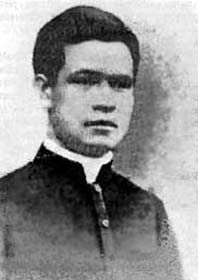
Saint Margarito Flores
Garcia
Prêtre mexicain et
martyr (+ 1927)
Canonisé le 21 mai 2000
avec Saint Cristóbal
Magallanes et ses 24 compagnons.
Homélie
de Jean-Paul II pour la canonisation, dimanche 21 mai 2000.
Dans la grande persécution mexicaine, il fut arrêté en raison de son sacerdoce
et abattu par une rafale de mitrailleuse à Tuliman au Mexique.
Martyrologe romain
SOURCE : http://nominis.cef.fr/contenus/saint/11169/Saint-Margarito-Flores-Garcia.html
Saint Margarito Flores
Margarito Flores Garcia
naquit le 22 février 1899 au Mexique, dans le diocèse de Chilapa à Taxco. Sa
famile était d'origine humble, aussi, lorsqu' à 14 ans il décida d'entrer au
séminaire, ses parents s'y opposèrent, ne pouvant subvenir à ses études. Il
avait déjà terminé son école primaire, et gagnait sa vie depuis l'âge de douze
ans, comme commis de magasin.
Finalement il réussit à
les convaincre, et il entra au petit séminaire de Chilapa à l'âge de 15 ans.
Pour gagner un peu d'argent et le donner à ses parents, il faisait office de
coiffeur, pour les autres séminaristes. Il fut ordonné prêtre dans la chapelle
du grand séminaire, le 5 avril 1924.
Il fut nommé vicaire de
la paroisse de Chilpancingo, toujours dans l'Etat de Guerrero. Chaque premier
vendredi du mois, il redoublait d'activité et attiraient ses paroissiens à la
confession.
Lorsque les événements de
1926, qui allaient mener à la guerre civile, intervinrent, il fut nommé
à Tecalpulco.
Il rendait une visite à
un curé de la région, l'abbé Pedro Bustos, lorsqu' il fut arrêté par les
troupes fédérales. Libérés, les deux prêtres partirent se réfugier en montagne.
De temps en temps, ils descendaient chercher des vivres chez des proches.
L'interdiction du culte
catholique par le gouvernement franc-maçon de Calles l'exposait à de grands
risques ; néanmoins il partit pour Mexico, afin de prendre contact avec des
proches, et de suivre des cours de dessin à l'académie Saint-Charles. C'était
une façon pour lui de continuer son apostolat pacifique.
Un jour, il fut interrogé
en chemin dans une auberge par des soldats fédéraux qui cherchaient un prêtre,
mais il se fit passer pour médecin.
A Mexico, il fut
appréhendé par la police, en juin 1927, car on le soupçonnait d'appartenir à la
Ligue Nationale de Défense Religieuse. Il fut accusé d'avoir confessé des
citoyens mexicains...En prison, il soutenait spirituellement ses codétenus.
Sur l intervention de la
famille Calvillo qu'il connaissait et qui était amie du général de la police,
il fut finalement libéré fin juillet ; mais dès lors il redoubla de
ferveur et se prépara au sacrifice ultime en se dévouant totalement à son
ministère de prêtre. La mort du prêtre David Urribe (1), survenue en
avril, pour avoir refusé de devenir évêque schismatique d'une Eglise créée
par le gouvernement, lui inspira le martyre. Il repartit pour Chilapa en
octobre. La veille il offrit sa messe pour le salut du Mexique.
Alors qu il allait à
Atenango del Rio pour secourir des âmes, il fut surpris par des soldats fédéraux. Les
mains attachées, en sous-vêtements, et pieds nus, il fut forcé par les soldats
qui étaient à cheval de parcourir sous les coups le chemin de Tuliman pour
comparaître devant les autorités locales. Il réclamait de l'eau en vain et
recevait des coups en échange.
A l'issue de
quelques questions expéditives, il fut condamné par le capitaine Manzo le
12 novembre.
On lui permit cependant
de choisir le lieu de son exécution et le jeune prêtre leur désigna le côté
arrière de l'église du bourg.
Il prit quelques minutes
pour prier à haute voix le Tout Puissant, et il baisa le sol. Un des soldats du
détachement lui demanda pardon et il lui répondit que non seulement il lui
pardonnait, mais qu' il le bénissait...Ils le fusillèrent.
Le cadavre du prêtre
resta trois heures sur le sol pour l'exemple. Plus tard deux bonnes personnes
l'inhumèrent.
Dix-huit ans après son
martyre, sont corps fut transféré à Taxco et plus tard enterré dans la chapelle
de Notre-Seigneur d'Ojeda, le quartier de Taxco où il vit le jour.
Il fut béatifié en 1992
et canonisé par Jean-Paul II, le 21 mai 2000 à Rome.
Il est fêté le 21
mai.
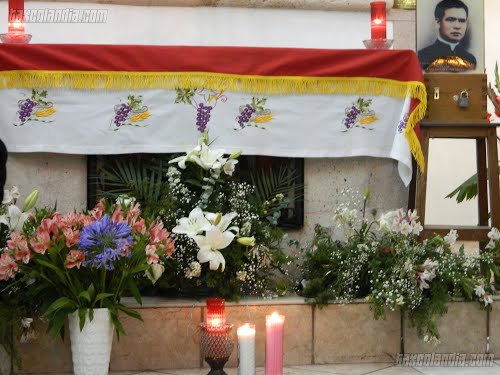
Lien ( en espagnol )
: http://www.taxcolandia.com
(1) Il fut canonisé le
même jour que Margarito Flores.
SOURCE : http://ut-pupillam-oculi.over-blog.com/article-13731056.html
Saint Margarito FLORES
GARCIA
Nom: FLORES GARCIA
Prénom: Margarito
Pays: Mexique
Naissance:
22.02.1899 à Taxco (Guerrero – Diocèse de Chilapa)
Mort: 12.11.1927 à
Tuliman (Guerrero)
Etat:
Prêtre - Martyr du Groupe des 25
martyrs du Mexique (1915-1937) 2
Note: Prêtre en 1924. La
mort héroïque du Père David
URIBE 2 lui
inspire le désir du martyr. Curé d’Atenango du Rio (Guerrero). Emprisonné et
fusillé à Tuliman.
Béatification:
22.11.1992 à Rome par Jean Paul II
Canonisation:
21.05.2000 à Rome par Jean Paul II
Fête: 21 mai
Réf. dans l’Osservatore
Romano: 1992 n.48 - 2000 n.22 p.5-7
Réf. dans la Documentation
Catholique: 1993 n.1 p.49
SOURCE : http://www.abbaye-saint-benoit.ch/hagiographie/fiches/f0657.htm
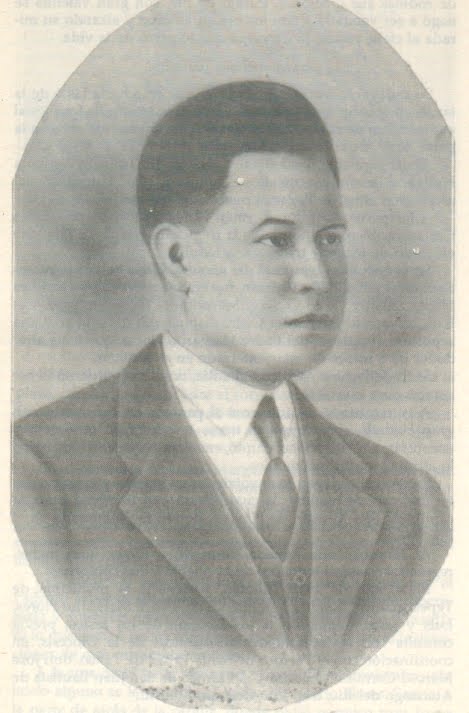
Margarito Flores García
Saint Margarito
Flores-García
Memorial
12
November
21 May as
one of the Martyrs
of the Mexican Revolution
Profile
Priest of
the diocese of Chilpancingo, Mexico,
serving in the parish in
Atenango del Rio. Imprisoned and executed for
the crime of priesthood. Martyr.
Born
22
February 1899 in
Taxco, Guerrero, Mexico
Died
shot in
the head by a firing squad on 12
November 1927 in
Tulimán, Guerrero, Mexico
Venerated
7
March 1992 by Pope John
Paul II (decree of martyrdom)
Beatified
22
November 1992 by Pope John
Paul II
Canonized
21 May 2000 by Pope John
Paul II
Additional
Information
other
sites in english
Hagiography
Circle
sitios
en español
Martirologio Romano, 2001 edición
fonti
in italiano
Cathopedia
Martirologio Romano, 2005 edition
Santi e Beati
MLA
Citation
“Saint Margarito
Flores-García“. CatholicSaints.Info. 17 May 2022. Web. 2 May 2025.
<https://catholicsaints.info/saint-margarito-flores-garcia/>
SOURCE : https://catholicsaints.info/saint-margarito-flores-garcia/
Saint Margarito Flores
Garcia, Priest and Martyr
Taxco, Mexico, February 22, 1899 – Tulimán, Mexico, November 12, 1927
He was born in Taxco,
Guerrero (Diocese of Chilapa) on February 22, 1899. Pastor of Atenango del Rio,
Guerrero (Diocese of Chilapa). His three years in the ministry were enough to
know his priestly character. The Vicar General of the Diocese appointed him vicar
to act as pastor of Atenango del Rio, Guerrero. Father Margarito set to work.
He was discovered and identified as a priest when he was about to reach that
goal; he was imprisoned and taken to Tulimán, Guerrero, where orders were given
to shoot him. Father Margarito asked permission to pray, he knelt for a moment,
kissed the ground and then rose and waited for the shots that destroyed his
head and forever united him to Christ the Priest, on November 12, 1927. On May
21, 2000, he was Canonized by Pope John Paul II together with 24 other martyrs
of Mexico. The group is known as Christopher Magallanes Jara and 24 companion
and is celebrated with an optional Memorial on May 21.Each is celebrated
separately, on their martrydom anniversary.
Roman Martyrology: In the
city of Tulimán Mexico, Saint Margarito Flores, Priest and Martyr, who, during
the great persecution against the Church, was arrested for his priesthood and
crowned by glorious martyrdom with the shooting.
Source: Santi
e Beati
SOURCE : https://theblackcordelias.wordpress.com/2009/11/12/saint-margarito-flores-garcia-november-12/
FLORES GARCÍA, MARGARITO,
ST.
Martyr, priest; b. Feb.
22, 1899, Taxco, Guerrero, Diocese of Chilapa, Mexico; d. Nov. 12, 1927,
Tulimán, between Chilapa and Chilpancingo. From the age of 12, Margarito
dedicated himself to God's service, while working in the fields to help support
his poverty-stricken family. He entered the seminary at Chilapa and was
ordained priest (1924). Soon thereafter he was appointed professor in the
seminary. He took refuge in Mexico City during the persecution and attended the
academy of San Carlos. After he was arrested, then released there, he decided
to return to Chilapa, where the vicar general had named him pastor of the
parish at Atenango del Rio, Guerrero. He was captured upon his arrival,
humiliated, and led to Tulimán where he was shot. Fr. Flores was both beatified
(Nov. 22, 1992) and canonized (May 21, 2000) with Cristobal magallanes [see
guadalajara, martyrs of, ss.] by Pope John Paul II.
Feast: May 25 (Mexico).
Bibliography: J.
Cardoso, Los mártires mexicanos (Mexico City 1953).
[K. I. Rabenstein]
New Catholic
Encyclopedia
COPYRIGHT 2003 The Gale
Group Inc.
SOURCE : http://www.encyclopedia.com/religion/encyclopedias-almanacs-transcripts-and-maps/flores-garcia-margarito-st
The Cristero War: the
Story Behind the Cover Up
Historian Gives
Evaluation of Film, Explains What Happened in 1920s Mexico
By Kathleen Naab
MEXICO CITY, 30 MAY 2012
(ZENIT)
If one asks a young
Mexican about the basics of the Cristero War — what it was and when it happened
— it's entirely possible to get a blank stare in response. Though one of the
most important chapters in 20th-century Mexico, the war has been largely covered
up.
The film "For
Greater Glory," which opens Friday in the United States and has found
great success in Mexico since it opened in April, aims to correct that
injustice and bring the war and its heroes to light.
"For Greater
Glory" (titled Cristiada in Spanish) is essentially historically accurate,
says historian Ruben Quezada, who has written “For Greater Glory: The True
Story of Cristiada" as a companion book to the film. The companion volume
is being published by Ignatius Press and will be released June 15 in English
and Spanish.
ZENIT asked Quezada for
an overview of the history of the Cristero War, and about some of the heroes of
the conflict — heroes both for society and for the Church.
ZENIT: Neither a film nor
a ZENIT interview is sufficient to explain all the historical intricacies of
such a complex epoch. Still, could you give us a brief overview of the Cristero
War?
Quezada: The Cristero War
is a chapter in Mexico’s history in the 1920s, when thousands of Catholics
answered this crucial question [of religious freedom] at the cost of their very
lives. President Plutarco Calles launched a direct attack on the Catholic
Church using articles from Mexico’s Constitution, which created this uprising
and counter-revolution against the Mexican government during that time.
The original rebellion was set off by the persecution of Roman Catholics and a
ban on their public religious practices.
There are two important
dates to point out here.
The persecution began on
Aug. 1, 1926, when the government re-enacted the penal code and forced the
closure of all Catholic churches throughout the entire country with its new
anticlerical laws. However, the first coordinated uprising for religious
freedom did not occur until Jan. 1, 1927.
It was not until mid June
1929 when the truce was officially signed, bringing an end to the Cristero War.
ZENIT: Is For Greater
Glory a historically accurate film?
Quezada: Apart from some
“artistic license” the film is essentially accurate.
ZENIT: The movie alludes
to some discrepancy between the Vatican's position regarding the religious
persecution, and that of the Cristero fighters. Could you explain this?
Quezada: When the
oppression was about to begin, the Vatican granted permission — requested by
the Mexican bishops — to cease any Catholic religious services in order to
avoid confrontations. Additionally, the Holy See wrote letters to the
government requesting they abolish the Calles Law. The government ignored each
request. As the war intensified, Rome continued to have direct communications
with President Calles to ask for leniency. Not only were Vatican officials [in
Mexico] dismissed, but diplomatic relations were broken off by the government.
Lastly, Pope Pius XI
wrote an encyclical letter to the clergy and the faithful of Mexico to give
them courage and hope during this persecution. There was really not much else
the Holy See could do. On Nov. 18, 1926, the Pope sent the encyclical letter Iniquis
Afflictisque (On the Persecution of the Church in Mexico) to offer prayers and
encouragement during this difficult time.
ZENIT: Some of the
characters of the film are real-life blesseds or saints. Who are they and what
is their story?
Quezada: Anacleto
González Flores (played by actor Eduardo Verástegui of Bella) was born on
July 13, 1888, in Tepatitlán, Jalisco, Mexico.
He was greatly involved
in social and religious activities and was an enthusiastic member of the
Catholic Association of Young Mexicans (ACJM). He taught classes in catechism,
was dedicated to works of charity and wrote articles and books with a Christian
spirit. In 1922 he married María Concepción Guerrero and they had two
children.
By 1926, the situation in
Mexico had worsened and Anacleto, who up until this time had advocated passive,
non-violent resistance, joined the cause of the National League for the Defense
of Religious Freedom upon learning of the murder of four members of the ACJM.In
January 1927 guerrilla warfare spread throughout Jalisco; and from his many
hiding places, Anacleto wrote and sent bulletins and studied major strategies.
The young man was captured on the morning of April 1, 1927, in the home of the
Vargas González family, along with the three Vargas brothers.
He was taken to Fort
Colorado where his torture included being hung by his thumbs until his fingers
were dislocated and having the bottom of his feet slashed. He refused, however,
to supply his captors with any information. Anacleto González Flores was
condemned to death and was shot together with the Vargas González brothers and
Luis Padilla Gómez on that same day, April 1, 1927.
It is important to note
here that Anacleto González Flores along with Miguel Gómez Loza both received
the “Pro Ecclesia Et Pontifice” award for their incredible works of service to
the Catholic Church.
Miguel Gómez
Loza (played by actor Raúl Mendez) was born on Aug. 11, 1888, in
Tepatitlán, Jalisco, Mexico. From a young age he had a strong love for God and
a great devotion to the Blessed Mother.When he was 26, Miguel entered the
University of Morelos where he earned a law degree, and eventually opened an
office in Arandas (state of Jalisco) as an attorney.In 1915 he became a member
of the ACJM, and in 1919 he established a national congress of Catholic workers
to unify industry workers, commercial employees and agricultural laborers. He
also worked tirelessly to defend the rights of the needy, which caused him to
be arrested 59 times for organizing protests against the government. In 1922,
Miguel married María Guadalupe Sánchez Barragán and they had three children. He
joined the "National League for the Defense of Religious Freedom" in
1927, but believed in non-violence in order to resist the persecution.
After the death of
Anacleto, he was appointed by Catholics as governor of Jalisco and strove by
all the means at his disposal to defend liberty and justice. By March of 1928,
Miguel was living on a ranch near Atotonilco, Jalisco. On March 21, federal
forces who had been hunting for him discovered his whereabouts; he was executed
by firing squad the same day.
José Sanchez del Rio
(played by actor Mauricio Kuri) was a young Cristero soldier who joined the
uprising to defend religious liberty. He was horrified to see the attacks on
the priests and the desecration of churches in his small hometown of Sahuayo,
Michoacan.When the Cristero War broke out in 1926, his brothers joined the
rebel forces, but his mother would not allow him to take part [because of his
young age]. The rebel general, Prudencio Mendoza, also refused his enlistment. The
general finally relented and allowed José to become the flag bearer of the
troop. He was known to be one of the youngest members of the Cristero movement.
After his arrest we know of the gruesome events that transpired after the
government's failure to break José's resolve on the evening of Feb. 10, 1928:
“Consequently they cut the bottom of his feet and obliged him to walk around
the town toward the cemetery. They also at times cut him with a machete until
he was bleeding from several wounds. He cried and moaned with pain, but he did
not give in. At times they stopped him and said, ‘If you shout ‘Death to Christ
the King’ we will spare your life.’ José would only shout, "I will never give
in. Viva Cristo Rey!" When they reached the place of execution, they
stabbed him numerous times with bayonets. He only shouted louder, "Viva
Cristo Rey!" The commander was so furious that he pulled out his pistol
and shot Blessed José Sanchez del Rio in the head.
We do have a list of
priests and laymen who have been beatified and canonized from this persecution
in Mexico.
St. Agustín Caloca
St. Atilano Cruz
Alvarado
St. Cristobal
Magallanes
St. David Galván
Bermudes
St. David Roldán
Lara
St. David Uribe
Velasco
St. Jenaro Sánchez
Delgadillo
St. Jesús Méndez
Montoya
St. José Isabel Flores
Varela
St. José Maria Robles
Hurtado (Priest)*
St. Jóven Salvador Lara
Puente
St. Julio Álvarez
Mendoza
St. Justino Orona
Madrigal
St. Luis Batiz Sáinz
(Priest)*
St. Manuel Morales
St. Margarito Flores
García
St. Mateo Correa
Magallanes (Priest)*
St. Miguel De La Mora
(Priest)*
St. Pedro de Jesús
Maldonado Lucero (Priest)*
St. Pedro Esqueda
Ramírez
St. Rodrigo Aguilar
Alemán (Priest)*
St. Román Adame
Rosales
St. Sabas Reyes
Salazar
St. Tranquilino
Ubiarco
St. Toribio Romo
González
Blessed Anacleto González
Flores
Blessed Andrés Solá
Molist (Priest)*
Blessed Ángel Darío
Acosta Zurita (Priest)
Blessed Ezequiel Huerta
Gutiérrez
Blessed Jorge Vargas
González
Blessed José Sánchez del
Río
Blessed José Trinidad
Rangel Montaño (Priest) *
Blessed Leonardo Pérez
Larios *
Blessed Luis Magaña
Servín
Blessed Luis Padilla
Gómez
Blessed Miguel Gómez
Loza
Blessed Mateo Elías del
Socorro Nieves (Priest)
Blessed Miguel Agustin
Pro Juárez (Priest)
Blessed Ramón Vargas
González
Blessed Salvador Huerta
Gutiérrez
* Indicates member of
Knights of Columbus
Our site
www.VivaCristoRey.com will have documentation on the lives of each one along
with the new book “For Greater Glory: The True Story of the Cristiada.” It’s
the official companion book to the film published in English and Spanish by
Ignatius Press. As an expert on the Cristero War, I was honored to write it.
The book also includes a foreword by Archbishop José Gomez of Los Angeles and
an introduction by Eduardo Verástegui, and there is an essay by Knights of
Columbus Supreme Knight Carl Anderson.
ZENIT: The Cristero War
is a page mostly lost to history, even for young Mexicans, who don't learn
about it in school. How is this possible?
Quezada: As recently as
the 1980s it was difficult to find a single book that mentioned anything
substantive about the Cristiada. If it was mentioned, it usually was no more
than a single sentence in President Calles’ biography. School systems did not
include the Cristiada as part of its history so that future generations would
soon lose any knowledge of it.
But even today, it is
important to note a crucial difference between the official state narrative and
the Catholic understanding of events. The Mexican government portrays the
Cristiada as a rebellion because the Cristeros “rebelled” against the
enforcement of the Calles Law. But rebellion is hardly a fitting way to
describe an attempt to restore customs in place for centuries before the
Mexican Revolution. Catholics see the Cristiada as a response, albeit a violent
one, to unjust persecution because Catholics were persecuted by unjust laws
that inhibited their religious freedom.
There is more freedom of
the press today, and a large volume of untold stories about the Cristiada —
testimonies and images that were illegal to print or publish for many years —
are finally emerging. There are literally thousands of testimonies coming to
light that reveal an inspiring history that has been hidden for decades under a
dark shadow of fear and denial.
On the Net:
“For Greater Glory: The
True Story of Cristiada”: www.forgreaterglorybook.com
This article has been
selected from the ZENIT Daily Dispatch
© Innovative Media, Inc.
ZENIT International News
Agency
Via della Stazione di
Ottavia, 95
00165 Rome, Italy
www.zenit.org
To subscribe http://www.zenit.org/english/subscribe.html
or email: english-request@zenit.org with
SUBSCRIBE in the "subject" field
Provided Courtesy of:
Eternal Word Television
Network
5817 Old Leeds Road
Irondale, AL 35210
www.ewtn.com
SOURCE : http://www.ewtn.com/library/CHISTORY/zcristero.htm
Margarito Flores García
San Margarito Flores
Garcia Sacerdote e martire
12
novembre
>>>
Visualizza la Scheda del Gruppo cui appartiene
Taxco, Messico, 22
febbraio 1899 - Tulimán, Messico, 12 novembre 1927
Nacque a Taxco, Guerrero
(Diocesi di Chilapa) il 22 febbraio 1899. Parroco di Atenango del Río, Guerrero
(Diocesi di Chilapa). I tre anni trascorsi nel ministero furono sufficienti per
conoscere la sua indole sacerdotale. Il Vicario generale della Diocesi lo
nominò vicario con funzioni di parroco di Atenango del Rio, Guerrero. Il Padre
Margarito si mise all'opera. Fu scoperto, identificato come sacerdote, quando
stava per giungere alla meta; fu imprigionato e condotto a Tulimán, Guerrero,
luogo in cui venne dato l'ordine di fucilarlo. Il Padre Margarito chiese il
permesso di pregare, si inginocchiò per qualche secondo, baciò il suolo e
quindi, in piedi, attese gli spari che gli distrussero la testa e lo unirono
per sempre a Cristo Sacerdote, il giorno 12 novembre 1927.
Emblema: Palma
Martirologio
Romano: Nella città di Tulimán in Messico, san Margherito Flores,
sacerdote e martire, che, durante la grande persecuzione contro la Chiesa, fu
arrestato per il suo sacerdozio e coronato da glorioso martirio con la
fucilazione.
Soltanto perché non
potevano permettersi il lusso di pagargli la scuola, si erano opposti con tanta
fermezza all’idea che uno dei loro figli entrasse in seminario. Per il resto,
Germano Flores e Mercede García erano buoni e ferventi cristiani e non si
sarebbero mai permessi di ostacolare una vocazione sacerdotale. Siamo in
Messico, nel 1915, e precisamente a Taxco, Guerrero, nella diocesi di Chilapa,
dove vivere non è sempre facile, specie in quel periodo e per far andare avanti
una famiglia servono anche le braccia di un ragazzo di 14 anni. Che è però
talmente convinto che quella del sacerdozio sia la sua strada, da mettersi in
quattro per trovare da sé, presso sacerdoti e amici, i benefattori di cui ha
bisogno per andare in seminario di Chilapa, dove studia senza farsi pregare;
tutti gli riconoscono intelligenza e capacità non comuni e lui collabora per
quanto può al suo mantenimento, tagliando barba e capelli a questo e a quello.
Intraprendente e determinato, dunque, il ragazzino, che nel poco tempo libero
si dedica anche con profitto alla scultura e alla pittura. Il 5 aprile 1924 è
ordinato sacerdote e lo mandano subito ad esercitare il ministero nella
parrocchia di Chilpancingo, dove rimane fino allo scoppio, nel 1926, della
persecuzione religiosa. In quell’anno dovrebbe trasferirsi a Tecalpulco, ma la
situazione è così incandescente e i preti sono così braccati e perseguitati che
deve darsi alla macchia, vivendo per parecchio tempo tra i monti, patendo la
fame e la sete fino a quando riesce a trovare rifugio nella casa paterna. Qui
si ferma il meno possibile, cosciente dei pericoli che fa correre anche ai suoi
familiari, e nei primi giorni del 1927 raggiunge Città del Messico,
qualificandosi come medico e frequentando anche per alcuni mesi l’Accademia,
dove perfeziona le sue inclinazioni artistiche. Ma nella capitale non resta con
le mani in mano: oltre ad esercitare clandestinamente il suo ministero, insieme
alla Lega Nazionale per la Difesa della Religione cerca di pacificare gli animi
nel clima torrido della persecuzione religiosa che si sta respirando in tutto
il Messico. Così facendo, finisce per esporsi troppo e con un bel gruppetto
della Lega a giugno finisce in cella e vi resta per oltre un mese, tutto
trascorso in preghiera e nel sostegno spirituale degli altri detenuti. A
tirarlo fuori dal carcere ci pensa una famiglia amica, ma Padre Margarito ormai
ha il presentimento che la sua sorte è definitivamente segnata. Ne parla
apertamente, con serenità e fermezza, raddoppiando le preghiere e le occasioni
per esercitare bene il suo ministero, consapevole che il tempo a sua
disposizione si fa sempre più breve. E’ sicuramente questo il pensiero che lo
accompagna in quel giorno di ottobre, quando celebra l’ultima messa nella
capitale, poche ore prima della sua partenza per tornare in diocesi. È
sicuramente la sua messa più sofferta, celebrata per ottenere il dono della
pacificazione del suo amato Messico, durante la quale offre la propria vita
perché non venga più sparso altro sangue innocente. Arrivato fortunosamente a
Chilapa, non ha neppure il tempo di disfare le valigie che il vicario generale
subito lo destina come parroco di Atenango del Rio. Si rimette in viaggio per
raggiungere la sua nuova parrocchia , ma qui trova ad accoglierlo le truppe
federali. Spogliato e lasciato con i soli indumenti intimi, picchiato e
malmenato, viene trascinato fino a Tuliman a piedi nudi, circondato come un
malfattore dalle guardie, che gli negano anche il conforto di un goccio
d’acqua. Qui lo attende un processo sommario , al termine del quale è scontata
la sua condanna a morte per il semplice motivo di essere un prete. Sceglie come
luogo per essere fucilato il muro posteriore della chiesa e vi si dirige con
assoluta serenità. È il 12 novembre 1927. Come ultimo desiderio chiede il tempo
necessario per una breve preghiera e per baciare la sua amata terra messicana;
il gesto non deve passare inosservato al plotone d’esecuzione, se una delle
guardie gli si avvicina per sussurrargli una richiesta di perdono. “Non solo il
mio perdono, ma anche la mia benedizione per tutti voi”: sono le ultime parole,
prima che una raffica di pallottole gli fracassino il cranio. Padre Margarito
Flores Garcia, il parroco massacrato a 28 anni a causa del suo ministero, è
stato beatificato nel 1992 e proclamato santo il 21 maggio 2006.
Autore: Gianpiero
Pettiti
SOURCE : http://www.santiebeati.it/dettaglio/90121
San Margarito Flores,
sacerdote
Nació en Taxco el 22 de
febrero de 1899. A los 12 años, cuando concluyó sus estudios primarios se
dedicó con fervor al servicio de Dios y visitaba diariamente el santísimo
sacramento. Por las dificultades económicas de la familia se puso a trabajar la
tierra. A los 14 años manifestó sus deseos de ingresar al seminario y al poco
tiempo lo hizo.
Fue ordenado sacerdote en
el seminario de Chilapa en 1924, y al poco tiempo se le nombró catedrático del
seminario. Era un hombre de carácter serio, atento y amable con todos, siempre
dispuesto a servir con humildad. Durante la persecución contra los cristianos
se refugió en la ciudad de México y asistió a la academia de San Carlos.
Al poco tiempo fue
capturado y cuando salió libre decidió regresar a Chilapa. A su arribo fue
apresado y conducido a Tulimán semidesnudo, descalzo, atado a la caballería y
bajo un sol agobiante. El 12 de noviembre de 1927 el capitán Manzo ordenó su
ejecución.
Fue beatificado el 22 de
noviembre de 1992 y canonizado el 21 de mayo del 2000 por el Santo Padre Juan
Pablo II.
Mártires
de la Guerra Cristera
SOURCE : https://www.aciprensa.com/testigosdefe/cristera/flores.htm
MARGARITO
FLORES GARCÍA
Nació en Taxco, Gro.
(Diócesis de Chilapa), el 22 de febrero del 1899. Párroco de Atenango del Río,
Gro., (Diócesis de Chilapa). Tres años de ministerio fueron suficientes para
conocer la entrega sacerdotal del Padre Margarito. Se encontraba fuera de la
Diócesis a causa de la persecución, cuando supo de la muerte heroica del Sr.
Cura David Uribe, exclamó: «Me hierve el alma, yo también me voy a dar la vida
por Cristo; voy a pedir permiso al Superior y también voy a emprender el vuelo
al martirio». El Vicario general de la Diócesis le nombró vicario con funciones
de párroco de Atenango del Rio, Gro. El Padre Margarito se puso luego en
camino. Fue descubierto como sacerdote al llegar a su destino; apresado y
conducido a Tulimán, Gro., donde se dio la orden de fusilarlo. El Padre
Margarito pidió permiso para orar, se arrodilló unos momentos, besó el suelo y
luego, de pie, recibió las balas que le destrozaron la cabeza y le unieron para
siempre a Cristo Sacerdote, el 12 de noviembre de 1927.
SOURCE : http://www.vatican.va/news_services/liturgy/saints/ns_lit_doc_20000521_flores-garcia_sp.html
San Margarito Flores,
sacerdote
Fecha central: 25 de mayo
Nació en Taxco el 22 de
febrero de 1899. A los 12 años, cuando concluyó sus estudios primarios se
dedicó con fervor al servicio de Dios y visitaba diariamente el santísimo
sacramento. Por las dificultades económicas de la familia se puso a trabajar la
tierra. A los 14 años manifestó sus deseos de ingresar al seminario y al poco
tiempo lo hizo.
Fue ordenado sacerdote en
el seminario de Chilapa en 1924, y al poco tiempo se le nombró catedrático del
seminario. Era un hombre de carácter serio, atento y amable con todos, siempre
dispuesto a servir con humildad. Durante la persecución contra los cristianos
se refugió en la ciudad de México y asistió a la academia de San Carlos.
Al poco tiempo fue
capturado y cuando salió libre decidió regresar a Chilapa. A su arribo fue
apresado y conducido a Tulimán semidesnudo, descalzo, atado a la caballería y
bajo un sol agobiante. El 12 de noviembre de 1927 el capitán Manzo ordenó su
ejecución.
Fue beatificado el 22 de
noviembre de 1992 y canonizado el 21 de mayo del 2000 por el Santo Padre Juan
Pablo II.
Mártires de la Guerra
Cristera
SOURCE : https://www.aciprensa.com/testigosdefe/cristera/flores.htm
Religious Persecution
during the Mexican Revolution [I] ~: http://newsaints.faithweb.com/martyrs/Mexico1.htm