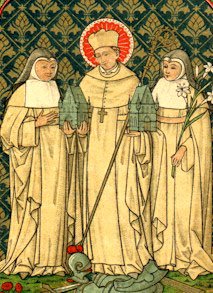
This
image of St. Gilbert of Neuffontaines (a Norbertine) is often confused for St.
Gilbert of Sempringham. This image is not of St. Gilbert of Sempringham.
San Gilberto con dos monjas gilbertinas, siglo XIX
Saint Gilbert de
Sempringham
Fondateur de l'ordre des
Gilbertins (+ 1189)
Fils d'un chevalier
normand, compagnon de Guillaume le Conquérant, son père l'avait envoyé faire
ses études à Paris et c'est là qu'il rencontre saint
Bernard. A vingt-quatre ans, il est mis en prison pour avoir soutenu saint
Thomas Beckett contre les exigences exagérées du roi Henri II
d'Angleterre. Il fonda un type de monastères originaux qui comprenaient dans
l'un, des chanoines réguliers, dans l'autre, des moniales, le tout formant une
petite agglomération avec des sœurs et des frères "convers",
c'est-à-dire, à l'époque, d'humble origine et sans instruction. Ceux-ci et
celles-ci s'occupaient des soucis matériels des monastères, des orphelinats et
des léproseries qui leur étaient joints. A la mort de saint Gilbert, il y en
eut treize de ce type. Et plus de vingt quand le roi Henri VIII les supprima.
Un internaute nous
signale que 'The Book of Saints', rédigé par les Bénédictins de Ramsgate depuis
1921, apporte les précisions suivantes :
"1083-1189: anglais,
né à Sempringham dans le Lincolnshire, il devint prêtre de la paroisse de son
village natal en 1123. Sept demoiselles de la paroisse voulant vivre en
communauté, il leur rédigea un ensemble de préceptes. Ceci est à l'origine de
l'ordre des gilbertins, qui comprit des moines selon la règle de saint Augustin
et des moniales selon la règle de saint Benoît. Gilbert était leur maître
général, jusqu'à ce qu'il devînt aveugle. A l'époque de la Réforme, l'ordre
comptait 22 maisons."
À Sempringham en
Angleterre, l’an 1190, saint Gilbert, prêtre. Il fonda, avec l’approbation du
pape Eugène III, un Ordre monastique double, où il imposa une double discipline
de vie: la Règle de saint Benoît pour les moniales, et celle de saint Augustin
pour les clercs.
Martyrologe romain
SOURCE : http://nominis.cef.fr/contenus/saint/562/Saint-Gilbert-de-Sempringham.html
Saint Gilbert de
Sempringham, prêtre
Fils d'un chevalier
normand, compagnon de Guillaume le Conquérant, né à Sempringham dans le
Lincolnshire en 1083, il est envoyé par son père pour faire ses études à Paris
et c'est là qu'il rencontre saint Bernard. A vingt-quatre ans, il est mis en
prison pour avoir soutenu saint Thomas Beckett contre les exigences du roi
Henri II d'Angleterre. C’est alors qu’il est curé de son village natal où il
est revenu, en 1123 qu’il est sollicité et reçoit l’intuition d’une fondation
originale : l'ordre des Gilbertins, qui comprit des moines selon la règle
de saint Augustin et des moniales selon la règle de saint Benoît. A sa mort, en
1189, alors qu’il est devenu aveugle et s’est retiré de sa responsabilité de
supérieur général pour se consacrer uniquement à la prière, l’ordre comptait 13
monastères et 22 quand la Réforme d’Henry VIII les supprima.

St.
Gilbert of Sempringham, sculpture at Essen (Belgium)
Escultura en Essen (Bélgica), siglo XIX.
Profile
Son of the wealthy Norman knight Jocelin.
When Gilbert showed no signs of becoming a soldier,
his father exiled him
to Paris, France to study.
Gilbert returned to England as
a master of arts, and opened a school for
the children of
the poor in
Sempringham, paying special attention to training in
religion. His father provided
him a living from the rents on part of his lands in Sempringham and Tirington,
but Gilbert redistributed most of this to the poor.
Clerk in the household of bishop Robert
Bloet of Lincoln, England. Ordained at
age 40. When his parents died in 1130,
Gilbert returned to the manor and began to spend his inheritance by
founding Benedictine and Augustinian monasteries,
and by providing for the poor.
He drew up rules for an order of nuns later
known as the Gilbertines,
the only order founded on a rule designed by an Englishman,
and which eventually grew to 26 houses before being suppressed in the persecutions of King Henry
VIII. Gilbert was the target of slander,
once accused of helping the exiled Saint Thomas
Becket, which accusation landed him in prison.
When he was 90 years old, some of Gilbert’s lay
brothers revolted against his authority, but Pope Alexander
III supported Gilbert. He became blind in
his old age, put aside all rule of the lands and the orders, devoted himself
to prayer and
the communal life, and lived to be over 100 years old.
Born
1083 at
Sempringham, Lincolnshire, England
1189–1190 at
Sempringham, England of
natural causes
1202 by Pope Innocent
III
Additional
Information
Book
of Saints, by the Monks of
Ramsgate
Dictionary
of National Biography
Lives
of the Saints, by Father Alban
Butler
Saints
of the Day, by Katherine Rabenstein
–
Life of Saint Gilbert, Prior of
Sempringham, by Father John
Dobree Dalgairns
books
Our Sunday Visitor’s Encyclopedia of Saints
Oxford Dictionary of Saints, by David Hugh Farmer
other
sites in english
images
video
sitios
en español
Martirologio Romano, 2001 edición
fonti
in italiano
nettsteder
i norsk
spletne
strani v slovenšcini
MLA
Citation
“Saint Gilbert of
Sempringham“. CatholicSaints.Info. 11 November 2023. Web. 5 March 2026.
<https://catholicsaints.info/saint-gilbert-of-sempringham/>
SOURCE : https://catholicsaints.info/saint-gilbert-of-sempringham/
Book of
Saints – Gilbert of Sempringham
(Saint) (February 4)
(12th century) Born at Sempringham in Lincolnshire and ordained priest by the
Bishop of Lincoln, he became Parish Priest of his native village, distributing
yearly to the poor the revenues of his benefice. He founded a convent of nuns and
afterwards an Order of men, which he himself joined, the Rule having been
approved by Pope Eugene III. He lived the life of penance and zeal he had thus
professed till his holy death (February 3, 1190), having, it is said, reached
the age of one hundred and six years. He was canonised A.D. 1202. His Order,
once widespread in England, has been long extinct.
MLA
Citation
Monks of Ramsgate.
“Gilbert of Sempringham”. Book of Saints, 1921. CatholicSaints.Info.
11 July 2013. Web. 6 March 2026.
<https://catholicsaints.info/book-of-saints-gilbert-of-sempringham/>
SOURCE : https://catholicsaints.info/book-of-saints-gilbert-of-sempringham/
St. Gilbert of
Sempringham
Feastday: February 4
Birth: 1083
Death: 1190
Gilbert was born at
Sempringham, England, son of Jocelin, a wealthy Norman knight. He was sent
to France to
study and returned to England to receive the benefices of Sempringham and
Tirington from his father. He became a clerk in the household of Bishop Robert
Bloet of Lincoln and
was ordained by Robert's successor, Alexander. He returned to Sempringham
as Lord on
the death of his father in 1131. In the same year he began acting as adviser
for a group of seven young women living in enclosure with lay sisters and
brothers and decided the community should be incorporated into an established
religious order. After several new foundations were established, Gilbert went
to Citeaux in 1148 to ask the Cistercians to
take over the Community. When the Cistercians declined
to take on the governing of a group of women, Gilbert, with the approval of
Pope Eugene III, continued the Community with the addition of Canons Regular
for its spiritual directors and Gilbert as Master General. The Community became
known as the Gilbertine Order, the only English religious order originating in
the medieval period; it eventually had twenty-six monasteries which continued
in existence until King Henry VIII suppressed
monasteries in England. Gilbert imposed a strict rule on his Order and became
noted for his own austerities and concern for the poor. He was imprisoned in
1165 on a false charge of aiding Thomas of Canterbury during
the latter's exile but was exonerated of the charge. He was faced with a revolt
of some of his lay brothers when
he was ninety, but was sustained by Pope Alexander III. Gilbert resigned his
office late in life because
of blindness and died at Sempringham. He was canonized in 1202. His feast day is February 4.
SOURCE : https://www.catholic.org/saints/saint.php?saint_id=654
New
Catholic Dictionary – Saint Gilbert of Sempringham
Article
Confessor, founder of
the Order
of Gilbertines, born Sempringham, England,
c.1083; died there,
1189. He was the first “Master” of his order, and erected a convent for
his nuns at Sempringham. Canonized, 1202.
Relics at Sempringham. Feast, 11
February.
MLA
Citation
“Saint Gilbert of
Sempringham”. New Catholic Dictionary. CatholicSaints.Info.
3 February 2013. Web. 6 March 2026.
<https://catholicsaints.info/new-catholic-dictionary-saint-gilbert-of-sempringham/>
SOURCE : https://catholicsaints.info/new-catholic-dictionary-saint-gilbert-of-sempringham/
Gilbert of Sempringham, Founder (RM)
Born at Sempringham, Lincolnshire, England, c. 1083-85; died there, February 4,
1189; canonized 1202 by Pope Innocent III at Anagni; feast day formerly on
February 4.
Saint Gilbert, son of Jocelin, a wealthy Norman knight, and his Anglo-Saxon
wife, was regarded as unfit for ordinary feudal life because of some kind of
physical deformity. For this reason, he was sent to France to study and took a
master's degree.
Upon his return to England, Gilbert started a school for both boys and girls.
From his father, he received the hereditary benefices of Sempringham and
Torrington in Lincolnshire, but he gave all the revenues from them to the poor,
except a small sum for bare necessities. As he was not yet ordained, he
appointed a vicar for the liturgies and lived in poverty in the vicarage.
In 1122, Gilbert became a clerk in the household of Bishop Robert Bloet of
Lincoln and was ordained by Robert's successor Alexander, and was offered, but
refused, a rich archdeaconry. Instead, upon the death of his father in 1131,
Gilbert returned to Sempringham as lord of the manor and parson. By his care
his parishioners seemed to lead the lives of religious men and, wherever they
went, were known to be of his flock by their conversation.
That same year of 1131, he organized a group of seven young women of the parish
into a community under the Benedictine rule. They lived in strict enclosure in
a house adjoining Sempringham's parish church of Saint Andrew. As the
foundation grew, Gilbert added laysisters and, on the advice of the Cistercian
Abbot William of Rievaulx, lay brothers to work the land. A second house was
soon founded.
In 1148, Gilbert went to the general chapter at Cîteaux to ask the Cistercians
to take on the governance of the community. When the Cistercians declined
because women were included, Gilbert provided chaplains for his nuns by
establishing a body of canons following the Augustinian rule with the approval
of Pope Eugene III, who was present at the chapter. Saint Bernard helped
Gilbert draw up the Institutes of the Order of Sempringham, of which Eugenius
made him the master. Thus, the canons followed the Augustinian Rule and the lay
brothers and sisters that of Cîteaux. Women formed the majority of the order;
the men both governed them and ministered to their needs, temporal and
spiritual. The Gilbertines are the only specifically English order, and except
for one foundation in Scotland, never spread beyond its border.
This order grew rapidly to 13 foundations, including men's and women's houses
side by side and also monasteries solely for canons. They also ran leper
hospitals and orphanages. Gilbert imposed a strict rule on his order. An
illustration of the enforced simplicity of life was the fact that the choir
office was celebrated without fanfare.
As master general of the order, Saint Gilbert set an admirable example of
abstemious and devoted living and concern for the poor. Gilbert's diet
consisted primarily of roots and pulse in small amounts. He always set a place
at the table for Jesus, in which he put all the best of what was served up, and
this was for the poor. He wore a hair-shirt, took his short rest in a sitting
position, and spent most of each night in prayer.
And, he was never idle. He travelled frequently from house to house (primarily
in Lincolnshire and Yorkshire), forever active in copying manuscripts, making
furniture, and building.
The later years of his long life were seriously disturbed. When he was about
80, he was arrested and charged with assisting Saint Thomas á Becket, who had
taken refuge abroad from King Henry II after the council at Northampton (1163).
(Thomas, dressed as a Sempringham lay brother, was said to have fled north to
their houses in the Lincolnshire Fens before doubling back on his tracks south
to Kent.) Though he was not guilty of this kindness, the saint chose to suffer
rather than seem to condemn that which would have been good and just.
Eventually the charge was dropped, although Gilbert still refused to deny it on
oath.
Later still there was a revolt among his laybrothers, who grievously slandered
the 90-year-old man, saying that there was too much work and not enough food.
The rebellion was led by two skilled craftsmen who slandered Gilbert, obtained
funds and support from magnates in the church and state, and took the case to
Rome. There Pope Alexander III decided in Gilbert's favor, but the living
conditions were improved.
Saint Gilbert lived to be 106 and passed his last years nearly blind, as a
simple member of the order he had founded and governed. He had built 13
monasteries (of which nine were double) and four dedicated solely to canons
encompassing about 1,500 religious. Contemporary chroniclers highly praised
both Gilbert and his nuns. His cultus was spontaneous and immediate. Miracles
wrought at his tomb were examined and approved by Archbishop Hubert Walter of
Canterbury (who ordered the English bishops to celebrate Gilbert's feast) and
the commissioners of Pope Innocent III in 1201, leading to his canonization the
following year. His name was added to the calendar on the wall of the Roman
church of the Four Crowned Martyrs soon after his canonization. His relics are said
to have been taken by King Louis VIII to Toulouse, France, where they are kept
in the Church of Saint Sernin.
Because the Gilbertine
Order was contained within the borders of England, it came to an end when its
26 houses were suppressed by King Henry VIII (Attwater, Benedictines, Delaney,
Encyclopedia, Farmer, Graham, Husenbeth, Walsh, White).
SOURCE : http://www.saintpatrickdc.org/ss/0216.shtml
St. Gilbert of
Sempringham
Founder of the Order
of Gilbertines, b. at Sempringham, on the border of the Lincolnshire fens,
between Bourn and Heckington. The exact date of his birth is unknown, but it
lies between 1083 and 1089; d. at Sempringham, 1189. His father, Jocelin, was a
wealthy Norman knight holding
lands in Lincolnshire; his mother, name unknown, was an Englishwoman of humble rank.
Being ill-favoured and deformed, he was not destined for a military or knightly
career, but was sent to France to
study. After spending some time abroad, where he became a teacher, he returned
as a young man to his Lincolnshire home, and was presented to the livings of
Sempringham and Tirington, which were churches in his father's gift.
Shortly afterwards he betook himself to the court of Robert Bloet, Bishop of
Lincoln, where he became a clerk in the episcopal household. Robert was
succeeded in 1123 by Alexander, who retained Gilbert in his service ordaining
him deacon and priest much
against his will. The revenues of Sempringham had to suffice for his
maintenance in the court of the bishop;
those of Tirington he devoted to the poor. Offered the archdeaconry of Lincoln,
he refused, saying that he knew no
surer way to perdition. In 1131 he returned to Sempringham and, is father being
dead, became lord of the manor and lands. It was in this year that he founded
the Gilbertine Order, which he was the first is "Master", and
constructed at Sempringham, with the help of Alexander, a dwelling and cloister for
his nuns,
at the north of the church of
St. Andrew.
His life henceforth
became one of extraordinary austerity, its strictness not diminishing as he
grew older, though the activity and fatigue caused by the government of the
order were considerable. In 1147 he travelled to Cîteaux,
in Burgundy,
where he met Eugene
III, St Bernard, and St.
Malachy, Archbishop of Armagh.
The pope expressed
regret at not having known of him some years previously when choosing a
successor to the deposed Archbishop of York.
In 1165 he was summoned before Henry II's justices at Westminster and
was charged with having sent help to the exiled St. Thomas a Becket. To clear
himself he was invited to take an oath that
he had not done so. He refused, for, though as a matter of fact he had not sent
help, an oath to
that effect might make him appear an enemy to the archbishop.
He was prepared for a sentence of exile, when letters came from the king
in Normandy,
ordering the judges to await his return. In 1170, when Gilbert was already a
very old man, some of his lay-brothers revolted and spread serious calumnies against
him. After some years of fierce controversy on the subject, in which Henry II
took his part, Alexander
III freed him from suspicion, and confirmed the privileges granted to
the order. Advancing age induced Gilbert to give up the government of his
order. He appointed as his successor Roger, prior of
Malton. Very infirm and almost blind, he now made his religious
profession, for though he had founded an order and ruled it for many years
he had never become a religious in the strict sense. Twelve years after his
death, at the earnest request of Hubert
Walter, Archbishop of Canterbury,
he was canonized by Innocent
III, and his relics were
solemnly translated to an honourable place in the church at Sempringham, his
shrine becoming a centre of pilgrimage.
Besides the compilation of his rule, he has left in little treatise entitled
"De constructione monasteriorum". His feast is
kept in the Roman calendar on 11 February.
Butler, Richard
Urban. "St. Gilbert of Sempringham." The Catholic
Encyclopedia. Vol. 6. New York: Robert Appleton
Company, 1909. 16 Feb.
2017 <http://www.newadvent.org/cathen/06557b.htm>.
Transcription. This
article was transcribed for New Advent by Joseph P. Thomas.
Ecclesiastical
approbation. Nihil Obstat. September 1, 1909. Remy Lafort,
Censor. Imprimatur. +John M. Farley, Archbishop of New York.
Copyright © 2023 by Kevin Knight.
Dedicated to the Immaculate Heart of Mary.
SOURCE : http://www.newadvent.org/cathen/06557b.htm
Order of Gilbertines
Founded by St. Gilbert,
about the year 1130, at Sempringham, Gilbert's native place, where he was
then parish priest. His wish
originally had been to found a monastery, but finding
this impossible, he gave a rule of life to the seven young women whom as
children he had taught at Sempringham, and built for them a convent and cloister to the
north of his parish church.
He received the support of his bishop, Alexander of
Lincoln, and in a year's time the seven virgins of Sempringham made their
profession. Gilbert seems to have been determined to copy the Cistercians as much
as possible. At the suggestion of William, Abbot of Rievaulx,
he instituted lay sisters to attend to the daily wants of the nuns, and soon added a
company of lay
brothers to do the rougher work in the farms and fields. These he
recruited from among the poorest serfs of his parish and estates.
For eight years the little community at Sempringham continued to flourish, and
it was not till about 1139 that the infant order was increased by another
foundation. Alexander of Lincoln gave to the nuns of Sempringham
the island of Haverholm, near Sleaford, in Lincolnshire, the site of one of his
castles destroyed in the contest between King Stephen and his barons.
Alexander's deed of gift makes it clear that the nuns had by this
time adopted the Cistercian rule
"as far as the weakness of their sex allowed". The fame of
Sempringham soon spread far and wide through that part of England, and the convent sent out
several colonies to people new foundations. In 1148 Gilbert travelled to Cîteaux in burgundy
to ask the Cistercian abbots there
assembled in chapter to take charge of his order. This they refused to do,
declining to undertake the government of women, and so Gilbert
returned to England,
determined to add to each of his convents a
community of canons regular, who were to act as chaplains and
spiritual directors to the nuns. To these he gave
the Rule of St.
Augustine. Each Gilbertine house now practically consisted of four
communities, one of nuns,
one of canons, one of lay sisters, and one of lay brothers. The
popularity of the order was considerable, and for two years after Gilbert's
return from France he
was continually founding new houses on lands granted him by the nobles
and prelates.
These houses, with the exception of Watton and Malton, which were in Yorkshire,
were situated in Lincolnshire, in the low-lying country of the fens. Thirteen
houses were founded in St. Gilbert's life, four of which were for men only.
The habit of the Gilbertine
canons consisted of a black tunic reaching to the ankles, covered with a white
cloak and hood, which were lined with lamb's wool. The nuns were in white,
and during the winter months were allowed to wear in choir a tippet of
sheepskin and a black cap lined with white wool. The scapular was worn
both by the canons and the nuns. The whole order
was ruled by the "master", or prior general, who was not Prior of
Sempringham, but was called "Prior of All". His authority was
absolute, and the year formed for him a continual round of visitations to the
various houses. He appointed to the chief offices, received the profession
of novices,
affixed his seal to all charters, etc. and gave or withheld his consent
regarding sales, transfers, and the like. He was to be chosen by the general
chapter, which could depose him if necessary. This general
chapter assembled once a year, at Sempringham, on the rogation days, and was
attended by the prior, cellarer, and prioress of each
house.
St. Gilbert, soon finding
the work of visitations too arduous, ordained that
certain canons and nuns should
assist him. These also appeared at the general chapter. A "priest of
confession" was chosen to visit each house and to act as confessor
extraordinary. A Gilbertine monastery had only
one church: this was divided unevenly by a wall, the main part of the building
being for the nuns,
the lesser part, to the south, for the canons. These had access to the nuns' part only for
the celebration of Mass. The nunnery lay to the
north, the dwellings of the canons were usually to the south. At Sempingham
itself, and at Watton, we find them at some distance to the north-east. The
number of canons to be attached to each nunnery was fixed
by St. Gilbert at seven. The chief difficulty Gilbert experienced was the
government of the lay
brothers. They were mostly rough and untamed spirits who needed the control
and guidance of a firm man, and it would have been surprising had there been no
cases of insubordination and scandal among them.
Two instances especially claim our attention. The first is related by St. Ælred, Abbot of Rievaulx,
and gives us an unpleasant story of a girl at Watton Priory who had been sent
there to be brought up by the nuns; the second was an
open revolt, for a time successful, of some of the lay brothers at
Sempringham.
From their foundation
till the dissolution of the monasteries the
Crown showed great favour to the Gilbertines. They were the only purely English
order and owed allegiance to no foreign superiors as did the Cluniacs and Cistercians. All the
Gilbertine houses were situated in England, except two
which were in Westmeath, Ireland. Notwithstanding
the liberal charters granted by Henry II and his successors, the order had
fallen into great poverty by the end of the fifteenth century. Henry VI
exempted all its houses from payments of every kind — an exemption which could
not and did not bind his successors. Heavy sums had occasionally to be paid to
the Roman Curia,
and expenses were incurred in suits against the real or pretended encroachments
of the bishops.
By the time of the Dissolution there were twenty-six houses. They fared no
better than the other monasteries,
and no resistance whatever was made by the last Master of Sempringham, Robert
Holgate, Bishop of Llandaff, a great
favourite at court, who was promoted in 1545 to the Archbishopric of York. The
Gilbertines are described as surrendering "of their own free will",
each of the nuns and
canons receiving "a reasonable yearly pension". Only four of their
houses were ranked among the greater monasteries as
having an income above £200 a year, and as the order appears to have preserved
to the end the plainness and simplicity in church plate and vestments enjoined
by St. Gilbert, the Crown did not reap a rich harvest by its suppression.
Sources
For bibliography see the
article on Gilbert, Saint; also GASQUET, Henry VIII and the English Monasteries
(London, 1899); P.L., CXCV; Hélyot, Histoire des ordres religieux, II (Paris,
1792); Floyd, An Extinct Religious Order and Its Founder in The Catholic World,
LXII (New York, 1896).
Butler, Richard
Urban. "Order of Gilbertines." The Catholic Encyclopedia. Vol.
6. New York: Robert Appleton
Company, 1909. <https://www.newadvent.org/cathen/06556b.htm>.
Transcription. This
article was transcribed for New Advent by Gayle Noraker.
Ecclesiastical
approbation. Nihil Obstat. September 1, 1909. Remy Lafort,
Censor. Imprimatur. +John M. Farley, Archbishop of New York.
Copyright © 2023 by Kevin Knight.
Dedicated to the Immaculate Heart of Mary.
SOURCE : https://www.newadvent.org/cathen/06556b.htm
ST. GILBERT A., FOUNDER
OF THE GILBERTINS — 1084-1190
Feast: February 16
He was born at
Sempringham in Lincolnshire, and, after a clerical education, was ordained
priest by the bishop of Lincoln. For some time he taught a free-school,
training up youth in regular exercises of piety and learning. The advowson of
the parsonages of Sempringham and Tirington being the right of his father, he
was presented by him to those united livings, in 1123. He gave all the revenues
of them to the poor, except a small sum for bare necessaries, which he reserved
out of the first living. By his cafe his parishioners seemed to lead the lives
of religious men, and were known to be of his flock, by their conversation,
wherever they went. He gave a rule to seven holy virgins. who lived in strict
enclosure in a house adjoining to the wall of his parish church of St. Andrew
at Sempringham, and another afterwards to a community of men, who desired to
live under his direction. The latter was drawn from the rule of the canon
regulars; rut that given to his nuns, from St. Bennet's: but to both he added
many particular constitutions. Such was the origin of the Order of the
Gilbertins, he
approbation of which he procured from Pope Eugenius III. At length he entered
the Order himself, but resigned the government of it some time before his
death, when he lost his sight. His diet was chiefly roots and pulse, and so
sparing, that others wondered how he could subsist. He had always at table a
dish which he called, The plate of the Lord Jesus, in which he put all that was
best of what was served up; and this was for the poor. He always wore a hair
shirt, took his short rest sitting, and spent great part of the night in
prayer. In this, his favorite exercise, his soul found those wings on which she
continually soared to God. During the exile of St. Thomas of Canterbury, he and
the other superiors of his Order were accused of having sent him succors
abroad. The charge was false; yet the saint chose rather to suffer
imprisonment. and the danger of the suppression of his Order, than to deny it,
lest he should seem to condemn what would have been good and just. He departed
to our Lord on the 3d of February, 1190, being one hundred and six years old.
Miracles wrought at his tomb were examined and approved by Hubert, archbishop
of Canterbury, and the commissioners of Pope Innocent III. In 1201, and he was
canonized by that pope the year following. The Statutes of the Gilbertins, and
Exhortations to his Brethren, are ascribed to him. See his life by a
contemporary writer, in Dugdale's Monasticon, t. 2, p. 696; and the same in
Henschenius, with another from Capgrave of the same age. See also,. Harpsfield,
Hist. Angl. cent. 12, c. 37. De Visch, Bibl. Cisterc. Henschenius, p. 567.
Helyot, &c.
(Taken from Vol. II
of "The Lives or the Fathers, Martyrs and Other Principal
Saints" by the Rev. Alban Butler, the 1864 edition published by D.
& J. Sadlier, & Company)
SOURCE : http://www.ewtn.com/library/MARY/GILBERT.HTM
Saint Gilbert
Gilbert was born in
Sempringham, England, into a wealthy family, but he followed a path quite
different from that expected of him as the son of a Norman knight. Sent to
France for his higher education, he decided to pursue seminary studies.
He returned to England
not yet ordained a priest, and inherited several estates from his father. But
Gilbert avoided the easy life he could have led under the circumstances.
Instead he lived a simple life at a parish, sharing as much as possible with
the poor. Following his ordination to the priesthood he served as parish priest
at Sempringham.
Among the congregation
were seven young women who had expressed to him their desire to live in
religious life. In response, Gilbert had a house built for them adjacent to the
Church. There they lived an austere life, but one which attracted ever more
numbers; eventually lay sisters and lay brothers were added to work the land.
The religious order formed eventually became known as the Gilbertines, though
Gilbert had hoped the Cistercians or some other existing order would take on
the responsibility of establishing a rule of life for the new order. The
Gilbertines, the only religious order of English origin founded during the
Middle Ages, continued to thrive. But the order came to an end when King Henry
VIII suppressed all Catholic monasteries.
Over the years a special
custom grew up in the houses of the order called "the plate of the Lord
Jesus." The best portions of the dinner were put on a special plate and
shared with the poor, reflecting Gilbert's lifelong concern for less fortunate
people.
Throughout his life
Gilbert lived simply, consumed little food and spent a good portion of many
nights in prayer. Despite the rigors of such a life he died at well over age
100.
Comment:
When he came into his
father’s wealth, Gilbert could have lived a life of luxury, as many of his
fellow priests did at the time. Instead, he chose to share his wealth with the
poor. The charming habit of filling “the plate of the Lord Jesus” in the monasteries
he established reflected his concern. Today’s Operation Rice Bowl echoes that
habit: eating a simpler meal and letting the difference in the grocery bill
help feed the hungry.
SOURCE : http://www.americancatholic.org/Features/Saints/saint.aspx?id=1293
Encyclopædia
Britannica – Saint Gilbert of Sempringham
Article
Gilbert of Sempringham,
Saint, founder of the Gilbertines, the only religious order of English origin,
was born at Sempringham in Lincolnshire, c.1083–1089. He was educated in
France, and ordained in 1123, being presented by his father to the living of Sempringham.
About 1135 he established there a convent for nuns; and to perform the heavy
work and cultivate the fields he formed a number of labourers into a society of
lay brothers attached to the convent. Similar establishments were founded
elsewhere, and in 1147 Gilbert tried to get them incorporated in the Cistercian
order. Failing in this, he proceeded to form communities of priests and clerics
to perform the spiritual ministrations needed by the nuns. The women lived
according to the Benedictine rule as interpreted by the Cistercians; the men
according to the rule of Saint Augustine, and were canons regular. The special
constitutions of the order were largely taken from those of the
Premonstratensian canons and of the Cistercians. Like Fontevrault it was a
double order, the communities of men and women living side by side; but, though
the property all belonged to the nuns, the superior of the canons was the head
of the whole establishment, and the general superior was a canon, called
“Master of Sempringham.” The general chapter was a mixed assembly composed of
two canons and two nuns from each house; the nuns had to travel to the chapter
in closed carts. The office was celebrated together in the church, a high stone
screen separating the two choirs of canons and nuns. The order received papal
approbation in 1148. By Gilbert’s death (1189) there were nine double
monasteries and four of canons only, containing about 700 canons and 1000 nuns
in all. At the dissolution there were some 25 monasteries, whereof 4 ranked
among the greater monasteries. The order never spread beyond England. The habit
of the Gilbertines was black, with a white cloak.
MLA
Citation
“Saint Gilbert of
Sempringham”. Encyclopedia Britannica, 1911. CatholicSaints.Info.
9 April 2024. Web. 6 March 2026.
<https://catholicsaints.info/encyclopaedia-britannica-saint-gilbert-of-sempringham/>
SOURCE : https://catholicsaints.info/encyclopaedia-britannica-saint-gilbert-of-sempringham/
Dictionary
of National Biography – Gilbert of Sempringham
Article
Gilbert of Sempringham
(1083?–1189), founder of the order that bears his name, was born about 1083
(Vita ap. Acta Sanct. p. 573, where, however, ‘sex’ may be a corruption of ‘senex;’
cf. Capgrave, fol. 157b2 and Digby MS. 36, fol. 48a2, 46b1). His father,
Jocelin, was a wealthy Norman knight, his mother an Englishwoman of lower rank
(Digby MS. 7 a; but cf. Dugdale, p. v). The family estates were in or near
Lincolnshire (Digby MS.) Of an ungainly figure, and showing no promise of
military vigour, Gilbert, as he himself told his followers, was treated with
contempt at home. Then he was set to literature, at which after a time he
worked vigorously, and went to France. Here he ultimately became a teacher (ib.
fol. 8), and acquired a great reputation for learning. While still a young man
he returned home, and began to instruct the boys and girls of his own
neighbourhood (ib.). His father gave him the churches of Sempringham and ‘Tirington;’
and though there was some opposition to Jocelin’s right of appointment, Gilbert
retained both livings (ib.)
His labours now attracted
the notice of Robert Bloet, bishop of Lincoln (d. 10 June 1123), in whose house
he ministered as a clerk. Later he lived in the court of Robert’s successor,
Alexander (d. 25 Feb. 1148). The economy thus effected enabled him to give his
Tirington income to the poor; but he refused the archdeaconry which one of
these prelates pressed him to accept. It was probably some time before he took
deacon’s orders, and strongly against his own will, that he became priest (ib.
fol. 12ar, 2, 13bl; for dates see Henry of Huntingdon, pp. 244, 280).
Gilbert founded his
order, which he primarily intended for women only, before the death of Henry I
(1135); but the difficulty of finding fitting inmates led him to admit men,
several of whom he chose from his early scholars. Bishop Alexander helped when
establishing his first house near St. Andrew’s Church at Sempringham; and as
the fame of Gilbert’s piety spread this example was followed by the wealthy
nobles, and finally by Henry II (Digby MS. 14a2, 1662, 17a2; cf. Instit. p.
30). By the advice of William, abbot of Rievaulx (d. 1145 or 1146), Gilbert
crossed the channel to obtain the papal sanction for the orders he had drawn up
to govern his followers; but at first without effect (Instit. St. Gilb., ap
Dugdale, p. 29, &c.; for date see John of Hexham, p. 317). When advancing
years made him anxious to lay aside his responsibility, he visited France,
leaving his flock under the care of his ‘chief friends’ the Cistercians. At the
great Cistercian assembly at Cîteaux (September 1147 or 1148) he met Eugenius
III, who grieved that it was now too late to make him archbishop of York. On
this occasion or another Gilbert acquired the friendship of St. Bernard and St.
Malachy (d. 2 Nov. 1148), the famous archbishop of Armagh, from each of whom he
received an abbot’s staff (ib. fol. 19; Dugdale, pp. xi, xii; cf. Capgrave,
fol. 157a2; for the dates, cf. O’Conor, iii. 762; St. Bernard, Vita Malachiæ,
col. 1114, and Jaffé, p. 629; Will. of Newburgh, i. 54–5).
On returning home Gilbert
completed arrangements for the ordination of some of his canons, and revised
the rules of his order. Later he found a successor in an old pupil, Roger of
Sempringham, provost of Malton Church. To Roger, Gilbert vowed obedience, and
received a canon’s habit at his hands at Bullington near Wragby (Digby MS. 28
a; Dugdale, p. 17; Capgrave, 157a2).
Gilbert supported Becket
against Henry II, and sent him money openly in his exile. For this he was
called before the king’s curia in London. Things might have fared ill with him
had not messengers arrived from the king, who was abroad, with orders to
reserve Gilbert for the royal judgment (Digby MS., 29b–31a1; Dugdale, pp. 17,
18; Capgrave, 157b1). Gilbert was held in such regard that when he came to
court the king used to visit him; Queen Eleanor and her sons esteemed him
highly, and when Henry heard of his death during the war against his rebellious
children he broke out, ‘I knew he must be dead because of the ills that have
increased upon me’ (Digby MS., 37b1, 2; Dugdale, p. 21; cf. Digby MS., 101b1,
2, 105b2, 106). Gilbert’s later years were troubled by the evil conduct of two
of his most trusted servants, Gerard and Ogger Carpenter. This Ogger, with his
poverty-stricken parents and three brothers, Gilbert had brought up from his
boyhood. His rapacity and ingratitude brought on his patron a reprimand from
Pope Alexander III, and the old man had to write to Rome in his own defence.
Nearly all the English bishops wrote in the same strain, as did also Henry II,
who refused the bribes of Gilbert’s enemies, though admitting the lax
discipline into which the new order had fallen (Dugdale, pp. 18–19; Digby MS.,
31a1–34a2; Harpsfeld, p. 386; cf. Digby MS., fol. 97b–109). Gilbert grew feeble
from old age; but when he was over a hundred years his eyesight alone failed
him. He received extreme unction on the night of Christmas 1188 in ‘Kaadeneia’
Abbey; then, fearing lest his body should be detained for burial elsewhere, had
himself carried by by-paths to Sempringham, ‘the head of his monasteries.’ Here
the rulers of all his churches came to receive his last blessing. Then, with
his successor only by his couch, he remained in a kind of stupor, from which he
woke repeating the words ‘He has dispersed, he has given to the poor,’ Psalm
112, v. 9. ‘This is your duty for the future,’ he added to the watcher at his
side. Next morning he died about matins, Saturday, 4 Feb. 1189 (Dugdale, pp.
22–3; Digby MS., fol. 46–8; cf. Capgrave, fol. 187b2). He was buried, wrapped
in his priest’s robes, between the great altars of St. Mary and St. Andrew at
Sempringham. King John and many other nobles visited his tomb (9 Jan. 1201),
and after due inquiries he was canonised by Innocent III (11 Jan. 1202),
largely owing to the efforts of Archbishop Hubert Walter, to whom the principal
account of his life is dedicated (Dugdale, pp. 23, 38; Digby MS., fol. 46–8;
cf. Capgrave, 187b2). His body was translated, 13 Oct. 1202, in the presence of
Archbishop Hubert and many other prelates and nobles (ib. pp. 27–9; Dugdale, p.
27). During his lifetime Gilbert had founded thirteen ‘conventual churches,’
and at his death his order numbered seven hundred men and fifteen hundred
‘sisters.’ Each house was ruled by two ‘probate’ senes and two ‘maturæ
sorores.’ The moral dangers inherent in his system, of which in later years
Walter Map speaks so apprehensively, had made their appearance before 1166, as
may be seen from the disgusting story of the ‘Wotton nun’ told by Ailred of
Rievaulx (Digby MS., 147b2; Capgrave, fol. 157a2; cf. Dugdale, fol. 97.
Ailred’s narrative may be read in Bale, p. 225–7, and in Migne, vol. cxcv. col.
789–96).
Gilbert’s writings
include a treatise, ‘De Constructione (or de Fundatione) monasteriorum’ (Digby
MS., fol. 14a2, 31a1; cf. Dugdale, pp. 9, 18, 19), rules and regulations for
his own order, which were confirmed by Eugenius III, Hadrian IV, and Alexander
III (Digby MS., 21ab; Dugdale, p. 13), and are printed in Dugdale, pp. 29,
&c.; and a letter to his order (Digby MS., 45a–46a2). De Visch adds a
volume of letters and certain discourses, ‘conciones’ or ‘exhortationes’ (p.
113; cf. Bale, p. 661).
Gilbert’s life, written by
one of his own order, and dedicated to Archbishop Hubert, is preserved, along
with many other documents relating to the saint, in a fifteenth-century
manuscript (Digby MS., 36) (see fol. 4a1, 6a1). The author had known Gilbert
personally, and wrote at the request of Abbot Roger (ib. fol. 7b1, 6a1).
Cotton. MS. Cleopatra, B. 1, fol. 31–173, as printed in the ‘Monasticon’ (pp.
i–xcix), following p. 795, seems to be an abbreviated, or perhaps an earlier,
form of this biography (cf. Digby MS., 6a1, 2). Two shorter lives are printed
in the Bollandists’ ‘Acta Sanct.’ for 4 Feb., pp. 570–573, one of which is a
reprint of Capgrave. Both the Cottonian and Digby MSS. give an account of
Gilbert’s canonisation. The latter is prefaced by a dedicatory letter to Archbishop
Hubert (fol. 4–6). It also includes two treatises on St. Gilbert’s miracles
(fol. 38–46a2, with which cf. Dugdale, p. 22, and fol. 63b–77a). It concludes
with the correspondence relating to Gilbert’s translation and canonisation, and
a number of interesting letters written to him or on his behalf by Henry II,
Alexander III, Henry, bishop of Winchester (d. 6 Aug. 1171), William, bishop of
Norwich (d. 16 Jan. 1174), Archbishop Roger of York (d. 20 Nov. 1181), Cardinal
Hugo, and other prelates, which seem to throw the Ogger dispute between 1170
and 1175 (for dates see Roger Hoveden, ii. 70; Flor. Wig. ii. 153; Ralph de
Diceto, ii. 10, i. 347).
[Digby MS. 36 in Bodleian
Library, Oxford; Dugdale’s Monasticon, ed. 1817, &c., vol. vi. pt. ii. pp.
i–xcix inserted between pp. 945 and 947; Walter Map’s De Nug. Cur. ed. Wright
(Camd. Soc.), 1850; William of Newburgh, ed. Howlett (Rolls Ser.); Ralph de
Diceto and Roger of Hoveden (Rolls Ser.), ed. Stubbs; William of Newburgh, ed.
Howlett; John of Hexham (Rolls Ser.); Bollandists’ Acta Sanctorum, February,
vol. i.; Capgrave’s Legenda Angliæ, 1516; St. Bernard’s Works, ap. Migne, vol.
clxxxii.; Epistolæ Eugenii, vol. iii. ap. Migne, vol. clxxx.; Ailredi Opera, ap
Migne, cxcv. 789–96; Harpsfeld’s Hist. Eccles. Anglic. pp. 265–7; Planta’s Cat.
of Cotton. MSS.; De Visch’s Bibliotheca Script. Ord. S. Cisterc. Douai, 1649;
Henriquez’s Menologium Cisterciense, 1630; Butler’s Lives of the Saints, ed.
1847, ii. 48–50; Baring-Gould’s Lives of the Saints, ii. 99–105, ed. 1872, Bale
ed. 1559, pp. 214–17; Pits, pp. 252–3.]
MLA
Citation
“Gilbert of
Sempringham”. Dictionary of National Biography. CatholicSaints.Info.
9 December 2022. Web. 6 March 2026.
<https://catholicsaints.info/dictionary-of-national-biography-gilbert-of-sempringham/>
SOURCE : https://catholicsaints.info/dictionary-of-national-biography-gilbert-of-sempringham/
St. Gilbert of
Sempringham: Man of Charity, Humility, and Piety
The saint of the day for
February 16 is St. Gilbert (1083-1189), founder of the Gilbertine order, which
consisted of a double monastery of canons regular and nuns.
Gilbert was born at Sempringham, near Bourne in Lincolnshire, the son of a
wealthy Norman knight and land-owner. Unable to become a knight due to a
physical deformity, Gilbert was sent to the University of Paris to study
theology. When he returned home, he served as a clerk in the household of
Bishop Robert Bloet of Lincoln and started a school for the children of the
poor in Sempringham. He was ordained as a priest at the age of 40. When
he was offered the archdeaconship of the largest diocese in Europe at the time,
he declined, humbly choosing to serve the poor in Sempringham.
When his father died in 1131, Gilbert returned to the manor and became lord of
the manor and lands. He began to spend his inheritance by founding Benedictine
and Augustinian monasteries, and by providing for the poor. That same year, he
drew up rules for an order of nuns later known as the Gilbertines, the only
order founded on a rule designed by an Englishman, which eventually grew to 26
houses before being destroyed in the persecutions of King Henry VIII.
The Gilbertine communities became known for their discipline, fasting and
self-denial, and service to the poor. A custom developed in the houses of the
order called "the plate of the Lord Jesus", whereby the best portions
of the dinner were put on a special plate and shared with the poor. As master
general of the order, Saint Gilbert set an admirable example of
self-disciplined and devoted living and concern for the poor. He ate small
portions (mainly roots) and slept little—taking only brief naps in a chair –
spending most of his nights in prayer.
In 1165, he was falsely charged with having assisted Thomas Becket when Thomas
had fled from King Henry II after the council of Northampton and spent some
time in prison for the crime, but he was eventually found innocent. Then, when
he was 90, some of his lay brothers revolted, but he received the backing of
Pope Alexander III. Gilbert resigned his office late in life because of
blindness and died at Sempringham in about 1190, at the age of 106.
Gilbert was canonized in 1202 by Pope Innocent III. Saint Gilbert of
Sempringham is a model of the Christian virtues of charity humility, and piety,
prayerfully serving the poor, placing their needs before his own and neither
requesting nor accepting earthly endorsement for his good works.
SOURCE : https://catholicfire.blogspot.com/2015/02/st-gilbert-of-sempringham-man-of.html
San Gilberto di
Sempringham Abate benedettino
Festa: 4 febbraio
Sempringham, Inghilterra,
ca. 1083 - Ivi, 4 febbraio 1189
Nato nel 1083 da una
famiglia di origine normanna, si dedicò giovanissimo alla carriera
ecclesiastica. Studiò in Francia e, tornato in Inghilterra, fondò un monastero
di religiose a Sempringham, al quale aggiunse poi una comunità maschile.
L'ordine, che seguiva la regola benedettina per le monache e quella agostiniana
per i chierici, fu approvato da papa Eugenio III nel 1148. Gilberto sostenne
san Tommaso Becket e subì persecuzioni da parte di Enrico II, ma fu infine
scagionato. Morì nel 1189, ultracentenario e cieco, e fu canonizzato da papa
Innocenzo III nel 1202.
Etimologia: Gilberto
= nobile ostaggio, dardo brillante, dal tedesco
Martirologio
Romano: A Sempringham in Inghilterra, san Gilberto, sacerdote, che, con
l’approvazione di papa Eugenio III, fondò un Ordine monastico, in cui impose
una doppia disciplina di vita: alle monache la regola di san Benedetto, ai
chierici quella di sant’Agostino.
Figlio di Jocelino, facoltoso cavaliere di origine normanna stabilitosi in Inghilterra al seguito di Guglielmo il Conquistatore, e di una inglese di modeste condizioni, Gilberto nacque a Sempringham nel Lincolnshire intorno al 1083. Avviato giovanissimo alla carriera ecclesiastica, andò a completare i suoi studi in Francia, dove si fermò poi anche per qualche tempo ad insegnare. Tornato in patria, aprí una scuola per la gioventú, ottenendo al tempo stesso in beneficio dal padre le due chiese di Sempringham e di Terrington, le cui ricche rendite, tuttavia, soleva distribuire regolarmente ai poveri, essendo andato a vivere nel palazzo episcopale di Lincoln, al servizio del vescovo Roberto Bloet (m. 1123), il quale lo ebbe in grande stima per la sua profonda pietà e da cui ricevette la tonsura e gli ordini minori. Seguitò a dimorare in quell'episcopio anche con il nuovo vescovo, Alessandro, che, dopo avergli conferito la sacra Ordinazione, lo nominò penitenziere della diocesi, circondandolo sempre della sua incondizionata fiducia.
Gilberto rimase ancora sette anni a Lincoln, poiché solo nel 1130 ritornò a Sempringham, dove fondò dapprima un monastero di religiose, votate alla vita contemplativa nella piú stretta clausura sotto la regola benedettina, e quindi anche una comunità maschile a cui diede la regola dei Canonici Regolari di s. Agostino, dopo che i Cistercensi ebbero rifiutato di assumerne la direzione spirituale; ebbe cosí vita l'Ordine dei Gilbertini, l'unico Ordine religioso sorto in Inghilterra, i cui statuti particolari furono approvati da Eugenio III nel 1148 e confermati poi da Adriano IV (1154-59) e da Alessandro III (1159-81).
Recatosi in Francia nel 1147, Gilberto ebbe occasione d'incontrarsi, al capitolo generale di Citeaux, con il papa Eugenio III e s. Bernardo al quale rimase poi sempre legato di stretta amicizia. Sostenne s. Tommaso Becket nella controversia contro Enrico II, per cui ebbe a subire persecuzioni, riuscendo tuttavia a scamparne finalmente per la grande stima che godeva presso il re. In seguito, dovette soffrire anche le calunnie di alcuni suoi monaci laici, sobillati dai due conversi Oggero e Gerardo, che mal sopportavano i rigori della disciplina imposta dalle costituzioni da lui dettate, ma in sua difesa interposero la loro voce unanime presso il papa Alessandro III tutti i vescovi inglesi.
Affranto dagli anni e dalla cecità, che lo aveva colpito nell'ultimo periodo della sua lunga esistenza, interamente votata al servizio di Dio e della Chiesa, Gilberto morí ultracentenario il 4 febbraio 1189 in mezzo ai suoi monaci di Sempringham, tra i quali alla fine era voluto entrare anch'egli giurando obbedienza al suo antico discepolo Ruggero, divenuto primo superiore generale dell'Ordine. L'ordine stesso alla morte del suo fondatore contava ben tredici monasteri, di cui nove doppi e quattro esclusivamente maschili. Fiorenti nei loro ventiquattro conventi sino al sec. XVI, i Gilbertini furono soppressi da Enrico VIII nel 1538-39.
Gilberto è autore dei seguenti scritti: De constructione (o De fundatione) monasteriorum (oggi perduto); Statuti dell'Ordine ed una Lettera al suo Ordine. Canonizzato da Innocenzo III l'11 gennaio 1202, s. Gilberto viene commemorato nel giorno anniversario della sua morte.
Autore: Niccolò Del Re
SOURCE : https://www.santiebeati.it/dettaglio/39550
Den hellige Gilbert av
Sempringham (~1083-85 - 1189)
Minnedag:
4. februar
Den hellige Gilbert ble
født i Sempringham i Lincolnshire i England omkring 1083-85. Han var sønn den
velhavende normanniske ridder Jocelin, og hans angelsaksiske hustru. Men han
ble selv betraktet som uskikket for det som ville vært hans naturlige løpebane
i det engelsk-normanniske føydalsamfunn, på grunn av en fysisk deformitet av
noe slag. Derfor ble han i stedet sendt til Frankrike for studier, og han endte
opp med en Master's degree.
Da han kom tilbake til
England, startet han en skole for både gutter og jenter. Fra faren mottok han
de arvelige beneficier fra Sempringham og Torrington i Lincolnshire, men han
skjenket all den avkastning disse gav ham til de fattige, med unntak av en
mindre sum for hans egne mest nødtørftige behov. Han var ennå ikke blitt
presteviet, og ble dermed kun vicar for det liturgiske, og levde i
fattigdom i prestegården.
I 1122 ble Gilbert
kleriker i biskop Robert Bloet av Lincolns hushold, og senere ble han
presteviet av Roberts etterfølger Alexander. Han ble da tilbudt, men avslo, et
rikt erkedekanat. Istedet drog han etter farens død i 1131 tilbake til
Sempringham, som lord av herskapshuset og tilliggende eiendommer. Hans
sognebarn ble av ham ledet frem til et fromt liv, og hvor de enn drog kunne man
gjenkjenne hans innflytelse på dem ved deres konversasjon.
I det samme år 1131
samlet han en gruppe på syv unge kvinner i menigheten, og organiserte sem som
en kommunitet under den hellige Benedikts klosterregel. De livde i klausur i et
hus inntil Sandinghams sognekirke "St. Andrew". Som grunnleggelsen
vokste, introduserte Gilbert også leksøstre (i motsetning til korsøstre), og
etter råd fra abbed William i cistercienserklosteret Riwcaulx dessuten
legbrødre som kunne arbeide på markene. Snart ble nok et ordenshus grunnlagt.
I 1148 drog Gilbert til
generalkapittelet i Cîteaux for å be cistercienserne om å overta ledelsen av
kommuniteten. Men da cistercienserne avslo - fordi det var kvinner med i
bildet -, sørget Gilbert for at nonnene fikk sine kapellaner ved det at han
grunnla en gruppe av kanniker som fulgte den augustinske regel - med
approbasjon av pave Eugenius III, som selv var tilstede på kapittelet. Den
hellige Bernhard hjalp Gilbert i å utarbeide statuttene for
Sempringham-ordenen, og pave Eugenius gjorde ham til dens leder. Slik ble det
at kannikene kom til å følge den augustinske regel, og nonnene Cîteaux-regelen.
Kvinnene utgjorde flertallet i den nye ordenen, mennene både ledet deres liv og
tjente dem i det åndelige og det materielle.
Gilbertinerne er den
eneste spesifikt engelske av Kirkens ordener, og med unntak av et ordenshus i
Skottland fikk den aldri noen utbredelse utenfor England.
Denne ordenen vokste
raskt, og fikk 13 ordenshus - der det var hus for menn og kvinner side om
side, og et eget kloster for kannikene. Blant deres apostolater var også
hospitaler for spedalske, og hjem for foreldreløse barn. Gilbert gav ordenen en
streng disiplin. Et seksmpel på den enkelhet som skulle råde, er at korofficiet
alltid skulle bes uten noen form for utbrodering eller fanfare.
Som ordenens
generalmester satte den hellige Gilbert et personlig eksempel med sitt
asketiske og fromme levned, og sin omsorg for de fattige. Hans måltider bestod
vanligvis av røtter og velling i små mengder. Han dekket alltid en egen plass
ved bordet for Jesus, og den beste maten ble alltid satt der - og senere
gitt til de fattige. Han hadde på seg hårskjorte, hadde sin siesta sittende, og
tilbragte det meste av nettene i bønn.
Og han lå aldri på
latsiden. Han reiste stadig fra hus til hus (for det meste i Lincolnshire og
Yorkshire), og var stadig opptatt med å kopiere manuskripter, snekre møbler og
utføre byggearbeider.
De siste årene av hans
lange liv var preget av uro. Da han var omkring 80, ble han arrestert og
anklaget for å ha bistått den hellige Thomas Becket, som hadde flyktet
utenlands for å unnslippe kong Henrik II etter synoden i Northamptin i 1163.
Det ble nemlig sagt at Thomas, kledd som en legbror fra Sampringham, hadde
flyktet nordover til gilbertinernes ordenshus i The Lincolnshire Fens, før han
derpå dro sørover til Kent igjen. Selv om han ikke hadde gjort seg
"skyldig" i denne vennetjeneste, foretrakk Gilbert å tie fremfor å
ytre seg på et vis som kunne utlegges som avstandtagen fra en gjerning som bare
ville ha vært god og rettferdig. Etter en stund lot man anklagen falle -
men Gilbert nektet likevel hele tiden å avlegge ed på at han ikke hadde hjulpet
Thomas.
Senere var det et opprør
blant hans legbrødre, som bakvasket på det groveste den da 90 år gamle Gilbert,
ved å hevde at det var alt for meget arbeide og ikke tilstrekkelig med mat.
Oppstanden ble ledet av to håndverkere som svertet Gilbert, skaffet midler og
støtte fra mektige krefter i Kirken, og fikk saken presentert i Roma. Pave
Alexander III felte sin dom i Gilberts favør, men levekårene ble forbedret.
Den hellige Gilbert ble
106 år gammel. De siste årene var han nesten blind, og han levde som et vanlig
medlem av den orden han hadde stiftet. Han hadde bygd 13 klostre (og ni av dem
var dobbeltklostre), og fire klostre utelukkende for kanniker. I alt omfattet
ordensfellesskapet rundt 1.500 medlemmer. Samtisige kronikører priser både
Gilbert og hans nonner. Kulten etter hans død oppstod spontant og umiddelbart.
Undre skjedde ved hans grav, og ble gransket og goskjent av erkebiskop Hubert
Walter av Canterbury - som beordet de engelske biskoper til å feire den
hellige Gilberts fest - og av utsendinger fra pave Innocent III i 1201.
Deretter fulgte hans helligkåring i Roma i 1202. Hans navn ble tilføyet
helgenkalenderen i den romerske kirke "Quattro Coronati" kort tid
etter. Relikviene skal ha blitt bragt av kong Ludvig VIII til Toulouse i
Frankrike, og der skal de befinne seg i kirken "Saint Sernin".
Ettersom gibertinerne var
slikt et engelsk fenomen, endte ordenens historie med reformasjonen, da kong
Henrik VIII oppløste de da 26 klostre.
Helligkåret av pave
Innocens III i 1202 i Anagni.
Minnedag 4. februar. (Men
den 16. februar nevnes også.)
Kilder: KIR
(minnedag fra Butler, Benedictines) - Sist oppdatert: 2000-02-04 19:37
SOURCE : https://www.katolsk.no/biografier/historisk/gilbert