
Martyre de saint Quentin (Martyrdom of Saint Quentin). Cote : Français 185 , Fol. 266. Vies de saints, France, Paris, XIVe siècle, Richard de Montbaston et collaborateurs - Legenda Aurea, Vies de saints (BNF Richelieu Manuscrits Français 185)
Saint Quentin
Martyr dans le
Vermandois (IIIe siècle)
Il était romain, cinquième enfant, si l'on en croit son nom, ce qui était rare dans le Bas-Empire. Il partit pour la Gaule avec saint Lucien de Beauvais et plusieurs compagnons pour évangéliser cette région du Beauvaisis et de la Picardie. Selon les 'Actes' de sa vie, son succès provoqua la colère du préfet romain Rictiovare qui l'arrêta à Soissons, lui fit subir interrogatoires et supplices, le fit enfin décapiter, le 31 octobre. Sur le lieu de son martyre, s'éleva une ville qui prendra son nom: Saint-Quentin.
Illustration: Laissez-vous conter Saint-Quentin (Saint-Quentin, ville d'art et d'histoire)
Quentin est le fils d'un sénateur romain, (cinquième enfant, si l'on en croit son nom) serait venu en Gaule avec saint Lucien, futur évêque de Beauvais, en mission d'évangélisation. Établi à Amiens il est décapité à Augusta Veromandum, capitale du Vermandois, qui deviendra Saint-Quentin. Il est fêté le 31 octobre. (source: Saints du Pas de Calais - diocèse d'Arras)
Saint Quentin fut un de ces jeunes Romains qui, comme saint Crépin et saint Crépinien, vinrent prêcher l'Évangile dans les Gaules et y communiquer le trésor de la foi qu'ils avaient reçu... (diocèse de Soissons, Laon et Saint-Quentin)
Dans le Vermandois, en Gaule Belgique, vers la fin du IIIe siècle, saint
Quentin, martyr, qui était de l'Ordre sacerdotal et fut mis à mort pour le
Christ sous l'empereur Maximien.
Martyrologe romain
La parole est vivante
lorsque ce sont les actions qui parlent. Je vous en prie, que les paroles se
taisent et que les actions parlent.
Saint Antoine de Padoue
SOURCE : https://nominis.cef.fr/contenus/saint/2110/Saint-Quentin.html

The
Life os St Quentin, Unknown Dutch Master - https://anastpaul.com/2024/10/31/saint-of-the-day-31-october-saint-quentin-died-c287-martyr/
Saint Quentin
MARTYR
Quentin, dit-on, naquit à
Rome d’un père idolâtre, Zénon, qui était sénateur de l’Empire. Converti au
christianisme, Quentin aurait été baptisé par le pape Marcellin qui l’aurait
envoyé prêcher dans les Gaules en compagnie de Lucius, Crépin, Crépinien,
Rufin, Valère, Marcel, Eugène, Victoric, Fuscien, Rieul et Piat. Arrivés à
Amiens, les douze missionnaires se seraient partagé, par la voie du sort, les
pays qu’ils devaient évangéliser : Quentin resta à Samarobriva (Amiens) et
Lucius partit pour Beauvais.
Menant une vie de
pénitence, la mission de Quentin, ourlée de nombreux miracles opérés par un
simple signe de crois, fut si fructueuse que Rictiovare, représentant dans les
Gaules de Maximien Hercule que Dioclétien avait associé à l’Empire, en fut
averti, alors qu’il était à Bâle. Rictiovare avait tant immolé de chrétiens à
Trèves, sa résidence habituelle, que les flots de la Moselle s’étaient rougis
de sang. Accouru à Amiens, Rictiovare fit arrêter Quentin qui, enchaîné, fut
enfermé dans une maison de la ville. Le lendemain, Quentin comparut devant
Rictiovare :
- Quel est ton nom ?
- Je porte le nom de
chrétien parce que, en effet, je le suis, croyant de cœur en Jésus-Christ et le
confessant de bouche. Toutefois mon nom propre est Quentin.
- Et quelle est ta
famille, ta condition ?
- Je suis citoyen romain
et fils du sénateur Zénon.
- Comment se fait-il donc
que, étant d’une si haute noblesse et fils d’un père si distingué, tu te sois
livré à une religion si superstitieuse et que tu adores un malheureux que des
hommes ont crucifié ?
- C’est que la souveraine
noblesse est d’adorer le Créateur du ciel et de la terre, et d’obéir de tout
cœur à ses divins commandements.
- O Quentin, laisse-là
cette folie qui t’aveugle et viens sacrifier aux dieux !
- Non, jamais je ne
sacrifierai à vos dieux qui, en vérité, ne sont que des démons. Cette folie
dont tu me dis aveuglé, ce n’est pas une folie, mais, au contraire, et je ne
crains pas de le proclamer hautement, c’est une souveraine sagesse. Car quoi de
plus sage que de reconnaître le Dieu unique et seul véritable, et de rejeter
avec dédain des simulacres muets, faux et mensongers ? Oui, et ceux-là,
assurément, sont des insensés qui leur sacrifient pour t’obéir.
- Si tu n’approches à
l’instant et ne sacrifies à nos dieux, j’en jure par ces mêmes dieux et par les
déesses, je te ferai torturer de toutes manières jusqu’à ce que tu en meures.
- Non, non, seigneur
président, sache-le bien, ce que tu m’ordonnes je ne le ferai jamais, et tes
menaces, je ne les crains nullement. Fais au plus tôt ce qui te plaira. Tout ce
que Dieu te permettra de m’infliger, je suis prêt à le subir. Oui, par la
permission de mon Dieu, tu peux soumettre ce corps à diverses tortures et à la
mort même, mais mon âme demeure au pouvoir de Dieu seul, de qui je l’ai reçue.
Rictiovare ordonne à
quatre soldats d’étendre Quentin sur un chevalet et de l’y déchirer à coups de
fouets. Quentin, pendant cette effroyable torture dit : Seigneur, mon Dieu, je
vous rends grâces de ce qu’il m’est donné de souffrir pour le saint nom de
votre Fils, Jésus-Christ, mon Sauveur. En ce moment donc, ô mon Dieu,
donnez-moi la force et le courage dont j’ai besoin. Tendez-moi une main
secourable, afin que je puisse demeurer supérieur à tous les traits de mes ennemis
et triompher de leur cruel préfet Rictiovare ; et cela pour l’honneur et la
gloire de votre nom lequel est à jamais béni dans les siècles des siècles. Du
ciel, une voix lui répond : Courage et constance, Quentin ! Je suis moi-même
avec toi. Les bourreaux sont renversés et, sans pouvoir se relever, souffrent
d’atroces douleurs au point de crier au préfet : Seigneur Rictiovare, prends
pitié de nous ; nous sommes en proie à de cruelles souffrances ; des feux
secrets nous dévorent ; impossible de nous tenir debout ; à peine pouvons-nous
parler.
Au comble de la fureur,
Rictiovare commande : J’en jure par les dieux et par les déesses, puisque de
Quentin est un magicien et que ses maléfices ont ici le dessus, qu’on le jette
à l’instant loin de ma présence et qu’on l’enferme dans le plus noir cachot où
il ne puisse absolument ni voir le jour ni recevoir la visite d’aucun chrétien.
La nuit suivante, alors
que Quentin est dans le noir cachot, un ange lui apparaît et lui dit : Quentin,
serviteur de Dieu, lève-toi et vas sans crainte au milieu de la ville ; console
et fortifie ses habitants dans la foi en Notre-Seigneur Jésus-Christ, afin
qu’ils croient en lui et qu’ils se purifient par le saint baptême : car voici
bientôt pour eux le jour de la délivrance ; les ennemis du nom de chrétien
seront prochainement confondus, ainsi que leur préfet, l’impie Rictiovare. Les
gardiens étant frappé d’un profond sommeil, l’ange le conduit hors de la
prison, jusque sur la place de la ville où Quentin prêche et convertit six cents
personnes. Les gardes, réveillés, rejoignent la place et s’y convertissent
aussi puis, revenant chez Rictiovare pour témoigner de leur foi.
Rictiovare fait reprendre Quentin mais, comme malgré d’horribles tortures, il n’arrive ni à le faire abjurer, ni à le faire mourir, il décide de l’envoyer à Rome. Parvenus à Augusta Veromanduorum (aujourd’hui Saint-Quentin), les soldats reçoivent l’ordre d’y attendre Rictiovare qui, le lendemain, 31 octobre 303, fait reprendre les tortures au bout desquelles, de guerre lasse, il ordonne qu’on décapite Quentin. Alors que la tête de Quentin tombe, on entend une voix crier : Quentin, mon serviteur, viens et reçois la couronne que je t’ai préparée. Voici les chœurs des anges qui viennent te faire cortège pour te conduire triomphant dans la Jérusalem céleste.
SOURCE : http://nouvl.evangelisation.free.fr/quentin_martyr.htm

the
processional Religuary of St Quentin kept in the Basilica- https://anastpaul.com/2024/10/31/saint-of-the-day-31-october-saint-quentin-died-c287-martyr/
31 octobre: Saint Quentin
de Vermand, martyr
Une ville fut fondée à
son nom
Il est rappelé non
seulement pour son martyre, mais aussi pour sa fermeté dans la foi, sa force
face aux persécutions et son dévouement pour la diffusion du christianisme. Il
s’agit de saint Quentin, originaire de Rome et ayant vécu au IIIe siècle. Peu d’informations
certaines nous sont parvenues à son sujet. On raconte qu’il était le fils d’un
sénateur influent nommé Zénon et qu’après avoir embrassé la foi chrétienne, il
entreprit une mission qui le conduisit jusqu’en Gaule, en compagnie de saint
Lucien de Beauvais.
Son activité
d’évangélisation commença à Amiens, où elle attira toutefois l’attention
négative des autorités romaines. Le préfet Riziovarus, célèbre persécuteur des
chrétiens et représentant de l’empereur Maximien, ordonna son arrestation.
Quentin fut emprisonné à cause de sa prédication et, malgré les violences
subies, il ne renia jamais sa foi.
Selon la tradition, après
plusieurs interrogatoires et tortures, Riziovarus décida de transférer le
prisonnier à Reims, capitale de la Gaule belgique, pour le soumettre à un
jugement officiel. Lors du trajet, près du lieu appelé Augusta Veromanduorum
(aujourd’hui Saint-Quentin), un événement miraculeux se produisit : Quentin
parvint à s’échapper et reprit sa mission d’évangélisation.
Sa liberté fut toutefois
de courte durée. Il fut de nouveau capturé, soumis à de nouvelles tortures et
finalement décapité. Son corps fut abandonné dans les marais du fleuve Somme,
où il resta caché pendant des années.
Environ cinquante-cinq
ans après sa mort, une noble femme aveugle se rendit à l’endroit où reposaient
les restes du martyr, guidée par une vision divine. Non seulement elle retrouva
miraculeusement le corps, qui selon la légende dégageait un parfum céleste,
mais elle recouvra également la vue immédiatement après l’avoir enterré au
sommet d’une colline, où elle fit construire une chapelle en son honneur.
Au fil du temps, le lieu
devint une destination de pèlerinages et le théâtre de nombreux miracles
attribués à l’intercession du saint. La ville qui s’éleva à cet endroit prit le
nom de Saint-Quentin et conserve encore aujourd’hui une profonde dévotion
envers son Patron.

SAINT QUENTIN
Quentin, noble citoyen
romain, vint à Amiens où ayant fait beaucoup de miracles, il fut pris par
l’ordre de Maximien, préfet de la ville, et battu de verges, jusqu'à l’entier
épuisement des bourreaux; après quoi il fut jeté eu prison. Mais un ange l’ayant
délivré, il alla au milieu de la ville prêcher le peuple. Pris une seconde
fois, étiré du haut du chevalet jusqu'à ce que ses veines eussent été rompues,
rudement battu à coups de nerfs de boeuf, il endura l’huile, la poix, la
graisse bouillante; comme il se moquait du président, celui-ci irrité lui fit
jeter dans la bouche de la chaux, du vinaigre et de la moutarde. Mais il
demeurait encore inébranlable; alors il fut conduit à Vermand, où le président
lui fit enfoncer deux broches qui allaient de sa tête à ses cuisses, et dix
clous entre ses ongles et sa chair ; enfin il le fit décapiter. Son corps jeté
dans un fleuve y resta caché 55 ans, et fut retrouvé ainsi qu'il suit par une
noble dame romaine. Comme elle se livrait assidûment à l’oraison, une nuit, elle
est avertie par un ange d'aller en toute hâte au camp de Vermand à l’effet d'y
chercher en tel endroit le corps de saint Quentin et de l’ensevelir avec
honneur. Elle se rendit donc, avec une grande suite, à l’endroit désigné, et y
ayant fait sa prière, le corps de saint Quentin entier et sain, et répandant
une odeur suave, surnagea aussitôt sur le fleuve. Elle l’ensevelit : et pour la
récompenser de ce bon office, elle recouvra l’usage de la vue. Elle bâtit en
cet endroit une église, après quoi elle se retira dans ses domaines.
La Légende dorée de Jacques de Voragine nouvellement traduite en français avec introduction, notices, notes et recherches sur les sources par l'abbé J.-B. M. Roze, chanoine honoraire de la Cathédrale d'Amiens, Édouard Rouveyre, éditeur, 76, rue de Seine, 76, Paris mdccccii
SOURCE : http://www.abbaye-saint-benoit.ch/voragine/tome03/161.htm

Reliquaire
de la main de saint Quentin, basilique de Saint-Quentin.
Reliquiario di
san Quintino
Reliquiare
in der Basilika St-Quentin in
St-Quentin

Reliquaire
de la main de saint Quentin, basilique de Saint-Quentin.
Reliquiario di
san Quintino
Reliquiare in der Basilika St-Quentin in St-Quentin
Saint Quentin
Martyr en Vermandois (+
vers 287).
Fête le 31 octobre.
Vie résumée
Saint Quentin fut un de
ces jeunes Romains qui, comme saint Crépin et saint Crépinien, vinrent prêcher
l’Évangile dans les Gaules et y communiquer le trésor de la foi qu’ils avaient
reçu. Amiens fut le centre de son apostolat. Les miracles confirmaient son
enseignement ; il traçait le signe de la Croix sur les yeux des aveugles,
et ils voyaient ; il faisait parler les muets, entendre les sourds,
marcher les paralytiques. Ces éclatants prodiges excitaient l’admiration des
uns et la haine des autres.
Quentin fut bientôt
dénoncé à ce monstre de cruauté qui avait nom Rictiovarus, gouverneur romain,
et il comparut devant lui : « Comment t’appelles-tu ? lui
demande le tyran.
– Je m’appelle chrétien.
Mon père est sénateur de Rome ; j’ai reçu le nom de Quentin.
– Quoi ! un homme de
pareille noblesse est descendu à de si misérables superstitions !
– La vraie noblesse,
c’est de servir Dieu ; la religion chrétienne n’est pas une superstition,
elle nous élève au bonheur parfait par la connaissance de Dieu le Père
tout-puissant et de Son Fils, engendré avant tous les siècles.
– Quitte ces folies et
sacrifie aux dieux.
– Jamais. Tes dieux sont
des démons ; la vraie folie, c’est de les adorer.
– Sacrifie, ou je te
tourmenterai jusqu’à la mort.
– Je ne crains
rien ; tu as tout pouvoir sur mon corps, mais le Christ sauvera
mon âme. »
Une si généreuse
confession est suivie d’une flagellation cruelle ; mais Dieu soutient Son
martyr, et l’on entend une voix céleste, disant : « Quentin,
persévère jusqu’à la fin, Je serai toujours auprès de toi. » En même
temps, ses bourreaux tombent à la renverse. Jeté dans un sombre cachot, Quentin
en est deux fois délivré par un Ange, va prêcher au milieu de la ville, et
baptise six cents personnes.
Tous ces prodiges, au
lieu de calmer le cruel Rictiovarus, ne servent qu’à allumer sa fureur. Il
envoie reprendre le martyr et le fait passer successivement par les supplices
des roues, des verges de fer, de l’huile bouillante, de la poix, des torches ardentes :
« Juge inhumain, fils du démon, dit Quentin, tes tourments me sont comme
un rafraîchissement. » Le tyran invente alors un supplice d’une férocité
inouïe et fait traverser le corps du martyr, de haut en bas, par deux broches
de fer ; on lui enfonce des clous entre la chair et les ongles. Enfin
l’héroïque Quentin eut la tête tranchée. Les assistants virent son âme
s’envoler au Ciel sous la forme d’une blanche colombe.
Abbé L. Jaud, Vie
des Saints pour tous les jours de l’année, Tours, Mame, 1950
Version longue (La Bonne
Presse)
Vers la fin du iiie siècle,
sous les empereurs Dioclétien et Maximien, une troupe de jeunes Romains vinrent
apporter l’Evangile dans le nord des Gaules. Pleins de jeunesse et d’amour de
Dieu, ils quittèrent leur patrie, leurs biens, pour enrichir cette région des
bienfaits de la loi divine.
Saint Quentin dans les
Gaules.
Parmi les missionnaires
que leur zèle poussa ainsi à quitter la capitale de l’empire se trouvait
Quentin, fils d’un sénateur romain.
En compagnie de saint Lucien
il se rendit jusqu’à la ville d’Amiens. Là, les deux apôtres se séparèrent afin
que la parole divine fût distribuée à un plus grand nombre d’âmes. Lucien se
retira à Beauvais tandis que Quentin demeurait à Amiens.
Dès lors, l’un et l’autre
se mirent à publier le nom du Christ, à prêcher sa parole, confirmant leurs
enseignements et leurs prédications par le témoignage de leurs miracles. Ils
traçaient le signe de la croix sur les yeux malades, et les aveugles
voyaient ; au nom de Jésus, ils faisaient parler les muets, entendre les
sourds, marcher les paralytiques. Mais ces merveilles, qui comblaient de joie
les fidèles du Christ, suscitèrent par contre l’irritation des idolâtres.
Rictiovare le bourreau.
A cette époque s’alluma,
en effet, dans tout l’empire la persécution de Dioclétien. Le Gaules eurent
particulièrement à en souffrir en raison de la cruauté du préfet Rictiovare.
Comme ce fonctionnaire passait à Bâle, en route pour son nouveau poste, il y
fît rechercher les chrétiens de la ville, puis, les trouvant inébranlables, il
ordonna de les noyer au lieu où la Birsa se jette dans le Rhin.
De là, il pénétra plus
avant dans le Nord-Ouest et se rendit au fort appelé autrefois Samarobriva, et
depuis Amiens. Là, on lui apprit l’ascendant qu’exerçait Quentin sur les
populations par l’éclat de ses vertus et de ses miracles. Rictiovare,
profondément indigné fit saisir aussitôt le missionnaire et donna l’ordre de le
jeter en prison.
Interrogatoire de saint
Quentin.
Le lendemain, Rictiovare
le fit comparaître devant son tribunal. – Quel est ton nom ? lui
demanda-t-il.
Quentin répondit :
– Je m’appelle chrétien,
car je le suis en effet, et je crois de cœur au Christ et le confesse de
bouche. Maintenant, j’ajouterai que je suis citoyen de Rome, fils du sénateur
Zénon, et que mes parents m’appellent Quentin.
Le préfet
lui dit :
– Comment ! malgré
tant de noblesse, d’où vient que tu te sois livré à de telles superstitions, et
que tu adores comme Dieu un homme crucifié par les Juifs ?
– La plus haute noblesse,
répondit le martyr, c’est de reconnaître Dieu et d’obéir généreusement à ses
lois. La religion chrétienne n’est pas une superstition ; elle nous élève
à la souveraine félicité, elle nous donne la connaissance de Dieu le Père
tout-puissant, de son Fils Jésus-Christ, engendré avant tous les siècles.
– Quentin, quitte ces
folies, sacrifie aux dieux.
– Je ne sacrifierai point
à tes dieux, car ce ne sont que des démons. Ma folie est la véritable sagesse,
celle que le Fils de Dieu nous a enseignée. Et la véritable folie serait de
t’obéir en sacrifiant aux dieux.
– Si tu ne sacrifies, dit
alors le préfet, je te tourmenterai jusqu’à la mort.
– Je ne crains point tes
menaces, et suis prêt à endurer tout ce que Dieu voudra. Tu as tout pouvoir sur
mon corps, mais le Christ prendra mon âme en pitié.
Saint Quentin est battu
de verges.
Ces paroles excitèrent la
fureur du préfet : il ordonna de flageller Quentin. Pendant que les
bourreaux déchiraient sa chair, le martyr levait les yeux au ciel, remerciait
Dieu qui lui accordait ainsi la faveur de souffrir pour Jésus-Christ ; il
demandait la force de vaincre le tyran, afin qu’une plus grande gloire en
jaillît sur le nom divin. Comme il terminait sa prière au milieu des coups, une
voix se fit entendre qui disait : « Quentin, persévérez jusqu’à la
fin, car je serai toujours auprès de vous. » Au même instant, les
bourreaux chancelèrent et tombèrent à la renverse, sans pouvoir se
relever ; se sentant comme brûlés vifs par un feu intérieur, ils
demandaient, à grands cris, du secours au préfet.
Jeté en prison, saint
Quentin en sort par miracle et prêche au peuple.
Rictiovare, à ce
spectacle étrange, attribua la vengeance divine au pouvoir magique du
martyr ; il ordonna qu’on le jetât au plus profond de la prison, et qu’on
ne permît à personne de le voir.
La nuit suivante, pendant
que Quentin donnait un peu de repos à ses membres couverts de plaies, un ange
lui apparut et lui ordonna de se rendre au milieu de la ville, de prêcher au
peuple, afin de consoler les fidèles et de baptiser ceux qui n’avaient pas
encore reçu le sacrement qui régénère, et cela pour la plus grande confusion
des ennemis du nom chrétien.
Quentin se leva
aussitôt ; ses fers se détachèrent d’eux-mêmes ; et, comme autrefois
l’apôtre saint Pierre, sous la conduite de l’ange, il traversa les divers corps
de garde de la prison, sans rencontrer aucun obstacle.
A peine était-il arrivé
au lieu indiqué, que le peuple y accourut de tous les côtés en foule. L’apôtre
parla alors longuement de la vanité des idoles, de la nécessité de la pénitence
et du baptême. « Mes frères, disait-il, écoutez-moi ; le Seigneur m’a
envoyé pour vous enseigner la vraie foi et vous gagner à Notre-Seigneur
Jésus-Christ. Convertissez-vous donc, faites pénitence, et recevez le baptême,
au nom du Père, du Fils et du Saint-Esprit. »
Après plusieurs jours de
cet apostolat, il eut la joie de voir une grande partie de ses auditeurs
demander le baptême ; il le donna à six cents personnes.
Conversion des gardes.
A leur réveil, les gardes
ouvrirent le cachot du martyr ; n’y voyant plus leur prisonnier, ils se
mirent à sa recherche, et bientôt ils le trouvèrent au milieu du peuple qu’il
évangélisait. Frappés au fond de l’âme d’un tel prodige, ils embrassèrent
eux-mêmes la foi, et ne craignirent point de proclamer hautement la grandeur du
Dieu que prêchait Quentin.
De là, ils allèrent
trouver le préfet, lui annoncèrent ce qui s’était passé, puis se mirent à
maudire les dieux et le culte idolâtre et à proclamer leur foi au Dieu unique
et véritable.
Le préfet, indigné, les
traita de magiciens, et ne pouvant supporter plus longtemps leurs injures envers
les dieux, il les fit chasser de sa présence.
Nouvelles tortures.
« Si je ne tue ce
magicien, disait Rictiovare, il finira par séduire tout le peuple et anéantir
le culte de nos dieux. »
Pour tenter une seconde
fois de vaincre son courage, il fît appeler de nouveau la victime. D’abord il
essaya la voie de la ruse, lui promettant toutes sortes de faveurs et de
richesses, des dignités, des vêtements de pourpre, des colliers d’or.
« Que ferai-je de tous ces riens, de toutes ces vanités ? répondit
Quentin ; le Christ Jésus seul me suffit. »
Rictiovare, à court
d’arguments, crut encore une fois que les tourments auraient plus de vertu
persuasive que les promesses, mais là encore, il subit la honte d’un
nouvel échec.
– Tu aimes donc mieux la
mort que la vie ? dit-il au martyr. Quentin répondit :
– Je ne redoute point la
mort, car si je meurs par tes mains, ce sera pour vivre avec le Christ.
Le préfet lui fît alors
infliger le supplice des roues avec une telle violence, que tous les membres du
patient furent disloqués. Il ordonna ensuite de le frapper avec des verges de
fer, de répandre de l’huile bouillante et de la poix sur ses plaies, pour
rendre les douleurs plus aiguës ; et, pour assouvir davantage sa rage, il
fit appliquer des torches ardentes sur les côtés du martyr.
Mais celui-ci, embrasé du
feu divin, remerciait Dieu et criait au préfet : « Juge inhumain,
fils du diable, tes tourments me sont comme des rafraîchissements. »
Rictiovare, outré de
dépit, fit verser dans la bouche de Quentin de la chaux détrempée dans du
vinaigre et dans d’autres liquides amers. Enfin, il le menaça de l’envoyer à
Rome pour lui faire souffrir des tourments encore pires en présence de ses plus
illustres parents. Le martyr lui répondit que Dieu étant partout, il saurait
aussi bien mourir à Rome qu’en Gaule. « J’ai cependant la confiance,
ajouta-t-il, qu’il n’en sera pas ainsi, parce que Dieu m’a révélé que je
mourrai en Gaule. »
Le préfet se rendit au
lieu appelé alors Augusta Veromanduorum, dans la région qui, du nom
de ses anciens habitants, s’est appelée le Vermandois, et qui porte maintenant
le nom glorieux de Saint-Quentin. Il y fit conduire le martyr, chargé de
grosses chaînes et d’énormes liens. Puis il le força à comparaître de nouveau
en sa présence ; mais ni les promesses ni les menaces n’ébranlèrent la
constance de Quentin qui, loin d’être intimidé, se réjouissait dans le
Seigneur.
Supplice des broches.
C’est alors que le tyran,
au paroxysme de la fureur, imagina des tourments dont on peut à peine se faire
l’idée. Sur son ordre un forgeron confectionna deux longues broches de fer, qui
devaient transpercer le martyr de la tête aux jambes, tandis que dix clous lui
perceraient les doigts entre la chair et les ongles. Rictiovare se félicitait
d’avance que des tourments aussi aigus arracheraient enfin à sa victime ou la
vie ou la foi. Il fut encore confondu. Le martyr triompha de si affreux
supplices, par la grâce de Dieu. Il endura tout avec patience, et se montra
aussi généreux que dans tous les tourments antérieurs.
Pendant qu’il souffrait
ainsi, le préfet, dépité, l’accablait d’injures et d’outrages : « Que
les chrétiens, disait-il, viennent contempler leur maître au milieu de ses
tourments et qu’ils prennent exemple sur lui ! » Rictiovare ne savait pas
si bien dire, car la vue d’une constance si héroïque et si digne d’imitation
était un grand exemple donné aux fidèles pour les affermir dans la foi, et même
aux infidèles pour les attirer à cette foi qui insufflait tant de courage à ses
champions.
Mort de saint Quentin.
Le préfet, à bout de
supplices, se résolut enfin à frapper le dernier coup. Sur Je conseil d’un
certain Severus, il ordonna de trancher la tête au martyr. Conduit au lieu de
l’immolation, Quentin demanda aux bourreaux quelques instants pour prier. Les
soldats les lui accordèrent, et le martyr, s’adressant au Seigneur, lui demanda
de vouloir bien le recevoir en son glorieux paradis, afin qu’il pût jouir de sa
vue pendant toute l’éternité. Sa prière finie, il présenta la tête aux
bourreaux : « Je suis prêt, leur dit-il, faites votre office. »
Et on lui trancha la tête.
Au même instant, les
assistants virent son âme, sous la forme d’une blanche colombe, prendre son
essor vers le ciel. Une voix se fit entendre : « Venez, disait-elle,
Quentin mon serviteur, venez recevoir la couronne que je destine à vos
mérites. » Ainsi mourut le bienheureux martyr Quentin, le 31 octobre 287,
du moins c’est l’année généralement admise pour cet événement qui se place
entre 285 et 303.
Le préfet ordonna de
conserver et de garder avec soin le corps du martyr. Son intention n’était
point de lui rendre des honneurs mérités, il voulait attendre le moment
favorable de s’en défaire en secret. De fait, par son ordre, la nuit suivante
les restes de Quentin furent jetés dans la Somme, le tyran espérant les dérober
par ce moyen à la vénération des chrétiens.
Mission d’Eusébie.
Dieu trompa encore
l’attente des persécuteurs en permettant que le corps de saint Quentin fût
retrouvé, cinquante-cinq ans après, d’une manière miraculeuse.
Le cruel Rictiovare était
mort misérablement ; les empereurs impies, ses maîtres, l’avaient suivi
dans la tombe. L’Eglise, longtemps agitée, jouissait alors de la paix sous le
règne de Constance, fils de Constantin, et de ses frères Constantin et
Constant. Alors, vivait à Rome une noble dame du nom d’Eusébie, qui signifie
« pieuse ». Sa naissance et ses richesses auraient pu la rendre
heureuse, mais depuis neuf ans elle était aveugle. Assidue à la prière, elle implorait
souvent la clémence du Seigneur. Une nuit qu’elle demandait ainsi à Dieu la
guérison de son infirmité, un ange lui apparut et lui dit :
« Eusébie, tes prières sont exaucées, car le Seigneur les a trouvées
agréables. Lève-toi, va dans les Gaules, informe-toi du lieu appelé Augusia
Veromanduorum et situé sur les rives de la Somme. Arrivée à l’endroit où
la voie publique de Samarobriva (Amiens) à Laudunum (Laon)
coupe la Samara (c’est-à-dire la Somme), cherche avec soin : tu
trouveras le corps du bienheureux Quentin, martyr du Christ, enseveli depuis
longtemps sous les eaux. Lorsque, grâce à tes soins, il aura été enlevé de là
et montré aux populations, tu recouvreras l’usage de tes yeux. »
Cette vision se répéta la
nuit suivante et, cette fois Eusébie ne douta plus de sa réalité. Sans retard,
elle se met en route ; montée sur un char à cause de son infirmité, elle
se dirige vers les Gaules. Outre les provisions du voyage, elle avait eu soin
de prendre des linges précieux destinés à envelopper le trésor que Dieu lui
avait fait connaître.
Parvenue, sous la
direction de l’ange, au lieu indiqué, elle fit la rencontre d’un vieillard
nommé Héraclien. Elle lui demanda où était le lieu nommé Augusta.
– C’est là tout près,
répondit le vieillard.
Eusébie repartit :
– Dis-moi, je te prie, si
tu as connu autrefois en ce lieu un homme du nom de Quentin, que les païens ont
mis à mort.
– Oui, certes, dit le
vieillard, j’en ai entendu parler, mais il y a longtemps que cela est arrivé.
– Si du moins tu connais
l’endroit où repose son corps, dis-le moi, je t’en supplie.
– Je n’en sais rien.
Eusébie, que l’ange avait
parfaitement renseignée, demanda alors :
– Je te conjure de
m’indiquer seulement l’endroit où le grand chemin qui va d’Amiens à Laon
traverse la Somme.
Ils cheminèrent quelque
temps, puis le vieillard lui dit :
– Voici le lieu que vous
cherchez.
Alors Eusébie, voyant
qu’une partie de la vision s’accomplissait, ne douta plus de l’heureux succès
du reste.
Le corps de saint Quentin
est retrouvé.
Elle descendit joyeuse de
son char, et, se jetant à genoux pour prier, conjura plus fervemment que jamais
le Seigneur de lui découvrir le corps du martyr, comme il avait accordé à sa
servante Hélène de découvrir le bois sacré de la Croix.
Comme elle achevait sa
prière, le lieu où le saint corps reposait sous les eaux se mit à trembler.
Aussitôt, le corps du martyr, par une merveilleuse intervention divine, s’éleva
au-dessus des eaux, qui l’apportèrent elles-mêmes jusqu’au bord, à portée de la
main des hommes ; et, par une autre faveur du ciel encore, la tête, qu’on
avait jetée plus loin, sortit également de l’eau, et vint se réunir
heureusement au corps.
La matrone, toute remplie
de joie, retira de l’eau les précieuses reliques, les enveloppa dans les linges
qu’elle avait apportés à cet effet, ne cessant de bénir le Seigneur et de le
remercier de tant de faveurs.
Le corps du martyr était
sans tache ni corruption, et dans toute son intégrité. Il était éclatant de
blancheur, et répandait une suave odeur, en sorte que les assistants,
émerveillés, semblaient oublier les joies profanes du monde.
Le corps de saint Quentin
est retrouvé par une pieuse aveugle.
Après avoir enveloppé le
corps, Eusébie se disposa à le conduire avec respect pour l’y ensevelir jusqu’à
la citadelle de l’Augusta, qui se trouvait à cinq milles de là. Mais le
martyr ne devait pas abandonner le lieu qu’il avait arrosé de son sang :
dès que le corps eut été déposé sur le sommet de la colline voisine, il devint
si pesant, qu’on reconnut bien vite, à ce nouveau prodige, les volontés du
ciel. Eusébie le fit donc ensevelir au même endroit, et elle commanda de bâtir
un oratoire en ce lieu.
A peine avait-on achevé
la sépulture, que la vénérable matrone sentit comme d’épaisses ténèbres tomber
de ses yeux ; et soudain elle recouvra la lumière. Au même instant,
plusieurs infirmes qui se trouvaient là eurent aussi le bonheur de retrouver
la santé.
Eusébie fit retirer les
broches de fer qui étaient restées enfoncées dans le corps du martyr, et elle
les emporta avec elle à Rome, où elle retourna bientôt, publiant partout les
merveilles que Dieu avait faites en elle, par les mérites de son glorieux serviteur.
La solennité de cette invention se célèbre le 25 juin.
Autres translations. – Le
culte de saint Quentin.
De nombreux miracles
attirèrent bientôt les foules au tombeau de saint Quentin. La chapelle bâtie
par Eusébie devint insuffisante ; il fallut une église pour la remplacer.
Cette église, bientôt
célèbre, devint le siège d’un évêché, dont saint Médard fut le quatorzième
pontife. Pour échapper aux invasions des barbares, qui ravageaient souvent
cette partie de la France, le prélat se retira en 531 à Noyon, où il établit
son siège. Les années qui suivirent marquèrent une telle période de troubles,
que, pour soustraire à la profanation le corps de saint Quentin, on le confia à
la terre.
Il devait faire l’objet
d’une deuxième translation le 3 janvier 641, sous l’épiscopat de saint Eloi, le
populaire évêque de Noyon ; nous en avons un récit détaillé dans la Vie
de saint Eloi écrite par saint Ouen. Une troisième translation eut lieu au
ixe siècle, que les Bollandistes fixent à l’année 835, en désaccord sur ce
point avec la plupart des historiens qui proposent l’année 825. De même les
archéologues disputent sur la question de savoir s’il faut attribuer à Eusébie
ou bien à un moine du ixe siècle, l’Abbé Hugues, le sarcophage de marbre
blanc où furent renfermées pendant des siècles les reliques de saint Quentin.
Longtemps la piété envers
l’apôtre du Vermandois s’est manifestée par de grands et fréquents pèlerinages
à son tombeau. Dès l’année 497 une basilique desservie par un collège de clercs
s’élevait sur le lieu même de son supplice. Cette communauté était devenue une
abbaye avant l’an 65o. Connue sous le nom de Saint-Quentin-en-Vermandois, elle
a subsisté jusqu’à la Révolution française.
Saint Quentin, dont le
Martyrologe romain fait mention au 31 octobre, a sa fête inscrite dans les
Propres d’Amiens, d’Arras, de Reims, de Meaux, de Soissons. En ce qui concerne
ce dernier diocèse, la S. Congrégation de la Consistoriale, faisant droit à une
requête du clergé local, a décidé par décret du 21 juin 1901 que l’évêque de
Soissons, qui depuis 1828 portait aussi le titre d’évêque de Laon, joindrait
désormais à ce double titre celui de Saint-Quentin.
A. H. L.
Sources consultées.
– Acta Sanctorum, t. I de janvier (Paris, 1863). – Dom Paul Piolin :
Supplément aux Petits Bollandistes (Paris, 1892). – (V. S. B.
P., n° 246.)
SOURCE : https://laportelatine.org/spiritualite/vies-de-saints/saint-quentin
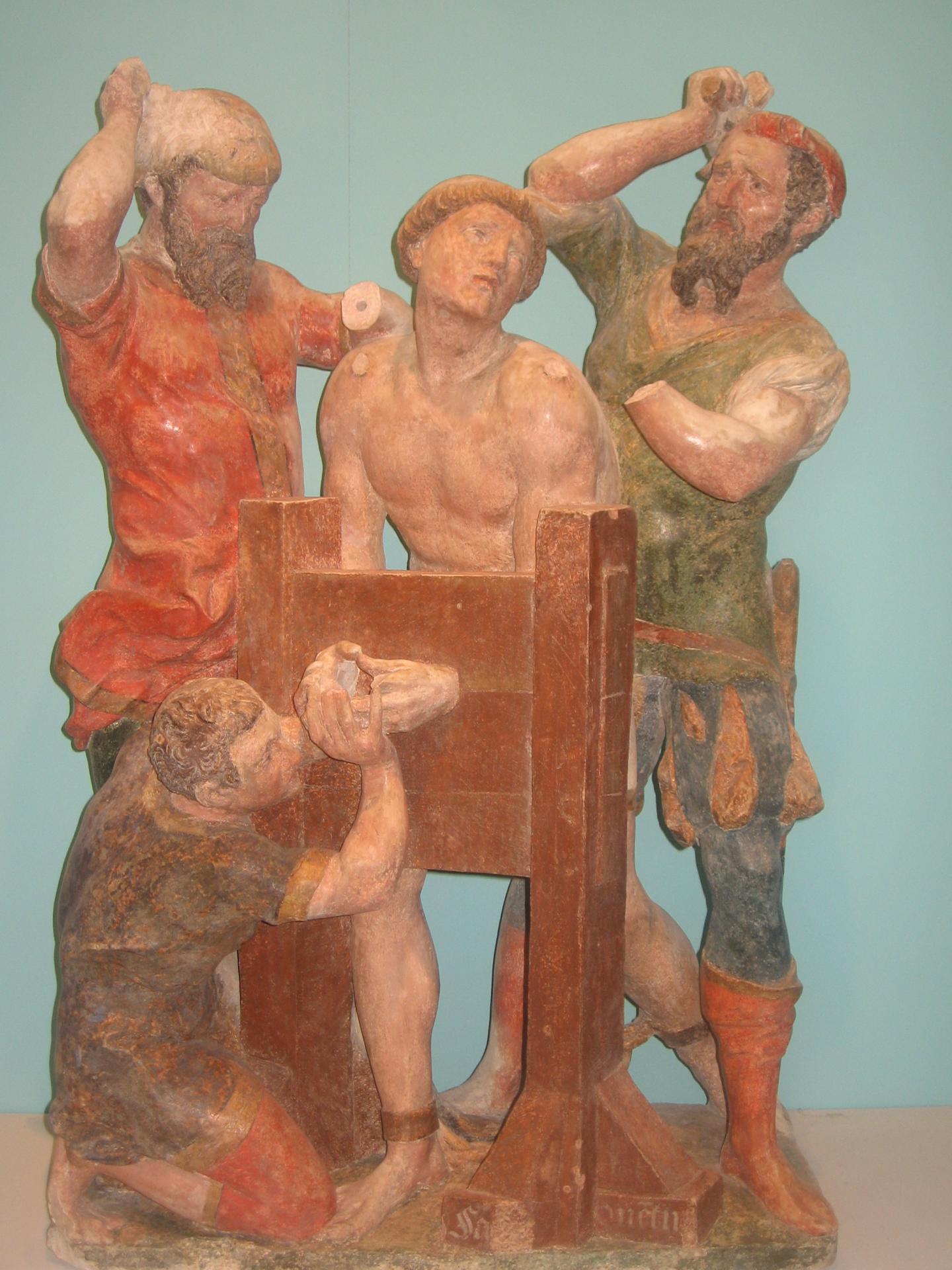
Martyre de Saint Quentin, 1550-1570 Groupe, calcaire, traces de polychromie et de dorure. Villiers-Herbisse (Aube) - Classé monument historique le 18.02.1908. Exposition Le Beau XVIe Siècle
Also
known as
Quentin of Vermand
Quinten…
Quintin…
Quintino…
Quintinus…
24 June on
some calendars
3 January (discovery
of relics)
25 October (translation
of relics)
Profile
Son of a Roman senator,
and raised a pagan,
Quentin converted to Christianity.
He served as a missionary to Gaul (in
modern France),
working with Saint Lucian
of Beauvais. Quentin’s preaching and
example won many converts in
the area of Amiens.
He was arrested in 286 by
Prefect Rictius Varus during the persecutions of
emperor Maximian. Martyr
Born
tortured and beheaded in 287 at
Augusta Veromanduorum, Gaul (now
Saint-Quentin, France)
body thrown in the river,
but recovered and buried by people he had helped convert
tomb known as a site
for miracles
relics later
re-discovered by Saint Eligius
bishop holding
a roasting spit
Roman soldier holding
one or two spits
young man nailed to
a chair
beheaded young
man with a dove flying
from his neck
Additional
Information
Book
of Saints, by the Monks of
Ramsgate
Lives
of the Saints, by Father Alban
Butler
Lives
of the Saints, by Father Francis
Xavier Weninger
Saints
of the Day, by Katherine Rabenstein
Short
Lives of the Saints, by Eleanor Cecilia Donnelly
books
Our Sunday Visitor’s Encyclopedia of Saints
Saints
and Their Attributes, by Helen Roeder
other
sites in english
images
video
webseiten
auf deutsch
sitios
en español
Martirologio Romano, 2001 edición
sites
en français
Abbé
Christian-Philippe Chanut
L’Eglise catholique dans l’Aisne
fonti
in italiano
Martirologio Romano, 2005 edition
MLA
Citation
“Saint Quentin of
Amiens“. CatholicSaints.Info. 3 February 2024. Web. 17 December 2025.
<https://catholicsaints.info/saint-quentin/>
SOURCE : https://catholicsaints.info/saint-quentin/

Article
(Quentin) (Saint) Martyr (October
31) (3rd
century) A Roman of noble family who accompanied Saint Lucian
as a missionary to Gaul. Saint Lucian
worked from Beauvais, Saint Quentin
from Amiens. Rictiovarus, Prefect of Gaul,
under Diocletian and
Maximian, caused the latter Saint to
be seized and beheaded at
the place now called Saint-Quentin, after him. His body was thrown into the
Somme (A.D. 290),
whence the Christians afterwards
recovered and reverently interred it.
MLA
Citation
Monks of Ramsgate.
“Quinctinus”. Book of Saints, 1921. CatholicSaints.Info.
19 October 2016. Web. 17 December 2025.
<https://catholicsaints.info/book-of-saints-quinctinus/>
SOURCE : https://catholicsaints.info/book-of-saints-quinctinus/
St. Quentin
Feastday: October 31
Quentin was also known as
Quintinus. According to legend, he was a Roman, went to Gaul as a missionary
with St.
Lucian of Beauvais, and settled at Amiens in Picardy. He was so
successful in preaching that he was imprisoned by prefect Rictiovarus,
tortured, and then brought to Augusta Veromanduorum
(Saint-Quentin), where he was again tortured and then was beheaded. His feast day is October
31st.
SOURCE : https://www.catholic.org/saints/saint.php?saint_id=134
October 31: Saint Quentin
of Vermand, Martyr
A city was built in his
name
He is remembered not only
for his martyrdom but also for his steadfast faith, his strength in the face of
persecution, and his dedication to spreading Christianity. Saint Quentin,
originally from Rome, lived in the 3rd century. Little is known for certain
about his life. According to tradition, he was the son of an influential
senator named Zeno and, after embracing the Christian faith, began a missionary
journey that led him to Gaul, together with Saint Lucian of Beauvais.
His evangelizing mission
began in Amiens, where he soon drew the attention of the Roman authorities. The
prefect Rictiovarus, a known persecutor of Christians and representative of
Emperor Maximian, ordered his arrest. Quentin was imprisoned for his preaching
and, despite the tortures he endured, he never renounced his faith.
According to tradition,
after several interrogations and tortures, Rictiovarus decided to transfer the
prisoner to Reims, the capital of Belgic Gaul, to subject him to an official
trial. During the journey, near a place called Augusta Veromanduorum (modern-day
Saint-Quentin), a miraculous event occurred: Quentin managed to escape and
resumed his mission of evangelization.
His freedom, however, was
short-lived. He was captured again, subjected to further tortures, and finally
beheaded. His body was abandoned in the marshes of the Somme River, where it
remained hidden for years.
About fifty-five years
after his death, a noblewoman who was blind, guided by a divine vision, reached
the place where the martyr’s remains lay. She not only miraculously found his
body—which, according to legend, emitted a heavenly fragrance—but also regained
her sight immediately after burying him on top of a hill, where she had a
chapel built in his honor.
Over time, the site
became a destination for pilgrims and the scene of numerous miracles attributed
to the Saint’s intercession. The city that later arose on that spot was named
Saint-Quentin and still preserves a deep devotion to its Patron Saint.
Golden Legend –
Life of Saint Quintin
Here followeth the Life
of Saint Quintin, and first of his name.
Quintin is said of quin,
that be five, and of teneo, tenes, that is to hold, and is as much to say as
holding five things. He held first in himself honesty of life, faith catholic,
purity and cleanness of conscience, true preaching and crown of martyrdom
Of Saint Quintin.
Quintin was of noble
lineage of the city of Rome, and came into the city of Amiens, showing many
miracles. And was taken there of the provost of the city by commandment of
Maximian, and was beaten until they that beat him were weary, and after was put
in prison, but he was unbound of an angel, and he went into the city and there
preached to the people. Then he was taken again, and was strained on the
eculee, an instrument to torment saints on, unto the breaking of his veins, and
beaten with raw sinews right long, and afterwards he was boiled in burning
pitch and oil, and yet for all that he mocked the judge. Then the judge did do
put into his mouth quicklime, vinegar, and mustard, and yet always he abode
constant and unmovable. And then he was brought into Vermandos, and fixed in
him two nails from his head unto his knees, and ten nails between his nails and
the flesh of his nails and the flesh on his hands. And at the last the provost
made him to be beheaded, and threw the body into the water.
Which body was hid there
fifty-five years, and then founden there by a noble woman of Rome. For as she
was continually in prayer, she was in a night warned by an angel that she
should go hastily unto the castle of Vermandos, and it was commanded to her
that she should fetch the body of Saint Quintin in such a place and bury it
honourably. And when she came to the said place with a great company, and as
she made her prayers, the body of Saint Quintin appeared above the water,
sweetly smelling and without corruption, which body she took and buried it
worshipfully. And for the sepulture that she made honourably, she that tofore
was blind, received her sight again for a reward. And then there she edified a
fair church, and returned home to her own place again. In which church now is a
fair monastery of monks and a good town called Saint Quintins in Vermandos,
where daily be showed many great miracles, especially for the dropsy, etc., and
swelling of great bellies for over great superfluity of water. For this
sickness in especial he is sought, and many men have been cured and made whole
by the merits of this blessed saint and martyr Saint
Quintin. To whom pray we that we may be delivered from all infirmities, as far
as it shall please God, and necessary for us. Amen.
SOURCE : https://catholicsaints.info/golden-legend-life-of-saint-quintin/
Saint Quentin
Apostle of Amiens,
Martyr at Rome
(† 287)
Saint Quentin was a
Roman, descended from a senatorial family. Full of zeal for the kingdom of
Jesus Christ, he left his country and went into Gaul, accompanied by eleven
other apostles sent from Rome. They separated to extend their campaign of
evangelization to the various regions of France. Saint Quentin remained at
Amiens and endeavored by his prayers and labors to make that region part of Our
Lord's inheritance. By the force of his words and works he preluded the glory
of his martyrdom. He gave sight to the blind, vigor to paralytics, hearing to
the deaf, and agility to the infirm, in the name of Our Lord, simply by the
sign of the Cross. At all hours of the day he invoked his God in fervent
supplications.
But this apostolate could
not escape the notice of Rictiovarus, the Roman prosecutor who at that time
represented Maximian Herculeus in Gaul. Saint Quentin was seized at Amiens,
thrown into prison, and loaded with chains. Rictiovarus asked him: How does it
happen that you, of such high nobility and the son of so distinguished a
father, have given yourself up to so superstitious a religion, a folly, and
that you adore an unfortunate man crucified by other men? Saint Quentin
replied: It is sovereign nobility to adore the Creator of heaven and earth, and
to obey willingly His divine commandments. What you call folly is supreme
wisdom. What is there that is wiser than to recognize the unique true God, and
to reject with disdain the counterfeits, which are mute, false and deceiving?
When the holy preacher
was found to be invulnerable to either promises or threats, the prosecutor
condemned him to the most barbarous torture. He was stretched on the rack and
flogged. He prayed for strength, for the honor and glory of the name of God,
forever blessed. He was returned to the prison when the executioners who were
striking him fell over backwards, and told Rictiovarus they were unable to
stand up, and could scarcely speak. An Angel released the prisoner during the
night, telling him to go and preach in the city, and that the persecutor would
soon fall before the justice of God. His sermon, a commented paraphrase of the
Apostles' Creed, has been conserved. To his profession of faith in the Holy
Trinity, he added that Our Lord Jesus Christ, whom he adored, gave sight to the
blind, hearing to the deaf, health to the sick and even life to the dead. At
His voice, the lame leaped up and ran, paralytics walked, and water was changed
into wine... He has promised to be forever with those who hope in Him, and He
never abandons those who place their hope in Him; by His omnipotence He
delivers them, whenever it pleases Him, from all their tribulations. His
guardians discovered that he had disappeared, though all doors were barred, and
found him in the city preaching. They were converted by the prodigy. But
Rictiovarus was furious and said to them: You, too, have become magicians?
Brought back before the
tribunal as a sorcerer, Saint Quentin said: If by persevering in my faith, I am
put to death by you, I will not cease to live in Jesus Christ; this is my hope,
I maintain it with confidence. He was again placed on the rack and beaten, and
tortured with other demoniacal means; his flesh pierced with two iron wires
from the shoulders to the thighs, and iron nails were thrust into his fingers,
his skull and body. Finally, this glorious martyr was decapitated, after
praying and saying: O Lord Jesus, God of God, Light of Light..., for love of
whom I have given up my body to all the torments... ah! I implore Thee, in Thy
holy mercy, receive my spirit and soul, which I offer Thee with all the ardor
of my desires. Do not abandon me, O most kind King, most clement King, who
livest and reignest with the Father, in the unity of the Holy Spirit, forever
and ever! His death occurred on October 31, 287.
His body was twice buried
secretly, and twice it was rediscovered miraculously — in the years 338 and
641, first by Saint Eusebie of Rome, on a marshy island, where it had remained
intact; later near the city of Augusta, by Saint Eloi. Saint Quentin remains in
great honor in France above all, where more than fifty-two churches and as many
localities were, at the beginning of the 20th century, dedicated to his
memory; he is honored also in Belgium and in Italy. Charlemagne and the kings
of France have gone to venerate the relics of Saint Quentin.
Reflection: Let us
never forget that the sufferings of the present life are not worthy to be
compared with the glory to come, prepared by God for those who love Him. (Romans 8:18; I
Cor. 2:9)
Les Petits Bollandistes:
Vies des Saints, by Msgr. Paul Guérin (Bloud et Barral: Paris, 1882), Vol.
13
SOURCE : https://sanctoral.com/en/saints/saint_quentin.html
Quentin of Amiens M (RM)
(also known as Quintinus)
Died 287. When we read
the lives of the martyrs who offered their lives as a testimony to a grateful
heart--a heart that humbly acknowledges the sacrifice of our Lord for a
sinner--we are forced to question our own lives. Are we witnesses to God's
infinite love at least by lives of self-denial, humility, and self-giving? We
may never be called to shed our blood, but what about our time, talent, and
treasure?
According to legend
Quentin was a Roman, the son of Zeno of senatorial rank. It is said that filled
with apostolic zeal, Quentin travelled to Gaul as a missionary with Saint
Lucian of Beauvais. Quentin settled at Amiens in Picardy, while Lucian
continued to Beauvais, where he won the martyr's crown.
By his multitudinous
prayers and continuous hounding of heaven, Quentin wrought many miracles that
confirmed the truth of the Gospel he preached among the heathen. He was so
successful in preaching that he was imprisoned by Prefect Rictovarus (Rictius
Varus), who had travelled there from Trier. Quentin was manacled, tortured
repeatedly, and thrown into a dungeon. When Rictovarus left Amiens, he
commanded Quentin to be brought to Augusta Veromanduorum (later Somme, now
St-Quentin), through which Rictovarus would pass upon his return to Trier. Here
Quentin was again tortured, beheaded, and thrown into (or drowned in) the River
Somme.
The body was recovered by
Christians several days later and buried on a mountainside. One-half century
later, it was discovered by a devout woman named Eusebia. A blind women
recovered her sight by the sacred relics. During the reign of Julian the
Apostate, the place of his burial was again lost to memory, though a chapel
which was built near it remained. When Saint Eligius found the relics in 641
after a concerted effort, he distributed the nails with which Quentin's body
had been pierced, as well as the saint's teeth and hair. The remainder Eligius
placed in a rich shrine made by his own hands. This was placed behind the high altar
at Noyon. The relics have been translated several times since then and are now
kept in Laon.
There is no doubt that he
is a historical person; however, his story has been much embellished
(Benedictines, Delaney, Encyclopedia, Husenbeth).
He is shown as a young
man with two spits (1) as a deacon; (2) with a broken wheel; (3) with a chair
to which he is transfixed; (4) with a sword; or (5) beheaded, a dove flying
from his severed head. He is venerated at Amiens. Patron of bombardiers,
chaplains, locksmiths, porters, tailors, and surgeons. Invoked against coughs,
sneezes, and dropsy (Roeder).
SOURCE : http://www.saintpatrickdc.org/ss/1031.shtml

The
Martyrdom of St Quentin – Unknown artist- https://anastpaul.com/2024/10/31/saint-of-the-day-31-october-saint-quentin-died-c287-martyr/
October 31
St. Quintin, Martyr
From his Acts in Surius,
written in a good style, before St. Eligius’s time, but later than Nestorius.
The author assures us, that he compiled them from a history written by one who
was present at the first translation of the martyr’s relics, fifty-five years
after his death. But the author has added certain circumstances from popular
traditions, with a fertur: which are not of equal authority. Other
Acts of St. Quintin, but of an inferior stamp, are given us by Claude Hemere,
in his History of the Town of St. Quintin’s. See Tillemont, t. 4, pp. 433, 436,
700.
A.D. 287.
ST. QUINTIN was a Roman,
descended of a senatorian family, and is called by his historian the son of
Zeno. Full of zeal for the kingdom of Jesus Christ, and burning with a holy
desire to make his powerful name and the mysteries of his love and mercy known
among the infidels, he left his country, renounced all prospects of preferment,
and, attended by St. Lucian of Beauvais, made his way to Gaul. They preached
the faith together in that country till they reached Amiens, in Picardy, where
they parted. Lucian went to Beauvais, and having sown the seeds of divine faith
in the hearts of many, received the crown of martyrdom in that city. St.
Quintin staid at Amiens, endeavouring by his prayers and labours to make that
country a portion of our Lord’s inheritance. Desiring nothing so earnestly as
to destroy the kingdom of the devil, that the name of God might be glorified,
he besought the Author of all good, without ceasing, that he would infuse his
saving knowledge and holy love into the souls of those to whom he announced the
divine law. God made him equally powerful in words and works, and his
discourses were authorized and strongly recommended by great numbers of
miracles, and illustrated and enforced by a most holy and mortified life. The
reward of his charitable labours was the crown of martyrdom, which he received
in the beginning of the reign of Maximian Herculeus, who was associated in the
empire by Dioclesian, in the year 286. Maximian made Rictius Varus prefect of
the prætorium; for though Augustus had appointed but one prætorian prefect to
judge causes and receive appeals from all the provinces of the empire, in the
reign of Dioclesian, each emperor appointed one, so that there were four
prætorian prefects, according to the number of emperors who then reigned
together; but Constantine the Great was the first who made this number regular,
and determined the districts and jurisdiction of these supreme magistrates of
the Roman empire. Rictius Varus, whose hatred of the Christian religion has
stored the Martyrology with lists of many illustrious martyrs, seems to have
resided at Triers, the metropolis of the Belgic Gaul; but, making a progress
into the Second Gaul, when he was near Soissons, he had intelligence of the
great progress the Christian faith had made at Amiens, and resolved to cut him
off who was the author of this great change. When he arrived at Amiens, he
ordered St. Quintin to be seized, thrown into prison, and loaded with chains.
The next day the holy preacher was brought before the prefect, who assailed his
constancy with promises and threats; and finding him proof against both,
ordered him to be whipped unmercifully, and then confined to a close dungeon
without the liberty of receiving either comfort or assistance from the
faithful. In two other examinations before the same magistrate, his limbs were
stretched with pulleys on the rack till his joints were dislocated; his body
was torn with rods of iron wire; boiled pitch and oil were poured on his back,
and lighted torches applied to his sides. The holy martyr, strengthened by Him
whose cause he defended, remained superior to all the cruel arts of his
barbarous persecutor, and preserved a perfect tranquillity of mind in the midst
of such torments as filled the spectators with horror.
When Rictius Varus left
Amiens, he commanded Quintin to be conducted to the territory of the
Veromandui, whither he was directing his course in his return. The capital of
that country was called Augusta Veromanduorum. In this city of the Veromandui
the prefect made fresh attacks upon the champion of Christ, with threats and
promises; and being ashamed to see himself vanquished by his courage and
virtue, caused his body to be pierced with two iron wires from the neck to the
thighs, and iron nails to be struck under his nails, and in his flesh in many
places, particularly into his scull; and, lastly, his head to be cut off. This
was executed on the 31st of October, in 287. The martyr’s body was watched by
the soldiers till night, and then thrown into the river Somme; but it was
recovered by the Christians some days after, and buried on a mountain near the
town; fifty-five years after, it was discovered by Eusebia, a devout lady; and a
certain blind woman recovered her sight by the sacred relics. 1 The
knowledge of the place was again lost in the persecution of Julian the
Apostate, though a chapel which was built near it remained, when in the
beginning of the year 641, St. Eligius, bishop of Noyon and the Vermandois,
caused the holy relics to be sought; and when they were discovered, together
with the great nails with which the body had been pierced, he distributed these
nails, the teeth, and hair, in other places, and inclosed the rest of the
sacred treasure in a rich shrine of his own work, which he placed behind the
high altar, as St. Owen relates in his life. A new stately church of St.
Quintin was built in the reign of Lewis Debonnaire, and another translation of
the relics was made on the 25th of October, 825. 2 They
were removed to Laon for fear of the Normans, but brought back on the 30th of
October, 885, and are still kept in the great church, which was in the hands of
monks from the time of Ebertran, the first abbot, till these were afterwards
dispersed by the inroads of the Normans. In the following age, secular canons
were put in possession of this famous church. Another church was built here in
the honour of St. Quintin, in the place where his body had been concealed
during fifty-five years, in an island in a marsh formed by the river Somme. It
became a famous monastery, now in the hands of the Benedictin monks of St.
Maur: it is called St. Quintin’s in the Island. St. Quintin’s on the Mountain,
a mile from Peronne, is another monastery of the same congregation, founded by
Eilbert, brother to Herbert, count of Vermandois, in the seventh century. From
the time of the translation of the martyr’s relics in the reign of Lewis le
Debonnaire, the town has taken the name of St. Quintin’s. 3
Martyrdom, when we are
called to it, is an homage we owe to God, and a debt due to faith and religion.
Happy are they whom God, by a special grace, allows to seal their fidelity to
him by their blood! How great is the honour and happiness for a poor mortal
man, and a poor sinner, to lay down his mean, miserable life for Him, who, out
of infinite love for us, gave his most precious life! Martyrs are holocausts
offered to the divine love and glory. They are witnesses, as the word imports
in the original Greek, bearing testimony to the infinite power and
goodness of God, in which they place an entire confidence, and to the truth of
his holy revealed faith, which they confirm with their blood. No testimony can
be more authentic, more glorious to God, more edifying to the faithful, or more
convincing to infidels. It is by the constancy of martyrs that our holy
religion is established. God was pleased to choose it for one of the means by
which he would accomplish this great work. Are we witnesses to God and his holy
religion, at least by lives of self-denial, meekness, and sanctity? Or do we
not rather by a contrary deportment disgrace his holy church, of which we have
the honour to be members, and expose his adorable name to the blasphemies of
infidels.
Note 1. Act. Mart.
et St. Greg. Turon. de Gl. Mart. c. 73. [back]
Note 2. Hemerè,
Hist. Aug. Verom. l. 2, pp. 72, 79. [back]
Note 3. Cluverius
and Sanson think the great city called Augusta Veromanduorum was destroyed by
the Barbarians in the fifth age, and that it stood where now the
Premonstratensian abbey of Vermand is situate, three leagues from Noyon, and
four from Peronne. But the Abbé de Longrue shows from the Acts of St. Quintin,
St. Gregory of Tours, and several chronicles, that the body of St. Quintin was
buried near Augusta Veromanduorum and always kept in that city. Consequently,
the town of St. Quintin’s was rebuilt upon the spot where the old city stood:
which also appears by the neighbourhood of the river Somme. [back]
Rev. Alban
Butler (1711–73). Volume X: October. The Lives of the
Saints. 1866.
SOURCE : http://www.bartleby.com/210/10/311.html
Weninger’s
Lives of the Saints – Saint Quintin, Martyr
Article
We not add a brief sketch
of the life of a Roman Senator, Saint Quintin, who ended his life by a glorious
martyrdom in the third century. He was already a Senator when he was received,
by means of holy baptism, into the pale of the true Church. At first, he kept
his conversion a secret; but some time later he revealed to the holy Pope
Cajus, his great desire to disseminate the the Gospel in foreign lands. Saint
Cajus praised his zeal, and gave him, as companion, Saint Lucian. Both, leaving
all their possessions, travelled to France, where Quintin remained at Amiens,
while Lucian went further into the district of Beauvais. Quintin preached the
Gospel of our Saviour Jesus Christ, with apostolic defiance of all danger, and
converted a great many heathens. He extended his zealous labors into the
surrounding country, and the many miracles which he wrought, by divine power,
on the blind, the lame, the possessed and the infirm, proved to the pagan
inhabitants that the Saint preached a truly divine doctrine. Hence the number
of the faithful increased daily.
Rictiovarus, the Roman
Governor of France, was informed of Saint Quintin’s labors by the idolatrous
priests, who feared the entire downfall of idolatry. He came himself to Amiens,
called Saint Quintin into his presence, and finding him firm in his faith,
ordered him to be whipped like a slave. The holy Martyr, with eyes raised to
heaven, thanked the Almighty for the great grace of being allowed to suffer for
Christ’s sake. During his martyrdom, a voice from heaven was heard, saying:
“Remain constant, Quintin, for it is I who suffer in thee. I will assist thee
and give thee strength.” At the same moment, the executioners were cast down to
the ground, as if struck by lightning. The governor, enraged at this, ordered the
Saint to be cast into a dark dungeon until the next day; but in the midst of
the night, an Angel appeared to Quintin, broke his chains and led him to the
public square of the town, where, at break of day, the martyr preached a most
powerful sermon to the people, who came running towards him from all parts, and
many of whom were converted.
Rictiovarus, on hearing
of it, became furious with rage and ordered the holy martyr to be stretched
upon the rack, and to be beaten with clubs. When his whole body was covered
with wounds, boiling oil and melted tar were poured over him, and he was burned
with torches. Quintin showed himself not only fearless under this cruel
torture, but cheerful and happy. The spectators of the terrible scene, however,
began to murmur against the barbarity of the governor. The latter, therefore,
ordered Quintin to be taken from the place of execution, and led away, on the
next day, to another city, whither he himself followed to torment him anew.
There two iron bars were thrust into his body, from his neck to his thighs, and
his hands and feet were pierced with nails. But he who had given this barbarous
order was again shamed; for, the Saint, miraculously strengthened by the
Almighty, showed himself more firm and cheerful than before. Hence nothing
remained but to behead him, and when this was about to take place, a voice was
again heard, which coming from heaven, said: “Come, Quintin, my servant, and
receive the crown you hast deserved by thy martyrdom.” The tyrant remained,
unmoved, and the Saint received the fatal stroke, in the year of our Lord, 287.
His holy body was cast into the river, by command of the Governor, but being
afterwards miraculously found, it was buried with great honors. Rictiovarus was
not long after this, deservedly punished for his wickedness, as has already
been related in the lives of Saint Crispin and Saint Crispinian.
Practical Considerations
Saint Quintin, in truth,
suffered many and great torments. His martyrdom was not ended all at once by
the sword, or on one day. He had to suffer different torments during several
days. What, however, are these tortures compared with those of hell which he
escaped? “Take fire, sword, wild beasts, and everything you can imagine, and it
will all be less than a shadow compared with the tortures of hell,” says Saint
Chrysostom. The reprobate has not only to suffer many, but all possible
tortures in hell. He is not tormented for many days, but for all eternity. Thus
are you taught by the true faith. “In heaven,” says Saint Augustine, “is to be
found all that is good and nothing that can be called an evil. All that we
wish, yes, even more than we can wish, we shall find there, and nothing that we
do not wish.” This means that in heaven is all happiness, honor, joy, and
nothing that might give us pain, fear, or anxiety. On the contrary, in hell is
everything that gives heart-ache and pain, and nothing that rejoices or that
brings comfort and consolation. The principal point of all this is: The
happiness, honors, and joys of heaven are eternal, and so are the sufferings,
the pains of hell. This we are taught by the word of God. What I now ask of
you, for the sake of your salvation, is this: think frequently on these most
important truths, especially when you are tempted to sin or have to suffer. If
you were assured that, immediately after you had become guilty of sin, you
would have to endure such tortures as Saint Quintin suffered, or that you would
at least be in danger of being thus tormented, would you commit the sin?
Certainly not. The impending martyrdom, nay, only the danger of it, would
restrain you. And why, then, does the thought of hell not prevent you from
committing sin, though you may be precipitated into it immediately after? Would
you then not suffer incomparably more than Saint Quintin did, although his
tortures were so terrible? Think of this whenever you are in danger of sin. And
if you are subjected to many and heavy afflictions, let me ask you: Did Saint
Quintin act wisely to endure his dreadful martyrdom patiently, nay, even
cheerfully, in the thought that by it he not only escaped hell, but obtained
the eternal joys of heaven? His torments were terrible, but they ended at last.
The joys of heaven are so great, that all suffering on earth, as the Apostle
assures us, is as nothing when compared to it (Romans 8) The best of it is,
however, that they are endless, while all earthly suffering has an end. May
you, therefore, act as wisely as Saint Quintin did; and that you may act thus,
represent to yourself the following truth: Through my suffering I may escape
hell, and, instead I of it, obtain the never-ending joys of heaven. “The misery
which you suffer here, is short and soon ended,” says Saint Gregory: “the glory
you expect will be everlasting.”
MLA
Citation
Father Francis Xavier
Weninger, DD, SJ. “Saint Quintin, Martyr”. Lives
of the Saints, 1876. CatholicSaints.Info.
22 May 2018. Web. 17 December 2025. <https://catholicsaints.info/weningers-lives-of-the-saints-saint-quintin-martyr/>
SOURCE : https://catholicsaints.info/weningers-lives-of-the-saints-saint-quintin-martyr/
Pictorial
Lives of the Saints – Saint Quintin, Martyr
Saint
Quintin was a Roman, descended of a senatorial family. Full of zeal for the
kingdom of Jesus Christ, he left his country, and, attended by Saint Lucian of
Beauvais, made his way to Gaul. They preached the faith together in that
country till they reached Amiens in Picardy, where they parted. Lucian went to
Beauvais, and having sown the seeds of divine faith in the hearts of many,
received the crown of martyrdom in that city. Saint Quintin stayed at Amiens,
endeavoring by his prayers and labors to make that country a portion of our
Lord’s inheritance. He was seized, thrown into prison, and loaded with chains.
Finding the holy preacher proof against promises and threats, the magistrate
condemned him to the most barbarous torture. His body was then pierced with two
iron wires from the neck to the thighs, and iron nails were thrust under his
nails, and his flesh in many places, particularly into his skull; and lastly,
his head was cut off. His death happened on the 31st of October, 287.
Reflection – Let us bear
in mind that the ills of this life are not worthy to be compared to the glory
“God has reserved for those who Jove Him.”
SOURCE : https://catholicsaints.info/pictorial-lives-of-the-saints-saint-quintin-martyr/
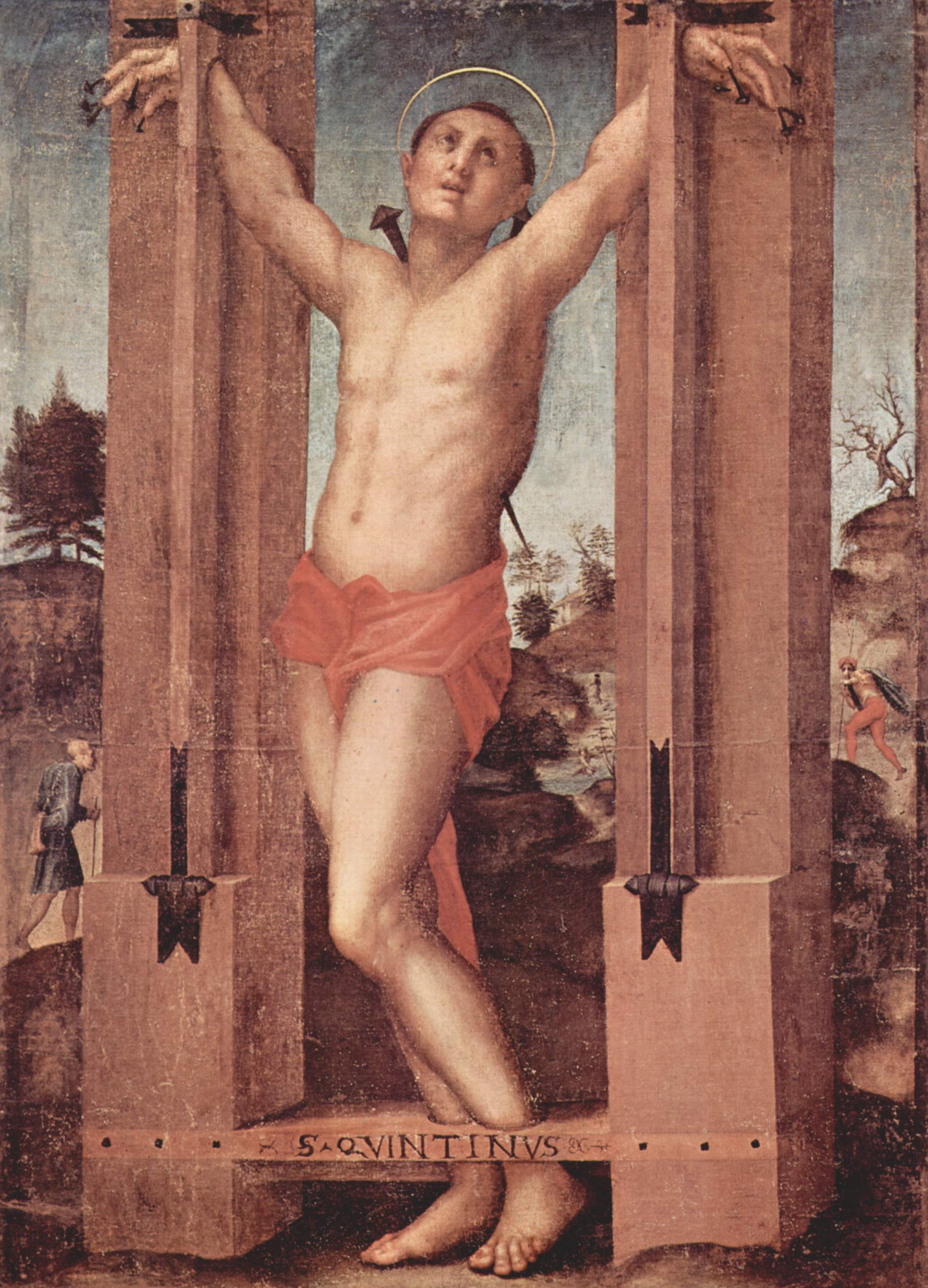
Jacopo
Pontormo (1494–), Martirio di
san Quintino, circa 1517 - 1518), olio su tela;163
x 103, Sansepolcro, Pinacoteca Civica «
musée municipal de Sansepolcro
San Quintino di
Vermand Senatore e martire
Festa: 31 ottobre
† Saint-Quentin, Francia,
287
San Quintino, di origine
romana, giunse in Gallia con San Luciano di Beauvais per evangelizzare le
regioni del Nord-Est, stabilendo il centro della sua predicazione ad Amiens. Fu
perseguitato dal prefetto Riziovaro, sotto l'imperatore Massimiano, e subì tortura:
venne percosso, bruciato, e costretto a bere calce, aceto e senape. Dopo la
decapitazione, il suo corpo fu gettato nel fiume, dove venne riscoperto 55 anni
dopo da una nobildonna romana a Vermand, sulla Somme. Nel VII secolo,
Sant'Eligio ritrovò le reliquie, le collocò in una preziosa teca e diffuse il
culto del santo, tanto che la città di Vermand cambiò nome in suo onore.
Etimologia: Quintino
= il quinto figlio nato, dal latino
Emblema: Palma
Martirologio
Romano: Nella cittadina in seguito insignita del suo nome nel territorio
dell’odierna Francia, san Quintino, martire, che, senatore, subì la passione
per Cristo sotto l’imperatore Massimiano.
Un proverbio popolare dice: " Povero come San Quintino, che suonava a Messa con i tegoli del tetto ". Il detto, efficacissimo e colorito, rappresenta bene una estrema, eppur serena povertà; ma fa pensare a San Quintino nelle vesti di prete, anzi di parroco, dandocene una immagine che mal corrisponde alla figura del Santo che la Chiesa festeggia l'ultimo giorno di ottobre, e che fu missionario in Gallia, nei primissimi secoli cristiani.
E' vero che, per quanto sia il più celebre, egli non è l'unico Santo di questo nome. Un altro è festeggiato il 4 di questo stesso mese, ma neanche la sua figura corrisponde a quella di un povero prete che suoni i tegoli del tetto invece delle campane, forse perché le campane si incominciarono a fondere, nel " bronzo campano " di Nola, soltanto dopo il IV secolo.
Anche questo San Quintino fu francese, di Tours, e sarebbe stato al servizio di un nobile della Turingia, di nome Gontrano. La moglie di questo ultimo si sarebbe invaghita follemente del servitore, e invano avrebbe tentato di sedurlo. Delusa nelle sue voglie, ordì una crudele vendetta e, incaricato Quintino di portare i cavalli al fiume per l'abbeverata, ordinò agli altri servi di decapitarlo.
La sua testa fu gettata in una fontana, che divenne miracolosa, testimoniando la santità del casto servitore. E l'ignoto biografo del Santo, dopo aver narrato la sua storia, molto simile a quella biblica di Giuseppe Ebreo, inutilmente tentato e velenosamente calunniato dalla lasciva moglie di Putifarre, esce a questo punto in una aspra invettiva contro le donne malvagie, che noi però non riporteremo, per non dispiacere alle gentili lettrici.
Il San Quintino di oggi, vien detto romano di nascita, e sarebbe giunto in Gallia al seguito di San Luciano di Beauvais. Dopo aver evangelizzato alcune regioni del Nord-Est, avrebbe posto il centro della sua predicazione ad Ambianus, cioè ad Amiens. Qui anch'egli cadde vittima, non di una donna, ma dei celebre e leggendario persecutore francese Riziovaro, prefetto militare sotto Massimiano Imperatore, cioè agli inizi dei III secolo.
In mancanza di notizie precise sulla passione di questo celebre Martire francese, leggiamo quanto dice lacopo da Varagine nella sua Legenda Aurea: " Quintino, facendo molti miracoli, per comandamento di Massimiano Imperatore fu preso dal prefetto di Roma, e battuto tanto che i battitori vennero meno ne le battiture, poscia messo in prigione. Ma l'angelo di Dio sciolse i legami de la prigione, e andoe nel miluogo de la città, e predicava al popolo. Onde preso poi un'altra volta, e disteso alla colla infino a la rottura de le vene, battuto ancora co' nerbi crudi durissimamente, sostenne l'olio e la pece 'l grasso boglientissimo; e faccendosi scherno del prefetto, adirato il prefetto gittogli in bocca la calcina e l'aceto e la senape ".
Dopo questi e altri raffinatissimi tormenti, Quintino fu decapitato e il suo corpo gettato nel fiume. Per cinquantacinque anni non se ne seppe più nulla, finché a Vermand, sulla Somme, una " gentile dama romana " non ritrovò e riconobbe nelle acque il corpo del Santo.
Anche a Vermand, il corpo del Martire, nel corso dei secoli, venne smarrito, e
fu ritrovato, nel VII secolo, da Sant'Eligio, il celebre orafo francese, che
modellò una preziosa teca dove furon riposte le reliquie del Santo, il cui
culto, da allora, si diffuse sempre di più, tanto che anche la città di Vermand
prese il nome del Santo, e si chiamò, e ancora si chiama, Saint Quentin.
Fonte : Archivio
Parrochia
SOURCE : https://www.santiebeati.it/dettaglio/75800

Quintinius von
Saint-Quentin
französischer Name:
Quentin
Gedenktag katholisch: 31. Oktober
Auffindung der Gebeine: 3. Januar
in Noyon: Erhebung der Gebeine: 2. Mai
Auffindung der Gebeine: 24. Juni
in Angers und Le Mans: Auffindung der Gebeine: 8. Juli
Übertragung der Gebeine: 13. Juli, 25. Oktober
Name bedeutet: der
Fünfte (latein.)
Märtyrer
* in Rom (?)
† um 285 beim heutigen St-Quentin in
Frankreich
Quintinius gehörte der
Überlieferung nach einer römischen Senatorenfamilie an und kam unter Kaiser
Maximianus nach Gallien, um gemeinsam mit Lucian als
Glaubensbote in der Gegend um Amiens zu
wirken; er wurde verhaftet, in Vermand gemartert
und schließlich beim heutigen St-Quentin enthauptet.
Nach späterer Überlieferung wurde er mit Nägeln gepiekst, mit heißem Pech
übergossen, der Leichnam in den Fluss Somme geworfen; vierzig Jahre später ließ
die blinde römische Adlige Matrone Eusebia aufgrund einer Vision den Leichnam
aus der Somme bergen und in einer von ihr erbauten Kapelle beisetzen.
Quintinius wurde nach dem
Zeugnis von Gregor
von Tours bereits im 6. Jahrhundert verehrt. Um 641 fand Eligius von
Noyon die Reliquien und
fertigte ein reich geschmücktes Grabmal an, aus jener Zeit stammt die erste überlieferte
Leidensgeschichte. Durch die großen Pilgerströme zu der dem Märtyrer
geweihten Kirche entwickelte
sich an dieser Stelle die Stadt St-Quentin, deren 813 bis 826 erneuerte Kirche
mit dem Grab von Quintinius auch als Neubau aus dem 13. Jahrhundert noch immer
ein Wallfahrtsort
ist.
In der Karolingerzeit
verbreitete sich die Verehrung, es entstanden mehrere weitere
Leidensgeschichten. Wegen der Normanneneinfälle wurden die Reliquien 881
und 883 nach Laon gebracht.
Die Geschichte des Quintinius wurde in mehreren altenglischen und
altfranzösischen Werken des späteren Mittelalters literarisch verarbeitet. In
Parma ist Qintinius die auf ein altes Oratorium, das außerhalb der Stadtmauern
errichtet worden war, zurückgehende Kirche San
Quintino geweiht.
Als Gefährten
gelten weitere Märtyrer, die demnach in Basel durch
Rictiovarus, den Statthalter von Trier,
getötet wurden, der auch Justus von
Beauvais töten ließ.
Attribute: Nägel
Patron der Schlosser, Schneider, Lastenträger, Ärzte und Kapläne; gegen
Husten, Keuchhusten, Schnupfen und Wassersucht
Quintinius' Geschichte in der Basilika St-Quentin in St-Quentin
Stadlers
Vollständiges Heiligenlexikon
Acta
Sanctorum - Auffindung der Gebeine
Die Basilika St-Quentin in
St-Quentin ist täglich von 8 Uhr bis 17 Uhr - mittwochs bis 19.30 Uhr geöffnet.
(2022)
Seite
zum Ausdruck optimiertUnser Reise-Blog:
Reisen zu den Orten, an denen die
Heiligen lebten und verehrt werden.
Empfehlung an
Freunde senden
Artikel
kommentieren / Fehler melden
Fragen? -
unsere FAQs antworten!
Impressum - Datenschutzerklärung
Schauen Sie sich zufällige Biografien an:
Charles
Wesley
Otto
von Niederaltaich
Maria
Fortunata
Autor: Joachim
Schäfer - zuletzt aktualisiert am 01.04.2023
Quellen:
• Vera Schauber, Hanns Michael Schindler: Heilige und Patrone im Jahreslauf. Pattloch, München 2001
• Charlotte Bretscher-Gisinger, Thomas Meier (Hg.): Lexikon des Mittelalters. CD-ROM-Ausgabe. J.B. Metzler, Stuttgart / Weimar 2000
• Lexikon für Theologie und Kirche, begr. von Michael Buchberger. Hrsg. von
Walter Kasper, 3., völlig neu bearb. Aufl., Bd. 8. Herder, Freiburg im Breisgau
1999
korrekt zitieren: Joachim Schäfer: Artikel Quintinius von Saint-Quentin, aus dem Ökumenischen Heiligenlexikon - https://www.heiligenlexikon.de/BiographienQ/Quintinius_Quentin.htm, abgerufen am 17. 12. 2025
Die Deutsche Nationalbibliothek verzeichnet das Ökumenische
Heiligenlexikon in der Deutschen Nationalbibliografie; detaillierte
bibliografische Daten sind im Internet über https://d-nb.info/1175439177 und https://d-nb.info/969828497 abrufbar.
SOURCE : https://www.heiligenlexikon.de/BiographienQ/Quintinius_Quentin.htm

Byld
fan Sint-Kwinten yn de Sint-Quintinuskerk fan Hees (Belgje)
Kwinten (hillige), Nieuwe
Sint-Quintinuskerk
- https://anastpaul.com/2024/10/31/saint-of-the-day-31-october-saint-quentin-died-c287-martyr/
31 de Octubre
San Quintín
Mártir
Año 287
Fue Quintín hijo de un
senador romano muy apreciado de la gente.
Se hizo amigo del Papa
San Marcelino, quién lo bautizó.
El más grande deseo de
Quintín era hacer que muchas personas conocieran y amaran a Jesucristo, y poder
derramar su sangre por defender la religión.
Cuando el Papa San Cayo
organizó una expedición de misioneros para ir a evangelizar a Francia, Quintín
fue escogido para formar parte de ese grupo de evangelizadores.
Dirigido por el jefe de
la misión, San Luciano, fue enviado Quintín a la ciudad de Amiens, la cual ya
había sido evangelizada en otro tiempo por San Fermín, por lo cual hubo un
nutrido grupo de cristianos que le ayudaron allí a extender la religión.
Quintín y sus compañeros se dedicaron con tan grande entusiasmo a predicar, que
muy pronto ya en Amiens hubo una de las iglesias locales más fervorosas del
país.
Nuestro santo había
recibido de Dios el don de sanación, y así al imponer las manos lograba la
curación de ciegos, mudos, paralíticos y demás enfermos. Había recibido también
de Nuestro Señor un poder especial para alejar los malos espíritus, y eran
muchas las personas que se veían libres de los ataques del diablo al recibir la
bendición de San Quintín. Esto atraía más y más fieles a la religión verdadera.
Los templos paganos se quedaban vacíos, los sacerdotes de los ídolos ya no
tenían oficio, mientras que los templos de los seguidores de Jesucristo se
llenaban cada vez más y más.
Los sacerdotes paganos se
quejaron ante el gobernador Riciovaro, diciéndole que la religión de los dioses
de Roma se iba a quedar sin seguidores si Quintín seguía predicado y haciendo
prodigios. Riciovaro, que conocía a la noble familia de nuestro santo, lo llamó
y le echó en cara que un hijo de tan famoso senador romano se dedicara a
propagar la religión de un crucificado. Quintín le dijo que ese crucificado ya
había resucitado y que ahora era el rey y Señor de cielos y tierra, y que por
lo tanto para él era un honor mucho más grande ser seguidor de Jesucristo que
ser hijo de un senador romano.
El gobernador hizo azotar
muy cruelmente a Quintín y encerrarlo en un oscuro calabozo, amarrado con
fuertes cadenas. Pero por la noche se le soltaron las cadenas y sin saber cómo,
el santo se encontró libre, en la calle. Al día siguiente estaba de nuevo
predicando a la gente.
Entonces el gobernador lo
mandó poner preso otra vez y después de atormentarlo con terribles torturas,
mandó que le cortaran la cabeza, y voló al cielo a recibir el premio que Cristo
ha prometido para quienes se declaran a favor de Él en la tierra.
Hay que ser: Pronto para
escuchar y lento para responder (S. Biblia Ec. 5,11).
SOURCE : https://web.archive.org/web/20190610215937/http://www.ewtn.com:80/spanish/saints/Quint%C3%ADn.htm
Saint Quentin (IIIe
siècle ) : https://eglisesduconfluent.fr/Pages/Pe-Quentin.php
Saint Quentin: The
Iconography : https://www.christianiconography.info/quentin.html
