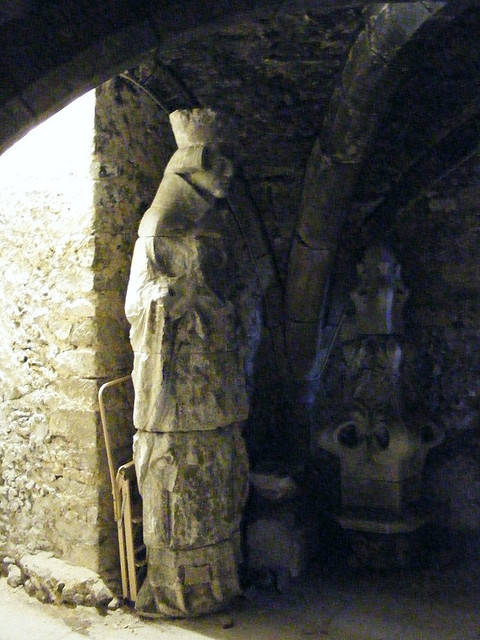
Saint Eustathe d'Antioche
Patriarche d'Antioche,
évêque et confesseur (+ v. 338)
Originaire d'Asie
Mineure, il fut d'abord consacré évêque de Bérée (Alep) puis transféré à
Antioche la Grande. Il prit une part active au concile œcuménique de Nicée. Les
partisans de l'arianisme réussirent à le faire déposer sous de faux
témoignages, le faisant accuser d'une liaison coupable où il aurait eu un
enfant. L'empereur Constantin et sainte Hélène l'envoyèrent
en exil en Thrace où il mourut peu après. Son innocence ne fut reconnue que
quelques années plus tard lorsque cette femme confessa avoir agi sous la
pression de plusieurs évêques partisans de l'arianisme.
21 février: commémoraison
de saint Eustathe, évêque d'Antioche, célèbre par sa doctrine. Pour avoir pris
la défense de la foi catholique, il fut envoyé en exil à Trajanopolis, en
Thrace, par l'empereur Constance favorable aux ariens et il entra dans le repos
du Seigneur vers 338. (martyrologe romain)
Choisi en 324 pour être
patriarche d'Antioche, il rétablit la paix dans une Église divisée par
l'arianisme. Avec saint
Jacques de Nisibe, il participa à un concile dont les saints canons
rappellent quel fut son souci d'avoir un clergé instruit et zélé. Accusé à son
tour d'hérésie par des évêques jaloux, il fut exilé. Une sédition de la
population d'Antioche en sa faveur, incita l'empereur Constantin l'éloigner
plus encore et à le bannir en Thrace puis en Macédoine où il mourut. Justice
lui fut rendue et son corps revint à Antioche. Saint Jérôme dit
de lui qu'il fut l'un des tout premiers à combattre Arius et il loue ses très
grandes connaissances théologiques.
Soutien aux étudiants en Irak #EtudiantsEnIrak
Mgr Mirkis: "En
soutenant les jeunes, nous les maintenons dans le pays. Il y aura ainsi des
médecins, des pharmaciens et architectes, des ingénieurs"
Martyrologe romain
SOURCE : https://nominis.cef.fr/contenus/saint/1330/Saint-Eustathe-d-Antioche.html

Свт. Евстафий, еп. Антиохийский. Миниатюра из Минология. Нач. XI в. (ГИМ. Син. греч. № 183. Л. 103r)
Saint Eustathe, évêque d'Antioche. Miniature du Ménologe.
Début du XIe siècle (Musée historique d'État. Syn. grec, n° 183. Feuille 103r)
Also
known as
Eustathius the Great
Eustacius…
Eustatius…
Eustace…
Eustazio…
6 March on
some calendars
5 June on
some calendars
16 July on
some calendars
23
August on some calendars
Profile
Noted for his learning
and personal piety, and his eloquence in the defense of Christianity. Bishop of Beroea, Syria. Bishop of Antioch (modern
Antakya, Turkey) c.324.
Fought Arianism.
Assisted at the General Council of Nice. Exiled by
Emperor Constantine
the Great for his opposition to Arianism.
His De Engastrimytho contra Origenem, an essay on the Witch of Endor, has
survived.
Born
c.270 at
Sida, Pamphylia (in modern Turkey)
c.337 at
Philippi, Macedonia of natural causes
relics transferred
to Antioch in 482
Additional
Information
Book
of Saints, by the Monks of
Ramsgate
Lives
of the Saints, by Father Alban
Butler
Roman
Martyrology, 1914 edition
Saints
of the Day, by Katherine Rabenstein
books
Our Sunday Visitor’s Encyclopedia of Saints
other
sites in english
images
sitios
en español
Martirologio Romano, 2001 edición
fonti
in italiano
nettsteder
i norsk
strony
w jezyku polskim
MLA
Citation
“Saint Eustathius of
Antioch“. CatholicSaints.Info. 18 February 2023. Web. 23 April 2026. <https://catholicsaints.info/saint-eustathius-of-antioch/>
SOURCE : https://catholicsaints.info/saint-eustathius-of-antioch/
Book of Saints
– Eustathius – 16 July
Article
EUSTATHIUS (Saint) Bishop
(July 16) (4th century) A native of Sida in Pamphylia who, as Saint Athanasius
assures us, had confessed the Faith of Christ before the Pagan persecutors, and
was a man of eloquence, learning and virtue. He was made Bishop of Berea in
Syria, and thence reluctantly translated to the Patriarchal See of Antioch. He
assisted at the General Council of Nice, where he opposed the practice of
translating Bishops from one See to another. He contended against the Arians,
being the first, according to Saint Jerome, to do so with the pen. Eusebius of
Nicomedia sought to have him removed from Antioch and by calumnies succeeded in
deceiving the Emperor Constantine and in procuring his banishment, first to
Treves then to Illyricum, where his virtues shone with the brightest lustre. He
died at Philippi in Macedonia, about A.D. 337.
MLA
Citation
Monks of Ramsgate.
“Eustathius”. Book of Saints, 1921. CatholicSaints.Info.
26 January 2013. Web. 23 April 2026.
<https://catholicsaints.info/book-of-saints-eustathius-16-july/>
SOURCE : https://catholicsaints.info/book-of-saints-eustathius-16-july/
Eustathius of Antioch B
(RM)
(also known as Eustace)
Born in Side, Pamphylia;
died in Thrace, Greece, c. 335, or Illyricum, c. 337. Much of what we know
about Eustace comes from Saint Athanasius. Confessor during a persecution by
Diocletian of Licinius, Eustace was a learned, eloquent, and virtuous man. His
ardent zeal for the purity of the faith caused him to be made bishop of Beroea,
Syria. When Saint Philogonius of Antioch died c. 323, the weak and wavering
bishop Paulinus succeeded him for a short time as patriarch. Saint Eustace was
called to replace Paulinus, but he opposed the transfer to the third most
important see because of his zeal for the purity of the faith, the quality most
needed at that time in Antioch. He felt that the transfer of bishops leads to
dangerous temptations of ambition and avarice. In various ways, Eustace was
forced to accept the patriarchal see of Antioch against his will.
He attended the Council
of Nicaea and concurred with his fellow bishops to forbid all translations of
bishops from one see to another. During, before, and after the council, Eustace
was a firm opponent of Arianism both in his preaching and in his writing.
Eustace was an
outstanding bishop. Upon returning to Antioch, he convened a synod to unite the
factions that had developed. He judiciously examined the character and faith of
those seeking ordination. Many he rejected later became leaders of Arianism. He
sent capable, virtuous men into other dioceses within his patriarchate to teach
and encourage the faithful.
In a impolitic move,
Eustace raised violent opposition against Eusebius of Caesarea, a suffragan
bishop of Antioch, who was one of the Arian leaders and close to the throne.
Together with Bishop Eusebius of Nicomedia, the bishop of Caesarea plotted to
remove Saint Eustace from his see. They accused him of altering the Nicene
Creed.
Eusebius of Nicomedia
went to Jerusalem and there gathered like- minded Arians, including Theognis of
Nicea, Eusebius of Caesarea, Patrophilus of Scythopolis, Actius of Lydda,
Theodotus of Laudicea, and other. They returned to Antioch and assembled a
synod in 331. They obtained the false testimony of a women, who said that
Eustace had fathered her child. Eustace protested his innocence and alleged
that tradition requires two or more witnesses before convicting a priest.
Before her death she did declare before many priests that she had been bribed
to make the charge and that Patriarch Eustace was innocent, the father of the
child was another Eustace, a brazier.
The Arians also accused
him of Sabellianism. Although the Catholic bishops present loudly protested
against the injustice of these proceedings, the Arians pronounced a sentence of
deposition against the saint. Eusebius of Nicomedia and Theognis hastened to
inform Emperor Constantine of the decision. The people of Antioch raised a
great sedition on this occasion, but Constantine was open to hearing the
slanders presented by his friends. He ordered Eustace to Constantinople.
Before his departure from
Antioch, the holy pastor assembled the people and exhorted them to remain
steadfast in the true doctrine. Constantine banished Eustace, together with
several of his priests and deacons, first into Thrace, as Saint Jerome and
Saint John Chrysostom testify, then into Illyricum, as Theodoret adds
(Benedictines, Encyclopedia, Husenbeth).
SOURCE : http://www.saintpatrickdc.org/ss/0716.shtml
St.
Eustathius
Bishop of Antioch, b. at Side in
Pamphylia, c. 270; d. in exile at Trajanopolis in Thrace,
most probably in 360, according to some already in 336 or 337. He was at
first Bishop of
Beræa in Syria,
whence he was transferred to Antioch c. 323. At the Council of Nicæa (325),
he was one of the most prominent opponents of Arianism and from
325-330 he was engaged in an almost continuous literary warfare against
the Arians. By
his fearless denunciation of Arianism and his
refusal to engage any Arian priests in
his diocese, he
incurred the hatred of
the Arians, who,
headed by Eusebius
of Cæsarea and his namesake of Nicomedia, held a synod
at Antioch (331) at which Eustathius was accused, by suborned witnesses,
of Sabellianism,
incontinency, cruelty, and other crimes. He was deposed by the synod and
banished to Trajanopolis
in Thrace by order of the Emperor Constantine, who
gave credence to the scandalous tales
spread about Eustathius. The people of Antioch, who loved and revered
their holy and learned patriarch, became indignant at the injustice done to
him and were ready to take up arms in his defence. But Eustathius kept them in
check, exhorted them to remain true to the orthodox faith and humbly
left for his place of exile, accompanied by a large body of his clergy. The adherents of
Eustathius at Antioch formed a separate community by the name of Eustathians
and refused to acknowledge the bishops set over
them by the Arians.
When, after the death of Eustathius, St. Meletius became Bishop of Antioch in 360 by
the united vote of the Arians and
the orthodox,
the Eustathians would not recognize him, even after his election was approved
by the Synod of Alexandria in 362. Their intransigent attitude gave rise to two
factions among the orthodox,
the so-called Meletian
Schism, which lasted till the second decade of the fifth century
(Cavallera, Le schisme d'Antioche, Paris, 1905).
Most of the numerous
dogmatic and exegetical treatises
of Eustathius have been lost. His principal extant work is "De
Engastrimytho", in which he maintains against Origen that the
apparition of Samuel (1
Samuel 28) was not a reality but a mere phantasm called up in the brain of
Saul by the witch of
Endor. In the same work he severely criticizes Origen for his
allegorical interpretation of the Bible.
A new edition of it, together with the respective homily of Origen, was made by A.
Jahn in Gebhardt and Harnack's "Texte und Untersuchungen zur Gesch. der
altchristl. Literatur" (Leipzig, 1886), II, fasc. iv. Cavallera recently
discovered a Christological homily: "S.
Eustathii ep. Antioch. in Lazarum, Mariam et Martham homilia
christologica", which he edited together with a commentary on the literary
fragments of Eustathius (Paris, 1905). Fragments of lost writings are found
in Migne (P.G.,
XVIII, 675-698), Pitra and Martin (Analecta Sacra, II, Proleg., 37-40; IV,
210-213 and 441-443). "Commentarius in Hexaemeron" (Migne, P.G., XVIII,
707-794) and "Allocution ad Imp. Constantinum in Conc. Nicæno" (Migne, P.G., XVIII, 673-676)
are spurious. His feast is
celebrated in the Latin
Church on 16 July, in the Greek on 21 Feb. His relics were brought
to Antioch.
Sources
BUTLER, Lives of the
Saints, 16 July; BARING -GOULD, Lives of the Saints, 19 July;
VENABLES in Dict. Christ. Biog.k s.v.; Acta SS., July, IV,
130-144; FESSLER-JUNGMANN, Institutiones Patrologiæ (Innsbruck,
1890), I, 427-431; BARDENHEWER, Patrology, SHAHAN tr.
(Freiburg-im-Br., St. Louis, 1908), 252-53.
Ott,
Michael. "St. Eustathius." The Catholic Encyclopedia. Vol.
5. New York: Robert Appleton
Company, 1909. <https://www.newadvent.org/cathen/05627b.htm>.
Transcription. This
article was transcribed for New Advent by WGKofron. With thanks to Fr.
John Hilkert and St. Mary's Church, Akron, Ohio.
Ecclesiastical
approbation. Nihil Obstat. May 1, 1909. Remy Lafort, Censor. Imprimatur. +John
M. Farley, Archbishop of New York.
Copyright © 2026 by New Advent LLC.
Dedicated to the Immaculate Heart of Mary.
SOURCE : https://www.newadvent.org/cathen/05627b.htm
St. Eustathius, Patriarch
of Antioch, Confessor
From St. Athanasius,
Sozomen, Theodoret, l. 1, Hist. c. 6, St. Jerom, in Catal. c. 85. See Tillem.
t. 7, p. 21. Ceillier, t. 4, and the Bollandists, Bosch in his Life, t. 4. Jul.
p. 130, and Solier in Hist. Chron. Patr. Antioch. ante, t. 4, Jul. p. 35.
A.D. 338.
ST. EUSTATHIUS was a
native of Sida, in Pamphylia, and with heroic constancy confessed the faith of
Christ before the pagan persecutors, as St. Athanasius assures us, 1 though
it does not appear whether this happened under Dioclesian or Licinius. He was
learned, eloquent, and eminently endowed with all virtue, especially an ardent
zeal for the purity of our holy faith. Being made bishop of Beræa, in Syria, he
began in that obscure see to be highly considered in the church, insomuch that
St. Alexander, of Alexandria, wrote to him in particular against Arius and his
impious writings, in 323. St. Philogonius, bishop of Antioch, a prelate
illustrious for his confession of the faith, in the persecution of Licinius,
died in 323. One Paulinus succeeded him, but seems a man not equal to the
functions of that high station; for, during the short time he governed that
church, tares began to grow up among the good seed. To root these out, when
that dignity became again vacant, in 324, the zeal and abilities of St.
Eustathius were called for, and he was accordingly translated to this see, in
dignity the next to Alexandria, and the third in the world. He vigorously
opposed the motion, but was compelled to acquiesce. Indeed, translations of
bishops, if made without cogent reasons of necessity, become, to many,
dangerous temptations of ambition and avarice, and open a door to those fatal
vices into the sanctuary. To put a bar to this evil, St. Eustathius, in the
same year, assisting at the general council of Nice, zealously concurred with
his fellow bishops to forbid for the time to come all removals of bishops from
one see to another. 2 The
new patriarch distinguished himself in that venerable assembly by his zeal
against Arianism. Soon after his return to Antioch he held a council there to
unite his church, which he found divided by factions. He was very strict and
severe in examining into the characters of those whom he admitted into the
clergy, and he constantly rejected all those whose principles, faith, or
manners appeared suspected; among whom were several who became afterwards
ringleaders of Arianism. Amidst his external employs for the service of others,
he did not forget that charity must always begin at home, and he laboured in
the first place to sanctify his own soul; but after watering his own garden he
did not confine the stream there, but let it flow abroad to enrich the
neighbouring soil, and to dispense plenty and fruitfulness all around. He sent
into other diocesses that were subject to his patriarchate, men capable of
instructing and encouraging the faithful. Eusebius, archbishop of Cæsarea, in
Palestine, (which church was, in some measure, subject to Antioch,) favoured
the new heresy, in such a manner as to alarm the zeal of our saint. 3 This
raised a violent storm against him.
Eusebius of Nicomedia
laid a deep plot with his Arian friends to remove St. Eustathius from Antioch,
who had attacked Eusebius of Cæsarea, and accused him of altering the Nicene
Creed. Hereupon, Eusebius of Nicomedia, pretending a great desire to see the city
of Jerusalem, set out in great state, taking with him his confidant, Theognis
of Nice. At Jerusalem they met Eusebius of Cæsarea, Patrophilus of Scythopolis,
Aëtius of Lydda. Theodotus of Laodicea, and several others, all of the Arian
faction: who returned with them to Antioch. There they assembled together, as
in a Synod, in 331, and a debauched woman, whom the Arians had suborned, coming
in, showed a child which she suckled at her breast, and declared that she had
it by Eustathius. The saint protested his innocence, and alleged that the
apostle forbids a priest to be condemned unless convicted by two or more
witnesses. This woman, before her death, after a long illness, called in a
great number of the clergy, and publicly declared to them the innocence of the
holy bishop, and confessed that the Arians had given her money for this action,
pretending that no perjury was implied in her oath, upon the frivolous and
foolish plea that she had the child by a brazier of the city called Eustathius. 4 The
Arians accused him also of Sabellianism, as Socrates and others testify; this
being their general charge and slander against all who professed the orthodox
faith.
The Catholic bishops who
were present with Eustathius, cried out loudly against the injustice of these
proceedings, but could not be heard, and the Arians pronounced a sentence of
deposition against the saint; and Eusebius of Nicomedia and Theognis hastened
to inform the Emperor Constantine of these proceedings. The Arian bishops
invited Eusebius of Cæsarea to exchange his see for the patriarchal chair of
Antioch; but he alleged the prohibition of the canons; and the Emperor
Constantine commended his modesty, by a letter which Eusebius has inserted in
his life of that prince. 5 We
should have been more edified with his humility had this circumstance been only
recorded by others. 6 This
happened, not in 340, as Baronius and Petavius imagine, but in 330 or 331, as
is manifest not only from the testimony of Socrates, Sozomen, Theodoret, and
Philostorgius, but also from several circumstances of the affair. 7 The
people of Antioch raised a great sedition on this occasion, but the Emperor
Constantine, being prepossessed by the slanders of the two bishops, ordered St.
Eustathius to repair to Constantinople, and thence sent him into banishment.
The holy pastor assembled the people before his departure from Antioch, and
exhorted them to remain steadfast in the true doctrine, which exhortations were
of great weight in preserving many in the Catholic faith. St. Eustathius was
banished, with several priests and deacons, first into Thrace, as St. Jerom and
St. Chrysostom testify, and from thence into Illyricum, as Theodoret adds.
Socrates and Sozomen confound him with a priest of Constantinople of the same
name, when they tell us he was recalled by Jovian, and survived till the year
370; for St. Eustathius died thirty years before St. Meletius was advanced to
the see of Antioch in 360, as Theodoret testifies. Nor was he mentioned in the
council of Sardica, or in any of the disputes that followed; and our best
critics and historians conclude him to have been dead in 337. Philippi, in
Macedon, which, in the division of the empire into diocesses, was comprised in
that of Illyricum, was the place of his death, 8 but
his body was interred at Trajanopolis, in Thrace, from which city Calandion,
one of his successors, caused it to be translated to Antioch, about the year
482, as Theodorus Lector informs us. 9t.
Eustathius bore his exile with patience and perfect submission, and was under
its disgraces and hardships greater and more glorious than whilst his zeal and
other virtues shone with the brightest lustre on the patriarchal throne. We may
please ourselves in those actions in which we seem to be something; into which,
however, self-love, under a thousand forms, easily insinuates itself. But the
maxims of our Divine Redeemer teach us that no circumstances are so happy for
the exercise of the most heroic virtue as humiliations and distresses when sent
by Providence. These put our love to the test, apply the remedy to the very
root of our spiritual disorders, employ the most perfect virtues of meekness,
forgiveness, and patience, and call forth our resignation, humility, and
reliance on Providence; in these trials we learn most perfectly to die to our
passions, to know ourselves, to feel our own nothingness and miseries, and with
St. Paul to take pleasure in our infirmities. Here all virtue is more pure and
perfect. A Christian suffering with patience and joy, bears in spirit the
nearest resemblance to his crucified Master, and enters deepest into his most
perfect sentiments of humility, meekness, and love: for Jesus on his cross is
the model by which his disciples are bound to form themselves, which they no
where can do with greater advantage than when they are in a like state of
desolation and suffering.
Note 1. Hist. Arian
ad Monachos, p. 346. [back]
Note 2. Conc. Nicæn.
Can. 15. [back]
Note 3. That prelate
had been educated at Cæsarea, where he studied with St. Pamphilus the martyr,
whose name he afterwards added to his own. He suffered imprisonment with him
for the faith about the year 309, but recovered his liberty without undergoing
any severer trial, and was chosen archbishop of Cæsarea in 314. When Arius, in
320, retired from Alexandria into Palestine, having been deposed from the
priesthood by St. Alexander the year before, Eusebius of Cæsarea and some other
bishops were imposed upon by him, and received him favourably. Hereupon Arius
wrote to Eusebius of Nicomedia, whom he calls brother to the other Eusebius of
Cæsarea. Eusebius of Nicomedia was at that time of an advanced age, and had
great interest with Constantine, who after the defeat of Licinius kept his
court some time at Nicomedia as other emperors had done before him since
Dioclesian had begun to reside in the East. This prelate was crafty and
ambitious; his removal, procured by his intrigues, from his first see of
Berytus to Nicomedia seems to have given occasion to the canon of the Nicene
council, by which such translations were forbidden. Notwithstanding which, in
defiance of so sacred a law, he afterwards procured himself to be again
translated to the see of Constantinople, in 338, in the beginning of the reign
of Constantius. The council of Sardica, in 347, confirmed the above-mentioned
Nicene canon under pain of the parties being deprived even of lay communion at
their death; but this arch-heretic died in 342. He openly defended not only the
person, but also the errors of Arius; subscribed the definitions of the Nicene
council for fear of banishment; but three months after, being the author of new
tumults, he was banished by Constantine, and after three years recalled, upon
giving a confession of faith in which he declared himself penitent, and
professed that he adhered to the Nicene faith, as Theodoret relates. By this
act of dissimulation he imposed upon the emperor, but he continued by every
base art to support his heresy, and endeavoured to subvert the truth. Eusebius
of Cæsarea held that see from 314 till his death in 339. He was always closely
linked with the ringleaders of the heresy. Nevertheless, the learned Henry
Valois, in his Prolegomena to his translation of this author’s Ecclesiastical
History, pretends to excuse him from its errors, though he often boggled at the
word Consubstantial. He certainly was so far imposed upon by Arius, as to
believe that heretic admitted the eternity of the Divine Word; and in his
writings many passages occur which prove the divinity and, as to the sense, the
consubstantiality of the Son, whatever difficulties he formed as to the word.
On which account Ceillier and many others affect to speak favourably, or at
least tenderly of Eusebius in this respect, and are willing to believe that he
did not at least constantly adhere to that capital error. Yet it appears very
difficult entirely to clear him from it, though he may seem to have attempted
to steer a course between the tradition of the church and the novelties of his
friends. See Baronius ad an. 380, Witasse Nat. Alexander, and the late Treatise
in folio, against the Arian heresy, compiled by a Maurist Benedictin monk.
Photius, in a certain work given us by Montfaucon, (in Bibl. Coisliana, p.
348,) roundly charges Eusebius with Arianism and Origenism.
Eusebius, whose conduct
was so inconstant and equivocal, shines to most advantage in his works,
especially those which he composed in defence of Christianity before the Arian
contest arose. The first of these is his book against Hierocles, who, under
Dioclesian, was a persecuting judge at Nicomedia, and afterwards rewarded for
his cruelty against the Christians with the government of Egypt. In a book he
wrote he made Apollonius Tyanæus superior to Christ. But Eusebius demonstrates
the history of this magician, written by Philostratus, when he taught rhetoric
at Rome, one hundred years after the death of that magician, to be false and
contradictory in most of its points, doubtful in others, and trifling in all.
About the time he was made bishop he conceived a design of two works, which
showed as much the greatness of his genius, as the execution did the extent of
his knowledge. The first of these he called The Preparation, the other The
Demonstration of the Gospel. In the first he, with great erudition, confutes
idolatry, in fifteen books, showing that the Greeks borrowed the sciences and
many of their gods from the Egyptians, whose true history agrees with that of
Moses; but the fictions of their theology are monstrous, impious, and condemned
by their own learned men; that their oracles, which were only a chain of
impostures and frauds, or the responses of devils, never attained to any
infallible knowledge of contingencies, and were silenced by a power which they
acknowledged superior. He also shows the Unity of God, and the truth of his
revealed religion as ancient as the world. In his Demonstration of the Gospel,
in ten books, he shows that the Jewish law in every point clearly points out
Christ and the gospel. These books of Evangelical Preparation and Demonstration
furnish more proofs, testimonies, and arguments for the truth of the Christian
religion than any other work of the ancients on that subject.
Eusebius’s two books
against Marcellus of Ancyra, and three On Ecclesiastical Theology are a
confutation of Sabellianism. His topography or alphabetical explication of the
places mentioned in the Old Testament, is most exact and useful. It was
translated into Latin, and augmented by St. Jerom. Eusebius’s useful Comments
on the Psalms were published by Montfaucon. (Collect. Nova Script. Græc. Paris,
1706.) His fourteen Discourses or Opuscula, published by F. Sirmond, (Op.
Sirmond, t. 1,) are esteemed genuine, though not mentioned by the ancients. His
discourse on the Dedication of the Church at Tyre, rebuilt after the
persecution, in 315, contains a curious description of that ceremony and of the
structure. By his letter to his Church of Cæsarea, after the conclusion of the
council of Nice, he recommended to his flock the definitions and creed of that
assembly. His panegyric of Constantine was delivered at Constantinople in
presence of that prince, who then celebrated the thirtieth year of his reign by
public games. The praises are chiefly drawn from the destruction of idolatry;
but study reigns in this composition more than nature, and renders the
discourse tedious, though the author took some pains to polish the style. His
four books of the Life of Constantine were written in 338, the year after that
emperor’s death. The style is diffusive, and the more disagreeable by being
more laboured. Photius reproaches the author for dissembling or suppressing the
chief circumstances relating to Arius, and his condemnation in the council of
Nice.
The Chronicle of Eusebius
was a work of immense labour, in two parts; the first called his Chronology,
contained the distinct successions of the kings and rulers of the principal
nations from the beginning of the world; the second part, called the Chronicle
or the Rule of Times, may be called a table of the first, and unites all the
particular chronologies of different nations in one. This second part was
translated into Latin, and augmented by St. Jerom. The first part was lost when
Joseph Scaliger gathered the scattered fragments from George Syncellus,
Cedrenus, and the Alexandrian Chronicle; but Scaliger ought to have pointed out
his sources; and has inserted many things which certainly belong not to
Eusebius.
Our author’s name has
been rendered most famous by his ten books of Church History, which he brings
down to the defeat of Licinius, in 323, when he first wrote it, though he
revised it again in 326. He collected the Acts of the Martyrs of Palestine, an
abstract of which he added to the eighth book of his History. Rufinus elegantly
translated this work into Latin, reduced to nine books, to which he added two
others, wherein he brings down his history to the death of Theodosius. Eusebius
copied very much Julius Africanus in his Chronicle; and in his History, St.
Hegesippos (who had compiled a History from Christ to 170) and others. This
invaluable work is not exempt from some mistakes and capital omissions; nor was
the author much acquainted with the affairs of the Western Church. (See
Ceillier, t. 4, p. 258,) &c. Christophorson, bishop of Chichester,
elegantly translated this History into Latin, but changed the manner of
dividing the chapters. The translation of the learned Henry Velesius is most
accurate. Eusebius was one of the most learned prelates of antiquity, and a man
of universal reading; but he did not much study to polish his discourses, which
is the common fault of those who make learning and knowledge their chief
business. [back]
Note 4. Theodoret,
l. 1, c. 20, 21. S. Hier. l. 3, in Rufin, &c. [back]
Note 5. Eus. l. 4,
de Vit. Constant. c. 61, p. 518. [back]
Note 6. Sozom. l. 2,
c. 19, p. 469. [back]
Note 7. See
Tillemont, Ceillier, Cave, Hist. Littér. p. 187, t. 1, and Solier, the
Bollandist. Hist. Patr. Ant. c. 24, p. 36. [back]
Note 8. Theodoret,
l. 1, c. 20. Theodorus Lector, l. 2, c. 1, p. 547. Theophanes, p. 114. See
Tillem. note 4, p. 653. [back]
Note 9. St. Jerom
(ep. 126, p. 38,) calls St. Eustathius a loud sounding trumpet, and says he was
the first who employed his pen against the Arians. The same father admires the
extent of his knowledge, saying that it was consummate both in sacred and
profane learning, (ep. 84, p. 327.) His just praises are set forth by St.
Chrysostom in an entire panegyric; and Sozomen assures us (l. 1, c. 2,) that he
was universally admired both for the sanctity of his life, and the eloquence of
his discourses. The elegant works which he composed against the Arians were
famous in the fifth century, but have not reached us. But we have still his
Treatise on the Pythonissa or Witch of Endor, published by Leo Allatius, with a
curious Dissertation, and reprinted in the eighth tome of the Critici Sacri. In
it the author undertakes to prove against Origen that this witch neither did
nor could call up the soul of Samuel, but only a spectre or devil representing
Samuel, in order to deceive Saul. He clearly teaches that before the coming of Christ
the souls of the just rested in Abraham’s bosom; and that none could enter
heaven before Christ had opened it; but that Christians enjoy an advantage
above the patriarchs and prophets, in being united with Christ immediately
after their death if they have lived well. This treatise is well written, and
justifies the commendations which the ancients give to this great prelate and
eloquent orator. Sozomen justly calls his writings admirable, as well for the
purity of his style as for the sublimity of thought, the beauty of the
expression, or the curious choice of the matter. Nothing more enhances his
virtue, than the invincible constancy and patience with which he suffered the
most reproachful accusation with which his enemies charged him, and the unjust
deposition and banishment which were inflicted on him. [back]
Rev. Alban
Butler (1711–73). Volume VII: July. The Lives of the
Saints. 1866.
SOURCE : http://www.bartleby.com/210/7/161.html
Sant' Eustazio di
Antiochia Vescovo
Festa: 21 febbraio
† Traianopoli, Tracia,
338 circa
Sant’Eustazio, vescovo di
Antiochia al tempo dell’imperatore ariano Costanzo, per la sua presa di
posizione in difesa della fede cattolica fu esiliato a Traianopoli, in Tracia,
dove morì nel 338 circa.
Etimologia: Eustazio
= che sta bene, dal latino Eustathius, tratto dal greco Eystàtios
Martirologio
Romano: Commemorazione di sant’Eustazio, vescovo di Antiochia, che,
illustre per dottrina, sotto l’imperatore ariano Costanzo fu mandato in esilio
a Tuzla in Tracia per aver difeso la fede cattolica e qui riposò nel Signore.
Oriundo di Sida in Panfilia, Eustazio fu un uomo eloquente, erudito e virtuoso, secondo quanto ci è stato tramandato. Designato vescovo della città siriana di Berea, meritò intorno al 324 di essere elevato alla sede di Antiochia, che allora deteneva ancora il terzo posto per importanza nella gerarchia della Chiesa universale, dopo Roma ed Alessandria. L’anno seguente fu accolto con tutti gli onori al concilio di Nicea, ove si distinse per la sua totale opposizione all’arianesimo. Quale capo della Chiesa di Antiochia, aveva anche giurisdizione sulle diocesi circostanti, nelle quali insediò vescovi degni d’istruire e guidare il proprio gregge.
La sua netta opposizione all’arianesimo lo portò ad uno scontro frontale con Eusebio, vescovo di Cesarea, celebre “padre della storia della Chiesa”, che per ripicca non lo nominò mai nella sua preziosa opera. Eustazio lo aveva infatti accusato di alterare il senso del credo niceno, scatenando così una feroce lotta tra i vescovi ortodossi e quelli che ancora parteggiavano per la dottrina ariana.
Eusebio, assiduo frequentatore della corte imperiale, riuscì nel 330 a persuadere Costantino a deporre Eustazio, ma quando l’anno seguente gli fu offerta proprio tale sede episcopale, preferì rifiutare. Il legittimo vescovo fu comunque esiliato a Traianopoli in Tracia, ma prima di lasciare la sua cattedra, parlò al suo gregge con una forza tale che parecchi decisero di dare vita ad una fazione e suo sostegno, tenacemente opposta ai vescovi ariani. Eustazio morì infine in esilio verso l’anno 338.
Scrisse parecchie opere, purtroppo andate tutte perdute. La più importante di esse era il trattato “Adversus Arianos” in otto volumi. A parte rari framment, l’unico brano pervenutoci appartiene al trattato antiorigenista “De engastrimutho”, noto come “La pitonessa di Endor contro Origene” o “Il Ventriloquo contro Origene”. Pare che la sua teologia fosse la medesima della scuola di Antiochia, con un approccio alla Scrittura decisamente più storico e critico rispetto a quello di Alessandria. Ciò lo portò anche ad essere talvolta sospettato di nestorianesimo e sabellianismo. Secondo la prima teoria in Cristo sussisterebbero due persone separate, mentre la seconda vuole Dio assolutamente uno e perciò i nomi “Padre” “Figlio” e “Spirito Santo” indicherebbero in Dio solo differenti modi ed azioni, ma non persone distinte.
Autore: Fabio Arduino
SOURCE : https://www.santiebeati.it/dettaglio/92835
Den hellige Eustathios av
Antiokia (~270-~338)
Minnedag:
21. februar
Antiokia ved Orontes (i
dag Antakya i Sørøst-Tyrkia) var på den tiden kristenhetens tredje viktigste
bispesete etter Roma og Alexandria. Da den hellige Filogonius av
Antiokia døde rundt 323, etterfulgte den svake og vaklende biskop
Paulinus ham en kort tid som patriark. Eustathios ble kalt til å erstatte
Paulinus på grunn av sin iver for troens renhet, den egenskapen som trengtes
mest i Antiokia på den tiden. Men han motsatte seg å bli overført til et annet
bispesete, for han følte at flyttingen av biskoper medførte vanskelige
fristelser til ambisjoner og havesyke. Men på ulike måter og mot sin vilje ble
han i 324 tvunget til å akseptere patriarksetet i Antiokia.
Han deltok i 325 på
Kirkens første konsil, innkalt av keiser Konstantin I den Store (306-37) i
Nikea i Bitynia (i dag Iznik i Tyrkia). Der forbød han sammen med sine
medbiskoper overflyttingen av biskoper fra ett sete til et annet. På konsilet
var han en av de drabeligste motstanderne av arianismen, og mellom 325 og 330
var han engasjert i en nesten kontinuerlig skriftlig krig mot arianerne. Da han
kom tilbake til Antiokia etter konsilet, sammenkalte han en synode for å forene
de fraksjonene som hadde dannet seg. Han nektet å engasjere noen ariansk prest
i sitt bispedømme, og han undersøkte omhyggelig karakteren og troen til dem som
søkte ordinasjon. Mange av dem han avviste, ble senere ledere for arianismen.
Han sendte dyktige menn til andre bispedømmer innen sitt patriarkat for å
undervise og oppmuntre de troende. Som biskop av Antiokia hadde han
overoppsynet med nabobispedømmene, hvor han utnevnte biskoper som var i stand
til å instruere og oppmuntre sine flokker.
Men etter hvert vant
arianismen stadig flere tilhengere, og Eustathios’ motstand mot kjetteriet
brakte ham i konflikt med den berømte kirkehistorikeren Eusebius av
Caesarea (ca 260-340), som overhodet ikke nevner Eustathios i sin
Kirkehistorie (Historia ecclesiastica). Eustathios beskyldte ham for å
forvrenge den nikenske trosbekjennelsen. Dette fremprovoserte en storm blant
biskoper som fortsatt støttet arianismen, som da fikk ny støtte fra
keiserhoffet, iherdig dyrket av Eusebius.
Lederen for arianerne,
Eusebius av Nikomedia i Bitynia i Lilleasia (i dag Izmit i Tyrkia), lot som om
han hadde en stor lengsel etter å se byen Jerusalem, så han satte avgårde og
tok med seg sin fortrolige, Theognis av Nikea. I Jerusalem møtte de Eusebius av
Caesarea, Patrofilos av Skytopolis, Aëtius av Lydda, Theodotus av Laodicea og
flere andre fra den arianske fraksjonen. Alle returnerte sammen med dem til
Antiokia. Der samlet de seg i 331 til en synode hvor Eustathios ble avsatt av
det arianske flertallet, som ble ledet av Eusebius av Caesarea og Eusebius av
Nikomedia, etter falske anklager om sabellianisme, ukyskhet, grusomhet og andre
forbrytelser.
Eustathios ble forvist
til Trajanopolis i Trakia (dagens Bulgaria) etter ordre fra keiser Konstantin,
som trodde på de skandaløse ryktene om Eustathios. Folket i Antiokia, som
elsket og æret sin fromme og lærde patriark, var rasende over behandlingen han
fikk og var villige til å gripe til våpen for å forsvare ham. Men Eustathios
fikk stagget dem, formante dem til å være trofaste mot den ortodokse tro og dro
ydmykt av sted til sitt eksil, fulgt av en stor del av presteskapet. Eusebius
av Caesarea ble tilbudt patriarksetet året etter, men han avslo. Eustathios’
tilhengere i Antiokia ville ikke følge hans etterfølger som patriark, så de
dannet sitt eget lille samfunn, «eustathianerne».
Eustathios’ forvisning
til Trakia bevitnes av de hellige Hieronymus (ca
342-420) og Johannes
Krysostomos (ca 347-407), mens Theodoret av Cyrrhus, en av
kirkehistorikerne som fortsatte Eusebius av Caesareas arbeid og dekker årene
fra 323 til 428, legger til at han deretter ble sendt til Illyria. Han døde i
sitt eksil i Trajanopolis i Trakia (eller i Illyria?) rundt 338 (noen kilder
sier rundt 360). Han ble gravlagt i Trajanopolis, og derfra kom hans relikvier
i 482 til Antiokia.
Etter hans død gikk både
ortodokse og arianere i 360 sammen om å velge den hellige Meletius til
biskop av Antiokia, men eustathianerne ville ikke anerkjenne ham, selv etter at
valget var godkjent av synoden i Alexandria i 362. Deres stivsinn førte til at
det oppsto to fraksjoner blant de ortodokse, det såkalte meletianske skisma,
som varte til 410-tallet.
De fleste av Eustathios’
mange dogmatiske og eksegetiske avhandlinger er gått tapt. Blant dem er
avhandlingen «Mot arianerne» (Adversus Arianos) i åtte bind.
Den Allocutio ad Imperatorem som er blitt tilskrevet ham, er neppe
ekte. Hans viktigste bevarte verk er De Engastrimytho contra Origenem,
hvor han kritiserer Origenes. Han
ser i Origenes’ teologi røttene til arianismen. Hans teologi synes å ha vært av
den antiokiske skolen, med en mer historisk og kritisk tilnærming til Skriften
enn i Alexandria, og dette har ført til at han er blitt mistenkt for
nestorianisme og sabellianisme.
I 482 ble Eustathios’
relikvier overført fra Filippi til Antiokia. Han ble høyt æret av de store
hierarkene på 300-tallet, som de hellige Basilios den Store av
Caesarea (ca 330-79), Johannes Krysostomos, Athanasius av
Alexandria (ca 296-373), Epifanios av
Salamis (ca 315-403), Anastasius av Sinai og Hieronymus. Den berømte
kirkehistorikeren og biskopen Theodoret av Cyrrhus kaller ham en pilar i Kirken
og Athanasius’ likemann i kampen for ortodoksien.
Eustathios’ minnedag i
Martyrologium Romanum er 21. februar, da også grekerne feirer ham, men
tidligere ble han minnet den 16. juli i Martyrologium Romanum. Andre minnedager
i øst er 5. juni og 23. august. Han gis noen ganger tilnavnet «den Store». Noen
kilder sier han trolig er den historiske skikkelsen som ligger til grunn for
legendenes Eustasius.
Dette gjelder for eksempel den salige kardinal Alfred Ildefons
Schuster av Milano (1880-1954) i hans Liber Sacramentorum fra
1929/32.
Kilder:
Attwater/Cumming, Butler (II), Benedictines, Bunson, Melchers, Gorys, KIR, CE,
Patron Saints SQPN, Infocatho, Bautz, santiebeati.it, en.wikipedia.org,
orthodoxwiki.org, zeno.org, britannica.com, oca.org, Butler 1866 - Kompilasjon
og oversettelse: p. Per Einar Odden
Opprettet: 27. november
1999
SOURCE : https://www.katolsk.no/biografier/historisk/eantioki