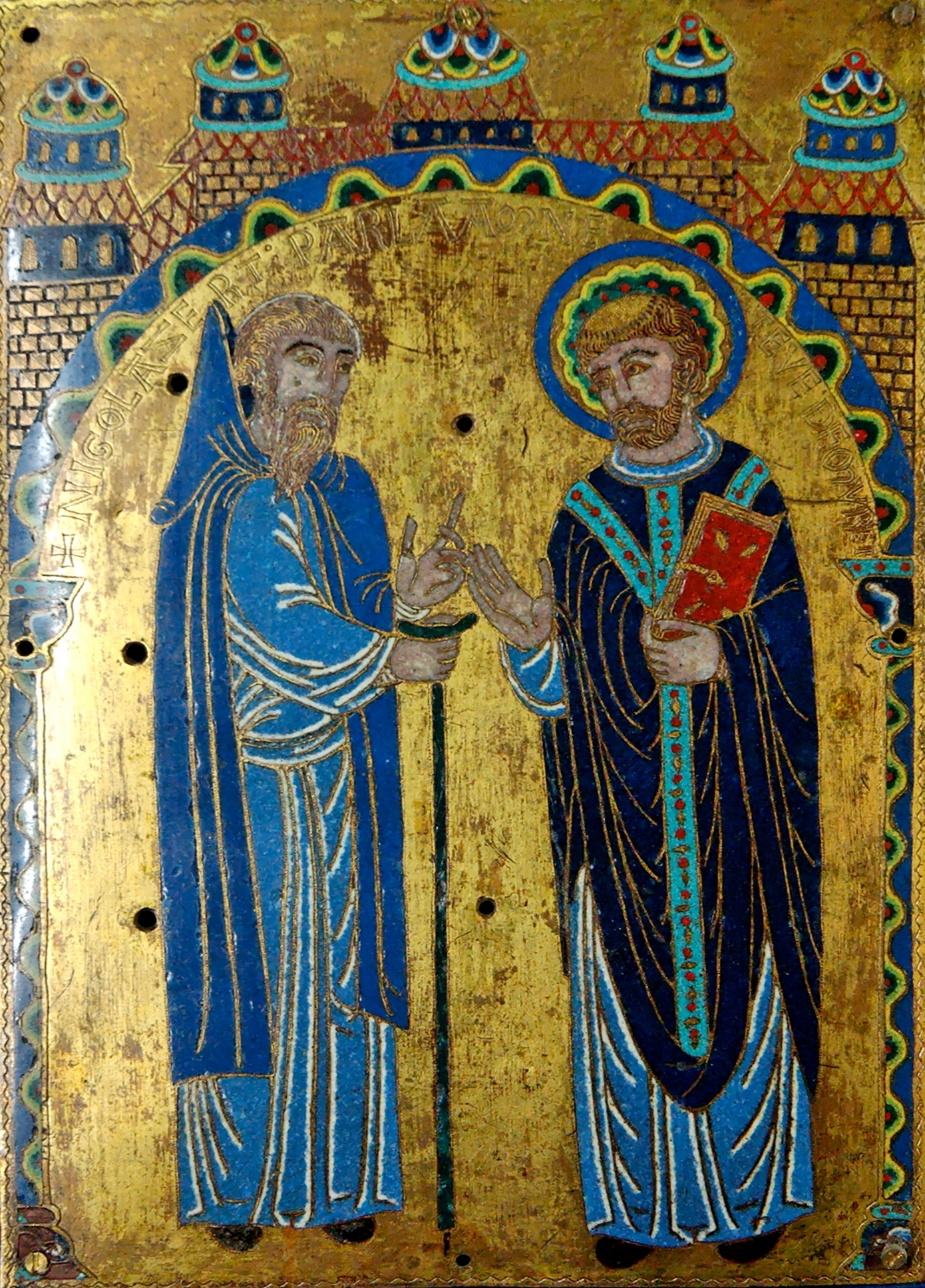
Saint Étienne et Hugues de La Certa, plaque du maître-autel de l'abbaye de Grandmont, XIIe siècle
St. Stephen of Muret and Hugh of Lacerta, plaque from the high altar of the Abbey of Grandmont, 12th century (Musée de Cluny)
Formella dell'altare dell'Abbazia di Grandmont con Ugo di La Certa e santo Stefano di Grandmont (XII secolo); Parigi, Museo di Cluny
Saint Etienne "de
Grandmont", abbé
Auvergnat de naissance,
ayant vécu une partie de sa jeunesse en Italie du Sud, il y eut sans doute
l’occasion d’entrer en contact avec des groupes d’ermites aux environs de
Bénévent. Il revient à 30 ans, vers 1078, dans le Limousin, renonce à tous ses
biens et gagne la forêt de Muret où il mène une vie de pénitence dans la
solitude des hommes et la présence de Dieu. Au bout de quelques temps, des
disciples le rejoignent et cette petite communauté d'ermites marquée par un
retour à une vie plus austère participera au renouveau de la vie monastique et
influencera de manière significative la renaissance spirituelle du XII e
siècle. Après sa mort, le 8 février 1124, ses disciples s’établissent à
Grandmont qui donnera son nom à l’ordre fondé par saint Etienne, appelé depuis
« saint Etienne de Grandmont ».
Saint Etienne de
Grandmont
Fondateur de
Grandmont (+ 1124)
Fils du vicomte de Thiers
en Auvergne, il est confié à 12 ans au doyen du chapitre de Paris et lorsque
celui-ci est nommé évêque de Bénévent en Italie, Etienne le suit. Après sa
mort, en 1078, il rentre à Thiers, renonce à tous ses biens et gagne la forêt
de Muret où il mène une vie de grande austérité dans la solitude des hommes et
la présence de Dieu. Au bout de quelques temps, des disciples le rejoignent et
cette petite communauté d'ermites quitta Muret après sa mort et s'établit
à Grandmont dans le Limousin. C'est du nom de ce lieu que vient celui de
cette congrégation.
Le roi d'Angleterre Henri
II obtint sa canonisation en 1189.
Voir aussi:
- L’expansion monastique
à l’époque féodale.
parmi les ordres
monastiques fondés à la fin du XIe siècle ou au début du XIIe siècle, figure
l’ordre de Grandmont dont le but est un retour à une vie plus austère. Son
fondateur, Etienne de Muret mène d’abord une vie d’ermite ; mais des disciples
viennent le rejoindre. Sur des terres qu’il a reçues, il peut entreprendre la
construction d’une église et d’un monastère. Mais il n’a pas terminé son œuvre
quand il meurt. (site
internet du diocèse de Limoges).
- Le nouvel autel de
Saint Jean de Montjoyeux contient des reliques de St Étienne de Muret
Auvergnat de naissance,
ayant vécu en Italie centrale, il revient à l’âge de 30 ans dans le Limousin. A
sa mort, en 1124, il laisse à ses disciples, comme règle de vie: «l’Évangile,
tout l’Évangile, rien que l’Évangile». L’ordre de Grandmont était né.
Monseigneur Aubertin, au
cours de son homélie: «St Etienne voulait retrouver le sens profond de la règle
de Saint Benoît qui invite à suivre le Christ» en insistant sur la force du
premier et du dernier mot de cette règle : «écoute…» et «tu parviendras…» (site
internet du diocèse de Tours).
- Saint Etienne de Muret,
fondateur de l'Ordre de Grandmont. (site
internet du Ministère de la culture).
À Muret dans le Limousin,
en 1124, saint Étienne, abbé, fondateur de l’Ordre de Grandmont, où il confia
aux clercs la louange divine et la contemplation, et aux seuls frères laïcs le
temporel à gérer non par domination mais par charité.
Martyrologe romain
SOURCE : http://nominis.cef.fr/contenus/saint/593/Saint-Etienne-de-Grandmont.html
Saint Étienne de
Grandmont
L'Ordre de Grandmont
était un ordre monastique originaire du Limousin fondé vers 1076 et dissous en
1772.
Cet ordre qui a été assez
répandu en Aquitaine, ainsi que de l’Angleterre à l’Espagne, se caractérisait
par sa règle et la diffusion de son modèle architectural unique ( tous les
monastères sont construits sur le même plan), conforme à la réforme grégorienne
A l'origine de l’ordre de
Grandmont, se trouve un ermite, Étienne, surnommé, "Étienne de Muret"
après qu’il se soit retiré dans les bois d’Ambazac (au nord de Limoges). C’est
un personnage tout à fait historique - même s’il y a des légendes à son sujet -
dont l’oeuvre est connue par diverses sources écrites et par la transmission
orale de sa règle, tout particulièrement à l'attention de son disciple favori,
Hugues de Lacerta, C'est ce disciple qui fut à l'origine du premier
recueil des pensées et directives du saint destiné à ses disciples.
Né vers 1046-1048,
Étienne serait, d'après la légende, fils d'un vicomte de Thiers en Auvergne.
Dès l'âge de douze ans, il serait partit avec son père en pèlerinage à Bari en
Italie, pour y vénérer les reliques de saint Nicolas. Le petit Étienne tomba
malade lors de l’escale qu’il fit avec son père, chez l’Archevêque Milon de
Bénévent en calabre. L’Archevêque aurait pris Étienne en affection et aurait
gardé l’enfant auprès de lui pour faire son éducation pendant douze ans. Plus
vraisemblablement il aurait été placé auprès du doyen du chapitre de Paris,
Milon, qui, élevé au rang d'archevêque de Bénévent en Italie, aurait emmené le
jeune garçon avec lui.
Le prélat l’aurait
ordonné diacre puis élevé au rang d'archidiacre de son diocèse... C’est près de
Bénévent (Calabre) qu’Etienne aurait connu une communauté d’ermites (peut-être
des Camaldules dont l’ordre fut fondé à Camaldoli en Toscane en 1012) vivant de
pauvreté et d’observances régulières (suivant une règle)
Après un séjour de
quelques années dans le milieu de la cour pontificale, Étienne regagna le
Limousin
Selon la tradition, de
retour en Auvergne, après la mort de ses parents, il aurait vendu ses biens et
distribué l’argent aux pauvres. Il aurait ensuite abandonné à son oncle
Guillaume, son titre de vicomte et ses droits de succession sur la baronnie de
Thiers. Étienne, en 1076, se serait ensuite retiré dans les bois d’Ambazac au
lieu-dit Muret au nord-est de Limoges, après avoir cherché un lieu pour y vivre
l’évangile dans la prière et la solitude du ‘’désert‘’, à l’exemple des ermites
qu’il avait vus en Calabre.
A cette époque de
recherche de perfection et de renouveau, la vie érémitique séduisait les
esprits en quête d'absolu. C’est la grande période des ermites en occident ...
Souvent ces ermites se regrouperont et cela aboutira à la fondation d’ordres
religieux mêlant les deux formes de vie, celle de l’érémistime et celle plus
classique du cénobitisme (les cénobites sont des religieux vivant en
communauté, tel les bénédictins, les cisterciens...) . Ainsi les camaldules ont
été fondé en 1012 puis il y aura la chartreuse en 1084....
L’ermite est une personne
qui vit seule, loin du monde. Elle cherche le désert (grec eremos) . En Europe
de l’ouest elle trouve le désert dans la forêt (latin for-foris = éloigné,
étrange ; foreanus= étranger). L’ermite cherche à se couper du monde pour se
consacrer à Dieu de toute son âme. Le problème de l’ermite c’est que, dés que
sa réputation de sainteté est connue et s’accroit, on vient vers lui, de sorte
que rapidement des disciples plus ou moins nombreux se groupent pour recevoir
son enseignement et mener une vie semblable. C’était déjà ce qui s’était
produit au désert de Thèbes en Égypte avec saint Antoine et les Pères de désert.
Étienne se retire donc
dans la forêt d'Ambazac, vers 1075-1079. Pratiquant la vie d'un “anachorète”
(l'anachorète est un ascète vivant dans la solitude, c'est le mot équivalent
d'ermite), il dispensa néanmoins à quelques disciples, parmi lesquels Hugues de
Lacerta, un enseignement traditionnel basé sur les écrits des Pères de
l'Église, dont saint Augustin, et sur les Évangiles. La Vita, écrite au moment
de la canonisation d’Étienne au XIIe siècle, le présente comme un
fondateur d’ordre. Cependant, il est resté diacre : il n’a pas revêtu
l’habit des moines, ni celui des chanoines. Étienne et ses premiers compagnons
se distinguent par leur choix d’une vie d’excessive pauvreté. Il interdit toute
possession de terres au-delà des bornes du domaine, tout animal hormis les
abeilles. Muret est si peu étendu que les ermites vivent des dons suscités par
leurs prières. Étienne et ses frères pratiquent les travaux manuels, les
cultures de subsistance, sans règle, dans leur enclos, loin du monde. Son
disciple Hugues de Lacerta a transmis son idéal de vie et sa doctrine fondée
sur l’Évangile : ce fut la base de la Règle de l’Ordre.
Étienne est mort le 8
février 1125 La Règle de l'Ordre fut approuvée par le Pape Adrien IV le 25 mars
1156. Étienne de Muret fut canonisé en 1189 par le Pape Clément III. La
cérémonie eut lieu à Grandmont, le 30 août 1189.
Ce n'est qu'après sa mort
que ses disciples, sous le priorat de Pierre de Limoges, qu’eu lieu, le
transfert de la petite communauté de Muret dans le lieu-dit de
"Grandmont" sur la paroisse de Saint Sylvestre. (A la mort d'Étienne,
le 8 février 1124, ses disciples furent chassés du bois de Muret par les
bénédictins d'Ambazac, qui avait donné la jouissance du lieu à Étienne sa vie durant,
mais non à sa communauté). Les disciples d’Etienne entreprirent alors la
construction d'une église et vécurent selon la règle de vie édictée par leur
fondateur. C’est cette fondation connue par la suite sous le nom d'Ordre de
Grandmont. (Cette érection avait été rendue possible grâce au don de
terres par l'impératrice Mathilde, épouse en seconde noces de Geoffroy
Plantagenêt et mère du futur Henri II, roi d'Angleterre.
L'ordre a par la suite
essaimé dans tout le domaine Plantagenêt, de l'Aquitaine à l'Angleterre.
Les religieux de cet
ordre, les Grandmontains, suivaient une règle austère. L'ordre était
Issu de l’érémitisme tout en empruntant des traits cénobitiques. C’était en
quelque sorte des ermites vivant en commun comme le sont les camaldules ou les
chartreux. Cependant l’aspect cénobitique était plus appuyé que dans d’autres
communautés ayant l’érémitisme pour origine. Ainsi les grandmontains prenaient
leurs repas en commun et couchaient en dortoir (contrairement aux chartreux).
La règle stipulait le silence absolu en dehors des offices, des jeûnes
fréquents et la quête d'aumônes auprès des paysans. Mais il semble qu'ils
redistribuaient aussi beaucoup, car ils furent surnommés les Bonshommes. Le
Coutumier organisait avec précision la vie de la communauté.
L'Ordre de Grandmont
comprenait des frères laïcs, les convers, pour les tâches matérielles, et des
frères religieux, les clercs, qui se consacraient à la prière. Mais tous se
trouvaient sur un pied d'égalité
Bien sûr, comme dans tous
les ordres monastiques, il y eut des crises et la simplicité originelle de la
Règle fut contrariée par la croissance rapide de l'Ordre. Favorisés par les
Plantagenêt, les grandmontains avaient, au XIIe siècle, une expansion rapide
dans toute l’Aquitaine, Plus de 160 maisons avaient été ainsi créées à la fin
du Xllle siècle avec 1200 religieux.
Avec l'extension de
l'Ordre celui-ci reçoit des aumônes. Des bienfaiteurs donnent des rentes, des
dîmes, des domaines. Les biens à gérer deviennent importants. Mais de nombreux
conflits apparurent entre clercs et convers, mais des révoltes de convers, en
1185-1188, puis en 1214-1220, amenèrent le déclin de l’ordre.
En 1216, les maisons
furent placées sous l'autorité d'un Correcteur choisi parmi les clercs. Le pape
Jean XXII essaya, sans grand succès, de réorganiser l’ordre des grandmontains
suite à la révolte des convers en 1317. Il créa alors 39 prieurés regroupant
des maisons annexes. Le prieuré de Grandmont devenait ainsi abbaye, chef
d'Ordre.
La Guerre de Cent Ans,
les Guerres de Religion et l’instauration de la commende furent
précipitèrent l'affaiblissement de l'Ordre du XlVe au XVle siècle que
n’arriva pas à enrayer une réforme de ses institutions menées au XVlle.
C’est “la Commission des
réguliers” qui fut l’occasion de la destruction de l'Ordre de Grandmont.
Celle-ci fut particulièrement l’oeuvre de Loménie de Brienne, archevêque
de Toulouse (rapporteur devant la Commission) , et Plessis d Argentré, évêque
de Limoges ( grand bénéficiaire de l'opération )
L'extinction de l'Ordre
fut prononcée par le pape Clément XVI le 6 août 1772, mais ne fut confirmée
par Louis XVI qu'en Mai 1784.
Malgré la résistance du
dernier abbé de Grandmont, Xavier Mondain de la Maison Rouge, l'Ordre disparut
à sa mort le 11 avril 1787. Les derniers grandmontains quittèrent l'abbaye en
Juillet 1788. Les bâtiments de l'abbaye furent démolis à la Révolution.
Sur la destruction de
l’ordre de Grandmont on peut se reporter au livre de M Gilles BRESSON : "la
Malédiction des Grandmontains"
La commende était un
système qui permettait de faire bénéficier d’une partie des revenus d’une
abbaye ou d’un prieuré une personne extérieure à cette maison. Ainsi un abbé
(ou un prieur) commendataire est un ecclésiastique, ou quelquefois un laïc, qui
tient une abbaye (ou un prieuré) in commendam, c'est-à-dire qui en perçoit les
revenus et qui, s'il s'agit d'un ecclésiastique, peut aussi exercer une
certaine juridiction sans toutefois exercer la moindre autorité sur la
discipline intérieure des moines.
À l'origine seules les
abbayes vacantes, comme celles qui se trouvaient provisoirement sans supérieur
effectif, étaient données in commendam et, dans le dernier cas, seulement
jusqu'à ce qu'un supérieur effectif eût été élu ou nommé. Une abbaye est tenue
in commendam, c'est-à-dire à titre provisoire, ce qui la distingue de celles
qui sont tenue in titulum, et qui sont des bénéfices permanents
Seulement le système se
généralisa . La commende devint perpétuelle ce qui entraîna la décadence des
maisons religieuses et des ordres eux-mêmes
La Commission des
Réguliers (1766-1780) avait été instituée à la demande de Louis XV pour
réfréner les abus du clergé et examiner la situation financière des
établissements ecclésiastiques aux ressources insuffisantes
Saint Etienne de Muret,
fondateur de l'Ordre de Grandmont
A l'origine de cette
[œuvre], se trouve un homme d'un grand charisme, Etienne, surnommé, après sa
retraite dans les solitudes boisées entourant Ambazac, "Etienne de
Muret". Ce personnage historique et son oeuvre nous sont bien connus tant
par les sources écrites, parfois contemporaines, que par la transmission orale
de sa Règle, tout particulièrement à l'attention de son disciple favori, Hugues
de Lacerta, comme en témoigne une plaque en émail champlevé* de
l'autel-majeur de l'abbaye de Grandmont conservée au musée national du Moyen
Âge de Cluny à Paris. C'est d'ailleurs ce dernier personnage qui fut à
l'origine du premier recueil des pensées et directives du saint destiné à ses
disciples, qu'il dicta à un clerc.
Né vers 1046-1048,
Etienne serait, d'après la légende, fils d'un vicomte de Thiers en Auvergne.
Dès l'âge de douze ans, il aurait été placé auprès du doyen du chapitre de
Paris, Milon, qui, élevé au rang d'archevêque de Bénévent en Italie, aurait
emmené le jeune garçon avec lui. Dans cette Calabre sauvage, ce dernier aurait
pour la première fois pris contact avec le mode de vie érémitique qui devait
guider par la suite la nature de son enseignement.
Après un séjour de
quelques années dans le milieu beaucoup plus mondain de la cour pontificale,
Etienne regagna le Limousin où il se retira dans la forêt de Muret près d'Ambazac,
vers 1075-1079. Pratiquant la vie d'un anachorète*,
il dispensa néanmoins à quelques disciples, parmi lesquels Hugues Lacerta, un
enseignement traditionnel basé sur les écrits des Pères de l'Eglise, dont saint
Augustin, et sur les Evangiles.
N'ayant jamais effectué
de retour dans le monde, il meurt le 8 février 1125 ; sa canonisation fut
prononcée un demi-siècle plus tard, en 1189. Bien que de nombreux miracles lui
aient été attribués de son vivant puis auprès de son tombeau, aucun culte
public de grande ampleur ne lui fut particulièrement consacré ni en sa personne
ni par l'intermédiaire de ses reliques.
Ce n'est qu'après sa mort
que ses disciples, malmenés par les habitants d'Ambazac, se retirèrent sur la
paroisse voisine de Saint-Sylvestre, dans
le lieu-dit de "Grandmont", où ils entreprirent la
construction d'une église placée sous la règle de vie édictée par Etienne,
fondation connue par la suite sous le nom d'Ordre de Grandmont. Cette érection
n'avait été rendue possible que grâce au don de terres par l'impératrice
Mathilde, épouse en seconde noces de Geoffroy Plantagenêt et mère du futur
Henri II, roi d'Angleterre.
SOURCE : http://www.culture.gouv.fr/culture/inventai/itiinv/ambazac/saintetiennedemuret.html

Buste
reliquaire de saint Étienne de Muret dans l'église de Saint-Sylvestre, Saint-Sylvestre
(Haute-Vienne)
Also known as
Stephen
of Grandmont
Stephen
of Thiers
Étienne
de…
Profile
Educated at Benevento, Italy from
age 12 by Archbishop Blessed Milo
of Benevento. Founder of the Benedictine house
of Grandmont in the forest of Muret, in Limousin, France. Abbot of
the house, though never formally a monk.
Born
c.1046 at
Thiers, Auvergne, France
8 February 1124 of
natural causes
1189 by Pope Clement
III
Additional Information
Book
of Saints, by the Monks of
Ramsgate
Lives
of the Saints, by Father Alban
Butler
Lives
of the Saints, Appendix, by Father Alban
Butler
Saints
of the Order of Saint Benedict, by Father Aegedius
Ranbeck, O.S.B.
books
Our Sunday Visitor’s Encyclopedia of Saints
other sites in english
images
sitios en español
Martirologio Romano, 2001 edición
fonti in italiano
spletne strani v slovenšcini
MLA Citation
“Saint
Stephen of Muret“. CatholicSaints.Info. 6 February 2023. Web. 10 March
2026. <https://catholicsaints.info/saint-stephen-of-muret/>
SOURCE :
https://catholicsaints.info/saint-stephen-of-muret/
St. Stephen of Muret
Feastday: February 8
Birth: 1046
Death: 1124
Canonized: 1189 by Pope Clement III
The early life of
Stephen, a native of Thiers, France, is uncertain due to historical
inaccuracies in the medieval biography of the saint. Nonetheless, his
undertaking of consecrated life as
a hermit is related in moving and convincing detail. Having built for himself a
small hermitage on the mountain of Muret, Stephen vowed himself to God thus:
“I, Stephen, renounce the devil and
all his pomps, and offer myself to God the
Father, Son, and Holy Spirit, the one true God in
three Persons.” He also prayed to the Blessed Virgin Mary, declaring, “Holy
Mary, Mother of God, I commend my body, soul, and senses to your Son and to
you.” Thereafter, Stephen spent the next forty-eight years of his life in
this wilderness, devoting himself to prayer and penitential
self-denial. When on one occasion two papal legates visited him, they inquired
as to whether he was a monk, a hermit, or a canon. He replied, “I am a sinner.”
Other men intending to imitate Stephen came to join him, so that the hermitage
of Muret grew into a monastic community and a new religious congregation that
would later be known as the Order of Grandmont.
SOURCE : https://www.catholic.org/saints/saint.php?saint_id=6000
Book of Saints
– Stephen – 8 February
(Saint) Abbot (February
8) (12th
century) A French Saint,
Founder of the Religious Order called of Grandimount, from the place in
Auvergne where its first house was established. The life of these monks,
over whom Saint Stephen
presided for fifty years, was that of hermits devoted to prayer and penitential
exercises, after the manner of some then flourishing in Southern Italy,
whom Saint Stephen
248 had visited. He died A.D. 1126 at
the age of seventy, and many miracles wrought
at his tomb bore witness to his sanctity.
MLA Citation
Monks
of Ramsgate. “Stephen”. Book of Saints, 1921. CatholicSaints.Info.
6 February 2017. Web. 10 March 2026. <https://catholicsaints.info/book-of-saints-stephen-8-february/>
SOURCE :
https://catholicsaints.info/book-of-saints-stephen-8-february/
St. Stephen of Muret
Born 1045; died at Muret,
8 February, 1124, founder of
the Abbey and Order of Grandmont.
Serious chronological difficulties are presented by
the traditional story of his early life, which runs as follows: Stephen in
his twelfth year accompanied his father,
the Viscount of Thiers, to Italy,
where he was left to be educated by Milo, Archbishop of Benevento;
after passing twelve years in this prelate's household,
he became the inmate of a Benedictine monastery in
Calabria, but never received the habit. He then returned to France to
bid farewell to his parents,
having formed the design of entering religion, but, finding them dead,
returned to Italy.
His patron Milo having also died, he established himself
at Rome,
where he studied the rules of the religious
houses of the city. After a four years' sojourn he obtained a Bull from Gregory
VII authorizing him to found an institute resembling that of
the solitaries he had frequented in Calabria, and returned to France.
He is said to have settled at Muret in 1076. This story is impossible;
his father visited Italy in
order to make a pilgrimage to St.
Nicholas at Bari;
but St.
Nicholas's relics were
not placed there till some years later; Milo was not Archbishop of Benevento for
twelve years. The exact truth as
to St. Stephen's life cannot now be established. He went
to Italy and
there saw
some religious whose holy life inspired him with
a desire to imitate them, but who they were, Carthusians or Benedictines,
we do not know.
The quarrel as to what great order could claim Grandmont as its
offspring, with the consequent forgeries, has done much to involve the
founder's life in obscurity. Though Stephen was certainly the founder
of the Order of Grandmont, he did little for
his disciples except offer them the example of
his holy life, and it was not till after his death that the order was
firmly established. His head is preserved in the parish Church of
St. Sylvestre, Canton of Laurière (Haute Vienne). He was canonized in
1189 and his feast occurs on 8 February. His works
(not authentic) may be found in Migne,
P.L. CCIV, 997-1162.
Webster, Douglas
Raymund. "St. Stephen of Muret." The Catholic Encyclopedia. Vol.
14. New York: Robert Appleton Company, 1912. <https://www.newadvent.org/cathen/14291b.htm>.
Transcription. This
article was transcribed for New Advent by Michael C. Tinkler.
Ecclesiastical
approbation. Nihil Obstat. July 1, 1912. Remy Lafort, S.T.D.,
Censor. Imprimatur. +John Cardinal Farley, Archbishop of New York.
Copyright © 2023 by Kevin Knight.
Dedicated to the Immaculate Heart of Mary.
SOURCE : http://www.newadvent.org/cathen/14291b.htm
St.
Stephen of Grandmont, Abbot
His
life was written by Stephen de Liciaco, fourth prior of Grandmont, in 1141: but
this work seems now lost. Gerard Ithier, seventh prior, and his abridger, fall
into several anachronisms and mistakes, which are to be corrected by the
remarks of Dom Martenne, who has given us a new and accurate edition of this
life, and other pieces relating to it, Vet. Scriptorum Ampliff. Collectio, t.
6. p. 1043. See also Dom Rivet, Hist. Liter. de la France, t. 10. p. 410.
Gallia Christ. Nova, t. 2. p. 646.
A.D.
1124.
ST. STEPHEN was
son of the virtuous viscount of Thiers, the first nobleman of Auvergne. From
his infancy he gave presages of an uncommon sanctity. Milo, a pious priest, at
that time dean of the church of Paris, was appointed his tutor, and being made
bishop of Beneventum in 1074, kept the saint with him, continued to instruct
him in sacred learning, and in the maxims of Christian perfection, and ordained
him deacon. After his death in 1076, Stephen pursued his studies in Rome during
four years. All this time he seemed to himself continually solicited by an
interior voice to seek a sanctuary for his soul in holy solitude, considering
the dangers of the pastoral charge, the obligations of leading a penitential
life, and the happiness of the exercises of holy retirement. He desired to
imitate the rigorous institute of a certain monastery, which he had seen in
Calabria, and obtained leave of Pope Gregory VII. to embrace an eremitical
life. He therefore returned to the castle of Thiers, the seat of his late
parents, to settle his affairs. He had always been their favourite child, and
regarded by them as the blessing bestowed on their prayers and fasts, by which
they had begged him of God. Being both exceeding pious, they had rejoiced to
see him so virtuously inclined; but they being now dead, his other friends
vehemently opposed his design of renouncing the world. Stephen left them
privately, and travelling through many deserts, arrived at Muret, a desolate,
barren mountain, in the neighbourhood of Limoges, haunted by wild beasts, and
of an exceeding cold situation. Here he took up his abode, and, by a vow,
consecrated himself to the divine service, in these words: “I, Stephen,
renounce the devil and his pomps, and do offer and dedicate myself to the Father,
Son, and Holy Gost, one God in three Persons.” This engagement he wrote and
kept always by him with a ring as the symbol. He built himself a hut with the
boughs of trees, and in this place passed forty-six years in prayer, and the
practice of such austerities as almost surpassed the strength of a human body. 1 He
lived at first on wild herbs and roots. In the second summer he was discovered
by certain shepherds, who brought him a little coarse bread; which some country
people from that time continued to do as long as he lived. He always wore next
his skin a hair-cloth with iron plates and hoops studded with sharp spikes, over
which his only garment, made of the coarsest stuff, was the same both in summer
and winter. When overcome by sleep, he took a short rest on rough boards, laid
in the form of a coffin. When he was not employed in manual labour, he lay
prostrate on the ground in profound adoration of the majesty of God. The
sweetness which he felt in divine contemplation made him often forget to take
any refreshment for two or three days together. When sixty years of age,
finding his stomach exceedingly weak, he suffered a few drops of wine to be
mixed with the water which he drank.
Many
were desirous to live with him and become his disciples. Though most rigorous
to himself, he was mild to those under his direction, and proportioned their
mortifications to their strength. But he allowed no indulgence with regard to
the essential points of a solitary life, silence, poverty, and the denial of
self-will. He often exhorted his disciples to a total disengagement of their
hearts from all earthly things, and to a love of holy poverty for that purpose.
He used to say to those who desired to be admitted into his community: “This is
a prison without either door or hole whereby to return into the world, unless a
person makes for himself a breach. And should this misfortune befall you, I
could not send after you, none here having any commerce with the world any more
than myself.” He behaved himself among his disciples as the last of them,
always taking the lowest place, never suffering any one to rise up to him; and
whilst they were at table, he would seat himself on the ground in the midst of them,
and read to them the lives of the saints. God bestowed on him a divine light,
by which he often told others their secret thoughts. The author of his life
gives a long history of miracles which he wrought. But the conversions of many
obstinate sinners were still more miraculous: it seemed as if no heart could
resist the grace which accompanied his words.
Two
cardinals coming into France, as legates to the king from the pope, one of whom
was afterwards Pope Innocent II., paid the saint a visit in his desert. They
asked him whether he was a canon, a monk, or a hermit? He said he was none of
those. Being pressed to declare what he was: “We are sinners,” said he, “whom
the mercy of God hath conducted into this wilderness to do penance. The pope
himself hath imposed on us these exercises, at our request, for our sins. Our
imperfection and frailty deprive us of courage to imitate the fervour of those
holy hermits who lived in divine contemplation almost without any thought for
their bodies. You see that we neither wear the habit of monks nor of canons. We
are still further from usurping those names, which we respect and honour at a
distance in the persons of the priests, and in the sanctity of the monks. We
are poor, wretched sinners, who, terrified at the rigour of the divine justice,
still hope, with trembling, by this means, to find mercy from our Lord Jesus
Christ in the day of his judgment.” The legates departed exceedingly edified at
what they saw and heard. Eight days after the saint was admonished by God of
the end of his mortal course, after which he most earnestly sighed. He
redoubled his fervour in all his exercises, and falling sick soon after, gave
his disciples his last instructions, and exhorted them to a lively confidence
in God, to whom he recommended them by an humble prayer. His exhortation was so
moving and strong that it dispelled their fears in losing him, and they seemed
to enter into his own sentiments. He caused himself to be carried into the
chapel, where he heard mass, received extreme unction and the viaticum: and on
the 8th day of February, 1124, being fourscore years old, expired in peace,
repeating those words: “Lord, into thy hands I commend my spirit.” He
had passed in his desert fifty years, bating two months. His disciples buried
him privately, to prevent the crowds of people breaking in. But the news of his
death drew incredible numbers to his tomb, which was honoured by innumerable
miracles. Four months after his death, the priory of Ambazac, dependent on the
great Benedictin abbey of St. Austin, in Limoges, put in a claim to the land of
Muret. The disciples of the holy man, who had inherited his maxims and spirit,
abandoned the ground to them without any contention, and retired to Grandmont,
a desert one league distant, carrying with them his precious remains. From this
place the order took its name. The saint was canonized by Clement III., in
1189, at the request of king Henry II. of England. See Gallia Christ. Nova, t.
2. p. 646
Note
1. William of Dandina, an accurate writer, in
the life of Hugh of Lacerta, the most famous among the first disciples of St.
Stephen, published by Martenne, (t. 6. p. 1143.) says, that the saint died in
the forty-sixth year after his conversion. His retreat, therefore, cannot be
dated before the year 1078, and the foundation of his order, which some place
in 1076, must have been posterior to this. Gerard Ithier mistakes when he says
that Saint Stephen went to Benevento in the twelfth year of his age; and remained
there twelve years. He went only then to Paris to Milo, who was bishop only two
years. See Martenne, p. 1053. [back]
Rev. Alban Butler
(1711–73). Volume I: January. The Lives of the Saints. 1866.
Saints
of the Order of Saint Benedict – Saint Stephen, Abbot
Saint Stephen, who was
born at Clermont, was brought, as soon as he was old enough, to Milo, the
Bishop of Benevento, to be trained in literature and morals. Milo’s efforts
were principally directed to cultivating the oratorical powers of his pupil;
and this he did by teaching him to pour forth all his prayers to God in the
simplest language, perfectly free from ornament. After our Saint had for some
time practised himself in this study, he joined a monastic house, and
subsequently became a hermit, in order that, in solitude, all his eloquence
might be employed in winning the favour of Heaven. On Mount Muretus he built
himself a rude cell, formed of interwoven branches, and scarcely large enough
for a human being. To support his sides when about to pray, he fastened a steel
corselet next his skin. His only food was coarse bread and cold water. One
wretched cloak was all the covering he wore both in summer and in winter. Thus
equipped, our Saint was so fervent and untiring in his addresses to Heaven,
that he often went without food for two or three days at a time. As years
rolled on, so efficacious was the eloquence of the Sainted Hermit, that, of the
crowds who flocked to hear him, many embraced the monastic state. His oratory
was as powerful in weaning the wicked from their sinful ways as it was in
obtaining from Above help for his friends. Though most ascetic as regards his
own food and clothing, he readily supplied the other monks with every
indulgence the Rule of the Order permitted. So great was his humility, too, so
unworthy did he consider himself, that, though he ruled the large community at
Muretus for fifty years, he could never be induced by the Bishops to take
Priest’s orders. His death took place when he was in his eightieth year, A.D.
1126.
While his brethren were
sorrowfully preparing the funeral obsequies of their deceased Abbot, they, who
for fifty years had been left in undisturbed possession of their monastery,
were driven from it. While making ready for departure, and still uncertain
where they would be allowed to lay the bones of the Saint, a voice from Heaven
bade them proceed to Grandimons. Hastening thither in mournful procession, they
there consigned the body to earth, and building themselves a humble monastery,
they carried out with the greatest exactness the practices of their Order.
Grandimons soon became so
celebrated for the numerous miracles wrought at the tomb of Saint Stephen, that
the newly-built Monastery was besieged by crowds, some coming through
curiosity, others through piety, and many in hopes of being cured. The
cloisters resounded by night and by day with the cries of those coming and
going. The new Abbot, seeing his Monks were unable to observe their vows of
silence and solitude in consequence of the confusion caused by the continuous
stream of visitors, went at the head of his brethren in solemn procession to
the tomb of the Saint, and, after praying before the relics, he entreated Saint
Stephen to restore to his house the peace and quiet that had been banished by
the miracles. The holy Father heard his prayers; from that moment the miracles
ceased, and the monks were enabled to again devote themselves to the observance
of their solemn vows.
– text and illustration
taken from Saints
of the Order of Saint Benedict by Father Aegedius
Ranbeck, O.S.B.
SOURCE : https://catholicsaints.info/saints-of-the-order-of-saint-benedict-saint-stephen-abbot/
Stephen of Muret: A
Medieval Christian Hermit's Thoughts
The fate of St. Stephen
of Muret (1045-1124), the last hermit-reformer of eleventh-century Western
Christianity, is representative of that tumultuous era of monastic and
eremitic movements. Stephen is identified by history as the founder of the
Grandmont religious order of hermits (which was suppressed in the eighteenth
century), though as leading Muret scholar Carole Hutchison puts it, he
"never intended founding a religious order and never set eyes on
Grandmont."
Instead, Stephen intended
a modest eremitic life in the remote Limousin district of south-central France,
eventually sharing his wisdom with aspiring hermits and inspired visitors.
His Maxims, or Thoughts, were compiled into a book years after his
death, though Stephen wrote nothing. So under-appreciated throughout history
has he been that Hutchison dubs him the "patron saint of the
unrecognized." But Stephen's thoughts still speak clearly to us across the
centuries.
BIOGRAPHY
The biographies of the
period are no more accurate about Stephen's life than hagiography: the
analogies with John the Baptist, the study and tutelage in Rome with an eminent
cardinal, the visit to his forest hut in later life by two eminent churchmen
who would become popes and would approve the Grandmont order and Stephen's
beatification. But Stephen's purported visit to Greco-Calabrian hermits, who
were to greatly inspire his decision at thirty to become a hermit, does ring
true.
The obscurity of
Stephen's life only highlights what we do know: that the Thoughts were
compiled at the behest of the fourth prior of Grandmont fifteen years after
Stephen's death. Compilation of the Thoughts coincided with
development of a Rule drawn up for the order, approved in 1156 by Pope Adrian
IV.
The most credible
information about Stephen describes his simple wattle dwelling situated on a
rocky terrace in a valley of trees in densely forested hills. His clothes were
the same in winter and summer: an undergarment and woolen tunic, with chain
mail in lieu of a hair shirt. Stephen's diet consisted of forest nuts and
berries, and he slept on rough boards. He passed his days in meditation and the
recitation of the traditional monastic hours. Stephen lived alone for several
years in this fashion until the arrival of disciples and visitors. It should be
noted that he was not a priest nor even a formal monk.
Stephen's
"Rule"
From the Prologue of
the Thoughts, we see the evangelical origins of Stephen's spirituality,
wherein he states boldly: "There is no rule other than the Gospel of
Christ."
All Christians who come
together to live as one can be called "monks," even if the name is
more particularly given to those who, like the apostles, kept a greater
distance from the business of the world, giving their minds to the thought of
God alone.
And this rule of Christ
supercedes monastic rules because it comes from the words of Jesus
himself: "Blessed are the poor in spirit." Against the rules of Basil
or Benedict, Stephen places the rule of Jesus that permits married or unmarried
to be equally sanctified by none else than the "Rule of God." For all
can follow the invitation of Jesus: "Let whoever wants to come after me
take up their Cross and follow me."
The "rule" of
God enjoins those who follow Stephen's eremitical example to, as Stephen puts it,
"give up your own wishes regarding eating, fasting, sleeping, keeping
vigil." The hermit must "become a peasant, fetching wood and carting
manure, a servant of all your brethren." Here is the first note of
ambiguity, however. On the one hand, the desert hermits were at the charitable
disposal of their fellows, but an order -- even a "hermit" order or
an organized coenobitic existence -- requires more deliberate rules and
responsibilities of its participants. Mutual aid among forest hermits, however,
seems to have been Stephen's modest goal, in keeping with the spirit of the
desert fathers.
Stephen intended no more
than, perhaps, the "order" of the apostles and Jesus. He tells those
who follow his example that:
You can move on to any
monastery you wish, where you will find impressive buildings, delicate foods
served according to their seasons. There, too, you will meet with great
expanses of land covered with flocks. Here you will find only poverty and the
Cross.
Again, he says, echoing
John the Baptist:
I desire to come
here in order to endure all things, not so that I may increase but rather
decrease.
"Poverty was coupled
with solitude," notes Hutchison. "The fundamental notion expressed in
his Thoughts and later made explicit in the Rule was that the hermits
were to embrace poverty in solitude." Many of the heart-felt passages of
the Thoughts suggest the hermit speaking to a handful of aspirants to
the eremitical life, for the method of these sayings is suggestive of gentle
counsel and their content is pure and without reservation full of love for the
way of life Stephen sees as the core of the Gospel. Here are some examples
from the earliest sections:
There is no other Rule
than the divine precepts. Anyone who keeps these is a religious; whoever strays
from them lives outside the bounds of all orders and Rules.
If God's Son would have
known a better way than poverty for a person to gain Heaven, he would surely
have chosen it as his path. Love poverty, then, for Jesus Christ chose it as
the better part. But do not take what I have said here as an accolade for me or
yourself. God alone knows how we really stand with him. Yet even if our way of
life is not guaranteed to be holy, at least it is not ambiguous.
Ignore any voice -- from
within or without -- counseling more involvement with the world.
[From the compiler]: He
[i.e., Stephen] demanded that we really give up the worldly affairs we have
renounced and that we live in our solitudes as though dead to the world,
forever on its margins.
Stephen's Personality
While the Thoughts attributed
to Stephen reveal the depth of his spiritual insight, they are not sufficient
to account for his outstanding spiritual attraction for others, although they
provide evidence of the paternal care which he afforded his spiritual progeny.
We can imagine Stephen's
hut as the center of a function frequently seen among the desert hermits: young
aspiring hermits making the rounds to the elders in order to confer with and to
listen to them. In time the brothers were called bon hommes, even in
Stephen's time.
Stephen himself may have
allocated the huts around what was probably a primitive chapel or oratory, but
early practices of the order of Grandmont show that even financial decisions
were delegated to lay brothers, with both the practical and the contemplative
brothers having equal status. This sharing of responsibilities extended to
sharing goods and labor with the neighboring poor.
Perhaps even within
Stephen's lifetime, growth led to that bee-like phenomenon of
"swarming," like the lavrae of the eastern monks and
hermits (learned, perhaps, from the Greco-Calabrians?), where new cells were
created a short distance away from others in order to accommodate the optimal
size communities.
But for all that,
activity was probably at a slow pace and spontaneous during Stephen's lifetime,
reflecting his simpler values. As a personality,
Stephen appears decidedly
non-descript. One of his most appealing qualities, and the one which is
strongly apparent in his Thoughts is the intensive humility which
prevented him from ever indulging in any overt criticism [of churchmen or
orders].
Unlike the clever and
acerbic Bernard of Clairvaux who attacked Cluny and Rome with equal vigor,
notes Hutchison, Stephen instead of overturning the tables of the
moneylenders ... quietly followed his Christ into the desert. Once there, he
proceeded to demonstrate that reformation can be achieved more effectively by
good example and gentleness than by thundering abuse.
Conclusion
Such is the hermit way,
not ignorant or tolerant of abuse but looking to the universal for a source of
inner change, inner reform, that would then radiate a small but steady light to
an immediate environ. Concludes Hutchison:
His achievement, the full
uncompromising appreciation of the plain Gospel of Jesus to a regular life of
shared solitude, has never received the acclamation it warrants. Stephen of
Muret, patron saint of the unrecognized, has thus remained throughout the
centuries one of the unsung heroes of the Christian Church.
Addenda: More Thoughts of
Stephen
Here are some favorite
sayings from Stephen of Muret's Thoughts:
If you submit with calm
and good grace to lacking the bare necessities, you do well, though this is not
yet perfect self-control. A perfect self-control has the object of the body's
desire before it but still leaves the thing untouched. When even your taste for
worldly pleasures dulls, then you have attained consummate self-control.
If you are unwilling to
imitate [the saints in their hard labor], then their pains will only serve to
terrify you.
Think of the lesser
beasts, deprived of reason, who can do none other but be busy doing the Lord's
will. This should awaken great shame and fear in your heart, that though
privileged to have the use of reason, you shrink back from your part in God's
plan. But act like this and you will end up being afraid of any and every
thing.
Often people bewail
situations they are never likely to be in, or fear giving what God is not
asking for anyway, while leaving undone that which their situation demands.
It is more perfect to
find something for which to blame yourself in a good deed than in a bad one.
For anyone can feel guilty committing evil, but it takes wisdom to recognize
how much ill still lies beneath a good action.
We are not able to
understand or relate all that goes on within ourselves. How can we say anything
of value about the depth of God? ... So you are wise if you simply stand in
wonder before what the power of God can do.
BIBLIOGRAPHICAL
REFERENCES
Stephen of Muret, Maxims.
Translated by Deborah van Doel, edited by Maureen M. O'Brien. Introduction
by Carole Hutchison. Kalamazoo, MI: Cistercian Publications, 2002.
Hutchison, Carole, The
Hermit Monks of Grandmont. Kalamazoo, MI: Cistercian Publications, 1989.
URL of this page: http://www.hermitary.com/articles/muret.html
© 2004, the hermitary and
Meng-hu
SOURCE : http://www.hermitary.com/articles/muret.html

Santo
Stefano di Grandmont (1650 ca.), incisione a bulino; collezione privata
Santo Stefano di
Grandmont o di Muret Eremita
Festa: 8 febbraio
Thiers, Alvernia, 1046
ca. - Muret, Limoges, 8 febbraio 1124
Figlio del visconte
feudale del luogo, viaggiò in Italia e Calabria, dove conobbe l'eremitismo
gregoriano. Tornato in Francia, si ritirò in solitudine a Muret, dove condusse
una vita austera di preghiera e penitenza. Attorno a lui si raccolse una
comunità di discepoli, che fondò l'Ordine di Grandmont, caratterizzato da una
vita eremitica integrale, senza possedimenti e lavoro manuale. L'Ordine ebbe
una grande diffusione nel XII secolo, ma nel XIV secolo iniziò a declinare a
causa della sua austerità.
Etimologia: Stefano
= corona, incoronato, dal greco
Martirologio
Romano: Presso Muret nel territorio di Limoges in Aquitania, in Francia,
santo Stefano, abate, che, fondatore dell’Ordine di Grandmont, affidò ai
chierici la lode divina e la contemplazione e ai soli fratelli laici la
gestione delle incombenze temporali da compiere secondo carità.
Le notizie che conosciamo di s. Stefano di Grandmont o di Muret, ci pervengono da numerose fonti scritte nel XII secolo, e sono i “Pensieri” del santo, raccolti dal suo discepolo Ugo di Lacerta († 1157); la “Regola” di Grandmont scritta dal quarto priore, Stefano di Liciac (1139-63) e la “Vita Stephani Grandimontensis” scritta dallo stesso priore; nel 1190 il settimo priore arricchì questa ‘Vita’ con il racconto dei numerosi miracoli.
Stefano nacque a Thiers in Alvernia nel 1046 ca., figlio del visconte feudale del luogo, a dodici anni accompagnò il padre in un pellegrinaggio alla tomba di s. Nicola a Bari, ma lì giunto Stefano si ammalò, e il padre fu costretto ad affidarlo alle cure dell’arcivescovo di Benevento, Milone.
Per dodici anni soggiornò presso l’arcivescovo, avendo la possibilità di conoscere la vita di un gruppo di eremiti calabresi.
Colpito dal loro esempio, decise di imitarli, fece approvare il suo progetto dal papa Alessandro II e trascorsi altri quattro anni, ritornò al suo Paese natio. Purtroppo tutta questa prima parte della ‘Vita’ è largamente insicura e contraddittoria nelle date, perché le reliquie di s. Nicola furono trasportate a Bari nel 1087, mentre Milone fu arcivescovo di Benevento dal 1074 al 1076, inoltre il racconto dice che Stefano divenne eremita a Muret nel 1076 all’età di 30 anni.
Nella seconda parte, più veritiera, si racconta che Stefano scelse un luogo selvaggio vicino Limoges chiamato Muret, per vivervi in solitudine; nel contempo con una particolare cerimonia, scrisse un documento in cui dichiarava di rinunciare al demonio e di consacrarsi alla SS. Trinità e mettendo al dito un anello, unico bene rimastogli del suo patrimonio.
Le sue penitenze e austerità, furono molte rigorose, dormiva in una cassa infossata nella terra come in una tomba, portava sulla nuda pelle una corazza di ferro, coperto giorno e notte da vestiti di sacco, si nutriva abitualmente solo di pane e di acqua.
Trascorreva le sue giornate recitando salmi e l’Ufficio della SS. Trinità, inginocchiato e prostrato a terra, al punto che il naso prese una posizione obliqua; inoltre si dedicava ai colloqui con i numerosi visitatori che venivano a trovarlo. Intorno a lui si radunarono molti discepoli, attratti dall’austerità della sua vita, fondando così una Congregazione di eremiti, intorno al 1075.
Verso il termine della sua vita, secondo i racconti prima citati, ricevette la visita di due cardinali, Legati pontifici a Limoges e che divennero poi i papi Innocenzo II e Anacleto II.
Morì a circa 80 anni, l’8 febbraio del 1124, dopo aver ricevuto i Sacramenti; in lui si trova l’ispirazione dell’eremitismo gregoriano, fatto di preghiera, rifiuto di ogni ricchezza e di lavoro manuale; in contrasto con la norma dei monasteri benedettini tradizionali.
Dopo la sua morte, i suoi discepoli, si spostarono nella solitudine del “deserto di Grandmont” nel circondario di Limoges, portandosi le reliquie della loro guida e padre fondatore.
Fu a Grandmont che sorse l’Ordine costituito ed organizzato dal quarto priore Stefano di Liciac verso il 1150-60. L’Ordine di Grandmont fu assai austero, modello di vita eremitica integrale, nel quale i fratelli non potevano possedere niente, né chiese, né greggi, inoltre per lasciare ai chierici la più grande libertà possibile, la Regola attribuiva ai conversi un’autorità esclusiva in campo amministrativo.
Questo originò gravi difficoltà nel 1185-1188 con una rivolta dei conversi; l’Ordine di Grandmont ebbe nella seconda metà del secolo XII una grande diffusione, grazie anche all’appoggio della dinastia reale dei Plantageneti, con i sovrani inglesi Enrico II (1154-89) e Riccardo Cuor di Leone (1189-99).
Nel 1317 papa Giovanni XXII, ridusse le Case dell’Ordine da 149 a 39, forse perché cominciavano le crisi di adesioni a questa vita troppo austera; nel XVI secolo l’abbazia fu data in commenda e dopo il fallimento di una riforma, l’Ordine venne soppresso tra il 1770 e il 1787.
Stefano di Muret fu ufficialmente proclamato santo da papa Clemente III nel 1189, la sua festa fu fissata all’8 febbraio.
Autore: Antonio Borrelli
SOURCE : https://www.santiebeati.it/dettaglio/40000
Saint Etienne du Muret :
https://www.limousin-medieval.com/saint-etienne-de-muret