
El Greco (1541–1614). San Ildefonso de Toledo (607-667), 1603-1605, 187 x 102, Capilla Mayor del Hospital de la Caridad de Illescas
Saint Ildefonse (ou Alphonse) de Tolède, évêque
Fils d’un couple de nobles espagnols, il est le neveu de Saint-Eugène de Tolède. Contrairement au souhait de ses parents, il s’engage dans la vie religieuse et prend l’habit au monastère d’Agli. Ordonné en 637, il prend la direction de son monastère en 650 et est finalement choisi pour succéder à son oncle comme archevêque de Tolède en 657. Il est également l'auteur de nombreux écrits. Il meurt en 669.
Saint Ildefonse de Tolède
Évêque de Tolède (✝ 669)
Ildefonse ou Alphonse.
Neveu de saint Eugène de Tolède, il étudia à Séville ayant pour maître saint Isidore. Moine, il devint abbé de Tagli, sur le Tage. Archevêque de Tolède en 657, il uniformisa les liturgies espagnoles. Pami les nombreux ouvrages qu'il écrivit, il composa un traité pour défendre la virginité perpétuelle de la Très sainte Mère de Dieu.
À Tolède en Espagne, vers 607, saint Ildefonse, évêque. Moine et supérieur de son couvent, il fut élu évêque et écrivit de nombreux ouvrages dans un style très élégant et honora la bienheureuse Marie Mère de Dieu et toujours Vierge avec un admirable zèle de dévotion.
Martyrologe romain
SOURCE : http://nominis.cef.fr/contenus/saint/489/Saint-Ildefonse-de-Tolede.html

SAINT ILDEFONSE, ÉVÊQUE ET CONFESSEUR.

Saint Ildefonse ou en espagnol Ildefonso ou Alonzo ou Alfonso, né vers 606, a été archevêque de Tolède en Espagne depuis 657 jusqu'à sa mort, le 23 janvier 667.

A de
vestir or clothed statue of Ildephonsus in his shrine in San Ildefonso, Bulacan, Philippines
Also
known as
Idelfonso
Ildefonso
Ildefonsus
Profile
Born to the Spanish nobility.
Nephew of Saint Eugene
of Toledo. Studied at Seville, Spain under Saint Isidore
of Seville. Monk at
Agli (Agalia) on the River Tagus near Toledo, Spain while
still a young
man. Abbot at
Agli. Attended the Council of Toledo in 653 and 655. Archbishop of Toledo in 657.
Responsible for the unification of the Spanish liturgy.
Noted writer,
especially on Our
Lady; only four of his works have survived. Reported to have received an
apparition of the Virgin Mary during
which she presented him with a chalice.
Born
667 of
natural causes
Additional
Information
A
Garner of Saints, by Allen Banks Hinds, M.A.
Book
of Saints, by the Monks of
Ramsgate
Lives
of the Saints, by Father Alban
Butler
Saints
of the Day, by Katherine Rabenstein
Saints
of the Order of Saint Benedict, by Father Aegedius
Ranbeck, O.S.B.
The
Fairest Flower of Paradise, by Cardinal Alexis-Henri-Marie
Lépicier, O.S.M.
books
Our Sunday Visitor’s Encyclopedia of Saints
Sacred
and Legendary Art, by Anna Jameson
other
sites in english
images
sitios
en español
Martirologio Romano, 2001 edición
fonti
in italiano
spletne
strani v slovenšcini
MLA
Citation
“Saint Ildephonsus of
Toledo“. CatholicSaints.Info. 28 September 2021. Web. 23 January 2022.
<https://catholicsaints.info/saint-ildephonsus/>
SOURCE : https://catholicsaints.info/saint-ildephonsus/

Santo Ildefonso. Realizado por Manuel Francisco Álvarez de la Peña
Poncelet, Albert. "St. Ildephonsus." The Catholic Encyclopedia. Vol. 7. New York: Robert Appleton Company, 1910. 23 Jan. 2016 <http://www.newadvent.org/cathen/07649b.htm>.

Ildephonsus of Toledo B (RM)
(also known as Alphonso, Ildefonsus, Ildephonse)
Born in Toledo, Spain, in 607; died there on January 23, 667; Doctor of the Church.
"Virgin Mother of God: may I bind myself to God and to you, serve your own Lord and serve you too, obey your own Son and so obey you. May I worship Him as my Maker and you as the mother of my Maker. May I venerate Him as the Lord of Hosts and you as the handmaid of the Lord. May I adore Him as my God and you as the mother of my God." --Saint Ildefonsus.
Ildefonsus, born of a noble Spanish family, was the nephew of Saint Eugene of Toledo and may have studied under Saint Isidore of Seville. He longed to become a monk. His family opposed his wishes. Nevertheless, the saint professed himself in his youth as a member of the monastery at Agli (Agalia) near his hometown of Toledo and was ordained about 637. The other monks recognized his deep spirituality and wisdom by making him their abbot about 650. Ildephonsus attended the council of Toledo in 653 and 655. About 657, he was consecrated archbishop of Toledo to succeed his uncle Eugenius.
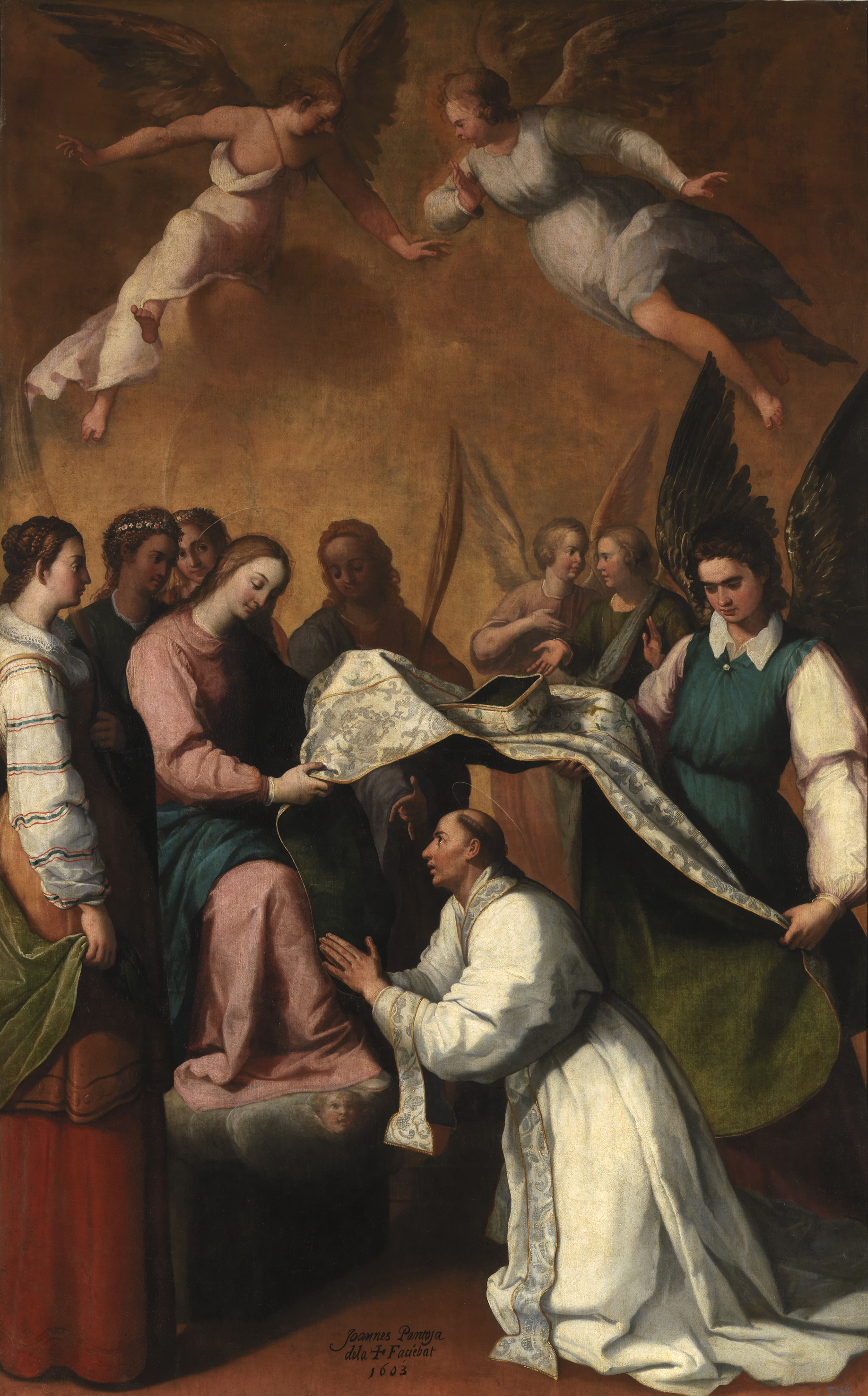
Saint Ildefonsus was sitting on the bishop's throne in his cathedral when he was granted a vision in which the Blessed Virgin presented him with a chasuble of heavenly tissue. The gift was a fitting one, for Ildefonsus adored the Virgin and wrote a defense of her perpetual virginity. He saw worship of Jesus as the supreme duty of a Christian; and he believed that one could do so by meditating on Jesus through the eyes of His virgin mother. He also had a special devotion to Saint Leocadia, patroness of Toledo.
For nine years he governed the church wisely, until his peaceable death. His successor to the see of Toledo gave high praise to Ildefonsus's virtues and abilities. The Ramsgate Benedictines say that he was responsible for the unification of the Spanish liturgy. He was also a musician. The grateful Spaniards dubbed him a Doctor of the Church and his memory is still revered.
Ildephonsus was an outstanding writer as well as a devoted pastor. His treatise on Baptism was followed by one of the spiritual journey of the soul after receiving the Sacrament. In De viris illustribus he compiled short biographies of notables in the 7th-century Church in Spain. He devotion to Mary led him to write several theological treatises, including De virginitate perpetua sactae Mariae, a work of exuberant enthusiasm, rather than of sober thought. This work was written as a defense of the perpetual virginity of the Blessed Mother against the heresy of Helvidius, Jovinian, and a Jew. His fervor had a marked effect on Spanish piety.
A short vita of Saint Ildephonsus was written by his successor, Bishop Saint Julian, 23 years after his death (Attwater, Attwater2, Benedictines, Bentley, Braegelmann, Coulson, Delaney, Farmer, Husenbeth, Tabor).
The investiture of Saint Ildephonsus is a favorite subject of Spanish artists, who depict him as a cardinal archbishop receiving a chasuble from the Blessed Virgin. His hat is near him. He may also be shown mitred with his abbot's crozier, chasuble, pallium, book, and cardinal's hat, or writing before an image of the Blessed Virgin (Roeder, Tabor). He is venerated throughout Spain but especially in Toledo and Seville (Roeder).
SOURCE : http://www.saintpatrickdc.org/ss/0123.shtml

Juan de Valdés Leal (1622–1690).
Miracle of St Ildefonsus, 1661, 270 x 250
._Relieve.jpg)
Puente
de Alcántara (Toledo)
Los
Reyes Católicos, que celebraron Cortes en Toledo (1480), reedificaron el
torreón del puente, próximo a la ciudad, siendo corregidor y alcalde don Gómez
Manrique (1484). Bóveda del torreón que da entrada a la ciudad.
Saints
of the Order of Saint Benedict – Saint Ildephonsus, Archbishop
This Saint was born in Spain, of an illustrious race. From
his childhood he led so pure and humble a life, that it showed his fitness for
the monastic state. His mother who, before his birth, had been warned of the
future greatness of her offspring, encouraged his religious fervour, and when
he was old enough, she placed him under the care of Saint Isidore, and he
afterwards entered the Monastery of Agalia. Here Ildephonsus made so great
progress in virtue that when the Archiepiscopal See of Toledo became vacant, he
was promoted to it. At this time a fearful heresy was beginning to creep in,
which assailed the virginity of the Blessed Mother of God; Ildephonsus, because
of the devotion to the Virgin of Virgins, which filled his breast, wrote a book
in which he emphatically denounced this error; and he was rewarded by a vision
of the Virgin Mother, who took in her hand the work in which he had defended
her virginity against Helvidius, and deigned to commend it. In this work the
Saint speaks of the Blessed Virgin with the most tender devotion. Ildephonsus
was praying one day at the tomb of Saint Leocadia, the King and a great crowd
of people being present at the time, when the holy Martyr appeared to him, and
said these words: “Through thee, O Ildephonsus, doth our Lady reign, who is
enthroned in the highest heavens.”
The Feast of the
Assumption of our Lady was one especially dear to the Saint, and when it
occurred he always took special pains to promote the honour that is due to the
Mother of God. He arranged for the performance, with due solemnity, of the
office which had lately been ordered for the celebration of the festival, he
caused hymns to be sung, and he exhorted the people to pay as much honour as
they could to the Holy Virgin. On one of the feast days of the Blessed Virgin,
the Saint rose early, as usual, for the office of Matins, and hastened to the
Church; but at the threshold his attendants were so struck with terror at a
glorious light which filled the Basilica, that they drew back, and Ildephonsus entered
alone. When he approached the altar he was favoured by a vision of the Mother
of God, surrounded by a resplendent band of Saints and Virgins, and our Lady
addressed to him the following words:
“O most beloved Servant
of God! receive the gift which I bestow upon thee from the treasures of my
Son.” When she had so spoken, she placed a vestment on his shoulders and
disappeared. Soon after this memorable vision, Saint Ildephonsus – having
presided over the Church at Toledo for nine years – died on January 23rd, 667.
– text and illustration
taken from Saints
of the Order of Saint Benedict by Father Aegedius
Ranbeck, O.S.B.
SOURCE : https://catholicsaints.info/saints-of-the-order-of-saint-benedict-saint-ildephonsus-archbishop/
.jpg)
Plaque
de Calle de San Ildefonso (rue, (district du Centre) de Madrid (España).
Sign
of Calle de San Ildefonso (street, Centro district) in Madrid (Spain).
Placa
de la Calle de San Ildefonso (distrito de Centro) de Madrid (España).
Mother
Inviolate – Gift of Fear in Mary
“If I have found favor in thy sight, O king, and if it
please thee, give me my life for which I ask, and my people, for which I
request.” – Esther 7:3
The Holy Ghost teaches us
that “the fear of the Lord is the beginning of wisdom.” This fear is not that
servile movement which has for its object the chastisement due to sin; it is a
sentiment of filial piety, grounded on the one hand on the greatness and majesty
of God, and on the other on the deformity of sin.
Servile fear may be found
even among those who do not love God, whom the dread of punishment alone keeps
back from offending their Lord and Master. Speaking of this fear Saint John
says that perfect charity casts it out.
On the other hand, filial
fear belongs to God’s children. These recognize the Most High for their
Sovereign Lord, and love Him as their tender Father; hence they have for Him a
profound esteem and veneration. Knowing that they are exposed in this life to a
thousand occasions of offending Him, by reason of the temptations they must
undergo through the frailty of the flesh, the malice of the demon, and the
allurements of the world, they fear sin above every other evil.
Lord, give me, I beseech
Thee, an ample share of this salutary fear, according as Thou hast said: “I
will give my fear in their heart.”
* * *
Mary, at the moment of
her Immaculate Conception, received, together with the other gifts of the Holy
Spirit, that of the fear of God. This fear in her was in no sort servile.
Pilled as she was with divine grace, altogether pure and holy, what
chastisement could she apprehend?
Neither was there in
Mary, properly speaking, that fear which theologians call “chaste fear,” which
has for its object the possible danger of falling away from God by sin; for she
well knew that by an especial assistance of the Holy Ghost, she would never
lose divine grace.
The fear of God was,
therefore, in Mary a reverential fear, caused by a keen and lively sense of the
awful majesty of the Most High and His limitless power. It was this very
sentiment which impelled this glorious Virgin to believe with all her heart the
truths revealed by God: to consecrate to the Lord all the affections of her
soul: to shelter herself and rest, like a white dove, under the fatherly wings
of Divine Providence: “I sat down under His shadow, whom I desired.”
* * *
The chief effect of the
gift of fear in Mary was to inspire her, in her adorations and supplications,
with so great a sense of respect and veneration for the Divine Majesty, that
all her petitions merited to be heard: even as we read of Jesus, that He “was
heard for His reverence.” a Mary might, therefore, like another Esther, present
herself without fear before the throne of the King of kings, and lay her
request at His feet, with a certain confidence of being fully heard, whatever
the object of her petition might be.
Oh, that we would imitate
Mary in the acquisition and exercise of this precious gift of the fear of God!
That our prayers might be animated with this reverential and wholesome fear,
which is the pledge of divine favors, for it is written that God “will do the
will of them that fear Him: and He will hear their prayer.” Would that we
dreaded above all things to commit sin, the greatest of evils, and that we
might courageously shun all the occasions of offending our Heavenly Father and
losing His grace!
Happy the soul that
possesses this salutary fear, the beneficial effect of which is felt especially
at the moment of death. For such a soul does not dread the passage from life to
eternity: on the contrary, it looks upon that moment as the beginning of all
real blessings. “With him that feareth the Lord, it shall go well in the latter
end, and in the day of his death he shall be blessed.”
Example
– Saint Ildephonsus
One of the most strenuous champions of the perpetual
virginity of the most holy Mother of God was Saint Ildephonsus, Archbishop of
Toledo, in Spain. His birth, which took place in the year
606, was the effect of a special grace of Mary. He came to this world on the
eighth of December, which is the day that was afterward consecrated to the
Immaculate Conception of our blessed Lady. When but ten years old, he was
placed under the direction of Saint Isidore of Seville, that he might learn,
besides human science, the virtues necessary in a minister of the Lord.
After ten years he returned
to his country, where, following the impulse of the Holy Spirit,
notwithstanding the opposition of his parents, he withdrew into solitude,
entering the monastery of Saints Cosmas and Damian. A short time after, the
splendor of his religious virtues moved his brethren to elect him Superior.
Later, he was raised to the dignity of Archbishop, succeeding Eugenius in the
See of Toledo.
Spain at that time was
infested by a crowd of Arian heretics, who taught that Jesus Christ was not
equal to His Father but only an adopted Son, and that therefore Mary was not
the Mother of God but an ordinary woman. These men, following the false
teaching of Elvidius, strove to deprive the Queen of Heaven of the halo of
perpetual virginity. Ildephonsus directed all his pastoral care against this
nefarious doctrine, and proved both by writing and preaching that Jesus Christ
is truly God, equal to the Father, and that Mary is the most holy Mother of
God, and yet always a Virgin.
Such zeal, if it excited
the wrath of Ildephonsus’ enemies, was however not unrewarded by God. One day
as Ildephonsus was praying at the tomb of Saint Leocadia in the presence of a
large multitude of the faithful, among whom was the King Recesvintus, the stone
which covered the sacred remains of this virgin, was suddenly lifted and the
Saint coming forth from the tomb addressed the holy Bishop, exclaiming: “O
Ildephonsus, through thee is my Mistress living.” By that, Saint Leocadia
wished to show how efficacious was the preaching of Ildephonsus for preserving
faith and devotion to Mary in the hearts of the people, despite the calumny of
the heretics. As witness of this wonderful apparition and to confirm the truth
which Ildephonsus had defended, Saint Leocadia invited him to detach a small
piece of the white veil which covered her head, and this is preserved to the
present day as a precious relic in the cathedral of Toledo. Saint Ildephonsus
died on the twenty-third of January, 667.
Prayer
O Mary, it was by a
special grace of the Holy Ghost that thou wast made sinless during thy mortal
life, and that thou wert animated with such a veneration for the Divine
Majesty, that thou didst merit to be heard in all thy prayers. Present, I
beseech thee, special petitions to the Most High, that I may ever keep alive in
me this gift of salutary fear, in order that I may avoid sin, and come to
eternal blessedness. Amen.
– text taken from
the book The Fairest Flower of Paradise: Considerations on the Litany
of the Blessed Virgin, Enriched with Examples Drawn from the Lives of
the Saints,
by Cardinal Alexis-Henri-Marie
Lépicier, O.S.M., 1922;
it has the Imprimatur of Cardinal Patrick
Joseph Hayes, Archdiocese of New
York, New
York, 30
June 1922
SOURCE : https://catholicsaints.info/mother-inviolate-gift-of-fear-in-mary/


San
Ildefonso Parish Church (Pio del Pilar, Arnaiz Avenue, Makati City) M. Reyes
Street corner Aranaiz Avenue and P. Binay Street, Roman Catholic Archdiocese of
Manila Vicariate of Saint Joseph the Worker (Makati City) Vicar Forane
Rev. Msgr. Roberto A. Espenilla, PC Founded 1761, built in 1870 and Renovated
Decreed as Parish Church in 1951 and 50th Anniversary Marker in August 11,
2001, in Legislative districts of Makati,
Barangay Pio del Pilar, Makati City along Arnaiz
Avenue.
Sant' Ildefonso
(Idelfonso) da Toledo Vescovo
Toledo (Spagna), 607 -
Toledo, 23 gennaio 667
Molto devoto a Maria, su
cui scrisse un celebre trattato, e significativo esponente della Spagna del suo
tempo, Ildefonso era discendente di una potente famiglia romana. Anche sotto i
Visigoti avrebbe potuto far carriera, ma si fece monaco e divenne diacono. Fu
eletto abate del monastero dei Santi Cosma e Damiano, nei pressi di Toledo.
Quando il vescovo morì, nel 657, l'uomo di lettere e preghiera, cinquantenne,
divenne anche uomo di governo ecclesiale nella diocesi della capitale del regno
visigoto. Si districò tra difficili questioni interne e tenne testa alle
pretese del re Recesvinto, che si era mosso personalmente per convincerlo a
lasciare il cenobio e accettare l'elezione. Ha lasciato libri di liturgia e
l'opera «De viris illustribus», una sorta di continuazione dell'enciclopedia di
sant'Isidoro di Siviglia (di cui secondo la tradizione sarebbe stato allievo).
Il 15 agosto del 660 la vergine gli apparve nel presbiterio della cattedrale,
lodandolo e consegnandogli una preziosa veste. Morì a Toledo, di cui è
patrono, nel 667.(Avvenire)
Etimologia: Ildefonso
= pronto alla battaglia, dal tedesco
Emblema: Bastone
pastorale
Martirologio
Romano: A Toledo in Spagna, sant’Ildefonso, vescovo, che, monaco e priore
di un cenobio, fu eletto all’episcopato, scrisse numerosi libri con stile assai
raffinato, compose celebri preghiere liturgiche e venerò con mirabile zelo e
devozione la beata e sempre Vergine Maria Madre di Dio.
Ha davanti a sé un futuro brillante, vincente. Potrebbe fare carriera in politica e come militare perché la sua famiglia è ricca e potente. Ma Ildefonso (il cui nome significa “pronto alla battaglia”, dal tedesco antico hiltifuns) preferisce farsi monaco: pregare, studiare, scrivere, insegnare agli altri il sapere. Nasce a Toledo (Spagna) nel 607. Entra in monastero e qui si ferma fino a cinquant’anni. Ama tanto la Madre di Gesù e in suo onore scrive vari libri. Ildefonso vorrebbe rimanere un semplice monaco, ma è talmente colto, intelligente, di buon carattere e bravo nello scrivere e nel parlare in pubblico, da essere nominato, malgrado il suo diniego, abate alla guida del monastero.
Quando muore il vescovo di Toledo Eugenio II, il re dei Visigoti Recesvinto
chiede con insistenza a Ildefonso di prendere il suo posto. Il santo vorrebbe
restare nel suo monastero, ma alla fine deve accettare il nuovo prestigioso e
difficile incarico. Come vescovo della capitale del regno dei Visigoti scrive
tante lettere ai potenti, sia della Chiesa, sia dell’impero, per denunciare
scandali e soprusi. Un giorno si narra di un fatto prodigioso legato alla venerazione
che Ildefonso nutre nei confronti della Vergine Maria. La vigilia della solenne
festa dell’Assunzione in Cielo della Vergine Maria, la notte del 14 agosto,
nella Cattedrale di Toledo, il vescovo Ildefonso intona le lodi alla Madre di
Dio assieme ai suoi diaconi, ed ecco sull’altare compare una forte luce che
stupisce e intimorisce i presenti, facendoli arretrare. Ildefonso si avvicina
e, con grande meraviglia, vede la Madonna che amorevolmente gli porge un abito
(la “pianeta” indossata durante le celebrazioni mariane) proferendo le seguenti
parole: «Tu mi sei fedele. Prendi questa veste che Gesù ha preso dal suo
forziere e indossala solo durante le feste a me dedicate». Ancora oggi nella
Cattedrale di Toledo si può visitare il luogo dove è apparsa la Madonna.
Sant’Ildefonso, tuttora molto amato e venerato in Spagna, muore a Toledo nel
667. Dopo l’invasione degli Arabi, le sue spoglie sono state trasferite a
Zamora, in Castiglia.
Autore: Mariella
Lentini
La sua famiglia, già potente sotto i Romani, lo rimane anche sotto i Visigoti, e gli prepara una carriera adeguata. Ma Ildefonso scappa di casa, rifugiandosi nel monastero dei santi Cosma e Damiano, vicino a Toledo. Non ha in mente la carriera. Si fa monaco, arriva al diaconato e qui si ferma. Gli va bene così. Ma i confratelli lo eleggono ugualmente abate nella loro comunità, perché ha tutto: pietà, cultura, energia, un parlare attraente. Ed è anche uno scrittore di grande efficacia.
Ma sui cinquant’anni deve lasciare il monastero: è morto Eugenio II, il vescovo di Toledo, e al suo posto si vuole lui, Ildefonso. Per convincerlo si muove il re visigoto in persona, Recesvinto. Così, nel 657, eccolo vescovo di quella che al tempo è la capitale del regno. Ora non ha più molto tempo da dedicare ai libri, impegnato com’è a scrivere tante lettere, e non proprio allegre. Abbiamo di lui pagine angosciate sugli scandali ad opera di certi cristiani influenti e falsi, sui conflitti duri con il re, che pure lo stima; e su tanti ecclesiastici che troppo s’immischiano negli affari di Stato.
Era davvero meglio il monastero: pregare con gli altri, studiare, scrivere... Ildefonso ci ha lasciato opere di dottrina e di morale, trattati sulla Madre di Gesù, inni liturgici. E anche l’opera divulgativa De viris illustribus (“Degli uomini illustri”) che è una continuazione dell'opera omonima di Isidoro di Siviglia (ca. 570-636). Ildefonso non può vivere senza insegnare, convinto anche lui (come san Braulio, vescovo di Saragozza) che il sapere "è un dono comune, non privato", e che perciò deve essere distribuito a tutti.
Colpisce i fedeli la sua devozione mariana, suscitando anche racconti di fatti
prodigiosi. Come quando, al momento di una celebrazione solenne, apparve in
chiesa la Madonna, porgendo a Ildefonso l’abito liturgico (la pianeta) per il
rito.
Dopo la morte, il suo corpo fu sepolto a Toledo; poi, con l’invasione araba,
venne trasferito a Zamora, in Castiglia. I fedeli lo hanno “gridato santo”
da subito, collegando sempre il suo nome a quello della Beata Vergine Maria. E
dieci secoli dopo la sua morte sarà ancora così, nei dipinti dei maestri del
siglo de oro (il “secolo d’oro” dell’arte spagnola): El Greco, Velázquez,
Murillo, Zurbarán (suo il particolare del dipinto riprodotto qui accanto), con
molti altri in tutta Europa, continueranno a raffigurare il vescovo di Toledo
accanto alla Madre di Gesù. Come anche Guido Reni nello stesso periodo, con
l’affresco conservato nella basilica di Santa Maria Maggiore in Roma. La grande
arte rifletteva così gli stati d’animo popolari, espressi nel culto
spontaneamente tributato a Ildefonso, dai fedeli e dal suo successore Giuliano,
che ne scrisse la vita.
Autore: Domenico Agasso
