Geertgen tot Sint Jans (circa 1460–circa 1488), Sint-Bavo, circa 1480, oil on canvas, 36.5 x 30, Hermitage Museum
Saint Bavon
Ermite à
Gand (+ 659)
ou Alowinus.
Seigneur dans le pays de Liège en Belgique, il mena longtemps une vie dissolue. A la mort de sa femme, il rencontra saint Amand qui le convertit et dont il devint le disciple et le collaborateur.
Il passa les trois dernières années de sa vie dans une solitude, à côté du monastère Saint Pierre que l'évêque saint Amand venait de fonder dans un lieu désert appelé Ganda, qui fut le berceau de la ville de Gand.
À Gand dans la Flandre, en 659, saint Bavon, moine. Disciple de saint Amand, il
dit adieu au siècle, distribua ses biens aux pauvres et se retira dans le
monastère qu’il avait construit dans cette plaine.
Martyrologe romain
SOURCE : http://nominis.cef.fr/contenus/saint/1944/Saint-Bavon.html

Statue
de saint Bavon au Metropolitan Museum of Art, New York.
Saint
Bavo North Netherlandish Utrecht 1460 CE Limestone
Saint Bavon
Moine-ermite à Gand
(† 659)
Bavon, qui portait aussi
le nom d’Allowin, était né vers 600, dans la Hesbaye (Brabant), d’une famille
riche et noble. Jeune encore, il donna les plus brillantes espérances, et
bientôt il fut appelé à gouverner son pays, divisé alors en quatre comtés. Ses mœurs
ne répondaient ni à ses talents ni à sa haute position; c’était un homme
déréglé, hautain, dur aux faibles. Sa fille unique, Agletrude, qui mérita
d’être mise au nombre des saintes, le ramena peu à peu à des sentiments plus
humains, et Amand, l’apôtre des Ménapiens, acheva sa conversion. Fidèle à la
grâce qui l’avait touché, il répara ses injustices passées, fit distribuer une
partie de ses richesses aux pauvres, et consacra le reste à l’entretien des
maisons religieuses.
Ayant reçu la tonsure des
mains du saint évêque, Bavon se plut à visiter les couvents les plus renommés
par leur discipline; mais, ne croyant pas sa pénitence complète, il obtint la
permission de se retirer dans la forêt de Mendonck, en Flandre. D’abord il
choisit le creux d’un arbre pour retraite, puis un ermitage aux environs de
Gand. La foule des pèlerins qui venait le trouver l’empêchait de goûter en paix
le bonheur de la solitude, et l’obligea, quelques mois plus tard, de chercher
un asile plus retiré auprès de l’abbaye de Saint-Pierre, placée depuis sous son
invocation. Il y mourut vers 659, le 1er octobre, assisté dans ses derniers
moments par saint Amand et saint Floribert.
Soixante nobles, que son
exemple avait édifiés, fondèrent à Gand une église en son honneur, et cette
ville l’adopta pour patron. La cathédrale Saint-Bavon (en néerlandais:
Sint-Baafskathedraal) est une importante église gothique de la ville de Gand,
en Belgique. Elle est le siège du diocèse de Gand érigé en 1559. Simple église
paroissiale placée sous le vocable de Saint-Jean au XIIIe siècle, elle a acquis
le statut de collégiale en 1536, puis de cathédrale en 1559.
La Vie des Saints
illustrée pour chaque jour de l’année, Paris, Librairie de Firmin-Didot et
Cie, 1887.
SOURCE : https://sanctoral.com/fr/saints/saint_bavon.html

Bavo,
Alewin, bijgenaamd, geboren in Haspengouw ca. 588, overleden ca. 637.
Beschermheilige van HaarlemGravure door Nicolaes van Lijnhoven naar een
tekening van Pieter Fransz. de Grebber.
Vervaardiger(s): Grebber, Pieter Fransz. de (1595/1605
-1652/1653)Lijnhoven, Nicolaes van (? – 1682/1702)
1er octobre : Saint
Bavon de Gand
D’abord prénommé Allowyn, il naquit au
tournant des VIe et VIIe siècles dans une famille noble dans les environs de
Liège. Il épousa la fille d’un comte, qui lui donna une fille, s’engagea dans
l’armée et mena une vie dissolue jusqu’à la mort de son épouse ; entendant
alors les prédications de saint Amand, évangélisateur de la Flandre et du
Brabant, il se convertit, distribua ses biens aux pauvres et devint moine à
Gand.
Bavon accompagna pendant
quelques temps Amand dans ses voyages missionnaires et devint lui-même un
prédicateur réputé. Au bout d’un certain temps, il se retira dans un ermitage à
proximité de Gand, dans lequel il vécut dans la pénitence et la prière. C’est
là qu’il mourut, vers l’an 654. Après sa mort, il apparut en songe à sainte Gertrude de Nivelles pour la prier de venir
enterrer sa dépouille.
SOURCE : https://reinformation.tv/1er-octobre-bavon-gand-calendrier/

Hieronymus Bosch or follower (circa
1450–1516), Die Almonspende des hl. Bavo, circa 1500, 167 x 60, Academy of Fine Arts Vienna
BAVON (Saint), qui
portait aussi le nom d’Alloïn, naquit au commencement du viiesiècle, dans
la Hesbaye, d’une famille noble et opulente. Jeune encore, il donna les plus
brillantes espérances et bientôt, en effet, il fut appelé au gouvernement de
son pays, divisé alors en quatre comtés, ce qui lui a fait donner le titre de
comte et même de duc par les hagiographes. Ses mœurs, malheureusement, ne répondaient
ni à ses talents, ni à sa haute position, et, quoique on ait exagéré, en
parlant de ses vices, il est prouvé que sa conduite était licencieuse et sa
dureté envers ses inférieurs criminelle. Sa fille unique, Agletrude, qui mérita
d’être mise au nombre des saintes, réussit à le ramener à des sentiments plus
dignes de son rang et de sa naissance : sa vie devint peu à peu, sinon
chrétienne, du moins plus régulière ; il se montra plus juste envers tous
et se fit un devoir de secourir les pauvres et les malheureux. Mais sa parfaite
conversion était réservée aux prédications de saint Amand, le pieux apôtre des
Ménapiens. Fidèle à la grâce qui l’avait touché, et se voyant entièrement libre
par la mort de sa femme et la retraite de sa fille, il répara ses injustices
passées et distribua une partie de ses grandes richesses aux indigents, en
employant l’autre à l’entretien de nouveaux monastères et surtout des deux
abbayes que saint Amand avait fondées à Gand, sous l’invocation de saint
Pierre, et dont l’existence était encore mal assurée. Bientôt élevé à la
cléricature par le saint évêque, il se plut à visiter les couvents les plus
renommés par la régularité et la vertu de leurs habitants, afin de se former à
la piété par leurs exemples. Trop humble cependant pour se croire déjà digne de
vivre en communauté des saints religieux, il obtint la permission de se
retirer, comme anachorète, dans la forêt de Metmedung, aujourd’hui Mendonck
(Flandre orientale), où les rigueurs salutaires de la pénitence et la contemplation
des vérités éternelles remplirent son âme des plus pures délices. La foule des
pèlerins qu’attiraient ses vertus, l’empêcha de goûter longtemps le bonheur de
cette solitude et le força, après quelques mois, à se retirer dans l’abbaye qui
occupait l’ancien castrum de Gand et qui prit plus tard son nom.
Bavon s’y livra à de nouvelles austérités, jusqu’à sa mort, arrivée le 1er octobre
654. Depuis la destruction de l’ancienne abbaye, saint Bavon est patron, non de
la ville, mais du diocèse de Gand et de la cathédrale, connue longtemps sous le
vocable de saint Jean-Baptiste.
J.-J. De Smet.
Acta SS. Belg., t. II, p.
486 et seqq.
J.-J. De Smet, BAVON, Saint, Biographie nationale de Belgique
SOURCE : https://fr.wikisource.org/wiki/Biographie_nationale_de_Belgique/Tome_2/BAVON,_Saint

Picture
of saint Bavo, church of St. Nicholas, Zoetermeer.
Saint
Bavo (H. Nicolaaskerk, Zoetermeer)
Also
known as
Allowin
Bavon
Bavone
Bavonius
Baaf
Profile
Belgian nobleman
who spent a wild youth,
noted for selfishness; known to have sold his servants as slaves to
local noble houses. Married,
and the father of one daughter, Adeltrude. Widower. Converted after hearing a sermon by Saint Amand
of Maastricht. Built an abbey on
his estate, called Saint Peter‘s
in his day and Saint Bavo’s
today. He turned it over to Saint Amand,
and became a monk in
the house. He finally gave his estate to the house, his belongings to the poor,
and lived as a recluse in
a hollow tree and later a cell in
the forest near
the abbey.
Born
589 at Brabant, Liege, Belgium as Allowin
654 at
Saint Bavo’s abbey of
natural causes
against
pertussis or whooping cough
in Belgium
in the Netherlands
Haarlem,
city of
duke hunting with
a falcon or hawk on
his wrist
prince giving alms in
front of his palace
hermit with
staff and a glove (which is probably related to falconry)
man near a wagon
man standing near a huge
stone
man with a purse or
giving alms
man with an angel holding
a palm above
him
man with sword and
scepter
old king in armor near
a book,
broken tree trunk, ship, and Saint Bavo’s monastery
Additional
Information
A
Garner of Saints, by Allen Banks Hinds, M.A.
Book
of Saints, by the Monks of
Ramsgate
Lives
of the Saints, by Father Alban
Butler
Lives
of the Saints, by Father Francis
Xavier Weninger
Saints
and Their Symbols, by E A Greene
Saints
of the Day, by Katherine Rabenstein
books
Our Sunday Visitor’s Encyclopedia of Saints
Oxford Dictionary of Saints, by David Hugh Farmer
Sacred
and Legendary Art, by Anna Jameson
Saints
and Their Attributes, by Helen Roeder
other
sites in english
images
sitios
en español
Martirologio Romano, 2001 edición
fonti
in italiano
MLA
Citation
“Saint Bavo of
Ghent“. CatholicSaints.Info. 22 January 2024. Web. 18 June 2026.
<https://catholicsaints.info/saint-bavo-of-ghent/>
SOURCE : https://catholicsaints.info/saint-bavo-of-ghent/

Saint
Bavo. Engraving by J. Matham.
(Saint)
Confessor (October
1) (7th
century) A nobleman of the district of Liege, who led an irregular life,
but on the death of his wife became a devout penitent. Retiring to a cell in a
forest, he gave himself up to prayer and died there (A.D. 654).
He is the Patron
Saint of Ghent and of Haerlem.
MLA
Citation
Monks of Ramsgate.
“Bavo”. Book of Saints, 1921. CatholicSaints.Info. 24 August 2012.
Web. 18 June 2026. <http://catholicsaints.info/book-of-saints-bavo/>
SOURCE : https://catholicsaints.info/book-of-saints-bavo/

Sint-Baafskerk
- Mendonk, België - Beeld van Sint-Bavo en de penitentiesteen
St. Bavo
Feastday: October 1
Patron: of Ghent; Haarlem; Lauwe
Birth: 622
Death: 659
This famous hermit, also
called Allowin, was a nobleman, and native of that part of Brabant called
Hesbaye. After having led a very irregular life he
was left a widower, and was moved to conversion to God by a
sermon which he heard St. Amand preach
at Ghent. Going home he distributed all his money among the poor, and went to
the monastery at Ghent that
was afterwards called by his name. Here Bavo received the tonsure at
the hand of St. Amand and
was animated to advance daily in the fervor of his penance and
the practice of virtue. St. Bavo seemed
to have accompanied St. Amand on
his missionary journeys in France and
Flanders, setting an example by the humiliation of his heart, the mortification of
his will, and the rigor of his austerities. St. Amand after
some time gave
him leave to lead an eremitical life, and he is said first to have chosen for
his abode a hollow trunk of a large tree, but afterward, built himself a cell
at Mendonck, where vegetables and water were his chief subsistance. St. Bavo is
said on one occasion to have done penance for
selling a man into
serfdom by making the man lead
him by a chain to the common lockup. Bavo at length returned to the monastery
at Ghent, where St. Amand had
appointed St.
Floribert Abbot; and with his approval Bavo built himself a new cell
in a neighboring wood, where he lived a recluse until the end of his
life. St.
Amand and St. Floribert attended
him on his death bed and his peaceful passage made a deep impression on all who
were present. As in the diocese of Ghent so
that in Haarlem in
Holland, St.
Bavo is titular of the Cathedral and
patron of the diocese. His feast
day is October 1.
SOURCE : https://www.catholic.org/saints/saint.php?saint_id=555

Peter Paul Rubens, La conversion de Saint
Bavon, 1624, 280 x 145, St Bavo's Cathedral, Ghent,
Arrondissement of Ghent, East Flanders, Flemish Region, Belgium
Bavo of Ghent, OSB Hermit
(RM)
(also known as Allowin,
Bavon)
Born in Brabant near
Liege, c. 589; died near Ghent in 654 (according to the majority; dates range
from 624 to 654).
The young Bavo,
christened Allowin, led a wild life as a wealthy landowner. He married and
fathered a daughter; otherwise, his life was totally disordered. His sole
object was to satisfy his every desire without regard to justice or truth. When
he needed more money, he would sell his servants as serfs to neighboring
landowners. Then his beloved wife died. Only thereafter did he realize how
selfish his life had been.
Upon hearing a sermon of
Saint Amandus, his heart convicted of his sin. Bavo began his conversion to
Christ by giving away all his property, including his estate at Ghent which he
offered to Saint Amandus, who built a monastery there. Bavo begged to enter it,
and began a course of canonical penance. So great was his self-mortification
that after his death the name of the abbey was changed from St. Peter's to St.
Bavo's.
By great good fortune Bavo
came across one man he had sold as a serf many years before. Bavo begged the
man to lead him by a chain in humiliation as far as the city jail. Similar
humility marked everything he now did. Saint Amandus allowed him to become his
companion on missionary expeditions throughout France and Flanders, during
which Bavo's personal mortifications were the wonder of all who saw them.
The austerities even of
monastic life soon were not enough to satisfy Saint Bavo's desire to discipline
the body that he had once over-indulged. He begged Amandus to give him
permission to live as a hermit. When permission was given, at first Bavo made
his dwelling in a hollow tree. Later he built a tiny cell, near Ghent in the
forest of Malmédun. He lived on vegetables and water, seeing only Amandus and
another friend, the saintly Abbot Floribert, until his death. He was buried at
Floribert's monastery nearby, which was later renamed after him--Saint-Bavon.
So great was the
impression left by Saint Bavo that 900 years later when the diocese of Ghent
was created, he was made its patron (Attwater, Benedictines, Bentley,
Encyclopedia).
In art, Bavo is sometimes
represented as a hermit, but generally shown before his conversion: as a duke
out hunting with a falcon or hawk on his wrist. He may also be shown: (1) with
a purse or giving alms; (2) as a prince giving out alms in front of his palace;
(3) with a sword and scepter; (4) as an old king in armor, with a book and
broken tree trunk, a ship, and St. Bavo's monastery nearby; (5) with a hollow
tree near him; (6) with staff and a glove; (7) near a wagon; (8) with a huge
stone; or (9) with an angel holding a palm above him (Bentley, Roeder).
Saint Bavo is still
venerated at Ghent and Liege, where his feast is celebrated (Roeder).
SOURCE : http://www.saintpatrickdc.org/ss/1001.shtml

Saint
Bavo, stained glass in Pamelekerk, Oudenaerde
Onze-Lieve-Vrouw
van Pamelekerk; Oudenaarde; Oost-Vlaanderen, Belgium; ref:
PM_011670_B_Oudenaarde; noordbeuk, glasraam J.De Loore, jaren 1960; interieur
October 1
St. Bavo, Anchoret,
Patron of Ghent
THIS great model of
penance, called Allowin, surnamed Bavo, was a nobleman, and native of that part
of Brabant called Hasbain, at present comprised in the territory of Liege.
After having led a very irregular life, and being left a widower by the death
of his wife, he was moved to a sincere conversion to God by a sermon which he
heard St. Amand preach. The apostolical man had no sooner finished his
discourse, but Bavo followed him, and threw himself at his feet, bathed in a
flood of tears. Sobs expressed the sorrow and emotions of his heart more
eloquently than any words could have done, and it was some time before his
voice was able to break through his sighs. When he had somewhat recovered
himself he confessed himself the basest and most ungrateful of all sinners, and
earnestly begged to be directed in the paths of true penance and salvation. The
holy pastor, who saw in his unfeigned tears the sincerity of his compunction,
was far from flattering him in the beginning of his work, by which his penance
would have remained imperfect; and whilst he encouraged him by the consideration
of the boundless mercy of God, he set before his eyes the necessity of
appeasing the divine indignation by a course of penance proportioned to the
enormity of his offences, and of applying powerful remedies to the deep wounds
of his soul, that his inveterate distempers might be radically cured, his
vicious inclinations perfectly corrected and reformed, and his heart become a
new creature. By these instructions Bavo was more and more penetrated with the
most sincere sentiments of compunction, made his confession, and entered upon a
course of canonical penance. 1 Going
home he distributed all his moveables and money among the poor, and having
settled his affairs, retired to the monastery at Ghent, where he received the
tonsure at the hands of St. Amand, and was animated by his instructions to
advance daily in the fervour of his penance, and in the practice of all
virtues. “It is a kind of apostacy,” said that prudent director to him, “for a
soul which has had the happiness to see the nothingness of this world, and the
depth of her spiritual miseries, not to raise herself daily more and more above
them, and to make continual approaches nearer to God.”
Bavo considered that self-denial
and penance are the means by which a penitent must punish sin in himself, and
are also one part of the remedy by which he must heal his perverse
inclinations, and carnal passions. He therefore seemed to set no bounds to the
ardour with which he laboured to consummate the sacrifice of his penance by the
baptism of his tears, the compunction and humiliation of his heart, the
mortification of his will, and the rigour of his austerities. To satisfy his
devotion, St. Amand after some time gave him leave to lead an eremitical life.
He first chose for his abode a hollow trunk of a large tree, but afterwards
built himself a cell in the forest of Malmedun near Ghent, where wild herbs and
water were his chief subsistence. He returned to the monastery of St. Peter at
Ghent, where St. Amand had appointed St. Floribert the first abbot over a
community of clerks, says the original author of our saint’s life. With the
approbation of St. Floribert, Bavo built himself a new cell in another
neighbouring wood, where he lived a recluse, intent only on invisible goods, in
an entire oblivion of creatures. He died on the 1st of October, about the year
653, according to Mabillon, but according to Henschenius, 657. 2 Perier
rather thinks in 654. The holy bishop St. Amand, the abbot St. Floribert with
his monks, and Domlinus the priest of Turholt were present at his glorious
passage, attending him in prayer. The example of his conversion moved sixty
gentlemen to devote themselves to an austere penitential life. By them the
church of St. Bavo was founded at Ghent, served first by a college of canons,
but afterwards changed into a monastery of the holy Order of St. Benedict. It
was again reduced to its primitive state, being secularized by Pope Paul III.
in 1537, at the request of the Emperor Charles V. who, building a citadel in
that part, three years after, transferred the canons to St. John’s, which from
that time possesses the relics, and bears the name of St. Bavo. When the
bishopric of Ghent was erected by Paul IV. in 1559, at the petition of King
Philip II. this church was made the cathedral. Cornelius Jansenius, author of a
learned Concordance or Harmony of the Gospels, and other works, was nominated
the first bishop. He is not to be confounded with the famous Cornelius
Jansenius, bishop of Ipres. An arm of St. Bavo is kept in a silver case at
Haerlem, of which church he is the titular saint and patron, in the same manner
as at Ghent. See the life of St. Bavo, written in the eighth century,
published by Mabillon, sæc. 2. Ben. Another compiled by Theodoric, abbot of St.
Tron’s, in the twelfth century, is extant in Surius, but not of equal
authority. See also the history of many miracles, wrought by his relics, in
three books. Among the moderns, Le Cointe, ad an. 649. Pagi, in Critica in
Annal. Baron. ad an. 631. n. 13. Batavia sacra, p. 27. Ant. Sanderus Rerum
Gandavensium, c. 4. p. 241. This author gives us the history of the church of
St. Bavo, now the cathedral, l. 5. p. 390. Perier the Bollandist, from p.
198 to 303. t. 1. Octob.
Note 1. “Post
pænitentiæ confessionem annis tribus præter 40 dierum abstinentiam,” &c.
See the original author of his life. [back]
Note 2. Henschenius,
in Comment. prævio ad vitam S. Amandi, n. 93, ad diem 6 Febr. [back]
Rev. Alban
Butler (1711–73). Volume X: October. The Lives of the
Saints. 1866.
SOURCE : http://www.bartleby.com/210/10/012.html

Sint-Baafskathedraal, Gent, Oost-Vlaanderen, Belgium. Cathedral collections. Painting. Two panels of Jan De Hertoghe. Michiel Coxie (attr to-). First panel: reverse, Saint Bavo. Grisaille, Oil on wood panel. 129 cm x 46,5 cm. End 16th century. Inv 445A. . Michiel Coxie (attr to-)
Weninger’s
Lives of the Saints – Saint Bavo, Confessor
Article
Saint Bavo was born on
the boundaries of Brabant. His father was a Count, his mother of royal lineage,
and both were, very pious. Bavo was led by them in the path that leads to
heaven. On arriving at manhood, he was, with the consent of his parents, united
to Ageltrude, a daughter of Count Adilion, who was lord over one part of
Brabant. Bavo lived several years in Christian love and unity with his spouse,
and when she was taken away from him by death, he was deeply grieved and began
to comprehend more than ever the vanity of all that is temporal and the
inconstancy of all earthly happiness. From this came his resolution to seek in
future only after eternal happiness. Hearing that the holy bishop Amandus
preached the word of God with great success in Ghent, which at that period, was
still in the blindness of Paganism, he went thither, in order to hear the
apostolic man and to ask his advice. After having heard the bishop preach
several times, his heart was so deeply moved, that he did not leave the Saint,
but accompanied him everywhere. At length, he made known his wish to enter the
religious state, and to give his services to the Church at Ghent. The bishop,
after convincing himself of the ability and virtue of Bavo, ordained him
priest. Bavo then sold the greater part of his property, and spent the money he
received for it partly to relieve the poor, and partly to erect a Church, and
resolved to serve God, for the future, in voluntary poverty, He mortified his
body with watching, fasting and other penances to such an extent that it became
necessary to moderate his fervor. To prayer and meditation he devoted all the
time he could dispose of.
Some time later, he went
into a dense forest, where he took up his abode in a large hollow oak tree, and
led a life of extraordinary holiness. Many people from the neighboring places
who heard of it, went to visit him; but the Saint, disliking to attract so much
attention, left his little dwelling, otherwise so agreeable to him, and sought
in another wood, two miles from Ghent, a more quiet abode. The more he
endeavored to conceal himself, the more his pious manner of living became known
in the surrounding villages, and the great number of those who came to him,
bringing him food, or requesting his advice, induced him again to leave his
retreat. He returned to Saint Amandus at Ghent, and was ordained by him deacon
of Saint Peter’s Church, with which was connected a monastery, filled with
fervent religious, under the rule of Saint Benedict. In a sequestered portion
of this sacred building, a small room was prepared, where Saint Bavo passed the
remainder of his life, under the direction of the first Abbot of the monastery.
When he was admonished to relent somewhat in his excessive severity to himself,
he used to reply: “All severity, all suffering, is as nothing when compared
with the glory that awaits us in heaven.”
He never showed the
slightest vexation in crosses or trials, because he believed himself deserving
of still more for his past sins. He never complained when he had to suffer
innocently, but thanked God for punishing him in this world. Meanwhile, his
body became quite emaciated and exhausted by his many and austere penances, and
he desired to be relieved from this temporal life and united with his God. His
wish was complied with, and heaven sent him a severe sickness, of which, after
having received the last Sacraments, he calmly and peacefully died, in the
presence of Saint Amandus. His holy body was buried with great solemnity in the
Church of Saint Peter, now called Saint Bavo. The many miracles which took
place at the shrine of the Saint, have made him still more famous since his
death than he was while living on earth.
Practical Considerations
• Saint Bavo complained
to no one, when he suffered innocently. He believed that his sins deserved
still more. He animated himself in his trials by the thought of the great glory
which he had reason to expect in heaven. The same lessons we find in the life
of Saint Leodegar. How do you act in your sufferings? You immediately relate to
all with whom you associate, what you have to endure. They all must know what
has happened to you, in any way, and how you have been unjustly oppressed and
persecuted. But, tell me, in what way does this benefit you? In no way at all;
but on the contrary, it does you harm; for, you lose the merit you might derive
from your sufferings, and perhaps by it you offend the Almighty. If you have
your own profit at heart, bear your sufferings silently, and do not complain in
future to any one, except perhaps to those who are able to! assist you by word
or deed. Commend it all to God and leave it in! His hands. Think, in the hour
of trial and tribulation, of the sins you have committed, for which you deserve
much greater suffering; think also of the glory which awaits you in heaven, if
you patiently bear your cross. Saint Gregory says: “When we think of the sins we
have committed, we can bear patiently every wrong done to us, because we know
that we have deserved much more.” And again: “If the elect turn the eyes of
their mind to contemplate eternal glory, they will see how trifling our
suffering is here below, when compared with the unending reward. The most
unbearable pain is mitigated by the contemplation of the reward which follows.”
MLA
Citation
Father Francis Xavier
Weninger, DD, SJ. “Saint Bavo, Confessor”. Lives
of the Saints, 1876. CatholicSaints.Info.
9 May 2018. Web. 18 June 2026.
<https://catholicsaints.info/weningers-lives-of-the-saints-saint-bavo-confessor/>
SOURCE : https://catholicsaints.info/weningers-lives-of-the-saints-saint-bavo-confessor/

Bavo,
Alewin bijgenaamd, geboren in Haspengouw ca. 588, overleden ca. 637.
Beschermheilige van Haarlem.Gravure door Pieter Soutman naar een tekening van
Pieter Soutman, op aanwijzing van Cornelis Visscher. Vervaardiger(s): Visscher,
Cornelis (II) (1628/1629-1658), Soutman, Pieter (1593/1601-1657). 1650
A Garner of Saints –
Saint Bavon
Article
Patron
saint of Ghent;
born of a noble family; his youth was somewhat wild, but after the loss of his
wife he became converted by a sermon of Saint Amand, bishop of Maestricht,
threw himself at the feet of the holy man and with tears confessed his sins. On
returning to his house he distributed his wealth to the poor, and then received
the tonsure from Saint Amand. Retiring first to the monastery of Saint Pierre
at Ghent he took up the life of a hermit, and lived for some time in the trunk
of a hollow tree, until he had made a cell for himself in the forest of
Malmedun, near Ghent, where he lived on wild herbs and water.
Saint Herbert the abbot of Saint Pierre, permitted him to live as a recluse in
a new cell which he constructed near the monastery,
and there he ended his days, communicating with no one but God alone. The monks
of Saint Pierre were present at his death, which took place in 657.
Sixty noblemen, converted by
his example, became penitents and built the church in his honour at Ghent. Among
the miracles attributed to him is the restoration of a nobleman’s slave who was
possessed, and the healing of the legs of a peasant, broken by his chariot; the
peasant was employed to bring the materials for the construction of the saint’s
cell, and though he had freely mocked at the holy man, Saint Bavon interceded
for him. 1st October.
Attributes
Usually dressed as a
prince in armour with a falcon on the left hand in sign of his rank.
hermit in a hollow tree
sometimes also he carries
a heavy stone in his arms which served him as a pillow in his cell.
MLA
Citation
Allen Banks Hinds, M.A.
“Saint Bavon”. A Garner of Saints, 1900. CatholicSaints.Info.
17 April 2017. Web. 18 June 2026.
<https://catholicsaints.info/a-garner-of-saints-saint-bavon/>
SOURCE : https://catholicsaints.info/a-garner-of-saints-saint-bavon/

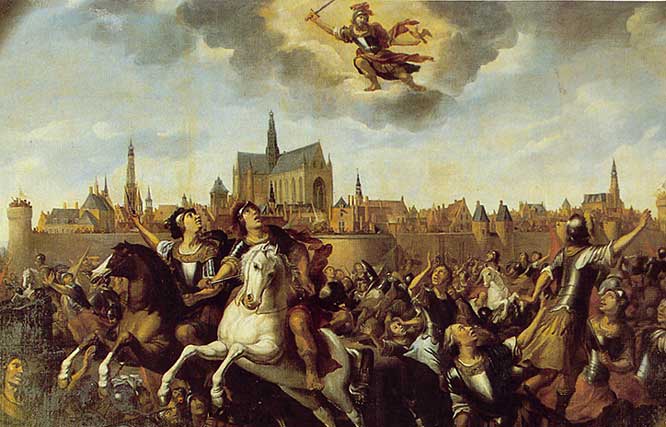
Reyer van Blommendael (1628–1675), Saint
Bavo scares off the Kennemmers during their attack on Haarlem in 1274, 1673, 144
x 213, Frans Hals Museum, Haarlem
Saints and
Their Symbols – Saint Bavon
Article
A.D. 657, October 1,
patron saint of Ghent and Haarlem, was Duke of Brabant, and spent his life in
gaiety and worldliness; but when he was fifty his wife died, and his heart
being softened, he was brought to repentance by Saint Amand, Bishop of
Maestrich. Leaving all his possessions to be given to the poor, he entered a
monastery at Ghent, and afterwards desiring more complete seclusion, withdrew
into a hollow tree in a forest, and there spent the remainder of his life.
Emblems – Falcon. In armour. Hermit praying in a hollow tree. Hermit praying in
a hollow tree.
MLA
Citation
E A Greene. “Saint
Bavon”. Saints
and Their Symbols, 1909. CatholicSaints.Info.
22 June 2022. Web. 18 June 2026.
<https://catholicsaints.info/saints-and-their-symbols-saint-bavon/>
SOURCE : https://catholicsaints.info/saints-and-their-symbols-saint-bavon/

Opschriften
/ Merken: verzamelaarsmerk, verso, gestempeld: Lugt 2228,
verzamelaarsmerk, verso, gestempeld: Lugt 2760, verzamelaarsmerk, verso,
gestempeld: Lugt 1904. Omschrijving: De heilige Bavo gekleed als Romeinse
soldaat met een valk op zijn hand. In de andere hand een zwaard. Links Romeinse
ruïnes.. Vervaardiging
Vervaardiger: prentmaker: Leendert van der Cooghen, naar eigen ontwerp
van: Leendert van der Cooghen
St. Bavo
St. Bavo, Bavo of Ghent. Born in Brabant near Liege, c. 589; died near Ghent in
between 624 and 654. The young Bavo, christened Allowin, led a wild life as a
wealthy landowner. His only aim in life was to satisfy his every desire without
regard to justice or truth. Then his beloved wife died, and he realized how
selfish his life had been. Bavo began his conversion to Christ by giving away
all his property, including his estate at Ghent which he offered to Saint
Amandus, who built a monastery there. Bavo begged to enter it, and began a
course of canonical penance. So great was his self-mortification that after his
death the name of the abbey was changed from St. Peter's to St. Bavo's. The
austerities of monastic life soon were not enough to satisfy Saint Bavo's
desire to discipline the body and soul. He begged Amandus to give him
permission to live as a hermit. When permission was given, at first Bavo made
his dwelling in a hollow tree. Later he built a tiny cell, near Ghent in the forest.
St. Bavo is patron of the dioceses of Ghent and Haarlem (Holland).
Feasr day: 1 October.
See: Hieronymus
Bosch St.
Bavo.
Recommended reading:
The
Oxford Dictionary of Saints (Oxford Paperback Reference) by David Hugh
Farmer. Oxford University Press, 2003.
SOURCE : https://www.freeart.com/gallery/saints/bavo.html

Haarlim,
Bavokatedraal, findel Sint-Bavo
San Bavone di Gand Eremita
Brabant, Liegi, Belgio,
589 - Gand, 1° ottobre 659
Di Bavone (in fiammingo
Baafs) esistono quattro «Vite» in gran parte leggendarie. Sarebbe morto prima
del 659. Nobile di alto rango, sposò la figlia del conte merovingio Adilone.
Rimasto vedovo, seguì sant'Amando che stava evangelizzando le pagane Fiandre.
Distribuì le sue terre ai poveri ed entrò nel monastero benedettino di Gand,
che prese poi il suo nome. Fattosi missionario con Amando, tornò in seguito a
Gand e visse gli ultimi tre anni da eremita nel cavo di un grosso
albero. Sue reliquie sono nella cattedrale di Gand e nell'abbazia di
Nelse-la-Reposte. (Avvenire)
Martirologio
Romano: A Gand nelle Fiandre, nell’odierno Belgio, san Bavone, monaco, che
fu discepolo di sant’Amando; abbandonato il mondo, distribuì i suoi beni ai
poveri e si ritirò nel monastero fondato in questo luogo.
Di questo santo fiammingo esistono quattro ‘Vite’ in buona parte leggendarie, come del resto la maggioranza delle vite dei santi dei primi secoli; la più antica che parla di Bavone (in fiammingo Baafs), è stata scritta probabilmente al tempo di Eginardo abate († 844), due secoli dopo la morte di Bavone, che si suppone avvenuta un 1° ottobre prima del 659; essa fu posta in versi intorno al 980.
Bavone nacque in una famiglia di alto rango sociale e sposò la figlia del conte merovingio Adilone ed ebbe una figlia di nome Agletrude.
La giovane moglie morì, non si sa come e Bavone colpito dalla disgrazia, interruppe la sua vita dissoluta e cadde in preda ad una crisi morale, che fu il punto di partenza della sua conversione. Si recò da s. Amando che stava predicando alle popolazioni ancora pagane della regione di Gand e per suo consiglio distribuì ai poveri le sue terre di Hesbaye, dove era nato ed entrò nel monastero di Ganda come religioso, monastero appena fondato da s. Amando e che in seguito si chiamerà ‘S. Bavone di Gand’.
Divenne discepolo del santo missionario e lo seguì nelle sue peregrinazioni apostoliche nelle Fiandre; dopo un certo tempo ritornò a Ganda, dove fattosi costruire una piccola cella nel cavo di un grosso albero, condusse vita eremitica ed ascetica per tre anni.
Ma le privazioni ed i sacrifici lo indebolirono rapidamente, morendo verso il 659; il suo corpo fu sepolto nel monastero di Ganda. Allo stato attuale, le sue reliquie riposerebbero in parte nella cattedrale di Gand e in parte nell’abbazia benedettina di Nesle-la-Reposte, località dove si erano rifugiati i monaci fuggiti da Ganda, per sottrarsi alle invasioni normanne, verso l’882-83.
Autore: Antonio Borrelli
SOURCE : http://www.santiebeati.it/Detailed/72575.html
Saint Bavo: The Iconography : https://www.christianiconography.info/bavo.html


.jpg)


.jpg)