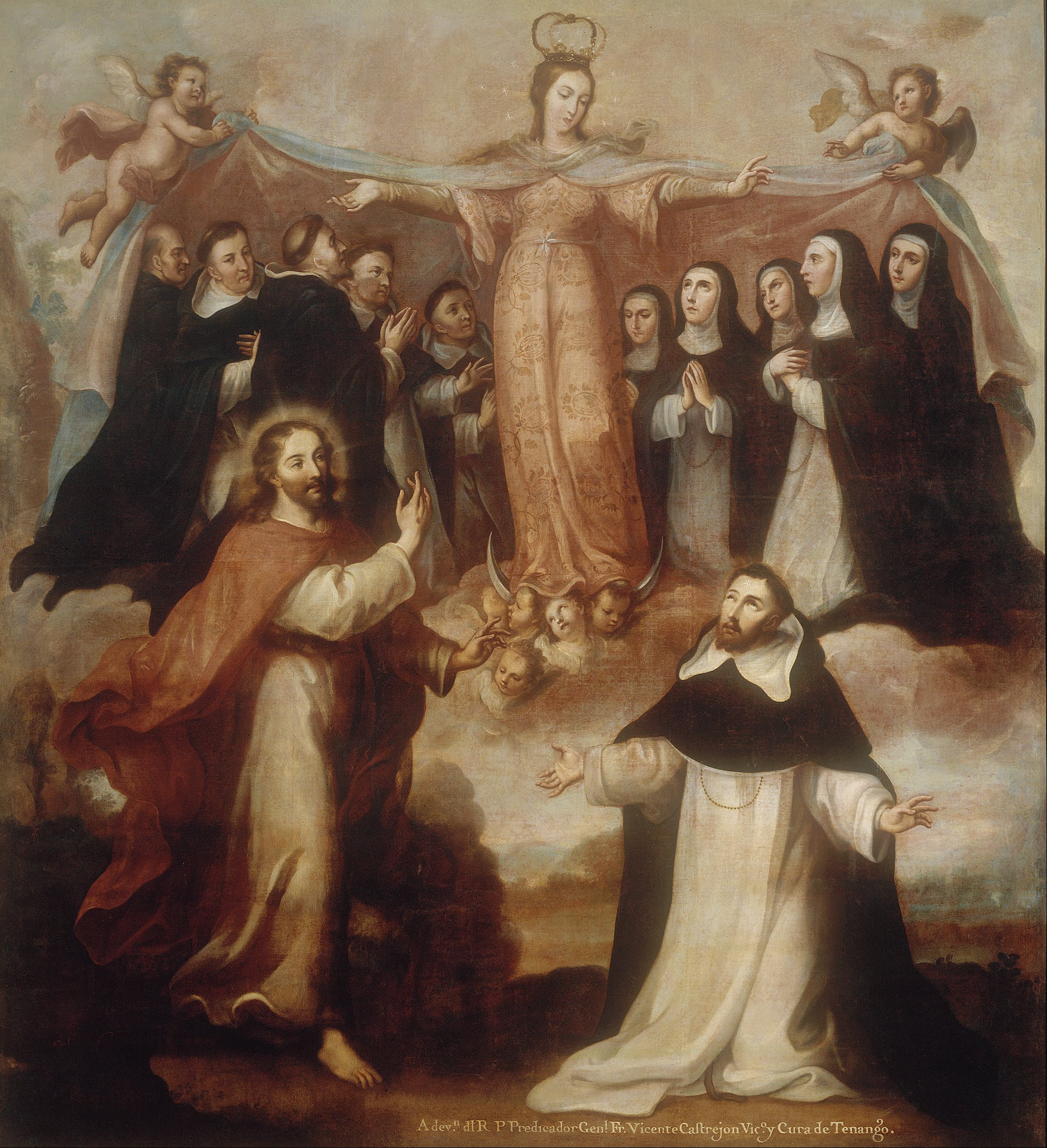
Miguel Cabrera (1695–1768). Alegoría
de la Virgen protectora de los dominicos, Museo Nacional de Arte
Also
known as
Henry of Utrecht
Profile
Raised in a pious home
with parents who insured Henry’s good education.
He studied at
the University
of Paris. Chosen a canon of
the cathedral of Utrecht, Netherlands. Priest.
Close friend of Blessed Jordan
of Saxony. Henry heard Saint Dominic
de Guzman preach in Paris,
and became one of the first Dominicans in 1220.
First prior at Cologne, Germany c.1221.
Additional
Information
Saints
of the Day, by Katherine Rabenstein
The
First Disciples of Saint Dominic, by Father Victor
Francis O’Daniel, O.P.
books
Our Sunday Visitor’s Encyclopedia of Saints
MLA
Citation
“Blessed Henry of
Cologne“. CatholicSaints.Info. 28 October 2021. Web. 20 June 2026.
<http://catholicsaints.info/tag/name-henry/>
SOURCE : http://catholicsaints.info/tag/name-henry/
Blessed Henry of Cologne,
OP (PC)
Died in Cologne, Germany,
1224 or 1225. One of the first Dominicans recruited from among the students of
the university of Paris, Henry became the first prior of the friary at Cologne.
He was the closest friend of Blessed Jordan of Saxony, who knew, understood,
and promoted friendships as important to the spiritual life. Henry met Jordan
when the latter was a professor at the University of Paris. Henry must have
been a very personal young man of fine character, for Jordan named him the very
flower of the Dominicans. He was "handsome, reverent and virtuous, of a
mind to grasp everything and with a rare faculty for expressing himself."
When Reginald of
Saint-Gilles died, Jordan had a vision in which he saw in the cloister of
Saint- Jacques a clear and limpid fountain that ran dry. In its place a
fountain sprang up, having two heads, surging up like a great river to water
the whole earth. It was revealed to him that Henry was one of the
fountainheads, and the brethren easily understood that Jordan himself was the
other.
By this time Jordan had
decided to abandon his academic career and join the Dominicans. But he could
not bring himself to leave behind his dearest friend. Often he would later say
in sermons, "You do not go to a banquet alone, but with your dear friends;
you should not go alone to heaven either!" Jordan's success in recruiting
young men for the order is probably due to this attitude. He could not imagine
anyone going into the joy of religious life without bringing his friends along
with him. So Jordan delayed entering the order until Henry was ready to do so,
too.
After Henry completed his
studies in the arts and theology in Paris, Jordan began recruiting him. When
Jordan returned from confession to Reginald, shaken and exalted by the ideals
that Reginald had envisioned for him, he looked for and found a Scripture text
to confirm his resolution. Then the book fell open to the text he wanted for
Henry, "Let us stay together, let us never separate." He urged this
on Henry, but the young man, who was chaste and obedient, found it difficult to
accept poverty.
Henry argued with
himself, prayed and meditated, but still was unable to accept the precept of
abandoning all things for the uncertainties of a mendicant life. One night,
after he had prayed for a long time, he saw himself at judgement, and a
thunderous voice demanded of him, "And you--what have you given up for
God?" Henry was shaken by this thought, went to see Master Reginald, and
resolved to enter the order as soon as possible. On Ash Wednesday, 1220, the
two friends went together to be received.
Jordan, a magnetic
preacher, thought that Henry was the model of preachers. Our image of Henry is
highly idealized because the only records remaining are those written by
Jordan. In 1221, when the priory of Cologne was established, Henry was sent
there as prior, and Jordan went to Lombardy. It was a sorrow to see the friends
separated, but they wrote frequently. Theirs was a friendship based on the love
of God and directed to the furthering of His kingdom.
At about the age of 35,
Henry died suddenly in the arms of Jordan, who was visiting Cologne. It was a
terrible grief to Jordan, and his letter concerning the death of Henry is one
of the saddest and most beautiful of all his eloquent writings. He writes to
Blessed Diana in the rawness of his sorrow, "Do not grieve too much about
the death of your sister Otta . . . it is good for us to be saddened now at the
same time, to go sowing our seed in tears; at the harvest we shall come
carrying our sheaves in joy." Jordan confesses that he wept copiously for
his friend and, after giving a beautiful account of the last moments of Henry,
he adds, "There is still a long way to go. If you are tired, your Jesus
was also . . . in all humility, in all patience, He knew how to wait"
(Benedictines, Dorcy).
SOURCE : http://www.saintpatrickdc.org/ss/1023.shtml
HENRY OF UTRECHT (OR OF
COLOGNE)
Father Henry of Utrecht,
as often happened in those days, received the last part of his name from the
city of his birth. Not infrequently, however, he is called Henry of Cologne
from the fact that he established the Friars Preacher in that municipality, and
ended his days there. The date of his birth is not known. Yet, as the writings
of Blessed Jordan of Saxony clearly indicate that Henry was younger than
himself, and the youthful religious from Utrecht was placed in charge of a
colony of his confrères sent to Cologne in 1221 or 1222, one may safely
conclude that the angelic Hollander was born about the middle of the last
decade in the twelfth century.(1)
Practically all that is
known of this early disciple of Dominic, extraordinary man though he was, has
been handed down to us by his friend, Jordan of Saxony. Henry's parents were
splendid Christians, as well as blessed with the goods of this world. From his
earliest childhood, they not only instructed him in his religion and trained
him in its duties with great care, but also provided every means for his
education. Thus he enjoyed exceptional advantages, both spiritual and
intellectual. Nature was bountiful to him. It accorded him a good heart,
disposed to virtue, and endowed him with a rare mind, that gave him a ready
grasp of all that he was taught.
Under these happy
circumstances, little Henry made marvellous progress in the development of both
mind and heart. God's grace also became manifest in its workings on his soul
almost from infancy. Indeed, the boy showed signs of a vocation at an early
age. Here again he was blessed. A saintly and learned canon of his native city,
who was a friend, or perhaps even a relation, of the family, took charge of
Henry's education for the priesthood. Under the diligent training of this
capable tutor, for he combined great industry with a docile disposition, the
subject of our sketch grew rapidly in knowledge, no less than in favor before
both God and man. Jordan assures us that his ways were so angelic that goodness
seemed to be inborn in him. Among his many virtues moral purity, humility,
charity towards the poor, and a spirit of prayer occupied a conspicuous place.(2)
Because of these rare
gifts of mind, heart, and soul, the canons of the cathedral at Utrecht, as
sometimes happened in those days, apparently elected Henry a member of their
distinguished body while he was but a ,student. There he completed his
belles-lettres, and made his course of philosophy. Then, that he might the
better round out his education in preparation for the brilliant future which
seemed certainly in store for him, he was sent to the University of Paris for
his theology. At the French capital, he at once contracted an intimate
friendship with Jordan of Saxony, who was a student there before him. It was a
holy alliance. Jordan took Henry to the hospice where he lived, and obtained
lodging for him there. The two young men were seldom seen, except they were
together. In the spirit of religious comradeship, they accompanied the one the
other in all those visits of piety, prayer, and charity which have been laid
before the reader in the sketch of Blessed Jordan. It is not necessary to
repeat them here.
When Saint Dominic
reached Paris on his way from Spain, it will be recalled, Jordan hastened to
hear him preach and to consult him about his own vocation. This was in the
spring of 1219. Although it is not on record, the intimate relations between
the two pious students seem to leave little or no doubt that Henry of Utrecht
did the same. Similarly, when Blessed Reginald of Orleans arrived in Paris from
Bologna, about November, 1219, Jordan, and most likely Henry also, took a
kindred keen interest in the new preacher.
Albeit Jordan, who
recounts the story of their entrance into the Order, does not tell us what it
was, it is evident that, while both felt strongly drawn towards the Friars
Preacher, there was something that held them back from joining them. In Henry's
case, it seems almost certain that the obstacle in the way to such a step was
the fear of offense to the canon of Utrecht, to whom he was bound by a great
debt of gratitude. Jordan's own description of his affection for Henry leads
one strongly to suspect that his friendship for and the hesitation of the
latter were among the difficulties which the future Master General had to
overcome.(3) Jordan
was the first to make up his mind. Then, to oblige himself to carry out his
good resolution, he took a vow before Blessed Reginald that he would enter the
Order. All this will be remembered from the sketch of Jordan.
After he had made this
solemn promise, our pious Saxon youth used every argument that he might induce
his favorite fellow-student and comrade to make the same decision. Jordan
himself, who calls Henry "the friend of my soul'), tells us all this.
Under his urging the young canon of Utrecht went to consult Blessed Reginald
again in the confessional. On his return, still undecided, Henry opened the
Bible in the hope that it might aid him. The first words on which his eyes fell
were: "The Lord hath given me a learned tongue, that I should know how to
uphold by word him that is weary. He wakeneth me in the morning; in the morning
He wakeneth my car, that I may hear Him as a master. The Lord hath opened my
ear, and I do not resist. I have not gone back" (Isaias, L, 4-5).
Jordan used his keenest
ingenuity in interpreting the sacred text so as to make it show that it was the
divine will that his friend should become a Friar Preacher. Since he himself
had already taken a vow to enter the Order, the future Father General clinched
his argument by the eighth verse of the same chapter, which says: "Let us
stand together." Although he wished with his whole heart to embrace the
life, Henry's fear still made him shrink from such a step. The next night he
spent in prayer before the altar of the Blessed Virgin in the Church of Notre
Dame for the courage which he felt he lacked. Even up to the time he left the
sacred edifice, it appeared that his supplications had been in vain; but hardly
had he begun to breathe the fresh air of the morning on the outside, when an
impulse came upon him to go to Blessed Reginald, as Jordan had done, and take a
vow to become a disciple of Saint Dominic. This the perplexed youth did at
once, lest he should again become a victim of uncertainty. Then, with a radiant
face, he returned to his anxious friend, and said with determination: "I
have made a vow to God; and I will keep it."
One needs hardly to be
told that Jordan was greatly rejoiced by this announcement. Yet there may be
those among our readers who will marvel at such vows to, enter an order, for a
number of them have been recorded in the course of these sketches, or even
wonder if they did not constitute a formal embracing of the religious life.
They simply show a preliminary step towards such an end which was not unusual
in the middle ages. Doubtless they were born of the strong faith of the times,
and were taken as an engagement so to consecrate one's self to the service of
God, when the opportune moment presented itself.
Jordan and Henry, now
that their resolution was taken, determined on Ash Wednesday, February 12,
1220, as the time when they should receive the habit of the new Friars
Preacher. Then, apparently under the leadership of Jordan, they induced their
mutual friend and fellow-Teutonic student at the University of Paris, whose
name was Leo, to join them in their holy enterprise. On the appointed day, all
three were clothed in the garb of Saint Dominic at Saint James' by Matthew of
France. As he had gone to his eternal reward a few days before, Blessed
Reginald of Orleans could not grace the occasion with his presence.
When Henry's benefactor
and two other canons of Utrecht learned the step he had taken, they were
greatly distressed, for they knew but little about the missionary society
lately established by the holy man from Calcruega. Indeed, they decided that at
least one of them should go to Paris and dissuade him from his rash act.
Happily, before taking the journey, they determined to spend the night in
prayer that they might know the divine will in the matter. In his vigil, one of
them heard the words: "This was done through the inspiration of the Lord;
and it can not be changed." Thus were their consciences, for they were men
of God, set at rest.
Blessed Jordan of Saxony
declares that, as far as he knows, he never loved any man so much as Henry of
Utrecht. He calls him "a vessel of honor and divine favor;" "the
companion and friend of my soul;" "a man of great intellectual acumen
and a most orderly mind." "God," says the same author,
"bestowed many marks of His grace on this vessel of election;" for he
was 44prompt in his obedience; strong in his patience; quiet in his gentleness;
pleasing by his joyous ways; diffuse in his charity." With rare candor of
nature and sincerity of heart he combined an angelic purity. Although he
possessed a marvellous gift of language, a keen, well-trained mind, and great
talent for writing .and preaching, he was the most modest of men in speech as
regards himself. His countenance was pleasant and handsome; his physique
comely; his gestures graceful; his voice rich and extraordinarily melodious. No
one ,ever saw him sad, or morose, or in bad humor. His manners won him the
confidence and affection of all with whom he came in contact.
Such praise, did it come
from a writer of the Latin races, might be considered more or less fulsome; but
bestowed by one of the phlegmatic northern temperament it means much.
Unfortunately, Jordan does not tell us when Henry of Utrecht was ordained.
However, we fancy it must have been very shortly after his entrance into the
Order. At any rate, he began to preach almost at once. All Paris and the
surrounding country, whether young or old, lay or cleric, flocked to hear the
sermons of the youthful, eloquent, and magnetic pulpit orator. Jordan assures
us that he was the marvel, the honor, the pride of the French capital. The
fruits of his ministry were visible in every rank of society. This success in
no wise upset the equipoise of God's servant, or disturbed his religious
spirit; for, in his prayers, he bad learned of our Lord to be truly meek and
humble of heart.
From Paris Henry of
Utrecht was soon sent to Cologne, where he established the Order, and became
the first prior. All the writers agree on these facts, for they are expressly
stated by Blessed Jordan. Echard thinks that Henry did not go to the city on
the Rhine before 1224, but he gives no authority for his statement.(4) However,
Touron follows him. Taegio and tradition, supported by the in ore common
opinion, tell us that the general chapter, held in Bologna at Pentecost, 1221,
sent fathers to Cologne tinder the leadership of Henry. In this case it was the
work of Saint Dominic himself. This date is substantiated by Giles Gelenius, a
non-Dominican, and an eminent authority on the medieval history of Cologne, who
says that it was in 1221 or 1222 that the Friars Preacher settled there.
Reichert, another German author, says the same as Gelenius.(5)
On their arrival the
Friars Preacher were heartily received by Saint Engelbert, the prince
archbishop of Cologne, who suffered martyrdom a few years later. Yet the people,
under some sinister influence, clamored that they should be driven from the
diocese at once. However, no sooner did the silver-tongued orator, Henry of
Utrecht, begin to preach than all opposition ceased. Both the clergy and the
laity were charmed by his extraordinary eloquence and magnetic personality.
Zeal, the spirit of self-sacrifice, and holiness of life not merely completed
the work of pacification; they bound the city to him by the strongest bonds of
affection.
From this time on, the
early disciple of Saint Dominic held as mighty a sway in Cologne as he had
wielded in Paris. He preached incessantly. Audiences gathered from near and far
to hear him. His word was law. The good became better. The wicked gave up their
ways of sin, and began to practise their religion, or even to ascend the
heights of virtue. One of the evils against which the man of God declaimed in
season and out of season, as well as with all the vigor of his soul, was the
vile habit of profanity then in shocking vogue throughout Rhenish Prussia. Few
could withstand the almost resistless power of his appeals. He instilled so
profound a veneration for the sacred name of Jesus into the hearts of the
people that, wherever it was heard, they gave outward manifestation of the
reverence which it stirred within their breasts. From the district of Cologne
this pious custom spread into other parts. May we not have here the origin of
the Holy Name Society, which is so intimately connected with the Friars
Preacher, and which is today one of the great spiritual powers for good in
English-speaking America?
Thus Henry labored
zealously on until the end. Blessed Jordan does not tell us, in his historical
outline, when the holy man died. For this reason, few of the older authors
venture to approximate the date of his death. Pio and Castillo, however, place
it in 1230. Touron, following Echard, simply says that he died before 1234, by
which time Jordan had certainly written his Beginnings of the Order (De
Initiis Ordinis), a work which indicates that our early disciple's life
was all too short. Touron gives his age as thirty-nine years, which seems too
much by perhaps a decade.(6)
The second volume of
the Année Dominicaine, published in 1884, says Father Henry of Utrecht
attended the general chapter of the Order assembled at Bologna on May 18, 1225.
After this meeting, he and the other representatives from Germany were
accompanied by Blessed Jordan to their native land, where the Master General
presided at the provincial chapter held in Magdeburg. From this city Jordan
continued his way to Treves, while Henry returned to Cologne. At this time
Jordan made a visitation of the Province of Germany. On his arrival at Cologne,
which lay on the way to Paris, he found his beloved friend, Father Henry of
Utrecht, at death's door. The Master General gave him the last sacraments, and
he breathed his last shortly afterwards.(7)
Jordan himself, as we
shall soon see, says elsewhere he was present at the final moments of his
angelic friend, and prepared him for his journey to heaven. All the community
were in tears; but the dying man responded to the prayers with evident joy. Our
Saxon General also clearly implies that the death of the man of God had been
hastened by overwork and personal austerity. The Année Dominicaine and
Touron say so expressly.
We have to thank the
writer of the article on Blessed Jordan of Saxony in the Année
Dominicaine for a long excerpt (translated into French) from a letter of
the Father General to a Benedictine Nun concerning the death of Henry. Father
Berthier (op. cit., pp. 108-111) reproduces the entire document in its pristine
Latin, but without a word of comment. In neither work is it dated (perhaps it
bears no date), or the whereabouts of the original made known to us. Thus,
quite naturally, we are left with an element of uncertainty as regards the year
of the sad event.(8)
In this letter, which we
are to suppose was written late in 1225, or early in 1226, Jordan tells the
Benedictine Sister of the sorrow caused him by the death of their mutual
friend, Henry of Utrecht. In one place he says: "In the night of October
23, just as the bell rang for matins, I went to see him before going to choir.
As I found him gasping for breath, and apparently beginning his agony, I asked
him if he would like to receive extreme unction. He replied that he desired it
ardently. So we satisfied his wish before office. From the way in which he
recited the prayers of the Church, one would almost think he was administering
the sacrament, instead of receiving it."(9)
After matins, Jordan
tells his friend, the sick man was still living, and praying to God with his
whole heart and soul. His death, which occurred in the course of the night,
brought many tears and deep sorrow to the entire community. Jordan felt that he
was specially grieved by it, for he regarded himself as the spiritual father of
Henry, and bad lost a cherished son of whom he had need. "In spite of his
youth," continues the letter, "he died full of years; or rather he
slept in the Lord."
Thus our early disciple
of Saint Dominic certainly died in the early morning of October 23, the feast
of Saint Severinus, patron of Cologne. If we may judge by the way the document
is woven into the Année's sketch of Blessed Jordan, the year of his
death was 1225. On page 192 of his edition of de Frachet's Vitae Fratrum, Reichert
gives this date, and it is doubtless correct. Marvellous things were attributed
to Henry of Utrecht, as is the case with many of the Friars Preacher of whom we
have written. Blessed Jordan himself is said to have had a vision of him in
glory. At Cologne he is still held in the highest veneration; for the
traditions of his zeal, holiness, great oratorical powers, and tireless labors
have continued through the course of centuries. More than one of the old
writers style him blessed. Many hope that some day he will be formally so
honored by the Church.
During his visitations of
the various convents, Jordan of Saxony was wont frequently to hold up a
companion of his youth to the novices and students as a model, after whom he
would have them pattern their religious lives. Though the General never
mentioned the name of this former confrère, all knew that he meant Father Henry
of Utrecht. Nor must we forget to call the attention of the reader to the fact
that the Convent of Saint Mary Magdalen (later, and still, called Holy Cross),
which Henry founded in Cologne, has a history no less glorious for the zeal,
sanctity, and learning that flourished within its walls, than for the numbers
who there wore the habit of Saint Dominic. We need mention but three by way of
illustration. Blessed Albert the Great was one of its professors. Saint Thomas
of Aquin studied there. The martyr, Saint John of Cologne, who is often called
John of Gorcum by misnomer, honored it by loyal membership.
NOTES
1. Acta
Sanctorum, XXXV (vol. 1 for August), 448-450; ALBERTI, fol. 198; Année
Dominicaine II (February), 503-507; CASTILLO, pp. 175176; CHAPOTIN, op.
cit., pp. 81-82; FRACHET, de, passim.; FLEURY, op. cit., XVI,
472-473; JORDAN of Saxony (Berthier ed.), pp. 20-27; MALVENDA, pp. 286-288-290;
MAMACHL pp. 621, 622, 623, 624 ff, 651652; PIO, col. 93; QUETIF-ECHARD, I,
93-95. The Acta simply gives what is contained in Jordan's work. Quetif-Echard
does practically the same. It is strange that the Année Dominicaine has
no special article on Henry of Utrecht (or Cologne, as it calls him); while
Marchese overlooks him altogether in his Sagro Diario Domenicano. (Ed.
note).
2. Father Touron refers
to the De Initiis Ordinis of Blessed Jordan frequently through his
sketch; but, as all the facts thus noted are given in three pages of the Acta, and
also in eight of Berthier's edition of Jordan's work, it seems unnecessary for
us to copy these references. (Ed. note).
3. We have never seen the
ideas expressed in this paragraph given elsewhere. Yet they are suggested by
Blessed Jordan's narrative itself. (Ed.note).
5. MAMACHI, p. 651;
Reichert's edition of de Frachet's Vitae Fratrum, p. 191.
6. CASTILLO, p. 176; PIO,
col. 93; QUETIF-ECHARD, I, 94.
7. Année Dominicaine,
II, 503-505.
8. It is the Année
Dominicaine that tells us this letter was written to a Benedictine Sister.
Nothing in the document itself shows who the addressee was.
9. Ibid., 206.
The First Disciples of
Saint Dominic. Adapted and Enlarged From Father Anthony Touron's. Histoire Abrégée des Premiers Disciples de saint Dominique By The Very Rev. Victor F. O'Daniel, O.P., S.T.M., Litt.D. THE
ROSARY PRESS, SOMERSET, OHIO 1928
SOURCE : http://www.domcentral.org/trad/disciples/49henryutr.htm
Fiche 51230 - HENRICUS de Colonia 2 : http://studium-parisiense.univ-paris1.fr/individus/51230-henricusdecolonia2