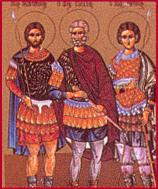
Saints Andronic, Tarachus
et Probus
Martyrs célèbres en
Orient (+ v. 304)
De Cilicie à Tarse puis à
Mopsuete, ils furent conduits prisonniers. Sans égard pour son grand âge, on
brisa la mâchoire de Tarachus à coups de pierres. Probus ne connut aucun
interrogatoire, il fut immédiatement frappé à coups de nerfs de bœuf. Andronic
le plus jeune, fut suspendu à une potence et on lui incisa les jambes avec des
lames effilées. Quelques jours plus tard, devant leur persévérance à confesser
Jésus-Christ, Tarachus fut suspendu la tête en bas au-dessus d'une épaisse
fumée, Probus fut soumis aux fers rouges et l'on força Andronic à manger des
viandes offertes aux idoles. Enfin, ils furent jetés en pâture dans l'arène. Les
gladiateurs les achevèrent.
À Anazarbe en Cilicie,
vers 304, les saints Tharace, Probus et Andronic, martyrs, qui offrirent leur
vie en confessant le Christ dans la persécution de Dioclétien.
Martyrologe romain
SOURCE : http://nominis.cef.fr/contenus/saint/8495/Saints-Andronic--Tarachus-et-Probus.html
Saints Martyrs PROBUS,
TARACHUS et ANDRONIQUE
Ces Saints Martyrs
vécurent sous le règne de Dioclétien et le gouvernement de Flavien (vers 304).
Citoyen romain et soldat, Tarachus était déjà avancé en âge. Sa patrie était
Claudiopolis en Isaurie. Probus était citoyen de la ville de Side en Pamphylie,
et Andronique était issu d'une noble famille d'Ephèse. Lorsqu'on eut découvert
qu'ils étaient Chrétiens, on s'empara d'eux à Pompéiopolis, en Cilicie, puis on
les déféra au tribunal du gouverneur Numérien Maxime, à Tarse, ensuite à
Mopsueste, puis une troisième fois dans la ville d'Anazarbe. Les menaces du
juge restant sans effet devant l'attitude résolue de Tarachus, il lui fit
briser la machoire à coups de pierres, sans pitié pour son âge. Quand on amena
Probus, il dit à Maxime de ne pas perdre de temps en un interrogatoire inutile
et lui demanda de passer sans plus tarder à la torture. Cruellement fouetté à
coups de nerfs de boeuf, il répondit au juge, qui lui demandait d'avoir pitié
de lui-même: «Ce sang répandu est pour moi une huile et un parfum, dont je
m'oins avec joie pour de nouveaux combats!» Andronique, le plus jeune, ayant
lui aussi témoigné de son empressement à souffrir pour gagner la vie éternelle,
fut suspendu à une potence; on lui incisa les jambes avec des lames effilées,
puis on lui brûla les côtes en jetant ensuite du sel sur les plaies.
Quelques jours plus tard, on les fit de nouveau comparaître. Tarachus fut
suspendu la tête en-bas au-dessus d'un brasier dégageant une épaisse fumée.
Après quoi on lui versa un âcre mélange de vinaigre, de sel et de moutarde dans
les narines, avant de le jeter en prison. Comme Probus se moquait des idoles et
de leurs adorateurs, il fut placé sur des fers rougis au feu, puis, après lui
avoir arraché le cuir chevelu, on lui plaça des charbons ardents sur le crâne
et on lui coupa la langue. Andronique à son tour fut mis à l'épreuve, mais ne
cessa pas toutefois de se moquer de ses tortionnaires. Comme on lui
introduisait de force dans la bouche des viandes et du vin offerts aux idoles,
il tourna en dérision la stupidité du magistrat qui croyait l'avoir vaincu, en
déclarant que pour les Chrétiens seule l'apostasie volontaire est une souillure
et une défaite.
Finalement, le lendemain du troisième interrogatoire, Maxime organisa des jeux
de bêtes et de gladiateurs, en prévoyant l'exécution des trois Martyrs comme
clou du spectacle. Incapables de marcher, à cause des supplices endurés
auparavant, ils furent portés jusque dans l'arène et livrés aux bêtes féroces,
qui avaient déjà fait plusieurs victimes ce jour là. Contrairement à toute attente,
un ours redoutable vint lécher paisiblement les plaies d'Andronique, comme pour
le consoler, et une lionne alla jouer avec Tarachus. Furieux devant ce
spectacle qui déclenchait l'admiration de la foule, le gouverneur Maxime fit
couper en morceaux les trois athlètes du Christ par ses gladiateurs, au milieu
de l'amphithéâtre. La nuit venue, grâce à l'intervention de Dieu, de pieux
chrétiens purent tromper les gardes et allèrent ensevelir les restes des trois
Martyrs dans une caverne de la montagne.
SOURCE : http://www.religion-orthodoxe.eu/article-saints-martyrs-probus-tarachus-et-andronique-57991263.html

Saints
Probus, Tarachus et Andronicus, Menologion de Basil II // Οι άγιοι
Πρόβος, Τάραχος και Ανδρόνικος. Από το Μηνολόγιον του αυτοκράτορα Βασιλείου Β'
(11ος αι.).
Also known as
Tharacus
Tracio
11
October (Latin calendar)
12
October (Greek calendar)
Profile
Tried and tortured for
the crime of Christianity in
Tarsus, Mopsuestia and Anazarbus in Cilicia during the persecutions of
Galerius and Diocletian;
local Christians at
each town made records of the examinations and abuse. Martyr.
Born
Cladiopolis, Isauria
beheaded in 304 in
the amphitheatre of Anazarbus, Cilicia
body left for animals to destroy, but local Christians recovered
and buried him
Additional Information
Acts
of the Early Martyrs, by Father James
A M Fastré, S.J.
Book
of Saints, by the Monks of
Ramsgate
Book
of Saints, by the Monks of
Ramsgate
Lives
of the Saints, by Father Alban
Butler
Saints
of the Day, by Katherine Rabenstein
Short
Lives of the Saints, by Eleanor Cecilia Donnelly
books
Our Sunday Visitor’s Encyclopedia of Saints
other sites in english
video
sitios en español
Martirologio Romano, 2001 edición
fonti in italiano
Martirologio Romano, 2005 edition
MLA Citation
“Saint Tarachus of Cladiopolis“. CatholicSaints.Info.
18 July 2022. Web. 28 April 2026.
<https://catholicsaints.info/saint-tarachus-of-cladiopolis/>
SOURCE : https://catholicsaints.info/saint-tarachus-of-cladiopolis/
Book
of Saints – Andronicus, Tarachus and Probus
Article
ANDRONICUS, TARACHUS and PROBUS (Saints) Martyrs
(October 11) (4th century) The triumph of these Martyrs has a prominent place
in the Greek and Roman Martyrologies. Their Acts are universally accepted as
genuine and contain the particulars of the triple examination which they
underwent in the towns of Tarsus, Mopsuestia and Anazarbus in Cilicia, together
with an authentic report of their passion written down by Christian
eyewitnesses. The latter recovered their bodies and buried them. They were
beheaded after unflinchingly undergoing excruciating tortures (A.D. 304), under
Galerius, the colleague of the Emperor Diocletian.
MLA Citation
Monks of Ramsgate. “Andronicus, Tarachus and
Probus”. Book of Saints, 1921. CatholicSaints.Info. 20
July 2012.
Web. 28 April 2026.
<http://catholicsaints.info/book-of-saints-andronicus-tarachus-and-probus/>
SOURCE : https://catholicsaints.info/book-of-saints-andronicus-tarachus-and-probus/
Book
of Saints – Tharacus, Probus and Andronicus
Article
(Saints) Martyrs (October
11) (4th
century) Christians martyred during
the persecution (A.D. 304)
at Tarsus in Cilicia (Asia
Minor). Tharacus appears to have been a Roman soldier,
Probus a stranger from Pamphylia, and Andronicus a prominent citizen of
Ephesus.
MLA Citation
Monks of Ramsgate. “Tharacus, Probus and
Andronicus”. Book of Saints, 1921. CatholicSaints.Info.
10 October 2016. Web. 28 April 2026.
<https://catholicsaints.info/book-of-saints-tharacus-probus-and-andronicus/>
SOURCE : https://catholicsaints.info/book-of-saints-tharacus-probus-and-andronicus/
St. Tharacus
Feastday: October 11
Death: 304
Also called Taracus,
a martyr with
Andronicus and Probus during the persecutions of Emperor Diocletian (r.
284-305). Tharachus was born about 239 and was a one-time officer in the Roman
army, Probus was a Roman citizen from Pamphilia (modern Turkey), and Andronicus
was a young man. They were tried by Numerian Maximus (r. 283-284) and cruelly
tortured. Thrown to wild beasts but unharmed, the martyrs were slain by sword
in Anazarbus or
Tarsus, Cilicia.
SOURCE : https://www.catholic.org/saints/saint.php?saint_id=2191
Saint Tarachus and his
Companions
Martyrs
(† 304)
During the persecution of
Diocletian in the year 304, Tarachus, Probus, and Andronicus, differing in age
and nationality but united in the bonds of faith, were denounced as Christians
to the governor of Cilicia. They were arrested at Pompeiopolis, and conducted
to Tarsus. The acts of these glorious martyrs are one of the most precious
monuments of Church history. The interrogations, making up the first three
parts of their acts, were recorded in the proconsular registers, which the
Christians bought for 200 denari from the public Notary. Line by line, we read
the questions posed by the governor of Cilicia named Maximus, and the answers
of the martyrs. These are followed by a narration of their death, written by
three Christian eyewitnesses, Mark, Felix and Verus, who buried their bodies.
Tarachus was a retired
military officer of the imperial armies, who had reached the age of sixty-five.
Probus had abandoned a fortune to serve Jesus Christ with greater liberty.
Andronicus, the youngest, was a member of one of the first families of Ephesus.
When Tarachus was told to
sacrifice, he replied, I cannot renounce the law of God. The governor of the
province said, There is only one law, the one we obey.
Tarachus: There is
another, and you transgress it by adoring your own handiwork, statues of wood
or stone. He was struck on the mouth and beaten with rods. Tarachus said while
being struck: Now you are making me truly wise; the blows you give me fortify
me, they increase my confidence in God and in Jesus Christ. He was chained and
taken to prison.
Probus was no less
courageous; while he was being beaten the governor said to him, Look at your
torn body, wretch, and the ground covered with your blood!
Probus: The more my
flesh suffers for Jesus Christ, the more my soul acquires strength and vigor.
He was placed in irons and no one was permitted to dress his wounds.
When the turn of
Andronicus came, Maximus said to him: Adore the gods and obey the emperors, who
are our fathers and masters.
Andronicus: The
devil is your father, when you do his works.
Maximus: Young man,
you are insolent; do you know that I have torments in readiness?
Andronicus: I would
rather see my body cut into pieces than lose my soul.
Maximus: Wretch, we
will see if you are insensible to torments. When you feel them, you will
perhaps renounce your folly.
Andronicus: This
folly is advantageous for us who hope in Jesus Christ. The wisdom of the world
leads to eternal death. He was tortured on the rack, and salt put on his
wounds. He said: Your torments have procured true refreshment for my body.
Maximus: I will have
you perish by a slow death. And he had him chained like the others and put in
prison.
A short time later they
were moved to another city, where the same governor began the questioning over
again. Tarachus had his teeth broken, his hands burnt, and vinegar and salt
poured into his nostrils. He said: Your vinegar has only sweetness for me, and
your salt seems insipid to me. Probus, brought before him, told him, My soul is
stronger than ever. In heaven I have a living God whom I serve and adore; I
know no other. When told to sacrifice to Jupiter, he said, Can you give the
name of god to one soiled by adulteries, incests, and other enormous crimes?
And when struck on the mouth, he said, I have not injured truth, I only said of
Jupiter what all who adore him already know. He was burnt with hot coals on the
head and feet. Andronicus was led before Maximus and told that his companions
had ceded under torture. He answered: Why do you try to deceive me? My companions
have not renounced the cult of the true God, and even if they had, I would
not commit such an impiety. The God I adore has given me the arms of faith.
Jesus Christ, my Saviour, is my strength, in such wise that I do not dread your
power or that of your masters or that of your gods. You can test me with all
the tortures that the most refined cruelty suggests to you. He was again beaten
and salt was rubbed into his wounds. Maximus said to him: You will not despise
my authority with impunity.
Andronicus: It will
not be said, either, that the cause of Jesus Christ has succumbed under your
authority.
A third interrogation and
another series of tortures followed at still another city. Tarachus was cruelly
tortured; when his ears were cut off he only said: My heart is no less
attentive to the word of God, and made other similar replies, as respectful as
they were heroic. Maximus said to Probus: The God you invoke has delivered you
Himself into my hands.
Probus: He loves
men. Food offered to idols was forced into his mouth.
Probus: I have
abandoned my body to your power in order to save my soul. When you force me to
eat what has been offered on your abominable altars, I am not soiled; God is
witness to the violence I suffer. He was blinded. He replied: You have deprived
me of the eyes of the body, but cannot take from me those of the soul. If you
knew your own blindness, you would find you were more unfortunate than I am.
The youngest confessor had his teeth pulled out, and was told he would be
devoured by the beasts in the amphitheater. He said: God will deliver me when
it so pleases Him.
Unable to walk because of
their wounds, these disciples of Christ were borne to the amphitheater. The
wild animals, when released, would not approach the martyrs; a bear who had
killed three men that day, came and licked the feet of the youngest martyr. The
governor had the beast killed. A furious lioness, even after being provoked,
lay down at the feet of Tarachus and licked them. Gladiators were told to kill
the martyrs. The Christians of the city sent this narration to the church of
Iconium, telling them to make it known to the faithful of the other cities of
the region for their edification.
Reflection: Such is
true Christian devotion. Is ours the faith of the Apostles who cried: Neither
death nor life shall be able to separate us from the love that is in Christ
Jesus? (Cf. Romans 8:38-39)
Les Petits Bollandistes:
Vies des Saints, by Msgr. Paul Guérin (Bloud et Barral: Paris, 1882), Vol.
12; Little Pictorial Lives of the Saints, a compilation based
on Butler's Lives of the Saints and other sources by John
Gilmary Shea (Benziger Brothers: New York, 1894).
SOURCE : https://magnificat.ca/cal/en/saints/saint_tarachus_and_his_companions.html
Andronicus, Tarachus
(Tharacus), and Probus MM (RM)
Died 304. These three
martyrs were considerably different from one another, except in their love for
Jesus and willingness to put sell everything to purchase the pearl of great
price. Tarachus (c. 239- 304) was a Roman born at Claudiopolis, Isauria. He became
a soldier in the Roman army but left he army when he became a Christian,
because he feared he might be required to act contrary to the law of God. When
he was 65, Tarachus was arrested with Andronicus, a patrician from one of the
leading families of Ephesus, and Probus, a plebeian born at Side in Pamphylia
of a Thracian father who gave up a considerable fortune to follow Christ, at
Pompeiopolis in Cilicia during the persecutions of Diocletian and Maximian.
They were tried before
Numerian Maximus, the governor, subjected to three interrogations (at Tarsus,
Mopsuestia, and Anazarbus), and cruelly tortured. They remained steadfast in
their faith and were ordered thrown to wild beasts in the arena near Anazarbus
in Cilicia; when the beasts did not harm them, gladiators killed them by sword.
Their authentic acta come
from the proconsular register, which some Christians purchased from the public
notaries for 200 denarii. (Though this is disputed.) An epilogue was added by
three eyewitnesses of the martyrdom: Marcian, Felix, and Verus. These same
witnesses later retrieved the bodies from the guards, interred them, and kept
watch over them the rest of their lives. They also asked that they be buried in
the same vault as the martyrs.
The acta begin at Tarsus
with Maximus addressing himself to the elderly Tarachus and asking his name.
Tarachus: I am Christian.
Maximus: Speak not of
your impiety, but tell me your name.
Tarachus: I am a
Christian.
Maximus: Strike him upon
the mouth, and bid him not answer one thing for another.
Tarachus was buffeted on
his jaws.
Tarachus: I tell you my
true name. If you would know that which my parents gave me, it is Tarachus;
when I bore arms I went by the name of Victor.
Maximus: What is your
profession, and from what country do you come?
Tarachus: I am of a Roman
family, and was born at Claudiopolis, in Isauria. I am by profession a soldier,
but quit the service because of my religion.
Maximus: Your impiety
rendered you unworthy to bear arms; but how did you procure your
discharge?"
Tarachus: I asked it of
my captain, Publio, and he gave it to me.
Maximus: In consideration
of your gray hairs, I will procure you the favor and friendship of the
emperors, if you will obey their orders. Draw near, and sacrifice to the gods,
as the emperors themselves do all the world over.
Tarachus: They are
deceived by the devil in so doing.
Maximus: Break his jaws
for saying the emperors are deceived.
Tarachus: I repeat it, as
men they are deluded.
Maximus: Sacrifice our
gods, and renounce your folly.
Tarachus: I cannot
renounce the law of God.
Maximus: Is there any
law, wretch, but that which we obey?
Tarachus: There is, and
you transgress it by adoring stocks and stones, the works of men's hands.
Maximus: Strike him on
the face, saying, 'Abandon your folly.'
Tarachus: What you call
folly is the salvation of my soul, and I will never leave it.
Maximus: But I will make
you leave it, and force you to be wise.
Tarachus: Do with my body
what you please, it is entirely in your power.
Maximus: Strip him, and
beat him with rods.
And the old man was
beaten.
Tarachus: You have now
made me truly wise. I am strengthened by your blows, and my confidence in God
and in Jesus Christ is increased.
Maximus: Wretch, how can
you deny a plurality of gods, when, according to your own confession, you serve
two gods? Did you not give the name of God to a certain person, named Christ?
Tarachus: Right; for this
is the Son of the living God; he is the hope of the Christians, and the author
of salvation to such as suffer for his sake.
Maximus: Forbear this
idle talk; draw near, and sacrifice.
Tarachus: I am no idle
talker; I am sixty-five years old; thus have I been brought up, and I cannot
forsake the truth.
Demetrius, the centurion,
said: "Poor man, I pity you; be advised by me, sacrifice; and save
yourself.
Tarachus: "Away, you
minister of Satan, and keep your advice for your own use.
Maximus: Let him be
loaded with large chains, and carried back to prison. Bring forth he next in
years.
Demetrius: He is here, my
lord.
Maximus: What is your
name?
Probus: MY chief and most
honorable name is Christian; but the name I go by in the world is Probus.
Maximus: From what
country do you come, and of what family?
Probus: My father was of
Thrace: I am a plebeian, born a Sida, in Pamphylia, and profess Christianity.
Maximus: That will do you
no service. Be advised by me, sacrifice the gods, that you may be honored by
the emperors, and enjoy my friendship.
Probus: I want nothing of
that kind. Formerly, I was possessed of a considerable estate; but I
relinquished it to serve the living God through Jesus Christ.
Maximus: Take off his
garments, gird him, lay him at his full length, and lash him with ox's sinews.
Demetrius, the centurion,
said to him, while they were beating him: "Spare thyself, my friend; see
how your blood runs in streams on the ground."
Probus: Do what you will
with my body, your torments are sweet perfumes to me.
Maximus: Is this your
obstinate folly incurable? What can you hope for?
Probus: I am wiser than
you are, because I do not worship devils.
Maximus: Turn him, and
strike him on the belly.
Probus: My Lord, assist
your servant.
Maximus: Ask him, at
every stripe, Where is your helper?
Probus: He helps me, and
will help me; for I take so little notice of your torments, that I do not obey
you.
Maximus: Look, wretch,
upon your mangled body; the ground is covered with your blood.
Probus: The more my body
suffers for Jesus Christ, the more is my soul refreshed.
Maximus: Put fetters on
his hands and feet, with his legs distended in the stocks to the fourth hole,
and let nobody come to dress his wounds. Bring the third to the bar.
Demetrius: Here he
stands, my lord.
Maximus: What is your
name?
Andronicus: My true name
is Christian, and the name by which I am commonly known among men, is
Andronicus.
Maximus: What is your
family?
Andronicus: My father is
one of the first rank in Ephesus.
Maximus: Adore the gods,
and obey the emperors, who are our fathers and masters.
Andronicus: The devil is
your father while you do his works.
Maximus: Youth makes you
insolent; I have torments ready.
Andronicus: I am prepared
for whatever may happen.
Maximus: Strip him naked,
gird him, and stretch him on the rack.
Demetrius: Obey, my
friend, before your body is torn and mangled.
Andronicus: It is better
for me to have my body tormented, than to lose my soul.
Maximus: Sacrifice before
I put you to the most cruel death.
Andronicus: I have never
sacrificed to demons from my infancy, and I will not now begin.
Athanasius, the
cornicularius, or clerk to the army, said to him: "I am old enough to be
your father, and therefore take the liberty to advise you: obey the governor."
Andronicus: You give me
admirable advice, indeed, to sacrifice to devils.
Maximus: Wretch, are you
insensible to torments? You don't yet know what it is to suffer fire and razors
When you has felt them, you wilt perhaps, give over your folly.
Andronicus: This folly is
expedient for us who hope in Jesus Christ. Earthly wisdom leads to eternal
death.
Maximus: Tear his limbs
with the utmost violence.
Andronicus: I have done
no evil, like a murderer. I contend for that piety which is due.
Maximus: If you had but
the least sense of piety, you would sacrifice to the gods whom the emperors so
religiously worship.
Andronicus: That is not
piety, but impiety to abandon the true God, and worship marble.
Maximus: Execrable
villain, are then the emperors guilty of impieties? Hoist him again, and gore
his sides.
Andronicus: I am in your
hands; do with my body what you please.
Maximus: Lay salt upon
his wounds, and rub his sides with broken tiles.
Andronicus: Your torments
have refreshed my body.
Maximus: I will cause you
to die gradually.
Andronicus: Your menaces
do not terrify me; my courage is above all that your malice can invent.
Maximus: Put heavy chain
about his neck, and another upon his legs, and keep him in close prison.
Thus ended the first
examination; the second was held at Mopsuestia, where Flavius Clemens
Numerianus Maximus sat before his tribunal and issued a command to his
centurion Demetrius.
Maximus: Bring forth the
impious wretches who follow the religion of the Christians.
Demetrius: Here they are,
my lord.
Maximus: Old age is
respected in many, on account of the good sense and prudence that generally
attend it; wherefore, if you have made a proper use of the time allowed you for
reflection, I presume your own discretion has wrought in you a change of sentiments;
as a proof of which, it is required that you sacrifice to the gods, which
cannot fail of recommending you to the esteem of your superiors.
Tarachus: I am a
Christian, and I wish you and the emperors would leave your blindness, and
embrace the truth which leads to life.
Maximus: Break his jaws
with a stone, and bid him leave off his folly.
Tarachus: This folly is
true wisdom.
Maximus: Now they have
loosened all your teeth, wretch, take pity on yourself, come to the altar, and
sacrifice to the gods, to prevent severer treatment.
Tarachus: Though you cut
my body into a thousand pieces, you will not be able to shake my resolution;
because it is Christ who gives me strength to stand my ground.
Maximus: Wretch, accursed
by the gods, I will find means to drive out your folly. Bring in a pan of
burning coals, and hold his hands in the fire till they are burnt.
Tarachus: I fear not your
temporal fire, which soon passes; but I dread eternal flames.
Maximus: See, your hands
are well baked, they are consumed by the fire; is it not time for you to grow
wise? Sacrifice.
Tarachus: If you have any
other torments in store for me, employ them; I hope I shall be able to
withstand all your attacks.
Maximus: Hang him by the
feet, with his head over a great smoke.
Tarachus: "After
having proved an overmatch for your fire, I am not afraid of your smoke.
Maximus: Bring vinegar
and salt, and force them up his nostrils.
Tarachus: Your vinegar is
sweet to me, and your salt insipid.
Maximus: Put mustard into
the vinegar, and thrust it up his nose.
Tarachus: Your ministers
impose upon you; they have given me honey instead of mustard.
Maximus: Enough for the
present; I will make it my business to invent fresh tortures to bring you to
your senses; I will not be baffled.
Tarachus: You will find
me prepared for the attack.
Maximus: Away with him to
the dungeon. Bring in another.
Demetrius: My lord, here
is Probus.
Maximus: Well, Probus,
have you considered the matter; and are you disposed to sacrifice to the gods,
after the example of the emperors?
Probus: I appear here
again with fresh vigor. The torments I have endured have hardened my body; and
my soul is strengthened in her courage, and proof against all you can inflict.
I have a living God in heaven: him I serve and adore, and no other.
Maximus: What! villain,
are not ours living gods?
Probus: Can stones and
wood, the workmanship of a statuary be living gods? You know not what you do
when you sacrifice to them.
Maximus: What insolence!
At least sacrifice to the great god Jupiter. I will excuse you as to the rest.
Probus: Do not you blush
to call him god who was guilty of adulteries, incests, and other most enormous
crimes?
Maximus: Beat his mouth
with a stone, and bid him not blaspheme.
Probus: Why this evil
treatment? I have spoken no worse of Jupiter than they do who serve him. I
utter no lie; I speak the truth, as you yourself well know.
Maximus: Heat bars of
iron, and apply then to his foot.
Probus: This fire is
without heat; at least, I feel none.
Maximus: Hoist him on the
rack, and let him be scourged with thongs of raw leather till his shoulders are
flayed.
Probus: All this does me
no harm: invent something new, and you will see the power of God who is in me
and strengthens me.
Maximus: Shave his head,
and lay burning coals upon it.
Probus: You have burnt my
head and my feet. You see, notwithstanding, that I still continue God's
servant, and disregard your torments. He will save me; your gods can only
destroy.
Maximus: Do you not see
all those that worship them standing about my tribunal, honored by the gods and
the emperors? They look upon you and your companions with contempt.
Probus: Believe me,
unless they repent and serve the living God, they will all perish, because
against the voice of their own conscience they adore idols.
Maximus: Beat his face,
that he may learn to say the gods, and not God.
Probus: You unjustly
destroy my mouth, and disfigure my face because I speak the truth.
Maximus: I will also
cause your blasphemous tongue to be plucked out to make you comply.
Probus: Besides the
tongue which serves me for utterance, I have an internal, an immortal tongue,
which is out of your reach.
Maximus: Take him to prison.
Let the third come in.
Demetrius: He is here.
Maximus: Your companions,
Andronicus, were at first obstinate; but gained nothing thereby but torments
and disgrace, and have been at last compelled to obey. They shall receive
considerable recompenses. Therefore, to escape the like torments, sacrifice to
the gods, and you shall be honored accordingly. But if you refuse, I swear by
the immortal gods, and by the invincible emperors that you shall not escape out
of my hands with your life.
Andronicus: Why do you
endeavor to deceive me with lies? They have not renounced the true God. And had
that been so, you should never find me guilty of such an impiety. God, whom I
adore, has clothed me with the arms of faith; and Jesus Christ, my Savior, is
my strength; so that I either fear your power, nor that of your masters, nor of
your gods. For a trial, cause all your engines and instruments to be displayed
before my eyes, and employed on my body.
Maximus: Bind him to the
stakes, and scourge him with raw thongs.
Andronicus: There is
nothing new or extraordinary in this torment.
Athanasius: Your whole
body is but one wound from head to foot, and cost you count this nothing?
Andronicus: They who love
the living God, make very small account of all this.
Maximus: Rub his back
with salt.
Andronicus: Give orders,
I pray you, that they do not spare me, that being well seasoned I may be in no
danger of putrefaction, and may be the better able to withstand your torments.
Maximus: Turn him, and
beat him upon the belly, to open afresh his first wounds.
Andronicus: You saw when
I was brought last before your tribunal, how I was perfectly cured of the
wounds I received by the first day's tortures: he that cured me then, can cure
me a second time.
Maximus, addressing
himself to the guards of the prison: "Villains and traitors," said
he, "did I not strictly forbid you to suffer any one to see them, or dress
their wounds? Yet, see here!"
Pegasus, the jailer,
said, "I swear by your greatness that no one has applied anything whatever
to his wounds, or had admittance to him; and he has been kept in chains in the
most retired part of the prison on purpose. If you catch me in a lie I'll
forfeit my head."
Maximus: How comes it,
then, that there is nothing to be seen of his wounds?
Pegasus: I swear by your
high birth that I know not how they have been healed.
Andronicus: Senseless
man, the physician that has healed me is no less powerful than he is tender and
charitable. You know him not. He cures not by the application of medicines, but
by his word alone. Though he dwells in heaven, he is present everywhere, but
you know him not.
Maximus: Your idle
prattling will do you no service; sacrifice, or you art a lost man.
Andronicus: I do not
change my answers. I am not a child, to be wheedled or frightened.
Maximus: Do not flatter
yourself that you shall get the better of me.
Andronicus: Nor shall you
ever make us yield to your threats.
Maximus: My authority
shall not be baffled by you.
Andronicus: Nor shall it
ever be said that the cause of Jesus Christ is vanquished by your authority.
Maximus: Let me have
several kinds of tortures in readiness against my next sitting. Put this man in
prison loaded with chains, and let no one be admitted to visit them in the
dungeon.
The third examination was
held at Anazarbus. In it Tarachus answered first with his usual constancy,
saying to all threats that a speedy death would finish his victory and complete
his happiness; and that long torments would procure him the greater recompense.
Then Maximus had him bound and stretched on the rack.
Tarachus: I could allege
the rescript of Diocletian, which forbids judges to put military men to the
rack. But waive my privilege, lest you should suspect me of cowardice.
Maximus: You flatter
yourself with the hopes of having your body embalmed by Christian women, and
wrapped up in perfumes after you art dead, but I will take care to dispose of
your remains.
Tarachus: Do what you
please with my body, not only while it is living, but also after my death.
Maximus ordered his lips,
cheeks, and whole face, to be slashed and cut.
Tarachus: You have
disfigured my face, but have added new beauty to my soul. I don't fear any of
your inventions, for I am clothed with the divine armor.
The tyrant ordered spits
to be heated and applied red hot to his armpits, then his ears to be cut off.
Tarachus: My heart will
not be less attentive to the word of God.
Maximus: Tear the skin
off his head, then cover it with burning coals.
Tarachus: Though you
should order my whole body to be flayed, you will not be able to separate me
from my God.
Maximus: Apply the
red-hot spits once more to his armpits and sides.
Tarachus: O God of
heaven, look down upon me, and be my judge.
The governor then sent
him back to prison to be reserved for the public shows the day following, and
called for the next. Probus being brought forth, Maximus again exhorted him to
sacrifice; but after many words ordered him to be bound and hung up by the
feet: then red-hot spits to be applied to his sides and back.
Probus: My body is in
your power. May the Lord of heaven and earth vouchsafe to consider my patience,
and the humility of my heart.
Maximus: The God whom you
implore has delivered you into my hands.
Probus: He loves men.
Maximus: Open his mouth,
and pour in some of the wine which has been offered upon the altars, and thrust
some of the sanctified meat into his mouth.
Probus: See, O Lord, the
violence they offer me, and judge my cause.
Maximus: Now you see that
after suffering a thousand torments rather than to sacrifice, you have
nevertheless partaken of a sacrifice.
Probus: You have done no
great feat in making me taste these abominable offerings against my will.
Maximus: No matter; it is
now done: promise now to do it voluntarily and you shall be released.
Probus: God forbid that I
should yield; but know that if you should force into me all the abominable
offerings of your whole altars, I should be no ways defiled: for God sees the
violence which I suffer.
Maximus: Heat the spits
again, and burn the calves of his legs with them.
To Probus: There is not a
sound part in your whole body, and still you persistent in your folly. Wretch,
what can you hope for?
Probus: I have handed my
body over to you that my soul may remain whole and sound.
Maximus: Make some sharp
nails red hot, and pierce his hands with them.
Probus: O my Savior, I
return you most hearty thanks that you have been pleased to make me share in
your own sufferings.
Maximus: The great number
of your torments make you more foolish.
Probus: Would to God your
soul was not blind, and in darkness.
Maximus: Now that you
have lost the use of all your members, you complain to me for not having
deprived you of your sight. Prick him in the eyes, but by little and little,
till you have bored out the organs of his sight.
Probus: Behold I am now
blind. you have destroyed the eyes of my body, but cannot take away those of my
soul.
Maximus: You continue
still to argue, but you are condemned to eternal darkness.
Probus: If you knew the
darkness in which your soul is plunged, you would see yourself much more
miserable than I am.
Maximus: You have no more
use of your body than a dead man, yet you continue to talk.
Probus: So long as any
vital heat continues to animate the remains which you have left me of this
body, I will never cease to speak of my God, to praise and to thank him.
Maximus: What! Do you
hope to survive these torments? Can you flatter yourself that I shall allow you
one moment's respite?
Probus: I expect nothing
from you but a cruel death, and I ask of God only the grace to persevere in the
confession of his holy name to the end.
Maximus: I will leave you
to languish, as such an impious wretch deserves. Take him hence. Let the
prisoners be closely guarded that none of their friends who would congratulate
with them, may find access. I desire them for the shows. Let Andronicus be brought
in. He is the most resolute of the three.
The answers and behavior
of these saints were usually respectful towards their judges; this is a duty,
and the spirit of the Gospel. Nevertheless, by an extraordinary impulse of the
Holy Spirit, some on certain occasions have deviated from this rule, e.g.,
Saint Paul called his judge a "whited wall" and threatened him with
the angel of God. Like him, Andronicus answers harshly. The governor pressed
Andronicus again to comply, adding, that his two companions had at length
sacrificed to the gods, and to the emperors themselves.
Andronicus: This is truly
the part of an adorer of the god of lies; and by this imposture I know that the
men are like the gods whom they serve. May God judge you, O worker of iniquity.
Maximus ordered rolls of
paper to be made, and set on fire upon the belly of the martyr; then bodkins to
be heated, and laid red hot between his fingers. Even after all this,
Andronicus was still unshaken.
Maximus: Do not expect to
die at once. I will keep you alive till the time of the shows, that you may see
your limbs devoured one after another by cruel beasts.
Andronicus: You are more
inhuman than the tigers, and more insatiable with blood than the most barbarous
murderers.
Maximus: Open his mouth,
and put some of the sanctified meat into it, and pour some of the wine into it
which has been offered to the gods.
Andronicus: Behold, O
Lord, the violence which is offered me.
Maximus: What will you do
now? You have tasted the offerings taken from the altar. You are now initiated
in the mysteries of the gods.
Andronicus: Know, tyrant,
that the soul is not defiled when she suffers involuntarily what she condemns.
God, who sees the secrets of hearts, knows that mine has not consented to this
abomination.
Maximus: How long will
this frenzy delude your imagination? It will not deliver you out of my hands.
Andronicus: God will
deliver me when he pleases.
Maximus: This is a fresh
extravagance: I will cause that your tongue to be cut out to put an end to your
prating.
Andronicus: I ask it as a
favor that those lips and tongue with which you imagine I have concurred in
partaking of the meats and wine offered to idols, may be cut off.
Maximus: Pluck out his
teeth, and cut out his blasphemous tongue to the very root; burn them, and then
scatter the ashes in the air, that none of his impious companions or of the
women may be able to gather them up to keep as something precious or holy. Let
him be carried to his dungeon to serve for food to the wild beasts in the
amphitheater.
Thus, the trial of the
three martyrs concluded. Maximus sent for the pontiff and the first magistrate
of Cilicia, and ordered that public games be produced the following day. Crowds
flocked to the amphitheater near the town of Anazarbus. The governor arrived
there about noon. The three eyewitnesses who wrote this epilogue watched from
the hillside, afraid to enter the amphitheater. The governor had the tortured
bodies of the three brought into the arena. Their bodies were so mangled that
they had to be carried in on the backs of porters and thrown in the pit before
the governor.
"We advanced,"
say the authors, "as near as we could on an eminence behind, and concealed
ourselves by piling stones before us as high as our breasts, that we might not
be known or observed. The sight of our brethren in so dismal a condition, made
us shed abundance of tears: even many of the infidel spectators could not
contain themselves. For no sooner were the martyrs laid down, but an almost
universal deep silence followed at the sight of such dismal objects, and the
people began openly to murmur against the governor for his barbarous cruelty.
"Many even left the
shows, and returned to the city: which provoked the governor, and he ordered
more soldiers to guard all the avenues to stop any from departing, and to take
notice of all who attempted it, that they might be afterwards called to their
trial by him. At the same time, he commanded a great number of beasts to be let
loose out of their dens into the pit. These fierce creatures rushed out, but
all stopped near the doors of their lodges, and would not advance to hurt the
martyrs.
"Maximus, in a fury,
called for the keepers, and caused one hundred strokes with cudgels to be given
them, making them responsible for the tameness of their lions and tigers,
because they were less cruel than himself. He threatened even to crucify them
unless they let out the most ravenous of their beasts.
"They turned out a
great bear which that very day had killed three men. He walked up slowly
towards the martyrs, and began to lick the wounds of Andronicus. That martyr
leaned his head on the bear, and endeavored to provoke him, but in vain.
Maximus possessed himself no longer, but ordered the beast to be immediately
killed. The bear received the strokes, and fell quietly before the feet of
Andronicus.
"The pontiff
Terentianus seeing the rage of the governor, and trembling for himself,
immediately ordered a most furious lioness to be let out. At the sight of her,
all the spectators turned pale, and her terrible roarings made the bravest men
tremble on their safe seats. Yet when she came up to the saints, who lay
stretched on the sand, she laid her self down at the feet of Saint Tarachus,
and licked them, quite forgetting her natural ferocity. Maximus, foaming with
rage, commanded her to be pricked with goads. She then arose, and raged about
in a furious manner, roaring terribly, and frightening all the spectators; who,
seeing that she had broke down part of the door of her lodge, which the
governor had ordered to be shut, cried out earnestly that she might be again
driven into her lodge.
"The governor,
therefore, called for the confectors or gladiators to dispatch the martyrs with
their swords; which they did. Maximus commanded the bodies to be intermixed
with those of the gladiators who had been slain, and also to be guarded that
night by six soldiers, lest the Christians should carry them off. The night was
very dark, and a violent storm of thunder and rain dispersed the guards. The
faithful distinguished the three bodies by a miraculous star or ray of light
which streamed on each of them. They carried off the precious treasures on
their backs, and hid them in a hollow cave in the neighboring mountains, where
the governor was not able, by any search he could make, to find them. He
severely chastised the guards." Thus, the three witnesses pledged to guard
the precious relics for the balance of their days (Benedictines, Delaney,
Husenbeth).
SOURCE : http://www.saintpatrickdc.org/ss/1011.shtml
Sts. Tarachus, Probus,
and Andronicus
Martyrs of the Diocletian persecution (about
304). The "Martyrologium Hieronymian." contains the names of
these three martyrs on
four different days (the four days 8-11 October evidently signify no
more than the date on a single day), with the topographical
identification: "In Tarso Cilicie", on 27 Sept. (ed. De
Rossi-Duchesne, 126), to which corresponds the expression, "In
Cilicia", given on the two days of 5 April, and 8-11 October. The
expression, "In Palestina", given under 13 May (ibid., 60), is either
an error or
refers to a special shrine of the martyrs in
Palestine. There are two accounts of the glorious martyrdom of
these three witnesses by blood, the first account being held by
Ruinart (Acta Martyrum, ed. Ratisbon,
448 sq.) to be entirely authentic. According to these Acts, Tarachus,
a native of Cladiopolis in Isauria, Probus of Side in
Pamphylia, and Andronicus, who belonged to a prominent family of Ephesus,
were tried and horribly tortured three times in various cities at Tarsus,
and at Anazarbus of
Cilicia. They were then condemned to death by
wild beasts, and when the animals would not touch them in the
amphitheatre they were put
to death with the sword. Harnack, however, expressed doubts as
to the genuineness of the account (Geschichte der altchristlichen
Literatur, pt. II: Die Chronologie, I, 479 sq., note 5), and Delehaye (Les
lxgendes hagiographiques, 135 sq.) puts the martyrdom in
the class of legends of martyrs that
he calls "historical romances". At the same time, however, there can
be no doubt as
to the actual existence of the three martyrs.
Their feast is
celebrated in the Latin
Church on 11 October, and in the Greek
Church on 12 October.
Kirsch, Johann
Peter. "Sts. Tarachus, Probus, and Andronicus." The
Catholic Encyclopedia. Vol. 14. New York: Robert Appleton
Company, 1912. 11 Oct.
2015 <http://www.newadvent.org/cathen/14450c.htm>.
Transcription. This
article was transcribed for New Advent by Christine J. Murray.
Ecclesiastical
approbation. Nihil Obstat. July 1, 1912. Remy Lafort, S.T.D.,
Censor. Imprimatur. +John Cardinal Farley, Archbishop of New York.
Copyright © 2026 by New Advent LLC.
Dedicated to the Immaculate Heart of Mary.
SOURCE : http://www.newadvent.org/cathen/14450c.htm
SS. Tarachus, Probus, and
Andronicus, Martyrs
From their original
presidial Acts in Ruinart, p. 419. See Tillemont, t. 5, p. 285
A.D. 304.
THE HOLY name of God was glorified by the triumph of these martyrs in the
persecution of Dioclesian, at Anazarbus in Cilicia, probably in the year 304,
when the edicts against the Christians were made general, and extended to all
the laity without exception. Their acts are a precious monument of
ecclesiastical antiquity. The three first parts contain the triple examination
which the saints underwent at Tarsus, Mopsuestia, and Anazarbus, three cities
in Cilicia; and are an authentic copy of the pro-consular register, which
certain Christians purchased of the public notaries for the sum of two hundred
denarii, upwards of six pounds sterling. The last part was added by Marcian,
Felix and Verus, three Christians who were present at their martyrdom, and
afterwards stole the bodies from the guards, and interred them, resolving to
spend the remainder of their lives near the place, and after their deaths, to
be buried in the same vault with them.
The three martyrs were joined in the confession of the same faith, but differed
in their age and countries. Tarachus was a Roman by extraction, though born in
Isauria; he had served in the army, but had procured his discharge, for fear of
being compelled to do something that was contrary to the duty of a Christian;
he was at that time sixty-five years old. Probus, a native of Pamphilia, had
resigned a considerable fortune, that he might be more at liberty to serve
Christ. Andronicus was a young nobleman of one of the principal families of the
city of Ephesus. Being apprehended at Pompeiopolis in Cilicia, they were
presented to Numerian Maximus, governor of the province, upon his arrival in
that city, and by his order were conducted to Tarsus, the metropolis, to wait
his return. Maximus being arrived there, and seated on his tribunal, Demetrius,
the centurion, brought them before him, saying, they were the persons who had
been presented to him at Pompeiopolis, for professing the impious religion of
the Christians, and disobeying the command of the emperors. Maximus addressed himself
first to Tarachus, observing that he began with him because he was advanced in
years, and then asked his name. Tarachus replied: “I am a Christian.”
Maximus.—“Speak not of thy impiety; but tell me thy name.” Tarachus.—“I am a
Christian.” Maximus.—“Strike him upon the mouth, and bid him not answer one
thing for another.” Tarachus, after receiving a buffet on his jaws, said,—“I
tell you my true name. If you would know that which my parents gave me, it is
Tarachus; when I bore arms I went by the name of Victor.” Maximus.—“What is thy
profession, and of what country art thou?” Tarachus.—“I am of a Roman family,
and was born at Claudiopolis, in Isauria. I am by profession a soldier, but
quitted the service upon the account of my religion.” Maximus.—“Thy impiety
rendered thee unworthy to bear arms; but how didst thou procure thy discharge?”
Tarachus.—“I asked it of my captain, Publio, and he gave it me.” Maximus.—“In
consideration of thy grey hairs, I will procure thee the favour and friendship
of the emperors, if thou wilt obey their orders. Draw near, and sacrifice to
the gods, as the emperors themselves do all the world over.” Tarachus.—“They
are deceived by the devil in so doing.” Maximus.—“Break his jaws for saying
that the emperors are deceived.” Tarachus.—“I repeat it, as men, they are
deluded.” Maximus.—“Sacrifice to our gods, and renounce thy folly.”
Tarachus.—“I cannot renounce the law of God.” Maximus.—“Is there any law,
wretch, but that which we obey?” Tarachus.—“There is; and you transgress it by adoring
stocks and stones, the works of men’s hands?” Maximus.—“Strike him on the face,
saying, abandon thy folly.” “What you call folly is the salvation of my soul,
and I will never leave it.” Maximus.—“But I will make thee leave it, and force
thee to be wise.” Tarachus.—“Do with my body what you please, it is entirely in
your power.” Then Maximus said.—“Strip him and beat him with rods.” Tarachus,
when beaten, said,—“You have now made me truly wise. I am strengthened by your
blows, and my confidence in God and in Jesus Christ is increased.”
Maximus.—“Wretch, how canst thou deny a plurality of gods, when, according to
thy own confession, thou servest two gods. Didst thou not give the name of God
to a certain person named Christ?” Tarachus.—“Right; for this is the Son of the
living God; he is the hope of the Christians, and the author of salvation to
such as suffer for his sake.” Maximus.—“Forbear this idle talk; draw near and
sacrifice.” Tarachus.—“I am no idle talker; I am sixty-five years old; thus
have I been brought up, and I cannot forsake the truth.” Demetrius the
centurion said: “Poor man, I pity thee; be advised by me, sacrifice, and save
thyself.” Tarachus.—“Away, thou minister of Satan, and keep thy advice for thy
own use.” Maximus.—“Let him be loaded with large chains, and carried back to
prison. Bring forth the next in years.”
Demetrius the centurion said: “He is here my lord.” Maximus.—“What is thy
name?” Probus.—“My chief and most honourable name is Christian; but the name I
go by in the world is Probus.” Maximus.—“Of what country art thou, and of what
family?” Probus.—“My father was of Thrace: I am a plebeian, born at Sida in
Pamphilia, and profess Christianity.” Maximus.—“That will do thee no service.
Be advised by me, sacrifice to the gods, that thou mayest be honoured by the
emperors, and enjoy my friendship.” Probus.—“I want nothing of that kind.
Formerly I was possessed of a considerable estate; but I relinquished it to
serve the living God through Jesus Christ.” Maximus.—“Take off his garments,
gird him, 1 lay
him at his full length, and lash him with ox’s sinews.” Demetrius the centurion
said to him, whilst they were beating him: “Spare thyself, my friend; see how
thy blood runs in streams on the ground.” Probus: “Do what you will with my
body; your torments are sweet perfumes to me.” Maximus.—“Is this thy obstinate
folly incurable? What canst thou hope for?” Probus.—“I am wiser than you are,
because I do not worship devils.” Maximus.—“Turn him, and strike him on the
belly.” Probus.—“Lord, assist thy servant.” Maximus.—“Ask him, at every stripe,
where is thy helper?” Probus.—“He helps me, and will help me; for I take so
little notice of your torments, that I do not obey you.” Maximus.—“Look,
wretch, upon thy mangled body; the ground is covered with thy blood.”
Probus.—“The more my body suffers for Jesus Christ, the more is my soul
refreshed.” Maximus.—“Put fetters on his hands and feet, with his legs
distended in the stocks to the fourth hole, and let nobody come to dress his
wounds. Bring the third to the bar.”
Demetrius the centurion said: “Here he stands, my lord.” Maximus.—“What is thy
name?” Andronicus.—“My true name is Christian, and the name by which I am
commonly known among men, is Andronicus.” Maximus.—“What is your family?”
Andronicus.—“My father is one of the first rank in Ephesus.” Maximus.—“Adore the
gods, and obey the emperors, who are our fathers and masters.” Andronicus.—“The
devil is your father whilst you do his works.” Maximus.—“Youth makes you
insolent; I have torments ready.” Andronicus.—“I am prepared for whatever may
happen.” Maximus.—“Strip him naked, gird him, and stretch him on the rack.”
Demetrius the centurion said to the martyr: “Obey, my friend, before thy body
is torn and mangled.” Andronicus.—“It is better for me to have my body
tormented, than to lose my soul.” Maximus.—“Sacrifice before I put thee to the
most cruel death.” Andronicus.—“I have never sacrificed to demons from my
infancy, and I will not now begin.” Athanasius, the cornicularius, or clerk to
the army, said to him: “I am old enough to be thy father, and therefore take
the liberty to advise thee: obey the governor.” Andronicus.—“You give me
admirable advice, indeed, to sacrifice to devils.” Maximus.—“Wretch, art thou
insensible to torments? Thou dost not yet know what it is to suffer fire and
razors. When thou hast felt them, thou wilt, perhaps, give over thy folly.”
Andronicus.—“This folly is expedient for us who hope in Jesus Christ. Earthly
wisdom leads to eternal death.” Maximus.—“Tear his limbs with the utmost
violence.” Andronicus.—“I have done no evil; yet you torment me like a
murderer. I contend for that piety which is due to the true God.” Maximus—“If
thou hadst but the least sense of piety, thou wouldst adore the gods whom the
emperors so religiously worship.” Andronicus.—“It is not piety, but impiety to
abandon the true God, and to adore brass and marble.” Maximus.—“Execrable
villain, are then the emperors guilty of impieties? Hoist him again, and gore
his sides.” Andronicus.—“I am in your hands; do with my body what you please.”
Maximus.—“Lay salt upon his wounds, and rub his sides with broken tiles.”
Andronicus.—“Your torments have refreshed my body.” Maximus.—“I will cause thee
to die gradually.” Andronicus.—“Your menaces do not terrify me; my courage is
above all that your malice can invent.” Maximus.—“Put a heavy chain about his
neck, and another upon his legs, and keep him in close prison.” Thus ended the
first examination; the second was held at Mopsuestia.
Flavius Clemens Numerianus Maximus, governor of Cilicia, sitting on his
tribunal, said to Demetrius the centurion: “Bring forth the impious wretches
who follow the religion of the Christians.” Demetrius said: “Here they are, my
lord.” Maximus said to Tarachus: “Old age is respected in many, on account of
the good sense and prudence that generally attend it: wherefore, if you have
made a proper use of the time allowed you for reflection, I presume your own
discretion has wrought in you a change of sentiments; as a proof of which, it
is required that you sacrifice to the gods, which cannot fail of recommending
you to the esteem of your superiors.” Tarachus.—“I am a Christian, and I wish
you and the emperors would leave your blindness, and embrace the truth which
leads to life.” Maximus.—“Break his jaws with a stone, and bid him leave off
his folly.” Tarachus.—“This folly is true wisdom.” Maximus.—“Now they have
loosened all thy teeth, wretch, take pity on thyself, come to the altar, and
sacrifice to the gods, to prevent severer treatment.” Tarachus.—“Though you cut
my body into a thousand pieces, you will not be able to shake my resolution;
because it is Christ who gives me strength to stand my ground.”
Maximus.—“Wretch, accursed by the gods, I will find means to drive out thy
folly. Bring in a pan of burning coals, and hold his hands in the fire till
they are burned.” Tarachus.—“I fear not your temporal fire, which soon passes;
but I dread eternal flames.” Maximus.—“See, thy hands are well baked; they are
consumed by the fire; is it not time for thee to grow wise? Sacrifice.”
Tarachus.—“If you have any other torments in store for me, employ them; I hope
I shall be able to withstand all your attacks.” Maximus.—“Hang him by the feet,
with his head over a great smoke.” Tarachus.—“After having proved an overmatch
for your fire, I am not afraid of your smoke.” Maximus.—“Bring vinegar and
salt, and force them up his nostrils.” Tarachus.—“Your vinegar is sweet to me,
and your salt insipid.” Maximus.—“Put mustard into the vinegar, and thrust it
up his nose.” Tarachus.—“Your ministers impose upon you: they have given me
honey instead of mustard.” Maximus.—“Enough for the present; I will make it my
business to invent fresh tortures to bring thee to thy senses; I will not be
baffled.” Tarachus.—“You will find me prepared for the attack.” Maximus.—“Away
with him to the dungeon. Bring in another.”
Demetrius the centurion said: “My lord, here is Probus.” Maximus.—“Well,
Probus; hast thou considered the matter, and art thou disposed to sacrifice to
the gods, after the example of the emperors?” Probus.—“I appear here again with
fresh vigour. The torments I have endured have hardened my body; and my soul is
strengthened in her courage, and proof against all you can inflict. I have a
living God in heaven: him I serve and adore; and no other.” Maximus.—“What!
Villain, are not ours living gods?” Probus.—“Can stones and wood, the
workmanship of a statuary, be living gods? You know not what you do when you
sacrifice to them.” Maximus.—“What insolence! At least sacrifice to the great
god Jupiter. I will excuse you as to the rest.” Probus.—“Do not you blush to
call him god who was guilty of adulteries, incests, and other most enormous
crimes?” Maximus.—“Beat his mouth with a stone, and bid him not blaspheme.”
Probus.—“Why this evil treatment? I have spoken no worse of Jupiter than they do
who serve him. I utter no lie: I speak the truth, as you yourself well know.”
Maximus.—“Heat bars of iron, and apply them to his feet.” Probus.—“This fire is
without heat; at least I feel none.” Maximus.—“Hoist him on the rack, and let
him be scourged with thongs of raw leather till his shoulders are flayed.”
Probus.—“All this does me no harm; invent something new, and you will see the
power of God who is in me and strengthens me.” Maximus.—“Shave his head, and
lay burning coals upon it.” Probus.—“You have burned my head and my feet. You
see, notwithstanding, that I still continue God’s servant and disregard your
torments. He will save me: your gods can only destroy.” Maximus.—“Dost thou not
see all those that worship them standing about my tribunal honoured by the gods
and the emperors? They look upon thee and thy companions with contempt.”
Probus.—“Believe me, unless they repent and serve the living God, they will all
perish, because against the voice of their own conscience they adore idols.”
Maximus.—“Beat his face, that he may learn to say the gods, and not God.”
Probus.—“You unjustly destroy my mouth, and disfigure my face because I speak
the truth.” Maximus.—“I will also cause thy blasphemous tongue to be plucked
out to make thee comply.” Probus.—“Besides the tongue which serves me for
utterance, I have an internal, an immortal tongue, which is out of your reach.”
Maximus.—“Take him to prison. Let the third come in.”
Demetrius the centurion said: “He is here.” Maximus.—“Your companions,
Andronicus, were at first obstinate: but gained nothing thereby but torments
and disgrace: and have been at last compelled to obey. They shall receive
considerable recompences. Therefore, to escape the like torments, sacrifice to
the gods, and thou shalt be honoured accordingly. But if thou refusest, I swear
by the immortal gods and by the invincible emperors, that thou shalt not escape
out of my hands with thy life.” Andronicus.—“Why do you endeavour to deceive me
with lies? They have not renounced the true God. And had that been so, you
should never find me guilty of such an impiety. God, whom I adore, has clothed
me with the arms of faith: and Jesus Christ, my Saviour, is my strength; so
that I neither fear your power nor that of your masters, nor of your gods. For
a trial, cause all your engines and instruments to be displayed before my eyes,
and employed on my body.” Maximus.—“Bind him to the stakes, and scourge him
with raw thongs.” Andronicus.—“
There is nothing new or extraordinary in this torment.” The clerk, Athanasius,
said: “Thy whole body is but one wound from head to foot, and dost thou count
this nothing?” Andronicus.—“They who love the living God, make very small
account of all this.” Maximus.—“Rub his back with salt.” Andronicus.—“Give
orders, I pray you, that they do not spare me, that being well seasoned I may
be in no danger of putrefaction, and may be the better able to withstand your
torments.” Maximus.—“Turn him, and beat him upon the belly, to open afresh his
first wounds.” Andronicus.—“You saw when I was brought last before your
tribunal, how I was perfectly cured of the wounds I received by the first day’s
tortures: he that cured me then, can cure me a second time.” Maximus addressing
himself to the guards of the prison: “Villains and traitors,” said he, “did I
not strictly forbid you to suffer any one to see them or dress their wounds!
Yet see here!” Pegasus, the jailer, said, “I swear by your greatness that no
one has applied any thing whatever to his wounds, or had admittance to him; and
he has been kept in chains in the most retired part of the prison on purpose.
If you catch me in a lie I’ll forfeit my head.” Maximus.—“How comes it then
that there is nothing to be seen of his wounds?” The jailer: “I swear by your
high birth that I know not how they have been healed.” Andronicus.—“Senseless
man, the physician that has healed me is no less powerful than he is tender and
charitable. You know him not. He cures not by the application of medicines, but
by his word alone. Though he dwells in heaven, he is present every where, but
you know him not.” Maximus.—“Thy idle prating will do thee no service;
sacrifice, or thou art a lost man.” Andronicus.—“I do not change my answers. I
am not a child to be wheedled or frightened.” Maximus.—“Do not flatter thyself
that thou shalt get the better of me.” Andronicus.—“Nor shall you ever make us
yield to your threats.” Maximus.—“My authority shall not be baffled by thee.”
Andronicus.—“Nor shall it ever be said that the cause of Jesus Christ is
vanquished by your authority.” Maximus.—“Let me have several kinds of tortures
in readiness against my next sitting. Put this man in prison loaded with
chains, and let no one be admitted to visit them in the dungeon.” The third
examination was held at Anazarbus. In it Tarachus answered first with his usual
constancy, saying to all threats, that a speedy death would finish his victory
and complete his happiness; and that long torments would procure him the
greater recompence. When Maximus had caused him to be bound and stretched on the
rack, he said: “I could allege the rescript of Dioclesian, which forbids judges
to put military men to the rack. But I wave my privilege, lest you should
suspect me of cowardice.” Maximus said: “Thou flatterest thyself with the hopes
of having thy body embalmed by Christian women, and wrapt up in perfumes after
thou art dead: but I will take care to dispose of thy remains.” Tarachus
replied, “Do what you please with my body, not only whilst it is living, but
also after my death.” Maximus ordered his lips, cheeks, and whole face to be
slashed and cut. Tarachus said: “You have disfigured my face; but have added
new beauty to my soul. I fear not any of your inventions, for I am clothed with
the divine armour.” The tyrant ordered spits 2 to
be heated and applied red hot to his arm-pits: then his ears to be cut off. At
which, the martyr said: “My heart will not be less attentive to the word of
God.” Maximus said: “Tear the skin off his head: then cover it with burning
coals.” Tarachus replied: “Though you should order my whole body to be flayed
you will not be able to separate me from my God.” Maximus.—“Apply the red hot
spits once more to his arm-pits and sides.” Tarachus.—“O God of heaven, look
down upon me, and be my judge.” The governor then sent him back to prison to be
reserved for the public shows the day following, and called for the next.
Probus being brought forth, Maximus again exhorted him to sacrifice; but after
many words ordered him to bound and hung up by the feet: then red hot spits to
be applied to his sides and back. Probus said: “My body is in your power. May
the Lord of heaven and earth vouchsafe to consider my patience, and the
humility of my heart.” Maximus.—“The God whom thou implorest, has delivered
thee into my hands.” Probus.—“He loves men.” Maximus.—“Open his mouth and pour
in some of the wine which has been offered upon the altars, and thrust some of
the sanctified meat into his mouth.” Probus.—“See, O Lord, the violence they
offer me, and judge my cause.” Maximus.—“Now thou seest that after suffering a
thousand torments rather than to sacrifice, thou hast nevertheless, partaken of
a sacrifice.” Probus.—“You have done no great feat in making me taste these
abominable offerings against my will.” Maximus.—“No matter: it is now done:
promise now to do it voluntarily and thou shalt be released.” Probus.—“God
forbid that I should yield; but know that if you should force into me all the
abominable offerings of your whole altars, I should be no ways defiled: for God
sees the violence which I suffer.” Maximus.—“Heat the spits again, and burn the
calves of his legs with them.” Then he said to Probus.—“There is not a sound
part in thy whole body, and still thou persistest in thy folly. Wretch, what
canst thou hope for?” Probus.—“I have abandoned my body over to you that my
soul may remain whole and sound.” Maximus.—“Make some sharp nails red hot, and
pierce his hands with them.” Probus.—“O my Saviour, I return you most hearty
thanks that you have been pleased to make me share in your own sufferings.”
Maximus.—“The great number of thy torments make thee more foolish.”
Probus.—“Would to God your soul was not blind, and in darkness.” Maximus.—“Now
thou hast lost the use of all thy members, thou complainest of me for not
having deprived thee of thy sight. Prick him in the eyes, but by little and
little, till you have bored out the organs of his sight.” Probus.—“Behold I am
now blind. Thou hast destroyed the eyes of my body; but canst not take away
those of my soul.” Maximus.—“Thou continuest still to argue, but thou art
condemned to eternal darkness.” Probus.—“Did you know the darkness in which
your soul is plunged, you would see yourself much more miserable that I am.”
Maximus.—“Thou hast no more use of thy body than a dead man; yet thou talkest
still.” Probus.—“So long as any vital heat continues to animate the remains which
you have left me of this body, I will never cease to speak of my God, to praise
and to thank him.” Maximus.—“What! dost thou hope to survive these torments?
Canst thou flatter thyself that I shall allow thee one moment’s respite?”
Probus.—“I expect nothing from you but a cruel death; and I ask of God only the
grace to persevere in the confession of his holy name to the end.” Maximus.—“I
will leave thee to languish, as such an impious wretch deserves. Take him
hence. Let the prisoners be closely guarded that none of their friends who
would congratulate with them, may find access. I design them for the shows. Let
Andronicus be brought in. He is the most resolute of the three.”
The answers and behaviour of the martyrs were usually very respectful towards
their impious judges and the most unjust tyrants; and this is a duty, and the
spirit of the gospel. Nevertheless, by an extraordinary impulse of the Holy
Ghost, some on certain occasions, have deviated from this rule. St. Paul called
his judge a whited wall, and threatened him with the anger of God. 3 In
the same manner some martyrs have reproached their judges, of whom St. Austin
says: 4 “They
were patient in torments, faithful in their confession, constant lovers of
truth in all their words. But they cast certain arrows of God against the
impious, and provoked them to anger; but they wounded many to salvation.” In
the answers of St. Andronicus we find many harsh expressions, injurious to the
ministers of justice, which we must regard as just reproaches of their impiety,
and darts employed by God to sting and awake them. The governor pressed
Andronicus again to comply, adding, that his two companions had at length
sacrificed to the gods, and to the emperors themselves. The martyr replied:
“This is truly the part of an adorer of the god of lies: and by this imposture
I know that the men are like the gods whom they serve. May God judge you, O worker
of iniquity.” Maximus ordered rolls of paper to be made, and set on fire upon
the belly of the martyr; then bodkins to be heated, and laid red hot between
his fingers. Finding him still unshaken he said to him: “Do not expect to die
at once. I will keep thee alive till the time of the shows, that thou mayest
behold thy limbs devoured one after another by cruel beasts.” Andronicus
answered: “You are more inhuman than the tigers, and more insatiable with blood
than the most barbarous murderers.” Maximus.—“Open his mouth, and put some of
the sanctified meat into it, and pour some of the wine into it which hath been
offered to the gods.” Andronicus.—“Behold, O Lord, the violence which is
offered me.” Maximus.—“What wilt thou do now? Thou hast tasted of the offerings
taken from the altar. Thou art now initiated in the mysteries of the gods.”
Andronicus.—“Know, tyrant, that the soul in not defiled when she suffers
involuntarily what she condemns. God, who sees the secrets of hearts, knows
that mine has not consented to this abomination.” Maximus.—“How long will this
frenzy delude thy imagination? It will not deliver thee out of my hands.”
Andronicus.—“God will deliver me when he pleases.” Maximus.—“This is a fresh
extravagance: I will cause that tongue of thine to be cut out to put an end to
thy prating.” Andronicus.—“I ask it as a favour that those lips and tongue with
which you imagine I have concurred in partaking of the meats and wine offered
to idols, may be cut off.” Maximus.—“Pluck out his teeth, and cut out his
blasphemous tongue to the very root; burn them, and then scatter the ashes in
the air, that none of his impious companions or of the women may be able to
gather them up to keep as something precious or holy. 5 Let
him be carried to his dungeon to serve for food to the wild beasts in the
amphitheatre.”
The trial of the three martyrs being thus concluded, Maximus sent for
Terentianus, the chiliarch or pontiff, and first magistrate of the community in
Cilicia, who had the care of the public games and spectacles, and gave him
orders to exhibit a public show the next day. In the morning, a prodigious
multitude of people flocked to the amphitheatre, which was a mile distant from
the town of Anazarbus. The governor came hither about noon. Many gladiators and
others were slain in the combats of the gladiators and by the beasts, and their
bodies were devoured by them, or lay slaughtered on the ground. We, say the
authors of the acts, came, but stood on an adjoining mountain behind, looking
over the walls of the amphitheatre, waiting the issue in great fear and alarms.
The governor at length sent some of his guards to bring the Christians whom he
had sentenced to the beasts. The martyrs were in so piteous a condition by
their torments that far from being able to walk, they could not so much as stir
their mangled bodies. But they were carried on the backs of porters, and thrown
down in the pit of the amphitheatre below the seat of the governor. We
advanced, say the authors, as near as we could on an eminence, behind, and
concealed ourselves by piling stones before us as high as our breasts that we
might not be known or observed. The sight of our brethren in so dismal a
condition made us shed abundance of tears: even many of the infidel spectators
could not contain theirs. For no sooner were the martyrs laid down, but an almost
universal deep silence followed at the sight of such dismal objects, and the
people began openly to murmur against the governor for his barbarous cruelty.
Many even left the shows, and returned to the city: which provoked the
governor, and he ordered more soldiers to guard all the avenues to stop any
from departing, and to take notice of all who attempted it, that they might be
afterwards called to their trial by him. At the same time, he commanded a great
number of beasts to be let loose out of their dens into the pit. These fierce
creatures rushed out, but all stopped near the doors of their lodges, and would
not advance to hurt the martyrs. Maximus, in a fury, called for the keepers,
and caused one hundred strokes with cudgels to be given them, making them
responsible for the tameness of their lions and tigers, because they were less
cruel than himself. He threatened even to crucify them unless they let out the
most ravenous of their beasts. They turned out a great bear which that very day
had killed three men. He walked up slowly towards the martyrs, and began to
lick the wounds of Andronicus. That martyr leaned his head on the bear, and
endeavoured to provoke him, but in vain. Maximus possessed himself no longer,
but ordered the beast to be immediately killed. The bear received the strokes,
and fell quietly before the feet of Andronicus. 6 Terentianus
seeing the rage of the governor, and trembling for himself, immediately ordered
a most furious lioness to be let out. At the sight of her, all the spectators
turned pale, and her terrible roarings made the bravest men tremble on their
safe seats. Yet when she came up to the saints, who lay stretched on the sand,
she laid herself down at the feet of St. Tarachus, and licked them, quite
forgetting her natural ferocity. Maximus, foaming with rage, commanded her to
be pricked with goads. She then arose and raged about in a furious manner,
roaring terribly, and affrighting all the spectators; who, seeing that she had
broken down part of the door of her lodge, which the governor had ordered to be
shut, cried out earnestly that she might be again driven into her lodge. The
governor, therefore, called for the confectors or gladiators to despatch the
martyrs with their swords; which they did. Maximus commanded the bodies to be
intermixt with those of the gladiators who had been slain, and also to be
guarded that night by six soldiers, lest the Christians should carry them off.
The night was very dark, and a violent storm of thunder and rain dispersed the
guards. The faithful distinguished the three bodies by a miraculous star or ray
of light which streamed on each of them. They carried off the precious
treasures on their backs, and hid them in a hollow cave in the neighbouring
mountains, where the governor was not able, by any search he could make, to
find them. He severely chastised the guards who had abandoned their station.
Three fervent Christians, Marcian, Felix, and Verus, retired into this cave of
the rock, being resolved to spend there all the remainder of their lives. The
governor left Anazarbus three days after. The Christians of that city sent this
relation to the Church of Iconium, desiring it might be communicated to the
faithful of Pisidia and Pamphylia, for their edification. The three martyrs
finished their glorious course on the 11th of October, on which day their names
occur in the Roman and other martyrologies.
The heroism of the martyrs consists not only in the constancy and invincible
courage with which they chose to suffer, rather than to sin against God, all
the torments which the most inhuman tyrants were able to invent and inflict
upon them one after another, but also in the patience, charity, meekness, and
humility, with which they were animated under their sufferings. In our daily
and hourly trials we have continual opportunities of exercising these virtues.
If we fail even in small things, and shew ourselves strangers to the Christian
spirit, can we assume, without blushing at ourselves, the sacred name of
disciples of Christ?
Note 1. This manner of girding those that were punished seems to mean a
covering their waist with a tunic, or something else, that they might not be
exposed naked. See Fleury. l. 9, n. 1. [back]
Note 2. [Greek] in the Acts.—[Greek] verucula, ab [Greek] veru Lexic.
Hederici.—Obeliscus (ex [Greek] veru, magis nomine quam re.) A great
square stone, broad beneath and growing smaller and smaller towards the top.—Ains. Those
made use of on this occasion were of the like figure, and of a size suitable to
the purpose of torturing. Fleury calls them spits, from their form,
though of stone. [back]
Note 3. Acts xxiii.
3. [back]
Note 4. In Ps. xxxix. n. 16, p. 23. [back]
Note 5. “Dentes ejus et linguam blasphemam tollite, et comburite, et
ubique spargite, ut nemo de consortibus ejus impiis, aut de mulierculis aliqua
colligat ut servet quasi pretiosum aliquid aut sanctum æstimet.”—p. 444. [back]
Note 6. See Orsi, diss. de Actis SS. Perpetuæ et Felic. c. 8. How the
martyrs were impatient to suffer, see St. Chrys. serm. ap. Orsi,
ib. [back]
Rev. Alban Butler (1711–73). Volume X: October. The Lives
of the Saints. 1866
SOURCE : http://www.bartleby.com/210/10/111.html
The
Acts of the Early Martyrs – Saint Tarachus and his Companions
Article
Among the acts of the
Martyrs, there are few which excite our admiration to a greater degree than the
authentic record of the trials and sufferings of the blessed Tarachus and his
two heroic companions, Probus and Andronicus. Though differing in age and
nationality, the generous confession of the same Faith, and the similarity of
the tortures inflicted upon them, have united them forever by the bonds of a
common brotherhood, in the esteem and devotion of the faithful. By the cruelty
of the Governor of Cilicia, they were dragged from city to city, that their
sufferings might terrify the Christians, but in the designs of Providence this
circumstance produced a quite contrary effect; for the constancy and superhuman
fortitude of the valiant champions of the faith everywhere awakened the zeal
and courage of their brethren. They that seemed fainthearted before, were made
to see that the weakness of human nature, when upheld by the grace of our
divine Master, is capable of gaining the most glorious victories: the strong
and resolute were taught to prepare themselves, by the practice of every
Christian virtue, to emulate the example of the three heroes – if it were God’s
will that they too should glorify His name by a similar confession.
The three Confessors were
arrested at Pompeiopolis, but the Governor, to make a greater display of his
power and authority, ordered them to be taken to Tarsus, the capital of
Cilicia. When it became known in the city that Maximus, the Governor, was to
hold a public interrogatory, a vast crowd of people soon gathered around the
tribunal. The greater number of these spectators were there simply to gratify
an idle curiosity, but others came through a feeling of sympathy, and to make a
faithful record of all that might be said or done during the trial. These
latter were Christians. It was on the twenty-fifth of March. Maximus,
surrounded by his attendants, seated himself on his tribunal. The deepest
silence prevailed throughout the assembly. Demetrius, the Centurion, pointing
to three prisoners and addressing the Governor, said: “My lord, there stand the
three persons who were brought before your Excellency at Pompeiopolis, by the
spearmen Eutolmius and Palladus. They are wicked and impious Christians,
resolved to disobey the commands of the Emperors.”
The Governor, turning to
Tarachus, said to him:
“What is thy name? For we
will begin with thee, as thy looks show that thou art farthest advanced in
years.”
“I am a Christian,”
answered Tarachus.
“Do not mention before us
thy impious profession,” said the Governor, “give us thy name.”
“I am a Christian,” again
replied Tarachus.
“Strike him on the
mouth,”” said Maximus to his attendants, “and tell him not to answer one thing
for another.”
“I am giving you my true
name,” said Tarachus. “But if you ask me for the name whereby I am commonly
known, I will tell you, that my parents called me Tarachus, and that, whilst I
was in the military service, I was known by the name of Victor.”
“What avocation dost thou
follow?” inquired Maximus.
“By profession, I am a
soldier,” answered the Confessor. “I am of a Roman family, and born at
Claudiopolis, in Isauria. Being a Christian, I have now left the military
service.”
“Ah, I understand,” said
the Governor; “on account of thy impiety, thou wast no longer allowed to be a
soldier. How didst thou obtain thy discharge?”
“I asked it of my
tribune, Fulvio. He gave me an honorable discharge.”
“And I also,” said
Maximus, “in consideration of thy gray hairs, am willing to treat thee kindly,
and to secure for thee the favorable regard of the Emperors; but thou must be
obedient. Come, then, follow the example which our princes give to the world:
offer sacrifice to the gods of the Empire.”
“By so doing they deceive
themselves: it is Satan himself who leads them into so great an error,” replied
Tarachus.
“Break his jaws,” said
the Governor to the executioners, “for saying that our Emperors can be
deceived.”
“I said, and I say it
again, that, as men, they are deceived.”
“Offer sacrifice to our
gods,” insisted Maximus, “and give up thy foolish notions.”
“I serve the God of my
fathers,” rejoined the Confessor: “To Him I offer sacrifice, not indeed of
blood, but that of a clean heart and of a conscience undefiled; bloody victims
my God does not demand.”
“I still feel some pity
for thee on account of thy gray hairs,” said the Governor, “wherefore give up
thy folly; honor the Emperors, show some respect to myself, and observe the
laws of our fathers.”
“I do not depart from the
law of my fathers,” replied Tarachus.
“Draw near then, and
sacrifice to the gods.”
“I cannot do that which
is impious; did I not say, that I keep the law of my fathers?”
“What! is there any other
law than that which we observe, thou miserable wretch?” asked the Governor.
“Yes, there is,” answered
Tarachus; “and you do wickedly transgress it by adoring stocks and stones, the
inventions of men.”
“Give him a blow on the
neck,” said the Governor to the executioners, “and tell him not to make a fool
of himself.”
When they struck him, the
Martyr said:
“I will never give up
what you call my foolishness, for I know that it is precisely that which
secures my salvation.”
“Yet I will teach thee
how to give it up,” said Maximus, “and to become a man of good sense.”
“You may do with my body
whatsoever you please,” replied Tarachus, “it is wholly in your power.”
Whereupon the Governor
ordered him to be scourged. The executioners took off his garments and gave him
the legal number of stripes. The Martyr bore the punishment without uttering a
word, although, to a person of his age and profession, this treatment appeared
exceedingly disgraceful, When it was over, he said:
“I must acknowledge that
your stripes have improved my good sense: they have greatly strengthened my
confidence in God, and in the power and goodness of Jesus Christ, His only
Son.”
“Thou impious wretch!”
cried out the Governor, “how canst thou refuse to worship our gods also, since
but now thou didst confess that thou servest two gods?”
“I confess and serve as
God, Him who really is,” answered Tarachus.
“And didst thou not speak
of a certain Christ as being also God?” said Maximus.
“And truly so,” replied
the Confessor; “for this Christ is the Son of the living God. He is the hope of
us Christians. He saves us, even by means of the very sufferings which we
endure for Him.”
“Let alone all that idle
talk,” said the Governor. “Come forward, and sacrifice at once to the gods.”
“I do not talk idly,”
said the Martyr; “I am speaking the truth. I am now over sixty years of age. I
was taught from my childhood ever to cling to the truth. I have never departed
from it.”
Demetrius, the Centurion,
then said: “Be persuaded by me, my good friend; spare thyself, offer
sacrifice.”
“Begone, minister of
Satan,” said Tarachus, “Keep thy advice for thyself”
The Governor, seeing that
he met with no success, said to the executioners: “Take him away, load him with
heavy chains, and send him back to prison. Bring in the next in age.”
The Centurien, Demetrius,
immediately led forward the second prisoner, and said to the Governor: “Here he
is, my lord.”
Maximus, addressing the
prisoner, said to him:
“I give thee warning
beforehand. Do not waste time by useless talk; answer directly to the point.
What is thy name?”
“My first and most
honorable name is that of Christian; men, however, call me Probus.”
“Of what country and
family art thou, Probus?” asked the Governor.
“My father was a
Thracian; I was born at Side, in Pamphylia; I am of plebeian origin, but a
Christian.”
“That will do thee no
good,” said Maximus. “Follow my advice: go, and without more ado, offer incense
to the gods; thus wilt thou secure the favor of our Emperors, and enjoy my
friendship.”
“I need not the favor of
the Emperors,” replied Probus, “and I care not for your friendship. The estate,
which I formerly possessed, was not small; yet I gave it up, that I might with
more freedom serve the living God through Jesus Christ.”
The Governor said to the
executioners: “Take off his garments, gird him, stretch him out on the ground,
and lash him with raw bull-hide thongs.”
Whilst the Martyr was
undergoing this punishment, and the blood was streaming from the many deep
wounds inflicted upon his body, Demetrius, the Centurion, who could not
withhold his advice, said to him: “Spare thyself, my dear man; seest thou not
how thy blood is flowing upon the ground?”
“My poor body is in your
power,” answered Probus. “Yet your blows seem to me no more than if sweet and
perfumed ointments were poured over my limbs.”
“Wilt thou never have
done with thy folly? What art thou waiting for, thou wretch?” said the
Governor.
“So far from being
foolish,” replied the Martyr, “I am much wiser than yourself, for I do not
worship devils,”
“Turn him over,” said
Maximus, “and strike him on his stomach.”
When the executioners had
turned him over, and began with new vigor to apply their lashes, the sufferer
raised his eyes towards heaven, and said: “Lord, help thy unworthy servant.”
“Strike him more
vigorously,” said the Governor to the executioners, “and, at every blow, ask
him, where is He who helps thee?”
“He is helping me,”
answered the Martyr; “and will help me still. For, as you see, I despise your
tortures, and am as far as ever from obeying your wicked commands.”
“Look at thy mangled body,”
said Maximus, “thou miserable wretch; seest thou not how the ground is covered
with thy blood?”
“You should know,”
replied Probus, “that the more my body is made to suffer for Jesus Christ, the
greater health and vigor are granted to my soul.”
The Governor, seeing that
he could not subdue the brave spirit of his victim, said to the executioners:
“Put him in irons; then place him in the stocks and stretch his legs to the
fourth hole. Do not allow any one to come near to dress his wounds. Bring the third
prisoner to the bar.”
Demetrius, the Centurion,
immediately said: “Here he stands, my lord.” The Governor asked: “What is thy
name?”
“I am a Christian,”
answered Andronicus; “I know that this is what you chiefly desire to know,
therefore, I say it at once.”
“As that name has proved
of no advantage to them who have gone before thee, give me the name I ask for,
without wasting time by useless circumlocution.”
“Men call me Andronicus.”
“Of what family?”
“I am a son of one of the
noblest families in Ephesus.”
“Do not make a vain
display of elegant words, but hearken to me as to a father, who feels the
greatest interest in thy well-being. They that have gone before thee have
chosen to act like madmen – they have gained nothing by their folly. Follow,
therefore, my advice; obey the orders of the Emperors; offer sacrifice to our
paternal gods, that it may go well with thee.”
“You do well to call them
your paternal gods,” said the youth; “for you have Satan for your father, and
are become like unto him, since you do his works.”
“Thy youth makes thee
insolent, but it will only increase thy punishment,” said the Governor.
“I may appear to your
excellency a youth in years, but I am old in spirit, and ready for the worst
you can do.”
“Give up all that empty
talk, and offer incense to the gods.”
“Think you that at my age
one has not yet sense enough, or that I possess less courage than my brethren?
I am prepared for whatsoever you may deem fit to do with me.”
The Governor then said to
the executioners: “Take off his garments, gird him, and put him upon the rack.”
Whilst they were engaged in doing this, Demetrius approached the youth, and
said; “Comply with the orders of his Excellency, poor wretch! before thy body
is torn to pieces and made to perish miserably.”
“It is better that my
body should perish than my soul,” replied Andronicus.
The Governor said again:
“Obey my commands and sacrifice, young madman, before we begin thy utter
destruction.”
“I have never offered
sacrifice to devils, not even in my childhood; think you that I would begin
now?”
“Apply the scourge to his
body,” said Maximus.
Whilst they were
scourging the Martyr, Athanasius, the Secretary, went up to him and said: “Obey
the Governor. I am old enough to be thy father; follow the advice of prudence
and experience.”
“Begone!” replied the
youth; “old as you are, you show that as yet you have but little sense. Do you
counsel me to sacrifice to stones and to devils?”
“Wretch!” said Maximus,
“are not these torments sufficient to cure thee of thy madness? Have pity on
thyself, and give up thy folly.”
“This folly,” answered
Andronicus, “is necessary for those who hope in Christ; but the wisdom of this
world draws down upon its possessors everlasting destruction.”
“Who has taught thee such
foolishness?”
“The Saviour, the Word,
by whom and for whom we live and shall live, having in heaven God Himself as
the pledge of our resurrection.”
“Let alone all that
nonsense, lest I order: more cruel tortures to be applied.”
“My body is at your
disposal,” said the Martyr. “You have the power; do as you please.”
“Twist and tear his legs
more violently,” said the Governor to the executioner. When this terrible
torment was inflicted, the sufferer looked up towards heaven and said:
“May God behold this, and
judge you soon. I have done no evil, and yet you torture me as if I were a
murderer.”
“Thou art full of impiety
towards the gods and the Emperors; thou despisest my tribunal, and thou sayest
thou hast done no evil?”
“I struggle for that
piety which is due to the One, True God.”
“Thou wouldst have real
piety wert thou to honor the gods whom the Emperors worship.”
“Not to worship the true
God, and to adore stocks and stones, is not piety, but impiety.”
“Sayest thou that our
Emperors are impious men, thou hangman?” asked Maximus, in a rage.
“Yes, I think so,”
answered the Martyr. “You, too, if you use your good sense, will see and say,
that it is impious to worship demons.”
“Turn him,” said the
Governor to the executioners, “and pierce his sides.”
“Do with my body
whatsoever you will; I am in your hands.”
Maximus then ordered his
men to take salt and rub it into the wounds of the sufferer; after which he
made them scrape his body with potsherds. When this cruel treatment was over,
the Governor looked at the Martyr, as if asking him how he felt after that. Andronicus
seeing this, said: “Now, at last, you have given some refreshment to my poor
body, and I feel much stronger than before.”
Maximus was furious. “I
will make thee perish by degrees, slowly but surely,” he said.
“I fear not your
threats,” replied the youth; “my resolution is stronger than all the inventions
of your malice. I despise your tortures.”
Being at a loss what to
do to give vent to his wrath, the Governor ordered heavy chains to be put about
the neck and the legs of the Martyr. After which he was cast into a deep
dungeon.
The second interrogatory
of the Martyrs was held at Mopsuestia.
Maximus, the Governor,
being seated on his tribunal, said to Demetrius, the Centurion:
“Call in the impious
followers of the religion of the Christians.”
“Here they are, my lord,”
said the Centurion.
Addressing Tarachus, the
Governor said: “I have no doubt, Tarachus, that many persons have a great
respect for thee on account of thy old age – which is generally attended by
good sense and prudence; do not, then, make today an ill-use of these gifts;
but, following the counsel of true wisdom, give up thy former sentiments. Come,
therefore, offer incense to the gods, and receive the reward which piety and
wisdom secure.
“I am a Christian,”
replied Tarachus, “and I desire nothing more than that yourself and your
Emperors would endeavor to secure that very same reward by abandoning your
blindness and by embracing the truth, which leads to everlasting life.”
“Strike him on the mouth
with a stone,” said the Governor to the executioner, “and tell him to give up
his foolish nonsense.”
“Did I not possess true
wisdom,” said Tarachus, “I should be like yourself, a fool.”
“Now that they have
loosened all thy teeth, take pity on thyself, miserable wretch.”
“You could not persuade me
to obey your wicked commands were you even to cut off by degrees all my limbs,
for I cling to Him who strengthens me – to Christ, my Saviour.”
“Believe me, it is for
thy own interest that thou shouldst sacrifice,” said Maximus.
“If I knew that it would be
of advantage to me, think you that I would prefer to undergo these torments.”
The Governor ordered him
to be placed on the rack and to be lashed, as was usual. The Martyr suffered in
silence. Maximus was vexed at this. He said to the executioners:
“Beat him again on the
mouth, and tell him to cry out.” This was done.
“You have knocked out my
teeth and broken my jaws, how can I cry out?” muttered Tarachus.
“And with all that, thou
still refusest to obey?” exclaimed Maximus. “Come, take him to the altar, and
let him sacrifice.”
“Although you have
deprived me of the free use of speech, you shall, at least, not shake my firm
resolution, for your tortures, thank heaven, have strengthened me therein.”
“We shall see about that
presently,” said the Governor. Then he ordered the executioners to take burning
coals, and put them into the Martyr’s hands. As the heat was scorching them,
Tarachus said:
“I am not afraid of your
fire, which does not last long; all I dread is to be condemned to everlasting
flames, were I to obey your commands.”
“Behold!” said Maximus,
“now that thy hands are so well baked, wilt thou still refuse to burn incense
to the gods?”
“You speak to me as if I
had at last yielded to your cruelty,” answered Tarachus. “You should, now at
least, be convinced that I am strong enough to resist all your attacks.”
“Bind his legs, hang him
up by the feet,” said the Governor to the executioners, “and raise a great
smoke under his head.”
“I cared not for your
fire,” replied the Martyr, “do you imagine that I am afraid of your smoke?”
“Now that thou art
hanging there,” said Maximus, “promise that thou wilt sacrifice, and thou shalt
be taken down.”
“Go, do it yourself,
Governor, since you are accustomed to offer incense to men. As for myself, God
preserve me from doing so wicked a thing.” These words aroused the wrath of the
Governor. He said to the executioners:
“Take strong vinegar,
salt it well, and then pour it into his nostrils.” This was done immediately.
Tarachus, however, was not subdued, but said:
“That vinegar is quite
sweet – the salt is weak and insipid.”
Maximus then ordered them
to mix strong mustard with the salt and vinegar, and put it to the nose of the
Martyr.
After they had been
applying the mixture for some time, Tarachus said:
“Your officers must have
made a mistake, Governor; it seems they are giving me honey instead of
mustard.”
Maximus was furious at
being thus baffled in every one of his ingenious experiments; at last he said:
“That is enough for the
present; I will try to invent something more effective to overcome thy
obstinacy.”
“I hope to be ready to
try your new inventions,” replied Tarachus.
Thereupon he was put in
irons and again taken to prison.
“Where is the next one?”
asked the Governor.
“Here he is, my lord,”
answered the Centurion, Demetrius.
“Tell me, Probus,” said
the Governor, “hast thou made up thy mind to free thyself from further torture,
or art thou still as much as ever given to thy foolishness? I would advise thee
to follow the worthy example of our invincible Emperors, who are wont to
sacrifice to the gods for the common safety of all men.”
“I am today better
prepared,” replied Probus, “and stronger than ever – such is the result of the
trial which I have before undergone. Try me again with all your cunning
inventions, for I assure you, neither you, nor your Emperors, nor the demons
whom you serve, nor your father, Satan himself, shall induce me to become guilty
of so great an impiety as to worship gods whom I ignore and despise. My God is
the living God, who reigns in the heavens – Him I adore; Him I serve.”
“And ours, then, are no
living gods? villain that thou art.”
“They that are made of
stone and of wood, the workmanship of men, how can they be living gods? You are
greatly mistaken, Governor, and it is an exceeding stupidity to worship them.”
“And sayest thou, thou
blackguard head, that I am mistaken because I worship the gods?”
“Perish your gods that
did not make the heavens and the earth, and all they who worship them; for
whosoever sacrifices to strange gods shall be exterminated. It is to the Lord
of heaven and earth that we must offer sacrifice – not indeed of blood, but of
praise, with a clean heart that knows Him in truth.”
“Give up thy wicked
folly, Probus,” said the Governor; “sacrifice to the gods, and save thyself.”
“I worship not several
gods,” replied Probus; “I serve and adore the one God, who truly is.”
“Well, then, come to the
altar of the great god Jupiter, and sacrifice to him, if thou art unwilling to
worship many gods.”
“There God in the
heavens; Him alone I fear. As for those whom you calls gods, I neither
acknowledge nor worship them.”
“T repeat my command,”
said Maximus; “sacrifice to the great and mighty Jupiter, who sees all things.”
“To that husband of his
own sister; to that lewd and profane libertine; to one proved guilty of every
crime by your own poets! Are you so impious and unjust as to force me to offer
sacrifice to him?”
“Beat him on the mouth,”
said the Governor to the executioners, “and say to him: Blaspheme not the
gods.”
“Why do you ill-treat me
thus?” asked the Martyr. “I have but repeated what their worshippers say of
your gods: I have uttered no falsehood; you know very well that I have only
spoken the truth.”
“I perceive that I
encourage thy folly by not punishing thee,” said Maximus. “Men, do your duty;
heat some iron bars and make him stand thereon.”
“Your fire is cold,” said
Probus, as he was standing upon the bars; “at least, I do not feel its heat.”
“Make the bars glowing
hot,” said Maximus, “and hold him whilst he is standing upon them.” This was
done accordingly, but the servant of God appeared insensible to the torture,
for he said:
“Your fire is as cold as
ever; I believe, Governor, that your servants are laughing at your orders.”
“Stretch him upon the
rack, whip him with raw leather thongs until you lay open his back; say to him:
Give up thy folly and offer sacrifice.”
“I did not dread your
fire, and I care not for your other tortures. If you have invented something
new, bring it forward, that I may show you the power of God, who strengthens
me.”
“Shave his head,” said
Maximus, “and then put burning coals upon it.”
When this had been done,
Probus said:
“You have burnt my feet
and my head, and you have received but another proof that I am God’s servant,
and that I despise all your threats.”
“If thou wert the servant
of the gods, thou wouldst show thy piety by sacrificing to them,” said Maximus.
“I am a servant of the
true God, not of your gods, who bring destruction upon all who worship them,”
replied Probus.
“Dost thou not see all
these men here standing around my tribunal? They worship our gods, and, in
return, they are rewarded and honored by them and by the Emperors. All these
look upon thee, wicked wretch, and upon thy miserable companions, with utter
contempt.”
“Believe me,” replied
Probus, “they shall all be lost forever, unless they repent of their evil
deeds, do penance, and serve the living God.”
“Smite him on the face,”
said Maximus, “that he may learn to say the gods, not God.”
“Because I speak the
truth, you order me to be struck on the face; is this your justice?”
“I do not only command thee
to be struck on the face, but I will order thy blaspheming tongue to be cut
out, if thou do not stop thy foolish talk and offer sacrifice to the gods.”
“Even should you cut off
the organ of my speech, I still have within me an immortal tongue wherewith I
will answer you,” replied the Martyr.
The Governor could with
difficulty contain his rage. After awhile he said:
“Take the wretch to
prison, and call in Andronicus.”
“Here he is, my lord,”
said the Centurion.
Maximus, having learnt by
experience that it was not likely that his plan would meet with success if he
continued in his endeavors of bringing about the apostasy of the Confessors by
force, now resolved to employ deception as a means to gain his end. Wherefore,
with an air of great benevolence, he said to Andronicus:
“Thy companions have
drawn upon themselves, to no purpose whatsoever, various torments; for, after
much suffering, they yielded at last to our arguments, and willingly offered
sacrifice to the gods, whereby, also, they have become entitled to receive
great praise and distinction from our Emperors. Wherefore, follow the good
counsel of one who wishes thee well; spare thyself the pain and disgrace of
being put to the torture; offer sacrifice, as they have done, and secure for
thyself the honors which will be the reward of thy obedience. If, however, thou
refuse to comply with our commands, I swear to thee, by the gods and by our
invincible Emperors, that I will make use of such means as will force thee to
obey.”
“Do not falsely accuse my
brethren of a criminal weakness of which they are not guilty,” replied the
Martyr; “nor flatter yourself that, even if they had been subdued by your
cruelties, their example could persuade me to act cowardly. Clad with the armor
of Faith, and firm in the hope I have in God, I fear neither you nor your
invincible Emperors, nor your gods. Make, therefore, the best use you can of
all the torments wherewith you threaten me.”
“Tie him to the stakes
and scourge him with raw thongs,” said Maximus. Thereupon, the executioners
seized the Martyr, and lashed him until the blood ran streaming from his body.
Far from being subdued, he said to the Governor:
“Is this all the effect
of that great oath which you swore just now by your invincible Emperors and by
your gods? It is but a small affair.”
Athanasius, the
Secretary, said: “Thy whole body is but one continued wound, and thou callest
that little?”
“They who love the living
God make little account of such trifles,” replied Andronicus.
“Rub salt into his
wounds,” said the Governor. This was done.
“Salt me somewhat more,”
said the Martyr, “that I may be so well seasoned as to become incorruptible,
and the better able to resist your malice.”
“Turn him over,” said
Maximus, “and beat him on the stomach, so as to open afresh his former wounds,
that the pain may penetrate the very marrow of his bones.”
“You might have seen,
when I appeared before you awhile ago,” said Andronicus, “that all the wounds
which I received at the first trial were perfectly healed. He who healed me
then, is able and ready to do so again.”
“Ye villianous fellows,”
said the Governor, addressing the soldiers who had guarded the prison, “did I
not command you to allow no one to enter the prison or to dress their wounds,
knowing that it was the best means of overcoming their obstinate resistance to
our will?”
“By your greatness,”
answered Pegasius, the jailer, “no one has dressed their wounds; neither has
any one entered their prison. I have kept them chained in the deepest apartments
of the dungeon, If your Excellency finds that I speak falsely, here is my head;
you have the power.”
“But how, then, did his
wounds altogether disappear?” inquired Maximus.
“By your nobility, I know
not how they were healed,” answered Pegasius.
“Senseless men,” said
Andronicus, “great and compassionate is our Physician. He heals them who hope
in Him – not by the use of medicines, but by His mere word. For, although He
dwells in the heavens, He is present everywhere; but ye know Him not.”
“All that idle talk will
avail thee nothing,” said Maximus; “but come, sacrifice to the gods, lest I do
utterly destroy thee.”
“To that I have no answer
to make,” replied the Martyr, “except what I have said before. Do you imagine
me a mere child, and that you can persuade me either by threatening or by
coaxing?”
“Neither shalt thou
overcome me, nor despise my authority.”
“You ought, ere now, to
be convinced, Governor,” said Andronicus, “that we dread neither you nor your
tortures. You shall ever find us valiant athletes of God, who strengthens us
through Jesus Christ, our Lord. Against Him all your wicked attempts must ever
prove vain and powerless.”
The Governor then said to
the executioners: “Prepare as many new kinds of tortures as you can invent for
the next sitting. Meanwhile, load this man with chains; put him in the deepest
dungeon, and have a care that no one, whosoever he may be, be admitted to see
him.”
The third interrogatory
was held at Anazarbus. Tarachus was again the first to be summoned before the
Governor. Maximus said to him:
“After enduring the lash
and the rack, and tasting the hardships of imprisonment, art thou finally
resolved to give up thy impious profession, which has brought thee nothing but
ill-luck? Now, then, Tarachus, listen to me: go at once, sacrifice to the
immortal gods, from whom all things receive existence.”
“Woe betide you and them,
if the world be ruled by those for whom fire and everlasting torments are
prepared. And what must we suppose is in store for them who do their bidding?”
replied Tarachus.
“Wilt thou never cease
blaspheming, insolent wretch?” said Maximus; “thinkest thou to overcome me by
thy impudence? I will put a stop to thy foolish prating by striking off thy
wicked head.”
“If you do me this favor,
my struggle will soon be over. But, pray, grant me the chance of a long combat,
that the reward of my faith may be the greater before the Lord.”
“Other criminals, who are
punished by the laws, might say the same thing.”
“Therein lies your error,
O Governor,” replied the Martyr. “They who do evil are deservedly punished; but
we who are innocent, and are tortured for the sake of Christ, we shall receive
a reward from Him.”
“Impious rascal! what
reward dost thou expect for dying a miserable death?”
“It is not for you to
inquire about this,” answered Tarachus, “nor to understand what reward has been
prepared for us in heaven; therefore, we willingly endure your insolent
threats.”
“Thou speakest to me,
villain, as if thou wert my equal,” cried out the Governor.
“I am not your equal,”
said Tarachus, “and am very far from desiring to be so; but I speak out freely
what I think, and no one shall hinder me from doing this, so long as He upon
whom I rely gives me strength.”
“But I will soon put a
stop to that freedom whereof thou boastest,” said Maximus.
“No one can deprive me of
this freedom; neither you, nor your Emperors, nor your father, Satan, nor all
the demons whom you worship.”
“Because I condescend to
speak to thee, it seems thou growest more and more insolent.”
“It is then your own
fault; keep your condescension to yourself; as for me, the God whom I serve
knows that your very look fills me with disgust. It would afford me great
pleasure not to be obliged to answer you.”
“To be brief: make up thy
mind to escape further tortures. Come, sacrifice,” said Maximus.
“At my first trial, at
Tarsus, and at my second, at Mopsuestia, I have publicly declared that I am a
Christian; I am the same today.”
“When I crush thy body
with tortures, knowest thou not, miserable wretch, that it will then be too
late to repent?”
“If there were a reason
for my repenting, I would have done so at my first or second trial, and I would
have yielded to you. Now I am strong, and, with God’s grace, I defy your worst
inventions.”
“I make thee more and
more impudent by not torturing thee at once,” said Maximus.
“I say it again,” replied
Tarachus, “you have full power over my body, do as you please.”
“Bind him and hang him
up,” said the Governor to the executioners, “that at last he may cease to make
a fool of himself.”
“If I were a fool,”
rejoined the Martyr, “I should be like yourself; I would not resist your
impious commands.”
“Whilst thou art hanging
there, resolve to obey before I order greater tortures to be applied.”
“Although I might allege
in my favor the decree of Diocletian – whereby you are forbidden to put me to
the torture on account of my military condition – I waive my privilege. Employ
whatsoever tortures you choose.”
“A soldier who honors the
Emperors, sacrifices to the gods for their prosperity, and thus gains
promotion. But thou art without any piety, and art, perchance, dishonorably
dismissed from the army, hence, prepare thyself for the most cruel torments.”
“Why are you still
threatening? why not set to work at once? I am ready.”
“Do not imagine that I am
about to despatch thee with one blow; I will torture thee by degrees, and
whatever shall remain of thy vile body thereafter, I will throw to the beasts,
to be devoured by them.”
“Still threatening? Why
not do what you have a mind to do?” said Tarachus.
“Do not flatter thyself,
wretch, that after thou art dead, Christian women will embalm thy body and wrap
it up in perfumes; I will take care that little indeed shall remain of thee.”
“Do with my body what you
please, not only now, but also after my death.”
“Sacrifice to the gods, I
command thee,” said the Governor.
“Are you so dull,”
replied Tarachus, “as not to understand me when I repeat, that I sacrifice not
to your gods, and worship not your abominations?”
“Beat his cheeks, cut and
tear his lips,” said Maximus to the executioners, This was done.
“You have disfigured my
face, but you have added new strength and beauty to my soul,” said the Martyr.
“Thou forcest me, wretch,
to employ other means than I have hitherto done.”
“Think not to frighten me
with your words; I am ready for everything, for I am clad in the armor of God.”
“What armor dost thou
wear, thou wretch? Do I not see that thou art naked and covered with wounds?”
“That is above your
understanding, and, being blind, you cannot see the complete armor I wear.”
“I endure thy folly with
patience; all thy impertinence shall not induce me to put thee to a speedy
death.”
“What harm is there in
saying that you cannot see the armor I wear? You are unable to see it, because
you are not clean of heart; for you are an impious murderer of the servants of
Christ.”
“I suspect that
heretofore thou hast led a bad life, and that thou wast addicted to sorcery
before coming here.”
“I never have been, nor
am I now given to such wickedness, for I do not worship demons, as you do. I
serve the one true God, who gives me patience, as well as words, to answer
you.”
“These reasonings will
avail thee nothing; sacrifice, that thou mayest free thyself from these
sufferings.”
“Think you that I would
be so stupidly foolish as to abandon the service of my God, who will give me
everlasting life? And why? to befriend you, who might give a momentary comfort
to my body, yet who would destroy my soul forever.”
“Heat some spits,” said
Maximus to the executioners, “and apply them to his breasts.”
“Were you to do even
worse than that,” said Tarachus, “you could not force a servant of God to
worship demons.”
“Take a razor,” said the
Governor to his men, “and cut off his ears; after that, shave his head and take
off the skin; then put burning coals upon his crown.”
When his ears were cut
off, the Martyr said: “You have cut off the ears of my body, but those of my
spirit are beyond your reach.” As they tore the skin from his head, he added:
“Were you to flay my whole body, I would not for a moment withdraw from my God,
who gives me strength to triumph over all the cruelties, which your malice
devises against me.”
“Take the spits again,”
said Maximus to the executioners; “make them glowing hot, then put them under
his armpits.”
While this was being
done, the Martyr said: “May God look down and judge you this day!”
“Upon what God art thou
calling? tell me, thou impious rascal,” said the Governor.
“Upon Him whom you know
not, although He is present everywhere; who will render to every one according
to his works,” replied Tarachus.
“I will cause thee to
perish in such a way that the women, as I said before, shall find it impossible
to embalm thy remains, and wrap them up in fine linen, with ointments and
perfumes; I will burn thee and scatter thy worthless ashes to the winds.”
“I say it again – do with
me as you please; you have power over my body in this world.”
“Take him back to his
dungeon,” said Maximus to his men, “guard him well; tomorrow, I shall have him
exposed to the beasts. Call in another prisoner.”
In a moment Probus stood
before the Governor. Maximus said to him:
“Have a care of thyself,
Probus, lest thou fall again into thy former miseries, like the wretch who was
here a while ago. I am certain the past must have taught thee a lesson of
wisdom; come, then, show thy good sense and piety by offering together with us
a sacrifice to the gods, that we may reward thee with honors and distinction.”
“My sentiments, and those
of my brethren, are the same,” replied Probus; “we serve the same God. Do not
expect to hear from me any expression different from those which you have
already heard. Neither flattery nor threats will avail anything. I am today
more resolved than ever to resist all your impious proposals. Why, then, do you
delay to show your evil designs against me?”
“It would seem that you
have agreed among yourselves obstinately to refuse to honor the gods?”
“Although you have
uttered many falsehoods, Governor,” said Probus, “this time you speak the
truth. Yes, we are all resolved to struggle for justice, and to confess our
Faith. Therefore, with the help of God, we have so far successfully resisted
your malice.”
“Before some evil fortune
befall thee,” said Maximus, “listen to me, as thou wouldst to thy father: give
up thy foolish nonsense, and offer sacrifice to the gods.”
“In everything you say,
Governor,” said Probus, “I see that you are an infidel. You should, however,
believe me when I make a solemn profession of my Faith. Neither yourself, nor
the devils whom you worship, nor they who have given you power over our bodies,
can change the faith we have in God, or turn us away from that love which we
have for Him.”
“Bind him,” said the
Governor to the executioners, “and hang him up by the feet.”
“Will you never cease,
cruel tyrant,” said the Martyr, “to do the work of demons, to whom you have
rendered yourself similar?”
“Believe me,” replied
Maximus, “have pity on thy body, before it is too late. See, what torments are
being prepared.”
“Whatever you do against
my body,” said the Martyr, “will prove of advantage to my soul; so do what you
please.”
“Heat the spits again,”
said the Governor to his men, “apply them this time to his side, that he may
learn to become wise.”
“The more foolish I
appear in your eyes, the wiser I become in the sight of my God.”
“Make the spits red-hot,”
said Maximus, “and put them on his back.”
“My body is in your
power. May God behold my sufferings, and may He judge between you and me.”
“The God upon whom thou
callest, miserable wretch, hast given thee up to me, that I may punish thee as
thou deservest.”
“The God whom I serve is
good; He loves men; but every one – being free and possessed of reason – knows
what is best for himself.”
“Take from the altar some
of the wine and of the meat that has been offered to the gods,” said Maximus,
“and force it into his mouth.”
“Lord Jesus Christ, Son
of the living God, look down from on high,” exclaimed the Martyr; “see the
violence they offer, and judge my cause!”
“After suffering so much,
wretch,” said Maximus, “thou hast, at last, tasted of our sacrifice, what wilt
thou do now.”
“You have not done
anything very wonderful by forcing these abominations into my mouth against my
will.”
“Nevertheless, thou hast
now tasted what had been offered to the gods; promise to do so again of thy own
accord, and I will release thee.”
“Woe to you, wicked
tyrant,” said Probus; “but you are not powerful enough to shake my resolutions.
For, were you to force me to swallow all the unclean offerings of your altars,
I should not be defiled. God sees the violence I am made to suffer against my
will.”
“Heat the spits again,”
said the Governor to the excutioners, “and this time apply them to the calves
of his legs.”
“Neither your fire, nor
your tortures, nor your father, Satan himself, as I have repeatedly said, can
induce a servant of the true God to forsake his religion.”
“There is not a sound
spot on thy body, poor wretch; dost thou still persevere in thy folly?”
“I gave up my body to
you,” answered the Martyr, “that I might keep my soul sound and undefiled.”
“Make some sharp-pointed
nails red hot, and pierce his hands with them.”
As he was being tortured
in this manner, Probus exclaimed: “Thanks to Thee, O Lord Jesus Christ, for
granting me the favor of suffering this for the sake of Thy holy name.”
“The more thou art
tormented the more foolish thou art becoming, it appears,” said Maximus.
“Your great power and
your wickedness,” replied the Martyr, “have not only rendered you foolish, but
blind as well; for you know not what you are doing.”
“Impious wretch!” cried
out the Governor, “darest thou call me foolish and blind, when I am combating
for that piety which is due to the gods?”
“Would to God that your
sight were blinded rather than your heart!” said Probus; “for now, whilst you
imagine that you see, you are involved in utter darkness.”
“Maimed as thou art in all
thy limbs, thou seemest to blame me for not having deprived thee of sight.”
“Even were your cruelty
to deprive me of the eyes of the body, those of my heart no one can take away.”
“Well, then, to show what
I can do, I will have thine eyes put out, thou madman!”
“Do not think to frighten
me with your talk. Yet, should you execute what you threaten, you are unable to
reach the eyes of my spirit.”
Thereupon the Governor
said to his men:
“Prick his eyes, but
slowly, so that whilst remaining alive, he may, by degrees, lose his sight.”
When this had been done,
the Martyr said:
“You have deprived me of
the eyes of the body, but those of my soul are as good as ever.”
“Thou art now wholly
placed in darkness, miserable wretch! and dost thou still talk?” said Maximus.
“If you knew the woeful
darkness in which you are yourself, cruel tyrant, you would call me happy.”
“Thy whole body is
wellnigh dead, and dost thou still continue to talk boastfully, contemptible
wretch?”
“So long as my spirit
abides in this poor crippled body of mine, I will not cease to give glory to
God, who gives me strength so to do.”
“After all the tortures
which I have made thee undergo, thinkest thou still to live? or dost thou
flatter thyself that I will permit thee to die at thy ease?”
“I fight only that my
confession may be perfect; for the rest, I care not in what manner you bring
about my death,” answered Probus.
“I will make thee succumb
by degrees beneath the blows which thou deservest.”
“You, as the servant of
pitiless tyrants, have the power to do it,” replied the Martyr
“Take him away from my
sight,” said the Governor to his attendants; “put him in chains and keep him in
his dungeon. Let none of his friends come near, lest they congratulate him for
persevering in his folly. At the first public shows, I will expose them to the
beasts. Let us hear again that worthless fellow, Andronicus.”
At the summons of the
Governor, Andronicus stood again before him. Maximus said:
“Art thou at last
resolved, Andronicus, to have pity on thy youth, and to worship the gods? or
art thou still determined to persevere in that foolishness which cannot
possibly be of any use to thee? Hearken to me! honor the gods and our Emperors,
and receive the reward of thy dutifulness. If not, look not to me for mercy. So
now, secure at once thy safety and happiness.”
“I have before now
endured your wrath and cruelty,” replied the youth; “do you expect to persuade
me to commit evil? No, I will never, by word or deed, depart from that
confession which I have already made. With God’s help, I am ready to show you
that the vigor of my youth and the firmness of my soul can defy all your
assaults.”
“It seems to me thou art
raving mad, and hast a devil in thee,” said the Governor.
“If I had a devil in me,”
answered Andronicus, “I would obey you; but you are a demon yourself, and do
the works of the devil.”
“They, who were here
before thee, talked after the same manner, until they felt the persuading power
of various tortures; then, however, they became quite pious towards the gods,
and submissive to the Emperors. Now they are sound and safe.”
“You do nothing that is
not in keeping with your wickedness,” said the Martyr, ‘when you utter these
falsehoods. They whom you worship did not themselves abide in the truth. You
lie, like your father Satan: may God judge you.”
“I see very well,” said
Maximus, “that, unless I treat thee as an impious rascal, I shall not overcome
thy impudence.”
“If God be my helper, I
fear neither you nor your wrath.”
“Take some rolls of
paper,” said the Governor to the executioners, “and burn them upon his naked
body.”
“Were you to burn my
whole body,” said the Martyr, “so long as breath remains in me I will defy your
wickedness.”
“Still as obstinate as
ever,” said Maximus; “at least thou shouldst ask to die soon, thus to be
relieved from further torments.”
“So long as I live, I
triumph over your barbarity; but when I die, a crown of glory awaits me.”
“Take some bodkins,” said
the Governor to his men, “make them glowing hot, and put them between his
fingers.”
“Impious tyrant!” said
Andronicus, “do you suppose that I fear any of the tortures which Satan
suggests to you? Jesus Christ is my protector, and I despise all your inhuman
contrivances.”
“Knowest thou not,
contemptible villain, that the Christ of whom thou speakest was an evil-doer,
put to death by Pilate, the Governor.”
“Be silent, unclean
spirit,” replied Andronicus, “you are not worthy to pronounce so holy a Name,
you who have no hope in Him; but who, like a reprobate as you are, endeavor to
withdraw His servants from their allegiance.”
“And thou, madman, what
advantage findest thou in believing and hoping in the man called Christ?” asked
Maximus.
“The greatest advantage,”
answered the Martyr, “and the certain assurance of the highest reward for all
these sufferings.”
“Thou art not going to
receive that reward very soon,” said the Governor, “I will throw thee to the
beasts, that they may devour thee limb by limb.”
“The beasts are not more
ferocious than yourself, for you treat as murderers, persons who are not only
innocent, but not even accused of any crime. Do your worst, therefore, that I
may show you what courage and strength there is in one who loves and serves
Christ.”
“Open his mouth,” said
Maximus to his men, “force him to eat and drink of the meat and wine offered to
the gods.”
“Lord, my God,” exclaimed
the Martyr, “behold the violence they offer me!”
“What wilt thou do now,
evil spirit?” asked the Governor; “thou hast tasted of the sacrifice offered to
the gods!”
“Senseless tyrant,”
answered Andronicus, “the soul is not defiled by what is forced against my will
into my mouth; the Lord sees my heart, and knows how I loathe your
abominations.”
“How long wilt thou
continue in thy folly? All this nonsense will not save thee.”
“I have a reason for my
willing perseverance in these torments, a motive which you cannot understand.”
“That is another foolish
extravagance,” said Maximus; “I will have thy tongue cut out to stop thy
prating, for my patience and kindness make thee only the more impudent.”
“Do me the favor, pray,”
replied the Martyr, “of cutting off my tongue and my lips, which have been
forced to touch your abominations.”
“How long, O wretched
madman, wilt thou suffer thyself to be tortured, especially after having tasted
of the sacrifices?”
“Infamous tyrant!” said
Andronicus, “may evil luck betide yourself and them, who have given you power
to worry and torment the servants of God.”
“Worthless villain,
darest thou speak insultingly of our mighty princes, who have given so glorious
a peace to the world.”
“I despise those drinkers
of human blood who overturn the world. May God arise in His might, and make
them feel what they have done to His servants.”
“Put a piece of iron into
his mouth,” said Maximus, to the executioners, “strike out his teeth and cut
off his blasphemous tongue, that he may learn to respect the Emperors. Then
take his teeth and tongue, burn them, and scatter the ashes to the winds, lest
some of his impious companions, or some foolish women, gather them and preserve
them as something precious and holy. As for himself, put him again in his
dungeon, and keep him safely, that, with his fellows, he may be exposed to the
wild beasts at the first public show.”
After this third trial of
the Martyrs, the Governor sent for Terentianus, the Chiliarch of Cilicia, – who
had the care of the public games, and ordered him to prepare, for the following
day, a show of the wild beasts. Terentianus immediately set to work, and,
although the time was very short, the next day the gladiators, the
beast-fighters, and the animals themselves were ready. The amphitheatre was
about a mile distant from the city. Early in the morning, all the inhabitants,
men, women and children, began to flock thither. At noon, Maximus himself made
his appearance, surrounded by his numerous attendants. The games began. Soon
the arena exhibited the disgusting spectacle of rivulets of blood flowing in
every direction; gladiators, beast-fighters, wild beasts, lay bleeding and
dying everywhere. The shouts of the multitude filled the air and drowned the
groans of the victims of this barbarous amusement. When Maximus perceived that
the excitement began to flag, he sent a body of soldiers to bring the three
Christians from their dungeon. The repeated tortures which they had undergone
had so disabled them, that they could no longer stand up, much less walk so
great a distance. The soldiers had them carried to the amphitheatre, and threw
them down in the arena, near the place where sat the Governor and his friends.
At the sight of the poor helpless victims of the Governor’s cruelty, the people
could not withhold the expression of their indignation. “What a barbarian we
have for Governor,” said some. “What justice can be expected from one who
treats the accused so cruelly,” said others. Many, unwilling to view the sad
spectacle that was now to be presented, left the amphitheatre and returned to
the city. This did not escape the watchful eye of the tyrant. Immediately he
gave orders to the soldiers to guard carefully every entrance, and to permit no
one to leave the place. At the same time he charged his attendants to note down
the names of all persons showing any displeasure, that he might be enabled to
call them to an account for their conduct.
Meanwhile, at a signal
given by the Governor, the grates of the cages were removed, and a great number
of the wild beasts bounded into the arena; they ran madly in every direction,
but could not be induced to take the least notice of the three Martyrs. Maximus
was furious; he sent for the chief keeper of the beasts, and, holding him
responsible for the tameness of the animals, ordered him to be cudgelled. After
this the keeper set loose an enormous she-bear, which that very day had torn to
pieces three men. She rushed into the arena, but soon slackened her step, and,
passing by the other Martyrs, she lay quietly down by the side of Andronicus,
and Saint Tarachus and Hs Companions. 51 began to lick his wounds. The Martyr
leaned his head upon her, as if he invited her to despatch him, but the animal
remained equally gentle. The Governor forthwith ordered her to be killed where
she lay by the side of the heroic youth.
Terentianus, the
Chiliarch, now began to grow uneasy, fearing lest the Governor might take a
notion of holding him responsible for the ill-success of the games. He,
therefore, requested the keeper to let loose a huge lioness, which had lately
been presented to him by Herod, the Chiliarch of Antioch. As she left her cage
and entered the arena, she set up so deafening a roar that it made the
spectators shudder. Seeing the Martyrs prostrate upon the ground, she drew
nigh, and quietly crouched down at the feet of the Blessed Tarachus. The Martyr
stretched forth his hands, and, seizing her by the mane and ears, tried to pull
her towards him, but she remained as gentle as a sheep, and began to lick his
feet. The Governor, foaming with rage, commanded the keeper to prick her with
goads; this angered the beast, and she returned to her cage. The grates,
however, having been let down by order of Maximus, she tore them to pieces with
her claws and teeth, roaring fearfully the while. All the people were
frightened, thinking that she was going to make her escape, and, with
tumultuous cries and threats, obliged the Governor to secure the ferocious
beast. This put an end to the games. Being now disappointed in his
expectations, Maximus gave orders to Terentianus to bring in the gladiators,
and to despatch the Martyrs with their swords. Thus, after countless
sufferings, Tarachus, Probus and Andronicus went to receive a crown for which
they had so nobly struggled.
Their triumph had been
witnessed not only by the Pagans, who in vast numbers had attended the
interrogatories in the different cities, but also by some of their brethren,
who were desirous of making a full and faithful record of all that was said and
done. On this day they had also seen everything that had occurred in the
amphitheatre. Having stationed themselves upon a neighboring mountain, which
overlooked the place, they hid themselves behind the rocks and shrubs, and
anxiously watched the final issue of the glorious combat. When all was over,
and the crowd had dispersed, the Governor commanded the bodies of the Martyrs
to be huddled together with the mangled remains of the gladiators and
beast-fighters who had been slain in the arena, with orders to have them
removed on the following day. A guard of ten soldiers was detailed to watch
over the unsightly mass, The shadows of night had already spread over the scene
of blood and excitement, and the silence of death reigned all around.
When the night was
somewhat advanced, say the Christians, in their relation of the martyrdom, we
slowly descended the mountain, and, kneeling down, begged of God to show us the
ways and means of rescuing the sacred remains of His blessed servants. We
approached the amphitheatre, and, to our utter surprise, perceived that the
soldiers had kindled a large fire in the middle of the arena, and now were
making merry, eating and drinking, and boisterously singing. Thereupon, we drew
back a short distance, and again betook ourselves to prayer, entreating our
Lord Jesus Christ to grant us His help, that we might free the bodies of His
generous champions from the contact and defilement of the profane. Soon we were
made aware that our earnest prayer had been heard. For, suddenly, flashes of
vivid lightning began rapidly to succeed each other. The rumbling sound of
thunder was heard, at first afar off, then near by, until peal after peal made
the very ground tremble where we stood; next the clouds seemed to burst open,
and torrents of rain poured down. Convinced that heaven favored out
undertaking, we ran forthwith into the arena. The soldiers had fled for
shelter, we knew not whither; the fire was extinguished. The night was so
exceedingly dark that we could not distinguish one body from another.
Simultaneously, and, as it were instinctively, we raised our hands to heaven,
beseeching God, with silent prayer, to help us in our difficulty. All at once,
we saw that the bodies of the Martyrs became luminous, as if a ray of light
from above had fallen upon them. Immediately we took them up, and hastened with
our precious burden toward the mountain.
After we had climbed some
distance tp the mountain, being well-nigh worn out with the cares and fatigues
of that eventful day, we laid down the bodies, and asked our Lord to favor us
once tore by giving us a sign whereby we might know the place where He wished
us to deposit the remains of His servants. He heard the prayer of our faith and
humility. Not far from the place where we were, we beheld a brilliant light; we
went towards it, and beheld a large cave in the side of the mountain. Here we
reverently deposited the three Martyrs, shedding tears of joy and devotion
whilst engaged in the holy occupation. After carefully shutting the cave, we
returned to the city. During three days we kept ourselves hidden; for the
Governor, not satisfied with punishing the soldiers for their carelessness, had
been doing everything in his power to discover the persons who had carried off
the remains. Seeing, however, that he was unsuccessful, and suspecting the
inhabitants of favoring, in secret, the bold act of the Christians, he left the
city in disgust. All danger now being passed, we sang a hymn of thankfulness to
God for the great mercy He had shown to us, through Jesus Christ our Lord.
Lastly, three of us – Marcion, Felix and Verus – resolved to spend the
remainder of our lives near the tomb of the blessed Martyrs, in the hope of
being also buried there, that through their merits and intercession with God,
we may become partakers of their bliss and glory in heaven.
The Martyrs suffered A.
D., 304; the Church keeps their festival on the 11th of October.
MLA
Citation
Father James A M Fastré,
S.J. “Saint Tarachus and his Companions”. The Acts
of the Early Martyrs, 1871. CatholicSaints.Info.
18 July 2022. Web. 28 April 2026.
<https://catholicsaints.info/the-acts-of-the-early-martyrs-saint-tarachus-and-his-companions/>
SOURCE : https://catholicsaints.info/the-acts-of-the-early-martyrs-saint-tarachus-and-his-companions/
Santi Taraco, Probo
e Andronico Martiri
Festa: 11 ottobre
† Anazarbo, Cilicia, 10
ottobre 304 circa
Martirologio
Romano: Ad Ainvarza in Cilicia, nell’odierna Turchia, santi Táraco, Probo
e Androníco, martiri, che durante la persecuzione dell’imperatore Diocleziano
diedero la vita per testimoniare la fede in Cristo.
Esisteva originariamente
una “passio” greca dei santi martiri Taraco, Probo ed Andronico, poi tradotta
in latino, dalla qualòe fu tratto l’elogio inserito nel Martirologio d’Usuardo
ed in seguito anche nel Martyrologium Romanum. Non pochi studiosi ritennero
tale narrazione autentica e degna di fede, anche se molti dettagli in essa
contenuti sono frutto dei luoghi comuni dell’agiografia leggendaria, così come
la comparsa dei martiri in tre differenti città sarebbe inspiegabile dal punto
di vista giuridico.
Pare che Taraco fosse cittadino romano di Claudianopoli in Isauria ed aveva
lasciato l’esercito in quanto cristiano., Probo era di Side ed Andronico
proveniva da una nobile famiglia di Efeso. In odio alla loro fede i tre vennero
processati e torturati barbaramente a Tarso ed a Mopsuestia, per essere infine
decapitati presso Anazarbo il 10 ottobre 304. Non a torto Taraco, Probo ed
Andronico possone essere considerati i più celebri martiri della Cilicia, il
cui culto in breve tempo si diffuse in tutto l’Oriente ed in molte altre
lontane regioni.
I martirologi geronimiano e romano li commemorano all’11 ottobre, ma il primo
li menzziona anche in altre date: 5 aprile, 13 maggio, 27 settembre, 9, 10 e 12
ottobre. In quest’ultima data i tre martiri sono commemorati dai sinassari
bizantini. Aussenzio, vescovo di Mopsuestia, nel V secolo edificò una basilica
in loro onore fuori le mura della città, facendo pervenire da Anazarbo alcune
reliquie. Il 7 maggio 483 anche Martirio, vescovo di Gerusalemme, depose sotto
l’altare del monastero di Sant’Eutimio alcune reliquie dei tre martiri. Severo
di Antiochia il 6 settembre 515 pronunziò un panegerico in loro onore. A
Costantinopoli, capitale imperiale, furono dedicate ben due chiese alla loro
memoria.
Autore: Fabio Arduino
SOURCE : https://www.santiebeati.it/dettaglio/92519
Santos Táraco, Andrónico y Probo.
M. 304.
Martirologio Romano: En
Ainvarza, hoy Turquía, santos Táraco, Probo y Andrónico, mártires, que durante
la persecución del emperador Diocleciano entregaron su vida por testimonar la
fe en Cristo.
Mártires en Tarso de
Cilicia, durante la persecución de Diocleciano. Táraco nació en Claudiópolis de
Isauria. Era soldado pero "por ser cristiano, me decidí a pasar a la vida
de paisano". Tenía 60 años cuando fue interrogado por primera vez.
"Yo soy cristiano. En cuanto a esa gloria que dices, yo la deseo para ti y
para tus emperadores, y que, dejando su impenetrable ceguera, vengáis a mejores
y más firmes pensamientos y seáis vivificados por el verdadero Dios".
Andrónico era un joven de Éfeso de buena familia y Probo un ciudadano romano de
Panfilia. Después de sufrir crueles torturas fueron degollados.
SOURCE : https://hagiopedia.blogspot.com/2013/10/otros-santos-del-dia_11.html