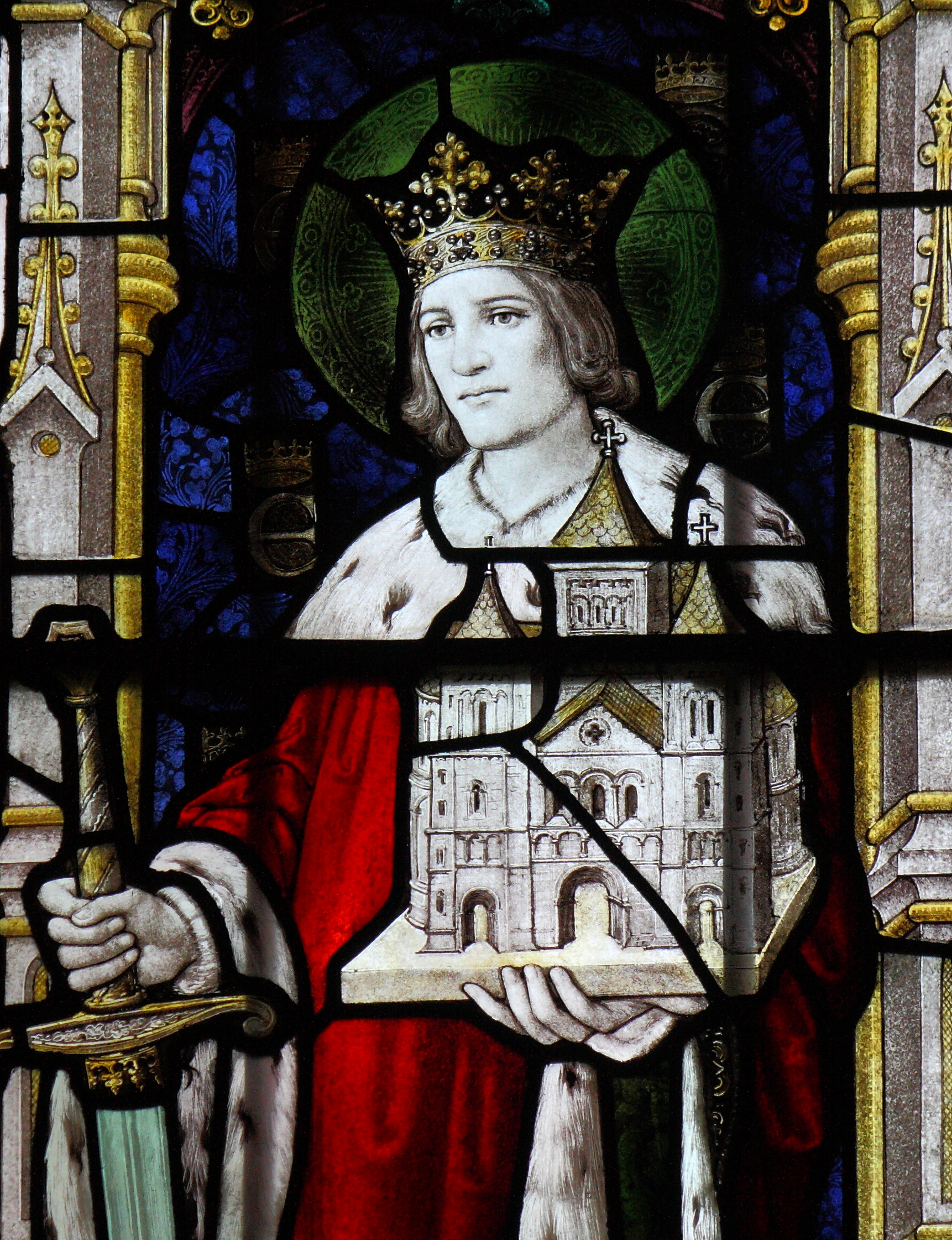
Saint
King Edwin de Northumbrie, église Saint Mary, Sledmere, East Riding of Yorkshire
Saint
King Edwin of Northumbria, Stained glass image, St Mary, Sledmere, East Riding of Yorkshire, England.
Vetrata
con Sant'Edwin di Northumbria; Sledmere (Gran Bretagna), Chiesa di Santa
Maria
Saint Edwin
Roi de Northumbrie (+ 633)
Encore païen, cet
anglais, roi de Kent, demanda en mariage une chrétienne, Ethelburge. Avec le
temps et au travers des événements qui marquaient son règne, il rejoignit la
foi de son épouse, instruit par saint Paulin,
l'évêque d'York. Il aida ainsi à la fondation de l'Eglise anglo-saxonne. Il
n'en rencontra pas moins des oppositions violentes tant de la part de nombreux
Anglo-Saxons demeurés païens que des Bretons chrétiens qui refusaient toujours
la présence de ces envahisseurs étrangers à leur Grande-Bretagne. Il fut tué
lors d'une bataille à Hatfield et sa mort fut considérée comme un martyre.
SOURCE : http://nominis.cef.fr/contenus/saint/2004/Saint-Edwin.html
Edwin de Northumbrie
ROI, MARTYR, SAINT
† 633
Edwin, qui dut sa
grandeur au bon usage qu'il fit de l'adversité,, était fils d'Alla, roi de
Déïre. Mais à la mort de son père, il fut dépouillé de ses états par Ethelfred,
roi des Berniciens, qui ne fit qu'une monarchie de tout le Northumberland. Il
se retira auprès. de Redwald, roi des Est-Angles. Ce prince, gagné par les
prières, et les promesses qu'on-lui avait faites, prit secrètement la
résolution de le livrer à son ennemi. Edwin n'ignora pas longtemps ce qui se
tramait contre lui; un ami qu'il avait dans le conseil de lledwald, l'avertit
de tout. Etant une nuit à la porte du palais, occupé de pensées fort tristes,
un étranger l'assura qu'il recouvrerait son royaume, et qu'il deviendrait même
le principal roi d'Angleterre, s'il voulait pendre les précautions qu'on lui
indiquerait pour la conservation de sa vie. Il le promit, et aussitôt
l'étranger, lui mettant la main sur la tête, lui dit de se ressouvenir de ce
signe.
Sur ces entrefaites,
Redwald changea de sentiment, à la persuasion de la reine sa femme; il attaqua
et tua même Ethelfred, qui lui avait déclaré la guerre, sur le bord oriental de
la petite rivière d'Idle, dans la province de Notlingham. Par cette victoire,
Edwin fut mis en possession du Northumberland, qui comprenait tout le nord de l'Angleterre.
Le succès de ses armes le rendit depuis si formidable, que tous les rois
anglais et même les bretons ou gallois reconnurent la supériorité de sa
puissance. Il épousa Edilburge, fille de S. Ethelbert, premier roi chrétien
d'Angleterre, et sœur d'Ealbad, roi de Kent. Mais 'e mariage ne fut conclu qu'à
condition que la princesse aurait la liberté de professer le christianisme, et
qu'on laisserait auprès d'elle S. Paulin qui venait d'être sacré évêque.
En 626, un assassin,
envoyé par le roi des West-Saxons, voulut ôter la vie à Edwin, en le frappant
avec un poignard empoisonné. C'en était fait de ce prince, si Lilla, son
ministre et son favori, ne se fût jeté entre lui et l'assassin. Le ministre
perdit la vie, mais le poignard atteignit aussi le roi, et lui fit une blessure
qui ne fut cependant pas mortelle. Le coupable ayant été arrêté sur-le-champ,
fut mis en pièces, après avoir tué toutefois un autre officier du roi. Edwin,
préservé d'un si grand danger, rendit des actions de grâces aux idoles qu'il
adorait. Mais S. Paulin lui représenta que son culte était sacrilège, et qu'il
était redevable de sa conservation aux prières de la reine. Il l'exhorta
ensuite à remercier le vrai Dieu, qui venait de lui faire éprouver si
visiblement l'effet de sa protection. Edwin parut écouter avec plaisir le
discours du saint, et il consentit que l'on consacrât à Dieu la princesse dont
la reine venait d'accoucher : elle fut baptisée, avec douze autres personnes,
le jour de la Pentecôte, et reçut le nom d'Eanflède.
Edwin promit à S. Paulin
d'embrasser la religion chrétienne s'il guérissait parfaitement, et s'il
remportait la victoire sur un ennemi qui avait attenté si lâchement à sa vie.
Sa santé fut à peine rétablie, qu'il rassembla son armée pour marcher contre le
roi des West-Saxons. Il le vainquit, et prit ou tua tous ceux qui étaient
entrés dans le complot tramé contre lui. Il renonça dès-lors au culte des
idoles ; mais il différa encore de recevoir le baptême. Le pape Boniface lui
écrivit pour l'exhorter à tenir sa promesse, et il joignit à sa lettre divers
présents, tant pour le roi que pour la reine. Cependant Edwin se fit instruire,
et eut plusieurs conférences avec ses principaux officiers sur le changement de
la religion qu'il projetait. S. Paulin, de son côté, priait pour sa conversion,
et le pressait de ne pas résister plus longtemps à la grâce. Ou dit que ce
saint évêque ayant appris par révélation, et ce que l'on avait prédit au roi,
et ce qu'il avait promis en conséquence, lui mit la main sur la tête, en lui
demandant s'il se ressouvenait de ce signe. Edwin, tremblant, voulait se jeter
à ses pieds ; mais il l'en empêcha, et lui dit avec douceur : « Vous voyez
que Dieu vous a délivré de vos ennemis ; non content de cette faveur, il
vous offre encore un royaume éternel. Pensez de votre côté à remplir votre
promesse en recevant le baptême et en conformant votre vie aux maximes de la
religion que vous aurez embrassée. »
Le roi répondit qu'il
voulait conférer avec les principaux membres de son conseil, pour les engager à
suivre son exemple. S. Paulin y consentit. Le prince ayant assemblé ce qu'il y
avait de plus distingué parmi ces officiers, leur demanda leur avis. Coifi,
grand prêtre des idoles, parla le premier, et déclara qu'il était prouvé par
l'expérience que les dieux qu'ils adoraient n'avaient aucun pouvoir. Une autre
personne dit qu'on ne devait pas balancer de se rendre à ce que désirait le
roi, puisqu'il n'y avait aucune comparaison à faire entre une vie de peu de
durée et un bonheur éternel. S. Paulin, qui était présent à l'assemblée, parla
ensuite avec beaucoup de force de l'excellence et de la nécessité de la
religion chrétienne. Coifi applaudit à ce discours, et fut d'avis que l'on
réduisît en cendres les temples et les autels des idoles. Le roi ayant demandé
qui les profanerait le premier, Coifi répondit que c'était à lui à donner
l'exemple, puisqu'il avait été le chef du culte idolâtrique. Il demanda qu'on
lui fournît des armes et un cheval ; car, selon la superstition de ces peuples,
l'usage des armes et du cheval était défendu au grand prêtre, et il ne pouvait
avoir qu'une cavale pour monture. Etant monté sur le cheval du roi, avec une
épée à son côté et une lance à sa main, il se rendit au principal temple, qu'il
profana en y jetant sa lance. Il ordonna ensuite à ceux qui l'accompagnaient de
le détruire et de le brûler avec son enceinte. Du temps de Bède on en voyait la
place à peu de distance d'York, du côté de l'Orient, et on la nommait Godmundingham,
c'est-à-dire réceptacle de dieux.
Edwin fut baptisé à York
le jour de Pâques de l'année 627, la onzième de son règne. La cérémonie de son
baptême se fit dans une église qui n'était que de bois, parce qu'on l'avait
bâtie à la hâte, et qui était dédiée sous l'invocation de S. Pierre. Le prince
jeta depuis les fondements d'une église de pierre, beaucoup plus vaste, dans
l'enceinte de laquelle était la première, mais qui ne fut archevêque sous le
règne de S. Oswald, son successeur. S. Paulin, du consentement du roi, fixa son
siège épiscopal à York, et il continua de prêcher librement l'Evangile. Il
administra le baptême à un grand nombre de personnes, parmi lesquelles on
comptait les enfants d'Edwin et des officiers de distinction. Le roi et la
reine étant à leur château d'Yeverin, parmi les Berniciens du Northumberland,
il employa plus d'un mois, depuis le matin jusqu'au soir, à instruire les
Infidèles, et il les baptisa dans la petite rivière de Glen. H n'y avait encore
ni oratoires ni baptistères, et c'est pour cela qu'on baptisait les catéchumènes
dans les rivières ; cette coutume prouve d'ailleurs que le baptême
s'administrait alors par immersion. Lorsque S. Paulin était à la campagne avec
le roi chez les Deïres, il administrait le baptême dans la rivière de Swale,
près de Cataract, et la tradition s'en est conservée dans le pays jusqu'à ce
jour.
Le roi fit bâtir une
église en l'honneur de S. Alban ; et de là se forma une nouvelle ville qui fut
appelée Albansbury, et depuis Àlmondbury. Il y avait en ce lieu un palais royal
que les Païens brûlèrent après la mort de S. Edwin. Les successeurs de ce
prince avaient un château dans le territoire de Loidis ou Leeds, où l'on bâtit
dans la suite une ville de ce nom.
Edwin, non content de
pratiquer lui-même l'Evangile, cherchait tous les moyens de répandre la
connaissance du vrai Dieu parmi ses sujets. On peut dire en général que la
nation anglaise reçut la foi avec une ferveur digne des premiers siècles de
l'Eglise. Les conversions furent aussi sincères que nombreuses. On voyait de
toutes parts des hommes parfaitement détachés de ce monde, qui ne pensaient
qu'au bonheur du ciel, et qui travaillaient chaque jour à se perfectionner dans
la science des saints. Les rois eux-mêmes ne trouvaient rien de pénible dans la
pratique de la vertu, et savaient maîtriser leurs passions pour les assujettir
au joug de la foi. Ils étaient, en un mot, les modèles de leurs sujets. Ils
n'avaient que du mépris pour les grandeurs, et foulaient aux pieds ces
couronnes pour lesquelles ils avaient tout sacrifié avant leur conversion. On
en vit plusieurs qui préféraient le cilice à la pourpre, et une pauvre cellule
aux plus riches palais; qui se dépouillèrent volontairement de leur puissance,
et qui allèrent vivre sous les règles de l'humilité et de l'obéissance.
D'autres portèrent toujours le sceptre; mais ce fut pour donner à leur zèle
plus de force et d'autorité, pour accroître le royaume de Jésus-Christ et pour
l'étendre chez les peuples barbares. Ce zèle se trouva dans Edwin et lui mérita
une mort glorieuse.
Redwald, roi des Est-Angles,
avait reçu le baptême dans le royaume de Kent. Mais s'étant depuis laissé
séduire, il voulut ailier le culte du vrai Dieu avec celui des idoles.
Earpwald, son fois et son successeur, se laissa toucher par les conseils
d'Edwin, et embrassa le christianisme avec beaucoup de sincérité. Il fut tué
quelque temps après, et ses sujets retombèrent dans l'idolâtrie. Au bout de
trois ans, Sigebert, revenu des Gaules, où il avait été exilé, rétablit la
religion chrétienne. Les Etats d'Edwin ne se ressentirent point de ces
variations. La paix et la tranquillité y accompagnèrent toujours la pratique du
christianisme; cette paix même passa en proverbe, et l'on assure qu'une femme
tenant son enfant dans ses bras pouvait sans rien craindre aller seule d'une
mer à l'autre. Il y avait aux fontaines qui se trouvaient sur les grands
chemins des vases d'airain pour puiser de F eau, et personne n'était même tenté
de les enlever, tant les lois étaient parfaitement observées.
Il y avait dix-sept ans
qu'Edwin régnait sur les Anglais et les Bretons, lorsqu'il plut à Dieu de
l'éprouver par les afflictions ; et Penda, prince du sang royal de Mercie,
fut l'instrument dont il se servit. Penda, qui protégeait l'idolâtrie, secoua
le joug de l'obéissance qu'il devait à notre saint. Il composa une armée de
vieux soldats vétérans, semblables à ceux qui s'étaient d'abord emparés de la
Bretagne, et qui étaient fort attachés à leurs anciennes superstitions. Son
dessein était de détruire le christianisme. Les Merciens le reconnurent pour leur
souverain, et il régna vingt-deux ans. En levant l'étendard de la révolte, il
fit alliance avec Cadwallon, roi des Bretons ou Gallois qui, à la vérité,
professaient le christianisme, mais sans en suivre la morale. Il était d'un
caractère barbare, et portait aux Anglais une haine implacable ; il croyait
qu'il lui était permis de leur causer tous les maux qui dépendraient de lui, et
même de les exterminer sans égard pour leur religion et sans aucune différence
d'âge ou de sexe. Comme Edwin était le prince le plus puissant de l'éparchie
anglaise, et que les autres lui rendaient une espèce d'obéissance, toute la
fureur de la guerre se tourna principalement contre lui, et il fut tué dans une
bataille qui se donna à Heavenfield, aujourd'hui Hatfield, dans la province
d'York. Le corps du saint roi fut enterré à Whitby : mais sa tête le fut
dans le porche de l'Eglise qu'il avait fait bâtir à York. Il a le titre de
martyr dans le martyrologe de Florus et dans tous les calendriers d'Angleterre.
On voit par le catalogue de Speed qu'il était patron titulaire de deux
anciennes églises, bâties, l'une à Londres, et l'autre à Brève, dans la
province de Sommerset. S. Edwin mourut en 633, dans la quarante-huitième année
de son âge.
SOURCE : Alban
Butler : Vie des Pères, Martyrs et autres principaux Saints… – Traduction :
Jean-François Godescard.
SOURCE : http://nouvl.evangelisation.free.fr/edwin_de_northumbrie.htm
Edwin de Northumbrie
Roi, Saint
vers 585-633
12 octobre
Tout d'abord, nous devons
nous souvenir de ce qu'il est important de savoir: le règne du roi Edwin marque
le début de l'unité anglaise, et son nom est associé à la naissance du
christianisme anglais.
Edwin naquit vers 585. Il
était le fils d'Aella roi de Deira. Deira était un royaume situé au sud de la
Northumbrie, dans la région du Yorkshire, au nord-est de l'Angleterre. Edwin
n'avait que 3 ans à la mort de son père, lorsque Ethelfrith, le roi de
Bernicie, situé au nord de la Northumbrie, s'empara du royaume d'Aella. Edwin
fut secouru par Redwald, le roi des Est-Angles, et il passa les trente années
suivantes au pays de Galles, en Est-Anglie. Jeune homme, Edwin épousa Cwenburg
de Mercie qui lui donna 2 fils.
En 616, avec l'aide du
roi Redwald, Edwin fut restauré sur le trône de Deira en battant Ethelfrith
lors d'une bataille proche de la petite rivière Idle. Auparavant un événement
avait troublé la vie d'Edwin. Ethelfrith avait eu l'intention de tuer Edwin.
Lorsqu'Edwin fut informé, la nuit suivante, en proie à une douloureuse
incertitude, il vit soudain paraître devant lui, au milieu des ténèbres, un
homme inconnu qui lui dit:
– Que promettrais-tu
à celui qui te délivrerait de ta tristesse... Et si on te promettait de te
faire roi, et roi plus puissant que tous tes ancêtres et que tous les autres
rois anglais?
Edwin promit que sa
reconnaissance serait à la hauteur d'un tel bienfait. Alors l'étranger
ajouta:
– Et si celui qui
t'aura exactement prédit de si grands biens te donne des conseils plus utiles
pour ton salut et ta vie qu'aucun de tes pères ou de tes proches n'en a jamais
reçus, consens-tu à les suivre?
Edwin jura qu'il obéirait
en tout à celui qui le tirerait d'un si grand péril pour le faire Roi.
Aussitôt l'inconnu posa
sa main droite sur la tête d'Edwin en disant:
– Quand un pareil
signe se représentera à toi, rappelle-toi à ce moment, tes discours et ta
promesse.
Et l'homme disparut,
subitement. C'est alors qu'un ami d'Edwin arriva et lui annonça qu'il n'avait
plus rien à craindre. Edwin fut établi roi en Northumbrie par son protecteur
Redwald, devenu le chef de la fédération anglo-saxonne. Edwin régna sur les
deux royaumes réunis de Deïra et de Bernicie. Nous sommes aux alentours de 615.
Entre temps, Edwin était
devenu veuf. Il voulut épouser la sœur du roi de Kent, Ethelburge, la fille
d'Ethelhert et de Berthe. Sachez que Berthe était la descendante de
Hengist et d'Odin par son père, et de sainte Clotilde par sa mère. Ethelburge
repoussa la demande d'Edwin, car elle était chrétienne tandis qu'Edwin était
païen. Edwin promit alors, que si on lui accordait la princesse, cette dernière
pourrait pratiquer librement sa religion avec tous ceux qui l'accompagneraient,
hommes ou femmes, prêtres ou laïques. Edwin ajouta que lui-même embrasserait la
religion de sa femme, lorsqu'on lui aurait prouvé que cette religion était plus
sainte et plus digne de Dieu que la sienne. Notons ici que, curieusement,
Berthe, la mère d'Ethelburge, n'avait quitté son pays et sa famille
mérovingienne qu'après avoir reçu les mêmes promesses, avant d'épouser le roi
de Kent. La conversion du royaume du Kent fut sa récompense. Ethelburge
était-elle destinée à être, comme sa mère, à l'origine de la conversion au
Christ, de tout un peuple? Peut-être… De toutes façons, Ethelburge accepta de
se marier avec Edwin. C'est l'évêque d'York, saint Paulin qui les maria.
En 624, Edwin devint le
plus puissant souverain d'Angleterre. Il dominait les autres royaumes
anglo-saxons, à l'exception du Kent. Cependant, en 626, il fut victime d'une
tentative d'assassinat organisée par le roi du Wessex, situé au sud-ouest de la
grande Bretagne. En représailles, Edwin mena une campagne victorieuse contre le
royaume du Wessex.
Depuis son mariage, Edwin
avait cessé d'adorer les idoles et remporté de nombreux combats. Cependant, il
hésitait toujours à se convertir au christianisme, lorsque, en 626, comme nous
venons de le dire, ayant failli être massacré par un envoyé du roi des Saxons
de l'Ouest, du Wessex, il donna à l'évêque Paulin sa petite fille qui venait de
naître pour qu'elle fût consacrée au Christ. Saint Paulin enseignait la foi
chrétienne à Edwin qui continuait à réfléchir sur les religions. Pourtant,
les exemples de vertu chrétienne qu'il voyait en sa femme commençaient à le
perturber, mais sans encore le convaincre. Aussi, devant l'indécision
d'Edwin, l'évêque Paulin lui rappela les promesses qu'il avait faites à un
inconnu, à la fin de son long exil. Et l'évêque posa sa main droite sur la tête
d'Edwin comme l'avait fait l'inconnu de la vision. Le roi Edwin, se jeta alors
aux pieds de Paulin, qui le releva et lui dit doucement:
– Eh bien, vous
voilà délivré des ennemis que vous redoutiez par la bonté de Dieu. Vous voilà,
de plus, pourvu par lui du royaume que vous désiriez. Souvenez-vous d'accomplir
votre troisième promesse, qui vous oblige à recevoir la foi et à garder les
commandements de Dieu. C'est ainsi seulement, qu'après avoir été comblé de la
faveur divine ici-bas, vous pourrez entrer avec Dieu en participation du
royaume céleste.
– Oui, je le sens;
je dois et je veux être chrétien, répondit Edwin.
Edwin fut baptisé à York,
en 627, par saint Paulin. Dès lors, Edwin participa à la fondation de l'Église
anglo-saxonne. Pendant six années, le roi et l'évêque travaillèrent de concert
à la conversion du peuple, malgré les oppositions violentes qu'ils
rencontrèrent, tant de la part de nombreux Anglo-Saxons demeurés païens que des
Bretons chrétiens qui refusaient toujours la présence de ces envahisseurs
étrangers. Cependant, on a écrit que "les six années qui s'écoulèrent
depuis la conversion d'Edwin jusqu'à sa mort, comptent parmi les plus
glorieuses et les plus heureuses qu'il ait été donné à un prince anglo-saxon de
connaître." De plus, à l'intérieur de ses États, Edwin fit régner une
paix et une sécurité inconnues avant lui, tant il prenait soin de ses sujets.
Malheureusement, Penda,
prince de Mercie, resté païen, s'allia avec Cadwallon, le roi des Bretons,
appelés aussi Gallois, barbare plein de haine pour les Anglais. Ils
combattirent Edwin qui fut tué au cours de la bataille d'Heavenfield, dans la
province d'York. Nous sommes en octobre 633. Edwin avait 48 ans. Il fut
considéré comme martyr par les anglais. Bien qu'il ne fût jamais canonisé,
Edwin est considéré comme un saint en Angleterre, et fêté le 12 octobre.
Après la mort d'Edwin, la
Northumbrie retourna au paganisme. Les massacres et le chaos qui suivirent
furent dramatiques, et ne cessèrent qu'à l'accession sur le trône de
Northumbrie, de saint Oswald en 634.
Paulette Leblanc
SOURCE : http://nova.evangelisation.free.fr/leblanc_edwin_de_northumbrie.htm
EDWIN saint (585-632)
roi
de Northumbrie (616-632)
Fils de Aelle (Ella) de
Deira, roi du Northumberland, saint Edwin (Eadwine, vieil anglais Aeduini)
succéda au premier roi, Aethelfrith. Ce dernier était tombé en 616 dans une
bataille contre Raedwald, roi de l'East Anglia, qui soutenait Edwin.
Primitivement païen, Edwin épousa la fille d'Ethelbert,
du Kent, qui, elle, était chrétienne ; le contrat de mariage stipulait
qu'elle et sa cour auraient toutes facilités pour pratiquer leur religion.
Edwin se fit lui-même baptiser à York en 627, après avoir miraculeusement
échappé au poignard d'un émissaire du roi des Saxons de l'Ouest. Les princes et
la plupart des sujets d'Edwin se convertirent également.
Dans le but d'agrandir
son domaine, il fait la guerre aux Gallois et conquiert le royaume d'Elmet. Il
occupe aussi l'île d'Anglesey, ainsi que l'île de Man, mais ne peut conserver
ces deux dernières conquêtes. Cependant Cadwallon (Caedwalla), roi gallois de
Gwynedd qu'Edwin a combattu, s'allie à Penda, de la maison de Mercie ; ils
viennent à bout d'Edwin, tué dans le Nord le 14 octobre 638.
Le règne d'Edwin marque
le début de l'unité anglaise et son nom est associé à la naissance du
christianisme anglais.
Paul QUENTEL,
« EDWIN saint (585-632) - roi de Northumbrie
(616-632) », Encyclopædia Universalis [en ligne], consulté
le 4 octobre 2015. URL : http://www.universalis.fr/encyclopedie/edwin/
SOURCE : http://www.universalis.fr/encyclopedie/edwin/

Also
known as
Aeduini
Eadwine
Edwin of Bernicia
Edwin of Deira
Edwin the King
Æduini
Profile
A prince,
born a pagan,
the son of King Ella
of Northumbria. King of Northumbria from 616 to 633. Married to Saint Ethelburga
of Kent. Adult convert to Christianity, baptized in 627 by Saint Paulinus
of York; first Christian King of Northumbria. Father of Saint Eanfleda
of Whitby and Saint Edwen
of Northumbria. Great-uncle of Saint Hilda
of Whitby. Grandfather of Saint Elfleda.
Worked for the evangelization of
his people. Listed as a martyr as
he died in battle with the pagan king,
Penda of Mercia, an enemy of the Faith.
Born
585 at
Deira, South Northumbria, England
633 in
battle with pagan Welsh and
Mercians at Hatfield Chase, England
relics at
Whitby
head in Saint Peter’s
Church, York
Name
Meaning
valuable friend (teutonic)
wealthy friend (old
english)
Additional
Information
Book
of Saints, by the Monks of
Ramsgate
Catholic
Encyclopedia, by George Phillips
Life
of Saint Edwin, King of Northumberland, by Father Frederick
William Faber
Lives
of the Saints, by Father Alban
Butler
Saints
of the Day, by Katherine Rabenstein
books
Our Sunday Visitor’s Encyclopedia of Saints
other
sites in english
fonti
in italiano
Readings
Holding a council with
the wise men, King Edward
asked of every one in particular what he thought of the new doctrine and the
new worship that was preached.
To which the chief of his
own priests, Coifi, immediately answered: “O king,
consider what this is which is now preached to us; for I verily declare to you
that the religion which we have hitherto professed has, as afar as I can learn,
no virtue in it. For none of you people has applied himself more diligently to
the worship of our gods than I; and yet there are many who receive greater
favors from you, and are more preferred than I, and who are more prosperous in
all their undertakings. Now if the gods were good for anything, they would
rather forward me, who have been more careful to serve them. If follows,
therefore, that if upon examination you find those new doctrines which are now
preached to us better and more efficacious, we should immediately receive them
without any delay.”
Another of the king‘s
chief men, approving of Coifi’s words and exhortations, presently added: “The
present life of man, O king,
seems to me, in comparison with that time which is unknown to us, like to the
swift flight of a sparrow through the room wherein you sit at supper in winter
amid your officers and ministers, with a good fire in the midst, whilst the
storms of rain and snow prevail abroad; the sparrow, I say, flying at one door
and immediately out at another, whilst he is within is safe from the wintry
storm; but after a short space of fair weather he immediately vanishes out of
your sight into the dark winter from which he has emerged. So this life of man
appears for a short space, but of what went before of what is to follow we are
utterly ignorant. If, therefore, this new doctrine contains something more
certain, it seems justly to deserve to be followed.”
The other elders,
and king‘s
counselors, by divine inspiration, spoke to the same effect. But Coifi added
that he wished more attentively to hear Paulinus discourse concerning the God
whom he preached. So the bishop having
spoken by the king‘s
command at greater length, Coifi, hearing his words, cried out: “I have long
since been sensible that there was nothing in that which we worshipped, because
the more diligently I sought after truth in that worship, the less I found it.
But now I freely confess that such evident truth appears in this preaching as
can confer on us the gifts of life, of salvation, and of eternal happiness. For
which reason I advise, O king,
that we instantly abjure and set
fire to those temples and altars which we have consecrated without reaping any
benefits from them.”
In short, the king publicly
gave his permission to Paulinus to preach the gospel, and,
renouncing idolatry,
declared that he received the faith of Christ; and when he inquired of the
high priest who
should first profane the altars and temples of their idols, with the inclosures
that were about them, the high priest answered, “I; for who can more properly
than myself destroy those things which I worshipped through ignorance, for an
example to all others, through the wisdom which has been given me by the true
God?” – the Venerable Bede, Ecclesiastical
History, writing about the conversion of King Edwin in 627
MLA
Citation
“Saint Edwin of
Northumbria“. CatholicSaints.Info. 9 December 2022. Web. 28 April 2026.
<https://catholicsaints.info/saint-edwin-of-northumbria/>
SOURCE : https://catholicsaints.info/saint-edwin-of-northumbria/

Ford Madox Brown (1821–1893), The
Baptism of Edwin, mural,
Manchester Town Hall
Article
EDWIN (Saint) King,
Martyr (October 12) (7th century) The powerful King of Northumbria, who after
his marriage with Saint Ethelburga, daughter of Saint Ethelbert of Kent,
embraced the Christian religion preached to him by Saint Paulinus, his Queen’s
chaplain, and zealously promoted the conversion of his subjects. He fell at
Hatfield Chase, A.D. 633, fighting against Cadwallon of Wales and the Pagan
tyrant of Mercia, Penda. Hence popular piety has numbered him among the Martyrs
to Christianity.
MLA
Citation
Monks of Ramsgate.
“Edwin”. Book of Saints, 1921. CatholicSaints.Info. 22 November 2012.
Web. 30 April 2026. <http://catholicsaints.info/book-of-saints-edwin/>
SOURCE : https://catholicsaints.info/book-of-saints-edwin/
St. Edwin of Northumbria
Feastday: October 12
Birth: 586
Death: 633
In the year 616, King
Ethelfrith was slain in battle by Redwald, King of the East Angles. Edwin of
Deira became king of the whole kingdom of Northumbria and after the death of
Redwald, he had a certain lordship over the other English kings. He married
Ethelburga, daughter of St. Ethelbert, King of Kent after promising to allow
her to practice her Christian religion.
St. Paulinus was sent as chaplain to
the Queen and bishop for
his converts. When Queen Ethelburga gave birth to a daughter, she was baptized
with twelve others on Whitsunday, and called Eanfleda; they were the first
fruits of the Northumbrians. Edwin was a man of
unusual wisdom and
deliberated in his heart to which religion he
should follow. Paulinus continued to instruct him and to pray for his
conversion. King Edwin was baptized at York at Easter in the year 627,
on the site of the present York Minster, in the wooden church of St. Peter which
he had caused to be built. This good king
had reigned seventeen years when the Welsh Cadwalon marched in arms against him
with Penda of Mercia, a pagan. King Edwin met them at Hatfield Chase on October
12, 633, and in the ensuing battle he was slain. St. Edwin was
certainly vernerated in England as a martyr, but though his claims to sanctity are
else doubtful than those of some other royal saints, English and other, he has
had no liturgical cultus so far as is known. His relics were
held in veneration, churches were dedicated in his honour in
London and at Brean in Somerset; and Pope Gregory XIII permitted him to be
represented among the English martyrs on the walls of the chapel of
the Venerabile at Rome. His feast day is October
12th.
SOURCE : https://www.catholic.org/saints/saint.php?saint_id=625
St. Edwin of Northumbria
Feastday: October 12
Patron: of converts; hoboes; homeless people; kings; parents of large families
Birth: 586
Death: 633
Having married the Christian princess
(Saint) Ethelburga, Edwin, the pagan king
of the English kingdom of Northumbria, began to consider becoming a Christian himself.
As the king delayed a final decision about his religion, Pope Boniface V wrote
to him, inviting him to accept “the medicine of salvation.” To encourage Queen
Ethelburga in her efforts to convert her husband, the pope sent her as gifts a silver
mirror and a comb for her hair. At length, Edwin was won over through the
efforts of Ethelburga’s chaplain, (Saint) Paulinus of York. Edwin spent the six
remaining years of his reign as a devout Catholic monarch
who brought peace to his kingdom. In a letter to Edwin, Pope Honorius I praised
the king’s newfound piety and zeal: “Your sincere Christian character,
afire with ardent faith in
the worship of your Creator, has shone out far and wide.” The subsequent
slaying of Edwin in a military battle instigated by the irreligious Welsh king
Cadwallon and the pagan English
warrior Penda of Mercia led to Edwin being venerated as a martyr slaughtered
for his Christian faith.
SOURCE : https://www.catholic.org/saints/saint.php?saint_id=5908
New Catholic
Dictionary – Saint Edwin
Derivation
Teutonic: valuable friend
Article
(c.585-633) Martyr,
first Christian King
of Northumbria, died Hatfield
Chase, England.
He was the son of Ella, King of Northumbria, but the usurper Ethelfrid kept him
from his throne until his thirtieth year. He married as his second wife
Ethelburga, sister of Eadbald, the Christian King
of Kent. He was baptized at
York, 627,
by Saint Paulinus, and thenceforth showed himself zealous for the conversion of
his people. The title martyr has
been given to him because he was slain in conflict with the pagan king,
Penda of Mercia, an enemy of the Faith. His relics were preserved at Whitby;
head in Saint Peter’s Church, York. Feast, 12
October.
MLA
Citation
“Saint Edwin”. New Catholic Dictionary. CatholicSaints.Info.
18 December 2012. Web. 30 April 2026. <https://catholicsaints.info/new-catholic-dictionary-saint-edwin/>
SOURCE : https://catholicsaints.info/new-catholic-dictionary-saint-edwin/
Edwin, King M (AC)
Born c. 585; died October
12, 633. Son of King Aella of Deira (southern Northumbria, Yorkshire area),
Saint Edwin was only three when his father died. The saint was deprived of the
throne by King Ethelfrith of Bernicia (North Northumbria), who seized Aella's
kingdom. Edwin spent the next 30 years in Wales and East Anglia. As a young man
he married Cwenburg of Mercia by whom he had two sons.
Finally in 616, with the
help of King Baedwald (Redwald) of East Anglia who had hosted him during his
exile, Edwin was restored to the throne by defeating and killing Ethelfrith at
the Battle of Idle River.
Edwin ruled ably and, in
625, after the death of his first wife, married Ethelburga, sister of King
Eadbald of Kent, and a Christian. At first his embassy seeking her hand was
rebuffed because he was not a Christian. But eventually a contract was reached
wherein Ethelburga would be permitted the freedom to practice her religion and
Edwin would seriously consider joining her in faith. With the agreement made,
Ethelburga brought with her to Northumbria her confessor, Saint Paulinus, a
Roman monk who had been sent by Pope Saint Gregory the Great to help Saint
Augustine in the conversion of England and who had just been consecrated bishop
of York. The bishop also saw this as an opportunity to spread the faith in the
northern parts of the island.
The thoughtful and
melancholy king was not naturally inclined to impetuous acts and, thus, it took
some time before his conversion. The examples of Christian virtue displayed by
his wife and her chaplain played an important role in his decision, but three
specific events were determinative. First, an unsuccessful assassination
attempt by the West Saxons. Second, the abandonment of paganism by Coifi the
high priest. And, finally, a reminder by Paulinus of a mysterious experience
Edwin had undergone while in exile some years earlier.
Following these
incidents, Edwin was converted to Christianity in 627, and baptized by Paulinus
at Easter (attested by Bede) after the birth of a daughter. Many in Edwin's
court and subjects in Yorkshire and Lincolnshire also came to faith. Thus,
began Christianity in Northumbria. The idols and false gods had already been
destroyed by the high priest himself.
King Edwin established
law and order in the kingdom and soon became the most powerful king in England.
He expanded his territory north into the land of the Picts, west into that of the
Cumbrians and Welsh, and into Elmet near Leeds. The Venerable Bede relates that
during the last year's of King Edwin's reign there was such peace and order in
his dominions that a proverb said 'a woman could carry her newborn baby across
the island from sea to sea and suffer no harm.'
His intention to build a
stone church at York (an unprecedented event in those days) never materialized
when his kingdom was invaded by pagan King Penda of Mercia and Cadwallon of
North Wales. Edwin was defeated and killed at the Battle of Hatfield Chase in
633. This church was constructed, enshrined his head, and became the center of
his cultus.
After his death,
Northumbria reverted to paganism and Paulinus had to conduct Ethelburga and her
children by sea to safety in Kent, where for the last 10 years of his life, he
embellished his diocese of Rochester. The massacres and chaos that followed
Edwin's death ended with the accession of Saint Oswald in 634.
Saint Edwin is view as a
tribal hero, model Christian king, and martyr. Although his feast was not
included in any of the surviving liturgical books of Northumbria, there was at
least one ancient church dedication in his honor. Pope Gregory XIII implicitly
approved his cultus by including Edwin among the English martyrs in the murals
of the English College at Rome.
Edwin's cultus had
another locus at Whitby, which had a shrine of his body, supposedly discovered
by revelation and brought there from Hatfield Chase. Whitby Abbey was governed
in turn by Edwin's daughter, Saint Enfleda, and his granddaughter, Saint
Elfleda. It became the burial site for the royal members of the house of Deira
and the home of Saint Gregory I's first biographer (Attwater, Benedictines,
Delaney, Encyclopedia, Farmer).
SOURCE : http://www.saintpatrickdc.org/ss/1012.shtml
EDWIN, KING OF
NORTHUMBRIA, ST.
B. 585; d. Oct. 12, 633.
As king of Deira (616) Edwin first united the Northumbrian kingdoms, and then
became overlord of all English peoples south of the Humber except those of
Kent. In 625 he married ethelburga, daughter of ethelbert of kent. After his baptism
by his wife's chaplain paulinus, Bishop of York, he opened his lands to
Christianity (627). But his death in the Battle of Hatfield Chase against the
pagan King Penda of Mercia halted missionary activity there. King Edwin was
venerated, at least locally, as a martyr.
Feast: Oct. 12; formerly
Oct. 4.
Bibliography: Sources. Bede, Historia
ecclesiastica, ed. C. Plummer (Oxford 1896; reprint 1956) bk. 2, ch. 5, 9–20;
bk. 3, ch. 1, 6; Opera historica, ed. C. Plummer, 2 v. (Oxford 1896)
2:86, 93–117. Bibliotheca hagiographica latina antiquae ct mediae aetatis (Brussels
1898–1901), 1:2428. Literature. W. Hunt, The Dictionary of
National Biography from the Earliest Times to 1900 (London 1885–1900)
6:550–552. R. Stanton, A Menology of England and Wales (London 1887)
487–488, 491. F. M. Stenton, Anglo-Saxon England (2d ed. Oxford 1947)
65–66, 79–81. C. J. Godfrey, The
Church in Anglo-Saxon England (New
York 1962).
[B. W. Scholz]
New Catholic Encyclopedia
St. Edwin
(Æduini.)
The first Christian King
of Northumbria, born about 585, son of Ælla, King of Deira, the southern
division of Northumbria; died 12 October, 633. Upon Ælla's death in 588, the
sovereignty over both divisions of Northumbria was usurped by Ethebric of
Bernicia, and retained at his death by his son Ethelfrid; Edwin, Ælla's
infant son, being compelled until his thirtieth year to wander from one
friendly prince to another, in continual danger from Ethelfrid's attempts upon
his life. Thus when he was residing with King Redwald of East
Anglia, Ethelfrid repeatedly endeavoured to bribe the
latter to destroy him. Finally, however, Redwald's refusal to betray his guest
led in 616 to a battle, fought upon the river Idle, in
which Ethelfrid himself was slain, and Edwin was invited to
the throne of Northumbria. On the death of his first wife, Edwin, in
625, asked for the hand of Ethelburga, sister to Eadbald, the Christian King
of Kent, expressing his own readiness to embrace Christianity,
if upon examination he should find it superior to his
own religion. Ethelburga was accompanied to Northumbria
by St. Paulinus, one of St.
Augustine's fellow missionaries, who thus became its
first apostle. By him Edwin was baptized at York in
627, and thenceforth showed himself most zealous for
the conversion of his people. In instance of this, Venerable
Bede tells how, at their royal villa of Yeverin in
Northumberland, the king and queen entertained Paulinus for five
weeks, whilst he was occupied from morning to night in instructing and baptizing the
crowds that flocked to him. By Edwin's persuasion, moreover,
Eorpwald, King of East Anglia, son of his old friend Redwald, was led to
become a Christian.
In token of his authority over the other kings of Bretwalda, Edwin used to have
the tufa (a tuft of feathers on a spear, a military ensign
of Roman origin) borne publicly before him, and he received tribute
from the Welsh princes.
Under him the law was
so respected, that it became, as the Venerable
Bede attests, a proverb that "a woman might
travel through the island with a babe at her breast without fear of
insult". St. Edwin was slain on 12 October, 633, in
repelling an attack made on him by Penda, the pagan King
of Mercia, who, together with the Welsh prince
Cadwallon (a Christian only
in name), had invaded his dominion. Perishing thus in conflict with the
enemies of the Faith, he was regarded as a martyr and
as such was allowed by Gregory
XIII to be depicted in the English
College church at Rome.
His head was taken to St. Peter's church at York,
which he had begun. His body was conveyed
to Whitby. Churches are said to have been dedicated to
him at London and
at Breve in Somerset.
Sources
Plummer ed., Bedae Historia
Ecclesiastica Gentis Anglorum (Oxford, 1896), II, 9-20; Tynemouth and
Capgrave, Nova Legenda Angliae (Oxford, 1901); Acta SS., 12
October; Butler, Lives of Saints (Dublin, 1872), 4 Oct.;
Lingard, History of England (London, 1883); Stanton, Menology of
England and Wales (London, 1892); Raine in Dict. Christ. Biog,, s.v.
Phillips,
George. "St. Edwin." The Catholic Encyclopedia. Vol.
5. New York: Robert Appleton Company, 1909. 4 Oct.
2015 <http://www.newadvent.org/cathen/05323b.htm>.
Transcription. This
article was transcribed for New Advent by J. Christopher McConnell.
Ecclesiastical
approbation. Nihil Obstat. May 1, 1909. Remy Lafort, Censor. Imprimatur. +John
M. Farley, Archbishop of New York.
SOURCE : http://www.newadvent.org/cathen/05323b.htm

Drawing
by Samuel Wale, re-engraved by William Walker for Raymond's History of
England, circa 1786
October 4
St. Edwin, King and
Martyr
THE SCHOOL of adversity
prepared this prince for the greatest achievements, as necessity often makes
men industrious, whilst affluence and prosperity ruin others by sloth and
carelessness. Edwin was son of Alla, king of Deira; but at his father’s death was
deprived of his kingdom by Ethelfred, king of the Bernicians, who united all
the Northumbrians in one monarchy. Edwin fled to Redwald, king of the
East-Angles, who, by threats and promises, was secretly brought to a resolution
to deliver him into the hands of his enemy. The young prince was privately
informed of his danger by a friend in the council, and as he sat very
melancholy one night before the palace gate, a stranger promised him the
restoration of his kingdom, and the chief sovereignty over the English, if he
promised to do what should be taught him for his own life and salvation. Edwin
readily made this promise, and the stranger, laying his hand upon his head,
bade him remember that sign. In the meantime Redwald was diverted from his
treacherous intention by the persuasion of his wife, and discomfited and slew
Ethelfred, who was marching against him, on the east side of the little river
Idle, in Nottinghamshire. By this victory Edwin was put in possession of the
whole kingdom of the Northumbrians, which comprised all the north of England;
and, in a short time, he became so formidable by the success of his arms, that
he obliged all the other English kings, and also the Britons or Welch, to
acknowledge his superior power. He took to wife Edilburge, daughter to the late
St. Ethelbert, the first Christian king of the English, and sister to Ealbald,
then king of Kent. St. Paulinus received the episcopal consecration, and was
sent to attend her. On Easter-eve, in 626, the queen was delivered of a
daughter; and, on Easter-day, an assassin named Eumer, sent by Quichelm, king
of the West-Saxons, being admitted into the presence of King Edwin, attempted
to stab him with a poisoned dagger, which he took from under his cloak. He made
a violent stab at the king, and would have certainly killed him, if Lilla, his
favourite and faithful minister, had not, for want of a buckler, interposed his
own body, and so saved the king’s life with the loss of his own. The dagger
wounded the king through the body of this officer. The ruffian was cut to
pieces upon the spot, but first killed another of the courtiers. The king
returned thanks to his gods for his preservation; but Paulinus told the king it
was the effect of the prayers of his queen, and exhorted him to thank the true God
for His merciful protection of his person, and for her safe delivery. The king
seemed pleased with his discourse, and was prevailed upon to consent that his
daughter that was just born should be consecrated to God. She was baptized with
twelve others on Whitsunday, and called Ean-fleda, being the first fruits of
the kingdom of the Northumbrians. These things happened in the royal city upon
the Derwent, says Bede; that is, near the city Derventius, mentioned by
Antoninus, in his Itinerary of Britain; it is at present a village called
Aldby, that is, Old Dwelling, near which are the ruins of an old castle, as
Camden takes notice.
The king, moreover,
promised Paulinus, that if God restored him his health, and made him victorious
over those who had conspired so basely to take away his life, he would become
himself a Christian. When his wound was healed, he assembled his army, marched
against the King of the West-Saxons, vanquished him in the field, and either
slew or took prisoners all the authors of the wicked plot of his assassination.
From this time he no more worshipped any idols; yet he deferred to accomplish
his promise of receiving baptism. Pope Boniface sent him an exhortatory letter,
with presents; and a silver looking-glass and an ivory comb to the Queen
Edilburge, admonishing her to press him upon that subject. Edwin was willingly
instructed in the faith, often meditated on it by himself, and consulted with
the wisest among his great officers. Paulinus continued to exhort him, and to
pray zealously for his conversion; at length, being informed, it is believed,
by revelation, of the wonderful prediction made formerly to the king, and of
his promise, he came to him, whilst he was thinking one day seriously upon his
choice of religion, and, laying his hand upon his head, asked him if he
remembered that sign? The king, trembling, would have thrown himself at his
feet; but the bishop, raising him up, said, with an affectionate sweetness:
“You see that God hath delivered you from your enemies; he moreover offers you
his everlasting kingdom. Take care on your side to perform your promise, by
receiving his faith, and keeping his commandments.” The king answered, he would
confer with his chief counsellors to engage them to do the same with him; to
which the bishop consented. The king having assembled his nobles, asked their
advice. Coifi, the high priest of the idols, spoke first, declaring that by
experience it was manifest their gods had no power. Another person said, the
short moment of this life is of no weight, if put in the balance with eternity.
Then St. Paulinus harangued the assembly. Coifi applauded his discourse, and
advised the king to command fire to be set to the temples and altars of their
false gods. The king asked him who should first profane them. Coifi answered
that he himself, who had been the foremost in their worship, ought to do it for
an example to others. Then he desired to be furnished with arms and a horse;
for, according to their superstition, it was not lawful for the high priest to
bear any arms, or to ride on a horse, but only on a mare. Being therefore
mounted on the king’s own horse, with a sword by his side, and a spear in his
hand, he rode to the temple, which he profaned by casting his spear into it. He
then commanded those who accompanied him to pull it down, and burn it with the
whole inclosure. This place, says Bede, is shown not far from York, to the
east, beyond the Derwent, and is called Godmundingham, that is, Receptacle of
Gods. It retains to this day the name of Godmanham; and near it is Wigton, that
is, Town of Idols, as Camden mentions, in Yorkshire.
King Edwin was baptized
at York on Easter-day, in the year of Christ 627, the eleventh of his reign.
The ceremony was performed in the church of St. Peter, which he had caused to
be built of timber, through haste; but he afterwards began a large church of stone,
in which this was inclosed, and which was finished by his successor, St.
Oswald. St. Paulinus fixed his episcopal see at York, with the approbation of
King Edwin, and continued to preach freely during the remaining six years of
this prince’s reign. He baptized, among others, four sons, one daughter, and
one grandson of the king’s; and both nobles and people flocked in crowds to be
instructed, and to receive the holy sacrament of baptism. When the king and
queen were at their country palace of Yeverin, in Glendale, among the
Bernicians in Northumberland, the bishop was taken up thirty-six days together,
from morning till night, in catechizing persons, and in baptizing them in the
little river Glen. Oratories and baptisteries not being yet built, the people
were baptized in rivers; which shows that baptism was then administered by
immersion. When St. Paulinus was with the king in the country of the Deiri, he
was wont to baptize in the river Swale, near Cataract, now the village of
Cattaric, which the tradition of that country confirms to this day, say Mr.
Drake, Mr. Smith, and Mr. Steevens. St. Edwin built a church in honour of St.
Alban, from which a new town arose which was called Albansbury, and since
Almondbury. The royal palace in that place was burnt by the pagans after the
death of St. Edwin. His successors had their country palace in the territory of
Loidis or Leeds, where a town of that name was afterwards built.
King Edwin was equally
zealous to practise himself, and to propagate on all sides the holy religion
which he professed. The English nation generally received the faith with a
fervour equal to that of the primitive Christians, and many among them became
by their conversion quite another people, having no other views but those of
another world, and no other thoughts but of the inestimable happiness which, by
the divine mercy, they were possessed of, to improve which was their only
study. Even kings, who find the greatest obstacles to virtue, and, whilst they
command others at will, are often, of all men, the least masters of themselves,
and the greatest slaves to their own passions—these, I say, among the newly
converted English, often set their subjects the strongest examples of the
powerful influence of grace, which is omnipotent in those who open their
breasts to it. No sooner had they got sight of heaven and immortality, but
earth appeared contemptible to them, and they trampled under their feet those
crowns for which, a little before, they were ready to suffer everything.
Several exchanged their purple and sceptres for hair-cloth, their palaces for
mean cells, their power and command for the humility of obedience. Others wore
still their crowns, but looked on them with holy contempt; and regarded it as
their chiefest glory to make Christ reign in the hearts of their subjects, and
to impart to other nations the blessing they had received. In these zealous
endeavours St. Edwin deserved for his recompence the glorious crown of
martyrdom. Redwald, king of the East-Angles, had received baptism in the
kingdom of Kent; but, being returned home, was seduced by his wife and other
evil teachers, and joined together the worship of his ancient gods and that of
Jesus Christ; erecting, Samaritan-like, two altars in the same temple, the one
to Christ, and another, smaller, for the victims of devils. His son and
successor, Earpwald, was prevailed upon by St. Edwin to embrace with his whole
heart the faith of Christ; though, he being killed soon after, that nation
relapsed into idolatry for three years, till Sigebert, returning from his exile
in Gaul, restored the Christian religion. The English enjoyed such perfect
tranquillity and security throughout the dominions of King Edwin, that this
peace became proverbial among them; and it was affirmed that a woman with her
newborn infant might safely travel from sea to sea. To the fountains on the
highways the king had caused copper cups to be chained, which none durst remove
or take away, so strictly were the laws observed.
This good king had
reigned seventeen years over the English and the Britons, of which he had spent
the last six in the service of Christ, when God was pleased to visit him with
afflictions, in order to raise him to the glory of martyrdom. Penda, a prince
of royal blood among the Mercians, a violent abetter of idolatry, revolted from
his obedience, and got together an army of furious veteran soldiers, such as
had first invaded Britain, and all that still adhered to their ancient
superstitions. Penda fought to extirpate Christianity, and from this time
reigned over the Mercians twenty-two years. In this first revolt he entered
into a confederacy with Cadwallo, king of the Britons or Welch, who was indeed
a Christian, but ignorant of the principles of this holy religion, savage and
barbarous in his manners, and so implacable an enemy to the English, as to seem
rather a wild beast than a man; for, in his violent rage utterly to destroy
that people, with all that belonged to them, he paid no regard to churches or
religion, and spared neither age nor sex. King Edwin being the most powerful
prince in the English Heptarchy, to whom all the rest paid a kind of obedience,
the fury of this war was entirely bent against him, and he was killed in a
great battle against these two princes, fought in Yorkshire, at a place now
called Hatfield, originally Heavenfield, which name was given it on account of
the great number of Christians there slain in this engagement. The body of St.
Edwin was buried at Whitby, but his head in the porch of the church he had
built at York. He is honoured with the title of martyr in the Martyrology of
Florus, and in all our English calendars. Speed, in his catalogue, mentions an
old church in London, and another at Breve, in Somersetshire, of both which St.
Edwin was the titular patron. His death happened in the year of Christ 633, of
his age the forty-eighth. In what manner the Christian religion was restored in
Northumberland is related in the life of St. Oswald, 5th Aug. On St. Edwin, see
Bede, Hist. l. 2, c. 9, 10, 12, 15, 20; William of Malmesbury and Alford, who
has inserted, ad ann. 632, the letter of Pope Honorius to this holy king, which
is also extant, together with his letter to Honorius, archbishop of Canterbury,
in Bede, and Conc. t. 6. See the life of St. Paulinus, Oct. 10.
The relics of St.
Ethelburge, wife of St. Edwin, were honoured with those of St. Edburg at Liming
monastery. Lel. Collect. t. 1, p. 10.
Rev. Alban
Butler (1711–73). Volume X: October. The Lives of the
Saints. 1866.
SOURCE : http://www.bartleby.com/210/10/046.html

Saint
Edwin, Saint Constantine, Saint Edmund, The fourth north aisle window of
Lancaster Priory, Lancaster, Lancashire.
Edwin of Northumbria ; Stained-glass
windows of Lancaster Priory
The
Life of Saint Edwin, King of Northumberland, by Father Frederick William Faber
Most
beautiful is the diversity in the lives of the saints. Some shine apart, like
single stars discerned through the clouds of a troubled night, while others
gather in manifold constellations, touching one upon another in a line of
shapely splendour across the sky, both equally, though in different ways,
illustrating our Lord’s gracious promise that He would be with His Church to
the end of time. And, if in writing the lives of single saints it is hard to
keep the biography from running into a general history of the age, so with a
cluster of saints, living with and acting upon each other, it is hard to make
the account of one complete without forestalling and borrowing from another.
Thus in the life of Saint Paulinus we have already virtually included much of
the life of Edwin, and in the life of Edwin we must in like manner almost
complete the life of his holy consort Saint Ethelburga.
There is, however, in
Edwin a very strongly marked personal character, much beyond what is common in
the lives of saints of whose inward conflicts we know so little; and this will
give an interest to the narrative of quite a different kind from that which
engages our attention to the life of Saint Paulinus. In the one case it is the
building-up of an infant Church, the beginnings of what was afterwards famous
and magnificent; in the other it is the temper, the character, the actions, the
changeful fortunes of the Saint himself.
Alla, the king of the
Deiri, died in 589, leaving an infant son, three years old. This infant was
Saint Edwin, in whom was fulfilled the prophecy of Saint Gregory that alleluias
should soon be sung in the kingdom of Alla. Of course it was not likely in
those times that an infant should take quiet possession of his hereditary
throne, if indeed the Saxon thrones of that day could be called hereditary at
all. Ethelfrid, the cruel king of the Bernicians, usurped the throne of Alla,
and constituted himself the guardian of the young child. Without assuming any
unusually rigorous treatment on the part of Ethelfrid, it is obvious that the
position which Edwin occupied in his court would be likely to try and bring out
the powers of his character, and, being a school of suffering, to form him in
virtue and fit him for great things. The child grew up, eminent for virtues and
winning graces, and so gained upon the affections of all that as he grew to
man’s estate he became an object of fear and jealousy to Ethelfrid. Meanwhile,
he married Quenburga, the daughter of Ceorl the Mercian king. This possibly
added to his influence, for soon after Ethelfrid, upon some false charge or
other, banished Edwin from his court, notwithstanding that Ethelfrid’s own
queen was Acca, Edwin’s sister, through which marriage the tyrant had probably
wished to give some appearance of legitimate right to his usurpation.
Under whatever irksome
restraints Edwin had lived in the court, his life now became one of great
suffering, want, and danger, which the company of Quenburga and his solicitude
for her safety would greatly enhance. He lived in constant dread of
assassination, and kept moving from place to place, disguised in a peasant’s
dress, until at length he threw himself upon the generosity of Redwald, the
king of the East Angles, by whom he was hospitably and even royally
entertained; and it was probably in the court of Redwald that his sons Offrid
and Edfrid were born, and that their mother Quenburga died. His conduct while
at the East Anglian court was such as to spread his fame all over the island,
and it is said that reading shared with martial exercises all his leisure
hours; though kings’ courts were not the common homes for students in the
seventh century. Of course his growing renown would make him still more an
object of jealous hatred to the usurper Ethelfrid, who employed spies and
assassins to take him off. By some means or other Edwin baffled his persecutor,
till Ethelfrid came to the resolution of sending a messenger to Redwald to buy
his guest. Redwald rejecting the odious offer, Ethelfrid menaced him with war,
and ultimately so won upon the fears of Redwald that he consented to betray a
single stranger rather than bring his whole kingdom into trouble. By the change
in Redwald’s demeanour Edwin perceived that something was wrong, for
persecution and living in the midst of enemies had greatly quickened his
suspicions, and had bred in him a caution which is afterwards very perceptible
in the matter of his conversion, yet wholly unaccompanied with coldness, as
caution mostly is in base natures. Meanwhile a friend of Edwin’s discovered the
secret treaty made between Ethelfrid and Redwald; and coming into his chamber
just as he was retiring to bed, in the first hour of the night, he informed him
of his danger, saying, “If you wish, I will this very hour take you out of the
province, and lead you into places where neither Ethelfrid nor Redwald shall be
able to find you.” But amid persecution Edwin had not learned distrust. He
answered, “Truly I am obliged to you for your good intentions; but I cannot do
what you suggest, and be the first to break the covenant which I have entered into
with so great a king, seeing he has done me no ill yet, nor shown me any
unfriendliness. Rather, if I must die, let him, sooner than a more ignoble
person, deliver me to death. And, indeed, whither shall I fly, when for so many
years I have gone as a vagabond through every province of Britain to evade the
snares of my enemies?”
When his friend had left
him, Edwin went forth and sat down sorrowful before the palace, perplexed with
opposite thoughts, and at a loss what to do or which way to turn. He was probably
by this time a widower, and that bereavement may have added to the natural
pensiveness and hesitation which belonged to his character, and so long delayed
his acceptance of the Gospel. It is scarcely possible we should not hear of his
queen afterwards, if she had not died before this; and, indeed, in his answer
to his friend, mingling with a noble trust and a resolution to abide honourably
by his promise, we may discover something of a broken spirit. Now, putting
aside the Gospel, it is plain that in the world’s acceptation of the term Edwin
was no common man. Cradled in adversity, tried by the hourly irksomeness and
petty rigours and disquieting restraints of Ethelfrid’s court, proved yet more
fiercely by the hardships of wandering and poverty, quietly dedicating his time
to study, rather than either seeking his throne through busy schemes and
plottings or burying his griefs in merriment and dissipation when harboured in
the Court of Redwald, and, when the dark cloud came over him, keeping his
honour, giving way to sadness rather than anger, a sadness, too, as his whole
life testifies, no way akin to cowardice, the Northumbrian prince shone forth
with virtues almost above a heathen. There had been to him a sanctification in
suffering, even before he found the cross; and suffering, because it had not
wrought in him selfishness and meanness and a low cunning, had wrought
nobleness and tenderness and a trust in others.
The use he had made of
God’s dispensations, like the alms and prayers of the unregenerate Cornelius,
earned him a further grace, though the great grace was still deferred. While he
sat, in anguish of mind and with a half-unsettled purpose, before the palace of
Redwald in the dark night, God looked down upon His creature whom He had
ordained as a chosen instrument through whom to give the cross to the
Englishmen of the north. Suddenly there was a silence in the night, or
something in the silence of an unwonted sort, which riveted his attention, and
through the darkness he saw a person approach him, whom he knew not, and whose
appearance for some reason or other, perhaps the instinctive knowledge and
feeling of an unearthly presence, alarmed him not a little. The stranger drew
near, and saluting him, asked him wherefore he sat wakeful upon the stone at an
hour when others were in deep sleep. Edwin, with the abruptness of a startled
person, said it was nothing to him whether he chose to pass the night in the
palace or out of doors. The stranger answered: “Think not that I am ignorant of
the cause of thy sadness and watching, and thy sitting here alone and out of
doors. I know most surely who thou art, and wherefore thou grievest, and what
ills thou fearest are nigh falling upon thee. But tell me, what reward wouldst
thou give the man, if one there be, who shouldst free thee from these
anxieties, and persuade Redwald neither to injure thee himself, nor deliver
thee to thine enemies to be slain.” Edwin replied that he would give all that
he possessed to any one who should confer such a benefit upon him; whereupon
the stranger said, “And what if he promise thee of a surety that thou shalt be
a king, and overcome thine enemies, so that thou shalt excel in power not only
all thine own ancestors, but even all those who have ever been kings in
England?” Edwin, recovering his self-possession during these interrogations,
promised without hesitation to reward most worthily any one who should confer
such benefits upon him. Then the stranger for the third time said, “If,
however, he, who foretelleth thee such and so great goods as really about to
come, can likewise counsel thee better and more wisely about thy life and
salvation than any of thine ancestors or relations ever heard, wilt thou
consent to obey him, and to follow his salutary admonitions?” Again Edwin unhesitatingly
promised that he would follow in all things the teaching of the person who
should from his present low estate raise him to a throne. When the prince had
thus answered, the stranger laid his right hand on his head, saying, “When this
sign shall be given unto thee, remember this hour and this discourse, and delay
not to fulfil what thou hast now promised.” Having uttered these words the
stranger, whether it were an Angel of the Most High, or the spirit of a just
man sent on that gracious embassy, disappeared so immediately as to convince
the prince that he had held converse with some spiritual being.
Meanwhile God was making
use of human instruments to bring about what his messenger had foretold.
Redwald had communicated to his queen the secret agreement which he had made
with Ethelfrid; but she, equally anxious for the honour of her royal husband
and the safety of her guest, persuaded the king to abandon a design so unworthy
of himself. Edwin was still sitting pensive and doubting, before the palace,
when the same friend, who had warned him at nightfall, found him and gave him
the welcome information of the change wrought in Redwald’s purpose through the
intercession of the queen. Ethelfrid, enraged at the failure of his design,
fulfilled his threat and made war on Redwald, who indeed had sent a personal
defiance to Ethelfrid as soon as he had abandoned his first dishonourable
intention: so short is the passage between a sinful purpose half formed, and
what a man fancies is righteous indignation against his tempter! In this
contest Edwin was no mean ally, for his prowess in riding and throwing the
lance is specially mentioned among the causes of Ethelfrid’s first jealousy
against him. Redwald, scarcely giving the usurper time to muster his forces, gave
him battle on the banks of the Idle in Nottinghamshire. Ethelfrid behaved with
singular bravery, and with his own hand slew Rainer, the son of Redwald; this
loss so exasperated the king of the East Anglians that, redoubling his efforts,
he became master of the field. Ethelfrid was slain on the spot, and Edwin
recovered his throne; while by the death of Rainer he likewise became heir to
Redwald. Oswald and Ebba, the children of Ethelfrid, fled from the country,
fearing the anger of their uncle Edwin, whose sister Acca was their mother.
This battle is usually placed in the year 617, when Edwin was about thirty-one
years old.
Edwin was not a likely
person to forget the supernatural vision and the covenanted sign; much was
fulfilled already, but there was more to come, and with his pensive disposition
he doubtless pondered it often in his heart. Meanwhile his career of conquest
began, and his fame was spread all round. In 620 he recovered the south-western
parts of Yorkshire and the country about Leeds from Cadwan, the king of the
Britons, who had taken it, together with most of the modern diocese of Ripon,
from Ethelfrid. In 621 he took advantage of a quarrel between Ferquhard, the
Pictish king, and his nobles, and gained a considerable accession of territory.
In the next year he made himself master of the islands of Anglesey and Man. In
624 Redwald died, and the people, passing over his son Erpenwald, offered their
crown to Edwin. Edwin seems to have behaved towards Erpenwald with a generosity
not common in those times, but worthy of his own noble character. He made
himself lord paramount of the East Anglian kingdom, but left to Erpenwald the
insignia of royal power. And now he assumed the title of Sovereign of the
English nation, which Ethelbert had borne before. Thus rapidly and completely
were the words of the heavenly messenger accomplished. The exile at the palace
door at dead of night in seven short years is, and not by empty title only,
Sovereign of the English nation: “For promotion cometh neither from the east
nor from the west, nor yet from the south. And why? God is the Judge; He
putteth down one, and setteth up another;” and Edwin was a chosen vessel in His
hands for the welfare of our dear country.
Edwin was now resting
from his conquests; and it seemed natural for a powerful monarch to wish to
consolidate his kingdom, and to ally himself with another regal house. The
resolution was natural, yet God was working in it; and through it the Divine
purpose was secretly advancing towards its gracious end. In 625 it was that
Edwin sent his ambassadors into Kent to demand of Eadbald his sister Ethelburga
in marriage. The first repulse which Edwin met with neither angered nor
discouraged him. He was not one to esteem a bride the less highly because she
preferred the dictates of conscience to a splendid alliance, or the honour of
her God to her own aggrandisement. As we have seen in the life of Saint
Paulinus, consent was ultimately given, and Saint Paulinus himself came with
the royal virgin to preserve and build up the queen and her Christian
attendants in their most holy faith. This marriage took place in the eighth
year of the reign of Pope Boniface the fifth, and in that same year he wrote
both to Edwin and Saint Ethelburga. In his letter to the king he dwells upon
the incomprehensibility of the Godhead, and holds up for Edwin’s imitation the
conversion of Eadbald his brother-in-law. He exhorts him to rid himself of idle
and hurtful superstitions, but to take upon himself the sign of the cross, and
not to refuse to listen to the preachers of the Gospel; and finally he presents
him with a shirt with a single gold ornament upon it, and a garment of Ancyra,
together with the blessing of the prince of the Apostles. This letter can
hardly have failed to make a deep impression upon a mind so serious as Edwin’s.
The selfish, unzealous indifference of polytheism is notorious: the love of
souls is a grace exclusively belonging to the Church of Christ. What then must
Edwin have thought of the vast power of faith and the intense charity which
such a phenomenon as the Papacy presented to the eye of a heathen? Rome had no
interest in the matter. Here was no priesthood to aggrandise, as men coarsely
and stupidly speak; here were no revenues to be received, no secular claims to
establish, no ambition to satisfy. On the very face of it Christianity came to
the heathen as something so different from the manifold forms of false religion
round them, as to arrest attention and engage inquiry; and it was the
mysterious interest which the Roman bishop took in their conversion which was
the most outward and striking characteristic of the new religion. It perplexed
them; and their perplexity led them on; and this would not be lost upon one
like Edwin.
Still he delayed. There
was none of that greedy credulity, of that facile acquiescence, of mental
weakness overawed by the tremendous doctrines of the Gospel, of an unreasoning
appetite for prodigies, which people nowadays believe made up the characters of
the old saints. On the contrary there is something quite striking, indeed one
might almost say unaccountable, in the long hesitation of Edwin, and in the
intellectual way (to use a modern word) in which he set about his inquiry.
There is nothing on the face of the history which adequately explains it; for
his whole life goes against the supposition of anything like a cold temperament
or a distrusting heart. Rather one may conjecture the cause to have been this:
that he was a very pious heathen, a religious man as far as he knew and
believed, one who had sought consolation in religious observances during his
long troubles, and whose thoughts from the pressure of circumstances had been a
good deal turned towards the invisible world. This would agree with all we know
of him, and explain what is the most difficult point in his character. For to a
man who first reads the history of Edwin’s conversion there will mostly come a
feeling of disappointment at the protracted hesitation and apparent
indifference which he exhibited. But if our conjecture be true that he had been
what men call a bigoted, that is, a sincere religionist in his dark way, even
the wretched observances of his false faith would, and rightly, have no small
value in his sight; and, as he did not hold them cheap, he would not lightly abandon
them. Supposing this to be the case, it is obvious that the daily quiet example
of his Christian consort, and the eminent virtues of Saint Paulinus, would help
on his conversion more than miracles or startling Providences. He was not ready
for them yet: doubtless the preparation of his heart had been long going on
before Saint Paulinus gave him the sign of the heavenly vision.
The growth of Edwin’s
power had not been observed by his neighbours without envy and disquietude,
which led in 626 to an atrocious attempt on his life, on the part of Quichelm,
the king of the West Saxons. He sent to Edwin a messenger of the name of Eumer,
who found the king at Aldby on the Derwent, not far from York. While he
pretended to be doing homage, the assassin suddenly drew a poisoned dagger from
under his garment, and fell upon the king. Lilia, Edwin’s favourite minister,
threw himself between his master and Eumer, and the weapon passed through his
body, making even a slight wound in Edwin’s flesh; and it was not until he had
slain Forthhere, one of the king’s soldiers, that the murderer was slain
himself. This narrow escape was on Easter Sunday. It happened that Saint
Ethelburga was at that time pregnant and near to her delivery, and the shock
bringing on the pains of travail she was that night delivered of a daughter
named Eanflede. Edwin, in the presence of Saint Paulinus, returned thanks to
his false gods for the queen’s safe delivery; but the Saint boldly affirmed the
blessing to have been an answer to some special prayers of his. The Bishop’s
life had been such as to clear him from any suspicion of craft or untruth, and
his words made a deep impression on the king. It is said that Edwin took
pleasure in his words, and promised that he would renounce his idols and serve
Christ, if, as a sign, victory was accorded to him over the base Quichelm, and,
as a present earnest, he delivered the infant princess to Saint Paulinus to be
consecrated to Christ. She, with twelve others of her family, was baptized on
the following Whitsunday, to the joy of Paulinus and the great consolation of
Saint Ethelburga.
At Whitsuntide the king,
being recovered of his wound, notwithstanding the poison in which the blade had
been dipped, marched against the West Saxons, and by God’s help utterly subdued
his enemies. Yet not even then did he perform the promise which he had given to
Saint Paulinus. A change of religion seemed a grave matter even to a
conscientious heathen. He did not forget or neglect his promise, but he made
Paulinus instruct him in the Christian faith on the one hand, while on the
other he conferred with the wisest persons of his court on this momentous
subject. The natural pensiveness of his disposition showed itself very
strongly; for not content to be instructed and to hold conferences, he withdrew
a great deal from public, and sat by himself for long together in silent
conflict. Perhaps what he had seen in the court of Redwald was a
stumbling-block in his way, and had done an injury to the cause of Christ in
Edwin’s mind. For Redwald had himself received the sacrament of regeneration in
Kent, but on his return to his own country was seduced from the faith, and in
the darkness of his mind professed both the Gospel and idolatry at once, having
a temple wherein was one altar to Christ, and a “small” one, a characteristic
difference, whereon to sacrifice to devils. This would of course bring about a
very wretched state of things among the East Saxons, and would be not unlikely
to take from the majestic and imposing appearance of the Gospel in Edwin’s
mind, even when it was afterwards brought before him as it really is in itself.
The heavenly vision, also, would doubtless be continually in his mind during
these silent retirements and lonely meditations. The oracle had been amply fulfilled
in all that was promised to temporal dignity and extended sway; what was there
in the circumstances about him which might be a fulfilling of the part which
spoke of salvation? What had come nigh him or gathered round him, apart from
his increased dominions and magnificence? A Christian queen, a handful of
Kentish believers, an Italian bishop – what were these to the Northumbrian
king? What place had they in the designs of Heaven? Were they connected with
the vision? Truly Edwin had need to sit alone and be silent: he was in the hand
of God; the shadow of the cross fell upon his very hearth, and he was beginning
to perceive it.
But now the hour of grace
was come. Whether it were that some prayer of perplexity was that moment
offered up, we know not; but while he sat alone, and pondered the new religion,
the vision came and found him out. Saint Paulinus entered, laid his right hand
on his head, and guided by divine inspiration, asked him if he knew that sign.
Edwin recognised the token; he trembled like an aspen leaf, and would have
fallen down at the bishop’s feet. But the holy man raised him up, and with an
encouraging manner addressed him thus: “See, you have by God’s assistance
escaped the enemies whom you feared; behold, you have through His bounty received
the kingdom which you desired. Take heed that you delay not that third thing
which you promised, namely, to embrace the faith and keep the commandments of
Him who hath out of temporal distresses raised you to a temporal kingdom, and
who will also free you from the perpetual torments of evil and make you
partaker with Himself of His heavenly kingdom, provided only you henceforth
conform yourself to His will, which I preach to you.” Edwin replied that he was
ready at once to submit to the faith of Christ, which the bishop taught.
But it seemed a small
thing to him, after all his delay and these convincing proofs, to come
empty-handed, so to speak, to the holy sacrament. He would fain his friends and
counsellors should share with him the grace of God and the benefits of the
blessed laver. He proposed, therefore, to hold a conference with his nobles,
and endeavour to persuade them to come with him to be cleansed in Christ, the
fount of life. This famous conference took place at Godmundingham, not far from
York. The nobles doubtless had many times been present at the preaching of
Saint Paulinus, for Edwin assumed that they knew something of the new religion
proposed to them. He began by asking them all round what each one thought of
the unheard-of doctrine and new worship of the Divinity which was proposed. The
chief priest, Coifi, was the first who answered, “See, O king, what manner of
thing this is which is now preached to us; for I candidly profess that for what
I see the religion we have held hitherto has neither power nor profit in it.
None of your subjects has more studiously attended to the worship of the gods
than myself, and yet there are many who receive greater gifts and higher
dignities from you than I do, and succeed better in all matters where anything
is to be achieved or gained. Now if the gods were worth anything, of course,
they would rather help me, who have served them so carefully. Wherefore, if we
find on examination the new things, which are preached to us, worthier and
stronger, let us make as much haste as ever we can to receive them.” It was an
odd test which poor Coifi hit upon to try a religion, and his disappointed
ambition comes to the surface with a very natural, if not dignified, candour.
Yet after all, though it has seldom been related without a passing sneer, is
the unhelpfulness of the idols set forth in so very different a way from what
it is on more than one occasion in the Old Testament?
Another of the king’s
chief counsellors, assenting to the words of Coifi, said, “O king, the present
life of man on earth seems to me, in comparison of the unknown time, as though
when you are sitting at supper with your generals and counsellors in the winter
time, when the fire is kindled in the midst and the room made warm, while
out-of-doors the wintry rain and snow are whirling about, and a sparrow comes
and flies quickly through the hall, coming in at one door and escaping by
another. For the moment during which it is within, it is not touched by the
winter storm, but the little space of quiet being run out in a moment, it
glides back into the winter whence it came. So seems man’s life for a while,
but what shall follow or what went before, we know nothing of. Wherefore if
this new doctrine inform us any the more certainly about it, it seems worthy of
being followed.”
The council seems to have
been quite unanimous: what Coifi had said would doubtless come home to some;
while the touching confession of ignorance, so beautifully made by the nameless
speaker, would find the better natures, and be as it were a voice to what they
had all along been feeling. Coifi, however, as was natural in a priest, wished
to hear Saint Paulinus more at length, on the subject of the new faith. The
holy bishop, at the king’s command, having addressed the council, Coifi
exclaimed, “I have long perceived that there was nothing in what we have been
worshipping, because the more diligently I sought for truth in that worship,
the less I found it. But now I openly declare that in this preaching shines
forth that truth which is able to give us life, salvation, and eternal
blessedness. Wherefore I propose, O king, that we immediately curse and burn
the temples and altars which we have fruitlessly consecrated.”
Thus ended the famous
debate of Godmundingham; and before the council broke up, Edwin gave Saint
Paulinus liberty to preach the Gospel, and openly renouncing idolatry, he
proclaimed his own submission to the faith of Christ. Then arose the question,
who was to desecrate the enclosures of the idol temples? the ardent Coifi
offered himself for that service, “for,” said he, “who is fitter than myself to
give that example to all, and to destroy, through the wisdom that God hath
given me, those things which I worshipped in my folly?” So saying, he requested
of the king arms and a stallion, thereby to show more signally his contempt for
his former superstitions, which forbade a priest to carry arms, and allowed him
to ride on a mare only. Then he went forth with his lance in rest, and rode to
the idol temple. The people, seeing his strange unpriestly guise, believed he
was gone mad; but when he approached the temple he threw his spear into it,
and, “much rejoicing in the acknowledgment of the true God,” he gave orders to
his companions to burn the temple with all its enclosures. And thus fell the
false gods of the Yorkshiremen, to rise again, yet only for a little while.
The facility with which
in this and some other cases a large body of people renounced their ancient
religion has sometimes provoked a sneer. Yet surely most unreasonably. To deem
the persons so converted insincere or indifferent is to underrate the divine
character of the Gospel, and to disbelieve the promise which Christ made of
being ever with His Church: that a sudden inspiration should light upon a
multitude of men is, of course, in one sense miraculous; but does not the
Gospel lead us to look for miracles in the conversion of the heathen? and, when
we call such a thing miraculous, do we mean anything further than that it is a
more palpable display of God’s power than the equally supernatural work of
convincing the intellect and preparing the heart of an individual? It does not
follow that Edwin’s conversion was the only sincere one, because in his case
only we know something of the protracted processes through which he was brought
to the knowledge of the truth and the acceptance of it. The nameless speaker at
the conference would probably imbibe the faith more readily than Edwin, from
his imaginative turn of mind and the melancholy tenderness so visible in his
speech. Neither must we forget, what history, of course, can take no cognisance
of, the daily operation of the preaching of Paulinus, the example of
Ethelburga, the converse of her Christian attendants, the sight of Christian
ceremonial, the presence of Christian emblems. The fact that, as Bede says, the
nobles universally submitted to the faith, and also a great many of the people,
may perhaps intimate that the movement began – just where all these things were
more specially present – in the court, and how long it may have been going on
even before the conference of Godmundingham, of course we cannot tell.
Notwithstanding Edwin’s
many conferences with Saint Paulinus, he required a yet more perfect
instruction in the mysteries of the faith, before he was fit to receive the
sacrament of regeneration. During this interval he had a wooden church, or
oratory, erected at York, which was to be the chief city of the bishopric. It
was on Easter Sunday, which in 627 fell on the 12th of April, that Edwin was
baptized in the wooden church dedicated to Saint Peter; and either then, or
shortly afterwards, his sons Offrid and Eadfrid, which Quenburga bore him in
his banishment, were also received into the Christian Church, and Iffi, the son
of Offrid. His sons Ethelhun and Wuscfrea, and his daughter Etheldrith, the
children of Saint Ethelburga, were all afterwards baptized; but Ethelhun and
Etheldrith, says Bede, were taken out of this life in their baptismal white,
and buried in the church at York. A large and noble church of stone now began
to rise over the wooden oratory; six years was Edwin building it, yet when he
died the wall had not reached its proper height, and the completion of it was
reserved for his great successor, Saint Oswald. The success which the Gospel
had in Northumberland, the labours of Saint Paulinus in Yorkshire, the
conversion of Lincolnshire, and the building of Southwell in Nottinghamshire,
are the chief events of the next six years, and belong rather to the life of
the bishop than of the king. Edwin seems to have had a taste for magnificence;
for not only in war, but also in peace, his banners were borne before him, and
even when he walked the streets the ensign, called by the Romans Tufa, was
borne before him. There was probably as much wise policy as personal love of
dignity, in general so distasteful to the saints, in this practice. Indeed, he
seems to have been a most able king, and the account of the state of his
dominions is very unlike our usual notion of the northern counties of England
in the seventh century. It was said, proverbially, that a woman with her
new-born child might traverse the island from sea to sea, and no one hurt her.
Whenever he perceived a clear spring near the highway, such was his paternal
solicitude for the good of his people that he had stakes driven into the
ground, and brazen saucers hung upon them, that they who travelled by might
slake their thirst – a beautiful instance of his characteristic thoughtfulness!
And such was the mingled dread and affection which he inspired that no one
dared to injure or remove the vessels.
In 632 the holy father
Honorius, who at that time ruled the Apostolic See, sent a letter of
exhortation to Edwin, in which he greatly praises his orthodoxy and the
inflamed fire of his faith, and warns him to persevere to the end in order that
he may reach the blessed mansions of the world to come, and then says, “Be
ofttimes occupied in the reading of your preacher, my lord Gregory, of apostolical
memory, and keep before your eyes the zealousness of his doctrine, which he
willingly employed for your souls, so that his prayers may augment your realm
and people, and present you unblamable before Almighty God.” The Pope at the
same time sent palls to Honorius of Canterbury, and Paulinus.
The life and reign of
Edwin now drew to a close. In 633 a rebellion broke out against him, the chiefs
of which were Cadwalla, the British king, and Penda, one of the Mercian blood
royal. A battle took* place at Heathfield, on the Don, on the 12th of October.
The contest was severe: Offrid, the gallant son of Edwin, making a fierce
charge upon the enemy, was killed; and the king himself was shortly afterwards
slain by the hand of the heathen Penda, whence he has been honoured with the
title of Martyr. He died in the 47th year of his age, and the 17th year of his
reign. After the admonition of Pope Honorius it is interesting to read that the
head of Edwin was brought to York, and was buried in the porch of the new church,
named, in affectionate honour of the great pontiff, the porch of Saint Gregory.
The life of Saint Edwin
does not seem like a story of the seventh century. But if it is devoid of the
interest borrowed from the signs and wonders which in so many cases it pleased
the Head of the Church to work by the hands of His saints, it has a special
edification of its own for our times. To our narrow view it appears as though
the age of miracle and prodigy and strange interventions and unearthly
judgments was of necessity destitute of scrutiny, firmness, delay, intellectual
hesitation, and the conscientious exercise of humble judgment. Now it is only
necessary to put Saint Edwin’s life by the side of Saint Oswald’s to see how
false this is. Both were eminent saints; the lives of both are for the most
part drawn from the same sources; yet one seems to move along a track of
miracles, the other to exhibit the gradual submission of a powerful intellect
to the faith of Christ. In a word, there is, in appearance, something modem
about Saint Edwin’s life, such as may, to a certain class of minds, suggest
thoughts which it were well they should improve upon.
Saint of the Day – 12
October – St Edwin of Northumbria (586-616)
Posted on October
12, 2017
Saint of the Day – 12
October – St Edwin of Northumbria (586-616) King and Martyr. Name
Meaning: • valuable friend (teutonic) • wealthy friend (old
english). (Born 586 at Deira, South Northumbria, England – 633 in
battle with pagan Welsh and Mercians at Hatfield Chase, England, he is
considered a Martyr.) His relics are at Whitby in North
Yorkshire and his head is in Saint Peter’s Church, York, North
Yorkshire. Patronages – • converts, • hoboes, tramps,
homeless peopl, • kings, • large families.
Edwin, born in 586, was a
prince of the Royal family of Deira in England. His father, King
Aelle, was deposed and Edwin was forced to flee and was raised in exile.
Once, Edwin, a pagan, met
a stranger who predicted the restoration of his kingdom if he would promise to
do whatever would be taught him regarding his own salvation. Edwin
promised and the stranger, laying his hand upon his head, bade him remember
that sign. Shortly after that incident, due to diverse political and military
circumstances Edwin recovered the Kingdom of Deira and afterward became King of
all Northumbria, one of the seven parts into which England was divided at that
time.
When his first wife died,
he married the Catholic Princess Ethelburga, daughter of the King of
Kent. He agreed that she should be allowed to practice her religion
and promised to study the truths of the Catholic Faith. He also welcomed
to his court St Paulinus, Archbishop of York and chaplain of the Queen, who
began to exercise influence over him. An attempt on Edwin’s life
was made but he was saved by a minister who took the dagger blow directed
against him. The same night his wife gave birth to a daughter,
Enflaed. That child became the first Catholic baptised in his
kingdom.
Touched by these two
things, Edwin promised to convert if he would win the war against the King of
the West Saxons. He conquered this King on the battlefield and
stopped worshiping idols and began to take instruction from St Paulinus.
To encourage him, Pope Boniface V sent a letter and gifts but Edwin
remained pagan. St Paulinus continued to teach him, but the King
did not convert.
One day, the Archbishop
approached the King, laid his hand on his head and asked him if he remembered
that sign. Edwin recalled the stranger from time past; quite
moved he repented of his former life, converted and was baptised on Easter
627. He became an exemplary Catholic and an apostle of his
people. He also helped the Catholic Faith to be spread in other
Kingdoms of the English Heptarchy.
Penda, a powerful pagan
King of Mercia, in alliance with the Welsh Prince Cadwallon invaded
Northumbria. At the battle of Hatfield Chase, on October 12, 633,
they defeated and killed St Edwin, which was their intention. Edwin is
considered a Martyr for the Faith.
Author: AnaStpaul
Passionate Catholic.
Being a Catholic is a way of life - a love affair "Religion must be like
the air we breathe..."- St John Bosco Prayer is what the world needs
combined with the example of our lives which testify to the Light of Christ.
This site, which is now using the Traditional Calendar, will mainly concentrate
on Daily Prayers, Novenas and the Memorials and Feast Days of our friends in
Heaven, the Saints who went before us and the great blessings the Church
provides in our Catholic Monthly Devotions. This Site is placed under the
Patronage of my many favourite Saints and especially, St Paul. "For the
Saints are sent to us by God as so many sermons. We do not use them, it is they
who move us and lead us, to where we had not expected to go.” Charles Cardinal
Journet (1891-1975) This site adheres to the pre-Vatican II Catholic Church and
all her teachings. . PLEASE ADVISE ME OF ANY GLARING TYPOS etc - In June 2021 I
lost 100% sight in my left eye and sometimes miss errors. Thank you and I pray
all those who visit here will be abundantly blessed. Pax et bonum! View All Posts
SOURCE : https://anastpaul.com/2017/10/12/saint-of-the-day-12-october-st-edwin-of-northumbria-586-616/
St Edwin, King and Martyr
Saint Edwin (Eadwine) was
the son of Alla, King of Deira, and was born around 584. When his father died,
Edwin was cheated out of his kingdom by King Ethelred of Bernicia, who united
Bernicia and Deira into a single kingdom of Northumbria.
Edwin fled to East Anglia
and took refuge with King Redwald. Redwald, because of the threats and promises
he had received, was persuaded to give Edwin up to his enemies. Edwin was
warned by a friend of the danger he faced. That night, a stranger promised that
his kingdom would be restored to him if Edwin would do as he taught him. Edwin
agreed, and the stranger laid his hand on Edwin’s head, telling him to remember
the gesture.
In time, Edwin became
ruler of the entire north of England and, by force of arms, obliged the other
kings to acknowledge him as sovereign. He married Ethelburga, the daughter of
St Ethelbert (February 25), the first Christian king in England. Ethelburga was
also the sister of King Ealbald of Kent.
There was an attempt on
Edwin’s life in 626, on the eve of Pascha. That night the queen gave birth to a
baby girl, and King Quichelm of the West Saxons sent an assassin named Eumer to
kill Edwin with a poisoned dagger. Eumer was admitted to Edwin’s presence and
tried to stab him. He would have succeeded if it had not been for Lilla, King
Edwin’s faithful minister, who placed himself between the king and the
assassin. The blade passed through his body, however, and wounded the king. The
assassin was killed, and Lilla saved Edwin’s life at the cost of his own. This
event is commemorated by a stone cross which stands on Lilla Howe near
Flyingdales Ballistic Missle Early Warning System on the North Yorkshire Moors.
Before the Pickering-Whitby road was built in 1759, this cross served as a
guide for those who walked across the moors from Robin Hood’s Bay to
Saltergate.
Edwin thanked his gods
that he had been spared, but he was told by Bishop Paulinus of York (October
10) that he had been saved by the prayers of his queen. The bishop said that he
should show his gratitude to the true God by allowing his newborn daughter to
be baptized. The child was baptized on Pentecost, and was given the name
Eanfleda.
The king, who had been
slightly wounded in the attack, promised Bishop Paulinus that he would become a
Christian if he were restored to health, and if he would triumph over those who
conspired to kill him.
As soon as his wound
healed, King Edwin marched against the King of the West Saxons with an army. He
vanquished the opposing army, killing or capturing those involved in the plot
against him. He no longer followed the pagan religion, but he put off his
promise to embrace Christianity, and it was many years before Edwin converted.
He would sit alone for hours trying to decide which religion he should follow.
St Paulinus, informed by a revelation about the stranger’s promise to the king,
went to Edwin and laid his hand upon his head. “Do you remember this gesture?”
he asked.
The king trembled with
astonishment, and would have fallen at the bishop’s feet. St Paulinus gently
raised him up and said, “You see that God has delivered you from your enemies.
Moreover, He offers you His everlasting Kingdom. See that you fulfill your
promise to become a Christian and keep the commandments of God.”
King Edwin said that he
would seek the counsel of his advisers and urge them to convert with him. He
asked them what he should do. Coifi, a pagan priest, said it was readily
apparent that their gods had no power. Another person said that this brief life
was inconsequential, compared to eternity.
St Paulinus addressed the
gathering, and when he had finished, Coifi told the king that the altars and
temples of their false gods should be burned. The king asked him who should be
the first to profane them. Coifi replied that he should be the first, since he
had been foremost in leading their worship. The chief priest of the pagans was
not permitted to bear arms or to ride a horse. It was customary that he ride a
mare. Coifi, however, asked for a horse and for arms. Mounted on the king’s own
horse, Coifi threw a spear into their temple, commanding the others to pull it
down and set it afire. This place was not far from York, and today it is known
as Godmanham.
In 627, the eleventh year
of his reign, St Edwin was baptized by St Paulinus of York in the wooden church
of St Peter. St Edwin began the construction of a new stone church, which was
completed by his successor St Oswald (August 5).
St Edwin ruled his
kingdom in peace for six more years, and continued to practice and promote
Christianity. He was killed in a battle with Penda of Mercia and Cadwalla of
Wales in 633, when he was forty-eight years old, at a place now known as
Hatfield.
St Edwin’s body was
buried at Whitby, but his head was buried at York in the church he had built.
Most of the early English calendars list St Edwin as a martyr.
After the death of St
Edwin, his wife St Ethelburga (April 5) returned to Kent, where she became the
abbess of a monastery which she founded at Lyminge.
SOURCE : https://oca.org/saints/lives/2010/10/12/102947-st-edwin-king-and-martyr

Plate
11 from Ecclesiae Anglicanae Trophae, 1584, a collection of engravings by
Giovanni Battista de'Cavalieri after murals by Nicolò Circignano in the chapel
of the Venerable English College, Rome. It shows the first christian kings of
Northumbria: Edwin, Oswald and Oswine.
Festa: 12 ottobre
584 – 12 ottobre 633
Il santo oggi festeggiato si inserisce nella folta schiera di santità che contraddistinse parecchie corti inglesi nel primo millennio. Il regno di Northumbria era costituito principalmente da due territori, la Bernicia e la Deira, sostanzialmente gli attuali Northumbria e Yorkshire, e Sant’Edwin era un principe della Deira che trascorse molti anni di esilio, durante il regno di Etelfrith di Bernicia. Quando questi nel 616 cadde in battaglia, Edwin succedette al trono, divenendo ben presto “bretwalda”, cioè monarca assoluto con autorità estesa anche su tutti gli altri sovrani anglosassoni. In quel periodo della sua vita egli era ancora pagano e quindi, nel chiedere in moglie Etelburga, figlia del re cristiano del Kent, dovette assicurare che non avrebbe interferito con la vita religiosa della sposa. Etelburga partì allora per il nord, accompagnata dal suo cappellano San Paolino.
Secondo il celebre storico cristiano San Beda il Venerabile, Edwin era una persona assai prudente e meditò a lungo sull’eventualità della propria conversione al cristianesimo, ma infine tre fattori lo influenzarono verso tale scelta: l’essere scampato ad un attentato, il ricordo di una visione e di un voto fatto durante l’esilio ed infine, ma assolutamente non meno importante, una calorosa lettera ricevuta del pontefice San Gregorio Magno.
Come da tradizione il re radunò dunque i suoi consiglieri per sentire il loro autorevole parere ed uno di essi affermò: “O re, la vita degli uomini sulla terra, a confronto di tutto il tempo che ci è conosciuto, mi sembra come quando tu stai a cena con i tuoi dignitari d’inverno, con il fuoco acceso e le sale riscaldate, mentre fuori infuria una tempesta di pioggia e di neve, ed un passero entra in casa e passa velocissimo. Mentre entra da una porta e subito esce dall’altra, per questo poco tempo che è dentro non è toccato dalla tempesta ma trascorre un brevissimo momento di serenità; ma subito dopo rientra nella tempesta e scompare ai tuoi occhi. Così la vita degli uomini resta in vista per un momento, e noi ignoriamo del tutto che cosa sarà dopo, che cosa è stato prima. Perciò se questa nuova dottrina ci fa conoscere qualcosa di più certo, senz’altro merita di essere seguita”.
Stabilirono allora che la nuova religione avrebbe dovuto essere accolta solo nel qual caso fosse riuscita ad aiutarli a comprendere meglio il senso della vita, in quanto lo stesso sommo sacerdote dell’antico culto pagano locale riconobbe che a tal fine la religione dei loro padri non era di alcun aiuto. Invitato allora Paolino ad insegnare loro qualcosa in più sul suo Dio, decisero infine di aderire alla fede cristiana e di essere battezzati con il re Edwin a York nel 627.
Il re nominò poi San Paolino vescovo di tale città e promosse la costruzione di una chiesa in pietra nel sito ove ancora oggi sorge la cattedrale. Il santo monarca si adoperò inoltre per diffondere il cristianesimo ed una duratura pace in tutto il suo regno, tanto che Beda poté scrivere di lui: “Si tramanda che in quel tempo ci fu tanta pace in Britannia fin dove si estendeva il dominio del re Edwin che, come tuttora si usa dire proverbialmente, anche se una donna sola voleva percorrere tutta l’isola con un figlio natole da poco, poteva farlo senza pericolo alcuno”.
Nel 633 però Edwin cadde in battaglia, sconfitto preso Hetfield Chase dalle forze alleate del re gallese Cadwallon e del re pagano Penda di Mercia. In Inghilterra iniziò ben presto a nascere un culto popolare nei suoi confronti quale martire, soprattutto a York ed a Whitby, che culminò con la traslazione nell’abbazia di quest’ultima località, evento da considerarsi per quei tempi una vera e propria canonizzazione. Il pontefice Gregorio XIII concesse che venisse raffigurato tra i martiri nella cappella del Collegio inglese di Roma, dove gli furono anche dedicate una o due antiche chiese.
La presunta santità di Sant’Edwin è comunque certamente da considerarsi più sicura rispetto a quella di parecchi altri santi sovrani di varie nazionalità venerati dalle Chiese cristiane: infatti Beda, fonte sicuramente attendibilissima in materia, lo definì re giusto e capace, convertitosi alla fede cristiana non prima di una meditata riflessione ed impegnato con tutto il cuore nell’evangelizzazione dei sudditi, senza ricorrere alla forza.
Sua moglie Etelburga, che gli sopravvisse sino all’8 settembre 647 divenendo badessa di Lyming, è talvolta anch’essa venerata come santa, anche se in tono assai minore.
Autore: Fabio Arduino
SOURCE : https://www.santiebeati.it/dettaglio/92671
St. Edwin – October 12. Prof. Plinio Corrêa de Oliveira : https://www.traditioninaction.org/SOD/j198sd_Edwin_10-12.html
St. Edwin, King of
Northumbria (AD 584-AD 633) : https://www.earlybritishkingdoms.com/adversaries/bios/edwin.html