
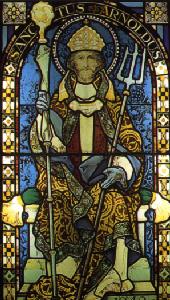
Glasraam
van Sint-Arnoldus van Soissons, onbekende kunstenaar, gedateerd 1942, in de
brouwerij Huyghe, Melle, België
Vitrail
représentant saint Arnold de Soissons, artiste inconnu, daté de 1942, dans la
brasserie Huyghe, à Melle, en Belgique
Saint Arnoul de Soissons
Évêque de Soissons (+ 1087)
ou Arnoulf, évêque de Soissons.
Saint Arnould de Palmèle (1082-1087) - Liste des évêques de Soissons.
Originaire du Brabant, il se mit tout d'abord au service de l'empereur et du roi de France. Mais la carrière des armes n'était pas sa vocation. Sous le prétexte d'aller à la cour de France, il se rendit au monastère Saint Médard de Soissons et revêtit l'habit bénédictin. Il édifia ses frères par sa vertu, son silence et la rigueur des observances monastiques. Il connut durant un temps un abbé qui s'était fait nommer par simonie et introduisit le relâchement dans la communauté. Il fut la risée de ceux qui trouvaient qu'il pratiquait trop la pauvreté. Lorsque l’évêché de Soissons fut vacant, il lui fut demandé d'en devenir le titulaire, mais il ne put entrer dans la ville en raison de l'opposition du roi Philippe Ier. Toutes ces difficultés furent pour lui des souffrances. Il sut les accepter, les surmonter et édifier sur elles sa sainteté.
À Ondenbourg en Flandre, l’an 1087, le trépas de saint Arnoul, évêque de
Soissons. De soldat devenu moine, puis évêque, il se dépensa en faveur de la
paix et de la concorde, et mourut dans le monastère qu’il avait fait
construire.
Martyrologe romain
SOURCE : http://nominis.cef.fr/contenus/saint/1667/Saint-Arnoul-de-Soissons.html

Mons (Belgique),
confrérie de saint Arnould patron des brasseurs,
portant la statue du saint au cours de la procession du Car d'Or lors du Dimanche de la Fête Sainte-Trinité.
Mons (Belgium),
brotherhood of Saint Arnulf, patron saint of brewers,
carrying the statue of the saint during the procession of the "Car
d'Or" (Golden Chariot) at the Trinity
Sunday.
Mons, die
Bruderschaft des Heiligen Heiligen Arnulf, des Schutzpatrons der
Brauer, trägt die Statue des Heiligen während der "Car d'Or"
(Goldenen Wagen) Prozession am Dreifaltigkeitssonntag.
Bergen, de Broederschap van Sint Arnulf, patroonheilige van de brouwers,
draagt het beeld van de heilige gedurende de "Car d'Or" Gouden
Wagen-processie tijdens de Drievuldigheidszondag.
Mons', confrérèye
sint Arnoul patron dès brèsseûs pwartant li statuwe do sint tins dol procèssion
do "Car d'Or" (Tchaur d'Ôr) li Dimègne dol Trinitè.
Saint Arnould de
Soissons, patron des brasseurs belges,…
Eh bien oui, cela existe
: un saint patron pour les brasseurs ! Les moines trappistes le connaissent
bien en Belgique... c’est saint Arnould de Soissons. "Divine Box"
nous raconte son histoire en deux minutes.
Le petit Arnould
voit le jour en 1040 en Belgique. En grandissant, il excelle rapidement dans la
chevalerie, où on on le surnomme « Arnould le fort ». Malgré son talent, la
vocation le tiraille et l’emporte. C’est décidé, saint Arnould sera moine !
Mais Arnould est filou !
Voulant revêtir l’habit bénédictin, il se rend un jour en cachette au monastère
Saint-Médard de Soissons, prétextant un passage à la cour de France. Et ça
fonctionne, le voilà désormais moine bénédictin. Quelques années plus tard, la
charge d’abbé risque de lui être confiée mais il ne l’entend pas ainsi et tente
alors de fuir l’abbaye. En vain ! La légende raconte qu’un loup rôdait à ce
moment-là et reconduisit saint Arnould jusqu’aux portes de l’abbaye où il se
vit dans l’obligation d’accomplir son devoir d’abbé.
Quelques années plus
tard, il devient prêtre puis endosse la charge d’évêque de Soissons, d’où son
nom : saint Arnould de Soissons. La charge épiscopale lui est de nouveau
assignée contre son gré… Aussitôt un successeur retrouvé, saint Arnould
retourne donc à la vie monastique, où il mourut en 1087.
Le miracle de la bière
Alors qu’il était évêque,
le pape confia à Arnould la rude mission de reconquérir sa Flandre natale et
d’y apporter la paix. Vaste programme ! Dans ce but, l’évêque ordonna la
fondation de l’abbaye d’Oudenburg en 1084, mais les ouvriers vinrent à manquer
suite à une violente épidémie de peste qui ravageait alors la région. La
construction de l’abbaye fut ainsi arrêtée. Futé, Arnould remarqua que les
habitants qui buvaient l’eau de la rivière mourraient les uns après les autres…
Il rassembla chez le brasseur du village les derniers ouvriers et bénit le
brassin de sa crosse. Après avoir bu la bière bénie, tout le monde fut guéri et
la peste fut éradiquée !
Miracle ou légende ? En
fait, aucun ! L’eau utilisée dans la fabrication de la bière est assainie par
les différentes étapes d’ébullition, ce qui la purifie des bactéries… Rien de
nouveau, mais à l’époque, ce n’était pas encore ancré dans les mémoires !
Aujourd’hui, on fête
officiellement saint Arnould de Soissons le 14 août. D’ailleurs, à Bruxelles,
un week-end entier lui est dédié chaque année fin août/début septembre pour
célébrer le « jour de la bière ». Dans de nombreuses abbayes qui brassent de
la bière trappiste, on retrouve saint Arnould en tableau,
souvent représenté avec une pelle à brasser dans la main gauche.
Source: Divine Box
SOURCE : https://www.cathobel.be/2020/09/saint-arnould-de-soissons-patron-des-brasseurs-belges/

Zu
den heiligen Mauren (Hostel), rechter Seitenaltar mit Gemälde der Heiligen
Hubertus, Matthäus und Arnolphus (Arnulf von Soissons), 18. Jh.
Also
known as
Arnoldus
Arnoul
Arnulfus
Arnulph
Arnulphus
Arnolfo
Profile
French nobleman.
Distinguished career soldier under King Robert
and King Henry
I. Benedictine monk at
the monastery of Saint Medard,
Soissons, France c.1060. Hermit,
living for three years in a tiny cell with
almost no contact with the outside. Called to return to his community, he
became abbot of
his house. He tried to refuse the responsibility; legend says he tried to flee
the house, but that a wolf blocked his path and forced him to return. Priest. Bishop of Soissons, France in 1081.
When first offered the bishopric,
he replied, “Leave a sinner to offer to God some
fruits of penance; and compel not a madman to
take upon him a charge which requires so much wisdom.” He was ordered to
take the position, but found it more than he could handle. When an interloper
drove him from his see, he
took the opportunity as a sign, resigned, and returned to monastic life.
Founded a monastery at
Aldenburg, Flanders where
he lived the rest of his days.
Born
1087 at
the monastery at
Aldenburg, diocese of Bruges, Flanders, Belgium of
natural causes
miracles reported
at his tomb were investigated and approved by a council at Beauvais, France in 1121
relics translated
to the church of Saint Peter, Aldenburg, Belgium in 1131
bishop blessing a burning castle
bishop wearing
a coat
of mail under his cope
bishop with
a fish with
a ring in
its mouth
bishop with
a mash rake (a beer brewing tool)
washing the feet of
the poor
Additional
Information
Saints
of the Day, by Katherine Rabenstein
books
Our Sunday Visitor’s Encyclopedia of Saints
Saints
and Their Attributes, by Helen Roeder
other
sites in english
1001 Patron Saints and Their Feast Days, Australian
Catholic Truth Society
images
sitios
en español
Martirologio Romano, 2001 edición
sites
en français
fonti
in italiano
MLA
Citation
‘Saint Arnulf of
Soissons‘. CatholicSaints.Info. 9 February 2024. Web. 23 April 2026.
<https://catholicsaints.info/saint-arnulf-of-soissons/>
SOURCE : https://catholicsaints.info/saint-arnulf-of-soissons/

Fondation
de l’abbaye Saint-Pierre d’Oudenburg en 1084. Enluminure, Codex
Aldenburgensis, 127/5, fol. LXIIIr, Grootseminarie (en), Bruges (ca.
1458). De g. à d. : Hasecca de Eine et son époux Conon Ier de Eine, le
comte Robert Ier de Flandre, l'évêque Radbod II de
Noyon-Tournai, Arnoult de Soissons, un moine.
Arnulf (Arnoul,
Arnulphus) of Soissons, OSB B (RM)
Born in Flanders; died at
Oudenbourg (Aldenburg), Bruges, Flanders (Belgium), in 1087. Arnulf was a
French nobleman and soldier who rendered distinguished service to King Robert
and King Henry I, when, about 1060, he entered the Benedictine monastery of
Saint Médard in Soissons. After a while he obtained his abbot's permission to live
as an anchorite in a narrow cell, where he devoted himself to prayer and
penance for three years.
He would have loved to
continue in that state but God had other plans for the lowly monk. First, he
was summoned to succeed Ponce as abbot. The cenobitic community was far too lax
when he had retired into his cell; in his absence it had declined further into
worldliness and simony. He accepted the office only reluctantly. In fact, there
is a legend that says he asked for a day in which to come to a decision about
accepting it. During that time he tried to escape, but was caught by a wolf and
forcibly returned before he went very far.
In 1081, he was chosen by
the council of Meaux to become the next bishop of Soissons. When deputies
announced the decision of the council to Arnulf, he responded: "Leave a
sinner to offer to God some fruits of penance; and compel not a madman to take
upon him a charge which requires so much wisdom." Nevertheless, he was
compelled to undertake the burdensome position.
With incredible zeal
Arnulf tried to fulfill all the obligations of his office. When he found
himself unable to correct certain grievous abuses among. He was probably not a
very effective administrator or politician; perhaps it was simply a saint's
sharper self-knowledge, rather than just humility, that had made him unwilling
to accept the office. A little less than two years after his installation, he
was driven from his see by an intruder. Fearing that the fault laid within
himself, he resigned rather than fighting to regain possession of his episcopal
chair. Thereafter he founded Oudenbourg Abbey in the diocese of Bruges,
Belgium, where he died in sackcloth and ashes.
Many of the miracles
wrought at his tomb were approved during a council held at Beauvais in 1121.
His relics were enshrined in 1131, and are still preserved in the church of
Saint Peter at Oudenburg. His name is very famous throughout the Low Countries
and in France (Benedictines, Encyclopedia, Farmer, Husenbeth).
In art, Saint Arnulf is
portrayed as a bishop wearing a coat of mail under his cope. At times the image
may include (1) a fish with a ring in its mouth; (2) a burning castle that
Arnulf is blessing; or (3) Arnulf washing the feet of the poor (Roeder). This
patron of music, millers, and brewers is venerated at Remiremont. He is invoked
to find lost articles (Roeder).
SOURCE : http://www.saintpatrickdc.org/ss/0815.shtml
August 15
St. Arnoul, or Arnulphus,
Bishop of Soissons, Confessor
HE was a French nobleman,
and had distinguished himself in the armies of Robert and Henry I. kings of
France. He was called to a more noble warfare, resolving to employ for God the
labour which, till then, he had rather consecrated to the service of the world.
He became a monk in the great monastery of St. Medard at Soissons; and his
example was followed by many other persons of distinction. After he had for
some time made trial of his strength in the exercises of a cenobitic life, he
formed to himself a new plan more suitable to his fervour. With his abbot’s
leave he shut himself up in a narrow cell, and in the closest solitude, almost
without any commerce with men, devoted himself to assiduous prayer, and the
exercises of the most austere penance. He had led this manner of life three
years and a half, when a council held at Meaux by a legate of Pope Gregory VII.
at the request of the clergy and people of Soissons, resolved to place him in
that episcopal see. To the deputies of the council who came on that errand,
Arnold returned this answer: “Leave a sinner to offer to God some fruits of
penance; and compel not a madman to take upon him a charge which requires so
much wisdom.” He was, however, obliged to put his shoulders under the burden.
He set himself with incredible zeal to fulfil every branch of his ministry; but
finding himself not able to correct certain grievous abuses among the people,
and fearing the account he should have to give for others no less than for
himself, he procured leave to resign his dignity. He afterwards founded a great
monastery at Aldenburgh, then a considerable city, in the diocess of Bruges,
towards Ostend, where he happily died on sackcloth and ashes in 1087. Many
miracles wrought at his tomb were approved in a council held at Beauvais in
1121. His relics were enshrined in 1131, and are still preserved in the church
of St. Peter at Aldenburgh or Oudenburgh. His name is very famous over all the
Low Countries and in France. See his life written by Lizard bishop of Soissons
in the same century, and by Hariulph abbot of Aldenburgh. See also Sanderus,
Flandria Illustrata, augmented by the canon Foppens. Gall. Chr. Nova, t.
9. p. 350.
Rev. Alban
Butler (1711–73). Volume VIII: August. The Lives of the
Saints. 1866.
SOURCE : http://www.bartleby.com/210/8/153.html

Drie
devoosjestoaties vo Sint-Arnoldus, Oudnburg
Sant' Arnolfo di
Soissons Vescovo
Festa: 14 agosto
Fiandre, 1040 circa –
Oudenbourg, Fiandre, 1087
Sant’Arnolfo nacque verso
il 1040 nelle Fiandre. Sin dalla giovane età intraprese la carriera militare
nell’esercito di Roberto ed Enrico I di Francia, ma in seguito decise di
entrare nel monastero di San Medardo presso Soissons, scegliendo di diventare un
eremita. Nel 1081 un sinodo straordinario lo elesse vescovo della città, su
richiesta del clero diocesano e, a quanto pare, della stessa popolazione.
Divenne comunque un vescovo molto attivo ma, poi si dimise dall’incarico e
fondò un monastero presso Oudenbourg, nelle Fiandre, ove morì nel 1087. Il
santo è popolarmente considerato quale speciale protettore dei produttori di
birra e dei birrai.
Patronato: Produttori
di birra e birrai
Etimologia: Arnolfo
= forte e astuto, dal tedesco
Emblema: Bastone
pastorale, Mitra
Martirologio
Romano: Ad Altenburg nelle Fiandre, ora in Germania, transito di
sant’Arnolfo, vescovo di Soissons, che da soldato si fece monaco e, eletto poi
vescovo, si adoperò per la pace e la concordia, morendo, infine, nel monastero
da lui stesso fondato.
Sant’Arnolfo (in francese Arnoul) nacque verso il 1040 nelle Fiandre. Sin dalla giovane età intraprese la carriera militare nell’esercito di Roberto ed Enrico I di Francia, ma in seguito decise di entrare nel monastero di San Medardo presso Soissons, scegliendo di diventare eremita e conducendo una vita improntata ad una severa penitenza e preghiera in una cella alquanto angusta, da cui i rapporti con l’esterno erano limitatissimi.
Nel 1081 un sinodo straordinario lo elesse vescovo della città, su richiesta del clero diocesano e, a quanto pare, della stessa popolazione. Non appena gli comunicarono l’avvenuta elezione, egli replicò: “Lasciate che questo peccatore possa offrire alcuni frutti di penitenza a Dio. Non obbligate uno stolto come me a fare qualcosa che necessita quanta più saggezza possibile”.
Contro la sua volontà fu costretto ad accettare, ma divenne comunque un vescovo molto attivo. Un usurpatore prese però illegittimamente il suo posto per ragioni sconosciute ed egli, anziché ribellarsi, chiese umilmente il permesso di dimettersi dall’incarico che aveva ormai perso.
Fondò in seguito un monastero presso Oudenbourg, nelle Fiandre, ove infine morì nel 1087. Si narra che in un concilio tenutosi a Beauvais nel 1120 l’allora vescovo di Soissons presentò all’assemblea una “Vita” del suo predecessore e chiese il consenso per trasferire in chiesa i suoi resti, sostenendo che, se essi si fossero trovati nel territorio della sua diocesi, già da tempo avrebbero abbandonato il cimitero. L’anno seguente, come richiesto, le reliquie di Arnolfo furono traslate nella chiesa abbaziale di Oudenbourg, atto a quel tempo corrispondente ad un’odierna canonizzazione.
Il santo è popolarmente considerato quale speciale protettore dei produttori di birra e dei birrai.
Autore: Fabio Arduino

.jpg)
_74.jpg)

