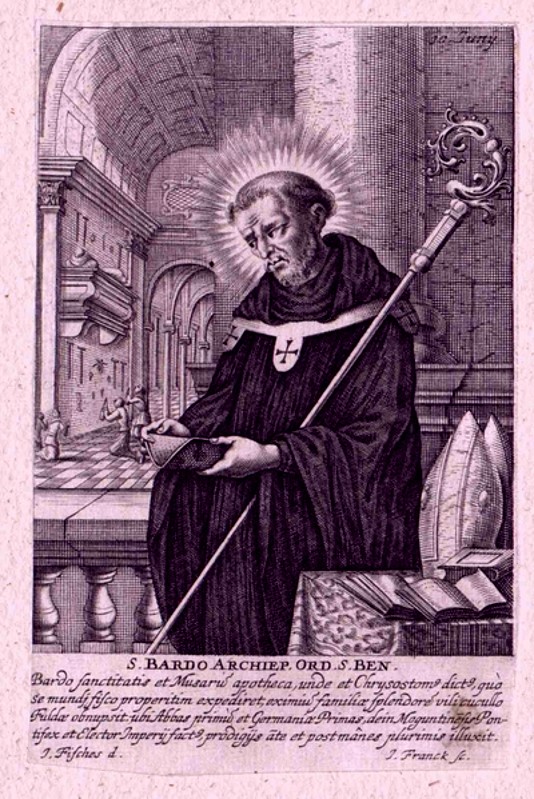
Bardo
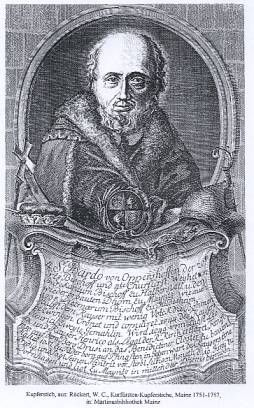
von Mainz. Kupferstich von W. C. Rückert. Erzbischof Bardo von Mainz.
Kurfürsten-Kupferstiche, Mainz 1751-1757
Reckert.
Archevêque Bardo de Mayence, 1757, Eau-forte, Martinusbibliothek Mainz
Saint Bardon
Archevêque de
Mayence (+ 1051)
Archevêque de Mayence, il vivait dans une telle austérité que le Pape Léon IX, passant par là, lui recommanda de mieux veiller à sa santé pour le bien de l'Église. Ce qu'il fit par obéissance.
À Mayence en Franconie (*), l’an 1051, le bienheureux Bardon, évêque. Premier abbé de Hersfeld, il fut élevé à l’ordre épiscopal et montra pour son Église une sollicitude pastorale incessante.
(*) région géographique et historique du centre-sud de l'Allemagne
Martyrologe romain
SOURCE : http://nominis.cef.fr/contenus/saint/7228/Saint-Bardon.html
Bardo de Mayence
980-1051
Bardo naquit vers 980 à
Habprahteshoven (Oppershofen, Hesse, Allemagne C), d’Adalbero et Christina.
Il fit de bonnes études
très tôt, et très tôt aussi montra de bonnes dispositions, au point que les
parents le placèrent comme oblat à l’abbaye bénédictine de Fulda. Bardo se
montra le meilleur des élèves, intellectuellement et spirituellement. En outre,
il devint un excellent orateur.
Il fut nommé prieur à
Saint-André de Fulda puis, en 1028, abbé de Werden-sur-Ruhr ainsi qu’en 1031,
de Hersfeld. Il eut l’habilité de gouverner l’un et l’autre monastère sans que
son absence suscitât la moindre difficulté.
En 1031, l’empereur le
préconisa pour le siège épiscopal de Mayence, et le choisit en même temps comme
chancelier d’Empire.
Une vilaine cabale de
comtes s’abattit sur Bardo qu’on chercha à discréditer auprès de l’empereur ;
Bardo se battit contre l’injustice avec les armes spirituelles : la patience et
l’austérité de sa vie, selon le mot du Christ Certains démons ne se
combattent que par la prière et le jeûne (Mt 17:21).
Chaque nuit il se rendait
dans quelque église pour prier ; un jour, le sacristain ne le reconnut pas et
lui envoya une volée de coups de bâton. Le lendemain, Bardo lui remit un
denier en remerciement.
La charité de l’évêque
était proverbiale. Dieu permit sans doute aussi la multiplication miraculeuse
de ses ressources, pour subvenir à tant de largesses.
En 1036 fut achevée la
nouvelle cathédrale, commencée déjà du temps de ses prédécesseurs ; il la
consacra à saint Martin (v. 11 novembre).
En 1049 eut lieu à
Mayence un grand concile pangermanique, présidé par le pape lui-même (Léon IX,
v. 19 avril) et auquel, bien sûr, participa Bardo. On y confirma la loi du
célibat des prêtres et la condamnation de la simonie. Au terme de ce concile,
Bardo fut nommé légat papal pour toute l’Allemagne.
Il mourut à Dornloh (auj.
Oberdorla) le 10 ou 11 juin 1051.
Saint Bardo de Mayence
est commémoré le 11 juin dans le Martyrologe Romain.
SOURCE : http://www.samuelephrem.eu/tag/hagiographie%20b/

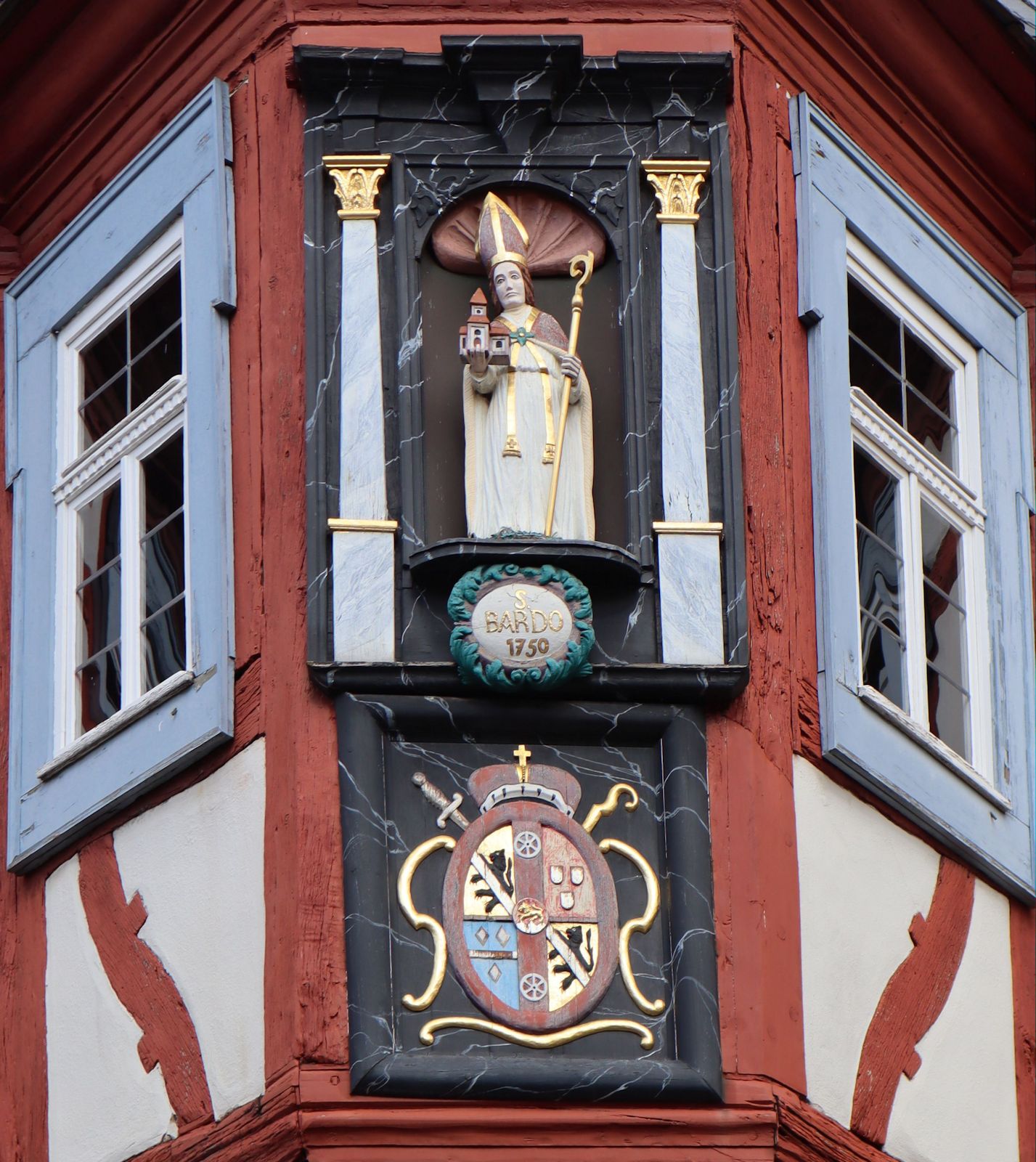
Statue
at the town
hall in St Bardo’s birthplace Oppershofen of which Town he is the
Patron Saint
Statue
am Rathaus in
Bardos Geburtsort Oppershofen
Also
known as
Bardo of Magonza
Bardon
Bardone
15 June (cathedral of Mainz, Germany)
10 June on
some calendars
Profile
Benedictine monk at
Fulda, Germany. Abbot of
Werden Abbey,
Essen-Werden, Germany in 1029. Abbot of
Hersfeld Abbey,
Hesse, Germany in 1031. Archbishop of Mainz, Germany in 1031.
As monk, abbot and bishop he
was known for his simple, ascetic life, his charity to
the poor,
the gift of prophecy, and his care for animals.
Born
1053 of
natural causes
Additional
Information
Book
of Saints, by the Monks of
Ramsgate
Saints
of the Day, by Katherine Rabenstein
books
Our Sunday Visitor’s Encyclopedia of Saints
other
sites in english
images
sitios
en español
Martirologio Romano, 2001 edición
fonti
in italiano
MLA
Citation
“Saint Bardo of
Mainz“. CatholicSaints.Info. 8 January 2022. Web. 20 April 2026.
<http://catholicsaints.info/saint-bardo-of-mainz/>
SOURCE : http://catholicsaints.info/saint-bardo-of-mainz/
Article
BARDO (Saint) Bishop
(June 10) (11th century) A monk of Fulda, consecrated Bishop of Mayence (A.D.
1031). He was distinguished not only for austerity of life and for pastoral
zeal, but for self-sacrificing charity to the poor. He had from God many supernatural
gifts, and in particular that of prophecy. He died on the day he had publicly
foretold, June 11, A.D. 1051.
MLA
Citation
Monks of Ramsgate.
“Bardo”. Book of Saints, 1921. CatholicSaints.Info. 18 August 2012.
Web. 20 April 2026. <http://catholicsaints.info/book-of-saints-bardo/>
SOURCE : https://catholicsaints.info/book-of-saints-bardo/
St. Bardo
Feastday: June 10
Death: 1053
Benedictine archbishop and
official of the Holy Roman Empire. He was born in Oppershafen, Wetterau,
Germany, in about 982. Educated at Fulda Abbey,
he became a Benedictine and was made the abbot of
two monasteries, becoming the archbishop of Mainz in
1031. He served as chancellor and chief almoner alms distributor for the
empire. Pope St. Leo IX advised
Bardo to lighten his duties and relax some of his personal austerities and
mortifications.
SOURCE : https://www.catholic.org/saints/saint.php?saint_id=1673
BARDO OF OPPERSHOFEN, ST.
Archbishop of Mainz; b.
Oppershofen, Germany, c. 980; d. Dornloh, near Paderborn, June 10,
1051. Born of a prominent family, he was sent at an early age to the monastery
of Fulda, where he eventually became a monk and the director of the monastic
school. In 1029 Bardo was made abbot of Werden, and two years later he assumed
the leadership of the important monastery of Hersfeld. On June 29, 1031, he was
consecrated archbishop of Mainz and energetically completed the construction of
the cathedral, which he consecrated in 1036 when the emperor, conrad ii, honored
the occasion with his presence. The most important event during his episcopate
was the synod held at Mainz in 1049 at which Pope leo ix presided. In addition
to having a great reputation for piety and humility, Bardo was highly regarded
as an eloquent preacher and was frequently called another Chrysostom. If the
sermon reported in his longer biography (Monumenta Germaniae Historica:
Scriptores 11:330–35) can be taken as typical, the author was surprisingly
familiar with Sacred Scripture. He was buried in the new cathedral at Mainz.
Feast: June 15.
Bibliography: Monumenta
Germaniae Historica: Scriptores (Berlin 1826—) 11:317–342. Acta
Sanctorum June 2:296–315. J. F. Bohmer and C. Will, eds., Regesten zur
Geschichte der Mainzer Erzbischöfe, 2 v. (Innsbruck 1877–86) 1:165–176.
Literature. G. Allemang, Dictionnaire d'histoire et de géographie ecclésiastiques,
ed. A. Baudrillart et al. (Paris 1912) 6:775. P. Acht, Lexikon für
Theologie und Kirche, ed. J. Hofer and K. Rahner (Freiburg 1957–65) 1:1243. A. M. Zimmermann, Bibliotheca sanctorum 2:780–782; Kalendarium
Benedictinum (Metten 1933–38) 2:297–299.
[H. Dressler]
New Catholic Encyclopedia
Bardo of Mainz, OSB B (AC)
Born at Oppershofen,
Germany, in 982; died in Mainz, in 1053; feast day formerly June 10. A helmet,
a lamb, and a Psalter were gifts presented to Bardo as a child, and these
symbolized courage, gentleness, and piety, each of which marked his later
career. He was a German of good birth, and received his first schooling from an
old woman who taught him his letters and to read the Psalms as he sat in her
lap. Years later he still remembered what he owed to her and made good
provision for her care. The balance of his education came at Fulda, where he
also received the Benedictine habit and became the dean. Upon his ordination as
a priest in 1029, Bardo was appointed an abbot at Werden am Ruhr because of his
family connection with the empress. One day, when he was at court, the
archbishop of Mainz, seeing in his hand his richly wrought abbot's staff,
remarked: "Abbot, I think that staff would become my hand better than
yours," to which Bardo replied: "If you think so, it will not be hard
for you to get it."
On returning to his
quarters, he called one of his attendants and, giving him the staff and other
insignia of his office, told him to take them as a gift to the archbishop. When
the attendant returned, Bardo asked him how the archbishop had received them,
"Middling well," was the answer. "Only middling well?" said
the abbot, "Heaven knows, perhaps before long they will be mine
again."
And sure enough, before
long his words came true: he was restored to his abbey. In 1031, Bardo was
appointed abbot of Hersfeld and was also appointed to succeed the archbishop of
Mainz.
He made, however, an
unfortunate beginning. When preaching before the emperor one Christmas morning,
through sickness or nervousness he made a very poor impression. "What a
man for an archbishop!" said those who heard him. "He is a stick. He
cannot preach. Why did your Majesty appoint such a boorish monk?" And the
emperor himself felt that he had made a mistake in appointing an ignorant monk
to the most important diocese in Germany.
Bardo was due to preach
again before the emperor a few days later, and his friends advised him not to,
but he replied: "To every man his own burden," and faced the ordeal.
This time he preached with such ease and power and created so admirable an
impression that the emperor was delighted, and said as he sat down to dinner:
"The archbishop has restored my appetite."
For a time Bardo was
chancellor and grand almoner of the empire, yet to the end Bardo preserved the
simple habits of a monk. He practiced austerities so severe that Pope Saint Leo
IX advised him to relax them. He was noted for his love of the poor, the
destitute, and animals. He was also a lover of birds, many rare specimens of
which he collected and tamed, and taught to feed from his own plate. Bardo was
diligent in his diocese and, as a prelate, a true father in God. He completed
the building of his great cathedral in honor of Saint Martin. He had a great
sense of justice, and protected many from the harsh treatment or wrong
conviction; and, hating drunkenness and other gross habits, he advocated,
especially to young people, the virtues of self-discipline and temperance
(Benedictines, Encyclopedia, Gill).
SOURCE : http://www.saintpatrickdc.org/ss/0615.shtml
Saint of the Day – 11
June – Saint Bardo of Mainz (c981-c1053), Archbishop, “The Chrysostom” of
his time
Posted on June
11, 2024
Saint of the Day – 11June
– Saint Bardo of Mainz (c981-c1053) Archbishop of Mainz from 1031 until 1051,
the Abbot of Werden from 1030 until 1031 and the Abbot of Hersfeld in 1031.
Ascetic, renowned for his piety and devotion, for his care and love of the poor,
renowned Preacher, called “The Chrysostom” of his time. Born in c981 in
Oppershofen, Germany and died on 10 or 11 June in 1051 or 1053 (records vary)
in Oberdorla near Mühlhausen in Thuringia, of natural causes. Patronage –
of Oppershofen. Also known as – “The Chrysostom” of his time and area, Bardo
of Magonza, Bardon, Bardone. Additional Memorial – 15 June (Cathedral of Mainz,
Germany) and 10 June (depending on the date chosen for his death. Name means:
battle axe and/or wolf [which our Saint was neither] (Old High German).
Bardo was the son of a
noble family, related to Empress Gisela, the wife of Emperor Conrad II. He
became a Benedictine Monk in the Monastery – on the site of the present
Cathedral – in Fulda. There, in around 1018, Bardo was appointed as the Head of
the Cathedral school and Provost of the new provostship at St Andreas in Fulda.
In 1029, Bardo was
appointed as the Abbot in Werden – today the district of Essen-Werden and in
1031, as the Abbot also in Hersfeld – today’s Bad Hersfeld. From 1031 Bardo
became the Archbishop of Mainz. Then, in 1036, Bardo Consecrated the new
Cathedral dedicated to St Martin of Tours, the construction of which Bardo had
been involved.
Bardo lived so
ascetically that Pope Leo IX admonished him to pay more attention to his
health. His piety and charity became famous, especially towards the travelling
people.
Bardo was also praised as
a preacher and was called “The Chrysostom” of his time . Under Bardo, Mainz
Cathedral was completed. he Consecrated it in 1036 in the presence of Emperor
Conrad and Bardo founded the Cathedral and St John’s Foundation in Mainz, as
well as the Monastery of St James. In 1041/42 he went to war against Bohemia
with Emperor Henry III .
Bardo died during a
journey and was buried in his new Cathedral in Mainz . His Tomb in the
Cathedral in Mainz became a place of pilgrimage where numerous miracles
occurred and still do.
Author: AnaStpaul
Passionate Catholic.
Being a Catholic is a way of life - a love affair "Religion must be like
the air we breathe..."- St John Bosco Prayer is what the world needs
combined with the example of our lives which testify to the Light of Christ.
This site, which is now using the Traditional Calendar, will mainly concentrate
on Daily Prayers, Novenas and the Memorials and Feast Days of our friends in
Heaven, the Saints who went before us and the great blessings the Church
provides in our Catholic Monthly Devotions. This Site is placed under the
Patronage of my many favourite Saints and especially, St Paul. "For the
Saints are sent to us by God as so many sermons. We do not use them, it is they
who move us and lead us, to where we had not expected to go.” Charles Cardinal
Journet (1891-1975) This site adheres to the pre-Vatican II Catholic Church and
all her teachings. . PLEASE ADVISE ME OF ANY GLARING TYPOS etc - In June 2021 I
lost 100% sight in my left eye and sometimes miss errors. Thank you and I pray
all those who visit here will be abundantly blessed. Pax et bonum! View All Posts
SOURCE : https://anastpaul.com/author/anastpaul/

San Bardone (Bardo) di
Magonza Vescovo
m. 1051
Martirologio Romano: A
Magonza nella Franconia in Germania, beato Bardone, vescovo, che fu dapprima
abate di Heresfeld, elevato poi alla dignità episcopale, curò egregiamente la
sua Chiesa con instacabile sollecitudine pastorale.
Nacque nel 981 a Oppertshofen da famiglia di antica nobiltà, imparentata con l'imperatrice Gisela, moglie di Corrado II. Entrato ancor giovane nel monastero di Fulda, si distinse soprattutto per l'umiltà, l'amore verso il prossimo e la prontezza al sacrificio, virtù che, già presenti nella sua mite natura, egli non mancò di sviluppare con esercizio perseverante. Il suo abate lo nominò ben presto decano e poi prevosto di Neumünster. Qui fu conosciuto dall'imperatore Corrado II, che ne riportò una impressione così favorevole da conferirgli qualche tempo dopo l'abbazia imperiale di Werden nella Ruhr, cui nel 1031 unì anche quella di Hersfeld, che era rimasta vacante. Nello stesso anno 1031 Bardone fu eletto arcivescovo di Magonza, e questa nomina contrariò il clero di corte, non certo disposto a tollerare che un monaco d'aspetto meschino e che non mostrava di avere qualità particolari, fosse stato promosso alla prima sede vescovile dell'Impero. Alcuni, anzi, lo ritennero un uomo inetto, con cui si potesse osare tutto, e tra questi Erchembaldo, podestà della città, che fece passare al santo ore amare. Nonostante il disprezzo di cui era oggetto, Bardone ottemperò in maniera esemplare ai suoi doveri di principe dell'Impero e nel 1040 prese anche parte alla guerra contro i Boemi. Ma la sua occupazione prediletta fu sempre la cura per i poveri e per i bisognosi: in Magonza li conosceva tutti per nome ed essi avevano libero accesso alla sua casa. Persino i giocolieri e i suonatori ambulanti trovarono in lui un protettore, non perché egli approvasse il loro mestiere, ma perché aveva compassione della loro condizione di girovaghi. Tali erano la sua generosità e la sua mitezza che regalò una moneta d'oro al custode che, avendolo una notte scambiato per un ladro nell'oscurità della chiesa, lo aveva percosso duramente. Il santo, infatti, aveva l'abitudine di pregare a lungo di notte, prima che avessero inizio le vigilie. Non si ha notizia di un eventuale incremento dei possessi temporali della diocesi di Magonza durante il governo di Bardone, mentre invece si sa che egli completò la costruzione del duomo della città e lo consacrò solennemente nel 1036. Godé sempre fama di zelante pastore e di illustre predicatore tanto da essere paragonato a san Giovanni Crisostomo. Una prova della sua eloquenza è il sermone per la festa di san Giovanni Evangelista, condotto sul versetto In conspecto eius nubes transierunt, in cui Cristo è paragonato al sole e i santi alle nuvole e alle stelle. Dopo aver assistito al sinodo tenuto da Leone IX nel 1049 a Magonza, l'11 giugno dello stesso anno Bardone morì a Dornloh, presso Paderborn. Con l'invocazione sancte Bardo Bardone è già nominato nella litania di Exeter del sec. XI, introdottovi forse dal vescovo Leofric. Dal sec. XVII la festa di Bardone ricorre a Magonza e ad Oppertshofen il 10 giugno, per evitare la concorrenza con san Barnaba (cf. Der Katholik, II, Magonza 1870, pp. 686 sg.); ma dal 1915 nel duomo della stessa città si celebra il 15 giugno con la liturgia dei Dottori della Chiesa, titolo spesso attribuito al santo in passato. Se ne fa memoria nei martirologi dell'Ordine benedettino il 10 giugno. Sino al sec. XIV si ha memoria della venerazione delle sue reliquie, ma alla fine del Medio Evo se ne persero le tracce, e neppure negli ultimi restauri del duomo, antecedenti al 1934, furono ritrovate. Una grande statua barocca di Bardone troneggia nella cripta di San Bonifacio a Fulda.
Autore: Alfonso M. Zimmermann
SOURCE : http://www.santiebeati.it/dettaglio/56830

Statue
of St Bardo in the Crypt of the Fulda Cathedral
Statue
in der Krypta des Domes in
Fulda
Bardo von Mainz
Gedenktag katholisch: 11. Juni
nicht gebotener Gedenktag im Bistum Fulda und Mainz: 10. Juni
Name bedeutet: Streitaxt
und Wolf (althochdt.)
Erzbischof von Mainz
* um 980 in Oppershofen in Hessen
† 10. Juni 1051 in Oberdorla bei
Mühlhausen in Thüringen
Bardo war ein Sohn aus
adliger Familie, verwandt mit Kaiserin Gisela, der Frau von Kaiser Konrad II.
Bardo wurde Benediktinermönch
im Kloster - an der Stelle des heutigen Domes -
in Fulda, um 1018 Leiter der Domschule und Propst der neuen Propstei an St.
Andreas in Fulda, 1029 Abt in Werden - heute der Stadtteil Essen-Werden und
1031 auch in Hersfeld -
dem heutigen Bad Hersfeld -, ab 1031 Erzbischof in Mainz - zunächst noch im
damaligen Dom an der Stelle der heute evanglischen Kirche
St. Johannis, dann im 1036 Martin
von Tours geweihten neuen Dom,
an dessen Erbauung er beteiligt war. Bardo lebte so asketisch, dass Papst Leo IX. ihn
ermahnte, mehr auf seine Gesundheit zu achten. Berühmt wurden seine Frömmigkeit
und Mildtätigkeit vor allem auch gegenüber dem fahrenden Volk.
Auch als Prediger wurde
Bardo gerühmt und als Chrysostomus seiner
Zeit bezeichnet. Unter Bardo wurde der Mainzer Dom fertiggestellt,
er weihte ihn 1036 im Beisein von Kaiser Konrad, und Bardo gründete das Dom-
und das Johannesstift in Mainz sowie das Kloster St. Jakob. 1041/42 zog er mit
Kaiser Heinrich III. in den Krieg gegen Böhmen.
Bardo starb während einer
Reise im 987 gegründeten damaligen Kloster an der Kirche St.
Peter und Paul der Augustiner-Chorherren in
Oberdorla. Er wurde in seinem neuen Dom in
Mainz bestattet.
Bardos Grab im Dom in
Mainz wurde eine Wallfahrtsstätte,
an der sich zahlreiche Wunder ereigneten.
Patron von Oppershofen
Stadlers Vollständiges
Heiligenlexikon
Der Dom in Fulda ist täglich von 10 Uhr bis 17 Uhr - sonntags erst ab 11.30 Uhr - zur Besichtigung geöffnet. (2021)
Der Dom in
Mainz ist werktäglich von 11 Uhr bis 16 Uhr, sonntags von 13 Uhr bis 16 Uhr zur
Besichtigung geöffnet. (2021)
Seite zum Ausdruck
optimiertUnser Reise-Blog:
Reisen zu den Orten, an denen die
Heiligen lebten und verehrt werden.
Empfehlung an
Freunde senden
Artikel
kommentieren / Fehler melden
Fragen? -
unsere FAQs antworten!
Impressum - Datenschutzerklärung
Schauen Sie sich zufällige Biografien an:
Johannes
Franziskus Macha
Abraham
von Rostov
Aquilonius
Autor: Joachim
Schäfer - zuletzt aktualisiert am 18.08.2025
Quellen:
• Vera Schauber, Hanns Michael Schindler: Heilige und Patrone im Jahreslauf. Pattloch, München 2001
• Friedrich Wilhelm Bautz. In: Friedrich-Wilhelm Bautz (Hg.): Biographisch-Bibliographisches Kirchenlexikon, Bd. I, Hamm 1990
• Lexikon für Theologie und Kirche, begr. von Michael Buchberger. Hrsg. von
Walter Kasper, 3., völlig neu bearb. Aufl., Bd. 1. Herder, Freiburg im Breisgau
1993
korrekt zitieren: Joachim Schäfer: Artikel Bardo von Mainz, aus dem Ökumenischen Heiligenlexikon - https://www.heiligenlexikon.de/BiographienB/Bardo.htm, abgerufen am 20. 4. 2026
Die Deutsche Nationalbibliothek verzeichnet das Ökumenische
Heiligenlexikon in der Deutschen Nationalbibliografie; detaillierte bibliografische
Daten sind im Internet über https://d-nb.info/1175439177 und https://d-nb.info/969828497 abrufbar.
SOURCE : https://www.heiligenlexikon.de/BiographienB/Bardo.htm