
Sainte Marie-Crescence
Tertiaire de Saint-François (+ 1744)
ou Anne Höss.
Elle vécut à Kaufbeuren sur l'Elbe en Bavière. Tertiaire de Saint-François, elle s'appliqua à communiquer aux autres la ferveur de l'Esprit Saint dont elle brûlait elle-même.
Béatifiée par Léon XIII le 7 octobre 1900 et canonisée le 25 novembre 2001 par le Pape Jean-Paul II.
"Sainte Maria Crescentia Höss est un grand don. Vous devez être orgueilleux de cette femme. Elle est une 'bannière', non seulement pour la ville de Kaufbeuren, mais également pour le diocèse d'Augsburg, pour la province ecclésiale de Munich et Freising et pour toute l'Eglise qui est en Allemagne.
Même si une longue période de temps nous sépare de la nouvelle sainte, elle nous parle de la même façon au début du troisième millénaire.
Chaque jour, des personnes de différentes confessions viennent prier sur sa tombe et lui confient leurs préoccupations. Déjà lorsqu'elle était en vie, Maria Crescentia Höss rappelait aux gens quelqu'un dont nous avons nous-mêmes besoin: l'Esprit Saint!"
(source: site du Vatican - audience aux pélerins réunis pour la canonisation de 4 bienheureux)
A Kaufbeuren sur l'Elbe en Bavière, l'an 1744, sainte Marie Crescence (Anne
Höss), vierge. Tertiaire de Saint-François, elle s'appliqua à communiquer aux
autres la ferveur de l'Esprit Saint dont elle brûlait elle-même.
Martyrologe romain
SOURCE : https://nominis.cef.fr/contenus/saint/10798/Sainte-Marie-Crescence.html
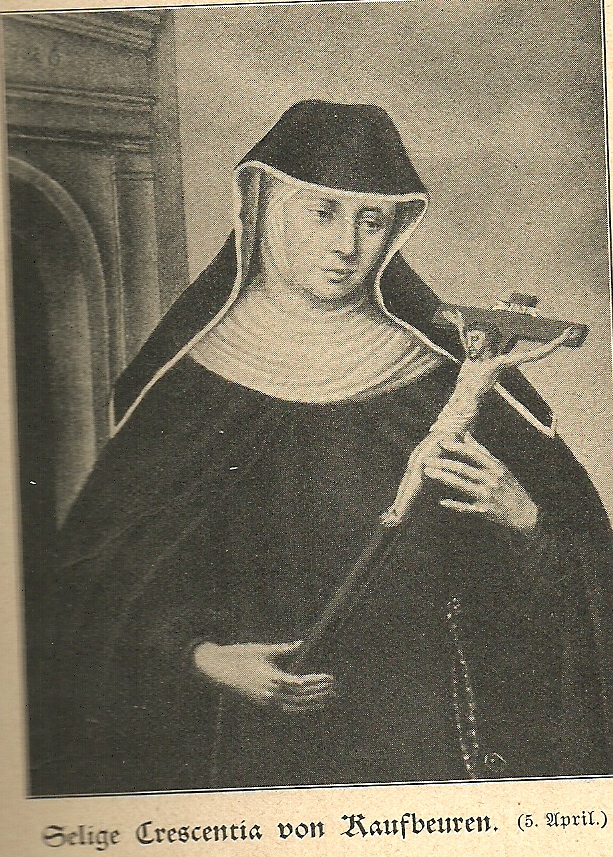
Sainte Maria Crescentia Höß
Vierge, moniale du tiers
ordre franciscain
Fête le 5 avril
Kaufbeuren, Bavière, 20
octobre 1682 – † id. 5 avril 1744
Béatifié le 7 octobre
1900 par le pape Léon XIII
Canonisé le 25 novembre
2001 par le pape Jean Paul II
Autre graphie : [Anna
Höss] Creszentia ou Kreszentia
Le 18 décembre 2000, cité
du Vatican, dans la Salle Clémentine, en présence de Jean-Paul II, des membres
de la Congrégation pour les Causes des Saints et des Postulateurs des Causes
respectives, un Décret a été promulgué relatif à un miracle attribué à l’intercession
de la Bienheureuse Maria Crescenzia (au siècle Anna Höss), allemande, Moniale
professe du Tiers-ordre régulier de St.François (1682-1744).
Maria Crescentia (au
siècle, Anna Höss), vierge, moniale bavaroise du Tiers-Ordre régulier de
Saint-François d’Assise au couvent de Kaufbeuren (Allemagne).
Anna Höss est née à
Kaufbeuren, en Bavière, au diocèse d’Augsburg : elle ne quitta jamais sa ville
natale. Elle y entra dans la vie religieuse et y vécut quarante ans une vie
mystique intense. Sa dépouille repose dans l’église du couvent. On la fête le 5
avril.
SOURCE : http://www.martyretsaint.com/maria-crescentia-hos/
CHAPELLE PAPALE POUR LA
CANONISATION DES BIENHEUREUX
HOMÉLIE DU PAPE JEAN PAUL
II
Dimanche 25 novembre 2001
1. "Il y avait
aussi une inscription au-dessus de lui: "Celui-ci est le roi des
Juifs"" (Lc 23, 38).
Cette inscription, que
Pilate avait faite placer sur la croix (cf. Jn 19, 19), contient à la
fois le motif de la condamnation et la vérité sur la personne du Christ. Jésus
est roi - lui-même l'a affirmé - mais son royaume n'est pas de ce monde
(cf. Jn 18, 36-37). Devant Lui, l'humanité se divise: ceux qui
le méprisent pour son échec apparent, et ceux qui le reconnaissent comme le
Christ, "image du Dieu invisible, Premier-Né de toute créature" (Col 1,
15), selon l'expression de l'Apôtre Paul dans l'Epître aux Colossiens, que nous
avons entendue.
Face à la croix du Christ
s'ouvre, d'une certaine façon, la grande scène du monde et s'accomplit le drame
de l'histoire collective et de chacun. Sous le regard de Dieu, qui dans son
Fils unique immolé pour nous s'est fait la mesure de chaque personne, de chaque
institution, de chaque civilisation, chacun est appelé à se décider.
2. Face au divin Roi
crucifié se sont également présentés ceux qui viennent d'être proclamés
saints: Giuseppe Marello, Paula Montal Fornés de San José de Calasanz,
Léonie Françoise de Sales Aviat et Maria Crescentia Höss. Chacun d'eux s'est
confié à sa royauté mystérieuse, en proclamant à travers toute leur vie:
"Jésus, souviens-toi de moi, lorsque tu viendras avec ton royaume" (Lc 23,
42). Chacun d'eux a reçu, d'une façon totalement personnelle, la réponse du Roi
immortel: "En vérité, je te le dis, aujourd'hui tu seras avec moi
dans le Paradis" (Lc 23, 43).
Aujourd'hui! Cet
"aujourd'hui" appartient au temps de Dieu, au dessein de salut, dont
parle saint Paul dans l'Epître aux Romains: "Ceux que [Dieu]
d'avance a discernés, il les a aussi prédestinés... appelés... justifiés...
glorifiés" (Rm 8, 29-30). Cet "aujourd'hui" contient également
le moment historique de la canonisation de ce jour, au cours duquel ces quatre
témoins exemplaires de la vie évangélique sont élevés à la gloire des autels.
Giuseppe Marello
3. "Car Dieu
s'est plu à faire habiter en lui [le Christ] toute la Plénitude" (Col 1,
19). A cette plénitude participa saint Giuseppe Marello, en tant que prêtre du
clergé d'Asti et en tant qu'évêque du diocèse d'Acqui. Plénitude de grâce,
fomentée en lui par l'intense dévotion à la Très Sainte Vierge Marie; plénitude
du sacerdoce, que Dieu lui conféra comme un don et un engagement; plénitude de
la sainteté, qu'il atteint en se conformant au Christ, Bon Pasteur. Mgr Marello
se forma au cours de la période glorieuse de la sainteté piémontaise, lorsque
face à de multiples formes d'hostilités contre l'Eglise et la foi catholique,
fleurirent des héros de l'esprit et de la charité, tels que Cottolengo,
Cafasso, Dom Bosco, Murialdo et Allamano. Jeune homme bon et intelligent,
passionné par la culture et l'engagement civil, notre saint ne trouva que dans
le Christ la synthèse de tous les idéaux et c'est à Lui qu'il se consacra dans
le sacerdoce. "Protéger les intérêts de Jésus" fut la devise de sa
vie, et c'est pour cela qu'il s'identifia totalement à saint Joseph, l'époux de
Marie, le "gardien du Rédempteur". Ce qui l'attira profondément chez
saint Joseph, fut le service caché, nourri d'une profonde intériorité. Il sut
transmettre ce style aux Oblats de saint Joseph, la Congrégation qu'il fonda.
Il aimait à leur répéter: "Soyez extraordinaires dans les choses
ordinaires" et il ajoutait: "Soyez des ermites chez vous et des
apôtres à l'extérieur". Le Seigneur voulut utiliser sa forte personnalité,
en l'appelant à l'épiscopat dans le diocèse d'Acqui, où, en quelques années, il
dépensa toutes ses énergies pour le troupeau, laissant une empreinte que le
temps n'a pas effacée.
Paula Montal Fornés de
San José de Calasanz
4. "En vérité,
je te le dis, aujourd'hui tu seras avec moi au paradis" (Lc 23, 43).
C'est au paradis, dans la plénitude du Royaume de Dieu, que fut accueillie sainte
Paula Montal Fornés de San José de Calasanz, fondatrice de l'Institut des
Filles de Marie, religieuses scolopes, après une vie de sainteté. Tout d'abord
dans sa ville natale, Arenys del Mar, engagée dans diverses activités
apostoliques et pénétrant, à travers la prière et la piété sincère, les
mystères de Dieu; ensuite, en tant que fondatrice d'une famille religieuse,
s'inspirant de la devise de Giuseppe Calasanz "piété et instruction",
elle se consacra à la promotion de la femme et de la famille en suivant son
idéal de "sauver la famille, en éduquant les petites filles dans la sainte
crainte de Dieu"; pour finir, elle fit preuve de l'authenticité, du
courage et de la tendresse de son esprit, un esprit modelé par Dieu, au cours
des trente années de vie retirée à Olesa de Montserrat.
La nouvelle sainte
appartient à ce groupe de fondateurs d'instituts religieux qui, au XIXème
siècle, se consacrèrent aux nombreuses nécessités qui se présentaient alors et
auxquelles l'Eglise, en suivant l'Evangile et l'inspiration de l'Esprit, devait
répondre pour le bien de la société. Le message de sainte Paula continue à être
actuel et son charisme éducatif est une source d'inspiration pour la formation
des générations du troisième millénaire chrétien.
Léonie Françoise de Sales
Aviat
5. Le dessein
bienveillant du Père qui "nous fait entrer dans le royaume de son Fils
bien-aimé" trouve en sainte Françoise de Sales Aviat une splendide
réalisation: elle a vécu jusqu'au bout l'offrande d'elle-même. Au coeur
de son engagement et de son apostolat, Soeur Françoise de Sales place l'oraison
et l'union à Dieu, où elle trouve lumière et force pour surmonter les épreuves
et les difficultés, et jusqu'à la fin de son existence elle persévère dans
cette vie de foi, désirant se laisser conduire par le Seigneur: "Ô
mon Dieu, que mon bonheur soit de vous sacrifier toutes mes volontés, tous mes
désirs!". La résolution qui caractérise si bien Mère Aviat,
"M'oublier entièrement", est aussi pour nous un appel à aller à
contre-courant de l'égoïsme et des jouissances faciles, et à nous ouvrir aux
nécessités sociales et spirituelles de notre temps. Chères Soeurs Oblates de
Saint-François-de-Sales, à l'école de votre fondatrice, en communion profonde
avec l'Eglise, là où Dieu vous a plantées, soyez bien déterminées à
recevoir les grâces présentes et à en profiter, car c'est en Dieu que l'on
trouve la lumière et le secours nécessaires en chaque circonstance! Confiantes
en l'intercession puissante de la nouvelle Sainte, accueillez dans la joie
l'invitation à vivre, dans une fidélité renouvelée, les intuitions qu'elle a si
parfaitement vécues.
Maria Crescentia Höss
6. Rendre gloire au
Christ, le Roi: ce désir a animé sainte Maria Crescentia Höss dès son
enfance! Elle plaça ses qualités à son service. Dieu lui avait doné une belle
voix. Jeune fille, elle eut l'occasion de chanter dans une chorale comme
soliste, non pour se mettre en valeur, mais pour chanter et jouer de la musique
pour le Christ-Roi.
Elle plaça également ses
connaissances au service du Seigneur. Cette franciscaine fut une conseillère
très sollicitée. Les personnes se pressaient devant la porte du couvent:
des hommes et des femmes simples, mais également des princes et des
impératrices, des prêtres et des religieux, des abbés et des évêques. Elle
devint ainsi une sorte de "sage-femme" qui tentait d'accoucher
la vérité dans le coeur de celui qui lui demandait conseil.
Toutefois, la douleur ne
lui fut pas non plus épargnée. Les rivalités internes existaient déjà à cette
époque. Elle supporta les intrigues au sein de sa communauté sans jamais mettre
en doute sa vocation.
Le vaste souffle de la
passion fit mûrir en elle la vertu de la patience. Elle réussit à devenir
Supérieure: pour elle, diriger spirituellement signifiait servir. Elle
avait une attitude généreuse envers les pauvres, maternelle envers ses
consoeurs et sensible à l'égard de ceux qui avaient besoin d'une bonne parole.
Sainte Crescentia a aimé la signification du Royaume du Christ:
"Dans la mesure où vous l'avez fait à l'un de ces plus petits de mes
frères, c'est à moi que vous l'avez fait" (Mt 25, 40).
7. "Vous
remercierez le Père qui vous a mis en mesure de partager le sort des saints
dans la lumière" (Col 1, 12). Jamais autant qu'en ce moment, ces
paroles de saint Paul résonnent en nous! La communion des saints nous fait
véritablement goûter à l'avance le Royaume céleste et, dans le même temps, elle
nous pousse, sur leur exemple, à le construire dans le monde et dans
l'histoire.
"Oportet illum
regnare", "Car il faut qu'il règne" (1 Cor 15, 25),
écrivait l'Apôtre en se référant au Christ.
"Oportet illum
regnare" nous répètent, à travers votre témoignage, saint Giuseppe
Marello, sainte Paula Montal Fornés de San José de Calasanz, sainte Léonie
Françoise de Sales Aviat et sainte Maria Crescentia Höss! Que votre exemple
nous incite à une plus vive contemplation du Christ-Roi, crucifié et
ressuscité. Que votre soutien nous aide à marcher fidèlement sur les traces du
Rédempteur, afin de partager un jour, avec vous, avec Marie et tous les saints,
sa gloire éternelle au paradis. Amen!
© Copyright - Libreria Editrice
Vaticana

Also
known as
Mary Crescentia Hoss
Crescentia Hoss
Profile
Seventh of the eight children of
Matthias Höss and Lucia Hoermann. Franciscan tertiary nun in 1703,
admitted to the convent at
Kaufbeuren, Germany at
the request of the town’s Protestant mayor. Mistreated by her new sisters for
her lack of a dowry, her holiness overcame their hostility, and she won them
all over. Porter. Novice-mistress from 1726 to 1741.
Reluctant superior of her house from 1741 until
her death in 1744.
Born
20
October 1682 at
Kaufbeuren, Bavaria, Germany
Easter, 5 April 1744 at
Kaufbeuren, Bavaria, Germany of
natural causes
interred in the chapel of
her monastery
2
August 1801 by Pope Pius
VII (decree of heroic
virtues)
7
October 1900 by Pope Leo
XIII
25
November 2001 by Pope John
Paul II
Additional
Information
Saints
of the Day, by Katherine Rabenstein
books
Our Sunday Visitor’s Encyclopedia of Saints
other
sites in english
Pope John Paul II: Homily at the Canonization Mass of Saint
Maria
images
video
sitios
en español
Martirologio Romano, 2001 edición
situs
di indonesia
fonti
in italiano
Dicastero delle Cause dei Santi
nettsteder
i norsk
Readings
God wants
the convent rich
in virtue, not in temporal goods. – Saint Maria
Hoss
MLA
Citation
‘Saint Maria Crescentia
Höss‘. CatholicSaints.Info. 5 April 2024. Web. 26 January 2026.
<https://catholicsaints.info/saint-maria-crescentia-hoss/>
SOURCE : https://catholicsaints.info/saint-maria-crescentia-hoss/

(1682-1744)
Maria Crescenzia
Hoss was born in Kaufbeuren, Bavaria, in the Diocese of Augsburg on 20
October 1682, the seventh of the eight children of Matthias Höss and Lucia
Hoermann. In 1703, in spite of family difficulties and the superior's
reluctance, she was admitted to the Franciscan Tertiaries of Mayerhoff where
she was professed in 1704 and remained until her death.
From 1709 to 1741 with
the election of superiors who were favourably disposed to her, she fulfilled
the most important positions of the monastery: porter, novice mistress,
and superior with the greatest dedication and generosity. She was novice
mistress from 1726 to 1741. In 1741 sister Maria Crescenzia was elected
superior of the community and, despite her attempts to refuse the post, was
forced to accept the task. To her sisters she recommended observing silence,
recollection, and spiritual reading, especially the Gospels. The teacher of
their religious life had to be Jesus on the Cross.
Maria Höss was also a
prudent and wise counsellor to all who turned to her for strength and comfort,
as can be seen from her numerous letters.
In her three years as
superior of the community of Mayerhoff she became its second foundress. She
justified her selectivity regarding vocations saying, "God wants the
convent rich in virtue, not in temporal goods". The principal points of
her program for the renewal of the house were: unlimited trust in divine
providence, readiness in the acts of the common life, love of silence, devotion
to Jesus crucified, and devotion to the Eucharist and the Blessed Mother.
She died on Easter in
1744 and her mortal remains are still very much venerated in the chapel of her
monastery.
SOURCE : http://www.vatican.va/news_services/liturgy/saints/ns_lit_doc_20011125_hoss_en.html
CANONIZATION OF 4
BLESSEDS
HOMILY OF JOHN PAUL II
Sunday, 25 November 2001
1. "There was
an inscription over his head,"This is the King of the Jews" (Lk
23,38).
That inscription, which
Pilate had placed on the cross (cf. Jn 19,19), contains the motive of the
condemnation and the truth about the person of Christ. Jesus is king ...
he affirmed it ... but his kingdom is not of this world (cf. Jn
18,36-37). Before him humanity is divided into two parts: those who
reject him on account of his apparent failure, and those who recognize him as
theChrist, "the image of the invisible God, begotten before all
creation" (Col 1,15), according to the expression of the Apostle Paul in
the Letter to the Colossians, that we have heard.
Before the Cross of Christ,
the great scene of the world is opened up and the drama of our personal
and collective history takes place. Under the gaze of God, who in his Only
begotten Son immolated for us, has become the measure of every person,
institution, and civilization, each one is called to decide for or against
Christ.
2. Those who were just
proclaimed saints: Joseph
Marello, Paula
Montal Fornés de San José de Calasanz, Leonie
Frances de Sales Aviat and Maria
Crescenzia Höss come before the crucified divine king. Each of them
entrusted himself/herself to his mysterious kingship, proclaiming with their
entire life: "Jesus, remember me when you enter into your
kingdom" (Lk 23,42). And in an absolutely personal way, each received the
reply from the immortal King: "Truly, I say to you, today you will
be with me in Paradise" (Lk 23,43).
Today! That
"today" belongs to the time of God, to the plan of salvation, of
which St Paul speaks in the Letter to the Romans: "Those whom he
foreknew he also predestined ... he also called ... justified ...
glorified" (Rom 8,29-20). That "today" contains the
historical moment of today's canonization, in which these four exemplary
witnesses of evangelical life are raised to the glory of the altars.
3. "It pleased God
to make every fullness dwell in him Christ" (Col 1,19). St
Joseph Marello participated in that fullness, as priest of the clergy
of Asti and as Bishop of the Diocese of Acqui. Fullness of grace, fostered in
him by an intense devotion to the Blessed Virgin Mary; fullness of the
priesthood, which God conferred on him as gift and mission; fullness of
holiness which he ahieved, by being conformed to Christ, the Good Shepherd.
Bishop Marello was formed in the golden period of holiness in the Piedmont
area, when, in the midst of numerous forms of hostility against the Church and
the Catholic faith, the champions of the spirit and of charity flourished, Sts
Cottolengo, Cafasso, Don Bosco, Murialdo and Allamano. Joseph was a good and
intelligent young man, enthusiastic about cultural and social movements, but
our saint only found in Christ the synthesis of every ideal and was consecrated
to him in the priesthood. "To take care of the interests of Jesus"
was his motto inlife, and for this reason he wanted to imitate St Joseph, the
spouse of Mary, the custodian of the Redeemer. What strongly attracted him to
St Joseph was the life of hidden service, joined with deep interior life. He
knew how to transmit this style to the Oblates of St Joseph, the Congregation
he founded. He liked to repeat to them, "Be extraordinary in ordinary
things" and he added, "Be Carthusians inside your house and apostles
outside". The Lord wanted to use his robust personality for his Church,
calling him to govern the Diocese of Acqui, where, in the span of a few years,
he spent himself for his flock, leaving a memory that has only grown with
time.
4. "I say to
you: today you will be with me in Paradise" (Lk 23,43). St
Paula Montal Fornés de San José de Calasanz, foundress of the Institute of
the Daughters of Mary, Sisters of the Pious Schools, was received in paradise,
into the fullness of the kingdom of God, after a life of holiness. First in her
native city, Arenys del Mar, she was involved in many apostolic activities and
in prayer and interior devotion she was led into the mystery of God; then as
foundress of a religious family, inspired by the slogan of St Joseph Calasanz
"Piety and Letters", she gave herself to advancing women and the
family with her ideal: "Save the family, educating the young girls
in a holy fear of God"; in the end, she was to give proof of the
authenticity, the firmness and the beauty of her spirit, a spirit shaped by God
during the 30 years of hidden life in Olesa de Montserrat.
The new saint belongs to
the group of founders of religious orders who in the 19th century came forward
to meet the many needs that were present and that the Church, inspired by the
Gospel and by the Spirit, wanted to respond to for the good of society. The
message of St Paula is still valid today and her educational charism is a
source of inspiration in the formation of the generations of the third Christian
millennium.
5. The loving plan of the
Father "who has made us enter the kingdom of his beloved Son" found a
splendid realization in St
Frances de Sales Aviat: who lived her self offering to the end. At
the heart of her dedication and of her apostolate, Sister Frances de Sales put
prayer and union with God, where she found the light and the energy to overcome
trials and difficulties, and to persevere to the end of her life in the life of
faith, desiring to be led by the Lord: "O my God, let my happiness
be found in sacrificing my will and my desires for you!". The resolution
which distinguished Mother Aviat so well, "Forget oneself completely",
is also for us an appeal to go against the current of egotism and easy
pleasures, and open ourselves to the social and spiritual needs of our time.
Dear Oblate Sisters of St Francis-de-Sales, at the school of your foundress, in
profound communion with the Church and wherever God has placed you, be
determined to receive the present graces and to benefit from them, for it is in
God that we find the light and the help necessary in every circumstance!
Trusting in the powerful intercession of the new saint, accept with joy the
invitation to live, with renewed fidelity, the intuitions which she so
perfectly lived.
6. Give glory to Christ
the King: this wish inspired St
Maria Crescenzia Höss from her childhood. It was for his service that
she used her talents. God gave her a beautiful voice. Already as a young lady
she could sing a solo part, not to display herself but to sing and to play for
Christ the King.
Her knowledge of her
fellow men she placed at the service of the Lord. This Franciscan was an
esteemed advisor. To her convent came many visitors: both simple men and
women, princes and empresses, priests and religious, abbots and bishops. In a
certain way she became a kind of "midwife" and helped those seeking
counsel to bring forth the truth in their hearts.
Sorrow did not spare the
saint. "Mobbing" took place in her time. She endured the intrigues of
her own community, without ever doubting her own vocation. The long period of
suffering allowed her to grow in the virtue of patience. That was helpful for
her when she became superior: for her to direct meant spiritually to
serve. She was generous with the poor, motherly with her sisters, and kind to
all who needed a kind word. St Crescenzia lived what the Kingdom of Christ
means: "Whatever you do to the least of your brothers, that you do
to me" (Mt 25,40).
7."Let us give
thanks with joy to the Father who has qualified us to share in the inheritance
of the saints in light" (Col 1,12). Never as at the present time do the
words of St Paul find an echo in our hearts! Truly the communion of saints
gives us the foretaste of the Kingdom of heaven, and, at the same time,
inspires us, following their example, to build it in the world and in
history.
"He must reign"
(I Cor 15,25), the Apostle wrote referring to Christ.
"He must reign",
you repeat to us with the example of your lives, St Joseph Marello, St Paula
Montal Fornés de San José de Calasanz, St Leonie de Sales Aviat and St Maria
Crescenzia Höss. May your example inspire us to living contemplation of Christ
the King, crucified and risen. May your support help us to walk faithfully in
the footsteps of the Redeemer, to share one day with you together with Mary and
all the
saints, his eternal glory in heaven. Amen.
© Copyright - Libreria
Editrice Vaticana
Saints
of the Day – Blessed Crescentia Héss, Tertiary
Article
Born in Kaufbeuren,
Bavaria, Germany; died there in 1744; beatified in 1900. The German virgin
Crescentia, daughter of a poor weaver, was admitted to the convent of the
Franciscan regular tertiaries in 1703 at the behest of the Protestant mayor of
Kaufbeuren. The other nuns neglected and even persecuted her because she had
entered without a dowry. Her holiness, however, overcame their hostility, when
they realized that it was her dowry. Eventually Crescentia became
novice-mistress, then superioress of the convent. Crescentia was blessed by
celestial visions. (Attwater2, Benedictines, Encyclopedia).
MLA
Citation
Katherine I
Rabenstein. Saints of the Day, 1998. CatholicSaints.Info.
20 July 2023. Web. 26 January 2026. <https://catholicsaints.info/saints-of-the-day-blessed-crescentia-hess-tertiary/>
SOURCE : https://catholicsaints.info/saints-of-the-day-blessed-crescentia-hess-tertiary/
St. Crescentia
(1682-1744)
Romantics think that a woman
who “takes the veil” can find in convent life a blissful escape from worldly
trials. This is an over-simplification at best. In the case of Blessed
Crescentia of Kaufbeuren it was largely untrue. Anna Hoess (that was her own
name) was the daughter of a poor woolweaver of Kaufbeuren, Bavaria. Raised
devoutly, young Anna was once kneeling in the chapel of the local Franciscan
nuns when she heard a voice from the crucifix: “This shall be your dwelling
place.”
Herr Hoess went along
with his daughter’s desire to become a nun, and requested the convent to
receive her. But he encountered an unexpected snag. The superior said they
could not accept Anna without a “dowry”, that is, a sizable entry gift. This
the father could not afford to pay. Dowries were customary then in most
convents, and the Kaufbeuren convent, being a poor one, could not afford to
totally abolish the custom. Yet it does seem that this particular group of
Franciscans were a little too much interested in the cash that their founder,
St. Francis of Assisi, so thoroughly despised.
Anna was not disturbed.
She simply waited in patience, working in her father’s weaving business until
she was 21. Then that patience was rewarded in a singular way.
Next door to the convent
was a noisy tavern. The sisters had tried at one point to buy it so as to be
rid of the nuisance, but the antagonistic landowner had tagged the tavern with
a sale price far above what the nuns could afford. One day, however, the mayor
of Kaufbeuren, a Protestant, but sympathetic towards the convent, got
possession of the tavern and deeded the site to the sisters. He asked for no
recompense other than that the nuns receive Anna, whom he esteemed, without a
dowry. The Franciscans could scarcely refuse, so Anna Hoess was given the veil
and the name Sister Crescentia.
Once clothed as a nun,
however, Sister Crescentia was subjected to a prolonged persecution by the
unfriendly superior and some of the older sisters. The basic reason seems to
have been her lack of a dowry. They called her a beggar and a hypocrite, and
made her a slave, giving her the most menial tasks to perform. Although
Crescentia was at first given a cell of her own, it was later taken from her
and given to a new novice who had brought with her the customary donation. Thereafter
she had to beg the other nuns for a corner of their cells to sleep in. When she
was finally given a place of her own again, it was a dark and damp cubbyhole.
Did Sister Crescentia
resent being treated like a convent Cinderella? No. She was already too
advanced in the spiritual life to consider these trials as anything but gifts
of God. When some more sympathetic nuns expressed their regrets at her
treatment, she rejected their consolation. She would not allow herself the
luxury of self-pity.
Patience was at length
rewarded. A more friendly nun was elected superior. Gradually all the other
sisters began to recognize, that Crescentia was a solid, indeed, a very holy
religious. She was eventually chosen as mistress of novices and finally as
mother superior. Meanwhile her spiritual life had been developing intensely.
Frightful temptations beset her, but these were counterbalanced by visions,
ecstasies, and the mystical sharing in Christ’s passion. That she still
remained down-to-earth, however, was proved by the fact that many from outside
the convent, including leaders of the Church, came to seek her advice.
Blessed Crescentia’s
presence in her convent proved, in the long run, far more valuable to her
sisters than any dowry could have been. She taught them two lessons in
particular. First: They should never criticize others unkindly, particularly in
their absence. Second: God is most pleased by our acceptance of the trials that
befall us, bearing “meekly and patiently the adversities that He sends or that our
neighbors inflict.” This is advice we can all profit by.
Jesus himself, then, was
the prince who rescued this real-life Cinderella from drudgery and disdain.
–Father Robert F.
McNamara
St. Crescentia was
canonized November 11, 2001 by Pope John Paul II.
© 2018 Saint Kateri
Tekakwitha Parish, Irondequoit, NY
SOURCE : http://www.kateriirondequoit.org/resources/saints-alive/caedmon-cyril-tejedor/st-crescentia/
Saint Crescentia Hoess
(St. Crescentia Höss)
Feast Day – April 5
Saint Crescentia Hoess was born on October 20, 1682,
in Kaufbeuren, a little town in the diocese of Augsburg. Her father, Matthias
Hoess, a simple weaver, was barely able in spite of diligent work to provide
the necessaries for his family of eight children. But he was a pious Christian,
satisfied with his condition, and delighted to think upon the poor life and the
bitter suffering of Jesus Christ. The mother bore a tender love for the sick
and poor.
Crescentia received the virtues of her good parents as
a precious inheritance. Even as a child she would withdraw from association
with her playmates in order to pray in church or in a quiet corner of the
house. If a poor person came to the house at mealtime, she often asked
permission to give her portion to him.
At an early age Saint Crescentia Hoess was so
thoroughly instructed in the truths of religions that her spiritual director
permitted her to go to Holy Communion at the age of seven. Her answers in
catechism class were sometimes filled with such depth of meaning that she said:
“My child, you must surely have a higher teacher.”
It has been recorded that her guardian angel and the
Lord Himself, in the guise of a child frequently conversed with her.
As Crescentia grew older, she not only assisted her
mother in all the housework, but also learned weaving from her father in spite
of the fact that she was not robust. Her whole deportment, however, showed that
she was not destined for this world. In town she was called “the little angel,”
and she entertained no fonder hope than to be admitted among the consecrated
virgins in the convent of the Tertiaries in her native town.
But the convent was poor, and the superiors declared
that they could not receive her without a dowry. Then the Protestant Mayor of
the town lent his aid. He had rendered the convent a great service; when the
nuns came to offer their expressions of gratitude, he told them that they might
now, as a favor to him, accept the daughter of the poor weaver Hoess.
“It would surely be a shame,” he added, “if such an
angel were spoiled by the world.”
Now Crescentia was received into the convent, but she
was made to feel that she had come without a dowry and was received only
through force of necessity. She was compelled to do the lowliest work of a
maid; she was regarded as a burden, frowned upon and despised. Her readiness to
be obliging and friendly were set down as flattery and hypocrisy; and when
visible persecutions came from the devil, she was called a witch. The nuns
would gladly have gotten rid of her if they had not been obliged to consider
the mayor.
SOURCE : http://www.roman-catholic-saints.com/saint-crescentia-hoess.html

Santa Maria Crescentia
Hoss Vergine, terziaria francescana
Kaufbeuren, Baviera, 1682
- 5 aprile 1744
Nacque il 20 ottobre 1682
a Kaufbeuren, città dell'Algovia, figlia di un modesto tessitore di lana. Sin
da giovanissima, si distinse per lntelligenza e devozione, ma non poté subito
entrare nel locale monastero delle Francescane perché la famiglia era troppo
povera per pagare la dote richiesta. Fu dunque anche lei tessitrice, finché il
sindaco protestante della città non le fornì l'aiuto economico necessario. In
monastero, come umile portinaia, divenne per molti una consigliera illuminata.
Il suo candore spirituale impressionò anche il principe ereditario e
arcivescovo di Colonia Clemens August che, subito dopo la morte chiese al Papa
la sua canonizzazione. Resta memorabile la sua azione di pace nella disputa per
la successione nell'abbazia principe di Kempten, quando diede consigli alla
principessa ereditaria bavarese ed imperatrice Maria Amalia per risolvere le
discussioni tra suo marito, l'imperatore Carlo VII, e Maria Teresa d'Austria.
Morì il 5 aprile 1744 a Kaufbeuren. È stata canonizzata da Giovanni Paolo II il
25 novembre 2001. (Avvenire)
Martirologio
Romano: A Kaufbeuren sul fiume Wertach nella Baviera, in Germania, santa
Maria Crescenza (Anna) Höss, vergine, che, associata al Terz’Ordine di San
Francesco, si sforzò di comunicare al prossimo la passione per lo Spirito
Santo, di cui ella ardeva.
A Kaufbeuren, in Baviera (Germania), nel XVII secolo, abita una numerosa famiglia. Papà Mattia è un modesto tessitore di lana e mamma Lucia cura la casa. C’è tanta povertà, ma non manca l’amore e così, nel 1682, dopo sette figli, nasce una bambina che viene chiamata Anna. La bambina è intelligentissima e precoce. Prega sempre e si isola negli angoli della casa per dialogare con l’angelo custode che le appare. Anna vorrebbe farsi suora, ma è troppo povera per pagare la dote richiesta dal convento. Un giorno, mentre Anna prega nel monastero della città, sente una voce che le predice: «Qui tu abiterai». Anna lavora assieme al padre come tessitrice per poter racimolare il denaro occorrente.
La ragazzina non passa inosservata: affascina chi la avvicina per la sua serenità e per le sagge parole che pronuncia. Il sindaco protestante le regala la dote per farla entrare nel povero convento francescano della città. La ragazza diventa suora e assume il nome di Maria Crescentia. Purtroppo viene maltrattata dalla superiora che la considera una mendicante: la fa lavorare fino allo stremo e la segrega in una malsana prigione per fare posto a una suora più ricca. Maria Crescentia è paziente, umile, dolce. Continua a pregare e il Signore la ricompensa con visioni celesti della Madonna e Gesù Bambino. La perfida madre superiora viene, poi, sostituita da un’altra badessa, buona e sensibile, che crede alle visioni di Maria Crescentia, ne apprezza le virtù e le affida la portineria del convento.
La suora assolve al suo ruolo con grandi capacità organizzative. Accoglie chi
bussa alla porta del convento per avere un consiglio e ai poveri dona pane e
vestiti. Lei stessa si priva di cibo e coperte per aiutare i bisognosi e per
questo viene chiamata “la Madre dei poveri”. Amata da tutti, diventa maestra
delle novizie. A lei si rivolgono perfino i regnanti dell’epoca per la
soluzione di delicate dispute politiche. Folle di pellegrini aspettano giorni
pur di essere da lei accolti. Suor Maria Crescentia riceve lettere da tutta
Europa e a tutti risponde. Quando diventa madre superiora del convento, entrate
e opere di carità si moltiplicano. Muore nel 1744 e un dolcissimo profumo emana
dal suo corpo.
Autore: Mariella
Lentini
Dalla
"francescana" di Kaufbeuren, Maria Crescentia Höss, fuoriuscivano
doti umane e morali talmente affascinanti che, all'avvicinarla, nessuno poteva
resistere. Per un numero straordinario di persone di ogni ceto ella fu
un'ausiliatrice previdente e assennata ed anche una consigliera illuminata, sia
per quelli che vivevano in religione sia per quelli che vivevano nel secolo.
Possedeva la capacità di riconoscere rapidamente i problemi e di risolverli in
modo appropriato e ragionevole.
Il Principe ereditario e
Arcivescovo di Colonia Clemens August la riteneva una guida d'anime saggia e
molto comprensiva: e rimase così impressionato dal suo candore spirituale che
giunse a chiederne la canonizzazione al Papa subito dopo la morte.
Memorabile è rimasta la
sua azione di pace nella disputa per la successione nell'abbazia principe di
Kempten, durante la quale diede consigli alla principessa ereditaria bavarese
ed imperatrice Maria Amalia durante le discussioni tra suo marito, l'imperatore
Carlo VII, e Maria Teresa d'Austria.
Numerose persone venivano
a trovare Crescentia nel suo monastero e pur di avere un colloquio con lei
erano disposte ad attendere anche per giorni. Erano poi parecchie migliaia le
persone che scrivevano a Crescentia dalle regioni d'Europa di lingua tedesca,
chiedendo consigli ed aiuto e ricevendo sempre un'adeguata risposta. Per
merito suo il piccolo monastero di Kaufbeuren portò a compimento un
sorprendente ed imponente apostolato epistolare. Crescentia nacque il 20
ottobre 1682 da un modesto tessitore di lana nella libera città imperiale di
Kaufbeuren, che all'epoca annoverava circa 2.500 abitanti, due terzi dei quali
erano protestanti. Già a scuola si distinse per la sua intelligenza e la sua
devozione. Divenne tessitrice, ma la sua massima aspirazione era quella di
entrare nel monastero delle Francescane di Kaufbeuren. Accadeva tuttavia che i
genitori erano troppo poveri per poter pagare la dote richiesta e solo mediante
l'aiuto decisivo del sindaco protestante poté finalmente entrare in religione.
Qui la sua vita venne
forgiata dall'amore gioioso verso Dio e dalla preoccupazione di adempiere in
tutto alla volontà di Lui. Il nucleo principale della sua devozione era la
partecipazione viva all'agonia di Cristo, da perseguirsi attraverso una vita di
sacrificio e di dedizione verso il prossimo. Venne degnata di molte visioni
delle quali parlava solo per ubbidienza di fronte ai suoi superiori
ecclesiastici.
Un suo merito peculiare è
stato quello di dare una regola ben determinata al monastero, grazie alla sua
convincente devozione e alla sua straordinaria intelligenza.
Dal 1710, in qualità di
portinaia previdente e caritatevole, mise in comunicazione con l'esterno la
tipica vita del monastero. Dal 1717, in qualità di maestra delle novizie, formò
le giovani suore per una vita degna all'interno della comunità monastica.
Nel 1741 le sue
consorelle la elessero Superiora all'unanimità. In questo ruolo guidò in modo
eccellente il monastero, e ciò sia per quanto riguardava gli interessi
religiosi che secolari, migliorandone decisamente la posizione economica al
punto che, per merito suo, il monastero poté essere in grado di fornire aiuti
ed elemosine generose.
Immediatamente dopo la
sua morte, avvenuta il 5 aprile 1744, era una domenica di Pasqua, la gente
accorse numerosa alla sua tomba nella chiesa del monastero, convinta di
trovarsi davanti ad una santa. Ben presto si contarono fino a 70.000 fedeli
all'anno, e Kaufbeuren divenne uno dei famosi luoghi di pellegrinaggio in
Europa. Il devoto concorso di folla, che si verificava presso la tomba di
questa grande religiosa, sopravvisse persino alla secolarizzazione, all'inizio
del XIX secolo, accrescendosi ulteriormente dopo la sua beatificazione, a cui
procedette Papa Leone XIII nell'ottobre del 1900.
Questa venerazione è fino
ad oggi rimasta viva in modo sorprendente. Nella diocesi di Augsburg,
Crescentia Höss è la santa più venerata e ciò fin dal primissimo momento. La
sua valida intercessione è testimoniata da un'abbondanza quasi incalcolabile di
doni votivi e rapporti di esaudimenti di preghiere. La canonizzazione del 25
novembre 2001 può ben definirsi il giusto riconoscimento della sua enorme fama
di santità.
Crescentia si presenta a
noi come un concreto esempio della realizzazione dei principi cristiani nella
vita quotidiana, mediante un'esistenza forgiata dalla fede nella sequela di
Cristo e nell'assistenza del prossimo.
È molto importante
sottolineare il fatto che ella viene considerata una santa dell'ecumenismo,
poiché venne e viene venerata dai fedeli cattolici e protestanti sia già
durante la sua vita che dopo la sua morte.
È inoltre un
riconoscimento, nell'ambito della Chiesa cattolica, dell'importante ruolo che
possono svolgere le donne. Ella si impegnò per la Chiesa e per l'aumento della
fede, nel cuore di ogni fedele senza distinzione, con grande costanza e
consapevolezza.
Fonte : Santa Sede
SOURCE : http://www.santiebeati.it/dettaglio/90576
CAPPELLA PAPALE PER LA
CANONIZZAZIONE DEI BEATI
OMELIA DI SUA SANTITÀ
GIOVANNI PAOLO II
Domenica, 25 novembre
2001
1. "C'era una
scritta, sopra il suo capo: Questi è il re dei Giudei" (Lc 23,38).
Quella scritta, che
Pilato aveva fatto porre sulla croce (cfr Gv 19,19), contiene al
tempo stesso il motivo della condanna e la verità sulla persona di
Cristo. Gesù è re - Lui stesso lo ha affermato -, ma il suo
regno non è di questo mondo (cfr Gv 18,36-37). Davanti a Lui,
l'umanità si divide: chi lo disprezza per il suo apparente fallimento, e chi lo
riconosce come il Cristo, "immagine del Dio invisibile, generato prima di
ogni creatura" (Col 1,15), secondo l'espressione dell’apostolo Paolo
nella Lettera ai Colossesi, che abbiamo ascoltato.
Dinanzi alla croce di
Cristo si spalanca, in un certo senso, la grande scena del mondo e si
compie il dramma della storia personale e collettiva. Sotto lo sguardo di Dio,
che nel Figlio Unigenito immolato per noi si è fatto misura di ogni persona, di
ogni istituzione, di ogni civiltà, ciascuno è chiamato a decidersi.
2. Dinanzi al divin Re
crocifisso si sono presentati anche coloro che poc'anzi sono stati proclamati
Santi: Giuseppe
Marello, Paula
Montal Fornés de San José de Calasanz, Léonie
Françoise de Sales Aviat e Maria
Crescentia Höss. Ognuno di loro si è affidato alla sua misteriosa regalità,
proclamando con tutta la propria vita: "Gesù, ricordati di me quando
entrerai nel tuo regno" (Lc 23,42). E, in modo assolutamente
personale, ciascuno di loro ha ricevuto dal Re immortale la risposta: "In
verità ti dico, oggi sarai con me nel paradiso" (Lc 23,43).
Oggi!
Quell'"oggi" appartiene al tempo di Dio, al disegno di salvezza, di
cui parla san Paolo nella Lettera ai Romani: "Quelli che [Dio] da sempre
ha conosciuto, li ha anche predestinati…
chiamati…giustificati…glorificati"(Rm 8,29-30).
Quell'"oggi" contiene anche il momento storico dell'odierna
canonizzazione, in cui questi quattro esemplari testimoni di vita evangelica
sono elevati alla gloria degli altari.
3. "Piacque a Dio di
fare abitare in [Cristo]ogni pienezza" (Col 1,19). Di tale pienezza
fu reso partecipe san
Giuseppe Marello, come sacerdote del clero di Asti e come vescovo della
diocesi di Acqui. Pienezza di grazia, fomentata in lui dall'intensa devozione a
Maria santissima; pienezza del sacerdozio, che Dio gli conferì come dono ed
impegno; pienezza di santità, che egli attinse conformandosi a Cristo, Buon
Pastore. Mons. Marello si formò nel periodo aureo della santità piemontese,
quando, in mezzo a molteplici forme di ostilità contro la Chiesa e la fede
cattolica, fiorirono campioni dello spirito e della carità, quali il Cottolengo,
il Cafasso, Don Bosco, il Murialdo e l’Allamano. Giovane buono e intelligente,
appassionato della cultura e dell'impegno civile, il nostro Santo trovò solo in
Cristo la sintesi di ogni ideale e a Lui si consacrò nel Sacerdozio. "Fare
gli interessi di Gesù" fu il motto della sua vita, e per questo si
rispecchiò totalmente in san Giuseppe, lo sposo di Maria, il "custode del
Redentore". Di san Giuseppe lo attrasse fortemente il servizio nascosto,
nutrito di profonda interiorità. Questo stile egli seppe trasfondere negli
Oblati di San Giuseppe, la Congregazione religiosa da lui fondata. Ad essi
amava ripetere: "Siate straordinari nelle cose ordinarie" e
aggiungeva: "Siate certosini in casa e apostoli fuori casa". Della
sua robusta personalità, il Signore volle servirsi per la sua Chiesa,
chiamandolo all'Episcopato nella Diocesi di Acqui, dove, in pochi anni, spese
per il gregge tutte le sue energie, lasciando un’impronta che il tempo non ha
cancellato.
4. "In verità
ti dico, oggi sarai con me in paradiso" (Lc 23, 43). Nel
paradiso, nella pienezza del Regno di Dio, fu accolta Santa
Paula Montal Fornés de San José de Calasanz, fondatrice dell'Istituto delle
Figlie di Maria, Religiose Scolopie, dopo una vita di santità. Prima nella sua
città natale, Arenys del Mar, impegnata in diverse attività apostoliche e
addentrandosi, con la preghiere e la pietà sincera, nei misteri di Dio; poi,
come fondatrice di una famiglia religiosa, ispirandosi al motto "pietà e
lettere", si dedicò alla promozione della donna e della famiglia con il
suo ideale di "Salvare la famiglia, educando le bambine nel santo timore
di Dio"; alla fine diede prova dell'autenticità, del coraggio e della
tenerezza del suo spirito, uno spirito modellato da Dio, durante i trent'anni
di vita ritirata a Olesa de Montserrat.
La nuova Santa appartiene
a quel gruppo di fondatori di istituti religiosi che nel XIX secolo andarono
incontro alle molte necessità che allora si presentavano e alle quali la
Chiesa, nella prospettiva del Vangelo e secondo i suggerimenti dello Spirito,
doveva rispondere per il bene della società. Il messaggio di Santa Paula
continua a essere attuale e il suo carisma educativo è fonte di ispirazione per
la formazione delle generazioni dl terzo millennio cristiano.
5. Il disegno benevolo
del Padre che "ci fa entrare nel regno del suo Figlio prediletto",
trova in San
Françoise-de-Sales Aviat una splendida realizzazione: ella ha
vissuto fino alla fine il dono di se stessa. Al centro del suo impegno e del
suo apostolato, suor Françoise-de-Sales mise la preghiera e l'unione con Dio,
dove trovò luce e forza per superare le prove e le difficoltà, e fino alla fine
della sua esistenza perseverò in quella vita di fede, desiderando lasciarsi
guidare dal Signore: "O mio Dio, che la mia felicità sia di
sacrificarti tutte le mie volontà, tutti i miei desideri!". La risoluzione
che caratterizzò bene Madre Aviat, "Dimenticarmi completamente" è
anche per noi un invito ad andare contro corrente rispetto all'egoismo e ai
piaceri facili, e ad aprirci alle necessità sociali e spirituali del nostro tempo.
Care Sorelle Oblate di San Francesco di Sales, sull'esempio della vostra
fondatrice, in comunione profonda con la Chiesa, laddove Dio vi ha poste siate
ben determinate a ricevere le grazie presenti e ad approfittarne, poiché è in
Dio che si trovano la luce e l'aiuto necessari in ogni circostanza! Confidando
nella potente intercessione della nuova Santa, accogliete nella gioia l'invito
a vivere, in una fedeltà rinnovata, le intuizioni che lei ha così perfettamente
vissuto.
6. Rendere onore a
Cristo, il Re: questo desiderio ha animato santa
Maria Crescentia Höss fin dall'infanzia. Al suo servizio mise le sue
capacità. Dio le aveva donato una bella voce. Già da ragazza poté cantare nel
coro come solista non per far bella mostra di sé, ma per cantare e suonare
per Cristo Re.
Mise anche le sue
conoscenze a servizio del Signore. Questa francescana fu una consigliera molto
richiesta. Le persone si accalcavano davanti alle porte del convento:
oltre a uomini e donne semplici, c'erano principi e imperatrici, sacerdoti e
religiosi, abati e Vescovi. Divenne così una specie di "levatrice"
che tentava di far partorire la verità nel cuore di chiedeva consiglio.
Tuttavia, neanche a lei
fu risparmiato il dolore. Il "Mobbing" esisteva già a quel tempo.
Sopportò gli intriganti presenti nella sua comunità senza mai mettere in dubbio
la propria vocazione.
L'ampio respiro della
passione fece maturare in lei la virtù della pazienza. Riuscì a divenire
Superiora: dirigere spiritualmente per lei significava servire. Aveva un
atteggiamento generoso verso i poveri, materno verso le consorelle e sensibile
verso quanti avevano bisogno di una parola buona. Santa Crescentia ha amato il
significato del Regno di Cristo: "Ogni volta che avete fatto queste
cosa a uno dei miei fratelli, l'avete fatto a me" (Mt 25, 40)
7. "Ringraziamo con
gioia il Padre che ci ha messi in grado di partecipare alla sorte dei santi
nella luce" (Col 1,12). Mai come in questi momenti trovano eco in noi
queste parole di san Paolo! Veramente la comunione dei santi ci fa pregustare
il Regno celeste e, al tempo stesso, ci spinge, sul loro esempio, a costruirlo
nel mondo e nella storia.
"Oportet illum
regnare", "Bisogna che egli regni" (1 Cor 15,25), scriveva
l'Apostolo, riferendosi a Cristo.
"Oportet illum
regnare" ci ripetete, con la vostra testimonianza, voi, san Giuseppe
Marello, santa Paula Montal Fornès de San Josè de Calasanz, santa Lèonie de
Sales Aviat e santa Maria Crescentia Hoss! Il vostro esempio ci stimoli a una
più viva contemplazione di Cristo Re, crocifisso e risorto. Il vostro sostegno
ci aiuti a camminare fedelmente sulle orme del Redentore, per condividere un
giorno, insieme a voi, insieme a Maria e a tutti i santi, l’eterna sua gloria
in paradiso. Amen!
© Copyright - Libreria
Editrice Vaticana
