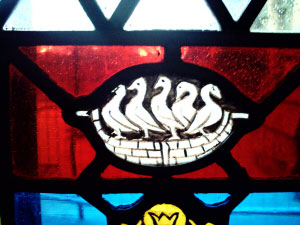
Saint
Werburga (detail). Chester Cathedral. Refectory - Eastern window
(1916):
Chester
(England). Kathedrale: Refektorium - Ostfenster (1916): Heilige Werburga
(Detail).
Sainte Wereburge
Abbesse d'Ely (+ 703)
On dit qu'elle fut
chargée par le roi Ethelred d'Angleterre de rétablir la discipline monastique
dans tous les couvents du royaume. Ce qu'elle aurait fait avec succès et, à sa
mort, son corps fut enterré dans l'un d'eux, à Chester.
À Threckingham dans le royaume
de Mercie en Angleterre, vers 700, le trépas de sainte Werburge, abbesse d’Ely,
qui fonda ou restaura plusieurs autres monastères, dont celui où elle mourut.
Selon son désir, elle fut inhumée à Hanbury.
Martyrologe romain
SOURCE : http://nominis.cef.fr/contenus/saint/560/Sainte-Wereburge.html

Chester
Cathedral. Shrine of saint Werburga, 1340

Chester
Cathedral. Shrine of saint Werburga, 1340

Chester
Cathedral. Shrine of saint Werburga, 1340
25 février : Sainte
Walburge, Abbesse
février 25, 2026
Une contemplative
consacrée à l’évangélisation
Walburge naquit vers l’an
710 dans le Wessex, dans le sud de l’Angleterre. Elle provenait d’une famille
noble anglo-saxonne et reçut son éducation dans un monastère, peut-être à
Wimborne. Comme ses frères, saint Willibald (700-787), premier Évêque
d’Eichstätt, et saint Winnebald (701-761), abbé du monastère bénédictin
de Heidenheim/Hahnenkamm, et comme son parent saint Boniface, elle se rendit en
Allemagne au VIIIᵉ siècle pour annoncer le message chrétien. Son action fut
déterminante dans l’organisation de la vie monastique féminine dans les pays de
langue germanique.
À la mort de Winnebald,
survenue en 761 à Heidenheim, Walburge prit la direction du monastère
bénédictin local en tant qu’abbesse. Celui-ci fut réorganisé selon le modèle
anglo-saxon comme un monastère double, comprenant une communauté masculine et
une communauté féminine.
C’est pourquoi elle est
considérée comme une femme consacrée qui, répondant à l’appel des missionnaires
anglais engagés dans l’évangélisation de l’Allemagne, sut gouverner avec
équilibre des communautés monastiques masculines et féminines, devenant un
exemple de guide spirituel et de dévouement évangélique.
Elle mourut le 25
février, probablement en 788 ou 790, et fut enterrée dans l’église abbatiale de
Heidenheim.
Quelques décennies après
sa mort, ses reliques furent transférées dans une église d’Eichstätt par
décision de l’Évêque local. Autour de cet événement naquirent des récits
édifiants sur l’efficacité de son intercession, qui contribuèrent à accroître
la dévotion à son égard.
Au cours du Moyen Âge,
son culte se diffusa encore davantage : souverains et Évêques effectuèrent
de nouveaux transferts de ses reliques et les consacrèrent à des églises et des
abbayes.

Also
known as
Vereburga
Werburga
Wereburge
Profile
Born a princess,
the daughter of King Wulfhere
of Mercia and his queen, Saint Ermenilda. Nun.
Spiritual student of Saint Etheldreda.
Worked for reform in female religious houses
throughout England.
Reported to read minds.
Born
in Staffordshire, England
3
February 699 of
natural causes
in England
Additional
Information
Book
of Saints, by the Monks of
Ramsgate
Book
of Saints and Friendly Beasts, by Abbie Farwell Brown
Lives
of the Saints, by Father Alban
Butler
Saints
of the Day, by Katherine Rabenstein
Virgin Saints and Martyrs, by Sabine Baring-Gould
books
Our Sunday Visitor’s Encyclopedia of Saints
Saints
and Their Attributes, by Helen Roeder
other
sites in english
Nobility
and Analogous Traditional Elites
images
sitios
en español
Martirologio Romano, 2001 edición
fonti
in italiano
MLA
Citation
“Saint Werburgh of Chester“. CatholicSaints.Info. 28 February 2024. Web. 27 August 2026. <https://catholicsaints.info/saint-werburgh-of-chester/>
SOURCE : https://catholicsaints.info/saint-werburgh-of-chester/

Chester Cathedral, Church of England cathedral and mother church of the Diocese of Chester, city of Chester, Cheshire,

Chester
Cathedral, Church of England cathedral and mother
church of the Diocese of Chester, city of Chester, Cheshire,
Article
(Wereberga) (Saint) (3 February)
(7th
century) The daughter of Wulfhere of Mercia and of Saint Ermenilda.
Her parents placed her under the care of her aunt Saint Etheldreda
of Ely. She lived a life of great sanctity and usefulness, and founded
various monasteries,
in one of which, that at Trentham, she died A.D. 699.
Her remains were
translated to Chester, where the Abbey Church erected
in her honour has become the present Chester Cathedral.
MLA
Citation
Monks of Ramsgate.
“Werburg”. Book of Saints, 1921. CatholicSaints.Info.
11 November 2017. Web. 28 August 2026.
<https://catholicsaints.info/book-of-saints-werburg/>
SOURCE : https://catholicsaints.info/book-of-saints-werburg/

St.
Werburgh's RC Church, Birkenhead
WERBURGA, ST.
Abbess; daughter of King
Wulfhere of Mercia and of St. Erminilda; d. Trentham (Threckingham,
Lincolnshire), England, 699. On her mother's side Werburga (Werburh, Werbyrgh)
was the granddaughter of St. Sexburga and grandniece of St. ethelreda, abbess
of ely. When she came to marriageable age, Werburga, who according to legend
was beautiful and much sought after, dismissed her suitors and after having
gained the consent of her reluctant father was received at Ely by Ethelreda.
After Wulfhere's death in 675, Werburga's mother entered the same monastery.
Wulfhere's brother,
Ethelred, who succeeded him as king, placed Werburga in charge of discipline in
the houses of religious women in Mercia. He apparently made over to her the
royal house at Weedon, which she made her headquarters. She supervised houses
in Hanbury, Staffordshire, and Trentham. She died in Trentham and at her own
request was buried in Hanbury. Her reputation for sanctity was such that during
the Danish invasions (c. 875) her still incorrupt body was transferred to
chester. Legend has it that on the journey her body disintegrated into ashes.
Her remains were enshrined at Chester where according to Cambden, Leofric (d.
1057) built a church in her honor. It is undoubtedly because her shrine early
became a place of pilgrimage that the many legends recorded by Goscelin
(fl. c. 1100), her first biographer, grew up about her. What remained
of her shrine, desecrated under henry viii, was converted into the throne of
the bishops of Chester, which still displays the carved images of Werburga's
royal ancestors.
Feast: Feb. 3; June 21
(translation, Chester).
Bibliography: Acta
Sanctorum (Paris 1863—) 1:388–394, life and legends by Goscelin. S.
Baring-Gould, Lives of the Saints, v. 2 (Edinburgh 1914) 52–56. A. Butler, The
Lives of the Saints, rev. ed. H. Thurston and D. Attwater (New
York 1956) 1:241–242. A. Zimmermann, Lexikon für Theologie und
Kirche, ed. M. Buchberger (Freiburg 1930–38) 10:825. j. tait, ed., The
Chartulary or Register of the Abbey of Saint Werburgh, Chester, 2 v.
(Manchester 1920–23) V.L. H. Bradshaw, The Life of Saint Werburge of
Chester, Ed. C. Horstmann (Millwood, NY 1988).
[M. E. Collins]
New Catholic Encyclopedia
SOURCE : https://www.encyclopedia.com/religion/encyclopedias-almanacs-transcripts-and-maps/werburga-st

St
Werburgh's parish church, Blackwell, Derbyshire, seen from the south
Werburga of Chester, OSB
V (AC)
(also known as Werburg,
Werebrurge, Werbyrgh)
Born at Stone,
Staffordshire, England; died at Threckingham, England, c. 690-700; feast of her
translation at Chester, June 21.
The patroness of Chester,
England, Saint Werburga, was born of a line of kings, being a daughter of
Wulfhere, King of Mercia. From her mother, the saintly Ermingilde (Ermenilda),
she learned as a child the Christian faith. By temperament she was pious and
virtuous, and her beauty attracted many admirers, among them a prince of the
West Saxons, who offered her rich gifts and made flattering proposals, and also
Werbode, a powerful knight of her father's court. But refusing all her suitors,
she secured, after much persuasion, her father's permission to enter a convent
(or she did so after her father's death).
When the time came, he
and his courtiers escorted her in great state to the abbey of Ely, where they
were greeted at the gates by her aunt, the royal abbess, Ethelreda, and her
nuns. Werburga fell upon her knees and asked that she might be received as a
novice, and to the chanting of the Te Deum they entered the cloister, where she
was stripped of her costly apparel, exchanged her coronet for a veil, and in a
rough habit began her new life.
She made good progress,
and after many years, at the request of her uncle, King Ethelred, was chosen to
superintend all the convents of his kingdom. This opened to her a large and
fruitful sphere of duty, and the religious houses under her care became models
of monastic discipline. Through the wealth and influence of her family she also
founded new convents at Trentham in Staffordshire, Hanbury near Tutbury, and
Weedon in Northamptonshire, and secured the interest of Ethelred in
establishing the collegiate Church of Saint John the Baptist in Chester, and in
giving land to Egwin for the great abbey of Evesham.
Werburga won many from
dissipation and vice, and God crowned her life with many blessings. Her work
was deeply rooted in prayer and discipline. She took but one meal daily and
that only of the coarsest food; she set before her the example of the desert
fathers; and she recited the whole of the Psalter daily upon her knees.
She lived to a ripe age,
and before her death she journeyed to all her convents, paying to each a
farewell visit; she then retired to Trentham (Threckingham in Lincolnshire),
where she died. She was buried in the monastery of Hanbury in Staffordshire.
Later, her remains were transferred with great ceremony in the presence of King
Coolred and many bishops to a costly shrine in Leicester, which attracted many
pilgrims.
In 875, for fear of the
Danes, her relics were removed to Chester. In 1095, they were translated within
Chester, where in the course of time a great church, now the cathedral, was
built over it, and where the remains of it may still be seen, carved with the
figures of her ancestors, the ancient kings of Mercia. On its four sides the
deep niches remain, where the pilgrims knelt, seeking healing, afterwards
receiving a metal token to show that they had visited her shrine. This final
translation was the occasion for Goselin to write her vita. The shrine was
destroyed under King Henry VIII, although part of its stone base survives.
Twelve ancient English churches were dedicated to her, including Hanbury and
Chester (Attwater, Benedictines, Encyclopedia, Farmer, Gill).
In art Saint Werburga
holds the abbey, while her crown lays at her feet. Sometimes there are wild
geese near her (Roeder), because, according to Goselin she restored one to life
(see below); however, the writer borrowed the story from his own vita of the
Flemish Saint Amelburga (Farmer). She is, of course, the patroness of Chester
(Roeder).
Like a cheerful gossip,
William of Malmesbury writes this tale of a local miracle wrought by Saint
Werburga:
"It was in the city
of Chester that the girl Werburga, daughter of Wulfhere, King of Mercia, and
Ermenilda . . . took her vows, and her goodness shone for many years. The story
of one miracle done by her I now shall tell, which made a great stir and was
long told about the countryside.
"She had a farm
outside the walls, where the wild geese would come and destroy the standing
corn in the fields. The stewart in charge of the farm took all shifts to drive
them off, but with small success. And so, when he came to wait upon his lady,
he added his complaint of them to the other tales he would tell her of the day.
"'Go,' said she,
'and shut them all into a house.' The countryman, dumbfounded at the oddness of
the command, thought that his lady was jesting: but finding her serious and
insistent, went back to the field where he had first spied the miscreants, and
bade them, speaking loud and clear, to do their lady's bidding and come after
him. Whereupon with one accord they gathered themselves into a flock, and
walking with down-bent necks after their enemy, were shut up under a roof. On
one of them, however, the rustic, with no thought of any to accuse him, made
bold to dine.
"At dawn came the
maid, and after scolding the birds for pillaging other people's property, bade
them take their flight. But the winged creatures knew that one of their company
was missing; nor did they lack wit to go circling round their lady's feet,
refusing to budge further, and complaining as best they could, to excite her
compassion. She, through God's revealing, and convinced that all this clamor
was not without cause, turned her gaze upon the steward, and divined the theft.
"She bade him gather
up the bones and bring them to her. And straightway, at a healing sign from the
girl's hand, skin and flesh began to come upon the bones, and feathers to
fledge upon the skin, till the living bird, at first with eager hop and soon
upon the wing, launched itself into the air. Nor were the others slow to follow
it, their numbers now complete, though first they made obeisance to their lady
and deliverer.
"And so the merits
of this maid are told at Chester, and her miracles extolled. Yet though she be
generous and swift to answer all men's prayers, yet most gracious is her
footfall among the women and boys, who pray as it might be to a neighbor and a
woman of their own countryside" (Malmesbury).
SOURCE : http://www.saintpatrickdc.org/ss/0203.shtml
St. Werburgh
(WEREBURGA,
WEREBURG, VERBOURG).
Benedictine, patroness
of Chester, Abbess of
Weedon, Trentham, Hanbury, Minster in Sheppy, and Ely, born in Staffordshire
early in the seventh century; died at Trentham, 3 February, 699 or 700. Her
mother was St. Ermenilda, daughter of Ercombert, King of Kent, and St.
Sexburga, and her father, Wulfhere, son of Penda the fiercest of the
Mercian kings. St. Werburgh thus united in her veins the blood of two very
different races: one fiercely cruel and pagan;
the other a type of gentle valour and Christian sanctity.
In her, likewise, centred the royal blood of all the chief Saxon kings, while
her father on the assassination of his elder brother Peada, who had been converted to Christianity,
succeeded to the largest kingdom of the heptarchy.
Whether Wulfhere was an obstinate pagan who
delayed his promised conversion, or a relapsed Christian,
is controverted, but the legend of the terrible and unnatural crime which has
been imputed to him by some writers must here be dismissed on the authority of
all earlier and contemporary chroniclers, as the Bollandists have
pointed out. The martyrs,
Sts. Wulfald and Ruffin, were not sons of Wulfhere and St. Ermenilda, nor
victims of that king's tyranny. Ermenilda at once won the hearts of her
subjects, and her zeal bore
fruit in the conversion of many of them, while her influence on the passionate
character of her husband changed him into a model Christian king.
Werburgh inherited her mother's temperament and gifts. On account of her beauty
and grace the princess was eagerly sought in marriage, chief among her suitors
being Werebode, a headstrong warrior, to whom Wulfhere was much indebted; but
the constancy of Werbrugh overcame all obstacles so that at length she obtained
her father's consent to enter the Abbey of Ely,
which had been founded by her great- aunt, St. Etheldra, and the fame of which
was widespread.
Wulfhere did not long
survive his daughter's consecration.
On his death, St. Ermenilda took the veil at Ely,
where she eventually succeeded her mother, St.
Sexburga, as abbess. Kenred,
Werburgh's brother, being a mere child at his father's death,
his uncle Ethelred succeeded to the throne. This king invited St. Werburgh to
assume the direction of all the monasteries of nuns in
his dominion, in order that she might bring them to that high level of
discipline and perfection which had so often edified him at Ely.
The saint with some difficulty consented to sacrifice the seclusion she prized,
and undertook the work of reforming the existing Mercian monasteries,
and of founding new ones which King Ethelred generously endowed, namely,
Trentham and Hanbury, in Staffordshire, and Weedon, in Northamptonshire. It had
been the privilege of St. Werburgh to be trained by saints;
at home by St. Chad (afterwards Bishop of Lichfield),
and by her mother, and in the cloister by
her aunt and grandmother. Her position worked no change in the humility which
had always characterized her, so that in devotedness to all committed to her
care she seemed rather the servant than the mistress. Her sole thought was to
excel her sisters in the practice of religious perfection. God rewarded
her childlike trust by many miracles,
which have made St. Werburgh one of the best known and loved of
the Saxon saints.
That of the stolen goose
appealed most to the popular imagination.
The story, immortalized in the iconography of St. Werburgh, relates that by a
simple command she banished a flock of wild geese that was working havoc in the
cornfields of Weedon, and that since then none of these birds has been seen in
those parts. She was also endowed with the gifts of prophecy and of reading the
secrets of hearts. knowing how devoted her different communities were to her
and how each would endeavour to secure the possession of her body after death,
she determined to forestall such pious rivalry
by choosing Hanbury as her place of burial. But the nuns of
the monastery of
Trentham determined to keep the remains. They not only refused to deliver them
to those who came from Hanbury, but they even locked up the coffin in a crypt and
set a guard to watch it. The people of Hanbury sent out anew a large party to
make good their claims. Reaching Trentham at midnight all the bolts and bars
yielded at their touch, while the guards were overpowered by sleep and knew not
that the coffin was being carried to Hanbury.
So numerous and
marvellous were the cures worked at the saint's tomb that
in 708 her body was solemnly translated
to a more conspicuous place in the church, in the presence of her
brother, Kenred,
who had now succeeded King Ethelred. In spite of having been nine years in
the tomb,
the body was intact. So great was the impression made on Kenred that
he resolved to resign his crown and followed in his sister's footsteps. In 875,
through fear of the Danes and in order to show greater honour to
the saint,
the body was removed to Chester.
The Church of St. Peter and St. Paul, on the site of the present cathedral of Chester,
was rededicated to St. Werburgh and St. Oswald, most probably in the reign of
Athelstan. The great Leofric, Earl of Mercia (who was likewise styled Earl
of Chester),
and his wife, Lady Godiva, repaired and enlarged the church, and in 1093, Hugh
Lupus, Earl of Chester,
richly endowed the abbey and
its church. By the instrumentality of this noble, Chester,
which had been in the hands of secular canons, became a great Benedictine abbey,
the name of St.
Anselm, then a monk at
Bee, being associated with this transformation. They abbey possessed
such immense influence and position that at the time of the suppression
under Henry
VIII the Earl of Derby was the abbot's seneschal.
In the vast wave of iconoclasm that swept over the country in that tyrant's
reign the cathedral was
sacked by apostates who
scattered St. Werburgh's relics.
Fragments of the shrine were used as the base of an episcopal throne. Many of
the labels and figures had been mutilated, and while restoring them the workmen
by mistake placed female heads
on male shoulders and vice versa. Only thirty of the original figures remain,
four having been lost. Late all these fragments were removed to the west end of
the south choir aisle, where they have been placed nearly in the original
position of the shrine, which is 10 feet high. St. Werburgh's feast is
celebrated 3 February.
Sources
Acta SS., I FEB.;
BRADSHAW, Metrical Holy Lyfe and History of Saynt Werburge, etc., ed.
HAWKINS (printed in facsimile for the Chetham Society, 1848); BUTLER, Lives
of the Saints (London, 1833); DUGDALE, Monasticon anglicanum (London,
1846); DUNBAR, Dict. of Saintly Women (London, 1905), s.v.;
HIATT, Chester, the Cathedral and See (London, 1898); LELAND, Collectanea (London,
1770); LEWIS, Topographical Dict. of England (London, 1831),
s.v.; Nova legenda Angliae, ed. HORSTMAN (Oxford, 1901); SPELMAN, Hist.
and Fate of Sacrilege (London, 1895); TANNER, Notitia Monast. (London,
1744). SISTER GERTRUDE CASANOVA.
Casanova,
Gertrude. "St. Werburgh." The Catholic
Encyclopedia. Vol. 15. New York: Robert Appleton
Company, 1912. 18 Dec.
2020 <http://www.newadvent.org/cathen/15588b.htm>.
Transcription. This
article was transcribed for New Advent by Michael T. Barrett. Dedicated to
Judy Van Horn.
Ecclesiastical
approbation. Nihil Obstat. October 1, 1912. Remy Lafort, S.T.D.,
Censor. Imprimatur. +John Cardinal Farley, Archbishop of New York.
Copyright © 2020 by Kevin
Knight. Dedicated to the Immaculate Heart of Mary.
SOURCE : https://www.newadvent.org/cathen/15588b.htm

St Werburgh's parish church, Lynmouth Road, Bristol
Butler’s
Lives of the Saints – Saint Wereburge, Virgin and Abbess, in England, Patroness
of Chester
Article
Seventh Age.
Saint Wereburge was
daughter of Wulfere, king of Mercia, by Saint Ermenilde, daughter of Ercombert,
king of Kent, and Saint Sexburge. In her was centred the royal blood of all the
chief Saxon kings; but her glory was the contempt of a vain world, even from
her cradle, on the pure motive of the love of God. She had three brothers,
Wulfade and Rufin, who died martyrs, and Kenred, who ended his life at Rome in
the odour of sanctity. Her father, Wulfere, resided near Stone, in
Staffordshire. His eldest brother Peada, had begun to plant the faith in
Mercia. Wulfere promised at his marriage to extirpate the remains of idolatry,
and was then a Christian; but worldly motives made him delay the performance of
his promise. Ermenilde endeavoured to soften the fierceness of his temper; but
she found it a far more easy task to dispose the minds of her tender nursery to
be faithful to divine grace; and, under her care, all her children grew up
fruitful plants in the garden of the saints. Wereburge excelled the rest in fervour
and discretion. She was humble, obedient, and meek; never failed of assisting
with her mother at the daily performance of the whole church office: besides
spending many hours on her knees in private devotion in her closet. She eagerly
listened to every instruction and exhortation of piety. At an age in which
youth is the fondest of recreations, pleasures, and vanities, she was always
grave, reserved, and mortified. She was a stranger to any joy but that which
the purity of her conscience afforded her; and in holy compunction bewailed
before God, without ceasing, her distance from him, and her other spiritual
miseries. She trembled at the thought of the least danger that could threaten
her purity; fasting and prayer were her delight, by which she endeavoured to
render her soul acceptable to her heavenly bridegroom. Her beauty and her
extraordinary qualifications, rendered more conspicuous by the greater lustre
of her virtue, drew to her many suitors for marriage. But a mountain might
sooner be moved than her resolution shaken. The prince of the West-Saxons
waited on her with rich presents; but she refused to accept them or listen to
his proposals, saying, she had chosen the Lord Jesus, the Redeemer of mankind,
for the Spouse of her soul, and had devoted herself to his service in the state
of her virginity. But her greatest victory was over the insidious attempts of
Werbode, a powerful wicked knight of her father’s court. The king was greatly
indebted to the valour and services of this knight for his temporal prosperity,
and entertained a particular affection for him. The knight, sensible of this,
and being passionately fond of Wereburge, made use of all his interest with the
king to obtain his consent to marry her, which was granted on condition he
could gain that of the royal virgin. Queen Ermenilde and her two sons, Wulfade
and Rufin, were grievously afflicted at the news. These two princes were then
upon their conversion to Christianity, and for this purpose resorted to the
cell of Saint Chad, bishop of Litchfield, under pretence of going a hunting;
for the saint resided in an hermitage, situate in a forest. By him they were
instructed in the faith, and baptized. Werbode, finding them an obstacle to his
design, contrived their murder, for which he is said to have moved the father
to give an order in a fit of passion, by showing him the young princes
returning from the bishop, and incensing him against them by slanders: for the
king was passionate, and had been likewise prevailed on by his perfidious
minister to countenance and favour idolatry. Werbode died miserably soon after,
and Wulfere no sooner heard that the murder was perpetrated, but, stung with
grief and remorse, he entered into himself, did great penance, and entirely
gave himself up to the advice of his queen and Saint Chad. He destroyed all the
idols, converted their temples into churches, founded the abbey of
Peterborough, and the priory of Stone, where the two martyrs were buried, and
exceedingly propagated the worship of the true God, by his zealous endeavours
and example.
Wereburge, seeing this
perfect change in the disposition of her father, was no longer afraid to
disclose to him her earnest desire of consecrating herself to God in a
religious state of life. Finding him averse, and much grieved at the proposal,
she pleaded her cause with so many tears, and urged the necessity of preparing
for death in so pathetic a manner, that her request was granted. Her father
even thanked God with great humility for so great a grace conferred on her,
though not without many tears which such a sacrifice cost him. He conducted her
in great state to Ely, attended by his whole court, and was met at the gate of
the monastery by the royal abbess Saint Audry, with her whole religious family
in procession, singing holy hymns to God. Wereburge, falling on her knees,
begged to be admitted in quality of a penitent. She obtained her request, and
Te Deum was sung. She went through the usual trials with great humility and
patience, and with joy exchanged her rich coronet, purple, silks, and gold, for
a poor veil and a coarse habit, and resigned herself into the hands of her
superior, to live only to Christ. King Wulfere, his three brothers, and
Egbright, or Egbert, king of Kent, and Adulph, king of the East-Angles, together
with the great lords of their respective states, were present at these her
solemn espousals with Christ, and were entertained by Wulfere with a royal
magnificence. The virgin here devoted herself to God with new fervour in all
her actions, and made the exercises of obedience, prayer, contemplation,
humility, and penance, her whole occupation, instead of that circle of vanities
and amusements which employ the slaves of the world. King Wulfere dying in 675,
was buried at Litchfield. Kenred, his son, being then too young to govern, his
brother Ethelred succeeded him. Saint Ermenilde was no sooner at liberty, but
she took the religious veil at Ely, under her mother, Saint Sexburge, at whose
death she was chosen third abbess, and was honoured in England among the saints
on the 13th of February. Her daughter, Saint Wereburge, at her uncle King
Ethelred’s persuasion, left Ely to charge herself, at his request, with the
superintendency of all the houses of religious women in his kingdom, that she
might establish in them the observance of the most exact monastic discipline.
By his liberality she founded those of Trentham in Staffordshire; of Hanbury,
near Tutbury, in the county of Stafford, (not in the county of Huntingdon, as
some mistake,) and of Wedon, one of the royal palaces in Northamptonshire. This
king also founded the collegiate church of Saint John Baptist, in the suburbs
of West-Chester, and gave to Saint Egwin the ground for the great abbey of
Evesham; and after having reigned twenty-nine years, embraced the monastic
state in his beloved monastery of Bardney, upon the river Witham, not far from
Lincoln, of which he was afterwards chosen abbot. He resigned his crown to
Kenred his nephew, brother to our saint, having been chosen king only on
account of the nonage of that prince. Kenred governed his realm with great
prudence and piety, making it his study, by all the means in his power, to
prevent and root out all manner of vice, and promote the knowledge and love of
God. After a reign of five years, he recommended his subjects to God, took
leave of them, to their inexpressible grief, left his crown to Coelred, his
uncle’s son, and making a pilgrimage to Rome, there put on the monastic habit
in 708, and persevered in great fervour till his happy death.
Saint Wereburge, both by
word and example, conducted to God the souls committed to her care. She was the
most perfect model of meekness, humility, patience, and purity. Besides the
church office, she recited every day the psalter on her knees, and, after
matins, remained in the church in prayer, either prostrate on the ground, or
kneeling till day-light, and often bathed in tears. She never took more than
one repast in the day, and read with wonderful delight the lives of the fathers
of the desert. She foretold her death, visited all places under her care, and
gave her last orders and exhortations. She prepared herself for her last hour
by ardent invitations of her heavenly bridegroom, and languishing aspirations
of divine love, in which she breathed forth her pure soul on the 3rd of
February, at Trentham, about the end of the seventh century. Her body, as she
had desired, was interred at Hanbury. Nine years after, in 708, it was taken up
in presence of King Coelred, his council, and many bishops, and being found
entire and uncorrupt, was laid in a costly shrine on the 21st of June. In 875
her body was still entire; when, for fear of the Danish pirates, who were
advanced as far as Repton, in the county of Derby, a royal seat (not Ripon, as
Guthrie mistakes) within six miles of Hanbury, (in the county of Stafford,) her
shrine was carried to West-Chester in the reign of King Alfred, who marrying
his daughter Elfleda to Ethelred, created him first earl of Mercia, after the
extinction of its kings. This valiant earl built and endowed with secular
canonries a stately church, as a repository for the relics of Saint Wereburge,
which afterwards became the cathedral. His lady rebuilt other churches, walled
in the city, and fortified it with a strong castle against the Welch. The great
kings, Athelstan and Edgar, devoutly visited and enriched the church of Saint
Wereburge. In the reign of Saint Edward the Confessor, Leofrick, earl of
Mercia, and his pious wife, Godithe, rebuilt many churches and monasteries in
those parts, founded the abbeys of Leonence, near Hereford, also that of
Coventry, which city this earl made free. At Chester they repaired the
collegiate church of Saint John, and, out of their singular devotion to Saint
Wereburge, rebuilt her minster in a most stately manner. William the Conqueror
gave to his kinsman, and most valiant knight, Hugh Lupus, the earldom of
Chester, with the sovereign dignity of a palatinate, on condition he should win
it. After having been thrice beaten and repulsed, he at last took the city, and
divided the conquered lands of the country among his followers. In 1093, he
removed the secular canons of Saint Wereburge, and in their stead placed monks
under an abbot, brought over from Bec in Normandy. Earl Richard, son and heir
to Lupus, going in pilgrimage to Saint Winefrid’s at Holywell, attributed to
the intercession of Saint Wereburge his preservation from an army of Welchmen,
who came with an intention to intercept him. In memory of which, his constable,
William, gave to her church the village of Newton, and founded the abbey of
Norton on the Dee, at the place where his army miraculously forded that great
river to the succour of his master, which place is still called Constable
Sondes, says Bradshaw. The same learned author relates, from the third book of
the Passionary of the Abbey, many miraculous cures of the sick, and
preservations of that city from the assaults of the Welch, Danes, and Scots,
and, in 1180, from a terrible fire, which threatened to consume the whole city,
but was suddenly extinguished when the monks carried in procession the shrine
of the virgin in devout prayer. Her body fell to dust soon after its
translation to Chester. These relics being scattered in the reign of Henry
VIII, her shrine was converted into the episcopal throne in the same church,
and remains in that condition to this day. This monument is of stone, ten feet
high, embellished with thirty curious antique images of kings of Mercia and
other princes, ancestors or relations of this saint. See Cooper’s remarks
on each.
MLA
Citation
Father Alban Butler.
“Saint Wereburge, Virgin and Abbess, in England, Patroness of Chester”. Lives of the Fathers, Martyrs, and Principal Saints, 1866. CatholicSaints.Info.
2 February 2013. Web. 18 December 2020.
<https://catholicsaints.info/butlers-lives-of-the-saints-saint-wereburge-virgin-and-abbess-in-england-patroness-of-chester/>

St
Werburgh's Church, Derby
Virgin
Saints and Martyrs – Saint Werburga
The words of Montalembert
deserve to be transcribed and re-read, so true are they as well as graceful.
“Nothing had more
astonished the Romans than the austere chastity of the German women; the
religious respect of the men for the partners of their labours and dangers, in
peace as well as in war; and the almost divine honours with which they
surrounded the priestesses or prophetesses, who sometimes presided at their
religious rites, and sometimes led them to combat against the violators of the
national soil. When the Roman world, undermined by corruption and imperial
despotism, fell to pieces like the arch of a cloaca, there is no better indication
of the difference between the debased subjects of the empire and their
conquerors, than that sanctity of conjugal and domestic ties, that energetic
family feeling, that worship of pure blood, which are founded upon the dignity
of woman, and respect for her modesty, no less than upon the proud independence
of man and the consciousness of personal dignity. It is by this special quality
that the barbarians showed themselves worthy of instilling a new life into the
West, and becoming the forerunners of the new Christian nations to which we all
owe our birth.
“Who does not recall
those Cimbri whom Marius had so much trouble in conquering, and whose women
rivalled the men in boldness and heroism? Those women, who had followed their
husbands to the war, gave the Romans a lesson in modesty and greatness of soul of
which the future tools of the tyrants and the Caesars were not worthy. They
would surrender only on the promise of the consul that their honour should be
protected, and that they should be given as slaves to the Vestals, thus putting
themselves under the protection of those whom they regarded as virgins and
priestesses. The great beginner of democratic dictatorship refused: upon which
they killed themselves and their children, generously preferring death to
shame.
“The Anglo-Saxons came
from the same districts, bathed by the waters of the Northern Sea, which had
been inhabited by the Cimbri, and showed themselves worthy of descent from
them, as much by the irresistible onslaught of the warriors as by the
indisputable power of their armies. No trace of the old Roman spirit which put
a wife in manu, in the hand of her husband – that is to say, under his feet –
is to be found among them. Woman is a person, and not a thing. She lives, she
speaks, she acts for herself, guaranteed against the least outrage by severe
penalties, and protected by universal respect. She inherits, she disposes of
her possessions – sometimes even she deliberates, she fights, she governs, like
the most proud and powerful of men. The influence of women has been nowhere
more effectual, more fully recognised, or more enduring than among the
Anglo-Saxons, and nowhere was it more legitimate or more happy.”
Britain had been invaded,
and subdued. From the wall of Antonine that connected the Firth of Forth with
the Clyde, to what was now to be called the English Channel, all the east coast
and centre of the island was occupied by the conquerors from Germany. The
Britons had been rolled back into the kingdoms of Strathclyde, Rheged, Wales,
and Cornwall and Devon.
The conquerors had
coalesced into three great kingdoms – Northumbria, Mercia, and Wessex.
From the island of Iona,
missionaries of the Irish Church had effected the conversion of the
Northumbrians. Augustine with his handful from Rome had introduced Christianity
into the little subject Kingdom of Kent. From Northumbria the disciples of Iona
penetrated Essex and made converts also there. But in Mercia Mid-England
paganism was supreme, and the terrible Penda made himself paramount from the
Thames and Wash to the Severn. The West Saxons were cowed.
But Saint Oswald, the
Northumbrian king, restored the older domination of Northumbria, only to fall
again. For thirty years Penda flung himself with fury against the Northern
kingdom, and devastated it with fire and sword. Towards the end of his long reign
he entrusted the government of the Mid-Angles to his son Peada, who married
Alcfleda, daughter of the Northumbrian king, and at the same time received
baptism from the hands of the Celtic bishop Finan.
Thus Christianity began
to infiltrate into Mid-England also from the North and from the Celtic Church;
and missionaries from Lindisfarne followed him into his principality.
The savage old pagan
Penda acquiesced – perhaps he thought it inevitable that England should become
Christian. The Britons to a man believed. All Northumbria had submitted to the
Cross; the conversion of the East Saxons and of Wessex was in full progress.
Penda raised no opposition, but poured forth the vials of his scorn upon such
as had been baptised, and who did not live up to their baptismal promises.
“Those who despise,” said he, “the laws of the God in whom they believe, are
despicable wretches.”
But, notwithstanding the
union by marriage between the families, the rivalry between Mercia and
Northumbria could not be allayed; it must be decided on the battlefield. It was
only when driven to desperation by the encroachments and insults of Penda, that
Oswy resolved to engage in a final conflict with the man who had defeated and
slain his two predecessors, Edwin and Oswald. During the thirteen years that
had elapsed since the overthrow of Oswald, Penda had periodically subjected
Northumbria to frightful devastations. Oswy, knowing his weakness, when the
eighty-year-old pagan had got as far north as Bamborough, entreated for peace,
and sent him a present of all the jewels and treasures of which he could
dispose. Penda set them aside roughly, resolved, so it was believed, to root
out and destroy the whole Northumbrian people. Then, in his despair, Oswy vowed
– should God strengthen his hand and lead him to victory – that he would give
his infant daughter to God and endow twelve monasteries. “Since the pagan will
not take our gifts,” he said, “let us offer them to One who will.”
The battle of Winwaed
resulted in the complete rout of the Mercians and their wholesale destruction,
and Penda himself fell.
For the moment the ruin
of Mercia seemed complete, and Oswy extended his supremacy over the whole of
it. For three years the Mercians endured this foreign rule; but in 659 they
surged up in revolt, drove the Northumbrian thanes from the land, and raised
Wulfhere, a younger son of Penda, to the throne.
Under the able arm of
this new king Mercia rose once more into a power even greater than that under
Penda. Oswy died in 670, and thenceforth no Northumbrian king made any attempt
to obtain the dominion over the Mid or Southern English.
During the three years
after the death of Penda, Oswy had poured missionaries into Mercia. Peada had
already brought the Irish monk Diuma with him, and he became bishop in Mercia.
He was followed by another Irishman, Ceolach, a disciple of Saint Columba. The
third bishop was Trumhere, a Northumbrian abbot, consecrated at Lindisfarne.
His successors, Jaruman and Ceadda, had also been ordained by the Scots.
In 658 Wulfhere had
married Ermenilda, daughter of Ercombert, King of Kent, and of his wife Saint
Sexburga. This was just before the revolt which raised him to the throne. He
does not seem to have been a Christian like his brother Peada, but to have felt
much like old Penda, his father.
By her he had four
children – Werburga, Ceonred, Rufinus, and Wulfhad.
Under a pious mother,
Werburga grew up in the nurture and admonition of the Lord; and from an early
age her great desire was to embrace the religious life, and spend her days in
the peace of the cloister. It was a lawless and godless time. Men were coarse
and cruel, the palace was a scene of drunkenness and riot, from which her
gentle spirit shrank. She is described as being very lovely and sweet in
manner. She daily assisted with her mother at Divine Service, and spent much of
her time in reading and in prayer.
When she came of age to
be married, her hand was sought by one Werebod, a thane about the court, but
she refused him.
Now we come to a story
about which some difficulties exist. In the twelfth century one Robert of
Swaffham wrote an account of the death of Rufinus and Wulfhad, sons of Wulfhere
and brothers of Saint Werburga. The authority is late, too late to be trusted,
as we do not know whence the writer drew his narrative.
According to this story,
when Rufinus and Wulfhad heard of Werebod’s proposal, they scouted it, and told
him to his face that he was not worthy to have her. Werebod dissembled his
mortification, and waited an opportunity for revenge. The princes were then at
Stone, in Staffordshire, where Wulfhere had a palace.
One day Wulfhad was out
hunting, when the stag he was pursuing brought him to the cell of Saint Ceadda
or Chad, who exhorted him to receive the faith of Christ and be baptised.
Wulfhad answered that he would do so if the stag he had been pursuing would
come of its own accord, with a rope round its neck, and present itself before
him. Saint Chad prayed, and the stag bounded through the bushes to the spot,
with the rope as Wulfhad desired. Saint Chad baptised the prince, and next
morning communicated him. Rufinus was led by his brother to receive holy
baptism, and when Werebod learned this, he told the king of it, and Wulfhere,
in a fit of fury, pursued his sons to the cell of Saint Chad, and killed them
with his own hands.
The story as it stands is
impossible. There is no early notice of it, so that it reposes on a late
tradition. Nevertheless, that there is a basis of truth is most probable, if
not certain. The Church of Kinver is dedicated to Saints Rufinus and Wulfhad,
and it stands under the Kefnvaur, the great red sandstone ridge on which are
earthworks where Wulfhere had one of his strongholds. This is probably the site
of the murder. That the two princes in their youthful pride scouted the suit of
Werebod and insulted him is likely enough. That they had received lively
impressions of reverence for Christianity from their mother is also very
probable. That they had placed themselves under instruction by Saint Chad, and
had been baptised by him, is also very likely. But that their father should
have killed them on that account is inadmissible. Werebod may have poisoned his
mind against his sons, and represented them as plotting against him with the
Northumbrian king and using Chad as an intermediary, and he may have goaded
Wulfhere into ordering their death on that account; or there may have been a
violent scene between them which ended in the king killing them; or, more
likely still, Werebod may himself have waylaid and assassinated them whilst out
hunting. It took very little among the Anglo-Saxons to transform any one who
died a violent death into a martyr; and when two royal princes had been killed,
some excuse for regarding them as witnesses to the faith was sought and
invented.
The bodies of the princes
were conveyed to Stone, so called because of a memorial set up over them by
Wulfhere, an inscribed pillar-stone; but, moved by compunction, he founded
there a religious house for women. Wulfhere himself was baptised, and gave his
consent to his daughter retiring from the world. He also founded the great
monastery of Medehamstead, afterwards Peterborough, as some expiation for his
crime.
Before this, Wulfhere had
been constantly engaged in extending the power of Mercia. He detached from Northumbria
all the district south of the Mersey, and with it got hold of Chester, of which
place in later times his daughter was to be regarded as patroness. He gained a
hold on the whole of the Severn valley and the Wye, our Herefordshire, over
which he set his brother Merewald as under-king. Then he fought the West Saxons
under Cenwalch in 661, and defeated them in a signal battle, and extended his
ravages into the heart of Wessex as far as Ashdown. Then he turned his arms
east along the Thames valley, and brought the East Saxons and London under his
sway. Still unsatisfied, he crossed the river into Surrey, subdued it, and
invaded Sussex and forced the King Ethelwalch to submit, and to receive
baptism. Werburga resolved to retire to Ely where her great-aunt Etheldreda was
abbess. Wulfhere and his court conducted her thither, in great state.
We cannot now see Ely in
anything like its ancient condition. Then the entire district from Cambridge to
the Wash was one broken sheet of water dotted with islets. In places there were
shallows where reeds grew dense, the islands were fringed with rushes and
willows. The vast mere was a haunt of innumerable wild birds, and the water
teemed with fishes. The vast plain of the fens – which is now in summer one sea
of golden corn, in winter a black dreary fallow cut up like a chess-board into
squares by dykes – was then a tangle of meres, rank growth of waterweeds and
copses of alders and grey poplars. The rivers Cam and Nen lost themselves in
the waste of waters. Trees torn up, fallen into the water, floated about,
formed natural rafts, lodged, and diverted what little current there was in the
streams.
Here and there poles had
been driven into the stiff clay that formed the bottom of the swamp,
cross-pieces had been tied to them, then platforms erected six, ten feet above
the surface of the water, and on these platforms huts had been constructed of
poles and rushes, in which lived families, their only means of communication
with each other and with the firm land being by boat. On the water and by the
water they lived, tilling little bits of land left dry in summer but submerged
in winter.
The islets were outcrops
of fertile land, natural parks, covered by the richest grass and stateliest
trees, swarming with deer and roe, goat and boar, as the water around swarmed
with otter and beaver, and with fowl of every feather and fish of every scale.
Of all these islets none
could compare with Ely, not, as has been supposed, named from the eels that
were found about it, but from the elves who were supposed to have chosen it for
their own and to dance in the moonlight on its greensward.
Better, purer beings than
elves, had taken possession of this enchanted isle – Saint Etheldreda and her
nuns; and it was through them that the wild fen-dwellers, those who lived on
platforms above the water, received the rudiments of the faith, and were ministered
to in their agues and rheumatic paralysis.
Etheldreda did not found
her monastery here till 673. As Wulfhere died in 675, he can have accompanied
his daughter there only very shortly after Etheldreda’s settlement in the
place. There is no stone anywhere near, every block that has been employed on
the glorious cathedral has been brought from a distance, mostly from Barwell,
in Northamptonshire.
Etheldreda constructed
her monastery and church entirely of wood. Great trunks had been split and
these split logs formed the sides of her church, and it was thatched with reeds
from the marshes. The king came by boat; the oars flashed in the sun, and the
water rippled as the vessels were driven through it to the landing stage.
Werburga, eager, stood looking forward to the lovely island that seemed to
float on the water; if, as is probable, she was born some time before Wulfhere
became king, she would then be between twenty-eight and thirty. At the
landing-stage was her great-aunt with her nuns, in black habits with white
veils; and no sooner had Werburga descended from the boat than they struck up
the Te Deum, and advanced, leading the way, singing, to their wooden church.
Now followed the usual
trials: Werburga was first stripped of her costly apparel, her coronet was
exchanged for a linen veil, purple and silks were replaced by a coarse woollen
habit, and she resigned herself into the hands of her superior, her great-aunt,
Saint Etheldreda.
We know the form of the
ceremonial, and the prayers used on such an occasion, but we do not know who
the bishop was who consecrated Werburga. She was led to the foot of the altar,
after the reading of the Gospel, and was then asked for two public engagements
which were indispensable to the validity of the act: in the first place, the
consent of her parents, and in the next her own promise of obedience to himself
and his successors. When this had been done he laid his hands upon her to bless
her and consecrate her to God. After prayers he placed the veil on her head,
saying, “Maiden, receive this veil, and mayest thou bear it stainless to the
tribunal of Christ before whom bends every knee in heaven and on earth.”
By the rules of the
Anglo-Saxon Church the taking of the irrevocable vows was not suffered till the
postulant had reached her twenty-sixth year, but we cannot be sure that this
rule prevailed so early. The Celtic Church allowed it at the age of twelve.
When Wulfhere died, then
Werburga’s mother came also to Ely, and on the death of Saint Etheldreda, in
679, her grandmother Sexburga, widow of Ercombert, king of Kent, became abbess,
and ruled till 699, when she died, whereupon Werburga’s mother succeeded. At
one time three generations of princesses of the blood of Hengest and Odin were
seen together in the peaceful isle of Ely, wearing the same monastic habit, and
bowing in prayer in the same wooden church. Werburga lived long and happily as
a simple nun under her grandmother’s and mother’s kindly rule and direction,
till, on her mother’s death, she was summoned to take the place of abbess.
It is very important for
us to understand what was the moving principle at this period which led to the
foundation of so many religious settlements. The Saxons and Angles had been a
people living in war, loving war, and regarding the cutting of throats and the
destruction by fire of every house and city as the highest vocation of a man.
But when they had occupied the greatest portion of Britain, and further, when
they had embraced Christianity, a change took place in their opinions. They came
to see that there was some charm in peace, and dignity in the cultivation of
the soil. But it was only after a struggle that they could stoop to take hold
of the plough and lay aside the spear. They could be brought to this only by
example, and it was this which the monks and nuns issuing from their own
princely, royal families showed them.
“In the monastic movement
of this time,” says Mr. Green, “two strangely contrasted impulses worked
together to change the very aspect of the new England and the new English
society. The one was the passion for solitude, the first outcome of the
religious impulse given by the conversion; a passion for communing apart with
themselves and with God which drove men into waste and woodland and desolate
fen. The other was the equally new passion for social life on the part of the
nation at large, the outcome of its settlement and well-doing on the conquered
soil, and yet more of the influence of the new religion, coming as it did from
the social civilisation of the older world, and insensibly drawing men together
by the very form of its worship and its belief. The sanctity of the monastic
settlements served in these early days of the new religion to ensure for them
peace and safety in the midst of whatever war or social trouble might be
disturbing the country about them; and the longing for a life of quiet
industry, which we see telling from this moment upon the older English longing
for war, drew men in crowds to these so-called monasteries.”
Wulfhere was succeeded in
675 by his brother Ethelred, a quiet, unambitious king, who devoted his
energies to the foundation of monasteries, dotting them about Mercia with the
object of softening and civilising a people that had the instincts of the
beasts of prey. He entrusted his niece Werburga with a sort of general
supremacy over all the nunneries in his kingdom. She visited them, regulated
them, and brought them into order, before her mother’s death and her own
appointment to the abbacy of Ely. Thus she resided for a while at the head of
the communities of Weedon, Trentham, and Hanbury.
One incident of her story
may be quoted.
It happened that a
shepherd at Weedon was being brutally maltreated by the steward. The daughter
of a king flew to the spot, threw herself between the overseer and the poor
wretch he was beating and kicking, and arrested his arm and thrust him back,
and held him from his victim, till his passion subsided, and he retired
shamefaced.
Werburga died at a ripe
age at Trentham, on February 3rd, 699.
Two centuries later, in
order to save her remains from the Danes, they were conveyed to Chester, where
there was a collegiate church that had been founded by her father at her
request. Her body was, however, laid in what is now the Cathedral.
– text and illustration
taken from Virgin Saints and Martyrs,
by Sabine Baring-Gould, F Anger, illustrator, published in New York, 1901
SOURCE : https://catholicsaints.info/virgin-saints-and-martyrs-saint-werburga/

St
Werburgh's pilgrimage badge, showing geese
The
Book of Saints and Friendly Beasts – Saint Werburgh and her Goose
I
Saint Werburgh was a
King’s daughter, a real princess, and very beautiful. But unlike most
princesses of the fairy tales, she cared nothing at all about princes or pretty
clothes or jewels, or about having a good time. Her only longing was to do good
and to make other people happy, and to grow good and wise herself, so that she
could do this all the better. So she studied and studied, worked and worked;
and she became a holy woman, an Abbess. And while she was still very young and
beautiful, she was given charge of a whole convent of nuns and school-girls not
much younger than herself, because she was so much wiser and better than any
one else in all the countryside.
But though Saint Werburgh
had grown so famous and so powerful, she still remained a simple, sweet girl.
All the country people loved her, for she was always eager to help them, to
cure the little sick children and to advise their fathers and mothers. She
never failed to answer the questions which puzzled them, and so she set their
poor troubled minds at ease. She was so wise that she knew how to make people
do what she knew to be right, even when they wanted to do wrong. And not only
human folk but animals felt the power of this young Saint. For she loved and
was kind to them also. She studied about them and grew to know their queer
habits and their animal way of thinking. And she learned their language, too.
Now when one loves a little creature very much and understands it well, one can
almost always make it do what one wishes – that is, if one wishes right.
For some time Saint
Werburgh had been interested in a flock of wild geese which came every day to
get their breakfast in the convent meadow, and to have a morning bath in the
pond beneath the window of her cell. She grew to watch until the big,
long-necked gray things with their short tails and clumsy feet settled with a
harsh “Honk!” in the grass. Then she loved to see the big ones waddle clumsily
about in search of dainties for the children, while the babies stood still,
flapping their wings and crying greedily till they were fed.
There was one goose which
was her favorite. He was the biggest of them all, fat and happy looking. He was
the leader and formed the point of the V in which a flock of wild geese always
flies. He was the first to alight in the meadow, and it was he who chose the
spot for their breakfast. Saint Werburgh named him Grayking, and she grew very
fond of him, although they had never spoken to one another.
Master Hugh was the
convent Steward, a big, surly fellow who did not love birds nor animals except
when they were served up for him to eat. Hugh also had seen the geese in the
meadow. But, instead of thinking how nice and funny they were, and how amusing
it was to watch them eat the worms and flop about in the water, he thought
only, “What a fine goose pie they would make!” And especially he looked at
Grayking, the plumpest and most tempting of them all, and smacked his lips.
“Oh, how I wish I had you in my frying-pan!” he said to himself.
Now it happened that
worms were rather scarce in the convent meadow that spring. It had been dry,
and the worms had crawled away to moister places. So Grayking and his followers
found it hard to get breakfast enough. One morning, Saint Werburgh looked in
vain for them in the usual spot. At first she was only surprised; but as she
waited and waited, and still they did not come, she began to feel much alarmed.
Just as she was going
down to her own dinner, the Steward, Hugh, appeared before her cap in hand and
bowing low. His fat face was puffed and red with hurrying up the convent hill,
and he looked angry.
“What is it, Master
Hugh?” asked Saint Werburgh in her gentle voice. “Have you not money enough to
buy to-morrow’s breakfast?” for it was his duty to pay the convent bills.
“Nay, Lady Abbess,” he
answered gruffly; “it is not lack of money that troubles me. It is abundance of
geese.”
“Geese! How? Why?”
exclaimed Saint Werburgh, startled. “What of geese, Master Hugh?”
“This of geese, Lady
Abbess,” he replied. “A flock of long-necked thieves have been in my
new-planted field of corn, and have stolen all that was to make my harvest.”
Saint Werburgh bit her lips.
“What geese were they?”
she faltered, though she guessed the truth.
“Whence the rascals come,
I know not,” he answered, “but this I know. They are the same which gather
every morning in the meadow yonder. I spied the leader, a fat, fine thief with
a black ring about his neck. It should be a noose, indeed, for hanging. I would
have them punished, Lady Abbess.”
“They shall be punished,
Master Hugh,” said Saint Werburgh firmly, and she went sadly up the stair to
her cell without tasting so much as a bit of bread for her dinner. For she was
sorry to find her friends such naughty birds, and she did not want to punish
them, especially Grayking. But she knew that she must do her duty.
When she had put on her
cloak and hood she went out into the courtyard behind the convent where there
were pens for keeping doves and chickens and little pigs. And standing beside
the largest of these pens Saint Werburgh made a strange cry, like the voice of
the geese themselves, – a cry which seemed to say, “Come here, Grayking’s
geese, with Grayking at the head!” And as she stood there waiting, the sky grew
black above her head with the shadowing of wings, and the honking of the geese
grew louder and nearer till they circled and lighted in a flock at her feet.
She saw that they looked
very plump and well-fed, and Grayking was the fattest of the flock. All she did
was to look at them steadily and reproachfully; but they came waddling
bashfully up to her and stood in a line before her with drooping heads. It
seemed as if something made them stay and listen to what she had to say,
although they would much rather fly away.
Then she talked to them
gently and told them how bad they were to steal corn and spoil the harvest. And
as she talked they grew to love her tender voice, even though it scolded them.
She cried bitterly as she took each one by the wings and shook him for his sins
and whipped him – not too severely. Tears stood in the round eyes of the geese
also, not because she hurt them, for she had hardly ruffled their thick
feathers; but because they were sorry to have pained the beautiful Saint. For
they saw that she loved them, and the more she punished them the better they
loved her. Last of all she punished Grayking. But when she had finished she
took him up in her arms and kissed him before putting him in the pen with the
other geese, where she meant to keep them in prison for a day and a night. Then
Grayking hung his head, and in his heart he promised that neither he nor his
followers should ever again steal anything, no matter how hungry they were. Now
Saint Werburgh read the thought in his heart and was glad, and she smiled as
she turned away. She was sorry to keep them in the cage, but she hoped it might
do them good. And she said to herself, “They shall have at least one good
breakfast of convent porridge before they go.”
Saint Werburgh trusted
Hugh, the Steward, for she did not yet know the wickedness of his heart. So she
told him how she had punished the geese for robbing him, and how she was sure
they would never do so any more. Then she bade him see that they had a
breakfast of convent porridge the next morning; and after that they should be
set free to go where they chose.
Hugh was not satisfied.
He thought the geese had not been punished enough. And he went away grumbling,
but not daring to say anything cross to the Lady Abbess who was the King’s
daughter.
II
Saint Werburgh was busy
all the rest of that day and early the next morning too, so she could not get
out again to see the prisoned geese. But when she went to her cell for the
morning rest after her work was done, she sat down by the window and looked out
smilingly, thinking to see her friend Grayking and the others taking their bath
in the meadow. But there were no geese to be seen! Werburgh’s face grew grave.
And even as she sat there wondering what had happened, she heard a prodigious
honking overhead, and a flock of geese came straggling down, not in the usual
trim V, but all unevenly and without a leader. Grayking was gone!
They fluttered about
crying and asking advice of one another, till they heard Saint Werburgh’s voice
calling them anxiously. Then with a cry of joy they flew straight up to her
window and began talking all together, trying to tell her what had happened.
“Grayking is gone!” they
said. “Grayking is stolen by the wicked Steward. Grayking was taken away when
we were set free, and we shall never see him again. What shall we do, dear
lady, without our leader?”
Saint Werburgh was
horrified to think that her dear Grayking might be in danger. Oh, how that
wicked Steward had deceived her! She began to feel angry. Then she turned to
the birds: “Dear geese,” she said earnestly, “you have promised me never to
steal again, have you not?” and they all honked “Yes!” “Then I will go and
question the Steward,” she continued, “and if he is guilty I will punish him
and make him bring Grayking back to you.”
The geese flew away
feeling somewhat comforted, and Saint Werburgh sent speedily for Master Hugh.
He came, looking much surprised, for he could not imagine what she wanted of
him. “Where is the gray goose with the black ring about his neck?” began Saint
Werburgh without any preface, looking at him keenly. He stammered and grew
confused. “I – I don’t know, Lady Abbess,” he faltered. He had not guessed that
she cared especially about the geese.
“Nay, you know well,”
said Saint Werburgh, “for I bade you feed them and set them free this morning.
But one is gone.”
“A fox must have stolen
it,” said he guiltily.
“Ay, a fox with black
hair and a red, fat face,” quoth Saint Werburgh sternly. “Do not tell me lies.
You have taken him, Master Hugh. I can read it in your heart.” Then he grew
weak and confessed.
“Ay, I have taken the
great gray goose,” he said faintly. “Was it so very wrong?”
“He was a friend of mine
and I love him dearly,” said Saint Werburgh. At these words the Steward turned
very pale indeed.
“I did not know,” he
gasped.
“Go and bring him to me,
then,” commanded the Saint, and pointed to the door. Master Hugh slunk out looking
very sick and miserable and horribly frightened. For the truth was that he had
been tempted by Grayking’s fatness. He had carried the goose home and made him
into a hot, juicy pie which he had eaten for that very morning’s breakfast. So
how could he bring the bird back to Saint Werburgh, no matter how sternly she
commanded?
All day long he hid in
the woods, not daring to let himself be seen by any one. For Saint Werburgh was
a King’s daughter; and if the King should learn what he had done to the pet of
the Lady Abbess, he might have Hugh himself punished by being baked into a pie
for the King’s hounds to eat.
But at night he could
bear it no longer. He heard the voice of Saint Werburgh calling his name very
softly from the convent, “Master Hugh, Master Hugh, come, bring me my goose!”
And just as the geese could not help coming when she called them, so he felt
that he must go, whether he would or no. He went into his pantry and took down
the remains of the great pie. He gathered up the bones of poor Grayking in a
little basket, and with chattering teeth and shaking limbs stole up to the
convent and knocked at the wicket gate.
Saint Werburgh was
waiting for him. “I knew you would come,” she said. “Have you brought my
goose?” Then silently and with trembling hands he took out the bones one by one
and laid them on the ground before Saint Werburgh. So he stood with bowed head
and knocking knees waiting to hear her pronounce his punishment.
“Oh, you wicked man!” she
said sadly. “You have killed my beautiful Grayking, who never did harm to any
one except to steal a little corn.”
“I did not know you loved
him, Lady,” faltered the man in self-defense.
“You ought to have known
it,” she returned; “you ought to have loved him yourself.”
“I did, Lady Abbess,”
confessed the man. “That was the trouble. I loved him too well – in a pie.”
“Oh, selfish, gluttonous
man!” she exclaimed in disgust. “Can you not see the beauty of a dear little
live creature till it is dead and fit only for your table? I shall have you
taught better. Henceforth you shall be made to study the lives and ways of all
things which live about the convent; and never again, for punishment, shall you
eat flesh of any bird or beast. We will see if you cannot be taught to love
them when they have ceased to mean Pie. Moreover, you shall be confined for two
days and two nights in the pen where I kept the geese. And porridge shall be
your only food the while. Go, Master Hugh.”
So the wicked Steward was
punished. But he learned his lesson; and after a little while he grew to love
the birds almost as well as Saint Werburgh herself.
But she had not yet
finished with Grayking. After Master Hugh had gone she bent over the pitiful
little pile of bones which was all that was left of that unlucky pie. A tear
fell upon them from her beautiful eyes; and kneeling down she touched them with
her white fingers, speaking softly the name of the bird whom she had loved.
“Grayking, arise,” she
said. And hardly had the words left her mouth when a strange thing happened.
The bones stirred, lifted themselves, and in a moment a glad “Honk!” sounded in
the air, and Grayking himself, black ring and all, stood ruffling his feathers
before her. She clasped him in her arms and kissed him again and again. Then
calling the rest of the flock by her strange power, she showed them their lost
leader restored as good as new.
What a happy flock of
geese flew honking away in an even V, with the handsomest, grayest, plumpest
goose in all the world at their head! And what an exciting story he had to tell
his mates! Surely, no other goose ever lived who could tell how it felt to be
made into pie, to be eaten and to have his bones picked clean by a greedy
Steward.
This is how Saint
Werburgh made lifelong friendship with a flock of big gray geese. And I dare say
even now in England one of their descendants may be found with a black ring
around his neck, the handsomest, grayest, plumpest goose in all the world. And
when he hears the name of Saint Werburgh, which has been handed down to him
from grandfather to grandson for twelve hundred years, he will give an
especially loud “Honk!” of praise.
Dear Saint Werburgh! One
would almost be willing to make a goose of himself if so he might see her
again, with all her feathered friends about her.
– from The Book of Saints and Friendly Beasts, by Abbie
Farwell Brown, illustrations by Fanny Y. Cory, 1900
SOURCE : https://catholicsaints.info/the-book-of-saints-and-friendly-beasts-saint-werburgh-and-her-goose/

Miracles
of St Werburgh, including the resurrection of the goose, depicted on a misericord at Chester Cathedral
Catholic
Truth Society of London – Saint Werburgh
(died 699)
About the beginning of
the seventh century, when England was earning for herself the most glorious of
her titles, that of “Island of the Saints,” a little girl was born in
Staffordshire who was to be the object of the love and devotion of her
countrymen, until the chill blast of heresy and unbelief swept away nearly all
that was best and holiest from the land. Vet even the Reformation was not able
entirely to extinguish the fame of Saint Werburgh: her name is still familiar
in some parts, and Chester Cathedral is dedicated to her.
She united in her veins
the blood of two widely different races: one the very essence of all that was
pagan, fierce and cruel; the other the perfection of all that was Christian,
holy, and gentle. Her father, Wulfhere, was the son of the famous or shall we
not rather say in famous? Penda, King of the Mercians, who, by the countless
victims of his unholy wars, swelled the white-robed army of martyrs, foremost
amongst whom were the five kings, Saint Oswald, Egric, Annas, Sigebert, and
Edwin. He is described by the chronicler as a man who breathed nothing but fury
and war, and loved to tread in ways stained with blood. At length, in 655, he
was slain in battle by King Oswin, the brother of Saint Oswald, who had
promised that if he got the victory he would consecrate his daughter to serve
God in perpetual virginity. Though the pagan army was thirty times as large as
the Christian, yet the pagans were cut to pieces and their leaders and generals
slain. King Oswin, mindful of his vow, offered his daughter to God in holy
religion; “and having spent three score years in our Lord’s service, the happy
virgin hastened to the embraces of the heavenly Bridegroom.” Penda was
succeeded by his son Peada, who became a Christian, but was assassinated three
years later; and Wulfhere then became the rightful heir to the largest kingdom
of the Heptarchy.
Saint Werburgh’s birth
happened most probably many years before Wulfhere’s accession, as the course of
the narrative will show. Wulfhere was married to the saintly and beautiful
Ermenilda, daughter to Erconbert, King of Kent, and of Sexburga his wife. The
latter was the daughter of the King Annas, of holy memory, who was slain by
Penda. Wulfhere and Ermenilda were strangely matched, for if Wulfhere had
inherited his father’s courage and military prowess, he had likewise inherited
his violent and cruel temper. We wonder how Saint Sexburga could have entrusted
her gentle young daughter to a man of such character, and, above all, to a
pagan; yet she may have foreseen that Ermenilda’s influence would at length
prevail, and that the leaven of her virtues would gradually impregnate the
whole country over which she would one day be queen. Besides, it was not the
first time in history that the “leopard was to lie down with the kid, and the
wolf with the lamb” (Isaias 11:6); a Patricius and a Monica, a Clovis and a
Clotilde come readily to mind.
Wulfhere and Ermenilda
had four children. Werburgh was the eldest and the only girl; the boys were
Ulfald, Rufifin, and Kenred: the last seems to have been much younger than the
others. Wulfhere probably did not interfere with the religion of his daughter,
since she was baptized and allowed openly to profess her faith. He no doubt
thought Christianity good enough for women: but with his sons it was a very
different matter. He wished them to be fond of war, to shed blood without
scruple, and to shrink from no means so long as they attained their end.
Ermenilda was therefore obliged to use her influence with the utmost tact, and
to instill Christian principles into them without allowing their father to
suspect what she was doing. Fortunately the children all inherited their
mother’s temperament and virtues; and she did not cease to water and tend with
the utmost care the tender plants entrusted to her, endeavouring to enkindle
within their hearts the undying flame of charity, and to impress on their minds
the imperishable truths which lead to life eternal.
Werburgh must very soon
have noticed the contrast between the violent nature of her pagan father and
the gentle sweetness of her Christian mother, since we read of her that she had
a serious thoughtfulness beyond her years, and took no pleasure in the usual
enjoyments of a child. Her chief delight was to sit by her mother’s side, to
learn from her to love God and His Saints, and to go with her to assist at the
celebration of Mass and the Divine Office, during which she would kneel the
whole time out of reverence. Divine Providence had constituted Ermenilda the
refuge of all in distress and the mother of the poor and needy; and in all her
exercises of charity she found a constant companion and a ready assistant in
Werburgh.
At that time Saint Chad,
afterwards Bishop of Lichfield, was living as a hermit in closest union with
God in a neighbouring forest. Saint Ermenilda desired very much that her sons
should have him for their master in the spiritual life now that they were
growing into man’s estate; yet she dreaded her husband’s violence if he should
come to know of her plan, and endeavoured to carry it out with the greatest
secrecy. It was therefore agreed that the two elder boys should go out on
pretence of hunting expeditions, and that in the course of the chase they
should slip away and seek out the hermit’s cell. This happened several times,
no one apparently suspecting anything; and their young hearts being inflamed by
Saint Chad’s instructions, they begged him not to defer their Baptism. At
length the Saint acceded to their request, and, pouring upon their heads the
regenerating water, washed their souls white in the Blood of the Lamb.
In the meanwhile Werburgh
had reached a marriageable age, and on account of her striking beauty and sweet
ways, she was eagerly sought after by suitors for her hand. But her chronicler
tells us that though her beauty of form made her exceedingly in request, the
still greater beauty of her mind caused her to care only for Him who is
beautiful above the sons of men; and that the vehement longing she had to taste
of His inestimable sweetness caused her heart to pant after Him as a thirsty
stag, heated in the chase, pants for water. She had therefore bound her
virginity by vow to Christ, and with angelic purity repulsed all suitors, God
Himself dwelling in her as sole Master of all her affections.
Among those who sought
her in marriage was a powerful nobleman named Werebode. Wulf here was greatly
indebted to this man, and was anxious to keep on good terms with him from
motives of policy as well as of gratitude. He therefore readily agreed to give
him his daughter, provided she herself would agree to the union. Werebode was a
headstrong, haughty man, unaccustomed to be thwarted, and with a very exalted
idea of his own attractions. When, therefore, Werburgh turned a deaf ear to his
proposals, he was stung to the quick, and being mad with passion, his love
speedily turned into hate. He understood that it was her religion which had
raised a barrier between them, and he determined to be revenged both on
Werburgh and her faith. He had noticed the mysterious disappearance of the two
young princes in the forest, and had secretly watched their interviews with
Saint Chad. He therefore formed the diabolical plan of com passing their ruin.
He sought out their
father and poured out a story full of slander and cunning about the deceit of
his sons, telling him how they had deserted the gods of their ancestors, Odin
and Thor, and had embraced the religion of the Crucified, and how they were
plotting to seize their father’s crown and kingdom to make it Christian too. It
was easy enough to rouse Wulfhere’s passionate nature, and Werebode so worked
upon his feelings that he became beside himself with rage. “Come,” said
Werebode, “and I will give you proof of my story;” and with that the two rode
off into the forest. It happened that at the moment they reached the hermit’s
cell the two boys were kneeling in the rude chapel, having but now received
holy Baptism from the hands of Saint Chad. Their souls were clad in the white
robe of innocence, a look of unearthly peace and joy lighted up their fair
faces. The King was exasperated, and, breaking in violently upon them, demanded
angrily of them to renounce their superstition and give up their foolery. But
no threats could move them, and the father in his fury bade Werebode murder his
own sons. Werebode had attained his end, but his triumph was to be short-lived,
for soon after he perished miserably.
We may well imagine the
grief, not unmingled with joy, of the holy mother at the news of this
martyrdom: grief at the terrible crime committed by her husband, and at the
loss of two who were dearer to her than life, yet joy and gratitude for the
martyrs death which had won for her sons an immortal crown. Taking Werburgh
with her, Ermenilda set out for the hermitage, and there found Saint Chad
keeping vigil by the precious relics. Ulfald and Ruffin lay locked in each
other’s embrace, apparently wrapped in a deep sleep, for no trace remained on
their countenances to tell of the violence of their death; rather the smile
which lingered there betokened the souls awakening to gaze for ever on the
Master for whom their lives had been sacrificed. Tenderly and reverently Saint
Chad, assisted by Ermenilda and Werburgh, laid them in their last
resting-place, which was soon to become so favourite a place of pilgrimage.
Then the mother and daughter retraced their steps homewards with heavy hearts,
not knowing what to expect, scarce knowing what to hope for. But the dying
prayer of the sons for their father had not been in vain; the blood which they
had shed cried for mercy and -not for vengeance, and even Wulf here’s hard
nature could not withstand the flood of grace which the little martyrs obtained
for him. Remorse, keen and deep, had taken possession of him, and he bitterly
deplored the fearful result of his passion. Humbled and crushed, he listened
the more readily to the words of hope spoken to him by Ermenilda and Werburgh,
and consented to go to Saint Chad to confess his sin and be instructed by him
in the faith for which his sons had died. Finally he embraced Christianity, and
with the sacred waters of Baptism expiated his crime. He caused a priory built
of stone to be erected on the scene of the martyrdom which has given its name
to the place (Stone, Staffordshire); and he undertook to finish and amply endow
the monastery of Peterborough, begun by his brother, as a lasting monument of
his sin and repentance.
From henceforth he was a
changed man, and when in 658 he was proclaimed King of the Mercians, three
years after his brother’s death, he utterly rooted out of his kingdom “the
pagan worship of devils,” commanding the name of Christ to be preached
everywhere and many churches to be built. William of Malmesbury says of him
“that at his first accession to the throne, to the end that he might not
deceive the expectation of his subjects, he spared no diligence, study, or
labour to show himself a good prince who sought the profit and happiness of his
kingdom. Moreover that by his favour and counte nance he earnestly advanced the
Christian faith, then gasping for life as being but a little before brought in
by his brother.” Capgrave, speaking of Saint Ermenilda, says that she was so
zealous in promoting the Christian faith that by her persuasion, kindness, and
holy example, the rude and perverse nation of the Mercians was brought to
submit to the sweet yoke of Christ; while her husband Wulfhere, complying with
her desires, assisted her in extirpating idolatrous superstition and filling
the kingdom with churches and priests.
Meanwhile, however,
Werburgh sighed after a higher and better life than that of the Court. Both she
and her mother despised riches; the gold, precious stones, and embroidered
robes which form the paraphernalia of royalty were far more burdensome than
honourable to them, and while at times of regal state they were obliged to
submit to be thus bedecked, they grieved to feel that they were still held
prisoners by such vanity.
At length Werburgh
obtained her father’s consent to follow the call which had so long sounded in
her heart to give herself unreservedly to God and His service in a monastery.
The fame of the Abbey of Ely in Cambridgeshire, which had been founded by her
great-aunt, the beautiful and gifted Etheldreda, or Audry, was already
widespread; but to Werburgh it must have been well known, for besides her aunt,
her grandmother had recently taken the veil there. Her grandfather, King
Ercombert, died in 664, and Harpsfield tells us how her grandmother, Saint
Sexburga, “like a bird which had been a long time enclosed in a cage gladly
escaped out of it, and divesting herself of all her royal ornaments and marks
of royal pomp and pride betook herself first to the Abbey of Sheppey, and later
to the society of holy virgins in the city of Ely governed by her sister the
most glorious virgin Etheldreda.” It was, then, most natural that Ely should
have been singled out as the future home of Werburgh, and that Wulfhere and
Ermenilda should have chosen to entrust their daughter to those who by every
title would love and cherish her.
Wulfhere himself escorted
Werburgh to Ely, accompanied by a large suite of noblemen and retainers. Upon
their arrival they were met in state at the great door of the Abbey by the
Abbess and her nuns, Saint Chad, now Bishop of Lichfield, and a number of
ecclesiastics. The reception of such a postulant was no small event in the
annals of the Monastery, for Wulfhere was the most powerful of all the kings of
the Heptarchy, and, besides, there was not one who did not marvel at the
generosity of the fierce old Saxon monarch, subdued by penance, and bowed down
by the remem brance of a crime forgiven but not forgotten, who thus sacrificed
to God his only daughter in all her youth and beauty. Werburgh fell upon her
knees before the com munity, and with great humility asked to be received as a
postulant into the Abbey. Her request being granted, she was led in procession
into the church. When she had laid aside her royal robes, Saint Chad cut off
her hair, and gave her the coarse habit of religion in exchange for her rich
garments, and the veil of virginity in place of the royal diadem. The “Te Deum”
was then sung, and the humble novice, resigning herself entirely into the hands
of her superiors, sought to divest herself interiorly, as well as exteriorly,
of all that savoured of the world, and to hasten as a pilgrim to her eternal
home. Wulfhere left her with many tears, yet found it in his heart to thank God
for choosing his daughter for His bride; and how much he valued the honour thus
bestowed was showed when he returned the follow ing year to be present at her
Profession. He invited for the occasion the King” of Kent, the King of the East
Angles, with all the great lords of their kingdoms, and his own three brothers
with their retinues. All these he entertained with a magnificence suited to
such an occasion as that of the Espousals of the Son of God with his daughter.
Wulfhere did not long
survive Werburgh’s consecration: he had reigned seventeen years, and by his
zeal for the faith in the latter years of his life had rendered himself beloved
both to God and man, when in 675 he was transferred, as we may hope, from an
earthly to an eternal kingdom. His widow, while she mourned his loss, rejoiced
to be able to cut the chain which bound her to the world, and to embrace the
religious state after which she had so long sighed; and she subjected herself
to the sweet yoke of Christ together with her daughter in the Monastery of Ely.
Here she lived unweariedly in all holiness, giving to the nuns an example of
every virtue. Mother and daughter vied with one another in humility, each
desiring, to be subject to the other: the mother, honouring the virginity of
her daughter, would have Werburgh be the first, while Werburgh naturally
desired to give place to her mother. The chronicler gives this account of Saint
Werburgh’s life and conduct at this period:’s Her only diligence and solicitude
was employed in avoiding all things which might displease the eyes of her
heavenly Bridegroom, for whose love she despised gold, jewels, rich attire, and
all other vanities admired by the world. All her thoughts were busied in this
one thing, how she might excel her religious sisters in observing silence,
abstinence, watchings, devout reading, and prayers. Which holy design having
compassed, insomuch as she was as far exalted above them in these and all other
virtues as in the nobleness of her descent, yet she thought so meanly of
herself, and was so free from any arrogance or pride, that she showed herself
always ready and willing to obey all, and cheerfully undertook the vilest
offices, among which a charitable care of the poor and needy, to whom she was a
pious and tender mother, took the principal place. In a word, through the whole
course of her life her conversation was such as showed that though her body
moved on earth yet her mind was always fixed in heaven.”
In 679 Werburgh and the
nuns of Ely suffered a grievous loss in the death of their Abbess Saint
Etheldreda, after she had governed the monastery for seven years, and had been
to her spiritual children a model of piety and virtue. Venerable Bede relates
of her that she rarely eat more than once a day except on great solemnities or
when her infirmities forced her to do otherwise; and that from midnight Matins
until break of day she would remain in the church absorbed in prayer. He
specially mentions her mortification in wearing coarse woollen garments, and in
denying herself the luxury of warm baths to which she had been accustomed. She
suffered much before her death from a very painful tumour on her neck; but she
rejoiced in this humiliating infirmity, saying to those who compassionated her,
“I know that I am justly pained in my neck because when I was a young maid I
wore about my neck weighty chains of jewels; therefore God in His mercy has
thus punished me, that the fierce heat and redness of the swelling in my neck
may satisfy for my former pride and levity.”
Saint Werburgh’s grandmother
Sexburga was unanimously chosen to succeed her sister in the abbatial office.
For fifteen years she had lived under religious discipline and had been all the
more assiduous in her devotions and rigorous in her mortifications in that she
had come so late in life to the school of perfection. But if she had come late
to religion it was from no lack of desire on her part, for her biographer tells
us that God thought fit to delay the execution of her aspirations that she
might, with no less merit and far more labour in her condition as a sovereign,
afford examples of virtue to all her subjects. This she had performed in an
admirable manner, being, as Capgrave describes her, “a most reverenced mother
to the great ones and a kind patroness to the poor. The former observed her as
a princess, the latter as a mother, those venerated her majesty, these admired
her humility. To the nobles she was awful, and to meaner persons seemed equal;
to all she was amiable and to all venerable, rarely seen in throngs but frequent
in churches.” After twenty-five years of married life, her husband, King
Ercombert, died, and she retired to the Isle of Shoppy in Kent, where she had
founded a monastery for nuns known as “the Minster,” and there received the
veil from Theodore, Archbishop of Canterbury. As foundress, the reins of
government were at once given into her hands, but she longed to live in
subjection as a simple nun; so no sooner did she hear of the foundation made at
Ely by Saint Etheldreda, her younger sister, than she determined to go and join
her. Therefore assembling the nuns about eighty in number she thus addressed
them:’s Farewell, my daughters; I leave you Jesus for your protector, the
angels for your companions, and I have chosen one among you to be superior in
my place. As for me, I go to the place of my birth to live under the rule of my
sister Etheldreda, and to share her labours on earth that I may likewise share
her crown in heaven.” She was received with the greatest possible joy by her
sister, and though her senior in age and probably also in experience of
religious life, she lived for some years in perfect obedience and submission to
her, until such time as God, having called Etheldreda to Himself, laid once
again upon her shoulders the burden of government. In her office as Abbess she
was more than ever watchful over herself and more fervent in her prayers,
remember ing that she had to give an account to Clod of many souls besides her
own.
After she had governed
her monastery to the great edification and contentment of all for sixteen
years, mindful of the great sanctity of her sister, she desired to translate
the body of the latter to a more honourable resting-place, and to substitute a
coffin of stone for the simple wooden one in which Etheldreda had been laid to
rest. A fitting church had now been built to receive the body of the venerable
foundress, and all that remained was to procure suitable stone for the coffin.
Venerable Bede tells how “Saint Sexburga commanded certain of the monks from
the adjoining monastery to search out a stone commodious for that purpose. Now,
the region of Ely being all encompassed with rivers and marshes afforded no
such stones of a convenient largeness. They therefore, taking boat, went to a
certain city not far distant which lay desolate, where presently near the walls
they found a coffin of white marble elegantly made and fitly covered with a
stone of the same. Perceiving hereby that God had prospered their journey, they
with great joy and thankfulness brought the coffin to the Monastery. Now when
the sepulchre was opened and the sacred body of the holy virgin and Spouse of
Christ discovered, it was found as free from any corruption as if she had been
buried the same day. The religious virgins therefore washed the Saint’s body,
and putting new vestments on it, carried it into the church, placing it in the
marble coffin lately brought thither. And, which was very strange, the said
coffin was found so exactly fit for the holy virgin’s body, as if it had been
made on purpose for her. The place likewise of the head, which was distinctly
framed, did properly suit with the measure of the virgin’s head.” On account of
this striking testimony to Saint Etheldreda’s heavenly glory, her feast is
usually kept in October on the anniversary of her translation, and not on June
23rd, the day of her death.
After Saint Sexburga had
performed this office of devotion and love for her sister, she herself was
called to her reward at a very advanced age, and her daughter, Saint Ermenilda,
Werburgh’s mother, was, on account of her great humility and other virtues,
chosen by her religious sisters, to whom she had so endeared herself, to be
their mother and mistress. How long they enjoyed her gentle government is not
known, for though she is mentioned in the Martyrology on February 13th, no year
for her death is given. Saint Ermenilda had one other sister, Earthongata, who,
as a young girl, desiring to lead a perfect life, went over to a French
monastery with two of her aunts, because at that time there were very few
religious houses in England. Of her, Venerable Bede writes as follows:’s Many
things are related very miraculous concerning Earthongata, but we will only
mention briefly her death and the wonders succeeding it. When the day
approached on which she was to be called out of this world to eternal
happiness, she went about the monastery visiting the cells of the religious
virgins, especially such as were more ancient and eminent for piety, to whose
prayers she humbly recommended herself, not concealing from them that she was
taught by revelation that her departure was at hand. Now on the same night at
break of day, she passed from the darkness of this world to the heavenly light.
Many of the monks whose lodgings were adjoining the monastery report that they
heard distinctly a melody of angels singing and a noise as it were of a great
multitude entering the monastery. Whereupon going forth to see what the matter
was, they saw a wonderful great light from heaven, in which that holy soul,
when delivered from the prison of her body, was conducted to eternal joys.
Three days after her burial they, having a mind to take up the stone which
covered her sepulchre and raise it higher, as they were busy about this, a
sweet odour of so wonderful a fragrance exhaled from beneath, that it seemed to
the religious men and sisters there assisting as if a cellar full of precious
balm was then opened.”
But to return to Saint
Werburgh. At the death of her father her brother Kenred was still so young that
her uncle Ethelred succeeded to the kingdom. He had a very high opinion of the
sanctity and intellectual capacity of his niece, and was most anxious that all
the convents in Mercia should be placed under her direction in order that she
might establish in them that perfection of religious discipline which to his
great edification he had often witnessed at Ely. This, at length, the Saint
consented to undertake, though it must have cost her dearly to leave her mother
and the peaceful seclusion she had enjoyed at Ely, to devote herself to the
welfare of strangers and to the work of reform, which so often proves a
fruitless task. But she did not hesitate before sacrifice, and it was
sufficient to her that God had made known to her His will by means of her
superiors; while He so blessed her efforts as to make them bring forth fruit a
hundredfold. Her uncle, eager in every way to further her pious designs,
enabled her to found three new monasteries, one at Trentham, one at Hanbury in
Staffordshire, and one at Weedon in Northamptonshire; the latter was a royal
palace which Ethelred placed at her disposal.
Werburgh’s exalted
position in no wise changed the humility which characterized her, and she
seemed to be rather the servant than the mistress of those over whom she ruled,
putting herself on the same footing as the very least of her subjects, and
seeking as far as was compatible with her office to take the lowest place. She
carried all her daughters in her heart, loving them as though they were indeed
her own children, and teaching them virtue by her own example. She possessed in
their fulness the spirit of peace, kindness, joy, and love. She was cheerful in
tribulation, overcoming all difficulties by faith, and rising above earthly
trials by fixing her heart on heaven. She preferred fasting to feasting,
watching to resting, holy reading and prayer to recreation and dissipation. In
God she possessed all things: He was her consolation in sorrow, her counsel in
doubt, her patience in trial, her abundance in poverty, her food in fasting, her
medicine in sickness.
It was no wonder, says
her biographer, that her spiritual children rendered her such ready obedience
and loving service, for even the irrational creatures obeyed her. There is a
famous legend illustrative of this, which is related even by Protestant
historians. It happened that when she was at Weedon, just before the harvest,
the cornfields were being greatly injured by a flock of wild geese which the
steward had done his best to drive away, but in vain. At last he came to complain
of the matter to his mistress. Werburgh, with childlike trust in God, told the
steward quite simply to go and call the geese and shut them up in the great
barn. The man looked at her amazed, thinking that she must be speak ing in
jest, and began muttering to himself about the absurdity of such an order. How
could he possibly be expected to confine birds in a barn who had wings to carry
them to heaven? “Of course,” he grumbled, “the instant I come up they will all
be off like the wind!” But Werburgh urged the command, telling him again to
call them in her name and put them into confinement. He dared not disobey any
longer; so off he went to the fields where, as usual, the geese were feasting
on the corn. “Go all of you to my mistress!” he shouted incredulously; when, to
his surprise, they meekly collected and waddled off in front of him like so
many naughty children. Not one of the flock raised a wing, and all were
imprisoned in the barn to await Werburgh s pleasure. That night after Matins
she prolonged her prayer as usual till after daylight, when very early she was
roused from her meditation by a tremendous cackling which came from the geese
who were getting tired of their confinement. The Saint, who was kindness itself
to all God’s creatures, went to set them free, telling them she did so on
condition they were never seen again in the place. But one of the farm boys had
during the night stolen one of the birds, intending to kill and eat it; the
result was that the flock settled on the roof of the church making a dreadful
noise, as though demanding restitution of the missing bird. Werburgh either
guessed what had happened, or knew by inspiration, for she found the culprit
and bade him release his captive. The boy went off much ashamed at being thus
convicted, and restored the missing goose. The Saint then cried out, “Bless the
Lord, all ye birds of the air,” upon which they flew off without more ado, and
no bird of that kind was ever after seen in those parts. “Rightly indeed,”
exclaims her biographer,’s did the birds obey one who had always obeyed their
Creator with such zeal and love.”
How lowly she was in her
own eyes, and how pleasing in the sight of God is known by a miracle of a very
touching character. Among the labourers on the Abbey estate was one who was
remarkable for his holiness of life. His name was Alnotus. One day some
trifling oversight on his part roused the steward’s indignation to such a
degree that he completely lost his temper and began beating the poor fellow
most unmercifully. At that moment Werburgh arrived on the scene, and was
naturally much distressed to see the ungovernable temper of her steward thus
venting itself on an innocent man. In her eagerness to bring him to his senses,
she threw herself at his feet crying, “Spare an innocent man who is far more
pleasing than we are to God who seeth all things.” The steward, however, who
was evidently beside himself, paid no attention; upon which Werburgh turned to
God for help, and immediately the offender fell paralyzed to the ground. It was
now his turn to cry for mercy, acknowledging his sin with many tears. Werburgh,
satisfied with his contrition, restored him to his natural strength. The
labourer afterwards became a hermit in the forest of Stow, not far from Weedon,
where he was martyred by robbers; and how acceptable he was to God was
afterwards proved by miracles.
God deigned to show how
much Werburgh was beloved by Him and how much power her prayers had with Him,
by making her the instrument of many miraculous cures upon the sick and maimed.
He also endued her with a spirit of prophecy and the power of discerning
spirits and reading the secrets of hearts. At length she felt that her useful
and holy life was soon to have an end, and she thought well to prepare her
daughters for her departure and arrange about the place of her burial. She knew
well how devoted the nuns were to her; each of her monasteries had some claim
on her motherly heart; each would have had her always with them, and she was
perfectly aware of the pious rivalry which would arise among them as to the
possession of her body after death. She therefore determined to forestall all
dispute by choosing Hanbury as her last resting-place, probably because it was
the largest, and the nearest to Ely her first monastic home. She gave strict
orders on this point, saying that no matter where she died her body was to be
taken to Hanbury.
On 3 February 699, the
day so long desired arrived a day which was to put an end to all the toils and
pains of earth and admit her to eternal joys: the day of eternity which was to
dissipate all shadows and cause the light of eternal glory to shine upon her.
Her blessed soul exulted when the summons came to invite her to the
Marriage-Feast; she rejoiced to leave exile for home, a prison for a kingdom, captivity
for liberty, the tyranny of this world for the Spouse whom she loved and longed
for. She died at Trentham, and her soul was carried by Angels to heaven and
admitted among the company of glorious virgins who follow the Lamb
whithersoever He goeth,and who sing the canticle which none but themselves can
sing. God willed that she should end her earthly course in this Monastery in
order that by a wonderful prodigy He might bear witness to her holiness. The
nuns of Trentham, setting aside the last wishes of their Abbess with regard to
her burial-place, determined to keep her precious remains among them at any
cost. To those who came from Hanbury to claim the body, they gave a decided
refusal, and even went so far as to lock up the coffin in a crypt and set a
guard over it. However, the people of Hanbury were equally determined not to be
done out of their treasure; and when they heard of the nuns refusal to give it
up, a whole party of them set out to insist on their claim. They reached
Trentham in the middle of the night, and, by an interposition of Providence,
all the bolts and bars of the Abbey and its crypt opened at their touch. They
found the guards over powered by a deep sleep, and without any opposition were
able to carry off the coffin in triumph to Hanbury. Here the holy virgin was
buried with great solemnity, while the many miracles which followed clearly
showed that her soul reigned in heaven, and that her prayers were powerfully
pleading for the people whom she had left in exile to mourn her loss. “In this
place,” writes a contemporary, “sick persons recover health, sight is restored
to the blind, hearing to the dumb, the lepers are cleansed, and persons
oppressed with several other diseases do there praise God for their recovery.”
On account of these
marvels, devotion to the Saint very naturally increased, and the people felt
that so great a light should not be buried under a bushel, but should be placed
in a conspicuous place in a suitable shrine, where the pilgrims could pay their
devotions in a proper manner. They therefore referred the matter to Kenred,
King of the Mercians, and younger brother to Saint Werburgh. In 704, Ethelred,
Kenred’s uncle, had abdicated in favour of his nephew, and retired into the
Monastery of Bardeney, in Lincolnshire. He had grown more and more tired of
government and the burden of secular affairs. The death of his niece had made
him even more eager to devote all his energies to the sanctification of his
soul and the acquirement of an eternal crown. He therefore handed over his
kingdom to Kenred, and became a simple monk in the Benedictine Abbey that he
himself had founded, where, after ten years of exem plary life, he died the
death of a Saint. Kenred readily acceded to the request of the people to
provide a fitting shrine for his sister, and in 708 he came in person with a
great concourse of ecclesiastics and nobles to assist at the translation of the
relics. As the body had rested for nine years in the earth, no one expected to
find any thing but dry bones; what was then their amazement when the holy
virgin’s body appeared absolutely intact, as though she had but now fallen into
a refreshing sleep. Her garments were as spotless and unruffled as though
freshly placed upon her, and when the Celebrant, in the sight of all present,
removed the veil from her face and a gentle flush was seen upon it like that of
a summer rose, a great shout of admiration and thanksgiving rent the air, and
the whole crowd praised God for His wonderful works. The priests, clad in the
richest vestments, reverently raised her upon their shoulders and carried her
to the shrine prepared for her, where as a beacon of light she continued to
shed her lustre over her faithful people.
This miracle made a very
deep impression on King Kenred, and deepened the desire he had for some time
cherished of following in the footsteps of his sister, who had despised all the
kingdoms of the earth as dirt in comparison with the pearl of great price which
she had obtained. Another occurrence of a less pleasing but not less impressive
nature fixed his resolution. Among his suite there was a knight to whom he was
greatly attached, who had fought side by side with him in many a battle, and
had vied with him in performing deeds of valour, for both were endowed with
great courage. Unfortunately, however, this knight was utterly reckless with
regard to his soul, and many and many a time Kenred, who was always good and
loyal to his God, had exhorted him to mend his ways and attend to the affairs
of his soul as faithfully as he did to those of his King. The knight took the
admonitions in good part, but always put off his conversion, saying he would
have plenty of time to attend to his soul when he was old and past work. But he
was struck down by the plague in the prime and vigour of his manhood, and had
most terrible sufferings, doubtless sent him by God to recall him to a better
mind. When the King heard of his condition, he hastened to his bedside and
begged him with all possible earnestness not to delay his confession and to make
his peace with God before it was too late. To these charitable entreaties the
sick man only replied that nothing would induce him to go to confession until
he got better, for his comrades would laugh at him for being chicken-hearted
and doing that for fear of death which he had not been willing to do when in
health.
The following day the
King determined to renew his efforts to save that unhappy soul, but the grace
of God had knocked and knocked in vain, and now the miser able man was a prey
to the most frightful despair. He told the King that during the night two
beautiful young men had entered his room carrying a book in which were written
all the good actions he had ever done, but their number was very small, and
none of them were of very great merit. Then a host of demons burst into the
room carrying a book of enormous size and weight, containing all the crimes,
evil words, and sinful thoughts of his life. The chief of these demons turned
to the young men and exclaimed, “Why stay you here, for you must see that this
soul is ours?” “It is true,” they answered; “take him and make him partaker of
your damnation.” “Thus,” says Venerable Bede, “died this unhappy, despairing
man, and now being for all eternity tormented, he practises without any fruit
repentance which he neglected to do in his lifetime, when a short penance might
have procured his pardon.”
This terrible death made
Kenred resolved to secure his own salvation at any cost; and, knowing by
experience the very grave dangers and temptations which beset the life of a
monarch, he felt inspired to follow the example of his uncle Ethelred, and
abdicate in favour of his cousin, after a short reign of five years, during
which he had administered his kingdom with great piety and justice. In order
that his sacrifice might be the more complete, he resolved to go right away
from a country where his name was famous and where he would always be treated
with honour. Early in the year 709 he put on pilgrim’s garb, and in company of
two others set out for Rome, to end his days as a humble suppliant at the Tomb
of the Apostles. He was accompanied by King Ina, of the East Saxons, who in all
the bloom of his youth left his home, his betrothed, his kingdom, and a people
who idolized him, to become the servant of the King of kings. These two arrived
in Rome after travelling the whole distance on foot, the journey taking the
best part of a year. There, kneeling before the Confession of Saint Peter’s,
they were tonsured and clothed with the monastic habit by the reigning Pontiff
Constantius; and after living for some years in the practice of prayer and
penance they died in the odour of sanctity and found awaiting them in Paradise
the crowns which they had sacrificed in this world that they might wear them
for all eternity in the next.
For many a long year
Saint Werburgh rested peacefully among her faithful daughters at Hanbury; but
in 875 England was invaded by the Danes, and it was deemed prudent to carry her
precious body to a more secure haven than Hanbury, which was in imminent peril
of being ravaged by the pagan invaders. Under no other circumstances would the
people of Hanbury have consented to part with their treasure, but they were
terrified at the approach of the Danes and dreaded desecration for the still
incorrupt body of the Saint. King Alfred the Great was then reigning, and he
had given his daughter in marriage to Ethelred, whom he had constituted first
Earl of Mercia, the race of its kings being extinct. This pious nobleman had
Saint Werburgh’s shrine conveyed with the utmost care to Chester, where he
caused a fine church to be built for its reception, which he amply endowed, and
placed canons there to guard the holy virgin’s body. This church afterwards
became the cathedral of the city, and the inhabitants honoured Saint Werburgh
as their own special patroness. The Saxon kings and nobles continued to pay
homage to the Saint, to visit her shrine, and to enrich it with costly gifts.
In the reign of Saint Edward the Confessor the Minster was rebuilt on a more
magnificent scale by Leofric, another Earl of Mercia, and a most devoted client
of the Saint. On the accession of William the Conqueror, Chester was offered to
him by his cousin, Hugh Lupus, on condition that he should fairly win it from
the Saxons, which after three attempts he succeeded in doing. He it was who, in
1093, replaced the secular canons, entrusted with the care of Saint Werburgh’s
shrine, by a community of Benedictine monks from Bee. It was for the settling
and ordering of this monastery that Saint Anselm was first invited to England.
Saint Werburgh seems to have kept a watchful care over the city committed to
her, and the people of Chester ascribed to her intercession their almost
miraculous escapes from the ravages of Danes, Scots, and Welsh. Many sick still
sought and found health at her shrine, and in 1180, a terrible fire having
broken out in Chester which threatened to destroy the city, the inhabitants
fled to her for protection; upon which the monks, taking up her body, carried
it in procession to meet the raging flames, which immediately subsided, and the
town was saved.
In the course of ages her
body fell to dust, probably that it might be saved from pollution, when, in the
reign of Henry VIII, the reformers sacked the cathedral and scattered her relics.
The shell of her tomb may still be seen in Chester Cathedral. It is ten feet
high and embellished with thirty quaint old bas-reliefs of the kings of Mercia
and others of her ancestors.
But if her relics are
lost to us the fragrance of her virtues still lingers around the land of her
birth. While she continues to intercede for her countrymen in heaven, the
example of her life is still before us to teach us to live like her a life of
faith; to remind us that we have not here a lasting city, but seek one that is
to come; and finally to encourage us so to detach our hearts from this world
that after her we may be brought with gladness and rejoicing into the temple of
the King.
– text taken from the
booklet Saint Weburgh, author
unknown, published by the Catholic Truth Society of London
SOURCE : https://catholicsaints.info/catholic-truth-society-of-london-saint-werburgh/

Santa Vereburga Badessa
650 – 700 circa
Emblema: Bastone
pastorale, Oca
Martirologio
Romano: A Chester nella Mercia in Inghilterra, santa Verburga, badessa di
Ely, fondatrice di vari monasteri.
La santa principessa
Vereburga (o Wereburga) discendeva da una famiglia di santi. Venerate come tali
erano infatti sua madre Ermenilda (Ermengilda), sua zia Ercongota, sua nonna
materna Sexburga, le sorelle di quest’ultima Eteldreda, Etelburga e Vitburga,
nonché la sorellastra Santa Setrida. Eteldreda, Sexburga ed Ermenilda si
susseguiro nella carica di badessa di Ely e la tradizione vuole che dopo di
esse giunse il turno per Vereburga nel ricoprire il prestigioso incarico.
Nata nel 650 dal re
Wulfhere di Mercia e da Santa Ermenilda, nel 675 alla morte del padre Vereburga
rinunciò ai fasti della corte e si ritirò nell’abbazia di Ely. Il fratello del
defunto, Etelredo, succedutogli al trono, fece tornare la nipote per affidarle
un gruppo di case per religiose nelle contee dell’Inghilterra centrale, con lo
specifico compito di introdurvi una più rigida osservanza. Tra questi monasteri
figuravano quello di Weedon nel Nothamptonshire, già abitazione reale che la
santa poi trasformò in monastero, Trentham nel Lincolnshire, ove ella morì, ed
Hanbury nello Staffordshire, in cui desiderò essere sepolta. Le reliquei di
Vereburga furono poi traslate a Chester, assai probabilmente per salvarle dalla
profanazione durante le invasioni danesi. Qui il suo sacrario, posto nella
cattedrale cittadina, divenne frequentatissima meta di pellegrinaggi.
Santa Vereburga deve gran
parte della sua popolarità ad una romanzesca leggenda, secondo la quale la
bella principessa respinse le avances di non pochi corteggiatori onde
salvaguardare la sua consacrazione al Signore. A Werbod, suo principale
ammiratore, il sovrano concesse la figlia in sposa, purché egli riuscisse ad
ottenere il libero consenso da parte di Vereburga. Il pretendente era però
pagano e quindi già la regina Ermenilda ed i suoi figli si opposero
all’eventualità di questa unione, suscitando però in tal modo la sua ira. I principi
erano stati educati da San Chad, vescovo di Lichfield, che viveva in una
foresta e dava perciò loro la possibilità di mascherare le visite rivoltegli
con delle spedizioni di caccia. Werbod denunciò questo fatto al re e
questi non esitò a farli uccidere. Anche Werbod, però, ben presto andò incontro
ad una miserabile morte ed il sovrano, roso dal rimorso, mutò in positivo i
suoi rapporti con la sua santa consorte e con San Chad. Questi eventi
incoraggiarono Vereburga nel suo proposito e chiese allora il permesso al padre
di poter entrare ad Ely.
Un’altra antica leggenda
spiega il perchè l’oca sia divenuto l’emblema principale di questa santa: un
gruppo di oche selvatiche devasto i raccolti di Weedon e Vereburga le fece
catturare, ma dopo che nottetempo un servo ne uccise una e la cucinò, la santa
la riportò in vita. Lo stormo di animali poi fuggì, senza più tornare a
rovinare i raccolti. Le reliquie di Santa Vereburga vennero nuovamente
traslate nella cattedrale di Chester nel 1095, cioè pressapoco quando Goscelino
scrisse la sua Vita, ove questa leggenda è raffigurata su una mensola
d’appoggio di un sedile del coro: al centro vi è la santa con un bastone
pastorale in mano, mentre un servo le porge un’oca; sulla destra un uomo
confessa di aver rubato l’animale, mentre a sinistra si scorgono le altre oche
rinchiuse. Questa storiella in realtà era già stata utilizzata dallo stesso
autore nella Vita di Santa Amalberga.
Santa Vereburga è
festeggiata dal Martyrologium Romanum al 3 febbraioi, presumibilmente data
della morte, mentre il 21 giugno ricorre l’anniversario della traslazione delle
reliquie nella cattedrale di Chester, della quale è protettrice. Attrazione per
numerosi pellegrini, il suo sacraio fu però distrutto sotto il regno di Edoardi
VIII d’Inghilterra, nel contesto della Riforma Protestante e della nascita
della Chiesa Anglicana.
Autore: Fabio
Arduino


.jpg?utm_source=en.wikipedia.org&utm_campaign=imageinfo&utm_content=original)


.JPG)