Saint
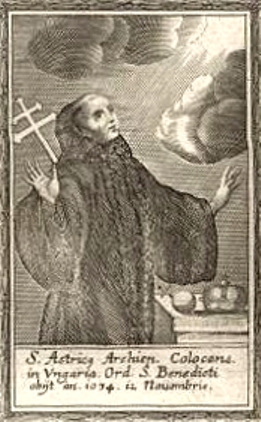
Astrik with Saint Stephen's crown (painting in Kalocsa, 18th century)
Gemälde: Erzbischof Asztrik, 18. Jahrhundert, im Archiv der Erzdiözese Kalocsa
Saint Astère
Moine bénédictin (+ 1053)
ou Astrik.
Moine bénédictin, il
était originaire de la Bohême. Il accompagna saint Adalbert
de Prague dans l'évangélisation de son pays. Devenu premier abbé du
monastère de Brevnov, il dut s'enfuir vers la Hongrie où il fut nommé premier
abbé du monastère de Pannonhalma que le roi saint Etienne avait
fondé. Saint Etienne l'envoya à Rome pour obtenir du pape Sylvestre II la
reconnaissance du nouveau royaume de Hongrie et saint Astère lui apporta la
couronne royale.
SOURCE : http://nominis.cef.fr/contenus/saint/202/Saint-Astere.html

St. Stephen's Basilica. St. Stephen's
crowning relief. It depicts: St. Stephen kneels, Astrik abbot's makes the crown
on his head, on left two soldiers with mace stand; to right is a priest with a
dual stick Shepherd Cross and two nuns. Recessed relief. Subtitle: "
MEMORY OF ST. STEPPHEN YEAR. 1938. - Square Szent István, Lipótváros neighbourhood, Budapest District V.
Szent István-bazilika elején a
bejárattól balra a falon a 'Szent István megkoronázása dombormű' (Jálics Ernő,
1938). - Budapest V. kerület, Lipótváros városrész,
Szent István tér.
Ces grands saints qui ont
fait la Hongrie
Camille Dalmas - publié
le 28/04/23
Du 28 au 30 avril
prochain, le pape François se rendra en voyage apostolique en Hongrie, nation
chrétienne dans laquelle foi et racines sont intimement liées. Bâti au Xe et
XIe siècle par une impressionnante "sainte dynastie" de martyrs,
rois, princesses et évêques, ce pays entretient avec une ferveur particulière
la glorieuse mémoire des ses grands saints nationaux.
1 Les saints hongrois
avant la Hongrie
Saint Quirin de Siscia
(inconnue-309) : le premier martyr
Natif de Sabarie - aujourd'hui
Szombathely - au début du IVe siècle, Quirin est un martyr chrétien qui refuse
d'abjurer sa foi pendant les persécutions de Dioclétien en 309. Torturé par le
gouverneur de Pannonie (province hongroise de l'Empire), il est jeté dans la
rivière Sibaris, une pierre de moulin attachée aux pieds. Son corps est
recueilli et conservé par les chrétiens locaux. Il sera ensuite transféré à
Rome afin de le préserver des actes de vandalisme pendant les grandes
invasions. Sa dépouille repose aujourd'hui dans la basilique Saint-Sébastien
sur la Via Appia.
Saint Martin de Tours
(316-397) : l'évangélisateur de la Gaule
Originaire de Sabarie en
Pannonie (actuelle Hongrie) au début du IVe siècle, ce fils de magistrat
militaire de l'Empire romain devient légionnaire et est affecté en Gaule.
Attiré par le christianisme malgré une éducation païenne, Martin connaît une conversion mystique célèbre, un
jour sur une route. Croisant un pauvre, il décide de découper sa cape de
légionnaire pour lui en donner la moitié. Le Christ lui apparaît ensuite revêtu
du pan de manteau qu'il a offert. Brusquement converti, il continue néanmoins à
se battre dans l'armée pendant deux ans puis se fait baptiser et commence à
mener une vie d'ermite. Réputé pour sa sainteté de son vivant, il est élu
évêque de Tours en 371. Grand évangélisateur, il est vénéré en France, mais
aussi dans son pays d'origine, particulièrement dans sa ville de naissance,
Szombathely .
2 Les saints fondateurs
de la Hongrie
Saint Étienne : le
premier roi
Fils d'un prince païen de
Hongrie du Xe siècle, Vajk rencontre l'évêque Adalbert de Prague qui le baptise
et le renomme Étienne. En 996, Étienne épouse Gisèle, sœur de l'empereur
Henri II. Après la mort de son père, Étienne prend sa suite et fonde, en l'an
mil, le royaume de Hongrie. Il est pour cela sacré avec une couronne envoyée
par le pape Sylvestre II, qui lui accorde le titre de "roi
apostolique". Pendant quarante ans, il organise son royaume et
l'évangélisera en faisant venir des missionnaires et en bâtissant de nombreuses
églises. Considéré comme un modèle de suzerain catholique, il est le saint
patron de la Hongrie. Il est enterré dans la basilique d'Albe Royale –
aujourd'hui Székesfehérvar.
Bienheureuse Gisèle de
Hongrie : une pieuse reine
Soeur de l'empereur Henri
II, Gisèle reçoit une éducation catholique très poussée dans la cour ducale de
Bavière. Alors que leurs parents se sont longtemps affrontés, Gisèle est mariée
à Étienne, prince hongrois, qui fonde le royaume de Hongrie en l'an mil, avec
la bénédiction du pape et de l'empereur. Cette union est possible du fait de la
conversion d'Étienne. Elle aurait donné de nombreux enfants à son mari,
notamment saint Émeric de Hongrie. Veuve en 1038, le successeur d'Étienne,
Pierre, se comporte en tyran, et la pousse à l'exil en Bavière, où elle se
retire dans l'abbaye bénédictine de Passau.
Saint Émeric (1007-1031)
: prince-moine de Hongrie
Fils cadet du roi Étienne
et de la reine Gisèle, Émeric a pour précepteur saint Gérard, alors moine
bénédictin et futur évêque de Csanad. Son frère aîné étant mort en bas âge,
Émeric est préparé à la royauté avec soin, et mène une existence particulièrement
pieuse, voire ascétique, au sein de l'abbaye de Pannonhalma, se liant d'amitié
avec saint Maur. Cependant, son avenir royal le force à être marié à une
princesse byzantine, et son père tente de le faire succéder à l'empereur Henri
II en Bavière à la mort de ce dernier en 1024. Bien que plus proche parent, sa
cause ne triomphe pas et c'est Conrad II qui récupère le trône et entre en
guerre contre la Hongrie : Émeric participe au combat et son armée l'emporte,
mais le prince renonce à ses prétentions à la couronne bavaroise. Il ne régnera
jamais : en 1301, il meurt tué par un sanglier lors d'une chasse. Il est
enterré dans la basilique d'Albe Royale – aujourd'hui Székesfehérvar – à côté
de son père.
Saint Astrik, Saint
Aldebert et Saint Maur : les premiers évêques bénédictins
Originaires de Bohème,
Astrik et Adalbert visitent la Hongrie dans le but de l'évangéliser. Adalbert
fonde le monastère de Bresnov, à Prague, et Astrik l'abbaye de Pannonhalma,
première institution ecclésiale de Hongrie dont il devient le premier abbé.
Devenu évêque de Prague, Aldebert baptiste Étienne de Hongrie, puis part en
missionnaire en Prusse orientale, où il est assassiné par une foule païenne.
Nommé évêque d'Esztergom – et donc premier évêque du pays. Moine de l'abbaye de
Pannonhalma, Maur est un des soutiens spirituels les plus importants du roi
Étienne. Devenu abbé de Pannonhalma, il est nommé évêque de Pécs, où il fait
construire la première cathédrale, en 1036. Cet intellectuel et grand spirituel
se distingue par son action pour la paix dans son pays, traversé alors par de
très violents conflits.
Saint Gérard de Csanád,
saint Bőd et saint Bystrík de Nitra : premiers martyrs de Hongrie
Né à Venise à la fin du
Xe siècle, Gérard Sagredo devient moine bénédictin et pour aller en Terre
Sainte passe par la Hongrie où le roi Étienne lui ordonne de devenir le
précepteur de son fils Émeric. D'abord ermite, il est nommé évêque du diocèse
de Csanád, fondé par le roi, et se voit confier la tâche d'évangéliser une
population intégralement païenne. Avec trois autres évêques, Bőd, Bystrik et
Beneta, il est attaqué par une foule païenne. Bőd et Gérard meurent en
martyrs, lynchés à coups de lance et de pierres sur la colline de Buda alors
qu'ils se rendent au couronnement du roi André en 1046. Bystrik et Beneta
réussissent à fuir en traversant le Danube. Sur l'autre rive, à Pest, Bystrik
est tué d'un coup d'épée, et seul Beneta s'en sort, sauvé par les armées du roi
André
3 Une sainte dynastie
Saint Ladislas, pieux
chevalier
Ladislas Ier est roi de
Hongrie de 1077 à 1095. Consolidant le royaume et élargissant ses frontières,
il est un modèle de chevalerie, et impose une législation très stricte contre
toutes les infractions contre la foi chrétienne. On lui doit la création du
diocèse de Zagreb en actuelle Croatie, qu'il conquiert, Très apprécié par son
peuple, dont il s'était voulu le juste protecteur, il meurt auréolé d'un grand
prestige. Trois ans de deuil sont respectés en Hongrie.
Vénérable Irène de
Hongrie : impératrice à Byzance
Fille du roi Ladislas, la
jeune Piroska est mariée très jeune à Jean II Comnène, fils de l'empereur
byzantin Alexis pour des raisons politiques. Forcée de se convertir à l'Église
orthodoxe et est rebaptisée Irène. Elle devient impératrice après l'accession
au trône de son époux, mais ne s'occupe pas de politique. Très pieuse, comme
son mari, elle fonde beaucoup de monastères. Cette mère de huit enfants meurt
en 1134. Elle est reconnue comme sainte par les orthodoxes et comme vénérable
par les catholiques.
Sainte Elisabeth de
Hongrie : suzeraine franciscaine
Fille du roi André II de
Hongrie, suzerain du début du XIIIe siècle, Elisabeth est fiancée dès ses quatre ans au landgrave
de Thuringe, Louis IV, qu'elle épouse à 14 ans. Ce couple très uni, malgré la
nature politique de leur union, a trois enfants, et vit dans un grand
dénuement, ayant embrassé les principes de la vie franciscaine. La légende
raconte qu'en apportant du pain aux pauvres en le cachant sous son manteau,
elle est arrêtée par son mari. Elle lui déclare qu'elle cache sous son manteau
des roses, et, ouvrant le pan de son vêtement, laisse miraculeusement
apparaître une pluie de pétales de fleurs. Son attitude ascétique scandalise
ses proches, mais elle tient bon, malgré le décès de son époux de la peste qui
en fait une veuve à seulement vingt ans. Refusant de se remarier, elle est
chassée par sa belle-famille et est recueillie par un oncle évêque. Elle
consacre alors toute sa vie aux pauvres, s'inspirant du Tiers-Ordre
franciscain, et entraînant autour d'elle d'autres femmes, et meurt à 24 ans.
Marguerite de Hongrie :
princesse dominicaine
Nièce d'Elisabeth de
Hongrie, la princesse Marguerite est la fille du roi Béla IV, suzerain hongrois
qui doit affronter les invasions mongoles au moment de sa naissance. Ses
parents font alors vœu de la consacrer à Dieu pour sauver leur pays, et elle
est éduquée dans un monastère dominicain à Veszprem. Développant une profonde
foi, elle refuse alors tout mariage que lui propose ses parents et embrasse
contre leur avis la pauvreté de la vie des Dominicains, distribuant toutes les
richesses qu'on lui donne. Elle s'illustre comme une ascèse sévère et comme une
mystique. Pie XII la canonise en 1943.
Sainte Kinga de Pologne :
patronne de la Pologne
Aussi appelée Cunégonde,
Kinga est la sœur de Marguerite de Hongrie. Contre son gré, elle est mariée au
roi de Pologne Boleslas V. Elle qui rêve, comme Marguerite, de rejoindre les
ordres, refuse de consommer son mariage : son mari accepte, et décide de vivre
avec elle une vie pauvre et chaste. Très aimée du peuple Polonais, elle vend
tout ce qu'elle possède à la mort de son époux et rejoint le monastère des
Clarisses qu'elle a fondé à Stary Sacz. Jean-Paul II la canonise en 1999.
4 Un saint des Guerres de
religion
Saint Étienne Pongracz :
martyr de Košice
Né à la fin du XVIe
siècle en Roumanie dans une famille hongroise, Étienne Pongracz entre dans la
Compagnie de Jésus et est formé à Prague, Ljubljana puis en Autriche, où il est
ordonné. Envoyé pour enseigner à proximité de Košice, en actuelle Slovaquie, il
est arrêté avec deux autres compagnons, le jésuite Melchior Grodziecki, et un
prêtre croate, Marko Krizin par l'armée calviniste de Bethlen, prince de Transylvanie.
Privés de nourriture pendant plusieurs jours, ils sont ensuite très brutalement
torturés, et meurent tous de leurs blessures. Le scandale est immense au sein
de la population qui appréciait les trois prêtres et le prince Bethlen se
retrouve forcé de les enterrer dignement. Jean-Paul II les a canonisés à Košice
en 1995.
Découvrez aussi les
saints patrons des pays européens :
Lire aussi :Pourquoi le pape François va-t-il en Hongrie ?
Lire aussi :Viktor Orbán et le pape François, une relation paradoxale
SOURCE : https://fr.aleteia.org/2023/04/28/ces-grands-saints-qui-ont-fait-la-hongrie/

Statue
d'Astéric avec la Couronne de saint Étienne,
Kalocsa (2000).
San
Anastasio, estatua en Kalocsa, Hungría. Obra de György Benedek (2000)
Szent
Asztrik szobra Kalocsán (részlet). Benedek György alkotása (2000)
Also
known as
Astricus of Ungarn
Anastasius XIX
Ascrick
Astericus
Astericus Anastasius
Astrik of Pannonhalma
Astrik-Anastaz
Radla
14 August on
some calendars
Profile
Monk in Rome, Italy,
taking the name Astricus. Friend of Saint Adalbert
of Prague, and assisted Adalbert on
his missionary work
in Bohemia.
First abbot of
Brevnov. Due to anti-Christian persecution in
the region, he had to flee to Hungary.
Worked as a missionary to
the Magyars. Spiritual teacher to
the wife of Duke Geza,
the mother of Saint Stephen
of Hungary, in 997.
First abbot of
Saint Martin’s monastery in
Pannonhalma, the first monastery in Hungary,
a house founded by Duke Geza.
When Saint Stephen succeeded
his father Geza
as duke,
Anastasius renewed his evangelization work
with the Magyars. First archbishop of
the Hungarian Church with
his see city
probably at Kalocsa. He was sent as ambassador to Rome,
and negotiated the recognition of the new kingdom of Hungary by Pope Sylvester II.
He transported the crown that
the pope gave
for Stephen to
be crowned as King of
the Hungarians by
Emperor Otto
III in 1001.
Advisor to Stephen on
matters of spirit and state until Stephen‘s death.
He outlived Stephen by
two years, and spent those last days as a prayerful monk.
Born
in Bohemia as Radla
c.1035 of
natural causes
Additional
Information
Saints
of the Day, by Katherine Rabenstein
books
Book of Saints, by the Monks of
Ramsgate
Our Sunday Visitor’s Encyclopedia of Saints
other
sites in english
images
MLA
Citation
“Saint Astricus of
Esztergom“. CatholicSaints.Info. 11 August 2020. Web. 21 June 2026.
<http://catholicsaints.info/saint-astricus/>
SOURCE : http://catholicsaints.info/saint-astricus/

Blessed
Astrik (Archbishop of Kalocsa),
Püspökkút Memorial
Column, Székesfehérvár
Bory
Jenő: Püspökkút (részlet), északi oldal (baloldalt) Boldog Asztrik pécsváradi
apát, kalocsai érsek, a szent koronával Székesfehérvár

Blessed
Astrik (Archbishop of Kalocsa),
Püspökkút Memorial
Column, Székesfehérvár
Bory
Jenő: Püspökkút (részlet), északi oldal (baloldalt) Boldog Asztrik pécsváradi
apát, kalocsai érsek, a szent koronával Székesfehérvár
New
Catholic Dictionary – Saint Astericus Anastasius
Article
(Astrik-Anastaz)
(Slavic, Radla) Apostle of the Magyars (c.955-c.1036) First Archbishop of
Gran, Hungary, born Bohemia. He entered the Benedictine
Order and became co-operator with Saint Stephen in establishing
the Catholic religion
in Hungary, being sent by the latter to beg papal approval for the organization
of the Church there and to ask for he crown of that kingdom. In 1000 he crowned
Stephen first King of Hungary. Feast,
Hungary, 12
November.
MLA
Citation
“Saint Astericus
Anastasius”. New Catholic Dictionary. CatholicSaints.Info. 30
July 2012.
Web. 22 June 2026.
<http://catholicsaints.info/new-catholic-dictionary-saint-astericus-anastasius/>
SOURCE : https://catholicsaints.info/new-catholic-dictionary-saint-astericus-anastasius/

Catedrala
Romano-Catolică Sfântul Mihail

Catedrala
Romano-Catolică Sfântul Mihail
St. Astericus
Feastday: November 12
Death: 1035
A Benedictine bishop and
ambassador to King Stephen of Hungary, the one who brought the Holy Crown to
St. Stephen. Astericus was born in Bohemia. After becoming a Benedictine, he
accompanied St. Adalbert to
the missions. Appointed the first abbot of
Brevnov, he was also named abbot of
Pannonhalma in Hungary. As the king's ambassador, he went to Rome to
negotiate the recognition of Hungary by
Pope Sylvester II. In some lists he is called Anastasius.
SOURCE : https://www.catholic.org/saints/saint.php?saint_id=1576

Szent
Asztrikot ábrázoló dombormű a kalocsai székesegyházon. Bory Jenő alkotása, 1938
St. Anastasius XIX
Feastday: November 12
Death: 1040
Archbishop and companion of St. Stephen. The first archbishop of
Hungary, he started as a monk originally
named Radla. In 997, he served as a missionary among the Magyars,
becoming abbot of
the abbey founded
by the duke and duchess of Geza in Hungary. St. Stephen was
the son and heir of the duke. He succeeded his father and aided Anastasius in
missionary efforts among the Magyars. Pope Sylvester II recognized
Stephen as king of the Hungarians and sent him a crown through Anastasius.
The archbishop supported
Stephen's enlightened rule, dying two years after the king's passing.
SOURCE : https://www.catholic.org/saints/saint.php?saint_id=1365

Saint
Astrik, engraving, 16th century
Astrik of Pannonhalma,
OSB B (AC)
(also known as
Anastasius, Astericus, Ascrick, Astricus)
Born in Bohemia; died c.
1030-1040. Radla, probably a Croat or a Czech from Bohemia, took the name
Anastasius when became a monk of SS Boniface and Alexius at Rome. He
accompanied Saint Adalbert to the Bohemian mission. He became the first abbot
of Brevnov, but had to flee to Hungary.
There he engaged in
missionary work among the Magyars, was in the service of the wife of Duke Geza
in 997, and was named first abbot of Saint Martin's in Pannonhalma, the first
monastery in Hungary, which was founded by the duke.
When Saint Stephen
succeeded his father Geza as duke, Anastasius set up a hierarchy, renewed his
evangelization efforts among the Magyars, to which he devoted the rest of his
life, and was appointed the first archbishop of the Hungarian Church with his
see probably at Kalocsa.
Anastasius was the king's
ambassador, sent to negotiate the recognition of the new Hungarian kingdom by
the Pope Sylvester II. This trip probably was responsible for Stephen receiving
papal recognition as King of the Hungarians and his crowning by Emperor Otto
III in 1001 with a crown sent by the Pope to him through Anastasius. He worked
closely with Stephen the rest of his life and died two years after him
(Benedictines, Delaney).
SOURCE : http://www.saintpatrickdc.org/ss/1112.shtml

Jankovits
Gyula: Asztrik-szobor Pannonhalmán
Gyula
Jankovits: Astrik statue in Pannonhalma
Vasárnapi
Ujság 1896/35 [1] Transferred
from hu.wikipedia to Commons.
ANASTASIUS, ST.
Hungarian archbishop; d.
Nov. 12 c. 1036–39. A German disciple of Bishop adalbert of prague,
Anastasius (or Ascherich; Ascrick; Astericus; Astrik; Radla-Astericus) became
abbot of Adalbert's newly founded monasteries at Brevnov, near Prague (993),
and then at Miedzyrzecz, Poland. He later undertook a mission to Hungary at the
request of King stephen i of Hungary, according to Stephen's vita (Monumenta
Germaniae Historica: Scriptores 11:232–33). There Anastasius became abbot of
St. Stephen's foundation at Pannonhalma, and later archbishop of Esztergom,
possibly the only Hungarian metropolitan see (K. Schünemann). In 1007
Anastasius attended the Synod of Frankfurt, and in 1012 he was at the
consecration of the church of St. Peter in Bamberg. His possible German origin
and his certain presence at German synods is witness to the continued close
links between Germany and the Christianization of Hungary under Duke Geza and
Stephen I.
Feast: Nov. 12.
Bibliography: K. Schünemann, Die Deutschen in Ungarn bis zum 12. Jahrhundert (Berlin-Leipzig 1923) 35–37, 46–48. A. Brackmann, Kaiser Otto III und die staatliche Umgestaltung Polens und Ungarns (Abhandlungen der Deutschen 1939) 23–26; Zur Entstehung des ungarischen Staates (ibid. 1940) 17–19. R. Bäumer, Lexicon für Theologie und Kirche, ed. J. Hofer and K. Rahner (Freiburg 1957–65) 1:494. A. Butler, The Lives of the Saints, ed. H. Thurston and D. Attwater (New York 1956) 4:325–326. F. Dvornik, The Making of Central and Eastern Europe (London 1949).
[V. I. J. Flint]
New Catholic Encyclopedia
SOURCE : https://www.encyclopedia.com/religion/encyclopedias-almanacs-transcripts-and-maps/anastasius-st

Bishop
Astrik gives the crown to Saint Stephen architectural reliefs made from
'itong', a kind of Styrofoam. Planned by Balázs Mozgay, 'constructor': Iceteam
Design. This is a copy, the original (by Ede Mayer) is located on the side of
the sanctuary of Budapest's Saint Stephen's Basilica. - cca 14 Szent István
út, Várpalota, Veszprém County, Hungary.
Asztrik
püspök átadja Szent Istvánnak a koronát (Mayer Ede, Mozgay Balázs (tervező),
2011, másolat, dombormű, épületdísz, itongból hungarocellből készült ) - Veszprém megye, Várpalota,
Szent István út kb. 14, egy panelházsor tűzfalán

Bishop
Astrik gives the crown to Saint Stephen architectural reliefs made from
'itong', a kind of Styrofoam. Planned by Balázs Mozgay, 'constructor': Iceteam
Design. This is a copy, the original (by Ede Mayer) is located on the side of
the sanctuary of Budapest's Saint Stephen's Basilica. - cca 14 Szent István
út, Várpalota, Veszprém County, Hungary.
Asztrik
püspök átadja Szent Istvánnak a koronát (Mayer Ede, Mozgay Balázs (tervező),
2011, másolat, dombormű, épületdísz, itongból hungarocellből készült ) - Veszprém megye, Várpalota,
Szent István út kb. 14, egy panelházsor tűzfalán
November 12
ST ASTRIK, or ANASTASIUS,
ARCHBISHOP OF THE HUNGARIANS (c. A.D. 1040)
It is agreed that the
first archbishop in Hungary was called Astrik, but there is a great deal of
uncertainty about his identity. There are three "candidates", all
associated with St Adalbert of Prague: viz. Anastasius, the first abbot of
Brevnov in Bohemia, Astericus, one of Adalbert's clergy, and Radla, Adalbert's
fellow student at Magdeburg and his close friend. The first two of these may be
really one person.
On the whole it seems
likely to have been Radla, a Czech or Croat from Bohemia who is known to have
been a monk in Hungary. He probably received the habit at Brevnov, taking the
name of Anastasius, of which Astrik seems to be an equivalent. Then, when St
Adalbert failed to consolidate his position in Bohemia, and left Prague, Astrik
Radla went to help the missionaries among the Magyars. He is known to have been
in the service of the wife of Duke Geza in 997; and he was almost certainly the
first abbot of St Martin's (Pannonhalma), the first ecclesiastical institution
of Hungary, founded by Geza. On the duke's death and the accession of his son
St Stephen I the evangelization of the Magyars was taken seriously in hand, and
St Astrik was active in the work of preaching the gospel and establishing an
ecclesiastical organization. In connection with this Stephen sent him to Rome
to confer with Pope Silvester II, and soon after his return the sovereign was
crowned with a royal crown, granted no doubt at the instance of the Emperor
Otto III, in 1001. There is a good case for Radla being the Astrik who was now
promoted to be archbishop of the new Hungarian church.
When Astrik attended a
synod at Frankfurt in 1006 he was styled simply Ungarorum episcopus, and it
seems that his seat was not at Esztergom, which before long became the
primatial see; Veszprem is the first Hungarian diocese for which there is
documentary evidence, but Astrik's see may have been at Kalocsa. Throughout the
remainder of his long life he worked hand in hand with King St Stephen for the
proper settlement of the Church in his dominions and for the conversion of the
fierce Magyars to the faith of Christ. He died soon after his royal master,
about the year 1040.
Of the personality and personal
life of St Astrik nothing is known; but it is significant that St Adalbert of
Prague had so much affection for and trust in him: Adalbert wrote to Geza's
wife asking her to send "his master" back to him in Poland and to
Astrik Radla himself he wrote saying that if the duchess would not release him,
he should slip away secretly and rejoin "your Adalbert". But to
Astrik his duty was clear that he must stay among the Magyars.
The best examination of
the problem is doubtless that of F. Dvornik in his Making of Central and
Eastern Europe (1949), pp. 159-166, which shows clearly how confused and
uncertain is the history of the conversion of Hungary, even for scholars who
are natives of Eastern Europe. Cf. C. Kadlec in the Cambridge Medieval History,
vol. iv, p. 214. See also St Bruno's Life of St Adalbert in Fontes rerum
Bohemicarum (1871), vol. i; the Life of St Stephen in MGH., Scriptores, vol.
xi, and cf. vol. iv, pp. 547, 563; and Lexikon für Theologie und Kirche, vol. i
(1930), c. 394.
(Butler's Lives of the
Saints, Christian Classics, 1995)
SOURCE : https://web.archive.org/web/20160303181457/http://www.katolikus.hu/hun-saints/astrik.html
Archdiocese of Gran
(Hungarian ESZTERGOM; Latin STRIGONIUM,
STRIGONIENSIS)
Located in Hungary. From the
earliest time of its existence (eighth century) up to the beginning of the
eleventh century, the Diocese of Gran embraced the greater part of Hungary, but as early as
the beginning of the twelfth century its extent was considerably diminished by
the founding of the Archdiocese of Bács. Gran, however, always remained the
most important, and the Archbishop of Gran
was looked upon as the Primate of Hungary. The jurisdiction of
Gran extended originally over the whole of Upper Hungary to the
territory of the Cumans beyond the Theiss. In 1766 two more dioceses were
established in this territory, Neusohl (Besztercze-Bánya) and Rosenau
(Rozsnyó), and in 1804 the Diocese of Erlau was separated from the Archdiocese
of Gran, and raised to the archiepiscopal rank,
with the suffragan sees of Rosenau, Szepes, Kaschau (Kassa),
and Szatmár. In
1776 the Greek
Ruthenian Bishoprics of Eperies, Munkács, and Kreuz
(Körös) were placed under the jurisdiction of the
Archdiocese of Gran; but in 1852 Kreuz was transferred to the Archdiocese of Agram, to
which it had formerly belonged. The Archdiocese of Gran extends today over
fourteen counties, and has as suffragans Neutra (Nyitra), Veszprém, Waitzen
(Vácz), Steinamanger (Szombathely), Stuhlweissenburg (Székes-Fehérvár), Raab
(Györ), Fünfkirchen (Pécs), and Neusohl (Besztercze-Bánya) (Latin Rite), also
the Greek Ruthenian Dioceses
of Eperies and Munkács. There are three
chapters, the metropolitan chapter
at Gran with 22 members, the collegiate chapter of Presburg with 13 members,
and the chapter at Tyrnau (Nagy-Szombat) with 6 members. The archdiocese is
divided into three vicariates, Gran, Tyrnau, and Budapest; 8 archdeaneries,
the cathedral deanery
of Gran and those of Bars, Hont, Komorn (Komárom), Neograd (Nógrád), Neutra
(Nyitra), Presburg (Pozsony), and Sassin (Sasvár); and 46 deaneries, of which
21 belong to the Vicariate of Gran, one to that of Budapest, and 24 to that of
Tyrnau. There are also in the archdiocese 13 abbeys, and 24
exempt abbeys.
At one time the parishes numbered
over a thousand, and as late as the middle of the sixteenth century exceeded
nine hundred. On account of the continued advance of the Turks and the
spread of Protestantism,
this number rapidly decreased, so that it was reduced to one hundred at the
beginning of the seventeenth century. Under the great Peter Pázmány, the zealous opponent
of Protestantism,
conditions were improved, and after his death there were 185 parishes. Today the
number is given as 480, and the total number of clergy in the
archdiocese 923, of whom 729 are occupied with the cure of souls. There are
5 seminaries for
the training of priests,
the central seminary at
Budapest, that of Gran, the Pazmaneum at Vienna, and the
preparatory seminaries at
Presburg and Tyrnau. There is also an archiepiscopal gymnasium
connected with the Tyrnau seminary. The students
number about 262. There are in the archdiocese 134 religious houses of
men and women,
whose members number collectively 2487. In the three vicariates of the
archdiocese (1909) there are 1,480,531 Catholics, and 1,057,282
members of other creeds.
The already existing See
of Gran was raised to metropolitan rank
by St. Stephen (c.
1000-38), first King of Hungary, who converted
the country to the Catholic Faith and organized
the Church there.
He chose for the metropolitan see Gran, at that
time the richest and most important city in Hungary and the
royal residence. St.
Adalbert, Bishop of Prague and martyr, was chosen
patron of the archdiocese. It was Adalbert who converted the royal family to
the Catholic Church and
evangelized the country. The metropolitan church
of Gran is dedicated to him, the titular patron being the Blessed Virgin. The
first cathedral was
begun by St. Stephen in 998. The foundation stone of the present building was
laid by Alexander von Rudnay (archbishop 1819-31),
and it was finished under Johann Simor (1866-92). In 1198 the royal palace at
Gran was given to the archbishop for
his residence. The first archbishop was
Astericus Anastasius (Astrik-Anastaz) (990-c. 1036), who was the most loyal
co-operator of King Stephen in organizing Catholic Hungary, and who was
sent by Stephen to Rome to
beg papal approval
for the organization of the Church in Hungary, and to ask for
the crown. It was also Astericus who, in the year 1000, crowned Stephen as
first King of Hungary with
the crown sent by Pope
Sylvester II.
On account of the part
played by its archbishops,
the history of the Archdiocese of Gran is closely connected with that of Hungary. Up to the
sixteenth century the archbishop resided
at Gran, but when the Turks overran Hungary after the
battle of Mohács, in which the primate, Ladislaus
Szálkán (1524-26), was slain, Paul Várdai (1527-49) removed the seat to
Presburg, and when Gran also fell into the hands of the Turks, to Tyrnau, which
remained the seat of the archdiocese until 1820. This period is one of the
saddest epochs in the history of the see. Ecclesiastical discipline
became relaxed, and notwithstanding the efforts of Nikolaus Oláh
(1553-68), Protestantism gained
more and more territory. After the death of Anton Veranotius (1569-73),
the episcopal see remained vacant for
twenty-three years. It was the greatest of all the archbishops of
Gran, Peter Pázmány (1616-37), who stemmed the decline of Catholicism in
Gran. He succeeded in reconciling with the Church many
influential families of Hungary, and thus
brought about the ecclesiastical reorganization
of the country. A pulpit orator
of distinction, he earned imperishable fame by his cultivation of the Hungarian
language and won a lasting place in the history of Hungarian literature. For
the advancement of the Catholic religion
and the promotion of learning, he founded at Vienna the
Pazmaneum, a seminary for
the training of priests.
The University of Tyrnau was also founded by him, but was transferred to Budat
(Ofen) by Maria
Theresa. In 1891 Klaudius Vaszary was appointed archbishop.
In virtue of his dignity
as Primate of Hungary, the Archbishop of Gran
possesses a number of extraordinary privileges. Johann von Kanizsai (1387-1418)
was the first to be mentioned as Primate of Hungary, though the
primacy was connected with the Archdiocese of Gran as early as 1279. The primate is entitled
to hold national
synods, is Legatus Natus of the Holy Roman Church, has
therefore the right, inside of his legation, to have the cross carried before
him, and deals directly with the Holy See. As primate he has
the right to
visit the episcopal
sees and the religious
houses in Hungary,
with the exception of the exempt Archabbey of Pannonhalma (S. Martinus in Monte
Pannoniæ). Since 1715 the primate has also
been a Prince of the Holy Roman Empire, having the title of Prince Primate. He
is the chief and privy chancellor of Hungary, and therefore
keeper of the great seal of the kingdom. Formerly he was also a member of the
supreme court, and in still earlier times, governor, viceroy, and First Count (Erbobergespan)
of the County of Gran. To the primate also
belonged the right to
superintend the royal mint, and for this he received a certain sum out of its
revenues (jus piseti). According to an ancient custom, he has the right of
crowning the king and of anointing the queen. By a gift of archiepiscopal property he was at
one time able to confer nobility (Prädialadel). The right to take
an oath before
a court of justice through
his deputy, and not personally, was another privilege of the Primate of Hungary. The primate is also
chief priest and
chancellor of the Order of St. Stephen, established in 1764. As first banneret
(baro regni) of Hungary,
he is a member of the Upper House.
Sources
KNAUZ, Monumenta
ecclesiæ, Strigoniensis, I, II (Gran, 1861-66); FRANKL, Beiträge zur
Gesch. der Entwicklung der Rechte des Erzbischofs von Gran als Primas legatus
natus und Grosskanzler (1866); TOROK, Die Primase Ungarns (Budapest,
1859); KARÁISONYI, Wer waren die ersten Erzbischöfe Gransö? in Szäzadok, XXVI; Das
katolische Ungarn, II (Budapest, 1902); Die Komitate und Städte
Ungarns. Komitat Gran (Budapest, 1908); Schematismus cleri
archidiæcesis Strigoniensis pro 1909.
Aldásy,
Antal. "Archdiocese of Gran." The Catholic Encyclopedia. Vol.
6. New York: Robert Appleton Company, 1909. <https://www.newadvent.org/cathen/06721b.htm>.
Transcription. This
article was transcribed for New Advent by Douglas J. Potter. Dedicated to
the Immaculate Heart of the Blessed Virgin Mary.
Ecclesiastical
approbation. Nihil Obstat. September 1, 1909. Remy Lafort, Censor. Imprimatur. +John
M. Farley, Archbishop of New York.
Copyright © 2026 by New Advent LLC.
Dedicated to the Immaculate Heart of Mary.
SOURCE : https://www.newadvent.org/cathen/06721b.htm

Sculpture
de Saint Astrik, Abbaye de Pécsvárad
Statue
of Archbishop Saint Astrik in front of the Benedictine Monastery in Pécsvárad.
Portuguese white granite, the work of sculptor István Rigó (2000). Photo taken
by uploader User:Csanády
Szent
Asztrik érsek szobra a Pécsváradi Bencés Kolostor előtt.
Portugál fehér gránit, Rigó István szobrászművész alkotása (2000)
Anastasius von Ungarn
Taufname: Ascherich
ungarischer Taufname: Asztrik
auch: Astrik, Astericus, Astricus, Ascrick
oder: Radla
Gedenktag katholisch: 12.
November
Gedenktag orthodox: 14.
August
Name bedeutet: der
Auferstandene (griech.)
erster Abt in Pannonhalma oder erster Abt in Břevnov, in Meseritz und in Pécsvárad (?), erster Erzbischof von Kalocsa (?)
* in Deutschland oder in Burgund in Frankreich oder in Böhmen in Tschechien
† 12. November 1036 oder 12. November 1039 in Kalocsa (?)
in Ungarn
Ascherich war ein Schüler
des Adalbert
von Prag, der den Ordensnamen Anastasius erhielt. 997 wurde er der erste
Abt des Klosters auf dem Martinsberg / Pannonhalma bei
Győr, dem heiligen Berg Ungarns; dieses Amt hatte er bis 1006 inne.
Nach anderer
Überlieferung ist der spätere Anastasius identisch mit dem Lehrer des Adalbert
von Prag, dem aus böhmischem Adelsgeschlecht stammenden Radla, der an der
Domschule in Magdeburg unterrichtete - der 955 errichtete erste
Dom war wie das schon 937 dort errichtete Kloster Mauritius geweiht
und stand an der auf dem heutigen Domplatz markierten Stelle. Demnach ging
Radla ins Benediktinerkloster Santi
Bonifacio e Alessio nach Rom und nahm den Ordensnamen Anastasius an.
Um 992 begleitet er demnach Adalbert nach Böhmen,
wo er dann ab 993 als erster Abt in Břevnov wirkte;
nach der Gründungsurkunde hatte er von Papst Johannes XV. dafür bischöfliche
Würdezeichen verliehen bekommen. Nachdem 995 die Přemysliden-Dynastie endgültig
gesiegt hatte, flüchteten die Mönche in das ebenfalls von Adalbert neu
gegründete Kloster in Meseritz - dem heutigen Międzyrzecz -
in Polen, wo Anastasius ab 996 wieder der erster Abt war. Nun erhielt er die
Bischofsweihe und sogar das Pallium eines
Erzbischofs.
Jedenfalls hatte
Anastasius schon um 1000 intensive Kontakte zum späteren ungarischen
König Stephan
I.; im Jahr 1000 reiste er im Auftrag von Adalbert
von Prag nach Rom,
um die Zustimmung von Papst Silvester II. zur Krönung Stephans als König von
Ungarn einzuholen; ihm brachte er als Gabe des Papstes
die Stephanskrone mit. 1 Auf
der Synode in Ravenna im
Jahr 1001 war er beteiligt an den Entscheidungen zur Kirchenorganisation und
Errichtung der Bistümer in Ungarn.
Dass Anastasius 1001 das
Amt des ersten Abtes im neuen Kloster Pécsvárad übernahm,
ist inzwischen widerlegt, die diesbezügliche Urkunde als Fälschung erwiesen.
Auch dass er bei der Errichtung der ungarischen Diözesen Erzbischof von Kalocsa geworden
sei, ist falsch, die Überlieferung beruht auch hier auf der gefälschten Urkunde
von Pécsvárad und auf einer interpolierten Stelle in Hartwigs Lebensgeschichte
über Stephan.
1006 wurde Anstasius zum
Erzbischof von Gran / Esztergom ernannt.
1007 nahm er an der Synode in Frankfurt teil,
1012 an der Weihe des Domes in
Bamberg.
Die Identität von
Ascherich mit Anastasius wird von Bischof Hartwig von Passau in
seiner um 1100 entstandenen Lebensgeschichte über Stephan ausdrücklich
betont. Dass Radla mit Anastasius identisch sein soll, wird des öfteren
bezweifelt.
1 Die Einigkeit der
bisherigen Forschung, dass Anastasius in Rom die
Königskrone für Stephan
I. holte, wird neuerdings in Frage gestellt. Die Krone sei nicht durch
den Papst, sondern durch den Kaiser verliehen worden, die Romfahrt sei eine
Erfindung von Bischof Hartwig. Das päpstliche Dokument hierzu wurde schon im
18. Jahrhundert als Fälschung erkannt - vgl. J.F. Böhmer, Regesta Imperii II,
Papstregesten 911 - 1024, bearb. von Harald Zimmermann, Böhlau, Wien, Köln,
Weimar 1998.
Stadlers
Vollständiges Heiligenlexikon
Der Dom in
Bamberg ist von April bis Oktober werktags von 8 Uhr bis 17 Uhr, im Winter nur
bis 17 Uhr, sonntags erst ab 13 Uhr zur Besichtigung geöffnet. (2021)
Seite
zum Ausdruck optimiertUnser Reise-Blog:
Reisen zu den Orten, an denen die
Heiligen lebten und verehrt werden.
Empfehlung an
Freunde senden
Artikel
kommentieren / Fehler melden
Fragen? -
unsere FAQs antworten!
Impressum - Datenschutzerklärung
Schauen Sie sich zufällige Biografien an:
Georg
Mazqwereli
Kaspar
Arnold
Osan
von Raith Osain
Autor: Joachim
Schäfer - zuletzt aktualisiert am 08.10.2023
Quellen:
• https://de.wikipedia.org/wiki/Astrik - abgerufen am 20.07.2023 - nach: P. Preiss, V. Vilímková: Ve znamení břevna a růží, Prag 1989
• Friedrich Wilhelm Bautz. In: Friedrich-Wilhelm Bautz (Hg.): Biographisch-Bibliographisches Kirchenlexikon, Bd. I, Hamm 1990
• https://www.deutsche-biographie.de/sfz1439.html - abgerufen am 20.07.2023
• Lexikon für Theologie und Kirche, begr. von Michael Buchberger. Hrsg. von
Walter Kasper, 3., völlig neu bearb. Aufl., Bd. 1. Herder, Freiburg im Breisgau
1993
korrekt zitieren: Joachim Schäfer: Artikel Anastasius von Ungarn, aus dem Ökumenischen Heiligenlexikon - https://www.heiligenlexikon.de/BiographienA/Anastasius_von_Ungarn.html, abgerufen am 22. 6. 2026
Die Deutsche Nationalbibliothek verzeichnet das Ökumenische
Heiligenlexikon in der Deutschen Nationalbibliografie; detaillierte
bibliografische Daten sind im Internet über https://d-nb.info/1175439177 und https://d-nb.info/969828497 abrufbar.
SOURCE : https://www.heiligenlexikon.de/BiographienA/Anastasius_von_Ungarn.html

Vilmos Aba-Novák, Papst Silvester II. übergibt
Abt Asztrik die Stephanskrone, 1938, Ungarische Nationalgalerie in Budapest
Vilmos Aba-Novák (1894–1941), Pope
Sylvester II and Abbot Asztrik, 1938, 50 x 60, Hungarian National Gallery, Buda
Castle in Budapest, Hungary.
Ascherich oder Anastasius
(heilig, nicht im
römischen Martyrologium), Apostel der Ungarn, erster Erzbischof von Gran
(Esztergom, Strigonium), † 12.11.1036 oder 1039.
Biographie
A. war, wie sein
Name andeutet, von deutscher Herkunft. Die Identität A.|Anastasius
(ungarisch Asztrik) wird von Hartwig in seiner Stephansvita, allerdings
erst um 1100, ausdrücklich betont. Über seine Persönlichkeit herrscht in der
Literatur ein Meinungschaos. Man identifizierte ihn in den verschiedensten
Variationen mit dem Gefährten des Adalbert von Prag, Radla, indem man ihn zum
vornehmen Böhmen machte, der Mönch im Alexiuskloster in Rom war und von dort
993 nach Prag kam, erster Abt von Břevno wurde, einen Abstecher nach Polen
machte, wo er erster Abt von Meseritz gewesen sein soll und 995 als Missionar
nach Ungarn ging. Nach anderen Versionen soll er von Břevno aus nach
Martinsberg geflüchtet sein und dort ein neues Kloster gegründet haben. Andere
sprechen von zwei Personen: A., Abt von Pécsvárad und Erzbischof von
Kalocsa, und Anastasius, Abt von Martinsberg und Erzbischof von Gran,
wobei A. ein Deutscher und Anastasius ein Italiener gewesen
sei. A.-Anastasius gehörte ohne Zweifel dem Kreise Adalberts von Prag an,
ohne jedoch mit Radla identisch zu sein. Er wurde bald nach 993 von Adalbert
nach Ungarn an den Hof des Fürsten Geisa als Erzieher und Missionar entsandt.
Als jedoch die Ungarn trotz der Bemühungen A.s an ihrer Mischreligion
festhielten, forderte Adalbert ihn zur Rückkehr auf (996). Er leistete aber dem
Ruf keine Folge, weil er mit Adalbert entzweit war; außerdem war er bereits in
Ungarn Mönch geworden. Später wurde er Abt seines Klosters Martinsberg. Zum
Erzbischof wurde er in Gran oder Neutra geweiht. Eine spätere Tradition hielt
ihn für den ersten Abt von Pécsvárad, doch ist die diesbezügliche Urkunde als
Fälschung erwiesen. Bei der Errichtung der ungarischen Diözesen soll er
Erzbischof von Kalocsa geworden sein, doch beruht die Überlieferung auch hier
auf der gefälschten Urkunde von Pécsvárad und auf einer interpolierten Stelle
von Hartwigs Stephansvita. Gegen die Einigkeit der bisherigen Forschung, daß er
1001 in Rom die Königskrone für Stephan I. holte und ihn krönte, machte
Brackmann wahrscheinlich, daß die Kronenübertragung nicht durch den Papst,
sondern durch den Kaiser geschah, und daß die Romfahrt A.s eine Erfindung
des für ungarische Interessen um 1100 schreibenden Hartwig, Bischofs von
Regensburg, ist. Die Teilnahme an der Frankfurter Synode 1007 wie auch an der
Weihung der Altäre der Peterskirche in Bamberg 1012 deutet darauf den,
daß A.-Anastasius geradezu als Glied der Geistlichkeit des Reiches
betrachtet wurde. In dem Streit, ob er der einzige damalige Erzbischof von
Ungarn war (außer Anastasius für Gran und A. für Kalocsa kommt noch
der von Hartwig erwähnte Sebastian von Gran in Frage, den A. nach
dessen Erblindung von Kalocsa aus vertreten haben soll), dürfte entscheidend
sein, daß die echte Unterschrift von 1007 „Ungrorum Archiepiscopus“ nicht mit
„ein Erzbischof der Ungarn“ übersetzt werden kann. Daß der Sitz des Erzbischofs
Gran war, bezeugt die größere Stephansvita und bestätigt indirekt der
Reisebericht Arnolds von Regensburg, wo der Entfernung nach nur Gran und nicht
Kalocsa gemeint sein kann.
Literatur
J. Karácsonyi, Szt.
István király oklevelei és a Szilveszterbulla, Budapest 1891, S. 84, 147;
ders., in: Századok, 1892, S. 23, 210;
L. Erdélyi, A Pannonhalmi Szent Benedekrend története I, ebenda 1902;
J. Melich, Szláv jövevényszavaink, ebenda 1905, S. 137;
E. Szentpétery, in: Értekezések a tört. tudományok köréböl. 24, 1918, Nr. 10;
H. Bresslau, in: Archiv f. Urkk.-F, 1918, S. 72 ff.;
K. Schünemann, Die Deutschen in Ungarn bis z. 12. Jh., 1923, S. 36 f., 46 ff.;
A. Brackmann, Zur Entstehung d. ungar. Staates, 1940, S. 17 ff.;
E.Amann, in: A. Fliche-V. Martin: Hist. de l'Eglise VII, Paris 1940, S. 378 f.;
B. Hóman, Stephan I. d. Hl., 1941, S. 100 ff.;
Ph. Schmitz, Gesch. d. Benediktinerordens I, Erlenbach-Zürich 1947,
S. 229 ff.;
LThK;
Dictionnaire d’Histoire et de Géographie Ecclésiastiques X, 1938, Sp. 476;
Enc. Catt. I,
1949.
Autor/in
Zitierweise
Buzás, Ladislaus,
"Ascherich oder Anastasius" in: Neue Deutsche Biographie 1 (1953), S.
411 f. [Online-Version]; URL:
https://www.deutsche-biographie.de/gnd135808634.html#ndbcontent
SOURCE : https://www.deutsche-biographie.de/135808634.html#ndbcontent


.jpg)
.JPG)