
Portrait
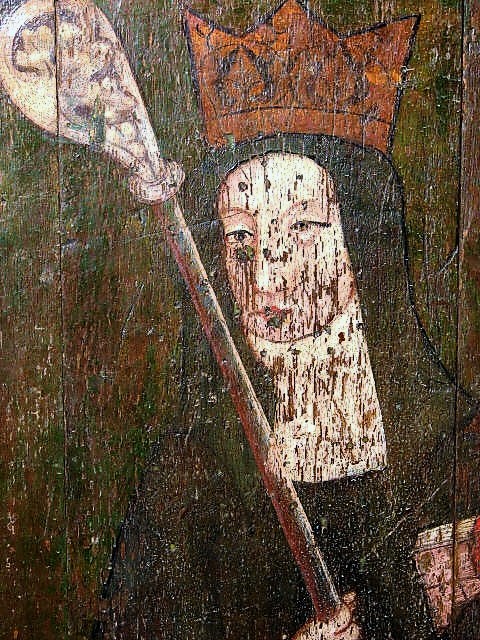
de Wihtburh sur le jubé de l'église Saint-Nicolas de Dereham.
St
Withburga, rood screen detail, church of St Nicholas, East Dereham
(interior)
Sainte Withburge de
Dereham
Religieuse à Dereham
Fête le 17 mars
OSB
+ 17 mars v. 743
Autre mention : 8
juillet
Autres mentions :
Withburge, Withburgh, Witburh ou Withburga
Fille la plus jeune
d’Anna, roi de l’Est-Anglie, elle forma autour d’elle une communauté à East
Dereham, dans le comté de Norfolk, mais elle mourut avant que la communauté ne
fût complètement organisée. Fondatrice de l’église de Dereham, une chapelle s’élève
sur le site de sa tombe. D’autres fêtes sont célébrées le 18 avril à Cambridge
et le 8 juillet ; aujourd’hui la fête commémore la translation de ses
reliques.
SOURCE : http://www.martyretsaint.com/withburge-de-dereham/

St
Wihtburh, behind the high altar in St. Nicholas Church, Dereham, Norfolk
Saint Withburgh of
East Anglia
Also
known as
Withburgh of Dereham
Vitburga…
Wihtburh…
Withburga…
Withburge…
8 July on
some calendars
Profile
Born a princess,
the youngest daughter of King Anna
of East Anglia (part of modern England).
Following the death of
her father in
battle, Withburgh became a nun and
lived as an anchoress at East
Dereham, Norfolk, England where
she eventually founded a convent.
c.743
in England
abbess with
two hinds at
her feet
holding a church inscribed Ecclia
de Esterdaham
Additional
Information
Book
of Saints, by the Monks of
Ramsgate
Lives
of the Saints, by Father Alban
Butler
Saints
of the Day, by Katherine Rabenstein
books
Our Sunday Visitor’s Encyclopedia of Saints
Saints
and Their Attributes, by Helen Roeder
other
sites in english
video
websites
in nederlandse
nettsteder
i norsk
MLA
Citation
“Saint Withburgh of East
Anglia“. CatholicSaints.Info. 6 April 2024. Web. 23 April 2026.
<https://catholicsaints.info/saint-withburgh/>
SOURCE : https://catholicsaints.info/saint-withburgh/

Dereham's
town sign, showing the story of Withburga
(Saint) Virgin (July 8)
(7th
century) A Princess of
East Anglia, sister of Saints Etheldreda
and Sexburga, who passed her life as a Recluse at Dereham in Norfolk. She died about
A.D. 643,
and her Relics with
those of the Saints,
her sisters, were solemnly enshrined in
Ely Cathedral, October
17, A.D. 1106.
MLA
Citation
Monks of Ramsgate.
“Withburga”. Book of Saints, 1921. CatholicSaints.Info.
8 July 2016. Web. 23 April 2026.
<https://catholicsaints.info/book-of-saints-withburga/>
SOURCE : https://catholicsaints.info/book-of-saints-withburga/
Withburga of Dereham, OSB
V (AC)
(also known as Withburge,
Witburh)
Died March 17, c. 743;
other feasts are celebrated on April 18 at Cambridge and on March 17; today's
feast commemorates her translation. She was the youngest daughter of King Anna
of the East Angles. Like her holy sisters, she devoted herself to the divine
service, and led an austere life in solitude for several years at Holkham, near
the sea-coast in Norfolk, where a church dedicated to her was afterwards built.
After the death of her father she changed her abode to East Dereham, now a
market-town in Norfolk, but then an obscure place of retirement.
Withburga assembled there
some devout maidens, and laid the foundation of a church and convent, but did
not live to finish the buildings. Her body was interred in the churchyard at
East Dereham and 50 years later was found incorrupt and translated into the
church. In 974, with soldiers and under the cover of night but with the
blessing of King Edgar and Saint Ethelwold, Abbot Brithnoth of Ely removed it
to Ely. They moved the body to wagons, drove 20 miles to Brandun River, and
continued their journey by boat--much to the dismay of the men of Dereham who
had pursued them by land and could only watch helplessly as their treasure
drifted away. At Ely Brithnoth deposited Withburga's relics near the bodies of
her two sisters.
In 1102, Withburga's
relics were moved into a new part of the church. In 1106, the remains of four
saints were translated into the new church and laid near the high altar. The
bodies of Saints Sexburga and Ermenilda were reduced to dust, except the bones.
That of Saint Etheldreda was entire, and that of Saint Withburga was not only
sound but also fresh, and the limbs flexible. This is related by Thomas, monk
of Ely, in his history of Ely, which he wrote the following year.
He also tells us that in
the place where Saint Withburga was first buried, in the churchyard at Dereham,
a spring of clear water gushed forth when her body was first exhumed: it is to
this day called Saint Withburga's well. The church at Holkham is dedicated to
her honor (Benedictines, Farmer, Walsh).
In art, Saint Withburga
is portrayed as an abbess with two hinds at her feet because William of
Malmesbury described her as being provided milk in her solitude by a doe. She
may be holding a church inscribed Ecclia de Estderham. She is venerated at
Barham, Burlingham, and Dereham in Norfolk (Roeder).
SOURCE : http://www.saintpatrickdc.org/ss/0708.shtml

St. Withburga, in St. Andrew's Church, Burlingham
St. Withburge, Virgin
SHE was the youngest of
the four sisters, all saints, daughters of Annas the holy king of the
East-Angles. In her tender years she devoted herself to the divine service, and
led an austere life in close solitude for several years at Holkham, an estate
of the king her father, near the sea-coast in Norfolk, where a church,
afterwards called Withburgstow, was built. After the death of her father she
changed her dwelling to another estate of the crown called Dereham. This is at
present a considerable market town in Norfolk, but was then an obscure retired
place. Withburge assembled there many devout virgins, and laid the foundation
of a great church and nunnery, but did not live to finish the buildings. Her
holy death happened on the 17th of March, 743. Her body was interred in the
church-yard at Dereham, and fifty-five years after, found uncorrupt, and
translated into the church. One hundred and seventy-six years after this, in
974, Brithnoth, (the first abbot of Ely, after that house, which had been
destroyed by the Danes, was rebuilt,) with the consent of King Edgar, removed
it to Ely, and deposited it near the bodies of her two sisters. In 1106 the
remains of the four saints were translated into the new church and laid near
the high altar. The bodies of SS. Sexburga and Ermenilda were reduced to dust,
except the bones. That of St. Audry was entire, and that of St. Withburge was
not only sound but also fresh, and the limbs perfectly flexible. Warner, a monk
of Westminster, showed this to all the people, by lifting up and moving several
ways the hands, arms, and feet. Herbert, bishop of Thetford, who in 1094
translated his see to Norwich, and many other persons of distinction were
eyewitnesses hereof. This is related by Thomas, a monk of Ely, 1 which
he wrote the year following, 1107. This author tells us, that in the place
where St. Withburge was first buried, in the church-yard of Dereham, a large
fine spring of most clear water gushes forth. 2 It
is to this day called St. Withburge’s well, was formerly very famous, and is
paved, covered and inclosed; a stream from it forms another small well without
the church-yard. See her life, and Leland, Collect, vol. iii. p. 167.
Note 1. Anglia
Sacra, t. 1, p. 613, published by Wharton. [back]
Note 2. Ib. p.
606. [back]
Rev. Alban
Butler (1711–73). Volume VII: July. The Lives of the
Saints. 1866.
SOURCE : http://www.bartleby.com/210/7/084.html
Saint Withburga
Today, July 8, we
celebrate the feast of Saint Withburga (died 643), sister of Saint
Etheldreda, miracle worker, foundress of the Convent at East Dereham, and
Abbess. The simple and obedient life of Saint Withburga inspires us to discern
the will of God in our own lives, following His plan to our best ability.
Born the youngest daughter of Anna, King of East Anglia, Withburga grew up in a
privileged class, considered a princess. Upon her father’s death, while she was
still quite young, Withburga was sent with her nurse to live in a small town
near Norfolk called Dereham. There, she grew in piety and love for the Lord,
and established a small nunnery with the help of her sister, Etheldreda. She
served as Abbess of the fledgling community, which grew considerably under her
direction. As the community grew, Withburga eventually began construction of a
church.
It is at that point that
miracles began to occur, spreading her notoriety and drawing pilgrims to her
construction site. As construction of the church continued, money was short. At
times, Withburga had little more than bread to feed her workers. One night Our
Blessed Mother appeared to Withburga, saying “Send two of your women down
to the stream every morning, where two does will stand to be milked.” This
she did without question, and the two nuns found the deer waiting, as promised.
As a result, there was butter and cheese for all to add to their diet, and the
construction progressed with great speed.
Saint Withburga came to
be recognized for her great piety, patience, and advice. She was sought out be
locals, as well as by leaders from far away. The local official, jealous of the
positive attention she was receiving, set off with his hounds to kill the
miraculous deer, but was instead thrown from his horse and died of a broken
neck. All present reported this as miraculous, which only increased the stream
of pilgrims to the area—visiting the stream, the church, and hoping for an
audience with Withburga herself.
Saint Withburga died
prior to the completion of the church. Pilgrims continued to flock to her
graveside, where numerous miracles were reported. Upon exhumation (55 years
after her death), her body was discovered to be incorrupt, and moved into a
shrine contained within the completed church. Having consecrated herself a
virgin while alive, Saint Withburga’s corpse is said to have blushed when one
of the men who exhumed the body brushed her check with his finger. Years later,
the saint’s relics were stolen from her tomb (by a well-intentioned bishop),
and translated to Ely, to be placed next to her sisters. Where her body had
been, fresh water sprang forth, and continues to flow freely today. Saint
Withburga’s Well has never run dry (despite drought), and some have claimed
miraculous healing due to prayer and imbibing of the clear water.
Saint Withburga’s simple
faith and obedience allowed her to create an active religious community, offer
healing and advice to believers, and feed those who were hungry. Her life is
remembered as one of purity and hard work, turning from a privileged life and
dedicating herself to the Lord. We look to her for inspiration—just as the
pilgrims of her day did-- in making our daily life choices. What advice might
Saint Withburga give each of us, were we to ask her today?
SOURCE : http://365rosaries.blogspot.ca/2011/07/july-8-saint-withburga-of-dereham.html
Saint Withburga
Jul 06, 2015 /
Written by: America
Needs Fatima
Feast July 8
Withburga was the
youngest of the four daughters of King Onna of East Anglia, a devout Christian
ruler. All of his daughters and one son are canonized.
Onna was killed in battle
against Penda of Mercia, and after her father’s death Withburga went to Dereham
in Norfolk where she gathered a few young girls and started a small convent.
She eventually built a
church and the story goes that not having much nourishment to give to the
workers, Our Lady appeared to her telling her to send two nuns to the stream
where they would find two does that could be milked.
And so the nuns had
regular milk to add to their daily sustenance. As news of this marvel spread,
people began to flock to the convent to the point that a leader in Dereham
became jealous of Withburga’s popularity. He set out on his horse to kill the
does, but the horse threw him and he broke his neck. This story is depicted on
a large sign in the town of Dereham.
Withburga died on March
17, 743 shortly after the completion of the church. Fifty years later, her body
was found perfectly incorrupt.
In 974, on being moved to
Ely near the bodies of her two sisters, it was still found whole and pliable.
The people of Dereham tried to bring their saint back, but being unsuccessful,
found at their return that a well had sprung in the empty tomb of Withburga.
They took it as a sign
from their saint for their consolation. This spring has never dried up.
SOURCE : https://americaneedsfatima.org/articles/saint-withburga
Tuesday, 8 July 2014
St Wihtburh and the Miracle on Holkham Beach
Today I'd like to introduce you to a miracle performed by St Wihtburh, an
Anglo-Saxon saint who was celebrated (in the few places where she was celebrated)
on 8 July. Wihtburh lived in East Anglia in the first half of the eighth
century, and according to legend she was the daughter of King Anna of East
Anglia and youngest sister of St Æthelthryth (Etheldreda)
of Ely - although this may be only legend, since Wihtburh is not mentioned in
Bede's otherwise well-informed account of Etheldreda and her family. Wihtburh's
claim to sanctity was that she founded a monastery at Dereham in Norfolk, with
the miraculous aid of deer who fed her workmen with milk as the monastery was
being built - hence the deer in the stained-glass window above. Tradition said
that she died on 17 March 743 (though this date is too late, if she really was
Etheldreda's sister), and her body was later removed to Ely, where she was
commemorated along with her saintly sisters. By 'removed', it would be more
accurate to say 'stolen'; in fact that's what today's feast commemorates,
because on 8 July 974 Abbot Byrhtnoth of Ely and a group of his monks purloined
the relics of Wihtburh from Dereham despite fierce resistance from the
townspeople, and spirited them away to Ely.
(This is a perfect example of what I was saying yesterday about
translation feasts being hard to justify! But such pious thefts are a literary
trope in translation narratives, and what this one probably tells us is that
Abbot Byrhtnoth, who had led the refoundation of Ely as a Benedictine
monastery, was gathering saints and relics for his community; and that he had
decided to focus its interests on the saints linked to St Etheldreda, who
included, besides Wihtburh, Etheldreda's sister Seaxburh, niece Eormenhild,
great-niece Wærburh, and half-sisters Æthelburh and Sæthryth. The abbot's theft
still seems to be rankling with whoever wrote the Wikipedia
entry for Wihtburh, though; old grudges die hard in Norfolk...)
Anyway, the miracle-story I want to post today relates to Wihtburh's childhood,
and is supposed to have taken place at Holkham, on the northern coast of
Norfolk. It's told in a Vita S. Wihtburge composed at Ely in the
early twelfth century, which is edited and translated by Rosalind Love in The
Hagiography of the Female Saints of Ely (Oxford, 2004), pp.54-93 (this
extract at pp.87-91):
[Wihtburh] was sent with
her nurse to be brought up by the seaside, in a village on her father’s lands,
called Holkham... While she was dwelling in that hamlet with her nurse and
tutors, one day, as children are wont to do, she went to play with her friends
on the dry parts of the sand. Although it is usual for boisterous games to be
encouraged, she stood out from the crowd in her blessed innocence, was sweeter
and gentler than the others, and joyfully and exultantly urged her companions
to be nicer in their playing, and with a gentle manner summoning them
altogether as they shouted one to another, she began to address them with
sweetly coaxing voice, speaking, so I believe, in the spirit of God: ‘Let us
go, my dear friends, to the nearby shore, to gather up the smaller pebbles
which together with the sand are tossed out of the sea into high piles by the
regular beating to and fro of the waves, because it may be that they assemble
themselves together and gather themselves into a heap ready for building-work, just
as if a church is to be constructed there.' When they heard this they quickly
rushed up, happy and ready, eagerly they presented themselves all set for
fetching and carrying. And when one by one they threw down in the middle all
the pieces which they had each brought separately, however big it was, the
whole heap, just as is the nature of pebbles, scattered all over the place. But
that small quantity which the only virgin of the Lord, Wihtburh, brought, when
she produced it, began to swell and multiply and at the same time to be reduced
to one solid mass. At this her companions were turned to shock and amazement,
and nodding to one another they haughtily turned to spite and envy against her,
and by repeatedly kicking the mass with their heels tried to turn it back, and
attempted to scatter into its former constituent parts the pile that had heaped
into one and was now solidified. When she saw this she reached out her hand,
made the sign of the cross, and called upon the Lord's name in the words of her
own language, and by the power of the holy cross imprinted upon it, the
heaped-up pile, as it had already begun to, stayed forever as if rooted and
grounded. St Wihtburh did this every time her little companions gathered to
play, as a true presage of future things...
[Every time this happened] they left those hardened masses there, but returning
the next day found them shifted far away on to the top of a hill, in a very
high place, well away from the stormy waves, placed a distance from the watery
plain which is regularly made treacherous by the coming and going of the
sea-tide, and this seems to offer a safe journey without fear to those who come
near.
Her nurse prophesies that a church will one day be built on this
miraculously-formed mound of pebbles, and her words came to pass: later a
church was built there "which is called in English Withburgsstowe,
where those stones are kept as a testimony to the event." The church at
Holkham was (and still is) dedicated to St Wihtburh, the only church in England
to bear that dedication.
Maybe it's just because I grew up by the seaside (though not in Norfolk), but I
find this a particularly appealing miracle - if nothing else, a childhood
miracle story in which the saint is shown actually playing like a child is an
unusual and rather sweet thing to see! The whole situation is a charmingly
ordinary one: a little girl on the beach with her nurse, all the children
playing with the sand and pebbles (with buckets and spades, you might imagine),
young Wihtburh trying to get them to play nicely (bossy little thing! but I
sympathise) - and then her miracle is not much more than a giant sandcastle
which turns into the site of a church! Plus, Holkham Beach is a distinctive and
memorable landscape, just the kind of place which deserves a miracle-story of
its own - have a look at it on Google
Images. Interestingly, the church at Holkham stands on what is probably a
man-made earthwork - a noticeable feature in a landscape of flat beaches - so
this story about Wihtburh's miraculous mound-building was perhaps meant to
explain that feature of the local environment. I wonder similarly about the
miraculous 'deer' of Dereham, whether the story might have been an
extrapolation from the place-name - it would have to be a late one, since in
Old English deor refers to any kind of wild animal, but I think it
might just about have been possible in the twelfth century, when the story is
first recorded. There are similarities between Withburh's legend and that
of St
Mildred of Thanet, which also features deer and an aetiological explanation
for a local earthwork; the two royal saints were related (somehow; I've lost
track of the genealogy!) and there may have been some borrowing of motifs in
one direction or the other. It was excellent work on the part of the anonymous
Ely hagiographer to give Wihtburh a miracle-story which fits so well with the
local landscape and with the role in which he has cast the saint - Etheldreda's
baby sister.
(I'm also inclined to enjoy this story because I've recently been re-reading
Charlotte Yonge's The Daisy Chain, in which it happens that the young
heroine - named Etheldred - puts heart and soul into getting a church built,
and thus unconsciously imitates the childhood endeavours of her namesake
saint's sister. That's the kind of coincidence which amuses me...)
In later centuries the site of Wihtburh's church was to become famous for a
much grander pile of stones: the palatial Holkham Hall. But the
church, retaining its unique dedication though much rebuilt, still stands in
the grounds of the estate, and you can read about it here.
SOURCE : https://aclerkofoxford.blogspot.com/2014/07/a-miracle-on-holkham-beach.html
St. Withburga of Dereham,
Abbess of Dereham
(Died AD 743)
Withburga was the
youngest of the saintly daughters of Anna,
King of East Anglia. Her sisters were SS. Ethedreda and Sexburga;
they had an elder half-sister St.
Saethrith and an illegitimate half-sister, St.
Ethelburga of Faremoutier-en-Brie. Withburga was also aunt of St.
Ermengild. When a young girl, she was sent to live with her nurse at Holkham in
Norfolk where, in process of time, a church was built in her honour and the
place called Withburgstowe. After her father's death, she built a convent at
East Dereham. While she was building it, she had, at one time, nothing but dry
bread to give her workmen. She applied for assistance to the Blessed Virgin
Mary who directed her to send her maids to a certain fountain every morning.
There, they found two wild does which yielded plenty of milk. In this way, the
workmen were fed and the work prospered until the overseer of those lands, in
contempt or dislike of the saint and her miracles, hunted the does, with dogs,
and made them leave off coming to the fountain to be milked. He was punished
for his cruelty, for his horse threw him and he broke his neck.
Withburga died on 17th
March AD 743 and was buried in the cemetery of the Abbey of Dereham and her
body, being found uncorrupted fifty-five years afterwards, was translated into
the church which she herself had built. In AD 974, Brithnoth, Abbot of Ely,
determined to lay the body beside those of her sisters. He went, with armed
followers, to Dereham where he invited the townsmen to a feast and made them
drunk. He carried off the body. They awoke and went in pursuit, and the men of
Ely and the men of Dereham fought lustily for their treasure. Javelins wore
thrown and hard blows were exchanged. At last, however, Brithnoth triumphantly carried
off the saint and deposited her at Ely.
Edited from Agnes
Dunbar's "A Dictionary of Saintly Women" (1904).
SOURCE : http://www.earlybritishkingdoms.com/adversaries/bios/withburga.html

The
site of Withburga's tomb in East
Dereham, Norfolk. In the churchyard of St. Nicholas, Dereham. The
plaque reads: [unreadable] of a Tomb which contained the Rema[ins of] WITHBURGA
youngest Daughter of ANNAS King of the East-Angles who died AD 654 The Abbot
and Monks of Ely stole this precious Relique and translated it to Ely Cathedral
Den hellige Withburga av
Dereham (d. ~743)
Minnedag:
17. mars
Etter at hennes far og
bror ble drept i et slag i 654, flyttet Withburga til Dereham, som nå er en
markedsby i Norfolk, men den gangen var det et ukjent og avsidesliggende sted.
Der samlet hun noen hengivne kvinner og grunnla en kommunitet. Hun begynte
byggingen av en kirke og et kvinnekloster, men hun døde før bygningene var
fullført. Hun døde den 17. mars rundt 743 og ble gravlagt på kirkegården i East
Dereham med vanlig monastisk enkelhet. Men 55 år senere ble hennes grav åpnet
og hennes legeme skrinlagt i sognekirken, og det ble da funnet å være like
friskt.
I 974 sørget abbed
Brithnoth av Ely for at Withburgas relikvier ble stjålet under påskudd av at
Withburga ville ha ønsket å bli gravlagt ved sine mer berømte søstre. En gruppe
av hans munker dro i hemmelighet om natten til Dereham, etter å ha fått tillatelse
fra den hellige kong Edgar av England og
den hellige biskop Ethelwold av
Winchester. De fjernet legemet og kjørte det på sine vogner tre mil til
elven Brandun. Derfra fortsatte de reisen med båt, til forferdelse for mennene
fra Dereham, som hadde fulgt etter dem, men nå bare hjelpeløst kunne se på at
deres største skatt forsvant.
Legemet ble gravlagt på
nytt i Ely, men det ble ikke undersøkt om det var like friskt, ettersom det
kunne ha tatt glansen fra Etheldreda. I 1102 ble Withburgas relikvier flyttet
inn i den nye delen av kirken og gravlagt ved høyalteret, hvor de i 1106 fikk
selskap av knoklene til de tre andre helgenene fra Ely, søstrene Etheldreda og
Sexburga samt Sexburgas hellige datter Ermengild. Legemene
av Sexburga og Ermengild var redusert til støv, bortsett fra knoklene, mens
Ethelburgas var helt og Withburgas var ikke bare helt, men friskt og med
bøyelige lemmer.
John Leland, som reiste
rundt i England på 1540-tallet, kopierte en liste over engelske helgengraver
«fra en liten bok over steder hvor helgener hviler i England» (E libello
de locis, quibus S. in Angl[ia] requiescunt). Der står det: In monasterio
Heliensis, S. Etheldrida, S. Wiburga, S. Sexburga soror eiusdem, S. Erminilda
filia Sexburgae («I klosteret Ely, St Etheldreda, St Withburga, St
Sexburga, søster av den samme, St Ermengild, datter av Sexburga») (Nicholas
Grant, 'John Leland's List of «Places where Saints Rest in England»', Analecta
Bollandiana, 122:2 (2004), s 382).
Etheldreda, Withburga og
Sexburga nevnes også i to helgenlister som bygger på listen over helgengraver
fra første halvdel av 1000-tallet, «On the Resting-Places of the Saints», eller
på gammelengelsk Secgan be þam Godes sanctum þe on Engla lande ærost
restan, nemlig Hugo Candidus’ latinske krønike om Peterborough Abbey fra midten
av 1100-tallet og Breviate of Domesday, som er vedlagt Geoffrey
Gaimars Description on Britain på normannerfransk fra 1300-tallet.
Deres navn finnes også i den sene middelalderkatalogen over engelske
helgener, Cathalogus Sanctorum in Anglia Pausancium fra 1300-tallet.
Ermengild nevnes imidlertid bare hos Hugo Candidus.
Withburgas minnedag er
dødsdagen 17. mars, med en translasjonsfest den 8. juli, som mange steder er
hovedfesten. I det nye Martyrologium Romanum (2001) minnes hun den 17. mars. I
Cambridge feires hun den 18. april ifølge Cathalogus Sanctorum in Anglia
Pausancium. I kunsten bærer Withburga en kirke som kan ha inskripsjonen Ecclia
de Estderham, mens hennes attributt i er et tamt dådyr, som historikeren
William av Malmesbury (ca 1080-1143) beskriver som hennes ledsager i
eneboertilværelsen som sørget for melk til henne. Hun æres i Barham, Burlingham
og Dereham i Norfolk. Kirken i Holkham er viet til henne.
Kilder:
Attwater/Cumming, Farmer, Butler, Butler (VII), Benedictines, Bunson, Cruz (1),
Grant, KIR, CSO, celt-saints, britannia.com, earlybritishkingdoms.com,
365rosaries.blogspot.com, zeno.org - Kompilasjon og oversettelse: p. Per Einar Odden
Opprettet: 1. juni 1998
SOURCE : https://www.katolsk.no/biografier/historisk/withburg


.jpg)
.jpg)

.jpg)

Witburga (ook Withburga) van
Dereham, Engeland; kluizenares; † 743.
Feest 17 maart &
18 april (te Cambridge) & 8 juli (overbrenging van Dereham naar Ely).
Zij was de jongste
dochter van koning Anna van East-Anglia († 654). Die had vier dochters die
later allemaal als heilige vereerd zouden worden. De beroemdste ervan is
Etheldreda (of Audrey), abdis te Ely. († 679; feest 23 juni). Ook Withburga had
het verlangen om haar leven in dienst te stellen van God. Dat was in haar tijd
nog iets geheel nieuws. Zij ging leven als kluizenares. Ze liet zich een
uiterst sober hutje bouwen, cel genaamd, in de buurt van het plaatsje Holkham
(Norfolk). Toen haar vader gesnueveld was in de strijd tegen koning Penda van
Mercia, verhuisde ze naar East Dereham (Norfolk). Hoewel ze in afzondering
leefde, trok haar ongewone leefwijze veel bekijks. Zo wekte ze bij andere
meisjes en vrouwen het verlangen om haar leven te delen. Van lieverlee ontstond
er een kloosterterrein, waar de vrouwen elk in een eigen cel leefden, maar
bijeen kwamen voor de diensten in het kloosterkerkje. Hun leven was zo arm dat
de bouwlieden die er werkten aan hun cellen en aan de kerk zich tevreden
moesten stellen met het voedsel dat de zusters aten: water en droog brood.
Withburga besefte dat dit eigenlijk niet genoeg was. Ze bad God om uitkomst. De
volgende dag zag Withburga hoe er twee hindes op de oever uit de rivier de
Brandun stonden te drinken. Ze wist meteen: mijn gebed is verhoord. Van toen af
kwamen de hindes elke dag terug. Ze gaven zoveel melk dat de zusters er meer
dan genoeg aan hadden. Er is nog een moment geweest dat de zusters gevaar
liepen hun bron van dieren kwijt te raken. Dat was toen een jager er met zijn
honden jacht op maakte. Maar toen de man over een heg wilde springen, bleef hij
met zijn voet haken, sloeg voorover en brak zijn nek. Zo werden door zijn dood
zowel de zusters als de dieren gered. Withburga moet gestorven zijn. Gegeven
het feit dat haar vader stierf in 654 en zij dus ruim voor die tijd geboren
moet zijn, mogen we daar uit afleiden dat zij heel oud geworden is. (Men vindt
als haar sterfjaar echter ook wel 679).
Haar medezusters
begroeven haar op het kerkhof. Op het moment van haar begrafenis ontsprong daar
een bron die er nog altijd is: St-Withburga's Well. Maar toen ze haar zo'n
vijftig jaar later weer opgroeven, bleek haar lichaam nog helemaal gaaf. Nu
waren ze ervan overtuigd dat hun stichteres een heilige was. Ze maakten voor
haar een mooie schrijn (= kunstig bewerkte doodkist) en gaven deze een
ereplaatsje inn de kerk: dan kon ieder die wilde haar vereren en haar in de
hemel om hulp vragen voor de noden op aarde.
Maar de monniken van Ely
hadden haar liever in hun klooster. Dan zouden immers degenen die haar wilden
vereren, naar hun klooster komen! Bovendien was haar beroemde heilige zuster
Etheldreda daar begraven. De beide zussen wilden na hun dood natuurlijk het
liefst zo dicht mogelijk bij elkaar zijn. Zo gingen ze er in een nacht op uit
om de schrijn van Withburga uit de kerk van Dereham te halen. Dat lukte. Zo
vlug mogelijk vervoerden ze haar naar de rivier, waar een boot klaar lag.
Intussen hadden de bewoners van Dereham er lucht van gekregen en zetten de
achtervolging in. Maar bij de rivier gekomen zagen ze nog juist hoe de monniken
van Ely met hun kostbare buit wegvoeren. Omdat zij geen boot hadden, beseften
ze dat ze hun heilige kwijt waren.
Tot op de dag van vandaag
staat haar schrijn naast die van haar zus Etheldreda in de kathedrale kerk van
Ely.
[000:Mildrith:bk:Rollason:45& pass; 115; 122; 128p:90; 142jr0679]
© A. van den Akker
s.j. / A.W. Gerritsen
SOURCE : https://heiligen-3s.nl/heiligen/03/17/03-17-0743-witburga.php
Dmitry Lapa, 3/30/2018. Venerable
Withburgh (Withburga) of Dereham. Commemorated: March 17/30 (repose) and July
8/21 (translation of relics) : https://orthochristian.com/111800.html