
Vénérable Humbert de
Romans
Maître général de l'ordre
des Dominicains (+ 1277)
Né vers 1200, originaire de Romans, en Isère, il rejoint l'ordre des dominicains à Paris et devint Maître général de l'ordre en 1254. Il produit de nombreux ouvrages concernant les rites liturgiques dominicains, la prédication, les homélies... Il se retire en 1263 à Valence où il mourut le 14 juillet 1277.
Humbert de Romans, troisième successeur de saint Dominique à la tête de l'Ordre, maître de l'ordre de 1254 à 1263: le vénérable Humbertus de Romans (France)
"Puisque l'effort humain ne peut rien accomplir sans l'aide de Dieu", écrit-il, "la chose la plus importante pour un prêcheur est qu'il ait recours à la prière".
(source: Retrouver
la dimension contemplative)
SOURCE : http://nominis.cef.fr/contenus/saint/11011/Venerable-Humbert-de-Romans.html
Vénérable Humbert de
Romans
Fils d’un couple fortuné
de la ville de Romans (Isère). Après avoir obtenu un doctorat en droit civil à
Paris, il songe dans un premier temps à entrer dans l’Ordre des Chartreux, mais
choisit finalement l’Ordre des Frères Prêcheurs, dont il prend l’habit au
Couvent de Saint-Jacques en 1224.
Il effectue ensuite un
pèlerinage en Terre Sainte, et dès son retour est nommé gouverneur de la
province romaine.
Il gravit ensuite
graduellement les échelons de son Ordre jusqu’à en atteindre le sommet en 1254
en devenant le cinquième général.
Il entreprend alors plusieurs missions en Europe en débutant par une visite en
Hongrie. En 1258, il est admis à siéger au conseil du roi Saint-Louis afin de
juger un conflit entre les seigneurs de Clermont, d’Anjou et de Poitiers.
Quelque temps après, il s’associe à Albert le Grand, Saint-Thomas d’Aquin et
Pierre de Tarentaise pour tenter de préserver les populations du Hainaut des
ravages causés par les incursions tartares.
En 1263, il quitte sa charge et se retire dans la solitude près de Valence, où
il passe les quatorze dernières années de sa vie.
Humbert est aussi l’auteur de nombreux ouvrages théologiques, parmi lesquels
figurent un traité sur les vœux de Religion, une histoire de la vie de
Saint-Dominique et une petite chronique de son Ordre (+ 1277).

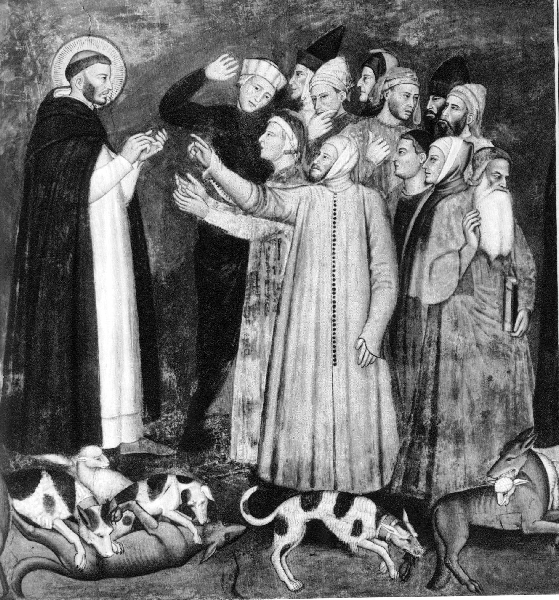

Profile
Studied in Paris, France.
Doctor of civil
law. Joined the Dominicans in 1224. Pilgrim to
the Holy Lands. Provincial of the Dominican Roman
province in 1240. Dominican provincial
of France in 1244.
Fifth master-general of the Dominicans in 1254.
Formed and sponsored several successful foreign missions,
supported the education of Dominicans,
and approved the final revision of the Dominican Liturgy.
He stepped down from his position in 1263,
and retired to the priory of Valence, France.
Came briefly out of solitude at the request of Pope Clement
IV to settle a dispute among members of the Cistercians.
Born
1193 at
Romans, Dauphiné, France
14 July 1277 at Valence, France of
natural causes
Additional
Information
Saints
and Saintly Dominicans, by Blessed Hyacinthe-Marie
Cormier, O.P.
Saints
of the Day, by Katherine Rabenstein
books
Our Sunday Visitor’s Encyclopedia of Saints
video
Treatise on Preaching (Priory Librarian audiobook)
MLA
Citation
‘Blessed Humbert of
Romans‘. CatholicSaints.Info. 4 November 2022. Web. 23 April 2026.
<https://catholicsaints.info/blessed-humbert-of-romans/>
SOURCE : https://catholicsaints.info/blessed-humbert-of-romans/
Saints
and Saintly Dominicans – 27 September
Blessed Humbert had asked
God to die either a Carthusian or a Dominican. God in His wisdom and for the
good of the Order called him to be a Dominican. For ten years he filled the
office of Master General. He was solid in his instructions, most zealous for
the correction of the liturgical books and the perfection of the Divine Office,
severe, at times, in his reprimands. But his principal characteristics were
affability and gentleness; in consequence his corrections were always well
received, as coming from a truly paternal heart. He was the means of founding
more than a hundred monasteries; he visited the Province of the Holy Land, and
it was due to him that Africa and the Indies received a great number of Friars
Preachers bearing the glad tidings of the Gospel. His principal work, which
still benefits the Order, was to instruct it by his writings in the excellence
and duties of regular Dominican life. This he did by descending to minute
details, but details regarded in the light of rational principles and practical
discretion, and with a high ideal of the beauty of the religious life. His mind
was so enlightened that he has been compared to Saint Thomas Aquinas. These
words were engraved upon his tomb: “Area florum, Regula doctorum, lux semita
normaque morum.” (1277)
Prayer
Blessed Humbert, obtain
for us the fulness of the religious spirit.
Practice
Meditate upon and examine
yourself on these motives of pleasing your neighbor given by Blessed Humbert,
not for your own satisfaction but for the good of others: First, that you may
be listened to more willingly; second, that your counsels may be more readily
followed; third, that your corrections may be received with less repugnance;
fourth, that you may be the better helped with temporal resources for your
charitable works.
– taken from the
book Saints
and Saintly Dominicans, by Blessed Hyacinthe-Marie
Cormier, O.P.
SOURCE : https://catholicsaints.info/saints-and-saintly-dominicans-27-september/
Blessed Humbert of
Romans, OP (PC)
Born at Romans, Dauphiné,
France, in 1193; died there in 1277. The contribution of Humbert of the Romans
to Dominican life can never be overestimated. While he has never been formally
beatified, he has been given the popular title of "blessed" since his
death. His name is associated with the foundation of the order and the
clarification of its rule and constitutions, which reveals the sure touch of
his saintly and logical mind.
Humbert came from a large
family, several of whom became religious; one of them was a Carthusian. He met
the Dominicans at the University of Paris, where he was teaching on the faculty
of arts and studying theology in 1224.
There is a charming story
concerning his choice of a vocation to the Dominicans. He was kneeling one day
in the cathedral of Notre Dame during the Office of the Dead being chanted by
the canons. His mind kept wandering to the choice of a vocation, for his family
had been friendly with the Carthusians for many years, and his brother had
already joined them.
As he debated with
himself, an old priest wandered down from the choir and engaged him in quiet
conversation. He asked Humbert where he came from, and Humbert replied that he
was a parishioner. The old priest regarded him shrewdly and said, "Do you
remember what you promised at your baptism--to renounce the devil and all his
pomps? Why don't you become a Friar Preacher?"
Humbert could hardly keep
his mind off the priest's words, and at the responsory for the lesson,
"Where shall I fly if not to You?," he decided once and for all that
he would become a friar. He went to consult with his professor of theology,
Hugh of Saint Cher, who was planning to become a Dominican himself as soon as
he could arrange his affairs. On the feast of Saint Andrew, Humbert knelt at
the feet of Blessed Jordan of Saxony and asked for the habit of the Dominicans.
The first task of the new
brother was teaching at Lyons. His profound knowledge of Scripture recommended
him for the highest teaching posts in the order. In 1240, when he was elected
provincial of Lombardy, he began his administrative career.
From that time until his
death, there was scarcely an event of any importance to the order in which he
did not play a part. As provincial of France, from 1244 to 1254, he worked
steadily to stabilize relations of the order and the university, perhaps
foreseeing that there would one day be a showdown between the two great forces
there. He was offered the patriarchate of Jerusalem, which he refused, and at
the election of Gregory IX he received nearly enough votes to be elected pope.
Humbert was a careful
canonist, and he carried around a master copy of the Dominican Constitutions in
order that a copy could be made in the various houses. In his time the order
had begun to feel the need for uniformity more than ever before, for its
members were spreading to the far parts of the earth, and local regulations
differed.
This was nowhere more
clearly seen than in the liturgy, which differed not only with each diocese but
with each basilica. When the brethren of various provinces got together for a
general chapter, it was harrowing to try to chant the office. Humbert, along
with several others, was appointed to begin work on a unification of the
liturgy, even before he became master general in 1254. After his election as
the fifth master general of the order, he intensified his efforts in this
behalf.
Most of the regulations
of the Dominican liturgy that have come down to us are in the words of Humbert.
His principal contribution appears to be the unification of the liturgy. He set
up a norm and insisted that all the varying elements conform to it, apologizing
to the brethren meekly for the fact that some of them would be disappointed in
the forms chosen ("since one cannot please everyone").
Many distinguishing
features of the Dominican Mass can trace their definite form to this talented
and sincere man who devoted his energies to the quiet task of building a structure
that would wear through the centuries.
The dignity and clarity
of the Dominican Constitutions likewise owe a debt to this man who wrote so
clearly and unequivocally of the spirit that Dominic had left to his children,
and which was in Humbert's day just being recorded for posterity. Humbert was
also successful in the development of the foreign missions, and in the
definitive planning of the studies of the Dominicans (Benedictines,
Dorcy).
SOURCE : http://www.saintpatrickdc.org/ss/0714.shtml
Humbert of Romans
(DE ROMANIS).
Fifth master general of
the Dominican
Order, b. at Romans in the Diocese of Vienne about
1194; d. 14 July, 1277 or 15 January, 1274, at Valence.
He is mentioned as a student at Paris in
1215. In 1224 he entered the Order
of St. Dominic, was professor of theology at
the school of
his order at Lyons in
1226, and prior at the same place from 1236 to 1239. In 1240 he
became provincial of
the Roman, and in 1244 of the French province of Dominicans.
After holding the latter office ten years he was elected master
general of his order at the general chapter held at Budapest in 1254.
In 1263 he voluntarily resigned
this office at the general chapter held in London,
and retired to the monastery of Valence where
he spent the rest of his life. During his generalate the liturgy of
the Dominican
Order received its permanent form. Humbert's humility did
not permit him to accept the Patriarchate of Jerusalem,
which was offered him after he had resigned as master general. He is
the author of various ascetical treatises,
some of which were collected and edited by Berthier: "Opera B.
Humberti" (2 vols., Paris, 1889). In a treatise entitled: "Liber de
tractandis in concilio Lugdunensi 1274" he
severely criticizes the faults of the clergy.
Parts of it were edited by Martène in "Veterum Script. et
monument. ecclesiasticorum et dogmaticorum ampl. collectio" (Paris,
1724-33), VII, 174-98.
Sources
MORTIER, Histoire
des Maîtres généraux de l'ordre des Frères-Prêcheurs, I (Paris, 1903-5),
415-664; L'Année Dominicaine, VII (Lyons, 1896), 283-342; DE
WARESQUIL, Le bienheureux Humbert de Romans (Paris, 1901).
Ott,
Michael. "Humbert of Romans." The Catholic
Encyclopedia. Vol. 7. New York: Robert Appleton
Company, 1910. 15 Jul.
2015 <http://www.newadvent.org/cathen/07542a.htm>.
Transcription. This
article was transcribed for New Advent by Albert Judy, O.P.
Ecclesiastical
approbation. Nihil Obstat. June 1, 1910. Remy Lafort, S.T.D.,
Censor. Imprimatur. +John Cardinal Farley, Archbishop of New York.
Copyright © 2026 by New Advent LLC. Dedicated
to the Immaculate Heart of Mary.
SOURCE : http://www.newadvent.org/cathen/07542a.htm
Humbert of Romans
Humbert of Romans (Humbertus
de Romanis, c.1200-1277), the fifth master general of the Order of
Preachers, 1254-1263. Humbert was born at Romans-sur-Isère in south-eastern
France (c.80 kms south of Lyons). As a young man, he went to Paris to study
theology and canon law, becoming a Master of Arts before joining the Order of
Preachers in 1224. In 1226, Humbert was appointed lector of theology for the
convent in Lyons, for which he was conventual prior in 1237. Around 1238,
he was elected prior provincial for the province of Romana, he received several
votes at a papal election in 1241, in 1244-45 he was elected prior provincial
of Francia, and finally, in 1254, the general chapter elected him master
general of the Order. During his generalate, which lasted to 1263, Humbert
contributed significantly to a re-organization and homogenization of the Order,
an improved relation to the Franciscan Order, and a joined mendicant defense
against their many secular critics. After leaving the office of master general
in 1263, he went back to his old convent of Lyons, where he continued his
series of numerous writings. Humbert died on 14 July 1277 and was buried in
Valence (near Romans). He became venerated as Blessed within the Order, but was
never officially beautified.
Humbert has left us a
number of written works of various kinds. These include a commentary on the
Rule of St. Augustine and the Dominican constitutions (Exposito regulae beati
Augustini Episcopi et super constitutiones fratrum praedicatorum), a treatise
on the formation of preachers (De eruditione praedicatorum), supplemented with
a series of model sermons, a treatise on the various officials in Dominican
convents (Instructiones de officiis ordinis), a manual for preachers of the
crusade (De
predicatione crucis contra Saracenos), a short comment on the ways in which
the brethren were bound by Dominican constitutions and decrees (Epistola de
regularis observantia disciplinae), and finally the work Opus tripartitum with
competent analyses of the state of the Western Church, relations between Greeks
and Latins, and conditions of the Holy Land. Humbert also functioned as
collector and publisher of earlier Dominican material, such as Fr. Gerald de
Frachet’s famous “Life of the Brethren” (Vitae fratrum) and a Legenda
sancti Dominici.
Lit.: William A.
Hinnebusch OP, The History of the Dominican Order, vol. 2, New York 1973,
288-294; Simon Tugwell OP, ‘Introduction’, in Early Dominicans :
Selected Writings, New York 1982, 31-35; Edward Tracy Brett, Humbert of
Romans : His life and views of thirteenth-century society, Toronto 1984.
De predicatione crucis
contra Saracenos (“On Preaching the Cross against the Saracens”).
Written by Humbert soon
after the Saracens had taken Sephed in 1266 as a tool of assistance for the
friars, whom the pope had commisioned to preach a new crusade to the Holy Land.
In 46 chapters, Humbert prepares the friars for the task and provides them with
ideas and materials for their sermons. Apparently, the crusade preaching manual
was still considered highly valuable in fifteenth-century Germany. A summary is
published by Lecoy de la Marche in “La prédication de la croisade au XIIIe S.”, Revue
des questions historique vol. 48 (1890), 5-28.
De predicatione crucis
contra Saracenos is now available in extenso online in an
edition by Kurt Villads Jensen, University of Southern Denmark 2007.
SOURCE : http://www.jggj.dk/Humbert.htm
Humbert of Romans, Fifth Master General of the Order of Preachers. TREATISE
ON PREACHING. Translated by the Dominican Students Province of St. Joseph. Edited by WALTER M. CONLON O.P. :