
The
20,000 martyrs of Nicomedia, including: Glycerius, Zeno, Theophilus, Dorotheus,
Mardonius, Migdonius, Indes, Gorgonius, Peter, Euthymius, and the virgins
Agape, Domna, and Theophila
Мученики
20000, в Никомидии в церкви сожженные
Константинополь.
985 г. Миниатюра Минология Василия II.
Ватиканская библиотека. Рим.
Saints Pierre, Gorgon et
Dorothée, martyrs
Chambellan de l'empereur
Dioclétien à la cour de Nicomédie, Pierre fut brûlé vif pour avoir protesté
ouvertement contre la cruauté des supplices infligés aux chrétiens. Avec lui,
Gorgon était un officier de l'entourage de Dioclétien, converti au
christianisme, qui refusa, comme son camarade Dorothée, de renier sa foi. Ils
furent torturés et mis à mort en 303.
Saint Pierre
Martyr à Nicomédie en
Bithynie (+ 303)
Chambellan de l'empereur
Dioclétien à la cour de Nicomédie, il fut brûlé vif pour avoir protesté
ouvertement contre la cruauté des supplices infligés aux chrétiens.
Officier de la chambre de
Dioclétien, comme il se plaignait avec trop de liberté des supplices infligés
aux martyrs, l’empereur le fit amener pour ce motif devant lui, ordonna d’abord
de le suspendre, de le déchirer longuement à coups de fouet, d’arroser ses
plaies de sel et de vinaigre, enfin de le brûler à petit feu sur un gril. De la
sorte, il fut vraiment l’héritier de la foi et du nom de Pierre. Dorothée et
Gorgon, préposés aussi à la chambre impériale, ayant protesté, perdirent la vie
étouffés, après des tortures variées.
Martyrologe romain
SOURCE : http://nominis.cef.fr/contenus/saint/6124/Saint-Pierre.html
SAINT GORGONIUS ou GORGON
SAINT DOROTHEE
et leurs compagnons
martyrs.
Dorothée était premier
chambellan de l'empereur Dioclétien, Gorgon et Pierre sous-chambellans. Ils
occupaient les premières places parmi les eunuques du palais. Les affaires les
plus difficiles de l'Etat étaient réglées par eux.
Galère, empereur de la
tétrarchie mise en place par Dioclétien (l'empire est gouverné par quatre
empereurs qui se partagent l'empire romain), fit mettre le feu au palais de
Nicomédie (aujourd'hui Izmit en Turquie) en accusant les chrétiens. Dorothée et
Gorgon furent arrêtés avec d'autres officiers du palais parce qu'ils étaient
chrétiens.
Ils furent torturés et
condamnés à être étranglés. Pierre eut un martyre encore plus barbare, puis
qu'on le suspendit en l'air, tout nu, et on le fouetta. Sur ses plaies, on
versa du sel, du vinaigre, puis les bourreaux le mirent sur un gril.
Sur l'ordre de
Dioclétien, leurs corps furent jetés à la mer, et récupérés par la suite par
des chrétiens, pour être ensevelis.
SAINT GORGON ET SAINT
DOROTHÉE, martyrs
(9 septembre)
Gorgon et Dorothée
étaient, à Nicomédie, les chefs de la troupe qui gardait le palais de
Dioclétien. Mais, pour pouvoir suivre plus librement leur maître divin, ils se
démirent de leur fonction et se proclamèrent chrétiens. Ce qu’entendant,
l’empereur fut désolé à la pensée de perdre d’aussi nobles et dévoués
serviteurs. Mais comme ni les menaces, ni les flatteries ne parvenaient à les
émouvoir, il les fit étendre sur le chevalet, fit déchirer leurs corps avec des
fouets et des griffes de fer, fit jeter du vinaigre et du sel dans leurs
intestins perforés ; puis comme ils n’en éprouvaient aucun mal, il les fit
mettre sur un gril ; et ils avaient l’impression d’être couchés sur un lit
de fleurs. Alors Dioclétien les fit pendre, et laissa leurs corps en pâture aux
chiens et aux loups. Mais les corps demeurèrent intacts jusqu’au moment où les
fidèles purent les recueillir. Ce martyre eut lieu en l’an du Seigneur 280.
Longtemps après, le corps
de saint Gorgon fut transporté à Rome. Plus tard encore, en l’an 763, l’évêque
de Metz, neveu du roi Pépin, fit transporter ce corps en Gaule et l’ensevelit
au monastère de Gorgocie.
Jacques de Voragine. La Légende dorée (1261-1266). Traduction
par T. de Wyzewa, Perrin et
Cie, 1910 (p. 508).
SOURCE : https://fr.wikisource.org/wiki/La_L%C3%A9gende_dor%C3%A9e/Saint_Gorgon_et_saint_Doroth%C3%A9e
09/09 St Gorgon, martyr
Culte attesté en 336.
Leçon des Matines (avant
1960)
Troisième
leçon. Gorgon était né à Nicomédie. Officier de la maison de l’empereur
Dioclétien, il convertit à la foi du Christ, avec l’aide de Dorothée son
collègue, tous les autres serviteurs du palais impérial. Un jour qu’ils
assistaient l’un et l’autre aux tortures cruelles infligées à un Martyr en
présence de Dioclétien, ils sentirent s’allumer en leur cœur le désir du
martyre. Et tous deux s’adressant à l’empereur : « Pourquoi, lui
dirent-ils, ne punir que celui-là, puisque nous méritons d’être condamnés comme
lui ? Sa foi est aussi la nôtre et nous imiterons sa constance. »
Aussitôt l’empereur ordonne qu’on les charge de chaînes, qu’on les flagelle
jusqu’à ce que tout leur corps ne soit plus qu’une plaie, et que l’on répande
sur leurs blessures du vinaigre mêlé de sel. Puis il commande de les attacher
sur un gril et de les placer sur des charbons ardents. Enfin, après des
tourments variés, ils moururent sur le gibet. Plus tard, le corps de saint
Gorgon fut transporté à Rome et enseveli entre les deux Lauriers, sur la voie
Latine ; mais on le transféra dans la basilique du prince des Apôtres,
sous le pontificat de Grégoire IV.
die 9 septembris
SANCTI GORGONII
Mart.
Commemoratio (ante CR
1960 : simplex)
Missa Lætábitur, de
Communi Communi unius Martyris IV loco, cum orationibus ut infra
Oratio
Sanctus tuus, Dómine,
Gorgónius sua nos intercessióne lætíficet : et pia fáciat sollemnitáte
gaudére. Per Dóminum.
Secreta
Grata tibi sit, Dómine,
nostræ servitútis oblátio : pro qua sanctus Gorgónius Martyr intervéntor
exsístat. Per Dóminum.
Postcommunio
Famíliam tuam, Deus,
suávitas ætérna contíngat et végetet : quæ in Mártyre tuo Gorgónio
Christi, Fílii tui, bono iúgiter odóre pascátur : Qui tecum.
le 9 septembre
Saint GORGON
Martyr
Commémoraison (avant
1960 : simple)
Messe Lætábitur, du
Commun d’un Martyr IV, avec les oraisons ci-dessous :
Collecte
Seigneur, faites que
saint Gorgon, votre martyr, nous console par son intercession, et nous fasse
goûter la joie de cette pieuse solennité.
Secrète
Que vous soit agréable
l’offrande de vos serviteurs, et que le saint Martyr Gorgon se montre notre
intercesseur
Postcommunion
Que le suave aliment
éternel touche et nourrisse votre famille, ô Dieu, et que celle-ci soit
embaûmée de la bonne odeur du Christ, votre Fils, en la fête de votre Martyr
Gorgon.
SOURCE : https://www.introibo.fr/09-09-St-Gorgon-martyr
S. Gorgon
Saint Gorgon naquit à
Nicomédie. Officier de la maison de l’empereur Dioclétien, il convertit à la
Foi du Christ, avec l’aide de Dorothée, son collègue, tous les autres
serviteurs du palais impérial.
« En punition de
cette audace, déclare le Martyrologe Romain, ils furent suspendus et
déchirés par tout le corps à coups de fouets ; puis on versa du vinaigre
et du sel sur leurs entrailles mises à découvert et après qu’on les eut brûlés
sur un gril, on finit par les étrangler ».
Ils furent mis à mort en
même temps que saint Théodore à Nicomédie, en 303. Plus tard on inhuma le corps
de saint Gorgon à Rome sur la voie Latine, et de là on le transféra dans la
Basilique de Saint-Pierre.
SOURCE : http://www.cassicia.com/FR/Vie-de-saint-Gorgon-martyr-Fete-le-9-septembre-No_449.htm

Martyrdom
of Saint Gorgon & Saint Dorothea (Gorgonius & Dorotheus). Lives of
saints, in Paris, in France, C.E.14th century, Richard de Montbaston &
collaborators.
Also
known as
Gorgon
28
December as one of the 20,000
Martyrs of Nicomedia
12
March on some calendars
Profile
Soldier.
Favourite and trusted servant in
the court of
Emperor Diocletian. Convert to Christianity. Tortured and martyred with
a group of other Christians during
the persecutions of Diocletian.
strangled
to death in 303 in
Nicomedia, Bithynia (modern Izmit, Turkey)
relics moved
to Rome, Italy by
order of Pope Saint Gregory
IV
Additional
Information
Book
of Saints, by the Monks of
Ramsgate
Lives of the Saints, by Father Alban
Butler
Lives
of the Saints, by Father Francis
Xavier Weninger
Saints
of the Day, by Katherine Rabenstein
books
Our Sunday Visitor’s Encyclopedia of Saints
other
sites in english
video
nettsteder
i norsk
MLA
Citation
‘Saint Gorgonius of
Nicomedia‘. CatholicSaints.Info. 8 November 2021. Web. 15 March 2026.
<https://catholicsaints.info/saint-gorgonius-of-nicomedia/>
SOURCE : https://catholicsaints.info/saint-gorgonius-of-nicomedia/
Peter of Nicomedia M (RM)
Died 303. Saint Peter was
Diocletian's valet (cubicularius) at Nicomedia. He had great pity for the
Christian martyrs and shared their fate as one of the first victims of the last
great persecution. The flesh was raked from his bones, salt and vinegar poured
into the wounds, and finally he was roasted to death over a slow fire. The new
calendar associates Peter of Nicomedia with Saints Gorgonius and Dorotheus, who
were killed in the same persecution and who have their own feast day as well
(Benedictines, Encyclopedia).
SOURCE : http://www.saintpatrickdc.org/ss/0312.shtml
Book of
Saints – Dorotheus and Gorgonius
Article
(Saints) Martyrs (September
8) (4th
century) Favourites of the Emperor Diocletian and
officials of his Court of Nicomedia in Asia Minor, whom he sacrificed to his
hatred for the Christian religion, causing them to be put to the torture and
eventually hanged (A.D. 303). Eusebius of Csesarea, a contemporary, has left us
a detailed and trustworthy account of their sufferings. The body of Saint Gorgonius
was translated to Rome under Pope Saint Gregory IV (827-844). Hence it has come
about that he is not only registered in the Roman Martyrology, but liturgically
commemorated each year.
MLA
Citation
Monks of Ramsgate.
“Dorotheus and Gorgonius”. Book of Saints, 1921. CatholicSaints.Info. 12
November 2012.
Web. 15 March 2026.
<http://catholicsaints.info/book-of-saints-dorotheus-and-gorgonius/>
SOURCE : https://catholicsaints.info/book-of-saints-dorotheus-and-gorgonius/
New
Catholic Dictionary – Saint Gorgonius
Article
Martyr, died Nicomedia, 304.
He was a trusted servant in the household of the Emperor Diocletian.
When the persecution began, Gorgonius remained firm in his faith, was tortured
with his companions Dorotheus, Peter, and others, and strangled. Feast, 9
September.
MLA
Citation
“Saint Gorgonius”. New Catholic Dictionary. CatholicSaints.Info.
27 May 2013. Web. 15 March 2026.
<https://catholicsaints.info/new-catholic-dictionary-saint-gorgonius/>
SOURCE : https://catholicsaints.info/new-catholic-dictionary-saint-gorgonius/
St. Gorgonius
Martyr, suffered in 304
at Nicomedia during
the persecution of Diocletian. Gorgonius
held a high position in the household of the emperor, and had often been
entrusted with matters of the greatest importance. At the breaking out of
the persecution he
was consequently among the first to be charged, and, remaining constant in the
profession of the Faith, was with his companions, Dorotheus, Peter and several
others, subjected to the most frightful torments and finally strangled. Diocletian, determined
that their bodies should not receive the extraordinary honours which the
early Christians were
wont to pay the relics of
the martyrs (honours
so great as to occasion the charge of idolatry), ordered them
to be thrown into the sea. The Christians nevertheless
obtained possession of them, and later the body of Gorgonius was carried
to Rome, whence
in the eighth century it was translated by St. Chrodegang, Bishop of Metz, and enshrined in
the monastery of
Gorze. Many French churches obtained portions of the saint's body from
Gorze, but in the general pillage of the French Revolution, most
of these relics were
lost. Our chief sources of information regarding these martyrs are
Lactantius and Eusebius.
Their feast is
kept on 9 Sept.
There are five
other martyrs of
this name venerated in
the Church. The
first is venerated at Nice on 10 March;
the second, martyred at Antioch, is commemorated
on 11 March; the third, martyred at Rome, is honoured at Tours on 11 March;
the fourth, martyred at Nicomedia, is reverenced
in the East on 12 March; while the fifth is one of the Forty Martyrs of Sebaste, whose feast is kept 10
March.
Sources
Acta SS., XLIII, 328; Analecta
Bollandiana, XVIII, 5.
Murphy, John
F.X. "St. Gorgonius." The Catholic Encyclopedia. Vol.
6. New York: Robert Appleton
Company, 1909. <https://www.newadvent.org/cathen/06651b.htm>.
Transcription. This
article was transcribed for New Advent by Gary Rosys.
Ecclesiastical
approbation. Nihil Obstat. September 1, 1909. Remy Lafort,
Censor. Imprimatur. +John M. Farley, Archbishop of New York.
Copyright © 2023 by Kevin Knight.
Dedicated to the Immaculate Heart of Mary.
SOURCE : https://www.newadvent.org/cathen/06651b.htm
September
9
SS. Gorgonius, Dorotheus, and Companions, Martyrs
From Lact. l. de Mort. Persec. et
l. 6, Instit. Euseb. l. 8.
A.D.
304.
DOROTHEUS was
first chamberlain to the Emperor Dioclesian; Gorgonius and Peter were under
chamberlains. They were the three principal eunuchs of the palace; had
sometimes borne the weight of the most difficult affairs of state, and been the
support both of the emperor and of his court. When the palace of Nicomedia was
set on fire, probably by the contrivance of Galerius, who unjustly charged the
Christians with it, Dorotheus, with Gorgonius, and several others under his
dependence, were very cruelly tortured, and at length strangled. Peter having
refused to sacrifice, was hung up naked in the air, and whipped on all parts of
his body. After the executioners had torn his flesh in such a manner that the
bones started out, without being able to shake his constancy, they poured salt
and vinegar into his wounds; then had a gridiron brought, and a fire made, on
which they broiled him as we do meat, telling him at the same time that he
should continue in that condition if he would not obey; but he was resolute to
the last, and died under the torture. The bodies of St. Dorotheus and his
companions were cast into the sea by an order of Dioclesian, lest the
Christians should worship them as gods, as Eusebius mentions, which mistake of
the heathens could only arise from the veneration which Christians paid to the
relics of martyrs. The martyr Gorgonius, whose name was famous at Rome, seems
different from the former. The Liberian Calendar, published by Bucherius,
mentions his tomb on the Lavican way, and he was honoured with an office in the
sacramentary of Pope Gelasius. Sigebert in his chronicle on the year 764,
Rabanus Maurus in his martyrology, and others, relate that St. Chrodegang
obtained from Rome, of Pope Paul, the relics of St. Gorgonius, and enriched
with that treasure his great monastery of Gorze, situated two leagues from
Metz. Among the poems of Pope Damasus is an epitaph on St. Gorgonius. 1
The
martyrs show by example, that a true Christian is invincible in virtue and
fortitude; for, as St. Gregory Nazianzen says, he looks upon misfortunes and
crosses as the seeds of the most heroic virtues; therefore he exults in
adversity. Torments do not discompose the serenity of his countenance; much
less do they change the steadfastness of his heart. Nothing is able to pull him
down; everything yields to the magnanimity and wisdom of this philosopher. If
he be stripped of the goods and conveniences of life, he has wings to raise him
even to heaven. He flies even to the bosom of God, who abundantly makes him
amends for all, and is to him all things. He is in the world with a body as if
he were a pure spirit. In the midst of passions and sufferings, he is as
invincible as if he were impassible: he lets himself be vanquished in every
thing except in courage; and where he submits he triumphs by humility,
patience, and constancy, even in torments, and in death itself. Do we maintain
this character even under the light trials we meet with?
Note
1. Damas. Carm. 14, p. 156. [back]
Rev. Alban Butler
(1711–73). Volume IX: September. The Lives of the Saints. 1866.
Weninger’s
Lives of the Saints – Saint Gorgonius, Saint Dorotheus and Saint Adrian,
Martyrs
Article
Saint Gorgonius, though
chamberlain of the heathen Emperor, Diocletian, was secretly a Christian, and
with the assistance of Dorotheus, who occupied a similar position, he gradually
converted all the chamberlains of the court to the Christian religion.
One day, when both had
witnessed the cruel torturing of a Christian, condemned by the emperor, their
hearts were filled with the desire to suffer martyrdom for their faith, and
addressing Diocletian they said: “Why do you torture only him? We profess the
same religion, and we wish to suffer for Christ’s sake as he suffers.” The
Emperor was highly incensed at these words, and both were immediately
barbarously scourged, after which, salt and vinegar were poured upon their
wounds. When this had been done, they were chained upon a gridiron, placed over
a fire, and having been thus roasted for some time, they were at length hung.
Thus died these two holy martyrs, animated to endurance by witnessing the
martyrdom of others.
Saint Adrian was
converted in a similar manner. He was about twenty-eight years old, descended
from the first Roman nobility, and was one of the most distinguished of the
imperial courtiers under Maximian Galerius. He was often a witness of the
sufferings of the Christians when they were tortured in the presence of the
emperor. Considering the constancy and joy with which they suffered the most
cruel pains, he came to the conclusion that such strength must be more than
human, and that there must be a God who imparted it, and further, that this God
must be the only true one. Having arrived thus far, he would no longer hide the
change that had taken place in him, and he confessed publicly that he was a
Christian, and desired to live and die as such. No sooner had the Emperor
Maximian been acquainted with this, than he commanded him to be cast into a
dungeon, where twenty-three others were already confined. Natalia, the wife of
Adrian, who, for a long time, had been a Christian, was greatly rejoiced when
she heard of his conversion. She hastened to the dungeon, threw herself upon
his neck, kissed the chains that fettered him, and praised him that at last he
had recognized the truth of Christianity. Having encouraged him to remain firm
in the approaching combat, she had to leave him as she was not permitted to
stay any longer. A few days later, Adrian was informed that the emperor had
sentenced him to die. Not in the least terrified at this message, he bribed the
jailer to allow him to go to his wife and communicate to her this joyful news,
promising to return in a few hours. When on his way, he met an acquaintance,
who hastened before him to prepare Natalia for the coming of her husband. She
was terrified when she heard of his coming, thinking that he must have become
faithless to Christ. Running hastily to the door of the house, she closed it
against him, saying that she neither could nor would recognize as her spouse,
one who had become an apostate. Adrian called to her to listen, as he had not
renounced the true faith, but had only returned to bring her the joyful news
that he had been sentenced to die. Quickly opening the door to him, Natalia,
falling at his feet, begged his pardon, and after some conversation, she
returned with him to the prison, where she renewed her exhortations that he
would remain firm, and she prayed to God to give him strength in his
approaching martyrdom. The day on which Adrian was brought before the Emperor,
Natalia, going to him, said: “The time has now arrived, my beloved spouse, to
manifest your noble resolutions. Think of the Almighty. Your sufferings will end,
but the reward which you will receive in heaven has no end. If you have been
brave in combating for your Emperor, who could give you only an earthly
recompense, how much braver ought you to be when fighting for Christ, who will
give you an eternal crown.” Adrian, filled with Christian heroism, went to the
Emperor, and as he fearlessly confessed Christ, the tyrant ordered him first to
be scourged with rods, then beaten with clubs, and after this, to be torn with
small iron hooks. Having suffered all this, he was led back to the dungeon,
where Natalia and some other matrons waited for him. Embracing him most
tenderly, she congratulated him on having so courageously withstood the first
assault. She wiped the blood that flowed from his wounds, and endeavored in
every possible way to give, him some comfort. The tyrant, hearing of it,
forbade them henceforth to admit women into the prison. Natalia, going home,
cut off her hair, put on male attire, and thus returned unknown to Adrian. Soon
after came the imperial command to cut off the hands and feet of all the
imprisoned Christians and to burn their bodies. The invincible confessors of
Christ praised God and prepared themselves for the cruel martyrdom. Natalia
requested the executioners to begin with her husband, that the sight of the
sufferings of the others might not give him fear. Encouraging him to bear his
pain with fortitude, she accompanied him to the place of execution, and there
manifested a heroism such as perhaps the world had never before beheld. She herself
laid the feet of her husband upon the block, and constantly animating him, she
held them there until the executioner had cut them off. She then did the same
with his hands. Adrian remained fearless to his last breath. Natalia
reverentially kissed his feet and hands, but was not allowed to take them home
with her. The fate of Adrian was shared by all those who had been imprisoned
with him, and when they had all gloriously ended their combat, the executioners
threw their bodies and limbs upon a pile of wood to burn them. But a terrible
storm arose, every one fled, and the rain extinguished the fire, which gave the
faithful an opportunity to carry the bodies and limbs, as yet untouched by the
flames, into the nearest Christian dwelling. They also bought for a large sum,
the garments which the martyrs had worn and which the executioners had divided
among themselves. Placing these and the sacred relics in a vessel, they brought
them from Nicomedia, where these holy martyrs had suffered, to Constantinople. One
arm of her husband was kept as a priceless treasure by Natalia, that
incomparable Christian heroine. Some days later, Adrian appeared to her, and
directed her to leave for Constantinople in order to escape the danger of
becoming the wife of a heathen, as the Emperor desired. Natalia obeyed, went to
Constantinople, and served God with great fervor, until Adrian again appeared
to her in her sleep and said: “Come, you zealous servant of Christ and of the
Martyrs! take possession of the glory prepared for thee in Heaven!” She awoke,
related her dream, again closed her eyes, as though she would sleep, and calmly
and peacefully expired.
Practical Considerations
• Gorgonius and Dorotheus
converted all the chamberlains of the Emperor to the true faith, and evinced a
most admirable zeal for the salvation of souls. There may be also in our time,
men in a subordinate condition, who have done the same in regard to their
companions. By kind persuasions, by explaining the Catholic faith, by inviting
them to listen to sermons, they have made them acquainted with the truth, and
thus converted them. Those who have occasion for such pious work ought not to
neglect it, as by it they prove their love to God and their neighbor, to the
great benefit of their own souls. There are many other ways in which domestics,
soldiers, and others, may give evidence of this love. You, perhaps, work with
another servant, or have a friend or acquaintance, who is negligent or slothful
in his prayers, in going to church, in partaking of the Holy Sacraments, in
reading devout books, or in the exercise of other good works. You know another
who is addicted to gambling, cursing, blasphemy, slander, or drinking.
He utters the most
lascivious speeches and laughs at them; he sings the most abominable songs;
reads heretical, superstitious, unchaste, or otherwise bad books. He is
faithless to those whom he serves, and purloins all he can lay hold of; he frequents
bad or dangerous company, and goes to places of sinful amusement. Oh! how you
can prove your zeal; how strong a love can you show to God and to your
neighbor, if you animate those who are tepid to greater fervor in prayer, to
visiting the church, to partaking of the Holy Sacraments, to reading devout
books, and other exercises of virtue, and in preventing those who are wicked
from doing works of iniquity! In many cases, this is your duty, and by omitting
it, you become guilty of the sins of others. It is not always possible for you
to make an impression with your words; but you can do much by your example, and
you can pray for those whom you can neither persuade nor dissuade. These means,
given you by the Almighty, you must not neglect to make use of, if you truly
love God and your neighbor. You must do all you can, and where you are in doubt
how to act, ask the advice of your confessor. I only tell you this: you cannot
do anything more pleasing to God or more beneficial to mankind, than to
admonish the sinner to do good, and to prevent him from doing evil.
You must also know that
you cannot do anything more displeasing to God, or more hurtful to yourself and
your neighbor, than by restraining the latter from doing good or by tempting
him to sin, or by giving him an opportunity of doing evil. Hence, guard
yourself from restraining your fellow servants, your friends, or others, from
praying, going to church to hear sermons, or similar pious works, by laughing
at them, or by deriding their piety. Still more guard yourself from tempting
them to faithlessness, disobedience, unchastity, or any other sin. Become not a
partaker in the iniquities that your fellow servants commit. Do not assist
them, even should they persecute you, or drive you from your place on account
of it. It is much better to be driven from the house innocently, by the
wickedness of such people, than deservedly to be precipitated into hell by the
Almighty. If you were to poison, or otherwise kill, the body of your
fellow-servant, you would render yourself guilty of death before the temporal
authorities and would die by the hand of the executioner. What do you suppose
you deserve from God, if you deprive your neighbor of the spiritual life of his
soul, yes, even of eternal life, which you do by tempting him to sin or by
giving him opportunities to do wrong, or by otherwise assisting him in doing
evil? Do not doubt that you deserve the unavoidable punishment of Divine
Justice, hell, eternal perdition. If you fear this, follow my advice.
• “Think of God!” With
these words Natalia animated her husband to endure bravely the most barbarous
martyrdom. By saying this, she meant: “God is present; He sees your suffering,
He will assist, strengthen, and richly recompense you. Think of this, and you
will not regard your pains, you will remain constant.”
Take this today as an
important lesson, not only to cheer you in adversity, but also to prevent you
from sin and to animate you to remain steadfast in the path of rectitude.
“Think of God:” He is always with you. He sees how and what you suffer. He will
assist you with His grace and richly recompense you. Hope in Him, do not
despair. He knows the good you do. He leaves nothing unrewarded. Therefore be
zealous in doing good. God is with you, when you are in temptation to sin. He
sees, hears, and knows everything. Nothing that you do escapes Him. Hence, dare
not commit sin in His presence, before His very eyes. He can precipitate you
into ever-lasting fire, the very moment you offend Him. Do not dare to utter an
offensive word, or to give place to an evil thought; for He will one day call
you to account for it. Think of God! In times long since past, this was the
lesson the venerable Tobias gave to his son: “All the days of thy life, have
God in thy mind; and take heed that thou never consent to sin.” (Tobias 4)
MLA
Citation
Father Francis Xavier
Weninger, DD, SJ. “Saint Gorgonius, Saint Dorotheus and Saint Adrian,
Martyrs”. Lives of the Saints, 1876. CatholicSaints.Info.
4 May 2018. Web. 15 March 2026.
<https://catholicsaints.info/weningers-lives-of-the-saints-saint-gorgonius-saint-dorotheus-and-saint-adrian-martyrs/>
Hieromartyr Anthimus,
Bishop of Nicomedia and those with him
Commemorated on September 3
The Hieromartyr Anthimus,
Bishop of Nicomedia, and those with him suffered during the persecution against
Christians under the emperors Diocletian (284-305) and Maximian (305-311). The
persecution became particularly intense after a fire at the imperial court at
Nicomedia. The pagans accused the Christians of setting the fire and reacted
against them with terrible ferocity.
In Nicomedia alone, on
the day of the Nativity of Christ, as many as twenty thousand Christians were
burned inside a church. However, this monstrous inhumanity did not frighten the
Christians, who firmly confessed their faith and endured martyrdom for Christ.
Saints Dorotheus,
Mardonius, Migdonius, Peter, Indes and Gorgonius died during this period. One
of them was beheaded by the sword, others perished by burning, or being buried
alive, or by drowning in the sea. The soldier Zeno boldly denounced the emperor
Maximian, for which he was stoned, and then beheaded.
Then the holy Virgin
Martyr Domna, a former pagan priestess, perished at the hands of the pagans,
and also Saint Euthymius, because of their concern that the bodies of the holy
martyrs should be buried. Bishop Anthimus, who headed the Church of Nicomedia,
hid himself in a village not far from Nicomedia at the request of his flock. From
there he sent letters to the Christians, urging them to cleave firmly to the
holy Faith and not to fear tortures.
One of his letters, sent
with Deacon Theophilus, was intercepted and given to the emperor Maximian.
Theophilus was interrogated and died under torture, without revealing to his
torturers the whereabouts of Bishop Anthimus. After a while Maximian managed to
learn where Saint Anthimus was, and sent a detachment of soldiers after him.
The bishop met them along
the way, but the soldiers did not recognize the saint. He invited them to join
him and provided a meal, after which he revealed that he was the one they
sought. The soldiers did not know what to do. They wanted to leave him and tell
the emperor that they had not found him. Bishop Anthimus was not one to
tolerate a lie, and so he would not consent to this.
The soldiers came to
believe in Christ and received holy Baptism. The saint ordered them to carry
out the emperor’s instructions. When Bishop Anthimus was brought before the
emperor, the emperor ordered that the instruments of execution be brought out
and placed before him. “Do you think, emperor, to frighten me with these tools
of execution?” asked the saint. “No indeed, you cannot frighten one who wishes
to die for Christ! Execution is frightening only for the cowardly, for whom the
present life is most precious.” The emperor then directed that the saint be
fiercely tortured and beheaded by the sword.
Bishop Anthimus joyfully
glorified God with his last breath, and received the crown of martyrdom. (See
December 28 for another account of the Nicomedian martyrs.)
Santi Pietro (detto
Cubicolario), Doroteo e Gorgonio Martiri di Nicomedia
Festa: 12 marzo
† Nicomedia, 303
Nella città di Nicomedia,
l'imperatore Diocleziano, noto per la sua feroce persecuzione dei cristiani, escogita
un semplice stratagemma per smascherare i seguaci di Cristo nella sua stessa
casa: ordina a tutti di sacrificare alle divinità pagane, provocando il rifiuto
di Pietro Cubicolario, suo maggiordomo. Pietro viene sottoposto a un martirio
cruento: frustato fino a lacerargli la carne, cosparso di aceto e sale sulle
ferite. Doroteo, addetto alla camera da letto imperiale, e Gorgonio, ufficiale
dell'esercito, protestano con l'imperatore per la punizione inflitta a Pietro,
dichiarando la loro fede cristiana e la loro lealtà al Dio unico. Condannati a
morte insieme a Migdonio, altro ufficiale, subiscono torture e la pena
capitale. Pietro, calpestato e arso sul rogo, sopporta l'agonia in silenzio.
Altri martirologi riportano i nomi di altri cristiani che potrebbero aver
trovato la morte in questa circostanza.
Martirologio
Romano: Nello stesso luogo, passione di san Pietro, martire, che, addetto
alle stanze dell’imperatore Diocleziano, lamentatosi senza timore dei supplizi
inferti ai martiri, fu per ordine dello stesso imperatore condotto in un luogo
pubblico e prima fu appeso e torturato per lunghissimo tempo a frustate, poi
fatto bruciare su una graticola infuocata. Doroteo e Gorgonio poi, anch’essi
preposti alle stanze del re, avendo protestato, furono puniti con analoghi
supplizi e infine impiccati.
Il celebre imperatore Diocleziano, feroce persecutore dei cristiani, si trivava a Nicomedia quando venne a sapere che nella sua stessa casa si trovavano dei seguaci di tale religione. Ideò allora un semplicissimo stratagemma per identificarli: esporre le immagini delle divinità pagane ed ordinare a tutti i presenti di offrire loro sacrifici, scatenando così immancabilmente il netto rifiuto dei cristiani.
Così avvenne e Pietro Cubicolario, suo maggiordomo, fu il primo a subire la punizione, consistente nell’essere appeso nudo e frustrato sino a strappargli la carne dalle ossa, per poi cversargli aceto e sale nelle piaghe.
Doroteo, addetto alla stanza da letto imperiale, e Gorgonio, un alto ufficiale dell’esercito, protestarono con l’imperatore per aver punito solamente Pietro: “E’ anche la nostra fede. Ti siamo sempre stati fedeli, ma d’ora innanzi serviremo solo il Dio che ci ha creati”.
Vennero allora anch’essi torturati e condannati a morte, insieme ad un altro
ufficiale di nome Migdonio.
Nel frattempo Pietro fu calpestato ed arso sul rogo, ma durante la sua agonia
non si udì alcun lamento. Alcuni martirologi citano anche i nomi di parecchie
altre persone, presumibilmente morte nella medesima circostanza.
Autore: Franco
Dieghi
Il celebre imperatore Diocleziano, feroce persecutore dei cristiani, si trivava a Nicomedia quando venne a sapere che nella sua stessa casa si trovavano dei seguaci di tale religione. Ideò allora un semplicissimo stratagemma per identificarli: esporre le immagini delle divinità pagane ed ordinare a tutti i presenti di offrire loro sacrifici, scatenando così immancabilmente il netto rifiuto dei cristiani. Così avvenne e Pietro Cubicolario, suo maggiordomo, fu il primo a subire la punizione, consistente nell’essere appeso nudo e frustrato sino a strappargli la carne dalle ossa, per poi cversargli aceto e sale nelle piaghe.
Doroteo, addetto alla stanza da letto imperiale, e Gorgonio, un alto ufficiale dell’esercito, protestarono con l’imperatore per aver punito solamente Pietro: “E’ anche la nostra fede. Ti siamo sempre stati fedeli, ma d’ora innanzi serviremo solo il Dio che ci ha creati”. Vennero allora anch’essi torturati e condannati a morte, insieme ad un altro ufficiale di nome Migdonio. Nel frattempo Pietro fu calpestato ed arso sul rogo, ma durante la sua agonia non si udì alcun lamento. Alcuni martirologi citano anche i nomi di parecchie altre persone, presumibilmente morte nella medesima circostanza.
Autore: Fabio Arduino
SOURCE : https://www.santiebeati.it/dettaglio/44690

.jpg)

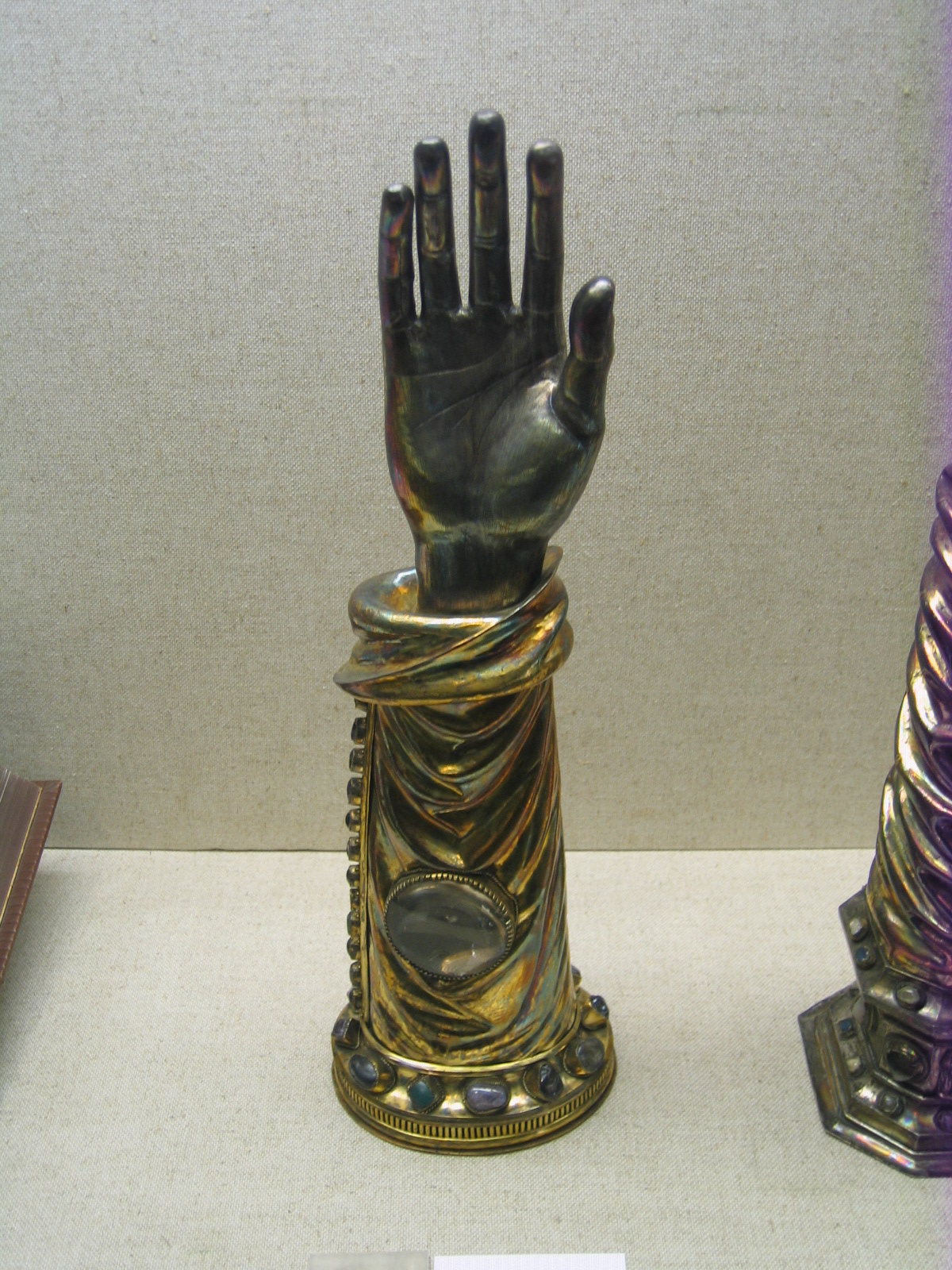
Reliqienarm des hl. Gorgonius. Holzkern mit Silberbeschlag, teilweise vergoldet, 2. Viertel des 15. Jhdts., Höhe 47,7 cm. Hinter einem Bergkristall die Reliquie des hl. Gorgonius, des Patrons des Domes, die einzige Reliquie des Gorgonius, die sich heute noch beim Dom befindet. Heinrich der Löwe hatte sie vermutlich von einer Wallfahrt mitgebracht. Er wurde 1168 im Dom zu Minden mit der englischen Prinzessin Mathilde von Bischof Werner von Bückeburg getraut. In der unteren Steinreihe befindet sich eine Gemme, darin eingeschnitten ein Korb mit Ähren, aus dem 1.-2. Jhdt. nach Christus. Dom zu Minden in Minden, Kreis Minden-Lübbecke, Nordrhein-Westfalen.
Arm
reliquary of Gorgonius of Nicomedia. Cathedral in Minden, District of Minden-Lübbecke, North Rhine-Westphalia, Germany.
Bras
reliquaire de saint Gorgonius. Noyau en bois orné de garnitures en argent,
partiellement doré, deuxième quart du XVe siècle, hauteur 47,7 cm. Derrière un
cristal de roche se trouve la relique de saint Gorgonius, saint patron de la
cathédrale, la seule relique de Gorgonius encore conservée dans l'édifice
aujourd'hui. Henri le Lion l'aurait probablement rapportée d'un pèlerinage. Il
épousa la princesse anglaise Mathilde à la cathédrale de Minden en 1168, lors
d'une cérémonie célébrée par l'évêque Werner de Bückeburg. Dans la rangée
inférieure de pierres se trouve une gemme, sculptée d'un panier d'épis de blé,
datant du Ier ou IIe siècle ap. J.-C. Cathédral à Minden, arrondissement de Minden-Lübbecke, Rhénanie-du-Nord-Westphalie, Allemagne.
De hellige Peter
Cubicularius, Gorgonios og Dorotheos av Nikomedia (d. 303)
Minnedag:
12. mars
De hellige Peter,
Gorgonios (lat: Gorgonius), og Dorotheos (lat: Dorotheus) levde på slutten av
200-tallet i Nikomedia i Bitynia i Lilleasia (i dag Izmit i Tyrkia), hvor de
romerske keiserne hadde en av sine favorittresidenser. Keiser på den tiden
var Diokletian (284-305),
og de sto alle tre i hans tjeneste: Peter var keiserens kammerherre (cubicularius),
Dorotheos hadde ansvaret for det kongelige sengekammer og Gorgonius var også en
høy tjenestemann i keiserpalasset. Alle tre var kristne, og de ble noen av de
første ofrene i den siste store forfølgelsen som Diokletian satte i gang i 303
og som var spesielt sterk i denne delen av imperiet.
Den berømte
kirkehistorikeren Eusebius av
Caesarea (ca 260-340) forteller i sin Kirkehistorie (Historia
ecclesiastica) hvordan forfølgelsene begynte. Keiser Diokletian utstedte
den 24. februar 303 et edikt som ga ordre om at alle kirker og hellige bøker
skulle ødeleggelses. Like etter promulgeringen av ediktet brøt det ut en brann
i keiserpalasset i Nikomedia, som de lokale kristne fikk skylden for. Årsaken
til brannen var uten tvil et dårlig slukket lys eller en gnist fra kjøkkenet.
Men det var et etterlengtet påskudd til å anklage de kristne, og keiseren
bestemte seg for en voldsom forfølgelse.{Eusebius, Historia Ecclesiastica,
VIII 6, 13}
Eusebius skriver at en
nidkjær kristen rev ned det keiserlige ediktet, og fra da av ble de kristne
prestene bedt om å ofre røkelse til de hedenske gudene hver gang de viste seg
offentlig. Byens biskop, den hellige Anthimos,
nektet å ofre, og da ble han halshogd i 303. Svært mange kristne henrettet på
keiserens ordre da forfølgelsene ble utvidet til også å gjelde legfolk. Alle
som ikke hadde tid til å flykte, ble brent levende, mens noen ble kastet i
sjøen. Noen snakker om 2 000 martyrer, andre om 20 000.
Keiseren fikk høre at det
fantes kristne i hans eget hushold, og han arrangerte da en enkel test for å
røyke dem ut. Gudebilder ble satt frem, og alle fikk ordre om å frembære offer
til dem. De kristne nektet, og den første som ble offer for keiserens hevn, var
Peter Cubicularius. Han ble kledd naken og hengt opp i luften, deretter
ble han pisket til kjøttet løsnet fra beina og skjelettet var synlig. Så ble en
blanding av eddik og salt helt i sårene.
Da protesterte Gorgonios
og Dorotheos overfor keiseren fordi han valgte seg ut Peter: «Hans tro er også
vår. Frem til nå har vi kjempet for deg, men fra nå av skal vi tjene den Gud
som skapte oss». De og en tjenestemann ved navn Migdonios ble da også torturert
og hengt (ifølge andre kilder var Migdonius en tjenestemann ved palasset i
Roma, drept der 303). I mellomtiden ble Peter, som forble like urokkelig,
skåret ned, trampet på og til slutt grillet langsomt over en rist til han døde.
De tre martyrene hadde en
godt attestert kult både i øst og vest den 12. mars (11. mars nevnes også).
Flere andre navn finnes i de ulike martyrologiene sammen med de nevnte, og det
er mulig at de alle døde ved samme anledning – se De 20 000
martyrer av Nikomedia. Dorotheus og Gorgonius æres av grekerne også den 9.
september. I Martyrologium Romanum er bare Peter oppført den 12. mars.
Deres ledsagere kalles
hos bollandistene de hellige Migdonius (prest), en annen Migdonius, Euticius
(Eunenus), Maxima (Maximus), Donata (Domna) (jomfru), Ruginus, Marius,
Smaragdus, Hilarius, Evengulus (Vingelosinus), Quirinus, Mareasus, Nestorius,
Eugenius og Matulus (Marulus). I takt med de økte smertene økte også martyrenes
mot. Midt i sine lidelser ropte de ut: «Hedningenes avguder er demoner, det er
Herren som har skapt alt!»
Denne Gorgonios er
feilaktig blandet sammen med den hellige martyren Gorgonius av Roma, som
skal ha lidd martyrdøden rundt 290 og har minnedag den 9. september. Legenden
om Gorgonius av Roma slik den står i Martyrologium Romanum, er egentlig om
Gorgonius av Nikomedia:
Legenden forteller at
Gorgonius skal ha vært hoffmann hos keiser Diokletian i Nikomedia. Han og
kollegaen Dorotheos falt imidlertid i unåde da de protesterte mot torturen av
en kristen ved navn Peter, og de ble arrestert. Legenden forteller at Peter
først ble hudflådd så kjøttet løsnet fra beina, deretter ble hans sår overhelt
med eddik og salt og til slutt ble han grillet langsomt over en rist til han
døde. Gorgonius’ legeme ble senere tatt med til Roma.
Det er nesten sikkert den
hellige martyrologisten Ado av Vienne som
har ansvaret for denne forvekslingen, og han ble fulgt av Usuard og den
ærverdige kardinal Cesare Baronius (1538-1607),
lærd oratorianer og kirkehistoriker, da han reviderte Martyrologium Romanum på
slutten av 1500-tallet.
Kilder: Attwater/Cumming,
Farmer, Butler (III), Butler (IX), Benedictines, Bunson, Gorys, KIR, CE, Patron
Saints SQPN, Infocatho, en.wikipedia.org, zeno.org, ocafs.oca.org - Kompilasjon
og oversettelse: p. Per Einar Odden
Opprettet: 6. juli 1998
SOURCE : https://www.katolsk.no/biografier/historisk/dnikomed
De 20 000 martyrer av
Nikomedia (d. 303)
Minnedag:
28. desember
Den berømte
kirkehistorikeren Eusebius
av Caesarea (ca 260-340) forteller i sin Kirkehistorie (Historia
ecclesiastica) hvordan forfølgelsene begynte. Keiser Diokletian utstedte
den 24. februar 303 et edikt som ga ordre om at alle kirker og hellige bøker
skulle ødelegges. Like etter promulgeringen av ediktet brøt det ut en brann i
keiserpalasset i Nikomedia, som de lokale kristne fikk skylden for. Årsaken til
brannen var uten tvil et dårlig slukket lys eller en gnist fra kjøkkenet. Men
det var et etterlengtet påskudd til å anklage de kristne, og keiseren bestemte
seg for en voldsom forfølgelse.{Eusebius, Historia Ecclesiastica, VIII 6,
13}
Eusebius skriver at en
nidkjær kristen rev ned det keiserlige ediktet, og fra da av ble de kristne
prestene bedt om å ofre røkelse til de hedenske gudene hver gang de viste seg
offentlig. Byens biskop, den hellige Anthimos, nektet å
ofre, og da ble han halshogd i 303. Svært mange kristne henrettet på keiserens
ordre da forfølgelsene ble utvidet til også å gjelde legfolk. Alle som ikke
hadde tid til å flykte, ble brent levende, mens noen ble kastet i sjøen, noen
ble halshogd og noen ble begravd levende. 20 000 kristne skal ha blitt
brent inne i en kirke på juledag 303.
Blant de første som led
martyrdøden, var tre av keiserens mest betrodde menn i palasset, de
hellige Gorgonios,
Peter og Dorotheos. Blant dem som ble kastet i fengsel, var Mardonios,
diakonen Migdonios og andre. Biskop Anthimos oppmuntret dem ved å sende brev
til dem. En av budbringerne, diakonen Theofilos, ble tatt og torturert for å få
ham til å røpe hvor biskopen gjemte seg. Men han avslørte ingenting og ble til
slutt henrettet. Det samme ble dem som biskopen hadde skrevet til i fengselet.
Selv om de ble henrettet på ulikt vis, viste de alle det samme mot og mottok
sine kroner fra Gud.
En stund etter gikk
keiseren inn i en kirke og forlangte at alle der inne skulle avsverge Kristus;
hvis de nektet, lovte han å brenne kirken og drepe alle de kristne som var der.
Den kristne presten Glykerios svarte ham at de kristne aldri avsverger sin tro,
selv under trussel om tortur. Keiseren skjulte sitt sinne og forlot kirken, men
etter en stund ga han ordre om at presten Glykerios skulle arresteres og
stilles for retten. Han ble torturert, men han fortsatte hele tiden å be og
påkalle Herrens navn. Da keiseren ikke klarte å tvinge en avsvergelse ut av
Glykerios, ga han ordre om at han skulle brennes levende. Glykerios ble bundet
til en påle og deretter brent.
Keiseren trodde at han nå
hadde utryddet alle kristne i Nikomedia, men han fant snart ut at det var mange
igjen og at de alle fortsatt ville bekjenne sin tro og var villige til å dø for
Kristus. Keiseren grublet over hva han skulle gjøre. Kommandanten for et
regiment Zeno (Zenon, Zinon) fordømte modig keiser Diokletians framferd i full
offentlighet, og han ble da på keiserens ordre arrestert, steinet og deretter
halshogd. Keiserens menn fengslet kammerpiken Indes (i andre versjoner evnukken
Indysos) fordi han nektet å delta i feiringen av en hedensk festdag. Jomfruen
Domna, en tidligere hedensk prestinne, og Euthymios led også martyrdøden i
hedningenes hender på grunn av sin omsorg for at legemene til de hellige
martyrene skulle få en verdig begravelse. De 20 000 martyrene feires den
28. desember i den ortodokse kirke.
Hos bollandistene står
den 28. desember Indes, Domna, Gorgonius, Peter, Dorotheus, Theofilus og Agape.
I aktene hos Surius den 26. desember forekommer også alle disse, men i stedet
for martyren Theofilus står Theofila. Men i tillegg har Surius også noen andre
navn, som også alle opptrer hos bollandistene, men på andre dager. Det gjelder
Glykerios (21. desember), Mardonius med Migdonius (23. desember), Zeno (22.
desember) og Euthymios (24. desember). Alle disse inngår i den store mengden
som på slutten av aktene angis til 20 000 martyrer.
Kilder: Bautz,
Heiligenlexikon, en.wikipedia.org, ocafs.oca.org, goarch.org, orthodox.cn -
Kompilasjon og oversettelse: p. Per Einar Odden
Opprettet: 5. juli 1998
SOURCE : https://www.katolsk.no/biografier/historisk/pnikomed