
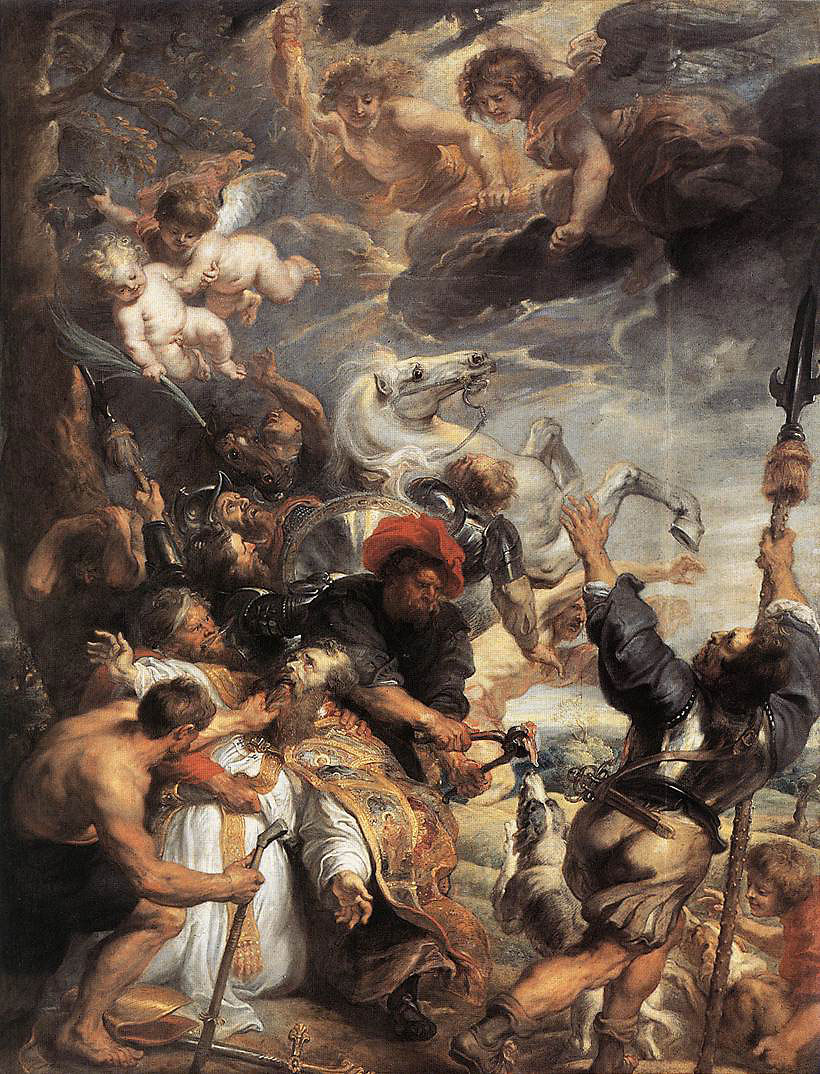
Rubens, Le Martyre de Saint Livinus, 1633, 455 x
347, Bruxelles, musées royaux des Beaux-Arts
de Belgique.
Peter Paul Rubens (1577–1640), The
Martyrdom of St Livinus, 1633, 413 x 347, Royal Museums of Fine Arts
of Belgium, Brussels
Peter
Paul Rubens, De marteling van de Heilige Livinus
http://193.190.214.119/art-foto/Rubensdatabase/Rubens-161_Catalogue_FR.pdf
Saint Livin
Évêque et martyr à
Gand (+ v. 657)
Lievin ou Lebuin.
Evêque irlandais et
apôtre de la Flandre occidentale. Il évangélisa la région, mais un jour qu'il
prêchait aux habitants d'Esche, il fut assassiné par un groupe de païens
hostile à sa prédication. Il est l'un des patrons de la ville de Gand,
considéré comme un martyr.
SOURCE : http://nominis.cef.fr/contenus/saint/9075/Saint-Livin.html

Laurent
Delvaux, Saint Liévin, marbre, musée des Beaux-Arts de Gand.
Laurent Delvaux (1696–1778), St Livinus.
Marble. Museum of Fine Arts Ghent (MSK)
Also
known as
Apostle of Flanders
Lebuino
Lebwin
Levinus
Liévin
Lievens
Livino
25 June (translation
of relics)
Profile
Son of a Scottish nobleman
and an Irish princess,
he was raised in Ireland,
and studied there and
in England. Ordained by Saint Augustine
of Canterbury. Highly successful missionary to Flanders, Belgium with
three companions. Bishop of Ghent, Belgium. Tortured by pagans, his tongue
was torn out to stop his preaching;
legend says tongue continued
to preach on
its own. Martyr.
Born
in the British Isles
martyred 12 November 633 near
Alost, Brabant, Belgium
relics translated
to Ghent, Belgium
in Belgium
bishop holding
his tongue with
a pair of tongs
bishop with
his tongue being
torn out
Additional
Information
Book of
Saints, by the Monks of
Ramsgate
Lives
of the Saints, by Father Alban
Butler
Roman
Martyrology, 1914 edition
Saints
of the Order of Saint Benedict, by Father Aegedius
Ranbeck, O.S.B.
books
Our Sunday Visitor’s Encyclopedia of Saints
Saints
and Their Attributes, by Helen Roeder
other
sites in english
images
fonti
in italiano
nettsteder
i norsk
MLA
Citation
‘Saint Livinus‘. CatholicSaints.Info.
6 December 2023. Web. 22 June 2026.
<https://catholicsaints.info/saint-livinus/>
SOURCE : https://catholicsaints.info/saint-livinus/

Buste
de Saint Liévin. Église Saint-Omer classée M.H., Merck-Saint-Liévin.
Article
(Lebwin) (Saint)
Bishop, Martyr (November
12) (7th
century) An Irish Saint who, desirous of winning souls to God, repaired to
Saint Augustine of Canterbury and was by him ordained priest and speeded on his
way to Flanders, then sadly in need of missionaries. Saint Livinus paid a
farewell visit to Ireland, whence he returned already consecrated Bishop and
accompanied by several other holy and zealous men. In Flanders his Apostolate
was most fruitful and was crowned by the martyrdom of the holy man at the hands
of the Pagans (A.D. 650 about). His relics were enshrined at Ghent.
MLA
Citation
Monks of Ramsgate.
“Livinus”. Book of Saints, 1921. CatholicSaints.Info.
8 November 2014. Web. 22 June 2026.
<https://catholicsaints.info/book-of-saints-livinus/>
SOURCE : https://catholicsaints.info/book-of-saints-livinus/

Saint
Livinus and Saint Margaret of Antioch, circa 1450, oil on panel.
10.5 x 10.5, Vlaamse Kunstcollectie, Museum of Fine Arts Ghent (MSK)
Livinus of Alost BM (RM)
(also known as Lebwin)
Died c. 650. An Irishman
by birth, he was ordained a priest by Saint Augustine of Canterbury, and sailed
to Flanders, where for some years he preached the gospel with great success. At
some time during this period he is said to have been consecrated bishop in
Ireland. He was martyred with several companions near Alost, Brabant, Belgium.
His relics are enshrined and venerated at Ghent. He is perhaps to be identified
with as Saint Lebuinus (Benedictines, Montague). Saint Lebwin is shown as a
bishop holding his tongue with a pair of tongs (because it was plucked out).
Venerated at Alost (Roeder).
SOURCE : http://www.saintpatrickdc.org/ss/1112.shtml

Reliquary
bust of Saint Livinus, Gilded silver, 14th century. Treasury of Saint Servatius
Basilica, Maastricht, Netherlands.
Reliekhouder
in de vorm van portretbuste Sint Lieven (Livinus), verguld zilver, 14e eeuw.
Schatkamer Sint-Servaasbasiliek, Maastricht.
St. Livinus
Feastday: November 12
Birth: 580
Death: 657
Martyred Irish bishop,
ordained by St. Augustine of Canterbury, England. He was the son of a Scottish
noble and an Irish princess. Livinus and three companions went to Flanders,
Belgium, where they evangelized the area. He was martyred near Clost, in
Brabant. Also called Lebwin, he is identified by some scholars with St.
Lebuinus.
SOURCE : https://www.catholic.org/saints/saint.php?saint_id=4295

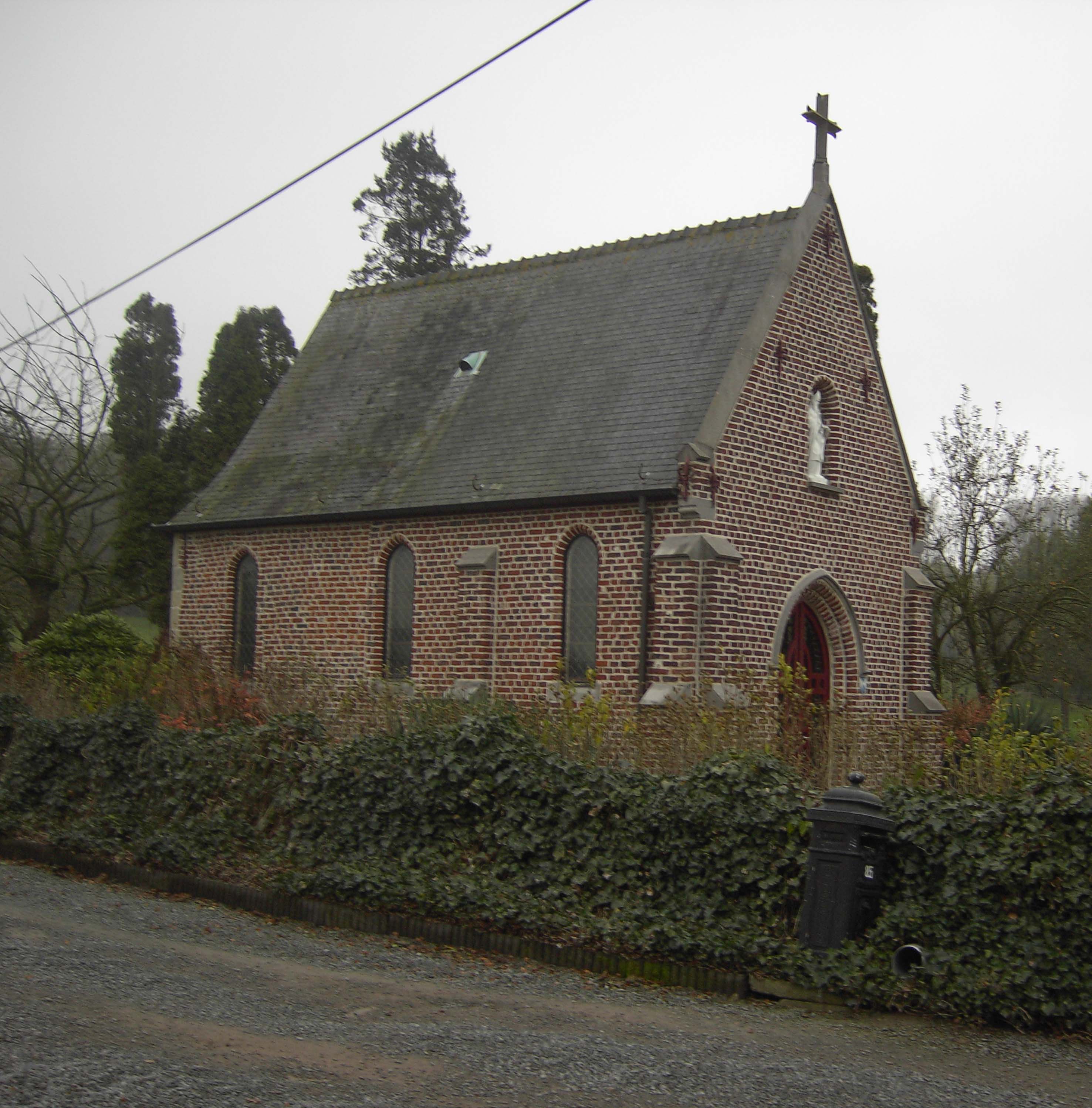
Chapelle
Saint-Liévin, à Hauthem, à l'endroit de son enterrement près
d'une source miraculeuse qu'il découvrit.
Sint-Livinuskapel
- Sint-Lievens-Houtem - Oost-Vlaanderen -
België.
Livinus, Saint
Livinus, Saint called the
apostle of Brabant, was born in Ireland, it is said of noble parents, and
received his education there. He was bishop of Dublin in 656. Being actuated by
religious zeal, he intrusted his diocese in Ireland to the management of its
archdeacon, and went to Ghent with three of his disciples, and, for a month,
offered up mass at the tomb of St. Bavo every day, and afterwards went to Esca
and preached the gospel, and converted numbers. He was murdered by some of the
pagan inhabitants, November 12, 656. See D'Alton, Memoirs of the
Archbishops of Dublin, page 16.
SOURCE : https://www.biblicalcyclopedia.com/L/livinus-saint.html

Beeld
in de Sint-Lievenkerk te Ledeberg
November 12
St. Livin, Bishop and Martyr
THIS saint was a learned and zealous Irish bishop, who
went over into Flanders to preach the faith to the idolaters. To enter upon
that work by dedicating himself a holocaust to God, he spent thirty days in
prayer at the tomb of St. Bavo, at Ghent, and offered there every day the holy
sacrifice. After this solemn consecration of himself to his Redeemer, he began
to announce the word of life, and converted many about the country of Alost and
Hautem. Having cultivated the study of poetry in his youth, he composed an
elegy on St. Bavo, who died only six years before him. 1 St.
Livin was massacred by the pagans, at Esche, in the year 633, according to
Colgan, who mentions him to have been bishop of Dublin before he went to the
mission of Flanders. His death is placed by others in 656. He was buried at
Hautem, three miles from Ghent; and his relics were translated to the great
monastery of St. Peter’s at Ghent, in 1006. In a shrine by that of St. Livin
are preserved the relics of St. Craphaildes, a lady in whose house St. Livin
was martyred. She was murdered by the same barbarians, for lamenting his death,
and her infant son Brictius, whom St. Livin had lately baptized. The infant
martyr’s bones are kept in the same shrine with those of St. Livin. St.
Brictius is commemorated in a collect with other saints of this monastery.
Usher 2 and
Mabillon have also published a letter of St. Livin, whose name occurs in the
Roman Martyrology on this day. See his life written by one Boniface in the same
age, in Mabillon, Sæc. 2, Ben. p. 251; Cointe, Annal. Fr. ad an. 651; Fleury,
l. 38, n. 58; Miræus, in Fastis Belg. Sanders, Rerum Gandav. l. 4, p. 342; and
Colgan, Trias Thaum. p. 112, n. 69.
Note 1. This elegy it published by Usher, and
Mabill. Sæc. 2 Ben. p. 461, and read in the old office of St. Bavo, at Ghent,
published by Gerard Salenson. [back]
Note 2. Hybern. Epist. Sylloge, p. 19. [back]
Rev. Alban Butler (1711–73). Volume
XI: November. The Lives of the Saints. 1866.
SOURCE : http://www.bartleby.com/210/11/123.html

Tafereel
uit het leven van Livinus, kerk van Elverdinge
Inscription : De H. Livinus draagt zijn eigen hoofd
Saints
of the Order of Saint Benedict – Saint Levinus, Archbishop and Martyr
Saint Levinus, who was the son of a Scotch noble, and
was destined to win fame in the four-fold capacity of Monk, Archbishop,
Apostle, and Martyr, had the good fortune to be baptized by Saint Augustine,
the Apostle and Primate of England. After receiving the rudiments of his
education in his native land, the boy was sent by his parents back to
Augustine. The Primate received him with as much joy as a father would a son,
and had him carefully trained in every branch of learning and piety. The
example of the good monks, his instructors, inspired Levinus with the desire to
enroll himself under the standard of Saint Benedict. The young novice soon
became perfect in the discharge of every monastic duty, and then, by the order
of Augustine, he returned to Scotland.
His reputation for sanctity had preceded him; so we
hear that his countrymen urged that such virtue ought not to be confined within
the cloister, but that the King should appoint Levinus to the Archbishopric,
which was then vacant. Long did our Saint decline the honour; but when the
command of his Abbot was added to that of the King, he was obliged to accept
it. For several years he ruled his See with the greatest success; but, like so
many other Scotch Saints, fired with zeal for spreading the Faith among heathen
nations, he handed over the Pontificate to Silvanus, and with three companions
crossed to Flanders.
There Floribert, the Abbot of Ghent, a monastery which
had recently been founded by Saint Amandus, gave a hearty welcome to the
missionaries. After they had rested there for some time and thoroughly equipped
themselves for their campaign, the four soldiers of Christ set out for the
wildest and most savage part of Flanders to wage war on idolatry. This campaign
was crowned with victory; the false gods were thrown down from their pedestals,
and the standard of the Cross was carried in triumph as far as Holta. The
inhabitants of this district, too, were won over in great numbers to Christianity
by the miracles which Saint Levinus was empowered to perform.
However, there were yet left in Holta some fierce and
obstinate pagans, who were enraged at seeing their old gods overthrown by a few
cowled monks. These, carried away by frenzy, made an attack on Levinus as he
was engaged in meditation in his house. Dragging him out of doors, they
cudgelled and beat him, and finally tearing his tongue out by the roots, they
threw it to their dogs. The glorious prize of martyrdom for which Levinus longed
was not yet to be his. By the power of the Almighty, he, whom his murderers had
left for dead, revived, and, when his tongue was replaced in his mouth, he
recovered the complete use of it.
His reward now was not far off. At Hesca, a village in
Flanders, his bloodthirsty enemies again set on him. So savagely did they hew
and hack him, that his body was cut in pieces, A.D. 633.
His remains, which were first interred near Deventer,
were transferred A.D. 1007 to the Monastery of Ghent, and he is honoured to
this day as one of the chief patron Saints of Flanders.
– text and illustration taken from Saints
of the Order of Saint Benedict by Father Aegedius
Ranbeck, O.S.B.


_%C3%A9glise_Saint-Omer_PA00108347_(14).JPG)
.jpg)
2.jpg)


.JPG)
Scuola
dei Paesi Bassi meridionali, ante del trittico di Zierikzee, con Filippo il Bello e Giovanna la Pazza, 1495-1506 ca.
Early
Netherlandish paintings in the Royal Museums of Fine Arts of Belgium
Triptiek
van Zierikzee (Koninklijke Musea voor Schone Kunsten van België, Brussel);
keerzijde rechterluik: De heilige Martinus (Inv.-Nr.: 2406); keerzijde
linkerluik: De heilige Livinus (Inv.-Nr: 2405)
San Livino (Lebuino) Vescovo
† Houtem (Belgio), 775
ca.
Martirologio Romano: A
Deventer in Frisia, nell’odierna Olanda, san Lebuino, sacerdote, che, monaco
venuto dall’Inghilterra, si adoperò per annunciare agli abitanti di questa
regione la pace e la salvezza di Cristo.
Nonostante le incertezze
sulle notizie della vita, esistono di lui varie raffigurazioni artistiche,
prima fra tutte il grande quadro d’altare, dipinto da Pietro Paolo Rubens, oggi
nel Musées des Beaux Arts di Bruxelles, dove s. Livino in abiti vescovili,
subisce il martirio con l’estirpazione della lingua, che viene data in pasto ai
cani, mentre nel cielo si scatena una tempesta che spaventa i crudeli
assassini.
La prima menzione di s.
Livino si legge in una lettera dell’abate Othelbold di S. Bavone di Gent (nome
fiammingo di Gand) in Belgio, che nel 1025 inventariava le reliquie del tesoro
dell’abbazia, nominando s. Livino vescovo di Scozia ucciso presso Houtem in
Belgio e da cui le reliquie nel 1007, furono traslate a S. Bavone di Gent.
Il suo culto fu sostenuto
dai monaci di S. Bavone, ma sembra uno sdoppiamento del culto di s. Lebuino
patrono di Deventer morto nel 775. Nel 1050 fu composta una leggenda molto
fantastica, secondo la quale, Livino o Lebuino avrebbe attraversato a piedi
asciutti il mare dall’Irlanda - Scozia? all’Inghilterra e da qui in Belgio,
morendo nel VII secolo.
Della traslazione a Gent
(Gand) del 1007, esiste una relazione scritta, mentre nel 1171 fu effettuata
una ricognizione per sfatare le calunnie sull’esistenza delle reliquie, messe
in giro dai monaci di S. Pietro di Gent, concorrenti con quelli di S. Bavone
per il possesso di reliquie.
Dal XII secolo s. Livino
o Lebuino viene celebrato liturgicamente a Gent e compare in tre codici di
Monaco e dal secolo XV il suo nome compare in vari ‘Martirologi’ storici
dell’epoca, dai quali passò poi nel ‘Martirologio Romano’ al 12 novembre; nella
moderna edizione egli è ricordato sempre al 12 novembre ma con il nome di
Lebuino.
Autore: Antonio
Borrelli