
Saint Colman Mac Duagh
Évêque irlandais (+
v. 632)
A lire (en anglais) la vie de saint Colman Mac Duagh.
À Kilmacduagh en Irlande, vers 632, saint Colman Mac Duagh, évêque. Moine
ordonné évêque malgré lui, il vécut avec un seul disciple, de légumes et d'eau,
puis fonda un monastère à Killmacduagh, qui le vénère comme son premier évêque.
Martyrologe romain
SOURCE : https://nominis.cef.fr/contenus/saint/10553/Saint-Colman-Mac-Duagh.html
Saint Colman Mac Duagh,
évêque en Irlande († v. 632)
Martyrologe Romain :
À Kilmacduagh en Irlande, vers 632, saint Colman Mac Duagh, évêque. Moine
ordonné évêque malgré lui, il vécut avec un seul disciple de légumes et d’eau,
puis fonda un monastère à Killmacduagh, qui le vénère comme son premier évêque.
©Evangelizo.org 2001-2016

Cathédrale
de Kilmacduagh, avec la tour ronde en arrière-plan
The
ruins of the Kilmacduagh cathedral
Ruiny klasztoru Kilmacduagh, Irlandia

Cathédrale
de Kilmacduagh, avec la tour ronde en arrière-plan
The
ruins of the Kilmacduagh cathedral
Ruiny
klasztoru Kilmacduagh, Irlandia
2
February on some rolls
Profile
Son of a chieftain named
Duagh. Hermit in
Arranmore where he built two churches. His reputation for holiness attracted
too much attention, so he retreated to the woods of Burren in 592 to
live in isolation. In 610,
on land donated by King Guaire
of Connacht, he founded a monastery which
became the center of the diocese of Kilmacduagh.
He reluctantly served as the house’s first abbot,
the diocese‘s
first bishop.
Born
29
October 632 of
natural causes
1903 by Pope Leo
XIII (cultus
confirmed)
Kilmacduagh, Ireland, diocese of
Additional
Information
Book
of Saints, by the Monks of
Ramsgate
Book
of Saints and Wonders, by Lady Gregory
Saints
of the Day, by Katherine Rabenstein
books
Battersby’s Registry for
the Whole World
Our Sunday Visitor’s Encyclopedia of Saints
other
sites in english
Catholic Heroes, part 1
Catholic Heroes, part 2
sitios
en español
Martirologio Romano, 2001 edición
fonti
in italiano
MLA
Citation
“Saint Colman of
Kilmacduagh“. CatholicSaints.Info. 7 May 2023. Web. 1 May 2026. <https://catholicsaints.info/saint-colman-of-kilmacduagh/>
SOURCE : https://catholicsaints.info/saint-colman-of-kilmacduagh/
Book of Saints
– Colman of Kilmacduagh
Article
COLMAN of KILMACDUAGH
(Saint) Bishop (October 29) (7th century) The son of the chieftain Duacus,
whence the name of the Episcopal See founded by the holy man. Towards the close
of his life Saint Colman retired into a hermitage, where he passed away about
A.D. 630.
MLA
Citation
Monks of Ramsgate.
“Colman of Kilmacduagh”. Book of Saints, 1921. CatholicSaints.Info. 12
October 2012.
Web. 1 May 2026.
<http://catholicsaints.info/book-of-saints-colman-of-kilmacduagh/>
SOURCE : https://catholicsaints.info/book-of-saints-colman-of-kilmacduagh/
St. Colman of Kilmacduagh
Feastday: October 29
Birth: 550
Death: 632
Abbot-bishop, son of the
Irish chieftain, Duac. He lived as a hermit at Arranmore and Burren, in County
Clare, Ireland. Made a bishop against
he will, he founded a monastery at Kilmacduagh, on landgiven by King Guaire of
Connaught.
SOURCE : https://www.catholic.org/saints/saint.php?saint_id=2700

Saint
Colman MacDuagh window, Hugh Lane Gallery
Colman of Kilmacduagh B
(AC)
Born at Corker, Kiltartan,
Galway, Ireland, c. 550; died 632; cultus approved in 1903. Son of the Irish
chieftain Duac, Colman was educated at Saint Enda's monastery in Aran.
Thereafter he was a recluse, living in prayer and prolonged fastings, at
Arranmore and then at Burren in County Clare. With King Guaire of Connaught he
founded the monastery of Kilmacduagh, i.e., the church of the son of Duac, and
governed it as abbot-bishop. The "leaning tower of Kilmacduagh," 112
feet high, is almost twice as old as the famous town in Pisa. The Irish round
tower was restored in 1880.
There is a legend that
angels brought King Guaire to him by causing his festive Easter dinner to
disappear from his table. The king and his court followed the angels to the
place where Colman had kept the Lenten fast and now was without food. The path
of this legendary journey is called the "road of the dishes."
As with many relics,
Saint Colman's abbatial crozier has been used through the centuries for the
swearing of oaths. Although it was in the custodianship of the O'Heynes of
Kiltartan (descendants of King Guaire) and their relatives, the O'Shaughnessys,
it can now be seen in the National Museum in Dublin (Attwater, Benedictines,
Carty, D'Arcy, Farmer, MacLysaght, Montague, Stokes).
Other tales are recounted
about Saint Colman, who loved birds and animals. He had a pet rooster who
served as an alarm clock at a time before there were such modern conveniences.
The rooster would begin his song at the breaking of dawn and continue until
Colman would come out and speak to it. Colman would then call the other monks
to prayer by ringing the bells.
But the monks wanted to
pray the night hours, too, and couldn't count on the rooster to awaken them at
midnight and 3:00 a.m. So Colman made a pet out of a mouse that often kept him
company in the night by giving it crumbs to eat. Eventually the mouse was tamed
and Colman asked its help:
"So you are awake
all night, are you? It isn't your time for sleep, is it? My friend, the cock,
gives me great help, waking me every morning. Couldn't you do the same for me
at night, while the cock is asleep? If you do not find me stirring at the usual
time, couldn't you call me? Will you do that?"
It was a long time before
Colman tested the understanding of the mouse. After a long day of preaching and
travelling on foot, Colman slept very soundly. When he did not awake at the
usual hour in the middle of the night for Lauds, the mouse pattered over to the
bed, climbed on the pillow, and rubbed his tiny head against Colman's ear. Not
enough to awaken the exhausted monk. So the mouse tried again, but Colman shook
him off impatiently. Making one last effort, the mouse nibbled on the saint's
ear and Colman immediately arose--laughing. The mouse, looking very serious and
important, just sat there on the pillow staring at the monk, while Colman
continued to laugh in disbelief that the mouse had indeed understood its job.
When he regained his
composure, Colman praised the clever mouse for his faithfulness and fed him
extra treats. Then entered God's presence in prayer. Thereafter, Colman always
waited for the mouse to rub his ear before arising, whether he was awake or
not. The mouse never failed in his mission.
The monk had another
strange pet: a fly. Each day Colman would spend some time reading a large,
awkward parchment manuscript prayer book. Each day the fly would perch on the
margin of the sheet. Eventually Colman began to talk to the fly, thanked him
for his company, and asked for his help:
"Do you think you
could do something useful for me? You see yourself that everyone who lives in
the monastery is useful. Well, if I am called away, as I often am, while I am
reading, don't you go too; stay here on the spot I mark with my finger, so that
I'll know exactly where to start when I come back. Do you see what I
mean?"
So, as with the mouse, it
was a long time before Colman put the understanding of the fly to the test. He
probably provided the insect with treats as he did the mouse--perhaps a single
drop of honey or crumb of cake. One day Colman was called to attend a visitor.
He pointed the spot on the manuscript where he had stopped and asked the fly to
stay there until he returned. The fly did as the saint requested, obediently
remaining still for over an hour. Colman was delighted. Thereafter, he often
gave the faithful fly a little task that it was proud to do for him. The other
monks thought it was such a marvel that they wrote it done in the monastery
records, which is how we know about it.
But a fly's life is
short. At the end of summer, Colman's little friend was dead. While still
mourning the death of the fly, the mouse died, too, as did the rooster.
Colman's heart was so heavy at the loss of his last pet that he wrote to his
friend Saint Columba. Columba responded:
"You were too rich
when you had them. That is why you are sad now. Trouble like that only comes
where there are riches. Be rich no more." Colman then realized that one
can be rich without any money (Curtayne).
SOURCE : http://www.saintpatrickdc.org/ss/1029.shtml
St. Colman
Bishop and
patron of Kilmacduagh,
born at Kiltartan c. 560; died 29 October, 632. He lived for many years as
a hermit in
Arranmore, where he built two churches, both forming the present group of
ruins at Kilmurvy. Thence he sought greater seclusion in the woods of Burren,
in 592, and at length, in 610, founded a monastery,
which became the centre of the tribal Diocese of Aidhne, practically
coextensive with the present See
of Kilmacduagh. Although the "Martyrology of Donegal" assigns
his feast to
2 February, yet the weight of evidence and the tradition of the diocese point
to 29 October, on which day his festival has been kept from time
immemorial, and which was fixed by a rescript of Pope
Benedict XIV, in 1747, as a major double.
Sources
Martyrology of Donegal, ed.
TODD AND REEVES (Dublin, 1864); Customs of Hy-Fiachrach, ed.
O'DONOVAN; LANIGAN, Ecclesiastical History of Ireland (Dublin, 1829);
II; COLGAN, Acta Sanct. Hib. (Louvain, 1645); PETRIE, Round
Towers (Dublin, 1845); FAHEY, Hist. and Ant. of Kilmacduagh (1893).
Grattan-Flood, William.
"St. Colman." The Catholic Encyclopedia. Vol. 4. New York: Robert
Appleton Company, 1908. 29 Oct. 2015
<http://www.newadvent.org/cathen/04114b.htm>.
Transcription. This article was transcribed for New Advent by Douglas J.
Potter. Dedicated to the Immaculate Heart of the Blessed Virgin Mary.
Ecclesiastical
approbation. Nihil Obstat. Remy Lafort, Censor. Imprimatur. +John
M. Farley, Archbishop of New York.
Copyright © 2026 by New Advent LLC.
Dedicated to the Immaculate Heart of Mary.
SOURCE : http://www.newadvent.org/cathen/04114b.htm
St. Colman of
Kilmacduagh, Bishop
3 February
In the Martyrology of
Tallaght, St Colman is commemorated on February 3, but in other Calendars and
in Ireland today he is remembered on October 29.
Born at Corker, Kiltartan, Galway, Ireland, c. 550; died 632. Son of the Irish
chieftain Duac, Colman was educated at Saint Enda's (f.d. March
21) monastery in Aran. Thereafter he was a recluse, living in prayer and
prolonged fastings, at Arranmore and then at Burren in County Clare. With King
Guaire of Connaught he founded the monastery of Kilmacduagh, i.e., the church
of the son of Duac, and governed it as abbot-bishop. The "leaning tower of
Kilmacduagh," 112 feet high, is almost twice as old as the famous town in
Pisa. The Irish round tower was restored in 1880.
There is a legend that angels brought King Guaire to him by causing his festive
Easter dinner to disappear from his table. The king and his court followed the
angels to the place where Colman had kept the Lenten fast and now was without
food. The path of this legendary journey is called the "road of the
dishes."
As with many relics, Saint Colman's abbatial crozier has been used through the
centuries for the swearing of oaths. Although it was in the custodianship of
the O'Heynes of Kiltartan (descendants of King Guaire) and their relatives, the
O'Shaughnessys, it can now be seen in the National Museum in Dublin (Attwater, Benedictines, Carty, D'Arcy, Farmer, MacLysaght, Montague, Stokes).
Other tales are recounted about Saint Colman, who loved birds and animals. He
had a pet rooster who served as an alarm clock. The rooster would begin his
song at the breaking of dawn and continue until Colman would come out and speak
to it. Colman would then call the other monks to prayer by ringing the bells.
But the monks wanted to pray the night hours, too, and couldn't count on the
rooster to awaken them at midnight and 3:00 a.m. So Colman made a pet out of a
mouse that often kept him company in the night by giving it crumbs to eat.
Eventually the mouse was tamed and Colman asked its help:
So you are awake all night, are you? It isn't your time for sleep, is it? My
friend, the cock, gives me great help, waking me every morning. Couldn't you do
the same for me at night, while the cock is asleep? If you do not find me
stirring at the usual time, couldn't you call me? Will you do that?
It was a long time before Colman tested the understanding of the mouse. After a
long day of preaching and travelling on foot, Colman slept very soundly. When
he did not awake at the usual hour in the middle of the night for Lauds, the
mouse pattered over to the bed, climbed on the pillow, and rubbed his tiny head
against Colman's ear. Not enough to awaken the exhausted monk. So the mouse
tried again, but Colman shook him off impatiently. Making one last effort, the
mouse nibbled on the saint's ear and Colman immediately arose--laughing. The
mouse, looking very serious and important, just sat there on the pillow staring
at the monk, while Colman continued to laugh in disbelief that the mouse had
indeed understood its job.
When he regained his composure, Colman praised the clever mouse for his
faithfulness and fed him extra treats. Then he entered God's presence in
prayer. Thereafter, Colman always waited for the mouse to rub his ear before
arising, whether he was awake or not. The mouse never failed in his mission.
The monk had another strange pet: a fly. Each day Colman would spend some time
reading a large, awkward parchment manuscript prayer book. Each day the fly
would perch on the margin of the sheet. Eventually Colman began to talk to the
fly, thanked him for his company, and asked for his help:
Do you think you could do something useful for me? You see yourself that
everyone who lives in the monastery is useful. Well, if I am called away, as I
often am, while I am reading, don't you go too; stay here on the spot I mark
with my finger, so that I'll know exactly where to start when I come back. Do
you see what I mean?
So, as with the mouse, it was a long time before Colman put the understanding
of the fly to the test. He probably provided the insect with treats as he did
the mouse--perhaps a single drop of honey or crumb of cake. One day Colman was
called to attend a visitor. He pointed the spot on the manuscript where he had
stopped and asked the fly to stay there until he returned. The fly did as the
saint requested, obediently remaining still for over an hour. Colman was
delighted. Thereafter, he often gave the faithful fly a little task that it was
proud to do for him. The other monks thought it was such a marvel that they
wrote it done in the monastery records, which is how we know about it.
But a fly's life is short. At the end of summer, Colman's little friend was
dead. While still mourning the death of the fly, the mouse died, too, as did
the rooster. Colman's heart was so heavy at the loss of his last pet that he
wrote to his friend Saint
Columba (f.d. June 9). Columba responded:
You were too rich when you had them. That is why you are sad now. Great
troubles only come where there are great riches. Be rich no more.
Troparion of St Colman of Kilmacduagh
Tone 8
Rejecting the nobility of thy birth, O Father Colman,
thou didst seek God in the solitude of desert places.
Thy virtue, like a beacon, drew men unto thee
and thou didst guide them into the way of salvation.
Guide us also by thy prayers, that our souls may be saved.
A Prayer:
May God's angels guard us
and save us till day's end,
protected by God and Mary
and Mac Duach1 and
Mac Daire
and Colm Cille
till days' end.
Aingil De dar gcoimhdeacht
's dar sabhail aris go fuin;
ar coimri De is Mhuire,
Mhic Duach is Mhic Daire
agus Colm Cille
aris go fuin.
1 St. Colman MacDuagh
"An Duanaire 1600-1900: Poems of the Dispossessed"
Photographs of KilMacduagh Monastery:
http://www.monasette.com/blog/gallery/kilmacduagh/
Martyrology of Tallaght:
http://www.celticchristianity.org/
( click on "Library" at page bottom)
SOURCE : https://celticsaints.org/2014/0203b.html

Saint
Colman's well. Photograph taken between ca. 1880 and 1900. Format: glass
negative Part of: National Library of Ireland Lawrence
Collection.
Tobar
Colmán idir 1880-1900
Book
of Saints and Wonders – Great Wonders of the Olden Time – Saint Colman of
Kilmacdaugh
The Birth of Colman of
Aidhne
When Rhinagh that was of
the race of Dathi was with child by Duach, it was told to the King of Connacht
of that time that the son she would bear would be greater than his own sons.
And when he heard that, he bade his people to make an end of Rhinagh before the
child would be born. And they took her and tied a heavy stone about her neck
and threw her into the deep part of the river, where it rises inside Coole. But
by the help of God, the stone that was put about her neck did not sink but went
floating upon the water, and she came to the shore and was saved from drowning.
And that stone is to be seen yet, and it having the mark of the rope that was
put around it.
And just at that time
there was a blind man had a dream in the north about a well beside a certain
ash tree, and he was told in the dream he would get his sight if he bathed in
the water of that well. And a lame man had a dream about the same well that he
would find at Kiltartan, and that there would be healing in it for his lameness.
And they set out together, the lame man carrying the man that had lost his
sight, till they came to the tree they had dreamed about. But all the field was
dry, and there was no sign of water unless that beside the tree there was a
bunch of green rushes. And then the lame man saw there was a light shining out
from among the rushes; and when they came to them they heard the cry of a
child, and there by the tree was the little baby that was afterwards Saint
Colman. And they took him up and they said ‘If we had water we would baptize
him.’ And with that they pulled up a root of the rushes, and a well sprang up
and they baptized him; and that well is there to this day. And the water in
springing up splashed upon them, and the lame was cured of his lameness, and
the blind man got his sight. And many that would have their blindness cured go
and sleep beside that well; and many that are going to cross the sea to
America, take with them a bit of a blessed board from an old tree that is in
that field.
His Home in Burren
He was a great saint
afterwards, and his name is in every place. Seven years he was living in Burren
in a cleft of the mountains, no one in it but himself and a mouse. It was for
company he kept the mouse, and it would awaken him when he was asleep and when
the time would come for him to be minding the Hours. And it is not known in the
world what did the dear man get for food through all that time. And that place
he lived in is a very holy place, being as it is between two blessed wells. No
thunder falls on it, or if there is thunder it is very little, and does no
injury.
The Little Lad and the
Birds
And if it is long since
Colman left this life and the churches he had made, it is well he minds the
people yet, and there are many get their eyesight at the wells he blessed, and
it is many a kindness he has done from time to time for the people of Aidhne
and of Burren. There was a little lad in Kiltartan one time that a farmer used
to be sending out to drive the birds off his crops; and there came a day that
was very hot and he was tired, and he dared not go in or fall asleep, for he
was in dread of the farmer beating him. And he prayed to Saint Colman, and the
saint came and called the birds into a barn, and they all stopped there through
the heat of the day till the little lad got a rest, and never came near the
grain or meddled with it at all.
The Little Lad in the
Well
There was a boy fell into
the blessed well that is near the seven churches at Kilmacduagh, a little lad
he was at the time, wearing a little red petticoat and a little white jacket.
And when some of the people of the house went to draw water, they looked down
in the well and saw him standing up in the water, and they got him out and
brought him in to the fire and he was nothing the worse. And he said it was a
little grey man, that was Saint Colman, came to him in the well and put his
hand under his chin, and kept his head up over the water.
Colman Helps a Farmer
There was a man going
home from Kinvara one night having a bag full of oats on the horse. And it fell
and he strove to lift it again but he could not, for it was weighty. Then the
saint himself, Saint Colman, came and helped him with it, and put it up again
for him on the horse.
He Shows Respect for
Respect
There was another man living
up beyond Corcomruadh, and he never missed to go to the blessed well that is
above Oughtmana on the name day of the Saint. And at last it happened he was
sick in his bed and he could not go. And Saint Colman came to him to the side
of the bed and said ‘It is often you came to me, and now it is I myself am come
to you.’ It is about forty years ago that happened.
A Very Good Well
Saint Colman’s well
beyond Kinvaraisa very good well. To perform around it seven times you should,
and to leave a button or a tassel or some such thing on the bush. The people of
Coole and of Tyrone used to be going to it at the time of the wars, asking
safety for their sons and their husbands and their brothers. And whoever would
pray there would be freed from the war, and would come safe home again.
– from A
Book of Saints and Wonders by Lady Gregory, 1906
Saint Colman of
Kilmacduagh in Ireland, Wonder Worker
Commemorated: October
29/November 11
St. Colman (c. 550 or c.
560-632), a great ascetic and one of the most interesting Irish saints of his
age, has been venerated and loved by pious Irishmen for more than 1300 years,
especially in Counties Galway and Clare (the provinces of Connacht and Munster)
on the west coast of present-day Northern Ireland. It is a relief that interest
in this wonderworker on the part of modern researchers has now grown.
The future saint was born
in Ireland into the family of a chief named Duagh (hence the full name of the
saint—Colman Mac Duagh, that is, “Colman, son of Duagh”) and his wife Rhinagh.
His birthplace may have been Corker in Galway, which is a pilgrimage site to this
day. When he was still in his mother’s womb, she heard a prophecy that her son
would become a great man who would surpass in his glory all men in his lineage.
According to tradition, the jealous father understood these words not in the
spiritual, but in the secular sense and bore malice to the still unborn child.
The pregnant mother, fearing for her baby’s safety, fled from their home.
However, Duagh’s servants soon found her, tied a heavy stone around her neck
and threw her into the river Kiltartin. But by the grace of God Rhinagh was
cast ashore, survived and gave birth. The very stone to which she was tied,
with marks of the rope, has survived and is kept inside a church in Corker.
When it was time to
baptize the newly-born Colman, the priest who came to Rhinagh found that there
was no water to perform the baptism. The mother, fearing to go back home, took
shelter under an ash-tree. She prayed hard and suddenly a holy spring gushed
forth from under the ground near the tree and the baby was baptized in it. Many
healings and other miracles occurred from the pure water of this spring, which
still exists in Corker near the river and attracts many pilgrims (there are
many modern reports of healing from it). Rhinagh entrusted her boy to the care
of pious monks.
Already a young man,
Colman arrived on the Aran Islands in Donegal where he remained for some years
under the great Irish Abbot St. Enda of Inishmore.1 Colman
became a monk there and was later ordained priest. According to tradition, St.
Colman spent several years as a hermit on Aranmore Island where he also built
two churches—the ruins of both of them can still be seen. Aranmore was always
known as an island with extremely harsh conditions for life; in spite of this,
a multitude of ascetics lived and prayed there for many years throughout “the
age of saints” in Ireland.
St. Colman’s zeal and
thirst for spiritual perfection were so strong that with time he resolved to
leave the island monastery and to retreat to a remote and quiet place to pray
more deeply. Thus, according to tradition, from 592 the holy man lived for
seven years alone in solitude in the dense Burren forests of County Clare, and
obtained the gift of unceasing prayer; he prayed and kept vigil day and night,
ate only herbs, drank water and wore a deerskin. In his ascetic practices St.
Colman imitated the Egyptian hermits, headed by St. Anthony; many other Celtic
saints lived in the same spirit in those centuries. Colman’s hermitage was
situated in a perfect setting surrounded by wild forest and the beautiful
Burren mountains.
St. Colman made himself a
tiny dwelling in a very small cave on a steep slope where he spent most of his
time praying. This cave, known as St. Colman’s cave, has been well-preserved to
this day. The saint also built a little chapel at the foot of the cliff where
he celebrated the services alone. This St. Colman’s Chapel existed for many
centuries after him but was severely damaged by puritan iconoclasts in the
seventeenth century. However, its ruins survive and still preserve a particular
spirit of holiness, which is evidenced by pilgrims who visit this place to this
day. The saint drank water from the natural holy well located near the chapel.
By the grace of God this holy well survives in good condition, and numerous
miracles still occur through its water today.
Like many Irish saints,
St. Colman lived in harmony with wild nature. Various versions of his life
relate the same and truly striking story (though with different minor details)
about the communication of the holy man with animals. This story says that a
cock, a mouse, and a fly were Colman’s closest friends in Burren. All of them
served their holy master as they could. The cock crowed at a certain time every
night, reminding the saint of the time for prayer; the mouse gently touched his
face, thus waking him up and ensuring that he slept only five hours per day;
the fly carefully crept over the lines of the sacred books that he read, and
when his eyes got tired or when the saint had to move away for a while, the fly
crawled onto the first letter of the following sentence so that he could never
lose his place.
The saint loved and fed
these faithful friends. Once Colman got so tired that he fell into a very deep
sleep and the mouse could not awaken him as usual. Then it began scratching his
ear so hard that Colman awoke immediately: he praised the animal and gave it
more food from that time on. One day the saint was away for more than an hour,
conversing with a guest. On his return he noticed that the fly was sitting
without movement on the very word in his prayer-book where he had stopped
before leaving. The saint praised the fly for its zeal and began giving it more
breadcrumbs with drops of honey as a treat. But by the end of summer all of
them died on the same day: the fly was the first and the mouse and cock died
after it from grief. In his sorrow St. Colman wrote a letter to his friend, St.
Columba of Iona, telling him this story. And St. Columba sent a letter in
reply: “When you had these friends, brother, you were rich. That is why you are
in sorrow now. Such sorrows come due to riches. So try not to have riches any
more.” And Colman realized that one can be rich even without money.
In the seventh year of
Colman’s solitude it came to pass that after spending Lent in fasting and
prayer, St. Colman had nothing to eat on the day of Holy Easter. At the same
time the pious and generous King Guaire of Connacht (possibly the saint’s
cousin) was about to celebrate Easter with his retinue, sitting at table with
sumptuous dishes. Suddenly the king exclaimed: “May all of our dinner by Divine
providence go to some worthy servant of God! And we will do without such a
luxury today.” And at once invisible angels carried all the dishes from the
royal table to St. Colman’s cave. The king ordered his men to find out: Who is
this holy man to whom angels brought food? And soon the hermit Colman was
found. The king marveled at his ascetic life, promised to give him land to
found a monastery, and assigned sufficient means to maintain it.
Thus St. Colman left his
hermitage and began to serve people. Soon his glory as a wonderworker spread
all over the region. Many people came to Colman and obtained healing and
consolation. Once the saint’s belt fell on the ground not far from his former
hermitage and it was a sign that he was to build a monastery on that spot. The
monastery was called Kilmacduagh (“church of the son of Duagh”) and Colman
became its first abbot. (His belt was later kept as a relic and many were
healed by it). Much against his will, St. Colman was also probably ordained
bishop of the region with its center in Kilmacduagh and founded the first
cathedral there. Colman, being a bishop and abbot at the same time, labored
with all his zeal as a true good pastor, caring for all the monasteries and
convents in his diocese and kindling the hearts of his flock with fervent love
for Christ our Saviour. But life “in the world” (in comparison with his former
seclusion), the fame and praise from people were a burden to him, and with all
his heart he desired to return to his beloved way of life one day. And after
many years of service to people, the saint resigned his episcopacy seven years
before his death. The saint settled in the Oughtmama valley in the Burren area
where he reposed on October 29, 632, at a very advanced age.
St. Colman was venerated
as a saint immediately after his death and became the patron-saint of
Kilmacduagh. In addition to his main relics, the episcopal vestments and the
personal staff of St. Colman were kept as precious relics for many centuries,
and the staff is still preserved at the National Museum in Dublin—it was used
for the taking of oaths in the late medieval period. According to legend, the
saint predicted that no man or animal would ever be killed by lightning in the
diocese of Kilmacduagh and it is said that this is true to this day.
In medieval times,
Kilmacduagh Monastery gained great popularity and excelled in preserving
ascetic traditions. This religious site was so important that from the twelfth
century on a permanent diocese existed here. Unfortunately, Vikings made raids
on the monastery, and it was eventually plundered in the twelfth century. In
the thirteenth century an Augustinian Abbey appeared on the site. This
monastery was dissolved at the Reformation.
Today Kilmacduagh is a
small village in the south of County Galway near the town of Gort. It continues
to be a holy site and a destination for pilgrimages. Many ancient picturesque
ruins survive, including ruins of the cathedral, monastery churches (St.
Mary’s, St. John the Baptist’s and others) and monastic buildings (the abbots’
house). One of its gems is an ancient Irish round tower—the highest surviving
such tower in the country (112 feet).
Saint Colman of
Kilmacduagh, pray to God for us!
11 / 11 / 2014
1 The
greatest monastery of St. Enda was situated on Inishmore in Galway; however,
for some time he lived on the Aran Islands, including on Aranmore.
SOURCE : http://www.pravoslavie.ru/english/75046.htm

.jpg)

.jpg)
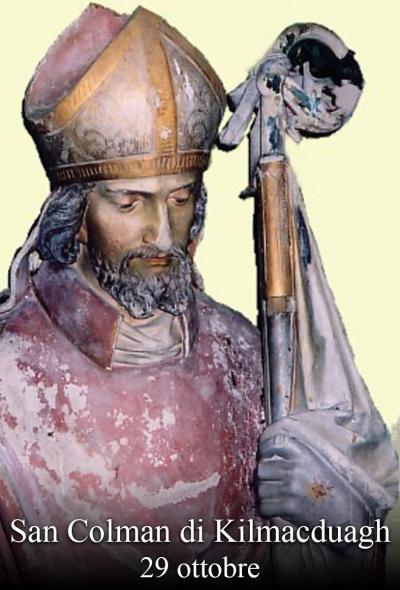
Image
source from https://www.santodelgiorno.it/san-colman-di-kilmacduagh/
San Colman di
Kilmacduagh Vescovo
Festa: 29 ottobre
Martirologio
Romano: A Galway in Irlanda, san Colmano, vescovo.
Nato a Corker, nel Kiltartan, verso la metà del sec. VI, Colmàn era figlio di Duach e apparteneva alla stessa famiglia di Guaire Aidhne, re del Connaught. Uomo di grandi virtù, visse per qualche tempo nell'isola di Aranmore, quindi, per desiderio di maggiore solitudine, andò a rifugiarsi tra le montagne della contea di Clare, a Burren, dove si ritirò, a quanto si dice, perché fatto vescovo contro la sua volontà. Ivi dimorò a lungo, assieme a un suo discepolo, nutrendosi unicamente di erbe selvatiche e di acqua. Intorno al 620 fondò un monastero nel luogo che venne poi chiamato Kilmacduagh (ovvero la «cella del figlio di Duach»), su un terreno che gli era stato donato dal regale suo parente Guaire del Connaught, il quale, come narra la leggenda, guidato dagli angeli, era riuscito a scoprire il suo romitorio. Considerato come il primo vescovo di Kilmacduagh, Colmàn morì nel 632 ed è venerato in tutta l'Irlanda, che ne celebra la festa il 29 ottobre; nel Martirologio di Tallaght (p. 14) è tuttavia, commemorato alla data del 3 febbraio.
Autore: Niccolò Del Re
SOURCE : https://www.santiebeati.it/dettaglio/75580
The Ascetic noble and saint – Colman of Kilmacduagh – October 29th : https://blog.stoliverspc.org/the-ascetic-noble-and-saint-colman-of-kilmacduagh-october-29th/
Oct 29 – St Colman of
Kilmacduagh (560-632) : https://www.catholicireland.net/saintoftheday/st-colman-of-kilmacduagh-560-632/
The Life of St Colman of Kilmacduagh : http://www.stcolman.com/life_monastery.html
St Colman of Kilmacduagh :
http://www.stcolman.com/pilgrimage.html
Scéla Colmáin meic Duach
ocus Guairi meic Colmáin : https://iso.ucc.ie/Scela-colmain/Scela-colmain-background.html
Marlène Viancin, Le
monastère de Kilmacduagh en Irlande, un lieu entouré de légendes Publié
le 29 octobre 2020 Mis à jour le 27 juillet 2025 : https://www.salutbyebye.com/irlande/monastere-de-kilmacduagh-en-irlande/