
Saint Ewald
Prêtre et martyr,
bénédictin, disciple de Saint Willibrord (+ 695)
Ils sont deux frères qui
portent d'ailleurs le même nom, alors on dit saint Ewald le Brun et saint Ewald
le Blond. Ils s'étaient faits moines en Irlande et suivirent saint Willibrord quand
il partit évangéliser les Frisons sur le continent. Puis ils le quittèrent pour
porter l'évangile aux Saxons. Ils rencontrèrent l'un de leurs chefs, mais les
notables de la tribu craignirent sa conversion au christianisme et la colère de
leurs divinités. Les deux frères furent mis à mort, vraisemblablement à Anlerbeck
en Westphalie. Le chef de la tribu vengea la mort de ces deux moines en faisant
brûler le village. Ils ne lui avaient pas encore enseigné sans doute la douceur
et le pardon évangéliques.
Chez les Saxons, en 695,
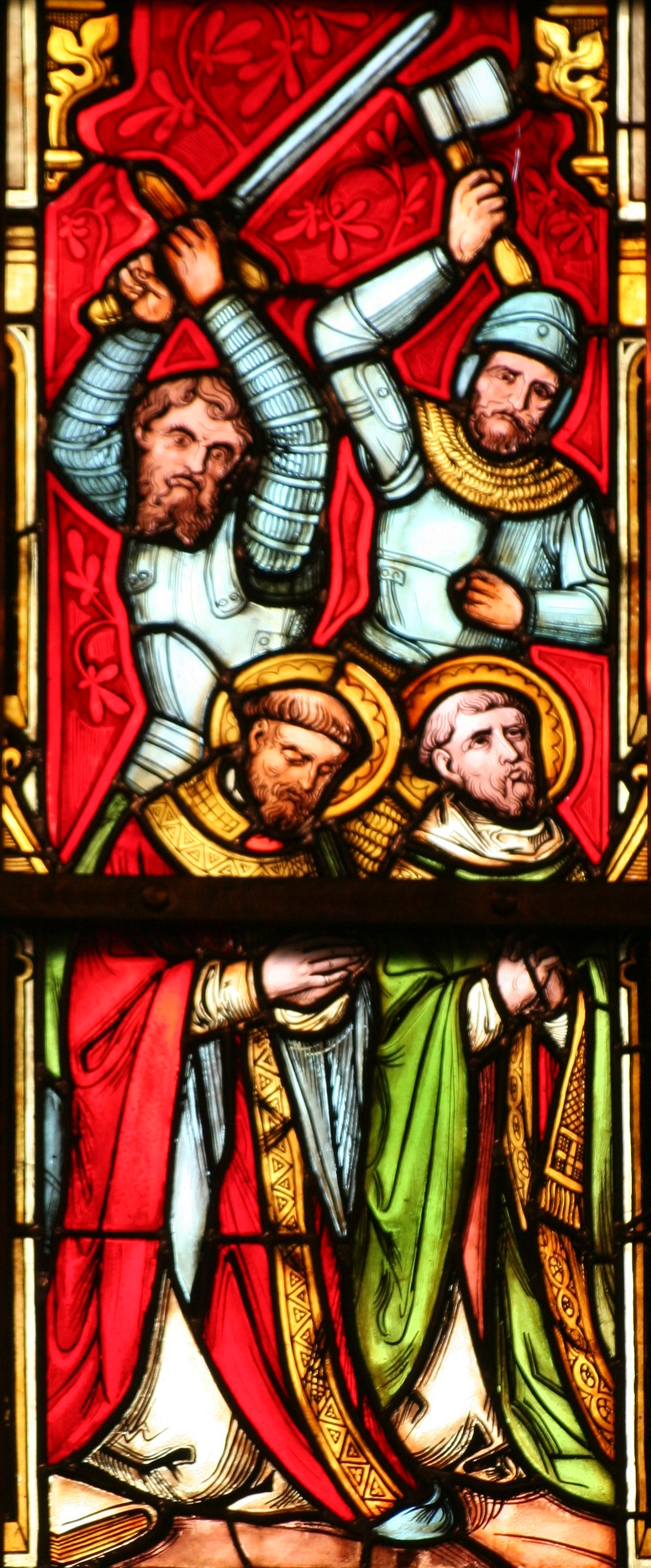
les deux saints martyrs Ewald, surnommés l'un le Noir, l'autre le Blanc.
Prêtres nés en Angleterre et formés par l'exemple de saint Willibrord et
d'autres, ils passèrent chez les Saxons et, alors qu'ils avaient commencé à
leur annoncer le Christ, ils furent saisis par les païens et massacrés.
Martyrologe romain
SOURCE : https://nominis.cef.fr/contenus/saint/1956/Saint-Ewald.html
SAINT EWALD LE BLOND ET SAINT EWALD LE BRUN, APÔTRES DE LA WESTPHALIE
Saint Ewald le Blond et saint Ewald le Brun nés en Northumbrie (nord de l’Angleterre) sont frères. Tous deux furent moines-prêtres en Irlande et suivirent saint Willibrord quand il partit évangéliser les Frisons sur le continent (Allemagne). Vers 690, ils le quittèrent pour porter l'évangile aux Saxons. Ils rencontrèrent l'un de leurs chefs, mais les notables de la tribu craignirent sa conversion au christianisme et la colère de leurs divinités. Ils décidèrent donc que les Ewalds devaient mourir. Ewald le Blond fut passé par le fil de l'épée, mais Ewald le Noir fut soumis à la torture, parce qu'il était le porte-parole et montrait une fière résistance. Les deux frères furent mis à mort, vraisemblablement à Anlerbeck en Westphalie. Leurs corps jetés dans le Rhin flottèrent miraculeusement à contre-courant sur quarante miles dans une lumière céleste. On dit qu’une fontaine jaillit au lieu de leur martyr. Les deux saints Ewald sont honorés comme martyrs et saints patrons de la Westphalie.
Saint Ewald le Blond et saint Ewald le Brun sont fêtés le 3 octobre
SOURCE : http://www.eoc-coc.org/eglise-orthodoxe-celtique-accueil/saints-du-mois/octobre/saints-ewald/
Saints Ewald le Blanc et
Ewald le Noir
3 octobre 2022
Frères, moines et martyrs
Deux jeunes moines
anglais venus de Northumbrie, deux frères surnommés d’après la couleur de leurs
cheveux, Ewald le Blanc pour le blond, Ewald le Noir pour le brun, accompagnent
saint Willibrord dans son épopée missionnaire de la Frise. Vers 690, ils
quittent Willibrord et se dirigent vers la Germanie dans l’intention d’y porter
l’Évangile. En attendant de rencontrer l’un des chefs saxons, ils logent chez
l’un de ses intendants. Mais voyant ces étrangers réciter des psaumes et
célébrer quotidiennement la messe, les proches de l’intendant prennent peur. Et
si leur chef se convertissait, les obligeant à renoncer à leurs traditions
idolâtriques ? Ils éliminent donc les deux frères. L’un par l’épée,
l’autre par la torture. Jetés dans le Rhin au nord de Cologne, leurs corps sont
repêchés par un moine qui les ensevelit dignement.
Seigneur Jésus, tu as annoncé à tes disciples qu’ils seraient envoyés comme des brebis au milieu des loups, et la force de l’Évangile a poussé les saints frères Ewald à partir vers des contrées païennes au péril de leur vie.
Permets que leurs prières
nous aident à annoncer la foi autour de nous.
Ce mois-ci, à l’écoute de
Marguerite-Marie
Il me donna un si tendre
amour pour les pauvres ; et il imprimait en moi une si tendre compassion
de leurs misères, que s’il avait été en mon pouvoir, je ne me serais rien
laissé.
SOURCE : https://francais.magnificat.net/magnificat_content/saints-ewald-le-blanc-et-ewald-le-noir/

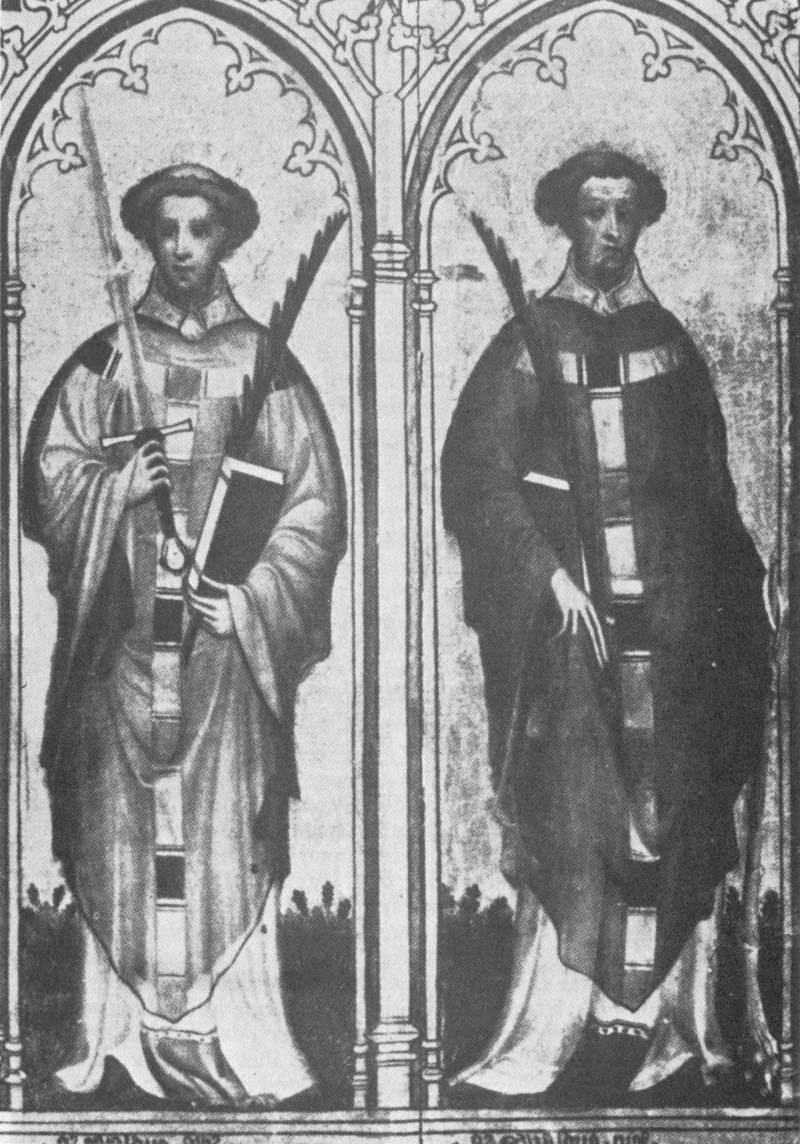
Painting
of the pair on the Ewaldi-Reliquienschrein at the Church of Saint
Kunibert, Cologne, c. 1400
Gemälde vom Ewaldi-Reliquienschrein in der Kirche St. Kunibert in Köln um 1400, seit 1945 verschollen
Peinture du reliquaire d'Ewaldi dans l'église Saint-Kunibert de Cologne, circa 1400, disparue depuis 1945.
Also
known as
Ewald the Dark
Hewald
Profile
Priest. Studied in Ireland.
Knew Saint Willibrord
of Echternach. Missionary to Saxony with Saint Ewald
the Fair c.690. Tortured and murdered by pagan Saxons who
feared to give up the old religion. Martyr.
Born
Northumbria, England
torn
limb from limb c.695 at
Aplerbeck, Westphalia
body thrown into the
River Rhine, but they were miraculously moved
40 miles upstream to a place where friends were camping, and then were
recovered
relics translated
to the church of Saint Cunibert, Cologne, Germany by Duke Pepin
of Austrasia
some relics translated
to the Premonstratensian monastery of
Florennes in the province of Namur in 1121 by Saint Norbert
most relics destroyed
by Anabaptists in 1534
Additional
Information
Book
of Saints, by the Monks of
Ramsgate
Lives
of the Saints, by Father Alban
Butler
books
Our Sunday Visitor’s Encyclopedia of Saints
other
sites in english
images
video
sitios
en español
Martirologio Romano, 2001 edición
fonti
in italiano
Martirologio Romano, 2005 edition
MLA
Citation
“Saint Ewald the
Black“. CatholicSaints.Info. 13 October 2018. Web. 27 April 2026.
<https://catholicsaints.info/saint-ewald-the-black/>
SOURCE : https://catholicsaints.info/saint-ewald-the-black/

Мощевик
священномучеников Светлого и Тёмного Эвальдов в кёльнской церкви святого
Куниберта.
Ewald
Reliquien Schrein in St. Kunibert (Köln).
Le
reliquaire des saints martyrs Ewald le Brun et Ewald le Blond, église
Saint-Kunibert, Cologne.
Also
known as
Hewald the Fair
Profile
Priest. Studied in Ireland.
Knew Saint Willibrord
of Echternach. Missionary to Saxony with Saint Ewald
the Black c.690. Tortured and murdered by pagan Saxons who
feared to give up the old religion. Martyr.
Born
Northumbria, England
torn
limb from limb c.695 at
Aplerbeck, Westphalia
body thrown into the
River Rhine, but they were miraculously moved
40 miles upstream to a place where friends were camping, and then were
recovered
relics translated
to the church of Saint Cunibert, Cologne, Germany by Duke Pepin
of Austrasia
some relics translated
to the Premonstratensian monastery of
Florennes in the province of Namur in 1121 by Saint Norbert
most relics destroyed
by Anabaptists in 1534
Additional
Information
Book
of Saints, by the Monks of
Ramsgate
Lives
of the Saints, by Father Alban
Butler
books
Our Sunday Visitor’s Encyclopedia of Saints
other
sites in english
images
video
sitios
en español
Martirologio Romano, 2001 edición
fonti
in italiano
Martirologio Romano, 2005 edition
MLA
Citation
“Saint Ewald the
Fair“. CatholicSaints.Info. 13 October 2018. Web. 27 April 2026. <https://catholicsaints.info/saint-ewald-the-fair/>
SOURCE : https://catholicsaints.info/saint-ewald-the-fair/

Druten GM Kattenburg 27

Druten
GM Kattenburg 27
Book
of Saints – Ewald the Dark and Ewald the Fair
Article
EWALD THE DARK and EWALD
THE FAIR (Saints) (October 3) (7th century) Two of the missionary priest monks,
sent by Saint Egbert with Saint Willibrord from England to evangelize Germany.
Venerable Bede relates that their field of work was “Old Saxony.” Their
Apostolate appears to have been very short. They were done to death by the
Pagans, probably in the neighbourhood of Dortmund about A.D. 695. Ewald the
Fair was struck down by a sword blow. Ewald the Dark, the more prominent of the
two, was fearfully maltreated, and in the end torn to pieces. King Pepin
enshrined their relics at Cologne.
MLA
Citation
Monks of Ramsgate. “Ewald
the Dark and Ewald the Fair”. Book of Saints, 1921. CatholicSaints.Info.
3 October 2016. Web. 27 April 2026.
<https://catholicsaints.info/book-of-saints-ewald-the-dark-and-ewald-the-fair/>
SOURCE : https://catholicsaints.info/book-of-saints-ewald-the-dark-and-ewald-the-fair/
St. Ewald & Ewald
Feastday: October 3
Death: 695
Martyred Northumbrian
brothers, one called "the Fair" and one called "the Dark",
companions of St. Willibrord. From Northumbria, they were educated in Ireland.
These priests of the Benedictine Order went
with Willibrord to Frisia, Netherlands. They were martyred together at
Aplerbeke, near Dortmund, Germany, by local pagans.
SOURCE : https://www.catholic.org/saints/saint.php?saint_id=3311
New Catholic
Dictionary – Saints Ewald
Article
Martyrs (c.695),
two priests,
natives of Northumbria, England,
who bore the same name, and were distinguished as the Black and the
Fair. They went as missionaries to Saxony where
they were the guests of the steward of a Saxon earl.
The pagans,
recognizing them as Christian priests,
and fearing the earl’s conversion, murdered them
and threw their bodies into the Rhine, whence they were miraculously retrieved.
Their relics were
preserved in the church of Saint Cunibert, Cologne. Feast, 3 October.
MLA
Citation
“Saints Ewald”. New Catholic Dictionary. CatholicSaints.Info.
3 October 2016. Web. 27 April 2026.
<https://catholicsaints.info/saints-ewald/>
SOURCE : https://catholicsaints.info/saints-ewald/
Sts. Ewald
(Or HEWALD)
Martyrs in Old Saxony
about 695. They were two priests and
natives of Northumbria, England.
Both bore the same name, but were distinguished as Ewald the Black and Ewald
the Fair, from the difference in the colour of their hair and complexions.
According to the example of many at that time, they spent several years as
students in the schools of Ireland.
Ewald the Black was the more learned of the two, but both were equally renowned
for holiness of
life. They were apparently acquainted with St.
Willibrord, the Apostle of Friesland, and were animated with his zeal for
the conversion of the Germans.
Indeed, by some they have been actually numbered among the eleven companions of
that saint, but it is more probable they did not set out from England till
after St. Willibrord's departure. They entered upon their mission about 690.
The scene of their labours was the country of the ancient Saxons, now part
of Westphalia,
and covered by the dioceses of
Münster, Osnabrück,
and Paderborn.
At first the Ewalds took up their abode in the house of the steward of a
certain Saxon earl or ealdormen (satrapa). Bede remarks
that "the old Saxons have no king, but they are governed by several
ealdormen [satrapas] who during war cast
lots for leadership, but who in time of peace are equal in power" (Hist.
Eccl., V, 10). The steward entertained his two guests for several days, and
promised to conduct them to the chieftain, as they affirmed they had a message
of considerable importance to deliver to him.
Meanwhile, the Ewalds
omitted nothing of their religious exercises. They prayed often,
recited the canonical
hours, and celebrated Mass,
for they carried with them all that was necessary for
the Holy
Sacrifice. The pagan Saxons,
understanding from these things that they had Christian priests and
missionaries in their midst, began to suspect that their aim was to convert
their over-lord, and thus destroy their temples and
their religion. Inflamed with jealousy and anger,
they resolved that the Ewalds should die. Ewald the Fair they quickly
despatched with the sword, but Ewald the Black they subjected to torture,
because he was the spokesman and showed greater boldness. He was torn limb from
limb, after which the two bodies were cast into the Rhine. This is understood
to have happened on 3 October at a place called Aplerbeck, where a chapel still
stands.
When the ealdorman heard
of what had been done he was exceedingly angry, and took vengeance by ordering
the murderers to be put
to death and their village to be destroyed by fire. Meanwhile
the martyred bodies
were miraculously carried
against the stream up the Rhine, for the space of forty miles, to the place in
which the companions of the Ewalds were residing. As they floated along, a
heavenly light, like a column of fire, was seen to shine above them. Even the
murderers are said to have witnessed the miraculous brightness.
Moreover, one of the martyrs appeared
in vision to the monk Tilmon
(a companion of the Ewalds), and told him where the bodies would be found:
"that the spot would be there where he should see a pillar of light
reaching from earth to heaven".
Tilmon arose and found the bodies, and interred them
with the honours due to martyrs.
From that time onwards, the memory of the Ewalds was annually celebrated in those
parts. A spring of water is said to have gushed forth in the place of the martyrdom.
Pepin, Duke of Austrasia,
having heard of the wonders that had occurred, caused the bodies to be
translated to Cologne,
where they were solemnly enshrined in the collegiate church of
St. Cunibert. The heads of the martyrs were
bestowed on Frederick, Bishop of Münster,
by Archbishop Anno of Cologne, at the opening of the shrine in 1074.
These relics were
probably destroyed by the Anabaptists in
1534. When St.
Norbert visited Cologne in 1121, he obtained two small vessels
containing the relics of
several saints,
and among them were bones of the sainted Ewalds. These were deposited either
at Prémontré,
or at Florennes, a Premonstratensian monastery in
the province of Namur.
The two Ewalds are honoured as
patrons in Westphalia,
and are mentioned in the Roman Martyrology on 3 October. Their feast is
celebrated in the dioceses of
Cologne and Münster.
Edmonds,
Columba. "Sts. Ewald." The Catholic Encyclopedia. Vol.
5. New York: Robert Appleton Company, 1909. 25 Oct.
2020 <http://www.newadvent.org/cathen/05672a.htm>.
Transcription. This
article was transcribed for New Advent by Gerald M. Knight.
Ecclesiastical
approbation. Nihil Obstat. May 1, 1909. Remy Lafort,
Censor. Imprimatur. +John M. Farley, Archbishop of New York.
Copyright © 2020 by Kevin
Knight. Dedicated to the Immaculate Heart of Mary.
SOURCE : https://www.newadvent.org/cathen/05672a.htm

.jpg)

Denkmal
der heiligen Ewalde auf dem Aplerbecker Marktplatz, Künstler: Kuno Lange
Kuno
Lange, Monument à saint Ewald sur la place du marché d'Aplerbeck

Denkmal
der heiligen Ewalde auf dem Aplerbecker Marktplatz, Künstler: Kuno Lange
Kuno
Lange, Monument à saint Ewald sur la place du marché d'Aplerbeck
The Two Ewalds, Martyrs
SOON after St. Willibrord
with eleven companions in 690 had opened the spiritual harvest in Friesland,
two brothers, both priests, of the English nation, followed their example, and
went over into the country of the ancient Saxons in Westphalia, in Germany, to
preach the gospel to blind idolaters. 1 They
had travelled into Ireland, to improve themselves in virtue and sacred
learning. Both were called by the same name, Ewald or Hewald; but, for
distinction’s sake, from the colour of their hair, the one was called the
Black, the other the White Ewald. The first was esteemed more learned, in the
holy scriptures, but both seemed equally to excel in the fervour of devotion
and holy zeal. The old Saxons in Germany were at that time governed by several
petty princes, who in time of war joined their forces, and cast lots who should
command the army in chief, and him the rest were bound to obey; and, as soon as
the war was over, they were all reduced to their former condition. The two
brothers arriving in this country about the year 694, met with a certain
steward, whom they desired to conduct them to his lord. All the way they were
constantly employed in prayer and in singing psalms and sacred hymns, and every
day offered the sacrifice of the holy oblation, for which purpose they carried
with them sacred vessels, and a consecrated table for an altar. The barbarians
observing this, and fearing lest the preachers might prevail upon their lord to
forsake his idols, resolved to murder them both. The White Ewald they killed by
the sword upon the spot; but they inflicted on the other brother most cruel
torments, and at length tore him limb from limb. The lord of the territory
being informed of this inhuman action, was highly incensed, put the authors of
it to the sword, and burned their village. The bodies of the martyrs, which had
been thrown by the murderers into the Rhine, were discovered by a heavenly
light which shone over them, and by other miracles, to their companions, who
were forty miles distant from the place where they were martyred; and one of
them, whose name was Tilmon, or as it is more correctly written in King
Alfred’s paraphrase of Bede, Tilman, was admonished in a vision to take them
up. This Tilman being a person of high birth, had formerly been an officer in
the English army, but was then a monk, and one of the missionaries in Germany.
These relics were first taken up and interred by their fellow missionaries,
Tilman and his companions, forty miles from the place of their martyrdom; but,
immediately after, by an order of Pepin, duke of the French, were honourably
conveyed to Cologn, where they are kept at this day in a gilt shrine in the
church of St. Cunibert. Their martyrdom happened between the years 690 and 700,
most probably in 695. They were honoured among the saints immediately after their
death, as appears from Ven. Bede’s prose Martyrology, which seems to have been
written a year after their death. St. Anno, archbishop of Cologn, in 1074,
translated their relics in this church. He bestowed their heads on Frederic,
bishop of Munster, where they seem to have been destroyed by the Anabaptists in
1534. They are honoured through all Westphalia as tutelar saints of the
country, and are mentioned in the Roman Martyrology on the 3rd of October,
which was probably either the day of their death or of some translation. See
Bede, Hist. l. 5, c. 11, and in his prose Martyrology; Alcuin’s poem on the
saints of the diocess of York, published by Gale, v. 1045; Massini, Vite de
Santi, t. 2, p. 232, 3 Oct.
Note 1. Old Saxony,
in the age of Charlemagne, lay betwixt the Rhine, the Yssel, and the Wesel,
where are now the bishoprics of Munster, Osnaburgh, and Paderborn, and the
county of La Mark. See Cluverius in Germania Antiqua, l. 3. D’Anville,
&c. [back]
Rev. Alban
Butler (1711–73). Volume X: October. The Lives of the
Saints. 1866.
SOURCE : http://www.bartleby.com/210/10/033.html


Hl.Brüder
Ewald aus Dorsten-Rhade (NRW, Deutschland)
Sculpture
en bois des saints frères Ewald de l'église de Dorsten-Rade
(Rhénanie-du-Nord-Westphalie, Allemagne)
деревянная
скульптура святых братьев Евальд из церкви Дорстен-Раде (Северный
Рейн-Вестфалия, Германия)
Sant' Ewaldo il Nero ed
Ewaldo il Bianco Monaci e martiri
Britannia, VII sec. - †
Renania, Germania, 3 ottobre 695
I santi con questo nome
che vengono ricordati oggi, in realtà, sono due: Edwaldo il Bianco ed Edwaldo
il Nero, patroni della Westfalia, così chiamati dal colore dei loro capelli. Di
origini anglosassoni, nacquero in Britannia nel VII secolo e seguirono nel 690
il loro abate Willibrordo (657-739), che con undici monaci aveva intrapreso la
sua opera evangelizzatrice tra i Frisoni occidentali. Nel 695 Willibrordo li
inviò ad evangelizzare i Sassoni. Le loro intenzioni però non poterono
attuarsi, perché nello stesso 695, i due monaci subirono il martirio per mano
di alcuni fanatici, difensori delle loro tradizioni pagane e timorosi della
propagazione del cristianesimo fra il popolo sassone. Il martirio fu diverso
per i due monaci; Ewaldo il Bianco fu trafitto subito con la spada, mentre
Ewaldo il Nero fu invece torturato a lungo crudelmente e come narra lo storico
anglosassone Beda il Venerabile (672-735), gli assassini infierirono su di lui
con orribili mutilazioni; i resti dei due martiri furono gettati nel fiume Reno
e ripescati e sepolti poi, da un monaco di nome Tilmon. (Avvenire)
Martirologio
Romano: In Sassonia, nell’odierna Germania, due santi martiri di nome
Evaldo, il primo detto Nero, l’altro Bianco: sacerdoti di origine inglese,
formati sull’esempio di san Villibrordo e dei suoi compagni, passarono in
Sassonia e, avendo cominciato a predicare Cristo, catturati dai pagani,
subirono il martirio.
La festa dei due santi
monaci e martiri Ewaldo, venerati come patroni della Westfalia, viene
comunemente celebrata il 3 ottobre, giorno del loro martirio, mentre nella
diocesi di Colonia, essi sono festeggiati il 12 ottobre.
I due omonimi monaci,
sono anche gli unici a portare questo nome, fra la variegata costellazione dei
santi e beati del cattolicesimo.
Di origini anglosassoni,
nacquero in Britannia nel VII secolo e seguirono nel 690 il loro abate s.
Willibrordo (657-739), che con undici monaci aveva intrapreso la sua opera
evangelizzatrice tra i Frisoni occidentali, (abitanti della Frisia, antica
regione dell’Europa nord-occidentale, oggi divisa fra i Paesi Bassi e la
Germania).
Data la loro omonimia,
per distinguerli furono soprannominati uno Ewaldo il Bianco (Albus) e l’altro
Ewaldo il Nero (Niger) dal colore dei loro capelli; il Nero si distingueva
anche per la sua ottima conoscenza della Sacra Scrittura; ambedue si
prodigarono con grande ardore missionario.
Nel 695, s. Willibrordo
li inviò ad evangelizzare i Sassoni, antica popolazione della Germania di N.O.;
le loro intenzioni però non poterono attuarsi, perché nello stesso 695, i due
monaci subirono il martirio per mano di alcuni fanatici, difensori delle loro
tradizioni pagane e timorosi della propagazione del cristianesimo fra il popolo
sassone.
Il martirio fu diverso
per i due monaci; Ewaldo il Bianco fu trafitto subito con la spada, mentre
Ewaldo il Nero fu invece torturato a lungo crudelmente e come narra lo storico
anglosassone s. Beda il Venerabile (672-735), gli assassini infierirono su di
lui con orribili mutilazioni; i resti dei due martiri furono gettati nel fiume
Reno (o in uno degli affluenti che li trascinò poi nel Reno), e ripescati poi,
dal monaco ex nobile soldato di nome Tilmon, che li seppellì cristianamente.
I due martiri, furono
uccisi secondo alcuni a Laer (presso Steinfurt) e secondo altri ad Aplerbeke
(presso Dortmund), ma studi concreti affermano che vennero martirizzati in una
località della Renania, a nord di Colonia, dove qualche anno più tardi, Pipino
di Heristal (padre di Carlo Martello), fece trasportare le loro reliquie, che
furono deposte nella Chiesa di S. Clemente, intitolata poi a san Cuniberto,
primo evangelizzatore della Germania.
S. Beda il Venerabile,
nel suo “Martirologio”, compose un elogio in onore dei due gloriosi santi
Ewaldo, che poi fu riportato immutato anche da altri scrittori, storici e
agiografi, come Floro di Lione, Usuardo, Rabano Mauro, Cesare Baronio.
Autore: Antonio
Borrelli