
Saint Méthode le
Confesseur
Patriarche de
Constantinople (+ 847)
Ce futur patriarche de
Constantinople est né à Syracuse en Sicile et se rendit à Constantinople pour y
parfaire ses études. Il voulait faire brillante carrière, mais la rencontre
avec un moine lui fit préférer la perfection monastique. Comme il était un intellectuel,
on lui confia la charge de copiste. C'était l'époque de la persécution
iconoclaste. Il prit la défense du culte des saintes images, et, pour cette
raison, il dut s'enfuir et se réfugier à Rome auprès du Pape. Mais le pape le
renvoie à Constantinople soutenir les partisans des Images, les icônes. Méthode
est arrêté, flagellé et enfermé durant 9 ans dans un étroit cachot. Libéré à la
mort de l'empereur, il est cependant mis en liberté surveillée car le nouvel
empereur craint son esprit d'indépendance. Devenu patriarche de Constantinople,
il fait triompher les Images, cherchant à ramener la paix dans l'Église,
indulgent envers ceux qui ont failli durant la persécution. Des moines
intransigeants l'accusent. Malgré cela, il restera conciliateur jusqu'à sa
mort.
À Constantinople, en 847,
saint Méthode, évêque. Alors qu’il était moine, il se rendit à Rome auprès du
pape saint Pascal Ier, pour la défense des saintes images et, élevé à
l’épiscopat, il célébra avec solennité la victoire de la foi orthodoxe.
Martyrologe romain
SOURCE : http://nominis.cef.fr/contenus/saint/1319/Saint-Methode-le-Confesseur.html
Saint Méthode de
Constantinople
(790-847)
Méthode est né en Sicile
vers 790. Moine retiré dans une petite île, Chio, il défendit le culte des icônes. Il fut emprisonné pendant sept ans pour avoir défendu la vénération des
images saintes. En 842, il fut nommé patriarche de Constantinople. Il n’aura de
cesse de défendre le culte des icônes et de ramener les fidèles à la foi
orthodoxe.
SOURCE : http://viechretienne.catholique.org/saints/2166-saint-methode-de-constantinople
Méthode de Sicile ou
Constantinople
? 847
Méthode était originaire
de Sicile, où il naquit dans la seconde moitié du 8e siècle.
Venu à Constantinople au
terme de ses études, il rencontra un moine qui lui donna le précieux conseil de
ne pas se laisser tromper par les fausses dignités de la terre. Le voilà donc
au monastère de Khenolaccos (la Mare aux oies) sur la côte sud de la
Mer de Marmara, en face de Constantinople.
Là il complète ses
études, transcrit des livres pour la bibliothèque, et devient higoumène, ou
supérieur : on l’appellerait en occident Abbé.
Au début du 9e siècle,
l’empereur Léon l’Isaurien rouvrit la Querelle des Images (815). La persécution
reprit. Méthode, partisan de l’orthodoxie, s’enfuit à Rome, supplier le pape
Pascal Ier d’intervenir en faveur des chrétiens, en particulier de
Théodore le Studite et ses moines, fidèles partisans du culte des saintes
Images.
En 820, Méthode recevait
du pape la mission de demander à l’empereur Michel II le rétablissement de
Nicéphore sur le siège patriarcal et la liberté pour les défenseurs des saintes
Images. Peine perdue : non seulement Méthode fut fort mal reçu, mais il fut
flagellé et enfermé dans un cachot aussi étroit qu’un tombeau, en compagnie de
deux criminels de droit commun. Ce supplice dura sept années !
L’empereur suivant,
Théophile (dont le nom devrait signifier Ami de Dieu), rendit une liberté
assez relative à Méthode, dont il appréciait le savoir : il le logea dans son
propre palais, pour le consulter à volonté, et même pour l’emmener avec lui
dans ses déplacements, ce qui en réalité éloignait de Constantinople le saint
higoumène, qui avait une réelle popularité.
A la mort de Théophile
(842), Méthode fut vraiment libre et gagna le monastère de Elegmi, mais il
restait en contact avec l’impératrice Théodora, qui lui était favorable.
Un concile (843) déposa
le patriarche iconoclaste Jean, et élut Méthode sur le siège de Constantinople.
Le culte des saintes images fut solennellement approuvé comme lors du IIe concile
de Nicée (787), et les évêques et abbés qui s’étaient fourvoyés dans l’erreur
furent déposés.
Méthode eut aussi l’idée
conciliante de faire admette que l’époux défunt de l’impératrice, Théophile,
était mort repentant, ce qui apaisa la fidèle impératrice.
Mais c’est surtout la
solennelle procession à Sainte-Sophie, le 11 mars 843, qu’il faut retenir de ce
concile, car c’est à partir de cette date que sera traditionnellement célébrée
la Fête de l’Orthodoxie dans l’Eglise orientale.
Méthode s’efforça
d’appliquer les décrets du concile, non sans difficulté. L’ancien patriarche
déposé essaya même de lui susciter des accusations calomnieuses d’adultère,
manœuvre indigne d’un prélat, et malheureusement pas unique dans l’historie de
l’Eglise.
Mais le saint patriarche
eut encore plus de difficultés, inattendues, de la part des moines qui étaient restés
fidèles à l’orthodoxie : ceux-ci ne s’accommodaient pas de la paix revenue, et
cherchaient à susciter d’autres querelles, au point que Méthode crut nécessaire
de jeter l’anathème sur leur monastère de Stoudion ; il comprit son excessive
sévérité et s’en repentit. La paix revint totalement avec son successeur.
L’hydropisie fut la cause
de la mort du fidèle patriarche Méthode, le 14 juin 847.
SOURCE : http://www.samuelephrem.eu/article-methode-de-constantinople-106614333.html

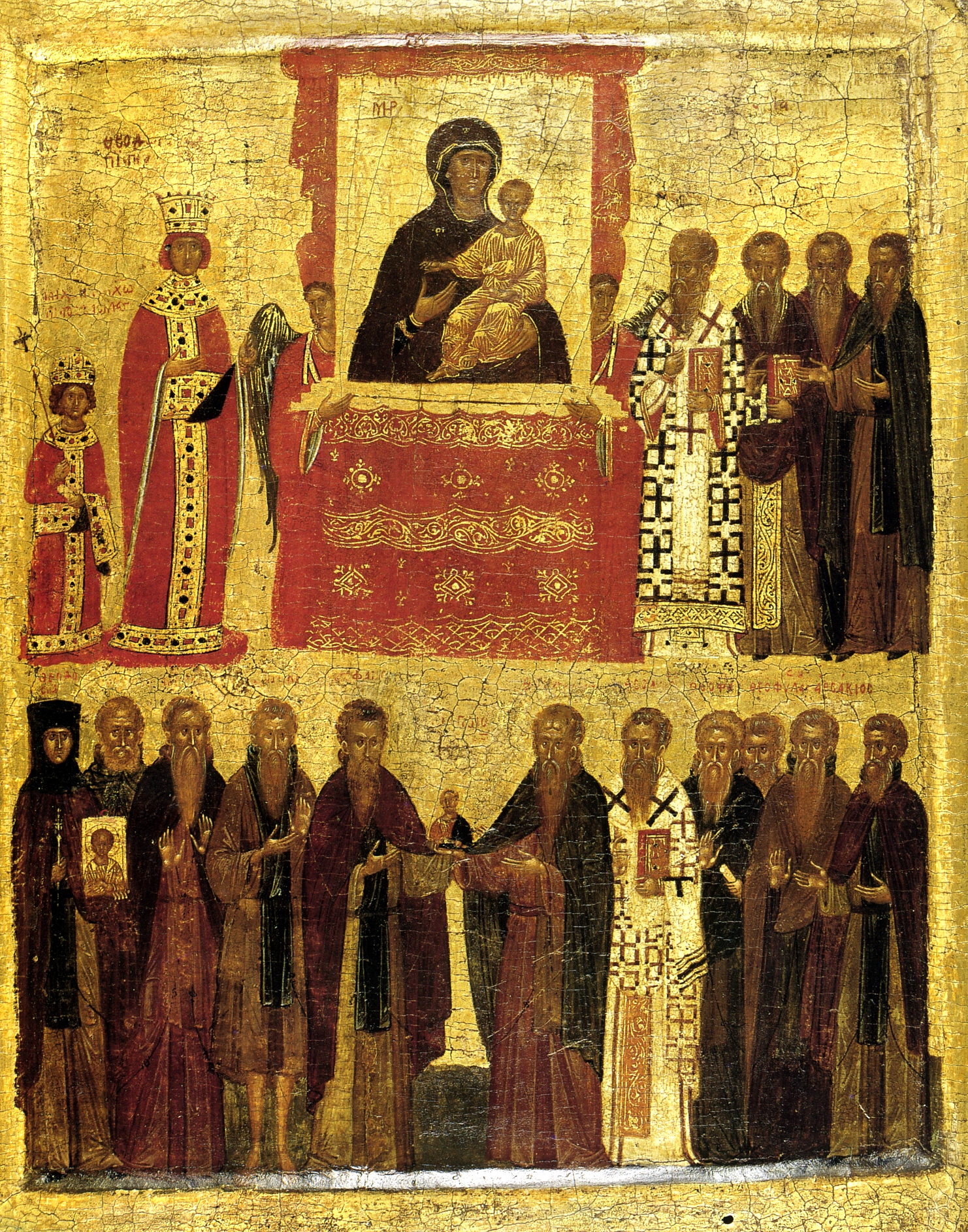
Icona
del Trionfo dell'Ortodossia con il patriarca alla destra dell'immagine di Maria
con Bambino.
Icône
byzantine illustrant le triomphe de l'Orthodoxie sur l'iconoclasme sous
l'impératrice Théodora, fin du 14ème, début du 15ème siècle. Le Patriarche
Méthode 1er de Constantinople est représenté en haut à droite, près de la
Vierge.
Late
14th-early 15th century icon illustrating the "Triumph of Orthodoxy"
under the Byzantine empress Theodora over iconoclasm. Patriarch Methodios I of
Constantinople is on the top right, close to the Virgin.
العربية: أيقونة
انتصار الأرثوذكسية تصوّر انتصار مؤيدي الأيقونات في حرب الأيقونات
البيزنطية في عهد الإمبراطورة ثيودورا وابنها ميخائيل الثالث.
Méthode de Constantinople
Patriarche de Constantinople, Saint
ca. 782-847
Méthode naquit à Syracuse
(Sicile) vers 782, probablement d’une famille noble ou aisée, car il reçu une
excellente instruction.
A peine débarqué à
Constantinople, il s'était vu accoster par un inconnu mystérieux qui lui avait
dit : « Beau jeune homme, à la gloire périssable que tu viens
chercher ici, pourquoi ne point préférer celle qui ne s'accompagne d'aucun
remords et dure éternellement ? » Renonçant d'emblée à ses projets,
Méthode s'était fait moine. Il dirigeait un monastère fondé par lui dans l'île de
Chio, quand la querelle des images se ranima dans l'Empire (813).
A l'avènement de Michel
II (820-829), le pape Pascal envoya Méthode lui demander de rendre à Nicéphore
le siège patriarcal de Byzance dont les iconoclastes l'avaient dépossédé. Mais
le pape était mal renseigné sur le nouvel empereur. Tout ce qu'obtint son
envoyé, ce fut d'être flagellé et ensuite exilé à l'île Saint-André, où il
passa sept ans dans le même cachot que deux criminels de droit commun. Fils et
successeur de Michel II, l'empereur Théophile (829-842) le rappela d'exil et
lui donna l'hospitalité dans son palais, avec toutefois défense d'en sortir.
Ainsi le souverain pouvait-il tirer parti de la science de son hôte et de ses
talents d'homme d'État, tout en l'empêchant d'exercer aucune influence
au-dehors. Cependant une chose arriva qu'il n'avait point prévue ; c'est
que Méthode profita de cette détention pour convertir l'impératrice Théodora
laquelle, une fois son mari disparu (842), nomma Méthode patriarche de
Constantinople et chef de l'Église orientale (843), chassa les iconoclastes de
tous les postes qu'ils occupaient, et employa sa longue régence (842-856) à
terminer cette absurde querelle des images qui, depuis cent ans, ensanglantait
l'Empire.
Il est mort à
Constantinople le 14 juin 847.
SOURCE : http://nova.evangelisation.free.fr/methode_de_constantinople.htm

Saint Methodius of
Constantinople
Profile
Educated in Syracuse, Sicily.
While in Constantinople to
seek a position at court,
he felt the call to enter the religious
life. Built a monastery and
started a monastic community
on the island of Chinos. Soon after finishing construction, Methodius was
summoned by the Patriarch of Constantinople to
help govern the diocese.
The Eastern
Church was debating the use of icons in
worship and as tools to bring the faithful closer to God.
Methodius and the Patriarch of Constantinople worked
against the iconoclasts,
and together suffered nearly as much abuse as the images.
They worked to unify and reconcile the sides. Methodius travelled to Rome, Italy to
seek the Pope‘s
help; during his absence, he was exiled.
After seven years, he returned as Patriarch of Constantinople in 842,
and continued to work for unity.
Born
8th
century at Syracuse, Sicily
847 of
natural causes
Additional
Information
Book
of Saints, by the Monks of
Ramsgate
Lives
of the Saints, by Father Alban
Butler
Roman
Martyrology, 1914 edition
Saints
of the Day, by Katherine Rabenstein
books
Our Sunday Visitor’s Encyclopedia of Saints
Saints
and Their Attributes, by Helen Roeder
other
sites in english
sitios
en español
Martirologio Romano, 2001 edición
fonti
in italiano
MLA
Citation
“Saint Methodius of
Constantinople“. CatholicSaints.Info. 6 April 2024. Web. 19 April 2026.
<https://catholicsaints.info/saint-methodius-of-constantinople/>
SOURCE : https://catholicsaints.info/saint-methodius-of-constantinople/
Book of Saints –
Methodius – 14 June
Article
(Saint) Bishop (June
14) (9th
century) By birth a native of Sicily,
he founded a monastery on
the Island of Chio in the Grecian Archipelago.
Summoned thence to Constantinople by
the Patriarch Nicephorus, he endured much persecution from the Iconoclasts.
On the death of
Nicephorus, the Empress Theodora induced Methodius to accept the vacant See,
which he occupied for four years. It is said that so great was the popular
opinion of his sanctity that his Festival as
a Saint began
to be celebrated during the Episcopate of his immediate successor, Saint Ignatius.
He has left several works, among which are a Book of Penitential Canons and
a Panegyric of Saint Dionysius
the Areopagite. He died A.D. 846.
MLA
Citation
Monks of Ramsgate.
“Methodius”. Book of Saints, 1921. CatholicSaints.Info.
14 November 2015. Web. 19 April 2026.
<https://catholicsaints.info/book-of-saints-methodius-14-june/>
SOURCE : https://catholicsaints.info/book-of-saints-methodius-14-june/
St. Methodius I
Feastday: June 14
Death: 847
Patriarch of
Constantinople, modem Istanbul. He was born in Syracuse, Sicily, and builta
monastery on the island of Chios. After some time in
Constantinople, he was sent to Rome in
815 as the representative of Patriarch Nicephorus,
who was exiled by Emperor Leo V the
Armenian for refusing to yield to the imperial decrees on the destruction of
icons. Methodius returned in 821 and was himself scourged and imprisoned for
seven years. Finally, in 842, Empress Theodora arranged for his elevation
as patriarch of
Constantinople. In this office, he convened a council and promoted orthodoxy and
the veneration of icons after the long years of iconoclasticism. Methodius was
a prolific writer, being the author of a life of
St. Theopanes.
SOURCE : https://www.catholic.org/saints/saint.php?saint_id=5099

Patriarch
Methodius I discussing matters with the emperor Theophilos (12th century Manasses Chronicle). Skyllitzes Matritensis, fol. 56r, detail
Methodius I of
Constantinople B (RM)
Born in Syracuse, Sicily;
died in Constantinople on June 14, 847. Although he was born in a time when
many in the Eastern Church were iconoclasts, Methodius courageously defended
the attempt of Christian artists to inspire the faithful by means of beautiful
icons. The saint was educated in Syracuse. Then he went to Constantinople
intending to be a courtier of the emperor, but a holy monk so much impressed
him that he decided to retire from the world. He built a monastery on the Greek
island of Chios (Khios), intending to stay there for the rest of his life. But
the patriarch of Constantinople, Saint Nicephorus, wanted Methodius by his
side. Both men boldly stood up against the destroyers of icons, but Nicephorus
was deposed and sent into exile by Emperor Leo the Armenian.
Methodius, too, was
forced to flee. He was sent to Rome where to report to Pope Saint Paschal I on
the destruction of sacred images. In 821, when Michael the Stammerer was
enthroned, Methodius returned to Constantinople with a letter from the Pope
Paschal demanding the reinstatement of Nicephorus. Instead the emperor
condemned Methodius as a seditionist and ordered that he be scourged and
exiled.
For seven years he was
kept in a tomb or mausoleum with three thieves. One died and his corpse was
left to rot in the dungeon alongside the three living prisoners. When Methodius
was released, we are told that he looked like a skeleton, but his spirit was
unbroken. He resumed his opposition to iconoclasm under Emperor Theophilus, and
was called before the emperor. Blamed for his past activities and for the
letter that he supposedly incited the pope to write, he replied boldly,
"If an image is so worthless in your eyes, how is it that when you condemn
the images of Christ you do not condemn the veneration paid to representations
of yourself? Far from doing so, you are continually causing them to be
multiplied."
There was a respite for a
time when Theophilus died in 842 and his widow Theodora took control of the
empire as regent for her small son, Michael III. Happily, she supported those
who defended icons and repealed all decrees against images. Within 30 days
exiled clergy were recalled and images restored to the churches amid rejoicing.
In 843, Methodius became patriarch of Constantinople, replacing the iconoclast
John the Grammarian.
He had five more years to
live. Speedily he summoned a synod in Constantinople that endorsed the decrees
of the Second Council of Nicaea declaring icons lawful in the church. An annual
'feast of Orthodoxy,' still observed in the Byzantine Church on the first
Sunday of Lent, was instituted to mark this victory for reason and devotion.
The patriarch also translated the relics of his predecessor, Nicephorus, to
Constantinople. Unfortunately, this period of reconciliation was marred by a
quarrel with some of his most ardent supporters--the monks of Saint Theodore
Studites--over some of the abbot's writings. The saint died of dropsy. His
immediate successor, Saint Ignatius, instituted an annual celebration of
Methodius's feast.
Saint Methodius was said
to have been a prolific writer, especially of hymns, though few of his writings
still exist. Notable among his extant works is a life of Saint Theophanes. He
also authored penitential canons, sermons, and an encomium of Saint Dionysius
the Areopagite, which some think incorporates the work of Hilduin that he may
have seen during his time in Rome (Attwater, Benedictines, Bentley, Delaney,
Encyclopedia, Husenbeth, Walsh).
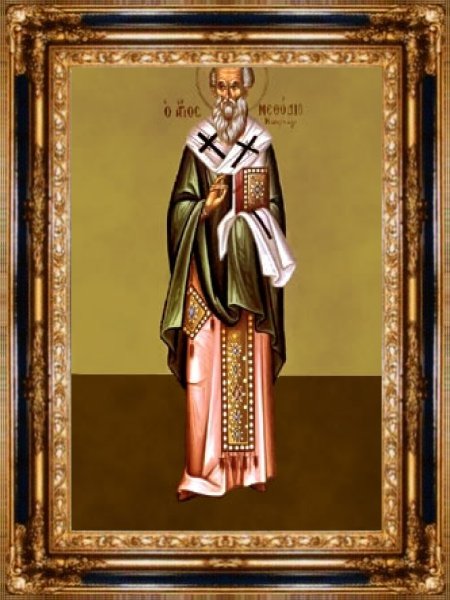
In art, Saint Methodius
is a Greek patriarch holding two candlesticks, one three-branched, one
two-branched, or holding a picture of the Last Judgement (Roeder).
SOURCE : http://www.saintpatrickdc.org/ss/0614.shtml
Methodius I
Patriarch of
Constantinople (842-846), defender of images during the second Iconoclast persecution, b. at Syracuse, towards the
end of the eighth century; d. at Constantinople, 14 June, 846. The son of
a rich family, he came, as a
young man, to Constantinople intending to obtain a place at Court. But a monk persuaded him
to change his mind and he entered a monastery. Under the
Emperor Leo V (the Armenian,
813-820) the Iconoclast persecution broke
out for the second time. The monks were nearly
all staunch defenders of the images; Methodius stood by his order and
distinguished himself by his opposition to the Government. In 815 the Patriarch
Nicephorus I (806-815) was deposed and banished for his resistance to the Iconoclast laws; in his place
Theodotus I (815-821) was intruded. In the same year Methodius went to Rome, apparently sent by
the deposed patriarch, to report the matter to the pope (Paschal I,
817-824). He stayed in Rome till Leo V
was murdered in
820 and succeeded by Michael II (820-829). Hoping for better things from the new
emperor, Methodius then went back to Constantinople bearing a letter in which
the pope tried
to persuade Michael to change the policy of the Government and restore the
Patriarch Nicephorus. But Michael only increased the fierceness of the persecution. As soon as
Methodius had delivered his letter and exhorted the emperor to act according to
it, he was severely scourged (with 70 stripes), taken to the island Antigoni in
the Propontis, and there imprisoned in a
disused tomb.
The tomb must
be conceived as a building of a certain size; Methodius lived seven years in
it. In 828 Michael II, not long before his death, mitigated the persecution and
proclaimed a general amnesty. Profiting by this, Methodius came out of
his prison and
returned to Constantinople almost worn out by his privations. His spirit was
unbroken and he took up the defence of the holy images as zealously as
before.
Michael II was succeeded
by his son Theophilus (829-842), who caused the last and fiercest persecution of
image-worshippers. Methodius again withstood the emperor to his face, was again
scourged and imprisoned under
the palace. But the same night he escaped, helped by his friends in the city,
who hid him in their house and bound up his wounds. For this the Government
confiscated their property.
But seeing that Methodius was not to be overcome by punishment, the emperor
tried to convince him by argument. The result of their discussion was that
Methodius to some extent persuaded the emperor. At any rate towards the end of
the reign the persecution was
mitigated. Theophilus died in 842 and at once the whole situation was changed.
His wife, Theodora, became regent for her son Michael III (the Drunkard,
842-867). She had always been an image-worshipper in secret; now that she had
the power she at once began to restore images, set free the confessors in prison and bring
back everything to the conditions of the Second Nicene Council (787). The Patriarch of
Constantinople, John VII (832-842), was an Iconoclast set up
by the Government. As he persisted in his heresy he was
deposed and Methodius was made patriarch in his place (842-846). Methodius then
helped the empress-regent in her restoration. He summoned a synod at
Constantinople (842) that approved of John VII's deposition and his own
succession. It had no new laws to make about
images. The decrees of Nicæa II that had received the assent of the pope and the whole
Church as those of an Œcumenical Council were put in force again. On 19 Feb.,
842, the images were brought in solemn procession back to the churches. This
was the first "Feast of Orthodoxy", kept again in memory of that
event on the first Sunday of Lent every year
throughout the Byzantine
Church. Methodius then proceeded to depose Iconoclast bishops throughout
his patriarchate,
replacing them by image-worshippers. In doing so he seems to have acted
severely. An opposition formed itself against him that nearly became an
organized schism.
The patriarch was accused of rape; but the woman in question
admitted on examination that she had been bought by his enemies.
On 13 March, 842,
Methodius brought the relics of
his predecessor Nlicephorus (who had died in exile) with great honour to
Constantinople. They were exposed for a time in the church of the Holy Wisdom,
then buried in that of the Apostles. Methodius was
succeeded by Ignatius, under whom the great schism of Photius
broke out. Methodius is a saint to Catholics and
Orthodox. He is named in the Roman Martyrology (14 June), on which day
the Byzantine Church keeps
his feast together with that of the Prophet Eliseus. He is acclaimed with the
other patriarchs,
defenders of images, in the service of the feast of Orthodoxy: "To
Germanus, Tarasius, Nicephorus and Methodius, true high priests of God and defenders
and teachers of Orthodoxy, R. Eternal memory (thrice)." The Uniate Syrians
have his feast on
the same day. The Orthodox have a curious legend, that his prayers and those
of Theodora saved Theophilus out of hell. It is told in the
Synaxarion for the feast of Orthodoxy.
St. Methodius is reputed
to have written many works. Of these only a few sermons and letters are extant
(in Migne, P.G.,
C, 1272-1325). An account of the martyrdom of Denis the Areopagite by
him is in Migne,
P.G., IV, 669-682, two sermons on St. Nicholas in N.
C. Falconius, "S. Nicolai acta primigenia" (Naples, 1751), 39-74. For
other fragments and scholia, see Krumbacher, "Byzantinische
Litteratur" (Munich, 2nd ed., 1897), 167.
Sources
Anonymous Life of
Methodius in P.G., C, 1244-1261; LOGOTETA, Commentarius
critico-theologicus de Methodio Syracusano (Catania, 1786); LEO
ALLATIUS, de Methodiorum scriptis diatriba in S. Hippolyti opera (Hamburg,
1718), pp. 89-95; CAVEL Scriptorum eccles. historia literaria, II
(London, 1688), 30; FABRICIUS-HARLES, Bibliotheca Græca, VII
(Hamburg, 1790-1806), 273-274.
Fortescue,
Adrian. "Methodius I." The Catholic Encyclopedia. Vol.
9. New York: Robert Appleton Company, 1910. <https://www.newadvent.org/cathen/09242a.htm>.
Transcription. This
article was transcribed for New Advent by WGKofron. With thanks to Fr.
John Hilkert and St. Mary's Church, Akron, Ohio.
Ecclesiastical
approbation. Nihil Obstat. October 1, 1910. Remy Lafort,
Censor. Imprimatur. +John M. Farley, Archbishop of New York.
Copyright © 2026 by New Advent LLC.
Dedicated to the Immaculate Heart of Mary
SOURCE : https://www.newadvent.org/cathen/09242a.htm
June 14
St. Methodius, Patriarch
of Constantinople, Confessor
HE was a Sicilian of high
birth, and very learned. Forsaking the world, he built a monastery in the
island of Chio, but was afterwards called to Constantinople by the patriarch
St. Nicephorus, whom he accompanied in his two banishments, under the Iconoclast
emperor, Leo the Armenian. In 817 he was sent by that patriarch Apocrisiarius
or Nuncio to Rome. Upon the news of the death of St. Nicephorus, he returned to
Constantinople; but was thrown into prison by the heretical emperor Michael the
Stammerer, where he remained till the end of his reign. In 830 he was released
by the Catholic empress Theodora, but soon after banished by her impious
husband Theophilus. That prince dying in 842, Theodora became regent for her
son Michael III., and placed Methodius in the patriarchal chair of
Constantinople. He purged that church of heresy, and instituted an annual feast
of thanksgiving, called the Festival of Orthodoxy. Having filled that see four
years, he died of a dropsy on the 14th of June, 846. His immediate successor,
St. Ignatius, celebrated his festival yearly, and it is kept both by the Latin
and Greek churches. Having had his jaw broken in the persecution, he wore a
bandage under his chin to support it. The works of St. Methodius consist of
penitential canons, certain sermons, and an encomium of St. Dionysius the
Areopagite, in which some think he made use of the works of Hilduin, which he
probably saw at Rome. See his life, written by a contemporary author in the
Bollandists, and Fleury, b. 48, n. 48.
Rev. Alban
Butler (1711–73). Volume VI: June. The Lives of the Saints. 1866.
SOURCE : http://www.bartleby.com/210/6/143.html
Saint Methodius of
Constantinople
Jul 06, 2015 /
Written by: America
Needs Fatima
Feast June 14
Bishop and Patriarch of
Constantinople
Born in Sicily in the
eighth century, Methodius, well educated and wealthy, hoped to receive a place
in the Court of Constantinople. However, influenced by a holy monk, he decided
to abandon materialism and become a religious, and built a monastery on the island
of Chios.
In 815, during the second
outbreak of the iconoclastic persecution, the movement against the veneration
of icons, Methodius was sent to Rome as a representative of Patriarch
Nicephorus, who was exiled by Emperor Leo V the Armenian for refusing to yield
to the imperial decrees on the destruction of icons. The holy man spoke in
favor of the reverence for holy images, seeking acceptance and approval for the
icons, but he returned to Constantinople unsuccessful.
Methodius returned to
Rome in 821 when a new emperor, Theophilius, sat on the throne, hoping to
convince him to allow the veneration of icons. Instead, he was scourged and
imprisoned for seven years.
In 843 he was consecrated
as Patriarch of Constantinople with the backing of the Empress Theodora,
Theophilius’ widow, and convened a council. Theodora was an ardent supporter of
the veneration of icons and was the reason icons were restored to Catholic
churches.
Methodius died in
Constantinople in 847 of dropsy, or what is now called edema.
SOURCE : https://americaneedsfatima.org/articles/saint-methodius-of-constantinople
Saint Methodius,
Patriarch of Constantinople
Commemorated on June 14
Saint Methodius,
Patriarch of Constantinople, was born in Sicily into a rich family. Having a
vocation to serve God, he went while still in his youth off to a monastery on
the island of Chios and renovated it with his means. During the reign of the
iconoclast Leo the Armenian (813-820), Methodius held the high position of
“apokrisiaros” (“advocate for Church matters”) under the holy Patriarch Nikēphóros
(June 2). He was dispatched by the patriarch to Rome on a mission to the papacy
and he remained there. During this period Leo the Armenian removed Nikēphóros
from the patriarchal throne and put on it the iconoclast Theodotus of
Melissinea, given the nickname “Kassiter” (“Tinman”) (815-822). After the death
of Leo the Armenian, Saint Methodius returned, and in the dignity of presbyter
he struggled incessantly against the Iconoclast heresy.
The emperor Michael the
Stammerer (820-829) at first was noted for his benevolence and he set free many
imprisoned by his predecessor for their veneration of icons, but after a while
he renewed the persecution against Orthodoxy. Saint Methodius was locked up in
prison in Akrita. After the death of Michael the Stammerer, the ruler was
Theophilus (829-842), who also was an iconoclast. More refined a man than his
father, he set free Saint Methodius, who likewise was a man of learning,
superbly skilled in matters not only ecclesial, but also civil. Having received
his freedom, Saint Methodius renewed the struggle with the heretics, and for a
while the emperor tolerated this.
But after defeat in a war
with the Arabs, Theophilus vented his anger against Methodius, saying, that God
had punished him because he had let an “icon-worshipper” come close to him.
Methodius objected, saying that the Lord was angry with him for the insults upon
His holy icons. They gave the saint over to tortures, and struck him much about
the face, from which his jaw was broken. Ugly scars remained on his face.
Methodius was sent off to the island of Antigonos and he was locked up there
with two robbers in a deep cave. In this dark prison where the light of day did
not penetrate, Methodius languished for 7 years until the death of the emperor
Theophilus.
During this time, the
holy Confessors Theodore and Theophanes the Branded (December 27), who had also
been sent to prison, sent Methodius greetings in verse, and the prisoner
replied with greetings in verse, as well.
After the death of
Theophilus, his son Michael III (842-867) began to rule, but not being of
mature age, the Byzantine Empire was actually ruled by his mother, the empress
Theodora, a venerater of icons.
The empress tried to
extirpate the Iconoclast heresy, and gave orders to free the confessors
imprisoned for icon veneration. The heretic Annios occupying the patriarchal
throne was banished, and Saint Methodius chosen in his place. At Constantinople
was convened a local Council with Saint Methodius presiding (842). The Council
restored icon veneration and established an annual celebration of the triumph
of Orthodoxy. The “Synodikon of Orthodoxy” compiled by Saint Methodius is read
on the First Sunday of Great Lent.
Attempting to undermine
the authority of Saint Methodius, and also the love and esteem of his flock for
him, the heretics slandered him as having transgressed chastity. The slander
was exposed as such, and the enemies of the saint put to shame. The final years
of the saint passed peacefully, he toiled much, wisely guided the Church and
his flock, renovated temples ruined by the heretics, gathered up the relics of
saints scattered about by the heretics, and transferred the relics of Patriarch
Nikēphóros from the place of his imprisonment back to Constantinople. Saint
Methodius died in the year 846. He was spiritually close to Ioannikos (4
November), who had foretold that he would become patriarch and also the time of
his death. Besides the “Synodikon of Orthodoxy,” the holy hierarch also
compiled a rule for those converted to the Faith, three rites of marriage and
several pastoral sermons and church hymns.
SOURCE : https://www.oca.org/saints/lives/2014/06/14/101719-saint-methodius-patriarch-of-constantinople


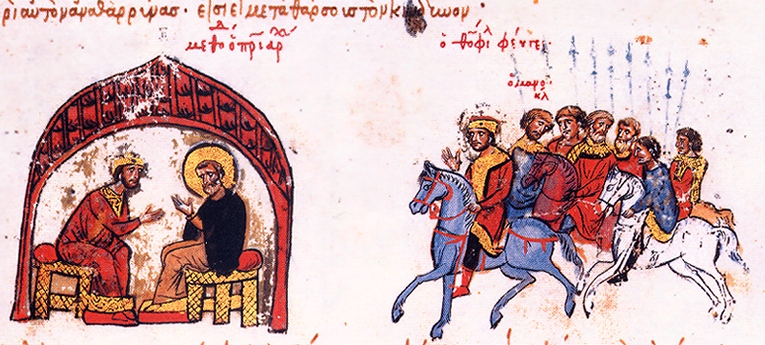

San
Metodio patriarca in una miniatura bizantina
Patriarch
Methodius, Madrid Skylitzes
San Metodio Patriarca
di Costantinopoli
Festa: 14 giugno
m. Costantinopoli, 847
È la figura di un
patriarca di Costantinopoli ai tempi della Chiesa indivisa, la figura che il
calendario liturgico presenta oggi alla venerazione dei fedeli. Siciliano
d'origine (la sua formazione sarebbe avvenuta a Siracusa), Metodio fu monaco
sull'isola di Chio prima di essere chiamato a Costantinopoli dal patriarca san
Niceforo. Erano quelli gli anni in cui divampava lo scontro sulle icone. Fermo
difensore della venerazione delle immagini, quando l'imperatore iconoclasta
Leone V l'Armeno depose il patriarca Niceforo, Metodio si recò a Roma per
informare papa Pasquale I dell'accaduto. Alla morte di Leone, il Papa inviò
Metodio a Costantinopoli con una lettera in cui chiedeva fosse reinsediato come
legittimo patriarca. Ma la lotta non era ancora finita: ad attenderlo trovò
infatti il carcere, dove rimase per anni. Solo con l'avvento dell'imperatrice
Santa Teodora, verrà la svolta definitiva in favore delle icone. E Metodio
tornerà sulla sede patriarcale di Costantinopoli. Morirà nell'847. (Avvenire)
Martirologio
Romano: A Costantinopoli, san Metodio, vescovo, che, mentre era monaco, si
recò a Roma dal papa Pasquale I per difendere il culto delle sacre immagini e,
elevato all’episcopato, celebrò solennemente il trionfo della retta fede.
San Metodio, patriarca di Costantinopoli, ebbe un ruolo coraggioso nella sconfitta definitiva dell'iconoclastia e dimostrò un'immane forza di sopportazione durante la prigionia. Spesso viene citato con gli appellativi “il Confessore” o “il Grande”. Di origini sicule, ricevette un'ottima educazione presso Siracusa. Si trasferì poi a Costantinopoli per assicurarsi un posto a corte, ma poi influenzato da un monaco decise di entrare nel monastero di Chenolacco. In seguito egli stesso intraprese la fondazione di un monastero sull'isola di Chio, nel Mar Egeo, dal quale fu richiamato nella capitale dal patriarca San Niceforo.
Il movimento iconoclasta, che sin dal tempo dell'imperatore Leone l'Isaurico (717-741) sosteneva la discruzione delle immagini sacre e l'abrogazione del culto dei santi, nonostante sconfitto nell'VIII secolo con San Giovanni Damasceno, all'inizio del secolo successivo trovò nuovo appoggio nell'imperatore Leone V l'Armeno, anche a causa delle pressioni e delle influenze provenienti dalla nascente dottrina islamica. Alcuni cristiani temevano che la venerazione delle immagini potesse degenerare in pratiche superstiziose, ma Metodio argomentò a buon ragione che le statue o le icone costituiscono un aiuto alla devozione, un'eredità della tradizione ecclesiastica. Si oppose dunque coraggiosamente a questo nuovo attacco. Dopo la deposizione e la condanna all'esilio del patriarca Niceforo, Metodio fu incaricato da altri vescovo di recarsi a Roma per informare papa San Pasquale I dell'accaduto e qui rimase sino alla morte di Leone. Il papa inviò poi una lettera al nuovo imperatore, Michele il Balbuziente, chiedendogli di reinsediare Metodio, legittimo patriarca di Costantinopoli. Nella città, però, infuriava ancora la controversia ed al suo arrivo venne accusato di aver costretto il papa: venne allora imprigionato per circa sette o nove anni.
Fu dunque costretto a vivere in condizioni disumane, rinchiuso forse in una grotta od in una tomba con altri due compagni, accusati di furto. Quando uno dei due morì, fu miseramente lasciato imputridire nella cella. Quando venne infine scarcerato, Metodio era ormai ridotto ad uno scheletro, calvo, pallido per i lunghi anni trascorsi nelle tenebre, abbigliato di sudici cenci. Era però rimasto intatto il suo spirito, tanto che quando l'imperatore Teofilo l'Iconoclasta rinnovò l'interdetto per le sacre icone egli coraggiosamente attaccò la venerazione delle immagini imperiali: “Se un immagine è così indegna ai tuoi occhi, come mai tu che condanni la venerazione delle immagini di Cristo allo stesso tempo non condanni quella tributata alle raffigurazioni di te stesso?”.
L'imperatore non esitò allora a farlo fustigare e gettare in carcere con una mandibola rotta: la notte stessa i discepoli tentarono di farlo fuggire. Teofilo morì fortunatamente poco dopo ed il potere passò nelle mani della vedova, l'imperatrice Santa Teodora, che resse il regno in nome del figlio minorenne Michele III, dando una decisiva svolta alla politica di corte schierandosi in favore del culto delle immagini. Cessarono così le persecuzioni e gli ecclesiastici esiliati poterono fare ritorno. Nel giro di trenta giorni le icone tornarono a comparire nelle chiese di Costantinopoli e, deposto il patriarca iconoclasta, Metodio poté nuovamente fare ritorno alla sua legittima sede, dotato di un bendaggio atto a sorreggere la mandibola ancora fratturata.
Il suo episcopato durò quattro anni, in cui convocò con Teodora un sinodo che ristabilì ufficialmente il culto delle immagini, riportò a Costantinopoli le reliquie del suo predecessore morto in esilio ed istituì la festa annuale dell'Ortodossia, che ancor oggi è celebrata in Oriente la prima domenica di Quaresima, componendo per l'occasione il “synodicon” da leggersi in tale occasione. Sfortunatamente ereditò da Niceforo la disputa con i monaci studiti, all'inizio tra i suoi più accesi sostenitori, ma in seguito acerrimi nemici dopo la condanna da lui tributata ad alcuni scritti del loro celebre abate San Teodoro Studita.
Scrittore assai prolifico, purtroppo non sono però più considerate autentiche
gran parte delle opere poetiche e teologiche a lui un tempo attribuite, mentre
paiono essere sue alcune opere agiografiche quale la Vita di San Teofano il
Cronografo.
Metodio morì in Costantinopoli nell'847.
Autore: Fabio Arduino
SOURCE : https://www.santiebeati.it/dettaglio/92500
METODIO, santo
di Maria Stelladoro
Dizionario
Biografico degli Italiani - Volume 74 (2010)
METODIO, santo. – Nacque
nel 789-790 da nobile e ricca famiglia a Siracusa, dove ricevette un’accurata
formazione culturale. Nell’810 si recò a Costantinopoli per proseguire gli
studi umanistici e fare carriera burocratica. Probabilmente per intervento di
Eutimio vescovo di Sardi, che forse M. aveva accompagnato a Costantinopoli nel
viaggio di ritorno dall’esilio a Pantelleria, scelse la vita ascetica, che
abbracciò nel monastero di Chenolakkos ai piedi dell’Olimpo. A 25 anni era
arcidiacono.
Nell’815, quando l’imperatore
d’Oriente Leone V l’Armeno iniziò la persecuzione iconoclasta, M. divenne
igumeno del monastero di Chenolakkos e di un altro (sembra quello degli Eligmoi
in Bitinia) da lui stesso fondato nella diocesi di Kios (non Chios: Janin,
1975, p. 144). Nell’815 il patriarca Niceforo, che aveva ripreso le relazioni
con la S. Sede, fu deposto e in aprile il sinodo apertosi in S. Sofia, sotto la
presidenza del nuovo patriarca Teodoto Melisseno, aveva sconfessato il concilio
di Nicea e riconosciuto, invece, gli atti del concilio iconoclasta del 754. M.
lasciò allora Costantinopoli per Roma, dove rimase sino all’821. Per alcuni fu
latore di lettere sinodiche a papa Leone III da parte di Niceforo; per altri fu
a Roma in volontario esilio per sfuggire alla persecuzione iconoclasta: le due
ipotesi potrebbero coesistere. A Roma difese l’ortodossia e, con l’aiuto del
vescovo Giovanni di Monemvasia, contribuì al fallimento dell’ambasciata inviata
dall’iconoclasta Leone V l’Armeno e dal patriarca Teodoto Melisseno (che aveva
anche esiliato i vescovi iconofili) per ottenere l’appoggio di papa Stefano IV.
M. e Giovanni di Monemvasia impedirono che il nuovo papa Pasquale I approvasse
la lettera sinodica di Teodoto; grazie al loro intervento il papa fu informato
della deposizione del patriarca Niceforo, sostituito con l’eretico Teodoto. M.
fu latore di un’epistola in greco inviata in risposta da Pasquale I a Leone V
l’Armeno; alcuni sostengono che il documento sarebbe arrivato nell’821. Pitra
(p. X) afferma che la lettera di Pasquale I fu portata da M. a Leone V nell’818;
per la communis opinio, invece, M. avrebbe ricoperto la funzione di legato
pontificio nell’821 sotto il successore di Leone V l’Armeno; la lettera
invitava a seguire la dottrina del concilio di Nicea sul culto delle immagini
sacre. Pare che i redattori greci ne stilassero estratti da divulgare a
Costantinopoli per confortare gli iconofili. Nello stesso tempo M. e Giovanni
consegnarono a Dionisio ed Eufemiano una lettera per Teodoro Studita che,
inviando al papa la seconda missiva, ne scrisse in risposta una a M. e
Giovanni, dalla quale si evinceva la funzione mediatrice di M. che facilitò
l’accesso dei legati provenienti dall’Oriente presso il pontefice. I monaci
bizantini a Roma erano ospitati o nel convento di S. Prassede o in quello di S.
Saba, diretto dall’archimandrita Basilio. M. avrebbe trovato ospitalità nel
primo, di cui sarebbe pure divenuto igumeno (ipotesi non da tutti condivisa:
Bernardini, p. 78).
Secondo Anastasio
Bibliotecario M. lasciò Roma da sacerdote dopo la morte di Leone V l’Armeno, il
che fa supporre che abbia ricevuto lì l’ordinazione canonica.
Intanto a Roma si era
diffusa la notizia dell’uccisione di Leone V nella notte di Natale dell’820. M.
tornò a Costantinopoli, latore di un documento dommatico papale, sul culto
delle immagini, al nuovo imperatore Michele II il Balbo, sotto il cui impero le
dispute religiose conobbero un periodo di tregua, ma non si giunse alla
restaurazione del culto delle immagini in quanto Michele II, iconoclasta più
moderato, proibì ogni discussione su tale divieto che riguardava Costantinopoli
e non riconobbe né il concilio di Nicea, né i sinodi iconoclasti.
Tornato a Costantinopoli,
M. fu perseguitato da Michele II e da suo figlio Teofilo (829-842), forse
perché sospettato di collusione con il ribelle generale Tommaso lo Slavo, o
perché lo si reputava calunniatore della corte bizantina presso il papa a Roma;
probabilmente M. era sospettato di spionaggio e considerato un emissario di
Roma. Non fu, quindi, imprigionato in quanto iconofilo ma perché il legame tra
gli iconofili bizantini e Roma aveva suscitato il risentimento dell’imperatore.
Sulla cronologia della
prigionia di M. e sul luogo della sua detenzione le fonti non sono concordi.
La Vita di Eutimio di Sardi, composta dallo stesso M., ha messo fine
alle incertezze riguardo alla sua detenzione: ormai imprigionato da tempo, M.
fu rinchiuso in una tomba dell’isola di Sant’Andrea sul litorale bitinico,
vicino al capo Acritas, quando, proprio pochi mesi prima che morisse Michele II
(829), circolò un libretto, attribuito a M., che profetizzava la morte
imminente dell’imperatore (un testo analogo era già stato attribuito a M.
durante il suo soggiorno a Roma); nell’831 fu rinchiuso nella stessa prigione
anche Eutimio di Sardi, che morì poco dopo assistito dallo stesso M., che,
ancora in carcere, ne scrisse, appunto, la Vita; questo dato rende
inaccettabile la tradizione che M. sia stato liberato da Michele II. Fu Teofilo
che liberò M. poco prima della fine del suo regno e lo fece vivere per qualche
tempo a suo fianco a palazzo, facendosi accompagnare varie volte da M. nelle
sue spedizioni militari contro i Saraceni, forse perché temeva che la sua
presenza a corte potesse nuocergli.
C’è chi sostiene che M.
sia rimasto a corte come moderatore della politica religiosa di Teofilo e che,
uscito dal carcere, sia passato nel Sigma, costruito nell’840.
Il 20 genn. 842, alla
morte di Teofilo, Giovanni Grammatico fu deposto dal patriarcato e allontanato,
mentre M. fu esiliato in Bitinia, nel suo convento degli Eligmoi, dove
trascrisse (durante la quaresima dell’842) i Sette Salteri. Per altri, M.
fu igumeno del monastero costantinopolitano dei Ss. Sergio e Bacco (in
quest’ultimo caso Stiernon ipotizza una possibile confusione con Giovanni
Grammatico).
Alla morte di Teofilo il
figlio e successore Michele III aveva tre anni e la reggenza fu assunta dalla
madre, Teodora. Il 4 marzo 843 M. fu eletto patriarca di Costantinopoli.
Forse M. più degli altri
personaggi proposti garantiva a Teodora e alla sua corte una soluzione non
estremistica al problema del secondo iconoclasmo. Il nuovo governo considerò la
restaurazione del culto delle icone come il compito primario e più urgente.
Eppure, a differenza di Irene, Teodora e M. non ritennero necessaria
l’approvazione di Roma per la restaurazione del culto delle immagini: era
necessario che Bisanzio si liberasse della sovranità di Roma dopo che
l’Occidente si era sottratto alla supremazia dell’Oriente.
La solenne cerimonia di
intronizzazione fu celebrata l’11 marzo 843 in S. Sofia. Nel discorso
inaugurale M., pur esprimendo soddisfazione per il trionfo dell’iconodulia,
esortava al perdono e, piuttosto che a vendicarsi degli iconoclasti, invitava a
indurli a spontanea conversione. Michele il Sincello (già igumeno del monastero
di Chora) divenne suo vicario generale alla morte di Simeone di Lesbo.
M. lottò contro gli
iconoclasti, ma anche contro i rigoristi studiti; fece restaurare dal monaco
Lazzaro il Kazaro l’icona di Cristo della Chalki, distrutta da Leone III;
intervenne nella traslazione a Costantinopoli delle spoglie di Teodoro Studita
e di Giuseppe, suo fratello; ordinò il trasferimento di Teofilatto di Nicomedia
dal luogo dell’esilio nella sua città episcopale; presiedette alla dedica del
restauro delle immagini; depose gli abati iconoclasti e i vescovi
iconomachi relapsi ma la sua moderazione suscitò il malcontento dei
monaci studiti e fu quindi costretto ad applicare l’anatema canonico e poi la
deposizione (845-846); riconobbe i canoni del II concilio di Nicea (787) e
ripristinò il culto delle immagini sacre per cui la Chiesa greco-ortodossa
celebra annualmente, nella prima domenica di quaresima, la festa
dell’ortodossia (istituita da M. l’11 marzo 843): la sconfitta
dell’iconoclastia rappresentava a Bisanzio il fallimento del tentativo di
subordinare completamente la Chiesa al potere statale. Un anno dopo, il 2 marzo
844, fu letto pubblicamente il famoso Synodikon, redatto da M., canone per
la vittoria dell’ortodossia (Analecta hymnica Graeca, X, p. 343 e n. 2; Patr.
Graeca, XCIX, coll. 1768-1780) in cui si inneggiavano gli iconofili prima in
forma impersonale e poi nominando i patriarchi, i vescovi e i monaci. A
differenza del periodo di Irene, la svolta ecclesiastica avvenne senza attriti
sicché Teodora e Teoctisto, con l’appoggio di M., liquidarono con prudenza il
precedente sistema, dimostrando grande diplomazia nei confronti degli ex
iconoclasti.
Eppure tale politica non
godette dell’assenso degli zeloti, per cui si riaprì l’antico scisma.
Nonostante Teodora, fervente ortodossa, chiedesse perdono per il marito,
l’iconoclasta imperatore Teofilo, i suoi seguaci a corte aspettavano una mossa
falsa di M. per spingere Teodora all’eresia. M. ricorse alla moderazione
contrariamente all’opinione dei monaci studiti e così Teofilo non fu
scomunicato quale eretico. Per i capi, i recidivi e gli estremisti si era
optato per la condanna, al doppio fine di epurare la gerarchia e di reintegrare
elementi nuovi.
M. non scelse i suoi
vescovi tra gli studiti ortodossi probabilmente perché temeva la loro rigidità
nell’applicazione dei canoni e il loro eccesso di zelo, che poteva ricondurre
la corte all’iconoclastia. La sua scelta ricadde su vescovi ortodossi più
elastici.
Morì a Costantinopoli il
14 giugno 847. Fu sepolto nella chiesa dei Ss. Apostoli.
Il suo nome fu inserito
nelle acclamazioni della domenica dell’Ortodossia. Il 14 giugno è celebrato
nella Chiesa occidentale e nei menei bizantini, mentre nel Synaxarium
Ecclesiae Constantinopolitanae la sua ricorrenza è fissata al 15 giugno;
l’iscrizione al 5 novembre nel calendario marmoreo di Napoli sembra una
contaminazione della festa di Giovanniccio. Gli sono attribuiti due miracoli.
Una trentina d’anni dopo la sua morte, Anastasio Bibliotecario, scrivendo a
Carlo il Calvo, informava che M., dalla sua elezione al patriarcato, era stato
da tutti venerato come santo.
Pitra (pp. 353-355)
elenca trentotto scritti di M. di cui si ricordano: Encomio di s. Agata (Bibliotheca
hagiographica Graeca [=B.H.G.], I, n. 38; Stelladoro); Vita di Eusebio
Alessandrino (B.H.G. e Novum auctarium B.H.G., n. 635x); la già
citata Vita di Eutimio di Sardi (Gouillard, 1987), che pare risalire
al periodo della sua reclusione a Sant’Andrea e quindi all’inizio
dell’832; Vita di s. Nicola di Mira (B.H.G., II, n. 1362y; il
cosiddetto Methodius ad Theodorum: testo in Anrich), scritta probabilmente
per Teodoro Cratero, tra l’821 e l’838 (Ševčenko, Hagiography, pp. 17 s.);
l’Encomio in s. Nicolaum ep. Myrrensis, collocabile intorno all’838-840,
attribuito a M. dalla più antica tradizione manoscritta (ma alcuni preferiscono
restituirlo a Basilio di Lacedemonia). Se è credibile la tradizione che
attribuisce a M. la composizione del De Ioanne auctoris patre (B.H.G.,
II, n. 1357), allora suo padre si chiamerebbe Giovanni, devotissimo a s. Nicola
dal quale sarebbe stato salvato da naufragio (Anrich, pp. 169 s.). Vita di
s. Teofane il confessore (B.H.G., II, n. 1787z), che pare composta dopo la
traslazione del santo (822). Sono attribuite a M. numerose composizioni liturgiche
(cfr. Follieri).
La raccolta agiografica
di Parigi e il Corpus dionisiaco di Londra non sono le sole
testimonianze dell’attività di copia del patriarca Metodio. All’attività di
copista esplicata da M. a Roma si attribuisce la trascrizione delle opere dello
Pseudo Dionigi e di una raccolta agiografica in due volumi (Canart).
La Vita
Methodii è stata editata da ultimo da Beck (1959, pp. 496-498), che l’ha
sintetizzata. L’opera, anonima, è stata attribuita a Gregorio Asbesta, allievo
prediletto di M., pure oriundo di Sicilia ma da anni trapiantato a
Costantinopoli, divenuto poi arcivescovo di Siracusa (B.H.G., II, n. 1278).
Per l’iconografia di M.
cfr. Stiernon.
Fonti e Bibl.: Anastasius
Bibliothecarius, Epistolae sive Praefationes, in Mon. Germ. Hist., Epistolae,
VII, 2, Berolini 1928, p. 441; J.-P. Migne, Patr. Gr., IV, coll. 669-684;
XVIII, coll. 397-404; C, coll. 1231-1272, 1286 s., 1308-1317; Theophanes
Continuatus, Chronicon, ibid., CIX, coll. 129-132, 173; Constantinus
Porphyrogenitus, De caerimoniis, ibid., CXII, col. 280; Michael
Glycas, Annales, a cura di I. Bekker, Bonnae 1836, pp. 537 s.;
Constantinus Manasses, Breviarium historiae metricum, a cura di I. Bekker,
Bonnae 1837, pp. 209 s.; Theophanes Continuatus…, Symeon magister…, a cura
di I. Bekker, Bonnae 1838, pp. 642-644; Georgius Cedrenus, Annales, II, a
cura di I. Bekker, Bonnae 1839, pp. 73, 116 s.; De Immacolata Deiparae
Conceptione hymnologia Graecorum, a cura di T. Toscani - I. Cozza, Romae 1862,
pp. 112 n. 23, 178 n. 11; Theodorus Studita, Epistolae, in Nova
patrum bibliotheca, a cura di A. Mai, VIII, Romae 1871, p. 165; Vita
Ioannicii, in Acta sanctorum novembris, II, 1, Bruxellis 1894, p. 372;
Iohannes Zonara, Epitomae historiarum, III, a cura di W. Büttner Wobst,
Bonnae 1897, pp. 338 s., 374 s.; Acta Graeca ss. Davidis…, in Analecta
bollandiana, XVIII (1899), p. 237; Synaxarium Ecclesiae
Constantinopolitanae…, a cura di H. Delehaye, in Propylaeum ad Acta
sanctorum novembris, Bruxellis 1902, coll. 345, 749-754; Vita Michaelis
Syncelli, a cura di Th. Schmitt, in Bulletin de l’Institut archéologique
russe, XI (1906), pp. 247 s.; Les regestes des actes du patriarcat de
Constantinople, II, Les regestes de 715 à 1043, a cura di V. Grumel, Paris
1936, pp. 42-64 nn. 414-443; Analecta hymnica Graeca, III, a cura di A.
Kominis, Romae 1972, pp. 134-145, 569-572; IV, a cura di A. Kominis, ibid.
1976, pp. 279-287, 343, 817-820, 829 s.; X, a cura di A. Acconcia Longo, ibid.
1972, pp. 50-62, 339-344; P. Carrera, Delle memorie historiche della città
di Catania, II, Catania 1641, pp. 15-37; J. Goar, Euchologion sive Rituale
Graecorum, Lutetiae Parisiorum 1647, p. 126; G.B. De Grossis, Agatha
Catanensis, Catanae 1656, pp. 234 s.; L. Allacci, De Methodiorum scriptis
diatriba, in Id., S.P.N. Methodii episcopi et martyris Convivium decem
virginum, Romae 1656, pp. 365-368; G.B. Pitra, Iuris ecclesiastici
Graecorum historia et monumenta, II, Romae 1868, pp. X, 48, 354, 363 s.,
455-457; D.G. Lancia di Brolo, Storia della Chiesa in Sicilia nei dieci
primi secoli del cristianesimo, II, Palermo 1884, pp. 217-239; Theophanis
Chronographia, a cura di C. De Boor, II, Lipsiae 1885, pp. 3-12, 28-30; C.
Sakkelion, Catalogue des manuscrits de la Bibliothèque nationale de Grèce,
Athènes 1892, p. 133; J. Pargoire, St Euthyme et Jean de Sardes, in Échos
d’Orient, V (1901-02), pp. 157-161; Id., St Méthode de Constantinople
avant 821, ibid., VI (1903), pp. 126-131; Id., St Méthode et la
persécution, ibid., pp. 183-191; E. von Dobschütz, Methodius und die
Studiten, in Byzantinische Zeitschrift, XVIII (1909), pp. 41-105; G.
Anrich, Hagios Nikolaos. Der heilige Nikolaos in der griechischen Kirche,
I, Leipzig-Berlin 1913, pp. 140-150, 169 s.; Methodii patriarchae
Constantinopolitani Vita S. Theophanis confessoris, a cura di A. Latyaev,
in Mémoires de l’Académie des sciences de Russie, s. 8, XIII (1918), 1,
pp. IX, 1-40; S. G. Mercati, Sull’epigramma di M. patriarca, in Bessarione,
XXIV (1920), pp. 192-199; R. Janin, Les îles des Princes, in Échos
d’Orient, XXIII (1924), pp. 317 s.; J.B. Papadopoulos, Les ruines de l’île
de Antigoni, in Byzantinisch-neugriechische Jahrbücher, V (1927), pp. 85
s.; V. Grumel, La politique religieuse du patriarche saint Méthode, ibid.,
XXXIV (1935), pp. 385-401; A. Ehrhard, Überlieferung und Bestand der
hagiographischen und homiletischen Literatur der griechischen Kirche, I-III,
Leipzig-Berlin 1937-52, ad ind.; H. Delehaye, Hagiographie
napolitaine, in Analecta bollandiana, LVII (1939), pp. 39 s.; D.
Mallardo, Il calendario marmoreo di Napoli, Roma 1947, p. 159; H. Moretus
Plantin, Les Passions de saint Denys, in Mélanges offerts au R.P.
Ferdinand Cavallera, Toulouse 1948, pp. 229 s.; E. Mioni, L’encomio di s.
Agata di M. patriarca di Costantinopoli, in Analecta bollandiana, LXVIII
(1950), pp. 58-93; R. Loenertz, La légende parisienne de st Denys
l’Aréopagite, ibid., LXIX (1951), p. 236; F. Dvornik, Lo scisma di
Fozio, a cura di G. Pacchiani, Roma 1953, pp. 17-35; H.G. Beck, Kirche und
theologische Literatur im byzantinischen Reich, München 1959, pp. 496-498, 557
s.; J. Gouillard, Une oeuvre inédite du patriarche Méthode : la vie
d’Euthyme de Sardes, in Byzantinische Zeitschrift, LIII (1960), pp. 36-46;
C. Mango, Materials for the study of the mosaics of St. Sophia at Istanbul,
Washington 1962, pp. 51-53, 55 tavv. 61 s., 66-68; A. Frolow, Le Christ de
la Chalcé, in Byzantion, XXXIII (1963), pp. 107-120; H. Ahrweiler, Sur
la carrière de Photius avant son patriarcat, in Byzantinische Zeitschrift,
LVIII (1965), p. 350; G. De Andrés Martínez, Catálogo de los códices
griegos de la Real Biblioteca de El Escorial, II, Madrid 1965, p. 333; S. Cirac
Estopañán, Skyllitzes Matritensis, I, Barcellona-Madrid 1965, ad ind.;
J. Darrouzès, Documents inédits d’ecclésiologie byzantine, Paris
1966, ad ind.; E. Follieri, Initia hymnorum Ecclesiae Graecae, V, 2,
Città del Vaticano 1966, p. 238; J. Gouillard, Le Synodikon de
l’orthodoxie. Édition et commentaire, in Travaux et mémoires, II (1967),
pp. 1-316; D. Stiernon, M. I, il Confessore, in Bibliotheca sanctorum,
IX, Roma 1967, coll. 382-393 (con bibl.); E. Tomadakis, Un problema di
innografia bizantina: il rimaneggiamento dei testi innografici, in Bollettino
della Badia greca di Grottaferrata, n.s., XXVI (1972), p. 5 n. 6b; I. Doens -
Ch. Hannick, Das Periorismos-Dekret des Patriarchen Methodios I. gegen die
Studiten Naukratios und Athanasios, in Jahrbuch der Österreichischen
Byzantinistik, XXII (1973), pp. 93-103; R. Janin, Les églises et les
monastères des grands centres byzantins, Paris 1975, pp. 53-55, 63-65, 136-139,
144-146, 151 s., 189 s., 195-199, 213 s.; L. Bernardini, M. I, patriarca
di Costantinopoli (843-847), vincitore del II iconoclasmo, in Oriente
cristiano, XVII (1977), 1, pp. 42-66; 2, pp. 32-81; 3, pp. 50-67; 4, pp. 25-32;
XVIII (1978), 1, pp. 33-54; XIX (1979), 1-2, pp. 40-57; I. Ševčenko, L’agiografia
bizantina dal IV al IX secolo, in La civiltà bizantina dal IV al IX secolo,
Bari 1977, pp. 87-173; Id., Hagiography in the iconoclast period, in Iconoclasm,
a cura di A.A. Bryer- J. Herrin, Birmingham 1977, pp. 17 s., 113-131; P.
Canart, Le patriarche Méthode de Constantinople copiste à Rome, in Palaeographica,
diplomatica et archivistica. Studi in onore di G. Battelli, Roma 1979, I, pp.
350, 353-363; A. Grabar - I. Manoussacas, L’illustration du manuscrit de
Skylitzes de la Bibliothèque nationale de Madrid, Venezia 1979, ad ind.;
N.B. Tomadakis, Ancora «iconodulia» e «iconofilia», in Epeteris
Hetaireias Byzantinon Spoudon. Annuaire de l’Association d’études byzantines,
XLIV (1979-80), p. 282; H. G. Beck, Geschichte der orthodoxen Kirche im
byzantinischen Reich, Göttingen 1980, pp. 89 s.; S.J. Voicu - S.
D’Alisera, Index in manuscriptorum Graecorum edita specimina, Roma 1981,
pp. 382 s.; H. Löwe, Methodius in Reichenauer Verbrüderungsbuch, in Deutsches
Archiv für Erforschung des Mittelalters, XXXVIII (1982), pp. 341-362; I.
Ševčenko, Ideology, letters and culture in the Byzantine world, London
1982, pp. 17 s.; C. Crimi, L’encomio «lacerato». A proposito di un
apocrifo secentesco su s. Agata, in Synaxis, III (1985), pp. 387-412;
J.-M. Hussey, The Orthodox Church in the Byzantine Empire, Oxford 1986,
pp. 53-65, 67, 69-71, 102; S. Marino, Considerazioni sulla personalità di
M. I, patriarca di Costantinopoli, in Culto delle immagini e crisi
iconoclasta. Atti del Convegno di studi, Catania… 1984, Palermo 1986, pp.
117-126; C. Crimi, Ancora sull’encomio «lacerato», in Synaxis, V
(1987), pp. 261-275; G. Da Costa-Louillet, Le patriarche Méthode contre
les iconoclastes et les stoudites, in Revue des études byzantines, XLV
(1987), pp. 15-57; La Vie d’Euthyme de Sardes († 831) une oeuvre du
patriarche Méthode, a cura di J. Gouillard, in Travaux et mémoires, X
(1987), pp. 1-101; J. Kuliè, Ricerca sulle commemorazioni giornaliere nei
menei bizantini, Roma 1992, pp. 165 s.; K.-P. Todt, Methodius, in Biographisch-bibliographisches
Kirchenlexikon, V, Herzberg 1993, coll. 1209-1212; B. Zielke, Methodius I.,
in Die Patriarchen der ikonoklastischen Zeit, a cura di R.-J. Lilie,
Frankfurt 1999, pp. 183-260; A. Acconcia Longo, Vite, passioni, miracoli
dei santi, in Lo spazio letterario del Medioevo, III, 1, La cultura
bizantina, a cura di G. Cavallo, Roma 2004, pp. 183-227; Id., Santi
siciliani di età iconoclasta, in Euplo e Lucia 304-2004. Atti del
Convegno… 2004, a cura di T. Sardella - G. Zito, Catania 2005, p. 305; C.
Crimi, S. Agata a Bisanzio nel IX secolo. Rileggendo M. patriarca di
Costantinopoli, ibid., pp. 143-163; M. Stelladoro, Agata. La martire,
Milano 2005, ad ind.; Id., S. Agata vergine e martire tra storia
devozione e culto, in Agorà, VII (2006-07), 27-28, pp. 30-37; A. Acconcia
Longo, I santi nell’innografia liturgica bizantina (sec. VI-IX), in Liturgia
e agiografia tra Roma e Costantinopoli. Atti del I e II Seminario di studio…, a
cura di K. Stantchev - S. Parenti, Grottaferrata 2007, pp. 59-72; Lexikon
für Theologie und Kirche, s.v.; Dictionnaire de théologie catholique,
s.v.; Dictionnaire de spiritualité ascétique et mistique, s.v.; Lexikon
der christlichen Ikonographie, VII, coll. 13 s.; Bibliotheca hagiographica
Graeca, I, nn. 38, 377a, 554d, 635x, 990z, 991c, 992, 1167m; II, nn. 1278,
1357, 1362y, 1787; Bibliotheca hagiographica Graeca, Auctarium, n.
991c; Bibliotheca hagiographica Graeca, Novum auctarium, nn. 554d,
635x, 2145; Dumbarton Oaks hagiography database, Washington 1998, pp. 68
s.; hhp://www.doaks.org.
M. Stelladoro
© Istituto della
Enciclopedia Italiana fondata da Giovanni Treccani - Riproduzione riservata
SOURCE : https://www.treccani.it/enciclopedia/santo-metodio_(Dizionario-Biografico)/