
Le
roi martyr saint ETHELBERT d’Est-Anglie représenté sur une plaque de cuivre
dans la cathédrale de Hereford (dessin d'après
modèle).
Saint Ethelbert
Roi et martyr (+ 793)
Roi d'Angleterre et
martyr à Cardiff.
Il était promis à sainte Alfreda quand
il fut assassiné.
Son assassin fit
pénitence en découvrant la sainteté de sa victime.
SOURCE : http://nominis.cef.fr/contenus/saint/7014/Saint-Ethelbert.html
SAINT MARTYR ETHELBERT
(AETHELBERT), ROI D'EST ANGLIE
Endormi près d'Hereford,
Angleterre, vers 793-794. Le roi Ethelbert a été l'objet d'un culte
considérable comme Thaumaturge et Martyr. Cependant, certains, comme Guillaume
de Malmesbury, eurent des appréhensions concernant la perpétuation de sa
vénération. Il citait l'autorité de Saint Dunstan et le témoignage des miracles
comme motif pour autoriser la continuité du culte. Ethelbert fut assassiné à
Sutton Walls dans l'Herefordshire, apparemment pour des raisons dynastiques, à
l'instigation de l'épouse d'Offa de Mercie.
Sa pieuse
"Vita", écrite par Giraldus Cambrensis (Gerald de Galles), nous
rapporte qu'Ethelbert fut un homme de prière dès son enfance. Bien qu'étant
encore fort jeune, il succéda à son père Ethelred comme roi d'Est Anglie et
régna rempli de bonne volonté quarante-quatre ans durant. On rapporte que sa
maxime habituelle était "au plus haute la position occupée par l'homme, au
plus il doit être humble". C'était la règle de sa propre conduite.
Désirant assurer la
stabilité de son royaume par une alliance, il sollicita la main de la vertueuse
Alfreda (Aelfthryth), fille du puissant roi Offa. A cet effet, il visita Offa à
Sutton-Walls, à quatre miles d'Hereford. Il fut courtoisement reçu, mais après
quelques jours, fut traîtreusement assassiné par Grimbert, un officier du roi
Offa, avec la connivence de la reine Quendreda qui voulait s'accaparer son
royaume pour agrandir le sien.
Son corps fut enterré
secrètement près de la rivière Lugg à Maurdine de Marden, mais des miracles en
révélèrent la cachette. Peu après, il fut déplacé à l'église de Fernley (Heath
of Fern), appelée à présent Hereford. La ville grandit autour de l'église portant
le nom d'Ethelbert après que le roi Wilfrid de Mercie l'agrandit et l'enrichit.
Hereford devint le second plus important lieu de pèlerinage de l'Angleterre
médiévale après Canterbury. Le corps fut brûlé par les Danois en 1050, mais le
chef d'Ethelbert fut enterré à Westminster. La fête d'Ethelbert est aussi
observée dans les diocèses papistes de Cardiff et Northampton.
Quendreda mourut
misérablement endéans les trois mois de son crime. Sa soeur Alfreda devint
Ermite à Croyland. Offa expia le péché de sa reine par un pèlerinage à Rome, où
il fonda une école pour les Anglais. Egfrid, le fils unique d'Offa, mourut
après un règne de quelques mois, et la couronne des Merciens fut transmise à
une famille descendant de Penda.
SOURCE : http://orthodoxie-libre.actifforum.com/t258-saint-ethelbert-d-est-anglie-20-mai-2-juin

Cambridge,
Trinity College, B.11.16, f077v. The beginning of the Vita Sancti Ethelberti
SAINT ETHELBERT, ROI DES
ANGLES ORIENTAUX
Tout à la fin de
son Histoire Ecclésiastique du Peuple Anglais, saint Bède-le Vénérable évoque
la mort, qui lui est toute contemporaine, de Wihtred roi de Kent (l’an 725) en
indiquant qu’il laissait trois héritiers de son royaume dont l’aîné était
Æthelberht (ou Ethelbert). (T. III, livre V, 23, 1, Sources Chrétiennes N°491,
Le Cerf, Paris - 2005). Plus tard, ce roi, deuxième du nom, « fut
assassiné par le roi de Mercie, Offa, qui convoitait l’Est-Anglie et l’unit en
effet à ses possessions. Offa fit pénitence, mais Dieu, qui punit souvent les
parents dans les enfants, permit que son unique héritier mourût après quelques
mois de règne et que la couronne de Mercie passât dans une autre famille. Le
corps de saint Ethelbert fut transporté à Hereford, où une église fut bâtie en
son honneur, et où il opéra un grand nombre de miracles. (An 793) » (Les
Petits Bollandistes, Vies des Saints, au 20 mai, date de la fête de saint
Ethelbert).
SOURCE : http://www.cassicia.com/FR/BOY-BISHOP-No_1501.htm

Saint Ethelbert of
East Anglia
Also
known as
Aethelbert
Albert
Albright
Etelberto
Profile
Son of Ethelred, King of
the East
Angles, and Leofrana. A pious youth, he would have preferred religious
life, but was in line for the throne. King of East
Anglia for 44 years. He would have preferred to remain celibate, but
agreed to seek the hand of Althryda (Alfrida)
daughter of Offa, King of
the Mercians in order to continue a stable line to the crown. There were a
number of supernatural indications that it was a bad choice, but Ethelbert went
anyway. Due to court intrigues,
Ethelbert was murdered by a man named Grimbert at the instigation of his
father-in-law, Offa of Mercia. Often listed as a martyr.
murdered in 793 at
Villa Australis, Mercia, England
his body was buried like
trash, but a heavenly light identified it, and it was eventually relocated
buried at
Maurdine near the Lugg River in Mercia
remains relocated to
Stratus-way
remains relocated to
Fernley (modern Hereford, England)
remains relocated
to Hereford Cathedral
during one of the moves
the head fell off the body, fell of the cart it was being carried in, touched a
pedestrian who had been blind for
eleven years, and cured him
head enshrined at Westminster Abbey
Additional
Information
Book
of Saints, by the Monks of
Ramsgate
Lives
of the Saints, by Father Alban
Butler
Saints
of the Day, by Katherine Rabenstein
books
Our Sunday Visitor’s Encyclopedia of Saints
other
sites in english
images
video
fonti
in italiano
MLA
Citation
“Saint Ethelbert of East
Anglia“. CatholicSaints.Info. 21 September 2022. Web. 18 April 2026.
<https://catholicsaints.info/saint-ethelbert-of-east-anglia/>
SOURCE : https://catholicsaints.info/saint-ethelbert-of-east-anglia/
.jpg)
Glass by Margaret Edith Aldrich Rope. East Window. Nativity with Saints. 1933. All Saints Church, Hereford (stained glass) ; Madonna and Child on stained-glass windows in the United Kingdom ; Saint Æthelberht II of East Anglia ; Saint Martin of Tours on stained-glass windows ; Saint George on stained-glass windows in England ; Thomas de Cantilupe
Book of Saints –
Ethelbert – 20 May
Article
ETHELBERT (Saint) King,
Martyr (May 20) (8th century) A King of East Anglia, who, invited by King Offa
to come to his Court to marry his daughter, was by that monarch’s orders
treacherously and cruelly put to death (A.D. 793). Numerous miracles justified
popular devotion in regarding him as a Martyr, and the place where his relics
were entombed was a little later made a Bishop’s See, that of Hereford.
MLA
Citation
Monks of Ramsgate.
“Ethelbert”. Book of Saints, 1921. CatholicSaints.Info.
16 January 2013. Web. 18 April 2026.
<https://catholicsaints.info/book-of-saints-ethelbert-20-may/>
SOURCE : https://catholicsaints.info/book-of-saints-ethelbert-20-may/
St. Ethelbert
Feastday: May 20
Death: 794
Martyred king of East
Anglia, England. When Ethelbert, the son and heir of Ethelred, went to Mercia
to ask for the hand of a princess, he was murdered by her mother, Queen
Cynethryth. He was especially venerated in Hereford.
SOURCE : https://www.catholic.org/saints/saint.php?saint_id=3188
New
Catholic Dictionary – Saint Ethelbert
Article
Martyr (died 793),
King of the East Angles. Although preferring a life of celibacy,
he agreed to woo Altrida (Alfrida) daughter of Offa, King of the Mercians, and,
undeterred by portents, repaired to Offa’s court, where he was murdered. His
ignominious burial place was revealed by a heavenly light, and the body having
been translated to Hereford Cathedral,
his sanctity was attested by the many miracles at his tomb. His head was
enshrined at Westminster Abbey.
The cathedral at
Hereford, of which he is patron, and 13 other churches in England are
named in his honor. Feast, 20
May.
MLA
Citation
“Saint Ethelbert”. New Catholic Dictionary. CatholicSaints.Info.
19 December 2012. Web. 18 April 2026.
<https://catholicsaints.info/new-catholic-dictionary-saint-ethelbert-2/>
SOURCE : https://catholicsaints.info/new-catholic-dictionary-saint-ethelbert-2/

Cambridge,
Corpus Christi College, MS 308, p. 3. The beginning of the Passio Sancti Ethelberti
Saints
of the Day – Ethelbert of East Anglia
Article
Died near Hereford,
England, in 793. King Ethelbert had a considerable cultus during the middle
ages, although some, such as William of Malmesbury, have misgivings about the
continuance of his veneration. He was murdered at Sutton Walls in
Herefordshire, apparently for dynastic reasons at the instigation of the wife
of Offa of Mercia. His pious vita, written by Giraldus Cambrensis, tells us
that Ethelbert was a man of prayer from his childhood. While still very young,
he succeeded his father Ethelred as king of East Anglia and ruled benevolently
for 44 years. It is said that his usual maxim is that the higher the station of
man, the humbler he ought to be. This was the rule for his own conduct.
Desiring to secure
stability for his kingdom by an heir, he sought the hand of the virtuous
Alfreda, daughter of the powerful King Offa. With this in mind, he visited Offa
at Sutton-Wallis, four miles Hereford. He was courteously entertained, but
after some days, treacherously murdered by Grimbert, an officer of king Offa,
through the contrivance of queen Quendreda who wanted to add his kingdom to
their own.
His body was secretly
buried at Maurdine of Marden, but miracles revealed its hiding place. Soon it
was moved to a church at Fernley (Heath of Fern), now called Hereford. The town
grew around the church bearing Ethelbert’s name after King Wilfrid of Mercia
enlarged and enriched it.
Quendreda died miserably
within three months after her crime. Her daughter Alfreda became a hermit at
Croyland. Offa made atonement for the sin of his queen by a pilgrimage to Rome,
where he founded a school for the English. Egfrid, the only son of Offa, died
after a reign of some months, and the Mercian crown was translated into the
family descended of Penda (Attwater, Benedictines).
MLA
Citation
Katherine I
Rabenstein. Saints of the Day, 1998. CatholicSaints.Info.
14 June 2020. Web. 18 April 2026.
<https://catholicsaints.info/saints-of-the-day-ethelbert-of-east-anglia/>
SOURCE : https://catholicsaints.info/saints-of-the-day-ethelbert-of-east-anglia/
St. Ethelbert
Date of birth unknown; d.
794; King of the East Angles, was, according to the "Speculum
Historiale" of Richard
of Cirencester (d. about 1401), the son of King Ethelred
and Leofrana, a lady of Mercia. Brought up in piety,
he was a man of singular humility.
Urged to marry,
he declared his preference for a life of celibacy,
but at length consented to woo Altrida (Alfrida),
daughter of Offa,
King of the Mercians. Leofrana foreboded evil and
tried to dissuade Ethelbert; but in spite of an earthquake, an eclipse of
the sun, and a warning vision, he proceeded from Bury St.
Edmunds to Villa Australis, where Offa resided.
On his arrival Altrida expressed her admiration for Ethelbert,
declaring that Offa ought
to accept him as suzerain. Cynethryth, the queen-mother, urged by hatred of Ethelbert,
so poisoned Offa's mind against
him, that he accepted the offer of a certain Grimbert to murder their
guest. Ethelbert, having come for an interview with Offa,
was bound and beheaded by Grimbert. The body
was buried ignominiously, but, revealing itself by
a heavenly light, was translated to the cathedral at Hereford,
where many miracles attested Ethelbert's sanctity.
The head was enshrined at Westminster
Abbey.
The "Chronicon"
of John Brompton (fl. 1437) adds a few particulars: the body
with the head was first buried on the banks of the Lugg. On the third
night the saint commanded
one Brithfrid, a nobleman, to convey his relics to
Stratus-way. During the journey the head fell out of the cart and healed a man
who had been blind for eleven years. Finally the body was entombed at Fernley,
the present Hereford.
According to Brompton, Altrida became a recluse at Croyland. Offa repented of
his sin (Matthew
of Paris represents Offa as ignorant of
the plot till after Ethelbert's murder),
gave much land to the martyr,
"which the church of Hereford holds
to the present day", founded St.
Albans and other monasteries,
and made his historic pilgrimage to Rome.
St. Ethelbert figures
largely in the Missal, Breviary,
and Hymnal of the Use of Hereford.
His feast is
on 20 May. Thirteen English churches, besides Hereford cathedral,
are dedicated in honour of Ethelbert;
and one of the gateways of Norwich cathedral bears
his name.
Sources
Anglo-Saxon Chronicle,
sub anno 792; RICHARD OF CIRENCESTER, Speculum Historiale, in R. S., I,
262 sqq; Chronicle of BROMPTON, in TWYSDEN, 748 sqq; Acta SS., May,
V, 271; Bibl. Hag. Lat., 394; BREWER, Opera Girald. Cambren., III,
407, V, pp. xlv and 407; WHARTON, Anglia Sacra, II, p. xxii; HARDY, Catalogue
of Materials, I, 495; STUBBS in Dict. Of Christian Biography, II, 215;
CHEVALIER, Répertoire, I, 1365; HUNT in Dict. Nat. Biog., XVIII, 17;
STANTLON, Menology.
Ryan, Patrick W.F.
"St. Ethelbert." The Catholic Encyclopedia. Vol. 5. New York: Robert
Appleton Company, 1909. 20 May 2015
<http://www.newadvent.org/cathen/05553a.htm>.
Transcription. This
article was transcribed for New Advent by Thomas M. Barrett. Dedicated to
St. Ethelbert.
Ecclesiastical
approbation. Nihil Obstat. May 1, 1909. Remy Lafort, Censor. Imprimatur. +John
M. Farley, Archbishop of New York.
Copyright © 2023 by Kevin Knight.
Dedicated to the Immaculate Heart of Mary.
SOURCE : http://www.newadvent.org/cathen/05553a.htm

Le
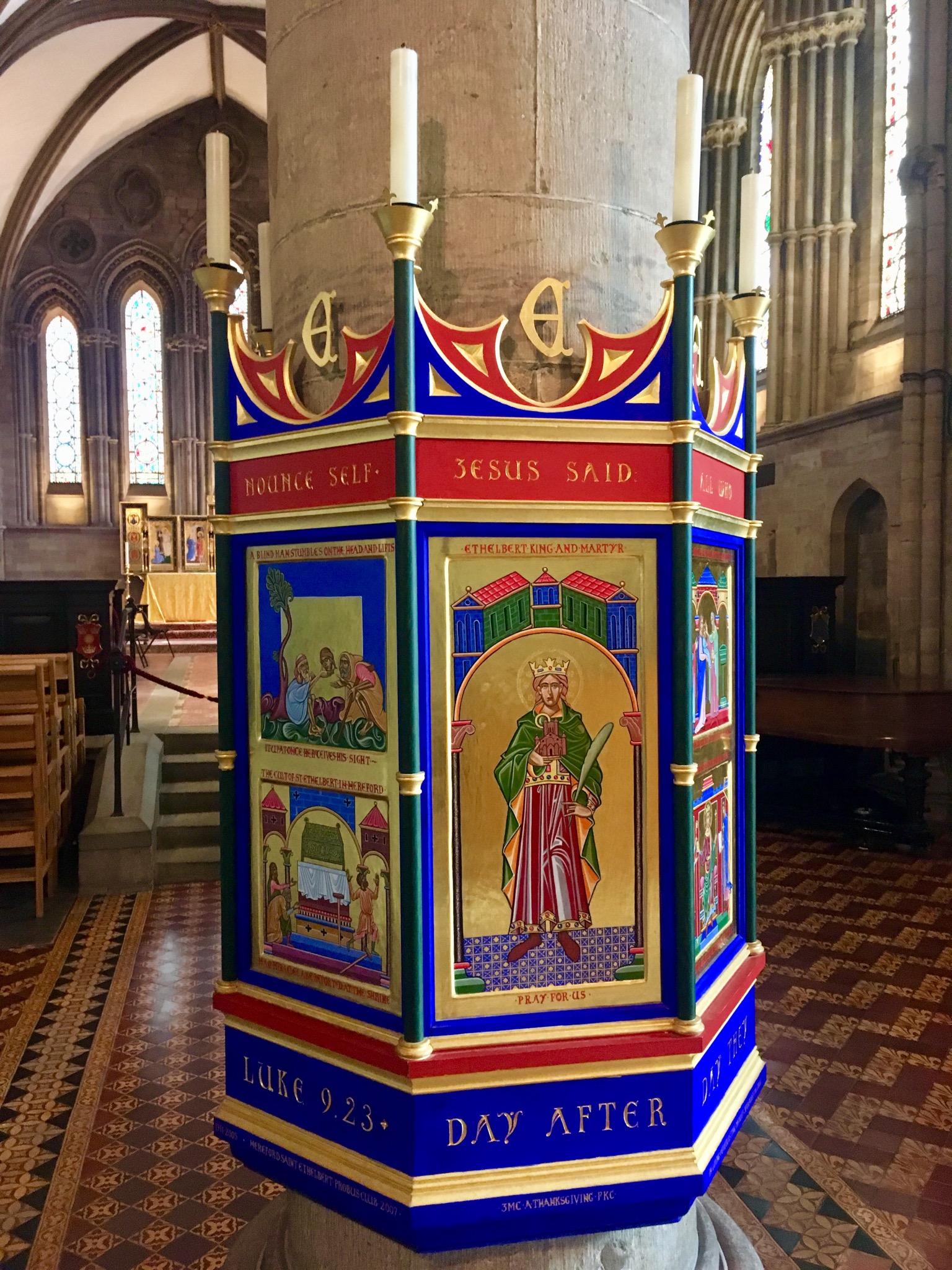
sanctuaire d'Æthelberht dans la cathédrale de Hereford.
Shrine
of Saint Ethelbert of East Anglia, Hereford Cathedral
May 20
St. Ethelbert, King of
the East-Angles, Martyr
IN his childhood, after
the hours of his studies, he stole away from his schoolfellows when they went
to play, and spent most of the time allotted to recreation in prayer. He
succeeded young his father Ethelred in his kingdom, which he ruled forty-four
years, according to the maxims of a perfect saint. It was his usual saying,
that the higher a station is in which a man is placed the more humble and
benevolent he ought to be. And this was the rule of his own conduct. To secure
the tranquillity of his kingdom by an heir, he was persuaded to marry; and
having heard much of the virtue of Alfreda the daughter of Offa the powerful
king of the Mercians, he thought of making her his royal consort. In this
design he paid a visit to that king, who resided at Sutton-Wallis, on the river
Lugg, four miles from the place where Hereford now stands. He was courteously
entertained, but, after some days, treacherously murdered by Grimbert an
officer of King Offa, through the contrivance of Queen Quendreda, that his
kingdom might be added to their own. This happened in 793. He was privately
buried at Maurdine or Marden; but his body being glorified by miracles it was
soon after removed to a fair church at Fernley, that is, Heath of Fern, now
called Hereford; which town had its rise from this church, which bore the name
of St. Ethelbert when Wilfrid king of Mercia much enlarged and enriched the
same. Quendreda died miserably within three months after her crime. Her
daughter Alfreda devoted herself to God, and led a penitential solitary life at
Croyland, amidst the fens. Offa endeavoured to atone for the sin of his queen
by a pilgrimage to Rome, where he founded a school for the English after the
example of King Ina, who had erected one in that city in 726, when he
established the Peter-pence among the West-Saxons, which Offa on this occasion
extended to the Mercians in 794. Egfrid the only son of Offa, died after a
reign of some months, and the Mercian crown was translated into another family
of the posterity of Penda. How sharp are the thorns of ambition! whereas virtue
finds its peace and crown whether in adversity or in prosperity. See
Harpsfield, Malmesbury, and Leland, Itiner. t. 8, p. 56, who quotes the Life of
St. Ethelbert written by Giraldus Cambrensis; also by Osbert de Claro.
Rev. Alban
Butler (1711–73). Volume V: May. The Lives of the Saints. 1866.
SOURCE : http://www.bartleby.com/210/5/202.html
St. Aethelbert of East Anglia
(AD 779-794)
King of East Anglia
Died: 20th May AD 794 at Sutton Walls, Herefordshire
Aethelbert was the son
and successor of Aethelred, King of East Anglia. He came to the throne very
young, at the time that the powerful Offa was King of Mercia. Offa was, in many
things, a good and just ruler, but he was guilty of a single act of treachery
towards Aethelbert, apparently prompted by his wife, Cwendreda.
The young prince,
disregarding the forebodings of his mother, came to the Court of Offa at Sutton
Walls, in Herefordshire, to seek the hand of his beautiful and pious
daughter, Etheldreda.
Offa received him with great respect and hospitality; but the Queen, Cwendreda,
was full of ambitious schemes. She took the King to one side and exclaimed,
"Look, your enemy has been delivered into your hands. He whose kingdom you
have so long coveted. Now destroy him secretly and his kingdom will be yours
and your heirs forever." The King hesitated.
Traditionally
Aethelbert's head was struck off, but Matthew of Westminster tells another
tale. He says that the Queen placed a richly adorned chair in the bedroom of
the young King, over a trap door in the floor, and, on the chair, she placed a
number of silk cushions. The young man, on reaching his room after a banquet,
flung himself into the chair. The trap immediately gave way and he was
precipitated into a vault where some of the Queen's servants were stationed;
and they quickly suffocated him with the silk cushions.
It can hardly be doubted
that Offa was privy to the commission of the murder. He certainly lost no time
in taking advantage of it, for he sent troops into East Anglia and annexed it
at once to his own possessions. Then, as usual, he built churches and
monasteries to atone for his wickedness, especially St. Albans Abbey and
Hereford Cathedral. The later was dedicated to St. Aethelbert and was the place
of his burial. Some say that Offa went a pilgrimage to Rome. At any rate, he
gave much to churches in that city and especially to the English school there.
Ealfreda, abhorring the crime that had been committed by her parents, retired
to Crowland Abbey, where she spent forty years in seclusion and died in the
odour of sanctity.
Edited from S.
Baring-Gould's "The Lives of the Saints" (1877).



Plate
17 from Ecclesiae Anglicanae Trophae, a collection of engravings by
Giovanni Battista de'Cavalieri after murals by Nicolò Circignano in the chapel
of the Venerable English College, Rome, 1584. It shows the martyrdom of Saint
Boniface, Saint Osyth and Saint Æthelberht of East Anglia. - https://archive.org/details/ecclesiaeanglica00cava
Sant' Etelberto Re
dell'Anglia Orientale, martire
Festa: 20 maggio
† 20 maggio 794
La sua vicenda,
tramandata principalmente per via orale e poi raccolta da Osbert di Clare
nell'XI secolo, si intreccia con la leggenda e con il culto religioso,
rendendone difficile la ricostruzione storica. Ciò che emerge è la sua tragica
morte, avvenuta nel 794 per mano di Offa, re di Mercia, forse a causa di un
matrimonio combinato sfumato. Etelberto, appena quindicenne, non si piegò al
volere del potente monarca e trovò la morte, con il corpo gettato nel fiume
Lugg e la testa venerata a Westminster. La sua figura, associata al martirio
per la giustizia e la fede, divenne simbolo per l'Anglia orientale, con ben
dodici chiese a lui dedicate.
Patronato: Hereford
Emblema: Corona,
Scettro, Palma
Poche e scarne notizie ci sono pervenute circa l’esistenza terrena del re martire Etelberto dell’Est Anglia, come anche per gli altri sovrani inglesi venerati come santi risalenti all’incirca a quel periodo. L’assassinio di Etelberto in lotta per l’indipendenza del suo antico popolo diede origine ad un culto nei suoi confronti quale “martire”.
La sua vicenda ci spiega come mai la cattedrale di Hereford sia stata dedicata proprio ad un sovrano dell’Anglia orientale. La prima stesura scritta della sua vita pare possa essere attribuita a Osbert di Clare a Westminster nell’XI secolo, che si rifece ad una tradizione orale di Hereford. L’ “Anglo-Saxon Chronicle” fa semplice menzione della morte di Etelberto.
Appena quindicenne, questi ebbe il coraggio di chiedere in sposa la figlia di Offa, re della Mercia, potentissimo monarca inglese che si era già impossessato di ben quattro regni. In principio Offa si dimostrò disponibile ed invitò Etelberto a Sutton Walls, vicino a Hereford, per mettere a punto i dettagli dell’accordo.
Forse a causa della contrarietà di sua moglie Cynethryth, Offa cambiò repentinamente idea e commissionò l’assassinio di Etelberto nel 794. Ne face poi gettare il corpo nel fiume Lugg, mentre il capo venne preso a calci e divenne in seguito oggetto di venerazione a Westminster.
In seguito ad un’apparizione del santo re, si decise di seppellirne il corpo nella chiesa di Hereford ed il suo culto si diffuse così nell’intera Anglia orientale. Alcuni secoli dopo il Circognani dipinse Etelberto nel Collegio inglese di Roma insieme a tutti i martiri inglesi. Nell’Est Anglia ben dodici antiche chiese sono a lui dedicate.
La vicenda Sant’Etelberto è paragonabile a quella di altri santi re anglosassoni, come San Chenelmo e Sant’Edoardo II, e scandinavi, come Erik IX di Svezia e Olav II di Norvegia. Come avvenuto anche per molti martiri del XX secolo, il concetto di martirio è stato dunque esteso a casi di morte violenta a causa della giustizia, “per testimonium caritatis heroicis”.
Autore: Fabio Arduino