
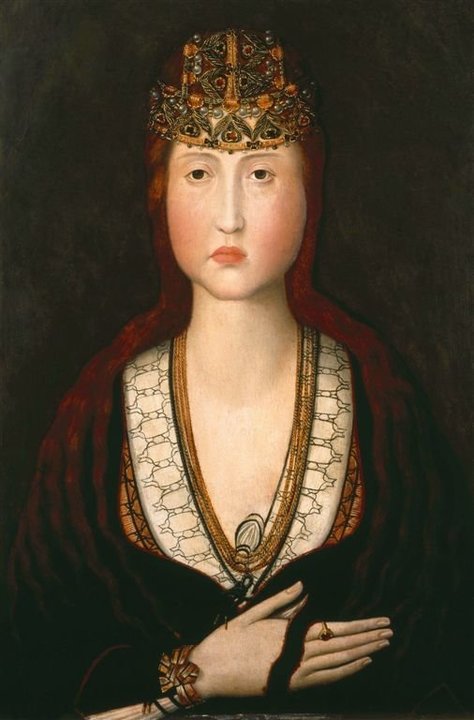
Nuno Gonçalves (1425–), Portrait of Princess Saint Joana, circa 1475, Convento de Jesus Aveiro, Portugal
Bienheureuse Jeanne du
Portugal
Vierge dominicaine (+ 1490)
"Chaque jour sa
beauté acquérait de nouvelles grâces" dit la chronique, ce qui la fit
maintes fois demander en mariage. Fille du roi de Portugal Alphonse V, elle
s'appliquait à paraître telle que doit paraître une fille de roi. Mais bonne
chrétienne, elle donna à Dieu la beauté de son âme et disparut dans l'humilité
du monastère des moniales dominicaines à Aveiro. Elle y offrit alors ses
souffrances pour la rédemption des captifs.
À Averio au Portugal, en
1490, la bienheureuse Jeanne, vierge. Fille du roi Alphonse V, elle repoussa
plusieurs projets de mariage et préféra servir Dieu dans l’Ordre des Prêcheurs,
où elle fut le refuge des pauvres, des orphelins et de veuves.
Martyrologe romain
SOURCE : http://nominis.cef.fr/contenus/saint/1143/Bienheureuse-Jeanne-du-Portugal.html

Sainte Jeanne de
Portugal
Princesse, dominicaine
(1452-1490)
La bienheureuse Jeanne de
Portugal, fille du roi Alphonse V de Portugal naquit à Lisbonne en 1452.
Sa naissance fut
ardemment implorée, moyennant beaucoup de prières, car ce roi n’avait pas
encore d’héritier pour son trône.
Dès sa naissance, les
trois états du royaume jurèrent de la reconnaître comme leur princesse et
héritière au trône, si un enfant mâle venait à manquer.
Âgée à peine de trois
ans, Jeanne perdit sa mère, morte en couches de l’héritier tant désiré. Elle
fût alors confiée aux bons soins de la bonne et “sainte” Beatrix de Menezes.
L’ardente piété et la
pureté angélique donnaient un charme exquis à l’extraordinaire beauté de Jeanne
qui, bien jeune encore fut convoitée par le Dauphin de France, par Maximilien d’Autriche
et par le roi d’Angleterre. Mais, la jeune princesse avait choisi un amour plus
grand, car dès son plus âge, le désir de sainteté, et de se consacrer et se
donner toute entière au Christ l’habitait. Elle désirait entrer chez les
dominicaines d’Aveiro.
Elle réussi à y entre,
mais seulement après avoir vaincu les oppositions et de son père et de la
cours, qui ne voyaient pas d’un bon œil cette retraite qui privait sûrement le
royaume de Portugal d’une alliance profitable.
Aussi bien son père que
son frère la harcelèrent pendant longtemps — allant jusqu’aux menaces et à
l’enlèvement —, lui demandant de quitter sa retraité et, à des fins politiques,
de se marier. Jeanne réussi toujours à réintégrer le monastère d’Aveiro où elle
mena une vie d’austère pénitence et d’humilité.
Ces oppositions et
tracasseries éloignées, elle put enfin vêtir l’habit des filles de saint
Dominique de Guzman, le 4 août 1472, au monastère d’Aveiro, où sa courte vie
fut un continuel holocauste d’amour et de sacrifice.
Elle décéda à l’heure
qu’elle avait elle-même prédite, le 12 mai 1490, quand ses consoeurs récitaient
la litanie des saints. Arrivées à l’invocation : « Tous les saints
innocents, priez pour nous », elle leva les yeux au ciel et expira
doucement dans le Seigneur, son époux.
Les miracles signalés sur
sa tombe sont fort nombreux.
Le pape Innocent XIII la
béatifia le 31 décembre 1692 et confirma son culte. Elle est fêtée le 12 mai.
SOURCE : http://voiemystique.free.fr/jeanne_de_portugal.htm

Giovanna of
Portugal, Santa Caterina d'Alessandria, Piazza Bellini, quarter of Kalsa, Palermo, Sicily
Riquadro
in marmi mischi e tramischi. Santa Sovrana: Giovanna d'Aviz (1452-1490).
Bienheureuse Jeanne du
Portugal
Religieuse dominicaine
portugaise
Fête le 12 mai
O.P.
Lisbonne, Portugal, 16
février 1452 – † Aveiro, Beira Litoral, 12 mai 1490
Béatifiée le 31 décembre
1692 par le pape Innocent XII
Autre mention : 30
mai
Autre graphie :
Juana de Portugal
À Aveiro au Portugal, la
bienheureuse Jeanne, fille du roi du Portugal Alphonse V, choisit de devenir
dominicaine et se consacra aux pauvres, aux orphelins et aux veuves.
SOURCE : http://www.martyretsaint.com/jeanne-du-portugal/

Joana
de Portugal, retratada em Breve Narratione Della Vita della Beata Giovanna
Principessa di Portogallo Dell’Ordine di San Domenico. Appellata communemente
la Santa Principessa. Raccolta da un religioso Dell'istess' Ordine di Lei
Devoto, 1693
The
engraving depicts the ‘saintly princess’ holding a skull, a crucifix, and a
crown of thorns. Printed in Breve Narratione Della Vita della Beata Giovanna
Principessa di Portogallo Dell’Ordine di San Domenico. Appellata communemente
la Santa Principessa. Raccolta da un religioso Dell'istess' Ordine di Lei
Devoto, Rome 1693. Credit: Women of the
Book Collection, Sheridan Libraries, Johns Hopkins University, digitized
with the support of the Arcadia Fund
Also
known as
Jane the Princess
Joan
Joana
Johanna
Juana
Profile
Princess,
the daughter of Elizabeth and King Alphonsus
V of Portugal.
Entered a Dominican convent at
Aveiro, Portual in 1473.
The royal family objected to her taking vows because she might need to marry to
insure the continuity of the royal bloodline. She agreed, fended off
arranged marriages,
and did not take vows until 1485 when
the succession was secured.
Born
16
February 1452 at
Lisbon, Portugal
12 May 1490 in
Aveiro, Portugal of
natural causes
31
December 1692 by Pope Innocent
XII (cultus
confirmed)
Additional
Information
Saints
of the Day, by Katherine Rabenstein
books
Our Sunday Visitor’s Encyclopedia of Saints
other
sites in english
images
audio
A Crown for Joanna, by Sister Mary Jean Dorcy
sitios
en español
Martirologio Romano, 2001 edición
fonti
in italiano
sites
em português
Readings
O God, in the midst of
the royal court you strengthened Blessed Jane
with purity of heart. By her prayers may your faithful turn from the things of
earth and seek after the things of heaven. We ask this through our Lord Jesus
Christ, your Son, who lives and reigns with you and the Holy
Spirit, one God, for ever and ever. – General Calendar of the Order of
Preachers
MLA
Citation
‘Blessed Jane of
Portugal‘. CatholicSaints.Info. 12 May 2024. Web. 15 April 2026.
<https://catholicsaints.info/blessed-jane-of-portugal/>
SOURCE : https://catholicsaints.info/blessed-jane-of-portugal/

Statue
of Saint Joana of Portugal, Mosteiro da Batalha. Unknown author of 18th century
Blessed Jane of Portugal,
OP V (AC)
(also known as Joanna)
Born in Lisbon, Portugal,
1452; died at Aveiro, Portugal, in 1490; cultus approved in 1693.
Joanna, a child of many
prayers, was born heiress to the throne of her father, King Alphonsus V, at a
time when Spain and Portugal had divided the colonial wealth of the earth
between them. Her sickly brother Juan was born three years later, and soon
after this their mother, Queen Elizabeth of Coimbra, died. Joanna was left to
the care of a wise and pious nurse, who cultivated the child's natural piety.
By age five the little princess had exceeded her teacher in penitential
practices. She fasted and prayed, rose at night to take the discipline, and
wore a hairshirt under her glittering court apparel.
Although Joanna would not
inherit the throne of Portugal while her brother was alive, a wise marriage
would do much to increase her father's power. Accordingly, he began early to
arrange for her marriage. Joanna, whose knowledge of court intrigue was as good
as his own, skillfully escaped several proposed matches. She had treasured the
desire to enter the convent, but, in view of her father's plans, her desires
met with violent opposition. She was flatly refused for a long time; finally,
her father gave his reluctant consent, but he withdrew it again at her
brother's insistence.
She was regent of
Portugal when her father and brother went to war against the Moors, and when
they defeated the Moors in 1471, her father, in the first flush of victory,
granted her request to take the veil. Joanna and one of her ladies-in-waiting
had long planned to enter the Dominican cloister at Aveiro, which was noted for
its strict observance. But when her father finally gave consent for her to
enter religion, he did not allow her to enter that Dominican convent. She had
to go to the nearby royal abbey of the Benedictines at Odivellas. Here she was
besieged by weeping and worldly relatives who had only their own interests at
heart. After two months of this mental torture, she returned to the court.
The rest of Joanna's life
is a story of obedience and trials. Her obligations of obedience varied. She
was required to bend her will to a wavering father, who never seemed able to
make a decision and abide by it; to bishops, swayed by political causes, who
forced her to sign a paper that she would never take her solemn vows; and to
doctors, who prescribed remedies that were worse than the maladies they tried
to cure. The trials came from a jealous brother, from ambitious and interfering
relatives, from illness, and from cares of state.
After 12 years of praying
and hoping, Joanna finally received the Dominican habit at Aveiro in 1485.
Once, she was deprived of it by an angry delegation of bishops and nobles, and,
at another time, her brother tore the veil from her head. Despite the
interruptions of plague, family cares, and state troubles, Joanna lived an
interior and penitential life. She became an expert at spinning and weaving the
fine linens for the altar, and busied herself with lowly tasks for the love of
God. She used all her income to help the poor and to redeem captives.
Her special devotion was
to the Crown of Thorns, and, in early childhood, she had embroidered this
device on her crest. To the end of her life she was plagued by the ambition of
her brother, who again and again attempted to arrange a marriage for her, and
continually disturbed her hard-won peace by calling her back to the court for
state business.
On one of these trips to
court, Joanna was poisoned by a woman--a person she had rebuked for leading an
evil life. The princess lived several months in fearful pain, enduring all her
sufferings heroically. She died, as it says in an old chronicle, "with the
detachment of a religious and the dignity of a queen," and with the
religious community around her (Benedictines, Delaney, Dorcy).
SOURCE : http://www.saintpatrickdc.org/ss/0512.shtml

Statue of Joan,
Princess of Portugal in Aveiro
Envolvente
Museu de Jesus ou Museu de Santa Joana
.jpg)
Statue of Joan,
Princess of Portugal in Aveiro
Envolvente
Museu de Jesus ou Museu de Santa Joana
Blessed Joanna of
Portugal
Born at Lisbon,
16 February, 1452; died at Aveiro, 12 may, 1490; the daughter of Alfonso
V, King of Portugal,
and his wife Elizabeth. She was chiefly remarkable for the courage and
persistency with which she opposed all attempts on the part of her father and
brother to make her marry.
She had resolved from childhood to be the spouse of Christ and, when
possible to enter the religious state; but being the next heir to
the throne in default of male issue, her wish was particularly
obnoxious to her family and
to the country. Joanna was very beautiful and her hand was sought by several
princes. Once, in her father's absence, she had to act as regent of the
kingdom, and in that office is said to have shown great capacity.
After many struggles, she
entered the Dominican house
called the Convent of Jesus, at Aveiro, where the rule was severe and
very strictly kept. For a time she was compelled, for political reasons, to
leave it and go back to Court. Finally, however, she was professed;
and her life in the convent was
so penitential, holy,
and heroically humble,
that she died in the odour of sanctity,
and miracles followed
her decease.
Capes,
Florence. "Blessed Joanna of Portugal." The Catholic Encyclopedia. Vol.
8. New York: Robert Appleton Company, 1910. 12 May
2015 <http://www.newadvent.org/cathen/08409a.htm>.
Transcription. This
article was transcribed for New Advent by Joseph P. Thomas. In memory of
Mr. P. Alvares.
Ecclesiastical
approbation. Nihil Obstat. October 1, 1910. Remy Lafort, S.T.D.,
Censor. Imprimatur. +John Cardinal Farley, Archbishop of New York.
Copyright © 2023 by Kevin Knight.
Dedicated to the Immaculate Heart of Mary.
SOURCE : http://www.newadvent.org/cathen/08409a.htm
Saints and
Saintly Dominicans – 12 May
Blessed Jane,
Infanta of Portugal,
Virgin, O.P.
Blessed Jane was so
inflamed with love of God and zeal for her own perfection that she despised all
the pleasures of the court, bore with calmness and constancy the persecutions
of her relatives and rejected all her princely suitors, including the son of
Louis IX of France, in order to consecrate herself to the service of God in the
Third Order. Her great delight was to teach the catechism to prisoners, and her
servants were ordered to seek twice every day for those poor persons who were
ashamed to own their poverty. The manifestation of her interior life to her
director seemed to her so important that she noted down each day her actions
and dispositions in order the better to make it. It is said that her great
horror of sin caused her martyrdom, for she was poisoned by a wicked woman whom
she had ordered to be driven away from Aveiro (the town in which Blessed Jane
had become a Dominican) after having failed by gentle means to reclaim her. Her
great devotion was to the Passion of Our Lord, of which she could not hear
without weeping. At the end of so pure a life she exclaimed when dying: “Lord,
turn Thy face away from my sins.” (1490)
Prayer
O God, enlighten those
parents who oppose the religious vocation of their children.
Practice
Seek out those who are,
ashamed of their poverty, either by yourself or by some trustworthy person.
– taken from the
book Saints
and Saintly Dominicans, by Blessed Hyacinthe-Marie
Cormier, O.P.
SOURCE : https://catholicsaints.info/saints-and-saintly-dominicans-12-may/

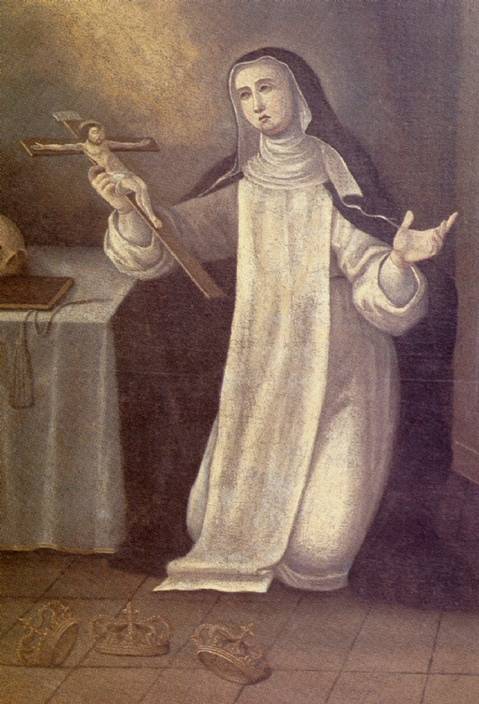
Painting anonymous, Blessed Joan of Portugal, 18th cent., Museu de San Pedro, Cathedral of Aveiro
Blessed Jane of Portugal,
V.O.P.
Memorial Day: May 12th
Profile
Joanna, a child of many
prayers, was born heiress to the throne of her father, King Alphonsus V, at a
time when Spain and Portugal had divided the colonial wealth of the earth
between them. Her sickly brother Juan was born three years later, and soon after
this their mother, Queen Elizabeth of Coimbra, died. Joanna was left to the
care of a wise and pious nurse, who cultivated the child's natural piety. By
age five the little princess had exceeded her teacher in penitential practices.
She fasted and prayed, rose at night to take the discipline, and wore a
hairshirt under her glittering court apparel.
Although Joanna would not
inherit the throne of Portugal while her brother was alive, a wise marriage
would do much to increase her father's power. Accordingly, he began early to
arrange for her marriage. Joanna, whose knowledge of court intrigue was as good
as his own, skillfully escaped several proposed matches. She had treasured the
desire to enter the convent, but, in view of her father's plans, her desires
met with violent opposition. She was flatly refused for a long time; finally,
her father gave his reluctant consent, but he withdrew it again at her
brother's insistence.
She was regent of
Portugal when her father and brother went to war against the Moors, and when
they defeated the Moors in 1471, her father, in the first flush of victory,
granted her request to take the veil. Joanna and one of her ladies-in-waiting
had long planned to enter the Dominican cloister at Aveiro, which was noted for
its strict observance. But when her father finally gave consent for her to
enter religion, he did not allow her to enter that Dominican convent. She had
to go to the nearby royal abbey of the Benedictines at Odivellas. Here she was
besieged by weeping and worldly relatives who had only their own interests at
heart. After two months of this mental torture, she returned to the court.
The rest of Joanna's life
is a story of obedience and trials. Her obligations of obedience varied. She
was required to bend her will to a wavering father, who never seemed able to
make a decision and abide by it; to bishops, swayed by political causes, who
forced her to sign a paper that she would never take her solemn vows; and to
doctors, who prescribed remedies that were worse than the maladies they tried
to cure. The trials came from a jealous brother, from ambitious and interfering
relatives, from illness, and from cares of state.
After 12 years of praying
and hoping, Joanna finally received the Dominican habit at Aveiro in 1485.
Once, she was deprived of it by an angry delegation of bishops and nobles, and,
at another time, her brother tore the veil from her head. Despite the interruptions
of plague, family cares, and state troubles, Joanna lived an interior and
penitential life. She became an expert at spinning and weaving the fine linens
for the altar, and busied herself with lowly tasks for the love of God. She
used all her income to help the poor and to redeem captives.
Her special devotion was
to the Crown of Thorns, and, in early childhood, she had embroidered this
device on her crest. To the end of her life she was plagued by the ambition of
her brother, who again and again attempted to arrange a marriage for her, and
continually disturbed her hard-won peace by calling her back to the court for
state business.
On one of these trips to
court, Joanna was poisoned by a woman--a person she had rebuked for leading an
evil life. The princess lived several months in fearful pain, enduring all her
sufferings heroically. She died, as it says in an old chronicle, "with the
detachment of a religious and the dignity of a queen," and with the
religious community around her (Benedictines, Delaney, Dorcy).
Born: Born in
Lisbon, Portugal, 1452
Died: died at
Aveiro, Portugal, in 1490
Beatified: April 4,
1693 by Pope Innocent XII (cultus confirmed)
Commemorations
First Vespers:
Ant. This is a wise
Virgin whom the Lord found watching, who took her lamp and oil, and when the
Lord came she entered with Him into the marriage feast, alleluia.
V. Pray for us Blessed
Jane, alleluia.
R. That we may be made
worthy of the promises of Christ, alleluia.
Lauds:
Ant. Come, O my chosen one, and I will place my throne in thee, for the King hath exceedingly desired thy beauty, alleluia.
V. Virgins shall be led
to the King after her, alleluia.
R. Her companions shall
be presented to Thee, alleluia.
Second Vespers:
Ant. She has girded her
loins with courage and hath strengthened her arm; therefore shall her lamp not
be put out forever, alleluia
V. Pray for us Blessed
Jane, alleluia
R. That we may be made
worthy of the promises of Christ, alleluia
Prayer:
Let us Pray: O god
who amidst royal delights and the allurements of the world didst strengthen
Blessed Jane, Thy Virgin, with unshaken constancy, grant, through her
intercession, that Thy faithful may despise all earthly things, and aspire
always to the things of heaven through Christ our Lord. Amen.
SOURCE :
http://www.willingshepherds.org/Dominican%20Saints%20May.html#Jane of Portugal

Joao
Baptista Pachim, Retrato da Princesa Santa Joana com o Menino
Joao Baptista Pachim, Princess Saint Joanna with the Infant Jesus, 18th century.
Beata Giovanna di
Portogallo Principessa, vergine domenicana
Festa: 12 maggio
Lisbona, Portogallo, 6
febbraio 1452 - Aveiro, Portogallo, 12 maggio 1490
Giovanna, figlia di
Alfonso V, Re del Portogallo, fu implorata dal cielo con molte preghiere,
perché mancava l’erede alla corona. Alla sua nascita, nel 1452, i tre stati di
quella corona giurarono di riconoscerla come loro Principessa ed erede al
Trono, in caso venisse a mancare la prole maschile. A tre anni Giovanna restò
senza mamma, la quale morì dando alla luce l’erede atteso. L’augusta bimba
crebbe come fiore d’altare squisitamente educata dalla Principessa, Donna
Beatrice de Meneses, sua istitutrice. L’ardente pietà e la purità angelica
davano un incanto particolare alla straordinaria bellezza di Giovanna, che
giovanissima fu chiesta in sposa da ben tre pretendenti, il Delfino di Francia,
Massimiliano d’Austria e dal Re d’Inghilterra. Ma essa, scossa da un amore più
grande, aveva già stabilito in cuor suo di vestire le bianche lane Gusmane. Il
suo rifiuto fu reciso. Allora cominciò quella lotta eroica che le costò
indicibili amarezze, per ottenere la libertà di dedicarsi tutta a Dio. Non si
trattava di espugnare soltanto il cuore paterno, ma tutto il regno che si
opponeva al suo disegno, essendo essa Principessa prescelta, e al mancare del
fratello, unica erede del Trono. Solo il 4 agosto 1472 poté vestire l’Abito
Domenicano nell’osservantissimo Monastero di Aveiro, dove la sua breve vita fu
tutto un olocausto d’amore e di sacrificio. Morì all’ora da lei predetta il 12
maggio 1490, ad Aveiro. Alla recita delle Litanie dei Santi, giunti
all’invocazione “Omnes Sancti Innocentes, orate pro ea”, alzò gli occhi al
cielo e spirò dolcemente. Sulla sua tomba fiorirono miracoli senza numero. Papa
Innocenzo XII il 31 dicembre 1692 ha confermato il suo culto.
Patronato: Aveiro
Martirologio Romano: Ad
Aveiro in Portogallo, beata Giovanna, vergine, che, figlia del re Alfonso V,
rifiutate più volte le nozze, preferì servire nell’Ordine dei Predicatori,
divenendo rifugio per i poveri, gli orfani e le vedove.
Giovanna nacque a Lisbona il 6 febbraio 1452 dal matrimonio tra Alfonso V re del Portogallo ed Elisabetta,figlia del duca di Coimbra. Venne alla luce dopo cinque anni di matrimonio, si disse per intercessione di S. Domenico. Secondogenita, dopo la morte del fratello maggiore Giovanni, era di fatto l’erede al trono, fino al 3 marzo 1455, quando nacque il terzogenito, futuro Giovanni II. Rimase orfana di madre il 2 dicembre 1455, improvvisamente, poco dopo la nascita dell’erede al trono. Giovanna crebbe nell'ambiente di corte e ricevette un’ottima educazione, come conveniva a una principessa dell’antica casata di Aviz che dominava uno dei regni più potenti d'Europa.Fu successivamente la zia Filippa di Coimbra (1437-1493), che pur non essendo monaca viveva nel monastero di Odivelas, ad occuparsi dei nipoti, Giovanna di tre anni e Giovanni di pochi mesi. L’esempio della zia le rimase tanto impresso che, fin da giovane, sentì il desiderio di abbracciare la vita religiosa.
Aveva sedici anni quando cominciarono i piani per il suo matrimonio che, come prassi, doveva essere un “patto politico”con una delle famiglie regnanti europee. Giovanna voleva dedicarsi alla vita religiosa, ma il padre la contrastò sempre, preoccupato che il Casato restasse senza eredi. Negli anni 1470-1471 fu reggente del regno, quandosuo padre si imbarcò diretto in Nord Africa per combattere i musulmani e conquistare Arzila, nel 1470, e Tangeri nel 1471.
L’anno seguente Giovanna poté fare il suo ingresso nel monastero domenicano di Aveiro, ma dovette poi desistere. Mentre scoppiava la Guerra di successione castigliana e il padre lasciò nuovamente il paese, Giovanna ebbe l’onere della reggenza, fino al 1475. Nel frattempo, fermamente intenzionata a prendere i voti, rifiutò tutte le importanti proposte di matrimonio che riceveva. Nel maggio 1475 nacque il nipote Alfonso - era assicurato un erede al trono – e le fu permesso di rientrarenel Monastero di Aveiro. Ricevette l’abito il 25 gennaio 1476, ma si ammalò gravemente e il padre ordinò il suo rientro a corte. Il vicario generale dell’Ordine la convinse a seguire la volontà paterna. Rimase comunque ad Aveiro per tre anni, poi, nel 1479, mentre infuriava la peste, fu condotta a corteda due vescovi. Giovanna obbedì, ma portò con sé sei monache. Nel 1481 il padre morì, le giunsero altre proposte di matrimonio, ma lei ritornò in monastero dove finalmente professò solennemente. Giovanna fu una convinta sostenitrice del fratello Giovanni II, sia in politica che nella vita familiare. Coinvolta, saltuariamente, negli affari di Stato, lasciò in alcune circostanze il monastero, tra le cui mura condusseuna vita austera e umile.
Giovanna morì, dopo lunga e dolorosa malattia, il 12 maggio 1490 ad Aveiro e fu tumulata nel Monastero. Aveva solo 38 anni. Il suo culto andò crescendo, in molti presso il sepolcro ottennero grazie e miracoli. Papa Innocenzo XII la beatificò il 4 aprile 1693, concedendo il culto al suo Ordine e al Portogallo, paese in cui è di fatto onorata come Santa. Paolo VI l’ha proclamata patrona di Aveiro.
Autore: Daniele Bolognini
SOURCE : https://www.santiebeati.it/dettaglio/90769

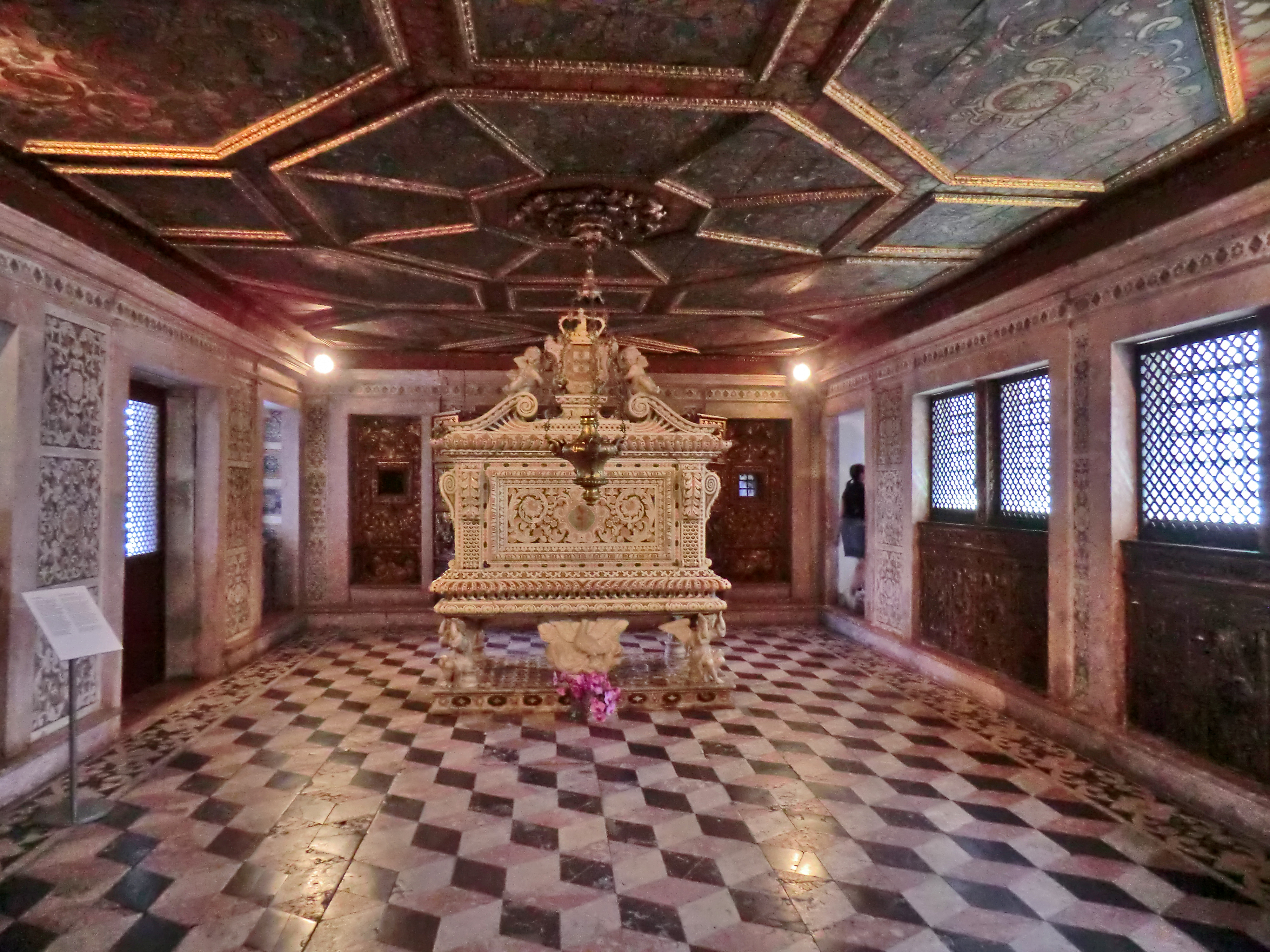
Sepultura
no Mosteiro de Jesus
Tomb
of blessed Joan of Portugal, in the Convento de Jesus at Aveiro, Portugal.
Marble work of 17th century


_17_07_2019_32.jpg)




Sepultura
no Mosteiro de Jesus
Tomb
of blessed Joan of Portugal, in the Convento de Jesus at Aveiro, Portugal.
Marble work of 17th century
Beata Joana de Portugal
virgem, +1490
Celebrado a 12 De Maio
A Beata Joana de
Portugal, conhecida em Portugal como Santa Joana, Princesa, nasceu a 6 de
fevereiro de 1452 e era filha de D. Afonso V, rei de Portugal, e de sua mulher
D. Isabel. Viveu em Lisboa até aos 20 anos onde sempre deu testemunho de grande
devoção e amor aos necessitados. Os pobres, os enfermos, os presos e os
religiosos viam nela a sua protetora e o seu amparo. Conservava um livro onde
anotava os nomes de todos os carenciados, o grau de pobreza de cada um e o dia
em que lhe deveria ser dada esmola. Orava e jejuava frequentemente e como
divisa ou insígnia real usava uma coroa de espinhos. Cedo percebeu que Deus a
chamava a consagrar-Lhe toda a sua vida e viveu decidida a ser «esposa» apenas
de Cristo. Sem deixar nunca de cumprir os deveres que o Reino lhe exigia, assim
que conseguiu, recolheu-se num convento. Primeiro em Odivelas, às portas de
Lisboa, e depois no Convento de Jesus, em Aveiro. Por ser muito bonita e
inteligente, era pretendida por nobres e por reis. A todos recusou sempre pois
queria ter como coroa, não as de ouro dos reis de Inglaterra, Alemanha ou
França, mas a do seu Senhor Jesus Cristo: a coroa de espinhos. Recolhida em
Aveiro, levou até ao fim a sua vida de oração, penitência e assistência aos
mais desfavorecidos. Partiu para o Céu aos 38 anos, no dia 12 de maio de 1490 e
neste dia celebramos a sua festa litúrgica. Em 1693 foi beatificada pelo papa
Inocêncio XII e em 5 de Janeiro de 1965 foi declarada padroeira de Aveiro pelo
Papa Paulo VI.
SOURCE : https://evangelhoquotidiano.org/PT/display-saint/5f75c476-1e66-422a-82fb-c2f7a6e7cae2