
Ritratto
di it:Papa Gregorio II nella it:Basilica di San Paolo fuori
la Mura, Roma
Portait of en:Pope Gregory II in the en:Basilica of Saint Paul Outside the Walls, Rome
Saint Grégoire II
Pape (89 ème) de 715 à
731 (+ 731)
Comme diacre, il avait
participé aux discussions du concile de Constantinople en 692 qui marqua déjà
les dissensions entre l'Eglise de Rome et Byzance. L'empereur de Byzance voulut
imposer ses taxes sur les territoires soumis à la juridiction du Pape et
l'exarque de Ravenne se heurta à un conflit avec les détachements de l'armée
locale qui soutenait le Pape. Le conflit s'étendit au domaine théologique quand
l'empereur, prenant position dans le domaine dogmatique, attaqua le culte des
saintes Images et déposa le patriarche de Constantinople. De militaire, le
conflit devint en même temps doctrinal. L'exarque de Ravenne soutenant alors le
Pape réussit à empêcher les Lombards encore païens de prendre part aux
campagnes militaires. Malgré tant de soucis, saint Grégoire n'oubliait pas
l'évangélisation des peuples germaniques et il accepta et mandata la mission de
saint Boniface. On retient cela et son combat pour le culte des icônes.
SOURCE : http://nominis.cef.fr/contenus/saint/613/Saint-Gregoire-II.html
Saint Grégoire II
Pape de 715 à 731
Grégoire II naquit à
Rome, et joignit une éminente sainteté à une profonde connaissance de
l’Écriture sainte et de toutes les matières ecclésiastiques. Il fut ordonné
sous-diacre par le pape Serge 1er, qui l’aimait beaucoup. Son rare mérite le
fit élever aux places de sacellaire et de bibliothécaire, qui étaient alors
très considérables. Il fut chargé de plusieurs missions importantes, dont il
s’acquitta avec une grande capacité. Il suivit à Constantinople le pape
Constantin, et satisfit à toutes les questions des Grecs, par les réponses les
plus solides. Après la mort de ce pape, il fut élu pour lui succéder.
Il signala son entrée au
pontificat par la déposition de Jean VI, faux patriarche de Constantinople, qui
favorisait l’hérésie des monothélites. Il fonda deux monastères à Rome, et fit
rebâtir celui du Mont-Cassin, détruit par les Lombards. Il travaillait sans
relâche à extirper toutes les erreurs qui corrompaient la pureté de la foi.
Comme plusieurs peuples de la Germanie vivaient encore dans les impiétés du
paganisme, il leur envoya des missionnaires zélés pour les instruire et les
amener à la connaissance de la vérité. Il sacra saint Corbinien et saint
Boniface, évêques, l’un de Frisingen et l’autre de Mayence.
L’empereur Léon
l’Isaurien ayant déclaré une guerre sacrilège aux saintes images, en 726, les
évêques orthodoxes d’Orient refusèrent d’obéir à ses édits, et s’adressèrent au
pape Grégoire. Le saint pontife tâcha en vain de fléchir le persécuteur par ses
larmes et ses prières. Il sut retenir dans le devoir les peuples d’Italie, qui
voulaient se révolter à cause des persécutions qu’éprouvaient les catholiques.
Il écrivit en même temps aux évêques de s’opposer généreusement aux progrès de
l’hérésie que l’empereur tâchait d’établir. Léon, aux yeux duquel l’attachement
à la sainte doctrine était un crime, donna plusieurs fois des ordres pour faire
assassiner notre Saint; et sans la vigilance des Romains et des Lombards, il
aurait infailliblement péri.
Il mourut le 10 février
731, après avoir siégé 15 ans 8 mois et 23 jours. Le martyrologe romain en fait
mémoire le 13 février.
L’Année chrétienne, La
Vie d’un Saint pour chaque jour, Paris, 1846
SOURCE : https://sanctoral.com/fr/saints/saint_gregoire_II_pape.html
Saint Grégoire II
(715-731)
Né à Rome.
Ce fut avec lui que le
pouvoir temporel des Papes commença. S’en suivirent les désaccords avec
l’empereur d’Orient et avec l’exarque de Ravenne.
Lors d’un concile il
ordonna que soit condamnée l’iconoclastie (destruction d’images sacrées).
Il promut une intense
oeuvre d’évangélisation des peuples germaniques.
SOURCE : http://eglise.de.dieu.free.fr/liste_des_papes_06.htm
Saint Saint Grégoire II
Celui qui allait devenir
le 89e Pape de l’histoire de l’Église sous le nom de Grégoire
II naquit à Rome en 669.
Encore diacre, il avait
participé aux discussions du concile de Constantinople en 692 qui marqua déjà
les dissensions entre l'Eglise de Rome et Byzance.
Élu Pape le 19 mai 715,
après quarante jours de vacance du Siège Apostolique, Grégoire II n’en finit
pas pour autant ses démêlés avec l’empereur de Byzance.
En effet, celui-ci voulut
imposer ses taxes sur les territoires soumis à la juridiction du Pape et
l'exarque de Ravenne se heurta à un conflit avec les détachements de l'armée
locale qui soutenait le Pape. Le conflit s'étendit au domaine théologique quand
l'empereur, prenant position dans le domaine dogmatique, attaqua le culte des
saintes Images et déposa le patriarche de Constantinople. De militaire, le
conflit devint en même temps doctrinal. L'exarque de Ravenne soutenant alors le
Pape réussit à empêcher les Lombards encore païens de prendre part aux
campagnes militaires.
Malgré tous ces
soucis — ou peut-être à cause d’eux, Grégoire II n'oublia pas
l'évangélisation des peuples germaniques, et autres, car dès la première année
de son pontificat, il envoya Corbinien en mission évangélique en Allemagne.
Puis, un peu plus tard, le 15 mai 719, il confia à Wynfrid de Wessex (S.
Boniface) la mission d’évangéliser la Hesse et la Thuringe.
Son action se dirigea
aussi vers la reconstruction du patrimoine de l’Église détruit pas les guerres.
Ce fut ainsi qu’il demanda à Petronax de rétablir l’abbaye du Mont-Cassin
détruite par les Lombards 140 ans auparavant.
On retiendra cela, bien
entendu, mais aussi son combat pour le culte des icônes.
En 727, invité à adhérer
aux édits iconoclastes de Léon II l’Isaurien, sous la menace d’une déposition
immédiate, il refusa et excommunia l’exarque de Ravenne chargé d’exécuter les
édits. Plus encore : Il invita les fidèles à se garder de l’hérésie
proclamée par l’empereur, à qui il reprocha de ne pas vouloir défendre
l’Italie.
Démontrant alors un
courage exceptionnel, il empêcha les Romains de payer l’impôt à Byzance, en
quoi il fut écouté non seulement par les Romains eux-mêmes, mais aussi par les
troupes impériales cantonnées en Italie qui se soulevèrent et se donnèrent des
chefs. L’exarque Paul fut tué dans une émeute des habitants de Ravenne. Les
Romains chassèrent leur duc, s’érigèrent en République, et le Pape acquit la
surintendance ministérielle de la ville et de son duché.
Mais les choses ne vont
en rester là, car en 728 le roi des Lombards Luitprand assiégea et prit
Ravenne. Pour se concilier le Pape, il fit don au Saint-Siège de Sutri et de
son territoire. Léon II envoya un nouvel exarque, Eutychius, qui ne put rien
faire sans troupe, d’autant plus que les ducs Lombards de Spolète et de
Bénévent, révoltés contre leur roi, soutinrent le pape. Il se rétablit
cependant à Ravenne avec l’aide de la République de Venise et à la demande du
pape.
Un an plus tard, les
troupes de Luitprand et d’Eutychius se présentèrent devant Rome. Alors,
Grégoire II écrivit à Charles Martel pour lui demander du secours, mais en
vain. Manquant d’autres arguments, il marcha à la rencontre du roi Lombard et
parvint à le convaincre d’abandonner le siège de la ville.
Fatigué par un pontificat
aussi tumultueux, Grégoire II rejoignit la Maison du Père le 11 février 731,
laissant à son successeur, Grégoire III, le soin du Siège Apostolique. Ce
dernier, dès le début de son pontificat condamna à son tour les iconoclastes et
les frappa d’excommunication.
Le 13 février 731, deux
jours seulement après sa mort Grégoire II fut canonisé — certainement
la canonisation la plus rapide de l’histoire religieuse.
Établi d’après plusieurs
documents.
SOURCE : http://nouvl.evangelisation.free.fr/gregoire_02_pape.htm

Paus
Gregorius II / Gregorius secundus, Liber Chronicarum, Neurenberg,1493
GRÉGOIRE II
89e Pape
Pape de 715 à 731, Saint
En dehors des grands
événements de son pontificat, on ne connaît que très peu de choses de la vie
intime de saint Grégoire II, 89e pape. Attention, il ne faut pas confondre
Grégoire II, notre saint d'aujourd'hui, avec saint Grégoire 1er le Grand
qui fut le 64e pape, de 590 à 604, et dont la fête est le 3 septembre.
Le saint qui nous
concerne aujourd'hui, le pape Grégoire II, serait né à Rome en 669. Il fut, à
la fois sacellaire, c'est-à-dire haut responsable financier de
l'administration byzantine qui était chargée, à l'origine, de la gestion du
sakkellion, la cassette, c'est-à-dire les problèmes financiers. Outre cette
fonction de sacellaire, Grégoire était bibliothécaire de l'Église romaine.
Encore diacre, il aurait participé à des discussions entre l'Église romaine et
l'empereur de Byzance vers 692, discussions qui révélèrent les dissensions
existant déjà entre l'Église de Rome et Byzance.
L'empereur de Byzance,
Justinien II, qui régna de 685 à 695, voulait imposer ses taxes sur les
territoires soumis à la juridiction du Pape. Il en résulta des conflits locaux
qui s'étendirent rapidement au domaine théologique lorsque l'empereur, prenant
position dans le domaine dogmatique, attaqua le culte des saintes Images et
déposa le patriarche de Constantinople. De militaire, le conflit devint ainsi
également doctrinal. L'exarque de Ravenne, qui soutenait alors le Pape, réussit
à empêcher les Lombards, encore païens, de prendre part aux campagnes
militaires. Malgré tant de soucis, saint Grégoire n'oubliait pas
l'évangélisation des peuples germaniques, et il accepta, et mandata, la mission
de saint Boniface. Du pontificat de Grégoire II, on retient surtout cela et son
combat pour le culte des icônes.
Voyons d'abord le souci
de Grégoire II pour l'évangélisation des peuples. Ordonné pape
le 19 mai 715, après 40 jours de vacance du Saint-Siège,
Grégoire II, dès la première année de son pontificat,
envoya Corbinien en mission évangélique en Allemagne. Qui, en
France, connaît saint Corbinien? Né en France, dans le département de
l'Essonne, Corbinien avait créé, en 680, un monastère à Saint Germain Lès
Arpajon. En 716, venu à Rome pour rencontrer le pape, il y fut sacré évêque,
par Grégoire II qui l'envoya en Bavière dans le but d'évangéliser ce pays
encore païen et fonder le diocèse de Munich-Freising.
Revenons à Grégoire II.
En 718, il demanda à Petronax de redonner vie à l’Abbaye du
Mont-Cassin, qui avait été détruite par les Lombards 140 ans
auparavant, en 580. Saint Pétronax, moine bénédictin, est considéré comme le
second fondateur de l'abbaye du Mont Cassin. Le 15 mai 719,
Grégoire II confiait à Wynfrid de Wessex, mieux connu sous le nom de saint
Boniface de Mayence, la mission d’évangéliser la Hesse et
la Thuringe.
Mais les querelles
byzantines se faisaient de plus en plus précises et graves, notamment pour ce
qui concernait le culte rendu aux icônes. De 717 à 741, régna l'empereur Léon
III dit l'Isaurien, c'est-à-dire le Syrien. Or, en 727, Léon III
"invitait" Grégoire II à adhérer à ses édits iconoclastes sous peine
de déposition immédiate. Grégoire II refusa et excommunia l'exarque de Ravenne
chargé d'exécuter ces édits. Grégoire, soucieux de l'évangélisation des
peuples, se tourna alors vers l'Occident, au détriment des querelles
byzantines. Il insista fortement pour que les fidèles se gardent de l'hérésie
proclamée par l'empereur et empêcha les Romains de payer l'impôt à Byzance.
S'ensuivit toute une série de conflits plus ou moins locaux.
En 728, Luitprand, roi
des Lombards, prit Ravenne, et, s'allia au pape à qui il fit don de Sutri et de
son territoire, situés dans la province de Viterbe, dans le Latium (Italie
centrale). Mais, un an plus tard, les troupes de Luitprand et d'Eutychius,
nouvel exarque de Ravenne envoyé par Léon III, se présentèrent devant et contre
Rome. Alors, Grégoire II implora le secours de Charles Martel, mais sans
succès. Il décida donc d'aller lui-même à la rencontre du roi Lombard, et
parvint à le convaincre d’abandonner le siège de Rome.
Mais le pape Grégoire II
épuisé par un pontificat aussi éprouvé, décéda bientôt, le 11 février 731. Son
successeur Grégoire III, pape de 731 à 741, poursuivit l'œuvre de son
prédécesseur: il affronta Luitprand et frappa les iconoclastes
d'excommunication.
Grégoire II fut canonisé
le 13 février 731, deux jours seulement après sa mort.
Paulette Leblanc
SOURCE : http://nova.evangelisation.free.fr/leblanc_gregoire02_pape.htm


_Liber_Chronicarum_(serietitel)%2C_RP-P-2016-49-62-9.jpg)

Giovanni Battista de'Cavalieri (1525–1601),
Calcografia in Giovanni Battista Cavalieri, Pontificum Romanorum effigies,
Roma, Basa Domenico\Zanetti Francesco, 1580. Municipal
Library of Trento
Saint Grégoire II, Pape
(89e) de 715 à 731
Comme diacre, il avait
participé aux discussions du concile de Constantinople en 692 qui marqua déjà
les dissensions entre l'Église de Rome et Byzance. L'empereur de Byzance voulut
imposer ses taxes sur les territoires soumis à la juridiction du Pape et
l'exarque de Ravenne se heurta à un conflit avec les détachements de l'armée
locale qui soutenait le Pape. Le conflit s'étendit au domaine théologique quand
l'empereur, prenant position dans le domaine dogmatique, attaqua le culte des
saintes Images et déposa le patriarche de Constantinople. De militaire, le
conflit devint en même temps doctrinal. L'exarque de Ravenne soutenant alors le
Pape réussit à empêcher les Lombards encore païens de prendre part aux
campagnes militaires. Malgré tant de soucis, saint Grégoire n'oubliait pas
l'évangélisation des peuples germaniques et il accepta et mandata la mission de
saint Boniface. On retient cela et son combat pour le culte des icônes.
SOURCE : https://alingilalyawmi.org/FR/display-saint/c29d5ba0-23a1-4931-a99d-91b966617f3d
Grégoire II (saint),
91e pape,
élu le 19 mai 715, mort le 10 février 731. Il était Romain de naissance; élevé
dans le palais de Latran, sous le pape Sergius, il s'était fait moine
bénédictin. Il défendit avec énergie, avec habileté et, en définitive, avec
succès, Rome et les domaines du siège apostolique contre les agressions des
Lombards. Mais les faits les plus importants de son pontificat se rapportent à
l'assistance qu'il prêta aux travaux de saint
Boniface pour la conversion des Germains, et à la résistance qu'il
opposa aux édits rendus par Léon l'lsaurien, pour abolir le culte des images,
ainsi qu'aux mesures prises pour assurer par la force l'exécution de ces
édits.
Un simple sommaire des
actes qui constituèrent la résistance de Grégoire et des incidents, nombreux et
divers, au milieu desquels elle se produisit, dépasserait de beaucoup les
limites assignées à cette notice, et néanmoins resterait à peu près
inintelligible. Nous devons nous borner à constater ici que, tout en se
montrant, vis-à-vis de l'empereur, toujours ferme, souvent hautain, parfois
méprisant, quand il s'agissait de la question religieuse, le pape sut
ordinairement respecter les devoirs résultant de la dépendance politique dans
laquelle Rome se trouvait envers l'Empire. Sa liberté et même, paraît-il, sa
vie furent plusieurs fois menacées par Léon, mais loin d'exciter le peuple à le
détrôner ou à s'affranchir de Constantinople, il s'efforça en diverses
occasions de contenir la désobéissance des Italiens dans les limites de la
résistance nécessaire à la conservation des images.
Autres actes appartenant
à l'histoire de ce pontificat : essai pour relever les murs de Rome;
restauration d'églises dévastées par les Lombards, notamment des basiliques de
Saint-Paul et de Saint-Laurent hors les Murs; rétablissement de monastères abandonnés,
tels que celui du Mont-Cassin .
Il reste de Grégoire Il
quinze lettres, parmi lesquelles deux adressées à l'empereur Léon, sur le culte
des images; trois à Boniface; sept à divers personnages, pour recommander sa
mission; en outre un capitulaire relatif à la discipline, dix-sept anathèmes
contre les mariages illégitimes, prononcés dans un synode tenu à Rome (721).
Ces documents se trouvent dans la Collection des conciles de Labbe. (E.-H.
Vollet).
SOURCE : http://www.cosmovisions.com/GregoireII.htm


Portrait paintings of
Gregorius II
Ikona
Papieża Grzegorza II.
Also
known as
Gregory the Younger
Gregory Junior
Profile
Involved in Church affairs
from an early age. Pope Saint Sergius
I ordained Gregory a sub-deacon.
He served the next four popes as treasurer of
the Church,
then librarian.
Assigned important missions. Accompanied Pope Constantine to Constantinople for
discussions with Emperor Justinian II.
Elected 89th pope in 715.
He held synods to correct abuses, stopped heresy and
promoted discipline and morality in religious and
clerical life. Rebuilt a great portion of the walls of Rome, Italy to
protect the city against the Lombards.
Restored churches, cared for the sick and aged,
re-established monasteries and abbeys.
Consecrated Saint Boniface and Saint Corbinian as missionary bishops to
the tribes in Germany. English pilgrims increased
to the point that they required a church, cemetery, and school of
their own.
In his dealings with
Emperor Leo III, Gregory’s showed strength and patience. Leo demanded
destruction of holy images. When bishops failed
to convince him of his error, they disobeyed and appealed to the Pope.
Gregory tried to change the emperor’s thinking, counseled the people to
maintain allegiance to the prince,
and encouraged the bishops to
oppose the heresy. It
appears he won out.
Born
Papal Ascension
11
February 731 at Rome, Italy of
natural causes
Additional
Information
Book
of Saints, by the Monks of
Ramsgate
Lives
of the Saints, by Father Alban
Butler
Saints
of the Day, by Katherine Rabenstein
Saints
of the Order of Saint Benedict, by Father Aegedius
Ranbeck, O.S.B.
Short
Lives of the Saints, by Eleanor Cecilia Donnelly
Pope
Gregory II Commends Bishop Boniface to the Christians of Germany
Pope
Gregory II Gregory Invests Boniface with Episcopal Authority
Pope
Gregory II Commends Boniface to the Leaders of Thuringia
Pope
Gregory II Commends Boniface to Charles Martel
Pope
Gregory II Commends Boniface to the People of Thuringia
Pope
Gregory II Replies to Questions Put by Boniface
Pope
Gregory II Invests Boniface with the Pallium
books
Our Sunday Visitor’s Encyclopedia of Saints
other
sites in english
images
sitios
en español
Martirologio Romano, 2001 edición
fonti
in italiano
nettsteder
i norsk
spletne
strani v slovenšcini
MLA
Citation
“Pope Saint Gregory
II“. CatholicSaints.Info. 2 April 2021. Web. 10 March 2026.
<https://catholicsaints.info/pope-saint-gregory-ii/>
SOURCE : https://catholicsaints.info/pope-saint-gregory-ii/


Wzornik
ikony Grzegorza II
Article
(Saint) Pope (February
13) (8th century) Roman-born and educated at the Papal Court, Saint Gregory II
became a Benedictine monk, and was made Librarian or Archivist of the Roman
Church. He succeeded Pope Constantine (A.D. 715) and, during his Pontificate of
sixteen years, initiated the conversion of Germany, by despatching thither as
missionaries Saints Boniface and Corbinian. He boldly opposed the outbreak of
Iconoclasm under Leo the Isaurian, and successfully resisted the aggression of
King Luitprand and his Lombards, restoring likewise many churches and
monasteries (among them the Abbey of Monte Cassino) destroyed by these
Barbarians. Saint Gregory frustrated several attempts of the Eastern Emperor to
seize or even murder him, and passed away in peace, February 10, A.D. 731. He
was (writes Anastasius Bibliothecarius) ” a man, pure in life, learned in Holy
Scripture, eloquent of speech, and of resolute will.”
MLA
Citation
Monks of Ramsgate.
“Gregory II”. Book of Saints, 1921. CatholicSaints.Info.
12 August 2018. Web. 10 March 2026. <https://catholicsaints.info/book-of-saints-gregory-ii/>
SOURCE : https://catholicsaints.info/book-of-saints-gregory-ii/
New
Catholic Dictionary – Pope Saint Gregory II
Reigned from 19
May 715 to February 731. Born in Rome, Italy; died there.
He is the first papal almoner or librarian known to us by name. As deacon he
accompanied Pope Constantine to Constantinople to
discuss the canons of the Quinisext Council with Justinian II. As pope, he
upheld the primacy of the Holy See, and opposed the iconoclastic edicts
of Leo the Isaurian, while nevertheless giving him the allegiance due to a
temporal sovereign. His opposition to the Byzantine
Empire brought the Lombards in union with the papacy. He sent Saint
Boniface to Germany,
and repaired Monte
Cassino and the walls of Rome. Feast,
Roman Calendar, 13
February.
MLA
Citation
“Pope Saint Gregory
II”. New Catholic Dictionary. CatholicSaints.Info.
3 September 2016. Web. 10 March 2026.
<https://catholicsaints.info/new-catholic-dictionary-pope-saint-gregory-ii/>
SOURCE : https://catholicsaints.info/new-catholic-dictionary-pope-saint-gregory-ii/
Gregory II, Pope (RM)
Born in Rome, Italy; died
731; sometimes celebrated also on February 13. The 89th pope, Saint Gregory,
became involved in church affairs in his youth, was educated at the Lateran,
became a subdeacon under Pope Saint Sergius, served as treasurer and librarian
of the Church under four popes, and became widely known for his learning and
wisdom. In 710, now a deacon, he distinguished himself in his replies to
Emperor Justinian when he accompanied Pope Constantine to Constantinople to
oppose the Council of Trullo canon that had declared the patriarchate of
Constantinople independent of Rome and helped to secure Justinian's
acknowledgment of papal supremacy.
On May 19, 715, Gregory
was elected pope to succeed Constantine, put into effect a program to restore
clerical discipline, fought heresies, began to rebuild the walls around Rome as
a defense against the Saracens, and helped restore and rebuild churches
(including Saint Paul-Outside-the-Walls), hospitals, and monasteries, including
Monte Cassino under Petronax, which had been destroyed by Lombards about 150
years previously. He sent missionaries into Germany, among them Saint Corbinian
and Saint Boniface in 719, whom he consecrated bishop. He also helped Saint
Nothelm in his researches in the papal archives to provide material for Saint
Bede's Ecclesiastical history. Gregory also received the Wessex king Ina, who
became a monk in Rome in 726.
An old tradition makes
Gregory a Benedictine monk, and his office figured for centuries in several
Benedictine Propria.
The outstanding concern
of his pontificate was his difficulties with Emperor Leo III the Isaurian.
Gregory opposed Leo's illegal taxation on the Italians, and counseled against
the planned revolt of Italy against Byzantium and the election of an emperor in
opposition to Leo. He also demanded that Leo stop interfering with church
matters, vigorously opposed iconoclasm supported by the emperor, and severely
rebuked him at a synod in Rome in 727. Gregory also supported Germanus,
patriarch of Constantinople, against Leo. Gregory's relations with the Lombards
who were intent upon conquering Italy were friendly mainly due to his influence
with their leader, Liutprand (Benedictines, Delaney, Encyclopedia, Farmer).
SOURCE : http://www.saintpatrickdc.org/ss/0211.shtml


Oleografia
Panigati e Meneghini Milano. Cromolitografia in L. Tripepi, Ritratti e
biografie dei romani pontefici: da S. Pietro a Leone 13, Roma, Vaglimigli
Davide, 1879. Municipal Library of Trento
Pope St. Gregory II
(Reigned 715-731).
Perhaps the greatest of
the great popes who
occupied the chair of Peter during the eighth century, a Roman,
son of Marcellus and Honesta. To his contemporaries in
the West he was known as Gregory Junior or the
Younger; to those in the East, who confounded him with Gregory
I (author of "Dialogues") he was "Dialogus". The
year of his birth is not known, but while very young he showed a desire for
the Church and
was placed by the pope in
the "schola cantorum". He was made a subdeacon and sacellarius (paymaster
and almoner) of the Roman
Church by Sergius
I. Then the care of the papal library was
entrusted to him, and he has the honour of
being the first papalalmoner
or librarian known to us by name. By the time he had become a deacon,
he had given such signs of character and
superior intelligence that he was chosen by Pope
Constantine to accompany him when he had to go
to Constantinople to discuss the canons of the Quinisext
Council with the truculent tyrant, Justinian II. Thepope's trust was
not misplaced. The deacon Gregory "by
his admirable answers", solved every difficulty raised by the emperor. One
of the first things which Gregory took in hand when he became pope (19
May, 715) was to put in repair the walls of Rome.
Not for the last time had the Lombards, those old enemies of
the Romans, attacked their city and now a new foe had shown itself. The
Mediterranean was fast becoming a Saracen lake,
and there was fear that the Moslems might
make a descent upon the Eternal
City itself. Gregory had made good progress with
his work of repair, when various causes combined with a devastating
flood of the Tiber to prevent him from completing it. But throughout all his
pontificate, Gregory failed not to scan with anxiety the movements of
the Saracens,
and he is credited with having sent tokens of encouragement to the Frankish leaders
who were stemming their advance in Gaul.
In the first year of his
pontificate, he received a letter from John, Patriarch of Constantinople. Addressed "to
the sacred head of the Church", it was really
an apology for his having shown himself subservient to Philippieus
Bardanes in the matter of Monothelism. Gregory also
received several distinguished pilgrims during
his pontificate. Among the many Anglo-Saxon pilgrims who
came to Rome during
his reign, the most famous were Abbot Ceolfrid and King Ina, of
whom the one took to the pope the
famous Codex
Amiatinus, and the other founded the "Schola
Anglorum". Duke Theodo I of Bavaria also
came to Rome to pray,
and no doubt to obtain from the pope more
preachers of the Hospel for his country. Among those whom Gregory dispatched
for the conversion of Bavaria was
St. Corbibian, who became one of its apostles. But the
great apostle of Bavaria,
as of Germany generally,
was St. Winfrid, or Boniface,
as he was afterwards called. Anxious to preach to the heathens,
he went to Rome,
and God "moved
the pontiff of the glorious See" to grant his wishes.
He sent Boniface "to
the wild nations of Germany",
bidding him, by the irrefragable authority of Blessed Peter, "go
forth and preach the truths of
both Testaments". Gregory watched and encouraged the work
of Boniface unremittingly.
In 722 he consecrated him bishop and interested the
famous Charles Mantel in his labours. Gregory was a
great supporter of the monastic order. On the death of his mother,
he converted his parental mansion
into a monastery,
and founded or restored many others. Among those he helped to restore was the
famous Abbey
of Monte Cassino. During the early portion of his
pontificate, Gregory was on good terms with the Lombards. Their
king drew up hislaws under
his influence; but their dukes, with or without the consent of their
king, embroiled the peninsula by seizing portions of
the possessions of the Greek empire. The Greek exarch at Ravenna was
quite unable to stem the advance of the Lombards, so that Gregory appealed for
help to Charles
Martel and the Franks. Charles could
not or would not come, but greater commotion in Italy than
could have been caused by his advent was aroused by the
publication there of the decrees of the Greek emperor, Leo III,
known as the Isaurian or the Iconoclast(727).
The Italians had
been previously enraged by his attempt to levy an extraordinary tax on them.
Despite the attempts of Greek officials to take his
life, Gregory opposed both the emperor's illegal taxes and his
unwarrantable interference in the domain of ecclesiastical authority.
Now was the opportunity of the Lombards. When the exarch attempted
to compel the pope to obey the
imperial decrees, they became his defenders. Nearly all
the Byzantine districts of Italy also
turned against the emperor, and but for the pope would
have electedanother emperor to oppose him. When all seemed lost to
the Byzantine cause in Italy, Eutychius,
the last of theexarchs, contrived to wean the Lombards from the pope and
to make them turn against him. The exarch was
to help Liutprand, the Lombard king, to bring the almost
independent Lombard Dukes of Benevento and Spoletointo
complete subjection of his authority, and Liutprand was to assist him
in bringing the pope to
his knees. But the personal influence
of Gregory over Liutprand was able to dissolve this
unnatural alliance, and he repaid the exarch's treatment
of him by furnishing him with troops to put down a rebellion against the
imperial authority.
In connection
with Gregory's struggle against the Iconoclast emperor
and his Italian representatives, certain doubtful points
have been hitherto passed over. For instance, it is certain that
about the year 730 Ravenna fell
for a brief space into the hands of the Lombards, and that by the
exertions of the pope and
the Venetians,
it was recovered and continued to remain for a year or two longer a portion of
the Byzantine empire. It is not, however,certain whether it
was Gregory II or Gregory
III who rendered this important service to Leo III.
Probably, however, it was done by Gregory II about the year 727;
though perhaps it is not quite equally probable that the two famous
condemnatory letters which Gregory II is said to have sent
to Leo III are genuine. If they areauthentic, then it is certain not
only that Ravenna was
captured by the Lombards about 727, but that the independent temporal
authority of the popes which
in fact began with Gregory II was consciously felt by him.
But when later Greek historians asserted
that Gregory "separated Rome and Italy and
the whole West from political and ecclesiastical subjection"
to the Byzantine
Empire, they are simply exaggerating his opposition to the emperor's
illegal taxes, and Iconoclastic edicts.
Despite all provocation, Gregory never for a moment swerved in his
loyalty to the Iconoclast emperor;
but, as in duty bound,
he opposed his efforts to destroy an article of Catholic Faith.
By his letters sent in all directions he warned the people against the
teachings of the emperor, and in a council at Rome (727)
proclaimed the true doctrine on
the question of the worship of images. To the best of his power,
also, he supported St. Germainus, the Patriarch of Constantinople,
in the resistance he was making to the "gospel of Leo", and
threatened to depose Anastasius, who had replaced the saint in
the See
of Constantinople, if he did not renounce his heresy. Gregory recognized
both the Patriarch of
Forum Julii (Cividale) and the Patriarch of
Grado as joint heirs of the original metropolitan
See of Aquileia,
and for a time caused these rival prelates to
live in peace.
Gregory died in February,
and was buried in St. Peter's (11 Feb., 731). He
is honoured as a saint in
the Romanand
other martyrologies.
Sources
Liber Pontificalis (Paris,
1886), I, 396 sqq., ed. DUCHESNE; PAUL THE DEACON, in Mon. Germ.
Hist.; Scripores Longob.; BEDE; THEOPHANES; JOHN THE DEACON OF
VENICE. etc.; Letters of ST. BONIFACE in Mon. Germ. Hist.; Epp., III;
HEFELE, History of the Councils (Edinburgh, 1896), V, tr,;
HODGKIN, Italy and her Invaders (Oxford, 1896), VI;
BURY, History of the Later Roman Empire; HIRSCH, Il ducato di
Benevento, Italian tr.; MALFATTI, Imperatori e Papi; BRUNENGO, I
primi Papi Ree Pultimo dei Re Longobardi; DUCHESNE, The Beginnings of the
Temporal Sovereignty of the Popes, tr.; PARGOIRE, L'Église Byzantine,
527-847; MARIN, Les Moines de Constantinople; MANN, Lives of the
Popes in the Early Middle Ages (London, 1902), I, Pt. II.
Mann,
Horace. "Pope St. Gregory II." The Catholic Encyclopedia. Vol.
6. New York: Robert Appleton Company, 1909. 12 May
2015 <http://www.newadvent.org/cathen/06787a.htm>.
Transcription. This
article was transcribed for New Advent by Janet van Heyst.
Ecclesiastical
approbation. Nihil Obstat. September 1, 1909. Remy Lafort,
Censor. Imprimatur. +John M. Farley, Archbishop of New York.
Copyright © 2020 by Kevin
Knight. Dedicated to the Immaculate Heart of Mary.
SOURCE : http://www.newadvent.org/cathen/06787a.htm
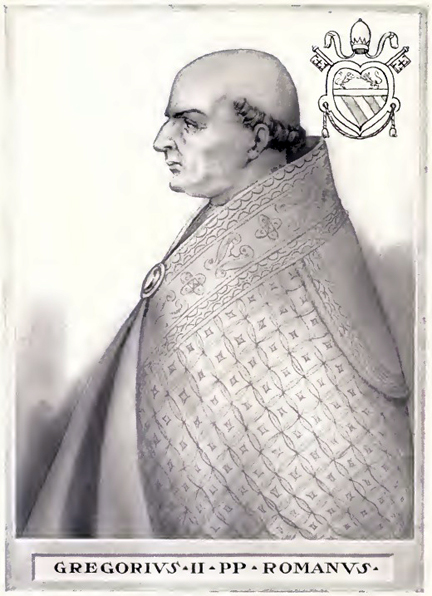

Saint
Grégoire II, Chevalier Artaud de Montor, The Lives and Times of the Popes,
New York: The Catholic Publication Society of America, 1911. It was originally
published in 1842.
St.
Gregory II. Pope and Confessor
HE was born in Rome, to an affluent fortune, and being educated in the palace
of the popes, acquired great skill in the holy scriptures and in ecclesiastical
affairs, and attained to an eminent degree of sanctity. Pope Sergius I. to whom
he was very dear, ordained him subdeacon. Under the succeeding popes, John the
sixth and seventh, Sisinnius, and Constantine, he was treasurer of the church,
and afterwards library keeper, and was charged with several important
commissions. The fifth general council had been held upon the affair of the
three chapters, in 553, in the reign of Justinian, and the sixth against the
Monothelites, in those of Constantine Pogonatus and Pope Agatho, in 660. With a
view of adding a supplement of new canons to those of the aforesaid two
councils, the bishops of the Greek church, to the number of two hundred and
eleven, held the council called Quini-sext, in a hall of the imperial palace at
Constantinople, named Trullus, in 692, which laid a foundation of certain differences
in discipline between the Eastern and Western churches; for in the thirteenth
canon it was enacted, that a man who was before married should be allowed to
receive the holy orders of subdeacon, deacon, or priest, without being obliged
to leave his wife, though this was forbidden to bishops. (can. 12.) It was also
forbidden (can. 55.) to fast on Saturdays, even in Lent. Pope Sergius I.
refused to confirm this council; and, in 695, the emperor Justinian II.
surnamed Rhinotmetus, who had succeeded his father, Constantine Pogonatus, in
685, was dethroned for his cruelty, and his nose being slit, (from which
circumstances he received his surname,) banished into Chersonesus. First
Leontius, then Apsimarus Tiberius ascended the throne; but Justinian recovered
it in 705, and invited Pope Constantine into the East, hoping to prevail upon
him to confirm the council in Trullo. The pope was received with great honour,
and had with him our saint, who, in his name, answered the questions put by the
Greeks concerning the said council. After their return to Rome, upon the death
of Constantine, Gregory was chosen pope, and ordained on the 19th of May, 715.
The emperor Justinian being detested both by the army and people, Bardanes, who
took the name of Philippicus, an Armenian, one of his generals, revolted, took
Constantinople, put him and his son Tiberius, only seven years old, to death,
and usurped the sovereignty in December, 711. In Justinian II. was extinguished
the family of Heraclius. Philippicus abetted warmly the heresy of the
Monothelites, and caused the sixth council to be prescribed in a pretended
synod at Constantinople. His reign was very short; for Artemius, his secretary,
who took the name of Anastasius II., deposed him, and stepped into the throne
on the 4th of June, 713. By him the Monothelites were expelled; but, after a
reign of two years and seven months, seeing one Theodosius chosen emperor by
the army which had revolted in January, 716, he withdrew and took the monastic
habit at Thessalonica. The Eastern army having proclaimed Leo III., surnamed
the Isaurian, emperor on the 25th of March, 717, Theodosius and his son
embraced an ecclesiastical state, and lived in peace among the clergy.
Pope Gregory signalized the beginning of his popedom by deposing John VI. the
Monothelite, false patriarch of Constantinople, who had been nominated by
Philippicus, and he promoted the election of St. Germanus, who was translated
to that dignity from Cyzicus, in 715. With unwearied watchfulness and zeal he
laid himself out in extirpating heresies on all sides, and in settling a
reformation of manners. Besides an hospital for old men, he rebuilt the great
monastery near the church of St. Paul at Rome, and, after the death of his
mother, in 718, changed her house into the monastery of St. Agatha. The same
year he re-established the abbey of Mount Cassino, sending thither, from Rome,
the holy abbot St. Petronax to take upon him the government, one hundred and
forty years after it had been laid in ruins by the Lombards. This holy abbot
lived to see monastic discipline settled here in so flourishing a manner, that
in the same century Carloman, duke or prince of the French, Rachis, king of the
Lombards, St. Willebald, St. Sturmius, first abbot of Fulda, and other eminent
persons, fled to this sanctuary. 1 Our
holy pope commissioned zealous missionaries to preach the faith in Germany, and
consecrated St. Corbinian bishop of Frisingen, and St. Boniface bishop of
Mentz. Leo the Isaurian protected the catholic church during the first ten
years of his reign, and St. Gregory II. laid up among the archives of his
church several letters which he had received from him, from the year 717 to
726, which proved afterwards authentic monuments of his perfidy. For being
infatuated by certain Jews, who had gained an ascendant over him by certain
pretended astrological predictions, in 726 he commanded holy images to be
abolished, and enforced the execution of his edicts of a cruel persecution. St.
Germanus, and other orthodox prelates in the East, endeavoured to reclaim him,
refused to obey his edicts, and addressed themselves to Pope Gregory. Our saint
employed long the arms of tears and entreaties; yet strenuously maintained the
people of Italy in their allegiance to their prince, as Anastasius assures us.
A rebellion was raised in Sicily, but soon quelled by the death of Artemius,
who had assumed the purple. The pope vigorously opposed the mutineers, both
here and in other parts of the West. When he was informed that the army at
Ravenna and Venice, making zeal a pretence for rebellion, had created a new
emperor, he effectually opposed their attempt, and prevented the effect.
Several disturbances which were raised in Rome were pacified by his care.
Nevertheless he by letters encouraged the pastors of the church to resist the
heresy which the emperor endeavoured to establish by bloodshed and violence.
The tyrant sent orders to several of his officers, six or seven times, to
murder the pope: but he was so faithfully guarded by the Romans and Lombards,
that he escaped all their snares. St. Gregory II. held the pontificate fifteen
years, eight months, and twenty-three days, and died in 731, on the 10th of
February; but the Roman Martyrology consecrates to his memory the 13th, which
was probably the day on which his corpse was deposited in the Vatican church.
Note 1. Bulteau, Hist. Mon. d’Occid. t. 2. l. 4. c. 2. p. 8. [back]
Rev. Alban Butler (1711–73). Volume II: February. The
Lives of the Saints. 1866.
SOURCE : http://www.bartleby.com/210/2/134.html
Saints
of the Order of Saint Benedict – Saint Gregory II, Pope
Most authorities agree in
stating that Saint Gregory II, a worthy namesake and successor of Saint Gregory
the Great, was born at Rome, and that his father’s name was Marcellus. At an
early age he entered a Benedictine Monastery, and became so famous for his
learning, that Pope Sergius removed him from his cell to take charge of the
Papal Library. This office he continued to hold under the three succeeding
Popes, till Pope Constantine, recognising his solid piety and profound
accomplishments, made him a member of the Sacred College. At this time a heresy
was raging in Greece, and generally throughout the East. To stamp it out on the
spot, Pope Constantine proceeded to Constantinople, taking with him his Court,
and among the rest of the Cardinals, Saint Gregory; for he wished Gregory to be
the champion of the Church against the Sectaries. Our Saint’s powerful
arguments and moving eloquence were completely successful in causing the
heretics to admit their error.
This brilliant triumph
led to Saint Gregory’s being named Pope on the death of Constantine. Our
Pontiff’s first care was to restore the city, whose churches, public buildings,
and walls were everywhere falling to ruin. Amongst the other Benedictine houses
that claimed his attention was Monte Cassino, which had lain in ruins for 130
years after its destruction by the Lombards. It was now thoroughly restored. It
was by Saint Gregory’s command and under his guidance that Saint Boniface
undertook his mission to Germany and succeeded in winning over to the true
Faith whole provinces of that country.
As formerly the frenzy of
Mauritius had been directed against Saint Gregory the Great, so now the Emperor
Leo Isauricus assailed Saint Gregory II. This monarch’s violence was aimed
especially at the pictures and statues of the Saints. An edict was published
even in Rome, for Rome, as well as the greater part of the West, was then
subject to the Eastern Emperor, ordering, under pain of exile and death, the
destruction of all sacred images and pictures, whether in private houses or in
churches. At first Saint Gregory tried to soften Leo’s violence by writing him
a mild yet firm remonstrance; but when this remonstrance only inflamed the
Emperor with greater fury, the Pope bade the Bishops from their Cathedrals
everywhere to plead the cause of the Saints and to denounce the impiety of the
Emperor. He also convened at Rome a Synod of seventy-nine Bishops, by which Leo
was excommunicated, and Rome and the rest of Italy absolved from their
allegiance to him. The Romans hastened to acknowledge Pope Gregory II, not only
as the Head of the Church, but also as their Temporal Sovereign.
When what had been done
in Rome and throughout Italy was known in Constantinople, the rage of the
Emperor knew no bounds. Marinus, with a band of assassins, was despatched to
slay the Pontiff; but he was overtaken by a Divine judgment, he fell dead of
apoplexy, before he could execute his wicked purpose. A similar fate awaited
Paulus, a patrician, who was secretly sent to Rome with the same object. He and
his fellow-assassins were seized by the Romans, and paid the penalty of their
crime with their lives. Leo, twice baffled in his attempts to get Saint Gregory
assassinated, set out against Italy with a large armament, intending to glut
his vengeance with wide-spread slaughter. By the Divine help this expedition
perished in the waters of the Adriatic. Rome and Italy were saved, and their
security for the future was ensured by an alliance with the King of Gaul.
The close of our Saint’s
Pontificate, peace being now restored, was marked by the same good works by
which its beginning had been distinguished. Besides three Monasteries which he
built, nearly all the churches and religious houses owed to Saint Gregory II,
if not their foundation, at least their restoration, or some addition to their
splendour and wealth. This most watchful and energetic Pontiff died A.D. 731,
after having ruled the See of Peter for fifteen years.
– text and illustration
taken from Saints
of the Order of Saint Benedict by Father Aegedius
Ranbeck, O.S.B.
SOURCE : https://catholicsaints.info/saints-of-the-order-of-saint-benedict-saint-gregory-ii-pope/


Darstellung
von Papst Gregor II. am rechten Turm des Hauptportals. St. Bonifatius in der
Heidelberger Weststadt (Baden-Württemberg, Deutschland);
Saint-Boniface
à Heidelberg's Weststadt (Bade-Wurtemberg, Allemagne); Représentation du pape
Grégoire II sur la tour droite du portail principal
Pope
Gregory II – Commends Bishop Boniface to the Christians of Germany, 1 December
722
Bishop Gregory, servant
of the servants of God, to all the very reverend and holy brethren,
fellow-bishops, religious priests and deacons, dukes, provosts, counts and all
Christian men who fear God.
Knowing that some of the
peoples in the parts of Germany that lie on the eastern bank of the Rhine have
been led astray by the wiles of the devil and now serve idols under the guise
of the Christian religion, and that others have not yet been cleansed by the
waters of holy Baptism, but like brute beasts are blind to their Creator, we
have taken great care to send the bearer of these letters, our revered brother
and fellow-bishop Boniface, into these parts to enlighten them and to preach
the word of faith, so that by his preaching he may teach them the way of
eternal life, and when he finds those who have been led astray from the path of
true faith or been misled by the cunning of the devil he may reprove them,
bring them back to the haven of salvation, instruct them in the teachings of
this Apostolic See and confirm them in the Catholic faith.
We exhort you, then, for
the love of our Lord Jesus Christ and the reverence you bear to his apostles,
to support him by all the means at your disposal and to receive him in the name
of Jesus, Christ, according to what is written of His disciples: “He who
receiveth you, receiveth me.” See to it that he has all he requires; give him
companions to escort him on his journey, provide him with food and drink and
anything else he may need, so that with the blessing of God the work of piety
and salvation committed’ to him may proceed without hindrance, and that you
yourselves may receive the reward of your labours and through the conversion of
sinners may find treasure laid up for you in heaven.
If, therefore, any man
assists and gives succour to this servant of God sent by the Apostolic See for
the enlightenment of the heathen, may he enjoy through the prayers of the
princes of the Apostles the fellowship of the saints and martyrs of Jesus
Christ.
But if (which God forbid)
any man should attempt to hinder his efforts and oppose the work of the
ministry entrusted to him and his successors, may he be cursed by the judgment
of God and condemned to eternal damnation.
Fare ye well.
Pope
Gregory II – Invests Boniface with Episcopal Authority, 1 December 722
Gregory, the servant of
the servants of God, to the clergy and people [of Thuringia], greeting in the
Lord.
Acceding without delay to
your praiseworthy desire, we have raised our colleague Boniface to the
episcopal dignity. We have commanded him not to ordain a man who has been
married twice or one who has married a woman not a virgin, or one who is not
fully instructed, or a man suffering from a physical defect, or who is
notorious for a crime whether civil or ecclesiastical, or who is known to be
subject to some liability. If he finds such persons in office he shall not
advance them. Under no circumstance whatsoever should he accept Africans who
dare to apply for admission to ecclesiastical orders, because some of them are
Manichaeans and others are known to have received Baptism several times. He shall
endeavour not to diminish but rather to increase the services and adornments of
the churches and whatsoever endowments they possess. He is to divide the
revenue and the offerings of the faithful into four parts: one for himself,
another to the clergy for their ministrations, a third to the poor and
pilgrims, and a fourth for the fabric of the churches, for all of which he must
render an account at the judgment seat of God. The ordination of priests and
deacons is to take place only at the quarter tenses of April, July and October
and at the beginning of Lent. Baptism must be conferred only at Easter and
Whitsuntide, except in the case of those who are in danger of death, for
otherwise they might perish eternally.
As long as he continues
to carry out the injunctions of this our see you are to show him unquestioning
obedience, that the body of the Church may be without blame and in perfect
peace, through Jesus Christ our Lord, who liveth and reigneth with Almighty God
and the Holy Spirit for ever and ever.
May God preserve you from
all harm, beloved sons.
Given on the kalends of
December in the seventh year of the reign of our august Lord, Leo, by the grace
of God crowned emperor, in the fourth year of his son Constantine the Great,
the sixth indiction.
Pope
Gregory II Commends Boniface to the Leaders of Thuringia, December 722
Pope Gregory to his
distinguished sons Asulf, Godolaus, Wilareus, Gundhar, Alvold and all the
faithful of Thuringia who are beloved of God.
The report of your
loyalty to Christ and of your steadfast answers to the heathen when they urged
you to return to the worship of idols that you would rather die than break
faith with Christ once you had accepted Him filled us with great joy. We give
thanks to our God and Redeemer, the Giver of all good. We pray that in the
strength of His grace you may advance to higher and greater things, whilst you
cling with all your might to the beliefs and teaching of the Holy Apostolic
See.
We pray also that as far
as the work of our holy religion requires, you will seek consolation from this
Holy Apostolic See, who is the spiritual mother of all believers, for as you
are her sons and joint heirs of a kingdom that has a royal Father it is fitting
that you do so.
We bid you to show
obedience in all things to our dearest brother Boniface, now consecrated
bishop, who is well grounded in all the traditions of this Apostolic See. We
send him to you to preach and instruct you in the faith and we urge you to
cooperate with him in working out your salvation in the Lord.
Pope
Gregory II Commends Boniface to Charles Martel, December 722
To the glorious Lord, our
son, Duke Charles.
Having learned, beloved
son in Christ, that you are a man of deeply religious feeling, we make known to
you that our brother Boniface, who now stands before you, a man of sterling
faith and character, has been consecrated bishop by us, and after being
instructed in the teachings of the Holy Apostolic See, over which by God’s
grace we preside, is being sent to preach the faith to the peoples of Germany
who dwell on the eastern bank of the Rhine, some of whom are still steeped in
the efforts of paganism, while many more are plunged in the darkness of
ignorance.
For this reason we
commend him without more ado to your kindness and goodwill, begging you to help
him in all his needs and to grant him your constant protection against any who
may stand in his way. Know for certain that any favour bestowed on him is done
for God, who on sending His holy Apostles to convert the Gentiles said that any
man who received them received Him.
Instructed by us in the
teachings of these Apostles, the bishop aforesaid is now on his way to take up
the work assigned to him.
SOURCE : https://catholicsaints.info/pope-gregory-ii-commends-boniface-to-charles-martel-december-722/
Pope
Gregory II Commends Boniface to the People of Thuringia, December 724
Our Lord, Jesus Christ,
came down from heaven and, true God as He was, became Man, suffered and was
crucified for our sakes [80] was buried and the third day rose again from the
dead and ascended into heaven. But to His holy Apostles he said: ” Go, teach
all nations, baptizing them in the name of the Father and, of the Son and of
the Holy Ghost “, promising eternal life to all those who believed.
Wherefore, desiring that
you should rejoice with us for all eternity where there is no end, no suffering
nor any bitterness, but only glory for evermore, we have sent you our most holy
brother Boniface as your bishop, so that he may baptize you, teach you the
faith of Christ and lead you from error to the path of salvation, whereby you
may be saved and enjoy everlasting life. Obey him in all things, respect him as
your father and submit your hearts to his teaching, because we have sent him to
seek, not earthly gain, but the profit of your souls.
Wherefore, love God and
receive Baptism in His name, because the Lord our God had prepared what the eye
of man hath not seen nor the heart conceived for those who love Him. Put aside
your evil ways and do good. Adore not idols nor make bloody sacrifices, because
God does not accept them; but in all things carry out and observe the
injunctions of our brother Boniface, and then both you and your children will
be saved for evermore.
Build him a house,
therefore, where he can dwell as your father and bishop; build churches where
you can pray: and may God have mercy on your sins and grant you everlasting
life.
Pope
Gregory II Replies to Questions Put by Boniface, 22 November 726
Gregory, the servant of
the servants of God, to Boniface, our most holy brother and colleague in the
episcopate.
Your devout messenger
Denual has brought us the welcome news that you are well and that, by the help
of God, you are making progress in the work for which you were sent. He also
delivered to us letters from you reporting that the field of the Lord which had
long lain fallow and was overgrown with the weeds of pagan customs has now been
ploughed up and sown with the truth of the Gospel, producing an abundant
harvest of souls.
in the same report you
included a number of questions concerning the faith and teaching of the Holy
Roman and Apostolic Church. This is a commendable practice, for here Saint
Peter the Apostle held his see and the episcopate had its beginning. And since
you seek our advice on matters dealing with ecclesiastical discipline, we will
state with all the authority of apostolic tradition what you must hold, though
we speak not from our own insufficiency but relying on the grace of Him who
opens the mouths of the dumb and makes eloquent the tongues of babes.
Your first question is:
Within what degrees can marriage be solemnized? Our answer is that if the
parties know themselves to be related by blood they should not marry; but since
moderation weighs more with these savage people than strict legal duties, they
should be allowed to marry after the fourth degree of consanguinity.
As to what a man shall do
if his wife is unable through illness to allow him his marital rights, it would
be better if he remained apart and practised continence. But since this is
practicable only in the case of men of high ideals, the best course if he is
unable to be continent would be for him to marry. Nevertheless, he should
continue to support the woman who is sick, unless she has contracted the
disease through her own fault.
As regards a priest or
bishop who has been accused by the people, if the evidence for the charge
against him is not substantiated by reliable witnesses he should protest his
innocence on oath before God, from whom nothing is concealed, and retain the
rank which is his due. For once a man has been ordained or consecrated he
cannot be ordained or consecrated anew.
In the sacred ceremony of
the Mass that rite must be observed which our Lord transmitted to His
Disciples, for he took the chalice and gave it to them, saying: “This is the
chalice of the New Testament in my blood: do this as often as you shall drink
it.” Therefore it is not fitting that two or three chalices should be placed on
the altar during the celebration of Mass.
As to foods offered in
sacrifice to idols, you ask whether a believer is permitted to eat them or not
after he has first made a sign of the cross over them. A sufficient answer to this
question is provided in the words of Saint Paul when he said: ” If any man says
to you, This has been offered in sacrifice, eat not for the sake of the man who
mentioned it and for conscience sake.”
You ask further: If a
father or mother gives a child during its early years to a monastery to be
brought up in monastic discipline, is it lawful for that child, after reaching
the age of puberty, to leave the cloister and enter into matrimony? This we
strictly forbid, for it is an impious thing to allow children who have been
offered to God by their parents to follow their baser instincts for pleasure.
You mention also that
some have been baptized by adulterous and unworthy priests without being
questioned on their belief in the articles of the Creed. In such cases you must
hold fast to the ancient custom of the Church, because whoever is baptized in
the name of Father, Son and Holy Ghost cannot be baptized again. For he has
received this grace not in the name of the minister but in the name of the
Trinity. Hold fast the teaching of the Apostles, ” One Lord, one faith, one
baptism “. We require you to impart spiritual instruction to such people with
particular earnestness.
As regards small children
who have been separated from their parents and do not know whether they have
been baptized or not, reason demands that you should baptize them, unless there
is evidence to the contrary.
Lepers who belong to the
Christian faith should be allowed to partake of the body and blood of the Lord,
but they may not attend sacred functions with people in good health. In the
case of a contagious disease or plague attacking a church or monastery you ask
whether those who have not been infected may escape danger by flight. We
declare this to be utterly foolish; no man can escape the hand of God.
At the end of your letter
you state that some priests and bishops are so vicious that their fives are a
continual reproach to the priesthood and you enquire whether it would be lawful
to eat and speak with them provided they are not heretics. We answer that you
are to admonish and correct them with our apostolic authority and so bring them
back to the purity of ecclesiastical discipline. If they obey, they will save
their souls, and you, on your side, will attain your reward. Do not refuse to
eat and speak with them at the same table. It often happens that where
correction fails to bring men to an acknowledgment of the truth, the constant
and gentle persuasion of their table companions leads them back to the paths of
goodness. You should follow this same rule in dealing with the nobles who are
of assistance to you.
This, my dear brother, is
all that need be said with the authority of the Apostolic See. For the rest, we
call upon the mercy of (34 which has sent you, under our apostolic authority,
to shed the light of truth on those regions of darkness, to crown your work
with success so that you may receive the reward of your labours and the
forgiveness of our sins.
May God keep you from all
harm, most reverend brother.
Given on the tenth of the
kalends of December in the tenth year of the reign of our august emperor Leo,
in the seventh of his son Constantine the Great, the tenth indiction.
SOURCE : https://catholicsaints.info/pope-gregory-ii-replies-to-questions-put-by-boniface-22-november-726/
Pope
Gregory II Invests Boniface with the Pallium, 732
Gregory, the servant of
the servants of God, to our most reverend and holy brother Bishop Boniface,
sent by this apostolic Church of God for the enlightenment of the German people
who live in the shadow of death, steeped in error.
It was a source of great
satisfaction to us to learn from a repeated reading of your letter that by the
grace of God many heathens have turned away from error and embraced the truth.
And because we are taught in the parable that he to whom five talents was given
gained also another five, we, and the whole Church with us, congratulate you on
your success. Hence we have sent the sacred pallium to you as a gift, desiring
with the authority of the Apostolic See that you accept it and wear it; and it
is our wish that you be recognized as one of the archbishops divinely
appointed. How you are to use it you will learn from the instructions of the
Apostolic See, namely: you must wear it only during the celebration of Mass and
when in the course of your episcopal duty you consecrate a bishop.
But since, as you say,
you are unable to deal with all the matters involved in imparting the means of
salvation to the multitudes of those who, by the grace of God, have been
converted in those parts, we command you in virtue of our apostolic authority
to consecrate bishops wherever the faithful have increased. This you must do in
accordance with the sacred canons, choosing men of tried worth so that the
dignity of the episcopate may not fall into disrepute.
As regards the priest
whom you say came to us and was absolved from his nefarious crimes, we would
like you to know that he made no confession to us, nor did he receive absolution so
that he could pursue his lustful desires. If you find that he has fallen into
error again we command you by the authority of the Holy See to correct and
discipline him in accordance with the sacred canons, as also any other person
you should meet like him. For when he came here he said, “I am a priest “, and
he asked for letters of recommendation to our son Charles. We gave him no other
favour. If his conduct is blameworthy we desire you to shun him, together with
the rest.
Those whom you say were
baptized by pagans and the case is proved should be baptized again in the name
of the Trinity.
You say, among other
things, that some eat wild horses and many eat tame horses. By no means allow
this to happen in future, but suppress it in every possible way with the help
of Christ and impose a suitable penance upon offenders. It is a filthy and
abominable custom.
You ask for advice on the
lawfulness of making offerings for the dead. The teaching of the Church is
this-that every man should make offerings for those who died as true Christians
and that the priest should make a commemoration of them [at Mass]. And although
all are liable to fall into sin, it is fitting that the priest should make a
commemoration and intercede for them. But he is not allowed to do so for those
who die in a state of sin even if they were Christians.
It is our command that
those who doubt whether they were baptized or not should be baptized again, as
also those who were baptized by a priest who sacrifices to Jupiter and partakes
of sacrificial offerings. We decree that each one must keep a record of his
consanguinity to the seventh degree.
If you are able, forbid
those whose wives have died to enter into second marriages.
We declare that no one
who has slain his father, mother, brother or sister can receive the Holy
Eucharist except at the point of death. He must abstain from eating meat and
drinking wine as long as he lives. He must fast on every Monday, Wednesday and
Friday and thus with tears wash away the crime he has committed.
Among other difficulties
which you face in those parts, you say that some of the faithful sell their
slaves to be sacrificed by the heathen. This, above all, we urge you to forbid,
for it is a crime against nature. Therefore, on those who have perpetrated such
a crime you must impose a penance similar to that for culpable homicide.
As often as you
consecrate a bishop, let two or three other bishops join with you so that what
you do may be pleasing to God, may be done with their assistance and sanctioned
by their presence.
These matters, dearest
brother, we wish you carefully to observe. Pursue the work of salvation on
which you have so piously embarked so that you may receive from our Lord God
the eternal reward of your labours.
The privilege for which
you asked is sent together with this letter. We pray God that under His
protection you may achieve complete success in turning the heathens from the
errors of their ways. May God protect you from harm, most reverend brother.
SOURCE : https://catholicsaints.info/pope-gregory-ii-invests-boniface-with-the-pallium-732/


Giovan Battista Fiorini, Liutprando conferma a papa
Gregorio II la donazione di Ariperto (1565),
affresco; Città del Vaticano, Palazzi Vaticani, sala Regia


Giovan Battista Fiorini, Liutprando conferma a papa
Gregorio II la donazione di Ariperto (1565),
affresco; Città del Vaticano, Palazzi Vaticani, sala Regia


Giovan Battista Fiorini, Liutprando conferma a papa
Gregorio II la donazione di Ariperto (1565),
affresco; Città del Vaticano, Palazzi Vaticani, sala Regia
San Gregorio II Papa
m. 731
(Papa dal 19/05/715 al 11/02/731)
Romano, promosse l'evangelizzazione della Germania, dove mandò san Bonifacio.
Fece restaurare molte chiese di Roma e il monastero di Montecassino.
Martirologio Romano: A
Roma presso san Pietro, deposizione di san Gregorio II, papa, che, nei tempi
funesti dell’imperatore Leone l’Isaurico, difese la Chiesa e il culto delle
sacre immagini e inviò san Bonifacio in Germania a predicare il Vangelo.
Nativo di Roma apparteneva al rango dei "suddiaconi" (il suddiaconato fu per lungo tempo considerato il primo gradino degli ordini clericali intrinsechi alla Chiesa Cattolica. Il primo rango maggiore al quale veniva richiesto il voto di castità e quindi del celibato. I paramenti di distinzione nella liturgia furono istiutiti attorno al III secolo ma ufficializzati solo nel XII e consistevano in una "camiciola" una "tunicella" ed un cordone di tessuto bianco cinto in vita. I suddiconi non potevano portare la "stola" riservata ai ranghi superiori, ovvero dal "diacono" in su. Il rango di suddiacono fu abolito solamente nel 1972, mentre persiste nell'ortodossia greco-ortodossa).
Quindi, ancora una volta fu eletto pontefice: un povero e comune cristiano. Correva il giorno 19 maggio del 715, quando imperatore d'oriente era Anastasio II, mentre la penisola italica era quasi tutta sottomessa al re longobardo Liutprando.
Inizialmente il pontificato di Gregorio II sembrò vacillare sotto una serie di contrapposizioni politiche e di dominio.
Le contrapposizioni rientrarono comunque grazie alla "diplomazia"
che, sulla scorta delle esperienze maturate nei secoli stava facendo diventare
il papato un regno temporale.
Nel frattempo a Benevento si insediò il duca longobardo Romoaldo II, il quale
aveva preso possesso anche di Cuma ( importante ed antica città campana di
origine etrusco-romana situata sulla via Domiziana, la cui datazione viene
fatta risalire al 730 a.c. - nda: probabilmente l'odierrna Pozzuoli -),
Ancora, nel 717, quando i longobardi stavano sottomettendo le popolazioni in
nome e per conto del cristianesimo, imperversando da settentrione verso il
meridione della penisola italica, il pontefice disconobbe tale mandato e con un
repentino cambio di intenti si rivolse al " napoletano dux Giovanni"
(prima console dell'imperatore d' oriente Anastasio II e dopo la sua defenestrazione
console del suo successore Teodoro), nell'intento di arginare l'avanzata
longobarda, probabilmente memore, attraverso la storia, delle loro scorribande
accadute tra il 581 ed il 589.
Oltre ai citati fatti questo pontefice fu meritorio per la tutela del
cosiddetto "ceto medio" , nel quale si annoverava la maggior parte
della cittadinanza laboriosa, ovvero i mercanti che investivano i propri
patrimoni in spedizioni navali e terrestri pur di soddisfare la domanda
economica interna. Così come riuscì in qualche modo a tutelare gli interessi
delle comunità attraverso la tutela dell'artigianato e la protezione delle
arti.
Oltre a questo si distinse sicuramente nell'opera di evangelizzazione dei
popoli nordici a partire da quelli germanici con la conversione di Teodo e
l'incisività patriarcale presso i "frisoni", tanto è vero che il
teologo e filosofo Winfrith fu insignito delle più alte cariche ecclesiastiche
al fine di ricondurre le popolazioni germaniche sotto le insegne di Roma
anzichè ricondurle alla soggezione dell'impero d'oriente.
L'attività evangelica però, non fu sempre limpida e spesso si tradusse in
aspetti qualche volta devastanti per le popolazioni coinvolte nelle azioni da
diverse interpretazioni, sopratutto quando salì al trono imperiale Leone III.
L'intransigenza bizantina, spesso in conflitto con Roma si era definitivamente
eretta a sentinella della "porta d'oriente" presso il patriarcato di
Ravenna, l'unica insormontabile difficoltà negli interessi ideologici rimase
quella del "culto alle immagini", permessa da Roma e negata in
oriente. (nda: in nome di quell'immagine raffigurante l' Acheropita).
L'epistolario tra il papa e l'imperatore si presenta ancor oggi molto ricco,
nonostante il trascorrere dei secoli, difficile fu come è stabilire le ragioni
rappresentate da ambo le parti, proprio per le diverse prerogative sia
temporali che teologiche.
Certo è che ancora una volta le contrapposizioni temporal-teologiche riuscirono
ad innescare un'ulteriore guerra ideologica.
Ancora una volta però davanti alla minaccia degli "unni" comandati da
re Liutprando, il papa si rimise in cammino per fermare le orde barbariche e
come il suo antesignano Leone Magno riuscì nel suo intento, riuscendo a
ricondurre a più miti considerazioni sia il re che tutto il resto del popolo
attraverso una messa celebrata in campo aperto.
Le truppe bizantine già scese in campo si ritirarono, così come fecero gli Unni, lasciando libere le popolazioni sotto l'influenza papale.
La realtà storica vuole invece che al di là delle prese di posizione iconografiche o iconoclastiche, ci fossero solamente dei giochi di potere per i quali chi ci rimise letteralmente la testa, perchè decapitato fu il duca "Tiberio Petasio", il quale autoproclamatosi imperatore "tuscio" (nda: quindi dell' odierna Italia) si dovette scontrare sia con il potere imperiale di Ravenna, governato dall'imperatore d' oriente, sia con quello itinerante dei longobardi, degli Unni e dei Visigoti i quali ogni tanto riuscivano ad eleggere un'unico presunto re, rivendicando ora il presidio di Ravenna, ora quello di Rimini oppure quello di Eraclea.
Dimenticando spesso che Roma ed il suo pontefice si stava mano a mano
organizzando anche con un proprio esercito ma, contando soprattutto sulle forze
alleate di esercitici intrinsechi alle piccole o grandi signorie feudali, ormai
completamente o parzialmente sganciate da una o l'altra potenza militare.
Gregorio II morì il giorno 11 febbraio del 731 e fu sepolto in San Pietro.
Autore: Franco
Prevato
SOURCE : https://www.blogger.com/blog/post/edit/5408295391443355751/9125966745822362347
GREGORIO II papa, santo
di Pio Paschini
Enciclopedia Italiana
(1933)
Figlio di Marcello,
romano, fu eletto papa il 19 gennaio 715. Allevato nel patriarchio lateranense,
dove era stato sacellario e bibliotecario, aveva accompagnato in Oriente, come
diacono, il suo predecessore Costantino.
Il Liber
Pontificalis parla della sua premura per i restauri delle basiliche di S.
Paolo e di S. Lorenzo e per i monasteri, specie per quelli posti intorno a S.
Paolo. Ma fondò anche, nella sua casa paterna, quello di Sant'Agata. Ebbe da
Liutprando, re dei Longobardi, la conferma della restituzione del patrimonio
delle Alpi Cozie, fatta già da Ariperto, e aiutò con denari i Napoletani a
riprendere il castello di Cuma, preso dai Longobardi. Affidata nel 719 a
Bonifacio la missione di evangelizzare la Germania, lo consacrò vescovo nel 723
e lo assisté con le sue lettere nell'ardua opera dell'organizzazione. Ma nel
726 si ebbero i primi tumulti in Italia per l'esosità dei Bizantini in fatto di
tributi e per il decreto di Leone III Isaurico contro le immagini. Di essi
approfittò il re longobardo Liutprando per impadronirsi prima delle città della
Pentapoli e di Osimo, e per marciare poi su Roma stessa. E fu un grande
successo per G. l'essere riuscito a fermare Liutprando a Sutri, e ad ottenere
anzi che il re donasse la città "agli apostoli Pietro e Paolo". Nel
728 Liutprando, d'accordo questa volta con il nuovo esarca bizantino Eutichio,
mosse contro Roma, assediandola; ma ancora una volta riuscì al papa di
accordarsi con Eutichio e con Liutprando: insieme col primo concorse a sconfiggere
un tal Petasio, detto anche Tiberio, proclamatosi imperatore nella Tuscia
romana; dal secondo ottenne mantello, spada e corona in omaggio alla tomba di
S. Pietro. G. aveva così posto le basi del potere temporale e costituito, con
Sutri, il primo nucleo dello stato pontificio. Morì il 10 febbraio 731.
Bibl.: P. Jaffé, Regesta
Pontif. Roman., Lipsia 1885, pp. 249-257; L. Duchesne, Liber Pontif., I,
Parigi 1886, pp. cclxi, 396; id., Les premiers temps de l'État
pontifical, Parigi 1911, pp. 7 segg., 24 segg.; Hefele-Leclercq, Histoire
des Conciles, III, Parigi 1910, p. 647 segg.; G. Kurth, S. Bonifacio, Roma
1905, p. 28 segg. Per i rapporti con i Longobardi: L. M. Hartmann, Geschichte
Italiens im Mittelalter, II, ii, Gotha 1903; G. Romano, Le
dominazioni barbariche in Italia, Milano 1910.
© Istituto della
Enciclopedia Italiana fondata da Giovanni Treccani - Riproduzione riservata
SOURCE : https://www.treccani.it/enciclopedia/gregorio-ii-papa-santo_(Enciclopedia-Italiana)/
GREGORIO II, santo
di Paolo Delogu
Enciclopedia dei Papi
(2000)
Nacque a Roma e fu
allevato ed educato nel patriarchio lateranense, il complesso di uffici, con
annesse scuole e collegi, in cui era esercitata l'amministrazione patrimoniale
ed ecclesiastica del papato. Ricevuto il suddiaconato da papa Sergio
I, ricoprì nel patriarchio l'importante ufficio di sacellario, e gli fu
affidata la cura della "bibliotheca". Promosso al diaconato,
accompagnò papa Costantino nel
viaggio che questi fece a Costantinopoli nel 710. Colà ebbe un ruolo importante
nelle trattative che composero il dissidio tra il papato e l'Impero bizantino
suscitato dal cosiddetto concilio Quinisesto, celebrato da Giustiniano II nel
691-692. Durante il soggiorno a Costantinopoli sembra che si facesse apprezzare
dallo stesso imperatore, rispondendo a quesiti su vari argomenti. Eletto papa,
fu consacrato quaranta giorni dopo la morte del predecessore Costantino, il 19
maggio 715.
Le sue prime iniziative
furono rivolte alla manutenzione della città di Roma. Intraprese il restauro
delle mura di cinta della città, che versavano da tempo in cattive condizioni;
in quest'impresa incontrò però resistenze, forse da parte delle autorità laiche
che governavano la città. Roma faceva ancora parte dell'Impero bizantino,
rappresentato in città da un duca, sebbene l'autorità politica e civile dei
papi fosse molto cresciuta negli ultimi decenni, ed essi esercitassero
probabilmente funzioni pubbliche anche fuori dal campo strettamente
ecclesiastico. G. poté invece effettuare indisturbato il restauro di alcune
grandi basiliche, anch'esse compromesse per la vetustà e la carente
manutenzione. Rinnovò i tetti di S. Paolo, di S. Lorenzo fuori le Mura e di S.
Croce in Gerusalemme, sostituendo le travi marce e risarcendo le parti già
crollate; ristabilì inoltre la vita religiosa in alcuni monasteri da tempo
abbandonati presso S. Paolo e S. Maria Maggiore, affidando alle comunità
monastiche ivi istituite l'incarico di celebrare notte e giorno l'ufficio nelle
basiliche contigue. Proseguì il rinnovamento della liturgia papale in corso
dalla fine del secolo precedente, istituendo tra l'altro la messa del giovedì
di Quaresima.
Queste iniziative
miravano a ripristinare il decoro dei grandi edifici ecclesiastici e del culto
a Roma, anche in considerazione del crescente afflusso di pellegrini che
visitavano la città e le sue memorie sacre, e che in gran parte provenivano dai
Regni barbarici dell'Occidente europeo, dove il culto dell'apostolo Pietro e la
reverenza per il papa suo successore e vicario si erano diffusi fin dal secolo
precedente. Nel 716 G. accolse a Roma il duca dei Bavari Teodo, primo
pellegrino della sua gente, che veniva a chiedere l'istituzione di una provincia
ecclesiastica dipendente da Roma nel suo Ducato. Nel 719 ricevette la visita
del monaco anglosassone Winfrith (680-750), che chiedeva direttive e sostegno
per la missione evangelizzatrice che intendeva intraprendere nella Germania
ancora pagana. Il 15 maggio di quell'anno G. gli conferì autorità e poteri
ecclesiastici, ribattezzandolo col nome del santo romano Bonifacio. Più tardi,
il 30 novembre 722, in occasione di un secondo viaggio di Bonifacio a Roma, G.
lo consacrò vescovo di Germania, ricevendo da lui il giuramento di obbedienza
al papato normalmente prestato dai vescovi suffraganei. Per guidare la sua
azione organizzatrice, G. diede a Bonifacio un libellum contenente norme di
diritto ecclesiastico secondo la tradizione romana. Scrisse inoltre diverse
lettere ai cristiani di Germania e di Turingia, invitandoli ad aiutare
Bonifacio e a rispettare le sue decisioni. Inoltre scrisse al principe franco
Carlo Martello chiedendogli di proteggere la missione di Bonifacio. In Francia
G. fu in rapporto anche col duca degli Aquitani Eude, cui verso il 720 inviò in
segno di benedizione tre spugne utilizzate nella mensa pontificia, che il duca
usò come talismani negli scontri avuti presso Tolosa con i Saraceni che dalla
Spagna tentavano di espandersi nella Francia meridionale. Buoni rapporti G.
ebbe inizialmente anche con il Regno longobardo; ne è testimonianza la
restituzione alla Chiesa di Roma del patrimonio fondiario delle Alpi Cozie da
parte del re longobardo Liutprando (712-744).
Tuttavia la situazione politica
in Italia si complicò presto. Nelle province bizantine dell'Italia
centro-settentrionale (Venezie, Esarcato, Pentapoli), l'autorità del governo
imperiale, già indebolita dalle violenze commesse dall'imperatore Giustiniano
II a danno delle popolazioni locali e dalle ricorrenti propensioni ereticali
degli imperatori, venne ulteriormente compromessa dall'avanzata araba in Asia
Minore, culminata nell'assedio posto a Costantinopoli, che durò dall'agosto 717
all'agosto 718. Probabilmente in connessione con queste vicende, i Longobardi,
che controllavano la maggior parte della penisola italiana, occuparono Classe,
porto di Ravenna, e i castelli di Narni e Cuma. Quest'ultimo faceva parte del
Patrimonio della Chiesa romana in Campania: G. si rivolse dunque al duca di
Benevento Romualdo, offrendo di riscattare il castello con 70 libbre d'oro. Non
riuscendo però ad ottenerne la restituzione, chiese l'intervento del duca di
Napoli, Giovanni, che insieme al rettore del Patrimonio Teodino riconquistò con
le armi il castello, restituendolo al papa, il quale volle comunque pagare il
riscatto promesso al duca longobardo. Interpretato da alcuni studiosi come
primo caso di esercizio di autorità papale su territori sottoposti alla
giurisdizione dello Stato bizantino, il recupero di Cuma non fu probabilmente
altro che una iniziativa volta a difendere il possesso di un patrimonio
fondiario della Chiesa romana; esso semmai conferma l'importanza che tali
patrimoni rivestivano per il papato, che da loro traeva sia redditi in natura,
per l'approvvigionamento del clero e delle istituzioni assistenziali nella
città di Roma, sia censi in denaro, indispensabili per le attività del governo
ecclesiastico. L'acquisizione da parte del papato di poteri giurisdizionali nei
territori soggetti alla sovranità imperiale deve dunque porsi in un momento
successivo, sia pur non di molto.
Problemi di natura
economica sembrano alla base anche dello scontro che di lì a poco oppose G.
all'imperatore bizantino Leone III Isaurico (717-741). Appena liberata
Costantinopoli dall'assedio degli Arabi, questi si dedicò alla riorganizzazione
dell'Impero interessandosi anche delle province italiane, dove peraltro impose
tasse pesantissime, forse anche per punire l'insubordinazione dimostrata dalle
popolazioni verso il governo imperiale. In quell'occasione, G. si oppose al
pagamento delle imposte che gravavano sui patrimoni e i contadini della Chiesa
romana, incitando forse alla disobbedienza fiscale "l'intera provincia
d'Italia" e la stessa città di Roma. La reazione del governo bizantino fu
violenta, anche se sulle prime indiretta: alcuni esponenti dell'aristocrazia
imperiale - il duca Basilio, il cartulario Iordanes e il suddiacono Giovanni
Lurion - spalleggiati dal duca di Roma Marino e dallo stesso esarca Paolo si
accordarono per uccidere il papa, senza trovare però subito l'occasione
propizia. Scoperta la congiura, i Romani stessi misero a morte i congiurati,
mentre il duca si allontanava da Roma. Nel 725 l'esarca Paolo cercò di
rimuovere G. dal papato, inviando a Roma un nuovo duca, appoggiato da un
esercito raccolto con difficoltà nel Ravennate; ma in quest'occasione venne in
luce la debolezza del governo bizantino in Italia. I Romani uscirono dalla
città per affrontare questo esercito, ed ebbero l'aiuto dei Longobardi di
Spoleto e di altri duchi longobardi confinanti col territorio romano. La
spedizione dell'esarca fu respinta, mentre si delineava un'intesa fra i poteri
regionali dell'Italia centrale, volta a difendere l'autonomia del papa in Roma
e la sua capacità di prendere iniziative politiche contro gli aspetti più
oppressivi del governo bizantino. Questa situazione si complicò e aggravò a
partire dall'anno successivo (726), quando Leone III vietò a Costantinopoli il
culto delle immagini sacre, come manifestazione idolatrica che comprometteva la
purezza della fede e del rituale ecclesiastico, dando avvio alla loro
distruzione sistematica (iconoclastia). Quali che fossero le motivazioni -
religiose e politiche - di questa decisione imperiale, essa aveva il torto di
andare contro una pratica devozionale consolidata nella cristianità occidentale
non meno che in quella orientale; inoltre la lotta iconoclastica configurava un
pesante intervento imperiale in una materia squisitamente ecclesiastica; cosa
che riportava d'attualità in Roma la memoria di tutte le violenze e le
vessazioni che i papi avevano subito, nel secolo precedente, per la loro
opposizione alla politica teologica degli imperatori di Bisanzio. Invitato da
Leone III ad aderire alle disposizioni iconoclaste, con la promessa di una
sanatoria per la precedente ribellione fiscale e la minaccia di deposizione se
invece avesse rifiutato, G. rispose condannando decisamente le disposizioni
imperiali come eretiche e scrivendo lettere ai "cristiani" per ammonirli
a guardarsi dalla nuova empietà che si profilava.
Non è chiaro se in
conseguenza di queste ammonizioni papali, o per propria iniziativa, le
popolazioni delle province bizantine della Pentapoli e delle Venezie si
sollevarono in armi contro i decreti imperiali, dichiararono decaduto e
maledetto l'esarca Paolo e i suoi sostenitori ed elessero propri duchi in
sostituzione dei funzionari nominati dal governo bizantino; la difesa
dell'incolumità del papa faceva comunque esplicitamente parte del loro programma.
A Ravenna e negli stessi territori romani la situazione era meno chiara, perché
vi si trovavano anche sostenitori della politica imperiale; nel 727 un duca
Esilarato col figlio Adriano, esponenti di una famiglia della nobiltà romana
che aveva antichi rancori verso G., cercarono di sollevare le popolazioni della
Campagna (cioè del Lazio meridionale) contro il papa e di provocarne
l'assassinio, ma vennero catturati dai Romani e messi a morte. In seguito anche
un duca Pietro venne accecato dai Romani. A Ravenna, tumulti cittadini
portarono all'uccisione dell'esarca Paolo. Gli insorti progettarono anche di
eleggere un imperatore in Italia e di portarlo con un esercito a Costantinopoli
per sostituirlo a Leone III; G. tuttavia si oppose decisamente a questo progetto.
Sembra che le dottrine eretiche e i decreti dell'imperatore in materia di culto
non compromettessero nella concezione del papa l'autorità istituzionale
dell'Impero bizantino, che era pur sempre il titolare della sovranità nelle
province italiane, e nel cui ordinamento la Chiesa romana si inquadrava,
sebbene i suoi orizzonti pastorali fossero più vasti. È inoltre probabile che
il papa vedesse con preoccupazione un indebolimento eccessivo dell'autorità
imperiale in Italia, giacché di esso sembravano pronti ad approfittare i
Longobardi. Già durante la ribellione delle province ai decreti iconoclasti
alcuni castelli e città dell'Emilia bizantina e della Pentapoli si erano dati
in potere del re longobardo Liutprando, mentre milizie longobarde occupavano il
castello di Sutri, sui confini del Ducato romano. G. inviò insistentemente
messi, lettere e doni a Liutprando per chiedere la liberazione di Sutri, che
finalmente ottenne, nella forma di una donazione del castello agli apostoli
Pietro e Paolo. Insieme al recupero di Cuma, questa "donazione di
Sutri" del 729 è stata tradizionalmente considerata come la tappa iniziale
del governo temporale del papato su terre appartenenti all'Impero bizantino.
Sembra però più probabile che la motivazione devozionale addotta da Liutprando
nella cessione del castello - la donazione agli apostoli - non comportasse
realmente l'instaurazione di un governo temporale del papato; nel ricevere la
donazione, il papa dovette agire come rappresentante del governo bizantino,
quale in realtà egli poteva essere sotto il profilo politico e istituzionale,
in quanto vescovo di Roma, tanto più che i capi laici della provincia, l'esarca
e il duca di Roma, erano stati entrambi fisicamente eliminati dai ribelli.
L'interesse del papa all'integrità del Ducato romano coincideva in questo caso
con l'interesse dell'Impero.
Peraltro la situazione
politica in Italia si complicò presto. Il re Liutprando cercava di profittare
dell'instabilità determinata dalla ribellione delle province bizantine anche
per sottoporre ad un più stretto controllo regio i Ducati longobardi di Spoleto
e di Benevento, i cui duchi da decenni governavano in modo sostanzialmente
autonomo. Contemporaneamente sbarcava a Napoli un nuovo esarca inviato
dall'imperatore Leone III, l'eunuco Eutichio, con l'incarico segreto di
eliminare il papa, cosa che Eutichio cercò di fare mandando a Roma un emissario
in cerca di complici. La missione fallì per la lealtà dei Romani verso il papa,
e sembra che il messo dell'esarca fosse sottratto alla morte dallo stesso
Gregorio II. Eutichio cercò allora di incrinare la solidarietà tra il papa ed i
duchi longobardi dell'Italia centrale, soprattutto quelli di Spoleto e di
Benevento, che era stata decisiva nel fallimento della spedizione dell'esarca
Paolo contro Roma, ma Longobardi e Romani consolidarono invece la loro alleanza
in difesa del papa. Al di là delle motivazioni religiose, consistenti nella
difesa dell'ortodossia, si intravede in questi rapporti un interesse politico
dei Ducati longobardi dell'Italia centromeridionale all'alleanza col papa,
forse proprio a tutela della loro autonomia nei confronti del potere regio.
L'esarca dovette allora proporre allo stesso re Liutprando un accordo per il
consolidamento delle rispettive sfere di sovranità: l'Impero avrebbe sostenuto
l'imposizione dell'autorità regia sui Ducati di Spoleto e di Benevento, mentre
Liutprando avrebbe aiutato l'esarca a recuperare il controllo di Roma e delle
altre province italiane. In effetti nel 729 Liutprando si recò con un esercito
a Spoleto, dove ricevette la sottomissione del duca locale e di quello di
Benevento; successivamente avanzò verso Roma accampandosi davanti alle mura
della città, nel cosiddetto Campo di Nerone. Secondo una versione interpolata
della biografia di G., egli avrebbe avuto l'intenzione di far catturare il papa
dall'esarca. Le cose andarono però diversamente, perché G., uscito a
parlamentare col re, fece appello ai suoi sentimenti religiosi, sicuramente
profondi, ottenendo garanzie per la propria incolumità e la propria autorità.
Liutprando si fermò a visitare infatti la tomba dell'apostolo Pietro
deponendovi in segno di devozione le insegne regali. Si adoperò inoltre a
riconciliare il papa con l'esarca, probabilmente all'interno di un piano
complessivo di ristabilimento dell'ordine in Italia.
Quali che fossero i
contenuti dell'accordo, G. diede concreta dimostrazione di lealtà nei confronti
dell'Impero, quando un certo Tiberio Petasio si ribellò nel castello di
Monterano, nel Lazio settentrionale, proclaovrendosi imperatore ed ottenendo il
sostegno degli abitanti di alcuni castelli vicini; una rivolta che preoccupò
l'esarca, evidentemente ancora privo di mezzi militari, ma che fu rapidamente
repressa dall'esercito romano inviato dal papa contro Monterano sotto la guida
di funzionari ecclesiastici. Il ribelle fu ucciso e la sua testa inviata a
Costantinopoli. In quest'episodio si può finalmente riconoscere un atto di
giurisdizione pubblica del papa, che dà direttive all'esercito romano, su cui
sembra che l'esarca non avesse più autorità, così come sembra che mancassero
allora comandanti appartenenti all'amministrazione militare. È possibile che
l'accordo con l'esarca avesse riconosciuto al papa poteri di governo in Roma e
nel Ducato romano; un governo che comunque si esercitava nel rispetto della
sovranità imperiale e in accordo con l'esarca stesso, che rimaneva il
rappresentante dell'imperatore in Italia. D'altra parte sembra che il
comportamento di G. nell'episodio di Tiberio Petasio inducesse l'imperatore a
revocare le istruzioni relative alla sua eliminazione. Tuttavia la contesa iconoclastica
non era terminata. Nel gennaio del 730 Leone III depose il patriarca
costantinopolitano Germano, difensore del culto delle immagini sacre,
sostituendolo con un prete Anastasio, favorevole alla dottrina imperiale in
materia. Secondo l'uso, il nuovo patriarca inviò al papa la lettera sinodica in
cui comunicava la propria elezione ed esponeva la dottrina della fede.
Esaminatone il testo però, G. rifiutò di riconoscere la dignità patriarcale ad
Anastasio e scrisse all'imperatore esortandolo a rinunziare a quelle miserevoli
manovre.
A G. sono attribuite
anche due lettere indirizzate a Leone III sulla questione dell'iconoclastia.
Esse contengono, oltre ad una discussione teologica sulla liceità del culto
delle immagini ed alla precisazione delle competenze e dei limiti rispettivi
dell'autorità imperiale e di quella sacerdotale, alcune originali espressioni
che sono state interpretate come sintomo del distacco ideale del papato
dall'Impero bizantino accompagnato dalla già matura consapevolezza che l'Occidente
dei Regni barbarici cristiani costituiva ormai l'ambito geografico e spirituale
in cui l'autorità del vicario dell'apostolo Pietro poteva affermarsi e venire
riconosciuta senza contese. In una delle lettere veniva addirittura adombrata
la possibilità che il papa lasciasse Roma, troppo esposta alle violenze
dell'imperatore bizantino, e si recasse nel più remoto Occidente a completare
l'opera di evangelizzazione che gli si richiedeva. In questi concetti si è
ravvisato l'inizio del processo che nel corso dell'VIII secolo avrebbe visto
realmente un papa (Stefano
II) recarsi in Francia per stabilire un accordo con i Franchi, ed il papato
distaccarsi progressivamente dall'Impero bizantino e finalmente riportare
l'Impero in Occidente, con l'incoronazione di Carlomagno. Peraltro la critica è
oggi orientata a considerare le due lettere come un prodotto confezionato a
Bisanzio nei primi decenni del IX secolo, quando l'iconoclastia ebbe un
rilancio, in ambienti ecclesiastici favorevoli al culto delle immagini e
contrari invece all'autorità dell'imperatore sulla Chiesa bizantina, che
cercavano nel papato - proprio per quanto esso aveva fatto nel secolo
precedente in difesa dell'ortodossia - un sostegno delle proprie posizioni. I
due testi entrarono infatti a far parte della liturgia bizantina, venendo letti
nella cosiddetta "domenica dell'ortodossia", istituita nell'843, dopo
il trionfo definitivo del culto delle immagini a Bisanzio. In essi il rapporto
del papato con l'Occidente era dunque descritto sulla base della conoscenza di
quanto era avvenuto dopo l'epoca di Gregorio II. Resta incerto se e fino a che
punto i due testi abbiano utilizzato lettere genuine di G. a Leone III, che peraltro
non sono pervenute.
G. non ebbe il tempo di
conoscere le reazioni imperiali a queste sue nuove iniziative. Morì infatti
l'11 febbraio (giorno in cui lo si commemora) del 731. Fu sepolto in S. Pietro.
fonti e bibliografia
Le Liber pontificalis, a
cura di L. Duchesne, I, Paris 1955², pp. 396-414.
Regesta Pontificum
Romanorum, a cura di Ph. Jaffé-G. Wattenbach-S. Loewenfeld-F. Kaltenbrunner-P.
Ewald, I, Lipsiae 1885, pp. 249-57.
Le lettere di G. a
Bonifacio edite in S. Bonifatii et Lulli epistolae, nrr. 12, 17-21, 24-6,
a cura di E. Dümmler, in Epistolae Merowingici et Karolini aevi tom. I, in
M.G.H., Epistolae, III, a cura di W. Gundlach-E. Dümmler, 1892, pp. 258,
266-70, 273-76.
Le presunte lettere a
Leone III sono edite in J. Gouillard, Aux origines de l'iconoclasme:
le témoignage de Grégoire II, "Travaux et Mémoires du Centre de Recherche
d'Histoire et Civilisation Byzantine", 3, 1968, pp. 243-307.
E. Caspar, Geschichte
des Papsttums, II, Tübingen 1933, pp. 643-64; 692-701.
O. Bertolini, Roma
di fronte a Bisanzio e ai Longobardi, Bologna 1941, pp. 423-52; Id., I
papi e le relazioni politiche di Roma con i ducati longobardi di Spoleto e di
Benevento, III, Il secolo VIII: da Giovanni VI (701-705) a Gregorio II
(715-731), "Rivista di Storia della Chiesa in Italia", 9, 1955,
pp. 1-57.
F.X. Seppelt, Geschichte
der Päpste, München 1955², pp. 88-101.
R.E. Sullivan, The
Papacy and Missionary Activity in the Early Middle Ages, "Medieval Studies",
17, 1955, pp. 46-106 (ripubblicato in Id., Christian Missionary Activity
in the Early Middle Ages, Aldershot 1994).
J. Haller, Das
Papsttum. Idee und Wirklichkeit, I, Esslingen 1962, pp. 351-58.
D.H. Miller, The
Roman Revolution of the Eighth Century. A Study of the Ideological Background
of the Papal Separation from Byzantium and Alliance with the Franks,
"Medieval Studies", 36, 1974, pp. 79-133.
J. Richards, The
Popes and the Papacy in the Early Middle Ages (476-752), London 1979, pp.
218-23.
H. Grotz, Beobachtungen
zu den zwei Briefen Papst Gregors II. an Kaiser Leo III., "Archivum
Historiae Pontificiae", 18, 1980, pp. 9-40.
D. Stein, Der
Beginn des byzantinischen Bilderstreites und seine Entwicklung bis in die 40er
Jahre des 8. Jahrhunderts, München 1980, pp. 89-137, 138 ss.
P. Classen, Italien
zwischen Byzanz und dem Frankenreich, in Nascita dell'Europa e Europa
carolingia: un'equazione da verificare, II, Spoleto 1981, pp. 919-67.
J.T. Hallenbeck, Pavia
and Rome. The Lombard Monarchy and the Papacy in the Eighth Century,
Philadelphia 1982, pp. 21-31.
P. Conte, Regesto
delle lettere dei papi del secolo VIII. Saggi, Milano 1984, pp. 192-200.
Th.F.X. Noble, The
Republic of St. Peter. The Birth of the Papal State, 680-825, Philadelphia
1984, pp. 24-38.
H. Grotz, Weitere
Beobachtungen zu den zwei Briefen Papst Gregors II. an Kaiser Leo III.,
"Archivum Historiae Pontificiae", 24, 1986, pp. 365-75.
G. Arnaldi, Le
origini dello Stato della Chiesa, Torino 1987, pp. 78-89.
H. Michels, Zur
Echtheit der Briefe Papst Gregors II. an Kaiser Leon III., "Zeitschrift
für Kirchengeschichte", 99, 1988, pp. 376-91.
P. Schreiner, Der
byzantinische Bilderstreit. Kritische Analyse der zeitgenössischen Meinungen
und des Urteils der Nachwelt bis heute, in Bisanzio, Roma e l'Italia
nell'alto medioevo, I, Spoleto 1988, pp. 319-407, in partic. le pp. 365-79.
A. Finck von
Finckenstein, Rom zwischen Byzanz und den Franken in der ersten Hälfte des
8. Jahrhunderts, in Festschrift für Eduard Hlawitschka zum 65. Geburtstag,
a cura di K.R. Schmith-R. Pauler, Kallmünz 1993, pp. 23-36.
G. Dagron, Empereur
et prêtre. Étude sur le "césaropapisme" byzantin, Paris 1996, pp.
169-97.
Per quanto riguarda la
documentazione archeologica, iconografica ed epigrafica v.: Lexicon
Topographicum Urbis Romae, I, Roma 1993, s.v. S. Andreas, S. Andreas
Apostolus, S. Andreas cata Barbara; ecclesia, monasterium, p. 39; s.v. SS.
Cosmas et Damianus ad sanctam Mariam Maiorem, p. 325; ibid., II, ivi 1995,
s.v. Domus: Gregorius II, p. 113; ibid., III, ivi 1996, s.v. Hierusalem,
basilica, ecclesia, pp. 27-8.
© Istituto della
Enciclopedia Italiana fondata da Giovanni Treccani - Riproduzione riservata
SOURCE : https://www.treccani.it/enciclopedia/santo-gregorio-ii_(Enciclopedia-dei-Papi)/


San
Michele all'Adige (Trentino) - Chiesa di San Michele - Scultura raffigurante
san Gregorio II
San
Michele all'Adige (Trentino, Italy) - Saint Michael church - Sculpture
portraying saint Gregorius II
GREGORIO II, papa, santo
di Paolo Delogu
Dizionario Biografico
degli Italiani - Volume 59 (2002)
Nacque a Roma,
presumibilmente nell'ultimo quarto del sec. VII, e fu allevato ed educato nel
patriarchio lateranense, il complesso di uffici, con annesse scuole e collegi,
in cui era esercitata l'amministrazione patrimoniale ed ecclesiastica del
Papato. Ricevuto il suddiaconato da papa Sergio I, ricoprì nel patriarchio
l'importante ufficio di sacellario, e gli fu affidata la cura della bibliotheca.
Promosso al diaconato, accompagnò papa Costantino I nel viaggio che questi fece
a Costantinopoli nel 710-711. Colà ebbe un ruolo importante nelle trattative
che composero il dissidio tra il Papato e l'Impero bizantino suscitato dal
cosiddetto concilio Quinisesto, celebrato da Giustiniano II nel 691 o 692.
Durante il soggiorno a Costantinopoli sembra che si facesse apprezzare dallo
stesso imperatore, rispondendo a quesiti su vari argomenti.
Eletto papa, fu
consacrato quaranta giorni dopo la morte del predecessore Costantino, il 19
maggio 715.
Le sue prime iniziative
furono rivolte alla manutenzione della città di Roma. Intraprese il restauro
delle mura di cinta della città, che versavano da tempo in cattive condizioni;
in quest'impresa incontrò però resistenze, forse da parte delle autorità laiche
che governavano la città. Roma faceva ancora parte dell'Impero bizantino,
rappresentato in città da un duca, sebbene l'autorità politica e civile dei
papi fosse molto cresciuta negli ultimi decenni, ed essi esercitassero
probabilmente funzioni pubbliche anche fuori del campo strettamente
ecclesiastico. Poté invece effettuare indisturbato il restauro di alcune grandi
basiliche, anch'esse compromesse per la vetustà e la carente manutenzione.
Rinnovò i tetti di S. Paolo, di S. Lorenzo fuori le Mura e di S. Croce in
Gerusalemme, sostituendo le travi marce e risarcendo le parti già crollate;
ristabilì inoltre la vita religiosa in alcuni monasteri da tempo abbandonati
presso S. Paolo e S. Maria Maggiore, affidando alle comunità monastiche ivi
istituite l'incarico di celebrare notte e giorno l'ufficio nelle basiliche
contigue. Proseguì il rinnovamento della liturgia papale in corso dalla fine
del secolo precedente, istituendo tra l'altro la messa del giovedì di
Quaresima.
Queste iniziative
miravano a ripristinare il decoro dei grandi edifici ecclesiastici e del culto
a Roma, anche in considerazione del crescente afflusso di pellegrini che
visitavano la città e le sue memorie sacre, in gran parte provenienti dai regni
barbarici dell'Occidente europeo, dove il culto dell'apostolo Pietro e la
reverenza per il papa suo successore e vicario si erano diffusi fin dal secolo
precedente.
Nel 716 G. II accolse a
Roma il duca dei Bavari Teodo, primo pellegrino della sua gente, che veniva a
chiedere l'istituzione di una provincia ecclesiastica dipendente da Roma nel
suo Ducato. Nel 719 ricevette la visita del monaco anglosassone Winfrith
(680-750), che chiedeva direttive e sostegno per la missione evangelizzatrice
che intendeva intraprendere nella Germania ancora pagana. Il 15 maggio di
quell'anno G. II gli conferì autorità e poteri ecclesiastici, ribattezzandolo
col nome del santo romano Bonifacio. Più tardi, il 30 nov. 722, in occasione di
un secondo viaggio di Bonifacio a Roma, G. II lo consacrò vescovo di Germania,
ricevendo da lui il giuramento di obbedienza al Papato normalmente prestato dai
vescovi suffraganei. Per guidare la sua azione organizzatrice, G. II diede a
Bonifacio un libellum contenente norme di diritto ecclesiastico
secondo la tradizione romana. Scrisse inoltre diverse lettere ai cristiani di
Germania e di Turingia, invitandoli ad aiutare Bonifacio e a rispettare le sue
decisioni. Inoltre scrisse al principe franco Carlo Martello chiedendogli di
proteggere la missione di Bonifacio. In Francia G. II fu in rapporto anche col
duca degli Aquitani Eude, cui verso il 720 inviò in segno di benedizione tre
spugne utilizzate nella mensa pontificia, che il duca usò come talismani negli
scontri che ebbe presso Tolosa con i Saraceni che dalla Spagna tentavano di
espandersi nella Francia meridionale. Buoni rapporti G. II ebbe inizialmente
anche con il Regno longobardo: ne è testimonianza la restituzione alla Chiesa
di Roma del patrimonio fondiario delle Alpi Cozie da parte del re Liutprando.
Tuttavia la situazione
politica in Italia si complicò presto. Nelle province bizantine dell'Italia
centrosettentrionale (Venezie, Esarcato, Pentapoli) l'autorità del governo
imperiale, già indebolita dalle violenze commesse dall'imperatore Giustiniano
II a danno delle popolazioni locali e dalle ricorrenti propensioni ereticali
degli imperatori, venne ulteriormente compromessa dall'avanzata araba in Asia
Minore, culminata nell'assedio posto a Costantinopoli, che durò dall'agosto 717
all'agosto 718. Probabilmente in connessione con queste vicende i Longobardi,
che controllavano la maggior parte della penisola italiana, occuparono Classe,
porto di Ravenna, e i castelli di Narni e Cuma. Quest'ultimo faceva parte del
Patrimonio della Chiesa romana in Campania: G. II si rivolse dunque al duca di
Benevento Romualdo, offrendo di riscattare il castello con 70 libbre d'oro. Non
riuscendo però a ottenerne la restituzione, chiese l'intervento del duca di
Napoli, Giovanni (I), che insieme con il rettore del Patrimonio Teodino
riconquistò con le armi il castello, restituendolo al papa, il quale volle
comunque pagare il riscatto promesso al duca longobardo. Interpretato da alcuni
studiosi come primo caso di esercizio di autorità papale su territori
sottoposti alla giurisdizione dello Stato bizantino, il recupero di Cuma non fu
probabilmente altro che una iniziativa volta a difendere il possesso di un
patrimonio fondiario della Chiesa romana; esso semmai conferma l'importanza che
tali patrimoni rivestivano per il Papato, che da loro traeva sia redditi in
natura, per l'approvvigionamento del clero e delle istituzioni assistenziali nella
città di Roma, sia censi in denaro, indispensabili per le attività del governo
ecclesiastico. L'acquisizione da parte del Papato di poteri giurisdizionali nei
territori soggetti alla sovranità imperiale deve dunque porsi in un momento
successivo, sia pure non di molto.
Problemi di natura
economica sembrano alla base anche dello scontro che di lì a poco oppose G. II
all'imperatore bizantino Leone III Isaurico. Appena liberata Costantinopoli
dall'assedio degli Arabi, questi si dedicò alla riorganizzazione dell'Impero
interessandosi anche delle province italiane, dove peraltro impose tasse
pesantissime, forse anche in punizione dell'insubordinazione di cui si erano
rese colpevoli le popolazioni verso il governo imperiale. In quell'occasione,
G. II si oppose al pagamento delle imposte che gravavano sui patrimoni e i
contadini della Chiesa romana, incitando forse alla disobbedienza fiscale
"l'intera provincia d'Italia" e la stessa città di Roma. La reazione
del governo bizantino fu violenta, anche se sulle prime indiretta: alcuni
esponenti dell'aristocrazia imperiale - il duca Basilio, il cartulario Iordanes
e il suddiacono Giovanni Lurion - spalleggiati dal duca di Roma Marino e dallo
stesso esarca Paolo si accordarono per uccidere il papa, senza trovare però
subito l'occasione propizia. Scoperta la congiura, i Romani stessi misero a
morte i congiurati, mentre il duca si allontanava da Roma. Nel 725 l'esarca
Paolo cercò di destituire G. II, inviando a Roma un nuovo duca, appoggiato da
un esercito raccolto con difficoltà nel Ravennate; ma in quest'occasione venne
in luce la debolezza del governo bizantino in Italia. I Romani uscirono dalla
città per affrontare questo esercito, ed ebbero l'aiuto dei Longobardi di
Spoleto e di altri duchi longobardi confinanti col territorio romano. La
spedizione dell'esarca fu respinta, mentre si delineava un'intesa fra i poteri
regionali dell'Italia centrale, volta a difendere l'autonomia del papa in Roma
e la sua capacità di prendere iniziative politiche contro gli aspetti più oppressivi
del governo bizantino.
Questa situazione si
complicò e aggravò a partire dall'anno successivo (726), quando Leone III vietò
a Costantinopoli il culto delle immagini sacre, come manifestazione idolatrica
che comprometteva la purezza della fede e del rituale ecclesiastico, dando
avvio alla loro distruzione sistematica (iconoclastia). Quali che fossero le
motivazioni (religiose e politiche) di questa decisione imperiale, essa aveva
il torto di andare contro una pratica devozionale consolidata nella Cristianità
occidentale non meno che in quella orientale; inoltre la lotta iconoclastica
configurava un pesante intervento imperiale in una materia squisitamente
ecclesiastica, cosa che riportava d'attualità in Roma la memoria di tutte le
violenze e le vessazioni che i papi avevano subito, nel secolo precedente, per
la loro opposizione alla politica teologica degli imperatori di Bisanzio.
Invitato da Leone III ad
aderire alle disposizioni iconoclaste, con la promessa di una sanatoria per la
precedente ribellione fiscale e la minaccia di deposizione se invece avesse
rifiutato, G. II rispose condannando decisamente le disposizioni imperiali come
eretiche e scrivendo lettere ai "cristiani" per ammonirli a guardarsi
dalla nuova empietà che si profilava. Non è chiaro se in conseguenza di queste
ammonizioni papali, o per propria iniziativa, le popolazioni delle province
bizantine della Pentapoli e delle Venezie si sollevarono in armi contro i
decreti imperiali, dichiararono decaduto e maledetto l'esarca Paolo e i suoi
sostenitori ed elessero propri duchi in sostituzione dei funzionari nominati
dal governo bizantino; la difesa dell'incolumità del papa faceva comunque
esplicitamente parte del loro programma.
A Ravenna e negli stessi
territori romani la situazione era meno chiara, perché vi si trovavano anche
sostenitori della politica imperiale; nel 727 un duca Esilarato col figlio
Adriano, esponenti di una famiglia della nobiltà romana che aveva antichi
rancori verso G. II, cercarono di sollevare le popolazioni della Campagna (cioè
del Lazio meridionale) contro il papa e di provocarne l'assassinio, ma vennero
catturati dai Romani e messi a morte. In seguito un duca Pietro venne accecato
dai Romani. A Ravenna, tumulti cittadini portarono all'uccisione dell'esarca
Paolo.
Gli insorti progettarono
anche di eleggere un imperatore in Italia e di portarlo con un esercito a
Costantinopoli per sostituirlo a Leone III; G. II, tuttavia, si oppose
decisamente a questo progetto. Sembra che le dottrine eretiche e i decreti
dell'imperatore in materia di culto non compromettessero nella concezione del
papa l'autorità istituzionale dell'Impero bizantino, che era pur sempre il
titolare della sovranità nelle province italiane, e nel cui ordinamento la
Chiesa romana si inquadrava, sebbene i suoi orizzonti pastorali fossero più
vasti. È inoltre probabile che il papa vedesse con preoccupazione un
indebolimento eccessivo dell'autorità imperiale in Italia, giacché di esso
sembravano pronti ad approfittare i Longobardi.
Già durante la ribellione
delle province ai decreti iconoclasti alcuni castelli e città dell'Emilia
bizantina e della Pentapoli si erano dati in potere del re longobardo
Liutprando, mentre milizie longobarde occupavano il castello di Sutri, sui
confini del Ducato romano. G. II inviò insistentemente messi, lettere e doni a
Liutprando per chiedere la liberazione di Sutri, che finalmente ottenne, nella
forma di una donazione del castello agli apostoli Pietro e Paolo. Insieme con
il recupero di Cuma, questa "donazione di Sutri" del 729 è stata
tradizionalmente considerata come la tappa iniziale del governo temporale del
Papato su terre appartenenti all'Impero bizantino. Sembra però più probabile
che la motivazione devozionale addotta da Liutprando nella cessione del
castello (la donazione agli apostoli) non comportasse realmente l'instaurazione
di un governo temporale del Papato; nel ricevere la donazione, il papa dovette
agire come rappresentante del governo bizantino, quale in realtà egli poteva
essere sotto il profilo politico e istituzionale, in quanto vescovo di Roma,
tanto più che i capi laici della provincia, l'esarca e il duca di Roma, erano
stati entrambi fisicamente eliminati dai ribelli. L'interesse del papa
all'integrità del Ducato romano coincideva in questo caso con l'interesse
dell'Impero.
Peraltro la situazione
politica in Italia si complicò presto. Il re Liutprando cercava di profittare
dell'instabilità determinata dalla ribellione delle province bizantine anche
per sottoporre a un più stretto controllo regio i Ducati longobardi di Spoleto
e di Benevento, i cui duchi da decenni governavano in modo sostanzialmente
autonomo. Nel 1727 sbarcava a Napoli un nuovo esarca inviato dall'imperatore
Leone III, l'eunuco Eutichio, con l'incarico segreto di eliminare il papa, cosa
che Eutichio cercò di fare mandando a Roma un emissario in cerca di complici.
La missione fallì per la lealtà dei Romani verso il papa, e sembra che il messo
dell'esarca fosse sottratto alla morte dallo stesso Gregorio II. Eutichio cercò
allora di incrinare la solidarietà tra il papa e i duchi longobardi dell'Italia
centrale, soprattutto quelli di Spoleto e di Benevento, che era stata decisiva
nel fallimento della spedizione dell'esarca Paolo contro Roma, ma Longobardi e
Romani consolidarono invece la loro alleanza in difesa del papa. Al di là delle
motivazioni religiose, consistenti nella difesa dell'ortodossia, si intravede
in questi rapporti un interesse politico dei Ducati longobardi dell'Italia
centromeridionale all'alleanza col papa, forse proprio a tutela della loro
autonomia nei confronti del potere regio. L'esarca dovette allora proporre allo
stesso re Liutprando un accordo per il consolidamento delle rispettive sfere di
sovranità: l'Impero avrebbe sostenuto l'imposizione dell'autorità regia sui
Ducati di Spoleto e di Benevento, mentre Liutprando avrebbe aiutato l'esarca a
recuperare il controllo di Roma e delle altre province italiane. In effetti nel
729 Liutprando si recò con un esercito a Spoleto, dove ricevette la sottomissione
del duca locale e di quello di Benevento; successivamente avanzò verso Roma
accampandosi davanti alle mura della città, nel cosiddetto Campo di Nerone.
Secondo una versione interpolata della biografia di G. II, egli avrebbe avuto
l'intenzione di far catturare il papa dall'esarca. Le cose andarono però
diversamente, perché G. II, uscito a parlamentare col re, fece appello ai suoi
sentimenti religiosi, sicuramente profondi, ottenendo garanzie per la propria
incolumità e la propria autorità. Liutprando visitò infatti la tomba
dell'apostolo Pietro deponendovi in segno di devozione le insegne regali. Si
adoperò inoltre a riconciliare il papa con l'esarca, probabilmente all'interno
di un piano complessivo di ristabilimento dell'ordine in Italia.
Quali che fossero i
contenuti dell'accordo, G. II diede concreta dimostrazione di lealtà nei
confronti dell'Impero, quando un certo Tiberio Petasio si ribellò nel castello
di Monterano, nel Lazio settentrionale, proclamandosi imperatore e ottenendo il
sostegno degli abitanti di alcuni castelli vicini; una rivolta che preoccupò
l'esarca, evidentemente ancora privo di mezzi militari, ma che fu rapidamente
repressa dall'esercito romano inviato dal papa contro Monterano sotto la guida
di funzionari ecclesiastici. Il ribelle fu ucciso e la sua testa inviata a
Costantinopoli. In quest'episodio si può finalmente riconoscere un atto di
giurisdizione pubblica del papa, che diede direttive all'esercito romano, su
cui sembra che l'esarca non avesse più autorità, così come sembra che mancassero
comandanti appartenenti all'amministrazione militare. È possibile che l'accordo
con l'esarca avesse riconosciuto al papa poteri di governo in Roma e nel Ducato
romano, un governo che comunque si esercitava nel rispetto della sovranità
imperiale e in accordo con l'esarca stesso, che rimaneva il rappresentante
dell'imperatore in Italia. D'altra parte sembra che il comportamento di G. II
nell'episodio di Tiberio Petasio inducesse l'imperatore a revocare le
istruzioni relative alla sua eliminazione.
Tuttavia la contesa
iconoclastica non era terminata. Nel gennaio del 730 Leone III depose il
patriarca costantinopolitano Germano, difensore del culto delle immagini sacre,
sostituendolo con il prete Anastasio, favorevole alla dottrina imperiale in
materia. Secondo l'uso, il nuovo patriarca inviò al papa la lettera sinodica in
cui comunicava la propria elezione ed esponeva la dottrina della fede.
Esaminatone il testo, però, G. II rifiutò di riconoscere la dignità patriarcale
ad Anastasio e scrisse all'imperatore esortandolo a rinunziare a quelle
miserevoli manovre.
A G. II sono attribuite
anche due lettere indirizzate a Leone III sulla questione dell'iconoclastia.
Esse contengono, oltre a una discussione teologica sulla liceità del culto
delle immagini e alla precisazione delle competenze e dei limiti rispettivi
dell'autorità imperiale e di quella sacerdotale, alcune originali espressioni
che sono state interpretate come sintomo del distacco ideale del Papato
dall'Impero bizantino accompagnato dalla già matura consapevolezza che
l'Occidente dei regni barbarici cristiani costituiva ormai l'ambito geografico
e spirituale in cui l'autorità del vicario dell'apostolo Pietro poteva
affermarsi e venire riconosciuta senza contese. In una delle lettere veniva
addirittura adombrata la possibilità che il papa lasciasse Roma, troppo esposta
alle violenze dell'imperatore bizantino, e si recasse nel più remoto Occidente
a completare l'opera di evangelizzazione che gli si richiedeva. In questi
concetti si è ravvisato l'inizio del processo che nel corso dell'VIII secolo
avrebbe visto realmente un papa (Stefano II) recarsi in Francia per stabilire
un accordo con i Franchi, e il Papato distaccarsi progressivamente dall'Impero
bizantino e finalmente riportare l'Impero in Occidente, con l'incoronazione di
Carlomagno.
Peraltro la critica è
oggi orientata a considerare le due lettere come un prodotto confezionato a
Bisanzio nei primi decenni del IX secolo, quando l'iconoclastia ebbe un
rilancio, in ambienti ecclesiastici favorevoli al culto delle immagini e
contrari invece all'autorità dell'imperatore sulla Chiesa bizantina, che
cercavano nel Papato (proprio per quanto esso aveva fatto nel secolo precedente
in difesa dell'ortodossia) un sostegno delle proprie posizioni. I due testi
entrarono infatti a far parte della liturgia bizantina, venendo letti nella
cosiddetta "domenica dell'ortodossia", istituita nell'843, dopo il
trionfo definitivo del culto delle immagini a Bisanzio. In essi il rapporto del
Papato con l'Occidente era dunque descritto sulla base della conoscenza di
quanto era avvenuto dopo l'epoca di Gregorio II. Resta incerto se e fino a che
punto i due testi abbiano utilizzato lettere genuine di G. II a Leone III, che
peraltro non ci sono pervenute.
G. II non ebbe il tempo
di conoscere le reazioni imperiali a queste sue nuove iniziative. Morì infatti
l'11 febbraio (giorno in cui lo si commemora) 731. Fu sepolto in S. Pietro.
Fonti e Bibl.: Per la
bibliografia si rinvia a P. Delogu, G. II, in Enciclopedia dei papi,
I, Roma 2000, p. 651.
© Istituto della
Enciclopedia Italiana fondata da Giovanni Treccani - Riproduzione riservata
SOURCE : https://www.treccani.it/enciclopedia/gregorio-ii-papa-santo_(Dizionario-Biografico)/
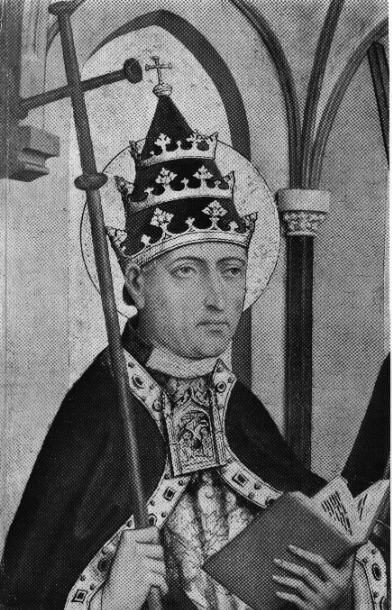

Portrait paintings of
Gregorius II
Den hellige pave Gregor
II (669 - 731)
Minnedag:
11. februar
Den hellige Gregor II var
i følge LP romer
og født i den velstående familien Savelli som sønn av Marcellus. Han hadde
tjent Kirken lenge, for han var blitt oppdratt i Lateranet, og som subdiakon
var han forvalter av statskassen. Deretter var han bibliotekar under Sergius I. Som
diakon ledsaget han Konstantin til Konstantinopel i 710-11, og spilte en
ledende rolle i forhandlingene med keiser Justinian II (685-95; 705-11) om de
anti-romerske vedtakene fra Trullanum-synoden i 692, og ble der kjent med
metodene i den østlige kirkepolitikken.
Etter at Konstantin døde
den 9. april 715, ble Gregor II valgt til ny pave og konsekrert den 19. mai.
Etter sju orientalske paver var det igjen en romer på Romas bispestol. Han
skulle vise seg som den mest fremtredende pave på 700-tallet.
Gregors pontifikat
innleder pavedømmets middelalder. I begynnelsen av 700-tallet lå det dystre
skygger over den kristne middelhavsverdenen. Mens Afrika og Spania ble overrent
av den andre arabiske erobringsbølgen, var Konstantinopel et helt år - fra
august 717 til august 718 - under uopphørlige angrep fra araberne. Likevel
kunne keiser Leo III Isaureren (717-41), en dyktig feltherre og østrikets
redningsmann, ved heltemodig forsvarskamp stoppe angrepene fra kristendommens
fiender mot Bosporus og dermed redde Øst-Europa fra islamsk erobring. Leo III
ble grunnleggeren av det isauriske dynasti. Han var en tøff soldat fra det
isauriske (syriske) høylandet, men også en tøff skattinnkrever. Hans krav
skapte særlig misnøye i Italia, hvor den beskjedne beskyttelsen som ble tilbudt
av de keiserlige styrkene, ikke rettferdiggjorde de høye skattene.
Men i vest var keiseren
maktesløs. Her ble det den handlekraftige frankiske hushovmester (major
domus) Karl Martell som reddet vest- og sentraleuropa ved sin seier over
de arabiske erobrerne ved Poitiers i 732. (Hushovmestrene var opprinnelig
forvaltere av kongsgodset, men etter hvert ble de delrikenes ledende størrelser
som en slags pseudo-arvelige førsteministre og de facto herskere; i
oversettelser gjerne omtalt som fyrster eller hertuger.)
Pavene var stadig lojale
mot det bysantinske keiserdømme. Av de 13 romerske biskopene mellom 678 og 752
var 11 sicilianere, grekere og syrere av fødsel, de tilhørte altså den
gresk-bysantinske kulturverdenen. Bare to, Benedikt II og Gregor II, var
romere. Den intelligente, statsmannsaktige og resolutte Gregor viste politisk
dyktighet i håndteringen av den forvirrede situasjonen som oppsto i Italia da
den bysantinske makten ble svekket.
Det lyktes den store
langobardkongen Liutprand (712-44) å knekke de alt for selvstendige og
selvrådige hertugene av Spoleto og Benevento. Han annekterte også mer
landområde fra Bysants ved å utnytte den misnøyen med keiseren som rådet blant
befolkningen i eksarkatet. I 716 overtalte Gregor ham til å levere tilbake
verdifulle pavelige eiendommer han hadde holdt i De kottiske Alper, men senere
sikret han seg at langobardene leverte tilbake nøkkelfestningene i Cumae og
Sutri til keiserriket.
Selv om Gregor var en
lojal undersått av keiseren, ledet han mellom 717 og 726 den forbitrede
motstanden i hele Italia mot tyngende skatter som keiser Leo III skrev ut for å
finansiere krigen mot araberne. De kirkelige landområdene i Italia og på
Sicilia ble også rammet. Resultatet ble at myndighetene, etter hvert frustrerte
av Gregors popularitet, la planer for å få ham enten avsatt eller drept.
Gregor kjempet for å
demme opp for langobardenes ekspansjonsplaner. Eksarken Paulos ble myrdet
(726/27), men hans etterfølger Eutykios inngikk en uventet og midlertidig
allianse med langobardkongen Liutprand. Da de i 729 beleiret Roma, avla Gregor
et dramatisk besøk i den langobardiske leiren. Det gjorde så sterkt inntrykk på
den katolske Liutprand at han ikke bare oppga beleiringen, men la også sine
kongelige insignier på St. Peters grav som tegn på underkastelse. Selv om
Eutykios inntok Roma, kom paven frem til en avtale med ham, og som alltid lojal
mot imperiet, hjalp han Eutykios med å knuse Tiberius Petasius, en opprørsk
tronpretendent.
Men de dypeste
motsetningene i Gregor IIs pontifikat var på det teologiske plan og kom til
syne i den såkalte billedstriden. Særlig i den greske kirken var hellige bilder
høyt elsket, og munkevesenet fremmet også skikken med å ære dem. Men det oppsto
også overdrivelser og misbruk, og dette gjorde at det i den greske kirken
oppsto et innflytelsesrikt billedfiendtlig parti rundt biskop Konstantin av
Nakoleia i Frygia. De vant nå innflytelse over keiser Leo.
Men også andre faktorer
spilte inn, for eksempel ulike sekters fordømmelse av det å ære bilder. Det
gamle Testamentet og dermed jødene hadde en avvisende holdning til bilder, og
islam var svært billedfiendtlig. Et edikt som ble utgitt av kalif Jezid II i
723, godtok ikke bilder i kristne kirker i de områdene som var underlagt ham.
Så et forbud mot bilder var delvis motivert i troen på at de var en hindring
for konversjonen av jøder og muslimer. Men et slikt forbud var fremmed for den
kristne tradisjon, og fremprovoserte de myndige skriftene til den store østlige
kirkelærer Johannes
Damascene (av Damaskus).
Det er uklart hva som var
keiser Leo IIIs egentlige mål, men de var høyst sannsynlig politiske. I 726
offentliggjorde han det første billedforbud, det vil si forbud mot å ære
hellige bilder (venerasjon), og ga ordre om at et høyt æret Kristusikon i
Konstantinopel skulle ødelegges. En storm av protester gikk over landet mot
denne ikonoklasmen (gr: eikon = bilde; klaein = å
ødelegge), og en del av hæren gjorde opprør og satte opp en motkeiser. Men det
lyktes keiser Leo å slå ned oppstanden i et blodbad den 28. april 727.
Nå ville keiseren også
vinne patriark Germanos av Konstantinopel og pave Gregor II for sitt syn. Men
begge talte mot billedforbudet, og Germanos ble avsatt. Paven støttet
patriarken og truet hans tronrøver av en etterfølger. Det keiserlige dekretet
som forbød bilder, nådde Italia i 727. I den forbindelse holdt Gregor en synode
i Roma, og den stadfestet Kirkens tradisjonelle lære. Mellom 726 og 730
korresponderte keiseren med paven og ba om hans støtte, etter hvert fulgt av
trusselen om avsettelse. Gregors to svarbrev (nå akseptert som i hovedsak
autentiske) er bevart. Paven var ubøyelig og avviste ikonoklasmen som kjetteri.
Han skrev advarende til keiser Leo at dogmer ikke var en sak for prinser, men
for prester (de to sfærene utfylte hverandre, men var forskjellige). Han møtte
keiserens trusler med den modige påminnelse at straks han var tre mil fra Roma,
var paven trygg, siden hele vesten aktet og æret Peters etterfølger.
Men keiseren ga ikke opp
sin politikk. Han fornyet billedforbudet i skjerpet form i et edikt av 17.
januar 730. Det var signert av den nye og mer føyelige østlige patriarken. Den
religiøse bruk av bilder, statuer og relikvier ble erklært gudsbespottelige. Nå
raste det snart en storm av ødeleggelse over landet, hvor ikke bare bildene,
men også mange av deres modige forsvarere, falt som ofre.
Ediktet var uakseptabelt
for Roma, og førte til forferdelse og opprør, blant annet i Nord-Italia. Ikke
mindre enn fem ganger reiste de italienske troppene seg i denne perioden sammen
med befolkningen for å beskytte paven mot utsendingene fra Konstantinopel som
skulle arrestere ham. Leo sendte en flåte for å gripe paven, men en storm ødela
den. Keiseren besatte eiendommene som tilhørte Patrimonium Petri i
Sicilia og Calabria.
Bruddet mellom Bysants og
Roma ble stadig tydeligere, og keiserens fiendtlighet mot hellige bilder bidro
bare til å fjerne hans italienske undersåtter mer og mer fra imperiet. Noen
ville sette opp en italiensk motkeiser, men dette ble forhindret av Gregor, som
aldri vaklet i sin lojalitet mot Bysants. Han skjønte også at Italia alene var
for svakt, og passet seg også for å støtte seg for ensidig på langobardene. Han
forsto at deres mål var herredømme over hele Italia, og for pavene etter Gregor I betydde
det faren for å ende som utelukkende en langobardisk biskop. Det var mye større
trussel enn den fra keiserne i det fjerne Konstantinopel.
Samtidig ble pavedømmet
stadig mer knyttet til den germansk-frankiske verden. Våren 718 kom den
angelsaksiske misjonæren Winfrid (680-754)
fra England til Roma for å besøke St. Peters grav. Gregor ga ham den 15. mai
719 et brev med det offisielle misjonsoppdraget å forkynne kristendommen i
pavens navn for friserne og sakserne. Samtidig ga paven Winfrid navnet Bonifatius,
etter martyren som den romerske kirken hadde feiret dagen før.
Tre år senere kom
Bonifatius for andre gang til Roma, og etter suksessen for hans arbeid i
Bayern, Thüringen og Hessen, konsekrerte Gregor ham til misjonsbiskop den 30.
november 722. Han utstyrte ham med et introduksjonsbrev til Karl Martell
(716-41), frankernes reelle hersker, som kunne gi Bonifatius beskyttelse og
gjøre ham i stand til å fortsette sitt arbeid med suksess. Paven påla
Bonifatius en ed som bandt ham direkte til Roma, og Gregor ga ham nå full
støtte og korresponderte regelmessig med ham. Som et resultat av pavens
innflytelse ble de romerske liturgiske skikkene overalt adoptert av den unge
germanske kirken.
I 716 mottok paven den
bayerske hertug Theodo som pilegrim i Roma og han sendte 16. mai 716 en legat
til Bayern. Sammen med Theodo utarbeidet han et forslag til en plan for
opprettelsen av en kirkeprovins i hans land. Planen skulle bli gjennomført 20
år senere.
I 726 trådte den
abdiserte kong Ine av Wessex inn i et romersk kloster. Etter senere
opplysninger grunnla Gregor Schola Saxonum i Roma. Som et
forsvarstiltak startet Gregor sitt pontifikat med å reparere bymurene. Han
utførte også reparasjoner etter ødeleggelsene som var skapt av den oversvømte
Tiberen, og han utførte omfattende restaurering i mange kirker.
Gregor støttet aktivt
munkevesenet, gjenoppbygde klostre og fylte dem med nye munker. Han gjorde om
sitt eget familiegods til et kloster viet Sta Agatha. Han ga i 720 abbed
Petronax av Brescia i oppdrag å gjenoppbygge Monte Cassino, som langobardene
hadde lagt i ruiner rundt 580.
Gregor var også en
liturgisk fornyer som blant annet innførte en messe for torsdager i fasten.
Gregor II døde den 11.
februar 731 og ble gravlagt i Peterskirken. Før sin død planla han et besøk i
nord som det viste seg at han ikke var i stand til å gjennomføre. Tegn på hans
kult opptrer først i Ados martyrologium fra 800-tallet. Hans minnedag er 11.
februar.
Paverekken - Kildehenvisninger -
Kompilasjon og oversettelse: p. Per Einar Odden -
Sist oppdatert: 1998-02-05 13:35
SOURCE : https://www.katolsk.no/biografier/historisk/gregor2
M. Louis Guérard. « Les
lettres de Grégoire II à Léon l'Isaurien », Mélanges
de l'école française de Rome Année 1890 10 pp.
44-60 : https://www.persee.fr/doc/mefr_0223-4874_1890_num_10_1_6627
Saint Grégoire II, 89e pape, de 715 à 731 : http://www.radio-silence.org/Sons/2014/LSM/pdf/lsm20140211.pdf