
Croire dans la Trinité, Dieu un, vrai et bon
Jean-Michel
Castaing | 14 juin 2019
Dieu est à la fois un,
vrai et bon. Les croyants sont unanimes à Lui reconnaître ces trois attributs.
Or comme le Dieu des chrétiens est Trinité, ces trois caractéristiques
peuvent-elles nous éclairer au sujet du mystère du Dieu unique en trois
personnes ?
La théologie a toujours
pensé à approprier chacun de ces attributs majeurs : l’Un, le Vrai et le Bon, à
une personne particulière de la Trinité. Cela n’est pas contradictoire avec
l’égalité du Père, du Fils et de l’Esprit saint. D’autant plus que la convertibilité
de ces trois qualités les unes dans les autres, c’est-à-dire l’impossibilité de
penser l’une sans les deux autres, reste un excellent moyen de saisir l’unité
du Dieu trinitaire. Aucune des trois personnes divines n’est en effet pensable
sans les deux autres.
L’Un et le Vrai
Sur quel fondement
s’appuie cette appropriation ? La qualité de l’Un est référée au Père parce
qu’il est la source de l’unité de la Trinité, son principe sans principe
(antérieur à lui). En tant qu’origine de la Trinité, le Père est
essentiellement Un. Le Père est également cause première du monde. Ainsi, c’est
par lui que le monde est un, de la même manière que l’espèce humaine est une.
La fraternité universelle a son fondement dans L’Un approprié au Père.
Le Vrai est référé au
Fils parce que le Vrai est l’expression de l’Être, ce que celui-ci dit de
lui-même. Or le Fils est le Verbe de Dieu, son expression. De plus, il est le
modèle de la Création : à ce titre aussi il est le Vrai. Le Vrai est l’être en
tant que connaissable : nous connaissons Dieu par le Fils, surtout depuis son Incarnation.
Le Vrai est toujours l’image parfaite de l’être, comme le Fils est l’image
parfaite du Père. Le Père étant cause première du monde, le Fils en est la
cause exemplaire, à savoir ce qui sert de modèle à la Création. À ce titre,
nous sommes appelés à reproduire les traits du Fils unique, appelés à la
filiation divine, à devenir fils de Dieu.
Le Bien, don de Dieu
Enfin le Bien est référé
à l’Esprit saint. Le Bien, c’est l’être en tant qu’il se communique. Or
l’Esprit est suprêmement Dieu en tant qu’il est donné. Il est le Don de Dieu.
En lui, être divin et grâce, divinité et don, coïncident. L’Esprit, procédant
du Père et du Fils, est le Don que chacune des deux premières Personnes de la
Trinité fait à l’autre. Il est leur échange d’amour, leur communion éternelle.
L’Esprit saint constitue
également le fruit de l’amour du Père et du Fils, la fécondité, faite Personne
divine, de cet amour divin. À ce titre il représente l’excès de Dieu, sa
surabondance. L’Esprit, c’est Dieu qui sort à l’extérieur de Lui-même pour se
donner au monde puisque « Dieu est amour » (1
Jn 4,8). L ’Amour étant don, l’Esprit représente la personnification
de ce don. L’Esprit est Dieu en tant qu’il se communique aussi bien à
l’intérieur de la Trinité qu’à l’« extérieur » d’elle, à la Création.
L’Esprit porte la touche
finale à la Création
L’Esprit constitue ainsi
la cause finale du monde, ce en vue de quoi Dieu a « lancé » la Création. Il la
parachève en effet en sainteté et en beauté. En Lui, le monde sera transfiguré
quand il passera en Dieu à la fin des temps.
L’économie du salut
souligne la causalité finale appropriée à l’Esprit parce que sa mission à
l’égard des croyants arrive après celle de Jésus : il leur est donné après que
celui-ci est remonté au ciel. Pour saint Thomas d’Aquin, la raison des missions
des personnes divines découle de l’ordre de leur procession au sein de la
Trinité éternelle. L’Esprit, occupant la troisième place dans l’ordre
trinitaire éternel, et, de plus, étant la seule Personne divine à procéder des
deux autres, il lui incombe de « terminer le travail » de Création en
la parachevant, en la transfigurant.
La Création, une œuvre de
la Trinité
Si les trois personnes
divines sont unes quant à la nature divine comme sur le plan de leurs
actions ad extra, c’est-à-dire touchant les réalités créées, existe-t-il
néanmoins une « division du travail » entre elles pour ce qui touche
la création du monde ? Avant de répondre à cette question, il n’est pas
inutile de rappeler qu’en Dieu, toutes les opérations ad extra sont
indivisiblement opérations des trois personnes. C’est le Dieu-Trinité tout
entier qui crée le monde : Père, Fils et Esprit sont tous les Trois engagés
dans cette opération. La tradition cependant approprie certains aspects de la
Création à une personne divine en particulier. C’est ainsi que la Création est
issue du Père par efficience, du Fils par Sagesse, et de l’Esprit par
sanctification.
Au Père est dévolue
l’éternité et l’unité de la divinité. Le Fils en manifeste la beauté et le
resplendissement. À l’Esprit sont attribués l’harmonie et le Bien divins.
Ainsi, dans la Création, la puissance qui s’y manifeste est référée au Père, la
Sagesse au Fils, et la bonté, la sanctification dynamique (la Création étant un
chemin de sanctification pour les hommes, ainsi que de pardon) à l’Esprit.
Ainsi, les trois
attributs divins de l’unité, de vérité et de bonté peuvent nous éclairer au
sujet du mystère trinitaire, même s’il ne faut pas oublier que les trois
Personnes, Père, Fils et Esprit saint, portent chacune l’unité, la vérité et la
bonté de Dieu !
SOURCE : https://fr.aleteia.org/2019/06/14/croire-dans-la-trinite-dieu-un-vrai-et-bon/
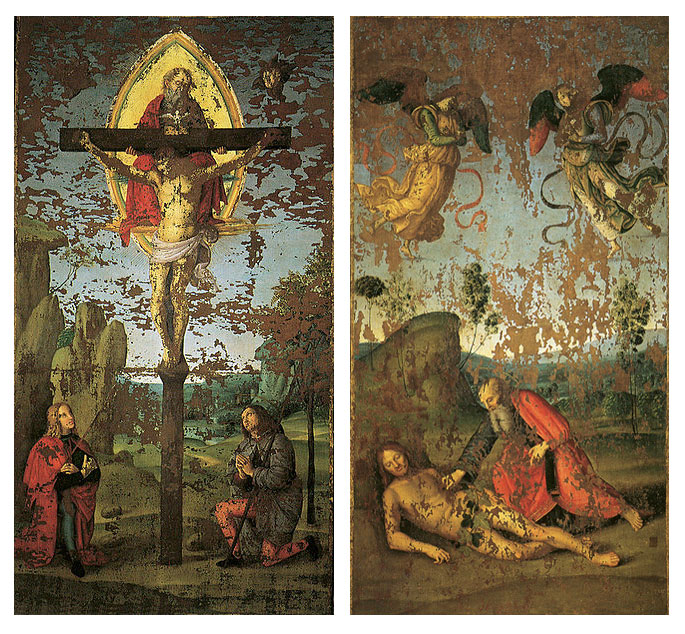
Attribué
à Raphaël, Le Stendardo della Santissima
Trinità (en français : Étendard de la Très Sainte Trinité),
bannière
de procession, un gonfalon, 1499-1500, 167 x 94, (sur le recto est peint
la Crucifixion surmontée
d'un trône de grâce avec les saints Roch et Sébastien ; sur le verso, la Création d'Ève).Pinacoteca Comunale, Città di Castello (Ombrie).
Prier la Trinité, mission
impossible ?
Jules
Germain | 25 mars 2019
La Trinité est un des
plus grands mystères du christianisme. De grands saints ont pu y voir la source
de toute vie de prière, contemplant l’Amour du Père et du Fils dans la
puissance de l’Esprit saint. C’est pourtant un mystère obscur pour beaucoup de
chrétiens. Aleteia vous explique comment il est possible d’ancrer réellement
notre vie dans ce splendide mystère.
La Trinité, un concept
abstrait ? Le terme ne se trouve pas dans la Bible. C’est un mot qui a été
utilisé après la rédaction du Nouveau Testament pour décrire les relations
entre Jésus Christ, Dieu le Père et le Saint-Esprit. Cela peut expliquer qu’il
représente pour de nombreux chrétiens une dimension plus obscure de la foi.
C’est pourtant l’un des mystères fondamentaux du christianisme et un de ses
grands points de divergence avec un monothéisme tel que l’islam.
Quand nous prions, il
paraît a priori plus facile de s’adresser « au Père, au Fils ou à l’Esprit
saint parce que nous en avons des représentations : le Père est le créateur
tout-puissant, nous voyons le Fils en l’homme, Jésus, l’Esprit est le don que
le Fils nous offre en quittant cette vie », explique Gaëlle de Frais, auteur
d’un livre passionnant sur le sujet, Au commencement la Trinité.
Cependant, confie-t-elle
à Aleteia, « ces représentations sont toujours restrictives ; elles limitent
Dieu selon nos concepts humains. En effet, nous prions l’Esprit, en oubliant
qu’il est l’Esprit du Père et du Fils, qu’il est la relation d’amour qui unit
le Père et le Fils ; nous prions le Fils, nous le représentant en son
Incarnation, oubliant qu’Il est Dieu de toute éternité, Dieu de Dieu, Dieu
descendu parmi nous pour nous conduire au Père ; et nous prions Notre Père en
oubliant que c’est le Fils, avec lequel Il n’est qu’Un, qui nous ouvre à cette
intimité et que nous ne sommes Fils du Père que par notre baptême au Nom du
Père, du Fils et du Saint-Esprit ».
Dieu est amour, Dieu est
Trinité, deux formules qui disent la même chose !
Pour comprendre la beauté
du mystère trinitaire, il est nécessaire de voir le lien fondamental entre «
Dieu est Amour », cette parole qui ne se trouve que dans la Bible chrétienne,
et le dogme trinitaire, lui aussi propre au christianisme. En effet, c’est
parce que Dieu est Amour que l’Amour du Père engendre le Fils, « Dieu né de
Dieu, Lumière née de la Lumière » et que cet amour infini qui lie le Père et le
Fils est précisément l’Esprit saint. Notre Dieu trinitaire est donc
intrinsèquement un Dieu en relation, un Dieu ouvert sur l’autre en son être
même.
La première chose à faire
pour percevoir ce mystère est, selon Gaëlle de Frais, d’« entrer en
contemplation : contempler Dieu qui n’est pleinement amour que parce qu’il est
trois, contempler les relations d’amour de ces trois Personnes tant unies
qu’elles n’en font qu’une, contempler chaque Personne dans son rapport aux deux
autres, puis ne pas oublier que notre prière atteint toujours Dieu-Trinité,
même si nous choisissons de nous adresser plus spécifiquement à l’une des
Personnes. Dieu est indivisible ! »
Prier avec la Trinité :
et si je commençais dès ce soir ?
Prier la Trinité, ce
n’est pas mission impossible, et c’est même une des grandes missions des
chrétiens. Contempler ce grand mystère, illuminant nos vies de l’amour
resplendissant du Père pour le Fils, c’est une nécessité pour vivre pleinement
les grâces de notre baptême. C’est aussi se rapprocher du Ciel, de la Gloire de
Dieu et de la vision béatifique qui nous y attend. Puisqu’il s’agit là encore,
selon Gaëlle de Frais, « de rejoindre, non pas le Père, le Fils ou l’Esprit,
mais Dieu en son Amour Trinitaire. »
Pour contempler ce
mystère et en nourrir notre prière, rien de tel que la prière d’une grande
sainte éblouie par ce qu’elle avait pu en recevoir, Élisabeth de la Trinité :
« Ô mon Dieu,
Trinité que j’adore »
Ô mon Dieu, Trinité que
j’adore, aidez-moi à m’oublier entièrement pour m’établir en vous, immobile et
paisible comme si déjà mon âme était dans l’éternité. Que rien ne puisse
troubler ma paix, ni me faire sortir de vous, ô mon Immuable, mais que chaque
minute m’emporte plus loin dans la profondeur de votre Mystère. Pacifiez mon
âme, faites-en votre ciel, votre demeure aimée et le lieu de votre repos. Que
je ne vous y laisse jamais seul, mais que je sois là tout entière, tout
éveillée en ma foi, tout adorante, toute livrée à votre Action créatrice.
Ô mon Christ aimé
crucifié par amour, je voudrais être une épouse pour votre Cœur, je voudrais
vous couvrir de gloire, je voudrais vous aimer… jusqu’à en mourir ! Mais je sens
mon impuissance et je vous demande de me « revêtir de vous même », d’identifier
mon âme à tous les mouvements de votre âme, de me submerger, de m’envahir, de
vous substituer à moi, afin que ma vie ne soit qu’un rayonnement de votre Vie.
Venez en moi comme Adorateur, comme Réparateur et comme Sauveur.
Ô Verbe éternel, Parole
de mon Dieu, je veux passer ma vie à vous écouter, je veux me faire tout
enseignable, afin d’apprendre tout de vous. Puis, à travers toutes les nuits,
tous les vides, toutes les impuissances, je veux vous fixer toujours et
demeurer sous votre grande lumière; ô mon Astre aimé, fascinez-moi pour que je
ne puisse plus sortir de votre rayonnement.
Ô Feu consumant, Esprit
d’amour, « survenez en moi » afin qu’il se fasse en mon âme comme une
incarnation du Verbe : que je Lui sois une humanité de surcroît en laquelle Il
renouvelle tout son Mystère. Et vous, ô Père, penchez-vous vers votre pauvre
petite créature, « couvrez-la de votre ombre », ne voyez en elle que le «
Bien-Aimé en lequel vous avez mis toutes vos complaisances ».
Ô mes Trois, mon Tout, ma
Béatitude, Solitude infinie, Immensité où je me perds, je me livre à vous comme
une proie. Ensevelissez-vous en moi pour que je m’ensevelisse en vous, en
attendant d’aller contempler en votre lumière l’abîme de vos grandeurs. »
Amen
© Cerf Patrimoines
Au
commencement, la Trinité, de Gaëlle de Frias, Les Éditions du cerf, octobre
2018, 416 p., 24 euros
SOURCE : https://fr.aleteia.org/2019/03/25/prier-la-trinite-mission-impossible/

I. " Au nom du Père et du Fils et du Saint Esprit "
232 Les chrétiens sont baptisés " au nom du Père et du Fils et du Saint-Esprit " (Mt 28, 19). Auparavant ils répondent " Je crois " à la triple interrogation qui leur
demande de confesser leur foi au Père, au Fils et à l’Esprit : " La foi de tous les chrétiens repose sur la Trinité " (S. Césaire d’Arles, symb. : CCL 103, 48).
233 Les chrétiens sont baptisés " au nom " du Père et du Fils et
du Saint-Esprit et
non pas " aux noms " de ceux-ci (cf. Profession de foi du pape Vigile en 552 : DS 415) car il n’y a qu’un seul Dieu, le Père tout puissant et son Fils unique et l’Esprit Saint : la Très Sainte Trinité.
234 Le mystère de la Très Sainte Trinité est le mystère central de la foi et de la vie chrétienne. Il est le mystère de Dieu en Lui-même. Il est donc la source de tous les autres mystères de la foi ; il est la lumière qui les illumine. Il est l’enseignement le plus fondamental et essentiel dans la " hiérarchie des vérités de foi " (DCG 43). " Toute l’histoire du salut n’est autre que l’histoire de la voie et des moyens par lesquels le Dieu vrai et unique, Père, Fils et Saint-Esprit, se révèle, se réconcilie et s’unit les hommes qui se détournent du péché " (DCG 47).
235 Dans ce paragraphe, il sera exposé brièvement de quelle manière est révélé le mystère de la Bienheureuse Trinité (I), comment l’Église a formulé la doctrine de la foi sur ce mystère (II), et enfin, comment, par les missions divines du Fils et de l’Esprit Saint, Dieu le Père réalise son " dessein bienveillant " de création, de rédemption et de sanctification (III).
236 Les Pères de l’Église distinguent entre la Theologia et l’Oikonomia, désignant par le premier terme le mystère de la vie intime du Dieu-Trinité, par
le second toutes
les œuvres de Dieu par lesquelles Il Se révèle et communique Sa vie. C’est par l’Oikonomia que nous est révélée la Theologia ; mais inversement, c’est la Theologia qui éclaire toute l’Oikonomia. Les œuvres de Dieu révèlent qui Il est en Lui-même ; et inversement, le mystère de Son Être intime illumine l’intelligence de toutes Ses œuvres. Il en est ainsi, analogiquement, entre les personnes humaines. La personne se montre dans son agir, et mieux nous connaissons une personne, mieux nous comprenons son agir.
237 La Trinité est un mystère de foi au sens strict, un des " mystères cachés en Dieu, qui ne peuvent être connus s’ils ne sont révélés d’en haut " (Cc. Vatican I : DS 3015). Dieu certes a laissé des traces de son être trinitaire dans son œuvre de Création et dans sa Révélation au cours de l’Ancien Testament. Mais l’intimité de Son Être comme Trinité Sainte constitue un mystère inaccessible à la seule raison et même à la foi d’Israël avant l’Incarnation du Fils de Dieu et la mission du Saint Esprit .
II. La révélation de Dieu comme Trinité
238 L’invocation de Dieu comme " Père " est connue dans beaucoup de religions. La divinité est souvent considérée comme " père des dieux et des hommes ". En Israël, Dieu est appelé Père en tant que Créateur du monde (cf. Dt 32, 6 ; Ml 2, 10). Dieu est Père plus encore en raison de l’alliance et du don de la Loi à Israël son " fils premier-né " (Ex 4, 22). Il est aussi appelé Père du roi d’Israël (cf. 2 S 7, 14). Il est tout spécialement " le Père des pauvres ", de l’orphelin et de la veuve qui sont sous sa protection aimante (cf. Ps 68, 6).
239 En désignant Dieu du nom de " Père ", le langage de la foi indique principalement deux aspects : que Dieu est origine première de tout et autorité transcendante et qu’il est en même temps bonté et sollicitude aimante pour tous ses enfants. Cette tendresse parentale de Dieu peut aussi être exprimée par
l’image de
la maternité (cf. Is 66, 13 ; Ps 131, 2) qui indique davantage l’immanence de Dieu, l’intimité entre Dieu et Sa créature. Le langage de la foi puise ainsi dans l’expérience humaine des parents qui sont d’une certaine façon les premiers représentants de Dieu pour l’homme. Mais cette expérience dit aussi que les parents humains sont faillibles et
qu’ils peuvent défigurer le visage de la paternité et de la maternité. Il convient alors de rappeler que Dieu transcende la distinction humaine des sexes. Il n’est ni homme, ni femme, il est Dieu. Il transcende aussi la paternité et la maternité humaines (cf. Ps 27, 10), tout en en étant l’origine et la mesure (cf. Ep 3, 14 ; Is 49, 15) : Personne n’est père comme l’est Dieu.
240 Jésus a révélé que Dieu est " Père " dans un sens inouï : Il ne l’est pas seulement en tant
que Créateur, Il
est éternellement Père en relation à son Fils unique, qui éternellement n’est Fils qu’en relation au Père : " Nul ne connaît le Fils si ce n’est le Père, comme nul ne connaît le Père si ce n’est le Fils et celui à qui le
Fils veut bien Le révéler "
(Mt 11, 27).
241 C’est pourquoi les apôtres confessent Jésus comme " le Verbe qui était au commencement auprès de Dieu et qui est Dieu " (Jn 1, 1), comme " l’image du Dieu invisible " (Col 1, 15), comme " le resplendissement de
sa gloire et
l’effigie de
sa substance "
(He 1, 3).
242 A leur suite, suivant la tradition apostolique, l’Église a confessé en 325 au premier Concile œcuménique de Nicée que le Fils est " consubstantiel " au Père, c’est-à-dire un seul Dieu avec lui. Le deuxième Concile œcuménique, réuni à Constantinople en 381, a gardé cette expression dans sa formulation du Credo de Nicée et a confessé " le Fils unique de Dieu, engendré du Père avant tous les siècles, lumière de lumière, vrai Dieu du vrai Dieu, engendré non pas créé, consubstantiel au Père " (DS 150).
Le Père et le Fils révélés par l’Esprit
243 Avant sa Pâque, Jésus annonce l’envoi d’un " autre Paraclet " (Défenseur), l’Esprit Saint. A l’œuvre depuis la création (cf. Gn 1, 2), ayant jadis " parlé par les prophètes " (Symbole de Nicée-Constantinople), il sera maintenant auprès des disciples et
en eux (cf. Jn 14, 17), pour les enseigner (cf. Jn 14, 26) et les conduire " vers la vérité tout entière " (Jn 16, 13). L’Esprit Saint est ainsi révélé comme une autre personne divine par rapport à Jésus et au Père.
244 L’origine éternelle de l’Esprit se révèle dans sa mission temporelle. L’Esprit Saint est envoyé aux apôtres et à l’Église aussi bien par le Père au nom du Fils, que par le Fils en personne, une
fois retourné auprès du Père (cf. Jn 14, 26 ; 15, 26 ; 16, 14). L’envoi de
la personne de
l’Esprit après
la glorification de Jésus (cf. Jn 7, 39) révèle en plénitude le mystère de la Sainte Trinité.
245 La foi apostolique concernant l’Esprit a été confessée par le deuxième Concile œcuménique en 381 à Constantinople : " Nous croyons dans l’Esprit Saint, qui est Seigneur et qui donne la vie ; il procède du Père " (DS 150). L’Église reconnaît par là le Père comme " la source et l’origine de toute la divinité " (Cc. Tolède VI en 638 : DS 490). L’origine éternelle de l’Esprit Saint n’est cependant pas sans lien avec celle du Fils : " L’Esprit Saint qui
est la Troisième Personne de la Trinité, est Dieu, un et égale au Père et au Fils, de même substance et aussi de même nature. (...) Cependant, on ne dit pas qu’il est
seulement l’Esprit du Père, mais à la fois l’Esprit du Père et du Fils " (Cc. Tolède XI en 675 : DS 527). Le Credo du Concile de Constantinople de l’Église confesse : " Avec le Père et le Fils il reçoit même adoration et même gloire " (DS 150).
246 La tradition latine du Credo confesse que l’Esprit " procède du Père et du Fils (filioque) ". Le Concile de Florence, en 1438, explicite : " Le Saint Esprit tient son essence et son être à la fois du Père et du Fils et
Il procède éternellement de
l’Un comme de l’Autre comme d’un seul Principe et par une seule spiration... Et parce que
tout ce qui est au Père, le Père Lui-même l’a donné à Son Fils unique en L’engendrant, à l’exception de
son être de Père, cette procession même du Saint Esprit à partir du Fils, Il la tient éternellement de son Père qui L’a engendré éternellement " (DS 1300-1301).
247 L’affirmation du filioquene figurait pas
dans le symbole confessé en 381 à Constantinople. Mais sur la base d’une ancienne tradition latine et alexandrine,
le Pape S. Léon l’avait déjà confessée dogmatiquement en 447 (cf. DS 284) avant même que Rome ne connût et
ne reçût, en 451, au Concile de Chalcédoine, le symbole de 381. L’usage de cette formule dans le Credo a été peu à peu admis dans la liturgie latine (entre le VIIIe et
le XIe siècle). L’introduction du filioque dans
le Symbole de Nicée-Constantinople par
la liturgie latine constitue cependant, aujourd’hui encore, un différend avec les Églises orthodoxes.
248 La tradition orientale exprime d’abord le caractère d’origine première du Père par rapport à l’Esprit. En confessant l’Esprit comme " issu du Père " (Jn 15, 26), elle affirme que celui-ci est issu du Père par le Fils (cf. AG 2). La tradition occidentale exprime d’abord la communion consubstantielle entre le Père et le Fils en disant que l’Esprit procède du Père et du Fils (filioque). Elle le dit " de manière légitime et raisonnable " (Cc. Florence en 1439 : DS 1302), car l’ordre éternel des personnes divines dans leur communion consubstantielle implique que le Père soit l’origine première de l’Esprit en tant que " principe sans principe " (DS 1331), mais aussi qu’en tant que Père du Fils unique, Il soit avec Lui " l’unique principe d’où procède l’Esprit Saint " (Cc. Lyon II en 1274 : DS 850). Cette légitime complémentarité, si elle n’est pas durcie,
n’affecte pas
l’identité de
la foi dans la réalité du même mystère confessé.
III. La Sainte Trinité dans la doctrine de la foi
La formation du dogme trinitaire
249 La vérité révélée de la Sainte Trinité a été dès les origines à la racine de la foi vivante de l’Église, principalement au moyen du baptême. Elle trouve son expression dans la règle de la foi baptismale, formulée dans la prédication, la catéchèse et la prière de l’Église. De telles formulations se trouvent déjà dans les écrits apostoliques, ainsi cette salutation, reprise dans la liturgie eucharistique : " La grâce du Seigneur Jésus-Christ, l’amour de Dieu et la communion du Saint-Esprit soient avec vous tous "
(2 Co 13, 13 ; cf. 1 Co 12, 4-6 ; Ep 4, 4-6).
250 Au cours des premiers siècles, l’Église a cherché de formuler plus explicitement sa foi trinitaire tant pour approfondir sa propre intelligence de la foi que pour la défendre contre des erreurs qui la déformaient.
Ce fut l’œuvre des Conciles anciens, aidés par
le travail théologique des Pères de
l’Église et soutenus par
le sens de la foi du peuple chrétien.
251 Pour la formulation du dogme de la Trinité, l’Église a dû développer une terminologie propre à
l’aide de notions d’origine philosophique :
" substance ", " personne " ou " hypostase ", " relation ", etc. Ce faisant, elle n’a pas soumis la foi à une sagesse humaine mais a donné un sens nouveau, inouï à ces termes appelés à signifier désormais aussi un mystère ineffable, " infiniment au-delà de tout ce que nous pouvons concevoir à
la mesure humaine "
(SPF 9).
252 L’Église utilise le terme " substance " (rendu aussi parfois par " essence " ou par " nature ") pour désigner l’être divin dans son unité, le terme " personne " ou " hypostase " pour désigner le Père, le Fils et le Saint-Esprit dans leur distinction réelle entre eux, le terme " relation " pour désigner le fait que leur distinction réside dans la référence des uns aux autres.
253 La Trinité est Une. Nous ne confessons pas trois dieux, mais un seul Dieu en trois personnes : " la Trinité consubstantielle " (Cc. Constantinople II en 553 : DS 421). Les personnes divines ne se partagent pas l’unique divinité mais chacune d’elles est Dieu tout entier : " Le Père est cela même qu’est le Fils, le Fils cela même qu’est le Père, le Père et le Fils cela même qu’est le Saint-Esprit, c’est-à-dire un seul Dieu par nature " (Cc. Tolède XI en 675 : DS 530). " Chacune des trois personnes est cette réalité, c’est-à-dire la substance, l’essence ou la nature divine " (Cc. Latran IV en 1215 : DS 804).
254 Les personnes divines sont réellement distinctes entre elles. " Dieu est unique mais non pas solitaire " (Fides Damasi : DS 71). " Père ", " Fils ",
" Esprit Saint " ne sont pas simplement des noms désignant des modalités de l’être divin, car ils sont réellement distincts entre eux : " Celui qui
est le Fils n’est pas le Père, et celui qui est le Père n’est pas le Fils, ni le Saint-Esprit n’est
celui qui est le Père ou le Fils " (Cc. Tolède XI en 675 : DS 530). Ils sont distincts entre eux par leurs relations d’origine : " C’est le Père qui engendre, le Fils qui est engendré, le Saint-Esprit qui procède " (Cc. Latran IV en 1215 : DS 804). L’Unité divine est Trine.
255 Les personnes divines sont relatives les unes aux autres. Parce qu’elle ne divise pas
l’unité divine,
la distinction réelle des personnes entre
elles réside uniquement dans les relations qui les réfèrent les unes aux autres : " Dans
les noms relatifs des personnes, le Père est référé au Fils, le Fils au Père, le Saint-Esprit aux deux ; quand on parle de
ces trois personnes en considérant les relations,
on croit cependant
en une seule nature ou substance " (Cc. Tolède XI en 675 : DS 528). En effet, " tout est un [en eux] là où l’on
ne rencontre pas
l’opposition de relation "
(Cc. Florence en 1442 : DS 1330). " A cause de cette unité, le Père est tout entier dans le Fils, tout entier dans le Saint-Esprit ; le Fils est tout entier dans le Père, tout entier dans le Saint-Esprit ; le Saint-Esprit tout entier dans le Père, tout entier dans le Fils " (Cc. Florence en 1442 : DS 1331).
256 Aux Catéchumènes de Constantinople, S. Grégoire de Nazianze, que l’on appelle aussi " le Théologien ", confie ce résumé de la foi trinitaire :
Avant toutes choses, gardez-moi ce bon dépôt, pour lequel je vis et je combats, avec lequel je veux mourir, qui me fait supporter tous les maux et mépriser tous les plaisirs : je veux dire la profession de foi en le Père et le Fils et le Saint-Esprit. Je vous la confie aujourd’hui. C’est par elle que je vais tout à l’heure vous plonger dans
l’eau et vous en élever. Je
vous la donne pour compagne et patronne de toute votre vie. Je vous donne une seule Divinité et Puissance, existant Une dans les Trois, et contenant les Trois d’une manière distincte. Divinité sans disparate de substance ou de nature, sans degré supérieur qui élève ou degré inférieur qui abaisse. (...) C’est de trois infinis l’infinie connaturalité. Dieu tout entier chacun considéré en soi-même (...), Dieu les Trois considérés ensemble (...).
Je n’ai pas commencé de penser à l’Unité que la Trinité me baigne dans
sa splendeur. Je
n’ai pas commencé de penser à la Trinité que l’unité me ressaisit ...
(or. 40, 41 : PG 36, 417).
IV. Les œuvres divines et les missions trinitaires
257 " O Trinité lumière bienheureuse, O primordiale unité " (LH, hymne " O lux beata Trinitas " de vêpres) ! Dieu est éternelle béatitude, vie immortelle, lumière sans déclin. Dieu est
amour : Père, Fils et Esprit Saint. Librement Dieu veut communiquer la gloire de sa vie bienheureuse. Tel est le " dessein bienveillant " (Ep 1, 9) qu’il a conçu dès avant la création du monde en son Fils bien-aimé, " nous prédestinant à
l’adoption filiale en celui-ci "
(Ep 1, 4-5), c’est-à-dire " à reproduire l’image de
Son Fils " (Rm 8, 29) grâce à " l’Esprit d’adoption filiale " (Rm 8, 15). Ce dessein est une " grâce donnée avant tous les siècles " (2 Tm 1, 9-10), issue immédiatement de l’amour trinitaire. Il se déploie dans l’œuvre de la création, dans toute l’histoire du salut après la chute, dans les missions du Fils et de l’Esprit, que prolonge la mission de l’Église (cf. AG 2-9).
258 Toute l’économie divine est l’œuvre commune des trois personnes divines. Car de même qu’elle n’a qu’une seule et même nature, la Trinité n’a qu’une seule et même opération (cf. Cc Constantinople II en 553 : DS 421). " Le Père, le Fils et le Saint-Esprit ne sont pas trois principes des créatures mais un seul principe " (Cc. Florence en 1442 : DS 1331). Cependant, chaque personne divine opère l’œuvre commune selon sa propriété personnelle. Ainsi l’Église confesse à la suite du Nouveau Testament (cf. 1 Co 8, 6) : " un Dieu et Père de qui sont toutes
choses, un Seigneur Jésus-Christ pour qui sont toutes choses, un Esprit Saint en
qui sont toutes choses " (Cc. Constantinople II : DS 421). Ce sont surtout les missions divines de l’Incarnation du Fils et du don du Saint-Esprit qui manifestent les propriétés des personnes divines.
259 Œuvre à la fois commune et personnelle, toute l’économie divine fait connaître et la propriété des personnes divines et leur unique nature. Aussi, toute la vie chrétienne est communion avec chacune des personnes divines, sans aucunement les séparer. Celui qui rend gloire au Père le fait par le Fils dans l’Esprit Saint ; celui qui suit le Christ, le fait parce que le Père l’attire (cf. Jn 6, 44) et que l’Esprit le meut (cf. Rm 8, 14).
260 La fin ultime de toute l’économie divine, c’est l’entrée des créatures dans l’unité parfaite de la Bienheureuse Trinité (cf. Jn 17, 21-23). Mais dès maintenant nous
sommes appelés à être habités par la Très Sainte Trinité : " Si quelqu’un m’aime, dit le Seigneur, il gardera ma parole, et
mon Père l’aimera et
nous viendrons à lui, et nous ferons chez
lui notre demeure " (Jn 14, 23) :
O mon Dieu, Trinité que j’adore, aidez-moi à m’oublier entièrement pour
m’établir en
Vous, immobile et paisible comme si déjà mon âme était dans l’éternité ; que rien ne puisse troubler ma paix ni me faire sortir de
Vous, ô mon Immuable, mais que chaque minute m’emporte plus
loin dans la profondeur de votre mystère ! Pacifiez mon âme. Faites-en votre ciel, votre demeure aimée et le lieu de votre repos. Que je ne Vous y laisse jamais seul, mais que je sois là, toute entière,
toute éveillée en ma foi, toute adorante,
toute livrée à votre action créatrice (Prière de la Bienheureuse Élisabeth de la Trinité).
EN BREF
261 Le mystère de la Très Sainte Trinité est le mystère central de la foi et de la vie chrétienne. Dieu seul peut nous en donner la connaissance en
Se révélant comme Père, Fils et Saint-Esprit.
262 L’Incarnation du Fils de Dieu révèle que Dieu est le Père éternel, et que le Fils est consubstantiel au Père, c’est-à-dire qu’il est en lui et avec lui le même Dieu unique.
263 La mission du Saint-Esprit, envoyé par le Père au nom du Fils (cf. Jn 14, 26) et par le Fils " d’auprès du Père " (Jn 15, 26) révèle qu’il
est avec eux le même Dieu unique. " Avec le Père et le Fils il reçoit même adoration et même gloire ".
264 " Le Saint-Esprit procède du Père en tant que source première et, par le don éternel de celui-ci au Fils, du Père et du Fils en communion " (S. Augustin, Trin. 15, 26, 47).
265 Par la grâce du baptême " au nom du Père et du Fils et du Saint-Esprit ", nous sommes appelés à partager la vie de la Bienheureuse Trinité, ici-bas dans l’obscurité de la foi, et au-delà de la mort, dans la lumière éternelle (cf. SPF 9).
266 " La foi catholique consiste en ceci : vénérer un seul Dieu dans la Trinité, et la Trinité dans l’Unité, sans confondre les personnes, sans diviser la substance : car autre est la personne du Père, autre celle du Fils, autre celle de l’Esprit Saint ;
mais du Père, du Fils et de l’Esprit Saint une est la divinité, égale la gloire, coéternelle la majesté "
(Symbolum " Quicumque " (DS 75).
267 Inséparables dans ce qu’elles sont, les personnes divines sont aussi inséparables dans ce qu’elles font. Mais dans l’unique opération divine chacune manifeste ce qui lui est propre dans la Trinité, surtout dans les missions divines de l’Incarnation du Fils et du don du Saint-Esprit.
Catéchisme de l'Église
Catholique
SOURCE : http://www.intratext.com/IXT/FRA0013/_P18.HTM

Our
Lady of the Rosary Shrine at Saint Patrick Church (Merlin, Ontario) - stained
glass, church nave, Symbols of the Persons of the Trinity. An artistic
depiction of the Trinity, with the hand
representing the Father, the Chi Rho and ichthys
representing the Son, and the dove representing the Holy Spirit
La Sainte Trinité
Les chrétiens croient que
Dieu est un en trois personnes : le Père, le Fils et le Saint-Esprit sont,
ensemble, un seul Dieu. C’est le dogme de la Trinité. À première vue, cela peut
paraître irrationnel : comment trois personnes peuvent-elles constituer un
Nº 159
Le dogme de la
Trinité : une vérité de mieux en mieux comprise
Les chrétiens croient que
Dieu est un en trois personnes : le Père, le Fils et le Saint-Esprit sont,
ensemble, un seul Dieu. C’est le dogme de la Trinité. À première vue, cela peut
paraître irrationnel : comment trois personnes peuvent-elles constituer un
seul être divin ? Pourtant, saint Thomas d’Aquin a montré que la
description de Dieu comme Trinité était en fait la plus convaincante pour la
raison. Que l’Église ait toujours défendu cette foi trinitaire, malgré les
oppositions et malgré la difficulté qu’elle pose à l’intelligence, montre que
l’Église transmet fidèlement la révélation divine, et non une doctrine inventée
par l’homme.
Les raisons d'y croire
Le mystère de la Trinité
est discrètement présent tout au long de l’Ancien Testament, mais n’est
vraiment révélé que par Jésus ; or, il serait absurde d’imaginer que des
hommes qui ne croyaient pas explicitement en la Trinité (les Hébreux de
l’Ancien Testament) aient ajouté des passages trinitaires dans leurs textes
sacrés.
Dès le début et tout au
long de l’histoire, le dogme trinitaire a été contesté : juifs, hérétiques
(ariens, modalistes, etc.) et musulmans n’y croient pas ; pour éviter
les persécutions ou pour faciliter les conversions, l’Église aurait eu tout
intérêt à accepter des compromis, mais elle a tenu fermement la foi trinitaire,
ce qui atteste qu’il ne s’agissait pas simplement d’une théorie qu’elle aurait
imaginée elle-même et qu’elle aurait pu nuancer, mais bien du dépôt de la
Révélation apportée par Jésus Christ.
Saint Thomas d’Aquin a
montré que le dogme de la Trinité, bien qu’étant effectivement au-dessus de ce
que la raison peut atteindre par elle-même, n’est pas contraire à la raison, et
qu’il est même le plus recevable pour la raison car, en décrivant en Dieu une
intelligence (le Fils) et une volonté (l’Esprit Saint), il permet de comprendre
que Dieu est le Créateur.
Le dogme de la Trinité,
en disant de Dieu qu’il est amour et relation, se prête moins à justifier
l’exercice d’un pouvoir politique autocratique et tyrannique, mais plutôt à un
partage de l’autorité : là encore, l’Église semblait aller contre son
propre intérêt et contre l’intérêt du pouvoir politique en défendant la foi
trinitaire ; elle a pourtant tenu bon.
En savoir plus
La foi chrétienne est
strictement monothéiste : il n’y a qu’un seul Dieu, et il ne peut y avoir
qu’un seul Dieu. Celui qui est au-delà de tout, le Dieu unique, est absolument
un et indivisible. C’est la seule position rationnelle : on ne peut
concevoir dans le premier principe aucune division, quelle qu’elle soit, car
une telle division impliquerait une forme de détermination, de partage, et donc
rendrait nécessaire un principe encore antérieur qui serait la cause de cette
détermination. C’est ainsi que le monothéisme se distingue radicalement du polythéisme :
il n’y a rien de commun entre le Dieu unique du monothéisme et « les
dieux » des mythologies.
Les Hébreux croyaient en
ce Dieu un et unique. La profession de foi fondamentale d’Israël dit :
« Écoute, Israël : le Seigneur, notre Dieu, le Seigneur [est] un »
( Deutéronome 6,4 ).
Pourtant, tout au long de la Bible hébraïque – l’Ancien Testament –,
à ce Dieu un sont associées les caractéristiques d’une certaine
pluralité : verbes conjugués au pluriel (comme dans « Faisons l’homme
à notre image », Genèse 1,26
) ; Abraham reçoit la visite de trois anges, mais leur parle au
singulier ( Genèse 18 ) ;
et même la profession de foi monothéiste, littéralement, est en même temps
marqué par une forme ternaire ; elle peut être traduite
littéralement : « Le Seigneur, notre Dieu, le Seigneur :
un. » D’où peuvent venir ces marques de pluralité ? Soit les auteurs
sacrés, alors qu’ils cherchent à défendre le monothéisme, ont volontairement
ajouté des indices de pluralité – mais une telle attitude est
incompréhensible –, soit Dieu a donné des indices de sa Trinité
– indices dont les auteurs eux-mêmes ne percevaient pas la portée.
Lorsque Jésus est venu,
il a exprimé avec plus de clarté que Dieu est Trinité : Dieu est le Père,
le Fils qui ne fait qu’un avec le Père (« Mon Père et Moi, nous sommes
un », Jn 10,30 ;
« Je suis dans le Père, et le Père est en moi », Jn 14,11 ), et l’Esprit Saint
(« le défenseur que je vous enverrai d’auprès du Père, lui l’Esprit de
vérité qui procède du Père », Jn 15,26
). Après sa résurrection, il envoie ses apôtres baptiser « au nom du
Père, et du Fils, et du Saint-Esprit » ( Mt 28,19 ). C’est le dogme de
la Trinité.
Dès le début, ce dogme a
été contesté. C’était l’un des points d’achoppement avec les Juifs :
Étienne est lapidé parce qu’il voit « le Fils […] à la droite de
Dieu » ( Ac 7,56 ).
Puis ce furent des hérétiques chrétiens : les modalistes (qui prétendaient
que le Père, le Fils et l’Esprit n’étaient que des modes différents de
manifestation de l’unique personne divine), les ariens (qui prétendaient que le
Fils n’était pas proprement Dieu, mais une créature quasi divine, créée avant
la fondation du monde), etc. À cette époque-là, le dogme de la Trinité
n’avait pas encore reçu de définition très précise de la part de
l’Église : c’est justement face aux hérésies que l’Église a été amenée à
préciser ce en quoi elle croyait. Mais pourquoi avoir défini rigoureusement la
Trinité – trois personnes divines strictement égales étant ensemble le
Dieu unique – au lieu d’opter pour une formule de compromis, qui aurait
ramené la paix entre les factions rivales et qui aurait facilité les
conversions ou le retour à l’Église des hérétiques ? Pourquoi l’Église
défendait-elle une position qui allait contre son intérêt ? La seule
explication crédible est que, dès le début, la foi transmise par les apôtres était
une foi strictement trinitaire. D’où pouvait venir cette foi trinitaire, sinon
de l’enseignement du Christ ? Les apôtres auraient-ils pu inventer un
dogme qui allait les conduire à la persécution ?
À la fin de l’Antiquité
et au début du Moyen Âge, le dogme trinitaire était rejeté au profit de
l’hérésie arienne par la majorité des rois barbares qui commençaient à dominer
dans l’Empire romain d’Occident. L’historien Michel Rouche, dans son livre Clovis
(Fayard, 1996), explique l’enjeu politique qu’il y avait derrière la question
dogmatique : le pouvoir politique, rappelle-t-il, est à l’imitation du
pouvoir divin ; or, si Dieu est communion de trois personnes, le pouvoir
politique doit préférablement être vécu comme une communion de plusieurs,
tandis que si Dieu est monolithique, le pouvoir royal pourra être absolu et
totalitaire. En défendant fermement la foi trinitaire, l’Église allait contre
le pouvoir des rois (notamment des Goths), et suscitait donc de nombreuses
oppositions ; et, en son propre sein, elle empêchait l’émergence d’un
pouvoir central absolu. À l’époque, l’Église semblait aller contre son propre
intérêt. Aujourd’hui, alors que la lutte contre les totalitarismes nous est
devenue familière, on comprend que le dogme trinitaire est largement convenable
sur le plan moral – ce qui est un motif de crédibilité, car il serait au
contraire assez irrationnel qu’un Dieu bon puisse être le fondement moral de la
dictature.
Enfin, au
XIIIe siècle, l’un des plus grands théologiens de tous les temps, saint Thomas
d’Aquin, a montré que la description de Dieu comme Trinité était en fait la
plus rationnelle pour rendre compte de la création du monde. Dans la première
partie de la Somme théologique, il compare Dieu à un architecte : de même
qu’un architecte, pour construire une maison, doit nécessairement avoir en
lui-même une certaine intelligence de son art, qui procède de lui et lui est
inséparable (l’intelligence de l’architecte n’est pas l’architecte lui-même,
mais elle est une avec lui et inséparable de lui), de même « Dieu qui est
le premier principe des choses », c’est-à-dire le Créateur de l’univers,
et qui « est aux choses créées ce que l’architecte est à ses œuvres »,
doit avoir en lui-même une intelligence qui procède de lui « comme terme
intime, sans diversité, par mode intellectuel », ce qui est la façon dont
la théologie latine décrit la relation éternelle du Fils au Père (Ia,
q. 27, art. 1, ad 3um). Et de même que le Fils est
l’intelligence du Père (on dit, en termes théologiques, son
« logos », ou son « verbe »), de même la volonté (l’amour)
du Père et du Fils est l’Esprit Saint. Ainsi se trouve expliquée d’une manière
non pas totale (car l’essence de Dieu demeure un mystère qui dépasse les
capacités de notre raison) mais convaincante, treize siècles après, ce dogme de
la Trinité auquel l’Église était restée inaltérablement fidèle.
Tristan Rivière
Au delà
Parce que Dieu est déjà
en lui-même relation, il peut aussi entrer en relation avec ses
créatures : c’est pourquoi le dogme de la Trinité est le fondement de
l’expérience chrétienne de la prière. La prière chrétienne n’est ni la
soumission purement formelle à un Dieu lointain, ni la dissolution de son
individualité dans un « grand tout » cosmique, mais une relation de
personne à personne avec Dieu. En ce sens, le dogme de la Trinité peut être
expérimenté avant même d’être compris intellectuellement : il est une
vérité pratique et pas seulement une vérité théorique.
Aller plus loin
La vidéo de
Donjojohannes, série « 3 Minute Catechism », ép. 16 : Quelle
est la signification de Dieu qui est Trinité ?
En complément
La vidéo du frère
Paul-Adrien : La Trinité expliquée
en 5 min !
La vidéo du frère
Paul-Adrien, La Trinité .
L’émission de KTO TV, « La Trinité » .
L’article de Maxime
Georgel, « Les
Juifs antiques croyaient-ils en la Trinité ? » , sur le site Par
la foi (parlafoi.fr), 14 août 2017.
L’article de Thomas
Joseph White, « Introduction
à la Trinité » , sur le site Aquinas (iaquinas.com).
Gilles Emery, La Trinité.
Introduction théologique à la doctrine catholique sur Dieu Trinité, coll.
« Initiations », Paris, Éditions du Cerf, 2009.
Gilles Emery, La Théologie
trinitaire de saint Thomas d’Aquin, coll. « Théologies », Paris,
Éditions du Cerf, 2005.

Guercino,
Santissima Trinità, 1642, Santa Maria della Vittoria, Roma. Una replica della
tela è in S. Nicola in Carcere - Roma Campitelli
le
Guerchin, La Sainte Trinité, 1642.
Doctrine de Dieu
Thèse 6 - Théologie
Trinitaire
Le Mystère de la Trinité,
Mystère central de la Foi, source et lumière de tous les autres mystères, se
résume dans l’enseignement johannique : "Dieu est Amour". Par
essence, Dieu est Don de Soi, Autocommunication, Relation, éternel évènement
d’Amour. Ce Mystère est directement celui de notre insertion même dans le
mystère du Christ, et par Lui en Dieu. Le Mystère de la Trinité ouvre
intrinsèquement sur le mystère de notre Salut.
C’est le Nouveau
Testament qui révèle pleinement le dessein salvifique de Dieu le Père, par
Jésus son Fils, dans l’Esprit Saint. Le Père envoie son Fils qui, glorifié,
envoie l’Esprit afin de nous conférer l’adoption filiale que le Fils nous a
obtenu par l’obéissance jusqu’à la Croix. Le Fils ne se contente donc pas de
nous révéler la Paternité de Dieu : en Lui, il nous fait participer de sa filialité.
Pour accomplir sa mission, le Fils est oint par l’Esprit. Revêtue de la
Puissance de l’Esprit, il annonce le Règne des Cieux et en accomplit les
signes. Et cela, jusqu’au signe absolu de la Croix. Glorifié, Il souffle ce
même Esprit sur les apôtres et – communicant l’adoption filiale - fonde
l’Eglise. L’Esprit sanctificateur procède donc du Père et du Fils comme d’un
seul principe, principalement du Père, par le Fils. Au nom du Père, du Fils et
du SE, nous sommes baptisés et sauvés, selon la volonté de Jésus, le Christ
Sauveur.
L’enseignement
conciliaire puis théologique éclaire alors dès les premiers siècles la
formulation de sa foi en Un seul Dieu en Trois Personnes. Nous vénérons ainsi
un seul Dieu dans la Trinité et la Trinité dans l’unité, sans confondre les
personnes, sans diviser la substance. L’unité divine tient du fait que les noms
des 3 personnes ou hypostases expriment des relations : l’opposition de
relation en Dieu est le seul principe de distinction trinitaire ; Si bien que
cette Trinité qui est un seul Dieu n’est pas hors du nombre, n’est pas non plus
enfermée dans le nombre. Ces 3 relations en Dieu sont substantielles. Les
Personnes enfin ne sont pas commutables, l’ordre (taxis) trinitaire étant donné
par les relations d’origine : procession du Fils par le Père, spiration de l’ES
par le Père et le Fils.
Cette pénétration du
Mystère de Dieu est rendu possible par le fait que Dieu est en soi tel qu’Il
s’est révélé à nous. La Trinité qui s’est manifestée dans l’économie du Salut
est la Trinité immanente. La Trinité économique correspond à la Trinité
immanente, qu’elle révèle donc.
La réflexion théologique
n’a dès lors de cesse de creuser le mystère des relations entre les 3 Personnes
qui sont un seul Dieu, cherchant analogie dans le monde créé. Père, Fils et
Esprit sont liés comme la source, le fleuve et le lac (Tertullien) ; comme en
notre esprit la mémoire, l’intelligence et la volonté (Augustin) ; comme
l’aimant, l’aimé et le condilectus aimé ensemble (Richard de St Victor) ; comme
les conjoints et l’enfant (Balthasar). Ces analogies ne sont pas sans cacher
cependant au cœur de la ressemblance qu’elles offrent une majeure dissemblance
(Latran IV), et ne sauraient en rien être absolutisées. Le coquillage de notre
compréhension ne saurait contenir l’océan du Mystère de la Trinité.
Bibliographie essentielle :
- Symbole « Quicumque », dit d’Athanase (V°s)
- Concile de Tolède XI (672-676)
- bulle « Cantate Domino » du Concile de Florence (1442)
Bibliographie
annexe :
- « Théologie, Christologie, Anthropologie » (Document de la C.T.I. , 1982)
- Redemptor Hominis (Jean Paul II, Encyclique, 1979)
- Dives in Misericordia (Jean Paul II, Encyclique, 1980)
- Dominum et Vivificantem (Jean Paul II, Encyclique, 1986)
- Deus Caritas Est (Benoit XVI, Encyclique, 2006)
SOURCE : http://www.theologie.fr/T6.htm

Murillo. The Heavenly and Earthly Trinities,
circa 1677, 293 x 207, National Gallery, Trafalgar
Square in the City of Westminster, in Central London. The
"Heavenly Trinity" joined to the "Earthly
Trinity" through the Incarnation of the Son
The Blessed Trinity
The dogma of the Trinity
The Trinity is the term
employed to signify the central doctrine of the Christian religion — the
truth that in the
unity of the Godhead
there are Three Persons,
the Father, the Son,
and the Holy Spirit,
these Three Persons
being truly distinct one from another.
Thus, in the words of the
Athanasian Creed:
"the Father is God,
the Son is God, and the Holy Spirit is God, and yet there are
not three Gods but
one God." In
this Trinity of Persons
the Son is begotten
of the Father by an eternal
generation, and the Holy
Spirit proceeds by an eternal
procession from the Father and the Son. Yet,
notwithstanding this difference as to origin, the Persons are co-eternal
and co-equal: all alike are uncreated and omnipotent. This, the Church teaches, is the revelation regarding God's nature which Jesus Christ, the Son of God, came upon
earth to deliver to the world: and which she proposes to man as the foundation of
her whole dogmatic
system.
In Scripture there is as yet no single
term by which the Three Divine Persons are denoted
together. The word trias (of which the Latin trinitas is a translation) is
first found in Theophilus
of Antioch about A.D. 180. He speaks of "the Trinity of God [the Father], His Word and His Wisdom (To Autolycus II.15). The
term may, of course, have been in use before his time. Afterwards it
appears in its Latin form of trinitas in Tertullian (On Pudicity 21). In the
next century the word is in general use. It is found in many passages of Origen ("In Ps.
xvii", 15). The first creed
in which it appears is that of Origen's pupil, Gregory Thaumaturgus. In
his Ekthesis tes pisteos
composed between 260 and 270, he writes:
There is therefore
nothing created,
nothing subject to another in the Trinity: nor is there anything that has been
added as though it once had not existed, but had entered afterwards: therefore
the Father has never been without the Son, nor the Son without the Spirit: and this same
Trinity is immutable and unalterable forever (P.G., X, 986).
It is manifest that a dogma so mysterious presupposes a
Divine revelation.
When the fact of revelation,
understood in its full sense as the speech of God to man, is no longer
admitted, the rejection of the doctrine follows as a necessary consequence.
For this reason it has no place in the Liberal Protestantism of today.
The writers of this school contend that the doctrine of the Trinity,
as professed by the Church,
is not contained in the New
Testament, but that it was first formulated in the second century and
received final approbation in the fourth, as the result of the Arian and Macedonian
controversies. In view of this assertion it is necessary to consider in
some detail the evidence afforded by Holy
Scripture. Attempts have been made recently to apply the more extreme
theories of comparative religion
to the doctrine of
the Trinity, and to account for it by an imaginary law of nature compelling men to group the objects
of their worship in threes. It seems needless to give more than a reference to
these extravagant views, which serious thinkers of every school reject as
destitute of foundation.
Proof of doctrine from
Scripture
New Testament
The evidence from the Gospels culminates in
the baptismal
commission of Matthew
28:20. It is manifest from the narratives of the Evangelists that Christ only made the
great truth known to the Twelve step by step.
First He taught them to
recognize in Himself the Eternal
Son of God. When His ministry was drawing to a close, He promised that the
Father would send another Divine Person, the Holy Spirit, in His
place. Finally after His resurrection,
He revealed the doctrine
in explicit terms, bidding them "go and teach all nations, baptizing them in the
name of the Father, and of the Son, and of the Holy Ghost" (Matthew 28:18). The
force of this passage is decisive. That "the Father" and "the Son" are
distinct Persons
follows from the terms themselves, which are mutually exclusive. The mention of
the Holy Spirit in
the same series, the names being connected one with the other by the conjunctions
"and . . . and" is evidence that we have here a Third Person co-ordinate with
the Father and the Son,
and excludes altogether the supposition that the Apostles understood the Holy Spirit not as a
distinct Person, but
as God viewed in His
action on creatures.
The phrase "in the
name" (eis to onoma) affirms alike the Godhead of the Persons and their unity
of nature. Among the Jews and in the Apostolic Church the
Divine name was representative of God. He who had a right to use it was invested
with vast authority: for he wielded the supernatural powers of
Him whose name he employed. It is incredible that the phrase "in the
name" should be here employed, were not all the Persons mentioned
equally Divine. Moreover, the use of the singular, "name," and not
the plural, shows that these Three Persons are that One Omnipotent God in
whom the Apostles believed. Indeed the
unity of God is so
fundamental a tenet alike of the Hebrew and of the Christian religion, and
is affirmed in such countless passages of the Old and New Testaments, that any
explanation inconsistent with this doctrine would be
altogether inadmissible.
The supernatural appearance
at the baptism of Christ is often cited as
an explicit revelation
of Trinitarian doctrine,
given at the very commencement of the Ministry. This, it seems to us, is a
mistake. The Evangelists,
it is true, see in it
a manifestation of the Three Divine Persons. Yet, apart from
Christ's subsequent
teaching, the dogmatic
meaning of the scene would hardly have been understood. Moreover, the Gospel
narratives appear to signify that none but Christ and the Baptist
were privileged to see the Mystic
Dove, and hear the words attesting the Divine sonship of the Messias.
Besides these passages
there are many others in the Gospels which refer to
one or other of the Three Persons
in particular and clearly express the separate personality and Divinity
of each. In regard to the First Person it will not be necessary to give
special citations: those which declare that Jesus Christ is God the Son, affirm thereby also the
separate personality
of the Father. The Divinity of Christ is amply attested
not merely by St. John, but by the Synoptists. As this
point is treated elsewhere (see JESUS CHRIST), it will
be sufficient here to enumerate a few of the more important messages from the Synoptists, in which Christ bears witness to His Divine Nature.
He declares that He will
come to be the judge of all men (Matthew 25:31). In Jewish theology the judgment of
the world was a distinctively Divine, and not a Messianic, prerogative.
In the parable of the wicked
husbandmen, He describes Himself as the son of the householder, while the Prophets, one and all,
are represented as the servants (Matthew 21:33 sqq.).
He is the Lord of Angels, who execute His
command (Matthew
24:31).
He approves the
confession of Peter when he recognizes Him, not as Messias — a step long
since taken by all the Apostles
— but explicitly as the Son
of God: and He declares the knowledge due to a
special revelation
from the Father (Matthew
16:16-17).
Finally, before Caiphas He not merely declares
Himself to be the Messias,
but in reply to a second and distinct question affirms His claim to be the Son of God. He is
instantly declared by the high
priest to be guilty of blasphemy,
an offense which could not have been attached to the claim to be simply the Messias (Luke 22:66-71).
St. John's testimony is
yet more explicit than that of the Synoptists. He expressly
asserts that the very purpose of his Gospel is to establish the Divinity of Jesus Christ (John 20:31). In the
prologue he identifies Him with the Word, the only-begotten
of the Father, Who from all eternity exists with God, Who is God (John 1:1-18). The immanence of the Son in the Father and of
the Father in the Son
is declared in Christ's
words to St. Philip: "Do you not believe, that I am in
the Father, and the Father in Me?" (14:10), and in
other passages no less explicit (14:7; 16:15; 17:21). The oneness
of Their power and Their action is affirmed: "Whatever he [the Father]
does, the Son also
does in like manner" (5:19, cf. 10:38); and to the Son no less than to the
Father belongs the Divine
attribute of conferring life on whom He will (5:21). In 10:29, Christ expressly teaches
His unity of essence
with the Father: "That which my Father hath given me, is greater than all
. . . I and the Father are one." The words, "That which my Father
hath given me," can, having regard to the context, have no other meaning
than the Divine Name, possessed in its fullness by the Son as by the Father.
Rationalist critics lay
great stress upon the text: "The Father is greater than I" (14:28). They argue
that this suffices to establish that the author of the Gospel held
subordinationist views, and they expound in this sense certain texts in which
the Son declares His
dependence on the Father (5:19; 8:28). In point of
fact the doctrine of
the Incarnation
involves that, in regard of His Human Nature, the Son should be less than
the Father. No argument against Catholic doctrine can,
therefore, be drawn from this text. So too, the passages referring to the
dependence of the Son
upon the Father do but express what is essential to Trinitarian dogma, namely, that the
Father is the supreme source from Whom the Divine Nature and
perfections flow to the Son. (On the essential
difference between St.
John's doctrine
as to the Person of Christ and the Logos doctrine of the
Alexandrine Philo, to which many Rationalists have
attempted to trace it, see LOGOS.)
In regard to the Third Person of the Blessed
Trinity, the passages which can be cited from the Synoptists as attesting
His distinct personality
are few. The words of Gabriel
(Luke 1:35),
having regard to the use of the term, "the Spirit," in the Old Testament, to
signify God as
operative in His creatures, can hardly be said to contain a definite revelation of the doctrine. For the same
reason it is dubious whether Christ's warning to the Pharisees as regards blasphemy against the Holy Spirit (Matthew 12:31) can
be brought forward as proof.
But in Luke 12:12,
"The Holy Ghost
shall teach you in the same hour what you must say" (Matthew 10:20, and Luke 24:49), His personality is clearly
implied. These passages, taken in connection with Matthew 28:19,
postulate the existence
of such teaching as we find in the discourses in the Cenacle reported by St.
John (14, 15, 16). We have in these
chapters the necessary
preparation for the baptismal
commission. In them the Apostles
are instructed not only as the personality of the Spirit, but as to His
office towards the Church.
His work is to teach whatsoever He shall hear (16:13) to bring
back their minds the
teaching of Christ (14:26), to convince
the world of sin (16:8). It is evident
that, were the Spirit
not a Person, Christ could not have
spoken of His presence with the Apostles as comparable
to His own presence with them (14:16). Again, were
He not a Divine Person
it could not have been expedient for the Apostles that Christ should leave
them, and the Paraclete
take His place (16:7).
Moreover, notwithstanding the neuter form of the word (pneuma), the pronoun
used in His regard is the masculine ekeinos. The distinction of the Holy Spirit from the
Father and from the Son
is involved in the express statements that He proceeds from the Father and is
sent by the Son (15:26; cf. 14:16, 14:26).
Nevertheless, He is one with Them: His presence with the Disciples is at the
same time the presence of the Son (14:17-18), while
the presence of the Son
is the presence of the Father (14:23).
In the remaining New Testament writings
numerous passages attest how clear and definite was the belief of the Apostolic Church in the
three Divine Persons.
In certain texts the coordination of Father, Son, and Spirit leaves no
possible doubt as to
the meaning of the writer. Thus in 2 Corinthians 13:13,
St. Paul writes:
"The grace of our Lord
Jesus Christ, and the charity of God, and the
communication of the Holy
Ghost be with you all." Here the construction shows that the Apostle is speaking of
three distinct Persons.
Moreover, since the names God
and Holy Ghost are
alike Divine names, it follows that Jesus Christ is also
regarded as a Divine Person.
So also, in 1
Corinthians 12:4-11: "There are diversities of graces, but the same Spirit; and there are
diversities of ministries, but the same Lord: and there are diversities of
operations, but the same God,
who worketh all [of them] in all [persons]." (Cf.
also Ephesians 4:4-6;
1 Peter 1:2-3)
But apart from passages
such as these, where there is express mention of the Three Persons, the teaching of
the New Testament
regarding Christ and
the Holy Spirit is
free from all ambiguity. In regard to Christ, the Apostles employ modes of
speech which, to men brought up in the Hebrew faith, necessarily signified belief in His Divinity.
Such, for instance, is the use of the Doxology in reference to
Him. The Doxology,
"To Him be glory
for ever and ever" (cf. 1 Chronicles 16:38;
29:11; Psalm 103:31; 28:2), is an
expression of praise offered to God alone. In the New Testament we find it
addressed not alone to God
the Father, but to Jesus
Christ (2
Timothy 4:18; 2
Peter 3:18; Revelation
1:6; Hebrews
13:20-21), and to God
the Father and Christ
in conjunction (Revelations
5:13, 7:10).
Not less convincing is
the use of the title Lord (Kyrios). This term represents the Hebrew Adonai, just as God (Theos) represents Elohim. The two are
equally Divine names (cf. 1 Corinthians 8:4).
In the Apostolic writings
Theos may almost be said to be treated as a proper name of God the Father, and
Kyrios of the Son
(see, for example, 1
Corinthians 12:5-6); in only a few passages do we find Kyrios used of the
Father (1 Corinthians
3:5; 7:17)
or Theos of Christ.
The Apostles from
time to time apply to Christ
passages of the Old
Testament in which Kyrios is used, for example, 1 Corinthians 10:9 (Numbers 21:7), Hebrews 1:10-12 (Psalm 101:26-28);
and they use such expressions as "the fear of the Lord" (Acts 9:31; 2 Corinthians 5:11;
Ephesians 5:21),
"call upon the name of the Lord," indifferently of God the Father and of Christ (Acts 2:21; 9:14; Romans 10:13). The
profession that "Jesus
is the Lord" (Kyrion Iesoun, Romans 10:9; Kyrios
Iesous, 1 Corinthians
12:3) is the acknowledgment of Jesus as Jahweh. The
texts in which St. Paul
affirms that in Christ
dwells the plenitude of the Godhead (Colossians 2:9),
that before His Incarnation
He possessed the essential
nature of God (Philippians
2:6), that He "is over all things, God blessed for ever" (Romans 9:5) tell us
nothing that is not implied in many other passages of his Epistles.
The doctrine as to the Holy Spirit is equally
clear. That His distinct personality was fully recognized is shown by many
passages. Thus He reveals His commands to the Church's ministers: "As they
were ministering to the Lord
and fasting, the Holy Ghost said to them:
Separate me Saul and
Barnabas . . ." (Acts
13:2). He directs the missionary journey of the Apostles: "They
attempted to go into Bithynia, and the Spirit of Jesus suffered them not"
(Acts 16:7; cf. Acts 5:3; 15:28; Romans 15:30). Divine attributes are
affirmed of Him.
He possesses omniscience
and reveals to the Church mysteries known only to God (1 Corinthians 2:10);
it is He who distributes charismata (1 Corinthians 12:11);
He is the giver of supernatural life (2 Corinthians 3:8);
He dwells in the Church and in the souls of individual men, as in
His temple (Romans
8:9-11; 1
Corinthians 3:16, 6:19).
The work of justification and sanctification
is attributed to Him (1
Corinthians 6:11; Romans
15:16), just as in other passages the same operations are attributed to Christ (1 Corinthians 1:2; Galatians 2:17).
To sum up: the various
elements of the Trinitarian doctrine are all
expressly taught in the New
Testament. The Divinity of the Three Persons is asserted or
implied in passages too numerous to count. The unity of essence is not merely
postulated by the strict monotheism
of men nurtured in the religion
of Israel, to whom "subordinate deities" would have been
unthinkable; but it is, as we have seen, involved in the baptismal commission of Matthew 28:19, and,
in regard to the Father and the Son, expressly asserted
in John 10:38.
That the Persons are
co-eternal and coequal is a mere corollary from this. In regard to the Divine
processions, the doctrine
of the first procession is contained in the very terms Father and Son: the
procession of the Holy
Spirit from the Father and
Son is taught in the discourse of the Lord reported by St.
John (14-17) (see HOLY GHOST).
Old Testament
The early Fathers were
persuaded that indications of the doctrine of the Trinity
must exist in the Old
Testament and they found such indications in not a few passages. Many of
them not merely believed
that the Prophets had
testified of it, they held that it had been made known even to the Patriarchs. They
regarded it as certain
that the Divine messenger of Genesis 16:7, 16:18, 21:17, 31:11; Exodus 3:2, was God the Son; for reasons
to be mentioned below (III. B.) they considered it evident that God the Father
could not have thus manifested Himself (cf. Justin, Dialogue with Trypho 60;
Irenaeus, Against Heresies
IV.20.7-11; Tertullian,
Against Praxeas 15-16;
Theophilus, To Autolycus
II.22; Novatian, On the Trinity 18, 25, etc.).
They held that, when the inspired
writers speak of "the Spirit of the Lord", the reference was to the
Third Person of the Trinity; and one or two (Irenaeus, Against Heresies II.30.9;
Theophilus, To Autolycus
II.15; Hippolytus,
Against Noetus 10)
interpret the hypostatic Wisdom of the Sapiential books, not, with St. Paul, of the Son (Hebrews 1:3; cf. Wisdom 7:25-26),
but of the Holy Spirit.
But in others of the Fathers is found what would appear to be the sounder view,
that no distinct intimation of the doctrine was given under
the Old Covenant. (Cf. Gregory
Nazianzen, Fifth
Theological Oration 31; Epiphanius, "Ancor." 73,
"Haer.", 74; Basil, Against Eunomius II.22;
Cyril of Alexandria,
"In Joan.", xii, 20.)
Some of these, however,
admitted that a knowledge
of the mystery was
granted to the Prophets
and saints of the Old Dispensation
(Epiphanius, "Haer.", viii, 5; Cyril of Alexandria,
"Con. Julian., " I). It may be readily conceded that the way is
prepared for the revelation
in some of the prophecies.
The names Emmanuel (Isaiah 7:14) and
God the Mighty (Isaiah
9:6) affirmed of the Messias
make mention of the Divine
Nature of the
promised deliverer. Yet it seems that the Gospel revelation was needed to
render the full meaning of the passages clear. Even these exalted titles did
not lead the Jews to
recognize that the Saviour
to come was to be none other than God Himself. The Septuagint translators
do not even venture to render the words God the Mighty literally, but give us,
in their place, "the angel
of great counsel."
A still higher stage of
preparation is found in the doctrine of the
Sapiential books regarding the Divine Wisdom. In Proverbs 8, Wisdom
appears personified, and in a manner which suggests that the sacred author was
not employing a mere metaphor, but had before his mind a real person (cf. verses 22, 23).
Similar teaching occurs in Ecclesiasticus
24, in a discourse which Wisdom is declared to utter in "the assembly
of the Most High", i.e. in the presence of the angels. This phrase
certainly supposes Wisdom to be conceived as person. The nature of the personality is left obscure;
but we are told that the whole earth is Wisdom's Kingdom, that she finds her
delight in all the works of God, but that Israel is in a special
manner her portion and her inheritance (Ecclesiasticus 24:8-13).
In the Book of the Wisdom of Solomon
we find a still further advance. Here Wisdom is clearly distinguished from Jehovah: "She is .
. . a certain pure emanation of the glory of the almighty God. . .the
brightness of eternal
light, and the unspotted mirror of God's majesty, and the
image of his goodness"
(Wisdom 7:25-26.
Cf. Hebrews 1:3).
She is, moreover, described as "the worker of all things" (panton
technitis, 7:21), an expression indicating that the creation is in some
manner attributable to her. Yet in later Judaism this exalted doctrine suffered
eclipse, and seems to have passed into oblivion. Nor indeed can it be said that
the passage, even though it manifests some knowledge of a second personality in the Godhead, constitutes a revelation of the
Trinity. For nowhere in the Old Testament do we find
any clear indication of a Third Person. Mention is often
made of the Spirit of the
Lord, but there is nothing to show that the Spirit was viewed as
distinct from Jahweh Himself. The term is always employed to signify God considered in His
working, whether in the universe
or in the soul of man. The matter seems to
be correctly summed up by Epiphanius, when he says: "The One Godhead is above all
declared by Moses,
and the twofold personality
(of Father and Son)
is strenuously asserted by the Prophets. The Trinity is
made known by the
Gospel" ("Haer.", lxxiv).
Proof of the doctrine
from tradition
The Church Fathers
In this section we shall
show that the doctrine
of the Blessed Trinity has from the earliest times been taught by the Catholic Church and professed by
her members. As none deny this for any period subsequent to the Arian and Macedonian
controversies, it will be sufficient if we here consider the faith of the first four
centuries only. An argument of very great weight is provided in the liturgical forms of the Church. The highest probative force must
necessarily attach to these, since they express not the private opinion of a
single individual,
but the public belief
of the whole body of the faithful.
Nor can it be objected that the notions of Christians on the
subject were vague and confused, and that their liturgical forms reflect
this frame of mind.
On such a point vagueness was impossible. Any Christian might be
called on to seal with his blood his belief that there is but
One God. The answer
of Saint Maximus (c. A.D. 250) to the command of the proconsul that he should
sacrifice to the gods, "I offer no sacrifice save to the One True God," is
typical of many such replies in the Acts of the martyrs. It
is out of the question to suppose that men who were prepared to give their
lives on behalf of this fundamental truth were in point of
fact in so great confusion in regard to it that they were unaware whether their
creed was monotheistic, ditheistic,
or tritheistic.
Moreover, we know
that their instruction regarding the doctrines of their religion was solid. The
writers of that age
bear witness that
even the unlettered were thoroughly familiar with the truths of faith (cf. Justin, First Apology 60;
Irenaeus, Against Heresies III.4.2).
(1) Baptismal formulas
We may notice first the baptismal formula, which
all acknowledge to be primitive. It has already been shown that the words as
prescribed by Christ
(Matthew 28:19)
clearly express the Godhead
of the Three Persons
as well as their distinction, but another consideration may here be added. Baptism, with its formal
renunciation of Satan
and his works, was understood to be the rejection of the idolatry of paganism and the solemn consecration of the baptised to the one true God (Tertullian, De Spectaculis 4; Justin, First Apology 4).
The act of consecration
was the invocation over them of the Father, Son, and Holy Spirit. The
supposition that they regarded the Second and Third Persons as created beings, and were
in fact consecrating themselves to the service of creatures, is manifestly absurd.
St. Hippolytus has
expressed the faith
of the Church in the
clearest terms: "He who descends into this laver of regeneration with faith forsakes the Evil One and engages
himself to Christ,
renounces the enemy and confesses that Christ is God . . . he returns
from the font a son of
God and a coheir of Christ.
To Whom with the all holy,
the good and
lifegiving Spirit be glory now and always,
forever and ever. Amen"
(Sermon on Theophany 10).
(2) The doxologies
The witness of the doxologies is no less
striking. The form now universal, "Glory be to the Father,
and to the Son, and
to the Holy Ghost,"
so clearly expresses the Trinitarian dogma that the Arians found it necessary to deny that
it had been in use previous to the time of Flavian of
Antioch (Philostorgius, "Hist. eccl.", III, xiii).
It is true that up to the
period of the Arian
controversy another form, "Glory to the Father,
through the Son, in
the Holy Spirit,"
had been more common (cf. Clement's
Epistle to the Corinthians 58-59; Justin, First Apology 67).
This latter form is indeed perfectly consistent with Trinitarian belief: it, however,
expresses not the coequality of the Three Persons, but their
operation in regard to man.
We live in the Spirit,
and through Him we are made partakers in Christ (Galatians 5:25; Romans 8:9); and it
is through Christ, as
His members, that we are worthy to offer praise to God (Hebrews 13:15).
But there are many
passages in the ante-Nicene Fathers which show that the form, "Glory be to the Father
and to the Son, and
to [with] the Holy Spirit,"
was also in use.
In the narrative of St. Polycarp's martyrdom we read:
"With Whom to Thee and the Holy Spirit be glory now and for the
ages to come" (Martyrdom
of Polycarp 14; cf. 22).
Clement of Alexandria
bids men "give thanks and praise to the only Father and Son, to the Son and Father with the Holy Spirit" (The Pedagogue III.12).
St. Hippolytus closes
his work against Noetus with the words: "To Him be glory and power with the
Father and the Holy
Spirit in Holy Church
now and always for ever and ever. Amen" (Against Noetus 18).
Denis of Alexandria uses
almost the same words: "To God the Father and to
His Son Jesus Christ with the Holy Spirit be honour and glory forever and ever, Amen" (in St. Basil, On the Holy Spirit 29.72).
St. Basil further tells
us that it was an immemorial custom among Christians when they lit
the evening lamp to
give thanks to God
with prayer: Ainoumen
Patera kai Gion kai Hagion Pneuma Theou ("We praise the Father, and the Son, and the Holy Spirit of God").
(3) Other patristic
writings
The doctrine of the Trinity
is formally taught in every class of ecclesiastical writing. From among the apologists we may note Justin, First Apology 6;
Athenagoras, A Plea for the Christians 12.
The latter tells us that Christians
"are conducted to the future life by this one thing alone, that they know God and His Logos, what is the
oneness of the Son
with the Father, what the communion of the Father with the Son, what is the Spirit, what is the
unity of these three, the Spirit,
the Son, and the
Father, and their distinction in unity." It would be impossible to be more
explicit. And we may be sure that an apologist, writing for pagans, would weigh well
the words in which he dealt with this doctrine.
Amongst polemical writers
we may refer to Irenaeus
(Against Heresies I.22
and IV.20.1-6). In
these passages he rejects the Gnostic figment that the
world was created by aeons who had emanated
from God, but were
not consubstantial with Him, and teaches the consubstantiality of the
Word and the Spirit by Whom God created all things.
Clement of Alexandria
professes the doctrine
in The Pedagogue I.6,
and somewhat later Gregory
Thaumaturgus, as we have already seen, lays it down in the most express terms
in his Creed.
(4) As contrasted with
heretical teachings
Yet further evidence
regarding the Church's
doctrine is furnished
by a comparison of her teaching with that of heretical sects.
The controversy with the
Sabellians in the third century proves conclusively that
she would tolerate no deviation from Trinitarian doctrine. Noetus of
Smyrna, the originator of the error, was condemned by
a local synod, about
A.D. 200. Sabellius, who propagated the same heresy at Rome c. A.D. 220, was excommunicated by St. Callistus.
It is notorious that the sect made no appeal to tradition: it found
Trinitarianism in possession wherever it appeared — at Smyrna, at Rome, in Africa, in Egypt. On the other
hand, St. Hippolytus,
who combats it in the "Contra
Noetum", claims Apostolic
tradition for the doctrine
of the Catholic Church: "Let us believe, beloved
brethren, in accordance with the tradition of the Apostles, that God the Word came down
from heaven to the holy Virgin Mary to save man."
Somewhat later (c. A.D.
260) Denis of Alexandria
found that the error
was widespread in the Libyan Pentapolis, and he addressed a dogmatic letter against
it to two bishops,
Euphranor and Ammonius. In this, in order to emphasize the distinction between
the Persons, he
termed the Son poiema
tou Theou and used other expressions capable of suggesting that the Son is to be reckoned
among creatures. He was accused of heterodoxy to St. Dionysius of Rome,
who held a council and addressed to him a letter dealing with the true Catholic doctrine on the
point in question. The Bishop
of Alexandria replied with a defense of his orthodoxy entitled
"Elegxhos kai apologia," in which he corrected whatever had been erroneous. He expressly
professes his belief
in the consubstantiality of the Son, using the very
term, homoousios,
which afterwards became the touchstone of orthodoxy at Nicaea
(P.G., XXV, 505). The story of the controversy is conclusive as to the doctrinal standard of
the Church. It shows
us that she was firm in rejecting on the one hand any confusion of the Persons and on the other
hand any denial of their consubstantiality.
The information we
possess regarding another heresy
— that of Montanus —
supplies us with further proof
that the doctrine of
the Trinity was the Church's
teaching in A.D. 150. Tertullian
affirms in the clearest terms that what he held as to the Trinity when a Catholic he still holds
as a Montanist (Against Praxeas 2); and
in the same work he explicitly teaches the Divinity of the Three Persons, their
distinction, the eternity
of God the Son (Against Praxeas 27).
Epiphanius in the same way asserts the orthodoxy of the Montanists on this
subject (Haer., lxviii). Now it is not to be supposed that the Montanists had accepted
any novel teaching from the Catholic Church since their
secession in the middle of the second century. Hence, inasmuch as there was
full agreement between the two bodies in regard to the Trinity, we have here
again a clear proof that
Trinitarianism was an article
of faith at a time
when the Apostolic tradition
was far too recent for any error
to have arisen on a point so vital.
Later controversy
Notwithstanding the force
of the arguments we have just summarised, a vigorous controversy has been carried
on from the end of the seventeenth century to the present day regarding the
Trinitarian doctrine
of the ante-Nicene Fathers. The Socinian writers of the
seventeenth century (e.g. Sand, "Nucleus historiae ecclesiastic",
Amsterdam, 1668) asserted that the language of the early Fathers in many
passages of their works shows that they agreed not with Athanasius, but with Arius. Petavius, who was at
that period engaged on his great theological work, was
convinced by their arguments, and allowed that at least some of these Fathers
had fallen into grave errors.
On the other hand, their orthodoxy
was vigorously defended by the Anglican divine Dr.
George Bull ("Defensio Fidei Nicaean", Oxford, 1685) and subsequently
by Bossuet, Thomassinus, and other Catholic theologians. Those who
take the less favourable view assert that they teach the following points
inconsistent with the post-Nicene belief of the Church:
That the Son even as regards His
Divine Nature is
inferior and not equal to the Father;
that the Son alone appeared in
the theophanies of the Old
Testament, inasmuchas the Father is essentially invisible, the Son, however, not so;
that the Son is a created being;
that the generation of
the Son is not eternal, but took place
in time.
We shall examine these
four points in order.
(1) In proof of the assertion
that many of the Fathers deny the equality of the Son with the Father,
passages are cited from Justin
(First Apology
13, 32), Irenaeus
(Against Heresies
III.8.3), Clement of
Alexandria (Stromata
VII.2), Hippolytus
(Against Noetus 14), Origen (Against Celsus VIII.15).
Thus Irenaeus (Against Heresies III.8.3)
says: "He commanded, and they were created . . . Whom did
He command? His Word,
by whom, says the Scripture,
the heavens were established. And Origen (Against Celsus VIII.15)
says: "We declare that the Son is not mightier than
the Father, but inferior to Him. And this belief we ground on the
saying of Jesus
Himself: "The Father who sent me is greater than I."
Now in regard to these
passages it must be borne in mind that there are two ways of considering the
Trinity. We may view the Three Persons insofar as they
are equally possessed of the Divine Nature or we may
consider the Son and
the Spirit as
deriving from the Father, Who is the sole source of Godhead, and from Whom
They receive all They have and are. The former mode of considering them has
been the more common since the Arian heresy. The
latter, however, was more frequent previously to that period. Under this
aspect, the Father, as being the sole source of all, may be termed greater than
the Son. Thus Athanasius, Basil, Gregory Nazianzen, Gregory of Nyssa, and
the Fathers of the Council
of Sardica, in their synodical letter, all treat our Lord's words, teaches
"The Father is greater than I" as having reference to His Godhead (cf. Petavius, "De
Trin.", II, ii, 7, vi, 11). From this point of view it may be said that in
the creation of the
world the Father commanded, the Son obeyed. The expression
is not one which would have been employed by Latin writers who insist
that creation and all
God's works proceed
from Him as One and not from the Persons as distinct from
each other. But this truth
was unfamiliar to the early Fathers.
(2) Justin (Dialogue with Trypho 60)
Irenaeus (Against Heresies
IV.20.7-11), Tertullian
("C. Marc.", II, 27; Against Praxeas 15-16), Novatian (On the Trinity 18.25),
Theophilus (To Autolycus
II.22), are accused of teaching that the theophanies were incompatible with
the essential nature of the Father,
yet not incompatible with that of the Son. In this case also
the difficulty is largely removed if it be remembered that these writers
regarded all the Divine operations as proceeding from the Three Persons as such, and not
from the Godhead
viewed as one. Now Revelation
teaches us that in the work of the creation and redemption of the world
the Father effects His purpose through the Son. Through Him He made the world; through
Him He redeemed it;
through Him He will judge it. Hence it was believed by these
writers that, having regard to the present disposition of Providence, the
theophanies could only have been the work of the Son. Moreover, in Colossians 1:15,
the Son is expressly
termed "the image of the invisible God" (eikon tou
Theou rou aoratou). This expression they seem to have taken with strict
literalness. The function of an eikon is to manifest what is itself hidden (cf.
St. John Damascene,
"De imagin.", III, n. 17). Hence they held that the work of revealing the Father
belongs by nature to
the Second Person of the Trinity, and concluded that the theophanies were His
work.
(3) Expressions which
appear to contain the statement that the Son was created are found in Clement of Alexandria (Stromata V.14 and VI.7), Tatian (Address to the Greeks 5),
Tertullian (Against Praxeas 6; Against Hermogenes 18-20),
Origen (Commentary on John I.22).
Clement speaks of Wisdom as "created before all things"
(protoktistos), and Tatian
terms the Word the
"first-begotten work of (ergon prototokon) the Father."
Yet the meaning of these
authors is clear. In Colossians
1:16, St. Paul
says that all things were created
in the Son. This was
understood to signify that creation
took place according to exemplar ideas predetermined by God and existing in the Word. In view of this,
it might be said that the Father created the Word, this term being
used in place of the more accurate generated, inasmuch as the exemplar ideas of creation were
communicated by the Father to the Son. Or, again, the
actual Creation of
the world might be termed the creation of the Word, since it takes
place according to the ideas
which exist in the Word.
The context invariably shows that the passage is to be understood in one or
another of these senses.
The expression is
undoubtedly very harsh, and it certainly would never have been employed but for
the verse, Proverbs
8:22, which is rendered in the Septuagint and the old Latin versions,
"The Lord created (ektise) me, who
am the beginning of His ways." As the passage was understood as having
reference to the Son,
it gave rise to the question how it could be said that Wisdom was created (Origen, De Principiis I.2.3). It
is further to be remembered that accurate terminology in regard to the
relations between the Three Persons was the fruit of
the controversies which sprang up in the fourth century. The writers of an
earlier period were not concerned with Arianism, and employed
expressions which in the light of subsequent errors are seen to be
not merely inaccurate, but dangerous.
(4) Greater difficulty is
perhaps presented by a series of passages which appear to assert that prior to
the Creation of the
world the Word was
not a distinct hypostasis
from the Father. These are found in Justin (Dialogue with Trypho 61),
Tatian (Address to the Greeks 5),
Athenagoras (A Plea for the Christians 10),
Theophilus (To Autolycus
II.10); Hippolytus
(Against Noetus 10); Tertullian (Against Praxeas 5-7; Against Hermogenes 18).
Thus Theophilus writes (To
Autolycus II.22):
What else is this voice
[heard in Paradise]
but the Word of God
Who is also His Son?
. . . For before anything came into being, He had Him as a counsellor, being
His own mind and
thought [i.e. as the logos endiathetos, c. x]). But when God wished to make all
that He had determined on, then did He beget Him as the uttered Word [logos
prophorikos], the firstborn
of all creation, not,
however, Himself being left without Reason (logos), but
having begotten Reason,
and ever holding converse with Reason.
Expressions such as these
are undoubtedly due to the influence of the Stoic philosophy: the logos
endiathetos and logos prophorikos were current conceptions of that school. It
is evident that these apologists
were seeking to explain the Christian Faith to their
pagan readers in
terms with which the latter were familiar. Some Catholic writers have
indeed thought that the influence of their previous training did lead some of
them into Subordinationism, although the Church herself was never
involved in the error
(see LOGOS). Yet it
does not seem necessary
to adopt this conclusion. If the point of view of the writers be borne in mind,
the expressions, strange as they are, will be seen not to be incompatible with orthodox belief. The early
Fathers, as we have said, regarded Proverbs 8:22, and Colossians 1:15, as
distinctly teaching that there is a sense in which the Word, begotten before
all worlds, may rightly be said to have been begotten also in time. This temporal generation they
conceived to be none other than the act of creation. They viewed
this as the complement of the eternal generation,
inasmuch as it is the external manifestation of those creative ideas which from all eternity the Father has
communicated to the Eternal
Word. Since, in the very same works which contain these perplexing
expressions, other passages are found teaching explicitly the eternity of the Son, it appears most
natural to interpret them in this sense.
It should further be remembered that
throughout this period theologians,
when treating of the relation of the Divine Persons to each other,
invariably regard them in connection with the cosmogony. Only later,
in the Nicene epoch, did they learn to prescind from the question of creation and deal with
the threefold Personality
exclusively from the point of view of the Divine life of the Godhead. When that stage
was reached expressions such as these became impossible.
The Trinity as a mystery
The Vatican Council has
explained the meaning to be attributed to the term mystery in theology. It lays down
that a mystery is a truth which we are not
merely incapable of discovering apart from Divine Revelation, but
which, even when revealed, remains "hidden by the veil of faith and enveloped, so
to speak, by a kind of darkness" (Constitution, "De fide.
cath.", iv). In other words, our understanding of it remains only partial,
even after we have accepted it as part of the Divine message. Through analogies and types we
can form a representative concept expressive of what is revealed, but we cannot
attain that fuller knowledge
which supposes that the various elements of the concept are clearly grasped and
their reciprocal compatibility manifest. As regards the vindication of a mystery, the office of
the natural reason is
solely to show that it contains no intrinsic impossibility, that any objection
urged against it on Reason.
"Expressions such as these are undoubtedly the score that it violates the laws of thought is
invalid. More than this it cannot do.
The Vatican Council further defined that the Christian Faith contains
mysteries strictly so
called (can. 4). All theologians
admit that the doctrine
of the Trinity is of the number of these. Indeed, of all revealed truths this is the most
impenetrable to reason.
Hence, to declare this to be no mystery would be a
virtual denial of the canon in question. Moreover, our Lord's words, Matthew 11:27,
"No one knoweth the Son,
but the Father," seem to declare expressly that the plurality of Persons in the Godhead is a truth entirely beyond
the scope of any created
intellect. The
Fathers supply many passages in which the incomprehensibility of the Divine Nature is affirmed. St. Jerome says, in a
well-known phrase: "The true profession of the mystery of the Trinity
is to own that we do not comprehend it" (De mysterio Trinitatus recta
confessio est ignoratio scientiae — "Proem ad 1. xviii in Isai.").
The controversy with the Eunomians,
who declared that the Divine Essence was fully
expressed in the absolutely simple notion of "the Innascible"
(agennetos), and that this was fully comprehensible by the human mind, led many of the Greek Fathers to insist on the
incomprehensibility of the Divine Nature, more especially
in regard to the internal processions. St. Basil, Against Eunomius I.14; St. Cyril of Jerusalem, Catechetical Lectures VI;
St. John Damascene, Of the Orthodox Faith I.2,
etc.).
At a later date, however, some
famous names are to be found defending a contrary opinion. Anselm
("Monol.", 64), Abelard
("ln Ep. ad Rom."), Hugo of St. Victor
("De sacram." III, xi), and Richard of St. Victor
("De Trin.", III, v) all declare that it is possible to assign
peremptory reasons why God
should be both One and Three. In explanation of this it should be noted that at
that period the relation of philosophy to revealed doctrine was but
obscurely understood. Only after the Aristotelean system had
obtained recognition from theologians
was this question thoroughly treated. In the intellectual ferment of
the time Abelard initiated a Rationalistic tendency:
not merely did he claim a knowledge
of the Trinity for the pagan
philosophers, but his
own Trinitarian doctrine
was practically Sabellian. Anselm's error was due not to Rationalism, but to too
wide an application of the Augustinian principle "Crede ut
intelligas". Hugh
and Richard of St. Victor
were, however, certainly influenced by Abelard's teaching. Raymond Lully's
(1235-1315) errors in
this regard were even more extreme. They were expressly condemned by Gregory XI in 1376. In
the nineteenth century the influence of the prevailing Rationalism manifested
itself in several Catholic
writers. Frohschammer and Günther
both asserted that the dogma
of the Trinity was capable of proof. Pius IX reprobated their
opinions on more than one occasion (Denzinger, 1655 sq.,
1666 sq., 1709 sq.), and it was to guard against this tendency that the Vatican Council issued
the decrees to which
reference has been made. A somewhat similar, though less aggravated, error on the part of Rosmini was condemned,
14 December, 1887 (Denz., 1915).
The doctrine as
interpreted in Greek theology
Nature and personality
The Greek Fathers approached the
problem of Trinitarian doctrine
in a way which differs in an important particular from that which, since the
days of St. Augustine,
has become traditional
in Latin theology.
In Latin theology thought fixed
first on the Nature
and only subsequently on the Persons. Personality is viewed as
being, so to speak, the final complement of the Nature: the Nature is regarded as logically prior to the Personality. Hence,
because God's Nature
is one, He is known
to us as One God
before He can be known
as Three Persons. And
when theologians
speak of God without
special mention of a Person,
conceive Him under this aspect.
This is entirely
different from the Greek point of view. Greek thought fixed primarily on the
Three distinct Persons:
the Father, to Whom, as the source and origin of all, the name of God (Theos) more
especially belongs; the Son,
proceeding from the Father by an eternal generation, and
therefore rightly termed God
also; and the Divine
Spirit, proceeding from the Father through the Son. The Personality is treated
as logically prior to
the Nature. Just as human nature is something
which the individual
men possesses, and which can only be conceived as belonging to and dependent on
the individual, so
the Divine Nature is
something which belongs to the Persons and cannot be
conceived independently of Them.
The contrast appears
strikingly in regard to the question of creation. All Western theologians teach that creation, like all God's external works,
proceeds from Him as One: the separate Personalities do not
enter into consideration. The Greeks invariably speak as though, in all the
Divine works, each Person
exercises a separate office. Irenaeus replies to the Gnostics, who held that
the world was created
by a demiurge other
than the supreme God,
by affirming that God
is the one Creator, and that He made all things by His Word and His Wisdom, the
Son and the Spirit (Against Heresies I.22,
II.4.4-5, II.30.9 and IV.20.1). A formula
often found among the Greek
Fathers is that all
things are from the Father and are effected by the Son in the Spirit (Athanasius, "Ad
Serap.", I, xxxi; Basil, On the Holy Spirit 38; Cyril of Alexandria,
"De Trin. dial.", VI). Thus, too, Hippolytus (Against Noetus 10) says
that God has
fashioned all things by His Word and His Wisdom
creating them by His Word,
adorning them by His Wisdom (gar ta genomena dia Logou kai Sophias technazetai,
Logo men ktizon Sophia de kosmon). The Nicene Creed still
preserves for us this point of view. In it we still profess our belief "in one God the Father Almighty,
Creator of heaven and
earth . . . and in one Lord
Jesus Christ . . . by Whom all things were made . . . and in the Holy Ghost."
The divine unity
The Greek Fathers did not neglect
to safeguard the doctrine
of the Divine Unity, though manifestly their standpoint requires a different
treatment from that employed in the West. The consubstantiality of the
Persons is asserted
by St. Irenæus when
he tells us that God created the world by His
Son and His Spirit, "His two
hands" (Against
Heresies IV.20.1). The purport of the phrase is evidently to indicate that
the Second and Third Persons
are not substantially distinct from the First. A more philosophical
description is the doctrine
of the Recapitulation (sygkephalaiosis). This seems to be first found in the
correspondence between St.
Denis of Alexandria and St. Dionysius of Rome.
The former writes: "We thus [i.e., by the twofold procession] extend the Monad [the First Person] to the Trinity,
without causing any division, and were capitulate the Trinity in the Monad without causing
diminution" (outo men emeis eis te ten Triada ten Monada, platynomen
adiaireton, kai ten Triada palin ameioton eis ten Monada sygkephalaioumetha —
P.G., XXV, 504). Here the consubstantiality
is affirmed on the ground that the Son and Spirit, proceeding from
the Father, are nevertheless not separated from Him; while they again, with all
their perfections, can be regarded as contained within Him.
This doctrine supposes a
point of view very different from that with which we are now familiar. The Greek Fathers regarded the Son as the Wisdom and
power of the Father (1
Corinthians 1:24) in a formal sense, and in like manner, the Spirit as His Sanctity.
Apart from the Son
the Father would be without His Wisdom; apart from the Spirit He would be
without His Sanctity. Thus the Son and the Spirit are termed
"Powers" (Dynameis) of the Father. But while in creatures the powers
and faculties are
mere accidental
perfections, in the Godhead
they are subsistent hypostases. Denis of Alexandria
regarding the Second and Third Persons as the Father's
"Powers", speaks of the First Person as being
"extended" to them, and not divided from them. And, since whatever
they have and are flows from Him, this writer asserts that if we fix our
thoughts on the sole source of Deity alone, we find in
Him undiminished all that is contained in them.
The Arian controversy led to
insistence on the Homoüsia.
But with the Greeks this is not a starting point, but a conclusion, the result
of reflective analysis.
The sonship of the Second
Person implies that He has received the Divine Nature in its fullness,
for all generation implies the origination of one who is like in nature to the
originating principle. But here, mere specific unity is out of the question.
The Divine Essence is
not capable of numerical multiplication; it is therefore, they reasoned,
identically the same nature
which both possess. A similar line of argument establishes that the Divine Nature as communicated
to the Holy Spirit is
not specifically, but numerically, one with that of the Father and the Son. Unity of nature was understood by
the Greek Fathers as involving
unity of will and unity of action (energeia). This they declared the Three Persons to possess (Athanasius, "Adv.
Sabell.", xii, 13; Basil, Epistle 189, no. 7; Gregory of Nyssa,
"De orat. dom., " John Damascene, Of the Orthodox Faith III.14).
Here we see an important advance in the theology of the Godhead. For, as we have
noted, the earlier Fathers invariably conceive the Three Persons as each
exercising a distinct and separate function.
Finally we have the doctrine of
Circuminsession (perichoresis). By this is signified the reciprocal inexistence
and compenetration of the Three Persons. The term
perichoresis is first used by St. John Damascene. Yet
the doctrine is found
much earlier. Thus St.
Cyril of Alexandria says that the Son is called the Word and Wisdom of the
Father "because of the reciprocal inherence of these and the mind" (dia ten eis
allela . . . ., hos an eipoi tis, antembolen). St. John Damascene
assigns a twofold basis for this inexistence of the Persons. In some
passages he explains it by the doctrine already
mentioned, that the Son
and the Spirit are
dynameis of the Father (cf. "De recta sententia"). Thus understood,
the Circuminsession is a corollary of the doctrine of
Recapitulation. He also understands it as signifying the identity of essence, will, and
action in the Persons.
Wherever these are peculiar to the individual, as is the
case in all creatures, there, he tells us, we have separate existence (kechorismenos
einai). In the Godhead
the essence, will,
and action are but one. Hence we have not separate existence, but
Circuminsession (perichoresis) (Of the Orthodox Faith I.8).
Here, then, the Circuminsession has its basis in the Homoüsia.
It is easy to see that
the Greek system was less well adapted to meet the cavils of the Arian and Macedonian heretics than was that
subsequently developed by St.
Augustine. Indeed the controversies of the fourth century brought some of
the Greek Fathers notably nearer
to the positions of Latin
theology. We have
seen that they were led to affirm the action of the Three Persons to be but one. Didymus even employs
expressions which seem to show that he, like the Latins, conceived the Nature as logically antecedent to
the Persons. He
understands the term God as signifying the whole Trinity, and not, as do the
other Greeks, the Father alone: "When we pray, whether we say 'Kyrie eleison', or 'O God aid us', we do not
miss our mark: for we include the whole of the Blessed Trinity in one Godhead" (De Trin.,
II, xix).
Mediate and immediate
procession
The doctrine that the Spirit is the image of
the Son, as the Son is the image of the
Father, is characteristic of Greek theology. It is asserted
by St. Gregory
Thaumaturgus in his Creed.
It is assumed by St.
Athanasius as an indisputable premise in his controversy with the Macedonians (Ad Serap.,
I, xx, xxi, xxiv; II, i, iv). It is implied in the comparisons employed both by
him (Ad Serap. I, xix) and by St. Gregory Nazianzen (Orations 31.31-32), of
the Three Divine Persons
to the sun, the ray, the light; and to the source, the spring, and the stream.
We find it also in St.
Cyril of Alexandria ("Thesaurus assert.", 33), St. John Damascene (Of the Orthodox Faith I.13),
etc. This supposes that the procession of the Son from the Father is
immediate; that of the Spirit
from the Father is mediate. He proceeds from the Father through the Son.
Bessarion rightly
observes that the Fathers who used these expressions conceived the Divine Procession as taking
place, so to speak, along a straight line (P.G., CLXI, 224). On the other hand,
in Western theology the symbolic
diagram of the Trinity has ever been the triangle, the relations of the Three Persons one to another
being precisely similar. The point is worth noting, for this diversity of
symbolic representation leads inevitably to very different expressions of the
same dogmatic truth. It is plain that
these Fathers would have rejected no less firmly than the Latins the later Photian heresy that the Holy Spirit proceeds
from the Father alone. (For this question the reader is referred to HOLY GHOST.)
The Son
The Greek theology of the Divine
Generation differs in certain particulars from the Latin. Most Western theologians base their
theory on the name, Logos, given by St. John to the Second Person. This they
understand in the sense of "concept" (verbum mentale), and hold that
the Divine Generation is analogous to the act by which the created intellect produces its
concept. Among Greek writers this explanation is unknown. They declare the
manner of the Divine Generation to be altogether beyond our comprehension. We know by revelation that God has a Son; and various other
terms besides Son employed regarding Him in Scripture, such as Word,
Brightness of His glory, etc., show us that His sonship must be conceived as
free from any relation. More we know not (cf. Gregory Nazianzen, Oration 29.8, Cyril of Jerusalem, Catechetical Lectures XI.19;
John Damascene, Of the Orthodox Faith I.8).
One explanation only can be given, namely, that the perfection we call
fecundity must needs be found in God the Absolutely
Perfect (St. John
Damascene, Of the
Orthodox Faith I.8). Indeed it would seem that the great majority of the Greek Fathers understood logos
not of the mental
thought; but of the uttered word (Athanasius, Dionysius of Alexandria,
ibid.; Cyril of
Alexandria, "De Trin.", II). They did not see in the term a revelation that the Son is begotten by way
of intellectual
procession, but viewed it as a metaphor intended to exclude the material
associations of human
sonship (Gregory of Nyssa,
Against Eunomius IV;
Gregory Nazianzen, Oration 30; Basil,
"Hom. xvi"; Cyril
of Alexandria, "Thesaurus assert.", vi).
We have already adverted
to the view that the Son
is the Wisdom and Power of the Father in the full and formal sense. This
teaching constantly recurs from the time of Origen to that of St. John Damascene (Origen apud Athanasius, De decr. Nic.; Athanasius, Against the Arians I; Cyril of Alexandria,
"Thesaurus"; John
Damascene, Of the
Orthodox Faith I.12). It is based on the Platonic philosophy accepted by
the Alexandrine School. This differs in a fundamental point from the Aristoteleanism of the Scholastic theologians. In Aristotelean philosophy perfection is
always conceived statically. No action, transient or immanent, can proceed
from any agent unless that agent, as statically conceived, possesses whatever
perfection is contained in the action. The Alexandrine standpoint was other
than this. To them perfection must be sought in dynamic activity. God, as the supreme
perfection, is from all eternity
self-moving, ever adorning Himself with His own attributes: they issue from Him
and, being Divine, are not accidents,
but subsistent realities. To these thinkers, therefore, there was no
impossibility in the supposition that God is wise with the
Wisdom which is the result of His own immanent action,
powerful with the Power which proceeds from Him. The arguments of the Greek Fathers frequently
presuppose this philosophy
as their basis; and unless it be clearly grasped, reasoning which on their
premises is conclusive will appear to us invalid and fallacious. Thus it is
sometimes urged as a reason for rejecting Arianism that, if there
were a time when the Son was not, it follows
that God must then
have been devoid of Wisdom and of Power — a conclusion from which even Arians would shrink.
The Holy Spirit
A point which in Western theology gives occasion
for some discussion is the question as to why the Third Person of the Blessed
Trinity is termed the Holy
Spirit. St. Augustine
suggests that it is because He proceeds from both the Father and the Son, and hence He
rightly receives a name applicable to both (On the Trinity XV.37).
To the Greek Fathers, who developed
the theology of the Spirit in the light of
the philosophical
principles which we have just noticed, the question presented no difficulty.
His name, they held, reveals
to us His distinctive character
as the Third Person,
just as the names Father and Son manifest the distinctive characters of the
First and Second Persons
(cf. Gregory Thaumaturgus,
Declaration of Faith;
Basil, Epistle 214.4;
Gregory Nazianzen, Oration 25.16). He is
autoagiotes, the hypostatic holiness of God, the holiness by which God is holy. Just as the Son is the Wisdom and
Power by which God is
wise and powerful, so the Spirit
is the Holiness by which He is holy. Had there ever
been a time, as the Macedonians dared to
say, when the Holy Spirit
was not, then at that time
God would have not
been holy (St. Gregory Nazianzen, Oration 31.4).
On the other hand, pneuma
was often understood in the light of John 10:22 where Christ, appearing to the
Apostles, breathed on
them and conferred on them the Holy Spirit. He is the
breath of Christ (John Damascene, Of the Orthodox Faith I.8),
breathed by Him into us, and dwelling in us as the breath of life by which we enjoy
the supernatural life of God's children (Cyril of Alexandria,
"Thesaurus"; cf. Petav., "De Trin", V, viii). The office of
the Holy Spirit in
thus elevating us to the supernatural
order is, however, conceived in a manner somewhat different from that of Western theologians. According
to Western doctrine, God bestows on man sanctifying grace, and
consequent on that gift
the Three Persons
come to his soul.
In Greek theology the order is
reversed: the Holy Spirit
does not come to us because we have received sanctifying grace; but
it is through His presence we receive the gift. He is the seal,
Himself impressing on us the Divine image. That Divine image is indeed realized
in us, but the seal must be present to secure the continued existence of the
impression. Apart from Him it is not found (Origen, Commentary on John II.6;
Didymus, "De
Spiritu Sancto", x, 11; Athanasius, "Ep.
ad. Serap.", III, iii). This Union with the Holy Spirit constitutes
our deification (theopoiesis). Inasmuch as He is the image of Christ, He imprints the
likeness of Christ
upon us; since Christ
is the image of the Father, we too receive the true character of God's children (Athanasius, loc. cit.; Gregory Nazianzen, Oration 31.4). It is in
reference to this work in our regard that in the Nicaeno-Constantinopolitan
Creed the Holy Spirit
is termed the Giver of life
(zoopoios). In the West
we more naturally speak of grace as the life of the soul. But to the Greeks
it was the Spirit
through whose personal presence we live. Just as God gave natural life to Adam by breathing into
his inanimate frame the breath of life, so did Christ give spiritual life to us when He
bestowed on us the gift
of the Holy Ghost.
The doctrine as
interpreted in Latin theology
The transition to the Latin theology of the Trinity
was the work of St.
Augustine. Western
theologians have
never departed from the main lines which he laid down, although in the Golden
Age of Scholasticism
his system was developed, its details completed, and its terminology perfected.
It received its final and
classical form from St.
Thomas Aquinas. But it is necessary first to
indicate in what consisted the transition effected by St. Augustine. This may
be summed up in three points:
He views the Divine Nature as prior to the
Personalities. Deus is for him not God the Father, but the
Trinity. This was a step of the first importance, safeguarding as it did alike
the unity of God and
the equality of the Persons
in a manner which the Greek system could never do. As we have seen, one at
least of the Greeks, Didymus,
had adopted this standpoint and it is possible that Augustine may have derived
this method of viewing the mystery
from him. But to make it the basis for the whole treatment of the doctrine was the work of
Augustine's genius.
He insists that every
external operation of God
is due to the whole Trinity, and cannot be attributed to one Person alone, save by appropriation (see HOLY GHOST). The Greek Fathers had, as we have seen,
been led to affirm that the action (energeia) of the Three Persons was one, and one
alone. But the doctrine
of appropriation was
unknown to them, and thus the value of this conclusion was obscured by a traditional theology implying the
distinct activities of Father, Son, and Holy Spirit.
By indicating the analogy between the two
processions within the Godhead
and the internal acts of thought and will in the human mind (On the Trinity IX.3.3
and X.11.17), he
became the founder of the psychological theory of the Trinity, which, with a
very few exceptions, was accepted by every subsequent Latin writer.
In the following
exposition of the Latin
doctrines, we shall follow St.
Thomas Aquinas, whose treatment of the doctrine is now
universally accepted by Catholic
theologians. It
should be observed, however, that this is not the only form in which the
psychological theory has been proposed. Thus Richard of St. Victor, Alexander of Hales, and St. Bonaventure, while
adhering in the main to Western
tradition, were more
influenced by Greek thought, and give us a system differing somewhat from that
of St. Thomas.
The Son
Among the terms employed
in Scripture to
designate the Second Person
of the Blessed Trinity is the Word (John 1:1). This is
understood by St. Thomas
of the Verbum mentale, or intellectual
concept. As applied to the Son,
the name, he holds, signifies that He proceeds from the Father as the term of
an intellectual
procession, in a manner analogous to that in which a concept is generated by
the human mind in all acts of
natural knowledge. It
is, indeed, of faith
that the Son proceeds
from the Father by a veritable generation. He is, says the
Nicaeno-Constantinopolitan Creed, begotten before all worlds". But the
Procession of a Divine Person
as the term of the act by which God knows His own nature is rightly called
generation. This may be readily shown. As an act of intellectual conception,
it necessarily produces the likeness of the object known. And further,
being Divine action, it is not an accidental act resulting
in a term, itself a mere accident,
but the act is the very substance
of the Divinity, and the term is likewise substantial. A process
tending necessarily to the production of a substantial term like in
nature to the Person from Whom it
proceeds is a process of generation. In regard to this view as to the
procession of the Son,
a difficulty was felt by St.
Anselm (Monol., lxiv) on the score that it would seem to involve that each
of the Three Persons
must needs generate a subsistent Word. Since all the
Powers possess the same mind,
does it not follow, he asked, that in each case thought produces a similar
term? This difficulty St.
Thomas succeeds in removing. According to his psychology the formation
of a concept is not essential
to thought as such, though absolutely requisite to all natural human knowledge. There is,
therefore, no ground in reason,
apart from revelation,
for holding that the Divine intellect produces a
Verbum mentale. It is the testimony of Scripture alone which
tells us that the Father has from all eternity begotten His consubstantial Word. But neither reason nor revelation suggests it
in the case of the Second and Third Persons (I:34:1, ad 3).
Not a few writers of
great weight hold that there is sufficient consensus among the Fathers and Scholastic theologians as to the
meaning of the names Word and Wisdom (Proverbs 8), applied to
the Son, for us to
regard the intellectual
procession of the Second
Person as at least theologically certain, if not a revealed truth (cf. Francisco Suárez,
"De Trin.", I, v, p. 4; Petavius, VI, i, 7; Franzelin, "De
Trin.", Thesis xxvi). This, however, seems to be an exaggeration. The
immense majority of the Greek
Fathers, as we have
already noticed, interpret logos of the spoken word, and consider the
significance of the name to lie not in any teaching as to intellectual procession,
but in the fact that it implies a mode of generation devoid of all passion. Nor
is the tradition as to the interpretation of Proverbs 8, in any sense
unanimous. In view of these facts the opinion of those theologians seems the
sounder who regard this explanation of the procession simply as a theological opinion of
great probability and harmonizing well with revealed truth.
The Holy Spirit
Just as the Son proceeds as the term
of the immanent act
of the intellect, so
does the Holy Spirit
proceed as the term of the act of the Divine will. In human love, as St. Thomas teaches (I:27:3), even
though the object be external to us, yet the immanent act of love arouses in the soul a state of ardour
which is, as it were, an impression of the thing loved. In virtue of this
the object of love is
present to our affections, much as, by means of the concept, the object of
thought is present to our intellect.
This experience is the term of the internal act. The Holy Spirit, it is
contended, proceeds from the Father and the Son as the term of the love by which God loves Himself. He is
not the love of God in the sense of
being Himself formally the love
by which God loves;
but in loving Himself
God breathes forth
this subsistent term. He is Hypostatic Love. Here, however, it
is necessary to
safeguard a point of revealed doctrine. It is of faith that the
procession of the Holy
Spirit is not generation. The Son is "the only
begotten of the Father" (John 1:14). And the
Athanasian Creed
expressly lays it down that the Holy Ghost is "from
the Father and the Son,
neither made, nor created,
nor begotten, but proceeding."
If the immanent act of the intellect is rightly
termed generation, on what grounds can that name be denied to the act of the
will? The answers given in reply to this difficulty by St. Thomas, Richard of St. Victor,
and Alexander of Hales
are very different. It will be sufficient here to note St. Thomas's solution.
Intellectual procession, he says, is of its very nature the production of a
term in the likeness of the thing conceived. This is not so in regard to the
act of the will. Here the primary result is simply to attract the subject to
the object of his love.
This difference in the acts explains why the name generation is applicable only
to the act of the intellect.
Generation is essentially the production of like by like. And no process which
is not essentially of that character can claim the name.
The doctrine of the
procession of the Holy
Spirit by means of the act of the Divine will is due entirely to Augustine.
It is nowhere found among the Greeks, who simply declare the procession of the Spirit to be beyond our
comprehension, nor is it found in the Latins before his time. He mentions the
opinion with favour in the "De
fide et symbolo" (A.D. 393); and in the "De Trinitate"
(A.D. 415) develops it at length. His teaching was accepted by the West. The Scholastics seek for Scriptural support for
it in the name Holy Spirit. This must, they argue, be, like the names Father
and Son, a name expressive of a relation within the Godhead proper to the Person who bears it. Now
the attribute holy, as applied to person or thing,
signifies that the being of which it is affirmed is devoted to God. It follows
therefore that, when applied to a Divine Person as designating
the relation uniting Him to the other Persons, it must signify
that the procession determining His origin is one which of its nature involves
devotion to God. But
that by which any person
is devoted to God is love. The argument is
ingenious, but hardly convincing; and the same may be said of a somewhat
similar piece of reasoning regarding the name Spirit (I:36:1). The Latin theory is a noble
effort of the human reason to penetrate the
verities which revelation
has left veiled in mystery.
It harmonizes, as we have said, with all the truths of faith. It is admirably
adapted to assist us to a fuller comprehension of the fundamental doctrine of the Christian religion. But
more than this must not be claimed. It does not possess the sanction of revelation.
The divine relations
The existence of
relations in the Godhead
may be immediately inferred from the doctrine of processions,
and as such is a truth
of Revelation. Where
there is a real procession the principle and the term are really related.
Hence, both the generation of the Son and the procession
of the Holy Spirit
must involve the existence of real and objective relations. This part of
Trinitarian doctrine
was familiar to the Greek
Fathers. In answer to
the Eunomian
objection, that consubstantiality
rendered any distinction between the Persons impossible, Gregory of Nyssa
replies: "Though we hold that the nature [in the Three Persons] is not
different, we do not deny the difference arising in regard of the source and
that which proceeds from the source [ten katato aition kai to aitiaton
diaphoran]; but in this alone do we admit that one Person differs from
another" ("Quod non sunt tres dii"; cf. Gregory Nazianzen, Fifth Theological Oration 9;
John Damascene, Of the Orthodox Faith I.8).
Augustine insists that of the ten Aristotelean categories
two, stance and relation, are found in God (On the Trinity V.5).
But it was at the hands the Scholastic theologians that the
question received its full development. The results to which they led, though
not to be reckoned as part of the dogma, were found to
throw great light upon the mystery,
and to be of vast service in the objections urged against it.
From the fact that there
are two processions in Godhead,
each involving both a principle and term, it follows that there must be four
relations, two origination (paternitas and spiratio) and two of procession
(filiatio and processio). These relations are what constitute the distinction
between the Persons.
They cannot be distinguished by any absolute attribute, for every absolute
attribute must belong to the infinite Divine Nature and this is
common to the Three Persons.
Whatever distinction there is must be in the relations alone. This conclusion
is held as absolutely certain
by all theologians.
Equivalently contained in the words of St. Gregory of Nyssa, it
was clearly enunciated by St.
Anselm ("De process. Sp. S.", ii) and received ecclesiastical sanction in the
"Decretum pro Jacobitis" in the form: "[In divinis] omnia sunt
unum ubi non obviat relationis oppositio." Since this is so, it is
manifest that the four relations suppose but Three Persons. For there is no
relative opposition between spiration on the one hand and either paternity or
filiation on the other. Hence the attribute of spiration is found in conjunction
with each of these, and in virtue of it they are each distinguished from
procession. As they share one and the same Divine Nature, so they possess
the same virtus spirationis, and thus constitute a single originating principle
of the Holy Spirit.
Inasmuch as the
relations, and they alone, are distinct realities in the Godhead, it follows that
the Divine Persons
are none other than these relations. The Father is the Divine Paternity, the Son the Divine
Filiation, the Holy
Spirit the Divine Procession. Here it must be borne in mind that the
relations are not mere accidental
determinations as these abstract terms might suggest. Whatever is in God must needs be
subsistent. He is the Supreme Substance, transcending
the divisions of the Aristotelean
categories. Hence, at
one and the same time He is both substance and relation.
(How it is that there should be in God real relations,
though it is altogether impossible that quantity or quality should be found
in Him, is a question involving a discussion regarding the metaphysics of
relations, which would be out of place in an article such as the present.)
It will be seen that the doctrine of the Divine
relations provides an answer to the objection that the dogma of the Trinity
involves the falsity
of the axiom that things which are identical with the same thing are identical
one with another. We reply that the axiom is perfectly true in regard to
absolute entities, to which alone it refers. But in the dogma of the Trinity
when we affirm that the Father and Son are alike identical
with the Divine Essence,
we are affirming that the Supreme Infinite Substance is identical
not with two absolute entities, but with each of two relations. These
relations, in virtue of their nature as correlatives,
are necessarily opposed the one to the other and therefore different. Again it
is said that if there are Three Persons in the Godhead none can be infinite, for each must
lack something which the others possess. We reply that a relation, viewed
precisely as such, is not, like quantity or quality, an intrinsic
perfection. When we affirm again it is relation of anything, we affirm that it
regards something other than itself. The whole perfection of the Godhead is contained in
the one infinite
Divine Essence. The
Father is that Essence
as it eternally
regards the Son and
the Spirit; the Son is that Essence as it eternally regards the
Father and the Spirit;
the Holy Spirit is
that Essence as it eternally regards the
Father and the Son.
But the eternal
regard by which each of the Three Persons is constituted
is not an addition to the infinite
perfection of the Godhead.
The theory of relations
also indicates the solution to the difficulty now most frequently proposed by
anti-Trinitarians. It is urged that since there are Three Persons there must be
three self-consciousnesses: but the Divine mind ex hypothesi is
one, and therefore can possess but one self-consciousness; in other words, the dogma contains an
irreconcilable contradiction. This whole objection rests on a petitio
principii: for it takes for granted the identification of person and of mind with
self-consciousness. This identification is rejected by Catholic philosophers as
altogether misleading. Neither person nor mind is
self-consciousness; though a person must needs possess
self-consciousness, and consciousness
attests the existence
of mind (see PERSONALITY). Granted
that in the infinite mind, in which the
categories are transcended, there are three relations which are subsistent
realities, distinguished one from another in virtue of their relative
opposition then it will follow that the same mind will have a
three-fold consciousness,
knowing itself in three ways in accordance with its three modes of existence. It is
impossible to establish that, in regard of the infinite mind, such a supposition
involves a contradiction.
The question was raised
by the Scholastics:
In what sense are we to understand the Divine act of generation? As we conceive
things, the relations of paternity and filiation are due to an act by which the
Father generates the Son;
the relations of spiration and procession, to an act by which Father and Son breathe forth the Holy Spirit. St. Thomas replies that
the acts are identical with the relations of generation and spiration; only the
mode of expression on our part is different (I:41:3, ad 2).
This is due to the fact that the forms alike of our thought and our language
are moulded upon the material world in which we live. In this world origination
is in every case due to the effecting of a change. We call the effecting of the
change action, and its reception passion. Thus, action and passion are
different from the permanent relations consequent on them. But in the Godhead origination is eternal: it is not the
result of change. Hence the term signifying action denotes not the production
of the relation, but purely the relation of the Originator to the Originated.
The terminology is unavoidable because the limitations of our experience force
us to represent this relation as due to an act. Indeed throughout this whole
subject we are hampered by the imperfection of human language as an instrument
wherewith to express verities higher than the facts of the world. When, for
instance, we say that the Son
possesses filiation and spiration the terms seem to suggest that these are
forms inherent in Him as in a subject. We know, indeed, that in
the Divine Persons
there can be no composition: they are absolutely simple. Yet we are forced to
speak thus: for the one Personality,
not withstanding its simplicity, is related to both the others, and by
different relations. We cannot express this save by attributing to Him
filiation and spiration (I:32:2).
Divine mission
It has been seen that
every action of God
in regard of the created
world proceeds from the Three Persons indifferently.
In what sense, then, are we to understand such texts as "God sent . . . his Son into the world"
(John 3:17), and
"the Paraclete
cometh, whom I will send you from the Father" (John 15:26)? What
is meant by the mission of the Son and of the Holy Spirit? To this it
is answered that mission supposes two conditions:
That the person sent should in some
way proceed from the sender and
that the person sent should come
to be at the place indicated.
The procession, however,
may take place in various ways — by command, or counsel, or even origination.
Thus we say that a king sends a messenger, and that a tree sends forth buds.
The second condition,
too, is satisfied either if the person sent comes to be
somewhere where previously he was not, or if, although he was already there, he
comes to be there in a new manner. Though God the Son was already
present in the world by reason of His Godhead, His Incarnation made Him
present there in a new way. In virtue of this new presence and of His
procession from the Father, He is rightly said to have been sent into the
world. So, too, in regard to the mission of the Holy Spirit. The gift of
grace renders the Blessed Trinity present to the soul in a new manner:
that is, as the object of direct, though inchoative, knowledge and as the
object of experimental love.
By reason of this new mode of presence common to the whole Trinity, the Second and the Third
Persons, inasmuch as each receives the Divine Nature by means of a procession, may be said
to be sent into the soul.
(See also HOLY GHOST;
LOGOS; MONOTHEISTS; UNITARIANS.)
Sources
Among the numerous patristic works on this subject, the following call for special mention: ST. ATHANASIUS, Orationes quatuor contra Arianos; IDEM, Liber de Trinitate et Spiritu Sancto; ST. GREGORY NAZIANZEN, Orationes V de theologia; DIDYMUS ALEX., Libri III de Trinitate; IDEM, Liber de Spir. Sancto; ST. HILARY OF POITIERS, Libri XII de Trinitate; ST. AUGUSTINE, Libri XV de Trinitate; ST. JOHN DAMASCENE, Liber de Trinitate; IDEM, De fide orthodoxa, I.
Among the medieval theologians: ST. ANSELM, Lib. I. de fide Trinitatis; RICHARD OF ST. VICTOR, Libri VI de Trinitate; ST.THOMAS, Summa, I, xxvii-xliii; BESSARION, Liber de Spiritu Saneto contra Marcum Ephesinum.
Among more recent writers: PETAVIUS, De Trinitate; NEWMAN. Causes of the Rise
and Success of Arianism in Theol. Tracts. (London, 1864).
Joyce, George. "The
Blessed Trinity." The Catholic Encyclopedia. Vol. 15. New York: Robert
Appleton Company, 1912. <https://www.newadvent.org/cathen/15047a.htm>.
Ecclesiastical
approbation. Nihil Obstat. October 1, 1912. Remy Lafort, S.T.D., Censor.
Imprimatur. +John Cardinal Farley, Archbishop of New York.
Copyright © 2026 by New Advent LLC.
Dedicated to the Immaculate Heart of Mary.
SOURCE : https://www.newadvent.org/cathen/15047a.htm

Depiction
of the Trinity on the portal of Saint Denis Basilica, Paris (12th century). Shows
the dove of the Holy Spirit above God the Father holding an Agnus Dei (symbol
of Christ).
Sermons from the Latins by Robert Bellarmine, translated by James Joseph Baxter
Trinity Sunday: The Holy
Trinity
"In the name of the
Father, and of the Son, and of the Holy Ghost" — Matt, xxviii. 19.
SYNOPSIS.
Ex. : Plan of Church
liturgy for year.
I. The Trinity: 1. Truth
and error. 2. State of nature and under law. 3. Under gospel.
II. Benefits
conferred : 1. By Father. 2. By Son. 3. By Holy Ghost.
III. Our return: 1.
Salvation by faith. 2. Works. 3. Final reckoning.
Per. : Imitation of
Blessed Trinity.
SERMON.
To-day, my dear Brethren,
the Church celebrates the feast of the Most Holy Trinity. In Advent she
glorified the Father for the merciful redemption she saw Him preparing for
mankind; from Christmas to Easter she adored God the Son in His birth and
sufferings and death, and last Sunday she sang the praises of God the Holy
Ghost the Sanctifier and Saviour of mankind. To-day having, as it were, chanted
a solo in honor of each divine person, she bids her children join one and all
in a grand chorus of praise to the ever adorable Trinity.
That you may the more
readily lend your voices to swell the chorus of praise, I will ask each of you
to consider briefly, first, What is the Blessed Trinity? second, What has the
Blessed Trinity done for me? third, What am I bound to do in return? In the
name of the Father and of the Son and of the Holy Ghost, Amen.
What do we mean by the
Blessed Trinity? By the Blessed Trinity we mean one God in three divine
persons. We agree with the Unitarian in saying that God, the infinite first
cause and supreme Lord of all things must be one, for if there were two first
causes, neither would be first, or if there were two infinite supreme beings
both would be finite and subject to a higher third. Again we agree with the
Trinitarians that God is three, because faith tells us so. But when the
Trinitarians say " there are three Gods," or when the Unitarians say
" there is only one person in God," we disagree with both, and stand
halfway between the two and say " there is one God in three persons."
For just as in myself there is a human nature which is common to me and to all
men, and a personality which distinguishes me from all others, so in God there
is one divine nature but three distinct personalities, Father, Son, and Holy
Ghost. Oh, but you say, " I cannot see how a thing can be one and three at
the same time, and so I do not believe your doctrine." Brethren, remember
Our Lord's words: " Blessed are they who have not seen and have
believed." Faith is a belief in things unseen founded on the word of God,
and without faith, especially in the Blessed Trinity, it is impossible to be
saved. Now as well might we attempt to drain the sea drop by drop into the palm
of the hand, as introduce an idea of the Trinity into our shallow brain. But
is, therefore, that great mystery a lie? Is our feeble mind on a par with the
infinite intelligence of God, the measure of transcendent truths and divine
mysteries? Will we refuse to accept on faith a truth which the voice of God
asserts in Scripture and Tradition, which God's infallible Church teaches, and
in the presence of which the sublime intelligence of an Augustine, an Aquinas,
and even the angels themselves bend in lowly homage? We cannot prove this truth
to be false; we have God's word for it that it is true, and therefore though we
cannot understand, we believe and beg God to help our unbelief. In fact if we
look around us we see that many of the things God has made bear His likeness in
that they are at the same time one and three. A triangular tower is one of
these, because as we view it from three different sides it is ever the same
tower we behold. St. Patrick used the shamrock to illustrate the Trinity. As
the Son proceeds from the Father and the Holy Ghost from both, so the blossom
comes from the tree, and the fruit from tree and blossom. The brute beast is a
complete being and in himself he contains two other distinct beings; his soul
and his body. The soul of man which God made to His own image and likeness —
that too, and in a special manner bears the impress of the Trinity, for while
it is one soul, it possesses the three faculties of memory, understanding, and
free will. It was precisely on account of this wonderful combination of unity
and multiplicity in natural objects that men, even before the coming of Christ,
were led to conclude some kind of a plurality in the Divinity. Hence, while the
unlettered throng held to the doctrine of one God in nature and person, the
Pagan philosophers taught Pantheism, and the wise men of God, guided by divine
inspiration, came to a knowledge of the mystery of the Trinity. But when Christ
came He announced this truth in plain terms, and men began to see why God in
creating said: " Let us make man to our own image and likeness." For
Christ taught that Himself, the Father and the Spirit, though three, are still
one; that He went to the Father and would send the Holy Ghost. He commanded men
to be baptized in the name of God — the Father, Son, and Holy Ghost; and finally
He said, by John, " There are three in heaven who give testimony — the
Father, the Word, and the Holy Ghost, and they are one." So plain are
these words that for every Christian, and more especially for every Catholic,
the existence of a triune God must be a fact beyond dispute. Now it is one
thing to know the existence of a truth, and it is another thing to be able to
explain it. That I move my hand is certain, but how I move it, not all the
philosophers that ever lived know or will be able to explain. Hence, that God
is at the same time one in nature and threefold in person we are certain of,
relying on the word of an infallible God and His infallible Church. But when we
ask how this can be, we can only lift up our eyes to God and adore His
incomprehensible perfections and exclaim with St. Paul:"0 the depth of the
riches of the wisdom and of the knowledge of God!"
Brethren, the first and
greatest object of our faith must ever be this great truth, that God exists;
that in Him there is only one nature, but three persons, the Father, Son, and
Holy Ghost; and I know of no better way to strengthen our faith than to reflect
what each person of the Trinity has done for us. What has God the Father done
for us? " I have loved you," He says, " with an eternal love,
and I have drawn you out of nothing." A million, a thousand, a hundred
years ago what were we? Who thought of us? Were we not lost or forgotten among
the millions and trillions of human possibilities? No; there was One who
thought of us. We held a place in the eternal knowledge and love of the great
Father of all, and when the time came He chose us and brought us into
existence, leaving millions of others in their nothingness forever. With
existence He bestowed on us every blessing which could make existence happy.
The heavens and the glory thereof, the earth, and the sea and every member of
the mineral, vegetable, and animal kingdoms, all He created for us, for our use
and for our enjoyment. Then, when He saw we would destroy ourselves by the
abuse of the things He had given for our use, He so loved us as to give up His
only-begotten Son to ransom us. And lest we should fall again He has surrounded
us on all sides with safeguards — He has placed us in the true Church to imbibe
her salutary doctrines, and with her sacraments to nourish our souls unto
eternal life. " I have loved you with an eternal love." We are
eternal beings, not only because we existed in God's knowledge and love from
the beginning; not only because with the same fatherly affection He watches over
and guards us all during this life, but because His love for us will endure
forever in the next life. If we go to heaven we will see and enjoy Him forever.
In purgatory, though He punish us, He will still love us, aye, and even in hell
though He will hate our wickedness He will still love us with an aching,
regretful, but withal an eternal love.
Secondly, God the Son —
what has He done for us? Say, rather, what has He not done for us? He came down
from the royal throne of His divinity, and stripping Himself of His princely
robe, of His divine perfections, laid it on our shoulders and clothed Himself
with our shabby, filthy humanity. "The Word was made flesh and dwelt
amongst us " in miserable poverty for thirty years. Then the charity of
God the Son appeared in that He delivered Himself up for us — and having loved
us He loved us unto the end. He said Himself in His Passion " even unto
death," aye, even unto the death of the cross. The greatest favor that man
can do for man; the strongest proof of the love of a brother for a brother, is
for one to give up his life for his friend — but Our Lord and Saviour has done
something greater still — He gave up His life for us while we were still His
enemies. When dying He was not content that the infinite life He gave up should
pass into and vivify all men past, present, and future, but He also left
special graces to guard us from danger; the precious food of His body and blood
to strengthen souls staggering under temptation; and the Sacrament of Penance
to revive them after the misfortune of having died in sin. Oh, surely the love
of God the Son for us is not less than that of the Father, for while the
Father's love for man knows no limit in duration — is eternal — the love of the
Son knows no limit in intensity — it is infinite.
Lastly, God the Holy
Ghost — what has He done for us? Oh, we can well exclaim with the Virgin:
" He that is mighty hath done great things to us, and holy is His
name." For what would it have profited us for the Father to have created
us, for the Son to have redeemed us, unless the Holy Spirit of God had come to
sanctify and save us? And come He did on Pentecost in the form of tongues of
fire — of tongues to show He came to teach us all truth, and of fire, because
He came to enkindle in men's hearts the fire of divine love. For the Holy Ghost
is the love of the Father and Son, and since the Son became man, the infinite
love of God embraces all mankind. Hence when the Son ascended into heaven He
and the Father sent the Holy Ghost to men to vivify the spirit of His Church,
to protect her doctrines from error and her morals free from corruption. Not
only the Church in general, but each and every one of us in particular,
experiences the effects and fruits of the Holy Ghost, for He tells us it is His
delight to inhabit our souls. Every temptation we resist is resisted with His
help, every good action we perform is done by His inspiration and assistance.
He has come to us not for a time, but to stay — to enter our souls in the
innocence of childhood — to accompany us all through life, encouraging us in
tHe practice of virtue and again going down after us into the abyss of sin and
dragging us back even from the brink of hell. In the ups and downs of life He
is with us through it all, even to our last breath, for Christ promised to send
the Paraclete, who would abide with us all days, even to the consummation of
the world.
Brethren, we believe
there are three persons in God and that the favors each has conferred on us are
inestimable, but is that enough? The devils in hell believe, but what doth it
profit them? Ah! what will it profit us to have known the Father, if we prove
rebellious sons? To have known the Son, if, like another Cain, we murder by our
vices, Christ, our Brother? To have known the Holy Ghost, if, like ingrates, we
turn from Him to follow the demon of sin? Oh, it were ten thousand times better
for us never to have known this truth, than after we have known it to neglect
to conform our lives to the faith that is in us. Faith without good works is
dead, aye, worse than dead, for it makes the sinner more responsible and
consequently more guilty in the sight of God. Of him to whom much is given much
shall be expected. " Have faith and fear not," is the cry of the
whole Christian world outside the Catholic Church, but that is not the way of
the Catholic Church. No, nor of Christ her Founder, for from Him she has
received her commission not only to teach all nations the mystery of one God in
three persons; not only to make known to them the merciful works done by each
person in our behalf — the works of creation, redemption and sanctification,
but also to teach men to observe all things whatsoever Christ has commanded. So
there, in brief, is the whole system of man's salvation, the Trinity above directing
all— «God's Church and her ministers on earth teaching her children, by sermons
and instructions, what they must believe, and showing them by example what they
must do to be saved, and finally the great throng of God's people, bound to
accept God's revealed truths, and so shape their lives in accordance with them,
that they may one day be among the blessed who have both heard the word of God
and kept it. Brethren, are we doing all this? Am I living the life and doing
the work of a faithful minister of God? Are you doing your whole duties as
children of God and heirs of heaven? Alas and alack, are we not each
individually and all together one grand colossal spiritual failure, with only
one , consolation for the present, only one hope for the future — the thought
that the Trinity loved us from the beginning, loves us now, and will continue
to love us without end in eternity? But if the thought of God's infinite love
and goodness to us tails to excite us to do something in honor of the Trinity
and in return for the blessings they have bestowed on us, let this other
thought sink deeply into our minds, that the day will infallibly come for you,
aye, and for me too, when we shall stand in the presence of that Trinity to
give an account of our stewardship — I, if I have faithfully by word and
example taught Christ's commandments; you, if you have conscientiously reduced
to practice the truths which I have taught. Woe to you and woe to me in that
terrible day, if during our lives we refused to bow our intelligences in simple
faith before the mystery of the Trinity, or forgot the goodness of each divine
person to us, or having admitted and believed these truths, failed to conform
our lives thereto. Woe to us then if we have to confess to the Father that
instead of loving and serving Him as our first beginning and our last end, we
gave all our thoughts to and placed all our happiness in the creatures He
intended to help rather than hinder us on the road of our earthly pilgrimage to
heaven. Woe to us if we have to own to the Son that His incarnation, His lowly
birth, and His humble life were for us all in vain; that His sacred body was
bruised and His adorable blood shed only to make our guilt greater and our
punishment more terrible. Woe to us then if we have to report to the Holy Ghost
a neglect of all His inspirations, a contempt for His heavenly gifts, and a
steady refusal to listen to His repeated warnings and invitations to return to
repentance, and to God. For if such be our condition in the last day, we will
then find that the day of mercy has given place to the night of wrath — that
God the Father is as omnipotent in hell as in heaven; that God the Son is as
all-wise in devising a hell of torture as He is in planning a heaven of
delights; that the justice of God the Holy Ghost is as implacable as His mercy
is infinite. " For they that shall believe and be baptized and keep My
commandments shall be saved, but they who shall not believe shall be
condemned."
Brethren, believe and do.
Have a firm faith in this great mystery of three persons in one God, and a
lively appreciation of the favors each has conferred upon you. But above all
things see that your faith be reflected in your life. Try to imitate the
allpowerful Father by doing all in your power for Him; try to imitate the Son
who died for you by dying to the world for Him; try to imitate the Holy Ghost,
the Spirit of love, by doing all you do for God out of pure love. Then will the
Trinity bestow on you its threefold blessing, the greatest of all blessings,
the blessing I wish you all, this morning; that the Father may guard you with
His paternal providence, that the Son may enlighten you always to know the way
of salvation, and that the Holy Ghost may ever draw you nearer and nearer to
Himself in the bonds of His eternal love.
SOURCE : https://en.wikisource.org/wiki/Sermons_from_the_Latins/Sermon_33

_-_stained_glass%2C_church_nave%2C_Symbols_of_the_Persons_of_the_Trinity.jpg?utm_source=en.wikipedia.org&utm_campaign=imageinfo&utm_content=original)


Francesco Albani (1578–1660), Le Baptême
de Jésus, circa 1630
Santissima Trinità
Festa: Domenica dopo Pentecoste (celebrazione
mobile) - Solennità
La solennità della
Santissima Trinità ricorre ogni anno la domenica dopo Pentecoste, quindi come
festa del Signore. Si colloca pertanto come riflessione su tutto il mistero che
negli altri tempi è celebrato nei suoi diversi momenti e aspetti. Fu introdotta
soltanto nel 1334 da papa Giovanni XXII, mentre l'antica liturgia romana non la
conosceva. Propone uno sguardo riconoscente al compimento del mistero della
salvezza realizzato dal Padre, per mezzo del Figlio, nello Spirito Santo. La
messa inizia con l'esaltazione del Dio Trinità "perché grande è il suo
amore per noi".
Martirologio Romano:
Solennità della santissima e indivisa Trinità, in cui professiamo e veneriamo
Dio uno e trino e la Trinità nell’unità.
Un Mistero non contro la ragione
Il mistero della Santissima Trinità è un mistero e come tale non può essere compreso. Ma non per questo è qualcosa d’irragionevole. Nella dottrina cattolica ciò che è mistero è sì indimostrabile con la ragione, ma non è irrazionale, cioè non è in contraddizione con la ragione.
La ragione conduce all’unicità di Dio: Dio è assoluto e logicamente non possono
esistere più assoluti. Ebbene, la ragionevolezza del mistero della Trinità sta
nel fatto che esso non afferma l’esistenza di tre dei, bensì di un solo Dio che
però è in tre Persone uguali e distinte. Nel Credo si afferma: «Credo in un
solo Dio in tre Persone uguali e distinte, Padre, Figlio e Spirito
Santo». Quale è il Padre, tale è il Figlio e tale è lo Spirito Santo.
Increato è il Padre, increato è il Figlio, increato è lo Spirito Santo.
Onnipotente è il Padre, onnipotente è il Figlio, onnipotente è lo Spirito
Santo. Tuttavia non vi sono tre increati, tre assoluti, tre onnipotenti, ma un
increato, un assoluto e un onnipotente. Dio e Signore è il Padre, Dio e Signore
è il Figlio, Dio e Signore è lo Spirito Santo; tuttavia non vi sono tre dei e
signori, ma un solo Dio, un solo Signore (Simbolo atanasiano).
Una possibile analogia
Per capire qualcosa della Trinità, ma senza la possibilità di esaurirne il mistero, si può utilizzare questa analogia. La Sacra Scrittura dice che quando Dio creò l’uomo, lo creò a sua “immagine” (Genesi 1,27). Dunque, nell’uomo si trova una lontana ma comunque presente immagine della Santissima Trinità.
L’uomo possiede la mente e la mente genera il pensiero. Il pensiero, contemplato dalla mente, è amato, e così dal pensiero e dalla mente procede l’amore. Ora mente, pensiero, amore, sono tre cose ben distinte fra loro, ma assolutamente inseparabili l’una dall’altra, tanto che si può dire che siano nell’uomo una cosa sola.
Nella Trinità il Padre è mente, che da tutta l’eternità genera il suo Pensiero perfettissimo (il Logos). Il Pensiero, generato eternamente dal Padre, sussiste, come persona distinta, ed è lo Spirito Santo.
Ma come la mente, il pensiero e l’amore sono nell’uomo tre cose distinte, ma
assolutamente inseparabili, così il Padre, il Figlio e lo Spirito Santo,
sebbene sussistano come persone distinte, sono però un Dio solo.
Un grande insegnamento sull’amore vero
Fin qui cose che solitamente si conoscono. Invece ciò di cui solitamente non si parla è il fatto che il mistero della Trinità esprime chiaramente quanto l’amore debba essere giudicato dalla verità. Vediamo in che senso.
Come abbiamo già avuto modo di dire, la Trinità è costituita dal Padre, dal Figlio e dallo Spirito Santo. Non si dice: dallo Spirito Santo, dal Figlio e dal Padre o dal Figlio, dal Padre e dallo Spirito Santo, ma: dal Padre, dal Figlio e dallo Spirito Santo. Il tutto in una successione logica ma non cronologica. Ciò vuol dire che senza il Figlio non ci sarebbe lo Spirito Santo e senza il Padre non ci sarebbe il Figlio. Ma – e anche questo lo abbiamo detto – non è che il Padre abbia creato il Figlio e il Figlio abbia creato lo Spirito Santo. Perché, se così fosse, il Figlio e lo Spirito Santo sarebbero delle creature e ciò non è.
Dunque una successione logica ma non nel tempo (cronologica). Il Cristianesimo ortodosso (quello dei Russi, dei Serbi, dei Greci, per intenderci) è lontano dal Cattolicesimo non solo perché non riconosce il Primato del Vescovo di Roma (il Papa), ma anche perché, a proposito della Trinità, non riconosce la dottrina cosiddetta del Filioque, cioè che lo Spirito Santo procede dal Padre e dal Figlio. Lo Spirito Santo – secondo gli ortodossi – procederebbe solo dal Padre.
Questione di lana caprina, direbbe qualcuno. Inutili pignolerie, direbbero altri. E invece no, la questione è importante, per non dire importantissima.
Didatticamente si attribuisce al Padre l’azione della creazione, al Figlio quella della redenzione, allo Spirito Santo quella della santificazione. Questo non vuol dire che nel momento della creazione il Padre agiva e il Figlio e lo Spirito Santo non partecipavano, oppure nella redenzione il Figlio agiva e il Padre e lo Spirito Santo erano assenti... Nella creazione ha agito tanto il Padre, quanto il Figlio, quanto lo Spirito Santo e così nella redenzione... ma metodologicamente si dice così: il Padre crea, il Figlio redime, lo Spirito Santo santifica.
Il Figlio è chiamato anche Verbo (Parola) per indicare il fatto che è il Dio che si manifesta, che si comunica. Il Figlio è anche il Logos, la Verità, mentre lo Spirito Santo è l’Amore. Ed ecco il punto nodale. Già in Dio è pienamente rispettata la processione logica verità-amore. L’amore deve essere sempre giudicato dalla verità, altrimenti può diventare anche la cosa più terribile.
Facciamo un esempio. Un padre di figli lascia la famiglia perché “s’innamora” di un’altra donna: fa bene? Oggi molti risponderebbero di sì e direbbero: se lo ha fatto per amore... Due uomini o due donne s’innamorano e decidono di vivere insieme: fanno bene? Se lo fanno per amore… Ma questo è il punto. L’amore se non è giudicato dalla verità diventa il contrario di sé. Facciamo un altro esempio. Perché Hitler e i suoi decisero di perseguitare gli Ebrei? La risposta può sembrare paradossale ma non lo è: per troppo “amore” nei confronti della razza ariana. Perché Stalin decise di sterminare milioni e milioni di piccoli proprietari? Per troppo “amore” nei confronti dello Stato socialista. Perché Robespierre decise di tagliare teste su teste? Per troppo “amore” nei confronti della Rivoluzione che sentiva minacciata. Ecco cos’è l’amore sganciato dalla verità. E, se si riflette bene, questo è uno degli errori più tipici dei nostri tempi. C’è chi si lamenta che oggi c’è poco amore. Verrebbe da dire: no, non è così, oggi ciò che manca non è l’amore, ma la consapevolezza della Verità, che è un’altra cosa! Oggi ciò che manca è la convinzione che l’amore – perché sia vero – deve essere giudicato dalla verità.
Bisognerebbe ritornare a meditare sulla natura di Dio per capire come già nella
Sua intima natura è presente questa verità, e cioè che l’amore è vero se è
conforme al Vero. Solo così si potrà anche capire perché mai la Chiesa
Cattolica ha tenuto fermo sul punto del Filioque.
Autore: Corrado Gnerre
Si afferma, con facilità,
che tutti i popoli - anche i non cristiani - sanno che Dio esiste e che anche i
'pagani' credono in Dio. Questa verità condivisa – pur con alcune differenze,
riserve e la necessità di purificare immagini e rapporti - è la base che rende
possibile il dialogo fra le religioni, e in particolare il dialogo fra i
cristiani e i seguaci di altre religioni. Sulla base di un Dio unico comune a
tutti, è possibile tessere un'intesa fra i popoli in vista di azioni concertate
a favore della pace, in difesa di diritti umani, per la realizzazione di
progetti di sviluppo e crescita umana e sociale. Su questo fronte abbiamo visto
gesti coraggiosi e positivi di intesa e collaborazione, promossi anche da
grandi Papi, come Giovanni XXIII, Paolo VI, Giovanni Paolo II; ma sempre nella
chiara consapevolezza che tutto questo è soltanto una parte dell'azione
evangelizzatrice della Chiesa nel mondo.
Per un cattolico l'orizzonte di relazioni fondate sull'esistenza di un Dio
unico non è sufficiente, e tanto meno lo è per un missionario cosciente della
straordinaria rivelazione ricevuta per mezzo di Gesù Cristo, rivelazione che
abbraccia tutto il mistero di Dio, nella sua unità e trinità. Il Vangelo che il
missionario porta al mondo, oltre a rafforzare e perfezionare la comprensione
del monoteismo, apre all'immenso, sorprendente mistero del Dio-comunione di
Persone. La parola 'mistero' è da intendersi più per ciò che rivela che per
quello che nasconde. In questa materia è meglio lasciare la parola ai mistici.
Per S. Giovanni della Croce "c'è ancora molto da approfondire in Cristo.
Questi infatti è come una miniera ricca di immense vene di tesori, dei quali,
per quanto si vada a fondo, non si trova la fine; anzi in ciascuna cavità si
scoprono nuovi filoni di ricchezze". Rivolgendosi alla Trinità, S.
Caterina da Siena esclama: "Tu, Trinità eterna, sei come un mare profondo,
in cui più cerco e più trovo, e quanto più trovo, più cresce la sete di
cercarti. Tu sei insaziabile; e l'anima, saziandosi nel tuo abisso, non si
sazia, perché permane nella fame di te, sempre più te brama, o Trinità
eterna".
La rivelazione cristiana del Dio trino offre parametri nuovi sul mistero di
Dio. Sia in se stesso, sia nei suoi rapporti con l'uomo e il creato, come pure
per le relazioni fra le persone umane. Un anonimo ha trasmesso il seguente
dialogo, scarno ma essenziale, tra un musulmano e un cristiano.
- Diceva un musulmano: "Dio, per noi, è uno; come potrebbe avere un figlio?"
- Rispose un cristiano: "Dio, per noi, è amore; come potrebbe essere solo?"
Si tratta di una forma stilizzata di 'dialogo interreligioso', che manifesta
una verità fondamentale del Dio cristiano, capace di arricchire anche il
monoteismo ebraico, musulmano e delle altre religioni. Infatti, il Dio rivelato
da Gesù (Vangelo) è soprattutto Dio-amore (cf. Gv 3,16; 1Gv 4,8). È un Dio
unico, in una piena comunione di Persone. Egli si rivela a noi soprattutto come
un "Dio misericordioso e pietoso" (I lettura); "Dio ricco di
misericordia" (Ef 2,4).
È questo il vero volto di Dio che tutti i popoli hanno il diritto e il bisogno
di conoscere * dai missionari della Chiesa. Per questo, afferma il Concilio,
"la Chiesa pellegrinante è missionaria per sua natura, in quanto essa trae
origine dalla missione del Figlio e dalla missione dello Spirito Santo, secondo
il progetto di Dio Padre" (Ad Gentes 2). Nei primi numeri dello stesso
Decreto il Concilio spiega l'origine e il fondamento trinitario della missione
universale della Chiesa, offrendo, tra l'altro, una delle più alte sintesi
teologiche di tutto il Concilio.
Autore: Padre Romeo Ballan