
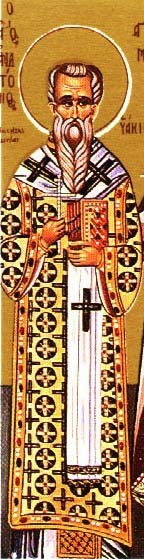
Saint Anatole
Évêque en
Syrie (3ème s.)
Originaire d'Alexandrie
en Égypte où il enseigna les sciences humaines et la philosophie. Sacré évêque
par Théoctecne de Césarée de Palestine. Alors qu'il se rendait au concile
d'Antioche, il passa par Laodicée où les chrétiens, dont l'évêque venait de mourir,
le retinrent. (source 'Catholicisme')
À Laodicée en Syrie,
commémoraison de saint Anatole, évêque au IIIe siècle, qui a laissé des écrits
dignes d’être admirés non seulement par les hommes pieux, mais aussi par les
philosophes.
Martyrologe romain
SOURCE : http://nominis.cef.fr/contenus/saint/10100/Saint-Anatole.html
Saint Anatole de
Laodicée
Évêque de Laodicée
(Syrie)
Fête le 3 juillet
Alexandrie, Égypte – † v.
282
Autre mention : 2
juillet
Mathématicien et
théologien de la Pâque, saint Anatole, originaire d’Alexandrie, fut évêque de
Laodicée de Syrie, actuelle Lattaquié, vers l’an 269. Une partie de ses traités
sur l’arithmétique existe encore. Directeur de l’école aristotélicienne
d’Alexandrie, il excella comme philosophe et comme mathématicien. Saint Jérôme
fait l’éloge de ses ouvrages.
SOURCE : http://www.martyretsaint.com/anatole-de-laodicee/
ANATOLE D'ALEXANDRIE,
évêque de Laodicée en Syrie, florissait sous les empereurs Carus et Probus. Il
possédait d'immenses connaissances en mathématiques, en astronomie, en
grammaire, en rhétorique et en dialectique. Son livre sur la Pâques et ses
leçons d'arithmétique nous donnent une idée de l'étendue de son génie.
Saint JÉRÔME. Tableau
des écrivains ecclésiastiques, ou Livre des hommes illustres.
SOURCE : http://www.abbaye-saint-benoit.ch/saints/jerome/002.htm
Saint Anatolius
d'Alexandrie
Anatolius d'Alexandrie ou Saint
Anatole (deuxième moitié du IIIe siècle ap. J.-C.), chrétien, out une
grande réputation scientifique et occupa à Alexandrie la
chaire de philosophie aristotélique.
Il y eut comme élève le païen Jamblique,
et s'y trouvait au moment du siège du Bruchium par Théodote, sous le règne
de Gallien.
Un peu après, vers 270, il fut nommé évêque de Laodicée de
Syrie, en remplacement d'Eusèbe.
Il mourut avant la persécution de Dioclétien (303).
Eusèbe (Hist.
eccl., VII, 32), donne un extrait de ses Règles pour la Pâque et
lui attribua de nombreux écrits, notamment dix livres d'Introductions arithmétiques.
Ces livres, dont il nous reste de nombreux fragments dans les Théologoumènes
arithmétiques, paraissent avoir été une compilation des spéculations mystiques des pythagoriciens sur
les dix premiers nombres. D'autres fragments, sur les mathématiques en
général, provenant d'un autre ouvrage d'Anatolius, se trouvent dans une
compilation publiée, sous le titre : Anonymi varia collectiones, par
Hultsch dans son édition de Héron (Berlin,
1864). Aux fragments qui portent expressément le nom d'Anatolius doivent être
ajoutés la plupart de ceux de la même collection qui ne sont pas tirés de Proclus et
notamment ceux que Hultsch a attribués à Geminos.
Le Comput pascal d'Anatolius,
que citent Bède et Raban
Maur, existe en latin (ancienne version de Rufin) et a été édité par Gilles
Boucher à Anvers ,
1634. L'authenticité en a été contestée. On a également mis en doute que
l'Anatolius, maître de Jamblique (d'après
Eunape) et auteur des fragments des Théologoumènes, fût le même que le
chrétien, évêque de Laodicée. (Paul Tannery).
SOURCE : http://www.cosmovisions.com/Anatole.htm
FRAGMENT
D'ANATOLIUS.
Anatolius d'Alexandrie ou
Saint Anatole (deuxième moitié du IIIe siècle après J.-C.), chrétien, out
une grande réputation scientifique et occupa à Alexandrie la chaire de
philosophie aristotélique. Il y eut comme élève le païen Jamblique, et s'y
trouvait au moment du siège du Bruchium par Théodote, sous le règne de Gallien.
Un peu après, vers 270, il fut nommé évêque de Laodicée de Syrie, en
remplacement d'Eusèbe. Il mourut avant la persécution de Dioclétien (303).
Eusèbe (Hist. eccl., VII,
32), donne un extrait de ses Règles pour la Pâque et lui attribua de
nombreux écrits, notamment dix livres d'Introductions arithmétiques. Ces
livres, dont il nous reste de nombreux fragments dans les Théologoumènes
arithmétiques, paraissent avoir été une compilation des spéculations mystiques
des pythagoriciens sur les dix premiers nombres. D'autres fragments, sur les
mathématiques en général, provenant d'un autre ouvrage d'Anatolius, se trouvent
dans une compilation publiée, sous le titre : Anonymi varia collectiones,
par Hultsch dans son édition de Héron (Berlin, 1864). Aux fragments qui portent
expressément le nom d'Anatolius doivent être ajoutés la plupart de ceux de la
même collection qui ne sont pas tirés de Proclus et notamment ceux que Hultsch
a attribués à Géminus.
Le Comput pascal d'Anatolius,
que citent Bède et Raban Maur, existe en latin (ancienne version de Rufin) et a
été édité par Gilles Boucher à Anvers, 1634. L'authenticité en a été contestée.
On a également mis en doute que l'Anatolius, maître de Jamblique (d'après
Eunape) et auteur des fragments des Théologoumènes, fût le même que le
chrétien, évêque de Laodicée. (Paul Tannery).
TEXTE
Qu'est-ce que les
mathématiques ?
Aristote, pensant que la
philosophie prise dans son ensemble embrasse la théorie et la pratique, et
divisant la pratique en morale et en politique, et la théorie en théologie, en
physique et en mathématiques, montre bien clairement et doctement que les mathématiques
font partie de la philosophie.
Les Chaldéens ont inventé
l'astronomie, tes Égyptiens la géométrie et l'arithmétique.
D'où les mathématiques
ont-elles tiré leur nom?
Les Péripatéticiens,
déclarant qu'on peut comprendre la rhétorique, la poétique et toute la musique
vulgaire, sans en avoir pris des leçons, mais qu'on ne peut acquérir la
connaissance d'aucun des objets nommés proprement, sans avoir pris
d'abord-des leçons sur ces objets, pensaient que pour cette raison la théorie
de ces mêmes objets avait reçu le nom de mathématiques. Mais on dit
que ce nom fut donné spécialement à la géométrie et à l'arithmétique seules par
les disciples de Pythagore. Car anciennement chacune de ces deux sciences était
nommée à part, et elles n'avaient point de nom commun. Or ils les nommèrent
ainsi, parce qu'ils y trouvèrent le caractère scientifique et l'aptitude à être
enseignées; car ils voyaient qu'elles roulaient sur des objets éternels,
immuables et purs de tout mélange, et ils pensaient que c'étaient là les seuls
objets où la science pût se rencontrer. Mais, à une époque plus récente, on a
donné à ce mot une plus grande extension, parce qu’on a pensé que le
mathématicien devait s’occuper, non seulement de la matière incorporelle et
idéale, mais encore de ce qui touche à la matière corporelle et sensible. En
effet, il doit être habile dans la théorie du mouvement des astres, de leurs
vitesses, de leurs grandeurs, de leurs figures et de leurs distances. Il doit,
en outre, savoir considérer les diverses modifications de la vue : il doit
savoir scruter les causes pour lesquelles les objets ne paraissent pas à toute
distance ce qu’ils sont, ni tels qu’ils sont en réalité, gardant, il est vrai,
leurs rapports mutuels, mais produisant de fausses apparences en ce qui concerne
leurs positions et leur ordre, soit dans le ciel et dans l’air, soit dans les
miroirs et dans toutes les surfaces polies, soit enfin dans ceux des objets
visibles qui sont transparents et dans tous les corps de cette nature. On
pensait, de plus, que le mathématicien devait être mécanicien et habile dans la
géodésie (géométrie pratique) et dans la logistique (arithmétique pratique), et
qu’il devait aussi s'occuper des causes de l'union mélodieuse des sons et de
leur combinaison dans la mélodie. Or ces objets sont corporels, ou du moins
sont au dernier rang parmi ceux qui s'élèvent au-dessus de la matière sensible.
Qu'est-ce que les
mathématiques?
Les mathématiques sont la
science qui s'applique à la théorie des objets perceptibles à la fois par
l'intellect et par la sensation, de manière à pouvoir transmettre les notions
relatives à ces objets. Et quelqu'un a remarqué, avec non moins d'esprit que de
justesse, que c'est de la science mathématique qu'il convient de dire : «
petite d'abord, elle s'élance, et bientôt elle a dressé sa tête dans le ciel,
tandis que ses pieds foulent le sol. » En effet, les mathématiques partent du
point et de la ligne, mais elles embrassent l'étude du ciel, de la terre et de
l'univers entier.
Combien y a-t-il de
parties des mathématiques?
La branche la plus
relevée et la première des mathématiques se divise en deux parties principales
: l'arithmétique et la géométrie. Celle qui s'occupe des choses sensibles se
divise en six parties : la logistique (art du calcul arithmétique), la géodésie
(géométrie pratique), l'optique, la canonique (science du canon musical,
qui est le type des valeurs numériques des sons), la mécanique et l'astronomie.
Mais, ni ce qu'on nomme la tactique, ni l'art de l'architecte, ni la musique
vulgaire, ni l'étude des apparences visibles, ni la mécanique (pratique) qui
porte le même nom que la mécanique par excellence, ne sont, comme quelques-uns
le croient, des parties des mathématiques : c'est ce que nous montrerons
clairement et avec méthode dans la suite de cet ouvrage.
Le cercle a huit solides,
six plans et quatre angles.[1]
Quelles sont les parties
des mathématiques les plus rapprochées les unes des autres?
Ce qui se rapproche le
plus de l'arithmétique (théorique), ce sont la logistique (art du calcul) et la
canonique (calcul de la valeur numérique des sons musicaux); car
l'arithmétique, ayant pris pour unité une certaine quantité, procède suivant
les rapports, les nombres et les proportions. Ce qui se rapproche le plus de la
géométrie, ce sont l'optique et la géodésie. La mécanique et l'astronomie se
rapprochent beaucoup de l'arithmétique et de la géométrie à la fois.
Les mathématiques tirent
leurs principes de l'hypothèse et roulent sur l'hypothèse. Le mot hypothèse a
trois significations ou plus encore. Par exemple, on nomme hypothèse la
péripétie dramatique, et c'est ainsi qu'on dit les hypothèses (ou sujets) des
drames d'Euripide. D'après une autre signification, on nomme hypothèse la
recherche des cas particuliers dans la rhétorique, et c'est ainsi que les
sophistes disent : il faut poser une hypothèse (un fait particulier
auquel la thèse générale s'applique). Par une troisième variété de
signification, on nomme hypothèse le principe de la démonstration
consistant en un postulatum d'où l'on tire une conséquence : c'est
ainsi qu'on dit que Démocrite prenait pour hypothèse les atomes et le
vide, et Asclépiade les masses et les pores. La science mathématique roule sur
le troisième genre d’hypothèse.
Ce n'était pas Pythagore
seul qui honorait l'arithmétique ; ses familiers aussi l'honoraient, en disant
: « Tout est fait à l'image du nombre ».
L'arithmétique a pour but
et pour résultat principalement la théorie scientifique, but le plus grand et
le plus beau de tous, et, comme conséquence de ce premier résultat, elle fait
connaître collectivement les nombres des accidents de la substance finie.
A qui est due chaque
invention en mathématiques?[2]
Suivant ce qu'Eudème
raconte dans son ouvrage sur l'astronomie, Œnopide le premier découvrit la
ceinture du zodiaque et la période de la grande année (c'est-à-dire du
cycle luni-solaire). Thalès le premier sut en quoi consiste l'éclipsé du
soleil, et que la période qui ramène le soleil aux points solsticiaux n'est pas
toujours égale. Anaximandre le premier découvrit que la terre est suspendue en
l'air vers le centre du monde, et qu'elle s'agite dans le voisinage de ce point
(de manière à produire les tremblements de terre. Anaximène découvrit
que la lune tire sa lumière du soleil, et comment elle s'éclipse. A ces
découvertes, d'autres ajoutèrent les découvertes suivantes : que les astres
fixes exécutent leur révolution (diurne) autour de l'axe immobile qui passe par
les pôles (de l'équateur), mais que les planètes exécutent leur révolutions
(propres) autour de l’axe perpendiculaire au plan du zodiaque (c’est-à-dire de
l’écliptique), et que l’axe des astres fixes et l’axe des planètes sont
éloignés l’un de l’autre d’un côté du polygone (régulier) de quinze côtés
(inscrit au cercle), c'est-à-dire de vingt quatre degrés.
[1] Les
huit solides engendres par le cercle sont sans doute le cône, le cône tronqué,
le cylindre à bases perpendiculaires sur l'axe, le cylindre à bases obliques
d'axe, la sphère, l'onglet sphérique, le segment sphérique et le secteur
sphérique. Les six plans engendrés par le cercle sont sans doute le cercle, le
demi-cercle, le segment déterminé par une seule corde et plus grand que le
demi-cercle, le segment déterminé par une seule corde et plus petit que le
demi-cercle, le segment compris entre deux cordes et le secteur compris entre
deux rayons. Les quatre angles à considérer dans le cercle sont sans doute
l'angle an centre, l'angle à la circonférence, l'angle dont un des cotés est un
diamètre et dont le sommet est en deçà du centre, l'angle dont an des côtés est
un diamètre et dont le sommet est au delà du centre.
[2] Ici
commence le chapitre xl de l'Astronomie de Théon de Smyrne.
SOURCE : http://remacle.org/bloodwolf/erudits/anatolius/fragment.htm
Also
known as
Anatolius of Laodicea
Anatolio…
Profile
Noted scientist, philosopher, scholar, teacher,
and writer.
He wrote ten books on mathematics alone,
and Saint Jerome praised
his scholarship and writing.
Head of the Aristotlean school in Alexandria, Egypt.
However, he was known not just as a scholar but
as a humble and deeply religious man. Ignorance horrified him, and part of his
work with the poor was
to educate them.
Held a number of government posts in Alexandria.
During a rebellion
against the Roman authorities in 263,
the area of Alexandria was
under seige, resulting in the starvation of
both rebels and citizens who had nothing to do with the uprising. Anatolius met
with the Romans and negotiated the release of non-combatant children, women,
the sick,
and the elderly,
saving many, and earning him a reputation as a peacemaker.
The rebels, freed of caring for the non-combatants, were able to fight even
longer. However, when they lost, Anatolius found himself with enemies on each
side of the conflict, and he decided to leave Alexandria.
Anatolius emigrated to
Caesaria, Palestine.
His reputation as a scholar and Christian had
preceeded him, and he became assistant and advisor to the bishop.
In 268,
while en route to the Council of Antioch, he passed through Laodicea, Syria.
Their bishop, Saint Eusebius
of Laodicea, had just died,
they saw Anatolius’ arrival as a gift from God,
and insisted that he assume the bishopric.
He accepted, and spent his remaining fifteen years there.
Born
283 at Laodicea, Syria of
natural causes
bishop with
globes and mathematical books
Additional
Information
Book
of Saints, by the Monks of
Ramsgate
Saints
of the Day, by Katherine Rabenstein
books
Our Sunday Visitor’s Encyclopedia of Saints
other
sites in english
Dictionary of Greek and Roman Biography and Mythology
video
sitios
en español
Martirologio Romano, 2001 edición
sites
en français
fonti
in italiano
MLA
Citation
“Saint Anatolius of
Alexandria“. CatholicSaints.Info. 13 January 2022. Web. 11 June 2026.
<https://catholicsaints.info/saint-anatolius-of-alexandria/>
SOURCE : https://catholicsaints.info/saint-anatolius-of-alexandria/
Article
(Saint) Bishop (July 3)
(3rd
century) A native of Alexandria in Egypt, he early acquired a great
reputation for eloquence, learning and virtue. Chosen (A.D. 269) to succeed his
friend Saint Eusebius at Laodicea in Syria, he survived till the eve of the
persecution under Diocletian, which broke out in the last decade of the third
century. He was the author of some theological treatises commended by Saint
Jerome, together with other works.
MLA
Citation
Monks of Ramsgate.
“Anatolius”. Book of Saints, 1921. CatholicSaints.Info. 19 July 2012.
Web. 11 June 2026. <http://catholicsaints.info/book-of-saints-anatolius/>
SOURCE : https://catholicsaints.info/book-of-saints-anatolius/
St. Anatolius of Laodicea
Feastday: July 3
Death: 283
Bishop, noted
philosopher, and scientist in Alexandria, Egypt. He was the bishop of Laodicea in
Syria, where he wrote ten books on mathematics. Eusebius, the historian,
relates that Anatolius was faced with a rebellion in Alexandria, Egypt, while
he was living there. The Romans had the part
of the city known as the Bruchium under siege, and the people were starving.
Anatolius parleyed with the Romans and
managed to have the ill, the elderly, and the women and children released
safely. The rebels surrendered as a result. Traveling to Laodicea, Anatolius
was hailed by the people and made bishop.
SOURCE : https://www.catholic.org/saints/saint.php?saint_id=1381
Anatolius of Alexandria B
(RM)
Born in Alexandria,
Egypt; died c. 283. Anatolius, one of the greatest scholars of his age, headed
the Aristotelian school at Alexandria. Fragments of the 10 volumes on
mathematics that he wrote have come down to us, and he was also a master of
geometry, physics, rhetoric, dialectic, astronomy, and philosophy.
Hypercritical Saint Jerome commends his work, which should be considered high
praise indeed. Constantly seeking to improve his knowledge and understanding,
he turned his inquiring mind to every subject that came to hand, and not least
to the mysteries of God, without whom his studies and life would have been
meaningless. He viewed learning as a spiritual as well as an intellectual
discipline, for it taught honesty and respect for the truth, gave the student a
sense of the infinite magnitude of God's work, and filled the soul with
humility.
Despite his reputation as
the leading scholar of a town famed for its scholarship, Anatolius was never
conceited or arrogant. If he sometimes considered ignorance, particularly among
Christians, as almost a sin, he nevertheless showed a sincere friendship for
poor and uneducated people. Instead of snubbing them, he humbly set himself to
learn from them, for there was always something new to be learned, some truth
about man or nature.
As a scholar, and more
importantly as a Christian, he knew that no piece of God's handiwork should be
passed by with indifference. Though his reason and intellect were the principal
instruments he used in his search for truth, he also understood their
limitations when confronted with the wider mystery of God.
His intelligence and his
willingness to serve his fellow man led him to accept several important posts
in the administration of his city, which at the time was part of the Roman
Empire. It was thanks to him that in 263 a large number of its inhabitants was
saved from starvation. A few years earlier Emilian had seized power in
Alexandria and had himself proclaimed emperor, but a Roman army under Theodosius
was quickly dispatched against him. Theodosius laid siege to the town, which
was not expected to be able to hold out for long.
Making use of his
friendship with Eusebius, a deacon who later became bishop of Laodicea, and who
had accompanied the Roman army, Anatolius obtained permission for all the
women, children, old men and sick people to leave Alexandria. This proved to be
a tactical victory as well as an act of mercy. The besieged forces, relieved of
the burden of feeding useless mouths and of caring for those who could not bear
arms, were able to prolong their resistance.
Perhaps because he had
dangerously compromised himself in this affair, Anatolius then left Alexandria
and went to Caesarea in Palestine, where his fame had already preceded him.
Theoctenes, the bishop of Caesarea, esteemed him so highly that he consecrated
him as his successor and at once passed on to him a large part of his
responsibilities.
In 268, they were both
summoned to the Council of Antioch, but as they were passing through Laodicea
they were politely but firmly stopped by the clergy and people. Eusebius, their
bishop, had just died and they saw Anatolius's sudden arrival as a gift from
God. Anatolius had no choice but to accept, and it was as bishop of Laedicea that
he died (Benedictines, Encyclopedia).
In art, Saint Anatolius
is portrayed as a bishop with globes and mathematical books (Roeder).
SOURCE : http://www.saintpatrickdc.org/ss/0703.shtml
St. Anatolius
Bishop of Laodicea in Syria,
one of the foremost scholars of his day in the physical sciences and
in Aristotelean philosophy.
There are fragments of ten books on arithmetic written by him, and also a
treatise on the time of the Paschal celebration. A very curious story
is told by Eusebius of
the way in which Anatolius broke up a rebellion in a part
of Alexandria known as time Bruchium. It was held by the
forces of Zenobia, and being strictly beleaguered by
the Romans was in a state of starvation. The saint, who was
living in the Bruchium at the time, made arrangements with the
besiegers to receive all the women and
children, as well as the old and infirm, continuing at the same time to let as
many as wished profit by the means of escaping. It broke up the defence and the
rebels surrendered. It was a patriotic action on
the part of the saint,
as well as one of great benevolence, in saving so many innocent
victims from death. In going to Laodicea he was seized by the people
and made bishop.
Whether his friend Eusebius had
died, or whether they both occupied the see together,
is a matter of much discussion. The question is treated at length in the Bollandists.
His feast,
like that of his namesake the Patriarch of Constantinople,
is kept on 3 July.
Sources
Acta SS., I, July;
MICHAUD, Biog. Univ.; BARING-GOULD, Lives of the Saints (London,
1872).
Campbell, Thomas.
"St. Anatolius." The Catholic Encyclopedia. Vol. 1. New York: Robert
Appleton Company, 1907. 3 Jul. 2016
<http://www.newadvent.org/cathen/01457c.htm>.
Transcription. This
article was transcribed for New Advent by W.S. French, Jr.
Ecclesiastical
approbation. Nihil Obstat. March 1, 1907. Remy Lafort, S.T.D.,
Censor. Imprimatur. +John Cardinal Farley, Archbishop of New York.
Copyright © 2026 by New Advent LLC.
Dedicated to the Immaculate Heart of Mary.
SOURCE : http://www.newadvent.org/cathen/01457c.htm
Anatolius of Alexandria
(b. Alexandria; d Laodicea; fl.
ca. a.d. 269
mathematics, philosophy.
The historian Eusebius,
whose Ecclesiastical History provides what we know of Anatolius’
life, says, “For his learning, secular education and philosophy [he] had attained
the first place among our most illustrious contemporaries.” Learned in
arithmetic, geometry, astronomy, and other sciences both intellectual and
natural, Anatolius was also outstanding in rhetoric. The Alexandrians deemed
him worthy of heading the Aristotelian school in that city.
Bishop Theotecnus of
Caesarea consecrated Anatollus as his successor, and he held office for a while
in Caesarea. About a.d. 280, however, as he passed through Laodicea on his way
to Antioch, he was retained by the inhabitants as their bishop, the previous
bishop, also called Eusebius, having died. He remained bishop of Laodicea until
his death some years later.
Anatolius’ Christian and
humanitarian character was much admired. During a siege of the Greek quarter of
Alexandria by the Roman army, he attempted to make peace between the factions.
He failed, but he succeeded in winning safe conduct from the besieged quarter
for all noncombatants.
Anatolius put his
knowledge of astronomy at the service of his religion in a treatise on the date
of Easter Eusebius gives the title of the work as The Canons of Anatolius
on the Pascha and quotes several paragraphs that display Anatolius’ grasp
of astronomy in the discussion of the position of the sun and moon in the
zodiac at the time of Easter. According to Eusebius, Anatolius did not write
many books; but those that he did write were distinguished for eloquence and
erudition, which is evident through his quotation of Philo, Josephus, and two
of the seventy who translated the Old
Testament into Greek during the third and second centuries b.c.
The only other work of
Anatolius known to us by name is his Introduction to Arithmetic. In ten
books, it seems to have been excerpted by the author of the curious writing
entitled Theologoumena arithmetica. A Neoplatonic treatise, uncertainly
attributed to lamblichus, it is a discussion of each of the first ten natural
numbers. It mixes accounts of truly arithmetical properties with mystical
fancies. Many parts of the discussion are headed “of Anatolius,” The character
of its arithmetical lore may be illustrated by the following quotation from a
part attributed to Anatolius “[Four] is called ’justice’ since its square is
equal to the perimeter [i.e., 4 x 4 = 16 = 4 + 4 + 4 + 4]; of the numbers less
than four the perimeter of the square is greater than the area, while of the
greater the perimeter is less than the area.”
In contrast with the
flights of fancy preserved in Theologoumena arithmetica, some paragraphs
of a writing of Anatolius are found in manuscripts of Hero of Alexander in
which Anatolius deals soberly and sensibly, and in Aristotelian terms, with
questions about mathematics, its name, is philosophical importance, and some of
its methods. The structure of Theologoumena arithmetica and its
selection of material from Anatolius suggest that Anatolius’ Introduction
to Arithmetic may have dealt with each of the first ten natural numbers.
The Pythagoreanism or Neoplatonism manifested here was in the spirit of the
times. Despite the number mysticism, however, Anatolius’ competence in mathematics
is clear and justifies the esteem in which Eusebius says he was held in
Alexandria.
BIBLIOGRAPHY
No individual works of
Anatolius’ are known to exist today. Some paragraphs of a work by him are found
in Heronis Alexandrini geometricorum et stereometricorum reliquiae, F.
Hultsch, ed. (Berlin, 1864), pp. 276–280. A seeming use of excerpts from
Anatolius’ Introduction to Arithmetic is Theologoumena arithmetica, V. De
Falco, ed. (Leipzig, 1922). Two sources of information on the life of Anatolius
are Eusebius, The Ecclesiastical History, H. J. Lawlor, trans., II
(Cambridge–London, 1942), 228–238; and Pauly–Wissowa, eds., Real–Enzyklopädie
der Klassischen Alterturnswissenschaft, XII (Stuttgart, 1894–), col. 2073 f.
John S. Kieffer
Complete Dictionary of Scientific
Biography
Anato'lius
(*) Anato/lios), Bishop of LAODICEA (A. D.
270), was an Alexandrian by birth. Eusebius ranks him first among the men of
his age, in literature, philosophy, and science, and states, that the
Alexandrians urged him to open a school of Aristotelian philosophy. (H. E. 7.32.)
He was of great service to the Alexandrians when they were besieged by the
Romans, A. D. 262. From Alexandria he went into Syria. At Caesarea he was
ordained by Theotechnus, who destined him to be his successor in the bishopric,
the duties of which he discharged for a short time as the vicar of Theotechnus.
Afterwards, while proceeding to attend a council at Antioch, he was detained by
the people of Laodicea, and became their bishop. Of his subsequent life nothing
is known; but by some he is said to have suffered martyrdom.
Works
He wrote a work on the
chronology of Easter, a large fragment of which is preserved by Eusebius. (l.c.)
The work exists in a Latin translation, which some ascribe to Rufinus, under
the title of Volumen de Paschate, or Canones Paschales.
Editions
This was published by
Aegidius Bucherius in his Doctrina Temporum, Antverp., 1634.
Treatise on Arithmetic
He also wrote a treatise
on Arithmetic, in ten books (Hieron. de Vir. Illust. 100.73), of
which some fragments are preserved in the Θεολογούμενα τῆς Ἀριθμετικῆς.
Editions
Some fragments of his
mathematical works are printed in Fabric. Bib. Graec. iii. p. 462.
[P.S]
William Smith. A
Dictionary of Greek and Roman biography and mythology. London. John Murray:
printed by Spottiswoode and Co., New-Street Square and Parliament Street. In
the article on Soranus, we find: "at this present time (1848)" and
this date seems to reflect the dates of works cited. 1873 - probably the
printing date.
A Dictionary of Greek and Roman biography and mythology
William Smith, Ed.
SOURCE : https://www.perseus.tufts.edu/hopper/text?doc=anatolius-bio-4&fromdoc=Perseus%3Atext%3A1999.04.0104
Anatolius, bp. of
Laodicea in Syria Prima (Eus. H. E. vii. 32). He had been famous at
Alexandria for proficiency in the liberal arts, while his reputation for
practical wisdom was so great that when the suburb of Brucheium was besieged by
the Romans during the revolt of Aemilianus, A.D. 262, the command of
the place was assigned to him. Provisions having failed, and his proposition of
making terms with the besiegers having been indignantly rejected, Anatolius
obtained leave to relieve the garrison of all idle mouths, and by a clever
deception marched out all the Christians, and the greater part of the rest,
many disguised as women. Having passed over to Palestine, he was ordained by
Theotecnus, bp. of Caesarea, as bishop-coadjutor, with the right of succession.
But going to Antioch to attend the synod against Paul of Samosata, on his way
through Laodicea, which had just lost its bishop, his old friend Eusebius, he
was detained and made bishop in his room, A.D. 269.
Eusebius speaks of him as
not having written much, but enough to show at once his eloquence and manifold
learning. He specially mentions a work on the Paschal question, published in a
Latin version by Bucherius (Doct. Temp., Antv. 1634). Some fragments of his
mathematical works were pub. at Paris, 1543, and by Fabricius (Bibl. Graec. iii.
462; Hieron. Sc. Eccl. c. 73). For an Eng. trans. of his extant works
see Ante-Nicene Lib. (T. & T. Clark).
[E.V.]
Dictionary of Christian Biography and Literature
edited by Henry Wace and William Coleman Piercy
Anatolius, bishop of
Laodicea in Syria Prima by Edmund Venables
Saint Anatolius of
Laodicea
His Homegoing date was
283 A.D.
Bishop of Laodicea in
Syria, one of the foremost scholars of his day in the physical sciences and in
Aristotelean philosophy. There are fragments of ten books on arithmetic written
by him, and also a treatise on time of the Paschal celebration. A very curious
story is told by Eusebius of the way in which Anatolius broke up a rebellion in
a part of Alexandria known as the Bruchium. It was held by the forces of
Zenobia, and being strictly beleaguered by the Romans was in a state of
starvation. The saint, who was living in the Bruchium at the time, made
arrangements with the besiegers to receive all the women and children, as well
as the old and infirm, continuing at the same time to let as many as wished
profit by the means of escaping. It broke up the defence and the rebels
surrendered. It was a patriotic action on the part of the saint, as well as one
of great benevolence, in saving so many innocent victims from death. In going
to Laodicea he was seized by the people and made bishop. Whether his friend
Eusebius had died, or whether they both occupied the see together, is a matter
of much discussion. The question is treated at length in the Bollandists. His
feast, like that of his namesake the Patriarch of Constantinople, is kept on 3
July.
THE PASCHAL CANON OF
ANATOLIUS OF LAODICEA
I
As we are about to speak
on the subject of the order of the times and alternations of the world, we
shall first dispose of the positions of diverse calculators; who, by reckoning
only by the course of the moon, and leaving out of account the ascent and descent
of the sun, with the addition of certain problems, have constructed diverse
periods,(2) self-contradictory, and such as are never found in the reckoning of
a true computation; since it is certain that no mode of computation is to be
approved, in which these two measures are not found together. For even in the
ancient exemplars, that is, in the books of the Hebrews and Greeks, we find not
only the course of the moon, but also that of the sun, and, indeed, not simply
its course in the general,(3) but even the separate and minutest moments of its
hours all calculated, as we shall show at the proper time, when the matter in
hand demands it. Of these Hippolytus made up a period of sixteen years with
certain unknown courses of the moon. Others have reckoned by a period of
twenty-five years, others by thirty, and some by eighty-four years, without,
however, teaching thereby an exact method of calculating Easter. But our
predecessors, men most learned in the books of the Hebrews and Greeks,-I mean
Isidore and Jerome and Clement,-although they have noted similar beginnings for
the months just as they differ also in language, have, nevertheless, come
harmoniously to one and the same most exact reckoning of Easter, day and month
and season meeting in accord with the highest honour for the Lord's
resurrection.(4) But Origen also, the most erudite of all, and the acutest in
making calculations,-a man, too, to whom the epithet
<greek>kalkenths</greek>(5) is given,-has published in a very
elegant manner a little book on Easter. And in this book, while declaring, with
respect to the day of Easter, that attention must be given not only to the
course of the moon and the transit of the equinox, but also to the passage
(transcensum) of the sun, which removes every foul ambush and offence of all
darkness, and brings on the advent of light and the power and inspiration of
the elements of the whole world, he speaks thus: In the (matter of the) day of
Easter, he remarks, I do not say that it is to be observed that the Lord's day should
be found, and the seven (6) days of the moon which are to elapse, but that the
sun should pass that division, to wit, between light and darkness, constituted
in an equality by the dispensation of the Lord at the beginning of the world;
and that, from one hour to two hours, from two to three, from three to four,
from four to five, from five to six hours, while the light is increasing in the
ascent of the sun, the darkness should decrease.(7) ... and the addition of the
twentieth number being completed, twelve parts should be supplied in one and
the same day. But if I should have attempted to add any little drop of mine (8)
after the exuberant streams of the eloquence and science of some, what else
should there be to believe but that it should be ascribed by all to
ostentation, and, to speak more truly, to madness, did not the assistance of
your promised prayers animate us for a little? For we believe that nothing is
impossible to your power of prayer, and to your faith. Strengthened, therefore,
by this confidence, we shall set bashfulness aside, and shall enter this most
deep and unforeseen sea of the obscurest calculation, in which swelling
questions and problems surge around us on all sides.
II.
There is, then, in the
first year, the new moon of the first month, which is the beginning of every
cycle of nineteen years, on the six and twentieth day of the month called by
the Egyptians Phamenoth.(9) But, according to the months of the Macedonians, it
is on the two-and-twentieth day of Dystrus. And, as the Romans would say, it is
on the eleventh day before the Kalends of April. Now the sun is found on the
said six-and-twentieth day of Phamenoth, not only as having mounted to the
first segment, but as already passing the fourth day in it. And this segment they
are accustomed to call the first dodecatemorion (twelfth part), and the
equinox, and the beginning of months, and the head of the cycle, and the
starting-point (1) of the course of the planets. And the segment before this
they call the last of the months, and the twelfth segment, and the last
dodecatemorion, and the end of the circuit (2) of the planets. And for this
reason, also, we maintain that those who place the first month in it, and who
determine the fourteenth day of the Paschal season by it, make no trivial or
common blunder.
III.
Nor is this an opinion
confined to ourselves alone. For it was also known to the Jews of old and
before Christ, and it was most carefully observed by them.(3) And this may be
learned from what Philo, and Josephus, and Musaeus have written; and not only
from these, but indeed from others still more ancient, namely, the two
Agathobuli,(4) who were surnamed the Masters, and the eminent Aristobulus,(5)
who was one of the Seventy who translated the sacred and holy Scriptures of the
Hebrews for Ptolemy Philadelphus and his father, and dedicated his exegetical
books on the law of Moses to the same kings. These writers, in solving some
questions which are raised with respect to Exodus, say that all alike ought to
sacrifice the Passover(6) after the vernal equinox in the middle of the first
month. And that is found to be when the sun passes through the first segment of
the solar, or, as some among them have named it, the zodiacal circle.
IV.
But this Aristobulus also
adds, that for the feast of the Passover it was necessary not only that the sun
should pass the equinoctial segment, but the moon also. For as there are two
equinoctial segments, the vernal and the autumnal, and these diametrically
opposite to each other, and since the day of the Passover is fixed for the
fourteenth day of the month, in the evening, the moon will have the position
diametrically opposite the sun; as is to be seen in full moons. And the sun
will thus be in the segment of the vernal equinox, and the moon necessarily
will be at the autumnal equinox.
V.
I am aware that very many
other matters were discussed by them, some of them with considerable
probability, and others of them as matters of the clearest demonstration,(7) by
which they endeavour to prove that the festival of the Passover and unleavened
bread ought by all means to be kept after the equinox. But I shall pass on
without demanding such copious demonstrations(on subjects(8)) from which the
veil of the Mosaic law has been removed; for now it remains for us with
unveiled face to behold ever as in a glass Christ Himself and the doctrines and
sufferings of Christ. But that the first month among the Hebrews is about the
equinox, is clearly shown also by what is taught in the book of Enoch.(9)
VI.
And, therefore, in this
concurrence of the sun and moon, the Paschal festival is not to be celebrated,
because as long as they are found in this course the power of darkness is not
overcome; and as long as equality between light and darkness endures, and is
not diminished by the light, it is shown that the Paschal festival is not to be
celebrated. Accordingly, it is enjoined that that festival be kept after the
equinox, because the moon of the fourteenth,(10) if before the equinox or at
the equinox, does not fill the whole night. But after the equinox, the moon of
the fourteenth, with one day being added because of the passing of the equinox,
although it does not extend to the true light, that is, the rising of the sun
and the beginning of day, will nevertheless leave no darkness behind it. And,
in accordance with this, Moses is charged by the Lord to keep seven days of
unleavened bread for the celebration of the Passover, that in them no power of
darkness should be found to surpass the light. And although the outset of four
nights begins to be dark, that is, the 17th and 18th and 19th and 20th, yet the
moon of the 20th, which rises before that, does not permit the darkness to
extend on even to midnight.
VII.
To us, however, with whom
it is impossible for all these things to come aptly at one and the same time,
namely, the moon's fourteenth, and the Lord's day, and the passing of the
equinox, and whom the obligation of the Lord's resurrection binds to keep the
Paschal festival on the Lord's day, it is granted that we may extend the
beginning of our celebration even to the moon's twentieth. For although the
moon of the 20th does not fill the whole night, yet, rising as it does in the
second watch, it illumines the greater part of the night. Certainly if the
rising of the moon should be delayed on to the end of two watches, that is to
say, to midnight, the light would not then exceed the darkness, but the
darkness the light. But it is clear that in the Paschal feast it is not
possible that any part of the darkness should surpass the light; for the
festival of the Lord's resurrection is one of light, and there is no fellowship
between light and darkness. And if the moon should rise in the third watch, it
is clear that the 22d or 23d of the moon would then be reached, in which it is
not possible that there can be a true celebration of Easter. For those who
determine that the festival may be kept at this age of the moon, are not only
unable to make that good by the authority of Scripture, but turn also into the
crime of sacrilege and contumacy, and incur the peril of their souls; inasmuch
as they affirm that the true light may be celebrated along with something of
that power of darkness which dominates all.
VIII.
Accordingly, it is not
the case, as certain calculators of Gaul allege, that this assertion is opposed
by that passage in Exodus,(1) where we read: "In the first month, on the
fourteenth day of the first month, at even, ye shall eat unleavened bread until
the one-and-twentieth day of the month at even. Seven days shall there be no
leaven found in your houses." From this they maintain that it is quite
permissible to celebrate the Passover on the twenty-first day of the moon;
understanding that if the twenty-second day were added, there would be found
eight days of unleavened bread. A thing which cannot be found with any
probability, indeed, in the Old Testament, as the Lord, through Moses, gives
this charge: "Seven days ye shall eat unleavened bread."(2) Unless
perchance the fourteenth day is not reckoned by them among the days of
unleavened bread with the celebration of the feast; which, however, is contrary
to the Word of the Gospel which says: "Moreover, on the first day of
unleavened bread, the disciples came to Jesus."(3) And there is no doubt
as to its being the fourteenth day on which the disciples asked the Lord, in
accordance with the custom established for them of old, "Where wilt Thou
that we prepare for Thee to eat the Passover?" But they who are deceived
with this error maintain this addition, because they do not know that the 13th
and 14th, the 14th and 15th, the 15th and 16th, the 16th and 17th, the 17th and
18th, the 18th and 19th, the 19th and 20th, the 20th and 21st days of the moon
are each found, as may be most surely proved, within a single day. For every
day in the reckoning of the moon does not end in the evening as the same day in
respect of number, as it is at its beginning in the morning. For the day which
in the morning, that is up to the sixth hour and half, is numbered the 13th day
of the month, is found at even to be the 14th. Wherefore, also, the Passover is
enjoined to be extended on to the 21st day at even; which day, without doubt,
in the morning, that is, up to that term of hours which we have mentioned, was
reckoned the 20th. Calculate, then, from the end of the 13th(4) day of the
moon, which marks the beginning of the 14th, on to the end of the 20th, at
which the 21st day also begins, and you will have only seven days of unleavened
bread, in which, by the guidance of the Lord, it has been determined before
that the most true feast of the Passover ought to be celebrated.
IX.
But what wonder is it
that they should have erred in the matter of the 21st day of the moon who have
added three days before the equinox, in which they hold that the Passover may
be celebrated? An assertion which certainly must be considered altogether
absurd, since, by the best-known historiographers of the Jews, and by the
Seventy Elders, it has been clearly determined that the Paschal festival cannot
be celebrated at the equinox.
X.
But nothing was difficult
to them with whom it was lawful to celebrate the Passover on any day when the
fourteenth of the moon happened after the equinox. Following their example up
to the present time all the bishops of Asia-as themselves also receiving the
rule from an unimpeachable authority, to wit, the evangelist John, who leant on
the Lord's breast, and drank in instructions spiritual without doubt-were in
the way of celebrating the Paschal feast, without question, every year,
whenever the fourteenth day of the moon had come, and the lamb was sacrificed
by the Jews after the equinox was past; not acquiescing, so far as regards this
matter, with the authority of some, namely, the successors of Peter and Paul,
who have taught all the churches in which they sowed the spiritual seeds of the
Gospel, that the solemn festival of the resurrection of the Lord can be
celebrated only on the Lord's day. Whence, also, a certain contention broke out
between the successors of these, namely, Victor, at that time bishop of the
city of Rome, and Polycrates, who then appeared to hold the primacy among the
bishops of Asia. And this contention was adjusted most rightfully by
Irenaeus,(1) at that time president of a part of Gaul, so that both parties
kept by their own order, and did not decline from the original custom of
antiquity. The one party, indeed, kept the Paschal day on the fourteenth day of
the first month, according to the Gospel, as they thought, adding nothing of an
extraneous kind, but keeping through all things the rule of faith. And the
other party, passing the day of the Lord's Passion as one replete with sadness
and grief, hold that it should not be lawful to celebrate the Lord's mystery of
the Passover at any other time but on the Lord's day, on which the resurrection
of the Lord from death took place, and on which rose also for us the cause of
everlasting joy. For it is one thing to act in accordance with the precept
given by the apostle, yea, by the Lord Himself, and be sad with the sad, and
suffer with him that suffers by the cross, His own word being: "My soul is
exceeding sorrowful, even unto death; "(2) and it is another thing to
rejoice with the victor as he triumphs over an ancient enemy, and exults with
the highest triumph over a conquered adversary, as He Himself also says:
"Rejoice with Me; for I have found the sheep which I had lost."(3)
XI.
Moreover, the allegation
which they sometimes make against us, that if we pass the moon's fourteenth we
cannot celebrate the beginning of the Paschal feast in light,(4) neither moves
nor disturbs us. For, although they lay it down as a thing unlawful, that the
beginning of the Paschal festival should be extended so far as to the moon's
twentieth; yet they cannot deny that it ought to be extended to the sixteenth
and seventeenth, which coincide with the day on which the Lord rose from the
dead. But we decide that it is better that it should be extended even on to the
twentieth day, on account of the Lord's day, than that we should anticipate the
Lord's day on account of the fourteenth day; for on the Lord's day was it that
light was shown to us in the beginning, and now also in the end, the comforts
of all present and the tokens of all future blessings. For the Lord ascribes no
less praise to the twentieth day than to the fourteenth. For in the book of
Leviticus(5) the injunction is expressed thus: "In the first month, on the
fourteenth day of this month, at even, is the Lord's Passover. And on the
fifteenth day of this month is the feast of unleavened bread unto the Lord.
Seven days ye shall eat unleavened bread. The first day shall be to you one
most diligently attended(6) and holy. Ye shall do no servile work thereon. And
the seventh day shall be to you more diligently attended(7) and holier; ye
shall do no servile work thereon." And hence we maintain that those have
contracted no guilt(8) 'before the tribunal of Christ, who have held that the
beginning of the Paschal festival ought to be extended to this day. And this,
too, the most especially, as we are pressed by three difficulties, namely, that
we should keep the solemn festival of the Passover on the Lord's day, and after
the equinox, and yet not beyond the limit of the moon's twentieth day.
XII.
But this again is held by
other wise and most acute men to be an impossibility, because within that
narrow and most contracted limit of a cycle of nineteen years, a thoroughly
genuine Paschal time, that is to say, one held on the Lord's day and yet after
the equinox, cannot occur. But, in order that we may set in a clearer light the
difficulty which causes their in credulity, we shall set down, along with the
courses of the moon, that cycle of years which we have mentioned; the days
being computed before in which the year rolls on in its alternating courses, by
Kalends and Ides and Nones, and by the sun's ascent and descent.
XIII.
The moon's age set forth
in the Julian Calendar.
January, on the Kalends,
one day, the moon's first (day); on the Nones, the 5th day, the moon's 5th; on
the Ides, the 13th day, the moon's 13th. On the day before the Kalends of
February, the 31st day, the moon's 1st; on the Kalends of February, the 32d
day, the moon's 2d; on the Nones, the 36th day, the moon's 6th; on the Ides,
the 44th day, the moon's 14th. On the day before the Kalends of March, the 59th
day, the moon's 29th; on the Kalends of March, the 60th day, the moon's 1st; on
the Nones, the 66th day, the moon's 7th; on the Ides, the 74th day, the moon's
15th. On the day before the Kalends of April, the 90th day, the moon's 2d; on
the Kalends of April, the 91st day, the moon's 3d; on the Nones, the 95th day,
the moon's 7th; on the Ides, the 103d day, the moon's 15th. On the day before
the Kalends of May, the 120th day, the moon's 3d; on the Kalends of May, the
121st day, the moon's 4th; on the Nones, the 127th day, the moon's 10th; on the
Ides, the 135th day, the moon's 18th. On the day before the Kalends of June,
the 151st day, the moon's 3d; on the Kalends of June, the 152d day, the moon's
5th; on the Nones, the 153d day, the moon's 9th; on the Ides, the 164th day,
the moon's 17th. On the day before the Kalends of July, the 181st day, the
moon's 5th; on the Kalends of July, the 182d day, the moon's 6th; on the Nones,
the 188th day, the moon's 12th; on the Ides, the 196th day, the moon's 20th. On
the day before the Kalends of August, the 212th day, the moon's 5th; on the
Kalends of August, the 213th day, the moon's 7th; on the Nones, the 217th day,
the moon's 12th; on the ides, the 225th day, the moon's 19th. On the day before
the Kalends of September, the 243d day, the moon's 7th; on the Kalends of
September, the 244th day, the moon's 8th; on the Nones, the 248th day, the
moon's 12th; on the Ides, the 256th day, the moon's 20th. On the day before the
Kalends of October, the 273d day, the moon's 8th; on the Kalends of October,
the 247th day, the moon's 9th; on the Nones, the 280th day, the moon's 15th; on
the Ides, the 288th day, the moon's 23d. On the day before the Kalends of
November, the 304th day, the moon's 9th; on the Kalends of November, the 305th
day, the moon's 10th; on the Nones, the 309th day, the moon's 14th; on the
Ides, the 317th day, the moon's 22d. On the day before the Kalends of December,
the 334th day, the moon's 10th; on the Kalends of December, the 335th day, the
moon's 11th; on the Nones, the 339th day, the moon's 15th; on the Ides, the
347th day, the moon's 23d. On the day before the Kalends of January, the 365th
day, the moon's 11th; on the Kalends of January, the 366th day, the moon's
12th.
XIV.
The Paschal or Easter
Table of Anatolius.
Now, then, after the
reckoning of the days and the exposition of the course of the moon, whereon the
whole revolves on to its end, the cycle of the years may be set forth from the
commencement).(1) This makes the Passover (Easter season) circulate between the
6th day before the Kalends of April and the 9th before the Kalends of May,
according to the following table:--
EQUINOX. Moon. Easter.
Moon.
1. SABBATH. XXVI. XVth
before the Kalends of 17th April. XVIII.
2. LORD'S DAY. VII.
Kalends of April, i.e., 1st April. XIV.
3. IID DAY (FERIAL).
XVIII. XIth before the Kalends of May, i.e., 21st April. XVI.
4. lIID DAY. XXIX. Ides
of April, i.e., 13th April. XIX.
5. IVTH DAY. X. IVth
before the Kalends of April, i.e., 29th March. XIV.
6. VTH DAY. XXI. XIVth
before the Kalends of May, i.e., 18th April. XVI.
7. SABBATH(2). II. VIth
before the Kalends of April, i.e., 27th March. XVII.
8. LORD'S DAY. Xlll.
Kalends of April, i.e., 1st April. XX.
9. IID DAY. XXIV. XVIIIth
before the Kalends of May, i.e., 14th March. XV.
10. IIID DAY. V. VIIIth
before the Ides of April, i.e., 6th April. XV.
11. IVTH DAY. XVI. IVth
before the Kalends of April, i.e., 29th March. XX.
12. VTH DAY. XXVII. IIId
before the Ides of April, i.e., 11th April. XV.
13. VITH DAY. VIII IIId
before the Nones of April, i.e., 3d April. XVII
14. SABBATH. XX. IXth
before the Kalends of May, i.e., 23d April. XX.
15. LORD'S DAY. I. VIth
before the Ides of April, i.e., 8th April. XV.
16. IID DAY. XII. IId
before the Kalends of April, i.e., 31st March. XVIII
17. IVTH DAY(2). XXIII.
XIVth before the Kalends of May, i.e., 18th April. XIX.
18. VTH DAY. IV. IId
before the Nones of April, i.e., 4th April. XIV.
19. VITH DAY. XV. VIth
before the Kalends of April i.e., 27th March. XVII.
XV.
This cycle of nineteen
years is not approved of by certain African investigators who have drawn up
larger cycles, because it seems to be somewhat opposed to their surmises and
opinions. For these make up the best proved accounts according to their calculation,
and determine a certain beginning or certain end for the Easter season, so as
that the Paschal festival shall not be celebrated before the eleventh day
before the Kalends of April, i.e., 24th March, nor after the moon's
twenty-first, and the eleventh day before the Kalends of May, i.e., 21st April.
But we hold that these are limits not only not to be followed, but to be
detested and overturned. For even in the ancient law it is laid down that this
is to be seen to, viz., that the Passover be not celebrated before the transit
of the vernal equinox, at which the last of the autumnal term is overtaken,(1)
on the fourteenth day of the first month, which is one calculated not by the
beginnings of the day, but by those of the moon.(2) And as this has been sanctioned
by the charge of the Lord, and is in all things accordant with the Catholic
faith, it cannot be doubtful to any wise man that to anticipate it must be a
thing unlawful and perilous. And, accordingly, this only is it sufficient for
all the saints and Catholics to observe, namely, that giving no heed to the
diverse opinions of very many, they should keep the solemn festival of the
Lord's resurrection within the limits which we have set forth.
XVI.
Furthermore, as to the
proposal subjoined to your epistle, that I should attempt to introduce into
this little book some notice of the ascent and descent of the sun, which is
made out in the distribution of days and nights. The matter proceeds thus: In
fifteen days and half an hour, the sun ascending by so many minutes, that is,
by four in one day, from the eighth day before the Kalends of January, i.e.,
25th December, to the eighth before the Kalends of April, i.e., 25th March, an
hour is taken up;(3) at which date there are twelve hours and a twelfth. On
this day, towards evening, if it happen also to be the moon's fourteenth, the
lamb was sacrificed among the Jews. But if the number went beyond that, so that
it was the moon's fifteenth or sixteenth on the evening of the same day, on the
fourteenth day of the second moon, in the same month, the Passover was
celebrated; and the people ate unleavened bread for seven days, up to the
twenty first day at evening. Hence, if it happens in like manner to us, that
the seventh day before the Kalends of April, 26th March, proves to be both the
Lord's day and the moon's fourteenth, Easter is to be celebrated on the
fourteenth. But if it proves to be the moon's fifteenth or sixteenth, or any
day up to the twentieth, then our regard for the Lord's resurrection, which took
place on the Lord's day, will lead us to celebrate it on the same principle;
yet this should be done so as that the beginning of Easter may not pass beyond
the close of their festival, that is to say, the moon's twentieth. And
therefore we have said that those parties have committed no trivial offence who
have ventured either on anticipating or on going beyond this number, which is
given us in the divine Scriptures themselves. And from the eighth day before
the Kalends of April, 25th March, to the eighth before the Kalends of July,
24th June, in fifteen days an hour is taken up: the sun ascending every day by
two minutes and a half, and the sixth part of a minute. And from the eighth day
before the Kalends of July, 24th June, to the eighth before the Kalends of
October, 24th September, in like manner, in fifteen days and four hours, an
hour is taken up: the sun descending every day by the same number of minutes.
And the space remaining on to the eighth day before the Kalends of January,
25th December, is determined in a similar number of hours and minutes. So that
thus on the eighth day before the Kalends of January, for the hour there is the
hour and half. For up to that day and night are distributed. And the twelve
hours which were established at the vernal equinox in the beginning by the
Lord's dispensation, being distributed over the night on the eighth before the
Kalends of July, the sun ascending through those eighteen several degrees which
we have noted, shall be found conjoined with the longer space in the twelfth.
And, again, the twelve hours which should be fulfilled at the autumnal equinox
in the sun's descent, should be found disjoined on the sixth before the Kalends
of January as six hours divided into twelve, the night holding eighteen divided
into twelve. And on the eighth before the Kalends of July, in like manner, it
held six divided into twelve.
XVII.
Be not ignorant of this,
however, that those four determining periods,(4) which we have mentioned,
although they are approximated to the Kalends of the following months, yet hold
each the middle of a season, viz., of spring and summer, and autumn and winter.
And the beginnings of the seasons are not to be fixed at that point at which
the Kalends of the month begin. But each season is to be begun in such way that
the equinox divides the season of spring from its first day; and the season of
summer is divided by the eighth day before the Kalends of July, and that of
autumn by the eighth before the Kalends of October, and that of winter by the eighth
before the Kalends of January in like manner.(5)
The
complete works of the Early Church Fathers.
SOURCE : http://www.reformation.org/saint_anatolius_of_laodicea.html
Sant' Anatolio di
Laodicea Vescovo
Festa: 3 luglio
III sec.
Figura di spicco del III
secolo, fu vescovo, filosofo ed erudito. Noto per la sua vasta cultura, si
distinse nella lotta alle eresie e nella promozione della dottrina ortodossa.
La sua fama di studioso attirò l'attenzione di tutto il mondo antico. Venne eletto
vescovo di Laodicea, dove guidò la comunità con saggezza e compassione. Tra le
sue opere, un computo pasquale e trattati teologici e filosofici. Morì intorno
al 283. La Chiesa lo ricorda il 3 luglio.
Martirologio
Romano: A Laodicea in Siria, commemorazione di sant’Anatolio, vescovo, che
lasciò scritti degni di ammirazione non solo per gli uomini di fede, ma anche
per i filosofi.
Anatolio di Laodicea, alessandrino di origine, si distinse tra i suoi concittadini per la cultura letteraria, filosofica e scientifica. In particolare gli si ascrive il merito di aver salvato una parte notevole dei suoi concittadini dai rigori dell'assedio posto dai Romani, probabilmente nel 263, al quartiere portuale di Alessandria detto il Bruchio (Bruchium). Poco dopo, forse perché compromesso in quell'episodio militare, si spostò in Palestina e si pose al servizio del vescovo di Cesarea, Teotecno, che lo creò vescovo e lo scelse come suo coadiutore. In occasione del secondo Concilio adunato ad Antiochia nel 268 contro Paolo di Samosata, Anatolio passò per Laodicea. Qui era stato vescovo per qualche anno, dal 264, Eusebio, suo compatriota e amico, nonché compagno nell'affare del Bruchio, venuto a mancare da poco alla sua chiesa. E per l'affetto che portavano allo scomparso e per la fama che Anatolio già godeva, gli abitanti di Laodicea costrinsero il santo ad accettare il governo della loro chiesa. Non sappiamo come Anatolio trascorse il suo episcopato, né quando morì. Secondo Eusebio, che ci tramanda le poche notizie che possediamo sulla sua vita, ad Anatolio vanno attribuiti un computo pasquale e dieci libri sull'aritmetica. Di questi ultimi restano alcuni frammenti, mentre è discussa la paternità del Liber Anatolii de ratione paschali, pubblicato per la prima volta dal Boucher nel 1634.
Autore: Franco Dieghi
SOURCE : https://www.santiebeati.it/dettaglio/60480
ANATOLIUS. SUR LES DIX
PREMIERS NOMBRES ; SUR LA DÉCADE ET LES NOMBRES QU'ELLE COMPREND. Oeuvre
numérisée par Marc Szwajcer : https://remacle.org/bloodwolf/erudits/anatolius/decade.htm
Anatolius of Alexandria.-
Paschal
Canon : https://www.ccel.org/ccel/schaff/anf06.vi.iii.i.html