
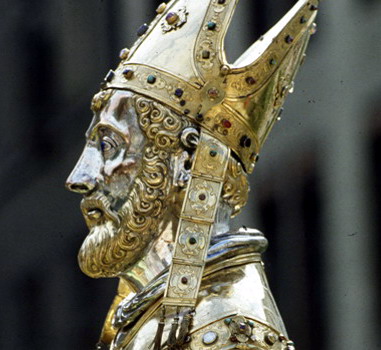
Portrait bust allegedly containing the skull of Saint Servatius, in the treasury of the Basilica of Saint Servatius, Maastricht, Netherlands. Gilded silver bust donated by Alessandro Farnese, Duke of Parma, as a replacement of an older bust that was destroyed by the Spanish troops in the sack of Maastricht, 1579.
Saint Servais
Évêque de Tongres (+ 384)
Évêque de Tongres et de Maestricht, il lutta aux côtés de saint Athanase d'Alexandrie, exilé à Trèves, pour défendre la pureté de la foi en la divinité du Verbe de Dieu, face à l'hérésie arienne.
Voir aussi traditions,
ville de Gimné, vie de saint Servais.
À Maästricht sur la
Meuse, vers 384, la naissance au ciel de saint Servais, évêque de Tongres, qui
se battit pour la foi orthodoxe de Nicée dans plusieurs conciles où l’on
disputait de la nature du Christ.
Martyrologe romain
SOURCE : http://nominis.cef.fr/contenus/saint/1150/Saint-Servais.html

Statue
de Saint Servatius sur le pont de saint Servatius à Maastricht, œuvre de
Charles Vos, 1934
Saint
Servatius on Servatius Bridge in Maastricht, by Charles Vos, 1934
St
Servaas op pijler van Sint-Servaasbrug in Maastricht, door Charles Vos, 1934
Saint Servais
Évêque de Tongres, saint
Servais, patron de la paroisse et de l'église de Gimnée, est un des grands
personnages de la chrétienté. La discrétion de l'histoire de sa vie est quelque
peu compensée par la légende qui ferait de lui un cousin du Christ et
descendant d'une soeur de sainte Anne. Son nom trahit une origine orientale,
peut-être arménienne. Il aurait été ordonné prêtre à Jérusalem et envoyé à
Tongres par un ange. Attila aurait épargné le saint à la vue d'un ange qui le
protégeait. A Rome, il aurait également reçu une clef d'argent des mains de
saint Pierre...
Saint Servais prit
probablement part au concile de Sardique en 343, parmi les évêques qui
soutiennent Athanase et défendent l'orthodoxie. Lors du concile de Rimini en
359, il défendit avec énergie la foi catholique devant l'arianisme qui refusait
le dogme de la Trinité. Les défenseurs de l'orthodoxie étaient peu nombreux,
mais, comme le raconte Sulpice Sévère, "plus réduit était leur nombre et
plus grand était leur courage". Phebadius, évêque d'Agen, et Servatio
(saint Servais), évêque de Tongres, étaient les plus tenaces. Phebadius finit par
céder, Servais restant seul, indépendant et obstiné. Finalement, Servais,
droit, simple et ferme, se laissa manoeuvrer et finit par signer un compromis
retors dans lequel les Grecs rusés lui proposaient des formules subtiles où
l'hérésie se cachait sous des mots relevant apparemment de l'orthodoxie.
Entre le concile de
Sardique et celui de Rimini, vers 350 ou 351, saint Servais a probablement été
envoyé comme ambassadeur de l'usurpateur Magnence à l'empereur Constance.
Ses reliques furent
transportées à Maastricht où l'évêque Monulphe lui dédia une basilique au VIème
siècle. Son corps est abrité dans une lourde châsse romane.
Le nom de saint Servais,
évêque très populaire, est un patronyme très répandu: dix-neuf églises et une
ville l'ont reçu comme titulaire. L'église de Gimnée lui est dédiée ainsi que
celles de Dourbes, Olloy, les deux Matagne, Fagnolle, et enfin Ossogne et
Matignolle, situés sur Vierves. Fêté le 13 mai, saint Servais est le dernier
des saints de glace.
SOURCE : https://sites.google.com/site/valhermeton/les-villages/gimnee/traditions-2/traditions

Saint
Sylvestre assis à côté de saint Servais avec sa clef, Livre d'images de madame Marie,
circa 1285, f.87r., 18 x 13, Bibliothèque nationale de France
Pope
Saint Sylvester I (left) and Saint Servatius (right) in the Livre d'images
de Madame Marie, circa
Saint Servais
Partons pour la Belgique
en faisant mémoire de saint Servais, grand évêque du IVe siècle. Il était
évêque de Tongres dans le Limbourg belge, alors que la redoutable hérésie de
l'Arianisme déferlait de l'Orient en Occident. Selon l'hérétique Arius, le
Christ n'était qu'une créature, certes d'exception, que le Père avait adoptée,
sans qu'elle soit vraiment Fils de Dieu. L'Arianisme battait ainsi en brèche la
base même de la foi chrétienne : le mystère de l'Incarnation du Fils de Dieu,
vrai Dieu et vrai homme.
Saint Servais fut l'un
des premiers en Europe à se rallier aux professions de foi des Conciles de
Nicée en 325 et de Constantinople en 381, et des illustres évêques d'Orient au
IVe siècle, défenseurs intrépides de la vraie foi : de Basile de Césarée à
Athanase d'Alexandrie. Servais anime les conciles régionaux siégeant à Cologne
en Allemagne et à Rimini en Italie, pendant que les Huns commencent à envahir
le nord de l'Europe. L'évêque Servais sera obligé de quitter Tongres, emmenant
ses fidèles et sa bibliothèque. C'est à Maastricht en Hollande qu'il achève son
parcours terrestre le 13 mai 384. Il fut lui aussi un saint "européen" !D'origine
latine : "servus, servire" : être soumis ,dévoué à.
Rédacteur: Frère Bernard
Pineau, OP
SOURCE : http://www.lejourduseigneur.com/Web-TV/Saints/Servais

Ahekapelle
(Engelgau), Hochaltar aus Holz (17. Jh.), Antependium, Gemälde St. Servatius, umgeben
von einem Kranz von Rosen (18. Jahrhundert)

Ahekapelle
(Engelgau), Hochaltar aus Holz (17. Jh.), Antependium, Gemälde St. Servatius, umgeben
von einem Kranz von Rosen (18. Jahrhundert)
-
Paintings of Saint Servatius
Also
known as
Servaas
Servatius
Servais
Servazio
formerly 22 May
Profile
Bishop of Tongres (in
the modern Belgium)
for 37 years. Welcomed Saint Athanasius
of Alexandria during his exile by
the Arians.
Worked to remove heretical bishop of Cologne, Germany in 346.
Active at the Council of Rimini in 359.
Prophesied the mid-5th
century invasion of Gaul by
the Huns.
Born
13 March 384 at Tongres, Belgium of fever
miracles reported
at his tomb including that snow would not accumulate on it no matter how deep
it was all around it
relics translated
to the Saint Servaas Basilica, Maastricht,
province of Limburg, Netherlands when Tongres was
sacked
in Belgium
bishop holding
a key and accompanied by an angel meeting
burghers at a city gate
bishop holding
a key in one hand while placing his crozier on
a dragon
bishop reading
desk where nearby sits a shield with three wooden shoes
bishop with
three wooden shoes
man striking water with
a staff
pilgrim sleeping
in the sun while an eagle fans
him
Additional
Information
Book
of Saints, by the Monks of
Ramsgate
Lives
of the Saints, by Father Alban
Butler
Roman
Martyrology, 1914 edition
Saints
and Saintly Dominicans, by Blessed Hyacinthe-Marie
Cormier, O.P.
Saints
of the Day, by Katherine Rabenstein
books
Our Sunday Visitor’s Encyclopedia of Saints
Saints
and Their Attributes, by Helen Roeder
other
sites in english
images
sitios
en español
Martirologio Romano, 2001 edición
fonti
in italiano
MLA
Citation
“Saint Servatus of
Tongres“. CatholicSaints.Info. 19 February 2024. Web. 16 April 2026.
<https://catholicsaints.info/saint-servatus-of-tongres/>
SOURCE : https://catholicsaints.info/saint-servatus-of-tongres/

Heilige Servatius van Maastricht door engelen ten hemel gedragen St. Servais (titel op object), prent. Objectnummer: RP-P-1913-4941. Catalogusreferentie: Hippert&Linnig 30-2(4). Opschriften / Merken: verzamelaarsmerk, verso, gestempeld: Lugt 2228, prentmaker: Theodoor Schaepkens (vermeld op object), naar schilderij van: Theodoor Schaepkens, 1837
Saint Servais de Maastricht emporté au ciel par les anges (titre figurant sur l’objet), estampe. Numéro d'objet : RP-P-1913-4941. Référence catalogue : Hippert & Linnig 30-2(4). Inscriptions / Marques : marque de collectionneur, au verso, estampillé : Lugt 2228. Graveur : Theodoor Schaepkens (mentionné sur l'objet), d'après une peinture de : Theodoor Schaepkens, 1837
Article
(Saint) Bishop (May 13)
(4th
century) A Bishop of
Tongres in the Low Countries, whence the See was
later transferred to Maestricht. Saint Gregory
has left us a long account of Saint Servatius
and of the many miracles he
wrought. He made a remarkable prophecy, foretelling the invasion of the Huns,
which was fulfilled a century later. One of his merits was his having given
hospitality to Saint Athanasius,
when the latter had been driven from Egypt by
the Arians. Saint Servatius died A.D. 384.
MLA
Citation
Monks of Ramsgate.
“Servatius”. Book of Saints, 1921. CatholicSaints.Info.
7 May 2017. Web. 16 April 2026. <https://catholicsaints.info/book-of-saints-servatius/>
SOURCE : https://catholicsaints.info/book-of-saints-servatius/

Saint
Servatius killing the dragon, personifying heresy (here a man) with his
crozier. Part of a reredo in the church of St. Lawrence in Schwimbach, Bavaria,
Germany. Possibly workshop of Michael Wolgemut.- Paintings of Saint Servatius
St. Servatus
Feastday: May 13
Patron: of
Maastricht; invoked against foot troubles, lameness, rheumatism, rats, and mice
Death: 384
Bishop of Tongres (in the
modern Low Countries), best known for having been the host of St. Athanasius during
the latter’s exile from his see of Alexandria, Egypt. He was probably an
Armenian. Servatus was active at the Council of Rimini in
359. He prophesied the
Hun invasion of France in
the mid-fifth century.
SOURCE : https://www.catholic.org/saints/saint.php?saint_id=2512

Souvenir
print of the opening in 1873 of the new Treasury of Saint Servatius in
Maastricht, Netherlands. Bottom left: a portrait and the coat of arms of the
Maastricht entrepreneur and sponsor of the new treasury Petrus Regout
(1801-1878).
Servatus of Tongres B
(RM)
(also known as Servais)
Died in Tongres, Belgium,
May 13, 384. Bishop Servatus of Tongres (Belgium) hosted Saint Athanasius, when
the latter was an exile in the West because of the Arian persecutions. He
strenuously defended his friend and the cause of orthodoxy, especially at the
council of Sardica (Sofia). Saint Gregory of Tours relates that Servatus
foretold invasion of Gaul by the Huns and implored the divine mercy to avert
that scourge by watching, fasting, prayers, many tears, and a pilgrimage to
Saint Peter's tomb in Rome in 382. Regardless of his pleading with the
Almighty, God revealed to him that punishment was necessary. Still weeping, he
hastened back to Tongres, where he sickened and died soon after. Gregory
testifies that many miracles occurred at his tomb, which caused a church to be
built over the relics of the man who had governed the diocese for 37 years.
Most of his relics are housed in the collegiate church in Maestricht. Shortly
after his death, the city of Tongres was plundered by Attila. Some have claimed
that Servatus moved his see to Maestricht, but the translation was made only
after the destruction of Tongres (Benedictines, Husenbeth).
In art, Saint Servatus is
generally a bishop with three wooden shoes. He may sometimes be portrayed (1)
at a reading desk with a shield by him with three wooden shoes; (2) being met
at the city gate by burghers as he holds the key and is attended by an angel; (3)
with a key in one hand, placing his crozier on a dragon; (4) striking water; or
(5) with an eagle fanning him as he sleeps in the sun dressed as a pilgrim
(Roeder). Servatus is invoked against foot troubles, lameness, rheumatism,
rats, and mice (Roeder).
SOURCE : http://www.saintpatrickdc.org/ss/0513.shtml

Penning
op het 15e eeuwfeest van St. Servatius, patroon van Maastricht. Vz: de H.
Servatius de face, staande met een sleutel in de rechter- en bisschopstaf in de
linkerhand, in bisschoppelijk ornaat; aan zijn voeten een draak. Kz: fraai
uitgevoerd gezicht op de Sint Servatiuskerk te Maastricht; in de afsnede,
rustend op een lint een ovaal schild, waarop "1884" en het wapen van
Maastricht.
Collectie W. van Rede, Rotterdam.
Opschrift / merk: Vz: omschrift op twee boogsgewijs aangebrachte matte
linten "XVDE EEUWFEEST VAN - DEN H. SERVATIUS / PATROON VAN -
MAASTRICHT". Kz: "1884", gesigneerd.
Vervaardiger: ontwerp: Ernest Allard
Médaille commémorant le 15e centenaire de saint Servais, patron de Maastricht. Avers : Saint Servais de face, debout, tenant une clé dans sa main droite et une crosse épiscopale dans sa main gauche, vêtu des ornements épiscopaux ; un dragon à ses pieds. Revers : Vue finement exécutée de l’église Saint-Servais de Maastricht ; à l’exergue, reposant sur un ruban, un écu ovale portant l’année « 1884 » et les armoiries de Maastricht. Collection W. van Rede, Rotterdam. Inscription/marque : Avers : inscription sur deux rubans mats disposés en arc de cercle : « XVᵉ SIÈCLE DE – SAINT SERVAIS / PATRON DE – MAASTRICHT ». Revers : « 1884 », signé. Créateur : Ernest Allard
May 13
St. Servatius, Bishop of
Tongres
HE gave St. Athanasius
during his banishment, a friendly and honourable reception, strenuously
defended his cause, and the Catholic faith, especially in the council of
Sardica; resisted the Arians at Rimini, and laboured much in preventing the ill
consequences with which the church was threatened by the misconduct of the
bishops in that council, through the fraud of the Arians. St. Gregory of Tours
relates that he foretold that the Huns would invade Gaul, and implored the
divine mercy to avert that scourge by watching, fasting, prayers, and many
tears, and by a pilgrimage to Rome to the tomb of St. Peter. This penitential
journey he undertook in the year 382, that he might obtain the patronage of the
apostles in behalf of his people, for whom he never ceased to implore the
divine mercy by watching, fasting, and prayer, accompanied with tears. But he
was informed by a revelation that God had determined to punish the sins of that
nation, which calamity, like Ezechias, he was assured his eyes should never
behold. Thereupon, weeping, he hastened back to Tongres, where he shortly after
sickened and died, on the 13th of May, 384, having been bishop about
thirty-seven years, not fifty-six, as is affirmed in the new edition of Moreri.
St. Gregory testifies that miracles drew many to his tomb, and that a church
was erected over it. His body remains in the noble collegiate church in
Maestricht, except some small portions distributed in other places. The city of
Tongres was shortly after plundered, and left in ruins by Attila, since which
time, it retains nothing of its ancient splendour. Some pretend that St.
Servatius removed his episcopal see to Maestricht a little before his death:
but it is certain that translation was only made in the following century,
after the city of Tongres was destroyed by Attila. See the works of St.
Athanasius, St. Gregory of Tours, Hist. Francor. &c. in Henschenius, p.
210. Also Rivet, Hist. Littér. de la France, t. 1, part 2, p. 242. Foullon,
Histor. Leod. t. 1, p. 43, and Henschenius, in the Acta Sanctorum, in his
Exegesis De Episcopatu Tungrensi et Trajectensi, prefixed to t. 7, Maij.
Rev. Alban
Butler (1711–73). Volume V: May. The Lives of the Saints. 1866.
SOURCE : http://www.bartleby.com/210/5/133.html

Seitenaltar
der Basilika St. Servatius, Grimbergen, Provinz Flämisch-Brabant, Flandern,
Belgien
Side
Altar of the Basilica St. Servatius, Grimbergen, Province of Flemish Brabant,
Flanders, Belgium
Statues of Saint
Servatius in Belgium
Saints and
Saintly Dominicans – 22 May
Saint Servatius was Bishop of Tongres in Belguim,
where he was famous for his learning and sanctity and defended the true Faith
as set forth by the Council of Nicea against the Arians especially at the
Councils of Cologne, of Sardica and of Rimini. His devotion tp the truth did
not in any way diminish his love of his country and he constantly besought God
to deliver it from the barbarians, whose incursions became more and more
threatening. But Saint Peter appeared to him and told him that God, Who was
offended, would permit the Huns to invade Gaul, which invasion came to pass,
and for one hundred years Tongres suffered from the effects of this disaster
till the time of the conversion of Clovis. Saint Servatius died in 384. It was
on the day of his feast that Charles Martel won his celebrated victory over the
Sarscens at Portiers. The Order of Friars Preachers honors Saint Servatius as
one of its benefactors, because, through a miraculous dream, he preserved the
Fathers assembled for a General Chapter at Cologne from being massacred, by
warning them to fly from the ambushes of Souths of Bavaria, their sworn enemy,
who desired to put them all to death and through them to strike a blow at the
whole Order. They afterwards reassembled at Maestricht (384).
Prayer
My God, I thank Thee for
all the graces granted to the Order of Saint Dominic and I earnestly beg the
continuance of Thy divine protection, and that good fruit may result from the
holding of General Chapters.
Practice
Pray that the plotting of
secret societies may be brought to naught.
– taken from the
book Saints
and Saintly Dominicans, by Blessed Hyacinthe-Marie
Cormier, O.P.
SOURCE : https://catholicsaints.info/saints-and-saintly-dominicans-22-may/

A
lithograph with the legend of Saint Servatius in comic story format (on the
back the Hymn of Saint Servatius), published for the 1923 Maastricht Pilgrimage
of the Relics (Heiligdomsvaart). RAL P-0936-001, part of the RHCL collections
in Maastricht, Netherlands.
Monday, May 22, 2017
LOST
FEAST: May 22: St. Servatius, B.,C., Protector of the Order
One of the feasts removed
from the Dominican calendar during the early 20th Century was that of St.
Servatius, a 4th Century bishop who lived in Gaul. He was an unofficial
protector of the Order of Preachers. In the 1909 Dominican Breviary, his
feast is a totum duplex. In his book, "The History of the Dominican
Liturgy", Fr. William Bonniwell, O.P., disputes the circumstances
surrounding the legendary intervention by St. Servatius at the Chapter at
Cologne. You can find his argument here (beginning
on p. 242).
From “Short Lives of the
Dominican Saints” (London, Kegan Paul, Trench, and Trübner & Co., Ltd.,
1901):
SAINT SERVATIUS was of
noble birth, and was May 22 renowned alike for his learning and sanctity. He
became Bishop of Tongres in Belgium, which then formed part of Gaul, and in
that capacity assisted at the Council of Sardica, where he strenuously defended
the Catholic faith against the Arians. He likewise stoutly resisted these
heretics at the Council of Rimini, and laboured to prevent the ill consequences
which threatened the Church through their frauds and the weakness of the
Bishops. Being sent by the tyrant Magnentius, together with Saint Maximin,
Bishop of Treves, as ambassador to the Emperor Constantius, he was honourably
entertained by Saint Athanasius at Alexandria.
Saint Gregory of Tours
states that Saint Servatius foretold the invasion of Gaul by the Huns, and
implored the Divine mercy by watching, fasting, prayers, and many tears to
avert so great a calamity from the flock entrusted to his care. For this
intention he undertook a penitential pilgrimage to the tomb of Saint Peter in
Rome. As he was weeping and praying there, the Prince of the Apostles appeared
to him and thus addressed him: "Wherefore dost thou importune me? The Lord
has decreed that the Huns should enter Gaul and lay it waste in a terrible
manner. Take my counsel, therefore; lose no time; set thy house in order,
prepare thy grave, make ready a clean winding-sheet. Behold, thou shalt depart
this life and shalt not witness the evils which the Huns are to bring upon
Gaul, as the Lord our God hath spoken."
The holy Bishop,
therefore, returned in all haste to his diocese, and with many tears imparted
the sad tidings to his heart-broken flock. "Holy Father, do not abandon
us," they exclaimed; “Good Shepherd, forget us not." Very shortly
afterwards he fell ill, as Saint Peter had foretold, and closed his saintly
life by a holy death on the I3th of May, A.D. 384, after an episcopate of
thirty-seven years. It is recorded that when all the country round was white
with snow his tomb at Maestricht always remained free from it until the time
when a church was raised over his holy remains.
Saint Servatius was
declared Protector of the Dominican Order in consequence of the following
circumstances. In the fourteenth century the Church and the Order were
suffering bitter persecution from the schismatical Emperor, Lewis of Bavaria.
Learning that the General Chapter was convoked to meet in his dominions, at the
city of Cologne, A.D. 1330, this prince secretly plotted the death of the
capitular Fathers. They had just assembled, when Saint Servatius appeared in a
dream to one of their number, a very holy religious, warned him of the danger
which threatened himself and his Brethren, and bade them flee to Maestricht.
This they accordingly did, thus escaping the snares which had been laid for
them. And though their coming to Maestricht was wholly unexpected, God disposed
the hearts of the inhabitants to receive them with the utmost kindness. In
gratitude for this providential intervention, the Fathers decreed that the
festival of Saint Servatius should henceforth be celebrated in the Order to the
end of time. But, as it was at first instituted only under the rite of a Feast
of Three Lessons, the great increase of festivals of higher rank caused it,
after the lapse of years, to fall into disuse. To preserve the memory of so
great a benefit, the Fathers, therefore, obtained permission from Pope Leo XII that
the festival of Saint Servatius should be henceforth celebrated throughout the
entire Order with the rank of a Totum Duplex, or Greater Double.
Prayer
Graciously hear these our
prayers, we beseech Thee, O Lord, which we offer to Thee in this solemnity of
Blessed Servatius, Thy Confessor and Bishop, that, as he deserved to do Thee
worthy service, so, through his merits and intercession, Thou wouldst mercifully
absolve us from all our sins. Through Christ our Lord. Amen.
SOURCE : https://breviariumsop.blogspot.com/2017/05/lost-feast-may-22-st-servatius-bc.html

Painting
of Saint Servatius (ca. 1450-70) in the parish church of St. Lawrence in
Nurmberg, Germany. - Paintings of Saint Servatius
Saint Servatius of
Tongeren
Servatius was the
first bishop of Tongeren, the capital of the Tungri in the east of what is now
called Belgium. In the fourth century, it belonged to a province of
the Roman empire called Germania
Secunda. In those days, Christianity was quickly gaining ground. In 311,
the emperor Galerius had
put an end to the great persecutions, and another emperor, Constantine
I the Great, actually favored the Church. For example, he gave juridical
powers to the leader of a Christian community in a town, the bishop. Moreover,
he gave fiscal privileges to the funds of Christian charity, for which the
bishop was responsible. From now on, a wealthy man could show that he cared for
his community by becoming bishop, and many members of the Roman elite
converted.
The first known bishop in
the Low Countries is Maternus of Cologne,
who attended the Council of
Arles in 314. (During this meeting, the Church gave up its pacifism.) Servatius
belonged to the next generation. According to a medieval legend, he was not
born in Tongeren, but in Armenia.
This piece of information is a bit problematic, because a bishop needed to
possess land near the town where he resided. It was the only way to manage the
capital needed for charity. We can of course assume that Servatius sold all his
worldly possessions before traveling to the far west, where he invested
his money in land again, but this is a bit farfetched. On the other hand, why
would a medieval hagiographer risk his credibility by inventing an Armenian
descent?
However this me be,
Servatius must have been a rich man, because he was able to travel throughout
the Roman empire. In 343, he was present at the Council of Serdica (modern
Sofia), where a man named "Sarbatios" signed a decree against the
followers of the theologian Arius of Alexandria,
a man of immense learning who had spoken about Christ in terms that appeared to
debase the divine nature of the Savior.
In this debate, the
western and eastern halves of the empire took different positions. The eastern
emperor Constantius
II agreed with Arius that Christ was neither co-eternal nor of one
substance with God the Father, but had been created as an instrument for the
salvation of mankind. Christ was, therefore, subordinate to the Father, and his
nature was not divine but human. The western emperor Constans,
a brother of Constantius, said that the Son and the Father were of the same
substance - in other words, that Christ was truly God. In this debate,
Servatius, who had traveled 3,000 kilometers to be present, represented the
views of his emperor. Because the eastern bishops shared the opinions of their
ruler, the Council of Serdica was a failure.
Seven years later, the
western emperor Constans fell victim to a plot. During a dinner party, a group
of courtiers proclaimed Magnentius emperor,
and Constans was murdered (350). The new emperor sent "Sarbatios" as
an envoy to Constantius. The bishop of Tongeren had to explain that Constans
had behaved like a tyrant and had suppressed the population with high taxes.
The aim of Servatius' mission was, of course, to obtain recognition of his
emperor from the ruler of the east. He met Constantius in Edessa in
Syria (after a trip of 5,000 kilometers), but was unable to appease his host.
The result was an extremely bloody civil war, which lasted two years and
resulted in the death of Magnentius (351-353).
We do not know why
Magnentius sent Servatius as an envoy, but it suggests that the bishop belonged
to the inner circle of the usurper. Since he seems to have had his base of
power in northern Gaul, it is possible that both men were friends.
In 359, the emperor
Constantius, now sole ruler of the Roman empire, decided that the time had come
to end the religious debate on the nature of Christ. A new Council was summoned
at Rimini, where the emperor wanted the bishops to agree on a compromise.
However, the opposition was strong. One of the most eloquent speakers against
the emperor's proposal was Servatius of Tongeren.
This time, our source,
Sulpicius Severus, calls him "Servatius", not "Sarbatios".
The difference between the two versions of the name can be ignored: our sources
for the Council of Serdicca and the failed embassy are written in Greek, and the
Greeks wrote the sound /v/ with a beta.
This is all we know about
Servatius from official, ecclesiastical texts. However, he was also remembered
in his diocese as the builder of two churches: one in Tongeren, and one
in Maastricht.
As far as Tongeren is concerned, the tradition has been confirmed by
excavations. Under the medieval basilica of Our Lady, the remains of a pretty
large fourth-century church have been identified. Excavation of the basilica of
Our Lady Star of the Sea in Maastricht, one of the most beloved sacred places
in the Low Countries, has not been possible, but it is likely that this church
was founded by Servatius as well. It was built on the site of an older, pagan
sanctuary and must have been a small chapel - not to be compared with the
church of Tongeren - because fourth-century Maastricht was a small fortress.
Three years after
the Council
of Constantinople, where the teachings of Arian were finally condemned,
Servatius probably died in Maastricht (384). From now on, Maastricht was to be
the seat of a bishop. It was not very usual to transfer the capital of a
diocese, and we do not know why this happened.
An explanation has been
offered by bishop Gregory of Tours, who wrote, two centuries after the death of
Servatius, that a bishop of Tongeren named Aravatius had been ordered by Saint
Peter to leave Tongeren and settle in Maastricht. Tongeren, Peter said, was to
be destroyed by the Huns because of the sins of its inhabitants. When
Aravatius had arrived at Maastricht, he fell ill of a mild fever, died, and was
buried beside the public highroad. This story has been accepted by several
scholars, who usually interpret the "sins" as a reference to a
quarrel between the shepherd and his Tungrian flock. An additional argument is
that the tomb of Servatius is still venerated on a place that was once near the
road to Tongeren.
However, this theory must
be rejected. In the first place, "Aravatius" is simply not the same
name as "Servatius" or "Sarbatios". In the second place,
the invasion of the Huns took place in 451. Finally, Gregory finishes his story
with the remark that later, the holy body was moved elsewhere. If we want to
accept Gregory's story, we must assume that he made no less than three errors,
and although the saintly bishop of Tours is quite capable of mistakes, this is
a bit too much. The idea that Servatius moved the bishop's seat to Maastricht
after a quarrel is insupportable.
So we are left with a
bishop of Tongeren who played a role of some importance in the Roman empire and
built a church in his hometown. Probably, he also built the chapel of
Maastricht. There is no reason to doubt that he lies buried in the basilica of
Saint Servatius at Maastricht, which was founded in c.560.
The holy day of the first
Christian leader of Belgium and the Netherlands is 13 May. His three basilicas
- Our Lady in Tongeren, Our Lady Star of the Sea in Maastricht, and Saint
Servatius in Maastricht - are among the most beautiful medieval monuments in
the Low Countries.
This page was created in
2003; last modified on 1 January 2015.
SOURCE : http://www.livius.org/person/servatius-of-tongeren/


_13.jpg)
_14.jpg)


.JPG)

.jpg)


Cripta
del santo del VI secolo Basilica di San Servazio a
Maastricht.
San Servazio Vescovo
Festa: 13 maggio
† 384
San Servazio,
probabilmente di origine armena, passò alla storia quale una dei più costanti
sostenitori di Sant'Atanasio durante la lunga controversia per l'ortodossia
nicena. Nei concili di Sardica e Rimini, tenutisi rispettivamente nel 343 e nel
359, sostenne infatti l'ortodossia. Venne tuttavia poi ingannato e firmò
un'ambigua formula che fece sostenere a Girolamo che tutto il mondo fosse
«divenuto ariano». In seguito, il celebre Sant'Ilario di Poitiers poté chiarire
a Servazio il reale significato di tale formula e questi non esitò a
disconoscerla. Eletto vescovo di Tongres, in Belgio, non si conosce però la
data della sua consacrazione. Negli ultimi tempi della sua vita intraprese,
secondo quanto riferisce San Gregorio di Tours, un pellegrinaggio a carattere
penitenziale da Tongres sino a Roma in relazione a una presunta profezia
secondo la quale Attila, re degli unni, avrebbe invaso la Gallia. La città fu
infatti oggetto di saccheggi e di una parziale distruzione proprio nello stesso
anno della morte di Servazio, cioè nel 384, mentre è incerto se la sede
episcopale sia stata trasferita presso Maastricht prima o subito dopo tale
evento.
Martirologio
Romano: Presso Maastricht nella Gallia belgica, nel territorio
dell’odierna Olanda, anniversario della morte di san Servazio, vescovo di
Tongeren, che in molti concili convocati per disputare intorno alla natura di
Cristo combattè in difesa della retta fede nicena.
San Servazio, probabilmente di origine armena, passò alla storia quale una dei più costanti sostenitori di Sant’Atanasio durante la lunga controversia per l’ortodossia nicena. Nei concili di Sardica e Rimini, tenutisi rispettivamente nel 343 e nel 359, sostenne infatti con grande coraggio la causa dell’ortodossia. Venne tuttavia poi ingannato e firmò un’ambigua formula che fece sostenere a Girolamo che tutto il mondo fosse “divenuto ariano”. In seguito, il celebre Sant’Ilario di Poitiers poté chiarire a Servazio il reale significato di tale formula e questi non esitò a disconoscerla.
Eletto vescovo di Tongres, in Belgio, non si conosce però la data della sua consacrazione, che precedette comunque quasi certamente la sua attiva partecipazione ai concili suddetti. Negli ultimi tempi della sua vita intraprese, secondo quanto riferisce San Gregorio di Tours, un pellegrinaggio a carattere penitenziale da Tongres sino a Roma in relazione ad una presunta profezia secondo la quale Attila, re degli unni, avrebbe invaso la Gallia.
La città fu infatti oggetto di saccheggi e di una parziale distruzione proprio nello stesso anno della morte di Servazio, cioè nel 384, mentre è incerto se la sede episcopale sia stata trasferita presso Maastricht prima o subito dopo tale evento. In quest’ultima città, infatti, i suoi resti mortali sono conservati all’interno di un antico reliquiario finemente cesellato, unitamente al pastorale. Al calice e ad una chiave d’argento, dono papale contenente limature delle catene di San Pietro.
A questo calice si attribuiva il potere di allontanare la febbre, ma il santo era inoltre invocato contro le malattie delle gambe e delle ossa, come protettore di fabbri, falegnami e vignaioli e per il buon successo delle iniziative intraprese. Il culto di San Servazio si diffuse e perdura tuttora, come testimonia la sua citazione da parte del Martyrologium Romanum in data 13 maggio. Numerose leggende firiorono al suo riguardo, ma poche sono purtroppo le fonti storicamente attendibili.
Autore: Fabio Arduino
SOURCE : https://www.santiebeati.it/dettaglio/92781