
Ettore Cadorin,The statue of Serra, one of two statues representing California in the National Statuary Hall at the U.S. Capitol
Bienheureux Juniper
Franciscain missionnaire
en Californie (+ 1784)
Franciscain, le frère
Juniper Michaël Serra a transmis la lumière du Christ en Californie, aux
pauvres et aux humbles.
À Monterey en Californie,
en 1784, le bienheureux Juniper (Michel Serra), prêtre franciscain. Malgré
beaucoup de fatigues et d’épreuves, il prêcha l’Évangile aux tribus de cette
région encore païennes dans leur propre langue et défendit avec beaucoup de
force les droits des pauvres et des humbles.
Martyrologe romain
SOURCE : http://nominis.cef.fr/contenus/saint/8019/Bienheureux-Juniper.html
MESSE ET CANONISATION DU
PÈRE JUNIPERO SERRA
HOMÉLIE DU SAINT-PÈRE
Réjouissez-vous toujours
dans le Seigneur. Je le répète : Réjouissez-vous ! Une invitation qui secoue
fortement notre vie. Réjouissez-vous, nous dit Paul avec une force
presqu’impérative. Une invitation faisant écho au désir d’une vie pleine, d’une
vie ayant un sens, d’une vie joyeuse, qui nous habite tous. C’est comme si Paul
avait la capacité d’entendre chacun de nos cœurs et prêtait sa voix à ce que
nous sentons, à ce que nous vivons. Il y a quelque chose en nous qui nous
invite à la joie et à ne pas nous satisfaire de placébos qui toujours veulent
nous apaiser.
Mais d’autre part, nous
vivons les tensions de la vie quotidienne. Les situations qui semblent remettre
en cause cette invitation sont nombreuses. La dynamique même à laquelle souvent
nous sommes soumis semble nous conduire à une résignation triste qui peu à peu
se transforme en accoutumance, avec une conséquence fatale : l’anesthésie du
cœur.
Voulons-nous, oui ou non,
que la résignation soit le moteur de notre vie ? Voulons-nous, oui ou non, que
l’accoutumance s’empare de nos vies ? Pour cela, nous pouvons nous demander :
comment faire pour que notre cœur ne s’anesthésie pas ? Comment approfondir la
joie de l’Evangile dans les différentes situations de notre vie ?
Jésus l’a dit aux
disciples d’hier et il nous le dit : allez, annoncez ! La joie de l’Evangile,
on l’expérimente, on la connaît et on la vit uniquement en la donnant, en se
donnant.
L’esprit du monde nous
invite au conformisme, au confort ; face à cet esprit humain, « il faut
reprendre conscience que nous avons besoin les uns des autres, que nous avons
une responsabilité vis-à-vis des autres et du monde » (Laudato
si’, n. 229). La responsabilité d’annoncer le message de Jésus. En effet,
la source de notre joie naît de ce désir inépuisable d’offrir la miséricorde,
fruit de l’expérience de l’infinie miséricorde du Père et de sa force
communicative (cf. Evangelii
gaudium, n. 24). Allez annoncer à tous en oignant et oindre en annonçant.
C’est à cela que le Seigneur nous invite aujourd’hui, nous disant :
La joie, le chrétien
l’expérimente dans la mission : allez vers les peuples de toutes les nations.
La joie, le chrétien la
trouve dans une invitation : allez et annoncez.
La joie, le chrétien la
renouvelle, l’actualise à travers un appel : allez et oignez.
Jésus les envoie à toutes
les nations. A tous les peuples. Et dans ce ‘‘toutes’’ d’il y a deux mille ans,
nous étions inclus nous aussi. Jésus ne nous donne pas une liste sélective de
celui qui est digne ou pas, de ceux qui sont dignes ou pas de recevoir son
message et sa présence. Au contraire, il a toujours embrassé la vie telle
qu’elle se présentait à lui. Avec un visage de douleur, de faim, de maladie, de
péché. Avec un visage de blessures, de soif, de fatigue. Avec un visage de
doutes et de pitié. Loin d’attendre une vie maquillée, décorée, parée, il l’a
embrassée comme elle venait à sa rencontre. Même si c’était une vie qui souvent
apparaissait défaite, souillée, détruite. A ‘‘tous’’, Jésus a dit à tous, allez
et annoncez ; allez et embrassez, en mon nom, toute cette vie comme elle est et
non comme il nous plairait qu’elle soit. Allez à la croisée des chemins, allez...
annoncer sans peur, sans préjugés, sans supériorité, sans purismes, à tous ceux
qui ont perdu la joie de vivre, allez annoncer l’embrassade miséricordieuse du
Père. Allez vers ceux qui vivent avec le poids de la douleur, de l’échec, du
sentiment d’une vie tronquée et annoncez la folie d’un Père qui cherche à les
oindre avec l’huile de l’espérance, du salut. Allez annoncer que l’erreur, les
illusions trompeuses, les faux pas n’ont pas le dernier mot dans la vie d’une
personne. Allez avec l’huile qui calme les blessures et restaure le cœur.
La mission ne naît jamais
d’un projet parfaitement élaboré ou d’un manuel très structuré et planifié ; la
mission naît toujours d’une vie qui s’est sentie recherchée et guérie,
rencontrée et pardonnée. La mission naît de l’expérience toujours renouvelée de
l’onction miséricordieuse de Dieu.
L’Eglise, le peuple saint
de Dieu, sait parcourir les chemins poussiéreux de l’histoire parsemés de
conflits, d’injustices et de violence, pour aller à la rencontre de ses fils et
frères. Le saint peuple fidèle de Dieu ne craint pas l’erreur ; il craint l’enfermement,
la cristallisation en élites, le fait de s’accrocher à des sécurités
personnelles. Il sait que l’enfermement sous ses multiples formes est la cause
de tant de résignations.
Par conséquent, sortons,
sortons pour offrir à tous la vie de Jésus Christ (cf. Evangelii
gaudium, n. 49). Le peuple de Dieu sait s’engager parce qu’il est disciple
de Celui qui s’est agenouillé devant les siens pour leur laver les pieds
(cf. Evangelii
gaudium, n. 24).
Aujourd’hui, nous sommes
ici, il nous est possible d’être ici, parce que beaucoup ont eu le courage de
répondre à cet appel, parce que beaucoup ont cru que « la vie grandit en se
donnant et s’affaiblit dans l’isolement et le confort » (Aparecida, n. 360).
Nous sommes des fils de l’audace missionnaire de nombreuses personnes qui ont
préféré ne pas « [se] renfermer dans les structures qui […] donnent une fausse
protection…dans les habitudes où nous nous sentons tranquilles, alors que,
dehors, il y a une multitude affamée » (Evangelii
gaudium, n. 49). Nous sommes des débiteurs d’une Tradition, d’une chaîne de
témoins qui ont permis que la Bonne Nouvelle de l’Evangile continue d’être, de
génération en génération, Nouvelle et Bonne.
Et aujourd’hui, nous nous
souvenons de l’un de ceux-là, qui a su témoigner sur ces terres de la joie de
l’Evangile, Frère Junípero Serra. Il a su vivre ce qu’est ‘‘l’Eglise en
sortie’’, cette Eglise qui sait sortir et aller par les chemins, pour partager
la tendresse réconciliatrice de Dieu. Il a su quitter sa terre, ses coutumes,
il a eu le courage d’ouvrir des chemins, il a su aller à la rencontre de tant
de personnes en apprenant à respecter leurs coutumes et leurs particularités.
Il a appris à porter la vie de Dieu et à l’accompagner dans les visages de ceux
qu’il rencontrait en faisant d’eux ses frères. Junípero a cherché à défendre la
dignité de la communauté autochtone, en la protégeant de ceux qui avaient abusé
d’elle. Des abus qui continuent aujourd’hui de susciter en nous un dégoût,
notamment en raison de la douleur qu’ils causent dans la vie de nombreuses
personnes.
Il s’est donné une devise qui a guidé ses pas et modelé sa vie : il a su dire, mais surtout il a su vivre, en disant : toujours de l’avant. Ce fut la manière de Junípero de vivre la joie de l’Evangile, pour que son cœur ne s’anesthésie pas. Il est allé toujours de l’avant, parce que le Seigneur attend ; toujours de l’avant parce que le frère attend ; toujours de l’avant à cause de tout ce qu’il lui restait à vivre ; il est allé toujours de l’avant. Comme lui hier, aujourd’hui nous pouvons dire : toujours de l’avant !
Copyright © Dicastère
pour la Communication
Le Bienheureux Jupinero Serra
Le Père de la Californie
1713-1738
Le Bienheureux Jupinero Serra est considéré comme le père de la Californie et,
à ce titre, il jouit d'une réputation bien méritée, comme l'un des pionniers
des Etats Unis. Sa statue monumentale est érigée à Washington, devant le
capitale - pourtant, il ne vint que tardivement en Californie, qu'il organisa
comme une Mission modèle, mais il a laissé la plus grande partie de son
ministère missionnaire au Mexique.
De l'Espagne au Nouveau
Monde
Michel-Joseph Serra est
né le 24 novembre 1713 à Petra, village de l'île de Majorque. Dès son jeune
âge, il fréquenta le couvent Franciscain de Saint Bernardin, à Petra, et entra
au noviciat des Frères Mineurs le 14 septembre 1730, au Couvent de de Jésus de
Palma de Majorque. Il y fit profession un an plus tard et reçut le nom de
Junipero. Assez doué pour les études, il effectua son cursus d'études
cléricales au Couvent Royal Saint François de Palma de Majorque, puis à
l'Université Lulliène de Palma où il obtint le titre de Docteur en Théologie,
puis il fut chargé d'une chaire de doctrine Scotiste.
En 1749, il demanda
l'autorisation de partir comme Missionnaire Apostolique en Nouvelle Espagne,
(actuel Mexique). Il reçut en fin d'année l'autorisation du Commissaire Général
des Indes, et partit pour Mexico. Il était âgé de 36 ans quand il atteignit le
port de Vera Cruz, puis la ville de Mexico, en décembre 1749. Pendant 17
années, il évangélisa les populations Indiennes, avec beaucoup de zèle, de
Charité et d'efficacité, ne ménageant ni sa peine, ni la mise en oeuvre de ses
qualités d'organisateur.
Les Missions
Californiennes
En 1767, les
Missionnaires Jésuites ayant du quitter les Missions qu'ils avaient fondées en
Amérique Latine, Frère Jupinero fut chargé d'administrer les 14 Missions de
Basse-Californie (Californie Mexicaine). Mais peu après, les rivalités
politiques entre l'Espagne, l'Amérique et la Russie (qui s'établissait en
Alaska), provoquèrent une expédition Espagnole en Haute Californie, et Junipero
fit chargé d'y fonder des Missions Catholiques. Il commença près de l'actuelle
frontière Mexicaine, en fondant la Mission de San Diego d'Alcala, qui est à
l'origine de l'actuelle ville de San Diego (Etats Unis).
On lui attribue
l'évangélisation et le Baptême d'un dixième de la population Indienne de la
Californie. Ayant beaucoup marché à pied durant toute sa vie missionnaire, il
imagina la création de postes Missionnaires à une journée de marche les uns des
autres (environ tous les 30 kilomètres), le long de la côte Californienne (de
San Diego à San Francisco). C'est pourquoi, l'on trouve encore, de nos jours,
les principales villes, le long de la côte, portent les noms des missions
fondée par Junipero, ou par ses collaborateurs. Ces noms étaient tirés du
sanctiral Franciscain. Il fonda lui-même, près de 8 Missions, dont celle de San
Juan de Capistrano, en 1776, année de l'Indépendance de l'Amérique.
Il mourut dans la Mission
de San Juan Carlos, à Carmel, le 28 août 1784, mission où il fut inhumé. La
Californie Franciscaine comptait 21 Misssions, portant la plupart des noms de
Saints Franciscains, dont, par exemple Notre Dame des Anges, actuelle Los
Angelès, en hommage à Sainte Marie des Anges, sanctuaire situé à Assise et
berceau de la Famille Franciscaine.
Frère Jupinero Serra fut
béatifié par le Serviteur de Dieu Jean Paul II le 25 septembre 1988, à Rome. De
nos jours, l'Université de San Diego entretient sa mémoire et a suscité un
grand nombre d'études sur l'oeuvre missionnaire du Bienheureux Jupinero Serra.
Les "Missions de Californie" sont aujourd'hui des sites touristiques
très fréquentés par les Américains en quête de retrouver leur racines. Quelques
Missions anciennes sont aujourd'hui réoccupées par les Franciscains, comme les
Missions de San Diego d'Alcala, San Luis Reis, ou Santa Barbara.
Texte recopié sur le
site http://fr.wikitau.org
Portraits du Bienheureux
Jupinero Serra
http://imagessaintes.canalblog.com/archives/2007/08/29/6039499.html
SOURCE : http://spiritualitechretienne.blog4ever.com/blog/lirarticle-83937-432334.html
Un missionnaire
exceptionnel
4/1/2015 par le Chevalier
Suprême, Carl A. Anderson
La canonisation prochaine
du Bienheureux Junípero Serra est un événement important pour l’Église
américaine
LES CATHOLIQUES QUI
adhèrent à la vision de saint Jean-Paul II sur l’héritage spirituel commun pour
tout le continent américain, vision que celui-ci avait évoquée dans son
exhortation apostolique Ecclesia in America, accueillent avec joie la nouvelle
annonçant que le pape François canonisera prochainement le Bienheureux Junípero
Serra. Fondateur, au 18e siècle, des neuf premières missions à s’établir le
long de la côte californienne, le père Serra a été décrit par un contemporain
comme « un être zélé, chaste, humble, pauvre et obéissant, qui possède toutes
ces vertus de manière égale et au plus haut degré [...] [À sa mort], aucune
parole ne pouvait décrire la peine éprouvée par les Indiens de la mission qui
voyaient en notre vénérable père un homme saint, un ange envoyé par Dieu pour
les sauver. » Ce n’est que récemment que le Bienheureux Junípero Serra a fait
l’objet d’une controverse, certains prétendant qu’il aurait opprimé les
autochtones de l’époque. quoi qu’il en soit, plusieurs faits le concernant demeurent
irréfutables. Tout d’abord, après 200 ans de colonisation en Amérique
espagnole, les autochtones représentaient la moitié de la population, tandis
qu’à l’est du Mississippi, en territoire anglophone, seulement 6 pour cent de
la population était autochtone. Comme l’a expliqué l’historien Steven W.
Hackel, en Californie, dans la période suivant celle des missionnaires
espagnols, « rien ne pouvait préparer » les peuples autochtones « à la
brutalité des Anglo-américains descendus dans la région dans les années 1840 et
1850. En 1854, après la ruée vers l’or et l’établissement de la loi américaine
en sol californien, la population d’Amérindiens s’établissait dans l’État à
environ 50 000, alors qu’on en avait compté jusqu’à 310 000 sur le même
territoire en 1769. » Junípero Serra ne saurait en être tenu responsable. La
colonisation de la Californie était inévitable ; et la contribution du père
Serra dans ce contexte s’est avérée providentielle. Ailleurs dans le présent
numéro de Columbia, nous tentons d’expliquer pourquoi cela a été le cas,
pourquoi le père Serra a plutôt défendu et protégé les autochtones, et pourquoi
le pape François a-t-il raison de canoniser ce formidable missionnaire (voir en
page 8). Alors qu’approche, en septembre, cette canonisation du Bienheureux
Junípero Serra, nous devrions garder à l’esprit deux autres réalités d’ordre
historique. Premièrement, et comme l’historien Hackel l’a également souligné, «
Junípero Serra, bien qu’il se distingue avec brio parmi ses pairs franciscains,
a été, dans sa pratique du catholicisme, à l’image des milliers de
missionnaires catholiques venus dans les Amériques au début de l’ère moderne. »
Dès lors, tenter de dénigrer les réalisations ainsi que la sainteté de ce
remarquable missionnaire revient à remettre en cause les efforts missionnaires
catholiques similaires déployés au Mexique, dans le sud-est des États-Unis et
jusqu’aux Philippines. Il est également important que nous reconnaissions
l’existence d’un préjugé culturel bien enraciné : ce que les historiens
d’aujourd’hui appellent la « Légende noire ». Dans son livre Tree of Hate
(L’arbre de haine), le professeur Philip Wayne Powell écrit que : « La prémisse
de base de la Légende noire est que les Espagnols se sont toujours montrés
exceptionnellement cruels, intolérants, tyranniques, obscurantistes, paresseux,
sectaires, avides et perfides ; ils sont si différents d’autres peuples à cet
égard, qu’eux-mêmes ainsi que l’histoire de leur pays doivent être vus et
compris en des termes ordinairement pas employés pour décrire et comprendre les
autres peuples. » Bien que nous ne puissions discuter ici de manière adéquate
des tenants et aboutissants de la Légende noire, le professeur Powell donne un
exemple qui montre comment se forme le préjugé : « Les meurtres d’autochtones
perpétrés par les Espagnols sont devenus des “atrocités” ou des “exterminations
sans pitié” ; par contre, lorsque les Anglais ont tué des Irlandais par
milliers ou les ont massacrés alors qu’ils s’étaient pourtant rendus, on a
pudiquement appelé cela “le problème irlandais”. » L’enjeu est important : la
canonisation prochaine du Bienheureux Junípero Serra aura des conséquences sur
l’avenir du catholicisme non seulement aux États-Unis, mais partout sur le
continent américain. Peut-être est-ce pour cette raison que le pape François,
le premier à provenir de notre hémisphère, a pris cette courageuse
initiative.
Vivat Jesus !
SOURCE : http://www.kofc.org/fr/columbia/supreme_knight/fromthesk_20150104.html
Junípero Serra, le saint
qui dérange l’Amérique
Damian Bacich - publié
le 07/01/24
Canonisé par le pape
François en 2015, Junípero Serra est considéré comme un grand saint par
certains et un personnage dérangeant par d’autres. Ces dernières années, ses
statues en Californie ont été renversées par des manifestants : un acte qui
vient d’une lecture erronée de son histoire, selon les évêques de Californie.
Junípero Serra
(1713-1784), qui était prêtre franciscain et professeur de philosophie en
Espagne, s’était senti appelé à évangéliser dans les Amériques. Il partit donc
pour le Nouveau Monde comme missionnaire et s’installa dans l’actuelle
Californie, où il fonda les neuf premières missions catholiques (sur les
vingt-et-une qui existent aujourd’hui). À cette époque, cette région faisait
partie de l’empire espagnol, où vivaient des communautés autochtones : les
Amérindiens.
Après la béatification de
Junípero Serra par le pape Jean-Paul II en
1988, des débats sur la moralité de la conquête des Amériques par les
Européens, et plus particulièrement par les Espagnols, ont fait couler beaucoup
d'encre. Le 500e anniversaire du premier voyage de Christophe Colomb se
profilait à l'horizon, et Junípero Serra était considéré par certains comme
faisant partie intégrante d'une structure coloniale oppressive. En 2015, année
du voyage du pape François aux États-Unis,
le débat autour de lui et de son rôle dans l'introduction du christianisme et
de la culture européenne en Californie s'est encore un peu plus polarisé.
La bataille autour d’un
saint
Si bien que ces dernières
années, de nombreux manifestants se sont attaqués aux statues de Junípero Serra dans
tout l'État de Californie. Nourris par des récits simplistes, ils espéraient
corriger les injustices actuelles en détruisant des icônes du passé. Même les
autorités civiles, dans l'espoir de réduire les tensions et d'apaiser les
manifestants, ont fait leur part en retirant les statues du saint des lieux
publics.
Si pour les manifestants
qui ont renversé ces statues en Californie, Junípero Serra représente "la
haine, le sectarisme et la colonisation", pour les évêques de Californie,
l’homme s’identifiait aux démunis, aux personnes marginalisées et intervint à
plusieurs reprises pour demander la clémence des autorités espagnoles à l’égard
des populations autochtones : "Si nous le considérions avec lucidité, nous
le verrions comme l’un des premiers défenseurs américains des droits de l’homme
des peuples autochtones" affirmait
ainsi en juin 2020 l’Archevêque de Saint Francisco, Salvatore Cordileone.
Pour Mgr José Horacio
Gómez, archevêque
de Los Angeles et président de la Conférence des évêques catholiques
des États-Unis, aussi, "saint Junípero n’est pas venu pour conquérir ; il
est venu pour être un frère. Il avait écrit : “Nous sommes tous venus ici et y
sommes restés avec pour seuls buts leur bien-être et leur salut [...] Et
je crois que tout le monde peut remarquer que nous les aimons”".En
travaillant avec les Amérindiens, Junípero Serra a été un homme en avance sur
son temps qui a fait d’immenses sacrifices pour défendre et servir la
population autochtone. Les chrétiens qui connaissent véritablement son
histoire, voient sa volonté de se sacrifier pour eux et sa foi profonde en
Dieu. Même le pape François avait dit lors de la canonisation de saint Junípero
Serra "le peuple saint de Dieu, sait parcourir les chemins poussiéreux de
l’histoire parsemés de conflits, d’injustices et de violence, pour aller à la
rencontre de ses fils et frères [...] aujourd’hui, nous nous souvenons de l’un
de ceux-là, qui a su témoigner sur ces terres de la joie de l’Évangile, Frère
Junípero Serra".
SOURCE : https://fr.aleteia.org/2024/01/07/junipero-serra-le-saint-qui-derange-lamerique/
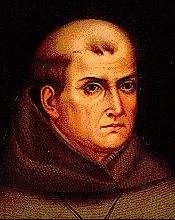
Fra
Juníper Serra, originari de Petra (Mallorca),
evangelitzador i fundador de Califòrnia.
Spanish
missionary Junipero Serra, native of Petra (Majorca),
founder of California.
Frère
Junioer Serra, originaire de Petra (Majorque),
évangélisateur et fondateur de la Californie.
Also
known as
Apostle of California
Miguel José Serra Ferrer
Profile
Entered the Franciscan University at Palma, Spain at
age 15, and joined the Order at
age 17, taking the name Junipero after the friend of Saint Francis. Ordained in 1737,
and taught philosophy and theology at
the Lullian University.
In 1749,
Serra was sent to the missionary territories
of the west of North America.
A mosquito bite he
received early in his trip to the New
World left one leg swollen;
this and his asthma made walking a painful process for the rest of his life.
In 1768 he
took over missions in
the Mexican provinces
of Lower and Upper California,
missions the Jesuits were
forced to abandon by order of King Charles
III. A tireless worker, Serra was largely responsible for the foundation and
spread of the Church on
the West
Coast of the United
States. Founded twenty-one missions, converted thousands
of Native
Americans, and trained many
of them in European methods
of agriculture, cattle husbandry,
and crafts. Dedicated religious and missionary,
penitent and austere in all areas of his life.
Blessed Junipero
Serra is the namesake of the Serra Club, an international Catholic organization
dedicated to the promotion of vocations, and the support of seminarians and
religious novices. Many of his letters and other writings have survived, and
the diary of his travels to the west was published in the early 20th
century.
Born
24 November 1713 at
Petra, Spanish Majorca
as Miguel Jose Serra
28 August 1784 of tuberculosis at
Mission San Carlos, California of
natural causes
buried at
Carmel, Monterey, California
9 May 1985 by Pope John
Paul II (decree of heroic
virtues)
25
September 1988 by Pope John
Paul II
23
September 2015 by Pope Francis
canonization recognition
celeberated at the Basilica of the Immaculate Conception, Washington, DC,
presided by Pope Francis
Name
Meaning
jester of God (=
Junipero)
Los
Angeles, California, archdiocese of
Additional
Information
Canonization
Homily, by Pope Francis
Catholic
Pioneers of America, by John O’Kane Murray
Miracle
of Padre Junipero, by Bret Harte
books
Our Sunday Visitor’s Encyclopedia of Saints
other
sites in english
National Catholic Register: Saint Junípero Serra is a Great
American Hero
images
audio
video
Diocese of Springfield,
Illinois
sitios
en español
Martirologio Romano, 2001 edición
fonti
in italiano
Dicastero delle Cause dei Santi
MLA
Citation
“Saint Junipero
Serra“. CatholicSaints.Info. 10 January 2026. Web. 4 February 2026.
<https://catholicsaints.info/saint-junipero-serra/>
SOURCE : https://catholicsaints.info/saint-junipero-serra/
HOLY MASS AND
CANONIZATION OF BLESSED FR. JUNÍPERO SERRA
HOMILY OF HIS HOLINESS
POPE FRANCIS
Rejoice in the Lord
always! I say it again, rejoice! These are striking words, words which impact
our lives. Paul tells us to rejoice; he practically orders us to rejoice. This
command resonates with the desire we all have for a fulfilling life, a meaningful
life, a joyful life. It is as if Paul could hear what each one of us is
thinking in his or her heart and to voice what we are feeling, what we are
experiencing. Something deep within us invites us to rejoice and tells us not
to settle for placebos which always keep us comfortable.
At the same time, though,
we all know the struggles of everyday life. So much seems to stand in the way
of this invitation to rejoice. Our daily routine can often lead us to a kind of
glum apathy which gradually becomes a habit, with a fatal consequence: our
hearts grow numb.
We don’t want apathy to
guide our lives… or do we? We don’t want the force of habit to rule our life…
or do we? So we ought to ask ourselves: What can we do to keep our heart from
growing numb, becoming anesthetized? How do we make the joy of the Gospel
increase and take deeper root in our lives?
Jesus gives the answer.
He said to his disciples then and he says it to us now: Go forth! Proclaim! The
joy of the Gospel is something to be experienced, something to be known and
lived only through giving it away, through giving ourselves away.
The spirit of the world
tells us to be like everyone else, to settle for what comes easy. Faced with
this human way of thinking, “we must regain the conviction that we need one
another, that we have a shared responsibility for others and for the world” (Laudato
Si’, 229). It is the responsibility to proclaim the message of Jesus. For
the source of our joy is “an endless desire to show mercy, the fruit of our own
experience of the power of the Father’s infinite mercy” (Evangelii
Gaudium, 24). Go out to all, proclaim by anointing and anoint by
proclaiming. This is what the Lord tells us today. He tells us:
A Christian finds joy in
mission: Go out to people of every nation!
A Christian experiences
joy in following a command: Go forth and proclaim the good news!
A Christian finds ever
new joy in answering a call: Go forth and anoint!
Jesus sends his disciples
out to all nations. To every people. We too were part of all those people of
two thousand years ago. Jesus did not provide a short list of who is, or is
not, worthy of receiving his message and his presence. Instead, he always
embraced life as he saw it. In faces of pain, hunger, sickness and sin. In faces
of wounds, of thirst, of weariness, doubt and pity. Far from expecting a pretty
life, smartly-dressed and neatly groomed, he embraced life as he found it. It
made no difference whether it was dirty, unkempt, broken. Jesus said: Go out
and tell the good news to everyone. Go out and in my name embrace life as it
is, and not as you think it should be. Go out to the highways and byways, go
out to tell the good news fearlessly, without prejudice, without superiority,
without condescension, to all those who have lost the joy of living. Go out to
proclaim the merciful embrace of the Father. Go out to those who are burdened
by pain and failure, who feel that their lives are empty, and proclaim the
folly of a loving Father who wants to anoint them with the oil of hope, the oil
of salvation. Go out to proclaim the good news that error, deceitful illusions
and falsehoods do not have the last word in a person’s life. Go out with the
ointment which soothes wounds and heals hearts.
Mission is never the
fruit of a perfectly planned program or a well-organized manual. Mission is
always the fruit of a life which knows what it is to be found and healed,
encountered and forgiven. Mission is born of a constant experience of God’s
merciful anointing.
The Church, the holy
People of God, treads the dust-laden paths of history, so often traversed by
conflict, injustice and violence, in order to encounter her children, our
brothers and sisters. The holy and faithful People of God are not afraid of
losing their way; they are afraid of becoming self-enclosed, frozen into
élites, clinging to their own security. They know that self-enclosure, in all
the many forms it takes, is the cause of so much apathy.
So let us go out, let us
go forth to offer everyone the life of Jesus Christ (Evangelii
Gaudium, 49). The People of God can embrace everyone because we are the
disciples of the One who knelt before his own to wash their feet (ibid., 24).
We are here today, we can
be here today, because many people wanted to respond to that call. They
believed that “life grows by being given away, and it weakens in isolation and
comfort” (Aparecida Document, 360). We are heirs to the bold missionary spirit
of so many men and women who preferred not to be “shut up within structures
which give us a false sense of security… within habits which make us feel safe,
while at our door people are starving” (Evangelii
Gaudium, 49). We are indebted to a tradition, a chain of witnesses who have
made it possible for the good news of the Gospel to be, in every generation,
both “good” and “news”.
Today we remember one of
those witnesses who testified to the joy of the Gospel in these lands, Father
Junípero Serra. He was the embodiment of “a Church which goes forth”, a Church
which sets out to bring everywhere the reconciling tenderness of God. Junípero
Serra left his native land and its way of life. He was excited about blazing
trails, going forth to meet many people, learning and valuing their particular
customs and ways of life. He learned how to bring to birth and nurture God’s
life in the faces of everyone he met; he made them his brothers and sisters.
Junípero sought to defend the dignity of the native community, to protect it
from those who had mistreated and abused it. Mistreatment and wrongs which
today still trouble us, especially because of the hurt which they cause in the
lives of many people.
Father Serra had a motto
which inspired his life and work, not just a saying, but above all a reality
which shaped the way he lived: siempre adelante! Keep moving forward!
For him, this was the way to continue experiencing the joy of the Gospel, to
keep his heart from growing numb, from being anesthetized. He kept moving
forward, because the Lord was waiting. He kept going, because his brothers and
sisters were waiting. He kept going forward to the end of his life. Today, like
him, may we be able to say: Forward! Let’s keep moving forward!
Copyright © Dicastery for
Communication
New
Catholic Dictionary – Blessed Junipero Serra
Article
Franciscan missionary to
southwestern North America. Born on 24
November 1713 at
Petra, Spanish Majorca
as Miguel Jose Serra; died on 28
August 1784 of tuberculosis at
Mission San Carlos, Monterey, California. Joined missionary college of San
Fernando, Mexico, in 1749,
and became famous as a fervent preacher, making long journeys on foot, though
suffering much from lameness. In 1767 he
was appointed superior of the Franciscan missions in Lower California, and
in 1769 founded
the first mission in Upper California. Difficulties with the military governor
compelled Serra to appeal to the viceroy, who decided in his favor. In 1778 the
faculty of administering Confirmation was granted. His principal writings are
the Representacion, drawn up by the
order of the viceroy; his Diario, and
many letters. Beatified on 25
September 1988 by Pope John
Paul II. Feast, 1
July.
MLA
Citation
“Blessed Junipero
Serra”. New Catholic Dictionary. CatholicSaints.Info.
18 December 2016. Web. 4 February 2026.
<https://catholicsaints.info/new-catholic-dictionary-blessed-junipero-serra/>
SOURCE : https://catholicsaints.info/new-catholic-dictionary-blessed-junipero-serra/
Junípero Serra
Born at Petra, Island
of Majorca, 24 November, 1713; died at Monterey, California,
28 August, 1784.
On 14 September, 1730, he
entered the Franciscan
Order. For his proficiency in studies he was appointed lectorof philosophy before
his ordination to
the priesthood.
Later he received the degree of Doctor of Theology from
the Lullian University at Palma, where he also occupied the Duns
Scotus chair of philosophy until
he joined the missionary college of San
Fernando, Mexico (1749). While traveling on foot from Vera
Cruz to the capital, he injured his leg in such a way that he suffered
from it throughout his life, though he continued to make his journeys on foot
whenever possible. At his own request he was assigned to
the Sierra Gorda Indian Missionssome thirty leagues north
of Querétaro.
He served there for nine years, part of the time as superior, learned the
language of the Pame Indians, and translated the catechism into
their language. Recalled to Mexico, he became famous as a most fervent and
effective preacher of missions. His zeal frequently
led him to employ extraordinary means in order to move the people
to penance. He would pound his breast with a stone while in the pulpit,
scourge himself, or apply a lighted torch to his bare chest. In 1767 he was
appointed superior of a band of fifteenFranciscans for
the Indian Missions of Lower California. Early in 1769
he accompanied Portolá's land expedition to Upper California.
On the way (14 May) he established the Mission San Fernando de
Velicatá, Lower California. He arrived at San Diego on 1
July, and on 16 July founded the first of the twenty-one California missions
which accomplished the conversions of all the natives on
the coast as far as Sonoma in the north. Those established by Father Serra or
during his administration were San Carlos (3 June, 1770); San
Antonio (14 July, 1771); San Gabriel (8 September,
1771); San Luis Obispo (1 September, 1772); San
Francisco de Asis (8 October, 1776); San Juan Capistrano (1 Nov.
1776); Santa Clara (12 January, 1777); San Buenaventura (31
March, 1782). He was also present at the founding of the presidio of
Santa Barbara (21 April, 1782), and was prevented from locating the
mission there at the time only through the animosity of Governor
Philipe de Neve. Difficulties with Pedro Fages, the military commander,
compelled Father Serra in 1773 to lay the case before Viceroy Bucareli. At the
capital of Mexico, by order of the viceroy, he drew up his
"Representación" in thirty-two articles. Everythingsave two
minor points was decided in his favour; he then returned to California,
late in 1774. In 1778 he received the faculty to administer
the Sacrament of Confirmation. After he had exercised his privilege for
a year, Governor Neve directed him to suspend administering
the sacrament until he could present the papal
Brief. For nearly two years Father Serra refrained, and then Viceroy
Majorga gave instructions to the effect that Father Serra was within his rights.
During the remaining three years of his life he once more visited the missions
fromSan Diego to San
Francisco, six hundred miles, in order to confirm all who had
been baptized.
He suffered intensely from his crippled leg and from his chest, yet he would
use no remedies. He confirmed 5309 persons,
who, with but few exceptions, were Indians converted during the
fourteen years from 1770. Besides extraordinary fortitude,
his most conspicuous virtues were insatiable zeal, love of mortification, self-denial,
andabsolute confidence in God.
His executive abilities has been especially noted by non-Catholic writers. The
esteem in which his memory is held by all classes in California may
be gathered from the fact that Mrs. Stanford, not aCatholic,
had a granite monument erected to him at Monterey. A bronze statue of
heroic size represents him as the apostolic preacher in Golden Gate
Park, San Francisco. In 1884 the Legislature of California passed
a concurrent resolution making 29 August of that year, the centennial of Father
Serra's burial, a legal holiday. Of his writings many letters
and other documentation are extant. The principal ones are his
"Diario" of the journey from Loreto to San Diego,
which was published in "Out West" (March to June, 1902), and the
"Representación" before mentioned.
Sources
PALOU, Noticias de
la Nueva California (San Francisco, 1774); IDEM, Relacion historica
de la vida y apostolicas tarcas del Ven. P. Fr. Junípero Serra (Mexico
City, 1787); Santa Barbara Mission Archives; San Carlos Mission Records;
ENGELHARDT, Missions and Missionaries of California, I (San Francisco,
1886); GLEESON, Catholic Church in California, II (San Francisco, 1871);
HITTELL, History of California, I (San Francisco, 1885); JAMES, In
and Out of the Missions (New York, 1905).
Engelhardt, Zephyrin. "Junípero Serra." The Catholic
Encyclopedia. Vol. 13. New York: Robert Appleton
Company, 1912. 23 Mar.
2015 <http://www.newadvent.org/cathen/13730b.htm>.
Transcription. This
article was transcribed for New Advent by Michael T. Barrett. Dedicated to
Catholic missionaries.
Ecclesiastical
approbation. Nihil Obstat. February 1, 1912. Remy Lafort, D.D.,
Censor. Imprimatur. +John Cardinal Farley, Archbishop of New York.
Copyright © 2023 by Kevin Knight.
Dedicated to the Immaculate Heart of Mary.
SOURCE : http://www.newadvent.org/cathen/13730b.htm
Catholic
Pioneers of America – Francis Juniper Serra, O.S.F.
Article
Founder of San Francisco,
and Apostle of California. Died A.D. 1784.
Centuries before the
greedy gold-hunter directed his steps towards California, its lofty hills and
lovely valleys were traversed by the Jesuit and the Franciscan – devoted
pioneers of the Catholic Religion – who were on a widely different mission. One
of them has written his name in shining letters on the first page of its
history. It is the Apostle of the State – Father Francis Juniper Serra.
He was born of poor but
pious parents on the 24th of November, 1713, in the island of Majorca. The
bright boy was educated by the Franciscan Fathers, and at the age of sixteen he
became a member of that Order. Young Serra’s gifts did not mar his virtue. He
was honored with the degree of Doctor of Theology, filled a professor’s chair,
and found his happiness in study, teaching, prayer, and the practice of virtue.
But Father Serra had the
missionary spirit, and he discovered his true field of exertion in the New
World. After a stormy passage, he landed in Mexico, and penetrated on foot to
the capital, in company with a number of his brother Franciscans. The Apostolic
band reached the city of Montezuma on New-Year’s Day, 1750.
Father Serra was now sent
to labor among the wandering tribes of .the Sierra Gorda, and he toiled for
years to gain these poor souls to Christ. He was a true spiritual guide.
He tried each art, reproved
each dull delay,
Allured to brighter worlds, and led the way.”
It is said that in order
to give his simple, dusky flock a good example, he made it a custom to go to
confession in the presence of the people.
When the Spanish
Government unjustly closed the Jesuit missions in Lower California, the
Franciscans were ordered to continue the work; and Father Serra was appointed
Superior of the band of priests sent to that province. As soon as the
missionaries were properly stationed, he proceeded to carry out the great labor
of his life – the establishment of missions in Upper California, or what is now
the State of California.
The Spanish missionaries
usually accompanied a military expedition, and it was so in this instance.
Father Serra and three Franciscans joined the expedition commanded by Galvez in
1769. “The first object of this expedition,” wrote the commander, in his
instructions, “is to establish the Catholic Religion among a numerous heathen
people, submerged in the darkness of paganism, and to extend the dominion of
our sovereign, the King of Spain.” The expedition left La Paz, in Lower
California, and after some sailing and forty-six days’ travelling by land, it
reached the port of the present city of San Diego. Here Father Serra began his
first mission.
The establishment of a
mission may be thus briefly sketched. The place was taken possession of by the
military authorities. A tent was erected as a temporary chapel. Father Serra
and the other priests then went in procession, and blessed the chapel, on whose
front a crucifix or simple wooden cross was raised. Mass was celebrated, and a
sermon preached on the coming and power of the Holy Ghost. The Veni
Creator was sung, and a Father was charged with the direction and
responsibility of the mission.
The Indians were
attracted by little presents. To the men and women were given small pieces of
cloth, or food, and to the children bits of sugar. They would soon gather
around the missionaries, when they found how good and kind they were; and the
priests were not slow in picking up the language. They became the fathers and
instructors of the poor, ignorant Indians, catechized them in the mysteries of
the faith, collected them into villages around the mission church, and taught
them to plough and cultivate the lands, to sow wheat, to grind corn, to. bake.
They introduced the olive, the vine, and the apple; and taught the savages how
to yoke the oxen for work, how to spin and weave their clothing, to prepare
leather from the hides and instructed them in the rudiments of commerce.
The outposts of religion
grew rapidly in numbers and extent. So busy was Father Serra in the wilderness
of California, that he had almost lost sight of the outside world. “As it is a
whole year since I received any letter from a Christian country,” he writes to
a friend in 1771, “your reverence may imagine in what want of news we are; but,
for all that, I only ask you, when you can get an opportunity, to inform me
what the most holy Father, the reigning Pope, is called, that I may put his
name in the Canon of the Mass.”
“Tell me, also,” he adds,
“if it is true that the Indians have killed Father Joseph Saler in Sonora, and
how it happened and if there are any other departed friends, so that I may
commend them to God, with anything else that you may think fit to communicate
to a few poor hermits, who are separated from human society. To-morrow, we
shall celebrate the feast and make the procession of Corpus Christi – though in
a very poor manner – in order to scare away whatever little devils there may
possibly be in this land.” Twelve priests joined in this sacred procession, and
the wild but lovely valleys of Monterey resounded as they had never done
before.
The Indians embraced the
faith in thousands. The only want was more missionaries. “Let those who come
here,” wrote Father Serra, “come well provided with patience and chanty, and
let them have a stock of good-humor, for they may become rich – I mean in
troubles. But where will the laboring ox go that he must not draw the plough?
And if he do not draw the plough, how can there be a harvest?”
At the very time when the
Fathers of this Republic were drafting the Declaration of Independence, a
mission was founded at San Francisco by order of the saintly Serra. It was on
the 27th of June, 1776, “San Francisco,” says a western writer, “has this, at
least, to boast of – that the first building erected within it, was dedicated
to God’s worship under the patronage of Saint Francis.”
Though age was rapidly
stealing over Father Serra, he continued, as Prefect Apostolic and Superior of
the missions in California, to push on the good work with the zeal and energy
of a young apostle. He was granted power to administer the sacrament of
Confirmation. One of the missionaries was murdered by the savages. “Thank God!”
he exclaimed, “that field is watered.” “Ten missions were already established,
and about ten thousand Indians had been baptized, when the angel of death came.
The great priest with trembling steps went to the church, and received the Holy
Communion on his knees. He ordered the carpenter of the mission to make his
coffin. He was assisted back to his bed, and soon after the solemn tolling of
the church bells at Monterey and the firing of salutes by the war vessels in
the harbor, with the flags at half-mast, announced to the world that the
venerable Father Serra was no more. He died on the 29th of August, 1784, at the
age of seventy-one years.
MLA
Citation
John O’Kane Murray, M.A.,
M.D. “Francis Juniper Serra, O.S.F.”. The
Catholic Pioneers of America, 1881. CatholicSaints.Info.
10 January 2026. Web. 4 February 2026.
<https://catholicsaints.info/catholic-pioneers-of-america-francis-juniper-serra-o-s-f/>
SOURCE : https://catholicsaints.info/catholic-pioneers-of-america-francis-juniper-serra-o-s-f/
Blessed Junipero Serra
In 1776, when the
American revolution was beginning in the east, another part of the future
United States was being born in California. That year a gray-robed Franciscan
founded Mission San Juan Capistrano, now famous for its annually returning
swallows. San Juan was the seventh of nine missions established under the
direction of this indomitable Spaniard. Born on Spain’s island of Mallorca,
Serra entered the Franciscan Order, taking the name of Saint Francis’ childlike
companion, Brother Juniper. Until he was thirty-five, he spent most of his time
in the classroom-first as a student of theology and then as a professor. He
also became famous for his preaching. Suddenly he gave it all up and followed
the yearning that had begun years before when he heard about the missionary
work of Saint Francis Solanus in South America. Junipero’s desire was to
convert native peoples in the New World.
Arriving by ship at Vera
Cruz, Mexico, he and a companion walked the 250 miles to Mexico City. On the
way Junipero’s left leg became infected by an insect bite and would remain a
cross, often life-threatening, the rest of his life. For eighteen years he
worked in central Mexico and in the Baja Peninsula. He became president of the
missions there.
Charles III of Spain
ordered an expedition to beat Russia to the territory. So the last two
conquistadores-one military, one spiritual-began their quest. Jose de Galvez
persuaded Junipero to set out with him for present-day Monterey, California.
The first mission founded after the nine-hundred-mile journey north was San
Diego (1769). That year a shortage of food almost canceled the expedition.
Vowing to stay with the local people, Junipero and another friar began a novena
in preparation for Saint Joseph’s day, March 19, the scheduled day of
departure. On that day, the relief ship arrived.
Other missions followed:
Monterey/Carmel (1770); San Antonio and San Gabriel (1771); San Luis Obispo
(1772); San Francisco and San Juan Capistrano (1776); Santa Clara (1777); San
Buenaventura (1782). Twelve more were founded after Serra’s death.
Junipero made the long
trip to Mexico City to settle great differences with the military commander. He
arrived at the point of death. The outcome was substantially what Junipero
sought: the famous “Regulation” protecting the Indians and the missions. It was
the basis for the first significant legislation in California, a “Bill of
Rights” for Native Americans.
Because the Native
Americans were living a nonhuman life from the Spanish point of view, the
friars were made their legal guardians. The Native Americans were kept at the
mission after Baptism lest they be corrupted in their former haunts — a move
that has brought cries of “injustice” from some moderns.
Junipero’s missionary
life was a long battle with cold and hunger, with unsympathetic military
commanders and even with danger of death from non-Christian native peoples.
Through it all his unquenchable zeal was fed by prayer each night, often from
midnight until dawn. He baptized over six thousand people and confirmed five
thousand. His travels would have circled the globe. He brought the Native
Americans not only the gift of faith but also a decent standard of living. He
won their love, as witnessed especially by their grief at his death. He is
buried at Mission San Carlo Borromeo, Carmel, and was beatified in 1988.
SOURCE : http://www.ucatholic.com/saints/bl-junipero-serra/
Bl. Junipero Serra
Feastday: July 1
Patron of Vocations
1713 - 1784
Beatified By: Pope John
Paul II
Miguel Jose Serra was
born on the island of Majorca on November 24, 1713, and took the name of
Junipero when in 1730, he entered the Franciscan Order. Ordained in 1737, he
taught philosophy and theology at the University of Padua until 1749.
At the age of
thirty-seven, he landed in Mexico City on January 1, 1750, and spent the rest
of his life working for the conversion of the peoples of the New World.
In 1768, Father Serra
took over the missions of the Jesuits (who had been wrongly expelled by the
government) in the Mexican province of Lower California and Upper California
(modern day California). An indefatigable worker, Serra was in large part
responsible for the foundation and spread of the Church on the West Coast of
the United States when it was still mission territory.
He founded twenty-one
missions and converted thousands of Indians. The converts were taught sound
methods of agriculture, cattle raising, and arts and crafts.
Junipero was a dedicated
religious and missionary. He was imbued with a penitential spirit and practiced
austerity in sleep, eating, and other activities. On August 28, 1784, worn out
by his apostolic labors, Father Serra was called to his eternal rest. He was
beatified by Pope John Paul II on September 25, 1988. His statue, representing
the state of California, is in National Statuary Hall. His feast day is July 1.
SOURCE : http://www.catholic.org/saints/saint.php?saint_id=401
Saint Junipero Serra:
Priest, Missionary and Founder
Apr 28, 2015 /
Written by: America
Needs Fatima
Feast July 1
Apostle of the West
Junipero Serra, the
indomitable apostle of California, was born on the Spanish Balearic island of
Mallorca in the Mediterranean Sea and received the name Miguel Jose in Baptism.
Later entering the
Franciscan Order, he took the name of Saint Francis of Assisi’s childlike
companion, Brother Juniper, and came to be known as Fray Junipero.
His was a
“rags-to-riches” story. Born into poverty but brilliant of intellect, before
the age of 30 he held a doctorate in theology and occupied the Duns Scotus
chair of philosophy at the Lullian University in Palma de Mallorca.
Renowned as a preacher
and professor, he could easily have become the dean of the university and more
but at the age of 36 he gave up all earthly semblance of glory to follow his
long-harbored desire to evangelize the natives in the New World.
The inspiration of his
missionary zeal was another Franciscan, the great 16th century apostle of South
America, St. Francis Solano.
Arriving in Vera Crux in
Mexico, Fray Junipero and a companion walked 250 miles to Mexico City. On the
way, Fray Junipero hurt his leg, which never fully healed, a condition that was
life-threatening at times and which caused him much discomfort for the rest of
his life.
He worked for eighteen
years in central Mexico and the Baja California Peninsula, and then was
convinced by Capitan Juan Galvez to follow him on a 900-mile journey to
present-day Monterey, California.
When insurmountable
difficulties arose with a military commander, he made the grueling trip to
Mexico City and there obtained from the Viceroy the famous document known as
the “Regulation” protecting the Indians and the missions. It was the basis for
the first significant legislation of California, a sort of “Bill of Rights.”
Serra was 54 when he took
charge of the missions in Alta California, heading a group of fifteen
Franciscans. He founded his first mission – San Diego de Alcalá – in 1769. This
mission almost had to be quit due to a shortage of food. Vowing to stay with the
local people, Saint Junipero began a novena to Saint Joseph. On March 19, the
feast of Saint Joseph and, coincidentally, the scheduled day for departure, the
relief ship arrived.
From San Diego, the holy
Franciscan, traveling indefatigably despite his bad leg, established another
eight missions. Twelve more missions were founded after his death. Many of
these missions became the centers of great cities like San Diego. The Apostle
of California baptized 6,000 people and traveled 20,000 miles.
Fray Junipero Serra’s
life was one long battle with the elements, the terrain, cold and hunger,
unsympathetic commanders, and even danger of death from non-Christian natives.
But he fed his unquenchable zeal with a life of intense prayer, often from
midnight to dawn.
He brought the Native
Americans the gift of faith and a better quality of life, and won their love in
the process. This ardent and zealous son of St. Francis died in 1784 at the age
70 at Mission San Carlos Borromeo and was beatified in 1988.
Such was the virtue, the
tenacity, and the sheer courage of this man of God, that even secularist
biographers, who struggle to understand Fr. Junipero’s astounding asceticism
and heroic generosity, salute the man. Such was his contribution to the
civilization of our nation that a bronze representation of him, cross held
high, stands in the National Statuary Hall of the United States Capitol, in
Washington D.C. 1
Nine missions Saint
Junipero founded:
Mission Basilica San Diego de Alcalá, July 16, 1769,
present-day San Diego, California.
Mission San Carlos Borromeo de Carmelo, June 3, 1770,
present-day Carmel-by-the-Sea, California.
Mission San Antonio de Padua, July 14, 1771
Mission San Gabriel Arcángel, September 8, 1771,
present-day San Gabriel, California.
Mission San Luis Obispo de Tolosa, September 1, 1772,
present-day city of San Luis Obispo, California.
Mission
San Juan Capistrano, November 1, 1776, present-day San Juan Capistrano
Mission San Francisco de Asís, June 29, 1776, present-day
San Francisco, California chain of missions.
Mission Santa Clara de Asís, January 12, 1777, present-day
city of Santa Clara, California, and
Mission
San Buenaventura, March 31, 1782, present-day Ventura, California.
Notes:
1 Just
weeks after Pope Francis announced his intention of canonizing Blessed Junipero
Serra during his visit to the United States, California’s openly homosexual
Senator Ricardo Lara began moving to replace the statue of our venerable saint
with that of Sally Ride the first female astronaut, who was also a lesbian.
SOURCE : https://americaneedsfatima.org/articles/saint-junipero-serra-priest-missionary-and-founder
St. Junípero Serra is a
Great American Hero
“Everything he did, from
the time he was a boy, was to promote the Catholic Church.”
July 1, 2020
St. Junipero Serra (1713-84)
is a significant name in California’s history. Revered by some, reviled by
others, the dedicated Franciscan friar launched California’s mission system in
1769, and would ultimately oversee the founding of the State’s first nine
missions. Twenty-one missions would be founded by the Spanish in all.
Serra was born in the
island of Majorca, a Spanish island possession off the eastern coast of Spain,
and joined the Franciscan order at age 17. He quickly distinguished himself for
both his piety and learning, and spent more than a decade preaching and
teaching at the university level in Majorca. Inspired by the example of the
great missionaries of his order, he sailed for Mexico on 1749. He spent the
remainder of his life evangelizing the Indians of Mexico and California.
At age 56, he began his
apostolic missionary work in California; his goal was to bring the Catholic
faith to the Indians and make them citizens of New Spain. His missionaries also
brought with them the crops and livestock which would make California prosper.
Pope John Paul II,
believing Serra lived a life of virtue and is a role model for Catholics,
declared him venerable in 1985. In 1988, the pontiff accepted that a
miracle had been worked through Serra’s intercession and beatified him. In
2015, Pope Francis canonized him at the Basilica of the National Shrine of the
Immaculate Conception in Washington, D.C.
Serra’s contribution to
California has been recognized by civil authorities as well. In 1931, a statue
of Serra was unveiled in the U.S. Capitol. The following are comments on
the life of St. Junipero Serra, offered by individuals who have studied the
life of the venerable padre extensively.
Andy Galvan is
curator of Mission Dolores in San Francisco. He is a former Franciscan
brother, and his ancestors include the Ohlone Indians (the inhabitants of the
San Francisco Bay area before the arrival of the Spanish). He also served
as a member of the board of directors of the Junipero Serra Cause for
Canonization. Although some who identify themselves as descendants of the
California Indians have criticized Serra for his treatment of the Indians,
Galvan has a different perspective. He said, “I believe Serra is a
saint.”
Galvan was active in the
support of Serra’s cause for canonization beginning in 1978, when he met Serra
biographer and Franciscan friar Fr. Noel Francis Moholy (1916-98) at Mission
San Jose. Fr. Moholy devoted over 40 years of his life to seeing Serra
canonized as vice postulator of Serra’s cause, and stood with Galvan at the
Vatican to see Serra beatified. Although Fr. Moholy died before Fr. Serra
was declared a saint, Galvan was excited to see it himself.
Galvan described Serra as
a hard worker, “all wood and nails.” Examination of his skeletal remains and
written accounts indicate that he was 5-foot, 2-inches tall, had blue eyes and
a dark complexion. But, most notably, “Serra was on fire for spreading the
Gospel message.”
In studying the friar,
however, it is important to remember that his was a perspective of a man of the
18th century, different from that of many people today, Galvan said.
As a teenager, Galvan
continued, Serra was inspired by the example of the Spanish Franciscan St.
Francis Solano (1549-1610), who came to present-day South America to preach the
Gospel to its inhabitants. He also stressed that Serra was heavily
influenced by the teachings of philosopher-theologian Blessed John Duns Scotus
(1266-1308).
Galvan remarked, “It
became Serra’s life dream to preach the Gospel in a place where it had never
been brought before.”
Msgr. Francis Weber of
Mission San Fernando is a priest and archivist emeritus for the Archdiocese of
Los Angeles. He has written “seven or eight” books on Serra, including Life
and Times of Fray Junipero Serra in 1987. He said, “Serra is one of the
great heroes of California, and a great exemplar for young people. He was an
outstanding person.”
One of Serra’s most
notable qualities, said Msgr. Weber, was curiosity, which “impelled him to do
all kinds of things.” He was curious about the lives of the California
Indians, for example.
Monsignor is a seasoned
historian, and he encourages those who want to learn about Serra to begin by
reading the ample writings of Serra himself, and historical accounts written
about Serra by those who knew him. Monsignor recommended the work of Franciscan
priest and historian Maynard Geiger (1901-77), a defender of the California
mission system, whose works include books on Serra himself and compilations of
Serra’s letters.
Msgr. Weber continued,
“Historians are literary detectives. They need to examine the evidence
presented by people who lived in the time [of people such as Serra].
Also, we must remember not to judge a person by our standards, but by the
standards of the time in which they lived.”
Serra and many of his
fellow missionaries were university professors, Msgr. Weber continued, who left
the comforts of home to bring the Catholic faith and “what they considered a
better way of life to the aboriginal people of California.” Monsignor
continued, “The Native Americans had no formal education, and the missionaries’
idea was to bring them to the missions, [introduce them to] agriculture and
raise cattle and other livestock.”
Relative to today, there
were few people in California and wild game plentiful, Msgr. Weber said. But,
he added, “If you’d kill a beast you’d have to eat it that day, as you’d have
nothing to refrigerate it with. They didn’t have what we’d consider the
necessities of modern life.”
It was the idea of the
Spanish, he said, to elevate the life of the California Indians: “They thought,
‘Our society offers a better way to live life out.’”
Msgr. Weber rejected the
belief of some that Serra had mistreated the Indians: “There’s no single
recorded example in the official documentation of the period that Serra
mistreated the Native Americans … in fact, he walked all the way to Mexico City
to get a bill of rights issued for them. He was a great man all around.”
Bob Spidell has
served as a docent at Mission San Juan Capistrano. He is past president
of the docent society, and has done an extensive study of Serra.
Spidell, who is not
Catholic, described Serra as a man “extremely dedicated to the Catholic Church.
Everything he did, from the time he was a boy, was to promote the Catholic
Church.”
He continued, “Serra was
always looking to expand the Church. He asked his superiors for
permission to found a mission, they’d say no, and he’d do it anyway.”
He was an able leader,
Spidell said, and effective at defending his actions to his superiors. Spidell
remarked, “He had to travel to Mexico several times to do this, and he was good
at it.”
Serra’s determination led
him to overcome many challenges. When he first arrived in Vera Cruz,
Mexico, he was bitten by a bug. The wound never properly healed, and it
caused him much suffering the rest of his life. Shortly before his death,
Serra walked from Carmel to Mission San Gabriel (in the Los Angeles area),
virtually not eating for 18 days. Spidell said, “He did this on sheer
will power.”
Serra’s contribution to
California was enormous, Spidell believes: “Without someone like him,
California would be a much different place. It’s not clear that Spain would
have expanded into California at all.”
Spidell, too, said there
was nothing in historical documents to indicate that Serra had mistreated the
Indians; in fact, “he was protective of the Indians, such as when the Spanish
soldiers were cruel to them. He looked after them as part of his flock.”
Spidell added that
considering one culture had completely dominated another, he was “surprised
there wasn’t more friction between them.” The Spanish converted the
Indians from hunter-gatherers to farmers and ranchers, he said, which allowed
for a much more stable food supply. Spidell quipped, “The Spanish had a
good business model. If you join our church, we’ll feed and clothe you.”
Kristina Foss is
museum director of Old Mission Santa Barbara, Vice Chair of the California
Missions Foundation, has taught Native American Studies at Santa Barbara City
College for 40 years and is a descendant of the Muscogee Indians.
She recently traveled to
Serra’s birthplace, Majorca, and visited sites of historical significance in
Serra’s life. “As a native person” she went with some negative attitudes
about Serra and the missions, but came home from Majorca “with a different take
than I thought I would.”
She saw Serra as a
classroom philosophy professor, influenced by the writings of Scotus, wanting
to establish “a perfect Christian community, in which everyone would share,
there would be no fighting and everyone would be kind to and love each other.”
He thought such a
community could not be achieved in Europe, she said, but the Indians “free from
his cultural trappings” could. She continued, “I saw Serra from his time
period. He was trying to come to the New World to bring what he believed
was cultural and social Christian improvement, not merely establishing the
political policies of Spain.”
She discovered that the
homes in Indian villages built in Santa Barbara were modeled after Serra’s own
boyhood home in Majorca. She continued, “He thought he was bringing
social change that would be beneficial to California. He went up in my
estimation.”
What is considered
mistreatment today—such as corporal punishment—was commonplace in Europe at the
time, she added, and was not considered mistreatment. Some of the harm
that came to the California Indians, such as diseases brought by the Spanish or
illnesses caused by the introduction of a new diet, was not intended by the
padres and “I think was a cause of sorrow to Serra.”
She believes it is
fitting to celebrate Serra’s life, because “whatever your political view, Serra
is incredibly important in what happened to California.”
Bob Senkewicz, a
professor of history at Santa Clara University who wrote a book on Serra,
agreed that Serra “is one of the most important figures in California history
before the Gold Rush.”
Serra is also a symbol of
what California has become, he said. He explained, “California is a place where
people of different points of view come together, sometimes amicably, sometimes
filled with tension. I think California is still that way today.”
Serra was not an American
but a Latin American missionary, he added, in a long-established mission
system: “He was extremely committed to his mission of evangelizing
non-Christians. He was trying to save people’s souls.”
Jim Graves was a
volunteer docent at Mission San Juan Capistrano, Orange County, California’s
only mission, for three years. During that time, he shared the story of St.
Junipero Serra and the missions with many school children.
This article originally
appeared July 1, 2017, at the Register.
Jim Graves Jim
Graves is a Catholic writer and editor living in Newport Beach, California. He
previously served as Managing Editor for the Diocese of Orange Bulletin, the
official newspaper of the Diocese of Orange, California. His work has appeared
in the National Catholic Register, Our Sunday Visitor, Cal Catholic Daily and
Catholic World Report.
SOURCE : https://www.ncregister.com/blog/st-junipero-serra-is-a-great-american-hero
Junipero Serra
(1713-1784)
A priest in the
Franciscan order of the Catholic Church, Junipero Serra was a driving force in
the Spanish conquest and colonization of what is now the state of California.
Serra was born into a
humble family on the Spanish island of Mallorca in the Mediterranean Ocean. His
parents sent him to a nearby Franciscan school, and his intellectual abilities
soon caught the attention of his teachers. At age fifteen he enrolled in a
prominent Franciscan school in the nearby city of Palma. The next year he
became a novice in the Franciscan order and shortly thereafter was ordained as
a priest.
Serra's intellectual
acumen and enormous willpower secured his appointment as a professor of
theology at the tender age of twenty-four. Six years later, in 1743, he moved
on to a professorship at the prestigious Lullian University.
Despite his success as a
pulpit orator and professor, Serra hungered for something more. In 1749 he
secured permission to travel with some fellow Franciscans who intended to
devote themselves to work at a mission near Mexico City. Serra took the long
sea voyage to Spain's colonies. Despite ill health from the voyage, upon his
arrival in Vera Cruz he insisted on walking all the way to Mexico City, a
distance of over two hundred miles. This was the first of many feats of
physical stamina and willpower which were to make the Franciscan a legend in
his own time.
For some fifteen years,
Serra worked in Mexico at much the same tasks as he had in Spain, although he
took on missionary work to nearby Indian peoples in addition to preaching,
hearing confessions, and helping to administrate Mexico City's College of San Fernando.
In 1767 the Spanish
emperor's expulsion of the Jesuits from Spain's colonies led the government to
ask the Franciscan Order to replace them as missionaries in Baja (lower)
California. Serra was appointed head of these missions. The next year the
Spanish governor decided to explore and found missions in Alta (upper)
California, the area which is now the state of California. This project was
intended both to Christianize the extensive Indian populations and to serve
Spain's strategic interest by preventing Russian explorations and possible
claims to North America's Pacific coast.
Serra spent the rest of
his life as head of the Franciscans in Alta California. Already over fifty
years old, dangerously thin, asthmatic, and seriously injured in one of his
legs, the undaunted Serra led the founding of the Mission of San Diego in 1769,
aided an expedition in locating San Francisco Bay, and personally founded eight
other missions, including his lifelong headquarters, the mission San Carlos
Borromeo at Carmel. His Herculean efforts subjected him to near-starvation,
afflictions of scurvy, and hundreds of miles of walking and horse riding
through dangerous terrain. Moreover, he was notorious for his mortifications of
the flesh: wearing heavy shirts with sharp wires pointed inward, whipping
himself to the point of bleeding, and using a candle to scar the flesh of his
chest. His sacrifices bore fruit for the missionaries; by his death in 1784,
the nine missions he had founded had a nominally converted Indian population of
nearly 5,000.
Serra argued with the
Spanish Army over the proper authority of the Franciscans in Alta California,
which he thought should subsume that of military commanders. In 1773 he
convinced the authorities in Mexico City to increase financial and military
support for expansion of his missions, and to expand the authority of the
Franciscans over both the army and the baptized mission Indians. He also urged
Mexican officials to establish an overland route to Alta California, a
suggestion which led to colonizing expeditions from New Mexico which
established civilian settlements at San Francisco in 1776 and at Los Angeles in
1781.
Serra wielded this kind
of political power because his missions served economic and political purposes
as well as religious ends. The number of civilian colonists in Alta California
never exceeded 3,200, and the missions with their Indian populations were
critical to keeping the region within Spain's political orbit. Economically,
the missions produced all of the colony's cattle and grain, and by the 1780's
were even producing surpluses sufficient to trade with Mexico for luxury goods.
Despite the frequent
conflicts between military and religious authority, for Alta California's
Indians the missions and their Franciscan administrators were part and parcel
of an enormously destructive colonization process. The Spanish, largely through
disease, were responsible for a population decline from about 300,000 Indians
in 1769 to about 200,000 by 1821. The strenuous work regime and high population
density within the missions themselves also caused high death rates among the
mission Indians. By law, all baptized Indians subjected themselves completely
to the authority of the Franciscans; they could be whipped, shackled or imprisoned
for disobedience, and hunted down if they fled the mission grounds. Indian
recruits, who were often forced to convert nearly at gunpoint, could be
expected to survive mission life for only about ten years. As one Friar noted,
the Indians "live well free but as soon as we reduce them to a Christian
and community life... they fatten, sicken, and die."
Junipero Serra is still a
well-known figure in California, a virtual icon of the colonial era whose
statue stands in San Francisco's Golden Gate Park and in the U.S. Capital. In
1987 Pope John Paul II beatified Serra, the second of three steps necessary for
the Church's bestowal of formal sainthood. Many Indians and academics condemned
this decision, pointing to the harsh conditions of mission life and Serra's own
justification of beatings. (In 1780, Serra wrote: "that spiritual fathers
should punish their sons, the Indians, with blows appears to be as old as the
conquest of [the Americas]; so general in fact that the saints do not seem to
be any exception to the rule.") Defenders of Serra cited the context of
his times, his enormous personal sacrifices and religious zeal, and his
opposition to punitive military expeditions against the Indians as exonerating
factors. More than two centuries after his death, Junipero Serra is still a
pivotal figure in California history and the history of the American West, this
time as a flashpoint for controversy over European treatment of Indians.
SOURCE : http://www.pbs.org/weta/thewest/people/s_z/serra.htm
FATHER JUNÍPERO SERRA:
BIOGRAPHY
When Father Junípero
Serra founded California's first mission in 1769, he was 56 years old and
asthmatic, with a chronic sore on his leg that troubled him for the rest of his
life, and he suffered frequently from other illnesses, as well. He stood just 5
feet, 2 inches, and, as a journalist later wrote, "He certainly didn't
look like the man who would one day be known as the Apostle of
California." Yet he endured the hardships of the frontier and pressed
forward with remarkable determination to fulfill his purpose: to convert the
Native Americans of California to Christianity.
In pursuit of that goal,
Father Serra walked thousands of miles between San Diego and Monterey and even
Mexico City. He traveled the seas, also; and by the time he died August 28,
1784, in Carmel he had founded nine missions, introduced agriculture and
irrigation techniques, and the Spanish language. He had battled governors,
bureaucrats and military commanders to secure a system of laws to protect the
California Indians from at least some of the injustices inflicted by the Spanish
soldiers whose practices often were in conflict with Father Serra's.
Father Serra had been a
philosophy professor and distinguished preacher at the Convent of San Francisco
in Mallorca, the Spanish island where he was born in 1713. He was 36 years old
when he reached the port of Vera Cruz, Mexico, on December 8, 1749, and walked
to Mexico City. ( It was during that journey of 24 days that an insect bite
caused the sore on his leg that sometimes became so painful he had difficulty
walking. ) He spent 17 years in missionary work in the Sierra Gorda in the
present area of North-Central Mexico. In 1767 he became president of the 14
missions in Baja California, originally founded by the Jesuits, then turned
over to the Franciscans.
At that time, faced with
the threat of Russian colonization from the north, Spain had committed itself
to pushing northward into what is now the American state of California. Russian
America (Alaska) was only 800 miles away. Spain feared that Russia would push
south and gain a firm foothold in Alta California. The Spanish military
launched an expedition into California in 1769 under the leadership of Gaspar
de Portola. Father Serra set out with them to establish missions.
Serra's blessing of the
site of Mission San Diego de Alcala on July 16, 1769, marked the beginning of
the European settlement of California.
Between the years of 1796
and 1784, Father Serra made six voyages by sea totaling 5,400 miles. He
traveled by land the distance between Monterey and San Francisco eight times,
Monterey and San Antonio 11 times, His longest journey by land was from
Monterey to Mexico City. In total, he traveled well over 5,500 miles by land.
Father Serra arrived at
Monterey aboard the sailing ship San Antonio on June 1, 1770. He celebrated the
first Mass on June 3, 1770, on the shore of Monterey Bay, where we now find the
city of Monterey.
He returned to San Diego
to work on the mission there, then founded Mission San Juan Capistrano in 1776,
the year of the American Declaration of Independence.
When Father Serra died in
1784 he had established nine California missions and baptized 6,000 Indians,
about 10 percent of the California Native American population. Those nine
missions grew to 21. Today, more than 60 percent of the state's nearly 26
million people live in areas surrounding the missions, and El Camino Real, the
road that Father Serra traveled on a tour of the missions shortly before this
death, established a major artery running much of the length of the state.
August 28th is the
anniversary of the death of Father Serra, and is set aside in special
remembrance of his many contributions to the Catholic Church in America.
SOURCE : http://www.serraclubofbethlehem.org/serra-4.htm
Saint Junipero Serra
Spanish Franciscan
priest, explorer and colonizer of California where he was the founder of the
missions of California. He was beatified by Pope John Paul II in September
1988.
Junipero Serra was born
Miguel Serra y Abram on November 24, 1713 in Petra, a farming village in
Mallorca’s central plain. At the age of sixteen, Miguel entered the Franciscan
friary and took the name Junípero, after St. Francis’ close, extroverted
friend.
Years of formation and
study followed, and in 1744 he was named Professor of Philosophy at the
monastery of San Francisco and at Lullian University. Serra was known as a
bright, articulate scholar — apparently a moving speaker and a clear, precise
writer — but he did not remain long in academic life. In 1749 he responded to
the call for Franciscan missionaries to the New World.
Nearly 200 years before,
Spain had established a colony called New Spain, the area now known as Mexico.
The success of colonization was due largely to the collaboration of the Spanish
imperial staff and the Catholic Church. By acting as partners in exploration
and settlement efforts, both their purposes were achieved: Spain claimed new
territory and the Catholic Church claimed new members.
By the middle of the 18th
century, Spanish cultural and religious influence was already evident in New
Spain’s great cathedrals, schools, hospitals, and seaports. However, this
sophisticated civilization was restricted to urban centers such as Mexico City.
The outlying areas were still uncharted and wild. The unexplored areas were
considered missionary territory.
Serra’s first assignment
was to a rugged, mountainous region of Sierra Gorda. Here he remained for nine
years, preaching to the Indians and strengthening the two missions already
established in the area. Serra’s second assignment was to journey out from
Mexico City into coastal villages and mining camps. In those eight years,
despite a leg chronically infected and ulcerated after an insect bite, he
walked over 6,000 miles on foot, preaching retreats and administering the
sacraments.
In 1767 when the King of
Spain banished the Jesuit Society from his dominions, the thirteen Jesuit
missions in Baja California were suddenly left unstaffed. Junipero Serra was
assigned the new Superior of Baja California, and within several years he was
given orders to move into Alta California, or what today is known as the state
of California. In 1769 Serra was appointed padre president of California.
Serra joined the
expedition of Don Gaspar de Pórtola, ordered by the Spanish king to explore and
occupy new territory. He reached San Diego on June 27, 1769 and founded there
the first mission. From San Diego the party journeyed northward and in April,
1770 Serra founded San Carlos Borromeo at Carmel, the second mission. In his
fifteen years as padre president, he established nine of his 21 missions, each
a one-day walk apart (about 30 miles), and linked by a dirt road called “El
Camino Real.”
Junípero Serra personally
oversaw the planning, construction, and staffing of each mission from his
headquarters at Carmel. From Carmel he traveled on foot to the other missions
along the California coast, to supervise mission work and to confer the
sacrament of Confirmation. Biographers estimate that, still bothered by the
infected leg, Serra walked more than 24,000 miles in California alone — more
than the journeys of Marco Polo and Lewis and Clark combined. He kept with
determination to his watchword, “Always to go forward and never to turn back.”
Each mission centered on
a church structure, usually a wood frame topped with a thatched roof. However,
when the church at San Luis Obispo burned after being showered by Indians’
flaming arrows, all churches were rebuilt of adobe and stone. Indians fashioned
rounded roof tiles by molding wet clay around their shins. Surrounding the
church itself were housing, areas for education of women and children, land
cultivated for farming, and cattle-grazing areas.
Junipero Serra did not
die a martyr as he had hoped. Instead he died a quiet, natural death at Carmel
on August 28, 1784.
On May 9, 1985 Fray
Junipero Serra was venerated by Pope John Paul II. On September 25, 1988, Pope
John Paul II declared Junipero Serra among the blessed worthy of public
veneration and designated July 1 as his feast day. On September 23, 2015, Pope
Francis canonized Blessed Junipero Serra a saint in the Basilica of the
National Shrine of the Immaculate Conception in Washington, D.C. Saint
Junipero Serra is the patron and namesake of Serra International, an
organization founded in 1935 in Seattle, Washington, with and over 1,000 Serra
Clubs whose primary purpose it is to foster vocations to the priesthood and
religious life around the world.
SOURCE : https://serracanada.com/about-serra/saint-junipero-serra/
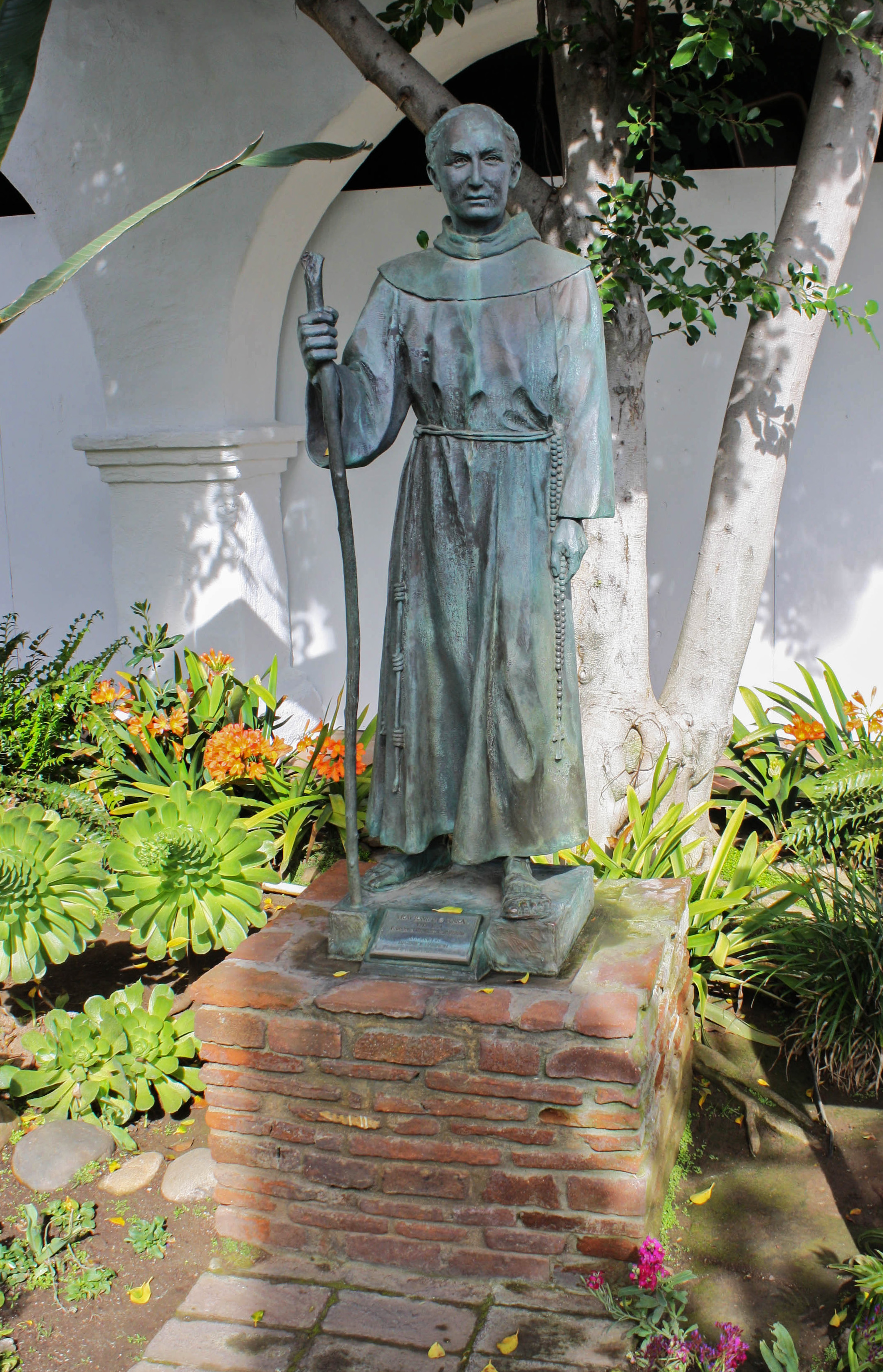
Statue
of Junipero Serra at Mission San Diego de Alcalá
Statue
de Junípero Serra à la Mission San Diego de Alcalá, San Diego, Californie
Estatua
de Fray Junípero Serra en la Misión de San Diego de Alcalá, San Diego,
California
San Junipero (Miguel
José) Serra Ferrer Sacerdote francescano
Petra, Maiorca, Spagna,
24 novembre 1713 - Monterey, California, USA, 28 agosto 1784
Miguel José Serra Ferrer,
nativo dell’isola di Maiorca in Spagna, entrò diciottenne nell’ordine
francescano, assumendo il nome di fra’ Ginepro (in spagnolo, Junipero) per
ricordare uno dei primi compagni di san Francesco d’Assisi. Sacerdote a 23 anni
nel 1737, si dedicò all’insegnamento (filosofia e teologia) e alla
predicazione. A 36 anni partì missionario in Messico, all’epoca soggetto alla
Spagna. Nel 1750, col discepolo Francisco Palóu, raggiunse la Sierra Gorda,
dove arrivò a dirigere cinque missioni. Si calcola che padre Serra abbia
percorso 9.900 chilometri in terra e 5.400 miglia in navigazione, arrivando
all’Alta California. L’ultima missione fondata è San Bonaventura (oggi
Ventura). Ma è sull’uomo che padre Serra compie i suoi prodigi, portandogli,
insieme alla fede, la spinta a costruirsi una vita degna della persona e della
famiglia. Quando se ne muore nel Carmelo di Monterey il 28 agosto 1784 (dove
sarà sepolto), per tutti quelli che via via ne ricevono la notizia è come aver
perduto davvero un padre, ma ricevendone pure una grande eredità. Nessuno prima
di lui ha fatto tanto per le popolazioni della California. Beatificato da san
Giovanni Paolo II il 25 settembre 1988, è stato canonizzato da papa Francesco
il 23 settembre 2015 a Washington D.C.
Martirologio Romano: A
Monterrey in California, beato Ginepro (Michele) Serra, sacerdote dell’Ordine
dei Frati Minori, che tra le tribù ancora pagane di quella regione, nonostante
gli ostacoli e le difficoltà, predicò il Vangelo di Cristo nella lingua dei
popoli del luogo e difese strenuamente i diritti dei poveri e degli umili.
Nacque a Petra, nell’isola di Maiorca in Spagna, il 24 novembre 1713 da Antonio Serra e Margarita Ferrer, e fu battezzato con i nomi di Miguel José. Frequentò la scuola annessa al convento francescano e nel contempo aiutava la famiglia nel lavoro dei campi. Rispondendo alla sua vocazione, da giovane si recò nella città di Maiorca per entrare nell’Ordine Francescano. Il 15 settembre 1731 fece la professione religiosa, prendendo il nome di fra’ Ginepro (in spagnolo, Junipero; d’ora in poi seguiremo questa forma perché anche in italiano è più noto così) in onore di uno dei primi compagni di san Francesco d’Assisi.
Per diciott’anni visse tutte le realtà francescane dell’arcipelago, divenendo sacerdote, predicatore, professore di filosofia e di teologia presso l’Università Luliana. Vivo successo spirituale fruttavano le sue predicazioni, in particolare durante la Quaresima.
All’inizio del 1749, a 35 anni, ubbidendo a una sua interiore vocazione, lasciò Maiorca per partire missionario in America, insieme a un discepolo, Francesco Palóu, che gli rimarrà vicino per tutta la vita.
Il 18 ottobre 1749 la sua nave gettò l’ancora a San Giovanni di Porto Rico e il 7 dicembre approdò a Veracruz. Proseguì a piedi fino a Città del Messico dove, la mattina del 1° gennaio 1750, fu accolto dai francescani del Collegio apostolico di San Ferdinando, posto nei dintorni della capitale.
Trascorsi cinque mesi di preparazione per diventare missionario tra gli indios, partì, insieme al Palóu per la Sierra Gorda, giungendo a Jalpán il 16 giugno 1750. Fu istruito da un governatore indigeno sulla lingua Pame, parlata nel luogo, quindi iniziò la sua predicazione agli Indios nel loro linguaggio: tradusse le preghiere ordinarie e il catechismo e li educò al lavoro.
Poté con il loro aiuto costruire un tempio in pietra a Santiago deJalpán in stile barocco, ancora oggi di interesse architettonico, il quale fu preso a modello per la realizzazione di quattro chiese nelle altre missioni.
Restò dal 1758 al 1767con vari incarichi, fra i quali quello di superiore nelle cinque missioni della Sierra Gorda, finché i suoi superiori lo inviarono nel Texas a ricostituire la missione di San Saba, distrutta poco prima dagli Apache. L’incarico fu in seguito annullato per il forte pericolo che comportava, cosìpadre Juniperorestò al Collegio apostolico di San Ferdinando come maestro dei novizi e predicatore delle missioni in varie diocesi messicane.
A giugno del 1767 i gesuiti furono espulsi dai possedimenti spagnoli e le missioni della Bassa California vennero affidate ai francescani. Padre Juniperofu nominato superiore: insieme ad altri 14 compagni giunse nella Bassa California il 1° aprile 1768. Dopo solo due anni, visteanche le condizioni generali più favorevoli, poté fondare la prima missione di San Diego il 16 luglio 1769.
Spostatosi verso l’Alta California, fondò lemissioni di San Carlos de Monterey (trasferita poi sulle sponde del fiume Carmel); di San Antonio, il 14 luglio 1771; di San Gabriel (oggi inserita nella grande città di Los Angeles), l’8 settembre 1771; di San LuisObispo, il 1° settembre 1772.
Seguì un periodo d’incomprensione con un comandante militare per cui si ritirò, sempre a piedi, di nuovo al Collegio di San Ferdinando in Messico. Vi rimase fino al 13 marzo 1774, quando fece di nuovo ritorno prima a San Diego e poi al Carmelo di Monterey, dove ebbe un periodo di relativa tranquillità, mentre l’evangelizzazione dell’intera penisola californiana proseguiva lentamente ma con costanza.
Diresse personalmente i lavori di ricostruzione della missione di San Diego distrutta dagli indios. Fondò il 1° agosto 1776 la missione di San Francisco, il 1° novembre quella di San Juan Capistrano e il 7 gennaio 1777 quella di Santa Clara.
Papa Clemente XIV gli concesse il privilegio di amministrare il sacramento della Cresima per dieci anni, al termine dei quali il numero dei cresimati di tutte le sue missioni da lui visitate fu di 5309. Nel 1782 fondò l’ultima missione di San Bonaventura, realizzata nei Nuovi Territori, poi si ritirò al Carmelo di Monterey, sempre con il suo fedele discepolo Palóu (che in seguito ne scrisse la vita avventurosa quale testimone oculare) e lì morì il 28 agosto 1784, munito dei conforti religiosi e sepolto nella chiesa della missione.
Fu un colosso dell’evangelizzazione: nella sola California in diciassette anni, dal 1767 al 1784, percorse circa 9900 km e 5400 miglia di navigazione, sopportando, nonostante l’età e le infermità, le condizioni aspre e disagiate dei lunghi viaggi in mare, sui fiumi e soprattutto a piedi. Fondò nove missioni da cui derivano i nomi di importantissime città californiane come San Francisco, San Diego, Los Angeles e altre ancora
Considerato come il padre degli indios, fu onorato come un eroe nazionale: dal
1° marzo 1931 la sua statua si trova nella Sala del Congresso di Washington
come rappresentante dello Stato della California. Inoltre, la cima più alta
della catena montuosa Santa Lucia in California porta il suo nome.
Nell’inverno tra il 1934 e il 1935, poi, quattro cattolici americani di Seattle
decisero di dar vita a una organizzazione di laici che favorisse, mediante
assidui contatti e opportuni approfondimenti, la conoscenza del cattolicesimo e
la sua diffusione nella società moderna. Dopo breve tempo, l’associazione ebbe
un indirizzo più preciso, ossia la promozione e il sostegno alle vocazioni
sacerdotali; come patrono venne scelto padre Junipero, per la sua azione
missionaria. Oggi i Serra Club, così vennero a chiamarsi, sono diffusi in tutto
il mondo.
Anche la Chiesa ha riconosciuto il valore della sua opera: dopo un attento processo canonico, è stata autorizzata la beatificazione, celebrata da san Giovanni Paolo II il 25 settembre 1988.
Di ritorno dal viaggio apostolico in Sri Lanka e Filippine, nel gennaio 2015, papa Francesco ha anticipato ai giornalisti presenti sul volo di ritorno che avrebbe riconosciuto santo il Beato Junipero, senza il riconoscimento di un miracolo attribuito alla sua intercessione, come già avvenuto per il papa San Giovanni XXIII e per l'oratoriano San Giuseppe Vaz.
Il 5 maggio 2015 ha quindi approvato la sentenza affermativa della Sessione Ordinaria dei Cardinali e Vescovi Membri della Congregazione vaticana per le Cause dei Santi circa la sua canonizzazione. Il rito si è svolto il 23 settembre 2015 nella cattedrale dell’Immacolata Concezione a Washington D.C., nel corso del viaggio apostolico negli Stati Uniti e a Cuba.
Autore: Antonio Borrelli ed Emilia Flocchini
SOURCE : http://www.santiebeati.it/dettaglio/60125
OMELIA DI GIOVANNI PAOLO
II
Piazza San Pietro -
Domenica, 25 settembre 1988
1. “La tua parola è
verità. Consacrali nella verità” (cf. Gv 17, 17).
La liturgia della
domenica di oggi professa e onora la verità racchiusa nella parola del Dio
vivente. Mediante le letture dell’antico e del nuovo testamento ci ricorda che
questa verità si è offerta agli uomini. Così leggiamo nel libro dei Numeri: “Il
Signore . . . prese lo spirito che era su di lui e lo infuse sui settanta
anziani” (Nm 11, 25). E Mosè, come testimone del fatto che “quelli
profetizzarono” (Nm 11, 25), dice: “Fossero tutti profeti nel popolo del
Signore e volesse il Signore dare loro il suo spirito!” (Nm 11, 29).
Questo avvenimento e le
parole di Mosè sono preannunzio della missione messianica di Gesù di Nazaret.
In virtù del suo sacrificio pasquale, in virtù della croce e della
risurrezione, Cristo ha effuso lo Spirito Santo sugli apostoli e lo ha
trasmesso alla sua Chiesa.
Tutti nella Chiesa, in
forza del Battesimo, partecipano alla missione di Cristo, del grande profeta,
del Figlio che è sul trono del Padre. La partecipazione a tale missione
profetica risalta in particolare misura nella vicenda dei santi: di coloro che
mediante la Parola del Dio Vivente sono “consacrati nella verità”.
2. Un motivo di gioia per
la Chiesa universale e, specialmente per la Chiesa del Messico, è la
beatificazione di padre Miguel Agustin Pr, sacerdote gesuita, le cui virtù oggi
esaltiamo e proponiamo al Popolo di Dio. Egli è nuova gloria per la amata nazione
messicana e per la Compagnia di Gesù.
La sua vita di apostolo
pieno di dedizione e coraggio è sempre stata ispirata da un instancabile zelo
evangelizzatore. Né le sofferenze delle gravi malattie, né l’indefessa attività
ministeriale svolta frequentemente in circostanze penose e rischiose,
riuscirono a soffocare la gioia irradiante e comunicativa che nasceva dal suo
amore per Cristo, e che nessuno gli ha potuto togliere (cf. Gv 16,
22).
Infatti, la radice più
profonda della dedizione agli altri era il suo amore appassionato a Gesù Cristo
e il suo ardente desiderio di immedesimarsi in lui, persino nella sua morte.
Espresse questo amore in modo particolare nel culto eucaristico. La
celebrazione quotidiana della santa Messa era il centro della sua vita, così come
fonte di forza e fervore per i fedeli. Padre Pro aveva organizzato le
cosiddette “stazioni eucaristiche” in domicili particolari, in cui
quotidianamente si poteva ricevere di nascosto il corpo del Signore durante gli
anni della persecuzione.
Di fronte all’eccellente
esempio di virtù sacerdotali di padre Pr,desidero incoraggiare ancora una volta
i miei amati fratelli alla dedizione totale a Gesù Cristo, vissuta gioiosamente
nel celibato per il Regno dei cieli e nel servizio generoso ai fratelli,
soprattutto i più poveri ed abbandonati.
3. “Chiunque vi darà da
bere un bicchiere d’acqua nel mio nome . . . vi dico in verità che non perderà
la sua ricompensa” (Mc 9, 41). Su queste parole evangeliche meditò certo a
lungo il Cardinale Giuseppe Benedetto Dusmet, per 27 anni Arcivescovo di
Catania, dopo essere stato per circa due lustri abate dello storico monastero
benedettino di san Nicolò “de arenis” in quella città. Egli si erge quale
testimone della carità evangelica in tempi particolarmente tormentati per la
vita della Chiesa, in mezzo ad accesi conflitti di parte e a profonde
alterazioni del tessuto politico e sociale del Paese, in una regione sconvolta
dal susseguirsi di paurose calamità naturali: epidemie di colera, terremoti,
inondazioni, eruzioni dell’Etna, oltre a quella costante e vastissima calamità
che è la miseria dei diseredati.
Pur allevato tra gli agi
di una famiglia aristocratica e facoltosa, egli fece della povertà, vissuta in
funzione di servizio e di donazione agli altri, una programmatica scelta di
vita talmente radicale che, alla sua morte, non si trovò neppure un lenzuolo in
cui avvolgerlo: di tutto, letteralmente, egli si era spogliato per rivestirne i
poveri, di cui si sentiva umile servitore.
Grande rilievo ebbe pure
l’opera da lui svolta a servizio dell’Ordine Benedettino, a cui apparteneva.
Per speciale mandato del Sommo Pontefice Leone XIII realizzò la rifondazione
del Collegio Internazionale di sant’Anselmo sull’Aventino - condotta a termine
esattamente un secolo fa -, e la strutturazione di quella Confederazione
dell’Ordine di san Benedetto che oggi è così autorevolmente rappresentata in
questa piazza da oltre 200 abati benedettini, convenuti da ogni parte del
mondo.
Il Cardinale Dusmet,
decoro e gloria del monachesimo, dell’episcopato e del Sacro Collegio
Cardinalizio, ci trasmette così il messaggio profetico di una autentica
solidarietà evangelica e di una docile e operosa fedeltà al carisma della
propria vocazione, vissute ed espresse nella realtà fattiva del dono totale di
sé sull’itinerario tracciato dalle orme di Cristo Salvatore.
4. Guardando all’altro
beato, a cui oggi la Chiesa tributa gli onori degli altari, Francesco Faà di
Bruno, è spontaneo ripensare all’esclamazione di Mosè: “Fossero tutti profeti
nel popolo del Signore!”. Il nuovo beato fu veramente un profeta in mezzo al
Popolo di Dio, a cui appartenne come laico per buona parte della sua vita.
Munito di chiara
intuizione pratica e sensibile alle tensioni e ai problemi del momento, egli
seppe trovare risposte positive alle esigenze dei suoi tempi, resistendo alle
tentazioni della fretta, del semplicismo culturale, degli interessi personali.
Curvo sui libri, impegnato in cattedra o intento ad alleviare nei modi più
diversi le sofferenze dei poveri, il beato ebbe come stella polare della sua
fervida attività un grande amore per Dio, che egli costantemente alimentava con
l’esercizio della preghiera e della contemplazione. Soleva dire: “Darsi a Dio
equivale a darsi ad una attività superiore, che ci trascina come le acque gonfie
e tumultuose di un torrente in piena . . .”. Dall’amore per Dio scaturiva
quell’amore per il “prossimo”, che spinse Francesco Faà di Bruno sulla strada
dei poveri, degli umili, degli indifesi, facendone un gigante della fede e
della carità. Nacque così tutta una serie di opere e di attività assistenziali
di cui non è facile fare l’elenco. Anche in campo scientifico egli seppe
portare la sua coerente testimonianza di credente, in un periodo in cui la
dedizione alla scienza sembrava incompatibile con un serio impegno di fede.
Particolare menzione
merita, tra le iniziative sociali, l’Opera di santa Zita per la promozione
sociale e spirituale della donna (serve, disoccupate, apprendiste, madri
nubili, malate, anziane): il beato promosse il sorgere di una vera “città della
donna”, fornita di scuole, laboratori, infermeria, pensionati, tutto con propri
regolamenti. In questa coraggiosa e profetica iniziativa egli profuse i beni di
famiglia, i suoi guadagni e tutto se stesso.
A cent’anni dalla sua
morte, il messaggio di luce e di amore suscitato dal beato Francesco Faà di
Bruno, lungi dall’esaurirsi, si rivela quanto mai attuale, spingendo all’azione
quanti hanno a cuore i valori evangelici.
5. In fra Junipero Serra,
sacerdote dei Frati Minori, troviamo un fulgido esempio di unità cristiana e
spirito missionario. Il suo grande obiettivo era di portare il Vangelo alle
popolazioni autoctone d’America, affinché anch’esse potessero essere
“consacrate nella verità”. Per molti anni si dedicò a questo compito in Messico,
nella Sierra Gorda, e in California. Sparse i semi della fede cristiana in
mezzo ai tumultuosi cambiamenti portati dall’arrivo dei coloni europei nel
Nuovo Mondo. Era un campo di impegno missionario che richiedeva pazienza,
perseveranza e umiltà, oltre che lungimiranza e coraggio. Contando sulla divina
potenza del messaggio annunciato, padre Serra guidò a Cristo i popoli
autoctoni. Egli era ben consapevole delle loro eroiche virtù - come dimostra la
vita della beata Kateri Tekakwitha - e cercava di promuovere il loro autentico
sviluppo umano sulla base della loro nuova fede di persone create e redente da
Dio. Dovette anche ammonire i potenti, nello spirito della seconda lettura di
san Giacomo, di non sfruttare e opprimere i poveri e i deboli. Nell’adempimento
del suo ministero, padre Serra si dimostrò autentico figlio di san Francesco.
Oggi, il suo esempio ispira in modo particolare i molti Gruppi Serra in tutto
il mondo, i cui membri svolgono un lavoro lodevole nell’animazione vocazionale.
Padre Junipero Serra,
modello esemplare di evangelizzatore pieno di abnegazione, è una gloria per la
grande famiglia francescana come anche per Maiorca, sua terra natale, che lo
venera e lo considera come un figlio illustre. La filiale devozione alla
Vergine Madre di Dio, nella spiritualità francescana propria di questo
maiorchino universale, sia forza per incrementare la vita cristiana del popolo
fedele.
6. Fin dall’infanzia, il
nuovo beato Frédéric Janssoone ha conosciuto la sofferenza, ha dovuto anche
lavorare molto presto. Dopo queste esperienze che l’hanno fatto maturare, ha
abbracciato generosamente l’ideale di san Francesco d’Assisi. Inviato in Terra
Santa, visse con ardore nello spirito francescano, contemplando il mistero di
Cristo nella passione e nella risurrezione; egli celebrava con una fede
impressionante la presenza del Salvatore nel sacramento dell’Eucaristia. Fu un
testimone che sapeva far partecipare alla sua intimità con il Signore.
Vero figlio di san
Francesco, il padre Frédéric ci dà l’esempio di una preghiera contemplativa che
abbraccia l’opera della creazione, gli eventi della vita quotidiana, ogni
incontro personale. Potessimo anche noi accogliere semplicemente come lui lo
Spirito effuso dal Signore sul suo popolo (cf. Nm 11, 29)!
Il “buon padre Frédéric”
ci mostra che lo spirito contemplativo, lungi dal frenare lo zelo apostolico,
lo fortifica. Vicino a Dio, è vicino anche alla gente. In Terra Santa e in
Canada, non smette di esortare chi lo incontra ad impegnarsi nella via
evangelica secondo lo spirito del Terz’Ordine Francescano, e anche
nell’apostolato concreto della vita familiare e professionale. Attento e
fraterno con i più piccoli, per la loro appartenenza a Cristo (cf. Mt 10,
42), il padre Frédéric condusse i suoi contemporanei ad essere testimoni
ardenti e coerenti del Vangelo. La sua glorificazione da parte della Chiesa
contribuisce a suscitare nell’Ordine Francescano e nella Chiesa uno slancio
rinnovato di santità e di zelo apostolico!
7. La Chiesa intona un
canto di giubilo e lode a Cristo per la beatificazione di Josefa Naval Girbés,
vergine secolare che dedicò la sua vita all’apostolato nel suo paese natale,
Algemesi, dell’arcidiocesi di Valencia, Spagna. Donna semplice e docile al
soffio dello Spirito, raggiunse nella sua lunga vita l’apice della perfezione
cristiana, dedita al servizio del prossimo nei tempi per nulla facili del XIX
secolo, durante i quali visse e sviluppò la sua intensa attività apostolica.
Aveva diciotto anni
quando, con il beneplacito del suo direttore spirituale, fece il voto di
castità. Aveva trent’anni quando nella casa della sua famiglia apre una
scuola-seminario dove si formeranno umanamente e spiritualmente moltissimi
giovani. Questo apostolato proseguirà nelle cosiddette “conversazioni del
giardino”, mediante le quali i discepoli meglio preparati ricevevano una
formazione spirituale più profonda.
Cosciente del fatto che,
come più tardi avrebbe affermato il Concilio Vaticano II, “la vocazione è, per
sua natura, anche vocazione all’apostolato” (Apostolicam
Actuositatem, 2), Josefa si è fatta tutta a tutti, come l’apostolo san
Paolo, per salvare tutti (cf. 1 Cor 9, 22). Da ciò l’impronta
incancellabile lasciata nell’esercizio della sua carità. Assisteva con cura i
moribondi, aiutandoli a morire in grazia di Dio. L’attenzione eroica a coloro
che erano colpiti dall’epidemia di colera nel 1885, è uno dei più espressivi
esempi della carità di questa anima prediletta.
Una caratteristica
singolare di Josefa è la sua condizione di secolare. Essa, che riempì di
discepole i conventi di clausura, rimase nubile nel mondo, vivendo i principi
evangelici ed essendo esempio di virtù cristiane per tutti quei figli della
Chiesa che, “dopo essere stati incorporati a Cristo col Battesimo . . . per la
loro parte compiono, nella Chiesa e nel mondo, la missione propria di tutto il
popolo cristiano” (Lumen
Gentium, 31).
8. “La legge del Signore
è perfetta, rinfranca l’anima”, proclama il salmo della liturgia odierna (Sal 19
[18], 8).
Il “curriculum vitae” dei
nostri nuovi beati abbonda di momenti difficili, in misura tale da potersi
dire, umanamente parlando, deprimente. Ciò nonostante essi sono testimoni di
grande gioia spirituale. Trovano gioia nei comandamenti di Dio, nella legge del
Signore. Il salmista annunzia che la legge del Signore rinfranca l’anima.
Ed in realtà è così.
L’uomo trova la forza dello spirito, la forza interiore e la gioia del cuore in
ciò che è retto, in ciò che è conforme alla verità.
La via della santità è
sempre la via della “consacrazione nella verità”. Si compie su questa via la
partecipazione alla vita di Dio stesso, alle inesauribili ricchezze che il suo
Spirito elargisce allo spirito umano: elargisce la verità, la forza e la gioia.
9. Siate benedetti tra i
beati della Chiesa:
Miguel Pr,S. J.,
Giuseppe Benedetto Dusmet, Arcivescovo,
Francesco Faà di Bruno, sacerdote,
Juniper Serra, O. F. M.,
Frédric Janssoone, O. F.,
Maria Josefa Naval Girbés.
“Appartenete a Cristo” .
. . consacrati nella verità.
Beati perché vedete Iddio.
Siateci accanto, per condurci sulla via della verità alla stessa vostra
beatificante visione.
© Copyright 1988 -
Libreria Editrice Vaticana
Copyright © Dicastero per
la Comunicazione
SANTA MESSA E
CANONIZZAZIONE DEL BEATO P. JUNIPERO SERRA
OMELIA DEL SANTO PADRE
«Siate sempre lieti nel Signore, ve lo ripeto:
siate lieti» (Fil 4,4). Un invito che colpisce fortemente la nostra vita.
Siate lieti, ci dice san Paolo, con una forza quasi imperativa. Un invito che
si fa eco del desiderio che tutti sperimentiamo di una vita piena, di una vita
che abbia senso, di una vita gioiosa. E’ come se Paolo avesse la capacità di
ascoltare ciascuno dei nostri cuori e desse voce a quello che sentiamo, che
viviamo. C’è qualcosa dentro di noi che ci invita alla gioia e a non adattarci
a palliativi che cercano sempre di accontentarci.
Ma, a nostra volta,
viviamo le tensioni della vita quotidiana. Sono molte le situazioni che
sembrano mettere in dubbio questo invito. La dinamica a cui molte volte siamo
soggetti sembra portarci ad una rassegnazione triste che a poco a poco si
va trasformando in abitudine, con una conseguenza letale: anestetizzarci il
cuore.
Non vogliamo che la
rassegnazione sia il motore della nostra vita – o lo vogliamo? Non vogliamo che
l’abitudine si impossessi delle nostre giornate – o sì? Per questo possiamo
domandarci: come fare perché non si anestetizzi il nostro cuore? Come
approfondire la gioia del Vangelo nelle diverse situazioni della nostra vita?
Gesù lo ha detto ai
discepoli di allora e lo dice a noi: Andate! Annunciate! La gioia del Vangelo
si sperimenta, si conosce e si vive solo donandola, donandosi.
Lo spirito del mondo ci
invita al conformismo, alla comodità. Di fronte a questo spirito umano «occorre
sentire nuovamente che abbiamo bisogno gli uni degli altri, che abbiamo una
responsabilità verso gli altri e verso il mondo» (Enc. Laudato
si’, 229). La responsabilità di annunciare il messaggio di Gesù. Perché la
fonte della nostra gioia sta in quel «desiderio inesauribile di offrire
misericordia, frutto dell’aver sperimentato l’infinita misericordia del Padre e
la sua forza diffusiva» (Esort. ap. Evangelii
gaudium, 24). Andate da tutti ad annunciare ungendo e ad ungere
annunciando. A questo il Signore ci invita oggi e ci dice:
la gioia il cristiano la
sperimenta nella missione: andate alle genti di tutte le nazioni;
la gioia il cristiano la
trova in un invito: andate e annunciate;
la gioia il cristiano la
rinnova e la attualizza con una chiamata: andate e ungete.
Gesù vi manda a tutte le
nazioni. A tutte le genti. E in questo “tutti” di duemila anni fa eravamo
compresi anche noi. Gesù non dà una lista selettiva di chi sì e chi no, di
quelli che sono degni o no di ricevere il suo messaggio, la sua presenza. Al
contrario, ha abbracciato sempre la vita così come gli si presentava. Con volto
di dolore, fame, malattia, peccato. Con volto di ferite, di sete, di
stanchezza. Con volto di dubbi e di pietà. Lungi dall’aspettare una vita
imbellettata, decorata, truccata, l’ha abbracciata come gli veniva incontro.
Benché fosse una vita che molte volte si presenta rovinata, sporca, distrutta.
A tutti, ha detto Gesù, a tutti andate e annunciate; a tutta questa vita
così com’è e non come ci piacerebbe che fosse: Andate e abbracciate nel mio
nome. Andate agli incroci delle strade, andate… ad annunciare senza paura,
senza pregiudizi, senza superiorità, senza purismi a tutti quelli che hanno
perso la gioia di vivere, andate ad annunciare l’abbraccio misericordioso del
Padre. Andate da quelli che vivono con il peso del dolore, del fallimento, del
sentire una vita spezzata e annunciate la follia di un Padre che cerca di
ungerli con l’olio della speranza, della salvezza. Andate ad annunciare che gli
sbagli, le illusioni ingannevoli, le incomprensioni, non hanno l’ultima parola
nella vita di una persona. Andate con l’olio che lenisce le ferite e ristora il
cuore.
La missione non nasce mai
da un progetto perfettamente elaborato o da un manuale molto ben strutturato e
programmato; la missione nasce sempre da una vita che si è sentita cercata e
guarita, trovata e perdonata. La missione nasce dal fare esperienza una e più
volte dell’unzione misericordiosa di Dio.
La Chiesa, il Popolo
Santo di Dio, sa percorrere le strade polverose della storia attraversate tante
volte da conflitti, ingiustizie e violenza per andare a trovare i suoi figli e
fratelli. Il Santo Popolo fedele di Dio non teme lo sbaglio; teme la chiusura,
la cristallizzazione in élite, l’attaccarsi alle proprie sicurezze. Sa che la
chiusura, nelle sue molteplici forme, è la causa di tante rassegnazioni.
Per questo, usciamo,
andiamo ad offrire a tutti la vita di Gesù Cristo (cfr Esort. ap. Evangelii
gaudium, 49). Il Popolo di Dio sa coinvolgersi perché è discepolo di Colui
che si è messo in ginocchio davanti ai suoi per lavare loro i piedi (cfr ibid.,
24).
Oggi siamo qui, possiamo
essere qui perché ci sono stati molti che hanno avuto il coraggio di rispondere
a questa chiamata, molti che hanno creduto che «la vita si accresce donandola e
si indebolisce nell’isolamento e nella comodità» (Documento di Aparecida, 360).
Siamo figli dell’audacia missionaria di tanti che hanno preferito non
rinchiudersi «nelle strutture che danno una falsa protezione […] nelle
abitudini in cui ci sentiamo tranquilli, mentre fuori c’è una moltitudine
affamata» (Esort. ap. Evangelii
gaudium, 49). Siamo debitori di una Tradizione, di una catena di testimoni
che hanno reso possibile che la Buona Novella del Vangelo continui ad essere di
generazione in generazione Nuova e Buona.
Ed oggi ricordiamo uno di
quei testimoni che ha saputo testimoniare in queste terre la gioia del Vangelo:
Padre Junipero Serra. Ha saputo vivere quello che è “la Chiesa in uscita”,
questa Chiesa che sa uscire e andare per le strade, per condividere la
tenerezza riconciliatrice di Dio. Ha saputo lasciare la sua terra, le sue
usanze, ha avuto il coraggio di aprire vie, ha saputo andare incontro a tanti
imparando a rispettare le loro usanze e le loro caratteristiche.
Ha imparato a generare e
ad accompagnare la vita di Dio nei volti di coloro che incontrava rendendoli
suoi fratelli. Junipero ha cercato di difendere la dignità della comunità
nativa, proteggendola da quanti ne avevano abusato. Abusi che oggi continuano a
procurarci dispiacere, specialmente per il dolore che provocano nella vita di
tante persone.
Scelse un motto che
ispirò i suoi passi e plasmò la sua vita: seppe dire, ma soprattutto seppe
vivere dicendo: “Sempre avanti”. Questo è stato il modo che Junipero ha trovato
per vivere la gioia del Vangelo, perché non si anestetizzasse il suo cuore. E’
stato sempre avanti, perché il Signore aspetta; sempre avanti, perché il fratello
aspetta; sempre avanti per tutto ciò che ancora gli rimaneva da vivere; è stato
sempre avanti. Come lui allora, che noi oggi possiamo dire: sempre avanti.
Copyright © Dicastero per
la Comunicazione
Junipero Serra
(1713-1784)
Beatificazione:
- 25 settembre 1988
- Papa Giovanni
Paolo II
Canonizzazione:
- 23 settembre 2015
- Papa Francesco
- Washington D.C., Stati
Uniti d'America
Memoria Liturgica:
- 28 agosto
Sacerdote professo
dell’Ordine dei Frati Minori, che tra le tribù ancora pagane di quella regione,
nonostante gli ostacoli e le difficoltà, predicò il Vangelo di Cristo nella
lingua dei popoli del luogo e difese strenuamente i diritti dei poveri
e degli umili
Ha saputo vivere quello
che è “la Chiesa in uscita”: “Sempre avanti”
VITA E OPERE
Il Beato Junipero Serra
(al secolo: Michele Giuseppe) nacque a Petra, nell’isola di Maiorca, il 24
novembre 1713, da Antonio e Margherita Ferrer, e fu battezzato nello stesso
giorno. Frequentò la scuola annessa al locale convento dei Frati Minori di San
Bernardino, pur rendendosi utile alla famiglia nel lavoro dei campi, in un
tempo di grande povertà a causa di ricorrenti epidemie e carestie. Avvertita la
vocazione alla vita religiosa, entrò nell’Ordine dei Frati Minori a Palma di Maiorca.
Dopo l’anno di noviziato, nel settembre del 1731 emise la professione dei voti
religiosi prendendo il nome di fra Junipero, in onore di Ginepro, singolare
compagno di San Francesco, esempio di gioia e semplicità francescana.
Ordinato
sacerdote nel dicembre del 1737, visse per circa diciotto anni nel convento di
San Francesco di Palma, dedicandosi all’insegnamento della filosofia e della
teologia presso l’Università Lulliana. Nei tempi liberi dalla docenza fu
zelante nel ministero della confessione sacramentale e nella predicazione delle
missioni popolari.
All’inizio
del 1749, quando aveva 35 anni, seguendo un’ispirazione favorita dalla lettura
delle vite dei Santi missionari del suo Ordine, partì per l’America insieme al
suo fedele discepolo Padre Francisco Palóu, che gli rimase accanto per tutta la
vita e fu poi autore della sua prima e fondamentale biografia. Salpata da
Cadice il 29 agosto 1749, dopo aver fatto tappa a Porto Rico nel mese di
ottobre, la sua nave approdò il 7 dicembre 1749 a Veracruz, dopo circa 99
giorni di navigazione. Da qui Padre Junipero proseguì a piedi fino a Città del
Messico dove il 1 gennaio 1750 fu accolto dai confratelli del convento di San
Fernando, sede del Collegio Apostolico e principale centro di irradiazione missionaria
in tutto il territorio della Nuova Spagna.
Il
beato vi trascorse cinque mesi di preparazione per poter svolgere efficacemente
l’apostolato tra gli Indios. Nel mese di giugno 1750 partì insieme al Palóu per
la regione della Sierra Gorda, dove prese in carico l’evangelizzazione dei
Pames, di cui imparò le lingue e i costumi. Le sue prerogative spirituali e
umane gli consentirono di consolidare quelle stazioni missionarie mediante
l’edificazione di nuove chiese e l’educazione delle popolazioni alla fede e al
lavoro. Nominato presidente delle missioni della Sierra Gorda, nel 1758 i
superiori di San Fernando lo richiamarono a Città del Messico, con l’intento di
destinarlo alla missione di San Sabás nel Texas, che in quell’anno era stata
distrutta da un attacco di Indiani. Non essendo stato possibile organizzare la
prevista missione, Padre Junipero restò nel Collegio di San Fernando, fino al
1768, con il compito di maestro dei novizi e di predicatore di missioni
popolari.
Con
l’espulsione dei Gesuiti da tutti i territori spagnoli, i Francescani furono
chiamati a sostituirli nelle missioni della Bassa California, dove essi erano
stati i primi ad impiantarsi. Padre Junipero fu nominato superiore e insieme ad
altri 14 compagni si avviò verso quel territorio, fondando nel 1769 la missione
di San Diego.
Spostatosi
poco più tardi verso l’Alta California, tra il 1771 e il 1772 fondò le missioni
di San Carlos Borromeo, di San Antonio, di San Gabriel e di San Luis Obispo.
L’ardore
apostolico del presidente delle missioni dell’Alta California, che, in base al
tradizionale legame fra trono e altare dell’ancien régime, chiedeva uomini e
mezzi per impiantare nuove missioni, provocò una forte tensione con le autorità
civili e militari ivi stabilite. Per difendere i diritti della Chiesa, impedire
indebite intromissioni e, soprattutto, per garantire la promozione umana e
religiosa degli Indiani che vedeva messa in pericolo dalla secolarizzazione
strisciante dei vari governatori e comandanti militari spagnoli, Padre Junipero
nel 1772 fece ritorno a Città del Messico, dove spiegò le sue posizioni e
riuscì ad ottenere dal viceré ampie rassicurazioni per poter continuare ad
evangelizzare senza ostacoli e impedimenti.
Ritornato
in Alta California nel 1774, diresse personalmente i lavori di ricostruzione
della missione di San Diego distrutta dagli Indiani; fondò, quindi, tra il 1776
e il 1777 le missioni di San Francisco, di San Juan Capistrano e di Santa
Clara.
Clemente
XIV, intanto, gli aveva concesso il privilegio di amministrare il sacramento
della Cresima per dieci anni, al termine dei quali il numero dei cresimati di
tutte le sue missioni da lui visitate fu di 5309; nel 1782 fondò la sua ultima
missione di San Buenaventura. Si ritirò, quindi, alla missione di San
Carlos Borromeo al Carmel di Monterey e lì morì il 28 agosto 1784, munito dei
conforti religiosi.
Autentico
gigante dell’evangelizzazione, nella sola California in diciassette anni dal
1767 al 1784 percorse circa 9900 km e 5400 miglia di navigazione, sopportando,
nonostante l’età e le infermità (una dolorosissima ferita alla gamba lo
tormentò senza tregua dal 1749), le condizioni aspre e disagiate dei lunghi
viaggi in mare, sui fiumi e soprattutto a piedi; fondò, oltre a quelle della
Sierra Gorda, nove missioni lungo il cosiddetto “Camino Real”, da cui derivano
i nomi francescani di importantissime città californiane come San Francisco,
San Diego, Los Angeles, Santa Clara.
"ITER" DELLA
CAUSA
a) In vista della
Beatificazione
Particolari avvenimenti
storici successivi alla morte di Padre Junipero, in particolare l’indipendenza
del Mexico dalla Spagna (1837) e la successiva guerra con gli Stati Uniti,
determinarono un ritardo nell’avvio del processo di canonizzazione, pur mantenendosi
viva e costante la fama di santità presso il popolo di Dio.
Il 17 dicembre 1943
l’Ordinario di Monterey-Fresno designò i membri della Commissione Storica che
ultimarono il loro lavoro nel 1948. Dal 18 dicembre 1948 al 7 luglio 1949 si
celebrò nella medesima diocesi il processo diocesano, durante il quale furono
ascoltati 50 testi, 5 dei quali ex officio. Si celebrarono anche
Processi Rogatoriali nelle curie diocesane di San Francisco e di Los Angeles.
Deposero testimoni di ascendenza spagnola, messicana, india e anglosassone dei
primi tempi della missione di P. Junipero. Intanto si erano pure celebrati i
previsti Processi super non cultu e super scriptis. Tutti
i processi furono aperti con Decreto della Sacra Congregazione dei Riti del 21
ottobre 1950.
La Positio super
vita et virtutibus ex officio concinnata fu edita nel 1981. La Seduta dei
Consultori storici si tenne il 17 febbraio 1982. Il Congresso dei Consultori
Teologi si celebrò il 12 febbraio 1985. La Sessione Ordinaria dei Padri Cardinali
e Vescovi si svolse il 2 aprile 1985. Il Decreto super virtutibus fu
promulgato alla presenza di Giovanni Paolo II il 9 maggio 1985.
Per la beatificazione del
Venerabile Servo di Dio fu presentata allo studio della Congregazione delle
Cause dei Santi la presunta guarigione miracolosa di una suora avvenuta nel
1960 in Saint Louis (Missouri-USA).
Il Processo sul
prodigioso evento si svolse nella Diocesi di Saint Luis nel 1985 e fu integrato
da un Processo suppletivo celebrato nel 1986. I Periti della Consulta Medica
l’8 luglio 1987 furono concordi nell’emettere la diagnosi di “grave
connettivite polimiositica” con prognosi infausta quoad vitam e nel
dichiarare la guarigione estremamente rapida completa e definitiva,
inspiegabile scientificamente. Il congresso dei Consultori Teologi si svolse il
23 luglio 1987. La sessione Ordinaria dei Padri Cardinali e Vescovi si tenne il
1 dicembre 1987. Il Decreto super miraculo fu promulgato l’11
dicembre 1987.
Il rito di Beatificazione
si svolse a Roma, in Piazza San Pietro, il 25 settembre 1988. In precedenza San
Giovanni Paolo II nel mese di settembre 1987 aveva compiuto lo storico viaggio
apostolico negli Stati Uniti, nel corso del quale poté rendere omaggio alla
tomba del Servo di Dio in San Carlo Borromeo Mission, Carmel, e pronunciare due
importanti discorsi, rispettivamente il 14 il 17 settembre 1987, con i quali
additava il Venerabile Junipero Serra come eminente apostolo e civilizzatore.
b) In vista della
Canonizzazione
Dopo la beatificazione e
soprattutto in occasione della solenne celebrazione del terzo centenario della
nascita del Beato (1713-2013) si sono moltiplicate nell’Ordine dei Frati Minori
e nelle Regioni Ecclesiastiche che più direttamente custodiscono la memoria
della vita e delle opere del Beato (Stati Uniti, Mexico, Europa), le iniziative
a favore del suo culto e gli auspici per una sua sollecita Canonizzazione. La
Postulazione Generale dell’Ordine dei Frati Minori, sensibile alle attese dei
numerosissimi devoti del Beato, ha pertanto raccolto in una speciale Positio
super Canonizatione la documentazione che illustra i motivi che sostengono
la speranza di una rapida canonizzazione del Beato.
Emergono nella Positio le
prove della estensione del culto e della vigorosa devozione di un’ampia fascia
del popolo di Dio verso il beato Junipero Serra; significative attestazioni del
potere di intercessione del beato che si manifesta con il conseguimento di
grazie materiali e spirituali; testimonianze sulla rilevanza della sua figura
di evangelizzatore nella storia della Chiesa in Mexico e Stati Uniti, di
civilizzatore nel dialogo tra le culture. Non mancano autorevoli interventi
degli ultimi Sommi Pontefici e dell’Episcopato Cattolico sulla permanente
attualità del suo messaggio spirituale e del suo zelo pastorale e missionario.
Gli Eminentissimi Padri
Cardinali e gli Eccellentissimi Vescovi della Congregazione delle Cause dei
Santi, riuniti in Sessione Ordinaria il 5 maggio 2015, esaminata la Positio
super Canonizatione hanno espresso il loro autorevole giudizio a favore
della canonizzazione del Beato Junipero, con dispensa del miracolo formalmente
approvato, esistendo una solida fama signorum e un culto liturgico
notevolmente esteso nella Chiesa. Il Santo Padre, nell’udienza del maggio 2015
concessa al Prefetto della Congregazione delle Cause dei Santi, Card. Angelo
Amato, ha ratificato il giudizio della Sessione Ordinaria ed ha disposto che si
procedesse, come di consueto, alla celebrazione del Concistoro.
SOURCE : https://www.causesanti.va/it/santi-e-beati/junipero-serra.html
HEILIGE MESSE UND
HEILIGSPRECHUNG DES SEL. P. JUNIPERO SERRA
PREDIGT DES HEILIGEN
VATERS
»Freut euch im Herrn zu
jeder Zeit! Noch einmal sage ich: Freut euch!« (Phil 4,4). Das ist eine
Aufforderung, die unser Leben mächtig aufrüttelt. Freut euch, sagt Paulus zu
uns fast in einem Befehlston. Eine Aufforderung, die den Wunsch nach einem
gelungenen Leben wiedergibt, den wir alle empfinden, den Wunsch nach einem
sinnvollen Leben, nach einem mit Freude erfüllten Leben. Es ist so, als ob
Paulus hören könnte, was jeder von uns im Herzen trägt, und dem Stimme
verleihen könnte, was wir empfinden und erfahren. Es gibt etwas in unserem
Innern, das uns einlädt, uns zu freuen und uns nicht mit Placebos zu begnügen,
die uns immer zufrieden stellen wollen.
Doch zugleich erfahren
wir die Anspannungen des alltäglichen Lebens. So viele Situationen scheinen
diese Aufforderung zur Freude in Zweifel zu ziehen. Ihre Eigendynamik, der wir
uns oft unterworfen fühlen, scheint uns in eine traurige Resignation zu führen,
die allmählich zu einer Gewohnheit wird, mit einer tödlichen Konsequenz: Unser
Herz wird betäubt.
Wir wollen nicht, dass
die Resignation unser Leben prägt – oder wollen wir das? Wir wollen nicht, dass
die Gewohnheit unsere Tage bestimmt, oder doch? Daher sollten wir uns fragen:
Was können wir tun, dass unser Herz nicht betäubt wird? Wie können wir die
Freude des Evangeliums in den verschiedenen Situationen unseres Lebens
vertiefen?
Jesus hat das damals zu seinen
Jüngern gesagt, und er sagt es zu uns: Geht! Verkündet! Die Freude des
Evangeliums kann man nur dann erfahren, erkennen und leben, wenn man sie
hergibt, wenn man sich selbst hergibt.
Der Geist der Welt
verleitet uns zum Konformismus, zur Bequemlichkeit; und angesichts dieses
menschlichen Geistes ist es wieder nötig zu »spüren, dass wir einander
brauchen, dass wir eine Verantwortung für die anderen und für die Welt haben« (Laudato
si’, 229). Es ist die Verantwortung, die Botschaft Jesu zu verkünden. Denn
die Quelle unserer Freude entspringt dem »unerschöpflichen Wunsch,
Barmherzigkeit anzubieten – eine Frucht der eigenen Erfahrung der unendlichen
Barmherzigkeit des himmlischen Vaters und ihrer Tragweite« (Evangelii
gaudium, 24). Gehen wir zu allen Menschen, um zu verkünden, indem wir
salben, und zu salben, indem wir verkünden.
Dazu lädt uns der Herr
heute ein und sagt uns: Die Freude erlebt der Christ in der Mission: »Geht zu
allen Völkern« (Mt 28,19).
Die Freude findet der
Christ in der Aufforderung: Geht und verkündet!
Die Freude erneuert und
verwirklicht der Christ durch eine Berufung: Geht und salbt!
Jesus schickt sie zu
allen Völkern. Zu allen Menschen. Und zu diesen »allen« seit zweitausend Jahren
gehören auch wir. Jesus macht keine Auswahlliste – wer ja und wer nein – von
denen, die würdig sind oder nicht, seine Botschaft und seine Gegenwart zu
empfangen. Im Gegenteil, er umarmte das Leben immer so, wie es sich ihm darbot.
Mit einem Gesicht des Schmerzes, des Hungers, der Krankheit und der Sünde.
Mit einem Gesicht der Verwundung, des Durstes, der Erschöpfung. Mit einem
Gesicht des Zweifels und des Erbarmens. Weit davon entfernt, ein beschönigtes,
ausgeschmücktes, hübsch zurechtgemachtes Leben zu erwarten, nahm er es an, wie
es ihm entgegenkam. Selbst wenn es ein Leben war, das sich oft als erbärmlich,
schmutzig und zerrüttet darstellte. Geht zu »allen«, sagte Jesus – zu allen! –
und verkündet; zu diesem Leben mit allem, was dazugehört, so wie es ist,
und nicht, wie wir es gerne hätten, geht und umarmt es in meinem Namen.
Geht an die Wegkreuzungen, geht hinaus… um ohne Furcht zu verkünden, ohne
Vorurteile, ohne Überlegenheitsgefühl, ohne „Purismen“, geht zu jedem, der die
Freude am Leben verloren hat; geht, um die erbarmende Umarmung des Vaters zu
verkünden. Geht zu denen, die mit der Last des Schmerzes, des Scheiterns, des
Gefühls einer zerstörten Existenz leben, und verkündet ihnen die Torheit eines
Vaters, der sie mit dem Öl der Hoffnung, des Heils salben möchte. Geht hinaus,
um zu verkünden, dass der Irrtum, die trügerischen Traumbilder, die Täuschungen
nicht das letzte Wort im Leben eines Menschen haben. Geht hinaus mit dem Öl,
das den Wunden Linderung verschafft und das Herz aufrichtet.
Die Mission erwächst nie
aus einem perfekt ausgearbeiteten Plan oder einem gut strukturierten und ordentlich
ausgearbeiteten Handbuch. Die Mission entsteht immer aus einem Leben, das
sich gesucht und geheilt, aufgenommen und verziehen weiß. Die Mission wird
geboren, wenn man ein ums andere Mal die erbarmende Salbung Gottes erfährt.
Die Kirche, das heilige
Volk Gottes, vermag die staubigen Wege der Geschichte zu beschreiten, die
so oft von Konflikten, Ungerechtigkeiten und Gewalt durchquert wurden, um zu
ihren Kindern, unseren Brüdern und Schwestern zu gelangen. Das heilige und
gläubige Volk Gottes fürchtet nicht, Fehler zu machen; es fürchtet, sich selbst
zu verschließen, in Eliten zu erstarren, sich an die eigenen Sicherheiten zu
klammern. Es weiß, dass das Sich-Verschließen in seinen vielfältigen Formen die
Ursache so vieler Momente der Resignation ist.
Lasst uns deshalb
aufbrechen, lasst uns hinausgehen, um allen das Leben Jesu Christi anzubieten
(vgl. Evangelii
gaudium, 49)! Das Volk Gottes weiß sich einzubringen, weil es Schüler
dessen ist, der sich vor den Seinen niederkniete, um ihnen die Füße zu waschen
(vgl. ebd.,
24).
Heute sind wir hier,
können wir hier sein, weil es viele Menschen gab, die sich entschlossen haben,
diesem Ruf zu folgen; viele, die geglaubt haben, dass »das Leben reicher und
reifer [wird], je mehr man es hingibt, um anderen Leben zu geben« (Aparecida 2007,
360). Wir sind die Söhne und Töchter der missionarischen Kühnheit vieler
Menschen, die es vorgezogen haben, sich nicht »einzuschließen in die
Strukturen, die uns einen falschen Schutz geben, … in die Gewohnheiten, in
denen wir uns ruhig fühlen, während draußen eine hungrige Menschenmenge wartet«
(Evangelii
gaudium, 49). Wir sind Schuldner einer Tradition, einer Kette von Zeugen,
die es möglich gemacht haben, dass die „Frohe Botschaft“ des Evangeliums von
Generation zu Generation immer aktuell und „froh“ sein konnte.
Heute gedenken wir eines
dieser Zeugen, der in diesem Land die Freude des Evangeliums bekundet hat,
Bruder Junípero Serra. Er verkörperte die »Kirche im Aufbruch«, diese Kirche,
die hinauszugehen und die Wege zu beschreiten weiß, um die versöhnliche
Zärtlichkeit Gottes allen mitzuteilen. Junípero Serra verließ sein Land und
dessen Gebräuche und entschloss sich, Wege zu eröffnen; er verstand es,
vielen entgegenzugehen, indem er ihre Bräuche und Besonderheiten kennen und
achten lernte. Er vermochte in denen, die er traf, das Leben Gottes zu erwecken
und zu erhalten und machte sie zu seinen Brüdern und Schwestern. Junípero
suchte die Würde der Gemeinschaft der Ureinwohner zu verteidigen und schützte
sie vor jenen, die sie missbraucht hatten. Diese Vergehen rufen bis heute unser
Missfallen hervor, besonders wegen des Leides, das sie im Leben vieler
Menschen verursachen.
Pater Junípero hatte ein
Motto, das seine Schritte beflügelte und sein Leben prägte: Siempre
adelante – immer voran!, pflegte er zu sagen, und vor allem handelte er
danach. Das war die Form, die Junípero fand, um die Freude des Evangeliums zu
leben und sein Herz vor Betäubung zu bewahren. Er ging immer voran, weil der
Herr wartet; immer voran, weil der Bruder oder die Schwester wartet. Immer
voran für die ganze Zeitspanne, die er noch zu leben hatte. Er ging immer
voran. Könnten auch wir heute so wie er damals sagen: Los! Gehen wir
immer voran!
Copyright © Dikasterium
für Kommunikation
SANTA MISA Y CANONIZACIÓN
DEL BEATO JUNÍPERO SERRA
HOMILÍA DEL SANTO PADRE
«Alégrense siempre en el Señor. Repito:
Alégrense» (Flp 4,4). Una invitación que golpea fuerte nuestra vida.
«Alégrense» nos dice Pablo con una fuerza casi imperativa. Una invitación
que se hace eco del deseo que todos experimentamos de una vida plena, una vida
con sentido, una vida con alegría. Es como si Pablo tuviera la capacidad de
escuchar cada uno de nuestros corazones y pusiera voz a lo que sentimos y
vivimos. Hay algo dentro de nosotros que nos invita a la alegría y a no
conformarnos con placebos que siempre quieren contentarnos.
Pero a su vez, vivimos las
tensiones de la vida cotidiana. Son muchas las situaciones que parecen poner en
duda esta invitación. La propia dinámica a la que muchas veces nos vemos
sometidos parece conducirnos a una resignación triste que poco a poco se va
transformando en acostumbramiento, con una consecuencia letal: anestesiarnos el
corazón.
No queremos que la
resignación sea el motor de nuestra vida, ¿o lo queremos?; no queremos que el
acostumbramiento se apodere de nuestros días, ¿o sí?. Por eso podemos
preguntarnos, ¿cómo hacer para que no se nos anestesie el corazón? ¿Cómo
profundizar la alegría del Evangelio en las diferentes situaciones de nuestra
vida?
Jesús lo dijo a los
discípulos de ayer y nos lo dice a nosotros: ¡vayan!, ¡anuncien! La alegría del
evangelio se experimenta, se conoce y se vive solamente dándola, dándose.
El espíritu del mundo nos
invita al conformismo, a la comodidad; frente a este espíritu humano «hace
falta volver a sentir que nos necesitamos unos a otros, que tenemos una
responsabilidad por los demás y por el mundo» (Laudato
si’, 229). Tenemos la responsabilidad de anunciar el mensaje de Jesús.
Porque la fuente de nuestra alegría «nace de ese deseo inagotable de brindar
misericordia, fruto de haber experimentado la infinita misericordia del Padre y
su fuerza difusiva» (Evangelii
gaudium, 24). Vayan a todos a anunciar ungiendo y a ungir anunciando.
A esto el Señor nos
invita hoy y nos dice: La alegría el cristiano la experimenta en la misión:
«Vayan a las gentes de todas las naciones» (Mt 28,19).
La alegría el cristiano
la encuentra en una invitación: Vayan y anuncien.
La alegría el cristiano
la renueva, la actualiza con una llamada: Vayan y unjan.
Jesús los envía a todas
las naciones. A todas las gentes. Y en ese «todos» de hace dos mil años
estábamos también nosotros. Jesús no da una lista selectiva de quién sí y quién
no, de quiénes son dignos o no de recibir su mensaje y su presencia. Por el
contrario, abrazó siempre la vida tal cual se le presentaba. Con rostro de dolor,
hambre, enfermedad, pecado. Con rostro de heridas, de sed, de cansancio. Con
rostro de dudas y de piedad. Lejos de esperar una vida maquillada, decorada,
trucada, la abrazó como venía a su encuentro. Aunque fuera una vida que muchas
veces se presenta derrotada, sucia, destruida. A «todos» dijo Jesús, a todos,
vayan y anuncien; a toda esa vida como es y no como nos gustaría que fuese,
vayan y abracen en mi nombre. Vayan al cruce de los caminos, vayan… a anunciar
sin miedo, sin prejuicios, sin superioridad, sin purismos a todo aquel que ha
perdido la alegría de vivir, vayan a anunciar el abrazo misericordioso del
Padre. Vayan a aquellos que viven con el peso del dolor, del fracaso, del
sentir una vida truncada y anuncien la locura de un Padre que busca ungirlos
con el óleo de la esperanza, de la salvación. Vayan a anunciar que el error,
las ilusiones engañosas, las equivocaciones, no tienen la última palabra en la
vida de una persona. Vayan con el óleo que calma las heridas y restaura el
corazón.
La misión no nace nunca
de un proyecto perfectamente elaborado o de un manual muy bien estructurado y
planificado; la misión siempre nace de una vida que se sintió buscada y sanada,
encontrada y perdonada. La misión nace de experimentar una y otra vez la unción
misericordiosa de Dios.
La Iglesia, el Pueblo
santo de Dios, sabe transitar los caminos polvorientos de la historia
atravesados tantas veces por conflictos, injusticias y violencia para ir a
encontrar a sus hijos y hermanos. El santo Pueblo fiel de Dios, no teme al
error; teme al encierro, a la cristalización en elites, al aferrarse a las
propias seguridades. Sabe que el encierro en sus múltiples formas es la causa
de tantas resignaciones.
Por eso, «salgamos,
salgamos a ofrecer a todos la vida de Jesucristo» (Evangelii
gaudium, 49). El Pueblo de Dios sabe involucrarse porque es discípulo
de Aquel que se puso de rodillas ante los suyos para lavarles los pies
(cf. ibíd., 24).
Hoy estamos aquí, podemos
estar aquí, porque hubo muchos que se animaron a responder esta llamada, muchos
que creyeron que «la vida se acrecienta dándola y se debilita en el aislamiento
y la comodidad» (Documento de Aparecida, 360). Somos hijos de la audacia
misionera de tantos que prefirieron no encerrarse «en las estructuras que nos
dan una falsa contención… en las costumbres donde nos sentimos tranquilos,
mientras afuera hay una multitud hambrienta» (Evangelii
gaudium, 49). Somos deudores de una tradición, de una cadena de testigos
que han hecho posible que la Buena Nueva del Evangelio siga siendo generación
tras generación Nueva y Buena.
Y hoy recordamos a uno de
esos testigos que supo testimoniar en estas tierras la alegría del Evangelio,
Fray Junípero Serra. Supo vivir lo que es «la Iglesia en salida», esta Iglesia
que sabe salir e ir por los caminos, para compartir la ternura reconciliadora
de Dios. Supo dejar su tierra, sus costumbres, se animó a abrir caminos, supo
salir al encuentro de tantos aprendiendo a respetar sus costumbres y
peculiaridades. Aprendió a gestar y a acompañar la vida de Dios en los rostros
de los que iba encontrando haciéndolos sus hermanos. Junípero buscó defender la
dignidad de la comunidad nativa, protegiéndola de cuantos la habían abusado.
Abusos que hoy nos siguen provocando desagrado, especialmente por el dolor que
causan en la vida de tantos.
Tuvo un lema que inspiró
sus pasos y plasmó su vida: supo decir, pero sobre todo supo vivir diciendo:
«siempre adelante». Esta fue la forma que Junípero encontró para vivir la
alegría del Evangelio, para que no se le anestesiara el corazón. Fue siempre
adelante, porque el Señor espera; siempre adelante, porque el hermano espera;
siempre adelante, por todo lo que aún le quedaba por vivir; fue siempre
adelante. Que, como él ayer, hoy nosotros podamos decir: «siempre adelante».
Copyright © Dicasterio
para la Comunicación
San Junípero Serra
Junípero Serra, San fray. Petra (Islas Baleares), 24.XI.1713 – Monterrey, California (Estados Unidos), 28.VIII.1784. Misionero franciscano (OFM), iniciador de la evangelización de la Alta California y santo.
Biografía
Tercer hijo de un
matrimonio de sencillos labradores, fue, junto con su hermana Juana María, el
único que sobrevivió de sus cinco hermanos, circunstancia que dio origen a la
rápida desaparición de la descendencia directa de la familia, porque Juana
María sólo llegó a tener un hijo, Miguelet, que ingresó en la Orden de los
capuchinos con el nombre de fray Miguel de Petra, al que fray Junípero llamaba
cariñosamente “mi capuchino”.
Miguel José Serra Ferrer
(en el siglo), recibió el nombre de Miguel José en el bautismo, pero él mismo
lo sustituyó al profesar en la Orden Franciscana (1731) por el de Junípero, por
su simpatía hacia el discípulo de san Francisco de ese mismo nombre, célebre
por las originalísimas iniciativas que sobre él recoge la recopilación anónima
contemporánea titulada Florecillas de san Francisco.
Como hijo de labradores,
su infancia y primera juventud se desarrollaron en el hogar paterno alternando
las labores del campo propias de una economía de subsistencia con el
aprendizaje de los estudios elementales en la escuela que regentaban los
franciscanos en la propia Petra, quienes, llegado el momento, le enseñaron
también Latín y Canto Gregoriano, los que llegó a dominar perfectamente.
Con el fin de seguir
avanzando en sus estudios, en 1729, acompañado de sus padres, se trasladó a
Palma de Mallorca, donde quedó a cargo de un canónigo de la catedral y comenzó
el estudio de la Filosofía, hasta que en 1730, y no obstante su pequeña
estatura, tomó el hábito franciscano y en 1731 emitió la profesión religiosa,
es decir, se incardinó plenamente en esa Orden.
A partir de este momento
y siguiendo la costumbre general de la Orden, inició su preparación para el
sacerdocio dentro de ella, mediante el estudio de tres años de Filosofía
(1731-1733) y cuatro de Teología (1734-1737), con lo que quedó capacitado para
recibir la ordenación sacerdotal, en fecha de la que no hay constancia.
Como sacerdote, no tardó
en iniciar la labor pastoral propia de su ministerio, siguiendo también la
costumbre general de la Orden y a la que indudablemente se hubiera tenido que
dedicar en adelante durante la mayor parte de su vida, si no hubiera sido
porque las dotes intelectuales manifestadas a lo largo de sus estudios
indujeron a sus superiores a encaminarlo por la labor docente, campo en el que
en 1737 ganó por oposición una cátedra de Filosofía en el convento de San
Francisco de Palma de Mallorca, que ocupó de 1740 a 1743, fecha esta última en
la que, tras obtener el grado de Teología, inició la enseñanza de Teología
Escotista en la Universidad luliana de Palma.
Entre sus alumnos,
figuraron varios franciscanos mallorquines que muy poco después lo imitaron en
su viaje a América y colaboraron con él, precisamente bajo sus órdenes, en su
nueva faceta de misionero franciscano, en la que llegaron a descollar por su
labor evangelizadora.
Esta nueva faceta, simple
variante de la de carácter pastoral que hasta entonces, y a pesar de sus
deseos, no había podido desarrollar en su plenitud debido a sus insoslayables
obligaciones docentes, la manifestó cuando en 1748 decidió viajar a
Hispanoamérica en calidad de misionero.
Esta fecha de 1748
representa un cambio fundamental tanto en su biografía personal como en las
posibilidades de conocimiento de la misma por parte de sus biógrafos. En el primer
sentido, porque constituyó el punto de arranque o, si se quiere, la plena
realización de su espíritu misional. En el segundo, porque es desde este
momento cuando se conoce la biografía reflejada por él mismo a través de los
escritos (predominantemente cartas) que han llegado hasta hoy, lo cual
independiza del relato y de las interpretaciones suministradas por su biógrafo,
paisano, colaborador y hasta confesor, el padre Francisco Palou, que fue, según
su propio relato, una pieza fundamental en este proceso.
En afirmación suya, el
mismo Palou abrigaba también el deseo de viajar a América en calidad de
misionero, pero a fin de asesorarse mejor, consultó este propósito con su
maestro fray Junípero, quien a su vez le manifestó que también él se proponía
lo mismo, pero que lamentaba el hecho de no conocer a nadie con quien compartir
tan prolongado viaje.
Solucionado
inesperadamente este problema, fue el propio fray Junípero quien comunicó por
carta este propósito de ambos al comisario general de Indias, franciscano
residente en Madrid, el cual trasladó la petición a quien en ese momento estaba
organizando una expedición de misioneros con destino a México.
Éste les remitió por
escrito su aceptación inmediatamente, la que tuvo que repetir más tarde por
haberse extraviado la primera. Con ella en la mano y tras dar por finalizados
los sermones que venía predicando en la propia Petra, se despidió de sus
oyentes y de su familia, pero sin descubrirles su proyecto de viajar a América
—hecho del que al llegar a Cádiz intentó justificarse mediante una extensa y
cariñosa carta dirigida a un franciscano natural también de esa villa—, y se
embarcó con Palou en abril de 1749 en Palma de Mallorca en un paquebot inglés
que lo condujo a Málaga, desde donde, en un barco español, prosiguieron viaje a
Cádiz.
Aquí, y con fecha de 15
de julio de ese mismo año, los oficiales de la Casa de la Contratación les
tomaron los preceptivos datos personales o “reseña”, imprescindibles para
poderse embarcar con destino a América, en la que con referencia a fray
Junípero consignaron que era “sacerdote, natural de la villa de Petra, en
Mallorca, de edad de 35 años, mediano de cuerpo, moreno, poca barba, ojos y
pelo negros”.
Esta inscripción en una
expedición de misioneros con destino a la América española, la que compartió
con los aproximadamente quince mil seiscientos que también lo hicieron desde
1493 hasta 1822, no llama la atención tanto por lo que, de hecho, tuvo siempre
de heroica y arriesgada, cuanto porque la puso en práctica a una edad (treinta
y seis años) y en posesión de una preparación intelectual más elevadas de las
que en este proceso se acostumbraron durante la evangelización española del
Nuevo Mundo.
Por lo que se refiere a
la edad, entre sus mismos franciscanos compañeros de expedición sólo le
superaban dos con treinta y siete años, mientras que la edad de todos los demás
oscilaba entre los veintidós y los treinta, con predominio de los comprendidos
entre los veinticuatro y los veintiocho. De ellos, solamente poseían título
académico el propio fray Junípero y su discípulo y biógrafo Palou, que era
lector de Filosofía.
En este mismo orden de
cosas, sirva como ejemplo el hecho de que desde 1790 hasta 1830 (poco después
de la muerte de fray Junípero) viajaron a Nueva España en calidad de misioneros
un total de doscientos veintisiete franciscanos, de los que solamente tenían
título superior nueve lectores de Teología, tres lectores de Filosofía, un
maestro en Artes, un maestro en Moral, un maestro en Gramática y un teólogo
escolástico.
Tras embarcarse en Cádiz
en agosto de 1749 junto con Palou y otros dieciséis franciscanos procedentes de
varias partes de España, después de una breve escala en Puerto Rico, desembarcó
en Veracruz (México) a comienzos de diciembre tras un viaje que él mismo
describe con bastantes detalles en una carta fechada en Veracruz el 14 de ese
mismo mes, la cual contribuye a enriquecer estos interesantísimos relatos para
conocer la vida de los religiosos enclaustrados durante tres meses en un barco,
género literario no totalmente desconocido, pero tampoco excesivamente
abundante.
Desde Veracruz prosiguió
viaje a pie hasta Ciudad de México, a la que llegó el 1 de enero de 1750
cojeando visiblemente a causa de una llaga en el pie izquierdo, de la que ya
nunca llegaría a curarse, a pesar de lo cual nunca se sirvió de ninguna
caballería para cubrir los casi diez mil kilómetros que llegó a recorrer por
tierras americanas.
Llegado a este punto, lo
normal hubiera sido que, una vez aclimatado a las nuevas circunstancias, en
este caso en el colegio de misiones de San Fernando, sus superiores lo
destinaran a una misión determinada con el carácter de simple misionero, por
carecer de momento de toda experiencia misional americana.
Sin embargo, en este
caso, semejante proceso solamente se dio en parte, porque, tras un período de
aclimatación de seis meses, fue destinado a las misiones de Sierra Gorda,
situadas al este de la capital mexicana, en plena Sierra Madre Oriental, donde
los franciscanos atendían desde 1744 a cinco puntos misionales, pero en calidad
de presidente de las mismas, en atención a la doble circunstancia de su edad y
de su preparación intelectual.
El nombramiento lo
consideró excesivo por su falta de experiencia y renunció al cargo, renuncia
que por esta única vez le fue admitida, porque en adelante ya no dejó de volver
a ser presidente en todas y cada una de las circunscripciones en las que
trabajó, con la circunstancia incluso de que en estas misiones de Sierra Gorda
volvió a serlo de 1751 a 1754, cargo que tuvo que compatibilizar con el de
comisario de la Inquisición desde 1752.
Como presidente, puso
especial empeño en convertir en auténticos templos las chozas que hasta
entonces hacían de iglesias y de viviendas de los religiosos, para de esta
manera poder cumplir el detallado reglamento misional vigente en las misiones
atendidas por estos colegios especializados en la evangelización, los cuales
señalaban las tareas que los misioneros debían realizar diariamente, tanto por
la mañana como por la tarde.
Como comisario de la
Inquisición, en 1772 remitió al tribunal de México un informe en el que
manifestaba que tenía varios indicios de que en el territorio de esa misión y
sus contornos había “varias personas de la gente que llaman de razón, esto es,
que no son indios, entregadas a los desestabilísimos y enormes delictos de
hechicerías, brujerías, adoración de los demonios y pactos con ellos”, junto
con otras cuyos delitos eran de la incumbencia exclusiva de ese tribunal.
Con el fin también de
desempeñar este cargo de presidente, pero ahora en las misiones franciscanas de
Texas que acababan de ser destruidas por los apaches, en 1758 fue llamado por
sus superiores a Ciudad de México, en la que permaneció nueve años, porque las
autoridades civiles novohispanas cambiaron de opinión y abandonaron el
proyecto.
Nacido para mandar,
durante ese período desempeñó en 1761 el cargo de maestro de novicios en el
colegio de San Fernando y sobre todo recorrió unos cuatro mil quinientos
kilómetros, a pesar de su dificultad para andar, en el ejercicio de la continua
predicación de misiones populares.
A este ministerio se
estaba dedicando plenamente cuando en 1767, a sus cincuenta y cuatro años, fue
destinado a las misiones de la Baja California (México), que acababan de
abandonar los jesuitas debido a la supresión de la Compañía de Jesús, a las que
se encaminó en calidad también de superior de los catorce franciscanos que lo
acompañaron, los cuales se establecieron en la villa de Loreto.
En principio, estos
franciscanos deberían haberse establecido con carácter de permanencia en las
quince misiones abandonadas por los jesuitas, pero razones de índole política
internacional obligaron a fray Junípero a modificar sus planes, es decir, a
cambiar la herencia ya consolidada de los jesuitas por la roturación del nuevo
campo misional que ofrecía la Alta California, hoy California norteamericana,
cediendo el primero a los dominicos en 1772.
Al parecer, la idea no
partió de fray Junípero, sino del visitador general de Nueva España, José de
Gálvez, con el que se había encontrado al poco de llegar éste a Loreto en julio
de 1768 con la orden oficial de ocupar el puerto norteño de Monterrey (Estados
Unidos) para vigilar la posible expansión rusa desde Alaska, a la que habían
llegado en 1741 Bering y Chiricow.
Con este fin y al mismo
tiempo que otras tres expediciones pero por caminos distintos, fray Junípero
—según él mismo lo relata en su diario de esta expedición— salió en marzo de
1769 hacia Monterrey en compañía de Gaspar de Portolá, gobernador de la región,
para en julio llegar al puerto de San Diego, en el que se reunieron todos los
expedicionarios, en un momento que iba a representar el comienzo de la
evangelización de California, pues fue el día 16 de ese mes la fecha en la que
fray Junípero estableció allí la primera de sus misiones mediante la colocación
de una cruz en una colina próxima, la que por cierto no duró más que un mes,
pues el día 15 de agosto sufrió un ataque por parte de los indios en el que
murieron varios soldados españoles.
Continuando este mismo
viaje en busca del puerto, al que llegó con sus acompañantes en mayo de 1770,
fray Junípero fundó en él en el siguiente mes de junio la misión de San Carlos
Borromeo, a la que en julio de 1771 añadió la de San Antonio de Padua, en
septiembre de ese mismo año, la de San Gabriel y, justo al año siguiente, la de
San Luis Obispo, formando lo que él mismo denominaba un rosario extendido
estratégicamente a lo largo de la costa del Pacífico utilizando el denominado
camino real.
Al regresar a San Diego
en septiembre de 1772, se encontró con una carta del virrey de Nueva España,
Antonio María Bucareli, en la que le recordaba la obligación que tenían todos
los misioneros de obedecer las órdenes del nuevo comandante militar de la
región, Pedro Fages, lo que le hizo sospechar que el virrey había recibido
alguna delación contra los franciscanos procedente del propio Fages, quien no
se distinguía precisamente por su simpatía hacia ellos, lo cual lo movió a
dirigirse inmediatamente a Ciudad de México para entrevistarse con el virrey.
En la entrevista le
entregó, en marzo de 1773, un amplio y detallado informe en el que a lo largo
de treinta y un párrafos no sólo le exponía las necesidades de cada misión sino
también la situación militar del territorio, las modificaciones que era
necesario introducir en este aspecto, el inadecuado comportamiento de Pedro
Fages, la necesidad de sustituirlo por alguien que reuniera determinadas
cualidades y finalmente el modo de proceder él mismo, fray Junípero, para
solucionar estos y otros problemas.
El documento le costó el
puesto a Fages y además sirvió de base para la elaboración de una auténtica
legislación californiana, que fue ratificada en Madrid en 1777.
De nuevo en San Diego, en
marzo de 1774, se vio forzado a observar una especie de etapa de inactividad
debido a las obstrucciones del nuevo comandante militar, Francisco Moncada y
Rivero, hasta que en 1775 los indígenas incendiaron de nuevo esa misión y
asesinaron a numerosos neófitos, con el misionero Luis Jaume a la cabeza.
Tras reedificar en 1776
esta misión, a finales de ese mismo año fundó la de San Francisco y reedificó
la de San Juan Capistrano, a las que en 1777 añadió la de Santa Clara.
Con total sorpresa para
él mismo, en junio de 1778 recibió una “patente” o documento oficial de sus
superiores en el que se le comunicaba que por fin había llegado de Roma lo que
en 1768 él mismo había sugerido que se solicitara de la Santa Sede, es decir,
que se le concediera, no a él concretamente, “sino —en palabras suyas— a alguno
o algunos de los misioneros de este santo Colegio [de San Fernando] con el solo
fin del mayor bien de las almas” la facultad de administrar el sacramento de la
confirmación sin ser obispo, de la misma manera que el papa Benedicto XIV se la
había concedido a los jesuitas de la Baja California por la imposibilidad de encontrar
obispos que lo administraran.
La concesión de este
privilegio, por una parte, sorprendió a las autoridades civiles de California,
las cuales trataron de impedir su ejercicio por no considerarlo conforme al
real patronato, en una polémica que duró hasta 1782. Por otra, aconsejó al
biógrafo de fray Junípero dejar en claro que éste no aspiraba con ello a ningún
obispado. Finalmente, indujo al propio fray Junípero a tomar la determinación
de no aceptar ningún cargo que le impidiera vivir como misionero apostólico que
era, vivir entre los paganos para así poder evangelizarlos, dispuesto a
derramar su sangre por la conversión de ellos.
A la vista de todas estas
circunstancias, no sorprende que, a pesar de la oposición de las autoridades
civiles, él iniciara inmediatamente el ejercicio de esa facultad por tratarse
de la administración de un sacramento encaminado a robustecer la fe recibida en
el bautismo, o lo que es lo mismo, a ratificar el objetivo de la
evangelización. Tampoco resulta extraño que desde este momento hasta su ya no
lejana muerte se dedicara primordialmente a administrar la confirmación, sin
más desvíos notorios de este menester que la fundación en marzo de 1782 de la
misión de San Buenaventura, novena y última de las que fundó.
A partir de 1778, su
correspondencia refleja en él una profunda preocupación por la actitud
inamistosa de las autoridades civiles para con sus misiones, preocupación a la
que desde 1782 se añadió una profunda tristeza, confesada por él mismo, ante el
rumor —que después no se confirmó— de que los franciscanos tendrían que
abandonar en breve California.
Sin poder calibrar hasta
qué punto influyó en su salud esta delicada situación anímica, el hecho es que
el día 18 de agosto de 1782 sufrió una fuerte opresión en el pecho y una
acusada inflamación de las piernas, tras lo cual el día 28 de ese mismo mes
apareció muerto, como si estuviera plácidamente dormido, en su habitación de la
misión de San Carlos Borromeo o del Carmelo, en Monterrey.
El ya citado Palou
compendia su labor en California atribuyéndole de manera oficial la conversión
de 4.646 indígenas, la administración de 6.736 bautismos y 4.723
confirmaciones, más la asistencia a 1.436 matrimonios y 1.951 defunciones,
dando por sabido que la fundación y suprema dirección de nueve de las diez
misiones que proyectaba en un principio, entrañaban, además del estudio de su
adecuado emplazamiento, la búsqueda de los medios necesarios (por ejemplo,
herramientas, semillas y ganado) para que los indígenas de estos poblados
misionales, a veces acompañados por españoles, pudieran desarrollarse
demográfica, religiosa, cultural y económicamente bajo la dirección de dos o
más misioneros y la protección de un “escolta” de soldados.
Esta labor, olvidada
durante el siglo XIX, comenzó a ponerse de relieve a comienzos del XX, hasta el
punto de que desde entonces ha recibido signos de especial valoración, como el
de ser el único español con una estatua en el Capitolio de Washington, el de
haber sido beatificado en 1988, el de contar con una abundantísima bibliografía
y el de merecer juicios como el del franciscano Salustiano Vicedo, máximo
especialista actual en este punto, quien lo califica de “figura colosal de la
cátedra, el púlpito y las misiones”. Como colofón al reconocimiento de su figura,
el 23 de septiembre de 2015 fue canonizado por el papa Francisco en la
ciudad de Washington.
Obras
A. Tibesar, Writings
of Junípero Serra, Washington, Academy of American Franciscan History,
1955-1956, 4 vols.
F. Dixon, Diario.
The Journal of Padre Serra from Loreto, the Capital of Baja California, to San
Diego, Capital of the new Establishments of Alta California, in three Months
and three Days, from March 28 to July 1, 1769, San Diego, Don Diego’s
Librería, 1964
S. Vicedo, Escritos
de fray Junípero Serra, Petra (Mallorca), Ediciones Apóstol y Civilizador,
1984, 5 vols.
Bibliografía
F. Palou, Relación
histórica de la vida y apostólicas tareas del venerable Padre Fray Junípero
Serra y de las misiones que fundó en la California septentrional, México,
Felipe de Zúñiga y Ontiveros, 1787 (editada numerosas veces, con su título
original o con otro distinto, tanto en español, como en inglés)
F. Torrens Nicolau, Bosquejo
histórico del insigne franciscano V. P. Fr. Junípero Serra, fundador y apóstol
de la California Septentrional, Felanitx (Mallorca), 1913
A. H. Fitch, Junípero
Serra, the Man and his Work, Chicago, A. C. Mc Clurg, 1914
F. B. Steck, Fr.
Junípero Serra and the military Heads of California, Illinois, 1922
P. Sabater, Junípero
Serra (colonizador de California), Madrid, Editora Nacional, 1944
Ch. J. G. Piette, Evocation
de Junípero Serra, fondateur de la Californie, Washington, Academy of
American Franciscan History, 1946
A. Replier, Junípero
Serra, pioneer colonist of Califiornia, New York, Random House, 1947
A. Casas, Fray
Junípero Serra, el apóstol de California, Barcelona, Luis Miracle, 1949
Ch. J. G. Piette, The
Secret de Junípero Serra, fondateur de la Californie Nouvelle
(1769-1784), Washington, Academy of American Franciscan History, 1949, 2
vols.
R. Majo Framis, Vida
y hechos de Fr. Junípero Serra, fundador de la Nueva California, Madrid,
Espasa Calpe, 1956
O. Englebert, Fr.
Junípero Serra, el último de los conquistadores, apóstol y fundador de
California 1713-1784, México, Grijalbo, 1957
M. Geiger, Representations
of Junípero Serra in painting and Woodcut. Their History and
Evaluation, Santa Bárbara, University of California, 1958
The Life and Times of
Junípero Serra, OFM, or the Man who never turned back (1959-1784), Washington,
Academy of American Franciscan History, 1959, 2 vols.
L. Gómez Canedo, De
México a la alta California. Una gran epopeya misional, México,
Editorial Jus, 1969
M. F. Sullivan, Westward
the Bells. Christian Civilization moves westward with Junípero Serra, Staten
Island, 1971
P. Herrera
Carrillo, Fr. Junípero Serra, civilizador de ambas Californias, México,
Editorial Jus, 1973
M. Geiger y F. J
Weber, The Life and Times of Fr. Junípero Serra, Los Angeles, 1985
D. de Nevi y N. F.
Moholy, Junípero Serra. The illustrated Story of franciscan Founder
of California’s Missions, San Francisco, 1985
X. Adro, Junípero
Serra. Su incógnita. Su siglo, Barcelona, Casals, 1986
M. Geiger y F. J.
Weber, Vida y época de Junípero Serra, Palma de Mallorca, Bartolomé
Font Obrador, 1987, 2 vols.
F. Palou, Junípero
Serra y las misiones de California, Madrid, Historia 16, 1988
L. Galmés Más, Fr.
Junípero Serra, apóstol de California, Madrid, Biblioteca de Autores
Cristianos, 1988
E. Oltra Perales, Vida
de Fr. Junípero Serra narrada para el hombre de hoy, Valencia, Editorial
Asís, 1988
C. Miglioranza, Fr.
Junípero Serra, apóstol de Sierra Gorda y de las Californias, Buenos
Aires, Editorial Club, 1993
B. Font Obrador, Fray
Junípero Serra. Doctor de gentiles, Palma de Mallorca, Miquel Font, 1998.
Autor/es
Pedro Borges Morán
SOURCE : https://historia-hispanica.rah.es/biografias/24926-san-junipero-serra
SANTA MISSA E CANONIZAÇÃO
DO BEATO PADRE JUNÍPERO SERRA
HOMILIA DO SANTO PADRE
«Alegrai-vos sempre no Senhor! De novo o digo:
alegrai-vos!» (Flp 4, 4). Um convite que toca fortemente a nossa vida.
Alegrai-vos – diz-nos São Paulo, com a força quase duma ordem. Um convite no
qual ecoa o desejo que todos experimentemos de uma vida plena, uma vida que
tenha sentido, uma vida jubilosa. É como se Paulo tivesse a capacidade de ouvir
cada um dos nossos corações e desse voz àquilo que sentimos, àquilo que
vivemos. Há algo dentro de nós que nos convida à alegria, não nos contentando
com paliativos que sempre procuram tranquilizar-nos.
Mas, por outro lado, vivemos
as tensões da vida diária. Muitas são as situações que parecem pôr em dúvida
este convite. A dinâmica, a que muitas vezes estamos sujeitos, parece levar-nos
a uma resignação triste que pouco a pouco se vai transformando num hábito com
uma consequência letal: anestesiar o coração.
Não queremos que a
resignação seja o motor da nossa vida; ou será que queremos? Não queremos que a
rotina se apodere da nossa vida; ou sim? Por isso podemos questionar-nos: como
proceder para que não se anestesie o nosso coração? Como aprofundar a alegria
do Evangelho nas várias situações da nossa vida?
Jesus disse aos
discípulos de então e repete-o a nós: Ide! Anunciai! A alegria do Evangelho só
se experimenta, conhece e vive, dando-a, dando-se.
O espírito do mundo
convida-nos ao conformismo, à comodidade. Perante este espírito mundano «é
necessário voltar a sentir que precisamos uns dos outros, que temos uma
responsabilidade para com os outros e o mundo» (Enc. Laudato
si’, 229); a responsabilidade de anunciar a mensagem de Jesus. Porque a
fonte da nossa alegria situa-se naquele «desejo inexaurível de oferecer
misericórdia, fruto de ter experimentado a misericórdia infinita do Pai e a sua
força difusiva» (Exort. ap. Evangelii
gaudium, 24). Ide ter com todos, a fim de anunciar ungindo e ungir
anunciando. A isto mesmo, nos convida hoje o Senhor dizendo:
A alegria, o cristão
experimenta-a na missão: ide ter com os povos de todas as nações.
A alegria, o cristão
encontra-a num convite: ide e anunciai.
A alegria, o cristão
renova-a e actualiza-a com uma vocação: ide e ungi.
Jesus envia-vos a todas
as nações, a todos os povos. E, neste «todos» de há dois mil anos, estávamos
incluídos também nós. Jesus não dá uma lista selectiva com aqueles a quem se
deve ir e a quem não ir, com aqueles que são dignos, ou não, de receber a sua
mensagem e a sua presença. Pelo contrário, abraçou sempre a vida tal qual Lhe
aparecia: com cara de tristeza, fome, doença, pecado; com cara de ferimentos,
sede, cansaço; com cara de dúvidas e de fazer piedade. Longe de esperar uma
vida embelezada, decorada, maquiada, abraçou-a como a encontrava; mesmo que
fosse uma vida que muitas vezes se apresentava arruinada, suja, destroçada. A
todos – disse Jesus – a todos, ide e anunciai; a toda esta vida, tal como é e
não como gostaríamos que fosse: ide e abraçai no meu nome. Ide pelas
encruzilhadas dos caminhos, ide... anunciar, sem medo, sem preconceitos, sem
superioridade nem purismos; a todos aqueles que perderam a alegria de viver,
ide anunciar o abraço misericordioso do Pai. Ide ter com aqueles que vivem com
o peso da tristeza, do fracasso, da sensação duma vida destroçada, e anunciai a
loucura dum Pai que procura ungi-los com o óleo da esperança, da salvação. Ide
anunciar que os erros, as ilusões enganadoras, as incompreensões não têm a
última palavra na vida duma pessoa. Ide com o óleo que cura as feridas e
restabelece o coração.
A missão nunca nasce dum
projecto perfeitamente elaborado ou dum manual bem estruturado e programado; a
missão nasce sempre duma vida que se sentiu procurada e curada, encontrada e
perdoada. A missão nasce de se fazer uma, duas e mais vezes a experiência da
unção misericordiosa de Deus.
A Igreja, o povo santo de
Deus, sabe percorrer as estradas poeirentas da história, frequentemente
permeadas por conflitos, injustiças e violência, para ir encontrar os seus
filhos e irmãos. O santo povo fiel de Deus não teme o erro; teme o fechamento,
a cristalização em elite, o agarrar-se às próprias seguranças. Sabe que o
fechamento, nas suas múltiplas formas, é a causa de tantas resignações.
Por isso saiamos, vamos
oferecer a todos a vida de Jesus Cristo (cf. Exort. ap. Evangelii
gaudium, 49). O povo de Deus sabe envolver-se, porque é discípulo d'Aquele
que Se ajoelhou diante dos seus, para lhes lavar os pés (cf. ibid.,
24).
Hoje encontramo-nos aqui,
podemos encontrar-nos aqui, porque houve muitos que tiveram a coragem de
responder a esta chamada; muitos que acreditaram que «na doação a vida se
fortalece, e se enfraquece no comodismo e no isolamento» (Documento de
Aparecida, 360). Somos filhos da ousadia missionária de muitos que preferiram
não se fechar «nas estruturas que nos dão uma falsa protecção (...), nos
hábitos em que nos sentimos tranquilos, enquanto lá fora há uma multidão
faminta» (Exort. ap. Evangelii
gaudium, 49). Somos devedores duma Tradição, duma cadeia de testemunhas que
tornaram possível que a Boa Nova do Evangelho continue a ser, de geração em
geração, Nova e Boa.
E hoje recordamos uma
daquelas testemunhas que souberam testemunhar nestas terras a alegria do
Evangelho: Padre Junípero Serra. Soube viver aquilo que é «a Igreja em saída»,
esta Igreja que sabe sair e ir pelas estradas, para partilhar a ternura
reconciliadora de Deus. Soube deixar a sua terra, os seus costumes, teve a
coragem de abrir sendas, soube ir ao encontro de muitos aprendendo a respeitar
os seus costumes e as suas características.
Aprendeu a gerar e
acompanhar a vida de Deus nos rostos daqueles que encontrava, tornando-os seus
irmãos. Junípero procurou defender a dignidade da comunidade nativa,
protegendo-a de todos aqueles que abusaram dela; abusos que hoje continuam a
encher-nos de pesar, especialmente pela dor que provocam na vida de tantas
pessoas.
Escolheu um lema que
inspirou os seus passos e plasmou a sua vida: «Sempre avante». Soube-o dizer,
mas sobretudo viver. Esta foi a maneira que Junípero encontrou para viver a
alegria do Evangelho, para que não se anestesiasse o seu coração. Foi sempre
avante, porque o Senhor espera; sempre avante, porque o irmão espera; sempre
avante por tudo aquilo que ainda tinha para viver; foi sempre avante. Como ele
então, possamos também nós hoje dizer: sempre avante.
Copyright © Dicastério
para a Comunicação
DÉFENDRE SAINT JUNÍPERO SERRA. Les évêques de Californie réagissent au vandalisme et au retrait des monuments commémoratifs du missionnaire catholique, 9/1/2020 : https://www2.kofc.org/fr/news-room/columbia/2020/september/defending-st-junipero-serra.html
The True Story of St.
Junipero Serra, the 1st Hispanic Saint in the US | EWTN News In Depth : https://www.youtube.com/watch?v=cwFpzNBllvg