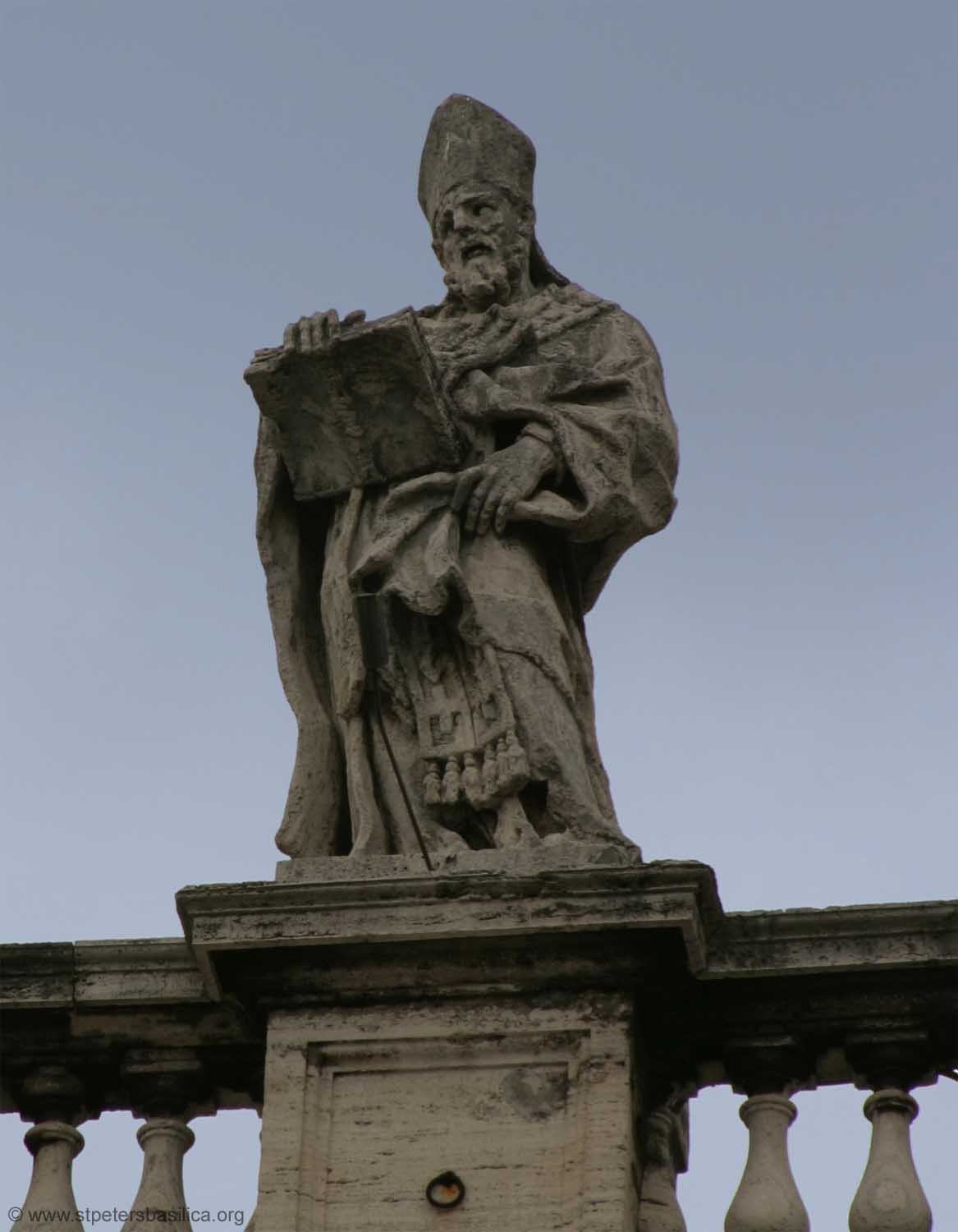
107.
St. Ubald. The 140 Saints of the Colonnade. St. Ubald
Born - c.1084. Died 1160 Gubbio, Italy. Feastday - 16 May. Statue created -
c.1669-1670
This is one of the group of 16 installed between
1 May 1669 and August 1670.. Sculptor - Giovanni Maria De Rossi
He received payments for his five statues in December 1668 and December 1669.
De Rossi's statues in this area show a greater adherence to the Bernini style
than those in the north arm.. Height - 3.1 m. (10ft 4in) travertine. The saint
is represented with a bishop's iconography: bearded man, pontifical robes, and
miter. Also, in his right hand is an open book. The medieval bishop of
Gubbio is still celebrated at the Basilica of Sant'Ubaldo in Gubbio, where his
relics are enshrined.
Saint Ubald de Gubbio
Évêque de
Gubbio (+ 1160)
Doyen de Saint-Augustin de Gubbio, près d'Ancone, il introduit la vie en communauté pour les chanoines de la cathédrale.
Évêque en 1128.
Canonisé en 1192.
Autre source d'informations (en italien)
Des internautes nous signalent:
- Connu en Italie sous le nom d'Ubaldo, Saint Thiébaut mort en 1160 fut l'évêque de Gubbio. Il est vénéré en France dans la ville de Thann (68) dont il est le saint patron. Fête le 30 juin (ndlr: en même temps que saint Thibaut).
- L'évêque de Gubbio st Ubaldo ne s'est jamais appelé Teobaldo (ou Thiébaud), lequel est le nom d'un saint français. Le culte du second, déjà établi à Thann, fut usurpé par les autorités civiles et religieuses, pour introduire le culte du premier car il était de parenté allemande et qu'il fallait un saint allemand pour faire réussir le pélerinage qu'on voulait essentiellement allemand. On garda le nom de "Thiébaut" avec le jour de sa fête (30 juin) pour faciliter la pantomime. De fait c'est le culte de st Ubald qui a toujours été célébré à la Collégiale de Thann. Ces choses-là étaient choses courantes au Moyen-Age, car les reliques étaient de l'or en barres...
A lire aussi:
- En l'an 1160 mourrait à Gubbio (Italie), l'évêque Saint Thiébaut. Il avait légué sa bague épiscopale à son fidèle serviteur. Mais, en voulant retirer l'anneau, le serviteur arracha le pouce droit. Il l'enchâssa dans son bâton de pèlerin et s'en retourna chez lui en Lorraine. En chemin, il arriva à Thann en 1161...
- La collégiale Saint-Thiébaut, une légende et un haut lieu de pèlerinage. Chaque année, le 30 juin, Thann commémore la légende de sa création avec la «crémation des trois sapins»: en 1161, au cours d'une halte dans la forêt, le serviteur de Thiébaut, évêque de Gubbio qui dissimulait dans son bâton une relique de son maître, ne parvint plus à l'arracher du sol...
- La collégiale Saint Thiébaut, (XIVe et XVIIe siècles) avec sa haute flèche (XVIe siècle) qui nous désigne le ciel... Dans la chapelle Saint Thiébaut avec l'admirable statue processionnelle du saint (1520)...
À Gubbio en Ombrie, l'an 1160, saint Ubald, évêque, qui travailla à
restaurer la vie commune de ses clercs. (16 mai au martyrologe romain)
Martyrologe romain
SOURCE : https://nominis.cef.fr/contenus/saint/1172/Saint-Ubald-de-Gubbio.html

Palma il Giovane (1550–1628). Apparition
de la Très Sainte Vierge Marie et de l’Enfant Jésus à Saint Ubald de
Gubbio, 1620, 352 x 210, São Paulo Museum of Art
St Ubald, évêque et
confesseur
Déposition à Gubbio
(Ombrie) en 1160. Canonisé en 1192. Fête en 1605.
Leçons des Matines avant
1960
Quatrième leçon. Ubald,
né d’une famille noble, à Gubbio, en Ombrie fut, dès ses plus tendres années,
élevé avec grand soin dans la piété et les lettres. Au cours de sa jeunesse, on
le pressa plusieurs fois d’embrasser l’état du mariage, mais jamais il
n’abandonna sa résolution de garder la virginité. Ordonné Prêtre, il distribua
son patrimoine aux pauvres et aux Églises, et étant entré chez les Chanoines
réguliers de l’Ordre de Saint-Augustin, il établit cet institut dans sa patrie,
et y vécut quelque temps de la manière la plus sainte. La réputation de sa
sainteté s’étant répandue, i ! fut préposé malgré lui par le Souverain Pontife
Honorius II au gouvernement de l’Église de Gubbio, et reçut la consécration
épiscopale.
Cinquième leçon. Ayant
donc pris possession de son Église, il ne changea rien à sa manière de vivre
accoutumée, mais il commença à se distinguer d’autant plus en tout genre de
vertus, qu’il procurait très efficacement le salut des autres par la parole et
l’exemple, s’étant fait de cœur le modèle de son troupeau. Sobre dans sa
nourriture, sans recherche dans ses vêtements, n’ayant pour couche qu’un lit
dur et très pauvre, il portait constamment en son corps la mortification de la
croix, tandis qu’il nourrissait chaque jour son esprit par une application
incessante à la prière. C’est ainsi qu’il parvint à cette admirable mansuétude,
qui lui fit non seulement supporter avec égalité d’âme les plus graves injures
et les mépris, mais encore prodiguer avec l’admirable tendresse de la charité
une entière bienveillance à ses persécuteurs.
Sixième leçon. Deux ans
avant de sortir de cette vie, Ubald, affligé de longues maladies, fut purifié
comme l’or dans la fournaise, par les plus cruelles souffrances ; cependant il
ne cessait de rendre grâces à Dieu. Le saint jour de la Pentecôte étant arrivé,
il s’endormit dans la paix, après avoir gouverné de nombreuses années avec le
plus grand mérite l’Église confiée à ses soins, et être devenu illustre par ses
saintes œuvres et par ses miracles. Le Pape Célestin III a mis Ubald au nombre
des Saints. Son pouvoir éclate particulièrement pour mettre en fuite les
esprits immondes. Son corps, demeuré sans corruption après tant de siècles, est
l’objet d’une grande vénération de la part des fidèles dans sa patrie que plus
d’une fois il a délivrée de périls imminents.
Dom Guéranger, l’Année
Liturgique
Pour honorer son Pontife
éternel, la sainte Église lui présente aujourd’hui les mérites d’un Pontife
mortel ici-bas, mais entre, après cette vie, dans les conditions de
l’immortalité bienheureuse. Ubald a représenté le Christ sur la terre ; comme
son divin chef il a reçu l’onction sainte, il a été médiateur entre le ciel et
la terre, il a été le Pasteur du troupeau, et maintenant il est uni à notre
glorieux Ressuscité, Christ, Médiateur et Pasteur. En signe de la faveur dont
il jouit auprès de lui dans le ciel, le Fils de Dieu a confié à Ubald le pouvoir
spécial d’agir efficacement contre les ennemis infernaux, qui tendent
quelquefois aux hommes de si cruelles embûches. Souvent l’invocation du saint
évêque et de ses mérites a suffi pour dissoudre les machinations des esprits de
malice ; et c’est afin d’encourager les fidèles à recourir à sa protection que
l’Église l’a admis au rang des saints qu’elle recommande plus particulièrement
à leur dévotion.
Soyez notre protecteur
contre l’enfer, ô bienheureux Pontife ! L’envie des démons n’a pu souffrir que
l’homme, cette humble et faible créature, fût devenu l’objet des complaisances
du Très-Haut. L’incarnation du Fils de Dieu, sa mort sur la croix, sa
résurrection glorieuse, les divins Sacrements qui nous confèrent la vie
céleste, tous ces sublimes moyens à l’aide desquels la bonté de Dieu nous a
rétablis dans nos premiers droits, ont excité au plus haut degré la rage de cet
antique ennemi, et il cherche à se venger en insultant en nous l’image de notre
créateur. Il fond quelquefois sur l’homme avec toutes ses fureurs ; par une
affreuse parodie de la grâce sanctifiante qui fait de nous comme les
instruments de Dieu, il envahit, il possède des hommes, nos frères, et les
réduit au plus humiliant esclavage. Votre pouvoir, ô Ubald, s’est signalé
souvent dans la délivrance de ces victimes infortunées de l’envie infernale ;
et la sainte Église célèbre en ce jour la prérogative spéciale que le Seigneur
vous a confiée. Dans votre charité toute céleste, continuez à protéger les
hommes contre la rage des démons ; mais vous savez, ô saint Pontife, que les
embûches de ces esprits de malice sont plus fatales encore aux âmes qu’elles ne
le sont aux corps. Prenez donc pitié aussi des malheureux esclaves du péché,
sur lesquels le divin soleil de Pâques s’est levé sans dissiper leurs ténèbres.
Obtenez qu’ils redeviennent enfants de la lumière, et que bientôt ils aient
part à cette résurrection pascale dont Jésus est venu nous apporter le gage.
Bhx Cardinal
Schuster, Liber Sacramentorum
La fête de ce saint
évêque de Gubbio (+ 1160), si puissant contre les esprits infernaux, entra dans
le calendrier de l’Église universelle seulement sous Paul V. La messe Statuit
est du Commun, mais la première collecte est propre.
La mitre de saint Ubald
est conservée à Rome dans la basilique d’Eudoxie sur l’Esquilin, où l’on
célèbre sa fête.
Prière. — « Apaisez-vous,
Seigneur, en nous accordant votre secours ; et par l’intercession du
bienheureux Ubald, votre Pontife et confesseur, étendez sur nous votre bras
miséricordieux contre toute malice diabolique. Par notre Seigneur, etc. »
Il vainc le diable, celui
qui s’exerce surtout aux vertus qui s’opposent davantage à sa malice ; l’amour
de Dieu par exemple, l’humilité, la chasteté et l’amour de la paix. Le démon
apparut un jour à saint Macaire et lui demanda : Macaire, que font les moines
de plus que nous ? Ils jeûnent souvent, et nous ne goûtons aucune sorte de
nourriture ; ils dorment peu, et nous ne reposons jamais ; ils sont chastes, et
nous n’avons pas même de corps. En quoi donc les moines nous sont-ils
supérieurs ? Le saint répondit : Vous êtes orgueilleux, et les moines sont
humbles, voilà ce qu’ils font de plus que vous. Alors, confus, le démon
s’enfuit.
Dom Pius Parsch, le Guide
dans l’année liturgique
La liturgie connaît
l’influence du diable dans l’Église et le combat efficacement.
Saint Ubald. — Jour de
mort : 16 mai (dimanche de la Pentecôte) 1160. Tombeau : à Gubbio, en Ombrie.
Image : On le représente en évêque, le diable fuyant devant lui. Vie : Le saint
est originaire de Gubbio, en Italie. Il devint prêtre et chanoine. En 1128,
malgré ses répugnances, il céda aux désirs du pape Honorius II et fut nommé
évêque de sa ville natale. Dans cette charge, il fut un modèle de simplicité
apostolique, de zèle pastoral et de sainteté personnelle. On invoque volontiers
son secours contre les mauvais Esprits. Il mourut le 16 mai 1160. Son tombeau
se trouve dans sa ville natale. Son corps s’est conservé jusqu’à nos jours sans
corruption.
Pratique : La puissance
de saint Ubald se manifesta surtout dans l’expulsion des mauvais Esprits. La
liturgie, qui insiste tant sur la proximité des anges, compte aussi avec la
forte influence des mauvais Esprits, car elle lutte continuellement contre eux.
C’est pourquoi il n’est pas rare de trouver, dans la liturgie, des exorcismes.
Il y a également un grand nombre de sacramentaux institués contre l’influence
des mauvais Esprits, par exemple l’eau bénite, les cierges, les rameaux bénits.
Ne méprisons pas ces moyens. — La messe (Statuit) est du commun des confesseurs
pontifes avec une oraison propre laquelle nous demandons à Dieu, par
l’intercession du saint, d’étendre la main contre toute méchanceté du diable ».
SOURCE : http://www.introibo.fr/16-05-St-Ubald-eveque-et
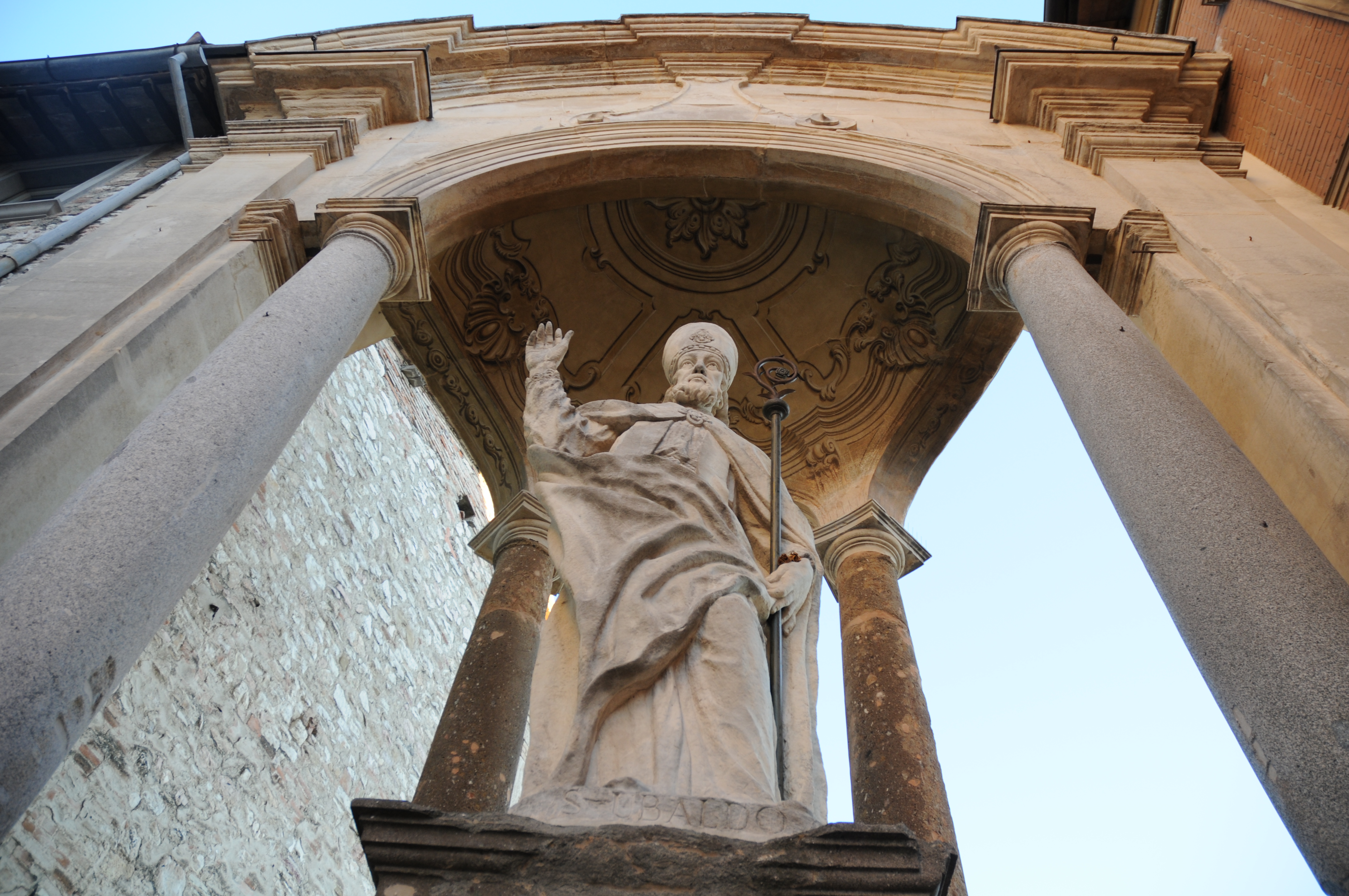
Statua
di Sant'Ubaldo, corso Garibaldi, Gubbio. Photographie de Simone Berettoni
Also
known as
Ubaldus of Gubbio
Ubaldo…
Ubald…
Ubalde…
Profile
Born to the nobility.
Related to Saint Sperandea.
Ubaldo’s father,
Rovaldo Baldassini, died when
the boy was
very young; his mother was
an invalid,
afflicted with what we now consider a neurological disease. Raised by his
uncle. Educated by
the prior of
the cathedral in Gubbio, Italy. Canon regular. Monk at
the Monastery of
Saint Secondo in Gubbio for
several years. Dean of
the cathedral in Gubio. Ordained in 1115.
Around 1120 he
convinced the canons of
his chapter to
live a common life together under the rule given by Peter degli Onesti; this
communal life was designed to keep them out of worldly ways. Ubaldo wanted to
be a hermit,
but was advised against it, and in 1128 he
accepted the bishopric of Gubbio.
Known as a patient, gentle, and brave pastor to his people. Convinced
Emperor Frederick
Barbarossa not to sack Gubbio as
he had done other cities. The tomb and shrine of Ubaldus is still a place
of pilgrimage.
Born
c.1085 at Gubbio near Ancona, Umbria, Italy as Ubaldo
Baldassini
around sunrise on
Monday 16 May 1160 at Gubbio near Ancona, Umbria, Italy of
natural causes
relics re-interred
on 11
September 1194
his right hand little
finger is held as a relic in
Thann, France
bishop giving
a blessing as angels carry
his crozier
bishop delivering
a blessing while
a devil flees from it
bishop holding
a model of Gubbio
Additional
Information
Book
of Saints, by the Monks of
Ramsgate
Lives
of the Saints, by Father Alban
Butler
Roman
Martyrology, 1914 edition
Saints
of the Day, by Katherine Rabenstein
books
Our Sunday Visitor’s Encyclopedia of Saints
Saints
and Their Attributes, by Helen Roeder
other
sites in english
images
video
sitios
en español
Martirologio Romano, 2001 edición
sites
en français
fonti
in italiano
MLA
Citation
“Saint Ubaldus
Baldassini“. CatholicSaints.Info. 17 May 2024. Web. 30 January 2026.
<https://catholicsaints.info/saint-ubaldus-baldassini/>
SOURCE : https://catholicsaints.info/saint-ubaldus-baldassini/
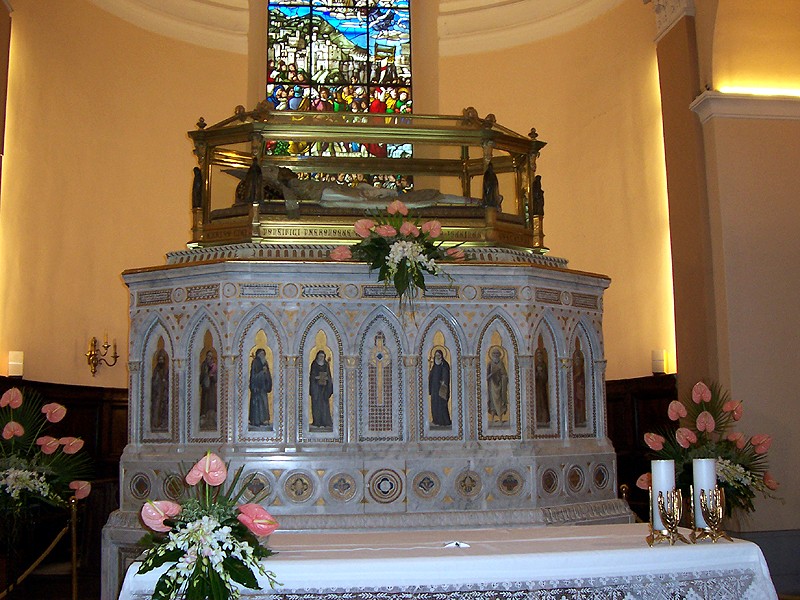
Urna
con le spoglie di S. Ubaldo, nella Basilica di S. Ubaldo,
Gubbio. Photographie de Geobia
(Saint) Bishop (May 16) (12th
century) A Bishop of
Gubbio in Italy,
near Ancona.
He was remarkable for his courage and success in meeting and softening the
heart of the fierce Emperor Frederick Barbarossa, then laying Italy waste
and threatening Gubbio. Saint Ubaldus died A.D. 1160 and
was canonised A.D. 1192.
MLA
Citation
Monks of Ramsgate.
“Ubaldus”. Book of Saints, 1921. CatholicSaints.Info.
8 May 2017. Web. 30 January 2026. <https://catholicsaints.info/book-of-saints-ubaldus/>
SOURCE : https://catholicsaints.info/book-of-saints-ubaldus/
St. Ubald Baldassini
Feastday: May 16
Patron: of Gubbio, Italy; against demoniac possession; migraine, neuralgia, sick children; autistics; people suffering from obsessive compulsive disorder
Birth: 1084
Death: 1160
Ubald Baldassini was born
of a noble family in Gubbio Italy,
was orphaned in his youth, and was educated by his uncle, the Bishop of
Gubbio. Ubald was ordained, was named deacon of the cathedral, reformed the
canons, and then left a few years later to become a hermit. Dissuaded from the
eremitical life by
Peter of Rimini, he returned to Gubbio and
in 1126, was named Bishop of Perugia but
refused the honor. He became Bishop of Gubbio in
1128 and persuaded Emperor Frederick II not
to sack Gubbio, as he had Spoleto during
one of his forays into Italy. Ill the last two years of his life, Ubald died
at Gubbio on
May 16, and was canonized in 1192. His feastday is May 16th.
SOURCE : https://www.catholic.org/saints/saint.php?saint_id=433
St. Ubaldus
Confessor, Bishop of Gubbio,
born of noble parents at Gubbio,
Umbria, Italy,
towards the beginning of the twelfth centry; died there, Whitsuntide,
1168.
Whilst still very young,
having lost his father,
he was educated by
the prior of
the cathedral
church of his native city, where he also became a canon regular.
Wishing to serve God with
more regularity he passed to theMonastery of St. Secondo in the same city,
where he remained for some years. Recalled by his bishop,
he returned to the cathedral monastery,
where he was made prior. Having heard that at Vienna Blessed Peter
de Honestis some years before had established a very fervent community
of canons regular, to whom he had given special statutes which
had been approved by Paschal II, Ubaldus went there, remaining with his
brother canonsfor three months, to learn the details and the practice of
their rules, wishing to introduce them among his owncanons of Gubbio.
This he did at his return. Serving God in
great regularity, poverty (for all his rich patrimony he
had given to the poor and to the restoration of monasteries), humility, mortification,
meekness, and fervour, the fame of his holiness spread
in the country, and several bishoprics were offered to
him, but he refused them all. However, the episcopal See
of Gubbio becoming vacant, he was sent, with some clerics,
by the population to ask for a new bishop from Honorius II
who, having consecrated him,
sent him back to Gubbio.
To his people he became a perfect pattern of all Christian
virtues, and a powerful protector in all their spiritual and
temporal needs. He died full of merits, after a long and painful illness
of two years. Numerous miracles were
wrought by him in life and after death. At the solicitation
of Bishop Bentivoglio Pope
Celestine III canonized him
in 1192. His power, as we read in the Office for his feast, is
chiefly manifested over the evil
spirits, and the faithful are
instructed to have recourse to him "contra
omnes diabolicas nequitias".
The life of
the saint was
written by Blessed Theobaldus, his immediate successor in
the episcopal
see, and from this source is derived all the information given by his
numerous biographers. The body of the holy man, which had at first
been buried in the cathedral
church by the Bishops of Perugia and Cagli,
at the time of hiscanonization was
found flexible and incorrupt, and was then placed in a
small oratory on the top of the hill overlooking the city, where in
1508, at the wish of the Duke of Urbino,
the canons regular built a beautifulchurch, frequented to this day by
numerous pilgrims,
who come to visit the relics of
their heavenly protector from near and far. The devotion to
the saint is
very popular throughout Umbria, but especially at Gubbio,
where in every family at
least one member is called Ubaldus. The feast of
their patron
saint is celebrated by the inhabitants of the country round with
great solemnity, there being religious and
civil processions which call tomind the famous festivities of
the Middle
Ages in Italy.
Allaria, Anthony. "St.
Ubaldus." The Catholic Encyclopedia. Vol. 15. New York:
Robert Appleton Company, 1912. 16 May
2015 <http://www.newadvent.org/cathen/15114b.htm>.
Transcription. This
article was transcribed for New Advent by Carol Kerstner.
Ecclesiastical
approbation. Nihil Obstat. October 1, 1912. Remy Lafort, S.T.D.,
Censor. Imprimatur. +John Cardinal Farley, Archbishop of New York.
SOURCE : http://www.newadvent.org/cathen/15114b.htm
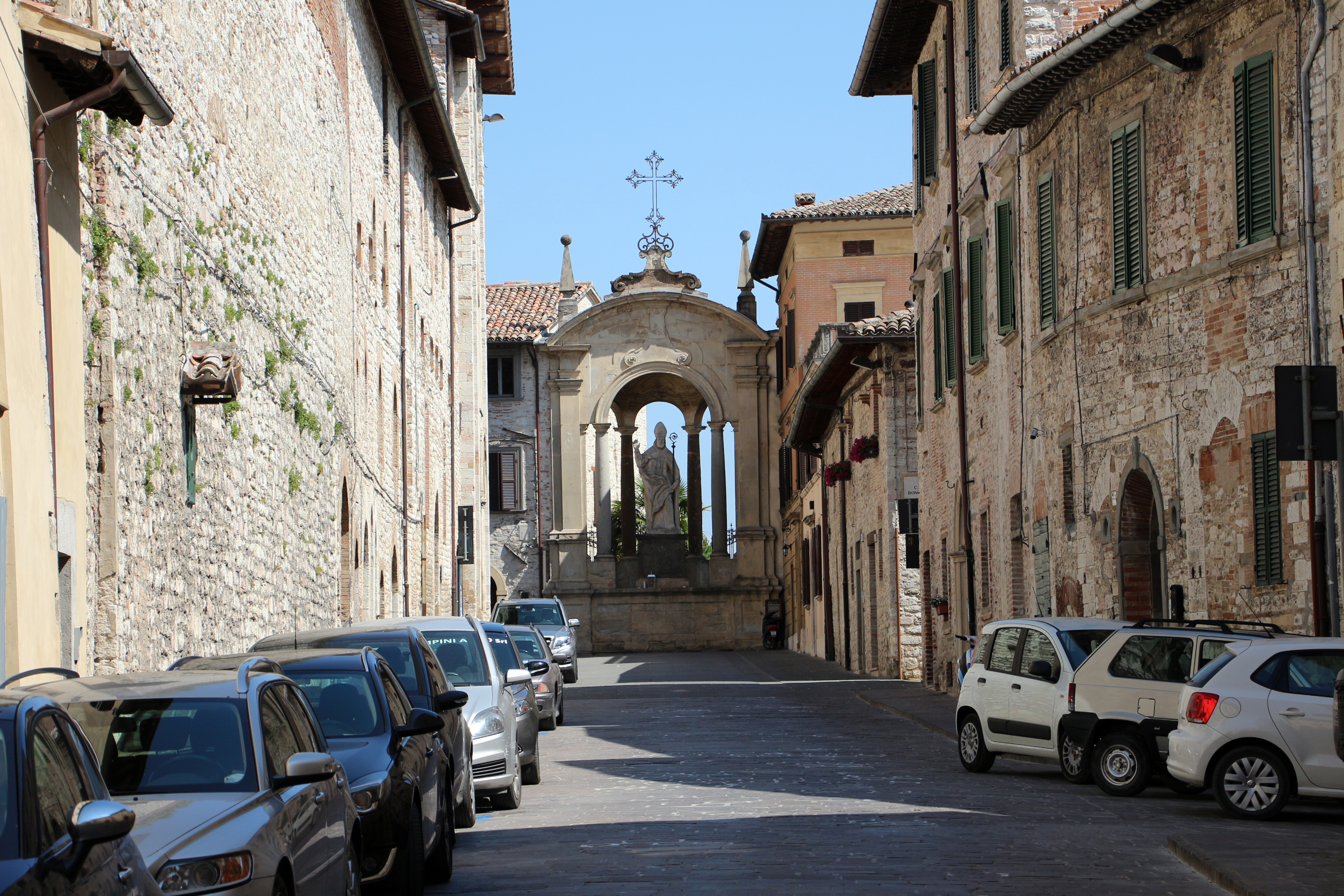
Edicola
di Sant'Ubaldo, corso Garibaldi, Gubbio.
Ubaldus Baldassini B (RM)
Born in Gubbio near Ancona, Umbria, Italy; died there in 1160; canonized in
1192. While dean of the cathedral in his home town, Ubaldus induced the canons
of the chapter to live a common life together, under the rule given by Peter
degli Onesti to his community at Ravenna. Ubaldus himself wanted to be a
hermit, but was advised otherwise, and, in 1128, he had to accept the bishopric
of Gubbio. He was an admirable bishop, noted for his patience and forbearance.
His character was remarkable for its combination of gentleness and courage with
which he succeeded in disarming the tyrannical Frederick Barbarossa. His shrine
is still a place of pilgrimage (Benedictines, Delaney).
In art, Saint Ubaldus is depicted as a bishop giving a blessing as angels carry
his crozier. On his book is written Sacerdos et Pontifex et virtutum opifex
pastor bone, etc. The devil may be shown fleeing the blessing (Roeder). Ubaldus
is invoked against demoniac possession, migraine, neuralgia, and for sick
children (Roeder).
SOURCE : http://www.saintpatrickdc.org/ss/0516.shtml
St. Ubaldus, Bishop of
Gubio
HE was born of a
noble family at Gubio, a city of the Ecclesiastical State, near the marquisate
of Ancona. He had his education in the seminary of SS. Marian and James, and
made great progress in his studies both profane and sacred; but the holy
scriptures, those springs of living waters, were his chief delight. Many
honourable matches were proposed to him by his friends; but he rejected all
such offers, and made a vow of celibacy. His ardour in the perfect practice of
virtue strengthened him against the bad example of many tepid companions.
However, not approving certain irregularities which he saw tolerated among
them, he exchanged this house for the seminary of St. Secundus, where he
finished his studies. The bishop of Gubio made him prior of his cathedral that
he might reform several abuses in the behaviour of the canons. Ubaldus prepared
himself for this important work by fasting, prayers, and tears, by which he hoped
to engage the divine assistance. He easily prevailed on three of his canons who
were the best disposed, to join with him in his exercises and rules of life;
and their example soon began to work upon the rest. The saint visited a
community of regular canons, esteemed for their regularity and sanctity, which
had been established by Peter de Honestis, a person of singular piety, in the
territory of Ravenna. He staid there three months in order to take an exact
view of the discipline of the house; and he carried its rule back with him to
Gubio, and in a short time got it received by the whole chapter to render their
reformation complete. After some years, their house and cloister being burnt
down, Ubaldus looked upon this as a favourable opportunity of leaving his post,
and retiring into some desert. In this view he made his way to that of
Font-Avellano, where he found Peter of Rimini, to whom he communicated his
design of quitting the world. That great servant of God opposed the motion as a
dangerous temptation, and exhorted him to return to his former vocation, in
which God had fixed him for the good of others. The saint, therefore, returned
to Gubio, rebuilt the cloisters, and rendered his chapter more flourishing than
it had ever been, to the great edification of the whole country. In 1126, St.
Ubaldus was unanimously chosen bishop of Perugia; but he hid himself in the
country, so that the deputies of that city were not able to find him; and when
they were departed, he went to Rome, threw himself at the feet of Pope Honorius
II. and with many tears begged that he might be excused; employing all the
interest he had in the world to obtain the favour he desired. Honorius granted
his request; but the see of Gubio becoming vacant two years after, the pope
directed the clergy of that city to proceed to his election according to the
forms prescribed by the canons: in consequence of which his holiness
consecrated him with his own hands in the beginning of the year 1129. The new
bishop made it his whole business to adorn the dignity of his station with all
the virtues of a true successor of the apostles. He practised a perpetual
mortification of all his senses, and lived dead to all the enjoyments of the
world: he was indefatigable both in the exercise of penance, and in the labours
of his ministry; frugal, humble, sincere, and full of compassion for all the
world. But mildness and patience, by which he appeared insensible to injuries
and affronts, was one of the brightest parts of his character. Once it
happened, that in repairing the wall of the city, the workmen encroached upon
his vineyard. The bishop mildly put them in mind of it, and desired them to
forbear. The overseer of the work moved with brutish fury, scornfully pushed
him into a great heap of mortar. The good bishop got up all covered with lime
and dirt, without making the least expostulation. The people demanded that the
overseer, in punishment for the offence, should be banished, and his goods
confiscated. The saint endeavoured to make it pass for an accident; but when
that could not satisfy the people, who knew how it happened, he being desirous
to deliver the man out of the hands of the magistrates, maintained that the
cognizance of the misdemeanour belonging to his own court, he would take care
to do himself justice. The workman, stung with remorse, proffered to accept of
any punishment the bishop should think proper to inflict on him, even though
his life was to pay for the offence. The holy prelate, rising from his chair,
went up to him, and told him with a smiling countenance, that by way of
satisfaction for the injury received, he insisted on his giving him a kiss of
peace, as a token of a perfect reconciliation, and that he begged of God to
pardon him that and all other offences. After which he saluted him.
The saint often
defended his flock in public dangers. Hearing one day that a sedition was
raised in one of the streets, wherein some were wounded, others killed, he ran
out, and venturing himself between the combatants, fell down amidst their naked
swords. The mutineers thinking him dead, all threw away their weapons, running
to take him up, and every one condemned himself as the murderer of their holy
bishop. Then the saint, thanking God that the tumult was appeased, dispelled
their fears by assuring them that he had received no hurt. The Emperor
Frederick Barbarossa, in his cruel wars in Italy, having taken and plundered
Spoleto, threatened to do the like by Gubio. Ubaldus, moved by a more than
fatherly tenderness for his flock, met the emperor on the road, and on his
first interview softened the heart of that tyrant to compassion, and obtained
of him the safety of his people. The two last years of his life he laboured
under a complication of painful distempers, which he bore with the patience of
a saint. On Easter-day, in 1160, his devotion to the glorious mystery of that
festival made him forget his infirm condition, get up, say mass, and give the
people a discourse on eternal life. From the cathedral he would be carried to
the church of St. Laurence, near which he had an apartment. He continued there
till the feast of the ascension in retirement, to prepare himself for death.
After that he was removed into his own house, where he repeated his last
instructions to his clergy and people, who came to visit him and beg his last
blessing. Having received the rites of the church, he expired on the 16th of
May, 1160. The people from all the neighbouring provinces attended his funeral
in crowds, and were eye-witnesses of the many miracles God performed at his
tomb. So tender was the devotion which this spectacle excited in every one,
that animosities and dissensions over the whole country were extinguished, and
a most wonderful spirit of charity was infused into all hearts. Injuries were
forgotten, and cities which had been long at variance, renewed the most sincere
league of friendship. St. Ubaldus had been favoured with the miraculous gift of
curing diseases in his lifetime, which he performed by the sign of the cross
and prayer; yet, when a certain blind man addressed himself to him to be cured,
the bishop told him that his corporal sight would be prejudicial to his soul,
and that his temporal blindness would be recompensed with the clear vision of
God in heaven for all eternity: at which the good man was so well satisfied,
that he no longer desired to be cured. St. Ubaldus was canonized by Pope
Celestine III. in 1192. See his accurate life written by Tebald, his successor,
in the Acta Sanctorum.
Rev. Alban Butler (1711–73). Volume V: May. The Lives of the Saints. 1866.
SOURCE : http://www.bartleby.com/210/5/163.html

Mitria di Sant'Ubaldo
May 16: St. Ubald
This saint lived in
twelfth-century Italy. He was an orphan raised by his uncle, a bishop. Ubald
was given a good education. When he finished his schooling, he had the chance
to marry. But he became a priest instead. Eventually, the pope made him bishop of
Gubbio, the city of his birth.
St. Ubald became well
known for his mild and patient disposition. One time, for example, a worker was
repairing the city wall. He badly damaged the bishop's vineyard. The saint
gently pointed it out to him. The workman must have been very tired. He
probably did not even recognize the bishop. He shoved Bishop Ubald so hard that
he fell into a pile of wet cement. He was covered with it. He got up, cleaned
himself off and went into the house. Some people saw the whole thing and
demanded that the worker be brought to court. Bishop Ubald appeared in the
courtroom and obtained the man's freedom.
The holy bishop loved
peace and he had the courage it takes to keep it. Once, when the people of
Gubbio were fighting in the streets, he threw himself between the two angry
crowds. He seemed unafraid of the swords clashing and the rocks flying.
Suddenly he fell to the ground. The people stopped fighting at once. They
thought the bishop had been killed. But he got up. He showed them he was not
even hurt. The people thanked God. They stopped fighting and went home.
Another time, Emperor
Frederick Barbarossa was on his way to attack Gubbio. St. Ubald did not wait
for him and his army to come to the city. He went out on the road to talk to him.
No one knows what he said. All they know is that he convinced the emperor to
leave Gubbio alone.
The saint had a great
amount of physical pain. Yet he never talked about it. On Easter Sunday, 1160,
he rose for Mass. He gave a beautiful sermon and blessed the people. Then he
had to go back to bed. He was not able to get up again. He died on May 16,
1160. All the people came to pay their respects. They cried and prayed to St.
Ubald to take care of them from heaven.
Reflection: At times it
is hard to forgive those who hurt us. We obtain the grace to do so by turning
to Jesus more and asking him to help us be as meek and forgiving as he was.
SOURCE : http://www.holyspiritinteractive.net/dailysaint/may/0516.asp
Miniature
Lives of the Saints – Saint Ubald, Bishop
Article
At an early age Ubald
turned his back on a brilliant future, and entered the Order of Canons Regular.
Finding his own community relaxed, he withdrew for a while to a house of strict
observance, whence he came back to re-establish the discipline of his monastery.
In 1128, being chosen Bishop of Gubbio, his native place, he redoubled the
severity of his life. His habitual self-denial was rewarded by an apparent
insensibility to insults or affronts. On one occasion a workman, whom he
reproved, pushed him into a heap of mortar, covering him with dirt. Ubald rose
without uttering one word of complaint, and even delivered his assailant from
the prosecution which the townsfolk set up. When the man, won by this clemency,
offered the bishop any reparation, Ubald only demanded of him the kiss of
peace. Knowing the blessings of this holy peace, he faced every danger to
preserve it in his flock, and proved himself as brave as he was gentle. When a
riot arose in the town, and he saw that his entreaties were of no avail, he
threw himself between the combatants, regardless of their drawn swords and of
the falling stones, and fell to the ground as if wounded. The rioters at once
cast down their weapons, believing him slain. But the Saint, rising up, thanked
God that the tumult was stayed. During his last years he bore with perfect
cheerfulness a most painful disease, and at length passed to peace eternal,
a.d. 1160.
MLA
Citation
Henry Sebastian Bowden.
“Saint Ubald, Bishop”. Miniature Lives of the
Saints for Every Day of the Year, 1877. CatholicSaints.Info.
24 February 2015. Web. 16 May 2020.
<https://catholicsaints.info/miniature-lives-of-the-saints-saint-ubald-bishop/>
SOURCE : https://catholicsaints.info/miniature-lives-of-the-saints-saint-ubald-bishop/

Basilica
di S. Ubaldo, Gubbio
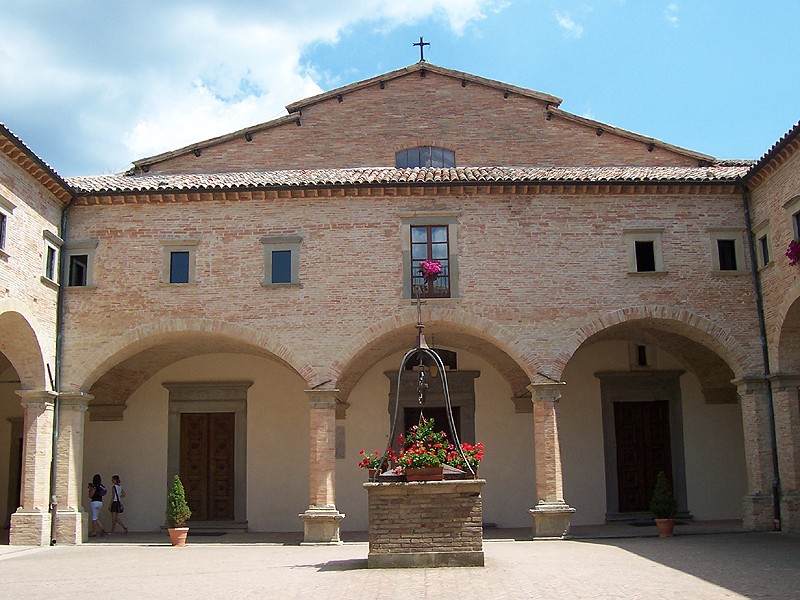
Basilica
di S. Ubaldo, Gubbio

Basilica
di S. Ubaldo, Gubbio. Photographie de Geobia
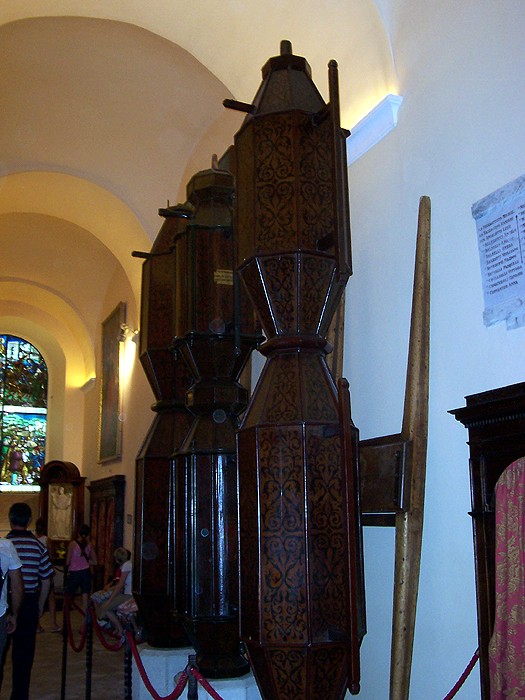
i
3 ceri custoditi nella Basilica di S. Ubaldo, Gubbio
St Ubaldus (16th May)
Umbria: Home Cities History Art Hagiography Contact
Gubbio: Home History Art Saints Walks Monuments Museums
St Ubaldus was born into
the noble Baldassini family in ca. 1075. His parents died while he was
still a child and he was raised by an uncle. This house (14th
century) at number 34-8 Via Baldassini (see the Walk)
is traditionally said to stand on the site of the family home.
St Ubaldus was educated
at San Secondo and then at San
Mariano. However, he disapproved of the way of life of the clergy of
San Mariano and was back at San Secondo in 1104, when the old Bishop Rustico died
and was succeeded by St John of Lodi. At the request of
the new bishop, St Ubaldus returned to San Mariano.
St Ubaldus was ordained
in 1114 and was elected prior of the San Mariano some four years later He
was sympathetic to the cause of Church reform and imposed an ascetic rule on
his community. [He imposed what is known as the Portuense Rule,
which Pope Paschal II had confirmed in 1116 for a community of
regular canons at the church of Santa Maria in Portu on the island of Corizo
near Ravenna. This rule subsequently became widely diffused in Italy,
France, Spain and Germany.]
When a fire in 1126
destroyed much of Gubbio, including the Duomo and the Canonica, St Ubaldus
fled to the Eremo di Fonte Avellana, intent on
dedicating himself to the monastic life. He was however persuaded to
return to Gubbio, and he became its bishop in 1129, just a year before the
start of the papal schism. His support for Pope Innocent II (perhaps
because this was the candidate pressed by St Bernard of Clairvaux) seems to
have been influential in deciding the obedience of the cities of Umbria.
One of his first acts as
bishop was to begin the rebuilding of the city. He also calmed the civil
unrest in the period 1135-40 that culminated in the establishment of the
commune and the election of Consuls. In 1151, exiled nobles from Gubbio
seem to have mobilised support from some eleven neighbouring cities, including
Perugia, Città di Castello, Nocera, Foligno, Spoleto and Assisi, and a force
under Perugian leadership attacked Gubbio. However, St Ubaldus had
rebuilt the walls of the city, and the invaders were forced to mount a
siege. Fortunately, St Ubaldus was able to dispatch soldiers to the
surrounding mountains under cover of darkness. The following day the
besieging army at Montelovesco di Gubbio found itself surrounded and was forced
to withdraw.
His help was needed again
in 1155, when the Emperor Frederick I, who was camped with a large army at
Gualdo Tadino after the sack of Spoleto, demanded a huge payment from
Gubbio. St Ubaldus pleaded with Frederick I, who was so impressed that he
left the city in peace and granted it a number of territorial privileges.
When St Ubaldus died in
1160, he was buried in the old Duomo,
beside the relics of SS Marianus and James. In 1188, Pope Clement
III gave permission to Bishop Benedetto Bentivoglio for the
translation of the relics of the saints of Gubbio (presumably including the
body of the future St Ubaldus) from the “antiqua civitate” to the site on
the mountain, where the “civitas de novo”had been constructed.
Theobald II, a monk from
Fonte Avellana who succeeded St Ubaldus as Bishop of Gubbio, wrote his
biography (BHL 8355-7) in 1163 and dedicated it to Frederick I . An
almost contemporary work was written by Giordano di Città di Castello (BHL
8354). This culminated in the canonisation of St Ubaldus by Pope Celestine
III in 1192. (BHL 8357 documents a church dedicated to St Crescentian (probably
the Pieve di San Crescentino, Cantiano) and a church dedicated to St Orphitus,
one of the associated Martyrs of Saddi).
Relics of St Ubaldus
In 1194, his relics
translated from the Duomo to a small oratory at the summit of Monte Ingino,
which was near an oratory that was dedicated to the Milanese SS
Gervasio and Protasio. (This was later to become the site of Basilica
di Sant’ Ubaldo, and recent research has located the oratory under the
present campanile). It is likely that this site was chosen so that the
soldiers stationed at the nearby Rocca Posteriore could protect them.
Two sarcophagi that previously contained the relics of St Ubaldus were brought here in 1997 from Santa Maria Nuova:
The sarcophagus (13th century) to the left of the apse was decorated with panels (early 14th century) that are attributed to the Maestro Espressionista di Santa Chiara (Palmerino di Guido?).
The relics were transferred to the sarcophagus (18th century) that now stands to the right of the apse in 1721.
In 1866, the relics of St
Ubaldus were translated to this glass and gilded brass coffin (1860) in the
apse, which rests on a neo-Gothic altar. The bronze statues at the
corners represent SS James, Marianus, Sperandia (the sister of St Ubaldus),
Francis, Rudolf Gabrielli, Forte Gabrielli and John of Lodi, along with the
Blessed Villanus.
Corsa dei Ceri
On 15th May each year,
the city celebrates the Festa
dei Ceri (Feast of the Candles). This may well have had pagan
origins, but it has long served as a celebration of the famous victory of
1151. Three enormous wooden structures representing candles, each of
which is connected with a particular neighbourhood and trade, are carried up
the steep hill to the church of Sant' Ubaldo. This is not a race:
the team with the structure that carries an image of St Ubaldus is always the
first to reach the summit.
Read more:
S. Brufani and E, Menestò (Eds), “Nel Segno del Santo Protettore: Ubaldo Vescovo, Taumaturgo, Santo: Atti del Convegno Internazionale di Studi, Gubbio, 15-19 Dicembre 1986” (1990) Spoleto, reprinted 1992
Return to Saints of Gubbio.
SOURCE : https://www.keytoumbria.com/Gubbio/St_Ubaldus.html

UBALDO
BALDASSINI
Citizen,
Bishop and Patron of Gubbio
The family and youth
St. Ubaldo's exact birth date has not been accertained yet. He was probably born more or less in the year 1085.
He was the only son of Rovaldo Baldassini, but he had a sister called Sperandìa, bigger than him. His mother, whose name maybe was Giuliana, was an invalid, seriously affected by a spastic disease.
The Baldassini family, maybe of german origin, was a family which became noble not long before, but was one of the most important in the city and was now considered a real eugubinian family. The Baldassini, who possessed domains at Carpiano, on the hills south of the city of Gubbio, had Baldassino as original family head, born in 1002, who was the great grandfather of our saint. St. Ubaldo's grandfather, Pace Baldassini, and the grandmother Pudenzia Armanni had two children: Rovaldo and Ubaldo, respectively father and uncle of St.Ubaldo.
When he was born, St.Ubaldo was baptized in the church of St. Giovanni,
situated near the present one.
St. Ubaldo's life was difficult from the beginning. In fact, he became orphan
of his father who died when he was still small and his mother died young too.
For this reason his uncle Ubaldo took care of him.
He received his first schooling at the clergy of St.Secondo. Here he passed a happy period of his life and for this reason he remained affectioned to that church for all his life and when he was elected bishop, he left a patrimony to the church.
We are not sure of the period in which he continued studying at St.Secondo, but we are sure that he passed a short period at Fano, then at the clergy of St.Mariano at Gubbio. But in this parish St.Ubaldo wasn't happy and wished to go to a place of retreat, when he managed to return to St. Secondo church. The reason for this decision was because the clergymen of St.Mariano disgusted the young St.Ubaldo with their immoral attitude: community life was an exception, the only rule was the presence of women in the clergy: everyone had their own concubine!
So therefore in 1104 St.Ubaldo was at St.Secondo church when the old bishop Rustico died and was succeeded by Giovanni of Lodi, man of great moral and spiritual reputation, who grew up at the school of St.Pier Damiani and was secretary, biographer, and prior successor at the monastery of Fonte Avellana.
The new bishop wanted St. Ubaldo with him and therefore conducted him to St.Mariano.
They lived under the same roof for not even a year, in fact S.Giovanni of Lodi
died in the autumn of 1005, but this short period was sufficient for the twenty
year old S.Ubaldo to stimulate his passion and vocation of reformer of clerical
life. Another Giovanni was nominated bishop, not more identified than the one
before, and the clerical life which had improved in the last period, returned
to its normal course. But this time St. Ubaldo didn't go back to St. Secondo
and even if he received strong pressure to get married and have children, in
this way regaining rights on the big patrimony of his family which was almost
taken over by his relatives, he refused to do so by saying: "Dear
friend, I will never turn back on my decisions" and "nobody who puts
their hands on a plough and then turns around is worthy to enter the kingdom of
God". As far as children were concerned, he repeated: "He who loves
his children more than me is not worthy of me". It was now clear that
his vocation was sincere and every day he sang to the Lord: "I only
ask one thing from the Lord, that is to live in his house for the remainder of
my days".
The Priesthood and the reform of the
clergy
Three years later, in 1118, he became the prior of the parish of St.Mariano, to tell the truth, against his desire, but he had to accept.
"Prior Ubaldino", as they affectionately called him, worked hard on the clerical reforms of the church life. Unfortunately the clergical life was an exception, preferring the priests to live at their own homes; therefore even the religious functions were reduced to the bare necessities.
Ubaldo heard about a community of priests of St.Maria in Porto, near Ravenna, where Pietro of the Onesti wrote a Rule in 1116 which was the base of the life in that community, a rule which had been approved by Pope Pasquale II.
Ubaldo didn't hesitate and left for Ravenna by foot, because he wanted to find out personally how life was in that community based on that rule.
He got there in the first months of 1119, the prior Pietro of the Onesti was a marvellous teacher and example: but on the 29th of March 1119 he died, so all St.Ubaldo could do was copy the text of the Rules and return to Gubbio.
In this rule it was compulsory to surround the clergy house with a wall; to close the external door during the night; to maintain the absolute silence in the church, in the refectory and in the dormitory; not to go out more than two at the same time and only with the permission of the prior. There were also numerous fastings, daily bible reading, charity and hospitality to the poor and needy people. The clergymen had to be poor and therefore they didn't possess anything, for that reason St. Ubaldo was worried about the partitioning of his whole inheritance received from his father, leaving a small pert to his relatives, while he divided all the rest between the poor and the clergymen: a great "francescan" example but 80 years before!
On his return to Ravenna, Ubaldo obviously had some difficulty in having the
Rule accepted; of all the clergymen present in St. Mariano, he only convinced
three of them, but with their help the new reform slowly took its course and
the clergy house became outstanding among others.
In 1126 a big fire destroyed Gubbio with its wooden houses, and even destroyed the clergy house of St. Mariano. St. Ubaldo was desperate, abandoned Gubbio and fled towards the nearest monastery of Fonte Avellana. But when the prior of that monastery, Pietro of Rimini, discovered the reason of his flee, he reproached him severely and warned him to return among his brothers who were left in great difficulty.
St.Ubaldo learnt the lesson and returned immediately to the ruins of his city
and dedicated himself with body and soul to the reconstruction of his clerical
house and the city itself.
The refusal to be bishop of Perugia
In the same year, 1126, the bishop of Perugia, Gennaro, died. A commission of perugians came to Gubbio to communicate to Ubaldo that he had been chosen as the new bishop.
But as soon as Ubaldo heard of it, he fled to a retreat in the surrounding mountains, but he knew that if the pope forced him into becoming bishop, he was obliged to do so. Then he secretly returned to the city and from there he continued on foot with four of his clerical brothers towards Rome and presented himself to Pope Onorio II.
He explained the reasons of his refusal to the pope. Onorio accepted the
refusal of Ubaldo and the perugians were forced to chose another bishop
(Rodolfo Armanni).
Ubaldo returns to Gubbio happy and relieved. Very little time passes and in 1129 the bishop Stefano dies in Gubbio, the eugubinian clergy can't find an agreement on the election of a new bishop, therefore a delegation goes to Rome to ask the pope to take the matter in his hands.
It was Ubaldo who was at the head of the delegation and Pope Onorio II obviously remembered him because of his visit few years before, when he refused to be bishop of Perugia. The pope had no doubt, and chose Ubaldo as the new bishop. Ubaldo tried to protest, but the pope was firm, and wished to make him bishop personally.
Ubaldo therefore returns from Rome, as bishop, but doesn't change his way of life. He continued living in the clergy house of St.Mariano and continued being "poor": maybe vegetarian, he ate very little and often only ate dry bread; his clothes were very thin, even if it was very cold; his bed was made of a mattress of very little hay and when it was too cold, he used his clothes to cover himself; in public he avoided any luxury. In other words he didn't seem to be a "bishop"! Even less to his relatives! They expected to have some advantages out of their bishop Ubaldo, but were shocked to see that it wasn't so. They called him: "son of an abnormal woman", "useless person", "the shame of all bishops" and even reached the point of calling him: "wreched, if only you could die!".
Many other eugubinians thought the same way, but Ubaldo in exchange gave them
his goodness, patience and forgiveness, in fact, he never "paid them back
with their own medicine".
The Bishop ill-treated by a bricklayer
There is a famour episode which happened in the year 1140. The great reconstruction of Gubbio, which started after the fire of 1126 reached a good point. They were constructing the walls of the city facing the mountain (situated slightly lower than the present walls, constructed a century later), and between these walls, exactly on the mountainous vineyard of the bishop, they were constructing higienic services and its refuse substances ended up right in the vineyard. Ubaldo went to the vineyard and kindly asked the bricklayers not to carry out such an offensive operation towards him and his vineyard. Unfortunately the head of the bricklayers reacted badly by insulting and pushing the bishop until he fell into the cement which was prepared for the building: Ubaldo, who was completely messed, got up patiently and went back into the clergy house.
Something serious had happened, and it went over all limits, to the point that the disgust of the people grew so much that they wanted to break down the house of the bricklayer and condemn him to exile.
But then the Bishop reappeared, telling the people not to hurl their insults, because Jesus also underwent insults and even his death on the cross, but he never took revenge. He ended his speech saying: "You can't punish him without offending me!" He then had the bricklayer called, and the man threw himself at Ubaldo's feet, but Ubaldo pulled him up, with the words: "my son, I forgive you almighty God" and kissed him.
What a great example of umility and forgiveness! From that day onwards the
Bishop Ubaldo was seen in a different light by the people.
We are almost at the half of the X11 century. It is the period of great political and social contrasts. From the political point of view the clash between guelphs (supporters of the political power of the Pope) and the ghibellines (supporters of the Imperator) started, but most of all the "new" clash between the two social classes worstened: on the one side the old feudal class of imperial origin, detainer of power, and on the other hand the new emerging class, which we could call the "middle class", composed of craftsmen, merchants who desired the increase of its their production and their commerce, and at the same time increase the richness of the city; obviously this class gained political control of the city ( in fact, towards the 1140 the first Consoli were elected).
The clashes were always more frequent and bloody. One day the tention grew so much that the piazza of S. Giuliano became a real battle field and the victims were numerous from both sides.
The Bishop Ubaldo was called and he immediately went to the point of the battle, but could not manage to make peace, so he threw himself in the middle of them, between the swords of the fighters, and all of a sudden he fell to the ground. Then everyone recognized Ubaldo, the Bishop, and they were afraid he would be dead; suddenly everyone stopped fighting and became worried, until a big crowd was formed around him, from both political sides, screaming and blaming themselves for his death.
But Ubaldo wasn't deat. He used this trick to convince the eugubinians to stop the battle and civil war.
When he realized that nobody wanted to continue fighting, and resolving problems with arms, Ubaldo got up calmly, and with his hand he thanked God for not having caused any victims.
Then everyone enjoiced and he severely reprimanded them and made them promise
never to use arms again, because they should have been satisfied with using
their ..... hands!
Gubbio againist eleven enemy cities
The civil war had now been avoided, but the political protests continued the same: once the "democratical" side gained power, they exerted it and many "aristocrats" were sent into exile. The bishop disapproved this measure but could not avoid it.
These exiles didn't give up, they plotted secretly and slowly looked for allies against the city of Gubbio that sent them out.
They managed to organize a proper military alliance against Gubbio without much trouble. In fact, Gubbio was envied because of its geographical position, for its intense political passion, for its prosperity and most of all for its expansionistic politics. Gubbio was also object of avidity and fear on behalf of the neighbouring cities who wanted to humiliate and limit the power of Gubbio.
All the big neighbouring cities formed part of the coalition against Gubbio e.g. Perugia, Città di Castello, Cagli, Sassoferrato, Nocera, Foligno, Spoleto and Assisi; including the Counts of Fossato, of Coccorano and Val Marcola.
We are in the spring of 1151. It is the famous "war of Eleven Cities against Gubbio"
The coalition army, lead by Perugia, camped out in the plains near the walls of Gubbio, and came nearer and nearer to the city day by day, and the city walls weren't even completed yet.
The numerical disproportion between the army of the allies and that on which Gubbio counted was very great: 14 to 1.
Some people say that it was even 40 to 1!
The fear in the city grew day by day.
While facing this tragic situation, the eugubinians were drawn still closer to their Bishop Ubaldo and tried to find a solution with him.
Obviously, as before, they tried the dipomatic solution: they made three tentatives, but no solution which was suggested was accepted by the perugians and their allies who intended dividing the areas conquested by the battle.
At this point the old bishop was forced to accept the use of arms. But first he called the people to the church of St. Mariano and said: "Brothers, don't be afraid of the multitude of enemies: if the Lord has intention of freeing us, they cannot do us any harm; if the Lord has decided to punish us, he can destroy us even without their help" and continued: "God hates sins, but not sinners; punish yourselves for the sins you have committed! Because in the name of the Lord I promise you that we will win the battle: only on condition that your sins have been cancelled with penetence."
Giordano, belonging to the same period and biographer of St. Ubaldo, writes that when the Eugubinians heard these words, they rushed to do their penetence, and their sins came to the light, and they tried being better persons". For another "three Days the city was overwhelmed by processions, hymns and prayers. Ahead there was the priest, near him the clergyman, and then the crowd of men, and at last the women: all of them were barefoot. For who desired to have communion, there was the host.
The prayers were followed by a victorious battle, prepared with care and military strategies: when the sun was setting a big group of chosen soldiers left the city on the north side, towards the mountain of Ingino, with the advantage of the dark they climbled up the slopes to then go down the gola of the Bottaccione and to once again climb up mount Calvo to descend into the plains and with a surprise attack their enemies. But this plan included also a frontal attack. In fact, the doors of the city suddenly opened and the eugubinian soldiers attacked their enemies who were camped outside the city walls.
The enemies were rapidly defeated. To flee was their only solution. When the eugubinians entered the enemy camps, they found enormous quantities of food and materials. It took them many days to transfer everything into the city.
The first of the four wars between Gubbio and Perugia had ended!
The Bishop and the Imperator Federico
Barbarossa
But the great dangers for this young comune were not at an end yet. In fact in 1154 the Imperator Federico 1 of Svevia, also called "Barbarossa" came to Italy, called by the Comunes of Lombardy who were battling among themselves. The Imperator had to face a situation which was very difficult to control: the Comunes, unlike the old Feudians, didn't accept imperial rule. Obviously Barbarossa couldn't tolerate such a situation and had to insist that the total power was in his hands: he made it clear to all the representatives of the Comunes present at the "Diet of Roncaglia".
However Barbarossa took time, he didn't face the situation immediately, and he was crowned King of Italy at Pavia, and then came to Rome to show Pope Adriano IV his new crown.
At the beginning of 1155 he continued on towards the North, followed the Via Flaminia, and passed through Spoleto. The city didn't consent to the demands of the Imperator and he conquested and completely destroyed the city. Then, continuing in the direction of Ravenna, he arrived near Gubbio, where the army camped. He asked the city to pay a big sum of money, as some of Gubbio's enemies had advised him to do.
The sum asked was enormous and impossible to pay, the possibility to pay it in rates was not accepted, the days passed and the risk of going through the same experience as the city of Spoleto was even more frightening.
The Eugubinians once more asked help from their bishop Ubaldo.
Ubaldo was very ill, but realized the gravity of the situation and spontaneously decided to present himself to Barbarossa. Now comes the shocking part: the imperator who wants to destroy Gubbio, when seing his old bishop, humbled himself and annulled all his mean plans. Giordano writes: "The imperator received him with solemnity" and "lowered his head to ask for a blessing". Then St. Ubaldo talks to him: "He who gave you the crown to govern on earth, giveth you the right to go to heaven". Federico, who had been longing to meet the bishop, sat near him and gave him a splendid silver cup as a present. This put an end to the hostility.
Once again Gubbio was saved by its bishop!
The meeting between the Bishop Ubaldo and Barbarossa made such an impression on
everybody that eight years later, in 1163, three years after the death of St.
Ubaldo, the Eugubinians offered the Imperator the "Vita di S.
Ubaldo", written by his successor Teobaldo and dedicated to Federico, who
dedicated to Gubbio the famous "Diploma" with which Gubbio was
recognized at the Comune of Gubbio and the exemption of taxes, and the right to
elect the Consuls: which was exactly what the free comune desired!
The last years of his life
The
last years of his life were really full of trouble. He had a serious disease
which covered his whole body with cysts from which a serum came out with a bad
odour. He was forced to change his underwear many times a day, and as soon as
the underwear cooled off, it became as hard as leather.
He became skin and bone, and there was hardly any flesh left on his body.
Ubaldo reached the spring of 1160 in these conditions. Before easter, which was on the 27th March, the eugubinians thought that it would be the last easter they would have passed with their bishop. They formed a small delegation and went to Ubaldo to ask him to celebrate the mass. It was Bambo, one of the Consuls, who entered the room saying: "...Christ has loved his children until the end .... you that have lived until today not for yourself, but for us .... celebrate Holy Mass for us today". When Ubaldo heard these words, he got emotionally upset and even though he had very much pain, he ordered that the necessary things be prepared for the mass and to help him walk to the Cathedrall. While the bells were ringing, a great crowd gathered in front of the Duomo. It was his last salute to his people. In his last preach he talked about eternal life, of Paradise, as if he would have liked to see them all up there.
Giordano writes that after the Mass, Ubaldo was taken almost dying to a bed
prepared in the church of S. Lorenzo and remained there until 5 May, when he
asked to go back to St. Mariano. Passing his days praying, on the 15th May, on
Pentecost day, when the holy spirit descended onto the Apostles, he asked for
extreme unction.
His death and the funerals
At sunrise on Monday, 16th May 1160, his soul ascended to God.
The news of his death brought an unconsolable sadness among the people. Gubbio didn't only lose its Holy Bishop, but also the most important of its citizens: an eugubinian who with his teaching, with his sweetness, but also with his energy and authority made of Gubbio a great important city.
Even though with tears, the body was prepared and dressed with bishop's clothes
and taken into church.
During those days the weather was fine and the temperature was warm. This
encouraged the arrival of people in the city, a great crowd came from the
nearby cities. The pilgrims became more and more.
Even though it was very hot, the body of Ubaldo did not have any bad odour, and Giordano says that "his flesh was clean and without any sore, apart from the sore on his right hand".
Between the pilgrims there were various miraculous healings, which caused enthusiasm and veneration towards the Saint. So the crowds grew more and more, until it was impossible to close the church door even at night.
The first three days after his death passed with hymns and song sung by the people. On the fourth day, the Thursday, it was necessary to bury the body for public reasons, due to the great arrival of the crowds.
It was Raniero, bishop of Cagli and nephew of St. Ubaldo, who announced to the people that he would be buried. The people reacted with desperate weeping. Everyone cried: men, women, young and old.
When, between sorrow and weeping, the holy body was lifted up in the middle of the church, asif it was going up into heaven, everyone asked for his protection and help. The eugubinians, one by one, greeted their Saint and Bishop with their arms up to the sky, crying: "Oh, St.Ubaldo, protect this city, defend your Church" and then "Oh, St.Ubaldo, defend this crowd that is united today in your honour".
The holy body was put in a sarcophagus of marble next to the tomb of the saints Mariano and Giacomo. The burying of the body didn't stop the pilgrimage, in fact the church of St. Ubaldo was always full of his followers from other cities: in the roads of Gubbio they sang hymns in honour of St. Ubaldo. Every night after that the whole city was lit up by pilgrims who walked around the city with "Ceri" lit up to go to the tomb of St. Ubaldo.
Giordano remembers that: "All hatred was set apart, fights turned into friendship, and enemies made peace".
That whole year was a jubilar year, full of happiness and joy; the generosity
towards the poor increased and in the whole territory of Gubbio there was no
needy person. The rich families donated large quantities of food to the church
of St. Mariano for the poor pilgrims that arrived at the tomb of the Saint.
Teobaldo, successor and biographer of St.Ubaldo remembers: "the good
citizens had the habit of coming every day, with lit candles to the tomb of St.
Ubaldo. They arrived in procession, singing hymns, men and women. The city of
Gubbio echoed with the voice of the songs and shone with the light of the CERI
lit up."
The canonization and the removal of
the Body
The two biographers, Giordano and Teobaldo, are of the same period and friends of our Saint, and wrote his biography in the first three years after his death, in fact in 1163 Teobaldo donates and dedicates his works to the Emperor Federico Barbarossa. They explain many miracles which took place, by the intercession of the bishop saint, in the days before his burial. They remember that in those days he made blind people see, deaf people hear, cripple people walk, but in his tomb he continued making miracles, eliminating demons and curing illnesses.
The fame of his healing powers soon became known all over and people came from far for comfort and health.
These facts are witnessed by the "Bolla di canonizzazione" given by Pope Celestino III, on the 5th March 1192, thirty two years after his death, in which the pope affirms: "he was pious and right when he lived on earth, after his death for the miracles which God allowed him to make in his name, he was respected by people near and far."
The Eugubinians proclaimed him "Saint and protector" in their hearts, as soon as his soul ascended to heaven. In fact he was buried in the tomb of the martyrs Mariano and Giacomo, protectors of Gubbio. But the official proclamation was made by the Bolla of Celestino 111 where the pope asked the eugubinians to: "celebrate the saint's festa every year, happily, on the 16th May, to demonstrate and increase the christian devotion."
Two years later, on 11th September 1194, the body of St.Ubaldo was transferred from the Cathedral to a little church built on mount Ingino not far below the rock and near the parish of St.Gervasio.
We aren't sure of the exact reason why the body was transferred, but certainly
the war between the two parties, the guelphans, and the ghibellines, is partly
responsible for this decision. In fact, after various incidents, in those years
it seemed asif the power was in the hands of the guelphans, but this caused the
fear of being attacked by the imperial army or any other city. If we also add
the fact that at those times it was normal that during the pillaging of a city,
they stole bodies of saints, we understand why the eugubinians preferred
placing the body of St. Ubaldo in a fortified place, exactly under the Rock of
the mountain.
From then onwards Mount Ingino was called the "Mountain of
St.Ubaldo."
During the following eight centuries which divide us from that date, the Body
of St.Ubaldo was taken back to the city five times.
In September 1929, the bishop Pio Navarra, to celebrate the solemn 8th
centenary of the consecration of St.Ubaldo as bishop of Gubbio (1129).
In May 1960, , the bishop Beniamino Ubaldi, in occasion of the eight hundredth
anniversary of St.Ubaldo's death.
In September 1986, the bishop Ennio Antonelli, in occasion of ninth centenary
of his birth..
Finally in September 1994, the bishop Pietro Bottaccioli, in memory of the
"traslazione" (transfer) of eight centuries ago.
The finger at Thann
It's dutyful to remember that the transfer of a small part of the body of St. Ubaldo to Thann, city of the region of Alsace in France.
A legend says that when St. Ubaldo was alive, he told his servant, who was originally from Northern Europe, that when he died he could have his episcopal ring. The servant did what he was told to do, but instead of pulling off the ring, he pulled away the whole thumb. The servant was shocked, and kept the relic as a treasure. He hid it in the knob of his stick, and returned to his hometown on foot.
After about a year, on the 30th June 1161, he reached the valley where Thann now is. It was a very hot day and he was very tired, so he put the stick near a tree and fell asleep in the shade of a fir tree. When he woke up, he wanted to continue his walk, but couldn't manage to pull the stick off the ground. In the meantime Count Enghelhard from his castle saw three flames coming out of the top of the tree without the tree burning and he immediately ran to see what was happening. There he found a man praying in front of his stick. The servant told his story and the count, who interpreted the fact as a divine sign, promised to build a small church to preserve that relic. After that the stick immediately came loose from the ground.
This is the legend, but the rest of the story confirms it, al least in the facts. The chapel really was constructed, after that the first houses were built, and the city of Thann was born. The inhabitants have always celebrated the founding of their city on the 30th of June. Two centuries later the actual church was constructed, the "Collégiale de St.Thiébaut", a splendid example of gothic art, where the relic of St. Ubaldo is conserved, a relic which since 1975 we know for sure to be part of St. Ubaldo's little finger of his right hand and not his thumb, as the legend said.
St.Ubaldo is object of great cult at Thann, even if the name has been changed
to: Thièbaut (Teobaldo) probably because the name Ubaldo, unknown in the
germanic zone, sounded like the diminutive of Teobaldo. The devotion to St.
Ubaldo created great ties between Thann and Gubbio, to the point that the
people of Thann usually say: "Thann est la fille aînee de
Gubbio" (Thann
is the eldest daughter of Gubbio).
SOURCES
AMBROGI M.G. - BELARDI G.
- GAGLIARDONI I. Gubbio, S. Ubaldo e la grande guerra, "Edizioni Porziuncola" Assisi
1991.
BARBI A. La Festa dei Ceri durante l'ascesa del fascismo, "Edizioni Ceraiole"
direzione A. Barbi, Gubbio 2000.
BRACCINI U. La mano di S. Ubaldo, Alla ricerca della verità sui legami tra Thann e Gubbio,
edito da "Santuario di S. Ubaldo", Gubbio 1993.
CENCI P. Il Culto di S. Ubaldo dalla morte alla traslazione, edito "Famiglie
Ceraiole" direzione A. Barbi, Gubbio 1994.
FANUCCI A. M. Ubaldo Baldassini, novecento anni dopo, edizioni Comunità S. Girolamo, Gubbio
1986.
GIORDANO da Tiferno Vita di S. Ubaldo, edito dalla "Famiglia dei Santantoniari" a cura di
A.M. Fanucci, Gubbio 1979.
NASALLI ROCCA Mons. G. B. SANT'UBALDO, Tipografia S. Lega Eucaristica, Milano 1914.
ROGARI O. Vita di S. Ubaldo, Perugia 1960.
TEOBALDO Leggenda del Beato Ubaldo, vescovo di Gubbio, tipografia vescovile, Gubbio
1860.
SOURCE : https://web.archive.org/web/20060622164216/http://www.eugubininelmondo.it/en/ubaldo.html#Morte

Procession
du 15 mai : La Corsa dei Ceri (Saint Ubaldo Day)
Translated by Paolo
Paoletti
S. UBALDO
A Bishop commander
UBALDO BALDASSINI was bishop of Gubbio in the 12° century, the dark years of the Middle Age in which the Communes fought between each other for the supremacy and Gubbio was involved in a bloody war against Perugia, Gualdo Tadino and other 9 bordering towns, all together in an aliance against Gubbio, but the history narrates that Gubbio with his Bishop S. UBALDO as a commander won the war, defeating miracolusly all his enemies.
In another historical episode the Bishop of Gubbio defended his people in occasion of the descent in Italy of Frederich Barbarossa, who attacked Gubbio. S.Ubaldo personally went to meet the emperor who became his friend and Gubbio was saved.
The death of the Bishop happened on May the 16th 1160, Monday of Whitsun after a long and exhausting illness.
After the solemn funeral rites the holy coffin was deposed in a sarcophagus of
marble in the ancient cathedral of Gubbio. After 32 years, in the 1192, he was
canonized and proclaimed Saint from Pope Celestino III and then the uncorrupted
Body was transferred in the church to him consecrated built on the Ingino Mount
which overhangs the city and placed in an urn of glass. THE S. UBALDO'S LIFE
as reported from Jordano
(XII century)
THE S. UBALDO'S LIFE has been handed down from two authors, the first is Theobald, his successor as bishop of Gubbio, in a written work ordered by Frederich Barbarossa, big admirer of Sant'Ubaldo, the second is Jordan, a prior of Citta' of Castle near Perugia, his friend and contemporary, more spontaneous and original in his narration, probably written immediately after the death of the Saint and full of a lot of episodes omitted by Teobaldo.
Who wants to read the original version in Latin and the version translated in
Italian by Don Fanucci Angelo, may acquire the book "VITA DI S. UBALDO"
Famiglie Ceraiole - Gubbio - 1992.
Here is the story
Giordano narrates with regard to the victory of Gubbio against 11 cites and the
episode of Barbarossa the Emperor.
Here a brief chronological
summary of the S. Ubaldo's life:
YEAR 1085- He was born in Gubbio, descendent of a noble family of Gubbio, he
was a young of attractive appearance and of a happy temperament, mild in the
conversation, calm and humble.
YEAR 1114- priestly Ordination
YEAR 1117- Nomination to prior.
YEAR 1119- Trip to Ravenna to acquire a new rule and a more severe new life style.
YEAR 1126- Fire of Gubbio, the Saint encourages the citizens to reconstruct the city.
YEAR 1129- Election to Bishopby Pope Onorio. He had previously the bishopric of Perugia.
YEAR 1125- He meets Frederich Barbarossa.
YEAR 1160- Death of the saint.
YEAR 1192- Canonization.
YEAR 1194- Traslation on the Ingino Mount.
The MIRACLES Of S. UBALDO
As narrated by Giordano, the number of the miracles is so large that he was not
able to write all of them, here the most important:
The recovery of 7 spastic
persons coming from Arezzo, Citta' di Castello, Fossombrone etc.
The recovery of 4 blind
persons, 2 men and 2 women.
Liberation from the devil
of 12 women, "one of her had gone only half of the trip: the devil didn't
dare to enter with her due to the presence of S. Ubaldo"!, another,
"a certain Teuza, vomited a very appalling snake".
Healing of three mad
person of Camerino, Ravenna and Runcignano.
Healing from a plague of
5 women, among them Berta of Cortona whose nostrils were infested with worms.
Healing from paralysis of
2 men and 2 women.
Healing from the epilepsy
of the Prior of the church of S. Erasmo (by Gubbio) who was suffering of
epilepsy even 10 times a day.
Healing of a mute and two
deaf and a and of a man wounded from an arrow.
Liberation of six chained
prisoners who were than brought each of the up to his sepulchre.
Rescue of a ship on the
sea with the calming of a terrible storm after the supplications of the
sailors.
Release of 35 pilgrims in
a trip to Jerusalem, captured by Saracens and imprisoned in Rovasia and rescued
by the Saint to whom they had addressed.
Many episodes of the life
of the Saint are reporten in the glass windows of the Cathedral dedicated to
him on the Ingino Mount which overhangs Gubbio.
Gubbio, S. Ubaldo and the Ingino Mount has also quoted from Dante in the Divine Comedy (Heaven Canto XI) with the followings verses:
Every year, on the 15th
of May, the vigil of Saint Ubaldo, the FESTA DEI CERI (WAX FEAST) is celebrated
at Gubbio.
FESTA DEI CERI (WAX
FEAST)
Some scholars would reascend the fest origins in ancient times, some others would reascend it as the CERERE’S CULT but in more recent times, it has been for sure dealing with wax offers which three corporations (commercial, artisan and agricultural ones) have been making to the Saint.
The FESTA DEI CERI (WAX FEAST), similarly to “Palio di Siena”, is one of the
most popular feast ever known in Italy. This was the reason why the Umbria
Region has placed the three wax of Gubbio onto its coat of arms.
On every May 14th, when
the Feast starts with the opening of the Taverne, Gubbio hosts thousands of
“Eugubini” (so are called the inhabitants of Gubbio) who once spread worldwide
are going back to Gubbio to enjoy their own feast !
This is the sole feast in Italy which has been developing for centuries, never interrupting, not even during the Great War when the women of Gubbio were the ones to bear the race wax on the Ingino Mountain. It is also the only feast which has ever been authorized by a pope indeed.
Being religious and pagan as well, church wise and pure mystical at the same time, the FESTA DEI CERI (WAX FEAST) is so indescribable as somebody should attend it in order to become aware of everything happening there. It is such involving as even the ignorant foreign tourist could find himself running behind the Wax without even knowing why and where is he going...
Within the letter of Celestino the 3rd the Pope, the FESTA DEI CERI (WAX FEAST) has been authorized to develop "ilariter" (cheerfully) or even better in a great riotous manner. And this is quite how the things happen there at Gubbio, on the 15th of May !
(To find out more about this particular feast you can log in www.ciaoumbria.it
and www.eugugininelmondo.it/ceri.html)
SOURCE : http://www.ilmiositoweb.it/santubaldo/Santo-i.htm

Sant' Ubaldo di Gubbio Vescovo
Gubbio, 1084/5 - Gubbio,
16 maggio 1160
Appartenente ad una
nobile famiglia originaria della Germania. Rimasto ben presto orfano di
entrambi genitori, Ubaldo fu allevato da un omonimo zio che curò la sua
educazione religiosa e l’intellettuale. Ordinato sacerdote nel 1114, qualche
anno più tardi Ubaldo veniva eletto priore della sua canonica, di cui riformò
la disciplina e il costume. La fama del suo nome e delle sue virtù si era
diffusa al di fuori della sua città, tanto che Perugia nel 1126 lo acclamò suo
vescovo. Ubaldo però, schivo di tanto onore, si recò subito a Roma per chiedere
al Papa Onorio II di essere esonerato da tale incarico, ottenendone grazia. Il
vescovo Ubaldo governò la diocesi di Gubbio per 31 anni, durante i quali superò
felicemente avversità ed ostacoli, riuscendo a piegare con la dolcezza i suoi
nemici e ad ammansire gli avversari con la mitezza d’animo.
Etimologia: Ubaldo =
spirito ardito, dal tedesco
Emblema: Bastone
pastorale
Martirologio Romano: A
Gubbio in Umbria, sant’Ubaldo, vescovo, che si adoperò per il rinnovamento
della vita comunitaria del clero.
Ubaldo nasce nel 1084 circa a Gubbio (Perugia), una delle città-Stato più potenti dell’Umbria. La sua famiglia (i Baldassini) è aristocratica. Rimasto orfano, invece di sposarsi rinuncia alle sue ricchezze e sceglie il sacerdozio. Canonico della Cattedrale di Gubbio, dopo un rovinoso incendio che la distrugge, la fa ricostruire. Per le sue grandi qualità è amato da tutti i cittadini di Perugia che lo vorrebbero come loro vescovo. Incarico a cui Ubaldo per umiltà rinuncia, nonostante sia lo stesso papa Onorio II a chiederlo. È costretto, però, ad ubbidire al papa quando viene nominato vescovo di Gubbio.
Come vescovo si contraddistingue per la sua modestia poiché evita cerimonie e paramenti costosi. Sempre dalla parte dei più deboli, il futuro santo umbro porta la pace tra le fazioni cittadine dilaniate da feroci faide. In un’occasione non esita a buttarsi in mezzo a una rissa furibonda, mettendo a repentaglio la propria vita. Lo ritrovano riverso a terra, tramortito. I cittadini di Gubbio temono per la vita del loro amato vescovo e, quando Ubaldo rinviene senza un graffio, gli animi si placano. Nel 1155 affronta, con coraggio, l’imperatore Federico Barbarossa che ha già raso al suolo Spoleto e avanza minaccioso verso Gubbio. Ubaldo gli parla e lo convince a risparmiare la città.
Tra i tanti miracoli compiuti c’è la guarigione di una bimba sordomuta e di un cieco. Muore a Gubbio nel 1160 lasciando tutti i suoi averi ai poveri. Riposa nella basilica a lui intitolata, sulla cima del Monte Ingino (Gubbio), da cui si può ammirare una suggestiva panoramica della città umbra e della valle che la circonda. A Gubbio, di cui è patrono, ogni anno, a maggio, si svolge la famosissima “corsa dei ceri” (tre enormi strutture di legno portate a spalla).
Si narra che alla morte di Ubaldo un suo fedele servitore abbia preso il suo
bastone e il suo anello poiché gli erano stati promessi. All’anello, però,
rimane attaccato il dito pollice del vescovo. Il servitore nasconde l’anello
con il dito nel bastone e si dirige verso il suo Paese, in Alsazia (Francia).
Un giorno, si ritrova in un bosco dove si addormenta. Al suo risveglio, il
bastone con l’anello che ha piantato per terra non si sfila più, come se avesse
messo le radici. In quel luogo viene costruita la maestosa Cattedrale gotica
Saint Thiébaut e tutto intorno nasce la fiorente città di Thann, rinomata per i
suoi vigneti.
Autore: Mariella
Lentini
Davvero non gli piacciono, questi canonici della cattedrale di San Mariano, in Gubbio: preghiera poca, penitenza meno ancora. Lo ospitano mentre pensa al sacerdozio, ma lì tira un’aria che può guastargli la vocazione. Così Ubaldo ritorna alla collegiata di San Secondo, dov’è stato già da ragazzo per i primi studi. (Nato in una famiglia di origine tedesca, ha perduto i genitori da bambino, e uno zio si è preso cura di lui). Per un breve periodo ha studiato a Fano, e poi è tornato stabilmente a Gubbio, che all’epoca è una città-stato tra le più potenti dell’Umbria.
Nella collegiata di San Secondolo scopre Giovanni da Lodi, già monaco per quarant’anni a Fonte Avellana (Marche), poi vescovo di Gubbio per un anno solo, l’ultimo della sua vita. Prende Ubaldo come collaboratore e lo rimanda proprio a San Mariano, perché metta in riga quei canonici bontemponi, anche se non è ancora prete. E lui ci riesce, col tempo e per gradi. Quei canonici, li raddrizza con le sue doti di persuasore e con la forza dell’esempio, al punto che sono poi loro a rieleggerlo priore per un decennio (e intanto è stato ordinato sacerdote). Intorno al 1125, però, un incendio distrugge molte case di Gubbio e la stessa cattedrale, sicché i canonici devono disperdersi presso altre chiese. Non c’è più comunità: scoraggiato, Ubaldo pensa di farsi eremita, ma poi torna in città, lavora a ricostruire.Un anno dopo gli arriva la sorpresa: a Perugia è morto il vescovo, e al suo posto i perugini vogliono mettere lui. Reagisce fuggendo, arriva a Roma e supplica papa Onorio II di lasciarlo semplice prete. Per quella volta il Pontefice lo accontenta. Ma quando a Gubbio muore il vescovo, non sente più ragioni e nomina lui a succedergli. Ora, altro che i canonici di SanMariano: le aspre divisioni tra le famiglie importanti accompagnano (e peggiorano) gli scontri nel clero, gli atti di indisciplina. Si arriva anche alle offese personali, fisiche, contro il vescovo. Lui risponde con la fiduciosa inalterabilità: mai impaurito, mai infuriato. E quando nelle liti cittadine si pone mano alle armi, è pronto a mettere in gioco persino la vita per fermarle.
Nel 1154 Gubbio è attaccata da una coalizione di città umbre capeggiate da Perugia, ne esce vittoriosa, e se ne dà merito alle preghiere del vescovo. Nel 1155 l’esercito di Federico Barbarossa dà fuoco a Spoleto e poi assedia Gubbio: Ubaldo corre dall’imperatore, si parlano, e l’assedio viene sciolto, la città è salva. In tutte queste crisi, Ubaldo chiama i cittadini alla preghiera, li fa sentire una cosa sola, li rassicura, evita il panico. Una strategia della fiducia che fa di lui una sorta di baluardo per la città. E in morte gli si attribuiscono profezie, miracoli, lo si proclama patrono, e già nel 1192 il papa Celestino III lo canonizza. Il corpo, dapprima sepolto in cattedrale, nel 1194 viene trasferito in una chiesa sul monte Ingino.
Ogni anno Gubbio festeggia Ubaldo con solenni riti religiosi e con una manifestazione all’aperto che unisce fede, gioia e fantasia: la notissima “corsa dei ceri”, che sono tre “macchine” di legno con i loro portatori in costume, trascorrenti nelle vie cittadine a passo di corsa, per salire poi sul monte Ingino, il luogo che custodisce i resti del patrono.
Autore: Domenico Agasso
SOURCE : http://www.santiebeati.it/dettaglio/32650
SAINT UBALDO SOCIETY. Celebrating the Tradition of La Festa dei Ceri : https://www.saintubaldosociety.org/