
Sainte
Dorothée de Césarée. Rhin supérieur, vitrail, circa 1450, Musée de Cluny
Stained
glass representing St. Dorothea of Caesarea. Upper Rhine, ca. 1450.
Sainte Dorothée
Vierge et martyre à
Césarée de Cappadoce (IIIe siècle)
Originaire de Césarée de Cappadoce, le gouverneur lui appliqua les édits de Dioclétien et, pour la faire renoncer à sa foi, la livra à deux sœurs, Christine et Calliste qui avaient apostasié. Elle les fit revenir au Christ. Le gouverneur, furieux, les fit attacher dos à dos et brûler vives. Quant à sainte Dorothée, elle eut la tête tranchée en même temps qu'un avocat païen, qui, voyant leur courage, se mit à confesser lui aussi le Christ.
À Césarée de Cappadoce, les saints martyrs Dorothée, vierge, et Théophile,
avocat.
Martyrologe romain
SOURCE : https://nominis.cef.fr/contenus/saint/579/Sainte-Dorothee.html
Sainte Dorothée
Vierge et Martyre
(† 304)
Le martyre de la vierge
Dorothée nous offre encore une belle page de l'histoire des premiers siècles de
l'Église. Elle était née à Césarée, en Cappadoce, où elle faisait l'étonnement
des païens et l'édification des chrétiens par ses rares vertus.
Saisie comme chrétienne,
elle parut les yeux baissés, mais avec fermeté, devant son juge:
"Quel est ton nom?
lui demande-t-il.
-- Je me nomme Dorothée.
-- Je t'ai fait mander
pour sacrifier à nos dieux immortels.
-- Je n'adore que le Dieu
du Ciel, car il est écrit: "Tu adoreras le Seigneur ton Dieu, et tu ne
serviras que Lui."
-- Écoute-moi et
sacrifie, c'est le seul moyen d'éviter le chevalet.
-- Les souffrances du
chevalet ne durent qu'un instant, mais elles me feront éviter des supplices
éternels."
Le juge la fait étendre
sur le chevalet pour l'intimider, mais elle réitère sa profession de foi:
"Pourquoi
retardes-tu mon bonheur? Je suis chrétienne! Je n'aspire qu'à voir Celui pour
qui j'affronte les tourments et la mort.
-- Et qui est Celui que
tu désire?
-- C'est le Christ, le
Fils de Dieu.
-- Ce sont là des folies,
sacrifie et tu seras heureuse.
-- Non, je ne sacrifierai
point aux démons, je suis l'épouse du Christ et je brûle de m'unir à Lui dans
les Cieux."
Elle est alors livrée à
deux malheureuses femmes qui avaient récemment apostasié; mais loin d'être
ébranlée par elles, elle leur fit sentir l'énormité de leur faute, les
convertit et assista bientôt à leur martyre.
Dorothée, à son tour, fut
de nouveau étendue sur le chevalet. "Jamais, je n'ai été si heureuse,
dit-elle au milieu des tourments, car j'ai rendu au Christ deux âmes que le
démon Lui avait ravies." Et se tournant vers le juge: "Misérable, lui
dit-elle, te voilà vaincu, toi et tes idoles!"
Elle fut condamnée à être
frappée du glaive. "Je Vous rends grâces, s'écria-t-elle, ô céleste Amant
des âmes, de ce que Vous m'appelez en Votre Paradis."
Comme on la menait à la
mort, un païen, nommé Théophile, la pria, par raillerie, de lui envoyer
"des fruits ou des roses du jardin de son Époux". Elle le lui promit.
Avant de recevoir le coup mortel, elle se mit à genoux et pria. Aussitôt parut
un enfant portant trois beaux fruits et des roses fraîches, bien qu'on fût en
février, et il les porta, de la part de Dorothée, à Théophile, qui confessa
Jésus-Christ et subit le martyre ce jour même en rendant grâces à Jésus-Christ.
Abbé L. Jaud, Vie
des Saints pour tous les jours de l'année, Tours, Mame, 1950
SOURCE : http://magnificat.ca/cal/fr/saints/sainte_dorothee.html

Matthias Grünewald (1480–1528), Heilige
Dorothea / Sainte Dorothée, circa 1511, 35.9 x 25.9, Kupferstichkabinett Berlin
Sainte Dorothée de
Césarée
A Césarée de Cappadoce,
déposition de Ste Dorothée pendant la persécution de Dioclétien, le 6 février
311. En Occident, elle est vénérée depuis le septième siècle. Fête au
XII-XIIIèmes siècles.
Leçon des Matines avant
1960
Neuvième leçon. Dorothée,
vierge de Césarée en Cappadoce, fut arrêtée par le gouverneur Apricius parce
qu’elle confessait le nom du Christ, et livrée à deux sœurs, nommées Crysta et
Callista, qui avaient abandonné la foi, afin qu’elles la fissent changer de
résolution. Mais ce fut le contraire qui arriva, car Dorothée les ramena à la
pratique de la religion chrétienne, pour laquelle elles souffrirent même le
martyre. C’est pourquoi la vierge, après avoir été longtemps tourmentée sur le
chevalet et accablée de soufflets, fut condamnée à avoir la tête tranchée et
reçut la double palme de la virginité et du martyre.
Dom Guéranger, l’Année
Liturgique
Aujourd’hui encore, c’est
une des plus aimables Épouses du Christ qui vient nous consoler par sa présence
; c’est Dorothée, la vierge naïve et courageuse qui sème les plus gracieux
prodiges sur la route qui la conduit au martyre. Notre sainte religion nous
offre seule ces admirables scènes, où l’on voit un sexe timide déployer une
énergie qui surpasse quelquefois peut-être celle que nous admirons dans les
plus vaillants martyrs. On sent que Dieu se plaît à voir briser la tête de son
ennemi sous la faiblesse même de ce pied que Satan redoute. L’inimitié que le
Seigneur a scellée entre la femme et le serpent, produit dans les annales de
l’Église ces luttes sublimes dans lesquelles l’Ange rebelle succombe, avec
d’autant plus de honte et de rage, que son vainqueur lui semblait moins digne
d’exciter ses alarmes. Il doit savoir maintenant, après tant de rudes
expériences, combien est redoutable pour lui la femme chrétienne ; et nous qui
comptons tant d’héroïnes parmi les ancêtres de notre grande famille, nous
devons en être fiers et chérir leur mémoire. Appuyons-nous donc sur leur
constante protection ; elles sont puissantes sur le cœur de l’Époux. Entre
toutes, Dorothée occupe un des premiers rangs ; glorifions sa victoire, et méritons
son secours.
La Légende que lui a
consacrée la Liturgie Romaine étant trop concise, nous empruntons les Leçons
plus détaillées du Bréviaire des Frères-Prêcheurs.
Dorothée, vierge de
Césarée en Cappadoce, fut arrêtée par ordre d’Apricius, gouverneur de cette
province, parce qu’elle confessait le nom de Jésus-Christ, et on la livra à
deux sœurs, nommées Crysta et Callista, qui avaient abandonné la foi, afin
qu’elles la fissent changer de résolution. Mais ce fut elle au contraire qui
fit revenir les deux sœurs à leur ancienne foi ; c’est pourquoi elles furent
jetées dans une chaudière, où elles périrent par le feu. Le gouverneur fit
étendre Dorothée sur le chevalet ; mais il n’en obtint que ces paroles : «
Jamais, dans toute ma vie, je n’ai goûté un bonheur pareil à celui que
j’éprouve en ce moment. » Il ordonna donc de brûler des torches ardentes, les
flancs de la vierge avec puis de la frapper longtemps au visage, enfin de lui
trancher la tête.
Comme on la menait au
supplice, elle dit ces paroles : « Recevez mes actions de grâces, ô ami des
âmes, qui avez daigné m’appeler aux délices de votre Paradis. » Un certain
Théophile, officier du gouverneur, l’entendit, et se moquant de la vierge : Eh
bien ! dit-il, épouse du Christ, envoie-moi du jardin de ton époux des pommes
ou des roses. » Et Dorothée lui répondit : « Je le ferai certainement » Avant
de recevoir le coup de la mort, ayant obtenu la permission de prier quelques
instants, un enfant de la plus grande beauté apparut tout à coup devant elle, portant
dans un linge trois pommes et trois roses. La sainte lui dit : « Portez, je
vous prie, ceci à Théophile. » Elle eut ensuite la tête tranchée, et elle alla
se réunir au Christ.
Au moment même où
Théophile racontait, en se jouant, à ses compagnons la promesse que Dorothée
lui avait faite, voici que l’enfant se présente devant lui portant dans le
linge trois pommes des plus belles, et trois roses des plus vermeilles, et lui
dit : « Selon ta demande, la très sainte vierge Dorothée t’envoie ceci du
jardin de son époux. » Comme on était au mois de février, et que la gelée
sévissait sur toute la nature, Théophile fut saisi d’étonnement, et, en
recevant ce qu’on lui présentait, il s’écria : « Le Christ est vraiment Dieu. »
Cette profession publique de la foi chrétienne l’exposait à un cruel martyre,
et il le souffrit courageusement.
Parmi les pièces
liturgiques que contiennent en l’honneur de sainte Dorothée les Missels et les
Bréviaires du moyen âge, nous choisirons la Prose suivante qui est d’origine
allemande, et convient parfaitement au Temps de la Septuagésime.
SÉQUENCE.
Unissons-nous dans un
concert harmonieux ; avec mélodie et dans la joie de nos cœurs, faisons
entendre un chant de triomphe.
Dans cette fête pleine
d’allégresse, que les cœurs purs, que les voix les plus douces entonnent les
louanges de Dorothée.
Servante du Christ,
généreuse et sans tache, brillante lumière de ce monde, tu nous enivres d’un
vin mystérieux.
Habitante du Paradis,
pour le mal tu rends le bien ; à un infidèle tu envoies les dons du ciel, des
roses, des fruits odorants.
Tu as mené la vie des
Anges ; soumise aux liens de la chair, tu n’en as pas senti le poids ; ton
amour pour le Seigneur dédaigne les noces mortelles.
Martyre du Christ, tu
foules aux pieds les dieux profanes, tu rends la foi à des âmes redevenues
païennes ; en elles tu restitues la pureté des mœurs.
Dans l’éclat de ta
beauté, tu es semblable à la rose vermeille et odorante ; ton courage brille
dans le combat, sous les menaces de Fabricius.
On te charge de chaînes,
tes membres sont étendus sur le chevalet, le bourreau te frappe au visage ;
mais tu demeures exempte de toute souillure.
Une troupe perverse,
pleine d’espérances coupables, loin d’écouter la parole de Dieu que ta bouche
lui annonce, meurtrit sans pitié les traits où brille la lumière céleste.
Dans sa fureur, elle
accroît encore les tortures cruelles auxquelles elle t’a soumise ; conduites
par sa main, des torches ardentes dévorent ton sein virginal.
A tes pieds, nous
implorons ton secours ; sainte Martyre, donne-nous la crainte du péché,
obtiens-nous le temps de faire une vraie pénitence.
Vierge pleine de
tendresse, efface nos péchés, nourris nos âmes, règle notre vie ; empêche que,
pour nos négligences, nous ne soyons condamnés par la loi redoutable.
Épouse du Christ, ô
Dorothée, par tes mérites rends-nous le bonheur ; que nos cœurs coupables étant
purifiés, nous devenions dignes de la récompense.
Apaise Dieu irrité contre
nous, afin qu’il daigne, après cet exil, nous octroyer cette place que nous
ambitionnons dans son sein, au plus haut des cieux.
Amen.
Vous êtes fidèle à vos
promesses, ô Dorothée, et dans les jardins de votre Époux céleste, vous
n’oubliez pas les habitants de la terre. Théophile l’éprouva ; mais le plus
beau des présents qu’il vous plut de lui adresser, ne fut pas la corbeille de
fleurs et de fruits qui dégageait votre parole ; le don de la foi, la
persévérance dans le combat, furent des biens autrement précieux. O Vierge !
Envoyez-nous donc des dons pareils. Nous avons besoin de courage pour rompre
avec le monde et avec nos passions ; nous avons besoin de nous convertir et de
revenir à Dieu ; nous sommes appelés à partager la félicité dont vous jouissez
; mais nous ne pouvons plus y avoir accès que par la pénitence. Soutenez-nous,
fortifiez-nous, afin que, au jour de la Pâque de votre Époux, nos âmes lavées
dans le sang de l’Agneau soient odorantes comme les beaux fruits du ciel,
vermeilles comme les roses que votre main cueillit en faveur d’un mortel.
Bhx Cardinal
Schuster, Liber Sacramentorum
Cette sainte orientale
est mentionnée aujourd’hui dans le Hiéronymien : In Cesaria Cappadocie, passio
sancte Dorothae. Sa légende, avec les fleurs du paradis envoyées par la martyre
à l’avocat Théophile, qui l’en avait priée au moment du supplice, est si
gracieuse et si pieuse que la sainte est entrée dans le calendrier romain en
plein moyen âge. On dit que ses reliques sont conservées au Transtevere dans
l’église qui lui est dédiée. Ce fut près de ce temple qu’au XVIe siècle saint
Gaétan de Thienne et saint Joseph Calasance inaugurèrent leurs respectives
congrégations religieuses.
La messe est celle du
Commun des vierges martyres, comme le jour de sainte Émérentienne. La fête de
sainte Dorothée, grâce à l’influence des Byzantins à Rome, était jadis en si
grande vénération que c’était sur la porte de son temple qu’on avait coutume
d’afficher les tablettes portant les noms de ceux qui n’avaient pas satisfait
au précepte annuel de la communion pascale ; cette fête est passée aujourd’hui
au second plan, depuis l’institution de celle de saint Tite.
Dom Pius Parsch, le Guide
dans l’année liturgique
Sainte Dorothée (le « Don
de Dieu »), vierge et martyre de Césarée de Cappadoce, souffrit pour la foi
vers 311 ; ses reliques sont vénérées à Rome dans l’église du Transtevere qui
porte son nom. (C’est aux portes de sainte Dorothée qu’on affichait le nom de
ceux qui n’avaient pas fait leur communion pascale). Au nom de sainte Dorothée
se rattache une légende charmante. Au moment où Dorothée, à cause de sa foi au
Christ, était menée à la mort, elle pria ainsi : « Je te remercie, ô Ami des
âmes, de ce que tu m’as appelée dans ton Paradis ». Un certain Théophile,
employé du gouverneur, lui dit en se moquant : « Adieu, Dorothée, envoie-moi du
jardin des délices de ton Époux des pommes et des roses. » « Je le ferai »,
répondit Dorothée. Ayant obtenu la permission, avant de recevoir le coup
mortel, de faire une courte prière, elle vit soudain devant elle un jeune
enfant d’une grande beauté qui avait dans un petit linge trois pommes et trois
roses. « Je te conjure », lui dit-elle, « de porter cela à Théophile. » Peu de
temps après, elle fut décapitée par le glaive et s’envola vers le Christ. Comme
ensuite Théophile racontait en riant, à ses amis, la promesse de Dorothée, il
vit soudain devant lui un jeune enfant qui portait dans un petit linge trois
pommes et trois roses magnifiques. « Voici que le vierge Dorothée t’envoie ceci
du Jardin de son Époux comme elle l’a promis. » Étonné au plus haut point — on
était en février et toute la campagne était glacée — Théophile prit les
présents et s’écria : « En vérité, le Christ est Dieu ». Il confessa
ouvertement sa foi au Christ et mourut lui aussi martyr.
SOURCE : http://www.introibo.fr/06-02-Ste-Dorothee-vierge-et
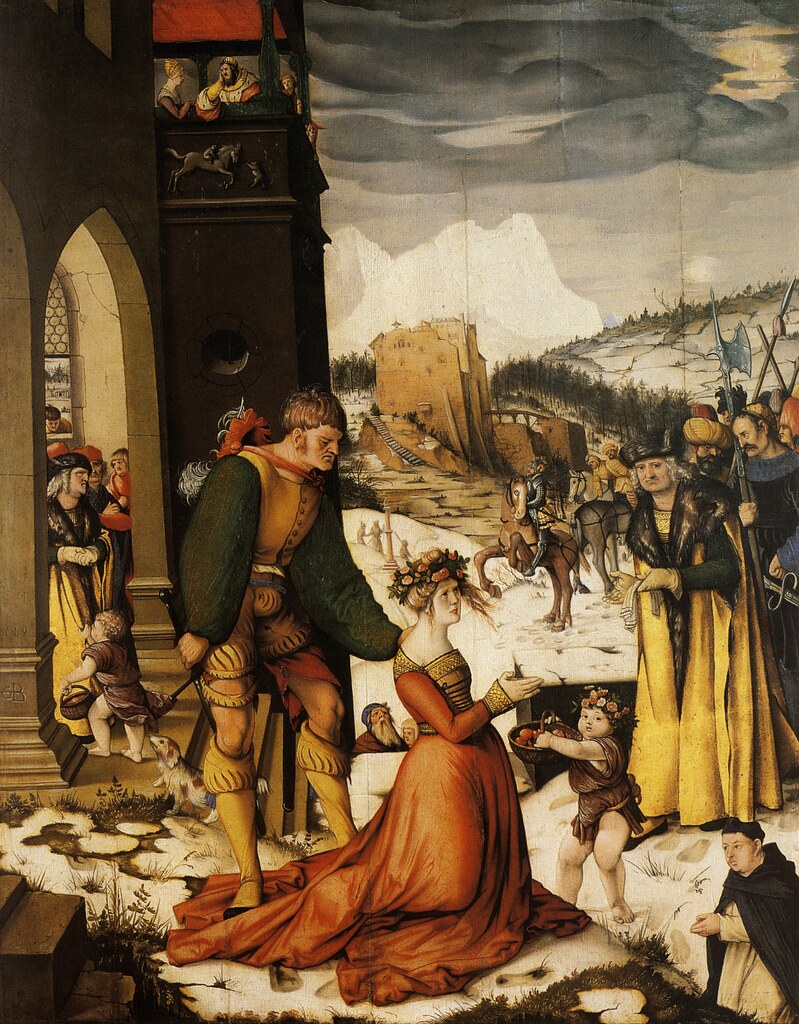
Hans
Baldung Grien (1484–1545), Beheading of Saint Dorothea of Caesarea, 1516, 78 x 61, National Gallery Prague
Also
known as
Dora
Dorotea
Dorothea
Profile
Apochryphal martyr whose
story has been beautifully told, and was popular for many years. Having made a
personal vow of virginity, she refused to marry,
or to sacrifice to idols.
She was tried, tortured,
and sentenced to death for
her faith by
the prefect Sapricius during the persecutions of diocletian.
The pagan lawyer Theophilus
said to her in mockery, “Bride of Christ, send me some fruits from your
bridegroom’s garden.” Before she was executed,
she sent him, by a six-year-old boy who is thought to have been an angel,
her headress which had the fragrance of roses and
fruits. Seeing this gift, and the miraculous messenger
who brought them, Theophilus converted,
and was martyred himself.
This story has been variously enlarged through the years. In some places, trees
are blessed on
her feast day
because of her connection with a blooming, fruitful miracle.
beheaded with
a sword on 6
February 311 in Caesarea Mazaca, Cappodocia (modern
day Kayseri, Turkey)
Name
Meaning
gift of God (greek)
crowned
with flowers and surrounded by stars as
she kneels before the executioner
crowned with palm and flower basket,
surrounded by stars
crowned and
carrying a flower basket
in an orchard
with the Christ-child in
an apple tree
leading the Christ-child by
the hand
maiden carrying a basket of fruit and flowers,
especially roses
veiled, with flowers in
her lap
veiled, holding apples from
heaven on a branch
with a basket of fruit and
the Christ-child riding
a hobby horse
with an angel and wreath of flowers
with an angel carrying
a basket of flowers
Additional
Information
A
Garner of Saints, by Allen Banks Hinds, M.A.
All
the Year Round, by Sister Mary Emmanuel, O.S.B.
Acts
of the Early Martyrs, by Father James
A M Fastré, S.J.
Book
of Saints, by the Monks of
Ramsgate
Lives
of the Saints, by Father Alban
Butler
Saints
of the Day, by Katherine Rabenstein
Short
Lives of the Saints, by Eleanor Cecilia Donnelly
books
Our Sunday Visitor’s Encyclopedia of Saints
Oxford Dictionary of Saints, by David Hugh Farmer
Saints
and Their Attributes, by Helen Roeder
other
sites in english
1001 Patron Saints and Their Feast Days, Australian
Catholic Truth Society
images
video
sitios
en español
Martirologio Romano, 2001 edición
fonti
in italiano
Martirologio Romano, 2005 edition
nettsteder
i norsk
MLA
Citation
“Saint Dorothy of
Caesarea“. CatholicSaints.Info. 1 April 2024. Web. 23 January 2026.
<https://catholicsaints.info/saint-dorothy-of-caesarea/>
SOURCE : https://catholicsaints.info/saint-dorothy-of-caesarea/

DOROTHEA (DOROTHY)
(Saint) Virgin Martyr (February 6) (4th century) The famous Virgin-Martyr of
Caesarea in Cappadocia, who was racked, scourged and beheaded under Diocletian,
about A.D. 300, and whose relics are now venerated in Rome. She converted to the
Christian Faith the very persons sent to persuade her to renounce it. She is
represented with fruit and flowers, in allusion to a lawyer having mockingly
asked her to send him “roses and apples” from the garden of her Heavenly
Bridegroom, and to his having mysteriously received them on the day of her
martyrdom amid the snows of a Cappadocian winter. The cultus of Saint Dorothy
appears to have been curiously neglected in the East.
MLA
Citation
Monks of Ramsgate.
“Dorothea”. Book of Saints, 1921. CatholicSaints.Info. 12
November 2012.
Web. 23 January 2026.
<http://catholicsaints.info/book-of-saints-dorothea/>
SOURCE : https://catholicsaints.info/book-of-saints-dorothea/
New Catholic
Dictionary – Saint Dorothea
Article
Greek: gift of God
Virgin, martyr (c.311), died Caesarea, Cappadocia.
According to the legend the pagan,
Theophilus, mocked her on her way to execution, “Bride of Christ, send me some
fruits from your bridegroom’s garden.” Before she was put to death she sent him
her headdress filled with heavenly fragrance of roses and fruits. He,
confessing his newly-found faith, was also martyred.
Patroness of gardeners. Emblems:
crown of flowers and fruit. Relics in church of Saint Dorothea, Rome. Feast, 6
February.
MLA
Citation
“Saint Dorothea”. People of the Faith. CatholicSaints.Info. 5
December 2010.
Web. 23 January 2026.
<http://catholicsaints.info/new-catholic-dictionary-saint-dorothea/>
SOURCE : https://catholicsaints.info/new-catholic-dictionary-saint-dorothea/
St. Dorothy
Feastday: February 6
According to her
apochryphal tradition, she was a resident of Caesarea, Cappadocia, who when she
refused to sacrifice to
the gods during Emperor Diocletian's persecution of
the Christians, was tortured by the governor and ordered executed. On the way
to the place of execution, she met a young lawyer, Theophilus, who mockingly
asked her to send him fruits from "the garden" she had joyously
announced she would soon be in. When she knelt for her execution, she prayed,
and an angel with
a basket of three roses and three apples, which she sent to Theophilus, telling
him she would meet him in the garden. Theophilus was
converted to Christianity and
later was martyred. Her feast
day is February 6th.
SOURCE : https://www.catholic.org/saints/saint.php?saint_id=221
Dorothy of Caesarea VM
(RM)
(also known as Dora,
Dorothea)
Born in Caesarea,
Cappadocia (now Armenia); died there, c. 300. The story of Saint Dorothy as it
has come to us is legendary. When the young maiden, Dorothy, was imprisoned as
a Christian during the persecutions of Diocletian, she converted two apostate
women warders sent to seduce her. This enraged Fabricius, the governor of
Caesarea, who sentenced her to death.
On the way to execution,
Dorothy was cruelly baited by a lawyer named Theophilus for refusing to marry
or to worship idols. He mockingly asked her to send him back some fruit and
flowers from the garden she had joyously announced she would soon be in. As she
knelt for her beheading and prayed, a child (or an angel) miraculously appeared
with a basket of golden apples and roses. She took a napkin and placed in it
three roses and three apples. Then she begged a child to take them to
Theophilus and tell him she would meet him in the garden. When he saw these
gifts he himself was converted to Christianity and later he, too, suffered
martyrdom. Before being killed, Dorothy was stretched on a rack. It is recorded
that she was then still smiling, as she remembered the warders she had
converted.
Although the early
martyrologies, such as that of Saint Jerome place her death in Cappadocia
during the persecution of Diocletian, Saint Dorothy's name is unknown in
Eastern calendars. There was another holy virgin, whom Rufinus calls Dorothy, a
rich and noble lady of the city of Alexandria, who suffered torments and a
voluntary banishment, to preserve her faith and chastity against the brutish
lust and tyranny of the emperor Maximinus, in the year 308, as is recorded by
Eusebius and Rufinus; but many believe this latter, whose name is not mentioned
by Eusebius, to be the famous Saint Catharine of Alexandria.
The center of her cultus
was Italy and Germany; although she is also represented in 15th-century stained
glass and screen paintings in England. Her legend was known by Saint Aldhelm
(died 709) and later formed the basis for the play The Virgin Martyr (1622) by
John Massinger and Thomas Dekker, as well as poems by Swithburne and Gerard
Manley Hopkins. Dorothy's relics are believed to lie at her church in Rome
(Attwater, Benedictines, Bentley, Delaney, Encyclopedia, Farmer, Husenbeth).
In art, Saint Dorothy is
a maiden carrying a basket of fruit and flowers, especially roses, which are
her special attribute. At times that angel attendant may carry the basket
(Tabor). Sometimes she may be shown (1) leading the Christ-child by the hand;
(2) with a basket of fruit and the Christ-child riding a hobby horse; (3) in an
orchard with the Christ-child in an apple tree; (4) crowned with flowers and
surrounded by stars as she kneels before the executioner; (5) crowned, carrying
a flower basket; (6) crowned with palm and flower basket, surrounded by stars;
(7) veiled, holding apples from heaven on a branch; (8) veiled with flowers in
her lap. She is often confused with Saint Elizabeth of Hungary, who usually has
the poor near her. On certain English roodscreens Saint Cecelia seems to have
the attributes of Dorothy (Roeder).
Saint Dorothy is the
patroness of brewers, brides, florists, gardeners, midwives, and newly-wedded
couples (Roeder).
SOURCE : http://www.saintpatrickdc.org/ss/0206.shtml

Dorothea of Caesarea, circa 1500, polychrome terracotta,
Bode
Museum, Berlin
ursprüngliche
Fassung; aufgestellt in einem Tabernakel aus Italien, 16. Jh., Kalkstein
Skulpturensammlung
Here followeth the Life
of Saint Dorothy.
The glorious virgin
and martyr Saint
Dorothy was born of the noble lineage of the senators of Rome, her father hight
Theodore. In that time the persecution of the christian people was great about
Rome, wherefore this holy virgin Saint Dorothy, despising the worshipping of
idols, counselled her father, her mother, and her two sisters, Christine and
Celestine, to forsake their possessions, and so they did, and fled into the
realm ol Cappadocia, and came into the city of Caesarea wherein they set Saint
Dorothy to school, and soon after she was christened of the holy bishop Saint
Appollinarius, and he named her Dorothy, and she was fulfilled with the Holy
Ghost, and in great beauty above all the maidens of that realm. And she
despised all worldly vanities, and burned in the love of Almighty God, and
loved poverty, and was full of meekness and chastity, whereof the fiend having
envy at her blessed living, provoked and set afire in her love the provost, so
that he would have her to his wife, and anon sent for her in all haste, and
when she came he desired to have her to his wife, and promised to her riches of
worldly goods without number. And when this holy virgin understood his desire
and request she refused it, and denied it utterly, and all his riches setting
at nought; and moreover she acknowledged herself to be christian, and that she
had vowed her virginity unto Jesu Christ, whom she had chosen to her spouse,
and would never have other. And when the provost Fabricius heard this he was
nigh from himself for anger, and commanded that she should be put in a tun of
burning oil, wherein she was preserved by the power of her spouse Jesu Christ
that she felt none disease ne harm, but a precious ointment of balm. And when
the paynims saw this great miracle, many of them were thereby converted to the
faith of Jesu Christ. And the tyrant said that she did all this by enchantment,
and did do put her in a deep prison nine days long without meat or drink, but she
was that while fed by angels’ food of our Lord, so that at the end of nine days
she was nothing appaired. Then the judge sent for her, supposing that she had
been nigh dead and feeble, but when she came she was fairer and brighter to
look on than ever she was before, whereof all the people marvelled greatly.
Then the judge said to her: But if thou wilt worship and do sacrifice to the
idols thou shalt not escape the torment of the gibbet. Then she answered to the
judge: I worship Almighty God that made all things, and despise thy gods that
be fiends. And then she fell down pat to the earth and lifted up her eyes to
Almighty God, beseeching him that he would show his power tofore the people
that he was only Almighty God and none other.
Then Fabricius the judge
let set up a pillar on high, and thereon he set his god, an idol, and anon
there came a multitude of angels from heaven and cast down this idol, and all
to-brake it, and anon the people heard a great noise of fiends crying in the
air, saying: O Dorothy, why cost thou destroy us and tormentest us so sore? And
for this great miracle many thousands of paynims were turned to the faith of
Jesu Christ and were baptized, and after received the crown of martyrdom for
the acknowledging of the name of Jesu Christ.
Then the judge commanded
that this holy virgin should be hanged on the gibbet, her feet upward and the
head downward, and then her body was all to-rent with hooks of iron, and beaten
with rods and scourges, and burnt her breasts with hot fiery brands, and as
half dead she was set again into prison, and after, when she was brought again,
she was all whole and strong, without any disease or hurt. Whereof the judge
had great marvel, and said to her: O fair maid, forsake thy God and believe on
our gods, for thou mayst see how merciful they be unto thee, and preserve thee,
therefore have pity of thy tender body, for thou hast been tormented enough.
And then the provost sent for her two sisters which were named Christine and
Celestine, which for fear of death forsook the faith of Jesu Christ, and went
to Saint Dorothy and counselled her to obey to the provost’s desire and forsake
her faith. But this holy virgin rebuked her sisters. and after informed them by
so fair and sweet language, that she withdrew them from their blind errors and
established them in the faith of Jesu Christ; in such wise that when they were
come to the judge they said they were christian and believed on Jesu Christ.
And when Fabricius heard that, he was mad for anger, and commanded that the
tormentor should bind their hands, and bind them both together back to back,
and cast them in the fire so bound, and burnt them. And then he said to the
virgin Dorothy: How long wilt thou trouble us with thy witchcraft? Or do
sacrifice to our gods or else anon thy head shall be smitten off. And then said
the holy virgin with a glad semblant: Do to me what torment thou wilt, for I am
all ready to suffer it for the love of my spouse Jesu Christ, in whose garden
full of delices I have gathered roses, spices, and apples. And when the tyrant
heard that he trembled for anger, and commanded that her fair visage should be
beaten with stones so that there should appear no beauty in her visage, but all
disfigured, and so to be put in prison till the next day. And on the next day
she came forth all so whole and sound as though she had suffered no disease,
and was more fairer for to look on than ever she was tofore, by the grace of
her blessed spouse Jesu Christ, for whose love she took on her these great and
sharp torments. And then this cursed judge commanded to smite off her head; and
as she was led to the place assigned where it should be done, a scribe of the
realm, named Theophilus, said to her in scorn: I pray thee to send me some of
thy roses and apples that thou hast gathered in the garden of thy spouse that
thou praisest so much, and she granted to him his desire. And this was in the
cold winter time when there was both frost and snow. And when she came to the
place where she should be beheaded, she kneeled down on her knees and made her
prayers to our Lord Jesu Christ, beseeching him that all they that worship her
passion that they might be kept steadfast in the faith, and to take their
tribulation patiently, and specially to be delivered from all shame, great poverty,
and false slander, and at their last end to have very contrition, confession,
and remission of all their sins. And also women with child that call to her for
help to have good deliverance, the children to be christened and the mothers to
be purified. Also she prayed to God that where her life was written or read in
any house, that it should be kept from all peril of lightning and thunder, and
from all perils of fire, from perils of thieves, and from sudden death, and to
receive the sacraments of holy church at their last end for their most
sovereign defence against their ghostly enemy the fiend.
And when she had ended
her prayer there was a voice heard from heaven that said: Come to me, my dear
spouse and true virgin, for all thy love is granted to thee that hast prayed
for, and also whom thou prayest for shall be saved; and when thou hast received
the crown of martyrdom thou shalt come to the bliss of heaven without end, for
thy labour. And this holy virgin bowed down her head, and the cruel tyrant smote
it off.
But a little before this
appeared before her a fair child barefoot, clothed in purple, with crisp hairs,
whose garment was set full of bright stars, bearing in his hand a little basket
shining as gold, with roses and apples, to whom the virgin said: I pray thee,
bear this basket to Theophilus the scribe. And thus she suffered death and
passed and Lord full of virtues, the sixth day of February, the year of our
Lord two hundred and eighty-eight, by Fabricius, provost under Diocletian and
Maximian, emperors of Rome. And as this said Theophilus stood in the palace of
the emperor, this child came to him and presented to him the basket, saying:
These be the roses and apples that my sister Dorothy hath sent to thee from
Paradise, the garden of her spouse, and then this child vanished away. Then he,
considering the marvellous work of God in this holy virgin, said anon with a
stern voice, praising the God of Dorothy for that great miracle which was
showed to him of roses and apples that time, that he that sent to me these
things is of great power, and therefore his name be blessed world without end,
Amen. And then he was converted to the faith of Jesu Christ, and the most part
of the people of the city. And when Fabricius knew this, anon, with great malice,
he tormented Theophilus the scribe with many divers torments, and at the last
hewed him into small pieces, and the pieces were cast to birds and beasts to be
devoured. But he was first baptized and received the holy sacrament, and
followed the holy virgin Dorothy into the bliss of heaven. Then let us devoutly
pray to this blessed saint Dorothy that she be our special protectress against
all perils of fire, of lightning, of thundering, and all other perils, and that
at our end we may receive the sacraments of the church, that after this short
life may come unto bliss in heaven whereas is life and joy perdurable, world
without end. Amen
SOURCE : https://catholicsaints.info/golden-legend-saint-dorothy/
St. Dorothea
Virgin and martyr,
suffered during the persecution of Diocletian,
6 February, 311, at Caesarea
in Cappadocia. She was brought before the prefect Sapricius,
tried, tortured, and sentenced to death.
On her way to the place ofexecution the pagan lawyer Theophilus said
to her in mockery: "Bride of Christ,
send me some fruits from your bridegroom's garden." Before she
was executed, she sent him, by a six-year-old boy, her headdress which was
found to be filled with a heavenly fragrance of roses and
fruits. Theophilus at once confessed himself a Christian,
was put on the rack, and suffered death. This is the oldest version of
the legend, which was later variously enlarged. Dorothea is represented
with an angel and
a wreath of flowers. She is regarded as the patroness of gardeners.
On her feast trees
are blessed in some places. In the West she has been venerated since
the seventh century.
Meier, Gabriel. "St. Dorothea." The Catholic Encyclopedia. Vol.
5. New York: Robert Appleton Company, 1909. 6 Feb.
2016<http://www.newadvent.org/cathen/05135d.htm>.
Transcription. This
article was transcribed for New Advent by Marcia L. Bellafiore.
Ecclesiastical
approbation. Nihil Obstat. May 1, 1909. Remy Lafort, Censor. Imprimatur. +John
M. Farley, Archbishop of New York.
Copyright © 2023 by Kevin Knight.
Dedicated to the Immaculate Heart of Mary.
SOURCE : http://www.newadvent.org/cathen/05135d.htm

Rudolf Belling, Dorothea, relief, 1929, Oberspreestraße 173, Berlin-Köpenick, Deutschland
Rudolf Belling, Dorothea, 1929, Oberspreestraße 173, Berlin-Köpenick, Germany
THE STORY OF ST. DOROTHY
St. Dorothy was a young,
beautiful girl, who lived in the city of Caesarea, in Cappadocia, in Asia
Minor. Theophilus, a rich and handsome young pagan, fell in love with Dorothy
and wished to marry her, but she refused, saying, "Theophilus, I cannot
marry you, because you are a pagan. If you will first learn about Jesus Christ
and become a Christian, then I will marry you, if it is God's Holy will."
This angered Theophilus
very much and he thought, "I will get back at Dorothy for not wanting to
marry me. I will tell Fabritius, the Governor of Caesarea that she will not
marry me or sacrifice to the idols, because she is a Christian!"
Before long, The
Governor's guards were at Dorothy's house. They seized her and almost dragged
her, so rude were they, and they threw her into a dirty old dungeon. One guard
said, "Stay here and suffer for a while. Tomorrow you will stand before
the Governor – maybe you will change your mind by then? Ha! Ha! Ha!" and
he laughed his way out the door.
Poor Dorothy sat there on
the dungeon floor. A rat scurried across the floor and she jumped, as it
brushed by her foot. Then she knelt and prayed, "My Jesus, my beloved, I
put all my hopes and trust in Thee. Please help me to be faithful to martyrdom,
if such be they Holy Will, and please dear Holy Ghost, enlighten me as to what
I must say when I stand before the Governor."
The next day, Dorothy was
brought before the Governor, and he asked her, "Who are you?"
To this the young girl
replied, "I am Dorothy, a virgin and a servant of Jesus Christ."
"You must serve our
gods or die," cried Fabritius.
Dorothy answered meekly,
"Be it so; then the sooner I shall stand in the presence of Him, whom I
most desire to behold."
"What do you
mean?" questioned the Governor.
She replied, "I mean
the Son of God, Jesus Christ, my spouse! His dwelling is in Paradise. By His
side are eternal joys, and in His garden grow celestial fruits and roses that
never fade!"
Fabritius was much
surprised at Dorothy's answer and instead of killing her; he had her taken back
to the dungeon. Then, in order to make her give up her Catholic Faith, he sent
her two women, named, Calista and Christeta, who were sisters, and who had once
been Christians, but who had given up the Catholic Faith. They had been
threatened with terrible torments and were afraid, and that is why they had given
up their Catholic Faith. But they should not have done so – they should have
trusted in Jesus who would give them strength to bear all their trials and
pains. The Governor had promised them a large reward if they would persuade
Dorothy to deny her Catholic Faith, as they had done.
The two sisters boldly
entered the dungeon where Dorothy was, and Calista said, "Dorothy, you
really don't believe all that Catholic foolishness, do you? Come now, be an
intelligent girl and follow us, and all will be fine!"
Then Dorothy retorted,
"You mean – follow you to Hell!"
"There's no such
place as Hell – it's only a story to scare people!" put in Christeta.
Dorothy prayed. She knew
that she would need the help of Jesus and Mary to convert these two women. As
she talked, she found out that these two women were Catholics at one time. So
Dorothy encouraged them, "Do you think that I would not do the same as you
if I did not trust in Jesus? God is so powerful. It is for reasons so weak that
you have both given up the Catholic Faith. But come now, if you pray with me, I
believe that Jesus will grant you the gift of Faith again, and then you can go
to Heaven too."
Calista and Christeta
resisted and argued at first, but Dorothy was kind and patient and she asked
the Guardian Angels of the two women to help them come back to the Faith.
Before long, the two women were weeping and begging God to forgive them for
leaving the Faith. They realized what a terrible mistake they had made and
cried, "O blessed Dorothy, pray for us that our cowardly sin may be
forgiven by God and that He will accept our penance."
"That, I will most
certainly do!" Dorothy answered. "And be sure that my prayers are
with you, so that you may go straight to Heaven!"
Then the two sisters left
the dungeon and cried, "We are Christians! We belong to Jesus Christ the
true God, and we will follow Him to our death!"
The Governor was furious!
"Calista and Christeta – you dare to go against me and the gods," he
screamed. "For this you will burn. I command you guards to burn these two
women and I also command you to bring Dorothy, to watch them burn – maybe then,
she will change her mind!"
Dorothy was dragged out
of the dungeon and thrown before Fabritius. "Do you see what will become
of you? I will burn you like these two women."
Dorothy could see the
fire burning the women and the smoke going up their noses, "O my friends,
fear not! Suffer bravely to the end! These short pains will be followed by
eternal joys! Heaven will soon be yours!" Thus encouraged, the women died
and Dorothy was sentenced, "You will be cruelly tortured and then have
your head chopped off!" the Governor cried.
Now Theophilus had been
standing in the courtroom while the Governor had been questioning Dorothy. And
when Theophilus saw Dorothy being lead to the torture chamber; he sneered,
"Ha, fair maiden! So now you're going to meet Jesus, your bridegroom! Send
me some of the apples and roses from His garden!"
"I will send you the apples and roses and I will wait for you in the garden from which they came," Dorothy said, and before long she was beheaded. Then after her death, an angel appeared with a basket in which were three apples and three roses. Theophilus ate the apples and was converted. Then he too, died as a martyr, and went to meet St. Dorothy in the Heavenly garden.
SOURCE : http://www.sspx.ca/EucharisticCrusade/2006_November/St_Dorothy.htm
.jpg)
Francisco de Zurbarán (1598–1664), Santa
Dorotea, circa 1648, 180.2 x 101.5
The
Acts of the Early Martyrs – Saint Dorothea and her Companions
Article
In the reign of the
Emperors Diocletian and Maximian, there lived at Caesarea, in the Province of
Cappadocia, a noble young lady, Dorothea by name. Her blameless life and holy
conversation, were a source of constant edification to all the Faithful. From her
childhood, she had consecrated her virginity to our Lord, and as a true Bride
of the Spotless Lamb, she devoted all her days to the practice of works of
mercy, to prayer and sacred recollection, whilst her humility and meekness, her
penitential austerities and unobtrusive demeanor, filled all the people with
respect and admiration. The Christians deemed it a special dispensation of God,
that one so holy, so faithful in the observance of the law, could be pointed to
as a model in the practice of every virtue; for no one, even among the Pagans,
could bring forward the least accusation to impeach in anything her holiness of
life, and unwearied exercise of Christian charity. It cannot be supposed, that
the wicked enemy of the souls of men would permit this virtuous maiden to
continue, without molestation, her saintly course of life. As she was
well-born, and connected with the most wealthy and influential citizens of
Caesarea, several persons sought her in marriage. Among these was Sapricius,
the Governor of Cappadocia; who seemed to think, that it would not be difficult
for him to distance all other rivals, because he held in his hands the power of
life and death.
The Christian maiden,
however, was wholly unwilling to listen, even for a moment, to his most flattering
proposals. No sooner did Sapricius become aware that the religious belief of
Dorothea was the chief cause of her opposition to his claims, than he resolved
to obtain by force that which he could not secure by a free and willing
consent. Although the laws made against the Christians were very severe, yet
the strict execution of them depended, in a great measure, upon the disposition
of the imperial officers. Disappointed, therefore, in his pretensions, the
Governor of Caesarea determined to take his revenge by making her apostatize
from her Religion. Wherefore, he sent his soldiers to arrest the noble maiden,
and to bring her before his tribunal. When Sapricius saw her standing in his
presence, he came at once to the conclusion, that it would be an easy task to
persuade her to comply with his commands; for her attitude was so lowly and
modest, that she seemed the very image of timidity personified. But that very
virtue, of which the Governor, in his ignorance of all religious principle, had
not even an idea, was a source of joy to the Angels of God. Knowing that she
was entering upon a mighty struggle with the power of darkness, Dorothea was
humbling herself in the presence of her heavenly Bridegroom, beseeching Him not
to suffer her weakness to be overcome, by the powerful enemies of His holy
name. Sapricius, therefore, pretending to be kindly affected to her, began in a
gentle tone the customary interrogatory:
“Tell me, lady, what is
thy name?”
“I am called Dorothea,”
she answered.
“I have thus publicly
summoned thee,” said the Governor, “to require thee to offer incense to the
immortal gods, who preserve the Empire, in accordance with the commands of our
august Emperors.”
“The true God, the august
Emperor of the universe,” replied the maiden, “commands me to worship Him only.
For it is written: ‘Thou shalt fear the Lord thy God and shalt serve Him only,’
And again: ‘The gods that have not made heaven and earth, let them perish from
the earth, and from among those places that are under heaven.’ Hence it is
evident whom we should obey. Is not the ruler of heaven greater than all the
rulers of the earth? the Creator mightier than His creatures? And who are the
great Emperors? are they not poor mortal beings, as well as the powerless
deities, whose images they worship?”
“If thou desirest to go
hence, and to return safe and sound to thy home, keep down that bold spirit of
thine, and be ready to offer incense to the gods. For, I assure thee, the
rigorous enforcement of the law must soon compel thee to follow my good advice,
and to give at the same time a base example of fear to all the people here
present.”
“On the contrary,”
replied Dorothea, “I will give to them all a good example of the fear of the
true God, so that they too may fear Him, and stand in no dread of the torments
inflicted by wicked men.”
“Thou appearest, then,
determined to persevere in thy most foolish resolution, and to be tortured to
death in the company of those vile wretches, as obstinate as thyself? Hearken
to my warnings, before it is too late. Do not rashly throw away thy youthful
life, by persistently refusing to burn a little incense in honor of the great
Jupiter. Make thy choice between obedience to our commands and the tortures of
the rack.”
“The torments endured on
the rack are only of short duration; the punishments of hell are everlasting.
Would it be wisdom in me to expose myself to endless sufferings, for the sake
of avoiding the transient ones which you may inflict? I remember too well the
words of my Lord and Redeemer: ‘Fear-not them, that kill the body and are not
able to kill the soul; but rather fear Him, that can destroy both soul and body
into hell!”
“According to thy own
saying,” cried out Sapricius, “thou shouldst fear the gods; because if thou
provokest their wrath by thy obstinacy, they will destroy both thy soul and thy
body; wherefore, to render thyself pleasing to them, offer sacrifice without
delay.”
“I have already told you,
oh Sapricius,” rejoined Dorothea, “that you have no means in your power whereby
to force me to offer sacrifice to demons. Did not your gods lead such
disgraceful lives, that the mention of them would cause decent persons to
blush? And they that follow their example, do their lives differ from those of
irrational animals, that neither know nor reverence the great Creator of the
universe. They, therefore, whose images of brass and stone you worship, are now
suffering in hell the punishment of their wickedness. And what must become of
those who, despising the laws of their God and Maker, imitate, in their
conduct, the shameful excesses of wicked devils?”
When Sapricius heard
these words, he flew into a dreadful passion. He began to understand that mere
threats were useless arguments against the courage of a youthful maiden, whose
true character and resoluteness he had altogether underrated. Turning to the
executioners, he said:
“Stretch her upon the
rack. Perhaps, when she feels the torture, she may believe that I am in
earnest, and think better of the gods, so as to become their devoted
worshipper.”
Whilst the servant of God
was undergoing these dreadful sufferings, she did not exhibit the least sign of
pain; neither did she give the Governor any hope that, by such inhuman means as
these, he would be able to shake her constancy. For, as bold and fearless as
before, she said to him:
“Why are you trifling
with me after this manner? What induces you to wait? Why not torture me at once
unto death, if you are so minded? Why not enable me soon to appear before Him,
for whose love I am anxious to lay down my life – for whose sake I esteem as
naught your most cruel torture!”
“And who is he, whom thou
lovest so much?” asked Sapricius.
“Christ the son of God,”
answered the Martyr.
“And where is Christ?”
inquired the Governor.
“As He is the Omnipotent
God, He is everywhere; yet, as a Divine Being falls not under the senses, and
as men are inclined to sensible things, He, a divine Person, assumed our human
nature, and, after dwelling among men, yea, after suffering and dying for their
redemption, He ascended into heaven, and is there seated at the right hand of
His heavenly Father. He is One God, with His Father and the Holy Spirit, and
invites us all to the enjoyment of the paradise of His delights – where the
trees and groves are at all times adorned with fruit; where the lilies and
roses, and all kinds of flowers are ever blooming; where the fields, the hills
and the mountains are never without their pleasing verdure; where the cool and
limpid streams and fountains are forever flowing; where the blissful souls of
the Saints are rejoicing in Christ. If you believe these things, oh Sapricius,
and, abandoning the worship of your false gods, give yourself to the service of
the only true and living God, you may enjoy one day the delights of Paradise.”
“Thou hadst better renounce
all that foolish nonsense,” said the Governor, “and offer sacrifice to the gods
of imperial Rome. Moreover, I would advise thee to take a husband, and to enjoy
the pleasures of the present life like other people do, lest thou also perish
as thy fathers have perished, on account of their folly.”
“I will offer no
sacrifice to devils,” replied Dorothea, “because I am a Christian; neither will
I take a husband, since I am a bride of Christ. And I am certain, that sooner
or later, He will admit me into His heavenly dwelling, there to celebrate our
sacred nuptials in the presence of the holy Angels.”
In spite of his
prejudices, Sapricius could not but admire the wonderful fortitude of so young
and delicate a maiden. Seeing, therefore, that he gained nothing by the use of
cruelty, he fancied that, perhaps, he might attain the object he had in view by
gentle means.
There lived at that time
in Caesarea, two sisters, Christa and Callista by name, distinguished for their
personal beauty and accomplishments. They had formerly been Christians,
exemplary in their conduct, and admired for their deeds of charity; but,
unfortunately, in the beginning of the persecution, when arrested on account of
their Religion – although apparently resolved to stand firm in their Faith –
the threats of the Governor, and the sight of the torments inflicted upon their
fellow Christians, had so terrified them that they lost all firmness, and
miserably apostatized. The Governor, to reward them for the scandal they had
given, had taken them under his special protection. They were living in the
possession of every luxury which wealth can secure; and their present condition
was pointed to as a sample of what might be expected by every Christian, who
would choose to forfeit his future hopes for the present enjoyments of this
world.
Sapricius sent for these
two sisters, and said to them:
“You know with how great
a kindness and consideration I have treated you, since, with a good sense,
worthy of every commendation, you abandoned the follies and superstitions of
the Christians. The great gods have lavished their favors upon you, as a reward
of the worship you willingly pay to them. I rejoice to have been their
instrument in conferring upon you this happiness. Now, you will lay me under
the greatest obligation, if, by your skill and zeal, you induce this young
lady, in whose welfare I take no common interest, to give up her foolish
notions, and to worship the gods of the Empire.”
They gladly consented to
comply with the request of the Governor, and took Dorothea to their home. They
treated her with the utmost kindness, and it was rather by their actions than
by their words, that they endeavored to make an impression upon the Christian
maiden. Their desire, however, of bringing her over to Paganism, arose not so
much from their belief in any of its absurdities, as from the thought of
rendering their own apostasy less odious and criminal in the – opinion of
others, if a person of so great a reputation for virtue and holiness as
Dorothea should also fall away from the Faith. Wherefore, they said to her:
“Do not, oh Dorothea,
disappoint the Governor – in his expectations. Agree to do his bidding, and
comply with the imperial laws. For, after all, what harm can there be in
burning a little incense before the image of Jupiter? We cannot be obliged to
do that which is above our strength; nor can we be guilty, if we are unable to
bear what is beyond all human endurance. We once thought as thyself, that it
was possible to undergo every kind of torture; but a little experience soon
convinced us of the contrary. Besides, why should we live at all, if it is not
permitted to enjoy any of the sweets of life? Think of thy youth, thy personal
attractions, and the charms of this world. Must these be deemed as nothing?
Must they be utterly forgotten and despised? No, no, Dorothea, that which
appears to thee wrong, at present, will soon wear another aspect, when thou
hast once made up thy mind to be no better than others. This our own experience
has taught us, and we find no cause of regret in having forsaken our former
queer notions of virtue.”
Dorothea listened to
their words without betraying the least emotion. When they had done speaking,
she looked at them for some moments in silence, as if she were thinking what
answer to make. Then, whilst the tears rolled from her eyes, she said:
“Oh, unhappy children,
how I pity your sad condition! The wicked advice, which you give me, does not
come from your heart; of this I feel persuaded. I see that you are miserable,
in spite of the light-hearted appearance, which you would fain put on. And no
wonder; for how could any one be cheerful and happy after renouncing the source
of all blissfulness – the love of Jesus? Yet, even now, my heart tells me, that
it is not too late to recover what, in an evil hour, you lost. You have, it is
true, left the service of Christ, and put on the livery of Satan: still, for
all that, He does not forget you, but, by my voice, He, at this very moment,
cries out to you: Return, return, ye that have gone astray; the arms of My
mercy are still extended to receive you – ready to press you to My Heart? Do
not then neglect His loving invitation: repent of the great crime you have
committed. Say to Him: ‘Father, we have grievously sinned: we confess our
offenses: pardon us for Thy mercy’s sake?’ He, the Father of mercies, will
accept your repentance. He will receive you again among His beloved children.”
The words of the Saint
produced a marvellous change in the heart of the two sisters. They stood for
atime looking at one another in silence, as if unable to give expression to the
struggle that was going on within them. At last, a torrent of tears gave them
relief, and both exclaimed:
“Alas! Dorothea, servant
of God, we confess that we have grievously sinned by going away from Jesus. How
could we dare to return again to Him, laden as we are with so enormous a crime?
How could He pardon our wickedness?”
“To despair of God’s
mercy,” replied Dorothea, “would be a crime far greater than to have offered
incense to the idols. No, dear sisters, fear not to return to the kind and
skillful Physician of your souls: He will heal all your wounds. No matter how
deep and ghastly they may be, they will yield at once to His divine treatment.
Is He called the Saviour, and does He not save? Is He the Redeemer, and does He
not redeem? Who did ever apply to Him, and was put off? Do but repent with all
your heart, your pardon is secured. His loving kindness will again fill your
souls with peace and consolation.”
Thereupon, both fell on
their knees, weeping and praying and striking their breasts; and they said to
Dorothea:
“O sweet and innocent
maiden, intercede thou for us. Offer our sincere repentance to our loving
Saviour; beseech Him to accept our united voice of supplication.”
The Saint, kneeling down
with them, and bursting into tears of joy and thankfulness, prayed aloud:
“God of mercies, who hast
said: ‘I desire not the death of the wicked, but that the wicked turn from his
ways and live;’ Lord Jesus Christ, who hast said: ‘There shall be joy in
heaven, upon one sinner that doth penance, more than upon ninety-nine just who
need not penance’ – grant Thy merciful forgiveness also unto these, whom the
evil one has tried to pluck out of Thy hand. Recall to Thy: fold the sheep that
have gone astray, that they may not perish, but have life everlasting: yea, let
their example encourage those that are still wandering in the wilderness of the
world, far away from Thee, that they too may return and find salvation among
Thine Elect.”
Whilst they were thus
daily engaged in prayer, and, as a token of sincere sorrow and repentance,
showed themselves ready, if it were God’s will, to lay down their lives to make
reparation for the scandal they had given, the Governor sent his officers to
summon the three maidens before him. Full of anxiety to know the result of
their efforts, he called Christa and Callista aside. Seeing joy and contentment
depicted upon their countenances, he doubted not but that their statement would
be agreeable to his wishes. With much eagerness, therefore, he said to them:
“Well, my good ladies,
let us hear good news: has Dorothea changed her mind?”
“My lord,” both answered,
“we have gone astray, we have done wickedly by sacrificing to demons, through
fear of torments which last but for a moment. Dorothea is ever faithful to her
God, who is now again our God; for by her prayers she has obtained for us the
grace of bewailing and detesting our former cowardice. This open profession of
our Faith, we are ready to seal with our blood, if it be your pleasure to make
a trial of our sincerity. Jesus Christ, in whom we put all our trust, will be
our help.”
Sapricius, hearing this
unexpected answer, was beyond himself with surprise and indignation. In his
rage, he tore his garments, and ordered the two sisters, tied back to back, to
be cast immediately into a burning furnace, unless they should at once offer
sacrifice to the gods. But they, with one voice, cried aloud: “Lord Jesus
Christ, Father of mercy, receive our penance and pardon our sins.”
They had scarcely uttered
these words when their bodies were already in the blazing furnace. Dorothea,
who stood by, called out to them:
“Go before me, beloved
sisters, to the joys of heaven. By this martyrdom, you recover all you have
lost. Your loving Father awaits you to bestow upon you the palm of victory, and
to receive you into His embrace.”
When the two sisters were
burnt to death, the Governor turned his fury against Dorothea. He ordered her
to be stretched again upon the rack, Whilst she was being tortured, she showed
a countenance so calm and cheerful, that it seemed as if she had realized her
fondest hopes. Sapricius was much annoyed at the sight, and said:
“What meanest thou by
this impertinent show of joy? Dost thou find these tortures so delightful?”
“Never in all my life,”
answered the Martyr, “have I felt such a joy as fills me this day. First, on
account of those two souls whom the devil, by your means, had snatched away
from God, and whom Jesus, through my instrumentality, has again taken to His
loving Heart. Today there is a great banqueting in heaven; for with them exult,
amidst ineffable delights, the Angels and Archangels, the Apostles, the
Martyrs, and the Prophets. Again, I am overjoyed, because I cherish the hope,
that the hour is not far distant, when I too shall join their blissful company.
Hasten, then, oh Sapricius, to do what you intend, that soon I may rejoice in
heaven with them, with whom I have wept upon earth.”
Then Sapricius commanded
the executioners to burn her sides with lighted torches. But Dorothea, as if
insensible to pain, said to him with a cheerful look:
“Have you not more power
over us, oh Sapricius, with all your idols?”
Thereupon he ordered her
to be taken from the rack, and said to his men:
“Now strike that insolent
mouth and that beautiful face, and let us see whether she will look as cheerful
and defiant as before.”
This order was forthwith
executed with so much cruelty, that the men themselves seemed ashamed of their
unmanly doings. But the joys of the Martyr seemed to increase with the pains
she was made to endure. At length, Sapricius, unable to overcome her constancy,
pronounced the following sentence:
“We command that Dorothea
– an exceedingly proud young lady – who is unwilling to save her life by
sacrificing to the great and immortal gods, and resolved to die through love
for Jesus Christ – a person whom we do not know – be beheaded with the sword.”
Dorothea, on hearing this
sentence, exclaimed with a loud voice:
“I thank Thee, oh Lord
Jesus, chaste Lover of souls, because Thou invitest me to Thy banquet in Paradise.”
As she was leaving the
Governor’s palace, to go to the place of execution, Theophilus, a young
attorney – who had been present at the first trial of the Martyr, and had heard
her say that in the Paradise of her Bridegroom, fruits and flowers were wanting
at no season of the year – came up to her, and said in a joking manner:
“Hearken to me, thou
bride of Christ. As soon as thou arrivest in the garden of Thy Bridegroom, send
me some of its delicious fruits and beautiful flowers.”
“Be assured,” replied
Dorothea, “I will not fail to comply with thy request.”
When she came to the
place where she was to be beheaded, she begged the executioner to allow her a
few moments to pray. This being granted, she knelt down, and, before she had
finished her prayer, there stood beside her a most lovely child, holding in his
hand a basket, in which there were three delicious apples, and three most
beautiful roses.
She said to the child:
“Go, take them to Theophilus, and say to him: “Dorothea, according to promise,
sends these from the garden of her heavenly Bridegroom.”
After this she bowed down
her head, and, receiving the stroke of death, her soul amidst the rejoicings of
Saints and Angels, was admitted into the presence of Him whom she had loved
upon earth with undivided affection.
Whilst all these things
were coming to pass, Theophilus had gone into the city, and was amusing himself
with his gay companions, by relating to them what had occurred at the trial of
the Virgin Dorothea.
“These Christians,” he
said, “have wonderful notions; they speak of their life and enjoyments in the
next world as we would talk of a neighboring city or country, with the
situations and attractions of which we are perfectly acquainted. A short while
ago, for example, I saw a young lady, called Dorothea, led to execution. She
thought herself the bride of Christ, their God. During her trial, at which I
was present, she said a great deal about the garden of delights, wherein He had
His dwelling. So, as I was passing by her, I said: ‘Bride of Christ, when thou
arrivest in the fairy garden of thy Bridegroom, be so kind as to send me some
of its fruits and flowers.’ And, sure enough, she was so silly as to reply:
‘Certainly, I will not fail to do so.’ See to what an extent those poor people
can be deluded by superstition.”
His companions could not
but laugh at what they thought a rich joke, and each one had some remark to
make about the promise to the attorney. As they were thus conversing together,
there entered a beautiful little child, carrying a little basket, and going up
to Theophilus, and, calling him aside, said:
“According to her
promise, the blessed lady, Dorothea, sends these apples and flowers, from the
garden of her heavenly Bridegroom, Jesus Christ.”
Theophilus taking the
basket and seeing its contents stood amazed at the marvellous sight; a sudden
change came over his heart. He felt as if he had become another man. Soon,
however, recovering himself, he cried out with a loud voice:
“Jesus Christ is the true
God; there is no falsehood, or deception in what is said of Him.”
His companions, not
understanding what had happened, and seeing his bewildered look, said:
“Thou art gone mad,
Theophilus, or thou art joking.”
“I am neither mad, nor am
I joking,” said the attorney, “but I feel within me a faith that convinces and
persuades; reason tells me that Jesus Christ is the true God. I firmly believe
in Him.”
His companions, who knew,
that, apparently at least, he had never been a friend of the Christians,
endeavored to argue with him. They tried to prove that it would be unreasonable
to change one’s mind so suddenly, that he would become the jest of all the
learned men of the city, that his reputation, hitherto so brilliant, would be
gone forever, in short, that all would be anxious to know what reason could
have influenced a man of his standing, to forego all his earthly prospects, for
the sake of taking up the notions of the Christians.
“They will ask me, what
reason could have influenced me, will they?” he exclaimed; “tell me, my
friends, what month of the year is this?”
“February,” they
answered.
“Gaze around you,” he
said; “ice is covering the ground, the snow-capped mountains of Cappadocia look
bleak and barren, not a sign of verdure on the hills or in the plains,
everything appears desolate; whence, think you, came these fresh-culled roses,
these blushing apples with the green leaves around them?”
“We never saw the like of
them for beauty and freshness – even at the proper season of the year.”
“Was I not just now
relating to you how I laughed at Dorothea, as she was on her way to die for
Christ? Did I not tell you what I then scoffingly asked of her, and what
promise she made? Behold now, no sooner has she reached the place of her
desires, than, faithful to her word, she sends me this, You all beheld that
angelic child, who is he? whence did he come? whither has he gone? More
suddenly than he came has he vanished from my sight – without giving me time to
puta single question. But I understand it all. Blessed are they that believe in
Christ, more blessed they that die for the glory of His Holy name. He is the
true God. And he is wise in very deed and truly rational whosoever puts his
trust in Him.”
Meanwhile, some of the
citizens of Caesarea, having learnt that something marvellous had occurred at
the place where Theophilus and his friends were staying, hurried thither. They
were greatly surprised to hear with what earnestness and eloquence he was
proclaiming the power of Christ, and deriding the absurdities of Paganism.
Their prejudices were aroused, their ignorant zeal awakened, and they hastened
to the Governor to acquaint him with what they had heard and seen.
“Sapricius,” they said,
“your friend, the attorney, who till now has excited you against the
Christians, and who was one of their greatest opponents, is stirring up the
whole city. He praises and blesses the name of Christ, and extols His power and
greatness with so fervid an eloquence, that very many believe the truth of all
he says.”
The Governor, though
disinclined to believe the report, immediately sent for the attorney, and said
to him:
“What is it I hear of
thee, Theophilus? Can it be that these rumors are true? Let us hear thy own
statement.”
“If they have reported to
you that I publicly proclaim that Christ is the true God, they have spoken the
truth; for this I know and believe, although this very morning I would have
said the contrary.”
“I wonder,” said
Sapricius, “that a man, as prudent as thyself, should be willing, I do not say
to praise, but even to mention, that Name, knowing that whosoever is bold
enough to do so, subjects himself to the penalties of the law.”
“Therein is made
manifest,” replied Theophilus, “the truth of my profession. In spite of the
dangers to which I expose myself by so doing, I openly avow that He has made
His power and divinity so clear to me, that I must needs yield my: assent
thereto, forsake the error of my ways, and cling to Him forever.”
“The love and relish of
wisdom,” said the Governor, “are increased in other persons by the wisdom which
they already possess; so that from wise, they become wiser; but thou, from a
wise man art suddenly become a simpleton, so as to call Him God, who, as the
Christians themselves say, was crucified by the Jews.”
“I certainly confess,
that He was crucified, and that I shared, in consequence, your own error,
denying His divinity, and daily blaspheming His holy Name. But now, full of
sorrow and contrition for my past crimes and blasphemies, I confess that Jesus
Christ is God.”
“When and where didst
thou become a Christian?” asked Sapricius. “If I mistake not, thou didst this
very day offer sacrifice to the gods.”
“The moment I believed in
Christ,” answered Theophilus, “I felt that I had become a Christian. Wherefore,
I began at once to bless His Name – a Name holy, blameless, true; wherein there
is neither deceit nor imposture, as there exists in your idols.”
“Sayest thou that there
is imposture in the gods?” said the Governor, in an angry tone.
“Think you that there is
aught else except imposture in your idols, which the hand of man has hewed out
of wood, made of brass or iron, and rendered heavy with lead; which the owls
guard by day, and the spiders cover with their webs by night, and which serves
at all times as the abode of rats and mice? You might accuse me of falsehood,
could these things not be proved. But since you know them to be true, why would
you refuse to acknowledge the truth, and abandon your errors? For it is but
just, that he who must often judge of the truth or falsehood in others, should
himself know and embrace the truth, as it is in Christ.”
“Thinkest thou, then,”
asked Sapricius, “that ours are not living gods?”
“Our senses sufficiently
testify,” answered Theophilus, “how much of life there is in them. If the sight
and touch show to you that they are without life and sense, what sort of gods
are they? The true God is the guardian and preserver of the universe; your gods
must be guarded and kept in repair by man. If this is not so, you can easily
prove the contrary. But if your reason and good sense tell you, that your idol
worship is not only wrong, but absurd, acknowledge, at least, that by practicing
it, you act against your own reason.”
The Governor knew not
what answer to make, and felt sorely annoyed; for he saw plainly that he was
overmatched by the attorney. To cut the matter short, he said to him:
“Unhappy Theophilus, I
see very well thou art anxious to die a miserable death.”
“No, Sapricius,” he
replied, “I am anxious to find a blissful and never-ending life.”
“Understand well, that,
if thou perseverest in this thy folly, I will make thee undergo every kind of
torture, and a most cruel death.”
“That is the object of my
greatest longing,” said Theophilus.
“Nevertheless, thou
shouldst have some regard for thy family and relatives, and not bring upon them
the disgrace of seeing thee die by the hands of the public executioner.
Hitherto, thou hast ever lived as a sage, do not rashly rush to death like a
fool.”
“It is the highest wisdom
to know how to command one’s passions, by subjecting them to faith and reason,
and, with God’s help, not only not to fear your torments, but to despise them.
Nor is there anything rash herein. I have given the matter due consideration,
and have come to the conclusion, that it is true wisdom to prefer the things of
eternity to those of time, and the things that abide forever to those that
swiftly pass away.”
“Dost thou call it the
part of wisdom,” asked Sapricius, “to choose the most cruel torments in
preference to peace and happiness, – an ignominious death, rather than an
honorable life?”
“Do not wrongfully accuse
me,” answered Theophilus; “I dread torments and fear death; but understand me
well, Sapricius: the torments which I dread are those which last forever, and
the death I fear, is that which leads to everlasting punishment: How great
soever may be the tortures which you inflict, they must some time or other have
an end; but the punishments which shall hereafter be the portion of the
worshippers of idols, shall be far more cruel than yours, and shall never
cease.”
Sapricius appeared now
fully convinced that Theophilus was really in earnest, and that his conversion
to Christianity was not the effect of any mental aberration. Wherefore, he
said:
“It is indeed an
unpleasant duty that calls upon me to apply the rigors of the law to one whom I
have heretofore honored with my friendship; only one chance of escape remains.
Tell me plainly, Theophilus: Art thou willing to give up thy foolish notions
about Christ, and return to the worship of the gods of the Empire?”
“When one has found the
truth, he would be a very madman, were he to renounce it to embrace the absurd superstitions
of a worship which his reason teaches him to loathe and abhor,” answered the
attorney.
“That is enough,” said
the Governor. “Let the learned and eloquent Theophilus be placed on the rack,
and let us see whether these arguments are not more powerful than his boasting
words.”
When the Martyr lay
stretched out upon the instrument of torture, he raised his eyes to heaven, and
exclaimed: “Now at last I may truly say that I am a Christian: here I lie
stretched upon this rack, even as my Saviour lay stretched upon the cross.
Thanks to Thee, O Lord Jesus Christ, for deeming me worthy of so great a
favor.”
When Sapricius beheld the
streams of blood flowing from the Martyr’s wounds, he said: “Wretched
Theophilus, hast thou no pity on thy poor body?”
“Unhappy Sapricius,”
replied the sufferer, “have you no pity on your own soul, For myself, I
cheerfully endure these torments in my body: the more severe they are the
sooner they shall cease. I rejoice in the hope that God will spare my soul
eternally.”
The Governor then ordered
his body to be torn with hooks, and lighted torches to be applied to his side.
Yet the Martyr showed no signs of pain, only from time to time he would
exclaim:
“Lord Jesus Christ, I
confess Thy holy Name: deign to receive me into the number of Thy Elect.”
Sapricius perceiving that
the executioners themselves grew weary of their bloody work, gave sentence as
follows:
“We condemn Theophilus,
who once was a faithful worshipper of the immortal gods, but has become a
follower of Christ – to die by the sword of the executioner.”
On hearing this sentence,
the Martyr exclaimed: “I give Thee thanks, O Lord Jesus Christ, for this Thy
great favor – undeserved by me, a poor sinner.”
Thus died Theophilus, the
attorney, baptized in his own blood. Called, as it were, at the eleventh hour,
he yet was deemed worthy to receive a heavenly reward with them that had been
sent into the Lord’s vineyard at the first, through the infinite mercy of Jesus
Christ, who has His chosen ones among all classes and conditions of men.
Their festival is kept on
the 6th of February.
MLA
Citation
Father James A M Fastré,
S.J. “Saint Dorothea and her Companions”. The Acts
of the Early Martyrs, 1871. CatholicSaints.Info.
17 July 2022. Web. 23 January 2026. <https://catholicsaints.info/the-acts-of-the-early-martyrs-saint-dorothea-and-her-companions/>
SOURCE : https://catholicsaints.info/the-acts-of-the-early-martyrs-saint-dorothea-and-her-companions/
Saint
Dorothea, February 6th, by Sister Mary Emmanuel
Saint Dorothea
You know the story of
Dorothy,
The little martyr-maid?
“I’m going,” she said, “to heaven, where
The flowers never fade.
“And in the gardens of my
Spouse
Shall I rejoice and play,
For there my Lord will welcome me,
If I must die this day.
“Nor threats nor yet fair
promises
Will tear me from my Lord,
For His sweet sake I’m ready now,
To die by scourge or sword.”
The noble youth,
Theophilus,
Beheld her led to die,
He said: “How brave is this small maid,
She gives not e’en one sigh.”
He cried: “From those
your gardens fair,
Oh! send some flowers to me.
Now, if you do, sweet Dorothy,
A Christian I will be.”
He spoke in jest, and no
one thought
That what he said was meant.
But see! the maiden gazes now
With look on him intent.
“Oh! noble youth, I’ll
send you some,”
She said, “this very day.
That you may keep your promise too,
Be sure that I shall pray.
“Be with me now, dear
Lord,” she prays,
“I can bear all with Thee.”
She flinch’d not under cruel rack –
At last her soul’s set free.
In that same hour,
Theophilus
Saw standing by his side
A child with fruits and flowers fair –
“Oh, who are you?” he cried.
“These flowers are sent
by Dorothy,”
Replied the lovely child,
“They grew in the gardens of her Lord,
These fruits, too, undefiled.”
The virgin’s words he now
believed,
For he was brave and true,
He soon became a Christian strong,
Who died for Jesus too.
They roam through
heaven’s gardens now,
Together, too, they sing
The praises of our Saviour Christ,
Our Lord, high heaven’s King.
If earth’s alluring
loveliness
Should e’er tempt you to sin,
Think then of heaven’s beauty, – there
A place for you to win!
Beseech the faithful
Dorothy
To aid you in the strife
And keep you true to Jesus Christ
Till your last hour of life.
SOURCE : https://catholicsaints.info/saint-dorothea-february-6th-by-sister-mary-emmanuel/

Reliquary of Saint Dorothy in the form of a bust, circa 1500, 46 x 33 x 17, National Museum in Wrocław
Santa Dorotea e Teofilo Martire di Cesarea di Cappadocia
Cesarea di Cappadocia, IV secolo
Patronato: Fioristi
Etimologia: Dorotea = dono di Dio, dal greco, come Teodora
Emblema: Cesto di frutta e fiori
Martirologio Romano: A Cesarea in Cappadocia, nell’odierna Turchia, santi martiri Dorotea, vergine, e Teofilo, maestro di scuola.
Il sei di febbraio cade la memoria significativa e simbolica di Santa Dorotea, vergine e martire nel 284 d.C., considerata patrona dei fioristi e dei fruttivendoli per il famoso miracolo del cesto di mele e rose in pieno inverno, e molto venerata nel Medio Evo tanto da essere una delle quatuor virgines capitales (insieme a Caterina, Barbara e Margherita), oltre che inserita nel gruppo dei santi auslitatori.
La sua vicenda si svolge nella Cappadocia, antica regione dell'Asia Minore, qui sorgeva la città di Cesarea, capitale così chiamata in onore dell'imperatore Tiberio. In questa città sul finire del III secolo viveva la nostra Dorotea, la quale con molta dedizione e costanza onorava il Signore in digiuni e orazioni, sin da bambina si distingue per le opere di carità, straordinaria saggezza e purezza di cuore. La sua passio molto antica, ma integrata da molti elementi leggendari, fa capire che la fanciulla fu anche oggetto d'invidia da parte di molti, incapaci di giungere all'altezza delle sue virtù. Furono forse queste persone che fecero arrivare alle orecchie del tiranno le lodi che si facevano di Dorotea. Da qui s'innesca l'inquisizione e il processo.
Al tempo di questa Santa, vi era in Cesarea un persecutore di cristiani, Saprizio, il quale, venuto a sapere che Dorotea era seguace di Cristo, la convocò per persuaderla a offrire sacrifici agli dèi. Ma visto che la giovane era ferma nelle sue convinzioni di fedele cristiana, la fece legare a una catasta minacciandola di farla morire tra le fiamme se non avesse rinnegato la fede. Vedendo che Dorotea non dimostrava alcun timore di finire tra le fiamme, Saprizio la fece togliere dalla catasta e la inviò a due ragazze che avevano rinnegato la fede: l'una si chiamava Crista, l'altra Calista, nomi entrambi che testimoniavano che le due sventurate erano state cristiane.
L’effetto che Saprizio sperava era che le due concittadine persuadessero Dorotea ad offrire sacrifici agli dèi, descrivendole le pene atroci di una morte così violenta. Al contrario Crista e Calista furono di nuovo convertite alla fede dalle parole persuasive di Dorotea, la quale ripeteva che la fede cristiana era l'unica che dava la salvezza eterna. Così riscattate, Crista e Calista ritornarono al palazzo di Saprizio e a lui proclamarono la loro riacquistata fedeltà a Cristo.
Immediatamente furono condannate al rogo. Dorotea, ancora più felice perché le due giovani avevano con coraggio affrontato il martirio in nome di Cristo, affrontò l'ira di Saprizio elevando lodi al Signore.
Avvenne che la Santa, uscendo dal palazzo per andare al martirio, incontrò il giudice Teofilo il quale era stato presente quando Dorotea diceva a Saprizio che il suo sposo era in cielo e come lassù i giardini erano pieni di fiori e di frutti. Teofilo subito si mise a deriderla, tanto che le disse "Ti prego, mandami delle mele e delle rose dal paradiso". Dorotea rispose che avrebbe soddisfatto la sua domanda anche se provocatoria. Prima di essere decapitata, Dorotea pregò in un estremo atto di fede. Finita l'orazione, ecco giungere un angelo nelle sembianze di un fanciullo che offrì a Teofilo le mele e le rose richieste. Poi l'angelo scomparve. Allora Dorotea reclinò il capo, che le fu reciso con un colpo di spada.
Tanto fu edificante la morte di Dorotea, preceduta da quell'evento prodigioso,
che il giudice Teofilo proclamò la sua conversione alla fede di Cristo. Per
questo suo "tradimento", anche lui fu condannato alla pena capitale
mediante decapitazione e nel martirologio il suo nome è associato alla nostra
Dorotea.
Autore: don Luca Roveda
I due martiri Dorotea e Teofilo sono ricordati in una ‘passio’ molto antica, ma anche leggendaria e commemorati dal Martirologio Geronimiano al 6 febbraio. Vissuta e morta nel IV secolo, Dorotea, originaria di Cesarea di Cappadocia, si distingueva per la sua carità, purezza e sapienza, la fama delle sue virtù arrivò fino al preside Sapricio,che la fece chiamare e la invitò a sacrificare agli dei, ma Dorotea essendo cristiana si rifiutò, pertanto venne torturata.
Ma Sapricio è cocciuto e deciso ad ottenere il suo scopo, l’affida a due sorelle apostate, Criste e Callista con l’incarico di fare apostatare anche lei. Ma avviene il contrario, sarà Dorotea che persuaderà le due sorelle a ritornare al cristianesimo; irritato Sapricio condanna le due sorelle ad essere bruciate vive e Dorotea alla decapitazione.
Durante il percorso al luogo del martirio, Dorotea incontra Teofilo, giovane ‘scolastico’, come è classificato in vari testi, che prendendola in giro dice: “Sposa di Cristo, mandami delle mele e delle rose dal giardino del tuo sposo”, Dorotea sfidandolo promette.
Mentre prega, prima di essere uccisa, le appare un bambino che reca tre belle rose e tre mele e lei gli dice di portarle a Teofilo; questi stava raccontando agli amici la sua bravata, quando gli si presenta il bambino, era il mese di febbraio e le rose certamente non fiorivano; Teofilo rimane confuso, per opera della Grazia di Dio, improvvisamente crede e quindi afferma che il Dio dei cristiani è vero ed unico.
Gli amici, prima credono che egli scherzi, poi visto che insiste lo denunciano a Sapricio, questi lo convoca in tribunale e cerca di persuaderlo ad essere più coerente con le sue convinzioni, ma Teofilo non recede nel professare la fede e perciò viene torturato sul cavalletto, scarnificato e infine decapitato.
Il culto per s. Dorotea fu molto diffuso per tutto il Medioevo e venne invocata come uno dei santi Ausiliatori. Tanti celebri artisti a partire dal XIV secolo, hanno creato pitture e sculture, sparse in tutta Europa, che la raffigurano quasi tutte con l’episodio delle mele e delle rose.
Autore: Antonio Borrelli
SOURCE : http://www.santiebeati.it/dettaglio/91369
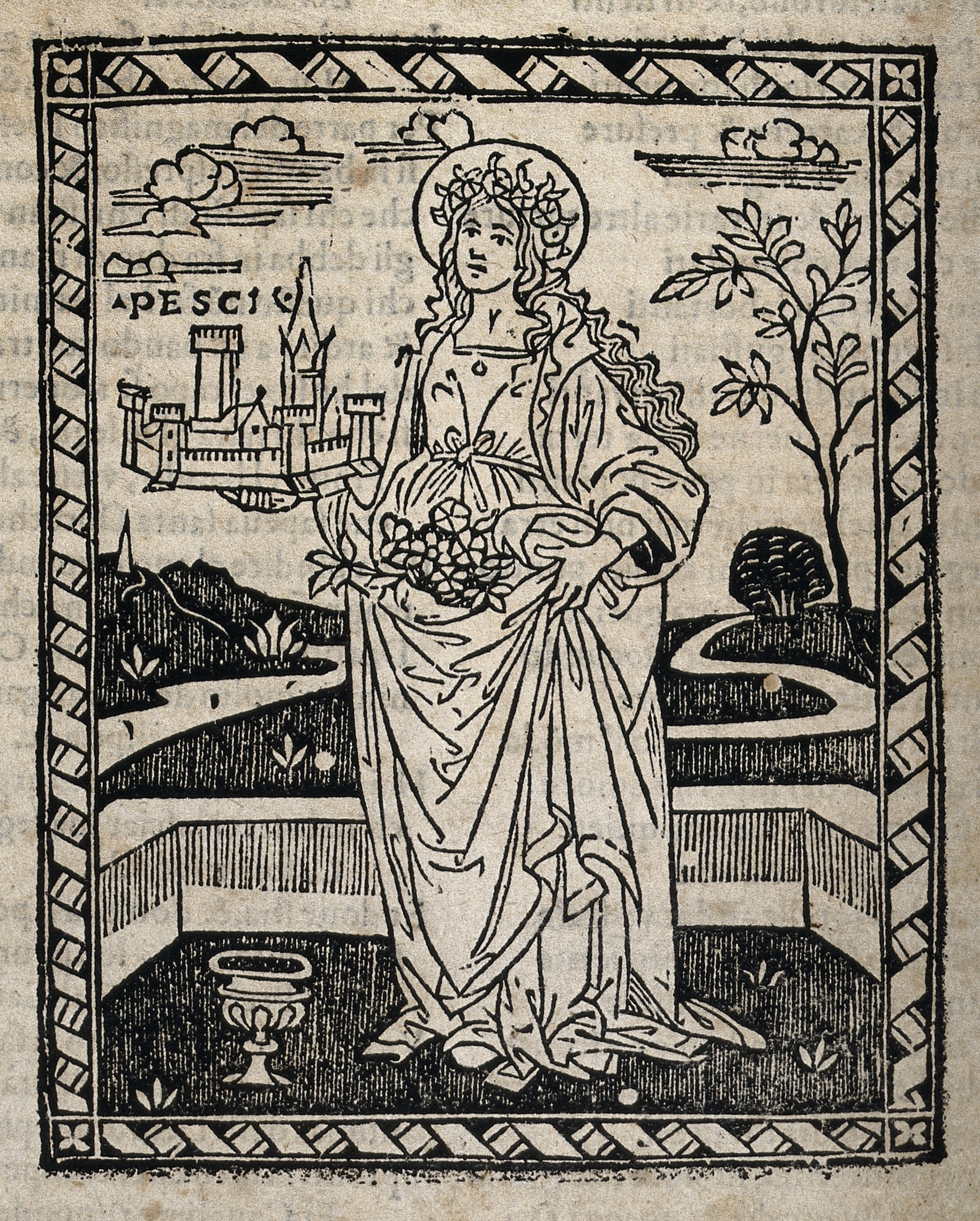
Den hellige Dorothea av
Caesarea og tre ledsagere (~290-~305)
Minnedag:
6. februar
Den hellige Dorothea
(Dora) ble født rundt 290 i Caesarea Cappadociae, den gamle hovedstaden i
den romerske provinsen Kappadokia (i dag Kayseri i Anatolia i Tyrkia). Ifølge
legenden kom hennes kristne foreldre Dorus og Thea fra en gammel romersk
senatorfamilie, men de flyktet fra Roma sammen med sine to døtre da
kristenforfølgelsene under keiser Diokletian (284-305; d. 311) brøt ut, og de
slo seg ned i Caesarea, hvor deres tredje datter Dorothea ble født og døpt i
hemmelighet av stedets biskop. Hun fikk et navn som var sammensatt av
foreldrenes, Dorus (it: Doro) og Thea. Den sjarmerende historien vi kjenner om
henne, er rent legendarisk, og vi har ingen historiske detaljer om hennes liv.
Legenden ble svært utsmykket i Legenda aurea av den salige Jakob av Voragine (ca
1226-98), biskop av Genova.
Legenden forteller at
Dorothea ble født rundt 290 i Caesarea som datter av den kristne senatoren
Dorus. Da hun vokste opp, ønsket provinsens guvernør Fabricius (Sapricius,
Apricius) å gifte seg med henne. Hun avslørte da at hun var kristen og bare
ville tilhøre Kristus. Fabricius lot henne derfor bringe for retten. Dette var
i kristenforfølgelsene under keiser Diokletian.
Hun ble arrestert og
utsatt for tortur. Den første torturen med kokende olje klarte ikke å skade
Dorothea, og hun steg opp av gryten som om hun var salvet med balsam. Etter nye
trusler ble hun sperret inne i ni dager og ni netter uten næring i et fangehull
uten lys, men hun trådte ut derfra vakrere enn noen sinne. Etter enda verre
trusler ba hun sin himmelske gemal om et tegn, og et gudebilde på en høy søyle
ble kastet ned av engler og knust. Mange mennesker omvendte seg da de så
englene og hørte djevler skrike i luften. Da heller ikke godord nyttet, lot
bøddelen Dorothea henge med føttene på en trehest, piske og få brystene brent
med fakler. Døden nær ble hun brakt derfra. Over natten ble hennes sår
helbredet, og hun sto opp uskadd
Dorotheas to søstre ved
navn Kristina og Callista (Christe og Calliste) var blitt apostater (frafalne).
Bøddelen hentet dem og sendte dem til Dorothea for å få henne til å oppgi
troen, men i stedet var det hun som vant dem tilbake. Dette gjorde guvernør
Fabricius så rasende at han fikk de to søstrene bundet til hverandre og kastet
på et bål og brent. Dorothea ble dømt til døden ved halshogging. Før hun døde
skal hun ha blitt torturert på en strekkbenk og brent med fakler, men ble sagt
at hun fortsatt smilte ved tanken på de to søstrene hun hadde omvendt.
Da hun ble truet med
døden, svarte Dorothea at hun gjerne ville dø av kjærlighet til sin Herre, og i
hans hage ville hun glede seg i evighet og plukke roser og epler. Dette hørte
den unge hedenske advokaten og rettsskriveren Theofilos, og
han spottet henne og ba henne kjekt om å skjenke ham en kurv med epler og roser
når hun kom til sin brudgoms himmelske hage (dette var midt på vinteren). Det
lovte hun å gjøre.
Dorothea ble ført til
retterstedet, hvor hun ba like før sin henrettelse. Øyeblikket etter at hun ble
halshogd, steg en himmelsk yngling ned og overrakte høytidelig rettsskriveren
en kurv med tre epler og tre roser sammen med en hilsen fra den hellige Dorothea.
Dette førte til at den sjokkerte Theofilos øyeblikkelig ble kristen og krevde å
bli henrettet på stedet. Ønsket ble etterkommet. Han ble halshogd og kastet for
villdyrene.
Det finnes en kirke ved
navn Santa Dorotea i Roma, som hevder å ha relikviene av en martyr ved det navn
som ble drept under Diokletian. Dorothea ble første gang nevnt, sammen med
Theofilos, i Martyrologium Hieronymianum. Siden 1300-tallet er også hennes
lidelseshistorie også overlevert i tallrike tyske vers- og prosaversjoner. I
England er det overlevert legender fra 1400-tallet.
Senteret for hennes kult
var Italia og Tyskland, selv om hun også finnes på glassmalerier og malerier på
lektorier i England. Hennes legende var kjent av den hellige Aldhelm (d. 709)
og utgjorde basis for stykket The Virgin Martyr (1622) av John
Massinger og Thomas Dekker, i tillegg til dikt av Swithburne og Gerard Manley
Hopkins. Dorothea ble i middelalderens Danmark regnet for å være en
«ekstra» nødhjelper,
den femtende, men hun var ikke med blant de offisielle fjorten. Hun var i
middelalderen en særdeles god venn av alminnelige mennesker. De ba henne om
hjelp i sin siste stund og hjelp mot fattigdom og ved fødsler. Dorothea
tilhører i noen versjoner Virgines Capitales sammen med de hellige
jomfruene Barbara, Margareta og Katarina
Hennes minnedag er 6.
februar. I Minden feires ankomsten av hennes relikvier den 11. mars, og i Metz
feires translasjonen av hennes relikvier den 12. mars. Relikvier æres ellers i
Roma og Bologna. Dorothea-kirken i Breslau (nå Wroclaw) ble opprinnelig bygd
for augustinereremitter og er nå sognekirke. I rådskapellet i Breslau ble det
fra 1445 oppbevart en hoderelikvie.
I den middelalderske
kunsten var hun en av de kjæreste helgenene. Hun blir fremstilt med en kurv med
blomster og epler, gjerne med en blomsterkrans i håret. Blomstene er helst
roser. Noen ganger bæres kurven av en engel. Rosekurven gjør at hun blandes
sammen med den hellige Elisabeth av Ungarn,
som imidlertid oftest har fattige med seg. Dorothea er skytshelgen for
bryggere, bruder, blomsterhandlere, gartnere, jordmødre og nygifte par. Ved
kalenderrevisjonen i 1969 ble hennes minnedag tatt ut av universalkalenderen og
henvist til lokale eller spesielle kalendre, fordi hun ble ansett som en rent
legendarisk skikkelse.
Kilder:
Attwater/John, Farmer, Bentley, Benedictines, Delaney, Bunson,
Schauber/Schindler, Melchers, Gorys, Dammer/Adam, KIR, CSO, Patron Saints SQPN,
Infocatho, Bautz, Heiligenlexikon, santiebeati.it, zeno.org - Kompilasjon og
oversettelse: p.
Per Einar Odden
Opprettet: 11. mars 1998
SOURCE : https://www.katolsk.no/biografier/historisk/dorotea
Saint Dorothy: The Iconography : https://www.christianiconography.info/dorothy.html