Saint Second (+ 134)
Martyr à Asti dans le
Piémont, décapité pour avoir pris soin de la sépulture du chrétien qui l'avait
converti et instruit.
SOURCE : http://nominis.cef.fr/contenus/saint/6460/Saint-Second.html
_-_BEIC_IE4411197.jpg?utm_source=commons.wikimedia.org&utm_campaign=imageinfo&utm_content=original)
Legendari
di sancti istoriado uulgar - Legenda aurea, 1497 – san Secondo , Biblioteca Europea di
Informazione e Cultura
SAINT SECOND, MARTYR *
Second, peut venir de se
couvrant, se composant en honnêteté de moeurs ; ou bien de secondant qui obéit
aux ordres du Seigneur; ou bien il vient de secum dux, chef de
lui-même, car il commanda à ses sens et il leur fit produire toutes sortes de
bonnes oeuvres. Ou bien Second se rapporte à premier : en effet il y a deux
chemins qui conduisent à la vie : Le premier, c'est celui de la pénitence et
des larmes; le second, c'est celui du martyre. Or, ce précieux martyr parvint à
la vie non pas seulement par le premier chemin , mais encore par le second.
Second fut un soldat
intrépide, et un athlète de J.-C. fort distingué; il fut un glorieux martyr du
Seigneur. Il reçut la couronne du martyre dans la ville d'Asti. Cette cité est
illustre par sa présence et se fait gloire de l’avoir pour patron. Il fut
instruit dans la foi de J.-C., par Calocérus, détenu dans la prison d'Asti
par l’ordre de Sapritius, préfet de cette cité. Or, comme le bienheureux
Martien était en prison dans la ville de Tardonne, Sapritius y
voulut aller pour le forcer à sacrifier ; Second partit avec lui, sous prétexte
de distraction, et avec le désir de voir le bienheureux Marcien. Sortis de la
ville d'Asti; une colombe descendit sur Second et se plaça sur sa tête.
Alors Sapritius lui dit : « Vois, Second, comme nos dieux t'aiment
puisqu'ils t'envoient des oiseaux du ciel te visiter. » Etant parvenus près du
fleuve Tanaro, Second vit un ange du Seigneur se promenant sur l’eau : «
Second, lui dit-il, aie la foi, et tu marcheras ainsi sur les fauteurs des
idoles. » Sapritius lui dit : « Mon frère Second, j'entends les dieux
qui te parlent. » Second lui répondit: « Marchons selon les désirs de notre
cœur. » Quand ils arrivèrent au fleuve Bormida, un ange lui apparut
encore, et lui dit : « Second, crois-tu en Dieu, ou bien aurais-tu des doutes?
» Second répondit: « Je crois la vérité de sa' passion et de sa résurrection.
» Sapritius dit alors : « Qu'est-ce que j'entends de ta bouche? » Or,
quand il entra dans Tardonne, Marcien; par l’ordre de l’ange, sortit de sa
prison et apparut à Second : « Entre, Second, lui dit-il, dans la voie de la
vérité ;- marche pour recevoir la palme de la foi. » Sapritius dit :
« Quel est donc cet homme qui nous parle comme s'il songeait? » Second lui
répondit : « C'est songe pour vous, mais pour moi c'est un avis et un
encouragement. » Après quoi Second alla à Milan; et un ange du Seigneur
conduisit au-devant de lui, hors de la ville, Faustin et Jovitas, qui
étaient gardés en prison. Il en reçut le baptême, une nuée leur ayant fourni de
l’eau. Et voici que tout à coup une colombe descendit du ciel et apporta le
corps et le sang de N. S. qu'elle donna à Faustin et à Jovitas ; mais
Faustin donna le corps et le sang du Seigneur à Second afin qu'il le portât à
Marcien. En revenant, Second arriva quand il faisait nuit sur la rive du Pô;
alors l’ange du Seigneur prit son cheval par la bride et lui fit passer le
fleuve. L'ayant accompagné jusqu'à Tardonne, il l’introduisit dans la
prison de Marcien et Second donna à Marcien le trésor de Faustin. Marcien dit
en le recevant : « Que le corps et le sang du Seigneur soit avec; moi pour la
vie éternelle. » Puis par l’ordre de l’ange, Second sortit de la prison et alla
en son hôtel. Après quoi Marcien fut condamné à avoir la tête tranchée et
Second enleva son corps qu'il ensevelit. En apprenant
cela, Sapritius le manda auprès de lui et lui dit : « Autant que je
puis voir, tu fais profession d'être chrétien. » Second lui répondit : « C'est
vrai, je m’avoue chrétien. » Sapritius lui dit : « Tu
désires donc mourir de mâle mort? » Second répondit : « C'est à toi plutôt
qu'elle est due. » Or, comme il ne voulait pas
sacrifier, Sapritius le fit dépouiller; mais aussitôt l’ange du
Seigneur vint pour lui préparer un vêtement. Alors Sapritius le fit
si longtemps tourmenter sur un chevalet que ses bras étaient disloqués ; mais
ayant été guéri par le Seigneur, il fut reconduit en prison. Pendant qu'il y
était, fange du Seigneur vint lui dire : « Lève-toi, Second ; suis-moi, et je
te conduirai à ton créateur. » Alors il le mena jusqu'à la ville d'Asti et le
mit dans une prison où était renfermé Calocérus et le Sauveur avec
lui. A sa vue, Second se jeta à ses pieds : « Ne crains pas, lui dit le
Sauveur, car je suis le Seigneur ton Dieu qui te délivrerai de tous les maux. »
Puis il les bénit et monta au ciel. Or, le matin, Sapritius envoya à la
prison qu'on trouva fermée, sans que Second y fût.
Alors Sapritius quitta Tardonne et vint à Asti, pour au
moins punir Calocérus qu'il se fit amener. Mais voici qu'on lui
apprit que Second était avec Calocérus. Il les fit donc comparaître devant
lui et leur dit : « Puisque nos dieux savent que vous les méprisez, ils veulent
que vous mouriez aussi tous les deux. » Or, comme ils ne voulaient pas
sacrifier, il fit fondre de la poix avec de la résine qu'il commanda de verser
sur leur tête et de jeter dans leur bouche. Mais ils buvaient cela comme l’eau
la plus exquise et avec grande ardeur en s'écriant à haute voix: « Que vos
paroles sont douces à la bouche, Seigneur ! » Alors Sapritius porta
une sentence par laquelle Second devait être décapité à Asti
et Calocérus envoyé à Albinganum pour y être puni. Or,
quand saint Second fut décollé, les anges du Seigneur vinrent prendre son corps
et lui donnèrent la sépulture en chantant des actions de grâces. Il souffrit le
3 des calendes d'avril.
* Le Martyrologe romain
annonce ainsi cette fête : A Asti, de saint Second, martyr. Bivar, dans
ses commentaires sur Detter, cite des passages textuels de cette légende
qu'il avait prise aux sources
La Légende dorée de
Jacques de Voragine nouvellement traduite en français avec introduction,
notices, notes et recherches sur les sources par l'abbé J.-B. M. Roze, chanoine
honoraire de la Cathédrale d'Amiens, Édouard Rouveyre, éditeur, 76, rue
de Seine, 76, Paris mdcccci
SOURCE : http://www.abbaye-saint-benoit.ch/voragine/tome01/057.htm

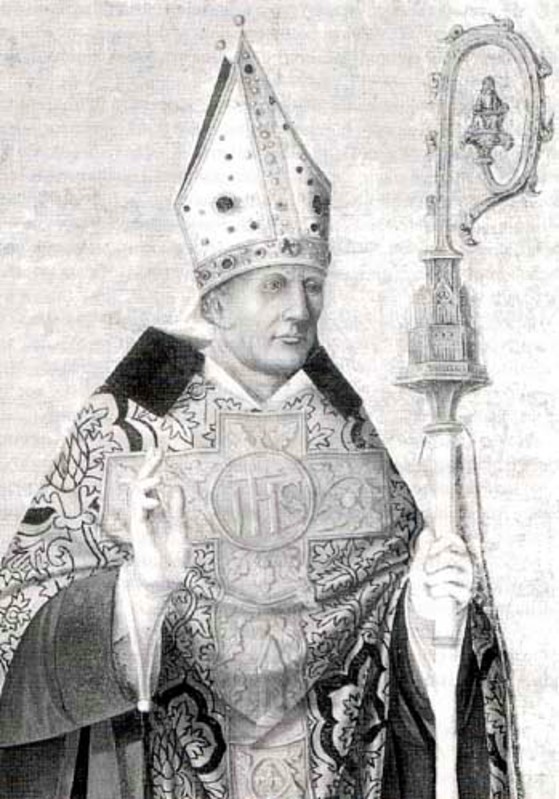
San
Secondo in un'incisione ottocentesca
Also
known as
Secondo di Asti
29 March (Asti, Italy until
the 15th
century)
1st Tuesday in May (Asti, Italy)
1 June (Asti, Italy;
translation of his relics)
Profile
Born to the patrician
class. Soldier;
subaltern officer in the imperial Roman army,
a low rank which probably indicates he was a young man. Convert to Christianity, baptised in Milan, Italy.
He illegally gave a Christian burial to
the martyr Saint Marcian
of Tortona, and then fled to his family in Asti, Italy.
There he was arrested, tortured and beheaded. Martyr.
A number of legends have grown up around him, but they’re just that – legends.
The large market that grew up around the cathedral in Asti,
which cathedral holds
his relics,
led to a tradition of patronage of bankers and merchants by
Secundus.
relics in
the cathedral in Asti
Representation
soldier holding
a miniature of the town of Asti, Italy
young soldier,
sometimes on horseback,
sometimes with a banner,
and often in the period attire of the artist,
not of Secundus
receiving a palm of martyrdom from
an angel
with the Theban
Legion
Additional
Information
Book
of Saints, by the Monks of
Ramsgate
Saints
of the Day, by Katherine Rabenstein
books
Our Sunday Visitor’s Encyclopedia of Saints
Sacred
and Legendary Art, by Anna Jameson
other
sites in english
images
sitios
en español
Martirologio Romano, 2001 edición
fonti
in italiano
Martirologio Romano, 2005 edition
Wikipedia:
San Secondo di Asti
Wikipedia:
Palio di Asti
nettsteder
i norsk
MLA
Citation
“Saint Secundus of
Asti“. CatholicSaints.Info. 19 November 2023. Web. 5 September 2026.
<https://catholicsaints.info/saint-secundus-of-asti/>
SOURCE : https://catholicsaints.info/saint-secundus-of-asti/

Image
of Saint Secundus of Asti, from the Codice della Catena, Turin
(Saint) Martyr (March
29) (2nd
century) A young man of Asti in Piedmont, converted and
instructed in the Christian religion
by Saints Calocerus
and Marcianus. Suspicion was drawn upon him by the care he bestowed to secure
the reverent interment of the latter Martyr;
and he was made to share the prison of
the former. In due course, he was brought to trial as a Christian and,
after sentence, put to the torture and beheaded (A.D. 134,
about).
MLA
Citation
Monks of Ramsgate.
“Secundus”. Book of Saints, 1921. CatholicSaints.Info.
16 March 2017. Web. 5 September 2026.
<https://catholicsaints.info/book-of-saints-secundus-29-march/>
SOURCE : https://catholicsaints.info/book-of-saints-secundus-29-march/

Incisione
raffigurante San Secondo di Asti tratta da: Vita
del glorioso martire s. Secondo (...). 1823
Engraved
portrait of saint Secundus of Asti from: Vita del
glorioso martire s. Secondo (...). 1823
St. Secundus
Feastday: March 29
Patron: of Asti; Ventimiglia
Death: 119
Martyred Roman patrician
(noble man) who was also serving in the Roman imperial army. Condemned for
being a Christian, he was put to death at Asti under
Emperor Hadrian.
SOURCE : https://www.catholic.org/saints/saint.php?saint_id=2477

St.
Secundus crossing the Po River - section of the Trinity Altar / Św. Sekundus
przeprawiający się przez Pad - kwatera z ołtarza św. Trójcy.1467, tempera on wood, 103 x 83.5,
Holy Cross Chapel, Wawel Cathedral, Kraków
Saints
of the Day – Secundus of Asti, Martyr
Died 119; feast day
celebrated some places on March 30. Saint Secundus was a patrician of Asti,
Piedmont, Italy, and a subaltern officer in the imperial army. He was beheaded
at Asti under Hadrian, but is remembered as one of the martyrs of the Thebn
Legion (Benedictines, Tabor). In art, he is portrayed as a young warrior with a
horse and is sometimes shown with Saints Maurice and Exuperius (Roeder).
MLA
Citation
Katherine I
Rabenstein. Saints of the Day, 1998. CatholicSaints.Info.
10 June 2023. Web. 5 September 2026.
<https://catholicsaints.info/saints-of-the-day-secundus-of-asti-martyr/>
SOURCE : https://catholicsaints.info/saints-of-the-day-secundus-of-asti-martyr/

Gandolfino d'Asti, San Secondo d'Asti, Collezione
D'Arte Della Banca Carige, Via Cassa Di Risparmio - 16123 Genova (GE)
San Secondo di
Asti Martire
Festa: 30 marzo
† Asti, 29 marzo 119
circa
Di lui si hanno solo
notizie leggendarie. Nobile pagano di Asti, sembra che andasse nelle prigioni a
visitare i martiri cristiani, nei confronti dei quali nutriva grande
ammirazione. Grazie a S. Calogero si convertì al cristianesimo. A Milano
incontrò S. Faustino e S. Giovita, anch’essi in carcere, dai quali ricevette il
battesimo. Amico di Sapricio, prefetto romano di Asti, lo accompagnò a Tortona
dove Marciano, vescovo della città, era in attesa di processo. Per aver sepolto
il corpo di Marciano e per aver rifiutato di abiurare la propria fede, fu
infine arrestato e martirizzato.
Patronato: Asti
Etimologia: Secondo
= figlio secondogenito, dal latino
Emblema: Palma,
Spada, Stendardo
Martirologio
Romano: Ad Asti, san Secondo, martire.
San Secondo di Asti fu certamente uno fra i primi martiri in terra piemontese, ma non va confuso con altri due santi omonimi venerati nella medesima regione: San Secondo di Salussola, venerato anche a Torino e Ventimiglia, e San Secondo di Pinerolo, entrambi ritenuti dalla tradizione popolare soldati della Legione Tebea. Maggior mistero aleggia sull’esistenza terrena del veneratissimo santo astigiano, i cui “Atti” raccolti dai bollandisti in quattro codici lo ritraggono quale uomo profondamente religioso ed assai famoso in Asti, associandolo però a figure di dubbia storicità.
Secondo sarebbe venuto a contatto con il cristianesimo grazie a San Calogero di Brescia, cui era solito far visita in prigione.Udendo che era giunto ad Asti il prefetto Sapricio, inviato dall’imperatore Adriano al posto di Antiochio, Secondo si recò da lui per chiedergli per quale buon motivo Calogero fosse stato imprigionato. Gli fu data quale motivazione che egli insegnava al popolo il disprezzo per i beni materiali, soggiungendo di aver saputo che a Tortona vi era un cristiano di nome Marciano e di aver intenzione di raggiungerlo. Secondo volle accompagnare il prefetto e Calogerò predisse al santo che sarebbe stato battezzato a Tortona ed al suo ritorno ad Asti avrebbe subito il martirio. Anche Martiniano, vescovo di Tortona, gli predisse le stesse cose.
Secondo si trasferì poi a Milano, ove incontrò i Santi Faustino e Giovita. Faustino lo battezzò e lo comunicò, affidandogli anche una particola consacrata da portare a Marciano e Calogero, quale segno del suo avvenuto battesimo. Fatto ritorno a Tortona, Secondo andò a trovare Marciano in prigione e gli portò la comunione, chiedendogli anche di pregare per lui. Il giorno seguente Marciano fu chiamato a comparire dinnanzi a Sapricio, il quale gli ordinò di offrire sacrifici agli dei, ma il cristiano rifiutò e fu allora fatto decapitare fuori della città. Sapricio rimase sorpreso alla notizia che Secondo aveva dato sepoltura al corpo del martire e lo mandò a chiamare, ma questi non si presentò ritenendo il prefetto reo di sangue innocente. Avendo rifiutato per ben tre volte la convocazione, infine fu allora arrestato ed obbligato a comparire davanti all’autorità, ove non esitò a confermare di essere cristiano. Venne dunque torturato e rispedito in cella.
Il racconto viene poi condito da elementi fantastici, secondo i quali il giorno seguente Secondo era scomparso ma la cella era chiusa.Sapricio, sempre più infuriato, diede allora ordine di tornare ad Asti per vendicarsi su Calogero: qui come per miracolo ritrovarono anche Secondo rinchiuso in cella con l’amico. Entrambi rifiutarono per l’ennesima volta di sacrificare agl’idoli pagani: Calogero fu nuovamente imprigionato e solo in un secondo momento trovò il martirio presso Albenga sulla riviera ligure di ponente, mentre Secondo fu subito condotto fuori della città e decapitato. Correva l’anno 119 circa.
Secondo quanto riporta la nuova edizione del proprio piemontese del Messale
Romano il tragico eccidio avvenne il 29 marzo del 119/120 ed infatti il
Martyrologium Romanum pone la commemorazione di San Secondo al 30 marzo. Nella
diocesi e nella città di Asti, che lo venerano quale loro patrono e ne
custodiscono le reliquie, è però festeggiato solennemente il primo martedì di
maggio.
ORAZIONE
O Dio, ascolta le nostre suppliche,
perché speriamo nella tua misericordia:
per l’intercessione del santo martire Secondo,
donaci il tuo paterno aiuto.
Per il nostro Signore Gesù Cristo, tuo Figlio, che è Dio,
e vive e regna con te, nell’unità dello Spirito Santo,
per tutti i secoli dei secoli. Amen.
Autore: Fabio
Arduino

Bernardo Strozzi (1581–1644), Saint
Secundus and the Angel, circa 1630, oil
on canvas, 82 x 101, Hermitage Museum, Saint
Petersburg,
Vissuto durante la
persecuzione dei cristiani, sotto l’imperatore romano Adriano (117-138),
Secondo discende da una nobile famiglia astigiana. L’iconografia lo ritrae come
un giovane patrizio romano in sella a un cavallo bianco. Secondo è un pagano
molto noto in città, grande amico del prefetto Saprizio, zelante esecutore
della legge dell’impero. Tuttavia Secondo comincia ad ammirare il coraggio dei
martiri cristiani e desidera conoscere la nuova religione tanto perseguitata.
Si reca a visitare i cristiani in carcere e uno di questi, San Calogero di
Brescia, prigioniero ad Asti, lo istruisce sul messaggio di Gesù.
Secondo si sente sempre più attratto dalle parole dei cristiani e un giorno
accompagna il suo amico prefetto Saprizio (all’oscuro delle sue inquietudini) a
Tortona (Alessandria), a trovare in carcere un altro martire, il vescovo della
città Marciano. Nel giovane Secondo cresce il desiderio di abbracciare il
Cristianesimo e, recatosi a Milano in visita ad altri due prigionieri
cristiani, i fratelli San Faustino e San Giovita, si fa battezzare. Siamo
nell’anno 119. Torna a Tortona, conforta il vescovo Marciano condannato a morte
e, dopo l’esecuzione, gli dà sepoltura. Quando Saprizio viene a saperlo per
Secondo è la fine. Il prefetto prima prova a convincere Secondo a rinunciare
alla sua fede, poi lo fa torturare. Infine, di fronte al rifiuto del suo ex
amico di rinnegare il Cristianesimo, ordina che venga giustiziato fuori città.
Nello stesso luogo sorge oggi la Chiesa di San Secondo dove sono custodite le spoglie del patrizio astigiano, proclamato patrono di Asti. Ogni anno la città piemontese, in onore del suo patrono, il primo lunedì di maggio organizza un suggestivo spettacolo pirotecnico sulle rive del fiume Tanaro. I festeggiamenti proseguono l’indomani, martedì, con il solenne corteo dei figuranti che sfilano indossando costumi medievali. Essi rappresentano i borghi e i comuni che nel mese di settembre partecipano alla famosa corsa dei cavalli del “Palio d’Asti”. Seguono l’esibizione degli sbandieratori dell’ASTA e la distribuzione della minestra dei poveri (pasta e fagioli, bruschetta e una fetta di mön, mattone dolce) per rispettare la tradizione secolare di offrire ai bisognosi un piatto caldo. Il giorno dopo, mercoledì, dall’alba al tramonto, le strade e le piazze del centro si riempiono di coloratissime bancarelle per dare vita alla “Fiera Carolingia”.
Autore: Mariella Lentini
SOURCE : https://www.santiebeati.it/dettaglio/47650

San
Secondo, incisione del XIX secolo
Den hellige Secundus av
Asti (d. ~119?)
Minnedag:
30. mars
Skytshelgen for Asti
Den hellige Secundus (it:
Secondo) ble født i det første århundret e.Kr. i Asti i regionen Piemonte i
Nord-Italia. Han var en hedensk patrisier og underoffiser i den keiserlige hær
og velkjent i Asti. Ifølge sine acta var han en dypt religiøs mann,
men disse sene aktene knytter ham til skikkelser av tvilsom historisk verdi. De
forteller at han pleide å besøke de kristne i fengselet, og disse møtene gjorde
at han fikk en dyp beundring for dem som var villige til å bli fengslet og
endog drept for sin tros skyld.
En av dem som han pleide
å besøke i fengselet, var den hellige Calocerus av
Brescia (it: Calogero), som lærte ham om den kristne tro. Keiser
Hadrian (117-38) sendte Sapricius (it: Sapricio, Saprizio) til Asti for å
erstatte prefekten Antiokus, og da Secundus hørte at han hadde kommet til byen,
gikk han for å treffe ham. Han spurte prefekten hvilken forbrytelse Calocerus
hadde blitt fengslet for. Sapricius forklarte at han overtalte folket til å
forakte gudene. I tillegg la han til at han hadde fått vite at det var en
kristen i Tortona ved navn Marcian (Marcianus,
Martianus; it: Marciano, Marziano), og han ønsket å dra dit. Secundus ba om å
få bli med ham, noe Sapricius gikk med på. Da Calocerus hørte dette, forutsa
han at Secundus ville motta dåpen og vende tilbake til Asti, hvor han ville
møte martyrdøden. Da Secundus kom til Tortona, ble han møtt av den kristne
Marcian, som viste seg å være byens biskop, og han sa det samme som Calocerus
hadde sagt. Sapricius arresterte Marcian og satte ham i fengsel.
I Tortona skilte Secundus
og Sapricius lag, og Secundus dro til Milano, hvor han møtte de hellige
brødrene Faustinus
og Jovita av Brescia (d. ca 121). Faustinus døpte ham og ga ham
Herrens legeme til å spise og også til å ta med seg til Marcian og Calocerus
som et tegn på at han virkelig var blitt døpt. Da Secundus kom tilbake til
Tortosa, oppsøkte han biskop Marcian i fengselet og ga ham sakramentet og ba
ham be for seg. Neste dag ble Marcian kalt til å møte for Sapricius og
kommandert til å ofre til gudene eller bli drept med sverd. Da han nektet å
begå en slik blasfemi, ble han tatt med utenfor byen og halshogd.
Til sin overraskelse
hørte Sapricius at Secundus hadde gravlagt Marcians legeme. Han tilkalte
Secundus, som avslo å treffe ham og sa at prefekten hadde blodet til en
rettferdig og uskyldig mann på hendene. Tre ganger sendte Sapricius bud etter
ham og tre ganger nektet Secundus. Til slutt ble Secundus satt i fengsel, men
neste dag ble han tvunget til å møte for prefekten. Han innrømmet fast at han
var blitt en kristen. Sapricius bønnfalt ham, men til ingen nytte. Da fikk han
ham torturert og sendte ham tilbake til fengselet.
Deretter tar historien av
inn i det mirakuløse. Neste dag ble fengselet funnet lukket og låst, men det
var ikke noe tegn til Secundus. Den rasende Sapricius ga da ordre om å vende
tilbake til Asti. Han ville la sitt raseri gå ut over Calocerus, som han visste
at han hadde i sin vold. Da hans tjenere dro til fengselet for å hente
Calocerus, fant de til sin store overraskelse Secundus sammen med ham. Begge
fikk ordre om å ofre til de romerske gudene, men begge nektet. Calocerus ble da
slått og sendt tilbake til fengselet, og han skal senere ha lidd martyrdøden
nær Albenga ved kysten i Liguria. Secundus ble derimot straks tatt med utenfor
byen og halshogd. Det var den 29. mars i år 119 eller 120 (?)
Secundus' acta,
samlet av bollandistene fra fire manuskripter, er en sen komposisjon, men det
er ingen tvil om at han virkelig døde for sin tros skyld som en av de første
martyrene i Piemonte og ble æret i Asti fra de tidligste tider. Det er kjent at
en kirke ble viet til ham i området så tidlig som på 800-tallet. Det er i dag
en kollegiatskirke ved navn San Secondo i Asti. Hans relikvier oppbevares i
Asti, og han er byens skytshelgen.
Ifølge den nye utgaven av
propriet for Piemonte til Missale Romanum led Secundus martyrdøden den 29. mars
i 119/120. Martyrologium Romanum, den offisielle, men ufullstendige listen over
hellige som er anerkjent av Den katolske kirke, har hans notis den 30. mars,
mens kilden Butler's Lives of the Saints plasserer ham under 31.
mars. I byen og bispedømmet Asti feires han høytidelig den første tirsdagen i
mai.
Manuskriptet (codex) som
kalles Codice della Catena i Torinos historiske arkiv, avbilder seks
helgener som er populære i Torinos religiøse tradisjon. På bildet ses fra
venstre de hellige Octavius av Torino, Maximus (den
første biskop av Torino), Adventor og Solutor av
Torino, Johannes
Døperen og Secundus av Asti. Under de hellige er oksen, som er
symbolet for kommunen, og hertugdømmet Savoias fane med det hvite korset på rød
bunn.
Secundus' attributter i
kunsten er palme, sverd og banner. Han avbildes som soldatmartyr, ofte med en
hest. Dette har gjort at mange feilaktig har assosiert ham med Den tebanske
legion under kommando av den hellige Mauritius, som
led martyrdøden i forfølgelsene rundt 287 (rundt 305?) under keiser Diokletians
(284-305) medregent i vest, Maximian Herculeus (286-305). Ofte skyldes dette
sammenblanding med to piemontesiske martyrer som angivelig skal ha tilhørt Den
tebanske legion, de hellige Secundus av
Salussola, som også æres i Torino og Ventimiglia, og Secundus av Pinerolo.
Den italienske maleren
Bernardo Strozzi (ca 1581-1644) malte rundt 1640 bildet «St. Secundus og
engel», som henger i Eremitasjemuseet i St. Petersburg i Russland.
Kilder: Butler
(III), Benedictines, Bunson, KIR, CSO, Infocatho, santiebeati.it,
en.wikipedia.org - Kompilasjon og oversettelse: p. Per Einar Odden -
Sist oppdatert: 2008-08-05 23:24
SOURCE : https://www.katolsk.no/biografier/historisk/secuasti