
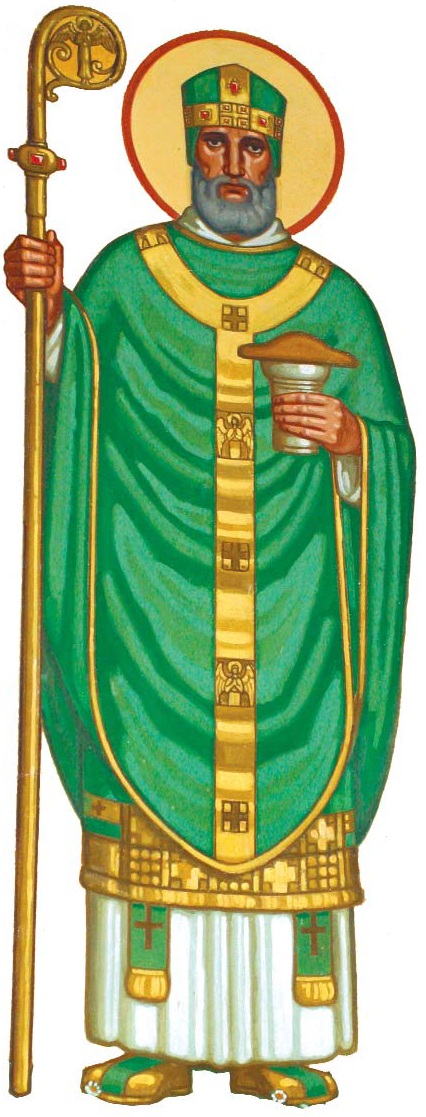
14
Świętych Wspomożycieli z polichromii parafialnego kościoła z wioski Immensee w
szwajcarskim Küssnacht
Saint Acace d'Antioche
Évêque (+ 250)
Evêque d'Antioche, il fut
arrêté pendant la persécution de l'empereur Dèce. Nous avons le compte-rendu de
son interrogatoire où Acace réfute avec une verve extraordinaire
l'interrogatoire du préfet Marcien qui le laisse parler puis l'acquitte. Les «
acta » de son interrogatoire semblent authentiques par leur simplicité.
SOURCE : http://nominis.cef.fr/contenus/saint/893/Saint-Acace-d-Antioche.html
Saint Acace Agathangelos
Évêque d’Antioche de
Pisidie
Fête le 31 mars
Églises d’Orient
† v. 251
Cf. Quatorze
Saints Auxiliaires (Les)
Autres graphies :
Acace, Achatius ou Acacius
Il fut probablement
évêque d’Antioche, en Pisidie, ou de Mélitène, en Arménie. Nous possédons le
compte rendu de son interrogatoire par le préfet Marcien, interrogatoire au
cours duquel il argumenta si brillamment contre l’idolâtrie que l’empereur Dèce
lui pardonna. Les Grecs le surnommèrent Agathange (bon ange) et Thaumaturge
(faiseur de miracles). Il est très vénéré en Orient. Ses « acta »
semblent authentiques. Il se peut qu’Acacius ou Achatius ait été évêque
d’Antioche ou de Mélitène, mais il se peut également qu’il n’ait pas été évêque
du tout. Éminent dans les cercles chrétiens d’Antioche, il est sommé de
paraître devant le fonctionnaire romain local, Marcien. Acace refuse de
sacrifier aux dieux païens, et bien qu’il ne fournisse pas les noms de ses
camarades chrétiens, il est envoyé en prison. Apparemment, quand l’empereur
Dèce reçoit le rapport de son procès, il est tellement impressionné par les
deux hommes qu’il promeut Marcien et pardonne à Acacius. Bien que désigné comme
martyr, il n’y a pas de preuve qu’il meurt pour la foi. Trois autres martyrs
des premiers siècles s’appellent aussi Acace.
SOURCE : http://www.martyretsaint.com/acace-agathangelos
ACTES DU PROCÈS DE SAINT
ACACE, ÉVÊQUE D’ANTIOCHE DE PISIDIE, EN 250.
Ce personnage fut très
probablement évêque d'Antioche de Pisidie, colonie romaine. La pièce originale
a dû être en langue grecque ; mais on ne la possède que dans la traduction,
laquelle présente d'ailleurs de solides garanties d'authenticité. Le procès de
saint Acace est très remarquable parce qu'il est clos par une grâce impériale.
BOLL. Act. SS. 31/III. Mort,
III, 903-905. — RUINART, Acta sinc., p. 139. — EDM. LE BLANT, Recherches
sur l'accusation de magie dirigée contre les premiers chrétiens (1869). — EDM. LE
BLANT, Note sur les bases juridiques des procès dirigés contre les
première chrétiens (1866), p. 8-13. — P. ALLLARD, Hist. des perséc.,
t. II, p. 412 suiv.
ACTES DU PROCÈS DE SAINT
ACACE, ÉVÊQUE ET MARTYR.
Chaque fois que nous
rappelons les actions illustres des. serviteurs de Dieu, nous rendons grâces à
Celui qui protège le patient dans la souffrance et qui couronne le vainqueur
dans la gloire. Martianus, consulaire, ennemi de la loi chrétienne, se fit
amener Acace que l'on lui avait signalé comme le refuge et le bouclier des
chrétiens d'Antioche.
Quand Acace eut été
introduit, Martianus dit : « Puisque tu vis sous les lois romaines, tu
dois aimer nos princes ».
Acace répondit : « Eh qui
a plus à coeur de le faire et qui aime mieux l'empereur que les chrétiens? Nous
prions assidûment pour lui, demandant à Dieu de lui donner une longue vie, un
gouvernement juste, un règne paisible ; nous prions pour le salut de l'armée,
la conservation de l'empire et du monde.
— Je te félicite pour ces
sentiments, mais afin que l'empereur en reconnaisse la sincérité, offre-lui
avec nous un sacrifice.
— Je prie mon Seigneur,
le grand et vrai Dieu, pour le salut du prince ; mais celui-ci n'a pas le droit
d'exiger de nous un sacrifice, ni nous n'avons le droit de lui en offrir. Qui
donc peut adresser son culte à un homme ?
— Dis-nous alors à quel
Dieu tu offres tes prières, afin que nous aussi nous l'honorions.
— Je te souhaite de connaître
mon Dieu qui est le Dieu véritable.
— Comment se nomme-t-il ?
— Le Dieu d'Abraham, le
Dieu d'Isaac, le Dieu de Jacob.
— Sont-ce là les noms de
ces dieux ?
— Ce n'est pas eux qui
sont Dieu, mais celui qui leur a parlé ; et c'est lui que nous devons craindre.
— Quel est-il ?
— Adonaï, le Très-Haut,
qui est assis sur les chérubins et les séraphins.
— Qui est-ce séraphin ?
— C'est le ministre du
Très-Haut et le plus rapproché du trône sublime.
— Cette fausse
philosophie t'a fourvoyé. Méprise les choses invisibles et reconnais Ies dieux
véritables qui sont sous tes yeux.
— Quels sont ces dieux
auxquels larve= me faire sacrifier ?
— C'est Apollon, notre
bienfaiteur, celui qui, repousse loin de nous la peste et la famine, et par qui
le monde entier est gouverné et conservé.
— Ah ! oui, un dieu
que l'on a tué, car c'est bien ce que vous dites de lui ; un dieu qui, épris
d'une fille, poursuivait l'aventure, ignorant qu'il perdrait la proie avant de
l'avoir saisie. Un tel ignorant, c'est clair, n'était pas dieu ; l'était-il
plus quand une autre fille le trompa ? Il en eut bien d'autres à souffrir, la
fortune lui réservait de plus cuisants chagrins. Il aimait les petits garçons:
Épris d'un certain Hyacinthe, il brûlait d'amour pour cet enfant; et le pauvre
dieu qui ne savait pas l'avenir, tua d'un coup de disque celui qu'il vulait
posséder. Un dieu, lui, qui, au temps jadis, se fit maçon avec Neptune, et
ensuite garda les troupeaux d'autrui, est-ce a lui que je dois sacrifier? Ou
bien tu préfères peut-être Esculape qui mourut foudroyé, ou bien encore Vénus,
une adultère, ou les autres monstres. Ainsi ma vie est en jeu si je n'adore pas
des coquins que je me garderai bien d'imiter, et je les méprise, et je les
accuse, et ils me font horreur ; si quelqu'un les imitait, on le mettrait en
prison ? Vous adorez ici ce que vous condamnez là. »
Martianus dit : « Les
chrétiens n'en font pas d'autres, il leur faut déblatérer sur nos dieux. C'est
entendu. Maintenant je t'ordonne de venir avec mai au temple de Jupiter et de
Junon, nous y ferons un bon 'souper et nous rendrons aux immortels l'honneur
qui leur est dû ».
Acace dit : « Je ne puis
cependant pas faire un sacrifice à un individu qui est enterré dans l'île de
Crète. Ah çà, est-il ressuscité » ?
Martianus dit : «
Sacrifie ou meurs ».
Acace reprit : « Moeurs
de Dalmate. En ce pays-là, il y a des brigands qui font métier de voler, ils
s'embusquent le long d'un chemin détourné et tombent sur les voyageurs.
Vient-il un passant, on l'arrête: la bourse ou la vie. Nul ne demande de
raison, mais considère la force de l'agresseur. Tu leur ressembles. Tu
commandes le mal, ou tu menaces de mort. Je ne crains rien, je n'ai pas peur.
Le droit public se charge de punir la débauche, l'adultère, le vol, la sodomie,
les maléfices et l'homicide. Si je suis coupable de, ces crimes, je suis le
premier à me condamner ; si, au contraire, j'adore le Dieu véritable et qu'on
me tue, ce n'est plus la justice, c'est l'arbitraire.. Le prophète a raison de
s'écrier : « Il n'y a personne qui fasse le bien, tous se sont relâchés, ils se
sont rendus inutiles ». Ainsi tu ne saurais faire autre chose que ce que tu
fais. Nous lisons dans nos livres : « Comme tu auras jugé, tu seras jugé
toi-même », et ailleurs : « Comme tu auras agi, l'on agira envers toi ».
Martianus : « Je n'ai pas
été envoyé pour juger, mais pour contraindre : si tu méprises le commandement,
tu seras châtié ».
Acace : « Et mon
commandement à moi est de ne pas renier mon Dieu. Si tu sers un homme chétif et
charnel que la mort atteindra bientôt et qui, tu le sais, deviendra la pâture
des vers, combien plus dois-je obéir à Dieu dont la toute-puissance est
éternelle, et qui a dit de lui-même : « Celui qui m'aura renié devant les
hommes, je le renierai devant mon Père céleste, quand je serai venu dans ma
gloire et ma force juger les vivants et les morts » !
Martianus : « Tu viens de
déclarer l'erreur de votre doctrine que j'étais, depuis longtemps, avide
d'entendre. Tu viens de dire, n'est-ce pas, nue Dieu a un fils ?
— Oui.
— Et quel est ce fils de
Dieu ?
— Le Verbe de grâce et de
vérité.
— Est-ce là son nom
?Actes du procès de saint Acace
— Tu ne me parlais pas de
son nom, mais de sa puissance.
— Eh bien, son nom,
maintenant ?
— Jésus-Christ.
— Qui fut sa mère ?
— Dieu n'a pas engendré
son fils, ainsi que font les hommes, de l'union avec une femme, mais il a formé
de ses mains le premier Adam, car il ne faut pas croire que la majesté divine
ait eu des rapports avec une femme mortelle. Dieu donc a fait de terre le corps
du premier homme et là où il a déjà mis sa parfaite image, il ajouta l'âme et
l'esprit. De même, le Fils de Dieu, le Verbe de vérité sort du coeur de Dieu,
ainsi qu'il est écrit : Mon coeur a proféré une parole parfaite.
— Alors c'est un Dieu qui
a un corps?
— Lui seul connaît la
forme invisible que nous ignorons, mais nous adorons sa force et sa puissante.
— S'il n'a pas de corps,
il n'a pas de coeur, car le sens exige l'organe.
— La sagesse ne naît pas
avec des organes, elle est donnée par Dieu. Quel rapport y a-t-il entre le sens
et l'organe ?
— Vois les Cataphryges ;
leur religion est ancienne, cependant ils l'ont abandonnée pour la nôtre,
aujourd'hui ils sacrifient aux dieux. Fais comme eux. Rassemble tous les
catholiques et suis avec eux la religion de l'empereur. Ton peuple, je le sais,
se laisse conduire, par toi.
— C'est à Dieu, non à
moi, qu'obéissent les chrétiens. Ils m'écouteront si je leur enseigne la
justice, ils me mépriseront si je leur conseille le mal.
— Donne-moi leurs noms à
tous ?
— Leurs noms sont écrits
au livre de vie. Comment des yeux mortels pourront-ils déchiffrer ce que la
puissance du Dieu immortel et invisible a écrit ?
— Où sont les magiciens
qui t'aident dans tes artifices, ou ceux qui t'ont enseigné tes prestiges ?
— Nous avons tout reçu de
Dieu, et la magie nous fait horreur.
— Vous êtes des
magiciens, puisque vous avez invepté une religion.
— Nous détruisons les
dieux créés par vous et dont vous avez peur. Quand l'ouvrier manque de pierre
ou que l'on manque d'ouvriers, vous n'avez plus de dieux. Le Dieu que nous
craignons, nous, n'est pas de notre fabrication, c'est nous qui sommes créés
par lui, car il est le Maître ; nous sommes aimés de lui, car il est le Père,
et comme un tendre pasteur il nous a arrachés à la mort éternelle.
— Allons, les noms, ou tu
meurs !
— Je suis devant ton
tribunal et tu' demandes des noms? Crois-tu donc venir à bout des autres, alors
que tu te laisses vaincre par moi seul? Mais, tiens, tu veux des noms, eh bien,
je m'appelle Acace et on m'a surnommé le « Bon Ange ». Fais ce que tu voudras.
»
Martien dit : « Tu seras
ramené en prison, les pièces du procès seront transmises à l'empereur. Il
décidera de ton sort. »
Dèce, ayant lu toute la
procédure, s'intéressa à cette controverse, et même il ne put s'empêcher de
sourire en la lisant. Peu de temps après il donna à Martianus la légation de
Pamphylie. Quant à Acace, qu'il admira fort, il lui fit grâce.
Telle fut la conduite du
consulaire Martianus, sous le règne de Dèce, le quatre des calendes d'avril.
LES MARTYRS. TOME II. LE
TROISIÈME SIÈCLE, DIOCLÉTIEN. Recueil de pièces authentiques sur les
martre depuis les origines du christianisme jusqu'au XXe siècle TRADUITES
ET PUBLIÉES Par le B. P. DOM H. LECLERCQ, Moine bénédictin de Saint-Michel de
Farnborough. Imprimi potest FR. FERDINANDUS CABROL, Abbas Sancti Michaelis
Farnborough. Die 15 Martii 1903. Imprimatur. Pictavii, die 24 Martii 1903. +
HENRICUS, Ep. Pictaviensis.


Acathius
of Melitene
Прп.
Акакий, еп. Мелитинский. Миниатюра из Минология. Нач. XI в. (ГИМ)
Saint Acacius
Agathangelos of Melitene
Also
known as
Acacius
Acacius of Hither
Achates
Achatius
Agathangelos
The Good Angel
The Wonder Worker
31
March (Eastern Orthodox calendar)
Profile
Bishop of
Hither, Asia (Melitene in Armenia, modern Malatya, Turkey). He intervened in
the Council of Ephesus to defend orthodox Christianity against
Nestorianism. Arrested in
the persecutions of Decius and
brought before the imperial tribunal for the crimes of Christianity and
refusing to sacrifice to idols.
His defense of the faith so
impressed the judges that they set him free. Because of his arrest and
his willingness to die for
the faith he
is often listed as a martyr,
but he apparently survived the persecutions.
c.251 of
natural causes
Additional
Information
Acts
of the Early Martyrs, by Father James
A M Fastré, S.J.
Book
of Saints, by the Monks of
Ramsgate
Lives
of the Saints, by Father Alban
Butler
Saints
of the Day, by Katherine Rabenstein
books
Our Sunday Visitor’s Encyclopedia of Saints
The Saints: A Concise Biographical Dictionary, by John
Coulson
other
sites in english
Regnum
Christi Spirituality Center
images
sitios
en español
Martirologio Romano, 2001 edición
fonti
in italiano
nettsteder
i norsk
MLA
Citation
‘Saint Acacius Agathangelos
of Melitene‘. CatholicSaints.Info. 22 November 2023. Web. 23 March 2026.
<https://catholicsaints.info/saint-acacius-agathangelos-of-melitene/>
SOURCE : https://catholicsaints.info/saint-acacius-agathangelos-of-melitene/
Article
ACACIUS (ACHATES) (Saint)
Bishop (March 31) (3rd century) Surnamed Agathangelus (Good Angel). A Bishop in
Phrygia (Asia Minor) who in the Decian persecution (A.D. 250) became famous for
having by his prudence and constancy so impressed the tyrant as to obtain his
discharge from custody. It is not known how long he survived. He is held in
great veneration in the East.
MLA
Citation
Monks of Ramsgate.
“Acacius”. Book of Saints, 1921. CatholicSaints.Info. 30 April 2012.
Web. 23 March 2026. <http://catholicsaints.info/book-of-saints-acacius/>
SOURCE : https://catholicsaints.info/book-of-saints-acacius/
St. Acacius
Bishop of Melitene in the
third century. The Greeks venerate him on
different days, but especially on 31 March. He lived in the time of the persecution of Decius, and although it
is certain that
he was cited before the tribunal of Marcian to give an
account of his faith,
it is not sure that he died for it. He was indeed condemned to death, but the
Emperor released him from prison after he had
undergone considerable suffering. He was famous both for the splendour of
his doctrinal teaching
and the miracles he
wrought.
There was a younger
Acacius, who was also Bishop of Melitene, and who was
conspicuous in the Council
of Ephesus, but it is not certain that he is
ranked among the saints.
Sources
Acta SS., March 3.
Campbell,
Thomas. "St. Acacius." The Catholic Encyclopedia. Vol.
1. New York: Robert Appleton
Company, 1907. <https://www.newadvent.org/cathen/01083a.htm>.
Transcription. This
article was transcribed for New Advent by Stephen Patrick Wilson. Dedicated
to Mother Teresa of Calcutta.
Ecclesiastical
approbation. Nihil Obstat. March 1, 1907. Remy Lafort, S.T.D.,
Censor. Imprimatur. +John Cardinal Farley, Archbishop of New York.
Copyright © 2023 by Kevin Knight.
Dedicated to the Immaculate Heart of Mary.
SOURCE : https://www.newadvent.org/cathen/01083a.htm
St. Achatius
Feastday: March 31
Achatius, also known as
Acacius; the facts of his life are
uncertain. He may have been bishop of Antioch or
of Militene and may not have been a bishop at
all. He was prominent in Christian circles
in Antioch and
when summoned to appear before the local Roman official, Martian, a dialogue
on Christianity and
it's teachings as compared to other religions ensued, which has come down to
us. Achatius refused to sacrifice to pagan gods,
and when he would not supply the names of his fellow Christians, was sent to
prison. Supposedly when Emperor Decius received
Martian's report of the trial he was so impressed by both men that he promoted
Martian and pardoned Achatius. Though listed as a martyr there
is no evidence he died for the faith.
SOURCE : https://www.catholic.org/saints/saint.php?saint_id=788
Acacius Agathangelos B
(AC)
(also known as Achatius)
Died c. 251.
"We venerate our God
because He made us; we did not make Him. He as our Master loves us, for He is
also our Father. Of His goodness He has rescued us from everlasting
death." --Saint Acacius.
Saint Acacius, bishop of
Antioch, Phrygia, led a devout life and was much revered for his charity and
zeal by his flock who nicknamed him 'Agathangelus,' which means 'good angel,'
and 'Thaumaturgus,' or the 'wonder-worker.' During the persecution of
Christians under the Emperor Decius, not a single Christian in his diocese is
said to have denied his faith.
Around 251, Decius's
representative in Antioch, Martian, summoned the bishop for cross-examination.
Acacius appeared and began by insisting that his flock was entirely faithful to
the emperor. Martian responded that the saint should prove this by making
sacrifice to the emperor as a god. This the bishop adamantly refused to do.
The following transcript
is from the public record of this interrogation:
Martian: "As you
have the happiness to live under the Roman laws, you are bound to love and
honor our princes, who are our protectors."
Acacius: "Of all the
subjects of the empire, none love and honor the emperor more than the
Christians. We pray without intermission for his person, and that it may please
God to grant him long life, prosperity, success, and all benedictions; that he
may be endowed by Him with the spirit of justice and wisdom to govern his
people; that his reign be auspicious, and prosperous, blessed with joy, peace,
and plenty, throughout all the provinces that obey him."
Martian: "All this I
commend; but that the emperor may be the better convinced of your submission
and fidelity, come now and offer him a sacrifice with me."
Acacius: "I have
already told you that I pray to the great and true God for the emperor; but he
ought not to require a sacrifice from us, nor is there any due to him or to any
man whatsoever."
Martian: "Tell us
what God you adore, that we may also pay Him our offerings and homages."
Acacius: "I wish
from my heart you did know Him."
Instead of instantly
sentencing Acacius to death, Martian continued to question him. They discussed
the nature of angels. They spoke about the myths of the Greeks and the Romans.
They philosophized together about the nature of God:
Martian: "Tell me
His Name."
Acacius: "He is
called the God of Abraham, Isaac, and Jacob."
Martian: "Are these
the names of gods?"
Acacius: "By no
means, but of men to whom the true God spoke; He is the only God, and He alone
is to be adored, feared, and loved."
Martian: "What is
this God?"
Acacius: "He is the
most high Adonai, who is seated above the cherubim and seraphim."
Martian: "What is a
seraph?"
Acacius: "A
ministering spirit of the most high God, and one of the principal lords of the
heavenly court."
Martian: "What
chimeras are these? Lay aside these whims of invisible beings, and adore such
gods as you can see."
Acacius: "Tell me
who are those gods to whom you would have me sacrifice?"
Martian: "Apollo,
the savior of men, who preserves us from pestilence and famine, who enlightens,
preserves, and governs the universe."
Acacius: "Do you
mean that wretch that could not preserve his own life: who, being in love with
a young woman (Daphne), ran about distracted in pursuit of her, not knowing
that he was never to possess the object of his desires? It is therefore evident
that he could not foresee things to come, since he was in the dark as to his
own fate, and as clear that he could be no god, who was thus cheated by a
creature. All know likewise that he had a base passion for Hyacinth, a
beautiful boy, and was so awkward as to break the head of that minion, the fond
object of his criminal passion, with a quail.
"Is not he also that
god who, with Neptune, turned mason, hired himself to a king (Laamedon of
Troy), and built the walls of a city? Would you oblige me to sacrifice to such
a divinity, or to Esculapius, thunderstruck by Jupiter? or to Venus, whose life
was infamous, and to a hundred such monsters, to whom you offer sacrifice? No,
though my life itself depended on it, ought I to pay divine honors to those
whom I should blush to imitate, and of whom I can entertain no other sentiments
than those of contempt and execration? You adore gods, the imitators of whom
you yourselves would punish."
Martian: "It is
usual for you Christians to raise several calumnies against our gods; for which
reason I command you to come now with me to a banquet in honor of Jupiter and
Juno, and acknowledge and perform what is due to their majesty."
Acacius: "How can I
sacrifice to a man whose sepulcher is unquestionably in Crete? What! Is he
risen again?"
Martian: "You must
either sacrifice or die."
Acacius: "Finis is
the custom of the Dalmatian robbers; when they have taken a passenger in a
narrow way, they leave him no other choice but to surrender his money or his
life. But, for my part, I declare to you that I fear nothing that you can do to
me. The laws punish adulterers, thieves, and murderers. Were I guilty of any of
those things, I should be the first man to condemn myself. But if my whole
crime be the adoring of the true God, and I am on this account to be put to
death, it is no longer a law but an injustice."
Martian: "I have no
order to judge but to counsel you to obey. If you refuse, I know how to force
you to a compliance."
Acacius: "I have a
law which I will obey: this commands me not to renounce my God. If you think
yourself bound to execute the orders of a man who in a little while must leave
the world, and his body become the food of worms, much more strictly am I bound
to obey the omnipotent God, Who is infinite and eternal, and Who hath declared,
`Whoever shall deny Me before men, him will I deny before My Father.'"
Martian: "You now
mention the error of your sect which I have long desired to be informed of: you
say then that God hath a son?"
Acacius: "Doubtless
He hath one."
Martian: "Who is
this son of God?"
Acacius: "The Word
of truth and grace."
Martian: "Is that
His name?"
Acacius: "You did
not ask me His name, but what He is."
Martian: "What then
is His name?"
Acacius: "Jesus
Christ."
Martian asked by what
woman God had this son, he replied, that the divine generation of the Word is
of a different nature from human generation, and proved it from the language
the royal prophet uses of in Psalm 44.
Martian: "Is God
then corporeal?"
Acacius: "He is
known only to Himself. We cannot describe Him; He is invisible to us in this
mortal state, but we are sufficiently acquainted with His perfections to
confess and adore Him."
Martian: "If God
hath no body, how can He have a heart or mind?"
Acacius: "Wisdom
hath no dependence or connection with an organized body. What does having a
body have to do with understanding?"
He then pressed him to
sacrifice as did some of the heretical Montanists.
Acacius: "It is not
me these people obey, but God. Let them hear me when I advise them to what is
right; or let them despise me, if I offer them the contrary and endeavor to
pervert them."
Martian then asked the
saint to provide him with the names of other Christians. The bishop would give
him only two names: his own, Acacius, and his nickname, Agathangelus.
Martian: "Give me
all their names."
Acacius: "They are
written in heaven, in God's invisible registers."
Martian: "Where are
the magicians, your companions, and the teachers of this cunningly devised
error [the priests?]?"
Acacius: "No one in
the world abhors magic more than we Christians."
Martian: "Magic is
the new religion which you introduce."
Acacius: "We destroy
those gods whom you fear, though you made them yourselves. We, on the contrary,
fear not him whom we have made with our hands, but Him who created us, and Who
is the Lord and Master of all nature; Who loved us as our good Father, and
redeemed us from death and hell as the careful and affectionate shepherd of our
souls."
Martian: "Give the
names I require, if you would avoid the torture."
Acacius: "I am
before the tribunal, and do you ask me my name, and, not satisfied with that,
you must also know those of the other ministers? Do you hope to conquer many;
you, whom I alone am able thus to confound? If you desire to know our names, mine
is Acacius. If you would know more, they call me Agathangelus, and my two
companions are Piso, bishop of the Trojans, and Menander, a priest. Do now what
you please."
Martian: "You shall
remain in prison till the emperor is acquainted with what has passed on this
subject, and sends his orders concerning you."
The emperor's
representative was so impressed by Acacius that he sent a transcript of the
whole interview to Decius himself. Decius smiled when he read it, promoted
Martian to a higher post, and pardoned Bishop Acacius.
The acta of Acacius seem
to be genuine. He is held in great veneration in the East (Attwater2,
Benedictines, Bentley, Encyclopedia, Husenbeth).
SOURCE : http://www.saintpatrickdc.org/ss/0331.shtml
March 31
St. Acacius, or Achates,
Bishop of Antioch, in Asia Minor, Confessor
ST. ACACIUS was bishop of
Antioch, probably the town of that name in Phrygia, where the Marcionites were
numerous. He was surnamed Agath-angel, or Good-angel, and extremely respected
by the people for his sanctity. It was owing to his zeal that not one of his
flock renounced Christ, by sacrificing to idols during the persecution of
Decius, a weakness which several of the Marcionite heretics had betrayed. Our
saint himself made a glorious confession of his faith; of which the following
relation, transcribed from the public register, is a voucher:
Martian, a man of
consular dignity, arriving at Antioch, a small town of his government, ordered
the bishop to be brought before him. His name was Acacius, and he was styled
the buckler and refuge of that country for his universal charity and episcopal
zeal. Martian said to him: “As you have the happiness to live under the Roman
laws, you are bound to love and honour our princes, who are our protectors.”
Acacius answered: “Of all the subjects of the empire, none love and honour the
emperor more than the Christians. We pray without intermission for his person,
and that it may please God to grant him long life, prosperity, success, and all
benedictions; that he may be endowed by him with the spirit of justice and
wisdom to govern his people, that his reign be auspicious, and prosperous,
blessed with joy, peace, and plenty throughout all the provinces that obey
him.” MARTIAN. “All this I commend; but that the emperor may be the better
convinced of your submission and fidelity, come now and offer him a sacrifice with
me.” ACACIUS. “I have already told you, that I pray to the great and true God
for the emperor; but he ought not to require a sacrifice from us, nor is there
any due to him or to any man whatsoever.” MARTIAN. “Tell us what God you adore,
that we may also pay him our offerings and homages?” ACACIUS. “I wish from my
heart you did but know him to your advantage.” MARTIAN. “Tell me his name.”
ACACIUS. “He is called the God of Abraham, of Isaac, and of Jacob.” MARTIAN.
“Are these the names of gods?” ACACIUS. “By no means, but of men to whom the
true God spoke; he is the only God, and he alone is to be adored, feared, and
loved.” MARTIAN. “What is this God?” ACACIUS. “He is the most high Adonia, who
is seated above the cherubim and seraphim.” MARTIAN. “What is a seraph?”
ACACIUS. “A ministering spirit of the most high God, and one of the principal
lords of the heavenly court.” MARTIAN. “What chimeras are these? Lay aside
these whims of invisible beings, and adore such gods as you can see.” ACACIUS.
“Tell me who are those gods to whom you would have me sacrifice?” MARTIAN.
“Apollo, the saviour of men, who preserves us from pestilence and famine, who
enlightens, preserves, and governs the universe.” ACACIUS. “Do you mean that
wretch that could not preserve his own life: who, being in love with a young
woman, (Daphne,) ran about distracted in pursuit of her, not knowing that he
was never to possess the object of his desires. It is therefore evident that he
could not foresee things to come, since he was in the dark as to his own fate:
and as clear that he could be no god, who was thus cheated by a creature. All
know likewise that he had a base passion for Hyacinth, a beautiful boy, and was
so awkward as to break the head of that minion, the fond object of his criminal
passion, with a quoit. Is not he also that god who, with Neptune, turned mason,
hired himself to a king, (Laomedon of Troy,) and built the walls of a city?
Would you oblige me to sacrifice to such a divinity, or to Esculapius,
thunderstruck by Jupiter? or to Venus, whose life was infamous, and to a
hundred such monsters to whom you offer sacrifice? No, though my life itself
depended on it, ought I to pay divine honours to those whom I should blush to
imitate, and of whom I can entertain no other sentiments than those of contempt
and execration? You adore Gods, the imitators of whom you yourselves would
punish.” MARTIAN. “It is usual for you Christians to raise several calumnies
against our gods; for which reason I command you to come now with me to a banquet
in honour of Jupiter and Juno, and acknowledge and perform what is due to their
majesty.” ACACIUS. “How can I sacrifice to a man whose sepulchre is
unquestionably in Crete? What! is he risen again?” MARTIAN. “You must either
sacrifice or die.” ACACIUS. “This is the custom of the Dalmatian robbers; when
they have taken a passenger in a narrow way, they leave him no other choice but
to surrender his money or his life. But, for my part, I declare to you that I
fear nothing that you can do to me. The laws punish adulterers, thieves, and
murderers. Were I guilty of any of those things, I should be the first man to
condemn myself. But if my whole crime be the adoring of the true God, and I am
on this account to be put to death, it is no longer a law but an injustice.”
MARTIAN. “I have no order to judge but to counsel you to obey. If you refuse, I
know how to force you to a compliance.” ACACIUS. “I have a law which I will
obey: this commands me not to renounce my God. If you think yourself bound to
execute the orders of a man who in a little time hence must leave the world,
and his body become the food of worms, much more strictly am I bound to obey
the omnipotent God, who is infinite and eternal, and who hath declared, Whoever
shall deny me before men, him will I deny before my Father,” MARTIAN. “You
now mention the error of your sect which I have long desired to be informed of:
you say then that God hath a son?” ACACIUS. “Doubtless he hath one.” MARTIAN.
“Who is this son of God?” ACACIUS. “The Word of truth and grace.” MARTIAN. “Is
that his name?” ACACIUS. “You did not ask me his name but what he is.” MARTIAN.
“What then is his name?” ACACIUS. “Jesus Christ.” Martian having
inquired of the saint by what woman God had his son, he replied, that the
divine generation of the Word is of a different nature from human generation,
and proved it from the language the royal prophet makes use of in the
forty-fourth psalm. MARTIAN. “Is God then corporeal?” ACACIUS. “He is known
only to himself. We cannot describe him; he is invisible to us in this mortal
state, but we are sufficiently acquainted with his perfections to confess and
adore him.” MARTIAN. “If God had no body, how can he have a heart or mind?”
ACACIUS. “Wisdom hath no dependence or necessary connexion with an organized
body. What hath body to do with understanding?” He then pressed him to
sacrifice from the example of the Cataphrygians, or Montanists, and engage all
under his care to do the same. Acacius replied: “It is not me these people obey
but God. Let them hear me when I advise them to what is right; but let them
despise me, if I offer them the contrary and endeavour to pervert them.”
MARTIAN. “Give me all their names.” ACACIUS. “They are written in heaven, in
God’s invisible registers.” MARTIAN. “Where are the magicians, your companions,
and the teachers of this cunningly devised error?” by which he probably meant
the priests. ACACIUS. “No one in the world abhors magic more than we
Christians.” MARTIAN. “Magic is the new religion which you introduce.” ACACIUS.
“We destroy those gods whom you fear though you made them yourselves. We, on
the contrary, fear not him whom we have made with our hands, but him who
created us, and who is the Lord and Master of all nature; who loved us as our
good father, and redeemed us from death and hell as the careful and
affectionate shepherd of our souls.” MARTIAN. “Give the names I require, if you
would avoid the torture.” ACACIUS. “I am before the tribunal, and do you ask me
my name, and, not satisfied with that, you must also know those of the other
ministers? Do you hope to conquer many; you, whom I alone am able thus to
confound. If you desire to know our names, mine is Acacius. If you would know
more, they call me Agathangelus, and my two companions are Piso, bishop of the
Trojans, and Menander, a priest. Do now what you please.” MARTIAN. “You shall
remain in prison, till the emperor is acquainted with what has passed on this
subject, and sends his orders concerning you.”
The emperor Decius having
read the interrogatory, recompensed Martian by making him governor of
Pamphilia, but admired so much the prudence and constancy of Acacius, that he
ordered him to be discharged, and suffered him to profess the Christian
religion.
This his glorious
confession is dated on the 29th of March, and happened under Decius in 250, or
251. How long Saint Acacius survived does not appear. The Greeks, Egyptians,
and other oriental Churches, honour his name on the 31st of March; though his
name occurs not in the Roman Martyrology. See his authentic acts in Ruinart, p.
152. Tillemont. t. 2. p. 357. Fleury, t. 2. Ceillier, t. 3. p. 560.
Rev. Alban
Butler (1711–73). Volume III: March. The Lives of the
Saints. 1866.
SOURCE : http://www.bartleby.com/210/3/312.html
The
Acts of the Early Martyrs – Saint Acacius
Article
Whilst we admire the
fervent zeal and unshaken fortitude of the heroes of Christianity, who laid
down their lives for the Faith, we cannot withhold our meed of praise from the
valiant champions, who encountered the frown of tyrants in defense of the truth.
Martyrdom completes the triumph of the soldier of Christ. Public confession of
the Faith – in the presence of the powers of earth, resolved to overthrow it –
may, in some sort, be likened to a drawn battle, wherein the things of God,
which appear foolish and weak, confound and bring to naught the wisdom and the
strength of men. Hence many of the confessors of the Faith, who did not
actually seal their confession with their blood, are honored with the title of
Martyr; because, when standing before judges and rulers, they bore witness to
the truth, prepared to shed their blood for its sake. Thus they proved
themselves not merely Martyrs in desire, but, by their bold championship,
anticipated, and endured in spirit, the torments which, in all probability, were
destined to close their struggle. Among these heroes the blessed Acacius,
undoubtedly, occupies a prominent place.
He was Bishop of Antioch,
in Pisidia. His great charity, which won for him the hearts of all men, his
humble piety, his holy zeal and venerable age made him a shining mark for the
enemies of Religion. Martian, the Governor of the Province, had no sooner
learned that Decius had renewed the persecution against the Christians, than he
resolved to gain the favor of his imperial master by an extraordinary display
of ardor in furthering his plans – the extermination of Christianity. When at
Antioch, his first care was to summon before him the holy old man. Acacius
thanked God, who deigned to bestow upon him so great an honor; and forthwith
presented himself before the Governor. The venerable appearance of the Saint
made so strong an impression on the mind of Martian, that he seemed at a loss
how to begin the interrogatory. Wherefore, setting aside the customary form of
similar trials, he addressed the holy Bishop in words of seeming kindness°
“It seems to me, thou
oughtest to entertain special feelings of love and reverence for our Emperors,
since thou hast the happiness of living under the protection of the Roman laws,
of which they are the faithful guardians.”
“And who, among all the
subjects of the Empire, show more regard for the person of the Emperor than we
Christians?” replied Acacius. “Without intermission, we offer our prayers to
God, that He may grant to the Emperor a long life and a prosperous reign; that
He may endow him with the spirit of wisdom in his counsels, and of justice in
his judgments; so that all the people committed to his care may enjoy peace and
plenty and happiness, and yield him obedience with willing hearts.”
“All this is very
praiseworthy, indeed,” said Martian, “but to convince the Emperor still more of
thy fidelity, and of thy zeal to serve him, as well as of thy attachment to his
sacred person, come now, let us go together and offer a sacrifice to him.”
“I told you even now,
that for the safety of the Emperor, I offer my vows and supplications to my
God, who is the only great and true God. But the prince has no right whatever
to demand that we should offer sacrifice to him. Sacrifice is due to God alone,
and to no man; no matter how great and powerful he may be.”
“Tell me what God thou
adorest, that we, too, may offer Him our prayers and sacrifices?”
“I wish with all my heart
that you did know Him, but with a useful and saving knowledge.”
“Tell me, then, his
name.”
“He is the God of
Abraham, of Isaac, and of Jacob.”
“Are they whom thou
mentionest also gods?”
“Not at all! they are the
names of holy men, to whom the true God hath spoken. He is the only God; He
alone must be adored, feared and loved.”
“But who, then, is this God?
what is His name?”
“His name is the Most
High Adonai, who sitteth on the Cherubim and Seraphim.”
“What meanest thou by
Seraphim?”
“The Seraphim are
ministering spirits of the Most High God; they are the principal lords of the
heavenly court, who stand near the throne.”
“What vain discussions of
philosophy have taught thee all these foolish absurdities? Put aside all these
invisible things, and worship the true gods, whom thou canst both know and
see.”
“And who are these gods
whom you recommend me to adore?”
“There is, first of all,
Apollo, the saviour of men, who preserves us from famine, from pestilence and
from other scourges; who illumines, rules and governs the world.”
“Apollo, you say? what!
that foolish fellow, who was captivated by the charms of a youthful beauty,
and, like a madman, ran in pursuit of her, not foreseeing that this was to lead
to his endless disappointment. It is plain enough from this, that he was no
prophet, for otherwise he would have had a clearer idea of the fate that
awaited him; neither could he be a god, since a timid maiden was able to
deceive him. Nor was this the only trick which fickle fortune played him. For,
as I have heard, and as you know very well, he loved a fair youth, Hyacinth by
name, but he was so awkward, – though reputed the master of all things
skillful, – that, with a quoit, he broke the head of his unfortunate favorite.
Is he not the same god that became also a mason, and, with Neptune – another
divinity like himself, – built for king Laomedon the walls of Troy? Is it not
also said of him, that he was driven from heaven for some misconduct, and that,
having no other means of gaining an honest livelihood, he hired himself to king
Admetus to tend his sheep? Do you expect that I would offer sacrifices to such
a deity?”
“But there are other
gods, against whose worship thou canst have no reasonable objections.”
“Perhaps, you mean
Esculapius, whom Jupiter struck with his thunderbolt; or Venus, one of your
goddesses celebrated for her infamous debaucheries. You cannot seriously hope
to persuade me to offer sacrifice to such monsters of iniquity. No, no, even if
I must lose my life by my refusal, I can never be led to worship your gods,
whom I would blush to imitate in my conduct, and for whom I feel the utmost
contempt and disgust. Nay, I dare say, if you were to give free expression to
your reason and good sense, you would speak even as myself.”
“As a Christian, thou art
unable to give a fair opinion of our gods,”
“That is a mistake. Tell
me, if any subject of the Empire were to commit the crimes attributed to your
gods, and if he were to justify himself by saying, that he had done so because
he wished to be a faithful and practical imitator of your gods; would you,
through regard for them, acquit him of guilt, and let him go unpunished? Why do
you honor and worship that in your gods, which you punish with the utmost
severity in men?”
“I know very well, that
it is usual with Christians to heap all sorts of calumnies upon our gods;
wherefore, I command thee to come with me, this very moment, and offer
sacrifice to the great Jupiter, and the divine Juno; after which we will in
their honor unite in a solemn banquet.”
“How can I worship as
god, a man whose tomb, it is well known, can still be seen in the Island of
Crete? Tell me, is he risen from the dead?”
“All this talk is to no
purpose; I can endure it no longer; make up thy mind either to sacrifice or to
die.”
“Now, that is an argument
quite to the point,” replied Acacius. “It is very much like the reasoning
employed by the highwaymen of Dalmatia. These, it is said, station themselves
in the narrow mountain-passes, and when some luckless traveler presents
himself, they rush upon him with the unwelcome invitation: ‘Either your money
or your life.’ No alternative is left, the poor man must give up the one or the
other. In like manner, I must either give up my life, or render myself guilty
of an act of impiety. But, I assure you, I fear nothing. The laws punish
adulterers, thieves, murderers. Were I guilty of any of these crimes, I would
be the first to condemn and punish myself, without awaiting your sentence. But
if I am accused of no crime, except that of worshiping the true and living God,
and. if, on this account, I am to be put to death, I am not condemned by the
Jaw, but by the injustice of the Judge. One of our prophets, who was also a
king, exclaims: ‘There is none that doeth good: all have gone aside, they are
become worthless together: there is none that doeth good, no not one.’ And in
our Sacred Books it is written: ‘With what judgment you judge, you shall be
judged.’ And again: ‘As you would that men should do unto you, do you also unto
them in like manner. Judge not, and you shall not be judged.'”
The Governor was not a
little embarrassed by this boldness of speech; he felt inwardly convinced, that
truth and sincerity animated the whole conduct of the aged Bishop. But what
seemed to annoy him most, was, that Acacius, by his superior wisdom, as well as
by the justice of his cause, had, in reality, become the accuser, instead of
being the accused. Soon, however as a last resort, Martian betook himself to
the maxim of tyrants: might is right. Wherefore, he said to Acacius:
“My orders are not to
examine and judge these matters; but to make thee obey: if thou refusest to
comply with my commands, I have torments at hand to inflict upon thee the
proper punishment.”
“And I also have my
commands,” answered the Saint, “with which I am resolved to comply, even at the
hazard of my life; these are, not to deny my God, nor to disobey His holy law.
If you think yourself obliged to serve with fidelity a mortal man, who indeed
possesses power to-day, but on the morrow Shall be the food of worms, how
great, think you, ought to be my fidelity and readiness in complying with the
orders of the ever-living God, of whose power there is no end, and who hath
beforehand pronounced this dreadful condemnation: ‘He that shall deny Me before
men, I will also deny him before my Father who is in heaven, when I shall come
in glory and majesty to judge the living and the dead?'”
Martian, who had a high
opinion of his own skill as a disputant, believing himself sufficiently
acquainted with the doctrines of Christianity to prove them false and absurd,
imagined that this last answer of Acacius had given him a fair opportunity of
refuting the teaching of the Church. With an air of triumph, he said to the
holy Confessor of the Faith:
“Thou didst just now
utter an error of thy Religion, of which I have long desired to be informed.
Thou sayest then that God hath a Son?”
“Doubtless He hath a
Son,” replied Acacius.
“And who is this Son of
God?”
“The Word of grace and of
truth.”
“Is that His name?”
“You did not yet ask me
about His name, but about His power.”
“Then I now ask thee,
what is the name of the Son of God?”
“His name is Jesus
Christ.”
“By what woman did God
have this Son?”
“God did not engender His
Son after the manner of men. Nay more, when God created the first man, he made
his body of the slime of the earth, and breathed into his face the breath of
life, and man became a living soul. Far from us be it, therefore, to imagine
that God, who is a pure Spirit, is like mortal man, whom He created. But the
Son of God, the Word of truth, is begotten by the intelligence of the Father,
as it is expressed in our Sacred Writings: ‘My Heart hath sent forth a good
Word.'”
“According to thy own
avowal, God must then have a body,” said the Governor.
“Whence do you draw this
inference?” asked Acacius. “He alone knows Himself. We cannot describe Him,
because He is invisible to us, so long as we dwell in this mortal body.
However, we know enough of Him, to adore, with humble submission, His infinite
power and perfections.”
“But if God hath no body,
as thou sayest, how can He have a Heart or an intellect, since whatever has
feeling must necessarily have a body?”
“Wisdom and intelligence
can exist independently of an organized body. For spirit and matter have of
themselves nothing in common with each other, but, if in man they exist
together, it is because such was the omnipotent will of the Creator.”
Martian now perceived
that, by entering into a further philosophical discussion, he should most
likely injure not only his own reputation, but furnish a new triumph to the
venerable servant of God. Changing, therefore, his manner of attack, he
endeavored to persuade Acacius to offer sacrifice, by alleging to him the
example of others who had renounced the Faith.
“Behold,” said he, “the
Cataphrygians; they too were a people who professed an ancient religion like
thy own, they have given up the errors to which they were so long addicted. Now
they unite with us in offering sacrifice to our gods. If thou art wise, thou
wilt not hesitate to follow their example. Go then, assemble together all the
Christians of the Catholic Church, who are under thy care, induce them to go to
the temples, and make them embrace the religion of the Emperor.”
“The Christians of whom
you speak,” answered the Bishop, “do not obey me, but God. When I teach them
things which are just and reasonable, and not opposed to the divine law, they
will undoubtedly listen to me with pleasure; but were I to attempt to pervert
them, by exhorting them to do that which is contrary to God’s precepts, they
would not only disregard my words, but look upon me with pity and contempt.”
“Give me then all their
names, and I myself will attend to them,” said the Governor.
“Their names are written
in heaven, in the sacred registers of God. Do you think that a mortal eye can
read the characters drawn by the immortal and invisible hand of God himself?”
“Where are the other
great magicians, thy companions, those cunning teachers of the deceitful art
practiced by the Christians?”
“We have faults enough
wherewith to reproach ourselves in the sight of God, but none in this world
abhor the art of magic more than we Christians.”
“And what but magic and
sorcery is this new Religion, which ye are introducing into the Empire?”
“Do you call that magic
and sorcery which we frequently do with regard to your gods? I own that, not
rarely, we overthrow them by a single word, and deprive them of that godship
which you yourselves have given to them. But then those poor gods of yours are
subject to very many infirmities, and liable to meet with sundry and unforeseen
accidents; in fact, as you very well know yourself, were wood and stone to
become scarce, most of them should never come into existence. With us it is far
different. We do not fear a god made by ourselves; but we fear and love Him who
made us. We adore Him as the Sovereign Lord and Master of all nature, who loves
us, as a good father loves his children; who saves us from everlasting death
and hell, as the careful and affectionate Shepherd of our souls.”
The Governor, who could
with difficulty control his excited feelings, was unwilling to acknowledge,
that the last words of the aged Prelate had rendered it impossible to condemn
him with any appearance of justice. After some moments of reflection, Martian
assumed again a bold tone and said to Acacius:
“Give me the names which
I ask, or take it for granted, that tortures will be my last argument to
persuade thee.”
“I am standing before
your tribunal, and do you ask me my name? Dispose of me first. Or do you
flatter yourself to be able to overcome, by your arguments, several of the
ministers of the true God, when you are no match for a simple, old man, like
myself? But if you insist so much upon knowing our names, I am going to tell
you all about them. I am commonly called Acacius, and if you want to know me
still better, my proper name is Agathangelus. Piso, Bishop of Troy, is the name
of one of my companions, here present; the other is called Menander, a Priest.
You may now do with me as you please.”
Upon this, Martian
finished the interrogatory, saying:
“Thou shalt be kept in
prison, until I receive an answer from the Emperor, to whom I shall send an
exact report of whatever has this day passed between us.”
An account of this
interrogatory was, consequently, sent to the Emperor Decius. After having read
it with considerable interest, cruel enemy of the Christians though he was, he
could not help smiling, and said to his attendants: “That old man did get
rather the better of my Governor of Pisidia; it is my will, therefore, that he
be restored to liberty, and allowed to worship his God, as he thinks proper. As
for Martian, we make him also Governor of Pamphylia, hoping that he will find
time enough to strengthen himself in the knowledge of dialectics.”
The generous prisoner,
after returning to his Church, continued for several years to labor in the
vineyard of the divine Master, distinguished for his holiness and miracles, as
well as for his learning and wisdom. His glorious confession is dated on the
29th of March. His memory is honored by the Church on the 31st of the same
month.
MLA
Citation
Father James A M Fastré,
S.J. “Saint Acacius”. The Acts of the Early
Martyrs, 1871. CatholicSaints.Info.
15 July 2022. Web. 23 March 2026.
<https://catholicsaints.info/the-acts-of-the-early-martyrs-saint-acacius/>
SOURCE : https://catholicsaints.info/the-acts-of-the-early-martyrs-saint-acacius/
Sant' Acacio di
Militene Vescovo
Festa: 17 aprile
† 435 circa
Acacio, lettore presso la
chiesa di Melitene, uomo di profonda cultura e precettore di Sant'Eutimio,
assurse al vescovado prima del Concilio di Efeso, schierandosi contro l'eresia
nestoriana. La sua amicizia con Nestorio non gli impedì di riconoscere l'ortodossia
di Cirillo d'Alessandria, pur criticando l'ambiguità di Giovanni di Antiochia.
Inviato a Teodosio II per denunciare le mene antiocheni, Acacio fu deposto da
Giovanni per aver sostenuto il successore di Nestorio a Costantinopoli.
Riconciliatosi con Cirillo, mantenne una posizione intransigente contro il
nestorianesimo, scrivendo lettere ai vescovi d'Armenia per contrastare la
sopravvivenza dell'eresia. La sua morte, avvenuta tra il 435 e il 449, lo
consacrò come "padre e dottore" della Chiesa, commemorato al Concilio
di Melitene del 449.
Etimologia: Acacio =
Acazio, Achazia
Martirologio
Romano: A Melitene nell’antica Armenia, sant’Acacio, vescovo, che, per
aver difeso la retta fede nel Concilio di Efeso contro Nestorio, fu
ingiustamente deposto dalla sua sede.
L’anacoreta Sant’Eutimio narra che Acacio era lettore presso la chiesa di Melitene in Armenia. Nato da una ricca famiglia ed educato da insigni maestri e letterati, il vescovo Otrea lo nominò precettore dello stesso Eutimio, poi autore della “passio” del santo. Prima del Concilio di Efeso (431), al quale prese parte militando fra gli antinestoriani, Acacio fu elevato all’episcopato. Il santo vescovo era legato da amicizia a Nestorio, ma era però evidente come le posizioni di Cirillo d’Alessandria fossero dettate da piena aderenza all’ortodossia piuttosto che dall’antica rivalità fra la sede di Alessandria e quelle di Costantinopoli ed Antiochia. Acacio ebbe comunque anche da ridire circa le ambigue posizioni tenute da Giovanni di Antiochia.
Acacio fu prescelto insieme ad altri sette per essere legato presso l’imperatore Teodosio II e riferirgli circa le mene degli antiocheni, che a loro volta non esitarono a respingere e rivolgere le medesime accuse allo stesso Acacio. In realtà questi mantenne sempre una chiara opposizione alle teorie nestoriane e, per aver partecipato alla consacrazione del successore di Nestorio alla sede costantinopolitana, Giovanni di Antiochia lo fece deporre da Melitene. Quest’ultimo si riconciliò infine con Cirillo d’Alessandria, ma Acacio mantenette una posizione di aperta intransigenza.
Verso il 435, l’ex-vescovo di Melitene continuava a lamentare la velenosa sopravvivenza dell’eresia nestoriana, ufficialmente tramontata e decise di combattere Teodoro di Mopsuestia, appoggiato da Rabbula di Edessa, inviando lettere ai vescovi d’Armenia circa la condotta da tenere. Pare che comunque il santo non partecipò alle controversie monofisite. Secondo Filartete, vescovo di Cernicov, Acacio sarebbe morto nel 435, ma probabilmente anche più tardi, ma in ogni caso prima del 449, quando salì sulla cattedra episcopale di Melitene il suo successore Costantino. Nel 449 al concilio di Melitene Sant’Acacio fu commemorato quale “nostro padre e nostro dottore”.
Autore: Fabio Arduino
SOURCE : https://www.santiebeati.it/dettaglio/93003
Den hellige Akakios
Agathangelos av Melitene ( -~251)
Minnedag:
31. mars
Den hellige Akakios
(Acacius, Achatius, Achacius, Acathius, Achathius, Achates) var biskop i
Lilleasia, noen kilder sier av Melitene (det nåværende Malatya i Tyrkia), andre
av Antiokia. Han levde et fromt liv og var høyt aktet av sin flokk, som ga ham
tilnavnet «Agathangelos» – den gode engel. Under keiser Decius' (249-51)
forfølgelser av de kristne blir det sagt at ikke en eneste kristen i hans
bispedømme fornektet troen.
Rundt 251 ble biskopen
innkalt til forhør av Martian, som var Decius' representant i Melitene. Akakios
møtte frem og insisterte straks på at hele hans flokk var fullstendig tro mot
keiseren. Martian ba ham bevise dette ved å ofre til keiseren som en gud, men
biskopen avviste det på det mest bestemte. I stedet for straks å dømme Akakios
til døden, fortsatte Martian å forhøre ham. De diskuterte englenes natur, de
greske og romerske myter og filosoferte om Guds natur. Martian ba ham deretter
om navnet på andre kristne. Biskopen ville bare gi ham to navn: Sitt eget,
Akakios, og sitt tilnavn Agathangelos.
Keiserens representant
var så imponert over Akakios at han sendte en utskrift av hele forhøret til
Decius selv. Decius smilte da han leste det, forfremmet Martian til en høyere
stilling og benådet biskop Akakios. Han ble løslatt fra fengslet og var fri til
igjen å tjene sitt bispedømme. Han ble kjent for mirakuløse helbredelser og for
sin rene lære.
Hans akter virker ekte.
Hans minnedag er 31. mars og hans navn står i Martyrologium Romanum. Grekerne
minnes ham på ulike dager, men spesielt på 31. mars. Han kalles martyr, men det
er ikke noe bevis på at han døde for sin tros skyld. Grekerne kaller ham også
Thaumaturgos, «Undergjøreren», og han æres høyt i øst. Det finnes en yngre
Akakios som også var biskop av Melitene, og som deltok på konsilet i Efesos i
juni 431, men det er usikkert om han regnes med blant helgenene.
Her er den bevarte
avskriften av forhøret:
Martian: Siden du er
så heldig at du lever under de romerske lovene, er du forpliktet til å elske og
ære våre fyrster, som er våre beskyttere.
Akakios: Av alle
undersåtter i keiserriket er det ingen som elsker og ærer keiseren mer enn de
kristne. Vi ber uten opphør for hans person, og at de må behage Gud å gi ham et
langt liv, velstand, suksess og alle velsignelser, at Gud må gi ham rettferds og
visdoms ånd i styringen av sitt folk, at hans styre må bli lykkebringende og
fremgangsrikt, velsignet med glede, fred og overflod i alle de provinsene som
adlyder ham».
Martian: Alt dette
anbefaler jeg, men for at keiseren kan bli enda mer overbevist om din
underkastelse og troskap, kom nå og ofre til ham sammen med meg.
Akakios: Jeg har
allerede sagt at jeg ber til den store og sanne Gud for keiseren, men han burde
ikke kreve et offer fra oss, det tilkommer verken ham eller noen andre
mennesker.
Martian: Fortell oss
hvilken Gud du tilber, slik at også vi kan tilby ham våre ofre og hyllest.
Akakios: Jeg ønsker
av hele mitt hjerte at du kjente ham.
(I stedet for straks å
dømme Akakios til døden, fortsatte Martian å spørre ham ut. De diskuterte
englenes vesen, de talte om grekernes og romernes myter og filosoferte sammen
om Guds natur:)
Martian: Si meg hans
navn.
Akakios: Han kalles
Abrahams, Isaks og Jakobs Gud.
Martian: Er dette
navn på Guder?
Akakios: Slett ikke,
det er navn på menn som den sanne Gud talte til. Han er den eneste Gud og han
alene skal tilbes, fryktes og elskes.
Martian: Hva er
denne Gud?
Akakios: Han er den
høyeste Adonai, som sitter over kjerubim og serafim.
Martian: Hva er en
seraf?
Akakios: En tjenende
ånd for den høyeste Gud, og en av de høyeste fyrster ved det himmelske hoff.
Martian: Hva slags
hjernespinn er dette? Legg bort disse påfunnene med usynlige vesener og tilbe
den slags guder som du kan se.
Akakios: Fortell meg
hvem disse gudene er som du vil ha meg til å ofre til.
Martian: Apollo,
menneskenes frelser, som redder oss fra pest og hungersnød, som opplyser,
bevarer og styrer universet.
Akakios: Mener du
den stakkaren som ikke kunne redde sitt eget liv, som, da han var forelsket i
en ung kvinne [Daphne], sprang forstyrret omkring i jakt på henne, uten å vite
at han aldri skulle få eie gjenstanden for sitt begjær? Det er derfor åpenbart
at han ikke kunne forutse det som skulle skje, siden han ikke kjente sin egen
skjebne, og like klart at han ikke kunne være noen gud, som på denne måten ble
lurt av en skapning. Alle vet også at han hadde en simpel lidenskap for
Hyacint, en vakker gutt, og var så klosset at han knuste hodet på denne
yndlingen, det elskede objektet for hans kriminelle lidenskap, med en vaktel.
Er ikke han også den gud som
sammen med Neptun ble murer, tok arbeid for en konge [Laamedon av Troy] og
bygde murene til en by? Vil du pålegge meg å ofre til en slik guddom, eller til
Esculapius, slått ned av lyn av Jupiter? Eller til Venus med sitt beryktede liv
og til hundre slike monstre som du ofrer til? Nei, selv om mitt liv selv var
avhengig av det, ville jeg ikke tilbe dem som jeg ville rødme over å
etterligne, og som jeg ikke kan føle annet enn forakt og avsky for? Du tilber
guder som hvis noen etterlignet dem, ville du straffe dem.
Martian: Det er
vanlig for dere kristne å baksnakke våre guder, og av den grunn kommanderer jeg
deg til å bli med meg til en bankett til ære for Jupiter og Juno, og anerkjenne
og utføre det som tilkommer deres majestet.
Akakios: Hvordan kan
jeg ofre til en mann hvis grav udiskutabelt er på Kreta? Hva? Har han stått opp
igjen?
Martian: Du må enten
ofre eller dø.
Akakios: Dette er
skikken til dalmatiske røvere. Når de har tatt en reisende i en trang passasje,
gir de ham ikke annet valg enn å gi dem pengene eller livet. Men jeg for min
del erklærer til deg at jeg ikke frykter noe du kan gjøre mot meg. Lovene
straffer ekteskapsbrytere, tyver og mordere. Hvis jeg var skyldig i en av de
forbrytelsene, skulle jeg være den første mann til å fordømme meg selv. Men
hvis min eneste forbrytelse er å tilbe den sanne Gud, og jeg av den grunn skal
dømmes til døden, er det ikke lenger lov, men urettferdighet.
Martian: Jeg har
ikke noen rett til å dømme, men å gi deg det råd å lystre. Hvis du nekter, vet
jeg hvordan jeg kan tvinge deg til å føye deg.
Akakios: Jeg har en
lov som jeg vil adlyde, og den påbyr meg å ikke avsverge min Gud. Hvis du mener
deg forpliktet til å utføre ordrene til en mann som om en liten stund må
forlate verden og hans legeme blir føde for marker, er jeg enda sterkere
forpliktet til å adlyde den allmektige Gud, som er uendelig og evig, og som har
erklært: «Den som fornekter meg overfor mennesker, vil jeg fornekte overfor min
Far».
Martian: Du nevner
nå din sekts vranglære som jeg lenge har ønsket å bli informert om: Du sier at
Gud har en sønn?
Akakios: Uten tvil
har han det.
Martian: Hvem er
denne Guds sønn?
Akakios: Ordet av
sannhet og nåde.
Martian: Er det hans
navn?
Akakios: Du spurte
ikke om hans navn, men hvem han er.
Martian: Hva er da
hans navn?
Akakios: Jesus
Kristus.
(Martian spurte med
hvilken kvinne Gud hadde denne sønnen, og Akakios svarte at Ordets guddommelige
avstamming er av en annen natur enn menneskelig avstamming, og beviste det med
ordene den kongelige profeten bruker i salme 44.)
Martian: Er Gud da
legemlig?
Akakios: Han kjennes
bare av seg selv. Vi kan ikke beskrive ham, han er usynlig for oss dødelige,
men vi er tilstrekkelig kjent med hans fullkommenhet til å bekjenne og tilbe
ham.
Martian: Hvis Gud
ikke har noen kropp, hvordan kan han ha hjerte eller hjerne?
Akakios: Visdom har
ingen avhengighet av eller sammenheng med en ordnet kropp. Hva har det å ha en
kropp med forståelse å gjøre?
(Deretter presset Martian
ham til å ofre, og det samme gjorde noen av de kjetterske montanistene.)
Akakios: Det er ikke
meg disse menneskene lystrer, men Gud. La dem høre på meg når jeg gir dem råd
om hva som er rett, eller la dem forakte meg hvis jeg tilbyr dem det motsatte
og bestreber meg på å forderve dem.
(Deretter ba Martian
Akakios om å gi ham navnet på andre kristne. Biskopen ville bare gi ham to
navn: sitt eget, Akakios, og hans tilnavn, Agathangelos.)
Martian: Gi meg alle
deres navn.
Akakios: De er
skrevet ned i himmelen, i Guds usynlige registre.
Martian: Hvor er
magikerne, dine ledsagere, og de som lærer denne listig uttenkte vranglæren
[prestene]?
Akakios: Ingen i
verden avskyr trolldom mer enn oss kristne.
Martian: Trolldom er
den nye religionen som du innfører.
Akakios: Vi
ødelegger de gudene som du frykter, selv om du lager dem selv. Vi derimot, vi
frykter ikke ham vi har laget med våre hender, men han som skapte oss, og som
er Herre og Mester for hele naturen, som elsket oss som vår gode Far, og
frelste oss fra døden og helvete som den påpasselige og kjærlige hyrde for våre
sjeler.
Martian: Gi meg de
navnene jeg ber om, hvis du vil unngå tortur.
Akakios: Jeg er for
tribunalet, og spør du meg om mitt navn, og ikke fornøyd med det må du også
vite navnene på de andre tjenerne? Håper du å beseire mange, du, som jeg alene
er i stand til å forvirre slik? Hvis du ønsker å kjenne våre navn, så er mitt
Akakios. Hvis du vil vite mer, så kaller de meg Agathangelos, og mine to
ledsagere er Piso, biskop for trojanerne, og Menander, en prest. Gjør nå som du
ønsker.
Martian: Du skal bli
i fengsel til keiseren er kjent med det som har skjedd og sender sine ordrer om
hva som skal skje med deg.
(Keiserens representant
var så imponert over Akakios at han sendte en utskrift av hele forhøret til
Decius selv. Keiseren smilte da han leste det, forfremmet Martian til en høyere
post og benådet biskop Akakios.)
Kilder:
Attwater/Cumming, Bentley, Benedictines, Bunson, Melchers, KIR, CE, CSO, Patron
Saints SQPN, Infocatho, Heiligenlexikon - Kompilasjon og oversettelse:
p. Per Einar
Odden - Opprettet: 2000-11-01 21:18 -
Sist oppdatert: 2006-07-16 18:08